Wednesday, September 22, 2021

Opinions
It is time Israel, the West admit the two-state solution is dead

A recent survey shows that even Western and Israeli pundits know two states in Palestine are impossible.


Haidar Eid
19 Sep 2021
A Jewish settler holds an Israeli flag as Palestinians argue with Israeli soldiers during a protest against Israel's plan to annex parts of the occupied West Bank, in Susya village south of Hebron on June 19, 2020 [File: Reuters/Mussa Qawasma]

In August, the influential US magazine Foreign Affairs carried out a survey on the two-state solution in Palestine among “authorities with specialized expertise together with leading generalists in the field”. It asked the question “is the two-state solution to the Israeli-Palestinian conflict no longer viable?” to which the 64 experts were supposed to indicate their agreement or disagreement and explain their stance with a brief comment.

Half disagreed that the two-state solution is dead, seven were neutral and 25 agreed with the premise.

Some of those who disagreed are currently or previously involved with Zionist-leaning think-tanks, such as the Washington Institute for Near East Policy. Among them is former US ambassador to apartheid Israel, Martin Indyk, who before starting his diplomatic career, served as a deputy research director for the American Israel Public Affairs Committee (AIPAC).

The list also includes Dennis Ross and others who were heavily involved in the so-called “peace process”, an unending affair with the aim of securing the Israeli apartheid state and liquidating basic Palestinian rights altogether. Obviously, those who were part of the “peace process” are still clinging to the illusion that it is possible to establish a Palestinian Bantustan.

Those who defended the two-state solution acknowledged that there are “barriers” to its fulfilment; among those, the most frequently cited one was the “lack of political will” on “both sides”. There were even suggestions that the Palestinian leadership is solely to blame, as Hamas and the Palestinian Authority lack support from the Palestinian people to make the necessary sacrifices and accept Israel’s apartheid and settler-colonial policies.

Interestingly, some of those who adopted the “neutral” position preferred to take a postmodern, relativist stand on an issue that is one of freedom, equality and justice – no more, no less. Others adopted a human rights approach to the Palestinian question, refusing to take a political stance.

What being “neutral” on a clear-cut question of justice means can be anyone’s guess. Just a few decades ago, who would have dared to be “neutral” about the end of apartheid in South Africa?

In general, most of the supporters of the two-state solution in academia, foreign policy circles and beyond are Israeli, American or European who do not see anything wrong with a settler-colonial project. The few Palestinians who are in favour of this racist approach to the Palestinian question fail to acknowledge facts on the ground: the system between the Jordan River and the Mediterranean Sea is a one-state reality, an apartheid state where one community has all the privileges of citizenship, while the other community is deprived of its fundamental human rights.

It is rather hard not to notice the racism and injustice involved in the apartheid reality in Palestine where the Palestinians who suffer are not only the ones who live in the 1967 occupied territories, as the Foreign Affairs question implies.

I, myself, took part in the survey believing that it was important to make my voice as a Palestinian heard. Here is what I had to say in the limited space provided:

“In addition to the fact that Israel has taken irreversible steps that have made this solution impossible – namely, the expansion of the Jewish-only settlements; the annexation of more West Bank lands in addition to Jerusalem; the construction of the apartheid wall that separates Palestinian from Palestinian; the blockade of the Gaza Strip; and the passing of the racist Nation-State Law by the Knesset – the two-state solution in principle does not offer the Palestinian people their basic rights under international law – equality and right of return. A Bantustan-like solution is a racist solution par excellence.”

For such an influential American journal to raise such a question about the two-state reality in Palestine and make sure that there are some Palestinian voices among the respondents is very indicative of the power of the Palestinians to make their voices heard in the heart of empire. It is also revealing of the fact that the international discourse on Palestine is slowly but surely moving away from talk about the “peace process” and the “intransigence” of the Palestinian leadership.

This is clearly annoying American and Israeli Zionists, with one survey respondent expressing his complete dismay at Foreign Affairs’ decision to even ask such a question. The defensiveness in the tone of many of the “disagree” responses reveals that even staunch Israel supporters are realising that the two-state solution cannot resolve the Palestinian question and it is already dead thanks to Israeli apartheid policies in Palestine.

The alternative is clear: one state for all inhabitants of historic Palestine, regardless of race, ethnicity and religion; a state a la post-apartheid South Africa, one that is not based on the oppression of one community by another. A true solution to the Palestinian question cannot be reached by entertaining racist ideas about the separation of peoples. Only the restoration of Palestine’s multicultural identity, one that is inclusive, secular and democratic can lead to lasting peace between the Jordan River and the Mediterranean Sea and beyond.

The views expressed in this article are the author’s own and do not necessarily reflect Al Jazeera’s editorial stance.


Haidar Eid is an associate Professor at Al-Aqsa University in Gaza.

India's protesting farmers set sights on key state election

Farmers vow to campaign against ruling party in 

next year’s state election in Uttar Pradesh

People shout slogans during a grand village council meeting as part of a farmers' protest against farm laws in Muzaffarnagar in the northern state of Uttar Pradesh, India, on Sept. 5, 2021. (Adnan Abidi/Reuters)

The mission for the group of Indian farmers sitting in a makeshift tent at a protest camp near the Indian capital of New Delhi is crystal clear.

The farmers are huddled to reinvigorate their months-long fight against controversial new farming laws passed by Prime Minister Narendra Modi's government last year. 

Modi's Bharatiya Janata Party is "running scared and on the defensive," said Jasbir Kaur Natt, a member of the Tikri border action committee that plans local protests.

"We have decided that we will hurt the BJP and defeat them" at the polls in next year's state election in Uttar Pradesh, she said.

Kaur Natt is convinced of this after two events this month that have galvanized the farmers' protests following a lull in demonstrations while India was battling a devastating second wave of the coronavirus pandemic in the spring. 

Jasbir Kaur Natt, centre, discusses the next steps with fellow members of the Tikri action committee, which plans future protests. She calls a recent farmers’ rally a 'shot in the arm' for the protest against India’s new farming laws. (Salimah Shivji/CBC)

The first was a massive gathering that organizers called the largest since the protest movement began last November, which saw tens of thousands of farmers rally in Muzaffarnagar in Uttar Pradesh. 

The predominantly agricultural state is India's most populous and has a state assembly election set for early next year — a fact that hasn't escaped the farmers, who are preparing for a battle. The state is controlled by the BJP.

"We'll intensify our protest by going to every single city and town of Uttar Pradesh to convey the message that Modi's government is anti-farmer," one of the more prominent union leaders, Rakesh Tikait, told the crowd gathered at Muzaffarnagar on Sept. 5. 

Farm leaders are also calling for a countrywide strike on Sept. 27, to draw more attention to their protest against the new laws.

A farmer sits on a tractor as he attends a grand village council meeting in Muzaffarnagar on Sept. 5, 2021. Farmers are an important voting bloc in the country, with slightly less than 60 per cent of Indians dependent on the agricultural sector to earn a living. (Adnan Abidi/Reuters)

For nearly 10 months, India's farmers have been fighting three new laws passed without consultation last year. The farmers say the laws will destroy livelihoods and leave smaller farmers vulnerable to being squeezed out by large corporations. 

The Indian government insists farmers will be better off under the new legislation, which loosens rules around how they can sell their goods. The government has also pledged to improve incomes, but farmers want the laws repealed. 

The sustained protests have created a tricky situation for the Modi government. Farmers are an important voting bloc in the country, with slightly less than 60 per cent of Indians dependent on the agricultural sector to earn a living. 

Demonstrations entrenched

Numerous rounds of talks between government officials and agricultural union leaders have failed to break the impasse and the demonstrations are now entrenched, with quasi-permanent protest camps still located at three locations that ring the Delhi national capital region They first materialized in late November 2020. 

The camps are a "well-oiled system," said Dalwinder Singh, a farmer from Haryana state who has been living at one of the sites for 10 months, only leaving occasionally to tend to his crops.

He sees it as his duty to stay at the site to promote the farmers' wider goal: to keep attention on the issue and pressure on the Indian government.

WATCH | India's farmers say they won't back down until new farming laws are repealed: 


India farmer’s have ramped up their protests after nearly a year, saying they won’t back down until new farming laws are repealed. They’re hoping to influence elections early next year in Uttar Pradesh, India’s most populous state. 2:16

Singh was also at the second protest that has injected new energy into the farmers' movement this month: a sit-in that lasted several days outside a government office in Karnal, in Haryana state. 

The city was the site of a protest in August that turned violent, with police officers charging at protesters with their batons. Ten people were injured, but anger against the authorities intensified when a video went viral in which a government official is heard telling police officers to "smash the heads" of protesting farmers.   

"The fight for Karnal was very important," Singh told CBC News. "We had to prove a point." 

The farmers got what they wanted: an inquiry will look into what happened and the bureaucrat seen in the video has been placed on leave until the investigation's report is released.  

"We got justice," Singh said. "It's obviously given us a big boost." 

'A major factor'

For agricultural policy analyst Indra Shekhar Singh, what happened in Karnal is a "litmus test" of the potential the farmers have to disrupt local politics because of how quickly the state government gave in to the farmers' demands. 

With five months to go until the state election in Uttar Pradesh, he believes the farmers have both the time and the will to sway voters.

Farmers listen to union leaders speaking at the Tikri camp, near the border with India’s capital New Delhi, on Sept. 12, 2021. They’ve been camping in protest against the country’s controversial new farming laws since late November 2020. (Salimah Shivji/CBC)

"For the first time, farmers will be a major factor and a major pressure group in the elections in Uttar Pradesh," said Shekhar Singh, a commentator formerly with the National Seed Association of India. 

"There is a very high probability that the BJP will face a strong resistance." 

The resistance is building at the Tikri protest camp, where Kaur Natt couldn't keep the smile off her face as she looked back on the last few weeks. 

'A shot in the arm'

"The Muzaffarnagar [rally] was a shot in the arm," she said. 

"It is going to be 10 months since we have been sitting here," she said, while adding quickly that the farmers have the time and patience to keep at it. "One thing is clear: we will not budge until these laws are repealed." 

‘This is my life now,” says 90-year-old Mahender Sangar, who has been living at the Tikri protest site for five months in a small tent with nine others. (Salimah Shivji/CBC)

That same determination is what keeps 90-year old Mahender Sangar going. He now spends his days living in a tent with nine other people. 

"This is my life now," he told CBC. "You can't afford to insult the farmers the way this government has, so I've decided to make this my home until we win this fight."


CORPORATE GOOD INTENTIONS ARE ALL TALK

More companies pledge ‘net-zero’ emissions to fight climate change, but what does that really mean?


The world’s pledges so far aren’t enough to stop climate change, U.N. data show. Metamorworks via Getty Images


September 20, 2021 2.00pm EDT

You’ll probably hear the term “net-zero emissions” a lot over the coming weeks as government leaders and CEOs, under pressure, talk about how they’ll reduce their countries’ or businesses’ impact on climate change. Amazon, for example, just announced that more than 200 companies have now joined its Climate Pledge, committing to reach net-zero emissions by 2040.

But what does net-zero emissions actually mean?


“Zero emissions” – without the “net” caveat – means emitting no greenhouse gases.

“Net-zero emissions” has more wiggle room. It’s like balancing a checkbook. The country or company cuts most of its emissions through efficiency and clean energy, then offsets the rest by removing carbon dioxide from the atmosphere or eliminating emissions elsewhere.

Written by academics, edited by journalists, backed by evidence.Get newsletter

For example, trees absorb carbon dioxide from the air, so they’re often considered “negative emissions.” The tiny Himalayan kingdom of Bhutan can claim net-zero emissions because almost all of its electricity comes from hydropower, and its forests sequester about three times more carbon than its vehicles, factories and other human activities emit.

Companies have another way to claim net-zero emissions – they can take advantage of carbon reductions elsewhere by buying carbon credits. For example, a U.S. company might pay to protect forests in South America and then subtract those trees’ negative emissions from its own emissions to say that its operations are “net-zero.” Other carbon credits support sustainable development projects, such as installing wind or solar power in poorer countries.

But counting on carbon credits also draws criticism, because it allows those companies to keep generating greenhouse gases. Other concerns are that some projects would happen anyway, the emissions reductions might not be permanent or even verifiable, or they might get double-counted by more than one entity. Some projects, like tree planting, can take years to pay off in emissions reductions while the companies buying forest offsets continue emitting greenhouse gases.


GDP
36
34
30
CO2 emissions
29
44
27
Population
12
28
60


Why does net-zero emissions matter?


Greenhouse gases trap heat near Earth’s surface. When their concentrations get too high, they fuel global warming.

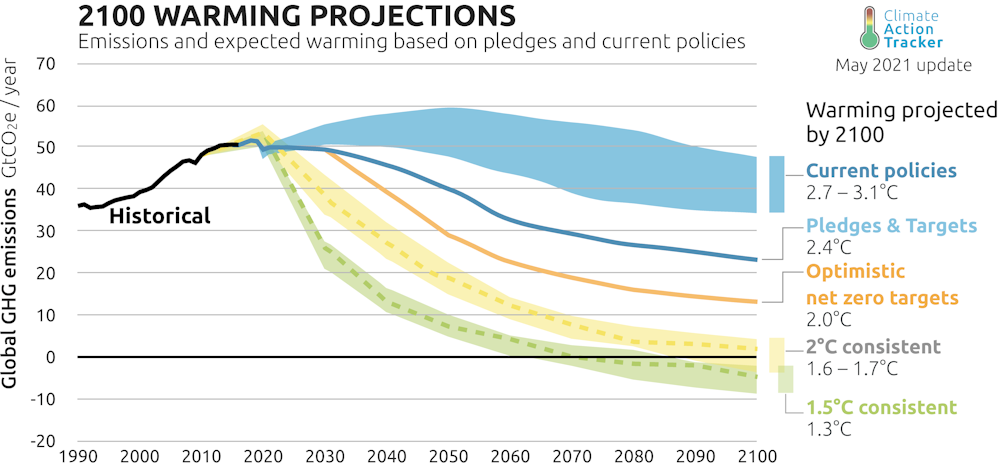
In 2015, countries around the world agreed to limit global warming to well under 2 degrees Celsius (3.6 F) compared with preindustrial times, with a goal of 1.5 C (2.7 F). To keep warming under 1.5 C with the least disruption, the United Nations says the world needs to be on a path to reach net-zero emissions by about 2050. To put those temperatures into perspective, global warming today is just over 1 C (1.8 F) above preindustrial levels, and rising seas and extreme weather are already a problem.

Several countries, including the United States, have pledged to meet the goal of net-zero emissions by 2050. But when the U.N. analyzed each country’s commitments under the Paris Agreement in mid-September, it found they still fall short by so much that even if every pledge is met, temperatures will rise about 2.7 C (4.86 F) this century.


Keeping global warming to 1.5 C will require negative greenhouse gas emissions. 


How a company gets to net-zero emissions

To see how a company might get to net-zero emissions, let’s imagine a hypothetical company, ChipCo, that makes, packages and distributes potato chips. ChipCo purchases electricity from a local utility to run machinery at its factory. It also has boilers to generate steam to heat the building and for some production processes. And it uses delivery trucks to transport its products to customers. Each step generates greenhouse gas emissions.

To achieve net-zero emissions, ChipCo’s first step is to ramp up energy efficiency. Improvements in insulation and equipment can reduce the amount of energy needed or wasted. A simple example is switching out incandescent light bulbs that use 60 watts of energy with LED bulbs that give off the same brightness, yet consume only 8 watts.

The second step is to switch from fossil fuels – the leading source of human-caused greenhouse gas emissions – to renewable energy, such as solar or wind power, that doesn’t produce greenhouse gas emissions. Once the company’s electricity is renewable, using electric delivery vehicles further cuts emissions.

Homes and office buildings can also be built to net-zero, or carbon-neutral, standards. In that case, the focus is on making them extremely energy-efficient and relying on heating and electricity from clean energy sources.


ChipCo’s third step is finding negative emissions. It might be too expensive or not yet technologically possible for it to replace its steam boiler with a carbon-neutral product. Instead, ChipCo might purchase carbon credits that would remove the same amount of carbon from the atmosphere that would be generated by the boiler.

Companies are increasingly under pressure from governments, activists and their customers, as well as some powerful investors, to cut their emissions.

To tell if a company is taking its responsibilities seriously, look for its action plan and performance so far. A company that announces a net-zero target of 2030 can’t wait until 2029 to take action. There needs to be a consistent trajectory of improvements in energy efficiency and clean energy, not just promises and carbon offsets.

Over 200 companies pledge net-zero emissions by 2040 as pressure on private sector mounts

The announcement comes in the wake of a dire warning from a UN climate panel.


ByCatherine Thorbecke
20 September 2021, 

Paul Morigi/Getty Images
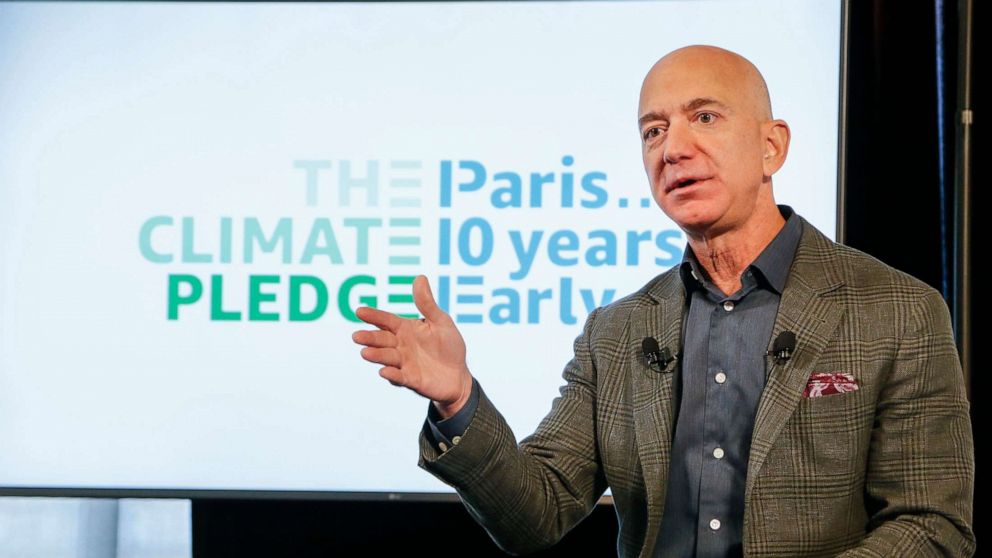
Amazon CEO Jeff Bezos announces the co-founding of The Climate Pledge at the National Press.

Proctor & Gamble latest to join Amazon’s climate pledge

The Climate Pledge now totals 201 companies, who employ more than 7 million people worldwide.

Nearly 90 new companies -- including multinational corporate giant Procter & Gamble, tech behemoth HP and cloud-computing titan Salesforce -- have signed onto the Climate Pledge, an Amazon-backed initiative that asks firms to commit to achieving net-zero carbon emissions by 2040.

Organizers of the Climate Pledge announced Monday a total of 86 new signatories, bringing the total number of companies involved to 201. The new commitments come as the United Nations General Assembly kicks off in New York City, with climate change talks expected to take center stage among the high-profile meeting of world leaders.

MORE: 'Unequivocal' that human influence has warmed the planet, UN climate panel finds

It also comes in the wake of a recent report from a U.N. panel -- that U.N. Secretary-General António Guterres called a "code red for humanity" -- warning of dire environmental consequences if immediate action is not taken to cut back greenhouse gas emissions


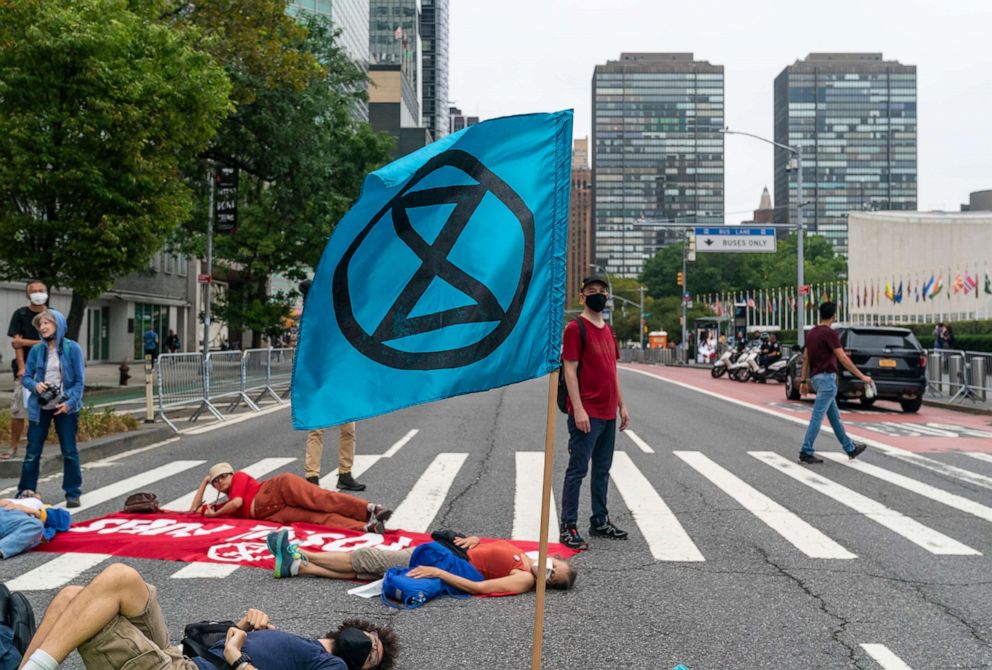
LightRocket via Getty Images
Members of Extinction Rebellion stage protest against companies supporting oil, gas and 
minera...

ASOS, Nespresso and Selfridges are among some of the other household names who joined the pledge Monday. Altogether, pledge signatories employ more than 7 million employees across 26 industries in 21 countries.

"I believe that now, more than ever, companies like Amazon have an obligation to lead the fight for our planet," Andy Jassy, Amazon's CEO, said in a statement Monday.

"But, solving this challenge cannot be accomplished by one company; it requires all of us to act together, and it’s one of the reasons we’re so excited to announce that more than 200 businesses have joined us in signing The Climate Pledge -- a commitment to reach the goals of the Paris Agreement 10 years early," Jassy added.


David S. Taylor, Procter & Gamble's CEO and president, echoed Jassy's sentiments in a separate statement, saying that addressing climate change effectively, "requires collaboration across industries and credible science-based actions."

"P&G has made significant progress over the past decade and we know we must do more," Taylor added. "The task ahead is urgent, difficult, and much bigger than any single company can solve alone. P&G is proud to join The Climate Pledge as we work together to preserve our shared home for generations to come."


Bloomberg via Getty Images, FILE
Proctor & Gamble Co. headquarters stands in downtown Cincinnati, Ohio, Aug. 19, 2014.

If all of the firms followed through on their promise, they would collectively mitigate some 1.98 billion metric tons of carbon emissions by 2040, according to an estimate from initiative organizers, or 5.4% of the current global annual emissions.

The firms have committed to measuring and reporting their greenhouse gas emissions on a regular basis, implement decarbonization strategies in line with the Paris Agreement's goalposts, and neutralize any remaining emissions with additional and quantifiable offsets.
MORE: Citing human rights risks, UN calls for ban on certain AI tech until safeguards are set up

report issued last month by a U.N. panel that warned that the impacts of human-caused climate change are severe and widespread -- and that while there is still a chance to limit that warming, some impacts will continue to be felt for centuries.

The report from the U.N.'s Intergovernmental Panel on Climate Change called for "immediate, rapid and large-scale reductions in greenhouse gas emissions" in order to limit future warming to 2 degrees Celsius over pre-industrial levels, as is the goal of the Paris Agreement by 2050. The report also warned that unless greenhouse gas emissions are drastically reduced, the world will exceed 1.5 degrees of warming in the next 20 years.

When calling the report a "code red," U.N. Secretary-General António Guterres added that, "The alarm bells are deafening, and the evidence is irrefutable: greenhouse‑gas emissions from fossil-fuel burning and deforestation are choking our planet and putting billions of people at immediate risk."
..
Jeff Bezos, Amazon's then-CEO, announced the Climate Pledge and the company's plan to commit to net-zero carbon emissions by 2040 -- a decade ahead of the international Paris Agreement -- in 2019. At the time, Bezos said that if Amazon "can meet the Paris Agreement 10 years early, then any company can."

MORE: Young people experiencing 'widespread' psychological distress over government handling of looming climate crisis, researchers say

Christiana Figueres, the U.N.’s former climate chief and now founding partner of Global Optimism -- the advocacy group spearheading the Climate Pledge with Amazon -- said in a statement Monday that the IPCC report is the starkest warning yet that "the window of time to act decisively is narrowing."

"This wake-up call from science must be faced with courage and conviction," she added. "In this light, it’s encouraging that 86 more companies -- some of the largest household names in the world -- are now joining The Climate Pledge, committing to accelerate their actions to tackle climate change in a timely fashion, and playing their part in building a low-carbon economy."

The private sector has faced immense pressure from consumers and even shareholders in recent years to address climate change. "Industry" accounted for a whopping 23% of greenhouse gas emissions in 2019, according to the U.S. Environmental Protection Agency, behind only transportation (29%) and electricity production (25%) -- data some advocates say highlights the need for large-scale industry changes vs. putting the onus to tackle climate change solely on individuals.


HP, Procter & Gamble join companies pledge to cut emissions

Mon., September 20, 2021, 


BERLIN (AP) — Computer-maker HP, consumer goods business Procter & Gamble and coffee capsule company Nespresso have joined a corporate pledge to sharply cut their greenhouse gas emissions over nearly two decades.

The Climate Pledge, a grouping of companies and organizations spearheaded by Amazon, said Monday that it has signed up 86 new members for its voluntary measures. In total, the group now has 201 members with global annual revenues of more than $1.8 trillion, it said.

Other new members include telecoms company BT, truck-maker Scania and the Selfridges department store chain.

Together, the companies aim to cut almost 2 billion metric tons of carbon dioxide by 2040 — more than 5% of the current global total.

While the group's members are encouraged to eliminate as many emissions as possible, those that can't be avoided need to be completely offset in the next two decades. That means paying for measures to ensure as many emissions are absorbed by then as the companies continue to emit.

Scientists say the world needs to achieve ‘net zero’ emissions by 2050 if it wants to meet the Paris climate accord's goal of keeping temperatures from rising more than 1.5 degrees Celsius (2.7 degrees Fahrenheit) by the end of the century compared to pre-industrial times.

Kat Kramer, head of climate policy at the anti-poverty campaign group Christian Aid, welcomed the decision by big players in the private sector to aim for net zero emissions.

But she urged the focus to be on cutting as many emissions as possible in the coming decade, rather than focus on unproven technology to remove the carbon once it's in the atmosphere.

'MAYBE' TECH

Here's the best 'moonshot' 

green tech, according to 

Bank of America

·Assistant Editor

Emerging green technologies could benefit a number of sectors and be instrumental in achieving global net-zero emissions, a goal that top U.S. climate envoy John Kerry said would be the greatest market transformation “since the Industrial Revolution.”

These green tech innovations — which include carbon capture & storage (CCS), nextgen batteries, green mining, and ocean tech — were part of the 14 "moonshot" technologies laid out in a recent Bank of America note. 

Other technologies consisted of 6G, brain computer interface, emotional artificial intelligence (AI), synthetic biology, immortality, bionic humans, eVTOL, wireless electricity, holograms, and the metaverse. In all, these technologies represent a market size of over $6 trillion by 2030, according to BofA

14 moonshot technologies for the future. (Source: BofA Global Research)

The researchers emphasized the accelerating pace of innovation and underscored how a few major disruptors have driven long-term trends in the last three decades. Just 1.5% of all stocks have created all net wealth since 1990, the report noted.

To bring any one of these future tech ideas to mainstream use requires innovation, adoption, and government support. The inverse of this is that the largest risks to these technologies are delayed scientific and technological development, prohibitive costs, and government regulation that limits their applicability.

Carbon capture and storage 

Carbon capture and storage (CCS) reached a major milestone recently when the world's largest facility for removing carbon directly from the air began operating in Iceland.

CCS will likely play a pivotal role in drawing down greenhouse gas emissions. In fact, the U.N.'s body for assessing climate change uses carbon capture in all of its modeled pathways to limit global warming to 1.5°C. Nations that continue to fall short of their climate targets early on may need to rely increasingly on carbon removal in the second half of the century. 

By 2030, according to the BofA report, "annual capex for CCS could reach approximately $25 billion or equivalent of $100 billion of cumulative investments. By 2040/2050, there could be $1 trillion in cumulative investments." 

The Climeworks Orca carbon removal plant opened on September 8, 2021, in Hellisheidi, Iceland (Photo: Climeworks)

For the past 40 years, post-combustion carbon capture has been the most widely used carbon removal technology. But filtering out carbon dioxide from the atmosphere after it has been emitted has proven to be far more costly and energy-intensive than preemptively reducing emissions through renewable energy sources, which has made the technology somewhat controversial.

Here's how it works: At emission sources, such as power plants or steel-making plants, gases from combustion pass by a chemical solution that selectively filters out carbon dioxide before it reaches the atmosphere. When the chemical sponge is saturated, the application of heat releases and compresses the carbon dioxide into a liquid where it can be stored, oftentimes deep underground in saline aquifers or depleted oil reservoirs. And after collecting up to 90% of carbon dioxide from power and industrial plants, alternative uses for carbon dioxide are being developed, such as fuel, fertilizer, enhanced oil recovery, and even carbonating beverages.

The upside of carbon capture and storage as a climate solution and market opportunity is that it has bipartisan policy support. Sen. Joe Manchin (D-WV), a key vote needed to pass the bipartisan infrastructure and $3.5 trillion reconciliation bills, expressed support for CCS. And proposals to expand tax credits and financing for CCS have already passed the Senate as part of the infrastructure plan.

Additionally, CCS has received significant buy-in from major oil companies like ExxonMobil (XOM) that face pressure to transform their businesses away from fossil fuels. 

That said, an over-reliance on CCS risks negating emissions reductions should it give fossil fuel companies license to continue pouring planet-warming emissions into the air with coal, oil, and gas projects.

Sen. Joe Manchin speaks to an aide as he walks out of a Democratic policy luncheon in Washington, Tuesday, Sept. 14, 2021. (AP Photo/Andrew Harnik)

Nextgen batteries 

In the short run, battery improvements could increase "utility and applicability" for consumer electronics and mobility, BofA analysts noted, and in the long run, utility-scale batteries could meet higher power and longer duration needs to power entire energy grids.

Although promises of battery breakthroughs have fizzled in the past, "rising demand, investment and the urgent need to meet climate action goals could accelerate feedback loops between cost reduction, energy density improvement and better-value propositions," the report noted.

An Xcel Energy representative checks over chargers for EVs on display in the Xcel exhibit at the Denver auto show Friday, Sept. 17, 2021 in Colorado. (AP Photo/David Zalubowski)

The key innovations for the next generation of battery technology involve advanced lithium-ion chemistry, material switching, solid-state batteries, batteries as structures, supercapacitors, and large-scale future energy storage. Solving challenges that current batteries face in one area, like longevity, often comes with trade-offs in other areas, like weight or size.

The growing adoption of electric vehicles, in particular, has generated demand for battery improvements, especially for lithium-ion batteries. The demand for EV batteries, for instance, is set to grow 28 times 2020 levels by 2030, according to the BofA APAC EV Battery Team, and the market size for EV batteries is expected to grow from $21 billion in 2020 to $354 billion by 2030.

In addition to advancing battery performance, scientists and engineers are working to find ways to make batteries with more abundant materials or to recycle metals in order to reduce the destructive environmental impacts of mining. 

Battery technologies that are being developed. (Source: BofA Global Research)

Electric vehicles and their batteries require more minerals than their combustion engine counterparts, and the demand for rare minerals will increase with growth of EV market share. For instance, between 2020 and 2040, the International Energy Agency expects demand for nickel and lithium to grow by 40 times. 

Green mining

Advances in green mining aim to facilitate the production of batteries and other future tech that will enable the green transition. As the BofA analysts wrote, “shifting from a carbon-intensive economy means becoming a metal-intensive one.”

Yet, when it comes to mining the massive amounts of raw materials needed, the environmental costs and costs to the communities near mining operations cannot be ignored. This has led to a search for alternative means of extracting metals and minerals, from deep sea mining, agromining, wastewater mining, and asteroid mining.

Overall, the green mining market size could be worth $12.9 billion by 2024, according to Bloomberg and MarketsandMarkets estimates. (The market size in 2019 was $9 billion.)

Phyllantus balgooyi phloem green sap is rich in nickel. (Photo: Antony van der Ent)

The extent to which deep sea mining is truly 'green' remains up for debate. Scientists and conservationists have opposed deep sea mining on the grounds that it simply externalizes the environmental costs to the ocean and marine life.

Many of the other mining technologies are in the very early phases of research. Small-scale pilot sites in Malaysia have begun testing the efficacy of agromining, for example, which promises to grow metals on trees. Agromining harnesses certain plants' innate ability to soak up high concentrations of minerals from the soil.

Other nascent green mining technologies like wastewater mining are developing ways to extract lithium from briny wastewater discharged from desalinization plants. Currently, the process can take up to two years and yields less than 50% of the lithium from brines. 

And if robots mining faraway asteroids for minerals seems far-fetched, that hasn’t stopped NASA and a burgeoning deep space industry from exploring how to mine the asteroid belt, which has an estimated mineral wealth amount of $700 quintillion, according to the BofA report. However, as with anything space-related, this comes with enormous investment to retrieve and return minerals.

Gerard Barron, Chairman and CEO of The Metals Company, holds a nodule brought up from the sea floor, San Diego, June 8, 2021 (Carolyn Cole / Los Angeles Times via Getty Images)

Ocean tech

The world's oceans support numerous industries and jobs. And when it comes to renewable energy, “oceans are the world’s largest untapped source of energy,” BofA noted.

As the population grows worldwide, so too will the demand for the ocean’s resources. The output of the blue economy could reach $3 trillion by 2030, or the equivalent of Germany’s economy in 2010, according to BofA.

However, marine systems will continue to be stressed by climate change, which could impact the development of ocean industries and create feedback loops of worsening weather effects. That's why ocean tech focuses on preserving ocean health as a key priority for new technology and products.

One problem that ocean tech hopes to solve is feeding the growing population. By 2030, the world’s consumption of fish is expected to increase by 18% compared to 2018 levels. Developments in marine aquaculture — the farming of fish in the open ocean or on-shore tanks — could restore marine ecosystems while providing more sustainable seafood for consumption.

French oyster farmer Anne Marquet collects oysters bags at her oyster farm off the port of La Teste on December 1, 2020 in the bay of Arcachon. (Photo by PHILIPPE LOPEZ/AFP via Getty)

Some marine aquaculture startups have not only developed ways of farming seaweed and shellfish, they are researching ways to create new markets for these products beyond health foods for climatarians. For instance, biodegradable seaweed packaging may come to replace plastic packaging.

Another ocean tech industry, precision fishing, uses advanced analytics to observe and measure the oceans to avoid overfishing. The BofA analysts stated that the use of these tools can help provide six times more food in a sustainable manner, “so we can have our fish and eat them too.”

Companies such as Google (GOOG) and Microsoft (MSFT) have already begun investing in ocean analytics and surveillance.

And the oceans could be a core source of renewable energy as new technologies unlock the energy potential behind tides, currents, waves, solar, salinity, thermal energy, and winds. Europe has been at the forefront of off-shore renewable installation, according to IRENA, with 70% of the world's offshore capacity located in the North Sea and Atlantic Ocean. 

And ocean renewable energy projects are likely to see a boost from more ambitious climate targets, as is the case with the EU Green Deal, which aims for 60 GW of offshore wind capacity by 2030 and 300 GW by 2050.

Grace is an assistant editor for Yahoo Finance and a UX writer for Yahoo products.