It’s possible that I shall make an ass of myself. But in that case one can always get out of it with a little dialectic. I have, of course, so worded my proposition as to be right either way (K.Marx, Letter to F.Engels on the Indian Mutiny)
Thursday, December 16, 2021
Deepest Ever Images of Our Galaxy Show Stars Dancing Around Supermassive Black Hole
Astronomers have made the most precise measurements of the stars that orbit the supermassive black hole at the heart of our galaxy to date.
Observing the stellar dance at the heart of the Milky Way has shown astronomers that 99.9 percent of the mass located there is possessed by the central black hole, named Sagittarius A* (Sgr A*), with just 0.1 percent attributed to stars, gas, and dust, dark matter and smaller black holes.
The team used cutting-edge astronomical equipment to measure the movement of four stars in the immediate vicinity of Sgr A*—S2, S29, S38, and S55—revealing details of the mass distribution at the center of the Milky Way.
The galactic center of the Milky Way, around 27,000 light-years from the solar system, contains a mass of at least 4.3 million times that of the sun, but until now astronomers have struggled to determine how much of this mass belonged to Sgr A*. That's because the galactic center is packed with a wealth of other cosmic objects and dense clouds of gas and dust.
"With the 2020 Nobel prize in physics awarded for the confirmation that Sgr A* is indeed a black hole, we now want to go further, We would like to understand whether there is anything else hidden at the center of the Milky Way and whether general relativity is indeed the correct theory of gravity in this extreme laboratory," Stefan Gillessen from the Max-Planck-Institute for Extraterrestrial Physics said. "The most straightforward way to answer that question is to closely follow the orbits of stars passing close to Sgr A*."
Gillessen is one of the authors of a paper set to publish in the journal Astronomy & Astrophysics detailing the team's work.
The researchers took advantage of a phenomenon predicted by Einstein's theory of general relativity, the most precise theory we have to describe gravity and therefore the orbits of moons, planets, and stars.
Video: Scientists Hurl Stars At Black Holes To See Who Survives In Incredible Simulation (Newsweek)
According to general relativity, orbits change their orientation over time tracing out a rosette-like pattern, a process called Schwarzschild precession. The astronomers traced out the rosette created by S2, S29, S38, and S55 by mapping their position and velocity.
To measure the velocities of the stars, the astronomers used spectroscopy from the Gemini Near-Infrared Spectrograph (GNIRS) at Gemini North near the summit of Maunakea in Hawai'i, and the SINFONI instrument on the European Southern Observatory's Very Large Telescope. The positions of the stars were measured with the GRAVITY instrument at the VLTI.
A diagram of stars dancing around the supermassive black hole at the heart of the Milky Way. GRAVITY collaboration/ESO
Detailing how these stars moved around Sgr A* and measuring the tiny variations in their orbits allowed the researchers to determine how mass was distributed in this region.
They found that mass within the orbit of the star S2 contributes only 0.1 percent of the total mass at the center of the Milky Way, leaving the other 99.9 percent owing to Sgr A*.
Measuring such tiny changes in the orbits of distant stars is no easy feat and a deeper investigation may have to wait until telescope technology improves.
"We will improve our sensitivity even further in future, allowing us to track even fainter objects," Gillessen concluded. "We hope to detect more than we see now, giving us a unique and unambiguous way to measure the rotation of the black hole."
An illustration showing stars close orbit around the supermassive black hole that dwells at the heart of the Milky Way, known as Sagittarius A* (Sgr A*). Astronomers have observed the dance of these stars in closer detail than ever before.
International Gemini Observatory/NOIRLab/NSF/AURA/J. da Silva/Spaceengine) Acknowledgement: M. Zamani (NSF's NOIRLab/NSF
Scientists say dark matter seems to be missing from the galaxy AGC 114905. Even after 40 hours of detailed measurements with state-of-the-art telescopes, they were unable to detect the presence of the elusive invisible matter that keep galaxies together. In this image, starlight is blue, and the green clouds are neutral hydrogen gas. Image via Javier Román/ Pavel Mancera Piña/ Royal Astronomical Society.
Dark matter is integral to modern cosmology, the science of our universe over time. Astronomers think that galaxies – the great star islands that are the building blocks of our universe – start to form due to accumulations of dark matter. So dark matter is thought to pervade our universe. That’s why, in 2019, after an international team of astronomers found six galaxies with no dark matter, colleagues told them to measure again and they’d find it. And measure they did. For example, they spent 40 hours examining galaxy AGC 114905 with the state-of-the-art Very Large Array observatory in New Mexico. But, still, there was no sign of dark matter. What does it mean? No one knows.
The team announced their confirmation of the dark-matter-free galaxy on December 6, 2021.
The researchers submitted their findings to the peer-reviewed journal Monthly Notices of the Royal Astronomical Society, which accepted it for publication on November 30, 2021. The preprint is available at arXiv.
A galaxy without dark matter
Galaxy AGC 114905 lies 250 million light-years away. Although it’s similar in size to our own Milky Way galaxy, AGC 114905 earns the classification of ultra-diffuse dwarf galaxy. This is because of how dim it is, with a thousand times fewer stars than our Milky Way galaxy.
When astronomers took their observations, made between July and October of 2020, and mapped them, they confirmed earlier observations. They plotted the rotational speed of the gas – how fast the gas moves around the center of the galaxy – at different distances from the center of the galaxy in a graph. This kind of graph is called a rotation curve. For nearly every galaxy measured in the universe, its rotation curve reveals a need for the presence of dark matter, matter that keeps the galaxy together even though its gas rotates “too fast” in the outer regions. But in AGC 114905, no dark matter is necessary to explain the motions of the gas.
Pavel Mancera Piña of University of Groningen and ASTRON, the Netherlands, said:
This is, of course, what we thought and hoped for because it confirms our previous measurements. But now the problem remains that the theory predicts that there must be dark matter in AGC 114905, but our observations say there isn’t. In fact, the difference between theory and observation is only getting bigger.
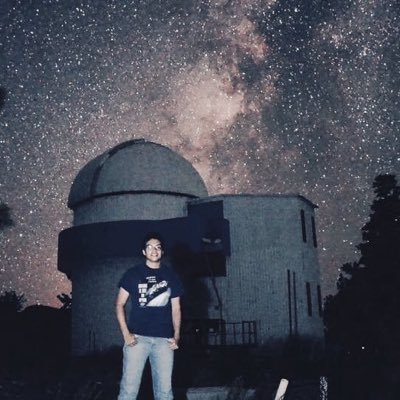
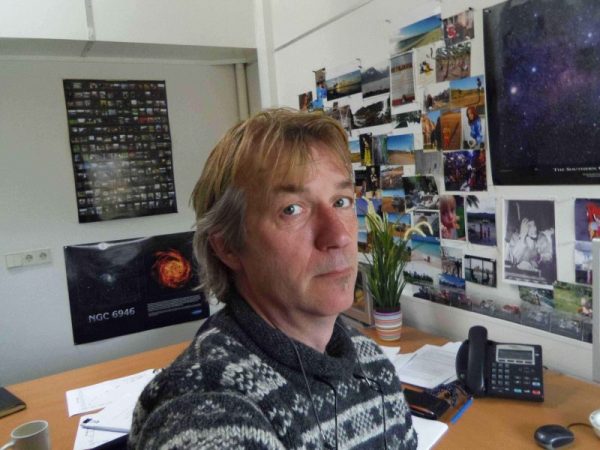
Paper co-author Pavel Mancera Piña. Image via Twitter.
Why doesn’t the galaxy have dark matter?
So why doesn’t AGC 114905 show any evidence of dark matter? One explanation could be that a large galaxy nearby stripped away the dark matter from the ultra-diffuse dwarf galaxy. Only there’s a problem with the nearby large galaxy theory, Piña explained:
There are none. And in the most reputed galaxy formation framework, the so called cold dark matter model, we would have to introduce extreme parameter values that are far beyond the usual range. Also with modified Newtonian dynamics, an alternative theory to cold dark matter, we cannot reproduce the motions of the gas within the galaxy.
The answer to the missing dark matter isn’t a nearby galaxy, and AGC 114905 doesn’t fit the two models that explain the formation of structures in the universe. There is one more possible explanation. If the angle at which they believe they are viewing the galaxy is not accurate, it could skew the results. Tom Oosterloo of University of Groningen and ASTRON, the Netherlands, said:
But that angle has to deviate very much from our estimate before there is room for dark matter again.
The team is going back to the original batch of six galaxies that showed no dark matter and are choosing another one to analyze. If it, too, continues to reveal no traces of dark matter, it will make their case even stronger.
Astronomers have previously discovered galaxies without hints of dark matter, though these objects remain rare anomalies.
Bottom line: Astronomers completed a 40-hour long observation of an ultra-diffuse dwarf galaxy and discovered no traces of dark matter.
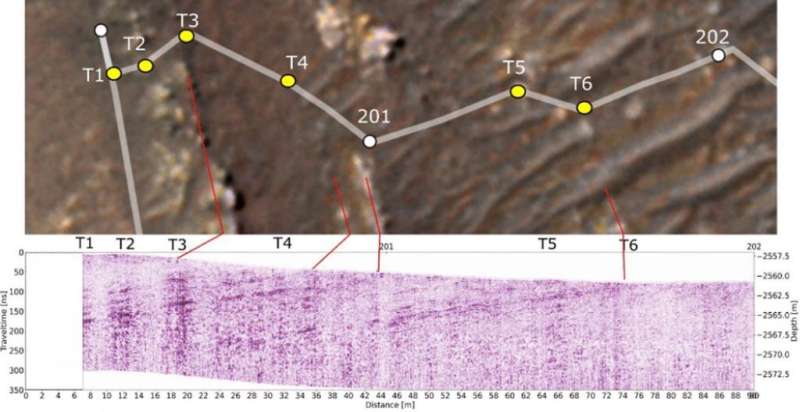
This graphic depicts Perseverance's entry into "Séítah" from both an orbital and subsurface perspective. The lower image is a subsurface "radargram" from the rover's RIMFAX instrument; the red lines indicate link subsurface features to erosion-resistant rocky outcrops visible above the surface. Credit: NASA/JPL-Caltech/University of Arizona/USGS/FFI
Scientists with NASA's Perseverance Mars rover mission have discovered that the bedrock their six-wheeled explorer has been driving on since landing in February likely formed from red-hot magma. The discovery has implications for understanding and accurately dating critical events in the history of Jezero Crater—as well as the rest of the planet.
The team has also concluded that rocks in the crater have interacted with water multiple times over the eons and that some contain organic molecules.
These and other findings were presented today during a news briefing at the American Geophysical Union fall science meeting in New Orleans.
Even before Perseverance touched down on Mars, the mission's science team had wondered about the origin of the rocks in the area. Were they sedimentary—the compressed accumulation of mineral particles possibly carried to the location by an ancient river system? Or where they igneous, possibly born in lava flows rising to the surface from a now long-extinct Martian volcano?
"I was beginning to despair we would never find the answer," said Perseverance Project Scientist Ken Farley of Caltech in Pasadena. "But then our PIXL instrument got a good look at the abraded patch of a rock from the area nicknamed "South Séítah," and it all became clear: The crystals within the rock provided the smoking gun."
The drill at the end of Perseverance's robotic arm can abrade, or grind, rock surfaces to allow other instruments such as PIXL to study them. Short for Planetary Instrument for X-ray Lithochemistry, PIXL uses X-ray fluorescence to map the elemental composition of rocks. On Nov. 12, PIXL analyzed a South Séítah rock the science team had chosen to take a core sample from using the rover's drill. The PIXL data showed the rock, nicknamed "Brac," to be composed of an unusual abundance of large olivine crystals engulfed in pyroxene crystals.
"A good geology student will tell you that such a texture indicates the rock formed when crystals grew and settled in a slowly cooling magma—for example a thick lava flow, lava lake, or magma chamber," said Farley. "The rock was then altered by water several times, making it a treasure trove that will allow future scientists to date events in Jezero, better understand the period in which water was more common on its surface, and reveal the early history of the planet. Mars Sample Return is going to have great stuff to choose from."
The multi-mission Mars Sample Return campaign began with Perseverance, which is collecting Martian rock samples in search of ancient microscopic life. Of Perseverance's 43 sample tubes, six have been sealed to date—four with rock cores, one with Martian atmosphere, and one that contained "witness" material to observe any contamination the rover might have brought from Earth. Mars Sample Return seeks to bring select tubes back to Earth, where generations of scientists will be able to study them with powerful lab equipment far too large to send to Mars.
Still to be determined is whether the olivine-rich rock formed in a thick lava lake cooling on the surface or in a subterranean chamber that was later exposed by erosion.
Taken by Perseverance’s Mastcam-Z instrument, this video features an enhanced-color composite image that pans across Jezero Crater’s delta on Mars. The delta formed billions of years ago from sediment an ancient river carried to the mouth of a lake that once existed in the crater. Credit: NASA/JPL-Caltech/ASU/MSSS
Organic molecules
Also great news for Mars Sample Return is the discovery of organic compounds by the SHERLOC (Scanning Habitable Environments with Raman & Luminescence for Organics & Chemicals) instrument. The carbon-containing molecules are not only in the interiors of abraded rocks SHERLOC analyzed, but in the dust on non-abraded rock.
Confirmation of organics is not a confirmation that life once existed in Jezero and left telltale signs (biosignatures). There are both biological and non-biological mechanisms that create organics.
"Curiosity also discovered organics at its landing site within Gale Crater," said Luther Beegle, SHERLOC principal investigator at NASA's Jet Propulsion Laboratory in Southern California. "What SHERLOC adds to the story is its capability to map the spatial distribution of organics inside rocks and relate those organics to minerals found there. This helps us understand the environment in which the organics formed. More analysis needs to be done to determine the method of production for the identified organics."
The preservation of organics inside ancient rocks—regardless of origin—at both Gale and Jezero Craters does mean that potential biosignatures (signs of life, whether past or present) could be preserved, too. "This is a question that may not be solved until the samples are returned to Earth, but the preservation of organics is very exciting. When these samples are returned to Earth, they will be a source of scientific inquiry and discovery for many years," Beegle said.
Six facsimile sample tubes hang on the sample tube board. Credit: NASA/JPL-Caltech
'Radargram'
Along with its rock-core sampling capabilities, Perseverance has brought the first ground-penetrating radar to the surface of Mars. RIMFAX (Radar Imager for Mars' Subsurface Experiment) creates a "radargram" of subsurface features up to about 33 feet (10 meters) deep. Data for this first released radargram was collected as the rover drove across a ridgeline from the "Crater Floor Fractured Rough" geologic unit into the Séítah geologic unit.
The ridgeline has multiple rock formations with a visible downward tilt. With RIMFAX data, Perseverance scientists now know that these angled rock layers continue at the same angle well below the surface. The radargram also shows the Séítah rock layers project below those of Crater Floor Fractured Rough. The results further confirm the science team's belief that the creation of Séítah preceded Crater Floor Fractured Rough. The ability to observe geologic features even below the surface adds a new dimension to the team's geologic mapping capabilities at Mars.Rocks on floor of Jezero Crater, Mars, show signs of sustained interactions with water
More information:For more about Perseverance: mars.nasa.gov/mars2020/ and nasa.gov/perseverance
Lava once flowed at the site of an ancient lake on Mars.
The Perseverance rover landed on the planet just 10 months ago, but it has already made that surprising discovery.
The rover's latest finding suggests that the bedrock it has been driving over since landing was once formed by volcanic lava flows -- something that was "completely unexpected," according to mission scientists. Previously, they thought the layered rocks Perseverance took photos of were sedimentary.
The rocks that Perseverance has sampled so far also revealed that they interacted with water multiple times, and some of them include organic molecules.
These discoveries could help scientists create an accurate timeline for the events that have taken place in Jezero Crater, the site of an ancient lake, and has wider implications for understanding Mars.
The finding was announced Wednesday during the American Geophysical Union Fall Meeting in New Orleans.
For years, scientists have questioned if the rock in this crater was sedimentary rock, comprised of layers of material deposited by an ancient river, or igneous rock, which forms when lava flows cool.
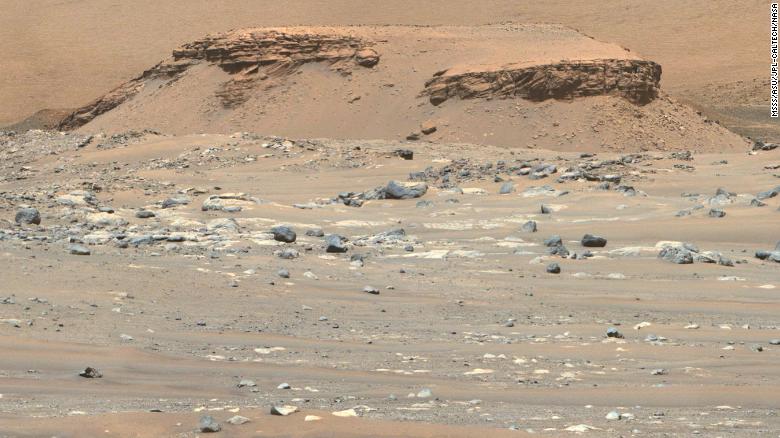
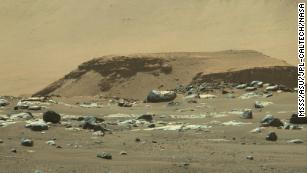
Perseverance took this photo of Jezero Crater in April. The flat-topped hill, named Kodiak, has ancient layered rocks.
"I was beginning to despair we would never find the answer," said Ken Farley, Perseverance project scientist at the California Institute of Technology in Pasadena, California, in a statement.
Everything changed when Perseverance began using a drill on the end of its robotic arm to scrape away at the surfaces of rocks.
"The crystals within the rock provided the smoking gun," Farley said.
Perseverance is armed with a suite of sophisticated instruments that can image and analyze these scraped rocks, revealing their composition and mineral content. Ones of these instruments is PIXL, or the Planetary Instrument for X-ray Lithochemistry.
In November, Perseverance used its instruments to study a rock, nicknamed "Brac" by the team. The analysis revealed large olivine crystals surrounded by pyroxene crystals, both of which pointed to the fact that the rock came from volcanic lava flows.
"A good geology student will tell you that such a texture indicates the rock formed when crystals grew and settled in a slowly cooling magma -- for example a thick lava flow, lava lake, or magma chamber," Farley said.
"The rock was then altered by water several times, making it a treasure trove that will allow future scientists to date events in Jezero, better understand the period in which water was more common on its surface, and reveal the early history of the planet. Mars Sample Return is going to have great stuff to choose from."
Now, the team wants to know if the rocks containing olivine were formed by a cooling lake of lava, or if they originated from a subsurface chamber of lava that was later exposed due to erosion.
"This was completely unexpected, and we are struggling to understand what it means," Farley said. "But I will speculate that this is not likely the original crater floor. From the diameter of this crater, we expect the original crater floor is significantly deeper than where we are right now."
It's possible that lava flowed down into the crater, he said, but the original crater floor is below the rock they are driving over now.
Bringing back samples
So far, Perseverance has collected four rock samples with plans to collect up to 37 more. These samples will be returned to Earth by future missions, which will enable them to be studied in great detail and a variety of ways. Samples from Jezero Crater and its river delta could reveal if life ever existed on Mars.
Once back on Earth, volcanic rocks can be dated with very high accuracy, so these latest samples could help the team establish more accurate dates for features and events on Mars.
These rocks interacted with water over time to create new minerals. The minerals within the samples can reveal what the climate and environment was like and even the composition of the water billions of years ago on the red planet.
"That will tell us whether or not the water that existed there was potentially habitable in the past," said Kelsey Moore, geobiologist and postdoctoral scholar research associate in planetary science at the California Institute of Technology.
The rover also detected organic molecules in the rock it sampled, using its SHERLOC instrument, or Scanning Habitable Environments with Raman & Luminescence for Organics & Chemicals.
The presence of organic molecules doesn't necessarily equal signs of past life, or biosignatures. Organics can be created biologically or abiotically -- a physical process that does not include living organisms.
The Curiosity rover, which landed on Mars in 2012, has also discovered organics within its landing site of Gale Crater. Now that Perseverance has detected them, too, "this helps us understand the environment in which the organics formed," said Luther Beegle, SHERLOC principal investigator at NASA's Jet Propulsion Laboratory in Pasadena, in a statement.
While more investigation is needed to determine how these organic molecules were created, their presence gives the science team hope. That's because it means that signs of past or present life could be preserved on Mars as well, if life ever existed there.
"When these samples are returned to Earth, they will be a source of scientific inquiry and discovery for many years," Beegle said.
And Perseverance has also been using its onboard ground-penetrating radar instrument, the first ever to be tested out on Mars. The Radar Imager for Mars' Subsurface Experiment, or RMFAX, was used to "to peek into the subsurface and determine the structure of a rock under our wheels," said Briony Horgan, associate professor of planetary science at Purdue University and a scientist on the rover mission.
The experiment was used as the rover drove across a ridgeline. The radar data revealed multiple rock formation with a downward tilt, which continue below the surface from the ridgeline itself. Instruments like RIMFAX can help scientists create a better geologic map of Mars to understand its history.
Investigating an ancient river
Perseverance had a banner year in 2021 and it will move on to even more intriguing territory next year: the ancient river delta.
This fan-shaped structure has intrigued scientists for years, and Farley said the rover will arrive at the delta in about six or eight months.
The rocks in the delta are most likely sedimentary, trapping and preserving precious layers of silt from the river that once flowed into the crater's lake. And the samples could reveal if organic molecules associated with signs of life, or even microfossils, could be hiding within the remains of the delta.
Astronomers Detect Secret Water Reserves in The Largest Canyon in The Solar System
A vast system of canyons that dramatically scars the face of Mars could be harboring reserves of hidden water.
An unusually high quantity of hydrogen has been detected in the heart of the 4,000 kilometers (2,485 miles) of canyons known as Valles Marineris, nicknamed the Grand Canyon of Mars. We know this thanks to new data from the ESA-Roscosmos ExoMars Trace Gas Orbiter's FREND instrument.
The finding suggests that, at depths up to a meter (three feet) below the surface, the soil in the region is rich in water, either bound up in minerals or as subsurface water ice, potentially offering a new way of locating the precious stuff on the apparently extremely arid world.
"With the Trace Gas Orbiter, we can look down to one meter below this dusty layer and see what's really going on below Mars's surface – and, crucially, locate water-rich 'oases' that couldn't be detected with previous instruments," said physicist Igor Mitrofanov of the Space Research Institute of the Russian Academy of Sciences in Russia; lead author of the new study.
"FREND revealed an area with an unusually large amount of hydrogen in the colossal Valles Marineris canyon system: Assuming the hydrogen we see is bound into water molecules, as much as 40 percent of the near-surface material in this region appears to be water."
We know there's water on Mars. We can see it, at the cold poles, bound up as ice. That's where most of it seems to be; at the equator, conditions are too warm for water ice to form at the surface.
It's possible that water can be found under the surface, but other previous searches by other Mars satellites only found it at higher latitudes.
Cue FREND, or the Fine Resolution Epithermal Neutron Detector. Rather than mapping light at the very surface of the red planet, FREND detects neutrons. This allows it to see the hydrogen content of Mars's soil up to a meter below the surface, the researchers said. Which, in observations taken between May 2018 and February 2021, it seems to have done.
"Neutrons are produced when highly energetic particles known as galactic cosmic rays strike Mars; drier soils emit more neutrons than wetter ones, and so we can deduce how much water is in a soil by looking at the neutrons it emits," said physicist Alexey Malakhov, also of the Space Research Institute of the Russian Academy of Sciences.
"We found a central part of Valles Marineris to be packed full of water – far more water than we expected. This is very much like Earth's permafrost regions, where water ice permanently persists under dry soil because of the constant low temperatures."
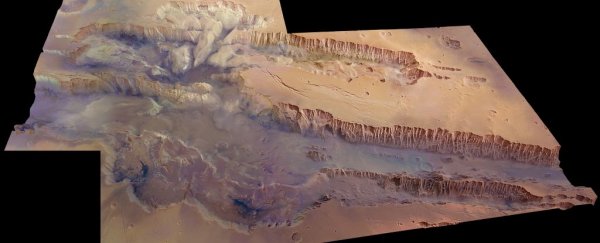
Viking orbiter mosaic showing Valles Marineris across the face of Mars. (NASA)
The high-hydrogen region is about the size of the Netherlands, and overlaps with Candor Chasma, one of the largest canyons in the Valles Marineris system. In this region of Mars, minerals typically contain very little water, so the researchers believe the substance is likely in the form of water ice below the surface.
But how that water could persist there is a mystery. Pressure and temperature conditions at the Mars equator ought to prohibit the formation of such water reserves. There may be some unknown combination of geomorphological conditions in Valles Marineris that allows it, such as patchy isolated deposits that have been there for some time, or the angle and orientation of steep slopes.
Further investigation will be needed to work out exactly what is going on – not just the conditions that allow for equatorial water on Mars, but to confirm what form that water takes. Doing so could be deeply rewarding: stores of water in a permafrost-like form may, just as we have found right here on Earth, have preserved frozen fragments of microbial life, or organic molecules that once existed on Mars.
The discovery also represents exciting possibilities for Mars exploration. Any crewed Mars mission is likely to set down near the equator; water that might be found not far beneath the surface would be an amazing asset, both for exploration purposes, and for the vital task of keeping water-reliant humans alive.
"This result really demonstrates the success of the joint ESA-Roscosmos ExoMars programme," said physicist Colin Wilson of the European Space Agency.
"Knowing more about how and where water exists on present-day Mars is essential to understand what happened to Mars's once-abundant water, and helps our search for habitable environments, possible signs of past life, and organic materials from Mars's earliest days."
A depiction of canyons (left), and Mars itself (right).1, 2
The Red Planet is hiding an appealing secret.
Scientists have discovered a world-historic discovery on Mars: "significant amounts of water" are hiding inside the Red Planet's Valles Marineris, its version of our grand canyon system, according to a recent press release from the European Space Agency (ESA).
And up to 40% of material near the surface of the canyon could be water molecules.
Mars' Valles Marineris canyon system is hiding water
The newly discovered volume of water is hiding under the surface of Mars, and was detected by the Trace Gas Orbiter, a mission in its first stage under the guidance of the ESA-Roscosmos project dubbed ExoMars. Signs of water were picked up by the orbiter's Fine Resolution Epithermal Neutron Detector (FREND) instrument, which is designed to survey the Red Planet's landscape and map the presence and concentration of hydrogen hiding in Mars' soil. It works like this: while high-energy cosmic rays plunge into the surface, the soil emits neutrons. And wet soil emits fewer neutrons than dry soil, which enables scientists to analyze and assess the water content of soil, hidden beneath its ancient surface. "FREND revealed an area with an unusually large amount of hydrogen in the colossal Valles Marineris canyon system: assuming the hydrogen we see is bound into water molecules, as much as 40% of the near-surface material in this region appears to be water," said Igor Mitrofanov, the Russian Academy of Science's lead investigator of the Space Research Institute, in the ESA press release.
Scientists have already discovered water on Mars, but most earlier discoveries detected the substance crucial to life as we know it near the poles of the Red Planet, subsisting as ice. Only very small pockets of water had shown up at lower latitudes, which was a big downer because future astronauts on Mars will need a lot of water, and there are better prospects for settling the planet at lower latitudes. But now, with what seems like a comparative abundance of water in Valles Marineris, we've taken a major step toward establishing a reliable source of water on the closest alien world.
Mars' canyon water could be liquid, ice, or a messy mix
"The reservoir is large, not too deep below ground, & could be easily exploitable for future explorers," read a tweet on the announcement from ExoMars. That sounds basically great! But it's too soon for Musk to pack up his bags and fly to the site, since much work is left to be done. A study accompanying the announcement, published in the journal Icarus, shows that neutron detection doesn't distinguish between ice and water molecules. This means geochemists need to enter the scientific fray to reveal more details. But several features of the canyon, including its topology, have led the researchers to speculate that the water is probably in solid form (ice). But it could also be a mixture of solid and liquid.
"We found a central part of Valles Marineris to be packed full of water — far more water than we expected," said Alexey Malakhov, co-author of the study, in the ESA release. "This is very much like Earth's permafrost regions, where water ice permanently persists under dry soil because of the constant low temperatures." So while we don't yet know the specific form of water is lying under Mars' vast system of canyons, the first human mission to Mars may consider exploring this area a major priority.
This was a breaking story and was regularly updated as new information became available.
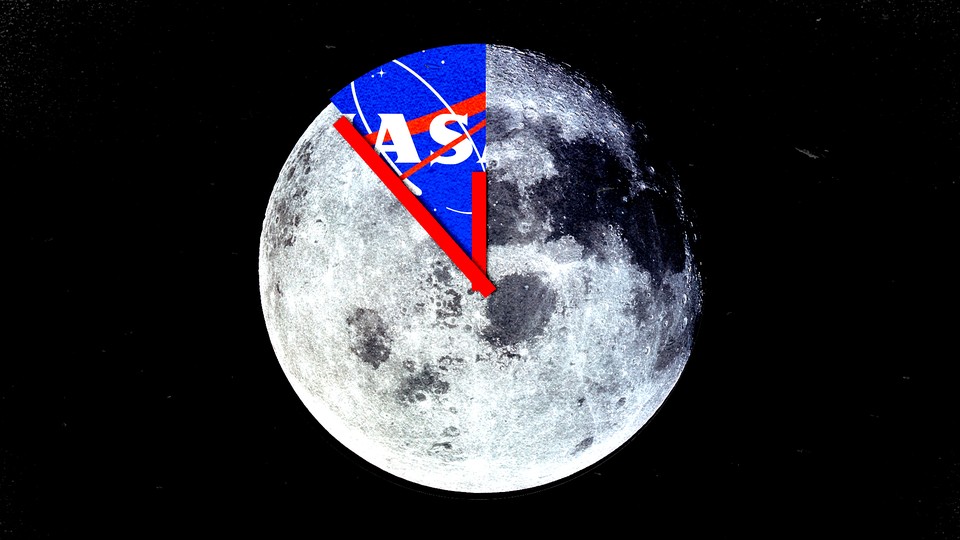
Why NASA Is Trying to Dodge the Moon
If the James Webb Space Telescope were to leave Earth at the wrong time, our very own satellite could thwart the mission.
The biggest, most powerful space telescope in history is currently sitting on top of a rocket in French Guiana, on the northeastern coast of South America, awaiting its blazing departure from this planet. The James Webb Space Telescope is designed to point its 18 gold-coated mirrors into the darkness and reveal hidden wonders in the universe. But its last few months on Earth have been a little stressful.
The Webb telescope arrived at its launch site in October unscathed after a days-long journey at sea. Yay! But then a hardware malfunction during launch prep jolted and shook the entire observatory, sparking fears that something inside might have been damaged. Yikes! Technicians checked out Webb and eventually deemed it fine, so they proceeded with fueling the observatory and hoisting it on top of its rocket. Great news! But now they’ve discovered a communications issue between the observatory and the rocket, which have to talk to each other in order to reach space. Oh no! It’s as if the entire astronomy community has piled into a car, and their driver, a $10 billion space telescope, keeps alternating between pressing the gas and hitting the brakes, determined to lurch all the way to their final destination.
The communications problem, which technicians were still troubleshooting as of this morning, has pushed Webb’s blastoff back a couple of days, to December 24. If new problems arise, the launch could be delayed again, to Christmas Day or sometime later in December. At this point, a reasonable observer might wonder whether the people in charge should just postpone the launch until January. Why not take a break, let everyone working on the mission enjoy the holidays, and then try again in the new year?
Well, if the schedule slips to January, program managers could run into a new kind of obstacle, one that no amount of troubleshooting can avoid: the moon. Our very own satellite, lovely and gray and minding its own business, could thwart the multibillion-dollar mission if the Webb telescope were to launch at the wrong time.
The Webb telescope is headed to a spot about a million miles from Earth, four times farther than the moon. To get there, it must follow a specific trajectory, nudging itself along the way with the help of its propulsion system. And during this journey, depending on where the moon is in its own orbit around Earth, our celestial companion can get in Webb’s way, explains Karen Richon, a flight-dynamics engineer at NASA’s Goddard Space Flight Center who has provided analyses on Webb’s launch trajectory for a decade. If the moon comes too close to Webb’s path, its gravity will tug on the observatory. “It either pulls us back, because it wants to try to capture us into orbit, or it gives some acceleration,” Richon told me.
Either effect could be bad news for the telescope. A tug backward would require Webb to expend more fuel than planned just to stay on track, which could, in the long run, shorten the observatory’s operational lifespan. A boost could be helpful, and even save Webb some fuel, but it could also send the observatory toward the wrong orbit altogether. The Webb telescope’s trajectory is so sensitive, Richon said, that, in addition to the moon, engineers even have to take into account the gravitational forces of the other planets in the solar system. If Webb struggles to reach its intended orbit, it risks becoming a very shiny, very expensive piece of space junk.
Richon and other engineers are prepared for some tiny deviations from their preferred trajectory. They’re planning to closely monitor where exactly the rocket deposits Webb in space, about a half hour after liftoff, and use the observatory’s thrusters to make adjustments as needed. But adding the moon to the mix would be a mess, which is why mission managers want to avoid it altogether. The moon becomes inconvenient once a month, and for December, the risk has already passed. But if Webb hasn’t launched by New Year’s Day, it’ll have just about a week to do so before the moon makes its move, closing the launch window sometime between January 9 and 13.
Richon says she is hopeful the telescope can find a good launch window before that deadline. But Webb can’t just lift off any old time in the next few weeks. The observatory can launch only during a certain time of day—morning in French Guiana. “We have at least 30 minutes every day through January 6,” Richon told me. Arianespace, the company that has provided the Ariane 5 rocket at the launch site in French Guiana, has vetoed the two following days, Richon said. And, after that, well, there’s our very beautiful, very rude moon. Richon has run the trajectory simulations out until early February, just in case.
The Webb telescope still has several important checkpoints to clear before it’s ready to fly. Once technicians figure out the latest glitch, they will enclose the observatory, its gleaming mirrors all folded up for the ride, inside the nose cone of the rocket. No rocket has carried a payload quite like Webb before, so engineers had to redesign this part to suit the observatory, Daniel de Chambure, a project manager at the European Space Agency who oversees Ariane 5 launch operations, told me. “We had to develop a specific procedure to be able to do this encapsulation in the safest way,” said de Chambure, who has been in French Guiana preparing for the launch since early November. After that, the rocket and its precious cargo will have a dress rehearsal, final reviews, a careful transport to the launchpad—and technicians must check on the hardware at every step.
There may be more lurching, more stops and starts, to come. NASA, along with its partners in this international effort—Arianespace, the European Space Agency, the Canadian Space Agency—are assembling many of these parts for the first time, in a way they couldn’t really practice until now. After about a quarter century of development, the Webb team is closing in on the finish line, but that’s precisely why mission managers seem willing to stop at any moment if they discover any new surprises. Unlike the Hubble telescope, Webb wasn’t designed to be repaired in orbit. When it’s been 25 years, what’s another few days?
It’s another few days of keeping technicians and engineers and other officials in a tiny seaside town with very few hotels. It’s extra spending for an already over-budget project. And it’s running the risk that while Webb waits, whether for technicians to fix something or for the moon to get the heck out of the way, something else could go wrong. “We definitely want to get there before the moon starts affecting our trajectory too much,” Richon said. But “space doesn’t care about the holidays.”
Transport Canada has published proposed amendments to the Transportation of Dangerous Goods Regulations to ensure employers understand the level of training required for compliance.
The Transportation of Dangerous Goods Regulations (TDGR) require “any person who handles, offers for transport or transports dangerous goods, to be ‘adequately trained’ in their dangerous goods tasks and receive a certificate of training,” according to Transport Canada. “While a majority of stakeholders meet or exceed the current training requirements, Transport Canada (TC) inspectors have identified that some employees lack the knowledge and skills required to conduct their dangerous goods tasks despite possessing a valid training certificate. Inconsistent or poor training of persons who handle, offer for transport or transport dangerous goods can result in improper handling and transporting of dangerous goods that could endanger public safety. The Transportation of Dangerous Goods (TDG) monitoring program revealed that, of the 409 dangerous goods incidents resulting in injury or death reported between 2014 and 2019, approximately 55 were attributed to improper or insufficient training. Extensive consultations with industry indicated that there is confusion among some stakeholders regarding what ‘adequately trained’ means and what type of training their employees need. Internationally, codes that govern the transport of dangerous goods currently require that persons who handle, offer for transport or transport dangerous goods receive both general awareness training and function-specific training. Since the training requirements in the TDGR do not clearly state that general and function-specific trainings are required, the wording needs to be better aligned with international requirements and clarify TC’s expectations of the regulated community.”
• “Introduce a competency-based approach to training and assessment. • “Incorporate by reference the new training standard developed under the guidance of the Canadian General Standards Board, and align training requirements with a series of international codes.”
By implementing these changes, Transport Canada will promote “more consistent training and certification for employees who handle and transport dangerous goods across the country,” the agency reported on Dec. 13.
Minister of Transport Omar Alghabra
The Transportation of Dangerous Goods Regulations (Part 6 – Training) apply to about 39,000 businesses, with approximately 659,000 employees across the transportation sector. The road transportation sector accounts for approximately 70% of businesses that transport dangerous goods in Canada, while a combination of the rail, air and marine transportation sectors account for the remaining 30%, according to Transport Canada.
“The amendments being proposed today [Dec. 13] will play an important role in reducing the risk of incidents involving dangerous goods,” Minister of Transport Omar Alghabra said. “Therefore, our government reiterates the importance of safety through effective training that will prevent unfortunate incidents and support the growth of the Canadian economy, including international partnerships, through regulatory alignment.”
A Comprehensive History of Amtrak That Narrowly Misses Its Mark
BOOK REVIEW: Amtrak, America’s Railroad – Transportation’s Orphan and its Struggle for Survival. By Geoffrey Doughty, Jeffrey Darbee, and Eugene Harmon. Indiana University Press, 2021.
Three authors who do not claim experience concerning passenger railroading in the United States, or advocacy for same, have joined forces to present a 220-page history of Amtrak; from the situation before it began, through its origin and early days, to a glimpse of “America’s Railroad” today. Their work is comprehensive, scholarly and loaded with politics, as could be expected.
The central challenge that probably should have been the focus of the endeavor was stated by Railway Age Editor-in-Chief William C. Vantuono at page 164 (but not sooner): “Amtrak’s purpose should be to attract passengers. It’s that simple.” The authors describe in detail how Amtrak has done over the years in its efforts to attract passengers or repel them, according to the politics appertaining at any given time. They also complain, strongly and correctly, about the lack of a transportation policy that includes passenger trains. In doing so, they present a great deal of background that will be useful to future historians when they analyze what will either be the half-century nadir of America’s attempts to produce such a transportation policy, or the early stages of the eventual downfall of a mode of travel well-liked by a portion of the citizenry but not by politicians who hold the power of the policy purse.
For us veteran Amtrak-watchers, there are few surprises. For the uninitiated, the authors spin a tale that appears shockingly difficult to believe, at least to someone who appreciates a robust and well-run network of trains designed to take riders where they want to go, and to resist undue political influence.
For the most part, they tell Amtrak’s history like it was: the sad story of a railroad that barely and unexpectedly made it to the half-century mark; well-liked by the public, but subsisting on grudging life-support from politicians who do not ride, and against other politicians who still strive to destroy it.
The role of the riders, who should be the primary stakeholders and intended beneficiaries of the entire Amtrak venture, is given only four pages of text (at 147-151); gleaned from interviews with randomly selected passengers. They were interesting, but why does the “rider experience” get less than 2% of the space?
The authors portray politics as the reason why Amtrak has not done better; an assertion beyond dispute. Still, they say little about the impact of its current head, political mastermind Stephen Gardner, and they ignore the provision of the Passenger Rail Investment and Improvement Act of 2008 (PRIIA) that froze Amtrak’s National Network at 14 trains; the same size it was in 1971.
They correctly condemn Roger Lewis (1971-74), an airline man without railroad experience, for poor leadership and similarly criticize George Warrington (1998-2002) for his errors, but those two men are safely in their graves. The authors are much kinder to more-recent airline men William Flynn (now CEO) and Richard Anderson (2017-20); many riders and their advocates see Anderson as the man who made a best effort to destroy Amtrak and kill their trains, but the authors criticize him only mildly (at 170-71). They praise Charles “Wick” Moorman, the CEO from Norfolk Southern who took the Amtrak job temporarily, and is best-remembered by riders for addressing serious track problems at New York Penn Station.
Inexplicably, the authors effusively laud Thomas M. Downs (1993-98) and quote him as saying: “If you wanted to kill off Amtrak, setting up three-day-a-week service would be the way to do it. All of Amtrak” (at 180). To this writer, such praise appears disingenuous at best and hypocritical at worst. It was Downs himself who implemented the infamous Mercer cuts during the mid-1990s that killed a number of trains and slashed service on roughly half of Amtrak’s long-distance network to three or four days a week. To his credit, Downs restored most trains to daily operation in 1997, killing two of them in the process. Downs set the stage for the entire long-distance network of passenger trains to be slashed to tri-weekly last year, until Congress intervened.
I read the book in an appropriate setting: the long ride from Florida to New York City on Trains 92 and 90. The reading experience felt like a ride on the NEC: smooth-going and enjoyable some of the time, like the “Speedway” in New Jersey, but harder during the wonky stuff in Part 3, like the rough-riding railroad closer to Philadelphia. One particular high spot was the appendix, which documented efforts by various states to establish state-supported trains and corridors. It’s also wonky, but it’s comprehensive.
One omission was the lack of disclosure about how much the authors have ridden on Amtrak trains and when they started riding. That information would have helped me (and probably you, too), in evaluating their experience with issues whose explanation require more than just traditional scholarship. Sometimes, to get a genuine understanding of a situation, there is no substitute for being there.
David Peter Alan is one of America’s most experienced transit users and advocates, having ridden every rail transit line in the U.S., and most Canadian systems. He has also ridden the entire Amtrak network and most of the routes on VIA Rail. His advocacy on the national scene focuses on the Rail Users’ Network (RUN), where he has been a Board member since 2005. Locally in New Jersey, he served as Chair of the Lackawanna Coalition for 21 years, and remains a member. He is also a member of NJ Transit’s Senior Citizens and Disabled Residents Transportation Advisory Committee (SCDRTAC). When not writing or traveling, he practices law in the fields of Intellectual Property (Patents, Trademarks and Copyright) and business law. The opinions expressed here are his own.