Tuesday, March 08, 2022

CANADA

WHITE SUPREMACISTS PRO-RUSSIA

‘Freedom convoy’ forums find new focus: disinformation about Russia-Ukraine war

In another post on the channel, a user addresses the Russian military: “We, the Russian residents of Kiev, are waiting for you. But be careful, there are a lot of hostile people here. And outright enemies and simply deceived by propaganda.”

READ MORE: Two million refugees have fled Ukraine since Russian invasion began: UN

It can be difficult — if not impossible — to ascribe motivations to the people participating in these forums, disinformation experts say. But one thing is clear: some pro-convoy forums have shifted from posting misinformation about COVID-19 to posting misinformation about the Russia-Ukraine war.

“It is definitely a trend that is happening,” said Carmen Celestini, who is a post-doctoral fellow with the Disinformation Project at Simon Fraser University.

“I mean, we can see images where they’re posting pictures of the mall in Ukraine with a swastika in the background and sort of supporting this narrative of Putin’s, that he’s de-nazifying Ukraine.”

Click to play video: 'Russia-Ukraine conflict: Trudeau inspects NATO troops in Latvia'Russia-Ukraine conflict: Trudeau inspects NATO troops in Latvia
Russia-Ukraine conflict: Trudeau inspects NATO troops in Latvia

Celestini was referring to an LED display at a Ukrainian mall that lit up with a swastika in 2019. The mall quickly took the image down and apologized, saying in a Facebook post that it had been hacked. However, images like the hacked mall LED display — presented without context — can be used to bolster Russian President Vladimir Putin as he continues to justify his invasion of Ukraine as an attempt to “de-nazify” the region.

Pro-convoy accounts and misinformation about Russia

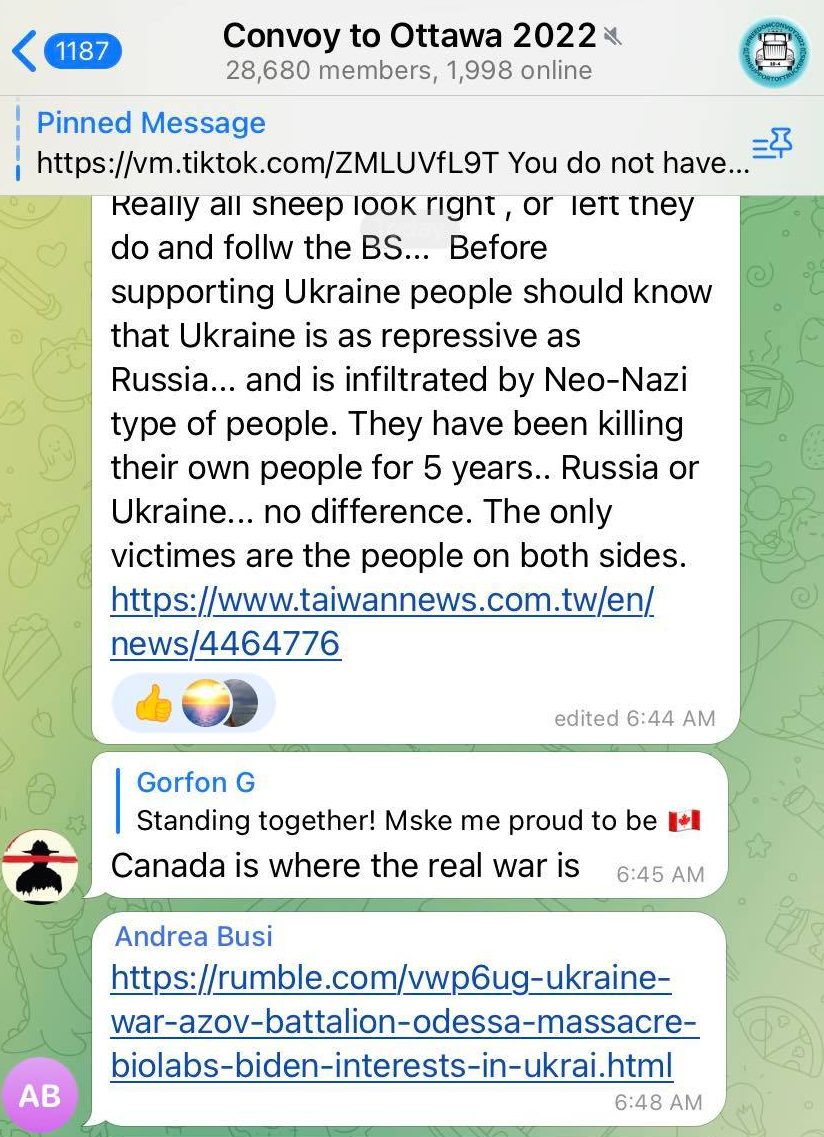
If you press the “join” button on Telegram channels created for the convoy that occupied Ottawa for weeks, you’d be forgiven for thinking you’re in the wrong place. Two channels, Convoy to Ottawa 2022 and Global Freedom Convoy, have been inundated with messages about Russia’s invasion of Ukraine, rather than the anti-mandate convoy they were created to support.

Between the two accounts, those messages — many of which are sympathetic to Putin — reach an audience over 48,000 members.

READ MORE: Spot the bot: How to navigate fake news about Russia’s invasion of Ukraine

One very popular post circulating on both forums suggests that Putin is simply invading Ukraine in order to destroy U.S.-run bioweapon labs in the region.

“Russia Produces Documents Showing US-Funded Bioterror Labs in Ukraine Producing Anthrax and Plague,” reads the headline of one article shared in the Global Freedom Convoy channel.

Another user posts that “in Ukraine since 2012, the US government has created dozens of biological laboratories…I think that’s where Covid19 was invented. Now, when the Russians are liberating these laboratories, a lot of interesting things come up.

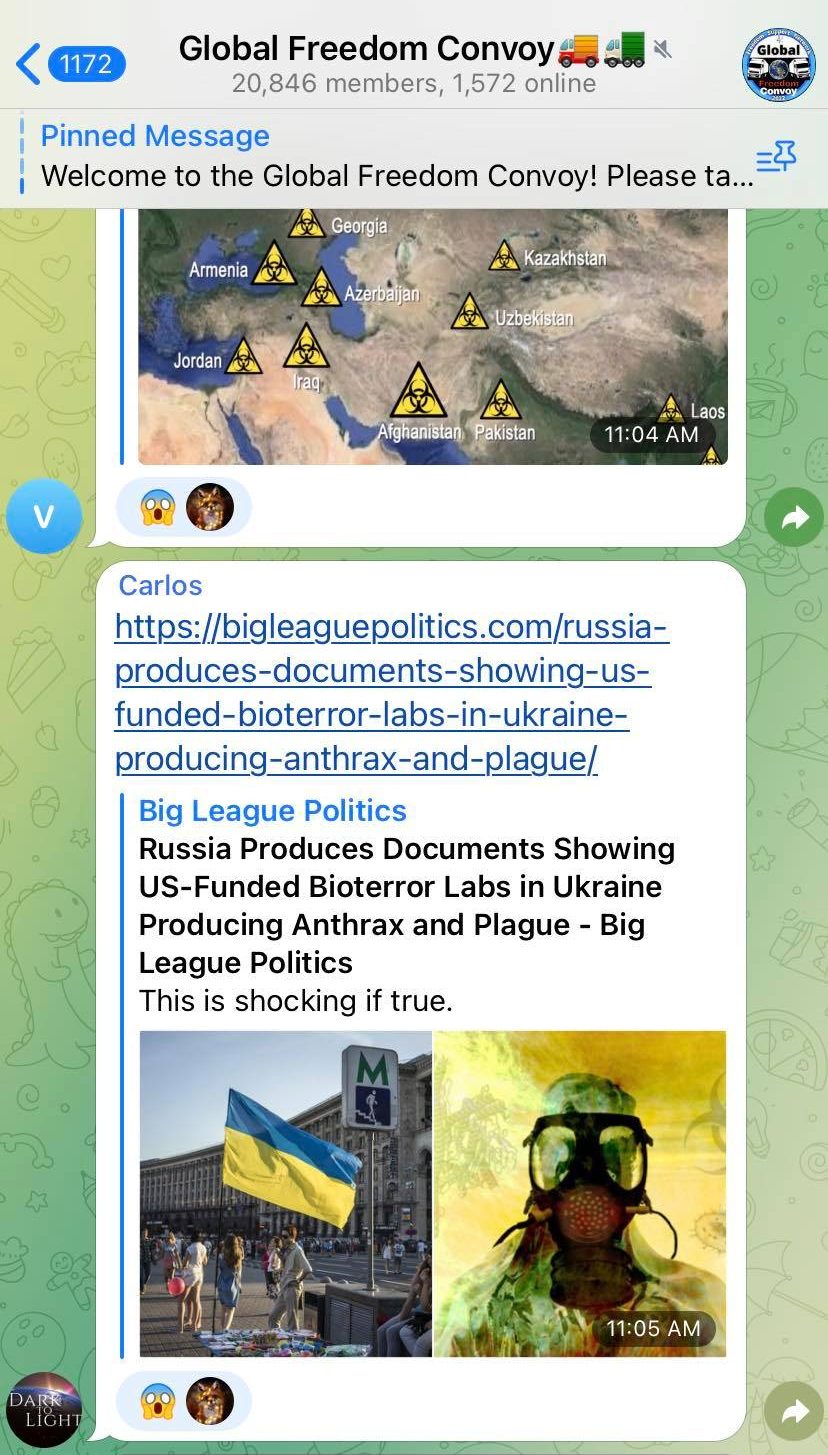


This disinformation about U.S. bioweapons manufacturing has been debunked.

There have also been a number of posts on the convoy Telegram channels parroting Putin’s false assertion that Ukraine is controlled by Nazis.

“The most popular disinformation that is spreading is that Ukraine is full with a bunch of Nazis,” said Mary Blankenship, a University of Nevada researcher who looks at how misinformation spreads through Twitter.

“This is sort of, kind of how they’re aligning themselves with Putin, because they’re making the statement that Canada’s government is filled with a bunch of Nazis, and (is) oppressing the people, and at the same time are supporting Nazis in Ukraine.”

This rhetoric of Nazis in Ukraine is on full display on Telegram convoy chats, where one user posted an image that claims to show a captured Ukrainian solider with a swastika tattoo — and another posted a video of “foreign students” being held “hostage” by a “Ukrainian Nazi army.”

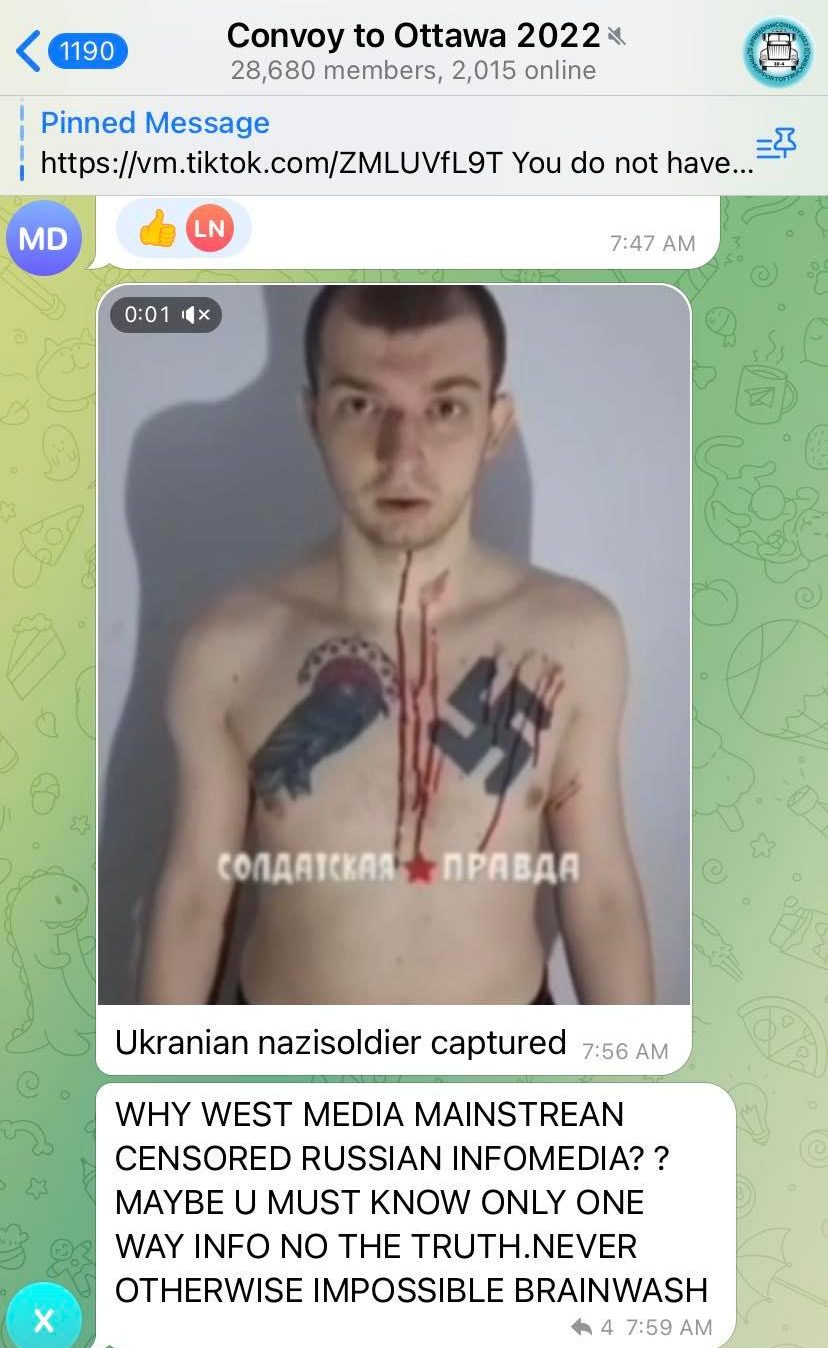

Putin’s “denazification” justification for the invasion of Ukraine has been widely rejected.

Still, the message seeps into conversations on other social media platforms and amplifies disinformation.

“The mainstream media wants to convince you that we should be funding Al-Qaeda and Ukrainian Neo-nazis, but that we can’t allow GoFundMe to distribute the millions that were raised for the Freedom Convoy,” said one user, who has 29,000 followers.
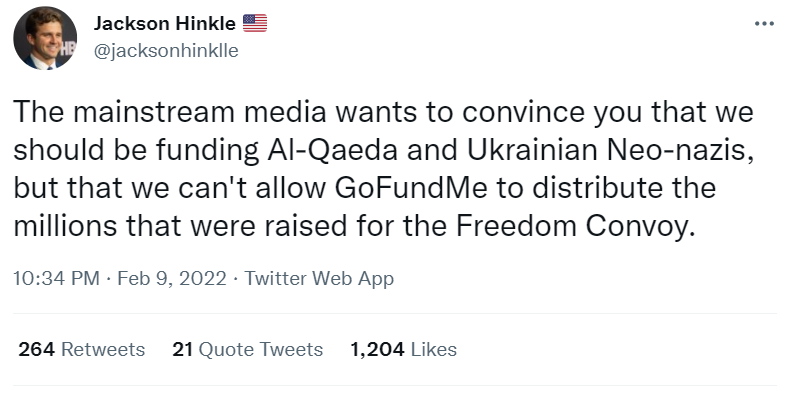
Another narrative that can be seen frequently in convoy circles is the allegation the war is simply intended as a distraction from the “tyranny” here in Canada.

Blankenship said, especially before Russia actually invaded Ukraine, a common comment among convoy supporters she studied on Twitter was that the “impending invasion that was going on was just a distraction” and that the “real war that’s going on is in Canada.”

This “distraction” theme is still evident in the pro-convoy Telegram channels.

“Canada is where the real war is,” said one user in the Convoy to Ottawa 2022 channel.

“War in Ukraine is a Great Reset distraction,” wrote another user, citing the widely debunked theory that details a vague “they” or a generally nameless “global elite” conducting looming, ominous power grabs around the world.

Not everyone is thrilled with the new direction of the convoy Telegram channels, however. Some users expressed their frustration with all the posts about Russia and Ukraine, pleading with their fellow users to stay true to the chat room’s original purpose.

“Wish this channel was still focused on the truckers and the people of THIS country,” one user wrote.

Why is this happening?

It can be difficult to assign a motivation to each user of an online forum that shares false information — knowingly or unknowingly, Celestini said.

“We can’t honestly say how many of these are genuine convoy people who are on Telegram, or who are bots, or who are just, for lack of a better term, s–t disturbers,” Celestini said.

However, early research indicates Russia has been deploying its pro-Putin disinformation networks across the internet. According to a recent report from the counter-disinformation group Mythos Labs, Russia seriously cranked up its legion of bots since November of last year.

Mythos Labs identified 58 accounts spreading pro-Russian disinformation and propaganda about Ukraine in November. Between Jan. 5, 2022, and Feb. 28, 2022, they found 914 of them.

“The volume of Ukraine-related tweets by accounts spreading pro-Russian disinformation/propaganda also increased by over 1,000 per cent during the last two weeks of February,” the report said.

Click to play video: 'Misinformation fuels copycats as Ottawa convoy gains international support'Misinformation fuels copycats as Ottawa convoy gains international support
Misinformation fuels copycats as Ottawa convoy gains international support – Feb 9, 2022

Blankenship said there are “undoubtedly” a “lot of bots and troll accounts that are present” in the spaces where misinformation about Ukraine is being shared.

“But I would say there’s still real people that believe this kind of disinformation and misinformation. So it’s a pretty big mix,” she said.

While people fall prey to disinformation for a variety of reasons, Celestini said she noticed one large area of overlap between pro-convoy accounts and pro-Putin accounts: their belief in conspiracy theories, namely in QAnon.

QAnon is a big-tent conspiracy theory that can be interpreted in a number of ways, according to Celestini. At its core, however, the completely unfounded theory claimed former U.S. President Donald Trump was waging a secret war against elite Satan-worshipping pedophiles in government, business and the media, the BBC explains.

READ MORE: Putin critic Navalny assists Canada in latest list of Russian sanctions, Trudeau says

With the advent of the COVID-19 pandemic, the conspiracy’s umbrella broadened to include accusations this shadowy global elite planned and managed the pandemic in the name of ushering in a “Great Reset.”

“(There’s) this idea that they’re taking over our government and bringing this New World Order, (and) there’s a hero here that could stop that from happening: Putin,” Celestini explained.

“They don’t want the West to get involved.”

How can you identify Russian misinformation?

More and more of the misinformation that’s circulating these days is “a personal attack to Ukrainians … as a people and as a culture,”  Blankenship said.

To make sure you’re not sharing it, there are some simple steps you can take. First, check the source.

“Try to find the original source, or look at news from local sources in Ukraine (like) Kyiv Independent. There’s also a few other independent sources in Ukraine that can give you the most up-to-date information about the situation,” Blankenship said.

“If you can’t find that, then I would say back away from what you’re seeing.”

READ MORE: Young Ukrainian volunteer killed delivering aid to dog shelter near Kyiv: ‘She was a hero’

It’s important not to take everything you see at face-value, Blankenship said. And there are some tools that can help you navigate that.

MediaSmarts has developed a custom fact-checker search engine, which you can use to Google something you saw. All the results will be from verified fact-checkers. There’s also a tool that will tell you the likelihood that an account is a bot.

If you do find something you suspect is misinformation or disinformation, Blankenship said, you should report it.

And whatever you do, try not to interact with the false information, because that means algorithms will likely boost its reach.

“That’s really important. … It doesn’t matter whether your agree or disagree with the post. You’re still perpetuating its spread,” Blankenship explained.

Click to play video: 'In 2-day spree, 61K users book Airbnb stays in Ukraine with no plans to go'In 2-day spree, 61K users book Airbnb stays in Ukraine with no plans to go


In 2-day spree, 61K users book Airbnb stays in Ukraine with no plans to go

And whether they’re driven by baseless conspiracy theories, Russian bots or simply misinformed citizens, these false narratives have a real impact on people living in Ukraine, some of whom are Blankenship’s relatives.

“You have enough people believing it, you’ll have people not support any of the government attempts to provide Ukraine with aid, whether that’s financial, military, or medical aid,” she said.

That, she said, is a “really huge and important impact that disinformation can have.”


PROVING HIS STAFF DOES HIS TWEETS

Alberta premier surprised his Twitter account restricted for some via ‘autoblock’: Kenney’s office

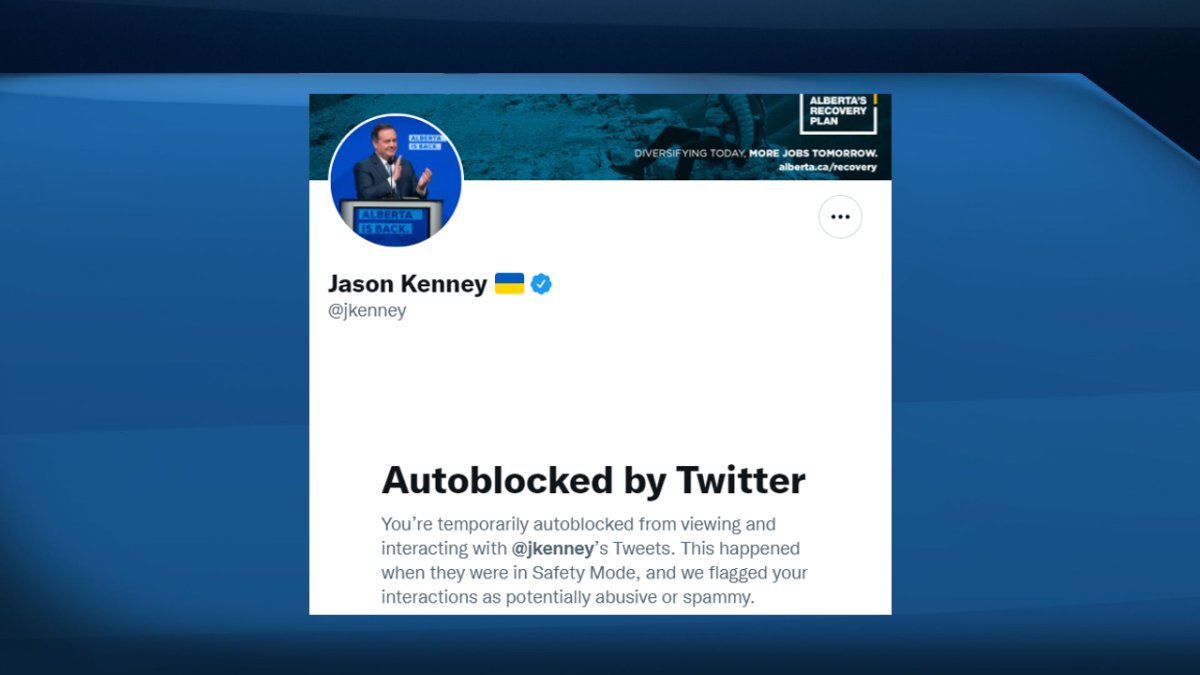
Many Twitter users in Alberta were met with an autoblock when trying to access Premier Jason Kenney's account on March 7, 2021. 

Some Albertans who follow Premier Jason Kenney on Twitter got a surprise notification Monday afternoon: they had been “autoblocked.”

That prevented Albertans from viewing the premier’s social media account, where he frequently posts news releases, livestreams of press conferences and even messages to other politicians, like when he wished Opposition Leader Rachel Notley a “speedy recovery” after she announced she had tested positive for COVID-19.

As of publication, Kenney had about 304,000 followers.

READ MORE: Twitter access being restricted in Russia amid Ukraine conflict

According to the social media platform’s website, an autoblock is a feature Twitter is experimenting with as part of its safety mode, detecting and blocking “potentially harmful language or repetitive, unwelcome interactions.”

“Autoblock is Twitter’s way of helping people control unwelcome interactions. When someone is in Safety Mode, Twitter automatically blocks another account that’s engaging in potentially abusive or spammy behaviour,” reads a frequently-asked-questions page. “If you get autoblocked, you’ll remain autoblocked for seven days.”

The premier’s press secretary confirmed to Global News that the move was not instigated by the premier or his office, and caught them by surprise. The premier’s office is looking into it, according to the press secretary.

Click to play video: 'Twitter war of words between Legault and English-rights advocate Marlene Jennings'Twitter war of words between Legault and English-rights advocate Marlene Jennings
Twitter war of words between Legault and English-rights advocate Marlene Jennings – Feb 25, 2022

It was also unexpected for Albertans who have been both critics and supporters of Kenney.

“Twitter has ‘autoblocked’ me for ‘spam.’ I can’t retweet Kenney anymore, who I support,” Linda_T tweeted.

“I have NEVER sworn to, denigrated or personally insulted (Jason Kenney),” Jason Scott tweeted. “I’ve asked for accountability and transparency. I’ve challenged Kenney on his posts and policies.

 I demanded better. And now I’m blocked.”

And at least one journalist was caught in the autoblock dragnet.

“I almost never interacted with/tagged Jason Kenney,” Adam Louis of the Agassiz Harrison Observer tweeted. “Very strange.”

“Is there a political science term for when the premier of your province gets autoblocked by Twitter?” asked Yasmeen Abu-Laban, a University of Alberta political science professor tweeted. Abu-Laban is also the Canada Research Chair for politics of citizenship and human rights.

Jamie Boisvenue, an epidemiologist and PhD student at the School of Public Health at the University of Alberta, surmised his autoblock was the result of presenting “real world evidence on why ending Alberta (public health) mandates was ill-guided.”

But that’s not necessarily how an autoblock or safety mode works.

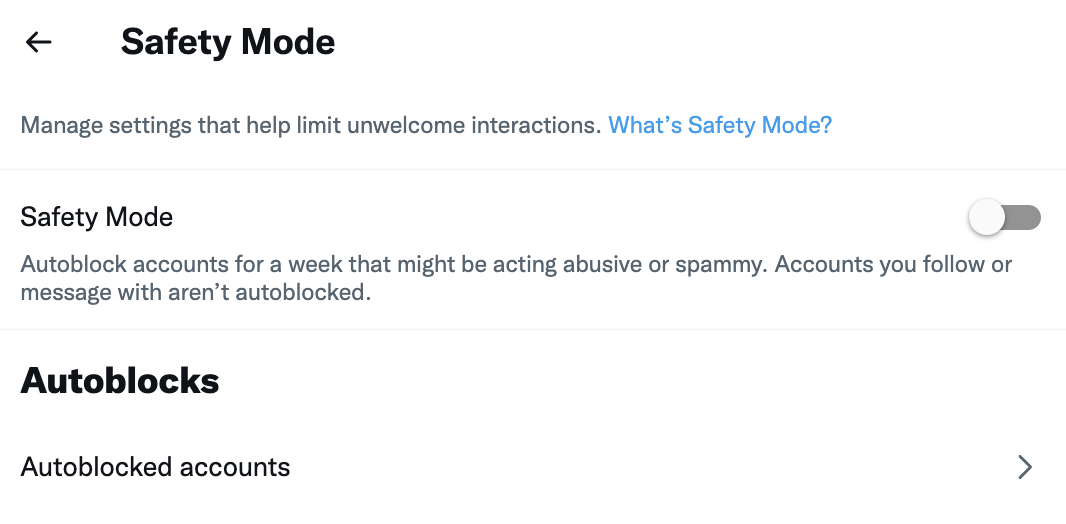
A Twitter spokesperson confirmed the default setting for safety mode is “off.”

The default setting for Twitter’s safety mode. handout / Twitter

Twitter rolled out the safety mode feature to half of Canadian accounts on Feb. 15, after starting to test the feature in September 2021. Half of accounts in the U.S., U.K., Ireland, Australia and New Zealand also got the feature in mid-February.

On its fall launch, senior product manager Jarrod Doherty explained some of how the autoblocks work:

“When the feature is turned on in your Settings, our systems will assess the likelihood of a negative engagement by considering both the Tweet’s content and the relationship between the Tweet author and replier. Our technology takes existing relationships into account, so accounts you follow or frequently interact with will not be autoblocked,” Doherty wrote.

On its FAQ, Twitter acknowledges its autoblock technology is imperfect. It also says the account using Safety Mode can “undo any autoblock mistakes at any time.”

Afghanistan marks muted women's day under Taliban eyes 


Aysha Safi

Afghanistan marked International Women's Day in muted fashion Tuesday, with activists cowed by the threat of arrest or detention at the hands of the country's new Taliban rulers.

Since returning to power on August 15 the Taliban have rolled back two decades of gains made by the country's women, who have been squeezed out of government employment, barred from travelling alone, and ordered to dress according to a strict interpretation of the Koran.

"The Taliban have taken away the sky as well as the ground from us," said an activist from the Woman's Unity and Solidarity Group, asking not to be named.

While the Taliban have promised a softer version of the harsh Islamist rule that characterised their first stint in power from 1996-2001, restrictions have been creeping in -- if not at the national level, then implemented locally at the whim of regional officials.

"If you care about women’s rights -- anywhere in the world -- you should be watching Afghanistan with deep alarm," said Heather Barr, of Human Rights Watch.

"It's been shocking to see how fast the progress of the last 20 years has been yanked back and how little the international community has done to stand up for Afghan women," she told AFP Tuesday.

Some Afghan women initially pushed back strongly against Taliban restrictions, holding small demonstrations and protests where they demanded the right to education and work.

But the Taliban soon wearied of the spectacle and rounded-up several of the ringleaders, holding them incommunicado even while denying they had been detained.

Since their release, most have gone silent, although the Taliban distributed videos of some purporting to confess they had been encouraged to protest by activists abroad, who said it would help them gain asylum.

Several rights groups said the alleged confessions were forced, calling them "hostage videos".

The Taliban at least acknowledged International Women's Day, with the foreign ministry calling it "auspicious", adding they would be provided with "an honourable and beneficial life in light of the noble religion of Islam and our accepted traditions".

- Protests banned -

Zabihullah Mujahid, the Taliban's chief spokesman, tweeted the day was "a great opportunity for our Afghan women to demand their legitimate rights" -- even though protests are banned unless permission is given.

Soon after taking power, the new government abolished the Ministry of Women's Affairs, replacing it with its dreaded religious police -- the Ministry for the Promotion of Virtue and Prevention of Vice.

Behind the walls of the sprawling United Nations compound on the outskirts of Kabul, an exhibition jointly organised by the UN and the Afghan Women's Chamber of Commerce and Industry showcased goods made by local female-owned businesses.

"It's a hope and a positive thing," said Tayeba Mashal, 47, owner of a firm that bears her name.

"We are hopeful that the women who are hiding in their homes because of the fear of insecurity will rise again in the society, resume their work, and resume their activities."

No other major public events were planned on Tuesday by women's groups, although one said members would mark the occasion by releasing balloons.

"Because of the restrictions imposed on us, we could not do it (collectively)," a Woman's Unity and Solidarity Group member told AFP.

"Now, everyone will do it individually at their homes."

A handful of members from another group, the Afghanistan Powerful Women Movement, planned to donate blood at a local hospital, but the Taliban denied them permission.

"The director of Jamhuriat Hospital said donating blood by women is not allowed as per Sharia law," said member Zakia Zahadat.

bur-fox/ssy


There is no thought of celebrating International Women's Day for the refugees arriving in the Polish border city of Przemysl after leaving their husbands and sons behind to fight in Ukraine.

"We lost our life, our safety," said a dazed-looking Anastasia Kazankina, a lawyer, speaking in a car park outside a busy refugee centre that was once a Tesco supermarket.

"We cannot plan any future because we don't know what will be tomorrow," said Kazankina, clutching her son Ilya's hand and her dog Marsia's lead.

Kazankina, who comes from the capital Kyiv, said she planned to stay in Poland but had no idea what to do there while her husband joins the army.

More than two million people have left Ukraine since the Russian invasion began on February 24.

Over a million have ended up in Poland, with many crossing into Przemysl from the western Ukrainian city of Lviv through the Medyka border control.

- 'I really hope to come back' -

In the Przemysl car park, buses come and go, spilling out mostly women and children hoping for safety and concerned about those they left behind.

One of the buses is headed to Estonia.

Kyiv grandmother Vera Verozub could be seen pushing her way towards it clutching two heavy bags, helped by her grandsons aged four and 14.

Their parents stayed to "defend the country".

"We took a train to Lviv. From Lviv, we took the bus for a bit and then walked," she told AFP, her teary eyes peeking out of a red hood and a beanie on a chilly morning.

Nearby, Anna Martynova, a retirement home assistant from southern Ukraine, stood on the side with her two children after spending a part of their trip on a bus with no seats.

"It was tough, we've been travelling for two days. There are disruptions, our railway is destroyed, the road bridges are destroyed, " she told AFP.

Martynova is one of the lucky ones -- her husband is already living in Poland, working on the railway.

But soft-spoken Yulia Sokolovskaya said she had to leave her spouse when she left their heavily shelled hometown of Kharkiv with her seven-year-old son.

"In Ukraine, we spent some days in the subway because it was dangerous to go outside," she told AFP.

She hopes to go and stay with friends in Italy -- "a good place to rest" -- but the sunny prospect crumbles as soon as she recalls her husband who had to stay.

"He cannot leave the country, he's still there. I check every hour if he's fine," she said, breaking into tears.

"I left all my life there and I really hope to come back one day."

frj/dt/yad

 Aurat March: Women rally in Pakistan despite attempts to shut down protest

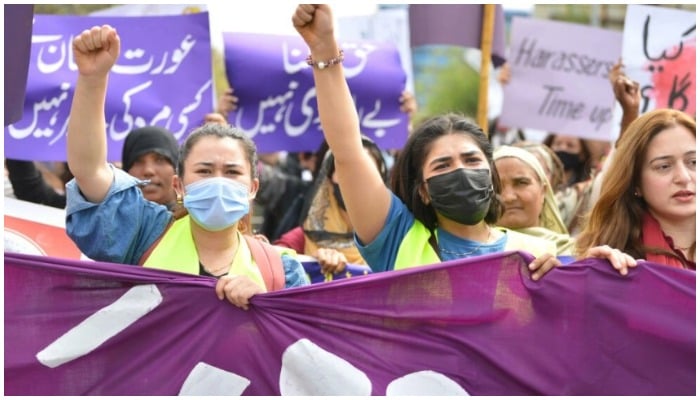
Aurat March protesters hold placards and shout slogans as they gather to mark International Womens Day in Islamabad — Farooq Naeem/ AFP
Aurat March protesters hold placards and shout slogans as they gather to mark International Women's Day in Islamabad — Farooq Naeem/ AFP
  • Rallies on International Women's Day have received fierce backlash since they were embraced four years ago.
  • Women march through streets in a jovial atmosphere, chanting slogans such as "Give respect to women" and "End the patriarchy".
  • March was guarded by riot police — and greeted by a small band of men chanting "end this obscenity".


LAHORE: Around 2,000 women rallied Tuesday in the Pakistan city of Lahore despite efforts by authorities to bar the protest and withdraw security for an event frequently the target of violence.

Rallies on International Women's Day have received fierce backlash since they were embraced four years ago.

In a society where women have been shot, stabbed, stoned, set alight and strangled for damaging family "honour", critics accuse rights activists of promoting liberal Western values and disrespecting religious and cultural mores.

On Tuesday dozens of events marking International Women's Day — known as the Aurat March in Pakistan — were held across the country.

Non-violent counter-protests, dubbed "hijab marches", were also staged by women from conservative religious groups in Karachi, Lahore and Islamabad where participants called for the preservation of Islamic values.

In the eastern city of Lahore, city authorities urged organisers to cancel the rally over safety concerns and threatened to not provide security.

Following a legal challenge, the Lahore High Court ruled the event could go ahead and authorities agreed to provide protection.

The women marched through the streets in a jovial atmosphere, chanting slogans such as "Give respect to women" and "End the patriarchy".

They were guarded by riot police — and greeted by a small band of men chanting "end this obscenity".

Student Sairah Khan, 23, cited recent high-profile cases of brutal violence against women "without consequences" for her attendance.

In Karachi — Pakistan's largest city — around 1,000 women gathered in a festival atmosphere with organisers conducting security checks as police stood by idly.

"We have only one slogan: equal wages, protection and peace," one woman chanted from a stage.

In the capital of Islamabad, around 200 women rallied outside the city's press club.

"We have come to raise our voices and highlight our issues," said student Fatima Shahzad.

They were outmatched by more than 400 counter-protesters from religious parties.

But organiser Farzana Bari pledged "we will continue to assert ourselves".

"These are the women who refused to bow down," she told AFP.

In 2020, groups of men from a religious party turned up in vans and hurled stones at women as they marched through Islamabad.

Doctored videos and photos of last year's events were spread online and even appeared on popular television shows falsely accusing women of chanting or carrying blasphemous slogans — an act that carries the death penalty in Pakistan.

Sexism exists': S.Korea feminist presidential candidate's lonely crusade

Claire LEE
Mon, 7 March 2022, 

Sim Sang-jung is a stark contrast to her gaffe-prone rivals 
(AFP/Jung Yeon-je)
Jung Yeon-je

Polling suggests Sim's strongest support is among women in their 20s 
(AFP/Jung Yeon-je)

South Korea's sole woman president, Park Geun-hye, was in office from 2013 to 2017
 (AFP/JEAN-PIERRE CLATOT)

South Korea will elect its next president on Wednesday 
(AFP/Jung Yeon-je)


Solid political credentials, scandal-free, and an excellent debater: Sim Sang-jung is one of South Korea's most established woman politicians. But as a left-wing feminist from a minor party, she doesn't stand a chance of becoming president on Wednesday.

In socially conservative South Korea, every president except one has been male and come from one of the country's two major parties. The next president will also be a man -- the front runners are both male.

As a four-time parliamentarian and seasoned labour and women's rights activist with not a whiff of scandal about her, Sim is a stark contrast to her gaffe-prone rivals -- Yoon Suk-yeol from the opposition People Power Party, and Lee Jae-myung of the ruling Democratic Party.

From Yoon's suspected links to dodgy shamans to widely reported allegations against Lee of mafia ties, the leading candidates have thrown so much mud at each other on the campaign trail that some local media have branded it the "election of the unfavourables".

Still, Sim doesn't stand a chance of winning -- her approval rating has never left the single digits.

As a self-identified feminist, Sim is the antithesis of the PPP's Yoon, who has vowed to abolish the ministry of gender equality -- claiming, despite the evidence, that women do not face systemic discrimination.

"Sexism clearly exists in South Korean society," Sim told AFP by email.

Yoon's stated objectives risk fanning dangerous misogynistic sentiment and will, ultimately, damage South Korean democracy, she said.

"We already know the historical consequences of election campaign strategies that encourage hate," she added.

- 'Patriarchal society' -


Despite its economic and technological advances, South Korea remains socially traditional and patriarchal, and has one of the world's thickest glass ceilings for women.

It has the highest gender wage gap in the OECD club of developed economies and only 3.6 percent of board members at the country's conglomerates are female.

Similarly in politics, women hold just 18.6 percent of assembly seats in parliament -- putting South Korea in 125th position in a global ranking maintained by the Inter-Parliamentary Union, just a few seats ahead of North Korea in 130th place.

"Korea is still a patriarchal society, and it is very hard for any female politician to rise to the top," Gi-Wook Shin, a sociology professor at Stanford University, told AFP.

The country's sole woman president, Park Geun-hye, in office from 2013 to 2017, "was an exception, who rode on the legacy of her father", the late dictator Park Chung-hee, he said.

Sim's second key handicap as a viable candidate is that she hails from the small, left-wing Justice Party, which holds six seats in the National Assembly.

South Korea, which uses a first-past-the-post election model, has a strong two-party system, and every president has come from that duopoly.

The Justice Party campaigns on issues such as climate justice, as well as LGBT and labour rights -- all considered radical in South Korea.

Sim entered politics after spending more than two decades on the front lines of South Korea's turbulent labour rights movement, going underground as a factory worker to organise unions while a student.

In 1985 she helped lead a groundbreaking strike and was rewarded by being put on the "most wanted" list of the country's then authoritarian government.

Her key policy as a presidential candidate reflects this background: she proposes a four-day work week, a revolutionary idea in a country where workers endure notoriously long hours.

Polling suggests her strongest support is among women in their 20s, but her overall approval ratings hover woefully low at around two to three percent.

She's a hero to some younger women for managing to "articulate the women's rights agenda" in the male-dominated labour movement, Vladimir Tikhonov, professor of Korean studies at the University of Oslo, told AFP.

- Long game -


But Sim has made costly mistakes: she did not speak out when a key corruption case hit incumbent President Moon Jae-in's administration, which made her party look complicit, analysts say.

People assumed her party was "a coalition partner of the Democratic Party, rather than a more reform-oriented left-wing alternative," said Yesola Kweon, a politics professor at Sungkyunkwan University in Seoul.

Sim herself blames her low approval ratings on her inability to convince South Koreans to see beyond the narrow policy choices offered by the two main parties.

"We couldn't convince people to believe in possibilities," she told AFP.

But although Sim has no chance of winning, it's an "important symbolic stance" that she is on the ballot on Wednesday, said Sharon Yoon, a Korean studies professor at the University of Notre Dame.

She's seeking to change Seoul's "two-party system that runs on personality politics and regional loyalties rather than policy interests," she told AFP.

"She is playing a long game."

cdl/ceb/ser/leg
Zelenskyy Says 'We Have the Possible Resolution' for Russian Demands

The Ukrainian president said that his country is "not prepared for ultimatums" from Moscow and urged Putin to escape his "informational bubble" and "start talking."


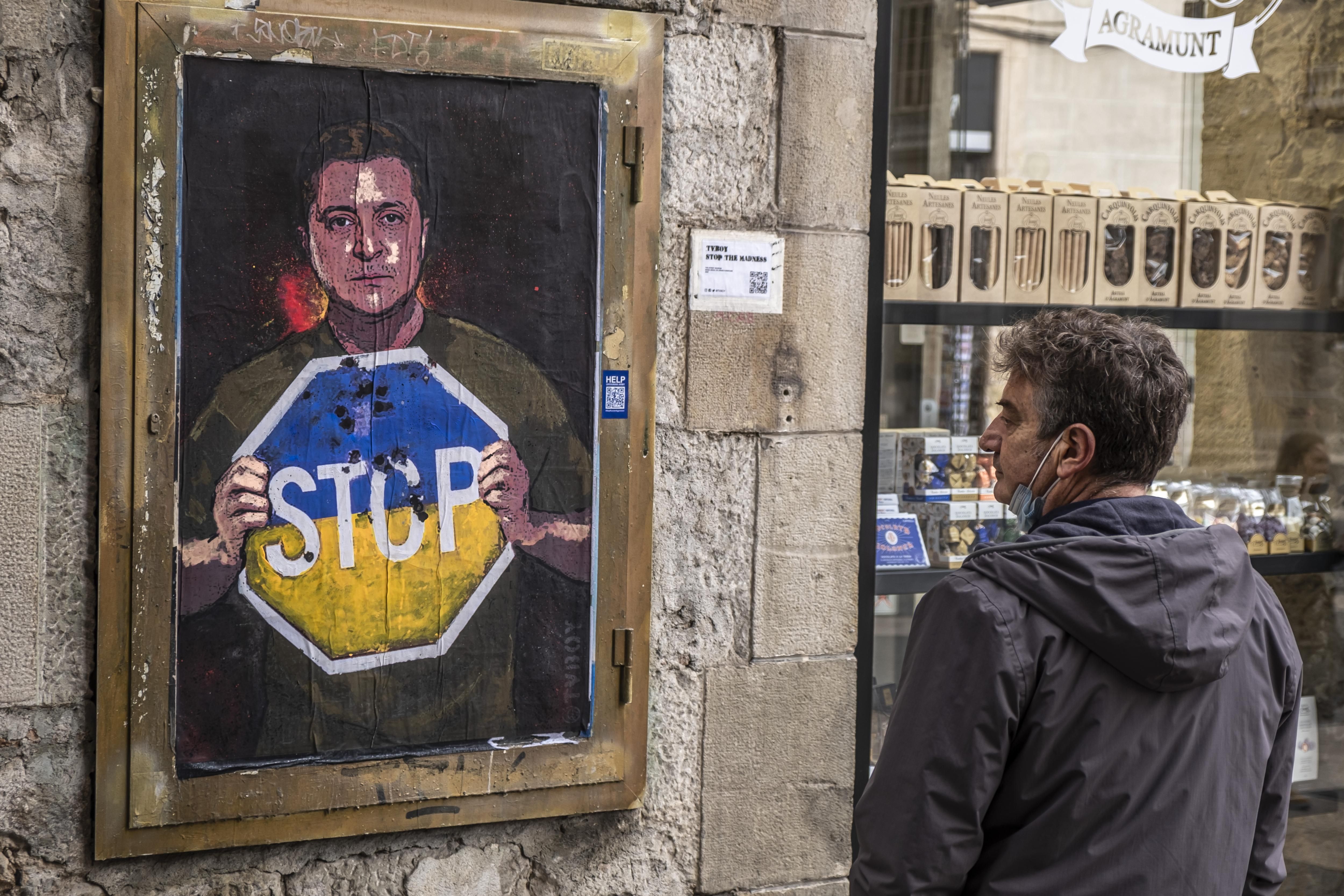
A person in Barcelona, Spain is seen observing the graphic representation of Ukrainian President Volodymyr Zelenskyy calling for an end to Russia's invasion on March 7, 2022. (Photo: Paco Freire/SOPA Images/LightRocket via Getty Images)

KENNY STANCIL
March 7, 2022


Ukrainian President Voldomyr Zelenskyy said Monday that bringing an end to Moscow's deadly assault on his country is within reach—but only if Russian President Vladimir Putin stops offering ultimatums and agrees to negotiate the terms of a peaceful settlement.

During an exclusive interview set to air in full on Monday night, ABC World News Tonight host David Muir asked Zelenskyy if he has rejected the Kremlin's "three conditions to end the war—that you must give up on joining NATO, recognize Crimea as part of Russia, and recognize the independence of those two separatist regions in the east."

"The question is more difficult than simply acknowledging [these terms]," Zelenskyy said in response. "This is another ultimatum, and we are not prepared for ultimatums. But we have the possible resolution for these three items—key items."

"What needs to be done," said Zelenskyy, "is for President Putin to start talking and start the dialogue instead of living in the informational bubble without oxygen. I think that's where he is; he is in this bubble. He's getting this information and you don't know how realistic that information is that he's getting."


Russia promised to immediately cease its invasion of Ukraine once the country's leaders agree to the three aforementioned demands earlier on Monday, prior to the third round of negotiations between diplomats from Moscow and Kyiv in Belarus.

Those talks have since come to a close with "small positive movements forward in improving the logistics of humanitarian corridors," according to lead Ukrainian negotiator Mykhailo Podolyak.

When asked what he would like to say to Putin, Zelenskyy said: "I think he's capable of stopping the war that he started. And even if he doesn't think that he was the one who started [it], he should know one important thing that he cannot deny, that stopping the war is what he's capable of."

Warning that a failure to end Russia's war on Ukraine could "trigger a world war," Zelenskyy stressed that "it should be stopped now."


At the same time, Zelenskyy reiterated that he wants the United States and NATO to establish a no-fly zone over Ukraine to prevent Russian missiles from destroying civilian infrastructure.

When Muir reminded Zelenskyy that U.S. President Joe Biden and NATO have refused to implement a no-fly zone due to "concerns this could trigger... a much bigger war than what we're seeing already because there would have to be a willingness to shoot Russian planes out of the sky," the Ukrainian president insisted that firing at Russian planes is necessary.

"You have to preserve lives. There... were simply kids there with tumors," Zelenskyy said of a recent Russian missile strike on a pediatric clinic. "And in the university, there were ordinary students. I'm sure that the brave American soldiers who would be shooting it down knowing that it is flying towards the students, I'm sure that they had no doubt in doing so."


However, as Anatol Lieven and William Hartung warned Monday in a Common Dreams opinion piece: "Shooting down Russian planes and bombing Russian anti-aircraft sites would greatly increase the risks of escalation, up to and including a nuclear confrontation. That's reason enough not to go forward, regardless of how loud the demands to do so may be."

Russian Foreign Minister Sergey Lavrov and his Ukrainian counterpart, Dmytro Kuleba, are set to meet in Turkey on Thursday.

"We hope this meeting will be a turning point," said Turkish Foreign Minister Mevlüt Çavuşoğlu, who is planning to attend the meeting. "We want this meeting to be an important step on the path of peace and stability. We will work for a lasting peace and stability."


Our work is licensed under Creative Commons (CC BY-NC-ND 3.0). Feel free to republish and share widely.
CRYPTOCURRENCY; A SPECULATIVE FICTION
Bitcoin and Ethereum continue to fall following sell-off in equity markets

It is likely to get worse for crypto before it gets better


Bitcoin and Ethereum continued their respective downward trends as sentiment leaves the market, with investors anticipating the conflict in Eastern Europe will go on longer than originally thought, according to analysts.

Bitcoin fell to US$38,265, its lowest price in over a week, while Ethereum hit a five-week low, falling 0.63% to change hands at US$2,520.

According to Naeem Aslam, market analyst at avatrade, movement over the last 24 hours was “spurred by the broader sell-off in equity markets.”

London's FTSE 100 closed 27 points lower than yesterday’s open.

Markets in America saw bigger declines, with the Nasdaq losing 482 points, falling 3.62%, and the Dow Jones falling by 797 points, or 2.37%.

Aslam adds that “sentiment suffered as investors reassessed the risks associated with the Russia-Ukraine conflict and likely projected that the war’s ramifications would last longer than expected.”

And it is predicted that it's likely to get worse for crypto before it gets better.

“Cryptocurrency markets may experience additional volatility this week as President Joe Biden is set to sign an executive order outlining the American government's strategy for catering to the blockchain space.”

“The order will examine the regulatory changes required by the United States as well as how cryptocurrencies may affect the country’s national security.”

In other crypto news, Coinbase blocked 25,000 accounts that were linked to Russian users.

Exchanges and crypto companies had held talks over the last week with Western leaders over enforcing crypto sanctions on Russian accounts.

In some of the alt coins, XRP was down 2.53% to US$0.721, Cardano was down 2.63% to US$0.795 and Dogecoin was down 1.67% to US$0.9942

IT IS NOT AN ALTERNATIVE TO GOLD

UK

Fair distribution of pension wealth ‘must not be overlooked during divorces’

5 March 2022, 00:04

A pair of wedding rings
Divorce shake-up. Picture: PA

Experts said pensions must be given attention when changes to the law on divorce come into force from April.

Care must be taken to make sure a shake-up to divorce rules does not negatively impact women’s pension rights, according to a former pensions minister.

Divorced women can already be at high risk of poverty in retirement because often relatively little attention is given to financial settlements which fully factor in pension wealth, former Liberal Democrat pensions minister Sir Steve Webb said.

Major changes to the law on divorce will come into force from April.

The Divorce, Dissolution and Separation Act 2020 reforms the legal requirements and process for divorce. The changes will reduce the potential for conflict between divorcing couples and help them avoid the “blame game”.

They will allow couples to end their marriage jointly and remove the ability to make allegations about the conduct of a spouse.

One group currently at high risk of retirement poverty is divorced women. In large part this is because relatively little attention is often given at the time of divorce to a financial settlement which gives proper weight to pension wealth

Sir Steve Webb

A new online service for applying for a divorce will be available from April 6 2022.

A research paper authored by Sir Steve and family law barrister Rhys Taylor looked at the new divorce law and its potential impact on the sharing of pensions in England and Wales.

It found the move to “no fault” divorce has been widely welcomed and is designed to streamline the process, but there are concerns that the new divorce law, coupled with the increased move to an online process could further undermine the effective sharing of pension wealth at divorce.

Divorcing spouses may underestimate the potential value of pension wealth, for example a salary-based pension income may be worth far more than the family home.

Couples may also be more focused on other priorities such as having somewhere to live and financial security and support for children.

While these problems exist in the current system, the authors raised concerns the new process could make matters worse.

In some cases, a spouse may receive notice that a divorce application has been made just a few months before the court is asked to grant the first divorce order and there may be little they can do to stop or delay the process, they said.

People may also be reluctant to raise pension issues for fear of being seen as obstructive in a new system designed to reduce conflict, the authors argued.

The authors called for close scrutiny by the Ministry of Justice into whether attitudes and outcomes on pensions change as a result of the new divorce process.

Sir Steve, who is now a partner at LCP (Lane Clark and Peacock) said: “One group currently at high risk of retirement poverty is divorced women.

“In large part this is because relatively little attention is often given at the time of divorce to a financial settlement which gives proper weight to pension wealth.

“It is entirely understandable that divorcing couples focus on other matters, but the risk is that people simply do not understand the value of pensions.

“While there is much to commend the new divorce law, it would be very unfortunate if a by-product was that even fewer divorces were accompanied by a fair sharing of the couple’s overall wealth, and in particular of pensions.”

Mr Taylor said: “I very much welcome the new divorce law, but the family justice system needs to be astute to avoid the law of unintended consequences.

“So often pensions are the last thing anyone really wants to think about, especially on divorce. Care needs to be taken to ensure that the fair distribution of pension wealth on divorce is not overlooked in this brave new era.”

A Ministry of Justice spokesman said: “This is not a new problem and, in fact, our changes give couples more time to resolve their issues and greater chance of doing so amicably.

“We have committed to further exploring financial provision, including pension sharing, once these changes are in force.”

By Press Association