Tuesday, March 08, 2022

Second Russian general killed on the battlefield as 'demoralised' troops suffer heavy losses

Verity Bowman
Tue, 8 March 2022

Major General Vitaly Gerasimov

A Russian general has been killed near the besieged city of Kharkiv, according to Ukrainian officians, making him the second senior Russian commander to die in the invasion.

Major General Vitaly Gerasimov, the first deputy commander of Russia's 41st army, died on Monday alongside other senior officials.

The Kremlin has been distracted by logistical issues and Ukrainian military commanders have claimed that the advance of Russia has been slowed by heavy losses and the “demoralisation” of its troops.

According to US intelligence, Vladimir Putin, the Russian president, has committed all of its troops congregated on the border into battle without making any significant territorial gains since late last week.

Russian forces are “demoralised and increasingly tend to looting and violations of international humanitarian law,” Ukrainian commanders said.

If the claims are verified, Gerasimov would become the second Russian general from the 41st army to die within a week.

Andrei Sukhovetsky was reportedly killed at the end of February.

Gerasimov was a decorated officer, having served during the second Chechen war, Russia’s activity in Syria, and the annexation of Crimea.

Bellingcat, an investigative journalism agency, said it had confirmed his death, which emerged after an alleged conversation between two Russian FSB officers was broadcast by the intelligence arm of the Ukrainian defence ministry.

The leaked conversation suggests Russia’s expensive new encrypted messaging service is already struggling to work, which would be a major blow for the Kremlin.

“Era is a super expensive cryptophone system that [Russia’s defence ministry] introduced in 2021 with great fanfare ... guaranteed [to] work ‘in all conditions,'" said Christo Grozev, Bellingcat’s director.

Mr Grozev said that during the phone call, an FSB officer assigned to the 41st army reported the death to a senior official, saying they had lost all secure communications.

“In the call, you hear the Ukraine-based FSB officer ask his boss if he can talk via the secure Era system. The boss says Era is not working,” he said.

Era needs 3G or 4G to operate, Mr Grovez added, but Russians have destroyed many 3G masts. The phone call was therefore made using a local sim card, resulting in the intercept.
РУССКИЕ!  МЯТЕЖ!  RUSSIANS! MUTINY!
‘They were sent as cannon fodder’: Siberian governor confronted by relatives of Russian unit

Pjotr Sauer
Tue, 8 March 2022


A Russian governor in Siberia has been confronted by angry citizens who blamed him for deploying a local riot police unit to Ukraine to become “cannon fodder”, a video clip circulating online showed.

The footage, first posted by Radio Free Europe (RFE) on Monday, showed a fiery exchange between Sergei Tsivilyov, the governor of the Kemerovo region, and people in the city of Novokuznetsk.

“They lied to everyone, they deceived everyone … Why did you send them there?” one woman asks Tsivilyov, saying that the soldiers thought they were going for military drills in Belarus.

“They didn’t know their objective … They were sent as cannon fodder,” the woman adds.

The governor would not have been responsible for the decision to deploy the unit, which would have been made by the country’s national guard, a separate internal military force directly subordinated to the president, Vladimir Putin.

According to RFE, the confrontation took place on Saturday at the gymnasium of the training base for riot police units, some of whose officers were killed or captured in Ukraine.

As the fighting in Ukraine nears its third week, more and more relatives of killed and captured Russian soldiers have expressed their opposition to the war, saying their loved ones were not told in advance about the country’s plans to invade Ukraine. Videos of captured Russian soldiers issued by the Ukrainians also appear to show that Russian troops were not informed of the invasion until the very end.

Western military experts have raised questions about Russian troops’ morale and preparedness in Ukraine, which could explain why Moscow’s blitzkrieg plan to overwhelm Ukraine and take Kyiv has so far failed.

Russia has revealed very little information about the state of its soldiers fighting in Ukraine. Last week, Russia’s defence ministry said that 498 Russian soldiers had died in Ukraine. Ukraine’s military claimed on Sunday that more than 11,000 Russian troops had been killed since the invasion of Ukraine began.

In the video, Tsivilyov defended the invasion, saying that Russia’s actions in Ukraine “shouldn’t be criticised”.

“Look, you can shout and blame everyone right now, but I think that, while a military operation is in process, one shouldn’t make any conclusions,” Tsivilyov said.

Russian officials, as well as state media, have been referring to Russia’s invasion of Ukraine as a “special military operation” rather than a “war” or “invasion”.

Authorities have also introduced a number of new laws aimed at stifling public opposition to the war.

On Friday, Putin signed into law a bill that introduced jail terms of up to 15 years for fake news about the Russian army, forcing many Russian and international outlets to cease their coverage of the events.

And while the authorities have been successful at getting a large segment of the population behind its war efforts, videos such as the Novokuznetsk footage circulating online suggest the war is deeply unpopular among those who have lost friends and relatives in Ukraine.

The Guardian previously spoke to family members of a Russian sniper captured in Ukraine, who similarly expressed anger and shock about their relative’s involvement in the war.

“Young boys are thrown like cannon fodder, and most importantly for what? For palaces in Gelendzhik?” the close family member of the captured sniper Leonid Paktishev said, referring to the palatial mansion on the Black Sea that Russian independent journalists have said is linked to Putin.

‘We f****** hit them’: Russian warship that attacked Snake Island soldiers ‘destroyed’


Chiara Giordano
Tue, 8 March 2022

Members of Ukraine’s navy can be heard cheering as they appear to destroy a Russian warship while defending the Odessa region (General Staff of the Armed Forces of Ukraine/Facebook)

Video footage has captured Ukrainian sailors cheering as they claim to have destroyed a Russian warship that attacked a small island on the first day of the war.

The recording, shared by the Ukrainian navy, shows a barrage of rockets being fired into the night sky during the defence of the Black Sea port of Odessa in the early hours of Monday before an orange glow appears to show a destroyed vessel in the distance.

One man can be heard shouting excitedly “We f****** hit them”, while another repeats the words spoken by captured Ukrainian soldiers on Snake Island, saying: “Russian warship, go f*** yourself.”

The General Staff of the Armed Forces of Ukraine shared the footage on Facebook, writing: “Today, March 7, 2022, the Marine Corps units of the Armed Forces of Ukraine, protecting Odessa region, struck an enemy ship.”

The Ukrainian navy later confirmed forces defending the port city in southern Ukraine hit a Russian vessel in the Black Sea with gunfire.

"The enemy has retreated again," it said in a brief statement on Facebook.

It was not immediately clear what type of vessel had been hit, however reports claim it was the Vasily Bykov – one of two ships involved in the notorious attack on Zmiinyi (Snake) Island which saw defiant Ukrainian border guards who refused to surrender tell the Russian navy “go f*** yourself” before being shelled in response.

In an audio recording of the incident, a Russian warship told the guards via loudspeaker that they should surrender or “be hit with a bomb strike”.


“Russian warship, go f*** yourself,” was their leader’s reply.

The 13 border guards stationed on the remote Snake Island, a largely uninhabited but strategically important strip of land in the Black Sea, about 186 miles west of Crimea, were initially thought to have been killed in the attack on 24 February.

Citizens fill bags with sand for frontlines along the beach of the Black Sea city of Odessa, in southern Ukraine, on 7 March 2022 (AFP via Getty Images)

But days later it emerged they were still alive and had been taken prisoner.

Russian state media showed the Ukrainian soldiers’ arrival in Sevastopol, Crimea, where they are reportedly being held.

They surrendered after repelling two Russian attacks “due to the lack of ammunition,” the Ukrainian navy said.

Ukrainian president Volodymyr Zelensky returned to his Kyiv office on Monday night, declaring he was “not hiding” from anyone and would stay in Ukraine for as long as needed to win the war started by Russia


The extent of Russia’s invasion of Ukraine (Press Association Images)

Overnight attacks and shelling continued in parts of Ukraine, including Kyiv and Sumy, and the Kyiv suburb Bucha faced heavy artillery fire last night.

To the west, tens of thousands in Lviv are facing starvation and homelessness, the city’s mayor announced.

Russia’s advance has slowed but it is on track to storm Kyiv, the Ukrainian army said on Monday after a third round of negotiations between the two nations hit a deadlock.

But the Ukrainian defence forces claim to have killed another top Russian military leader, Major General Vitaly Gerasimov.

 Women 'working around the clock' to help Ukrainians, organizer says

  • 21 hours ago
  • News
  • Duration

Mariya Dmytriyeva, a resident of Kyiv and women's rights expert for the Democracy Development Centre, tells CBC News she's not leaving Ukraine because she feels she will be more useful there than as a refugee.


Amnesty International: Russia's invasion of Ukraine is 'a crime under international law'

 
Cécile Coudriou, President of Amnesty International, joins FRANCE 24 and acknowledges that her organization has taken a "very strong position." Nevertheless, she asserts that they are "absolutely justified to call [Russia's invasion of Ukraine] an aggression, according to international law." Ms. Coudriou denounces Russia's actions, arguing that they did not have "a legitimate defense." She further states that Russia never sought authorization "from the Security Council of the United Nations. So, in that case, it can be characterized as an aggression." And now that the ICC is launching a war crimes investigation over Russia's assault on Ukraine, Ms. Coudriou is hoping that Vladimir Putin will face justice for his actions, not only in Ukraine, but also in Syria. "Our organization is trying to document, day after day, these war crimes because it will help in the investigation conducted by the International Criminal Court."

Ukrainians escape besieged Sumy through corridor

Ukrainians boarded buses to flee the besieged eastern city of Sumy on Tuesday (March 8), the first evacuation from a Ukrainian city through a humanitarian corridor agreed with Russia.
Saskatchewan prepared to accept large number of Ukrainian refugees

By David Giles Global News
Posted March 8, 2022


The UN says two million Ukrainians have fled country amid the ongoing conflict. Mike Armstrong has the latest on the ground in Lviv.


The Saskatchewan government is asking its federal counterpart to consider sending a larger number of refugees from Ukraine to Saskatchewan.

Jeremy Harrison, the province’s immigration minister, said the province has a long history of Ukrainian immigration and Saskatchewan would be an ideal location for incoming refugees.

READ MORE: Two million refugees have fled Ukraine since Russian invasion began, UN says

He also suggested taking advantage of the immigrant nominee program as a way of bringing more people to the province.

“We are not doing this exclusively because there is a labour shortage, we are doing this because we believe we are in a unique situation for there to be successful outcomes for refugees who are resettled regardless of skills or education,” Harrison said.

Immigration critic Aleana Young said while the NDP believes the province should take in as many people who want to come to Saskatchewan as possible, they want to ensure sufficient supports are in place.

“We’ve seen in the past that support, especially for those who have been fleeing war and conflict, has not always matched the need, whether it is language, support or care needed for students potentially experiencing trauma,” she said.

“I think of the hundreds of families who moved to Saskatchewan following the war in Syria. So ensuring that newcomers are supported and welcomed, of which I have no doubt, will be critical.”


READ MORE: Regina man shares his experiences while in Ukraine during Russian invasion

Premier Scott Moe said a number has not been attached to what his government will invest in supporting Ukrainians fleeing the conflict and coming to Saskatchewan.

“We have turned much of our attention towards how do we get those Ukrainian people here out of that area of conflict, get them to Saskatchewan where we can provide the supports,” he said.

“Whatever those supports are, they’ll be provided.”

Moe is also looking for unanimous support for a motion he introduced in the legislature on Monday that supports Ukraine and condemns Russia.

“Your courage and determination are an inspiration to us all. We unequivocally condemn this unprovoked and illegal invasion,” he said in a statement.

“Democracy and freedom are under attack and it is our hope that the whole world will stand up to Russia and say no.”


5:10 Mass exodus from Ukraine continues


© 2022 Global News, a division of Corus Entertainment Inc.
Queen Elizabeth meets Canada's Trudeau in first face-to-face since she had COVID-19

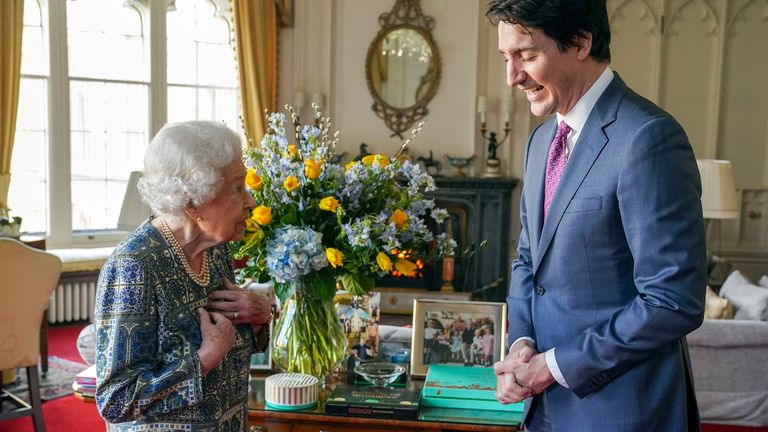
Queen Elizabeth II met with Canada Prime Minister Justin Trudeau on Monday.
Photo courtesy of Buckingham Palace/Twitter


March 7 (UPI) -- Queen Elizabeth II met Monday with Canadian Prime Minister Justin Trudeau, marking her first in-person official meeting since her COVID-19 diagnosis two weeks ago.

The 95-year-old queen, Britain's longest reigning monarch, tested positive on Feb. 20 and said at the time she was experiencing "mild cold-like symptoms." She recovered last week and made virtual appearances with foreign diplomats before the meeting with Trudeau.

The queen, wearing a long-sleeve dress and pearl necklace and earrings, smiled and grasped Trudeau's hand in greeting at Windsor Castle, a photo released by Buckingham Palace showed.

The queen has been staying at Windsor Castle, about an hour away from London's Buckingham Palace, through the COVID-19 pandemic, after previously using it as a weekend getaway, and has decided to make it her permanent home and main official residence, The Sunday Times reported.

Trudeau thanked her "for being a stabilizing force throughout the pandemic and congratulated Her Majesty on her Platinum Jubilee," the prime minister's office said in a statement.

The jubilee weekend in June will mark the queen's 70th year on the British throne.

"The Prime Minister highlighted that Canada will celebrate her Platinum Jubilee and seven decades of Canadian achievements by hosting a range of activities throughout 2022 and support community projects and initiatives across the country," his office statement said.

Before her recovery last week, Queen Elizabeth postponed two virtual events as she experienced cold-like symptoms, but she upheld a weekly audience with Britain's Prime Minister Boris Johnson.

She was fully vaccinated and had a booster shot before her COVID-19 diagnosis.

Trudeau also met with Johnson Monday to discuss response to the Russia-Ukraine war.

RELATEDCOVID-19 surges in Hong Kong with 300,000 cases, 1,200 deaths in week

"Canada will impose new restrictions on 10 individuals complicit in Russia's unjustifiable invasion of Ukraine, including former and senior government officials, and supporters of Russian leadership," Trudeau's office said in a statement. "These measures put further pressure on Russia's leadership, including President Putin's inner circle, to cease its repeated violations of human rights and Ukraine's sovereignty and territorial integrity."

"Both leaders agreed to pursue further joint support for Ukraine by providing critical humanitarian and military aid and ensuring that Russia is held accountable for its illegal, unprovoked and unjustifiable invasion, including by referring the attacks to the International Criminal Court," the statement continued.

Trudeau and Johnson also agreed to work together on other global issues, such as economic recovery from the pandemic and climate change, according to the statement.

They also joined a trilateral meeting with Netherlands Prime Minister Mark Rutte to discuss additional response to Russia's violation of international law, the statement added.

That weird photo of Queen Elizabeth going around is fake

MARK FRAUENFELDER 
BOING BOING
 TUE MAR 8, 2022


A widely spread photo of Queen Elizabeth with her head in an abnormally low position is fake. You can see Steve Parsons' actual photo of the Queen shaking hands with Canadian Prime Minister Justin Trudeau at Getty Images.

Why would someone create and post a photo like this? Gizmodo suggests that it's because there's a rumor that the Queen died some time ago. But how could such a photo support that rumor? My theory is it is just someone trying to be funny. What do you think? 
NOT FAKE!


Queen Elizabeth II Made a Statement in Support of Ukraine During Her Meeting With Justin Trudeau

Trudeau was in the U.K. to discuss the situation in Ukraine.


(Image credit: Getty/Steve Parsons)

By Iris Goldsztajn

When the Queen is photographed in one of the royal homes, the objects featured in the background always tell a carefully curated story.

In the latest example, the monarch received Canadian Prime Minister Justin Trudeau at Windsor Castle on March 7, and the scene was set to make a strong statement in support of Ukraine.

As the two heads of state spoke, a large bouquet of blue and yellow flowers was visible behind them—that's blue and yellow to represent the Ukrainian flag.

Trudeau was in the U.K. to meet with Prime Minister Boris Johnson for discussions relating to the Ukrainian crisis following the Russian invasion. The Canadian statesman acknowledged on at least two occasions that he also discussed Ukraine with the Queen.

"@JustinTrudeau confirmed he discussed the #Ukraine #UkraineUnderAttaсk #UkraineRussia situation with the Queen and she had plenty to say: 'I was able to talk about the situations we are facing and draw on her long experience from having seen much over these past decades,'" tweeted royal editor Roya Nikkhah.

Posting on Instagram Stories, Trudeau wrote, "It's always wonderful to see Queen Elizabeth II. When we met at Windsor Castle, we spoke about a wife range of issues—including global affairs, the situation in Ukraine, and Her Majesty's lifetime of service to Canada and the Commonwealth."

The meeting was also significant because it was the Queen's first in-person engagement since she contracted COVID in February.

This isn't the first time the Queen has broken her usual impartiality to show her support for peace in Ukraine. She also recently made a "generous donation" to the Disasters Emergency Committee (DEC) Ukraine Humanitarian Appeal, according to The Sun.

Roya Nikkhah@RoyaNikkhah📷 @PA5:58 AM · Mar 7, 2022·Twitter for iPhone


Soaring oil prices could be the death rattle of our fossil-fuelled economy

By Max Fawcett | Opinion, Politics | March 8th 2022

It’s long been said that the cure for high oil prices is high oil prices, writes columnist Max Fawcett. 
Photo by Erik Mclean / Unsplash

It was the worst of times, it was the best of times. For the people working in the corner offices of Calgary’s corporate towers, that’s been the story of 2022 so far, especially when it comes to the war in Ukraine. After years of watching their industry get beaten down, first by a price war and then by growing concerns about climate change, it’s suddenly a very good time to be an oil and gas company executive. After briefly trading in negative territory less than two years ago, Canadian oil is poised to set a new all-time high.

But the joy being felt in those Calgary towers is misplaced because the renewed surge in commodity prices is a long-term defeat disguised as a short-term victory.

Russia’s invasion of Ukraine will almost certainly prove to be the tipping point in the global energy transition as entire continents move to make their economies and societies less dependent on oil-exporting countries like Russia and Saudi Arabia. Yes, those executives in Calgary will see their stock options increase in value, and the Alberta government will collect billions more in royalty revenue.

But this is the death rattle of the fossil-fuelled global economy, not its latest renaissance.

That’s because unlike the last time oil prices traded above $100 a barrel, consumers and companies alike have options for reducing their exposure to high fuel prices. Those options will only continue to grow in number in the year to come, as every major automaker on the planet rolls out its own range of electric vehicles.

“Oil staying above or near $100 a barrel for a protracted period of time just makes renewable investment look better,” Sarah Ladislaw, managing director at the think tank RMI, told the Los Angeles Times. “If the price environment and the strategic conflict lasts a bit longer, I think it drives people to find alternatives.”

Investors have already twigged to this. Case in point: When the markets opened on Feb. 24 in the wake of Russia’s invasion of Ukraine, it seemed likely that a huge increase in oil prices would be the story of the day. But by the time it was over, a much different one had emerged. Yes, global energy stocks were up, with the largest energy ETF in the world gaining 1.7 per cent on the day. But that was nothing compared to the iShares Global Clean Energy ETF, which was up 7.6 per cent — and on a day when the overall market fell.

What people are reading

The unethical opportunism of Jason Kenney
By Max Fawcett | Opinion | March 5th 2022

High oil prices, and the impact they’re already having on household budgets, aren’t a good thing for the vast majority of people. But when it comes to driving down global emissions and increasing the sense of urgency people feel about climate change, they might just do the trick. The longer prices stay at these nosebleed levels, the more likely it is that consumers, businesses, industry and even entire countries will look to find alternatives. Once they do, it’s unlikely they’ll ever look back again.


That’s particularly true in Europe, where the combination of high energy costs and Russia’s reckless invasion of Ukraine could prove transformative.

“The stuff coming out of the mouths of European leaders has never come out of their leaders’ mouths before,” said Nikos Tsafos, the James R. Schlesinger Chair for Energy and Geopolitics with the Centre for Strategic & International Studies, in an interview with Scientific American. “There is a different strategic resolve coming out of Europe, and if you’re not factoring that into your model, I think you’re missing something.”

Opinion: The longer prices stay at these nosebleed levels, the more likely it is that consumers, businesses, industry and even entire countries will look to find alternatives, writes columnist @maxfawcett. #Ukraine #FossilFuels #Renewables

That’s why the federal government needs to hold its nerve when it comes to its promised plan to regulate and restrict oilsands emissions. Premiers like Jason Kenney and Scott Moe will renew their demands for more pipelines and production, and industry advocates will repeat their tired arguments about ethical oil. Let them. What they can’t see, or won’t, is that the transition away from fossil fuels has shifted into a higher gear.

If Canada can’t keep up with that, it risks getting left behind in years and decades to come — especially as global demand for oil starts to roll over and fall off.

Most fossil fuel enthusiasts, including the well-paid ones in those Calgary corporate towers, refuse to believe that’s even a possibility. Mick Dilger, the former CEO of Pembina Pipeline, told the Calgary Herald’s Chris Varcoe in November: “The key question right now is: What is the tenure of hydrocarbon production? And I think it looks a lot like it’s four to five decades, rather than one to two decades.”


But if the pace of the energy transition starts to really pick up in the years ahead, we’ll almost certainly look back to early 2022 as a key influence on that.

It’s long been said that the cure for high oil prices is high oil prices. This time, it might be a permanent one.

B.C. adds conditions for Trans Mountain expansion, ministers say concerns remain

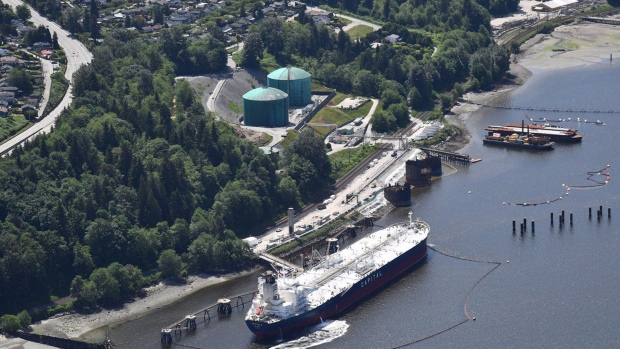
Burnaby oil terminal

An aerial view of the Trans Mountain marine terminal in Burnaby, B.C., is shown on Tuesday, May 29, 2018. British Columbia has amended the conditions of its environmental assessment certificate for the Trans Mountain pipeline expansion and told the federal government it still has concerns about its response to potential marine oil spills. THE CANADIAN PRESS Jonathan Hayward 

The Canadian Press
Published Tuesday, March 8, 2022 5:24AM EST

British Columbia has amended the conditions of its environmental assessment certificate for the Trans Mountain pipeline expansion and told the federal government it still has concerns about its response to potential marine oil spills.

The changes announced in late February focus on the impacts of marine shipping and potential oil spills from ships related to the pipeline project.

The expansion is set to nearly triple the capacity of the existing 1,150-kilometre pipeline that carries 300,000 barrels per day of petroleum products from Alberta to B.C., which will significantly increase the number of tankers carrying oil for export.

In a letter relaying B.C.'s updated conditions, Environment Minister George Heyman and Energy Minister Bruce Ralston urged federal Natural Resources Minister Jonathan Wilkinson to adopt a series of recommendations that would address the province's concerns after it consulted with Indigenous nations, municipalities, government agencies and the public.

Those concerns would be most effectively addressed by Ottawa as part of the regulations and measures that fall under federal jurisdiction, Heyman and Ralston wrote in the letter, dated Feb. 24.

B.C. has made changes that are under its jurisdiction and sought to avoid duplicating existing federal regulations, the province said in a news release.

One of B.C.'s recommendations encourages Transport Canada to "expand the scope of its oversight" to include work done by the Western Canada Marine Response Corp., which responds to spills. In particular, it says Transport Canada's oversight should include shoreline cleanup, planning for sunken and submerged oil, co-ordinating volunteers, and managing wildlife and waste in the event of a spill.

"We strongly urge you to carefully consider these important recommendations, and to take action on them ... as soon as possible, so that the (Trans Mountain expansion) is operated in as safe a manner as possible," the ministers wrote.

Among B.C.'s new conditions is a requirement that Trans Mountain, a federal Crown corporation, provide a report on health risks in the event of a marine oil spill. It must identify measures to reduce human exposure and negative health effects and outline which authorities would be responsible.

Another condition requires Trans Mountain to provide a report with baseline data on B.C.'s shoreline in areas that could be affected by an oil spill, including Vancouver's English Bay and the Strait of Georgia. The report should include information on land use, infrastructure, flora and fauna, the order says.

The province has also amended a condition to require updates every five years on research Trans Mountain is involved with related to diluted bitumen and how the heavier, unrefined oil product could be cleaned up if spilled in water.

A Trans Mountain spokesperson said it is reviewing the changes to determine next steps.

Neither Wilkinson nor anyone from his Department of Natural Resources was available to comment on the provincial government's request.

Andrew Radzik, an energy campaigner with the Georgia Strait Alliance, said the province's changes are welcome, but gaps remain.

"If a spill happens, we've got better baseline data. So that's great, that's important. That's information that will inform spill response plans," he said in an interview.

"But they're not requiring shoreline spill response plans of a particular standard."

Instead, the province is relying on federal regulations on marine shipping and spill response that it has criticized for being too vague, Radzik said.

Transport Canada requires certified marine response organizations to treat 500 metres of shoreline per day and the Western Canada Marine Response Corp. has indicated it's working to increase its capacity to 3,000 metres.

But the existing regulations and emergency plans for the pipeline expansion lack some key detail, Radzik said, like what exactly it means to fully "treat" a shoreline.

The province shares jurisdiction along its shoreline and it could have amended the project's certificate to require more specific information or standards, he said.

On human health risks, Radzik said it's a step forward for B.C. to require an outline of the roles and responsibilities of different levels of government and the pipeline operator in reducing exposure after a potential spill.

However, it's not clear who would foot the bill for those health measures and what portion the province would have to pay, he said.

Asked why B.C.'s new conditions didn't include more specific requirements for marine spill preparedness and response, the Environment Ministry said the changes reflect certain criteria it had to follow in its review.

The opportunity for B.C. to change its environmental assessment certificate stemmed from a 2018 decision by the Federal Court of Appeal. It found the National Energy Board, since renamed the Canada Energy Regulator, had incorrectly excluded marine shipping from its assessment.

The regulator reconsidered the potential impacts, and the federal government used the subsequent report in 2019 to approve the pipeline expansion for a second time.

The B.C. Court of Appeal later decided that because the provincial ministers who issued the environmental assessment certificate had relied on the regulator's original assessment, they should have the opportunity to consider the later report and make changes, provided the issues related to differences between the two reports and fell under provincial jurisdiction.


RCMP says Ottawa protesters not donors to Freedom Convoy had accounts frozen

RCMP: donors not frozen

Assistant RCMP Commissioner Michel Arcand says the Mounties only gave the names of people directly involved in Ottawa protests to banks to freeze their accounts

Arcand is appearing at the House of Commons finance committee today during its study of the government's use of the Emergencies Act to bring an end to blockades in Ottawa and several border crossings.

He says the RCMP did not send banks the names of any people who only donated to the Freedom Convoy or names of people involved in protests outside Ottawa.

Hundreds of demonstrators blockaded roads in Ottawa for more than three weeks last month, and similar demonstrations blocked four major border crossings in Ontario, Manitoba, Alberta and British Columbia.

Arcand says the intelligence about who was involved in the Ottawa protests was gathered by the RCMP, Ontario Provincial Police and Ottawa police before the names were given to banks.

Arcand says the accounts were frozen to encourage protesters to leave and to discourage others to join the protests


Banks went beyond RCMP list of names in


 freezing a ‘small number’ of accounts under


 Emergencies Act: Bankers Association


MARCH 7, 2022

The Canadian Bankers Association told MPs Monday that a “small number” of additional accounts were frozen under the Emergencies Act based on the banks’ own “risk-based” reviews and were not on a list of names provided by the RCMP.

Angelina Mason, the CBA’s general counsel and vice-president, made the comments during an appearance before the House of Commons finance committee, which is reviewing how the banking-related aspects of the special powers were used last month.

During her testimony, Ms. Mason said there has been considerable “misinformation” related to how the powers were used. She said the banks’ additional screening did not involve reviewing lists of individuals who had donated financially to the trucker convoy protests.

“We primarily related on the names provided by the RCMP. But there were obligations under the order, separate from that, that required banks to make their own determinations,” she said. “We did not rely on external information. I know there’s been suggestions of leaked donor lists, et cetera. We did not rely on that information at all. What banks were obligated to do though was apply their normal risk-based approach in monitoring their accounts, as they would do for money laundering or what have you. And if something then was flagged … looking through the eyes of the activities in Ottawa, then there would be, again, an obligation to freeze.”

Ms. Mason said examples of activity that could lead to the flagging of an account include large deposits and activity that suggests an account is being used in connection to a fundraiser. Ms. Mason declined to say how many accounts were frozen by the banks using their own screening rather than relying on the RCMP’s list.
-

“A small donation wouldn’t have been caught by our normal risk-based approach,” she said.

Conservative MP Mark Strahl claimed last month that a component in his BC riding had her account frozen after she donated $50 to the convoy protest. Mr. Strahl has yet to provide evidence in support of his statement.

The government invoked the Emergencies Act for the first time in Canadian history on Feb. 14 and ended the use of the powers on Feb. 23.

At the time the powers were invoked, a protest in downtown Ottawa opposing Canadian COVID-19 restrictions was into its third week with no sign of ending. Large trucks were blocking the main streets close to Parliament Hill. Related protests at various border crossings were still under way.

The Finance Department has said about $7.8-million in about 206 accounts was frozen, but the total number of individuals involved would be less than that figure as some people had several accounts. The CBA said about 180 of those accounts involved banks, while the rest relate to other types of financial institutions. The CBA said Monday that all frozen accounts have since been unfrozen, except for those that are frozen in response to a court order.

Parliament approved the Emergencies Act in 1988 as a replacement for the War Measures Act.

From a policing perspective, the powers allowed officers to declare specific areas – such as downtown Ottawa or approaches to border crossings – as off limits to the public.

The financial aspects of the powers were the most unusual. The regulations approved by cabinet allowed banks to freeze personal and business accounts without obtaining a court order and without fear of being sued. Ms. Mason said the law compelled the banks to freeze accounts subject to the federal orders.

Ms. Mason said the banks relied on verbal briefings from federal officials in determining what actions were required.

“There was no published guidance as you would normally have for regulations,” she said. “That’s why we had to rely on briefings from Finance [Canada] to make sure we had absolute clarity on implementation.”

An RCMP statement issued on Feb. 24 said the powers were used to encourage individuals to leave the illegal protests “and deter them from counseling others to commit criminal offenses.” The RCMP also said the list was not based on donation lists.

RCMP assistant commissioner Michel Arcand, who also appeared Monday at the finance committee, said police calls to individuals who had been in Ottawa revealed the freezing had an immediate impact.

“Some comments that we received [were]: ‘We’re not going to go back. We’re back home. Please unfreeze our accounts,'” he said. “Some people left, being afraid that their accounts were going to be frozen.”

Canadian trucker protests reveal fault lines by age, work status

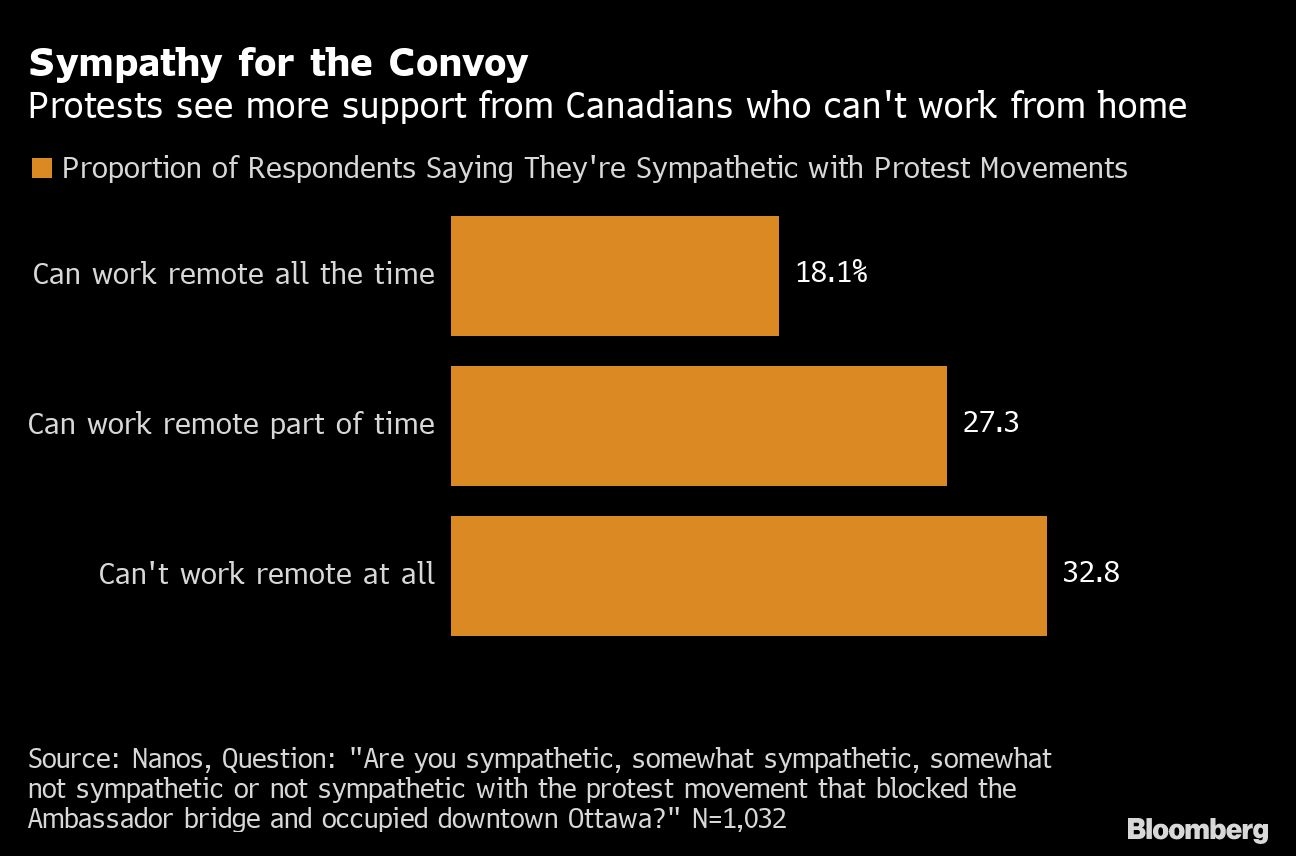
Canadians have little sympathy for the erstwhile protesters who occupied downtown Ottawa for weeks and closed border crossings. But younger Canadians and those who can’t work from home register more support for the demonstrators, calling attention to a new potential political challenge for Prime Minister Justin Trudeau’s government.

The blockades were unpopular across all groups, according to a Nanos Research Group survey for Bloomberg News fielded in the days after authorities retook control of downtown Ottawa. Only 22 per cent of Canadians said they were at least somewhat sympathetic with the anti-government movement, compared with three-quarters who said they weren’t sympathetic.

But groups known to have experienced more isolation or work inflexibility during the pandemic were more likely to respond positively about the demonstrators, who drove columns of big-rig trucks into the capital city to protest against COVID-19 restrictions. Offshoot demonstrations spread to key border crossings, prompting Trudeau to invoke emergency police powers.

Roughly 33 per cent of people who couldn’t work remotely or digitally showed at least some sympathy for the protesters. By contrast, only about 18 per cent of Canadians who didn’t need to leave home for work felt similarly. Among those who could work remotely part time, 27 per cent expressed some support.

The convoy was initially prompted by border rules that Trudeau put in place in mid-January, requiring truckers crossing the U.S.-Canada border to be vaccinated. But it quickly galvanized into a broader political protest against government authority.

“There is definitely a class divide element to this,” said Lori Turnbull, director of the School of Public Administration at Dalhousie University in Nova Scotia. 

Embedded Image

Some writers and political scientists have wondered aloud whether the protests might reflect worsening class divisions between those who work in the physical world and those who work in the digital world. 

This new prospective pool of anti-government voters might explain why some of the more populist-leaning members of the Conservative Party expressed public support for the truckers, at least initially.

The polling suggests that negative sentiment toward government goes beyond the working-class men whom Trudeau has long struggled to win over.

Indeed, younger Canadians -- a group more likely to have lost work during the pandemic and less likely to have gotten seriously ill -- also supported the truckers at higher levels than Canadians overall. About 28 per cent of respondents between 18 to 34 years old expressed at least some sympathy for them, versus 16 per cent for those 55 years and older. Younger Canadians were also more likely not to have a work from home option, with one-third of them unable to work remotely.

Embedded Image
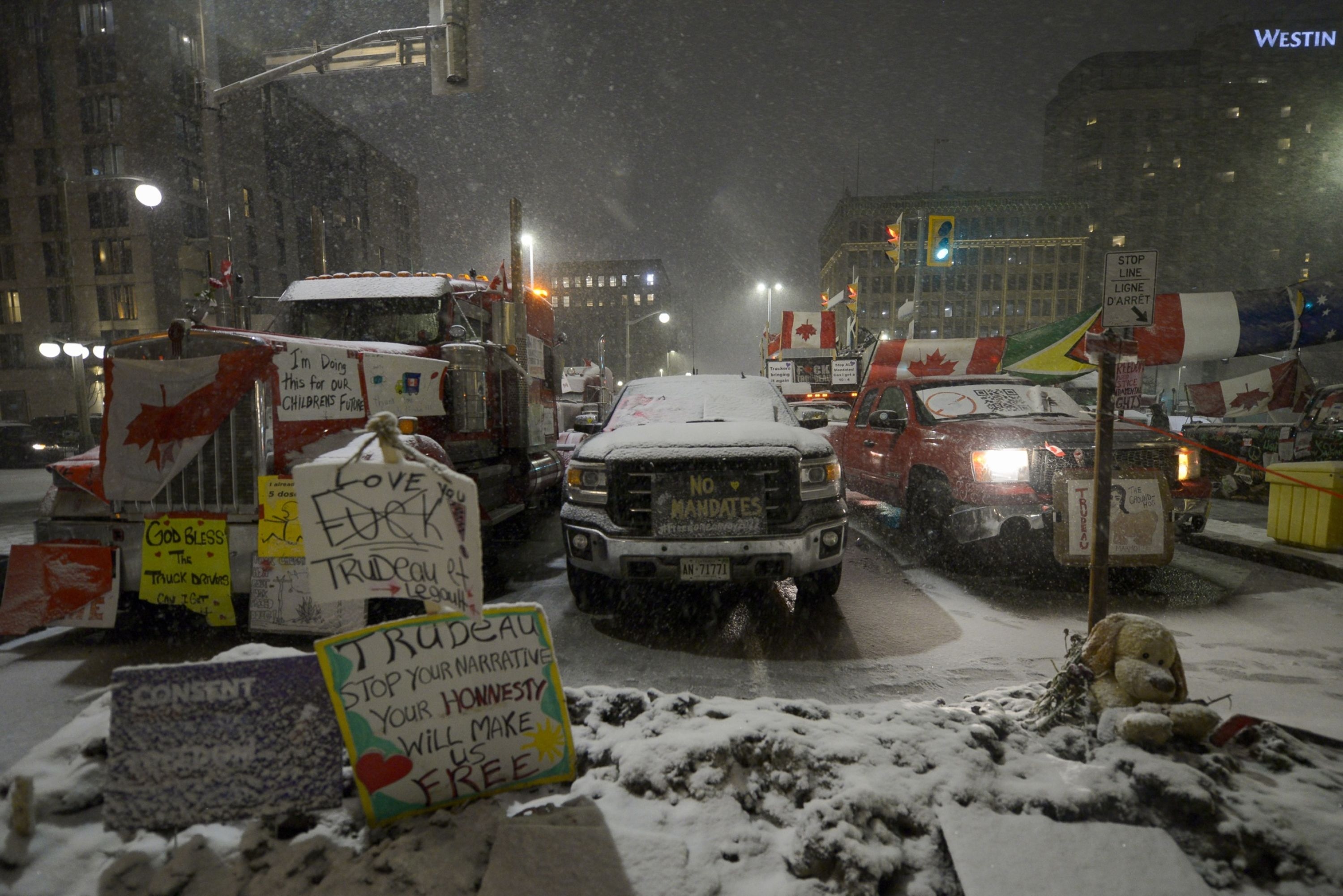
Trucks block a major downtown intersection in Ottawa on Feb. 17, 2022.

That trend tracks with other polling that shows rising support for Conservatives among younger voters. The share of voters between 18 and 29 who support the Conservatives jumped to 34 per cent at the end of February, from about 20 per cent at the end of January, according to separate weekly polling by Nanos. 

Some traditional political fault lines were also evident in the Nanos survey for Bloomberg News, with higher sympathy levels for the truckers in western Canada, where support for Trudeau’s government tends to be low. 

Hundreds of semis and other heavy vehicles blockaded the downtown of Canada’s capital city for three weeks last month in demonstrators that also inspired offshoots along key U.S. border crossings, including the Ambassador Bridge to Detroit. Trudeau lifted the emergency edict on Feb. 23, once all blockades were cleared. 

The hybrid telephone and online random survey of 1,032 Canadians was conducted between Feb. 23 and Feb. 24. It has a margin of error of 3.1 percentage points.