Wednesday, March 09, 2022

IAEA head offers to go to Ukraine after another nuclear facility damaged

"We must take action to help avert a nuclear accident in Ukraine," Rafael Mariano Grossi, the director general of the International Atomic Energy Agency, said. 
 File Photo by Christian Bruna/EPA-EFE

March 8 (UPI) -- The head of the United Nations' nuclear watchdog has offered to visit Ukraine for talks to secure its nuclear facilities after another building containing radioactive material was damaged by Russian shelling over the weekend.

Rafael Mariano Grossi, the director general of the International Atomic Energy Agency, said in a statement Monday that he's willing to travel to the Chernobyl Nuclear Power Plant to secure a commitment to the safety and security of all of Ukraine's facilities.

"We must take action to help avert a nuclear accident in Ukraine that could have severe consequences for public health and the environment," he said. "We can't afford to wait."

Grossi's offer follows Ukraine informing the IAEA that shelling in the city of Kharkiv on Sunday damaged a new nuclear research facility that produces radioisotopes for medical and industrial uses.

While radiological consequences of the facility being damaged are not expected due to nuclear material in the facility being subcritical and its inventory of radioactive material being very low, the fact it was damaged at all highlights the dangers such facilities in the country face, Grossi said.

"We must avert a nuclear accident in Ukraine," he said Monday during an IAEA board of governors meeting.

"This time, if there is a nuclear accident, the cause will not be a tsunami brought on by mother nature," he said, referring to the 2011 Fukushima nuclear disaster caused by an earthquake-induced tsunami. "Instead, it will be the result of human failure to act when we could, and we knew we should."

Since the start of the Russian invasion late last month, several nuclear facilities have been impacted by the ensuing war.

The IAEA states an electrical transformer at a Kharkiv nuclear disposal facility was damaged during fighting on Feb. 26. The next day, a similar facility in the capital Kyiv was hit by missiles.

Then on Friday, a fire broke out at the Zaporizhzhia Nuclear Power Plant after facing Russian artillery fire and came under Russian command on Sunday, making it the second plant to be under the Kremlin's forces control after the Chernobyl facility was taken at the start of the invasion.

The occupation of the two sites has impacted their security with the IAEA saying it has not been able to deliver spare parts or medicine to the Zaporizhzhia facility and that the 210 technical staff and guards working at the Chernobyl plant have not been able to rotate, meaning they have worked straight through.

The IAE said that "having operating staff subject to the authority of the Russian military commander contravenes an indispensable pillar of nuclear safety."

The regulator also said the safety and security of facilities that use dangerous category 1-3 radiation sources in the eastern port city of Mariupol are unknown as it has not been able to communicate with them.

Of Ukraine's 15 nuclear power plants, eight of them were operating, including two at the Zaporizhzhya site.

IAEA says loses contact with Chernobyl nuclear data systems


Tue, 8 March 2022,

On February 24, Russia invaded Ukraine and seized the defunct Chernobyl plant
 (AFP/Sergei SUPINSKY) (Sergei SUPINSKY)

The Chernobyl nuclear power plant is no longer transmitting data to the UN's atomic watchdog, the agency said Tuesday, as it voiced concern for staff working under Russian guard at the Ukrainian facility.

On February 24, Russia invaded Ukraine and seized the defunct plant, site of a 1986 disaster that killed hundreds and spread radioactive contamination west across Europe.

International Atomic Energy Agency chief Rafael Grossi "indicated that remote data transmission from safeguards monitoring systems installed at the Chornobyl NPP had been lost", the agency said in a statement.

"The Agency is looking into the status of safeguards monitoring systems in other locations in Ukraine and will provide further information soon," it said.

The IAEA uses the term "safeguards" to describe technical measures it applies to nuclear material and activities, with the objective of deterring the spread of nuclear weapons through early detection of the misuse of such material.

More than 200 technical staff and guards remain trapped at the site, working 13 days straight since the Russian takeover.

The situation for the staff "was worsening" at the site, the IAEA said, citing the Ukrainian nuclear regulator.

The defunct plant sits inside an exclusion zone that houses decommissioned reactors as well as radioactive waste facilities.

More than 2,000 staff still work at the plant as it requires constant management to prevent another nuclear disaster.

The UN agency called on Russia to allow workers to rotate because rest and regular shifts were crucial to the site's safety.

"I'm deeply concerned about the difficult and stressful situation facing staff at the Chornobyl nuclear power plant and the potential risks this entails for nuclear safety," said Grossi.

"I call on the forces in effective control of the site to urgently facilitate the safe rotation of personnel there."

With remote data transmission cut off and the Ukrainian regulator only able to contact the plant by email, Grossi reiterated his offer to travel to the site or elsewhere to secure "the commitment to the safety and security" of Ukraine's power plants from all parties.

Russia also attacked and seized Europe's largest atomic power plant, Zaporizhzhia, last week, drawing accusations of "nuclear terror" from Kyiv.

Zaporizhzhia alone has six reactors of a more modern, safer design than the one that melted down at Chernobyl.

The IAEA said two of those were still operating, the plant's personnel were working in shifts and radiation levels remained stable.

On Wednesday, Russian news agency RIA Novosti published a video of a Russian national guard official in front of the Zaporizhzhia atomic plant saying Moscow's forces were in full control of the site.

"Currently, the plant is operating as normal. The management of the site is fulfilling its functions. The situation is fully controlled by the Russian national guard," the official said.

The official accused Ukraine of storing weapons at the facility.

"A large number of armaments and ammunition, including heavy weapons, were discovered in the reactors of the plants," after it was taken by Russian forces, the official said.

bur-jfx/leg


Putin nuclear threats 'extremely dangerous', 'blackmail': ICAN


ICAN won the 2017 Nobel Peace Prize for its campaigning work worldwide
 (AFP/Tobias Schwarz)


Nina LARSON
Tue, March 8, 2022

Russian President Vladimir Putin is using nuclear "blackmail" to keep the international community from interfering in his Ukraine invasion, the head of the Nobel prize-winning group ICAN said.

"This is one of the scariest moments really when it comes to nuclear weapons," Beatrice Fihn, who leads the International Campaign to Abolish Nuclear Weapons, told AFP in an interview Tuesday.

The 40-year-old Swede, who has spearheaded the group's global efforts to ban the weapons of mass destruction since 2013, said she had never in her lifetime seen the nuclear threat level so high.

"It is incredibly worrying and overwhelming."

Just days after Russia launched its full-scale invasion of its pro-Western neighbour on February 24, Putin ordered his country's nuclear forces to be put on high alert, sparking global alarm.

Addressing the US Congress on Tuesday, Avril Haines, US Director of National Intelligence, described Putin's move as "extremely unusual".

"We have not seen a public announcement from the Russians regarding a heightened nuclear alert status since the 1960s," she pointed out.

Fihn described the move as "extremely dangerous".

"Not only is this meant to instil fear in the whole world; it's also meant to scare anyone from helping in Ukraine."

- 'Everyone is terrified' -

Countries during the Cold War argued that large nuclear arsenals served as deterrents, helping avoid conflict. Now Moscow was using its arsenal to enable conflict, she said.

"Russia is using it to blackmail almost, to be able to invade Ukraine, and nobody can interfere."

The nuclear threat "is now being used in an extremely malicious and evil way, to... enable an illegal invasion of a country that doesn't have nuclear weapons."

Would Putin actually use nuclear weapons? Fihn stressed she still did not think it was likely.

But "it is not ruled out", she said. "We are starting to worry that it might happen."

But even if there is no plan to actually use such weapons, with tensions soaring "misunderstandings can escalate quickly and we could stumble into nuclear use by accident", she warned.

Fihn said she had received numerous messages from people asking how to speak to their children about the threat.

"Everyone is terrified right now," she said, acknowledging that the situation was getting to her too.

"I spent the last decade talking about what happens when a nuclear weapon is used, what happens to bodies, what happens to cities," she said.

"I am finding it very difficult to talk about it now."

- 'Wake-up call' -


But Fihn hopes the current crisis will serve as a wake-up call that will push countries towards nuclear disarmament.

"If we survive this, we're not going to be so lucky all the time," she said.

"We cannot let countries do this to other countries anymore, (just) because they have nuclear weapons."

ICAN won the 2017 Nobel Peace Price for its key role in drafting the Treaty on the Prohibition of Nuclear Weapons, which took effect a year ago.

Fifty-nine countries have ratified the treaty, and more have signed it.

Fihn pointed out that the treaty bans the kinds of nuclear threats being made by Russia, which is not a party to it. Nor are any of the states known to possess nuclear weapons.

But the current crisis has sparked growing interest in the treaty, she said.

"I feel like there's an opening now that we can really start working towards nuclear disarmament."

Once the conflict ends, she said, Russia should not be permitted to maintain its current nuclear arsenal.

"They're going to have to do something... in order to be able to be let back into the international community again, and nuclear disarmament should be that."

nl/rjm/jj/jfx
LEAD & MERCURY POISIONING
Mounds of old batteries threaten Gaza health


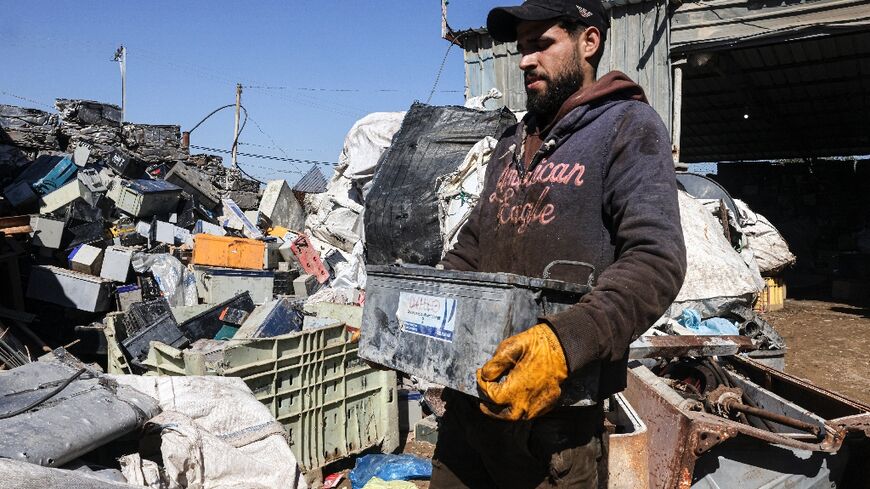
A Palestinian man picks discarded batteries to resell for recycling in the Gaza Strip; batteries are an essential power source in Gaza, where public electricity supply is sparse - SAID KHATIB

by Sakher Abou El Oun


March 9, 2022 — Gaza City (Palestinian Territories) (AFP)

At a landfill in southern Gaza, mounds of discarded batteries pile up, rusting cells that pose a growing health risk to Palestinians in the enclave.

Batteries are an essential power source in Gaza, where public electricity supply is sparse and infrastructure has decayed since an Israeli blockade of the enclave began in 2007, the year Hamas Islamists seized control.

"The batteries have been piling up for 15 years," said Ibrahim Baraka, who works at the 2,000 square metre (half an acre) landfill in Khan Yunis, where residents of surrounding houses can peer in to see piles of lead and mercury waste accumulating daily.

Gaza, home to 2.3 million Palestinians, has only one power plant that runs on diesel. Fuel deliveries are unreliable, largely due to the blockade. The plant was also bombed by Israeli fighter jets during a 2006 conflict with Hamas.

Mohamed Masleh, director of resources at Gaza's Environment Ministry, estimated that there are 25,000 tonnes of used batteries in Gaza that need to be recycled.

Most are at sites not suited for storing dangerous materials.

- A dangerous 'farce' -


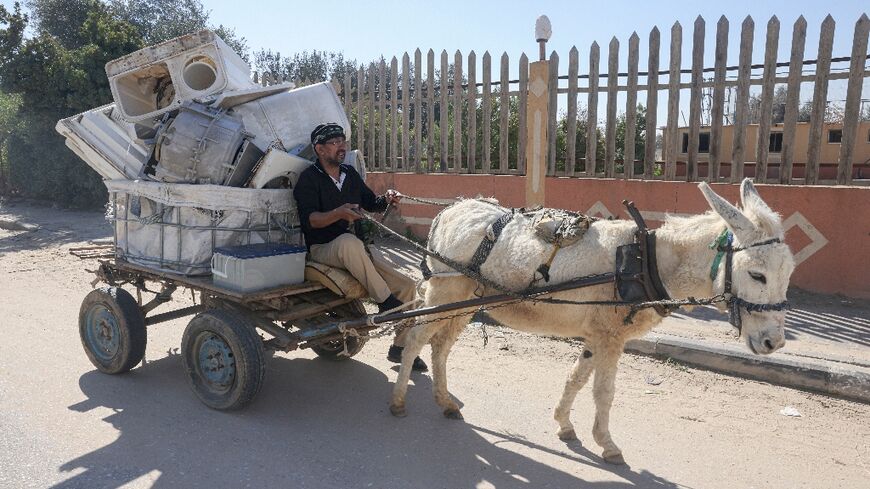
A Palestinian man collects discarded batteries for recycling in Gaza; battery collection is also a source of income for the impoverished territory, where unemployment rates hover around 50 percent

Battery collection is also a source of income for the impoverished territory, where unemployment rates hover around 50 percent.

On a crisp morning, Zakaria Abu Sultan meandered his horse-drawn cart through the streets of Gaza City, shouting his mission through a loudspeaker.

"Anyone with damaged batteries to sell?" he called out.

"I've been wandering since dawn to buy damaged batteries. I buy them at best for 50 shekels ($15), and sell them to the scrap dealer for 70 shekels," he told AFP.

Typically, damaged cells are taken to landfills, like the one in Khan Yunis where Baraka works, which dismantle them for materials like plastic that are then sold to factories.

Ahmed Hillis, director of Gaza's National Institute for Environment and Development, said that while he understood there was profit in discarded batteries, the trade was extremely dangerous.

"Tonnes of batteries are accumulating in dumps, some of which are more than 40 and 50 metres high," he said.

"Batteries are found among people and on animal carts, children are carrying them around," he told AFP.

"Sometimes we find a father and son trying to open them up with a screwdriver. It is a farce and chaos," he added.


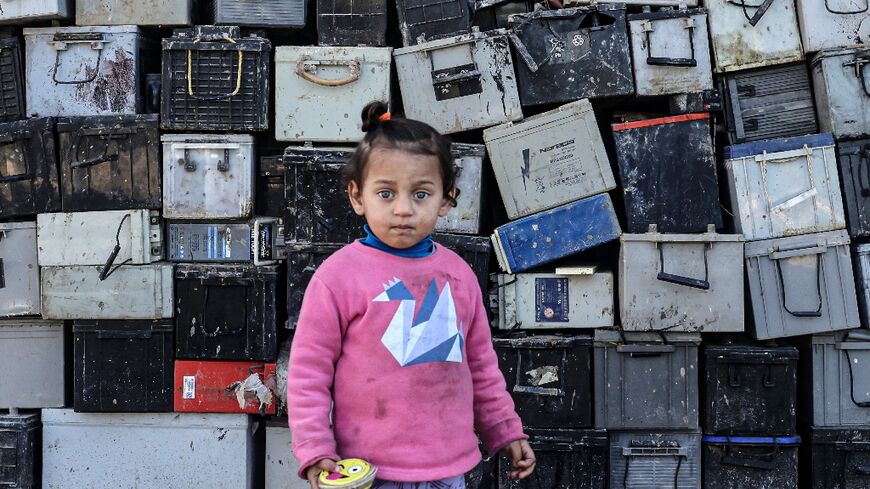
A Palestinian girl stands next to a stack of discarded batteries; Israel used to play a role in managing toxic materials from Gaza, but that stopped with the Hamas takeover in 2007

Israel used to play a role in managing toxic materials from Gaza, but that stopped with the Hamas takeover in 2007.

Hamas is considered a terrorist organisation by much of the West, and it has no direct contact with Israel.

Last month, the Israeli defence ministry body responsible for civil affairs in the Palestinian territories (COGAT) said that a second iron shredding machine had become operational at the Kerem Shalom crossing between Israel and Gaza.

The enhanced shredding capacity "will provide a significant increase in the export of iron scrap from the Gaza Strip", COGAT said.

Baraka said that had raised hope for a solution to battery waste, with most agreeing the current situation is not sustainable.

Hillis meanwhile urged Hamas to establish clear rules on handling toxic substances.

He said battery waste was now being managed by people "who do not comply with any rules and have no experience in collecting hazardous materials".

Read more: https://www.al-monitor.com/originals/2022/03/mounds-old-batteries-threaten-gaza-health#ixzz7N1uzd89R
Fukushima region forges renewable future after nuclear disaster


A gleaming field of solar panels now lines a coastal stretch north of the stricken Fukushima plant
 (AFP/Philip FONG)

Etienne BALMER and Harumi OZAWA
Tue, 8 March 2022, 

Solar farms along tsunami-ravaged coastlines, green energy "micro-grids" and the experimental production of non-polluting hydrogen: 11 years after its nuclear nightmare, Japan's Fukushima region is investing in a renewable future.

On March 11, 2011, an earthquake unleashed a deadly tsunami on northeastern Japan, triggering a meltdown at the Fukushima nuclear plant and forcing mass evacuations over radiation fears.

One year later, Fukushima's regional government set a goal of meeting all its energy needs with renewable power by 2040, a policy intended to help residents "reclaim" the place they call home, officials say.

Substantial progress has been made, in part thanks to hefty financial support from the national government.

Renewables accounted for 43 percent of Fukushima's energy consumption in fiscal 2020, up from just 24 percent in 2011.

But obstacles remain, from the higher cost for consumers to lingering concern over contamination.

"A strong desire to never see a repeat of such an accident was the most important starting point" for the green energy drive, Noriaki Saito, energy director at the prefecture's planning department, told AFP.

A gleaming field of solar panels now lines a coastal stretch north of the stricken Fukushima plant, in a location once earmarked for the region's third nuclear power station, a project abandoned after the tsunami.

Power from the site, which was completed in 2020 and is as big as 25 football pitches, is used to make hydrogen -- a clean fuel when generated with renewable electricity, and one that Japan hopes will help it reach its goal of carbon neutrality by 2050.

Fuel produced at the "Fukushima Hydrogen Energy Research Field" in Namie has so far been used for small-scale purposes including at the Tokyo Olympics last year, and to refill locally run fuel-cell cars.

"In the near future, much more renewable energy will come to the grid" in Japan, said Eiji Ohira of NEDO, the public research body managing the facility.

The site aims eventually to draw renewable energy from the national grid on days when there is surplus production nationally, helping reduce wastage while generating new green hydrogen, he told AFP.


Fukushima region forges renewable future after nuclear disaster
John SAEKI


- 'Double-edged sword' -


The Fukushima region already had hydroelectric dams, but wind farms are appearing in its mountains, biomass power plants are being constructed and solar fields have sprung up on land abandoned after the tsunami.

Not everyone in the region has been won over, however.

Price is still a sticking point, according to Apollo Group, a small energy provider in Fukushima that has bolstered its renewable offerings in recent years.

The price of solar-generated electricity is "a little higher" than conventional power, said CEO Motoaki Sagara.

"When we explain this to our customers, they often say they prefer cheaper electricity. I feel like the understanding is still not there," he told AFP.

Public subsidies gave Apollo impetus to switch, but Sagara calls them a "double-edged sword", because businesses like his may come to rely on the cash and struggle without it.

- Micro-grids -

Another renewables project hoping to win over residents involves "micro-grids", where electricity is produced and consumed in the same place.

Katsurao, a small village near the Fukushima plant, was evacuated because of radioactive contamination between 2011 and 2016 and now has only 450 residents, less than a third of its former population.

A former rice field, used to store radioactive materials when workers conducted dangerous early decommissioning work, now hosts a solar farm whose electricity is routed directly to the village.

The project has been operational since 2020 and Seiichi Suzuki, vice-president of Katsurao Electric Power, calls the village Japan's "first autonomous community with a micro-grid".

"The villagers... expressed a strong desire to live with natural sources of energy" when they returned to their homes following lengthy evacuations, he said.

For now, the solar farm only covers 40 percent of the village's average yearly electricity needs, and the spectre of the nuclear disaster hangs over other projects.

Some residents oppose a planned biomass, or plant waste, power station, fearing it could produce radioactive emissions if material from still-contaminated parts of the region is used.

But the solar farm has helped Hideaki Ishii, a worker in a family-owned restaurant and grocery store in Katsurao, feel more secure in his home, he told AFP.

"When you use electricity created in the community, it's easier to see how it's generated," he said.

"I feel safer that way," he said, and "it's good for the environment".

etb-oh/kaf/sah/mtp/leg


The price of solar-generated electricity is "a little higher" than conventional power, 
said CEO Motoaki Sagara 

Seiichi Suzuki, vice-president of Katsurao Electric Power, calls the village 
Japan's "first autonomous community with a micro-grid" 


Fuel produced at the "Fukushima Hydrogen Energy Research Field" 
in Namie has so far been used for small-scale purposes including at the Tokyo Olympics last year


Hideaki Ishii, a worker in a family-owned restaurant and grocery store in Katsurao 

PHOTOS BY  AFP/Philip FONG


Sudanese protesters face tear gas at Women's Day rally


Demonstration against the military coup, on International Women's Day in Khartoum
THE PROTESTER ON THE LEFT IS USING THE HUNGER GAMES THREE FINGERED SALUTE THAT HAS SPREAD FROM THAILAND PROTESTS  ,GLOBALLY.


Tue, March 8, 2022,

KHARTOUM (Reuters) - Sudanese protesters marching against military rule on International Women's Day were met with tear gas as they approached the presidential palace on Tuesday, a Reuters reporter said.

Women's rights groups had called the protest along with neighbourhood resistance committees that have been organising street demonstrations since the military took power in October.

The coup put an end to a power-sharing arrangement between civilians and the military that was struck after former President Omar al-Bashir who ruled for 30 years was toppled in a 2019 uprising in which women played a prominent role.

"Women's demands are the revolution's demands," said one protest banner. After the rally reached the presidential palace in the capital Khartoum, security forces chased protesters back into nearby streets.

The protest comes as Sudan faces economic free-fall. On Tuesday, the Sudanese pound was devalued by about 19% after its price had slid on the black market.

The coup has also resulted in the reversal of decisions made since Bashir's fall, and a crackdown in which political figures have been arrested and dozens of protesters killed.

On Tuesday, politician Babiker Faisal became the latest prominent former member of a committee tasked with dismantling Bashir's regime to be detained, his party said in a statement.

In recent weeks, courts have reversed the committee's firings of dozens of bureaucrats in the central bank, foreign ministry, and other entities.

Sudan's ruling council said on Monday that holds placed on some accounts by the committee would be lifted, while other decisions affecting more than 1,500 individuals and companies would be upheld while under review.

In a further sign of rolling back work done under the power-sharing government, the head of a committee investigating the lethal dispersal of a sit-in in June 2019 said he had suspended its work after security forces took over its offices.

(Reporting by Khalid Abdelaziz, writing by Nafisa Eltahir; editing by Aidan Lewis and Aurora Ellis)

Sudan arrests senior opposition leader amid protest crackdown


Tue, March 8, 2022,
WOMEN AND YOUTH LEAD THE SUDANESE PROTESTS FOR DEMOCRACY

Sudanese security forces arrested a senior opposition leader Tuesday, as officers fired tear gas to stop thousands of protesters rallying against last year's military coup, an AFP correspondent said.

The demonstrations were the latest since an October 25 military takeover led by army chief Abdel Fattah al-Burhan, which was followed by a broadening crackdown on civilian and pro-democracy figures in the north-east African nation.

At least 85 people have been killed and hundreds wounded by security forces during over four months of protests demanding civilian rule and justice for those killed in demonstrations, according to medics.

On Tuesday, security forces fired a barrage of acrid tear gas at crowds heading towards the presidential palace in the centre of the capital Khartoum, with several people injured, an AFP correspondent said.

Tuesday's protests coincided with International Women's Day.

Crowds chanted slogans in support of Sudanese women -- who have played a key role in the recent protest movement, as well as in the rallies that paved the way to the 2019 ouster of longtime autocrat Omar al-Bashir.

"Long live the 'Kandakas'," the crowd shouted, using the name for ancient Nubian queens.

In North Khartoum, many waved national flags or carried posters of fellow demonstrators who have been killed, witnesses said.

- 'Excessive force' -

Also on Tuesday, prominent politician Babiker Faisal was arrested while he was attending a funeral in North Khartoum, according to Sudan's Unionist Alliance.

Faisal was a member of the committee tasked with recovering properties seized during Bashir's three-decade long rule, before he was toppled and jailed.

Last month, several senior committee members were arrested, including Mohamed al-Fekki, who was also a member of Sudan's Sovereign Council before he was ousted in the October coup.

Since the military takeover, authorities have accused the committee of misappropriating funds that it confiscated, accusations its members deny.

The military power-grab derailed a transition to full civilian rule negotiated between military and civilian leaders following Bashir's ouster.

On Monday, the UN Human Rights Council said it estimated around 1,000 people have been arrested since the coup, including women and children.

"The Sudanese authorities must cease to use excessive force and live ammunition against protesters," said UN human rights chief Michelle Bachelet said, calling for the release of detainees.

Also on Monday, the ambassadors of the European Union, Canada and the United States slammed "attempts to unduly limit freedom of expression" in Sudan.

"We therefore call on the de facto Sudanese authorities to return to commitments made to defend media freedom ... and respect the right to peaceful assembly," the diplomats said.

On Tuesday, deputy chairman of Sudan's Sovereign Council, Mohamed Hamdan Daglo, met with African Union envoy Mohamed Lebatt to discuss the crisis in the country. The AU has suspended Sudan's membership since the coup.

bur/pjm

Tuesday, March 08, 2022

Brazil's Bolsonaro backtracks on 'menstrual poverty' row


Tue, 8 March 2022

A woman and a girl seen at Copacabana beach in Rio de Janeiro, Brazil, on December 31, 2021 (AFP/Daniel RAMALHO) (Daniel RAMALHO)

Brazilian President Jair Bolsonaro signed a decree Tuesday providing for free menstrual supplies for low-income women and girls, five months after drawing criticism for vetoing a similar measure.

The far-right leader signed the executive order at a ceremony on International Women's Day, two days before Congress was due to vote on overriding his veto.

Bolsonaro blocked the earlier legislation in October, arguing there was no funding to provide free menstrual supplies for more than five million low-income women and girls.

The new decree will be funded by a budget of 130 million reais ($26 million), according to the health ministry, but will reach fewer people -- an estimated 3.6 million.

"Menstrual poverty" is a major issue in Brazil, where women unable to afford tampons and pads often resort to scraps of cloth, diapers, bread or whatever else they can find when they get their periods.

A lack of menstrual supplies keeps one in four girls home from school each month, according to a 2021 report by a United Nations Foundation program called Girl Up.

Bolsonaro has been criticized for a history of remarks condemned as anti-women, including telling a congresswoman in 2014 she was "not worth raping" because she was "too ugly."

"When we speak of women, we must also speak of the family.... Respect above all, and the preservation of family values," he said at Tuesday's signing ceremony.

"You are beyond essential, you are indispensable for the future of this great nation. May you continue participating more and more with us in building it."

He added that if women decided, "we would have no wars in the world."

Bolsonaro is also due to speak Thursday at a privately organized event on promoting women's participation in politics.

However, it has been hit by backlash, as well, over the fact that all five speakers invited are men, including two of the president's ministers.

mls/jhb/md
Afghans promised safety by Canada have had agonizing, dangerous and long wait

Nearly seven months after Kabul fell to the Taliban, civilians who aided Canada's 13-year Afghanistan mission say their applications for government immigration programs have been ignored

Author of the article:Bryan Passifiume
Publishing date:Mar 08, 2022 
 
Half a year after they returned to power in Afghanistan, Taliban arrests of Westerners are growing in frequency. 
PHOTO BY WAKIL KOHSAR/AFP VIA GETTY IMAGES


Six months later, and he’s still wondering where Canada went.

For those whose service with Canada’s Afghanistan mission branded them traitors in the eyes of the Taliban, life has become a desperate game of hide-and-survive.

“We have no money, no home and no food,” said Qalandari, who asked he only be identified by his surname to protect his family.

“Our children are not going to school.”

Qalandari was one of the thousands of Afghan nationals who worked as an LEC — Locally-Employed Civilian — with allied forces during their respective missions in Afghanistan.

He was hired in the early 2010s by the Canadian Armed Forces as a heavy equipment operator and logistics specialist in Kandahar, a job he says he held for the balance of Canada’s presence in Afghanistan.

He continued to work in the field, supporting his wife and children, until Kabul fell to the Taliban last August.


Canada promised to take in up to 40,000 Afghan refugees. Where are they?


Thousands of Canada's allies and their families stranded in Afghanistan


Then, everything changed.

News that the Taliban was going door-to-door searching for “traitors and collaborators” — and Qalandari’s service with the Canadian Forces surely made him that in their eyes — sent him and his family underground, leaving behind their home for a life on the run.

“My children ask me every day, why the Canadian Armed Forces aren’t helping us,” he said.

“My wife sold her gold, this is the last of our money.”

Last August, Qalandari was relieved to see Canada had joined other allies in promising safe passage in exchange for past service, and he wasted no time signing up.

Other than an automated reply to an October email requesting an update on his application, that was the last he heard from Immigration, Refugees and Citizenship Canada (IRCC).

For the hundreds of Afghan families lucky to find new lives in Canada, thousands more continue to wait for word on their applications.

Canada’s efforts to evacuate both Canadians and Afghan nationals during last summer’s fall of Kabul have been roundly criticized as inadequate and dangerous.

While other nations either airlifted evacuees to safety or dispatched armed escorts to waiting flights, Global Affairs Canada largely left its evacuees to fend for themselves.

The Toronto Sun spoke with several evacuees last summer who say they were directed by GAC emails to wear red and present themselves either at the Kabul airport’s north gate, or later in the week to meet Canadian consular officials at a hotel.

Those who followed the instructions reported being turned away by soldiers at gunpoint, or even targeted by the Taliban, who got wind of Canada’s “wear red” edict and delivered beatings on anybody caught wearing red clothing.

My children ask me every day, why the Canadian Armed Forces aren't helping us

Canadians left stranded in Kabul reported being shocked to receive emails from GAC seeking consent to disclose their location to “local authorities.”

Since returning to power, the Taliban commenced a crackdown on what they consider to be foreigners meddling in their affairs.

On Monday, the Washington Post reported Nadima Noor — a 38-year-old Canadian woman who ran a small humanitarian organization in Afghanistan — was taken into custody last month after a Taliban raid on her office.

Her brother told the newspaper that while colleagues arrested alongside her that day were subsequently released, Noor remains in custody.

Taliban officials have so far refused to comment publicly on her case or even say what laws she’s accused of breaking.

Taliban arrests of Westerners are growing in frequency.

Citing a senior Taliban intelligence officer, the Washington Post reported a total of eight Westerners in Taliban custody — mostly British, but also at least one American.

For those who’ve helped desperate Afghans flee to safety, Qalandari’s story is an all-too-familiar one.

Chris Ecklund, founder of the Canadian Heroes Foundation who helped facilitate numerous rescues of Canadian Forces contractors and interpreters, said that for every family they’ve managed to help, untold others were left behind.

“A day does not go by where I don’t get an email or message from somebody,” he said.

“It never, ever stops.”

Ecklund organized teams in Afghanistan and secured money — sometimes spending as much as $100,000 per week — to rent homes, apartments and villas to use as safehouses, pay for visas and travel documents, and help usher entire families to freedom.

“This is something that’s going to go on for years and years,” he said.

Inquiries to Immigration, Refugees and Citizenship Canada went unreturned.

For Qalandari — and the others Canada left behind in Afghanistan — keeping one step ahead of the Taliban has become part of the daily routine, as is his fear that one day his family’s luck may run out.

“My life’s in more tension from the end of August until now,” he said.

“We’ve lost everything.”

• Email: bpassifiume@postmedia.com | Twitter: bryanpassifiume
Minneapolis educators go on strike, canceling school for more than 30,000 students

By Gregory Lemos and Dakin Andone, CNN 

Minneapolis educators began striking Tuesday after failing to reach a deal with Minneapolis Public Schools, canceling classes indefinitely for more than 30,000 students.
© Carlos Gonzalez/Star Tribune/AP 
Greta Callahan, president of the teacher chapter of the Minneapolis Federation of Teachers, talks to reporters Monday in Minneapolis.

The Minneapolis Federation of Teachers (MFT) and Education Support Professionals (ESP) are seeking "a living wage" for ESPs, "lowering class sizes, and for safe and stable schools," according to a post on the teacher union's Facebook page -- goals that were clearly spelled out Tuesday morning on picketers' signs outside Justice Page Middle School in South Minneapolis.

"We are going on strike tomorrow for the safe and stable schools that our students deserve," MFT President Greta Callahan said Monday at a news conference.

"We have continued to do so much more with so much less," Callahan said. "Those at the top of this district continue to hoard power -- continue to do so much less with so much more. And if we don't intervene, we believe that the Minneapolis Public Schools will cease to exist. We are in the fight for strong public schools for our city, for our students."

The union planned to march Tuesday afternoon to the Minneapolis Public Schools district office following a rally at the Minneapolis Public Schools Nutrition Center, according to the group's Facebook page.

Minneapolis Public Schools called news of the strike "disappointing" in an update on its website, but said "we know our organizations' mutual priorities are based on our deep commitment to the education of Minneapolis students."
The district has 31,598 students, 3,266 teachers and 1,223 education support professionals, per its website.

"MPS will remain at the mediation table non-stop in an effort to reduce the length and impact of this strike," the district said.

There had been no movement by mid-morning on the federation's demands, Callahan said.

National education leaders rally in Minneapolis

Among the striking teachers' supporters were high-profile leaders of national unions, including American Federation of Teachers President Randi Weingarten, who echoed the local unions' demands and called Minneapolis class sizes "way too high."

Weingarten pointed to neighboring St. Paul, where teachers had been poised strike before the Saint Paul Federation of Educators and Saint Paul Public Schools announced late Monday they had reached a tentative agreement on new contracts.

This was a "tale of two cities," Weingarten said, calling on Minneapolis school district leaders to "get to the table."

The National Education Association's 3 million members also stand in solidarity with Minneapolis teachers, that group's president, Becky Pringle, told reporters Tuesday morning. "And we will not stop until we ensure ... every single student has the resources they need and deserve," she said. "And the most precious resource are our educators."

All Minneapolis Public Schools classes for pre-K through 12th grade will be canceled "for the duration of the strike" starting Tuesday, the district said. Parents will need to arrange child care, the district said, because Minneapolis Public Schools can only provide child supervision on a limited basis because of limited staff.

Families can pick up meal bags daily with breakfast and lunch for their students at their school beginning Wednesday, the district added, and online learning activities will be available.
PUTTING A FACE TO PUTIN'S VICTIMS
Young Ukrainian volunteer killed delivering aid to dog shelter near Kyiv: ‘She was a hero’

By Ashleigh Stewart Global News
Updated March 8, 2022 


Young Ukrainian woman Anastasiia Yalanskaya was killed as she delivered food to a dog shelter in Kyiv.

As Russian troops closed in on the Ukrainian capital of Kyiv, Anastasiia Yalanskaya insisted she would stay, even while her friends and family fled around her.


The 26-year-old Ukrainian woman was delivering food to a dog shelter in Bucha, 30 kilometres outside Kyiv, on Friday when she was shot and killed alongside two men she had been volunteering with.

Yalanskaya’s friends and family say her car was deliberately targeted at close-range by Russian troops. Global News has been unable to confirm the circumstances of her death.

Friends do not know why she was targeted, but believe Russian troops are increasingly killing civilians at random as a way to scare the population into submission.

2:05 Ukrainians resist as Russia hammers major cities

“I asked her to be extra cautious. That nowadays, a mistake costs extremely much,” her husband Yevhen Yalanskyi says.

“But she was helping everyone around. I asked her to think of evacuation but she did not listen.”

Despite denials from Russian President Vladimir Putin, the number of civilian casualties in Ukraine is mounting – though the total number remains unclear.

As of March 1, the United Nations Human Rights Monitoring Mission in Ukraine said it has recorded 752 civilian casualties. The next day, Ukraine’s State Emergency Service said 2,000 civilians had been killed.

Friends believe she was killed at close-range

Yalanskaya had been delivering food to a dog shelter in Bucha that had been without supplies for three days. The town has been devastated by Russian bombardment. It is part of the line of Ukrainian defence as Russian troops make their push to Kviv.

Her final Instagram story, posted just hours before her death, shows her sitting in the backseat of a vehicle, smiling into the camera, beside bags of dog food.

Yalanskaya’s best friend, Anastasiia Hryshchenko, who evacuated to Vinnytsia, 250 kilometres southwest of Kyiv, raised the alarm about her friend after she hadn’t heard from her in several hours.

View image in full screenA photo of Yalanskaya and the volunteers she was killed alongside on Friday.

Hryshchenko says she had been in constant contact with Yalanskaya, due to dangerous areas around Kyiv where fighting has intensified in recent days, including the area where her friend was delivering food and medical supplies.

When Yalanskaya didn’t respond for several hours, she contacted the father of a man that Yalanskaya had been volunteering with. The trio were due to return to his house after their trip.

READ MORE: Ukraine’s Zelenskyy has survived multiple assassination attempts amid Russian war: reports

He told her he had found their car, riddled with bullets, not far from his house, Hryshchenko says. They had delivered the dog food and had almost gotten home.

The damage to the car indicated it was fired at from a close distance and from a “heavy weapon,” she says.

Though there has been no formal identification of her body, Yalanskaya was carrying her driver’s licence and has distinctive tattoos that were identified by friends. Her body, along with those of the two men she was with, remain at the man’s father’s house, because the fighting is so intense no one can get through, Hryshchenko says.

Yalanskaya and her husband Yevhen Yalanskyi. 
Yalanskyi says ‘she loved animals.’.

“Not being able to help her last journey is very painful for me,” Yalanskyi says. He and Yalanskaya were separated but remained extremely close, he says, a fact which other friends also spoke about. He is currently in Sri Lanka.

“She was one of the best human beings I knew. She was committed to help, to help her friends and relatives and whoever needed help,” Yalanskyi says.

“She loved animals. We had a dog and a cat. She was the best partner I ever had.”

'We will all be together soon, safe and at peace'

Yalanskaya, a job recruiter, had been keeping a daily blog on Telegram to inform her friends and family of her surroundings as she delivered aid around the region.

On Saturday, February 26, she wrote on the channel in Russian, after having spent the night sleeping in a parking garage due to bombing fears: “Now I realize even better how important it is to be able to just see the loved ones whenever you want.”

“We will all be together soon, safe and at peace. I believe in it.”

Yalanskaya’s friends say ‘the world needs to know she’s a hero.’.

In the preceding days, she chronicled her volunteer work and spoke of her talks with the Ukrainian Armed Forces at checkpoints, saying she was proud of being Ukrainian “for the first time in my life.”

On Tuesday, she wrote about helping a kindergarten in Brovary, just outside Kyiv, where 40 children were without food and diapers, as well as bringing aid to a military hospital and bringing food for volunteer dogs.

“We are not scared. We are united like never before. We help each other. We stand for hours at roadblocks and thank those who protect us,” she wrote. “We will win.”

On Wednesday, Yalanskaya wrote her longest post, detailing her thoughts and feelings from her week of volunteering.

2:11 Further Russian troop surge in Ukraine invasion

She spoke of needing to drive with the windows half-open to hear which side of the road the shelling was on and to “step on the gas” while driving past the forest.

Hryshchenko says Yalanskaya had told her the fighting was particularly intense around the forest.

“Do not slow down” signs must be obeyed, Yalanskaya wrote, otherwise “you can hear random sh_t exploding right next to the wheels.”

She wrote of visiting people to drop off supplies 20 kilometres from the fighting and 200 metres from the fighting.

READ MORE: Canadian troops in Latvia ready for ‘whatever we have to face,’ commander says

“The ‘hotter’ the location you are heading to, the more people there will be at the roadblocks trying to dissuade you from going. But when they see the determination in your eyes, they will wish you strength, they will thank you, and ask you to be careful.”

On Thursday, Yalanskaya outlined her plans for the next day — the day she would die.

“I am tired. Third day in the car,” she wrote. “Could not get to Irpin. They blew up the bridge where I went yesterday.

“Tomorrow we’ll try to enter from another side.”

'She was never prouder to be Ukrainian'

Yalanskaya’s friends are reeling after her death, though they are not surprised that she was killed helping people, as it was what she was known for.

Hryshchenko says Yalanskaya was a “kind and caring person” and “she could energize everyone around her.”

While people had asked her to evacuate for her own safety, Yalanskaya was “absolutely sure she was needed there,” she says.

Yalanskaya decided to stay in Kyiv as her friends and family fled, despite protestations from loved ones.

“She was a very good person, she was always helping everyone, she wouldn’t do anything else.”

Hryshchenko says civilians are now increasingly being targeted, especially around Kyiv.

“They’re just randomly shooting people. They see civilians and they just shoot them,” she says.

“They want people to be scared and horrified. But it only makes our people braver.”

Valeriia Gorska, a former colleague and friend, said “the world should know that she’s a hero.”

“She was helping people. She believed in people.

“I knew her three years ago, and I knew her now, and I saw a change in her recently. She was so strong. And she was never prouder to be Ukrainian.”


© 2022 Global News, a division of Corus Entertainment Inc.

Three Ukrainians ‘targeted by Russian forces’ after delivering food to animal shelter

Three Ukrainians in their 20s were killed after delivering food to an animal shelter in Bucha, a city west of Kyiv.
© Provided by National Post
 Anastasia Yalanska, 26, was killed on Friday. Her colleague told the Kyiv Independent that she was “very dedicated and upbeat, everyone loved her.”

Serhiy Ustymenko, 25, Maxym Kuzmenko, 28, and Anastasia Yalanska, 26, were driving in an SUV together, according to the Ukrainian publication the Kyiv Independent . They were returning from the shelter to pick up Ustymenko’s parents when they were fatally shot on Friday by soldiers in a Russian vehicle, witnesses said.

Ustymenko’s father, Valeriy, ran to the car but the passengers were already dead. Their bodies were brought to his basement, where they remain; They cannot be buried safely because there is constant shelling in the city.

Witnesses told the media outlet that the shots came from a Russian vehicle described as “either a tank or an infantry fighting vehicle.”

Photos of the victims were obtained by the Kyiv Independent. 
© The Kyiv Independent Maxym Kuzmenko, 28, was in an SUV that was fatally shot after helping to deliver food to an animal shelter. 
© The Kyiv Independent Serhiy Ustymenko, 25, was found dead by his father on Friday in an SUV. He was on his way to pick up his parents after delivering food to an animal shelter with Kuzmenko and Yalanska.

The Guardian also reported on the event, saying Yalanska’s car was believed to be “targeted by Russian forces.”

In a Twitter post, Andriy Piddubny, a colleague of Yalanksaya, said “it was not an accidental shot” and the “civilian car was shot at point-blank range.”
“The car was (obviously) civilian,” a friend of Kuzmenko, named Dmytro Zubkov, told the Kyiv Independent. “Maxym was wearing a hat with a pom pom. They didn’t look like the military at all.”

Russia maintains that their soldiers are not targeting civilians. However, in a statement on Monday, the United Nations recorded 406 civilian deaths and nearly double the amount of injuries in Ukraine.

In late February, Dmitry Peskov, who is Russian President Vladimir Putin’s press secretary, said the Russian military is not targeting residential areas in Ukraine, the Associated Press reported.


On Tuesday, the Vatican urged Russia to stop armed attacks on Ukraine and to guarantee humanitarian corridors.

A Vatican statement said Cardinal Pietro Parolin spoke on the phone with Russian Foreign Minister Sergei Lavrov.

Parolin also repeated the Vatican’s willingness “to do anything” to help bring about peace.

The statement said the cardinal told Lavrov that Pope Francis was “deeply worried” about the war.


Parolin appealed “that armed attacks stop and that humanitarian corridors be guaranteed for civilians and rescue workers and that the violence of weapons be substituted by negotiations,” the statement said.

Ukrainian civilians began leaving two besieged areas on Tuesday after Russia opened “humanitarian corridors” for them, but Kyiv said Russian forces had shelled an evacuation route from the port city of Mariupol.

Earlier, in its own statement about the call, the Russian foreign ministry said Lavrov set out Moscow’s position on the conflict in Ukraine.

Lavrov “outlined the principled Russian position regarding the causes and goals of the special military operation being carried out in Ukraine,” the Russian statement said.

Both parties expressed hope that a fourth round of talks between Moscow and Kyiv would be held as soon as possible to agree on the main problems underlying the crisis and to stop hostilities, the Russian ministry added.

Ukraine has said it would welcome Vatican mediation and Parolin, who ranks second to Pope Francis in the Vatican hierarchy, has said previously it is willing to “facilitate” dialog” between Russia and Ukraine.

Parolin has previously described the war as having been “unleashed by Russia.”

Francis has not yet blamed Russia by name publicly but has implicitly rejected Moscow’s use of the term “special military operation” for its invasion of Ukraine.

“In Ukraine, rivers of blood and tears are flowing. This is not just a military operation but a war which sows death, destruction and misery,” Francis said in his weekly address to crowds gathered in St. Peter’s Square on Sunday.

Francis has dispatched two cardinals to help distribute aid to refugees fleeing Ukraine and both have said they will try to enter the country.

The Vatican and the then-Soviet Union began a dialog in earnest after the fall of the Berlin Wall in 1989, with former Soviet leader Mikhail Gorbachev visiting Pope John Paul II that year.

Full diplomatic relations with Russia were established in 2009 and have been cordial.

Relations between the Vatican and the Russian Orthodox Church were at first spotty after the break up of the Soviet Union but have improved significantly in recent years.

In 2016 Francis became the first pope to meet a leader of the Russian Orthodox Church since the great schism that split Christianity into Eastern and Western branches in 1054.

With reporting by Reuters


GM ramps up EV push with plans to make battery materials in Canada


By Steve Scherer and Aishwarya Nair
© Reuters/Rebecca Cook FILE PHOTO: FILE PHOTO:
 Logo of GM atop the company headquarters

(Reuters) -General Motors Co and South Korea's POSCO Chemical will build a $400 million facility to produce battery materials in Canada as the carmaker ramps up plans to produce mainly electric vehicles (EVs) in the future, the companies said on Monday.

The plant will produce cathode active material (CAM) for vehicle batteries in Becancour, Quebec. Cathodes are the most complex and costly chemical component of an electric vehicle battery.

The cathode "represents about 40% of the cost of every EV battery cell," said Scott Bell, GM Canada's President and Managing Director, in a news conference. "We plan to have capacity by 2025 to build a million EVs in North America."

The plant's construction will begin immediately and the goal is to have it running by 2025. Once completed, it will create an estimated 200 jobs, according to a statement. GM aims to produce light vehicles that run exclusively on electricity by 2035.

The CAM produced at the plant will be used to make GM's Ultium batteries that will power the company's EVs, such as the Chevrolet Silverado EV, GMC HUMMER EV and Cadillac LYRIQ. GM's Ingersoll, Ontario, factory will launch EV production later this year, Bell said.

Both Canada's federal government and Quebec's provincial government are working with GM and POSCO Chemical, the companies said, though details were not released.

Rich in key materials for EV battery production - including lithium, graphite, cobalt and nickel - Canada has been wooing battery makers to safeguard the future of its car manufacturing industry as the world seeks to cut emissions.

It is the second CAM plant announcement for Becancour in less than a week. On Friday, BASF SE said it was planning one there, too.

Canada's Industry Minister Francois-Philippe Champagne said that Becancour will become a hub for the country's EV battery "ecosystem". More "good news" is on the way, Champagne said, adding that there were "very live discussions" under way about building a battery factory in Canada.

"Starting from this announcement, we will be integrated in the global supply chain for cars in North America," Champagne said.

(Reporting by Aishwarya Nair in Bengaluru and Steve Scherer in Ottawa; Editing by Shinjini Ganguli and Aurora Ellis)

GM and POSCO to build plant in Quebec to produce battery material

Quebec was chosen for facility because of several

advantages, says GM representative

David Paterson, vice-president of corporate affairs for GM Canada, says environmental standards, great logistics links and a well-educated workforce are some 'reasons why we chose Quebec.' (CBC)

General Motors Co. and South Korea's POSCO Chemical have announced a deal to build a plant in Quebec to produce material for batteries to be used in electric vehicles (EV).

The companies say the new facility in Bécancour, Que., will cost $400 million US. Bécancour is just south of Trois-Rivières, Que.

It will produce cathode active materials (CAM) for GM's Ultium batteries. 

"It is so exciting to see GM Canada and Quebec playing a key role in building the emerging 'mines to mobility' EV battery ecosystem in North America,'' Scott Bell, president and managing director of GM Canada, said in a news release.

CAM consists of processed nickel, lithium and other materials, and will ultimately help power electric vehicles such as the Chevrolet Silverado EV and GMC Hummer EV.

CAM represents almost 40 per cent of the cost of every EV battery.

Site preparation and construction are scheduled to begin immediately and will create around 200 jobs.

This announcement comes after GM and POSCO agreed to form a CAM-processing joint venture in December and build a factory in North America.

The companies also say the site will be built to allow for future expansion. In November, POSCO announced plans to acquire a 15 per cent stake in Chinese EV battery material producer Inner Mongolia Sinuo New Material Technology Co.

Quebec was chosen for this facility because of several advantages, according to David Paterson, vice-president of corporate and environmental affairs at GM Canada.

"Quebec's low greenhouse gas (GHG), low-cost electricity is really important,'' he said in an interview.

"In addition to its environmental standards, great logistics links and a well-educated workforce are some of the other reasons why we chose Quebec.''

GM is also gearing up to launch Canada's first full electric vehicle manufacturing plant in Ingersoll, Ont., later this year.