Monday, November 07, 2022

U.S. Latinos contributed trillions of dollars to the economy in 2020. So why are they so underserved by financial services?

Emma Ockerman - Yesterday 

When it comes to banking, Mireya Olvera knows that Latino consumers want to feel understood — or, at the very least, like the person on the other end of the interaction respects them.


Related video: Hispanic Americans views on wealth gaps and the economy
Duration 2:23   View on Watch

She’s been in that vulnerable position before. Olvera immigrated to the United States from Mexico 27 years ago and, despite growing up with a father who worked for a financial institution, she remembers how she felt afraid to visit banks, because of both a language barrier and her concerns that she wouldn’t grasp how accounts and loans worked in the U.S.

Today, she’s an area manager at a branch of the Notre Dame Federal Credit Union in South Bend, Ind., where she serves a largely Latino community. And to Olvera, truly providing for that population means offering free financial classes, plenty of patience, and ample bilingual services; though U.S.-born Latinos are overwhelmingly proficient in English, only 37% of Latino immigrants speak English proficiently, according to the Pew Research Center.

Her credit union also offers loans with rates of 12.99% to help cover the immigration fees and legal expenses associated with coming to the U.S., as well as mortgage loans for immigrants who only have an Individual Taxpayer Identification Number, rather than a Social Security number. Without that kind of opportunity, immigrants may face higher rates, she said.

“Once we open the doors for the Hispanic community, and once we give them opportunities, they will always be committed to paying on time,” Olvera said.

The Hispanic population in the United States has grown precipitously in the past several decades to reach at least 62.1 million people, largely owing to immigrants and their descendants. They’re also a critical component of the U.S. labor force, as well as the country’s small-business ecosystem: A 2020 research report from the Stanford Latino Entrepreneurship Initiative found that the number of Latino-owned businesses had increased by 34% over the past decade, compared to 1% for all other small businesses.

What’s more, Latinos had a total economic output of $2.8 trillion in 2020, according to a September report from the Latino Donor Collaborative in partnership with Wells Fargo That means if they were their own independent nation, they’d have the fifth largest gross domestic product in the world, behind Germany, Japan, China and the United States, the report said.

Many Latinos are plenty knowledgeable of how the financial system works, one analyst said — they’re just more likely to be discriminated against within it.

Yet despite being an economic powerhouse in their own right, Latinos remain woefully underserved in the financial realm, advocates say: 9.3% of all Hispanic people in the U.S. were unbanked in 2021 — down from 12.2% in 2019, but still substantially higher than the 2.1% of white people who remain unbanked, according to a survey from the Federal Deposit Insurance Corporation.

There also remains a significant — albeit narrowinggap between Latino people and white people when it comes to homeownership, as well as disparities in wealth, inheritance, education and income, according to the National Community Reinvestment Coalition.

It’s no surprise, then, that Latinos also are far more likely to report that they’re dissatisfied with banking and financial services when compared to their white peers, according to a December 2021 report from McKinsey & Company.

“We have a financial system that has been structured in such a way that incentivizes some of these inequities that we see, where minority populations don’t have access to the tools that the white majority has had access to, through which they have built their wealth,” said Pablo DeFilippi, the executive vice president of Inclusiv, a network of 500 credit unions that have been certified as community development financial institutions and minority depository institutions.

In an effort to remedy that, the Inclusiv network’s members try to pave a nontraditional path when it comes to banking. Many provide mortgages to people who have an Individual Taxpayer Identification Number instead of a Social Security number, DeFilippi said. Member credit unions also provide credit-builder loans so customers can eventually access other services they might not qualify for otherwise.

Larger banks haven’t really caught up in offering those kinds of services, he said.

“We like to talk about financial inclusion as being not just sustainable, but as a driver of growth for financial institutions, especially small and mid-sized institutions,” DeFilippi said. Financial literacy

Financial technology companies have also been stepping up to create products with Latinos specifically in mind. SUMA Wealth, for example, is a digital platform for young U.S.-born Latinos that Beatriz Acevedo, the company’s co-founder and CEO, worked to create during the pandemic after she saw how the community was struggling economically, all without the sorts of culturally relevant resources that could help them.

Now, the platform’s community is 615,000 strong, she said. The company provides free financial education, as well as an app that can provide personalized financial coaching and advice in a way that might feel more accessible to young Latinos. (The basic app, which helps track users’ savings and debt-to-income ratios, among other features, is free, while the personalized aspect that comes with targeted insights and robo-coaching has a subscription fee of $14.99 a month.)

SUMA Wealth is also partnering with employers to provide its premium product as a benefit, she said.

“For me, success means that we really helped move the needle when it comes to closing the wealth gap in our community, and not so much just having a high valuation for my company,” Acevedo said. The role of industry and government

Still, while there have been valuable conversations around financial literacy and education as a means of bringing more Latino consumers into the fold, those can only go so far, according to Susana Barragán, an economic policy analyst at UnidosUS, a Hispanic civil rights and advocacy organization. Many Latinos are plenty knowledgeable of how the financial system works, Barragán said — they’re just more likely to be discriminated against within it. It will take both industry and government to fix that, she added.

“When we look at credit scores or access to credit in general, Latinos really show a high understanding of how the credit system works,” Barragán said. “Yet they have much lower credit scores than the national average, they’re much more likely to get denied access to credit, and they’re much more likely to be ‘credit invisible,’ meaning that they have absolutely no recorded credit with any of the credit reporting agencies.”

A survey of 1,200 Latinos in Arizona, California and Texas, commissioned by UnidosUS and published last month, showed that 20% of Latinos lacked any credit history, while only 56% had a credit card, compared to a national rate of 84% among adults. When it came to getting extra cash to cover basic living expenses, 32% of Latinos said they primarily relied on loans from friends or family, according to UnidosUS.

Olvera also said that addressing these issues has to go beyond offering basic bilingualism and good customer service: People in the financial-services industry need to be willing to stick with their customers for the long haul, offering compassion and understanding throughout their financial journey. Bilingualism can’t be limited to just bank-teller communications either, Barragán added: A 2017 report from the Consumer Financial Protection Bureau noted that many financial institutions reported only offering written contracts and agreements in English.

At one point in her career, Olvera said, she encountered two credit-union members who were married and had saved for years and years to purchase a house — but all of their savings were in cash, and they had no credit history. They’d also taken Olvera’s financial-literacy classes.

Olvera told the couple they had to establish credit. Two years later, they were able to apply for a mortgage and purchase a home.

“Most of those stories make me feel like we have a purpose here to keep coming to work,” Olvera added.
A decade of legal weed

Kerri Sandaine, Lewiston Tribune, Idaho
Sun, November 6, 2022

Nov. 6—Ten years ago today, Washington voters gave the green light to legalizing the sale of recreational marijuana.

Love it or hate it, it's the law.

At the local level, the move sparked contentious city council meetings in Clarkston and Pullman before a limited number of shops were allowed to open their doors a few years later. Months of heated discussions in both jurisdictions drew record-sized crowds to city halls.

After moratoriums were eventually lifted, the legal marijuana business started booming on the Palouse and in downtown Clarkston. However, cities and counties still aren't receiving much of the tax revenue.

Marijuana is certainly big business in Washington. According to state figures, there was nearly $1.5 billion in retail sales in fiscal year 2021, which generated an additional $553 million in excise taxes. Of that tax money, only $15 million went to county and municipal governments; the rest filled the coffers of the state government.

During fiscal year 2021, retail marijuana sales in Asotin County totaled more than $15 million while the county and cities collected $75,088 in excise tax money. Whitman County had more than $13 million in retail sales and its entities received $133,686 in excise tax money. Garfield County doesn't have a marijuana store and doesn't get any of the tax money.

The businesses aren't causing any major upticks in crime, but law enforcement officials worry about the message it sends to kids, increases in impaired driving and the potential psychological effects of higher concentrations of THC, the psychoactive component in pot.

Marijuana advocates and store owners point to the benefits of their products, saying they are safer than what's sold on the black market and helping people deal with a wide array of ailments.

Matt Plemmons, owner of Greenfield Company in Clarkston, said the fastest growing group of customers are senior citizens. Some have used marijuana in the past, but many are newcomers seeking health remedies.

"Legalization has opened the minds of a lot of residents who questioned marijuana in the beginning," Plemmons said. "Our biggest demographic has grown in the 60-to-90 age group. They've bravely come through the doors of the shop and experienced the product for themselves."

When the businesses opened, owners in states where it is legal weren't allowed to use traditional banks because marijuana is still prohibited on the federal level.

Plemmons said that issue has since been resolved. Armed delivery services transport cash for all retail shops now. He uses Timberland Bank in Auburn for his Sweet Releaf shop in Mt. Vernon, and Numerica Credit Union in Spokane for Greenfield.

"Both shops also utilize a debit card 'cashless' ATM at the point of sale for customers who don't use cash," he said.

The shops in Clarkston and Pullman have the advantage of being located next to a state where marijuana can't be sold legally. There's no doubt that Idaho residents are helping the bottom line in both cities.

Lewiston Detective Cpl. Cody Bloomsburg said his department has "definitely seen a rise in the amount of people with marijuana" since it was legalized across the river.

"I was on patrol when marijuana was still illegal in Washington, and I feel like after it was legalized, there were a lot more traffic stops that yielded marijuana. It's much more common now."

What worries police is how concentrates, which are products that contain increased levels of THC, can affect people. Bloomsburg said he's seen several cases where younger people have used strong doses of THC, such as "dabs," and the results weren't pretty.

"I can specifically think of a young man who ended up on the fifth floor (of St. Joseph Regional Medical Center) and then he broke out, and the entire episode was caused by concentrates with higher THC levels. We still don't know all of the effects those have psychologically."

Longtime Pullman Mayor Glenn Johnson remembers when Floyd's, a popular shop near the state line and University of Idaho, would pick up customers in a bus. "I haven't seen that lately," he said. "The shops closest to the Washington State University campus also seem to have a "rather busy clientele."

The city of Pullman treats marijuana stores like any other business, Johnson said. Each year when the Washington State Liquor and Cannabis Board issues license renewals, he sends a notice to police, fire and a community development director to see if there are any problems with the stores.

So far, no concerns have been reported, Johnson said.

"Still to this day, we have some residents who don't like it, and another larger population that accepts it," Johnson said. "So far, there's been no reported increase in criminal activity because of it."

However, cities and counties aren't seeing much benefit financially from the profitable trade of legalized marijuana.

"Like any city in Washington, we would like to have more of the tax revenue," the mayor said. "This has been on the Association of Washington Cities' legislative agenda for years, along with the city's."

Whitman County Sheriff Brett Myers said when marijuana was legalized, law enforcement agencies were promised tools to detect impaired drivers, but the state never delivered.

"That makes it really, really hard for law enforcement," he said. "There's no doubt there's more impaired people on the road. It's just harder for law enforcement to detect in a way that will hold up in court."

Myers, who has been in law enforcement for 25 years, said even before it became legal, his department primarily targeted people trafficking in marijuana rather than small possession cases.

"Marijuana was already here, so it's not like this is a new thing," Myers said. "Legalization is a new approach that allows people to use it more openly. Now you can smell marijuana in public spaces."

Myers said if he ran random urine tests at the Whitman County Jail, the results would show how prevalent it's become.

"I bet about 95% would test positive for THC," he said, "and most of them would show they'd used it in the last two or three days. ... The number of mental health patients has skyrocketed in jails across the state of Washington, and the levels of THC have gone up as well. There is some incredibly potent marijuana out there now."

Studies and surveys indicate some alarming trends in states that have legalized the sale of recreational marijuana, he said. For example, the number of drivers who die in car wrecks with THC in their systems has doubled, and more Washington high school kids are reporting marijuana use.

"The sad thing is the message it sends to our youth," said Myers, who also serves as the commander of the Quad Cities Drug Task Force. "We don't want any of our children using drugs, but it almost seems like we've put our stamp of approval on it."

Clarkston Police Chief Joel Hastings agrees the biggest concern and issues now are access to minors and people operating motor vehicles under the influence.

"The legal marijuana industry is still relatively new, and the black market continues to operate. Reducing black market operations in our state is a work in progress," Hastings said.

"The marijuana retail outlets are extremely regulated and have been good at securing their stores against theft and burglary," he added. "Each store is subject to compliance checks by the Washington State Liquor and Cannabis Board. I am unaware of any cases of marijuana being sold directly to minors at our local stores. When we find marijuana on juveniles, it has often come from home or the black market."

One thing that has widespread agreement is that youth should not be exposed to marijuana use, Hastings said. The Clarkston Police Department is involved in prevention efforts and is a participant in the EPIC (Empowering People and Inspiring Change) coalition. EPIC leads community programs to increase youth connection to family, friends and community. Its primary goal is to minimize the likelihood that our youth will develop short- and long-term physical and emotional problems as a result of substance abuse.

"Statistically, driving under the influence of marijuana has been trending upward," Hastings said. "Drivers should know that driving under the influence of marijuana is dangerous and can lead to increased crash risk. Law enforcement has been working toward improving detection and processing of DUIs involving marijuana."

Kelly Jackson, of Asotin, is the former owner of Canna4Life and one of the advocates who attended Clarkston City Council meetings in support of allowing retail shops in the downtown corridor.

"For me, it was very personal because cannabis tinctures have controlled my chronic asthma. The expensive pharmaceutical drugs I used to take didn't work, and cannabis does at a fraction of the cost," Jackson said.

He and other retailers believe legalization has increased the safety of the products now sold in shops across the state of Washington.

"Legalization has taken an uncontrolled black market product and made it safer for consumers, because all cannabis sold in state-licensed stores must adhere to state-controlled testing labs," Jackson said.

"We will always be proud of bringing a safer product to our community with so many health benefits. If we could change one thing, it would be to increase how much of the taxes remain in our town so our elected officials could use the money instead of the state controlling all of the revenue."

Sandaine can be reached at kerris@lmtribune.com.
Republican Sen. Dan Sullivan of Alaska is the latest member of Congress to violate a federal conflicts-of-interest law with improperly disclosed stock trades


Dave Levinthal
Sun, November 6, 2022 

Republican Sen. Dan Sullivan, 

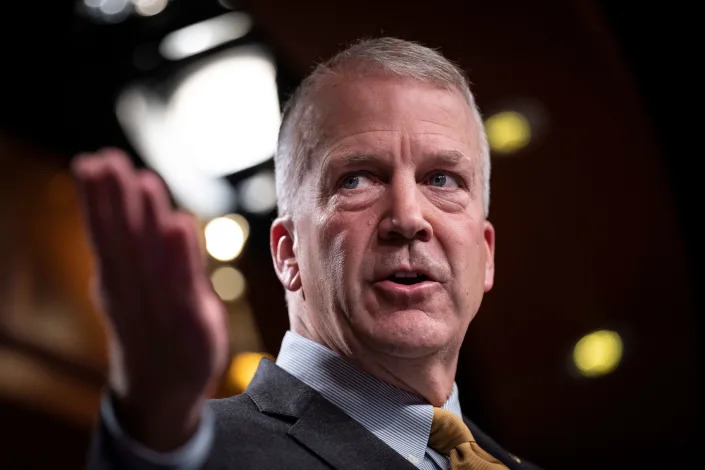
Sen. Dan Sullivan, a Republican from Alaska, was weeks late disclosing two stock sales.

Sullivan's office told Insider that an investment manager was tardy informing the senator that the stock had been sold.

Since 2021, 75 members of Congress have violated the Stop Trading on Congressional Knowledge Act's disclosure provisions.


Republican Sen. Dan Sullivan of Alaska violated a conflicts-of-interest and transparency law by failing to disclose two stock sales until weeks past a federal deadline.

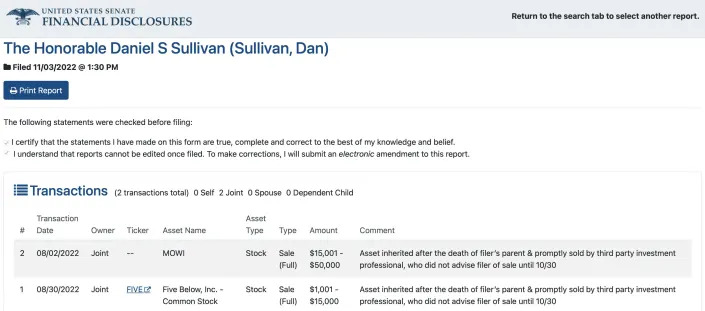
Sullivan affirmed in a financial disclosure filed with the US Senate that he inherited and sold $15,000 to $50,000 worth of stock in Mowi, a seafood company, on August 2, and $1,001 to $15,000 worth of stock in Five Below Inc., a discount store chain, on August 30.

But the senator did not publicly report the sales until November 3, well past a 45-day stock trade disclosure specified in the Stop Trading on Congressional Knowledge Act of 2012.

Congress created this law to curb insider trading among lawmakers and provide the American public with more information about public officials' personal financial dealings — and dozens of lawmakers have since violated it.

A personal financial disclosure filed on November 3, 2022, by Sen. Dan Sullivan, a Republican who represents Alaska.US Senate

In a statement to Insider, Sullivan spokesman Mike Reynard said that Sullivan wasn't aware of the sale of his stock until after a federal disclosure deadline had already passed.

"The two assets were inherited after the death of the Senator's parent and were promptly sold by the third party investment manager, who did not advise the senator until October 30," Reynard said.

Sullivan's mother, Sandy Sullivan, died in 2019, and his father, Tom Sullivan, died in 2020.

"As soon as the senator was made aware of the sale, the necessary steps were immediately taken" to file disclosure paperwork with the US Senate Select Committee on Ethics, "which has acknowledged receipt," Reynard said.

Reynard did not reply to a question about who the third-party investment manager is or why the investment manager didn't inform the senator of the stock sales until after a federal deadline for publicly disclosing the sales.

A potential stock trade ban in Congress

Since 2021, Insider and other media organizations have identified 75 members of Congress — a cross-section of Republicans and Democrats, leaders, and back-benchers — who've violated the STOCK Act's disclosure provisions by failing to properly report their various financial trades or holdings.

Two of those members — Democratic Reps. Bill Keating of Massachusetts and Lloyd Doggett of Texas — violated the STOCK Act within the past week.

Insider's ongoing "Conflicted Congress" project, along with reporting from The New York Times, Wall Street Journal, and Sludge, have also found numerous examples of financial conflicts of interests among federal lawmakers, judges, and executive branch officials.

Calls for reform have come from numerous quarters inside and outside of Congress. And in September, after months of deliberations, dickering, and delay, Democratic House leaders — backed by Speaker Nancy Pelosi — unveiled a bill that would ban members of Congress, as well as many other top government officials, from trading individual stocks. It would also strengthen the generally weak penalties for violating the STOCK Act.

But some Democrats and Republicans alike, as well as government reform groups, immediately lambasted it, either arguing that the bill is too broad or too riddled with loopholes, such as allowing lawmakers to create blind investment trusts that they don't consider truly blind.

House leadership ultimately punted on voting until after the midterm elections, meaning it'll be mid-November before debate on the stock-ban bill resumes in earnest.

Sullivan's office did not respond to Insider's question about whether the senator supports or opposes the House leadership bill.

Read the original article on Business Insider
After Years of Trump-Russia Denials, Putin’s Enforcer Admits Election Interference

Barbie Latza Nadeau
Mon, November 7, 2022

Misha Japaridze/Reuters

After adamantly denying interfering in the 2016 U.S. election that brought Donald Trump to power, a Kremlin insider has admitted that suspected Russian interference in American elections was real. “We have interfered, are interfering and will continue to interfere,” Yevgeny Prigozhin, a chief ally and favorite chef of Vladimir Putin said on Russian social media through his Concord Catering company on Monday. “Carefully, precisely, surgically and in our own way. During our pinpoint operations, we will remove both kidneys and the liver at once.”

The remark, made on the eve one of the most important elections in recent history as American go to polls for midterm elections Tuesday, did not immediately garner comment from Democrats or Republicans.

Prigozhin is the first Russian close to Putin to admit what the FBI has long suspected: that Russia interfered in U.S. elections.

The Russian who orchestrates Putin’s private army—the Wagner group—did not specify which election the Russians have intervened in, but he is well aware that there has been intense focus, and several indictments, surrounding Russia’s alleged efforts in the election of Trump, when there was reason to believe that Kremlin wanted the former reality TV star to be victorious.

It has been reported that Russian agents dug deep, probing voter databases for insecurities and even hacking Hillary Clinton’s campaign to try to swing the vote towards Trump.

During the election campaign, Russian operatives are suspected of hacking the Democratic Congressional Campaign Committee and the Democratic National Committee and even trying to hack the Republican National Committee. The FBI also contends they spread propaganda on social media, including Twitter, Facebook, YouTube and Instagram and staged fake rallies in the swing states Florida and Pennsylvania.

‘Putin’s Chef’ Suddenly Has a Lot to Say About Twisted New War Effort

Prigozhin did not elaborate on the extent of the interference, or if the FBI was right when they indicted him and a dozen other Russians in 2018 as part of the Mueller investigation for operating a covert social media campaign, nor if Russia was behind setting up fake meetings with Trump associates that included a promise of a Trump Tower in Moscow.

The Justice Department under Trump eventually tried to get the charges dismissed since the two main companies named—Concord Management and Consulting LLC and Concord Catering—had no fiscal presence in the U.S. and that trying them would potentially lay bare some investigative secrets.

Prigozhin, who has been slapped with sanctions from the U.S., U.K., and E.U., also admitted in September that he founded and funded the Wagner mercenaries that fought in Syria and African and who are now operating for Russia in Ukraine after denying involvement for years.

In July, the U.S. offered a $10 million award for information on his “engagement in U.S. election interference.”

De Sousa leaves his seat and the leadership of the Communist Party of Portugal

The secretary general of the Communist Party of Portugal (PCP), Jerónimo de Sousa, announced this Sunday that he is stepping down from his seat and the post of secretary general of the PCP, which he had held for 18 years.


Archive - The general secretary of the Portuguese Communist Party (PCP), Jerónimo de Sousa - 
PCP© Provided by News 360

"There is a qualitative alteration of my capacities and taking into account the dimension of our bench, an absence does not come well," said De Sousa in a press conference picked up by the 'Diário de Notícias'. "We need to reinforce ourselves. We are going to reach an alternative to give strength and dynamism to the PCP", he added. De Sousa stressed that it was "a decision of his own".

Duarte Alves will replace De Sousa in the National Assembly, while Paulo Raimundo will be in charge of the leadership of the party after the decision of the Central Committee scheduled for next Saturday.

"I have participated in a long process of 18 years and as secretary I have always tried to do my best (...) with ethical values of honesty, openness and fraternity," he said.

De Sousa has also emphasized that he leaves his responsibilities "with his head held high". "I have known defeats, victories, setbacks", he answered when questioned about the trajectory of declining electoral results.

The PCP is now in the opposition with six seats after the recent absolute majority achieved by the Socialist Party of Portugal, but in the previous legislature it was key to support the Socialists in a minority government baptized as the 'geringonça' or "botched job" that brought together Socialists, Communists, ecologists and Left Bloc.
Israeli reporter resigns after 40 years: 'Freedom of press at risk'


By JERUSALEM POST STAFF - Yesterday

Israeli journalist Rina Matzliach announced that she was resigning on Sunday after nearly 40 years in the press, stressing that she was worried about the state of freedom of press in Israel.


Channel 12 news anchor and journalist, Rina Matzliach at a conference of the Israeli Television News Company in Jerusalem on March 7, 2021
© (photo credit: YONATAN SINDEL/FLASH90)

"I retire wholeheartedly, with great sadness and concern," wrote Matzliach in a letter to the employees of N12, where she served as an anchor on the Meet the Press show. "In my entire adult life, I did nothing but be a journalist. For years, this profession defined me and I enjoyed every moment."

"I have fulfilled dreams that I did not dare to dream. I also broke a few glass ceilings. But that's it, it's time to say goodbye," added Matzliach. "I feel like I need a rest. I'm also, and perhaps mainly, tired of my field of coverage: politics. I'm no longer excited to come to the Knesset and I'm not really excited to interview another minister and another member of the Knesset."

The N12 anchor referenced threats she received while working as a journalist, including what she called a "very severe personal attack" against her about two years ago.

"I wasn't scared by the letters threatening my life, and I cleaned my cell phone of the thousands of hateful messages that were also addressed to my late beloved parents. But over time I realized that after all I was left with a severe scar," wrote Matzliach. "The attackers, who were organized and activated by political forces, did not scare me. I continued to speak my mind, but something in me broke."


Israeli journalist Rina Matzliach (credit: MOSHE SHAI/FLASH90)

"I have learned in recent years that there are two political camps in Israel. One actively wants to harm the free and independent press, and the other at best, 'doesn't deal with it,' and at worst, tries to silence journalists from the opposite camp," added the reporter.

Addressing fellow journalists, Matzliach stressed "Your profession is journalism - but your mission is to protect the freedom of the press and freedom of expression. I told you about the terrible attack I went through. I did not for a moment consider suing any of the attackers who defamed me. I thought, and I still think so today, that we journalists need to grasp the most expansive meaning of freedom of expression because this is the obligatory derivative of our work."

"I'm sure that some of you are asking yourselves now - what is she talking about? Who is stopping us from speaking our minds?" added Matzliach. "The damage to the freedom of the press is not direct, but the intensification of competition often leads to rounding corners, to stretching professional principles, not being precise in the rules of ethics, fear of shaming on the networks, fear of damaging sources, all of this weakens the independence of the journalist. I believe that every journalist should grow a backbone because only this will guarantee them long-term success."

Past controversy surrounding Matzliach

In 2020, Matzliach was suspended by N12 for a week after stating that “Netanyahu supporters say they would still vote for him if he raped their daughter.”

The comments sparked outrage, with Netanyahu stating at the time "Your sick hatred for Likud voters and for me reached a new abyss. First, you called us blind herd and now you say things I cannot even repeat, and you still dare to call yourself a journalist.”
‘Slash and burn’ economics not the answer to global woes, Freeland warns

Rachel Gilmore - 

Canada won't turn to "slash and burn" economics as the world braces for a looming economic downturn, Finance Minister Chrystia Freeland said.


Deputy Prime Minister and Minister of Finance Chrystia Freeland arrives for a news conference before tabling the Fall Fiscal Update in Ottawa, on Thursday, Nov. 3, 2022.
THE CANADIAN PRESS/Justin Tang© JDT

Her comment comes after she tabled her fall economic statement on Thursday, which warned Canada is set to face "significantly weaker growth" and runs the risk of stubborn and prolonged inflation in the months ahead.

Despite a dire economic prognosis for the global economy, the fall economic statement still contained some $30 billion net in new spending measures over the next six years -- and Freeland defended this approach in an interview with The West Block's Mercedes Stephenson, aired Sunday.

"We saw a couple of weeks ago what happens when a hard-right government decides that the solution to a challenging global economy is just to slash and burn," Freeland said.

"That's what we saw with (former Prime Minister) Liz Truss in the U.K. And the outcome wasn't pretty."

Read more:
Inflation will chart Canada’s economic fate, Ottawa’s fiscal update shows

The Bank of England warned this week that the U.K. is headed for its "longest recession since records began, according to reports. Truss's plan was widely panned as trickle-down economics, and the reaction was swift with Freeland saying the world saw the British pound "plummeting."


"We saw British pension funds on the brink of collapsing and the Bank of England had to step in to save the British economy," Freeland said.

"We are not going to do that in Canada."


Times of economic uncertainty, Freeland added, are "when we need our social safety net the most, when Canadians need the security of EI and the CPP."

"And we are going to defend that," she added.

Conservative Leader Pierre Poilievre, meanwhile, slammed the economic statement in the House of Commons on Thursday, calling it an "inflationary scheme."

The Opposition leader criticized the Liberals for not matching their $30.6 billion in new spending over six years outlined in the update with equal budgetary cuts, which he said will continue to drive up inflation and hurt average families.

Federal government warns Canadians of more economic challenges ahead

But event before the fall economic statement was tabled, Poilievre had been critical of the current government's plans for the economy -- including its push to increase CPP and EI premiums. He has characterized the increases as "taxes" and has repeatedly called on the government to change course.

Speaking on Friday, Prime Minister Justin Trudeau pushed back. He accused Poilievre's Conservatives of advocating for "failed" policies.

"They're actually doubling down on the failed, old theory of trickle-down economics, which means tax breaks for the wealthy while hollowing out the middle class," he said.


Meanwhile, the federal government did not state outright in its projections whether it believes Canada will fall into a recession, even as the chorus of voices predicting such a downturn grows louder.

The consensus of economists polled back in September projected “significantly weaker growth” than predicted in Ottawa’s budget this past spring. The new baseline forecast sees overall gross domestic product (GDP) growth of “just above zero for the next several quarters” and unemployment rising to 6.3 per cent by the end of 2023.

That projection also puts the odds of a recession in Canada at 40 per cent. But Ottawa’s update also provides a “downside scenario” outlining a worse case amid economic uncertainty.

-- with files from Global News' Craig Lord, Amanda Connolly
HRW accuses Uzbekistan of unjustified use of lethal force against protesters

Daniel Stewart -
 News 360

The NGO Human Right Watch (HRW) on Monday accused Uzbekistan's security forces of unjustifiably using lethal force to disperse demonstrators during protests in early July this year.


Archive - The President of Uzbekistan, Shavkat Mirziyoyev - Bernd von Jutrczenka/dpa© 

Responses allegedly made by security forces included the inappropriate use of small arms and various types of grenades, as well as weapons that can cause serious injury and death when used recklessly.

According to data collected by the organization, at least 21 people were killed, including four law enforcement officers, and more than 270 were injured.

For this reason, HRW has called on the Government of Uzbekistan to launch an "independent investigation" into the conduct of security forces during the protests and to "urgently" review the use of certain categories of grenades.

"Many people were killed and hundreds injured, some with the most horrific injuries, in Karakalpakstan in July," said Human Rights Watch Europe and Central Asia director Hugh Williamson.

"Uzbekistan owes it to the victims to properly investigate how this happened and to hold those responsible for serious violations accountable," he added.

Through an independent medical analysis of the visual evidence, the NGO has identified seven cases in which people suffered, and likely died from, severe tissue damage that was highly consistent with blast trauma.

Separately, it has analyzed two significantly heavier types of projected grenades, some of which were manufactured in Bulgaria. Used during protests, they can cause significant injury or even death.

"Uzbekistan has an obligation to respect the rights of peaceful expression and peaceful assembly, including ensuring that its security forces are trained and equipped to control demonstrations in a rights-respecting manner. The inappropriate use of small arms and grenades violates several of Uzbekistan's international human rights obligations," HRW stressed in a statement.

It also stressed that "basic principles" on the use of force and firearms of the UN state that security forces should "apply non-violent means before resorting to the use of force and firearms" and always use the minimum necessary force.

"The government's response to the events of July is a test of whether Uzbekistan has turned the page and truly intends to respect human rights and the rule of law," said Williamson.

"It should not shy away from bringing to justice the security forces personnel responsible for the deaths and injuries of so many people," he added.
Drought tests resilience of Spain's olive groves and farmers


Drought tests resilience of Spain's olive groves and farmers© Provided by The Canadian Press

QUESADA, Spain (AP) — An extremely hot, dry summer that shrank reservoirs and sparked forest fires is now threatening the heartiest of Spain's staple crops: the olives that make the European country the world's leading producer and exporter of the tiny green fruits that are pressed into golden oil.

Industry experts and authorities predict Spain's fall olive harvest will be nearly half the size of last year's, another casualty of global weather shifts caused by climate change.

“I am 57 years old and I have never seen a year like this one,” farmer Juan Antonio Delgado said as he walked past his rows of olive trees in the southeast town of Quesada. “My intention is to hang on as long as I can, but when the costs rise above what I make from production we will all be out of a job.”

High temperatures in May killed many of the blossoms on the olive trees in Spanish orchards. The ones that survived produced fruits that were small and thin because of not enough water. A little less moisture can actually yield better olive oil, but the recent drought is proving too much for them.

This year has been the third-driest in Spain since records were started in 1964. The Mediterranean country also had its hottest summer on record.

Spain's 350,000 olive farmers typically harvest their crops in early October, ahead of their full ripeness, in order to produce the olive oil. But with his olives still too puny to pick, Delgado left most of the fruit on his trees, hoping for rain. So far, no luck.

If the wished-for rain doesn't arrive soon, the country will produce nearly half as many olives as it did last year, according to Spain’s agriculture minister.

“Our forecast for this harvest season is notoriously low,” Agriculture Minister Luis Planas told The Associated Press. “The ministry predicts that it won't even reach 800,000 tonnes (882,000 U.S. tons)," compared with 1.47 million tonnes (1.62 million U.S. tons) in 2021.

Olive trees cover 2.7 million hectares (6.8 million acres) of Spain’s soil, with a full 37% of them found in Jaén province, which is known for its “sea of olives” and where Delgado farms.

On average, Spain grows more than three times as many olives as Italy and Greece, which also are seeing smaller yields.

Olive oil production in the European Union as a whole is forecast to fall drastically compared with last year, according to the Committee of Professional Agricultural Organizations and the General Confederation of Agricultural Cooperatives,

The European farming organizations, known by the acronyms COPA and COGECA, warned in September that the yield could drop by 35% due to drought and high temperatures. The two groups called the situation in Spain “particularly worrying.”

The smaller harvest is driving up prices, according to Italian olive oil producer Filippo Berio. The company said the price of European olives for extra virgin oil has soared from 500 euros per tonne ($495) to 4,985 euros ($4,938) per tonne.

Along with warmer than usual weather, the drought is affecting Spanish olives in other ways. Farming method consultant Antonio Bernal is witnessing the return of long-forgotten diseases during his visits to Quesada. He believes that milder winters are helping fungi to proliferate.

Bernal also fears that the most widespread variety of olive cultivated in Jaén won’t be able to adapt to such a quickly changing climate.

“The solution is to stop climate change: Olive groves cannot adapt at a pace to assume such a fast change," Bernal said.

Besides the olive branch being the universal symbol of peace, the olive is a symbol of the Mediterranean. Plato was said to have dispensed his wisdom under an olive tree and the olive's widespread cultivation in Spain goes back to the Romans.

When it got too dry for orange and lemon trees, olive trees were counted on to continue thriving. The short, gnarly trees cling to dry, rocky ground and seem not to mind when the sun comes pounding down. Under torrid midday conditions, microscopic pores on their leaves close to reduce water loss.

“For Jaén, the olive has been our culture, our way of subsisting and feeding our families,” said olive farmer Manuel García.

Yet even the hearty olive has limits. These days, the fruit represents the challenges communities face in a hotter, dryer world.

Researcher Virginia Hernández is an olive expert based at the Institute of Natural Resources and Agrobiology in Seville, Spain. She is studying how to adapt irrigation practices to drought, specifically the point at which “sub-optimum” quantities of water can be used to promote sustainability.

With less rain likely to become a norm, using water sparingly is critical, Hernández said. She thinks a more intelligent use of high-tech irrigation systems combined with more drought-resistant varieties of trees could save the industry as the planet warms.

According to climate experts, the Mediterranean is expected to be one of the fastest warming regions of the world in the coming years. The trick is convincing farmers that reducing their output some today might save their livelihoods tomorrow, the kind of adaptability at which olives are particularly adept, Hernández said.

“The truth is that the olive is the paradigmatic species when it comes to resisting a lack of water,” she said. “I can’t think of another that can hold up like the olive. ... It knows how to suffer.”

___

Joseph Wilson reported from Barcelona, Spain. Photojournalist Bernat Armangue and videojournalist Iain Sullivan contributed from Quesada.

___

Follow AP's coverage of the climate and environment: https://apnews.com/hub/climate-and-environment

Raquel Redondo And Joseph Wilson, The Associated Press
Ukraine suffered a comms outage when 1,300 SpaceX satellite units went offline over funding issues

Alex Marquardt - CNN 

Ukraine’s fears that its troops  may lose access to Elon Musk’s crucial Starlink internet service deepened in the past week after 1,300 of the military’s satellite units went offline, according to two sources familiar with the outage.


'Bad timing': Elon Musk's company can no longer fund its vital service to Ukraine
Duration 3:33 View on Watch

The small, easy-to-use satellite dishes made by Musk’s private rocket company SpaceX have been universally hailed as a game-changing source of communication for Ukraine’s military, allowing it to fight and stay online even as cellular phone and internet networks have been destroyed in its war with Russia. 

But concerns have risen recently over the dependability of SpaceX after discussions about funding were revealed and outages were reported near the frontlines. 

CNN first reported that SpaceX sent a letter in September to the Pentagon claiming it had spent almost $100 million funding Starlink in Ukraine and that it could no longer continue to do so. The letter requested that the Defense Department  take over more of the funding  for Ukraine’s military, which it calculated would run tens of millions of dollars a month. 

Days after the CNN report, Musk appeared to reverse course, claiming that SpaceX had withdrawn the request. 

“The hell with it,” Musk tweeted, “we’ll just keep funding Ukraine govt for free.”

Negotiations between SpaceX and the Defense Department continue despite Musk’s claim that SpaceX withdrepw its request, according to a senior defense official.

“Negotiations are very much underway. Everyone in our building knows we’re going to pay them,” the senior Pentagon official told CNN, adding that the department is eager to have commitments in writing “because we worry he’ll change his mind.”


SpaceX CEO Elon Musk provides an update on the development of the Starship spacecraft and Super Heavy rocket at the company's Launch facility in south Texas. -
Jonathan Newton/The Washington Post/Getty Images

On Wednesday, Musk attended a ceremony for US Space Force which also included Secretary of Defense Lloyd Austin and General Mark Milley, the Chairman of the Joint Chiefs of Staff. Musk has also been embroiled in his high-profile and controversial takeover of Twitter.

Neither Musk nor SpaceX responded to a request for comment. The Ukrainian government, including the Ministry of Defense, did not immediately respond.

The recent outage started on October 24 and was described by one person briefed on the situation as a “huge problem” for Ukraine’s military. The terminals had been disconnected, this person said, due to a lack of funding.  

The outage affected a block of 1,300 terminals that Ukraine purchased from a British company in March and were used for combat-related operations. 

SpaceX was charging Ukraine’s military $2,500 a month to keep each of the 1,300 units connected, pushing the total cost to almost $20 million by September, the person briefed on the matter said. Eventually, they could no longer afford to pay, the person said.  

A British request

Before the terminals went completely dark, Ukraine’s Ministry of Defense made a request in early October to their British counterparts to pick up the $3.25 million monthly bill. The batch of terminals were also rotated out as concerns grew that service could be turned off, in order to minimize the impact, the source said.

A British official said after discussions between the ministries “it was agreed there were higher priority military capabilities.” Among many other channels of support, the UK has been flying thousands of Ukrainian troops to Britain for training before they head back to the frontlines.

“We support a number of terminals that have a direct tactical utility for Ukraine’s military in repelling Russia’s invasion,” the British official told CNN.  “We consider and prioritize all new requests in terms of the impact contributions would have in supporting Ukraine to defend its people against Putin’s deplorable invasion.”

A senior Ukrainian official confirmed the outage, calling the Starlink units “very important” for Ukraine’s fight against Russia.  

The September letter from SpaceX to the Pentagon said there were almost 20,000 Starlink terminals in Ukraine. At that time, by SpaceX’s own admission, the majority of them were fully or partially purchased with outside funding, including from the US, Polish and UK governments. The letter claimed those sources paid for about 30% of the monthly connectivity bill as well.

The terminals, which include small satellite dishes, connect to SpaceX’s constellation of satellites orbiting the earth and not only keep troops and civilians online but have been used with lethal effect, proving critical for Ukraine’s use of drones and artillery targeting.

It’s unclear exactly how many terminals Ukraine’s military is operating but the 1,300 that recently shut off represent a significant portion. In July the country’s commander-in-chief wrote Musk directly asking for more, in a letter seen by CNN, saying approximately 4,000 had been deployed by the military.

A woman rides a bicycle past a damaged building in the town of Kupiansk on November 3, 2022, Kharkiv region, amid the Russian invasion of Ukraine. -
Dimitar Dilkoff/AFP/Getty Images

Earlier this month, Musk said that of the more than 25,000 terminals now in Ukraine, fewer than 11,000 were paying for the service, which can run as high as $4,500 per month.

On Monday a Pentagon spokesman declined to comment on potential contracts or agreements but said talks are ongoing.

“We continue to discuss Ukraine’s satellite communication needs with Ukraine and companies like SpaceX and others,” Brigadier General Patrick Ryder told reporters.

Whether greater cooperation with SpaceX would give the US government stronger control over the Starlink signal in Ukraine has not been answered. Currently SpaceX controls where Ukraine Starlink terminals can be used and outages have previously been reported by Ukrainian units near the front, as they advanced and liberated Russian-held areas.

As a result, Musk’s control of the signal gives him significant sway over the battlefield at a time when he has come under heavy criticism for arguing that Ukraine should sue for peace and give up some of its territory.