Wednesday, October 11, 2023

Paintings of Indigenous ways of life in a northern Saskatchewan hamlet return home


CBC
Mon, October 9, 2023 
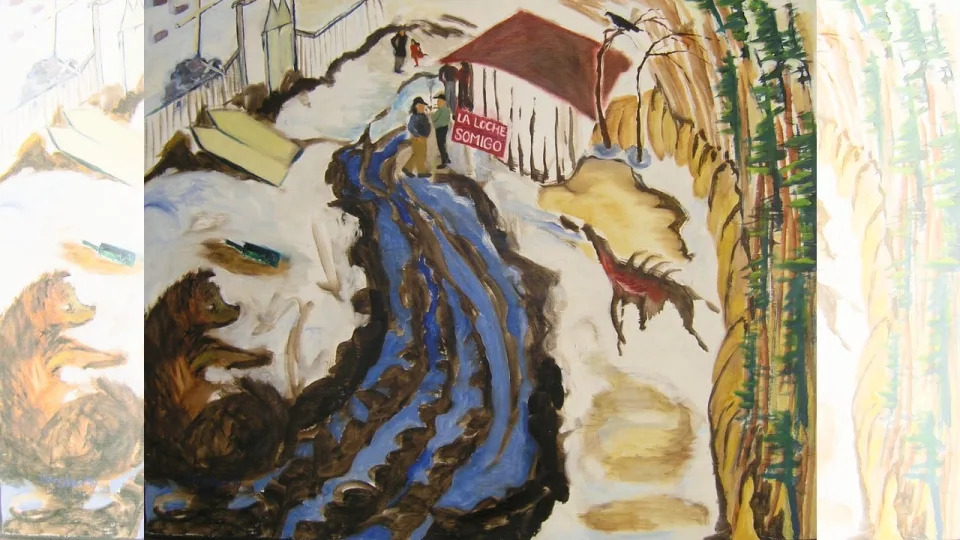
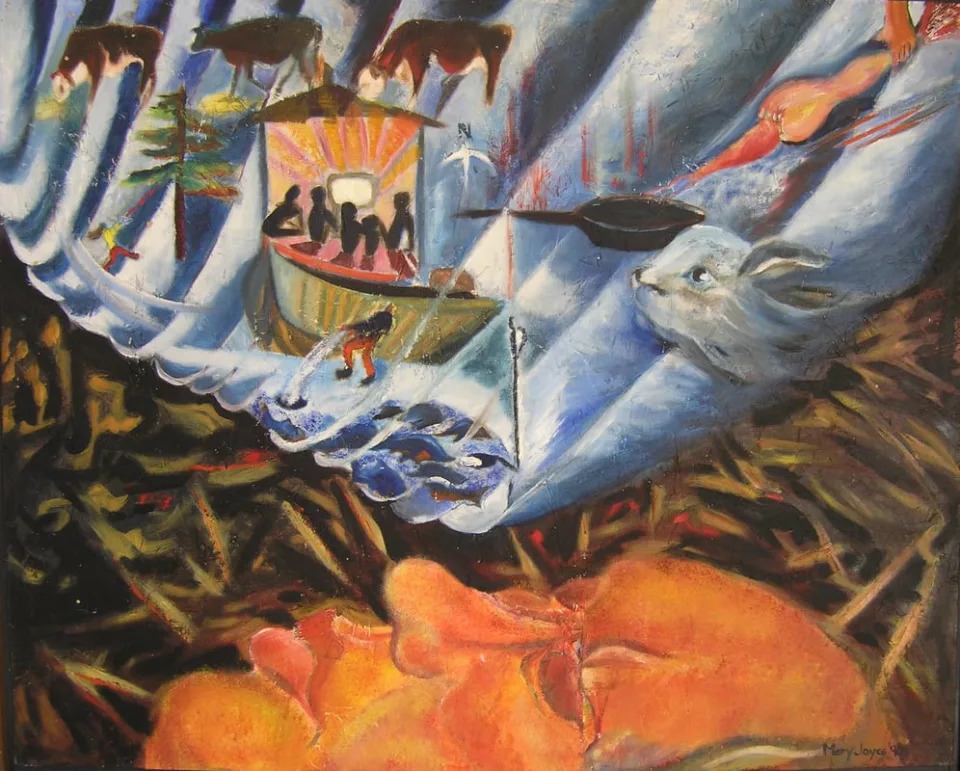
Joyce painted this oil on gesso piece in 1990, called From Under the Melting Snow in Spring. It represents the spring melt after a long winter. (Submitted by Mary Joyce - image credit)

A little over 30 years ago, Mary Joyce moved to Black Point, Sask., for a year. She left the remote northern Saskatchewan hamlet with an impressive art collection and a deep appreciation for the Indigenous community's ways of life.

Now in 2023, she's giving back to the community by donating her paintings in the Black Point collection that vividly depict the people she met, the stories she heard and the lessons she learned.

Joyce and her then husband left Edmonton to start their one year stint in Black Point, near La Loche, Sask., in October of 1989. She says no white person had ever spent the full winter in the hamlet.


A lot of her paintings focus on the women's roles because Joyce says they helped integrate her into the community.

"The women were looking out for me, they basically educated me, took care of me, taught me what they were doing, and made quite a lot of jokes, along with me," Joyce said on CBC Radio's Saskatchewan Weekend.

"I learned a lot of things about how to carry on in a community like that, as well as life lessons."

Focus on traditions


Joyce hoped her paintings could spread awareness around the ways of life in Black Point.

"My paintings are mostly about the old ways, because Black Point was a kind of a community where people who still wanted to pursue the old ways, their traditions," Joyce said.
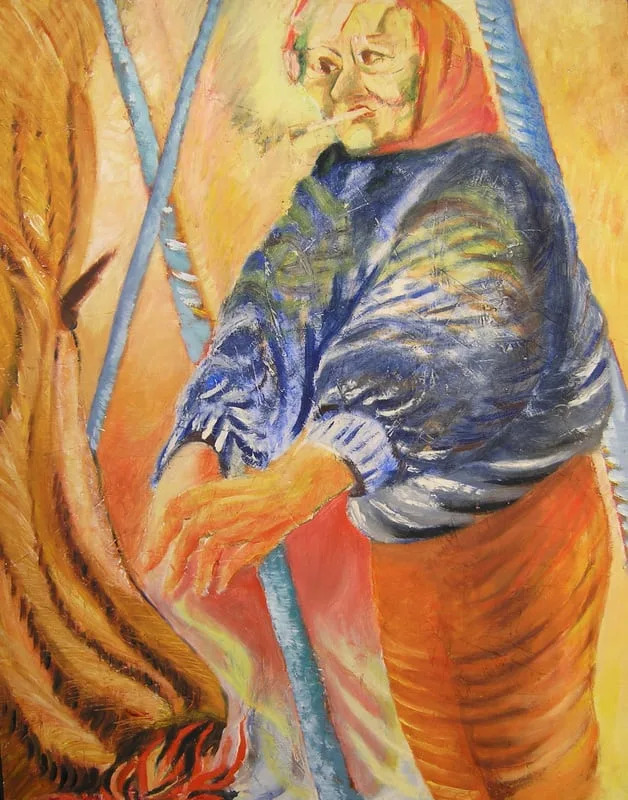
This 1990 painting titled Véronique with Hide was made with oil on gesso panel, and shows an elder in the golden light inside her teepee tending the hide as it is smoked.

This 1990 painting titled Véronique with Hide was made with oil on gesso panel, and shows an elder in the golden light inside her teepee tending the hide as it is smoked. (Submitted by Mary Joyce)

One of the experiences that stands out most for Joyce is spending time with the local woman in the smoking teepee tending to moose hide.

"Those are good memories. They were very intimate, " Joyce said.

Paintings returning home


The homecoming of the Black Point collection is being done with the help of the Mann Art Gallery in Prince Albert. The art gallery received the donation from Joyce and transported some of the paintings up to the La Loche Friendship Centre last week. The paintings will be in La Loche on rotating long-term loans.

"People came through and immediately recognized their relatives, their great aunties, their grandmothers," Marcus Miller, the Mann Art Gallery's curator and director said.

"I'm telling you, there were smiles on everybody's faces and I knew that these paintings had truly come home to the right place."

Miller says Joyce's artwork does an amazing job of depicting real life in Black Point in 1989 and 1990. Joyce wrote extensive captions to go alongside with each painting to describe who the person was in the piece and what they were doing.

Rosie’s Dream, oil on gesso panel, 24 x 30”, 1990. Joyce painted this piece of a woman dreaming to juxtapose the arrival the television in Black Point with more traditional activities such as swinging on a tree and ice fishing. This 1990 painting titled Rosie's Dream was made with oil on gesso panel. (Used with permission of Mary Joyce)

One of the paintings Miller highlighted shows an Indigenous woman named Rosie dreaming about kids watching TV — a newer addition to the community at the time. The painting also features a daughter playing on a swing and an older brother ice fishing.

Joyce says that painting is about her concern for her kids' futures.

"The reality that Mary captured here, that's what's going to do it for people. That's what did it for me," Miller said.

Starting conversations


Leonard Montgrand, executive director of the La Loche Friendship Centre, says the paintings tell an important story.

"I think it tells the story of our elders, especially in Black Point. I see a lot of our elderly people there. Some of them are probably not around today, but it creates an atmosphere of conversation," Montgrand said.

"These paintings reflect our culture and our history … we try to keep that as much as we possibly can, but our languages, our culture are very strong."


Cathy Montgrand, granddaughter of Vulgazeh — one of Mary Joyce's most important subjects, and Leonard Montgrand, centre, shake hands with Marcus Miller, right, at the La Loche Friendship Centre. (Submitted by Marcus Miller )

Joyce says she thinks the paintings belong back in the community that inspired them.

"I'm getting on in life and I want to take care of these things before I die," Joyce said.

"So to have the whole collection in the care of a respectable art gallery who will make sure that it is cared for properly, remains intact and is accessible to the people that it belongs to, morally, that really pleases me."

MARY JOYCE IS A WELL KNOWN EDMONTON ARTIST,  ASST. FINE ARTS PROF, AND A PERENNIAL CANDIDATE FOR THE COMMUNIST PARTY OF CANADA (MARXIST-LENNIST) CPC-ML

B.C. professor pushing plan to protect marbled murrelet habitat in old growth forest


It is only a little bird, weighing a few ounces, but the marbled murrelet is known for its remarkable ability to fly far out to sea to catch fish before returning in the darkness of night to inland treetop nests on mossy limbs.

It also inspires outsized devotion among those who want to study and protect it

Royann Petrell of Courtenay on Vancouver Island has been an avid bird watcher since childhood, but in retirement she has taken up the cause of protecting the marbled murrelet's habitat. 

The seabird has been listed as "threatened" for decades as habitat loss on both sides of the Canada-U.S. border adds to its precarious existence. 

Petrell's birding activities have even landed her in court, fighting a logging company that put up gates in the contentious Fairy Creek area where protests over old-growth logging landed hundreds in handcuffs. 

Petrell, who’s a retired associate professor at the University of B.C. in the faculty of applied science, claimed the gates prevented her from collecting data on the murrelet and its habitat. 

The data, she said, is crucial to her proposal for the provincial government to create additional wildlife habitat areas to protect the murrelets' nesting grounds because continued logging will mean the bird's eventual loss. 

"The forestry company said in its own forestry management plan that the forest will be gone in 15 years. They will cut it all down except for these few wildlife habitat areas," Petrell said. "It's not going to last. It's not sustainable."

In the last two decades, Petrell and her fellow birders calculated that a quarter of the murrelet's prime nesting habitat has been lost in what's known as Tree Farm License area 46, currently held by the Teal Jones Group.

Petrell belongs to The Old Growth Birders and BioBlitzers, a group of citizen scientists who have proposed to the provincial government the creation of more protected areas for the birds in Fairy Creek. Petrell said the group found discrepancies in government pledges to protect habitat versus the actual amount of land set aside. 

In a December 2022 letter to the province, Petrell urged the creation of new designated habit areas that "will protect two of the best remaining sizable remnants of B.C.’s old-growth forests on Vancouver Island."

In a response letter from the Ministry of Water, Land and Resource Stewardship, the provincial government thanked Petrell for her efforts.  

"We welcome the public’s constructive identification of potential areas for a WHA (wildlife habitat area) and as noted regional staff will review the proposal," an April 2023 response letter said. 

Her work has since received endorsement from researchers in the United States, who are urging Premier David Eby to adopt the proposal. 

Martin Raphael, a retired U.S. Forest Service research scientist in Washington state, said protecting marbled murrelet habitat is crucial to the species' survival. 

Raphael's work goes back decades, documenting the bird's migration from the U.S. to nesting areas in the Fairy Creek watershed using radio tags to track the bird's long flights out to sea back to inland nesting grounds. 

"Protection of nesting habitat is really the key driver in trying to recover the species, and so when this proposal came along to try to conserve habitat, protect it from logging and other losses, I knew that would be important," he said. 

Raphael had never seen a marbled murrelet before he began researching and surveying the birds in the 1990s, but they eventually became the focus of his work for 20 years. 

His fascination grew, he said, out of admiration for how they fly far out to sea to forage for fish "and find the exact limb on a tree in the middle of the forest that it's nesting on."

"The fact that they do that at night when there's no visibility, it just amazes me," he said. 

In Washington state, the birds' habitat enjoys federal protection on public lands, but private forest lands are still fair game for logging, leading to habitat loss and population decline, he said. 

For Petrell, her love of bird watching stems from her mother's sadness after the loss of her father when Petrell was just two years old. 

"The one thing that made her happy was bird watching," she said. 

One excursion stands out for Petrell, when she and a group of fellow birders were awoken early one morning by the shrieking calls of murrelets flying above their tents. 

Recent research, she said, indicates the birds communicate about suitable nesting areas as they make their way back to their forested homes. 

"We were just totally blown away," she said. "You hear them flying right over your tent, up the watershed, right into the forest, and that's the same forest that we would like to make sure that it turns into a wildlife habitat area."

This report by The Canadian Press was first published July 23, 2023. 

Darryl Greer, The Canadian Press

Conservationists raise concerns over B.C.'s proposed grizzly bear stewardship plan

 The Canadian Press


Grizzly bears seen starving in the rainforests of British Columbia's south coast because there isn't enough salmon to sustain them raises alarm bells for wildlife biologist Wayne McCrory, who's known as a leading bear expert in Canada.

The science is "crying out" for greater habitat protections for the iconic species as industrial activities eat away at the landscapes the bears depend on, he said.

"There's a huge amount of protection work that needs to be done that isn't happening, so you can say it's in a crisis mode," he said in an interview.

McCrory said the province's draftplan to adjust grizzly management doesn't meaningfully address habitat loss and could prove "disastrous" for the bears.

He is among the signatories of an open letter sent to provincial officials last week as public engagement closed for the draft grizzly stewardship framework.

The letter published by Pacific Wild and signed by more than 50 scientists, advocates and conservation groups says the proposed plan minimizes the threats posed by the "severe fragmentation" of grizzly habitat in B.C. by logging, road building and other industrial activities against the backdrop of climate change.

"In order to mitigate the massive loss of biodiversity, the B.C. government must also shift from profit-first exploitation of wildlife habitat to the protection of our last remaining intact natural areas," the letter says.


The federal government listed the grizzly bear under the Species at Risk Act in 2018, classifying the bears as "special concern" following a recommendation by the Committee on the Status of Endangered Wildlife in Canada six years earlier.

The committee's report said grizzlies are "highly sensitive to human disturbance" and concluded that concern would grow without a reversal of the "increasing pressures of resource extraction and cumulative impacts" on their habitat.

The listing is meant to trigger a requirement for governments to produce plans aimed at minimizing the likelihood of the species becoming endangered.

But McCrory said such a plan has not yet materialized for grizzlies in B.C.

He said the new draft framework repeats much of what's already known about grizzly management in the province but lacks what's really needed — actions to ensure healthy grizzly populations roam B.C.'s landscape for decades to come.

The plan is "fuzzy around the edges, without any way of really moving forward to get the on-the-ground habitat protection changes that grizzly bears need today if we're going to have them around 50 or 100 years from now," he said.

A statement from the Forests Ministry said the framework was developed with input from approximately 85 Indigenous governments and groups.

“A key learning from that process was the different First Nations have different approaches to grizzly bear stewardship. Regionally based planning recognizes and honours this reality,” it said.

The stewardship framework is what would previously have been referred to as a management plan, the ministry added.

“The purpose of the framework and strategy is to engage with First Nations, scientists and the public on supporting grizzly bears and their habitat, to ensure we continue to have a thriving population for years to come,” said a statement attributed to Forests Minister Bruce Ralston.

In addition to larger protected areas, McCrory said the roughly 15,000 grizzlies in B.C. need a "mosaic" of smaller yet continuous habitats that connect salmon streams to healthy forests, to berry patches and denning spots in the mountains.

B.C.'s auditor general delivered what McCrory described as a "scathing" review of grizzly bear management in 2017, finding the greatest threat to the bears was human activity that degrades their habitat, not hunting that's since been banned.

The B.C. government announced the end of grizzly hunting in December 2017, with some exceptions for First Nations, and pledged to work on "renewed" strategy.

The draft stewardship framework released earlier this year says there is no "one size fits all" approach that works across B.C. and encourages the development of local plans to be initiated by provincial wildlife staff as well as First Nations.

Those plans may then be shaped by local advisory teams consisting of relevant B.C. government staff and "interested parties such as industry, environmental organizations, independent biologists, and other stakeholders," the document says.

McCrory said he's worried the local teams will open decision-making tables to hunting interests and "muddy the waters" around what really needs to be done.

"You're not going to end up with sound, science-based plans. You're going to end up with, you know, whoever dukes it out and comes out on top," he said of the teams.

"I grew up in the Slocan Valley and I've worked with many wildlife and conservation groups throughout B.C. and I just know how the backwoods politics works when it comes to conflicts and the grizzly bear trophy hunting," he added.

In his statement, Ralston said the province is not looking at lifting the ban at this time, adding members of First Nations continue to have the constitutional right to hunt the bears for food, social, and ceremonial purposes.

This report by The Canadian Press was first published Oct. 11, 2023.

Brenna Owen, The Canadian Press

Alberta no longer has a human-wildlife conflict specialist. Some want that to change


CBC
Mon, October 9, 2023 

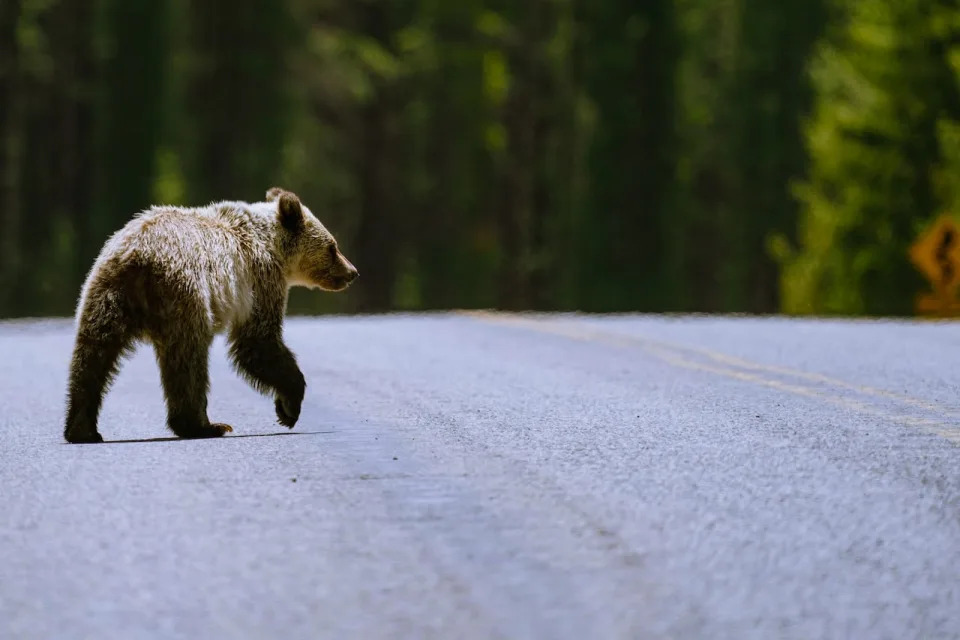
The province's latest Grizzly Bear Recovery Plan calls for more human-wildlife conflict specialists to be hired in areas of high need in Alberta. (David Gray/CBC - image credit)

Alberta's former human-wildlife conflict specialist is calling on the province to fill the position he left vacant last year, given the volume of human and bear interactions seen in the province this fall.

Jay Honeyman retired in spring 2022, after a decade spent working as the province's only large carnivore conflict biologist — primarily dealing with grizzly bears.

Honeyman said his job was proactive in nature, and that he focused on preventing conflicts between humans and bears from happening in the first place. Often, this was done through education and by removing or securing attractants like food sources from public and private properties.

The goal? To improve coexistence between people and bears, and to increase tolerance for grizzly bears in Alberta, said Honeyman.

Today, Honeyman's post remains unfilled.

"Bottom line, there is no dedicated position to doing this kind of work and bears and people are interacting more than ever and it's not going to change. It's going to continue to be an ongoing issue," said Honeyman, whose regional role covered the Rocky Mountain House area down to the Montana border.


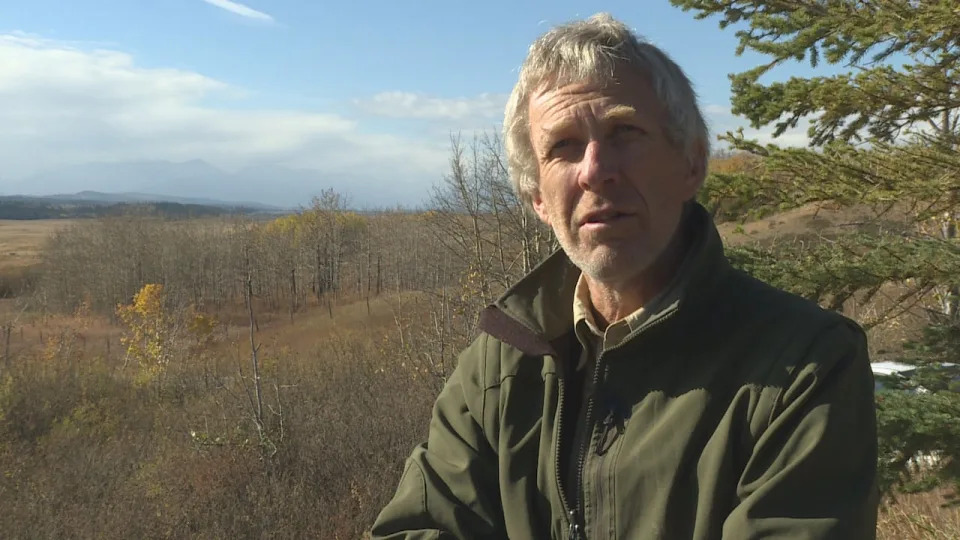
Jay Honeyman a human-wildlife conflict biologist, says outdoor enthusiasts need to be aware of their surroundings to help avoid a bear encounter. Jay Honeyman was the province's first and only large carnivore conflict biologist. He says the role was fairly niche, and he wouldn't be surprised if it was cut for a broader role with higher priority
. (Dave Gilson/CBC)

Honeyman added that people living and working in bear country need to feel safe, something difficult to achieve when there is no one working to prevent bears from causing property damage or creating public safety concerns.

"If landowners are not going to be tolerant of grizzly bears where they live and work and recreate, then we're going to end up with a lot of bears being killed because of a low tolerance for their presence."

Honeyman said he was hopeful someone would be hired to replace him, but that he retired during a year of ministry changes and later, budget cuts. Now, he said he isn't surprised that the role remains vacant.

After a number of human-bear interactions throughout Alberta this fall, Honeyman said it's time the province follows its own recommendations and hires another expert to fill the role.

Grizzly Bear Recovery Plan calls for more specialists


The province's latest Grizzly Bear Recovery Plan, released in 2020, calls for a database to track the location, cause and response to human and grizzly bear conflicts.

It also calls for more conflict specialists to be hired in areas where there's high need.

Honeyman said most of what's listed in the 83-page plan has not been completed.


"It's been written up, but it hasn't gotten off the page. It needs to get put into practice. It needs to get executed, and it hasn't been," said Honeyman.

"What's the point of the recovery plan if we're not going to follow the recommendations within it, including one of these positions within every [bear management area]?"

Grizzly bears have been considered a threatened species in Alberta since 2010.


Honeyman said the plan is important for not only improving the province's grizzly bear population numbers, but also in ensuring landowners have help with their concerns.

"We need to somehow increase tolerance and that occurs when coexistence is possible and people aren't feeling threatened for their safety."

New human-wildlife coexistence program


According to a spokesperson for Alberta's Ministry of Forestry and Parks, the department is developing a new provincial human-wildlife coexistence program.

That team would be responsible for the BearSmart program, as well as "carnivore conflicts with agriculture producers, predatory damage prevention, ungulate damage prevention and compensation program delivery," said spokesperson Pam Davidson.

The province did not provide an answer as to whether it has future plans to fill Honeyman's old role, or why the role hasn't been filled.

Instead, Davidson said a team of experts in Forestry and Parks, as well as in Environment and Protected Areas, are working to reduce the number of human-wildlife conflicts in Alberta.

"Alberta's government is committed to protecting wildlife and taking necessary steps to ensure public safety on Crown land."
University of Calgary Academics Demand Public Inquiry Into Alberta Energy Regulator

Provided by BNN Breaking


The Alberta Energy Regulator (AER), a body responsible for overseeing the province’s extensive oil and gas activities, has been put under the microscope as academics at the University of Calgary call for a public inquiry into its operations. Their recently published report criticizes AER’s relationship with the industry it regulates and its management of environmental liabilities, adding fuel to the ongoing debate about how best to manage Alberta’s lucrative, yet environmentally fraught, energy resources.
A Controversial Relationship

The report alleges that the AER has consistently favored industry interests over the public good. It criticizes the regulator for its lack of transparency and discretion in enforcing environmental requirements. The authors of the report argue that there is a dire need for increased information and accountability regarding the AER’s actions and its handling of environmental liabilities.

The Orphan Well Fund Under Scrutiny


The academics also took a critical stance towards the Orphan Well Fund, an industry-funded group responsible for the reclamation of wells that have no owner. The report indicates that the operation of this fund lacks sufficient transparency and accountability, raising concerns about its effectiveness and the potential for conflicts of interest.

Related video: Alberta Energy Regulator followed rules in mine wastewater release, report finds (cbc.ca)  Duration 2:03   View on Watch

Addressing Environmental Liabilities


At the heart of this controversy is the handling of growing environmental liabilities in Alberta. The province’s oil and gas sector has been struggling with a growing number of orphaned wells, which pose significant environmental risks if not properly managed. The report calls for a more robust and transparent approach to address these liabilities, which are currently estimated to be in the billions of dollars.
Implications and Future Directions

If the calls for a public inquiry are heeded, it could lead to significant changes in how the Alberta energy sector is regulated. This could potentially impact the oil and gas industry, environmental stewardship, and public trust in regulatory bodies. As Alberta continues to grapple with the challenges posed by its energy wealth, the way it manages and regulates its resources will undoubtedly remain a topic of intense scrutiny.

The Manitoba election shows how mean-spiritedness can lose elections in Canada


Story by Kathy L. Brock, Professor, Policy Studies, Queen's University, Ontario
• The Conversation

well-respected politician once told me that governments lose elections if voters consider them too mean-spirited. Those words have always resonated, particularly during the final weeks of the recent Manitoba election when the Conservatives engaged in a negative media campaign. Negative campaigns are often only tolerated if they don’t go too far.

The Manitoba campaign featured one ad that promoted the government’s decision not to search a landfill site for the bodies of two First Nations women believed to be victims of a serial killer who has disposed of victims in such places.

Premier Heather Stefanson, flanked by a number of colleagues running for re-election, publicly defended the decision on the grounds that the search would be too costly (up to $184 million) and too dangerous given the site’s toxicity.

A second ad targeted NDP Leader Wab Kinew, now the premier-elect of the province, and eight other NDP candidates. The ad questioned Kinew’s ability to lead Manitoba by raising past charges against him, including driving under the influence and assaulting a taxi driver.

Kinew had previously spoken publicly about his turbulent youth and had been pardoned by the Parole Board of Canada in 2016 for those offences and two breaches of court orders.


Related video: Kinew on what Manitobans voted for by electing NDP (cbc.ca)
Duration 0:58  View on Watch

American inspiration?

Both ads smacked of American-style politics and desperation. The first ad was decried as insensitive and campaigning on a tragic issue. The second ad was disparaging and disrespectful.

Together the ads appeared mean-spirited. One commentator said the Conservative ad campaign was “nastier and more vicious” than past campaigns and an attempt to win “almost at any cost.”

Research is divided over the effects of negative ad campaigns on democracy. A 2009 study found that negative ads can cause voters to take more interest during elections and learn about issues and candidates. On the other hand, other research has found that campaigns that go too negative may discourage and disincentivize voters.

But what is too negative? Observational evidence from Canada suggests there are some lines that should not be crossed.

Voters recoil from campaigns when the rhetoric trivializes, denigrates or comes at the expense of vulnerable groups. The Manitoba ads regarding the Conservatives’ decision not to search the Prairie Green landfill prioritized fiscal prudence, leaving voters with the horrific image of someone’s children or sisters abandoned in a filthy grave after suffering a terrible death.

In a similar vein, the federal Conservatives learned during the 2015 election campaign how quickly public sentiment can turn against a government and its policies after a picture emerged of a young Syrian refugee boy lying washed up on a beach.

The photo had become the human face of the Syrian refugee crisis globally just as Stephen Harper’s government was promoting more restrictive immigration policies compared to opposition parties calling for welcoming more refugees.

Both the federal and provincial Conservative governments lost power.

Canadians more empathetic?

In contrast to Americans, Canadian elections over the past few decades suggest Canadian voters seem to sympathize with leaders who are flawed but have worked to overcome personal challenges.

Kinew had atoned for his past mistakes and learned from them to go on and live a successful life as a proud Indigenous father, community leader and politician. The ads against him seemed like cheap shots rather than fair criticism.

This lesson is not new. The 2018 Liberal ads attacking Conservative policies and implying Doug Ford was unsuitable to be premier backfired in the face of Ford’s image as an everyday guy who understood what people felt and who had stood by a troubled brother.

In 2003, the federal Conservatives had to pull ads that mocked Jean Chrétien’s style of speaking out of one side of his mouth when he publicly announced it was due to having Bell’s palsy as a child.

Bloc Québecois Leader Lucien Bouchard’s public reputation was enhanced significantly after overcoming necrotizing fasciitis, the flesh-eating illness.

This reputation damage or enhancement works retroactively. History was forgiving when it came to the drinking habits of Canada’s first prime minister, Sir John A. Macdonald, but when his policy decisions became linked to atrocities in residential schools, his reputation took a posthumous hit.

While Canadians will tolerate what is perceived as negative but fair criticism in an election campaign, the Manitoba election is the latest to suggest they won’t accept a government or party that goes too far. Mean-spiritedness can clearly lose elections in Canada.

This article is republished from The Conversation, a nonprofit news site dedicated to sharing ideas from academic experts.

Read more:

Kathy L. Brock does not work for, consult, own shares in or receive funding from any company or organisation that would benefit from this article, and has disclosed no relevant affiliations beyond their academic appointment.

NCTR Condemns Wave Of Residential School Denialism


 (ANNews) – The head of the National Centre for Truth and Reconciliation (NCTR) says residential school denialism promulgated in certain corners of the media is inhibiting reconciliation. 

Executive director Stephanie Scott wrote a Sept. 29 article on the NCTR website described by APTN as a “clarion call to believe survivors of Canada’s residential and day schools” in advance of the third annual National Day for Truth and Reconciliation.

“Unfortunately, even as more and more Canadians engage in sincere acts of commemoration and reconciliation, the voices of those who minimize, distort and deny this history are also getting louder,” Scott wrote.

“National and international media outlets have given a platform to residential school deniers who – despite having no particular expertise on the subject – loudly reject the findings of the Truth and Reconciliation Commission of Canada and dismiss the lived experiences of survivors. The efforts of families to find the children buried at residential school sites have become a lightning rod for hatred.”

Kimberly Murray, an independent special interlocutor for missing children and unmarked graves, has noted the prevalence of online attacks against Indigenous communities who announce they’ve discovered potential unmarked graves.

Some denialists have reportedly entered the grounds where these sites are believed to be located in an attempt to disprove preliminary findings, Murray has noted.


In June, Murray said that denialists allegedly entered the site of the former Kamloops Indian Residential School, where the unmarked graves of 215 Indigenous children were believed to have been found, on Tk’emlúps te Secwépemc territory. 

“Denialists entered the site without permission. Some came in the middle of the night, carrying shovels; they said they wanted to ‘see for themselves’ if children are buried there,” Murray wrote in a report outlining the barriers to searching for unmarked graves. 

Denialism, said Murray, is the final phase of genocide. 

“Denialism is violence. Denialism is calculated. Denialism is harmful. Denialism is hate,” she said. “Denialism is a non-Indigenous problem and therefore it’s for non-Indigenous people to address it.”

The dangers of residential school denialism, Scott wrote, “must be countered through a clear and unwavering commitment to truth-telling.” 

She called on “governments to urgently consider legal mechanisms that can effectively combat these hateful actions.”

“For far too long, the truth of this shameful part of Canada’s history was kept hidden. Survivors were told to be silent,” Scott added. 

Progress on this issue, including former prime minister Stephen Harper’s 2008 apology for residential schools and the Truth and Reconciliation Commission came as a result “of the courage of survivors and their steadfast commitment to the truth.”

Scott addressed the tide of denialism at the third annual National Day for Truth and Reconciliation ceremony on Sept. 30 in Ottawa, emphasizing the need to uplift survivors’ voices. 

“We must respect all survivors, amplify their voice and call out the deniers,” Scott said. “We must challenge the people who don’t want to face the truth.”

The NCTR hosts a memorial registry of Indigenous children who were killed at residential schools, with 4,140 names as of writing. 

“There are additional names of children waiting to be found that are not included within this register. There remains an extensive amount of work to be done to find all the children that never returned home and their burial sites,” the NCTR cautions.

Noting that the “burden of truth-telling should not be placed on the shoulders of survivors,” Scott urged all Canadians “to take time to review the register.”

“Think about the children and their families. Reflect on why this truth must not be denied or diminished. And champion these truths in your life and community, so that Canada will not falter or turn back on the road to reconciliation,” she wrote.

Jeremy Appel, Local Journalism Initiative Reporter, Alberta Native News

CONSPIRACY THEORY; DENIALISM
P.E.I. councillor says he won't resign over sign that called unmarked Indigenous graves a hoax

CBC
Mon, October 9, 2023 

Murray Harbour Coun. John Robertson says he took the sign down because some people were 'not getting the message' as he intended it. (Village of Murray Harbour - image credit)

WARNING: This story contains distressing details.

Amid renewed calls for his resignation, a councillor in the village of Murray Harbour, P.E.I., says he will not step down over a sign he installed on his property.

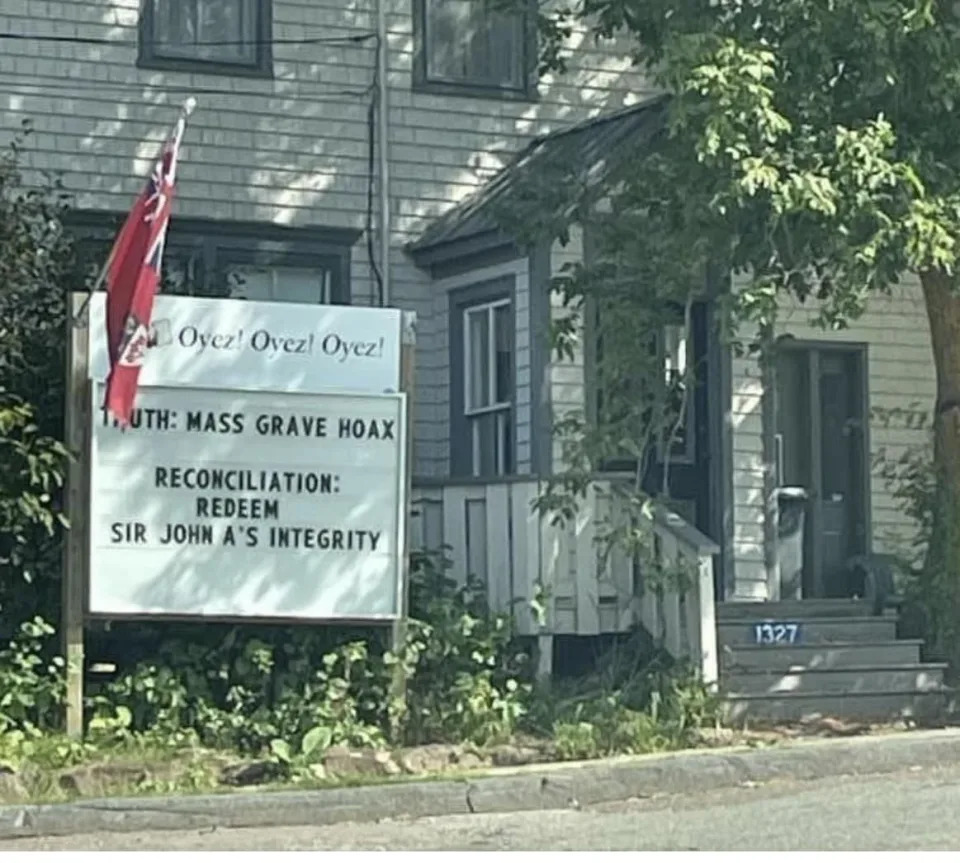
The sign on John Robertson's property called the detection of unmarked graves at the former sites of residential schools in the last few years a "mass grave hoax." It added: "Redeem Sir John A's integrity."

Since the confirmation of community knowledge of suspected unmarked graves in British Columbia, First Nations across Canada have located evidence of the remains of more than 2,300 children in suspected unmarked graves at or near former residential schools and Indian hospitals, according to a report from the independent special interlocutor for missing children and unmarked graves and burial sites associated with Indian Residential Schools that was released earlier this year.

Get the news you need without restrictions. Download our free CBC News App.

Robertson said he took the sign down because some people were "not getting the message" as he intended it.

"I'm sorry for people who felt upset or hurt by what was on the sign," Robertson said Monday during an interview. "I hope it is an opportunity for us all to learn."

The sign was located on property owned by Murray Harbour Coun. John Robertson. (Harry Vanden Broek)


In a statement released Sunday, P.E.I. Sen. Brian Francis said Robertson should step down immediately.

He said the incident shows how "denialism" is used to "minimize and even ridicule established facts about the historical and ongoing injustices faced" by Indigenous communities.

"The impact of denialism is profound," Francis's statement said, in part. "It invalidates painful experiences, perpetuates discriminatory and racist beliefs and practices and hinders efforts to rebuild."

Abegweit First Nation Chief Junior Gould and Murray Harbour Mayor Terry White have also said Roberston should leave his post.

Roberston said he will not resign because he is "not guilty of anything worth stepping down for."

The mayor has invited Gould to attend Murray Harbour's council meeting Wednesday night to present and educate on Indigenous history.

When asked if he would be going, Robertson said "No comment."

Support is available for anyone affected by the lingering effects of residential school and those who are triggered by the latest reports.

A national Indian Residential School Crisis Line has been set up to provide support for residential school survivors and others affected. People can access emotional and crisis referral services by calling the 24-hour national crisis line: 1-866-925-4419.
TORONTO
Few complaints arose from alcohol in parks pilot project, city says


CBC
Mon, October 9, 2023 

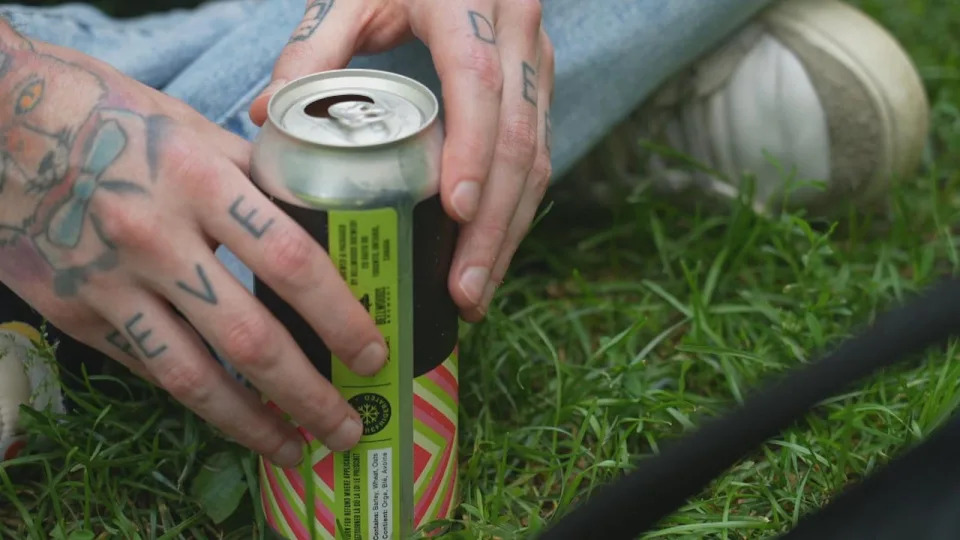
The city says the number of complaints it received due to its Alcohol in Parks pilot was low. The pilot project ran from Aug. 2 to Oct. 9 in 27 parks across Toronto. (Paul Borkwood/CBC - image credit)

A pilot project that allowed Toronto residents to drink alcohol in certain parks wrapped up on Monday and the data shows there were few complaints that resulted from the public experiment, the city says.

In an email on Monday, the city said the number of complaints it received due to its Alcohol in Parks pilot was low. The pilot project ran from Aug. 2 to Oct. 9 in 27 parks across Toronto.

"The City has found that people complied with the guidelines set out by the Alcohol in Parks pilot program," the city said in the email.

From August 2 to Sept. 24, the city said it received two complaints related to alcohol in parks where people were allowed to drink, compared to 28 complaints related to alcohol in parks where people were not allowed to drink.

Over the same period, the city issued no charges related to alcohol in pilot parks and one charge related to alcohol in one of the non-pilot parks.

Coun. Josh Matlow, who represents Toronto-St. Paul's, said in an interview on Monday that he thinks the pilot wasn't necessary, but he is glad to learn that it showed that Toronto residents can drink responsibly in public places. He added that the city should just allow drinking in parks now.

"It doesn't surprise me that chaos didn't ensue and riots didn't break out. Toronto was just hesitant and sheepish about doing something that's normal in most every other place in the world. You know, responsible adults are going to act responsibly. People who don't act responsibly won't care about a pilot or a bylaw," he said.

"We should simply just allow responsible adults to enjoy a drink together in a park, like most cities around the world already allow, and move on with dealing with real problems," he added.

Matlow, who is in favour of legalizing the drinking of alcohol in parks, said the pilot touches upon an equity issue. He said some Toronto residents have backyards in which to drink alcohol but many Toronto residents do not because they live in apartments.

"They should have a place outdoors to be able to enjoy a drink with a friend responsibly as well," he said.

The city is conducting a survey based on the experience of people who used the pilot. The survey is open until Oct. 16.

In July, when the pilot was approved, city council voted to direct the general manager of its parks, forestry and recreation division to report to the city's economic and community development committee on the results of the pilot project. That report is expected in the first quarter of 2024.


Two Toronto councillors are asking the city to consider posting smaller signs linked to the alcohol in parks pilot project.

Two city councillors, Paula Fletcher and Alejandra Bravo, asked the city to scale down the signs advertising the program around playgrounds. The city agreed to install new signage in some locations. (Patrick Morrell/CBC)

While the pilot may have gone smoothly, the size of the signs advertising the pilot became an issue early on, however.

Two city councillors, Paula Fletcher and Alejandra Bravo, asked the city to scale down the signs advertising the program around playgrounds. The city agreed to install new signage in some locations.

According to guidelines issued by the city, Toronto residents aged 19 or over could only drink within the pilot parks and between park hours, which were 5:30 a.m. to midnight.

They also had to dispose of empties in a park recycling bin or take them home, be respectful, not disturb other park users, and not supply or serve alcohol to people under legal drinking age.

Alcohol could not be consumed within two metres of playgrounds, wading pools, splash pads or skateboard parks, or inside the gates of an outdoor swimming pool or deck.

Public intoxication and disruptive behaviour, including public urination, were also not allowed.

On its website, the city included public health information about drinking: "Alcohol is the most commonly used psychoactive substance in Canada. Most adults drink alcohol in moderation and for them, alcohol is not a problem. However, for some people, alcohol can present harm to themselves or others including injuries and chronic diseases."
ONTARIO
OCDSB overestimate bumps some teachers into more precarious jobs


CBC
Tue, October 10, 2023 

OCDSB overestimated the number of students enrolling this year by about 1,600. (Celeste Decaire/CBC - image credit)

When Denise Morgan found out she got a long-term occasional (LTO) teaching assignment this June, she got to work right away.

She made a long-range plan and invested more than $250 of her own money in classroom supplies and resources.

Morgan, a pseudonym CBC is using to protect her identity due to her concerns about her relationship with her employer, spent a month in an Ottawa-Carleton District School Board (OCDSB) classroom.

She got to know her students. They got to know her. And then it was gone.

She learned that a permanent contract teacher would take over her class as the board consolidated elementary classrooms.

Morgan said she was "absolutely devastated."

"All that work that I put in, I don't get to see the fruits of my labour and neither do my students," she said.

"I know that it's technically not permanent employment, but there's no way that I would be able to deliver a high-quality program to my students if I did not prepare for a full year," she added.

"If I have to prepare for a full year, I should be able to complete that full year."

Like many, Morgan received only five days' notice about the change as the board shuffled out LTO teachers after elementary enrolment numbers came in short of projections for the current school year.

Pat Dixon, president of the Ottawa Carleton Elementary Occasional Teachers' Association, said teachers who were filling LTO positions for the year have suddenly been bumped out of those jobs to make room for reassigned contract teachers.

"It's a huge impact on my members, because people who thought they had a full year's job … now they're down to no job, other than whatever daily work they can pick up," she said.

Board looking to find displaced LTOs other work

The income loss for teachers who were bumped is significant, according to Dixon.

She said LTOs are paid at the same rate as permanent contract teachers, while a daily occasional teacher — often known as a supply or substitute teacher — would make thousands less even if they picked up work every school day of the year.

Darcy Knoll, an OCDSB spokesperson, confirmed the classroom reorganization displaced many elementary LTOs, though he did not say how many.

He noted that the collective agreement allows for those positions to be cancelled with five days' notice.

He said the board is working to offer them other jobs and many may be able to work in the designated occasional teacher program, which keeps occasional teachers dedicated to substitute work at one particular school to the extent possible.


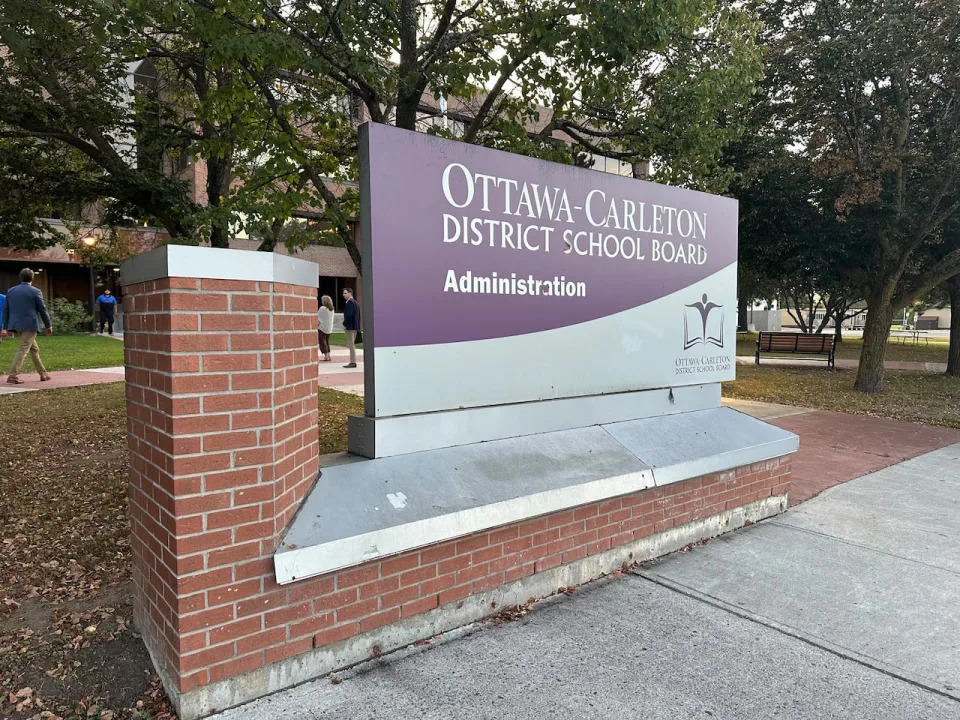
The Ottawa-Carleton District School Board sign at its main building on Greenbank Road.
Darcy Knoll, an OCDSB spokesperson, says the collective agreement allows cancellation of long-term occasional positions with five days' notice.
(Danny Globerman/CBC)

Morgan said taking on a role like that would be a "drastic change" from what she accepted in June.

"Being an everyday classroom teacher in the same class for a long period of time is a very different job than someone who's filling in for a teacher every day," she said.

She said there are no sick leave or health benefits in the role, something she had in the LTO position, and she'd have to be prepared for redeployment in the event that no teachers were absent from her designated school.

It could also affect her career prospects, she said, since an LTO job looks much better on a resume.

"As a teacher, you learn a lot from seeing a full year through with the same group of students," she said. "Ending this assignment creates a break in my resume."

Shuffling hard on permanent teachers too

Dixon said it isn't unusual to see a reorganization at the beginning of the year, but she's never seen anything like what happened this year when the board's projection was about 1,600 students too high.

"The unusual part of it is the number of students that we misprojected," she said. "We thought there would be more growth."

Rebecca Zuckerbrodt, president of the Ottawa-Carleton Elementary Teachers' Federation of Ontario, said the reshuffling is stressful for permanent contract members as well.

They too have spent a month getting to know their students and now some have to start over with a whole new group.

At a certain point, about 80 contract teachers were being reassigned, she said, though that's not necessarily the latest number. Some have had to move schools, according to Zuckerbrodt.

She blamed what she called a "broken funding formula" from the province that keeps boards on tight budgets with tight timelines and forces them to scramble to fill deficits when projections don't pan out.

She called the situation "government-induced chaos" that could make it hard to recruit and retain teachers.

Malaka Hendela, co-chair of the Ottawa Carleton Assembly of School Councils, has a 12-year-old at Centretown's Glashan Public School. She said the reorganization cut one class there, pushing more students into her son's classroom.


Malaka Hendela, co-chair of the Ottawa-Carleton Assembly of School Councils, said parents will need organizational and other support to build community around the students who are registered for remote learning. Malaka Hendela, co-chair of the Ottawa-Carleton Assembly of School Councils, says the reorganization is tough on students. (Francis Ferland/CBC)

Reorganization can be tough on students, she added, creating a lot of disruption for their learning and social development.

"A student is going to experience peer disruption, learning disruption, with a teacher they may have connected with," Hendela said.

She's concerned the disruption also creates a risk of losing teachers, who might drop out of the district or the profession.

"To lose your classroom and then go occasional, it's a hardship," she said. "And it's a hardship that's going to be felt on the people that we need to grow to be our teachers for tomorrow."