Trump May Be Among the Most Vile of Anti-Immigrant Demagogues, But He is Not Original
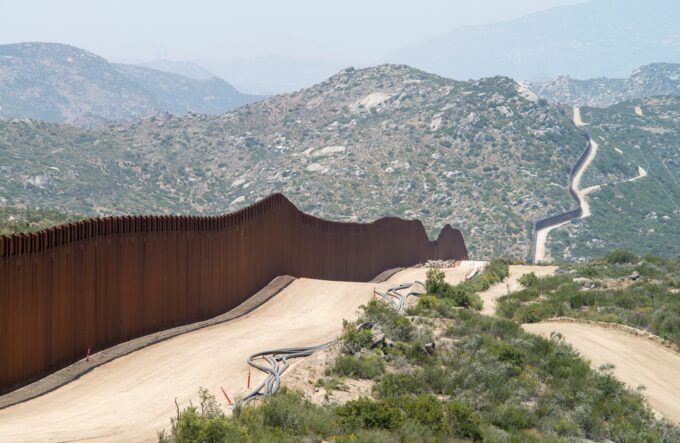
Image by Greg Bulla.
Immigration to the U.S. southern border has long been subject to cold-hearted racial demagoguery. The Statue of Liberty may have welcomed some of the “huddled masses” from Europe at different times, but no such welcome was ever given to people from south of the border. There, a different attitude has prevailed.
Donald Trump’s MAGA hate speech includes such descriptions of non-European immigrants as “stone cold killers,” “immigrant criminals from the dungeons of the world,” “rapist,” “pet eaters” — or “invaders” from across the southern border. Some may find Trump’s words pleasing and others dreadful, but he is far from original.
The story begins in 1846 when U.S. President Polk— encouraged by the slavocracy eager for more land to expand their operations and by the merchant capitalists looking for a gateway to the Pacific — set about to rip off the northern half of Mexico from the rest of that country. Among the European Americans who followed their “Manifest Destiny” west to newly conquered lands after the war in 1848, there was debate about whether the new U.S. territories would be “slave” or “free.” But there was neither debate nor doubt about how to receive the non-white immigrants who made it to those promising lands.
In a Congressional hearing in the 1880s a member of the House committee on immigration questioned a representative from California: “Two years ago California came before this committee and stated herself in opposition to the Chinese and Japanese immigrant and in favor of Chinese and Japanese exclusion, stating that they wanted to develop a great big white State in California, a white man’s country; and now you come before us and want unlimited Mexican immigration . . . I cannot see the consistency.”1
But there was consistency. Chinese and Japanese workers were among the first waves of non-whites whose labor would lay the groundwork for large scale agriculture and the California dream that would not be theirs. But as important as their labor was it came with a defect making them far from the ideal workers white employers desired: They were difficult to remove thus posing an unacceptable threat to white demographic dominance.2 Mexican labor, however, was close at hand and easily deportable, a quality that made it, by the early 1920s, the immigrant labor of choice.
The southern border became, not the firm line of defense of national sovereignty as our contemporary demagogues would have us see it, but the portal for the low wage laborers on whose backs an empire was being built. But the door was meant to be a revolving one and herein lay the conflict.
Through the years the southern border has been the scene of a schizoid dance of immigration. There were times when employers on U.S. farms, factories, and railroads, couldn’t get enough of those “hard working,” “uncomplaining” Mexican (or Central American) workers—think of the Bracero program during the World War II years.3 Then there were other times marked by furious nativist-driven campaigns to stop the flow and rid the land of “criminals,” “disease ridden delinquents,” “drug runners,” “ants,” “communists” or “terrorists”— depending on the era. Notable in this are the years 1930, 1954, and 1994.
In the early 1930s hundreds of thousands of Mexicans were deported or otherwise forced out of the U.S. having been made convenient scapegoats for a brutal Depression economy. The deportations were massive and indiscriminate and accompanied by a ferocious campaign of racial intimidation and threats so intense that many of those who left the U.S., did so on their own out of fear of violence. Forty to sixty percent of those deported or repatriated were U.S. citizens, and many were children.
1954 was the year of Operation Wetback, a militarized campaign of terror and mass deportation that resulted in the suffering and death of many immigrants. Operation Wetback was principally an ethnic cleansing campaign. Its goal was to reverse the “troubling” growth of Mexican and Mexican American communities in California and the Southwest. But the deportation campaign ultimately failed, not because it wasn’t well planned or brutally executed, but because the immigrant communities had become interwoven in the economic and social fabric of border states. After a military style mass deportation of more than a million immigrants which caused terrible suffering, American authorities appealed to Mexicans to return to the U.S.! The California and southwest economy could not function without them. 4
In the intervening years since Operation Wetback the structural dependence of U.S. capitalism on cheap, vulnerable labor has increased. At the same time, one of the foundations of white supremacist control and identity, the demographic dominance of white people, is more challenged than ever. What began as a labor system largely restricted to California and the southwest has now become a key part of the labor structure for the entire country. In places throughout the U.S., and especially in the cities, essential jobs from service to construction to meat packing, child care and elder care, are dependent on immigrant workers. And the countryside? Today nearly 90% of U.S. farm and dairy workers are immigrants, roughly half undocumented.
Walk the streets of major cities, go to the school rooms and work places and the demographic future greets you in all its multiplicity. This is what lies at the heart of the MAGA-fascist immigrant frenzy— a clash of demographics.
For the nativist who has bought into the notion that the U.S. is a “white man’s land” and must always remain so — this is the metastasizing of a nightmare. For those who view humanity through a broader lens, it is a twist of historical irony and the harbinger of a potentially better world.
The Crazy Dance
In the 1980s President Reagan tried to alter the crazy dance of immigration with an amnesty for what were then three million immigrants deprived of documents.5 Today, 38 years on, there are at least 11 to 12 million people with this status. Thirty-eight years have passed since there has been any viable path to the most basic “legal residency” for those millions. And the reason for this is no great mystery: No matter how much verbal fog obscures it, the U.S. economy depends on their labor, their cheap labor.
U.S. capitalism admits to no apartheid nor racial caste system, and yet it can’t function – and compete — without workers deprived of basic rights. The endless discussions and promises over the last decades about “comprehensive immigration reform,” have been so entangled in their own contradictions that one residing in Alice’s Wonderland would find it beyond the pale . . . with no end in sight.
Beginning in the 1990s we witnessed with Clinton, Bush and Obama, the border wall constructed, laws criminalizing immigrants enacted, a spectacularly cold blooded decision to drive refugees from NAFTA6 into the desert where many died, and an endless raging frenzy over “border security.” Meanwhile, beginning especially under Obama, immigrant detention centers sprouted like diseased deformities on the landscape. In the mid 1990s California’s conservative governor Pete Wilson tried to solve the state’s “demographic problem.” It was called Proposition 187, a draconian plan of ethnic removal that sought to enlist teachers and healthcare workers to its cause. The ballot measure passed easily but the plan failed. Massive resistance by teachers, medical workers, and youth from the immigrant communities, played an important role. The fight to defeat Proposition 187 was a watershed for California. It actually secured greater respect and rights for immigrants, much to the chagrin of the nativists and white supremacists. And they have not forgotten that defeat!
When campaigning for office the first time in 2016, Trump cited and praised Operation Wetback. He even mimicked Herbert Brownell, the Secretary of State in 1954 who, at the height of that Operation, threatened to shoot immigrants to discourage them from coming. Trump, not to be outdone in the verbal thuggery department, said at the time he would machine gun them. And we saw how those words aroused people to horrible actions in 2019 in places like the garlic festival in Gilroy, California and a Walmart in El Paso, Texas.7
And now in the Trump2 era, a more rabid fascist nationalism targets the broader non-white community, and non-white immigrants in particular, not only as inferiors, but overtly as racial enemies, and poisoners of blood!
Trump2 is better organized, with a more indoctrinated base, possessed with a histrionic passion for preserving white dominance, or white supremacy, and with the added zeal of racial animus and Christian fundamentalism. It is also linked to the more desperate moment as the U.S. empire confronts greater challenges to its global dominance. The MAGA fascists look to rouse the populace with a racial zeal for the imperial tests ahead.
The depth of Trumpite insanity was spoken to by the MAGA groupie Elon Musk in a conversation with Joe Rogan on November 4 when he referred to then upcoming election as an “existential” moment: “If the Democrats win the election they will legalize enough illegals to turn the swing states. And [then] everywhere will be like California. There will be no escape” (my emphasis)–“Everywhere will be like California.” Such is the vision of hell for the MAGA racial fanatics.
To be sure Trump’s MAGA fascism is more than an immigration and demographics project. It is the fervent vision of a U.S. returning to the unassailable heights of global domination. The glue that holds this MAGA project together bears a striking resemblance to its German counterpart in the 1930s. Racial demagogy, white (instead of Aryan) supremacy, (and misogyny) at its core. While not new, in the world of today, it’s a lunatic vision and its lust for a racial reckoning is more dangerous than it’s ever been.
Postscript:
The opposite of this MAGA vision sees defense of humanity as a whole as our sacred responsibility. And that includes the defense and preservation of this little, abused planet of ours. The MAGAites are going to have to be defeated if we are to succeed in uplifting our humanity. Along with that, the system out of which this MAGA nightmare has arisen will also have to go. Will the coming assaults on immigrants be a spark for a broader, more radical social movement?
1 Stoll, Steven, The Fruits of Natural Advantage, UC Press, 1998 p.152
2 Throughout the 1800s western nativists waged war on Asian immigrants. This included racist pogroms that literally burned down Chinese communities on the west coast. In 1882 the nativists succeeded in passing the Chinese Exclusion Act.
3 The Bracero program was a wartime measure begun in 1942 that brought millions of Mexican workers under contract to work in California and other states. Their contract stipulated that they had to return to Mexico after their period of contractual labor ended. The Bracero program ended in 1964 but the need for Mexican labor did not.
4 Operation Wetback was a militarized operation led by a retired U.S. Army Lieutenant General. At least one million workers and their families were deported, sometimes deep into Mexico far from their homes. Some deportees were dumped inside the Mexican border without food or water. Hundreds of deaths resulted.
5 In 1986 Congress passed the Simpson/Mazzoli Act (Immigration Reform and Control Act or IRCA) that provided for an amnesty for 3 million undocumented workers to legalize their status. In addition a program for growers allowed for many additional legalizations. One of the aims of this amnesty was to assure employers of a more stable workforce. Simpson/ Mazzoli provided for sanctions for employers who continued to hire undocumented workers. This was meant to stem the flow of undocumented immigrants. But this provision was not enforced and following Simpson /Mazzoli the flow of undocumented immigrants into the labor force continued and increased.
6 The North American Free Trade Agreement went into effect in 1994. Among its effects were lowering tariffs on U.S. produced corn. The subsequent flooding of the Mexican market with cheap U.S. corporate grown corn caused corn prices to fall and hundreds of thousands of small Mexican farmers were ruined, a fact that the mainstream media has largely ignored. Many displaced farmers and rural workers, to survive, went north. But just at that time a border wall was constructed in such a way as to force them to make their way north through dangerous mountainous and desert terrains leading to hundreds and then thousands of deaths. According to one estimate at least 8,000 immigrants have died crossing the Mexico – U.S. border since the latter 1990s.
7 In August 2019 a mass shooter killed 23 people at an El Paso Walmart in one of the deadliest attacks targeting Latinos in modern U.S. history. This followed a shooting in Gilroy the previous month where three people were killed and eleven wounded. The shooters in both cases were white, those injured and killed, mainly Latinos.

