Thursday, December 12, 2024

THIRD WORLD U$A


A major disaster declaration every two days is "the new normal," FEMA administrator says


Dec 11, 2024
The U.S. faced an unprecedented 179 disasters in 2024, according to FEMA, affecting millions of Americans and wiping out some towns. CBS News' Nicole Sganga spoke with FEMA Administrator Deanne Criswell about these catastrophes and the dwindling funds to help those affected.

FEMA's Criswell on disinformation after deadly hurricanes


Dec 11, 2024
Deanne Criswell, the administrator for the Federal Emergency Management Agency, says the spread of disinformation about the agency's efforts after Hurricane Helene and Milton was overwhelming. CBS News' Nicole Sganga reports. 


Helene caused nearly $1 billion in losses, capping a tough year for NC agriculture

Adam Wagner, The Charlotte Observer
Dec 10, 2024
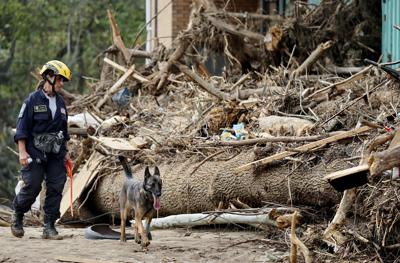

A member of the FEMA Urban Search and Rescue Task Force searches a flood-damaged property with a search canine in the aftermath of Hurricane Helene along the Swannanoa River on Oct. 4, 2024, in Asheville, North Carolina. At least 215 people were killed in six states in the wake of the powerful hurricane which made landfall as a Category 4. President Joe Biden ordered the deployment of 1,000 active duty U.S. soldiers to assist with storm relief efforts in what is now the deadliest U.S. mainland hurricane since Hurricane Katrina. (Mario Tama/Getty Images/TNS)Mario Tama/Getty Images North America/TNS

North Carolina’s $111 billion agricultural sector was already suffering in 2024, and then Helene hit.

A dozen industry representatives told the House Agricultural Committee Tuesday that without significant, quick investment, those impacts could reverberate through the industry for years.

“This year has been challenging. That doesn’t do it justice. It’s been awful for agriculture,” said Steve Troxler, North Carolina’s agricultural commissioner.

Before Helene, North Carolina’s agriculture industry had lost $696 million from a prolonged drought throughout the spring and summer followed by tropical storms and historic rains from an unnamed storm in Southeastern North Carolina.

“It was kind of like taking a house plant that’s been pampered and putting it out in the front yard in the sun and not being able to water it and then drowning it with a great big gulp of water. That’s what happened to agriculture in the state,” Troxler said.

Then, Troxler said, Helene caused another $907.62 million in losses, based on estimates from N.C. State University’s Blake Brown and Mike Walden.

“It’s a disaster,” Troxler sad.

Jerred Nix, an apple farmer from Henderson County’s Edneyville, described watching an orchard he’d been set to inherit from his father wash away in the course of about eight minutes. As he spoke before the committee, Nix showed an aerial photo of his property, with a field covered in dirt.

“I have beach front property in Edneyville right now because that 10 acres has about three feet of sand over top of it,” said Nix, the vice president of Flavor Full Farms.

The General Assembly has passed two Helene relief bills, with additional funds that could be sent to the relief effort via a third bill where the House is expected to take a veto override vote Wednesday. None of those packages have included targeted relief for the state’s agricultural industry.

Troxler urged legislators to custom-fit relief programs for the needs of Western North Carolina, where farmers are more prone to grow Christmas trees and nursery crops that are much less likely to be covered by crop insurance than the corn and soy beans that are more popular in the Coastal plain.

“We can’t afford to sit back and wait. I know we want to see the feds pay everything that they will pay for but having been through this with Florence and other disasters, those programs that they are going to come with are probably not going to fit,” Troxler said.

For example, Troxler said, Christmas tree farmers have lost the on-farm infrastructure like roads and culverts that they need just to be able to reach their crops, much less to bring them off of a mountain.

In one case, a Christmas tree farmer had a 12-acre pasture on a river, Rodney Buchanan, president of the N.C. Christmas Trees Association, told the committee. After floodwaters stripped a portion of the pasture down to the bedrock, that farmer has a seven-acre pasture.

“There is nothing you can do on solid rock for agriculture,” Buchanan said.

David Davis, the N.C. Cooperative Extension’s Yancey County director, said he’s barely left the county since Helene hit on Sept. 27, helping farmers with everything from logistics to arranging for them to receive fence posts to helping talk through their mental health struggles.

“The next few years we’re going to spend a lot of time trying to keep our farmers in business. That’s the task at hand,” Davis said.

In some parts of Yancey County, farms were covered with a foot to six feet of silt. Those places were lucky, Davis said, because that silt had washed off of land upstream, wiping out what he called “prime production land.”

Between 80% and 90% of the county’s best farmland is located on rivers and streams, Davis added. He showed the committee a photo of Cane River, which is typically 12 to 15 feet wide and swelled to between a mile and a mile-and-a-half on Sep. 27.

“We had many farms that have lost sand and silt, and they have nothing to grow in,” Davis said, adding that he lost topsoil in some of the most productive fields on his own 17-acre cabbage and tomato farm.

Even cleaning out rivers and streams in Western North Carolina will cost between $350 million and $500 million, Troxler said. That will likely require at least $100 million in state matching funds, Troxler added.

“If we don’t do that, the next five-inch rain or the next seven-inch rain will put us back where we are right now because the water has no place else to go,” Troxler said.

Opinion
The NC legislature’s disastrous disaster response

Rob Schofield
Thu, December 12, 2024 

a washed-out farm

Leaders in NC's agriculture industry detailed the extensive damage and erosion left in the wake of Helene. (Photo: David Davis, County Extension Director, N.C. Cooperative Extension)

On any list of key governmental functions, natural disaster response is near the top. If public services and structures don’t provide relief and spearhead recovery when disasters strike, communities can literally and permanently fall apart.

And tragically, this appears to be happening in parts of western North Carolina in the aftermath of Hurricane Helene.

Thanks in large part to the slow and woefully inadequate response of state lawmakers, businesses and farms are failing, unemployment and evictions are rising, morale is sinking, and some once vibrant cities and towns are disintegrating as residents simply pack up and leave.

Rather than heeding Gov. Cooper’s call for an aggressive, all-hands-on-deck response that would provide a critical financial lifeline to thousands and spur community hope and optimism, Republican legislative leaders are sticking to their usual shortsighted and cheapskate ways.

The bottom line:  The problems in the west are massive and state government can’t solve them all, but by largely turning its back, the legislature has irresponsibly shirked one of its most basic duties.

For NC Newsline, I’m Rob Schofield.


South Carolina farmers face Helene's damage after months of drought and falling prices

By Macon Atkinson
 Report for America corps member matkinson@postandcourier.com 
and Lillia Callum-Penso lcallumpenso@postandcourier.com

Oct 2, 2024

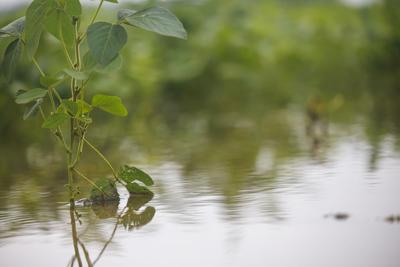
A field is flooded after Tropical Storm Debby dumped rain, Aug. 8, 2024, in Dillon. Farmers across South Carolina are just beginning to assess the damage wrought by Tropical Storm Helene.Grace Beahm Alford/Staff

PIEDMONT — Jackson Wood wondered if Helene would be the end of his DarkSpore Mushroom Co.

With no electricity, the owner of the specialty mushroom farm that sells to nearly 20 local restaurants and three farmers markets had been forced to throw away all his fresh product. It was about 700 pounds, or $9,000 worth of sales.

Wood was looking at starting from scratch.

“I’m unsure if we’ll be coming back from this or not, honestly,” Wood said.

Once power comes back he’ll reassess, then start the nearly monthlong process of growing mushrooms again.

Even so, Wood remained grateful.

“Our building is still intact and we’re all OK,” he said Oct. 1. “We have a lot of family members and friends in this industry too that have been affected a lot worse than we have. It’s very unfortunate.”

Wood is one of the multitude of farmers across South Carolina just beginning to assess the damage wrought by Tropical Storm Helene, which packed a punch to the Upstate with flooding rains and winds up to 72 mph. The storm killed at least 36 people across the state and left thousands in damaged homes and without power.

For farmers, the storm destroyed specialty crops like Wood's mushrooms as well as cash crops such as soybeans, cotton and peanuts. Others are dealing with livestock losses due to downed fences and structural damage to feed-storage facilities. The lack of power could be detrimental to poultry producers in particular, as well as farmers who are reliant on wells with electric pumps to water their livestock.

"There's a number of moving parts that we're dealing with right now," said Adam Kantrovich, director of Clemson Cooperative Extension Service's agribusiness team.

Amid intense heat and getting little rain, multiple SC counties face 'severe' drought

The devastation came on the heels of several already disastrous months for South Carolina farmers, who have battled drought, plunging commodity crop prices and previous flooding from Hurricane Debby in August.

All of that means more yearly losses are likely, Clemson extension experts said in a press release.

That includes products like cotton — one of South Carolina's more popular crops.

Farmers planted 225,000 acres of cotton in South Carolina in 2024, up from 210,000 in 2023, according to the U.S. Department of Agriculture.

Cotton's development varies greatly, said Michael Jones, a cotton specialist at the Pee Dee Research and Education Center in Florence. Harvest typically begins in late September in South Carolina, and cotton fiber weight and quality are best the day the boll opens.

Fiber degrades with water produced by storms, so many farmers were waiting to defoliate until after the storm passes.

“Most fields have open bolls at this time, so the storm will be an issue," Jones said in the press release.

High winds blow lint to the ground, and tangled plants make harvest difficult, he added. Wet ground also makes it difficult to use heavy equipment.

Another popular South Carolina offering — soybeans, is expected to take a hit.


4 years after Trump's tariff war, SC farmers able to profit again — from soybeans


About 25 percent of the state’s soybean crop has reached maturity, with most of the crop beginning to drop leaves, said Michael Plumblee, a corn and soybean specialist in Blackville.

While the rain will help relieve drought-like conditions, wind made the mature soybeans drop their leaves and could make younger plants bend too close to the ground, making it harder for farmers to harvest them.

The USDA reported South Carolina farmers planted 390,000 acres of soybeans in 2024, slightly less than 2023 when 395,000 acres were planted.

Helene was a most unwelcome guest for farmers who, just months ago, lost specialty crops like melons and saw significantly lower corn yield because of a late-spring to summer drought, Kantrovich said. Still more struggled because geopolitical events such as international trade tensions have spurred commodity prices for grain items to drop while input remains the same.

Hurricane Debby also created flooded conditions late this summer, cutting into production.

Growers with crop insurance should work with their crop insurance company if they've seen heavy losses, while those who have uninsurable crops should get in touch with the USDA Farm Service Agency within their county, Kantrovich said. The USDA Farm Service Agency can also help with emergency loans.

While many farmers had made good assessments in the days following the storm, others remained uncertain. At Swamp Rabbit Café & Grocery in Greenville, the owners were still unsure what the extent of the impact will be on their small business that sources product almost exclusively from local and regional producers.

Mary Walsh, who opened the grocery and café with Jac Oliver 13 years ago, spent Oct. 1 trying to figure out how to restock the store’s shelves after the power had been restored. She also began checking in with some of the hundreds of farmers the store works with.

She hadn’t been able to get in touch with many from the Asheville area.

“We haven’t had time to assess but I know other people are way worse off than we are,” she said.

In the aftermath of Helene, Clemson Extension is offering an Agricultural Impact Assessment form for producers to use to file individual farm and field reports, as well as area reports by extension agents. The assessments help in recovery and aid requests for the state and beyond.

Producers can visit www.clemson.edu/extension/helene.html for more information on how to complete the impact assessment form.

HEY AMERIKA

Robert Reich: How Are You Doing? – OpEd


By 

We are in a queasy interregnum. Four weeks ago, we learned that Donald Trump won the 2024 election. In six weeks, he’ll be taking over the United States government. 


To run that government, he’s nominated a Star Wars cantina of fanatics, extremists, conspiracy theorists, billionaires, sexual harassers, and disreputable no-goods. 

Republican senators — the only firewall against this bunch — seem reluctant to take Trump on, other than drawing a line at the reprehensible Matt Gaetz. 

The person Trump wants to run the FBI is pledging a campaign of vengeance against his political enemies. The people he wants to put in charge of the military and the border are promising a mass roundup and deportation of undocumented immigrants. The billionaires he’s put in charge of eliminating “waste” are gunning for Social Security, Medicare, and Medicaid. The person he wants to run the nation’s health is a nutcase who doesn’t believe in vaccinations. And so on. 

This time there will be few if any grownups around him to constrain Trump’s worst instincts. 

Some of you are frightened. Me too. You’d have to be living on another planet not to fear what will happen starting in six weeks. 


Meanwhile, most of the criminal charges against Trump, as well as his sentencing for the felonies he was found guilty of having committed, have been dropped or vacated. 

Many of you are furious that Trump won’t be held accountable. I am too. 

Yet I’m surprised at how many of the people I speak with are in denial. They tell me “Trump is just bluffing,” or “He’s not so stupid as to try these things.” Or they say “the Constitution is strong enough to withstand Trump.”

I fear they’re wrong. He’s nuts, he and his minions will try these things, and the Constitution is already near the breaking point. 

I’ve also been surprised at the silence of the Democrats. Where’s the Democratic leadership? Who’s speaking up for the rule of law right now, other than Liz Cheney? Why have Joe Biden and Kamala Harris seemingly disappeared?

Democratic leaders apparently believe it’s better for them to say nothing now and let Republicans take the heat. 

But there’s little or no heat. Trump seems to be taking over Washington without a whimper of opposition. 

I just heard from an old friend who’s also a U.S. senator, who writes: “The new administration isn’t as bad as we thought. It’s worse.” 

I wish him well. We need people of integrity on the front lines to try to constrain Trump and his sicko sycophants. 

Yet even those of us who aren’t on the front lines must be activists. 

If you don’t want to watch the news, I understand. If you’re feeling frightened or furious or worried, you’re in good company.

But I hope you feel more determined than ever to fight the fanatics who will take charge in just six weeks.

Stand up to them. Call them out. Do not tolerate intolerance. We cannot compromise with cruelty. There is no middle ground between democracy and fascism. 

I use these daily posts to you as ways of finding some hope in the dark. As small tokens of resistance. As means of fortifying you in these difficult times. 

Thank you for reading. Thank you for sharing. Thank you for your comments and your words of encouragement. 

Mostly, thank you for your commitment to a fair and decent society. 

As we head into the darkness, we need each other to help light the way forward.


Robert B. Reich is Chancellor's Professor of Public Policy at the University of California at Berkeley and Senior Fellow at the Blum Center for Developing Economies, and writes at robertreich.substack.com. Reich served as Secretary of Labor in the Clinton administration, for which Time Magazine named him one of the ten most effective cabinet secretaries of the twentieth century. He has written fifteen books, including the best sellers "Aftershock", "The Work of Nations," and"Beyond Outrage," and, his most recent, "The Common Good," which is available in bookstores now. He is also a founding editor of the American Prospect magazine, chairman of Common Cause, a member of the American Academy of Arts and Sciences, and co-creator of the award-winning documentary, "Inequality For All." He's co-creator of the Netflix original documentary "Saving Capitalism," which is streaming now.
Mandate or mirage? Trump's narrow victory could imperil his party in 2026

For the third time, Donald Trump failed to win more than 50 percent of the electorate. The Republican Party should thus thread carefully if it wants to hold on to its majorities in Congress.


David Schultz


Presidential candidates in the United States like to claim that their victories are political mandates. President-elect Donald Trump is no exception. But the final numbers are now in, and they show that Trump may not have secured that much support for his agenda after all.

For the third straight presidential election in a row, Trump has failed to clinch more than 50 percent of the votes. Though he won three million more votes in November than in 2020, his final popular vote was 49.72 percent of the electorate, barely one and a half percent more than Kamala Harris.

It was the second smallest popular vote victory for a US president in the last 40 years.

Yet the winner-takes-all aspect of American politics has given Trump and his party a false claim of a mandate that misinterprets voter preferences in 2024 and could potentially lead to the loss of one or both houses of Congress in the 2026 midterm elections.

What's in a mandate

What it means to have a political mandate is a matter of debate. One definition is that a "mandate is the authority that voters confer on an elected official to act as their representative."

In a democracy, this often means at least a majority of the voters have supported you and endorsed your policies.

Using this definition, Trump and Republicans may not have a mandate. It is more likely the results were a protest vote against US President Joe Biden, Vice President Kamala Harris, and the status quo.

Thus, Trump's victory was less a vindication and support for him, and more the consequence of other factors.

For example, Harris was tainted by Biden's general unpopularity and a disapproval for his policies, as well as her failure to break from him and distinguish her possible administration from Biden's.


US President Joe Biden, First Lady Jill Biden, Vice-President Kamala Harris and Second Gentleman Doug Emhoff at the Kennedy Center in Washington, DC, December 8, 2024 (AFP).

Additionally, Harris herself was a weak candidate, generally underperforming across the country compared to other Democratic candidates for the Senate or other statewide offices. Trump, in effect, beat a weak candidate in the popular vote.

By the numbers

In the electoral vote, had Harris picked up approximately 124,000 more votes in the critical swing states of Michigan, Pennsylvania, and Wisconsin, she would have won the presidency.

However, because Trump consistently beat her across the critical seven swing states, the distorting effects of the Electoral College gave Trump 312 electoral votes to Harris's 226.

Meanwhile, in the House of Representatives, Republicans have barely held on to their majority. Democrats picked up one House seat, creating the narrowest partisan majority in US House history since 1930, when Republicans and Democrats were even.

In the US Senate, the Republicans did flip the chamber, but Democratic Senate candidates received 1.4 million more votes than were cast for Republican candidates.


Finally, when one looks at some critical issues on the ballots across the country, abortion or reproductive rights ballot propositions passed in seven of 10 states.

In Florida, one of the three states where it failed, it still received 57 percent of the vote— 3 percent short of the 60 percent requirement for a constitutional amendment.


From a numerical perspective, it is hard to conclude that Trump and the Republicans have a mandate. Yet in a polarised political world of winner-take-all politics, Republicans and Donald Trump have the numerical majorities in Congress to potentially legislate what they wish. Still, they do so with peril.


Voter punishment

One lesson in American history is that candidates or parties who overestimate their strength overreach are punished by the voters in the next election.


The dome of the US Capitol is seen at dusk in Washington, DC on November 13, 2023. Who controls Congress is 2026 remains to be seen (AFP).

For example, after their election in 2008, former President Barack Obama and the Democrats upset voters by passing the Affordable Care Act, leading to Republicans capturing both Houses in 2010.

Then when Trump and the Republicans who were elected in 2016 overreached with conservative Supreme Court appointments, Democrats captured both Houses in the 2018 elections.

Already, the 2026 American elections are on the horizon, even though Trump and other Republicans have not yet been sworn into office. Historically the president's party loses seats in Congress in midterm elections.
,,

The Republicans and Trump have an excellent opportunity. They attracted many working-class voters, including people of colour, and they moved many middle-class voters to their side in November.

In 2026, there will be 33 US Senate seats up for elections, with 20 held by Republicans and 13 by Democrats. Thus, the 2026 electoral map favors the Democrats.

The question is, will Trump and his Republicans listen to voters and address the concerns they have, or will they push their own narrow base agenda despite what might be majority preferences.

The Republicans and Trump have an excellent opportunity. They attracted many working-class supporters, including those from diverse backgrounds, and shifted significant middle-class support to their side in November.

Were Trump and the Republicans to adopt an agenda addressing more narrowly the concerns of these voters, such as illegal immigration and health care costs, they could redefine the political alignment of America for a generation to come.

Whether they will accept that choice is yet to be seen. If they do, perhaps then they will have forged a proper mandate.

SOURCE: TRT World

David Schultz is Hamline University Distinguished Professor of Political Science, Legal Studies, and Environmental Studies in Saint Paul, Minnesota. He is the author of more than 45 books and 200 articles.


Dec 10, 2024  Impromptu/Washington Post

America has lost faith in experts, and it’s certainly showing in some of Donald Trump’s Cabinet picks. Beyond a lack of qualifications, there are concerns over character problems with several nominees too. But do either really matter in American politics anymore? Deputy Opinions Editor David Von Drehle talks with columnists Ruth Marcus and Dana Milbank about what, if anything, can sink a nominee in today’s political culture.


The Birmingham Blade is a unique wind turbine which was entirely designed by AI with customized functionality at a fraction of the cost of conventional research and development.


Case of bird flu found in Republic of Ireland

Louise Cullen
BBC News NI agriculture and environment correspondent
PA Media
Buzzards are largely resident throughout Ireland and Britain

Bird flu has been found in a wild bird in the Republic of Ireland, the first confirmed discovery on the island of Ireland since September 2023.

The bird, a buzzard, was found in County Galway.

Poultry, game and pet bird owners in Northern Ireland have been urged to review their biosecurity standards to help lower their risk.

Northern Ireland's Chief Veterinary Officer, Brian Dooher, said the virus was present in wild birds.

'Huge risk to poultry sector'

"The recent detection of HPAI H5N1 in a wild buzzard in Galway demonstrates that the virus is present in wild birds on the island of Ireland," Mr Dooher said.

"This finding highlights the importance of maintaining high standards of biosecurity to protect the poultry industry in Northern Ireland from the threat of avian influenza.

"I would reiterate my earlier warning that owners of poultry, game or pet birds should act now to ensure their biosecurity measures are sufficient to reduce the risk of disease to your flocks," he added.

A biosecurity checklist is available on the website of the Department of Agriculture, Environment and Rural Affairs ( Daera).

The disease poses huge risk to the local poultry sector which is worth around £0.5bn a year to the Northern Ireland economy.

There has not been an outbreak in a commercial poultry setting since December 2021.

Bird flu restrictions were eased in Northern Ireland in April 2023, following the outbreak which began in October 2021.

It was described as the largest ever in these islands.

But strict biosecurity protocols have remained in place.
REPEAT AFTER ME; 


Japanese survivor of atomic bomb recalls its horrors in Nobel Peace Prize acceptance speech

A Japanese man who lived through the American atomic bombing of Nagasaki has accepted this year’s Nobel Peace Prize on behalf of an organization of survivors


ByFANNY BRODERSEN Associated Press and VANESSA GERA Associated Press
December 10, 2024


OSLO, Norway -- A 92-year-old Japanese man who lived through the American atomic bombing of Nagasaki described on Tuesday the agony he witnessed in 1945, including the charred corpses of his loved ones and the ruins of his city, as he accepted this year's Nobel Peace Prize on his organization's behalf.

The prize was awarded to Nihon Hidankyo, a grassroots movement of Japanese atomic bombing survivors who have worked for nearly 70 years to maintain a taboo around the use of nuclear weapons. The weapons have grown exponentially in power and number since being used for the first and only time in warfare by the United States on Nagasaki and Hiroshima in 1945.

The bombings pushed Japan to surrender to the Allies. They killed some 210,000 people by the end of 1945, but the full death toll from radiation is certainly higher.

As the survivors reach the twilight of their lives, they are grappling with the fear that the taboo against using the weapons appears to be weakening. It was a concern expressed by the 92-year-old-survivor, Terumi Tanaka, who delivered the acceptance lecture in Oslo's City Hall to an audience that included Norway's royal family.

“The nuclear superpower Russia threatens to use nuclear weapons in its war against Ukraine, and a cabinet member of Israel, in the midst of its unrelenting attacks on Gaza in Palestine, even spoke of the possible use of nuclear arms,” Tanaka said. “I am infinitely saddened and angered that the nuclear taboo threatens to be broken.”

That concern drove the Norwegian Nobel committee to award this year's prize to the Japanese organization, though it had honored other nuclear non-proliferation work in the past.

Jørgen Watne Frydnes, the chair of the committee, said in introducing the laureates that it was important to learn from their testimony as the nuclear dangers grow.

“None of the nine countries that possess nuclear weapons — the United States, Russia, China, France, the United Kingdom, India, Pakistan, Israel and North Korea — appear interested in nuclear disarmament and arms control at present,” he said. “On the contrary, they are modernizing and building up their nuclear arsenals.”

He said the Norwegian Nobel Committee was calling upon the five nuclear weapon states that have signed the Treaty on the Non-Proliferation of Nuclear Weapons — the U.S., Russia, China, France and the U.K. — to take seriously their obligations under the treaty, and said others must ratify it.

“It is naive to believe our civilization can survive a world order in which global security depends on nuclear weapons,” Frydnes said. “The world is not meant to be a prison in which we await collective annihilation.”

In his speech, Tanaka described the attack on Nagasaki on Aug. 9, 1945, three days after the first bomb was dropped on Hiroshima.

He recalled the buzzing sound of a bomber jet followed by a “bright, white light," and then an intense shock wave. Three days later, he and his mother sought out loved ones who lived near the hypocenter.

“Many people who were badly injured or burned, but still alive, were left unattended, with no help whatsoever. I became almost devoid of emotion, somehow closing off my sense of humanity, and simply headed intently for my destination,” he said.

He found the charred body of an aunt, the body of her grandson, his grandfather on the brink of death with severe burns and another aunt who had been severely burned and died just before he arrived. In all, five family members were killed.

He described the efforts of survivors to use their experiences to try to abolish nuclear weapons for the sake of humanity, and to try to receive compensation from the Japanese state, which started the war, for their suffering.

“I hope that the belief that nuclear weapons cannot — and must not — coexist with humanity will take firm hold among citizens of the nuclear weapon states and their allies, and that this will become a force for change in the nuclear policies of their governments,” he said.


Nobel Peace Prize winners urge young people to fight against nuclear weapons

Tue Tuesday 10 December, 2024

Terumi Tanaka, a survivor of the Nagasaki atomic bombing in 1945, accepted the Nobel Peace Prize on behalf of Nihon Hidankyo, an anti-nuclear organisation. 
(AP: Kin Cheung)

In short:

A group of Japanese atomic bombing survivors have been awarded the 2024 Nobel Peace Prize at a ceremony in Oslo.

Terumi Tanaka, the co-chair of the Nobel laureate group Nihon Hidankyo, called for young people to take up their fight against nuclear weapons.

He warned that threats in Ukraine and Gaza to use nuclear weapons were undermining the group's mission of creating a nuclear-free world.


A Japanese atomic bomb survivors' group has urged young people to take up the fight for a nuclear-free world while accepting this year's Nobel Peace Prize.

Nihon Hidankyo, a grassroots movement of survivors of the 1945 nuclear bombings of Japanese cities Hiroshima and Nagasaki, is campaigning for a world free of nuclear weapons using witness testimony.

Nihon Hidankyo's ranks are dwindling with every year. The Japanese government lists around 106,800 survivors of the bombings, also known as "hibakusha", still alive today. Their average age is 85.

"Any one of you could become either a victim or a perpetrator, at any time," Terumi Tanaka, 92, told the audience.

"Ten years from now, there may only be a handful of us able to give testimony as firsthand survivors. From now on, I hope that the next generation will find ways to build on our efforts and develop the movement even further."

Mr Tanaka's group had "undoubtedly" played a major role in creating the worldwide standard that it was unacceptable to use atomic weapons, or 'nuclear taboo', he said. But he warned that standard was being weakened.

"In addition to the civilian casualties, I am infinitely saddened and angered that the 'nuclear taboo' risks being broken," he said.


Terumi Tanaka, Shigemitsu Tanaka, and Toshiyuki Mimaki accepted the Nobel Peace Prize at a ceremony in Oslo. (AP: Kin Cheung)

Nihon Hidankyo was also represented at the ceremony by its two other co-chairs, Shigemitsu Tanaka, 84, and Toshiyuki Mimaki, 82.

An estimated 210,000 people died, either immediately or over time, as a result of the bombs dropped in August 1945 on Hiroshima and Nagasaki. Today's nuclear weapons are far more powerful than those used at that time.

Mr Tanaka was 13 years old at the time of the Nagasaki bombing, and although he survived the explosion almost unharmed at his home some 3km from ground zero, he lost five family members and recalled the harrowing experience.

"The deaths I witnessed at that time could hardly be described as human deaths. There were hundreds of people suffering in agony, unable to receive any kind of medical attention," Mr Tanaka told the audience.


"I strongly felt that even in war, such killing and maiming must never be allowed to happen."
Group warns of nuclear weapon threats

Mr Tanaka expressed concern over threats to use nuclear weapons in the ongoing wars in Ukraine and Gaza.

"There still remain 12,000 nuclear warheads on Earth today, 4,000 of which are operationally deployed, ready for immediate launch," Mr Tanaka said.

In 2017, 122 governments negotiated and adopted the historic UN Treaty on the Prohibition of Nuclear Weapons (TPNW), but the text is considered largely symbolic as no nuclear power has signed it.


THE GANG OF FOUR
Ambassadors from Russia, China, Israel, and Iran were not present at the ceremony.
 (AP: Kin Cheung)

While all ambassadors stationed in Oslo were invited to Tuesday's ceremony, the only nuclear powers in attendance were Britain, France, India, Pakistan and the United States. Russia, China, Israel and Iran were not present, the Nobel Institute said.

Expressing concern about the world entering "a new, more unstable nuclear age", Norwegian Nobel Committee chairman Jørgen Watne Frydnes warned that "a nuclear war could destroy our civilisation".

"Today's nuclear weapons ... have far greater destructive power than the two bombs used against Japan in 1945. They could kill millions of us in an instant, injure even more, and disrupt the climate catastrophically," Mr Frydnes said.

Reuters/AFP


Nuclear War: How Western Media Preps The World – OpEd


By 

Recent modification by the Russian government of its nuclear doctrine has given rise to a wave of news reports and analysis by western media that appears less concerned about the application of the updated doctrine than to tell the world that anything the Russians may want to do in its militarism, the West can do better.


In a 2020 decree, well before its invasion of Ukraine in 2022, Russia had warned that it may use nuclear weapons in case of a nuclear attack by an enemy or conventional attack that threatened the existence of the Russian state. This doctrine – enacted well before the war with Ukraine in 2022 – did not cause concern as it mirrored a similar if unpublicised doctrine of the United States and its western allies.

A later version of this decree proposed in September 2024 for a broadening of the threats under which Russia would consider a nuclear strike. It also included Belarus, an ally, under Russia’s nuclear umbrella and the warning that a rival nuclear power supporting a conventional strike on Russia or its ally would also be considered to be attacking it.

Since then there has been a worsening of the war situation in Ukraine with President Biden’s approval of the use of US long range missiles to strike targets within Russia. This was responded to by President Putin signing into law the earlier proposed September changes. To remind the West of the new red lines, Putin approved the launching of a potentially nuclear warhead carrying missile into Ukraine. Nicknamed ‘Oreshnik’, the hypersonic missile is capable of carrying six nuclear warheads and reaching its targets in Europe in 15-30 minutes.

Western Media Response to Oreshnik

Much of the reaction in western media circles, war analysts and think tanks has been not only to pour cold water on Russia’s capacity to begin a qualitatively new and more destructive phase of military combat. The Ukrainian  newspaper. The Kyiv Independent, argued that Russia is engaged in a psych and propaganda offensive to create a climate of fear and scare Ukrainians and the West into submission (https://kyivindependent.com/oreshnik-strike-propaganda/)

Quoting The Moscow Times, a pro-west  paper, the paper claimed that the propaganda offensive was coordinated between government, military, and intelligence officials, as well as PR experts as a response to the West’s decision to permit Ukraine to strike inside Russia with US and ally ATACM missiles (Army Tactical Missile System).


Although the US has said that it will not change its nuclear posture despite the lowering of the Russian threshold, western media have begun a counter propaganda offensive aimed at heightening condemnation of the Russian measures. At the same time a more intensive propaganda campaign is now ongoing amongst the wolf warrior forces of the west to impress western public on the ability of the US to successfully conduct a nuclear war.

Engaged are also more reputed western media channels intent on increasing their readership by putting up the nuclear war subject in their front page whilst assigning the blame for the start of any nuclear war to the enemies of the West.

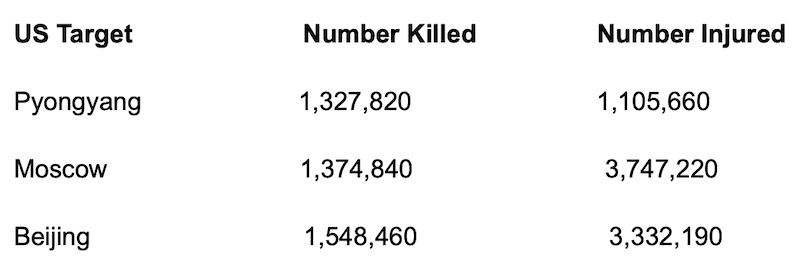
For the ‘benefit’ of its Asian readership, the latest report by American weekly, Newsweek, which claims a large multicultural audience and ‘fair and independent’ journalism, provides detailed maps of the impact of a US initiated nuclear war in Asia. The report starts off with the following lead statement which is intended to absolve the US from responsibility in any of the wars taking place.

“The U.S. is inadvertently involved in multiple conflicts around the world in backing its allies, while also facing tensions with China over several issues including trade.”

According to the report casualties, in an US initiated first nuclear strike, would be of the following magnitude:

What is especially noteworthy in the report is that it is a follow up to initial modelling of the casualties likely from a Russian nuclear strike against the US and NATO capitals. This appears to give the impression that the magazine is fair in its reportage although the emphasis on the American ‘inadvertent involvement’ in multiple conflicts clearly exposes the paper’s real intentions.

The impact of such obviously slanted and clearly mischievous journalism is not only to play up the war fantasies of the forces and lobbies of war in the US and NATO. It is also to desensitize and harden the public into acceptance of the lives to be paid for in any nuclear conflict; and to justify this by assigning blame and responsibility to Russia, China and North Korea.

Policy of NFU on Nuclear Weapons

Most important and crucially missing from the current news reports and analysis on the possibility of a nuclear war taking place is discussion on the policy of first use of nuclear weapons (NFU). For now, China and India are the only two nuclear power countries that have formally committed to a no first use policy. In 1964, following the detonation of its first atomic bomb, China declared that it would never be the first to use nuclear weapons. Today it is the only nuclear-armed nation with an unconditional policy of NFU of nuclear weapons.

In contrast the US and NATO, and its member states of France and the United Kingdom, have repeatedly spurned demands from their public to commit to a NFU policy, thus showing a policy intent not only aimed at deterrence but also to warfighting and first strike.

Media and other stake players committed to preventing a nuclear conflict would do well to highlight the importance of all nations in subscribing to NFU. This would be a more constructive and worthwhile subject for their front pages than what they are now focusing on to prevent a nuclear holocaust.


Lim Teck Ghee

Lim Teck Ghee PhD is a Malaysian economic historian, policy analyst and public intellectual whose career has straddled academia, civil society organisations and international development agencies. He has a regular column, Another Take, in The Sun, a Malaysian daily; and is author of Challenging the Status Quo in Malaysia.