Saturday, January 25, 2025

'Absolutely Insane': Trump Teases Killing FEMA While Touring Disaster Zones

"If we abolish federal funding for disaster assistance, municipalities and states wouldn't be able to cover these types of catastrophic emergencies and people would be left to fend on their own," one expert warned.
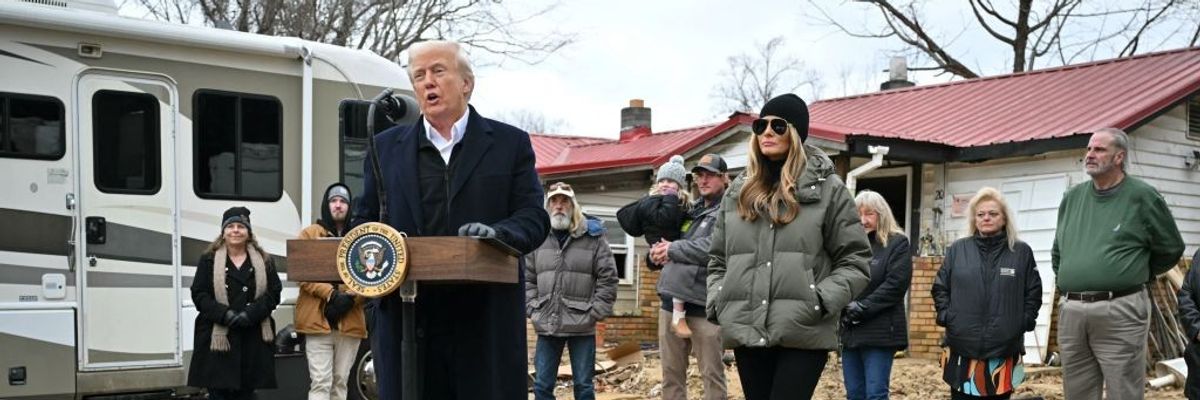


U.S. President Donald Trump speaks while visiting a neighborhood affected by Hurricane Helene in Swannanoa, North Carolina, on January 24, 2025.
(Photo: Mandel Ngan/AFP via Getty Images)

Jessica Corbett
Jan 24, 2025
COMMON DREAMS

With trips to North Carolina and California on Friday, Republican U.S. President Donald Trump renewed his threat to the federal disaster assistance agency, drawing swift rebukes from climate campaigners, experts, and members of Congress.

Trump was sworn in on Monday and took aim at the Federal Emergency Management Agency (FEMA) during a Wednesday interview with Fox News' Sean Hannity. He echoed those comments on Friday after landing at Asheville Regional Airport in North Carolina, to visit a region devastated by Hurricane Helene in September.

During his first trip since Inauguration Day, Trump declared that he will "be signing an executive order to begin the process of fundamentally reforming and overhauling FEMA or maybe getting rid of FEMA."

"I think, frankly, FEMA's not good," he said. "I think when you have a problem like this, I think you want to go, and whether it's a Democrat or Republican governor, you want to use your state to fix it and not waste time calling FEMA."

"FEMA's turned out to be a disaster," the president added. "I think we're gonna recommend that FEMA go away and we pay directly, we pay a percentage to the state, but the state should fix this."


While attempting to kill FEMA could be legally complicated due to a federal law passed after Hurricane Katrina, Trump's comments sparked concern and criticism. According toCNN:
Officials with FEMA scrambled to understand his comments in North Carolina Friday, with personnel nationwide calling and texting one another, trying to figure out what his statements meant for the agency's future and work on the ground, according to a source familiar.

Trump's desire to eliminate or curtail FEMA could have chilling effects on emergency response even at state levels, former FEMA Chief Deanne Criswell told CNN.

"We need to take him at his word, and I think state emergency management directors should be concerned about what this means for spring tornado season" and the coming hurricane season, said Criswell, who served under former President Joe Biden. "Do they have the resources to protect their residents?"

Responding to Trump's remarks on social media, the think tank Carolina Forward said that "if you were upset at how FEMA responds to natural disasters, just wait until they don't exist at all. (Trump obviously won't do this—he can't, after all—but he'll very likely make a lot of noise about it and then not actually do anything, as usual)."

Congresswoman Deborah Ross (D-N.C.) also weighed in on X, saying that "FEMA has been a crucial partner in our fight to recover from Hurricane Helene. I appreciate President Trump's concern about Western N.C., but eliminating FEMA would be a disaster for our state."


Matt Sedlar, climate analyst at the Center for Economic and Policy Research (CEPR), noted in a Friday statement that "before he took office, some wondered whether Trump would actually deny federal disaster aid to states he considered politically unfriendly. The unpleasant truth is that in theory he could—and right now he appears willing to test that idea in reality."

"Trump is already setting the stage for a significant reduction in federal disaster aid and mitigation funding," warned Sedlar, who also published an article on CEPR's website that highlights how Trump's attacks on the agency relate to the Heritage Foundation-led Project 2025. "He has made repeated demands that would tie California's aid to specific policy changes he would like to see, and has even begun discussing the possibility of overhauling FEMA—if not eliminating it entirely."

"States cannot absorb the costs of these disasters, and they don't have the money to prevent them either," he stressed. "The federal government agencies that aim to make the U.S. climate resilient are already chronically underfunded as it is. If Trump truly wanted to make America great again, he would prioritize funding for aid and mitigation. Instead, he is making incoherent political demands and setting Americans up for four years of uncertainty and suffering."

Shana Udvardy, senior climate resilience policy analyst at the Union of Concerned Scientists, released a similar statement on Friday.

"The president is suggesting eliminating FEMA. My question is: Should we also ban hospitals? Both are a means to recovery," Udvardy said. "This latest comment stretches the boundaries of reality. If we abolish federal funding for disaster assistance, municipalities and states wouldn't be able to cover these types of catastrophic emergencies and people would be left to fend on their own."


After visiting North Carolina on Friday, Trump took off for the Los Angeles area, which has been ravaged by recent wildfires. As of press time, the Hughes Fire was only 56% contained, according to the California Department of Forestry and Fire Protection.

Sharing a video of Trump's Friday remarks on social media, Congresswoman Sydney Kamlager-Dove (D-Calif.) said that "as someone who's actually been on the ground in LA, people are grateful for FEMA and want more help—not less."

Margie Alt, director of the Climate Action Campaign, said in a Friday statement that "the people of Los Angeles are suffering. They need and deserve help. Wildfires fueled by high winds and climate change-fueled drought have destroyed 12,000 homes and killed 27 people in the area so far."

"Rather than playing the traditional presidential role of 'comforter in chief,' Donald Trump's visit to the area is performative, using the tragedy to advance his personal agenda: changing state water management policy to help his Los Angeles private golf club," Alt suggested. "Trump's threat to withhold disaster aid to benefit his golf club seems, unfortunately, to be par for the course when it comes to his presidency. But the people of Los Angeles deserve better, and quickly."

"Wildfires like these will only get worse and more frequent if we don't address the climate crisis that is intensifying these disasters and other extreme weather including flooding, extreme heat, drought, and more that we are experiencing across the U.S. and the world," she added. "It is unconscionable to threaten to withdraw federal support to Americans suffering the effects of this crisis because of where they live or whom they may have voted for. The climate crisis won't spare anyone."

Alt argued that "the only acceptable course of action for Trump and the Republican majority in Congress is to stop playing politics with people's lives. They must ensure that FEMA has the resources it needs, and need to stop cutting programs designed to help mitigate climate pollution and pushing for more of the fossil fuels responsible for making this crisis worse."


U.S. Sen. Sheldon Whitehouse (D-R.I.), ranking member of the U.S. Senate Environment and Public Works Committee, said in a Friday statement that "if Donald Trump cared even one bit about the communities being ravaged by climate change, he wouldn't hold disaster aid hostage to his political whims, dismiss the climate crisis as a hoax, or pander to his Big Oil donors."

"Instead, he'd tackle the carbon pollution driving these catastrophes and support U.S. clean energy dominance to lower energy costs for families," he added. "But from day one, Trump's priority has been rewarding his corrupt fossil fuel donors and sabotaging America's clean energy future. Now, he's exploiting the suffering caused by extreme weather to peddle his political agenda—proving once again he's all in for polluters and all out for the American people."

This isn't the first time Trump—who was previously president from 2017-21—has come under fire related to disaster response. As The Associated Pressreported Friday:

The last time Trump was president, he visited numerous disaster zones, including the aftermath of hurricanes and tornadoes. He sometimes sparked criticism, like when he tossed paper towels to survivors of Hurricane Maria in Puerto Rico.

Trump tapped Cameron Hamilton, a former Navy SEAL with limited experience managing natural disasters, as FEMA's acting director.

Reporting on Hamilton's position, The New York Timesnoted Wednesday that "since Hurricane Katrina, when the federal response was severely criticized, FEMA has been led by disaster management professionals who have run state or local emergency management agencies, or were regional administrators at FEMA."
'Not good': Trump proposes 'getting rid of' FEMA and conditioning California aid on voter ID


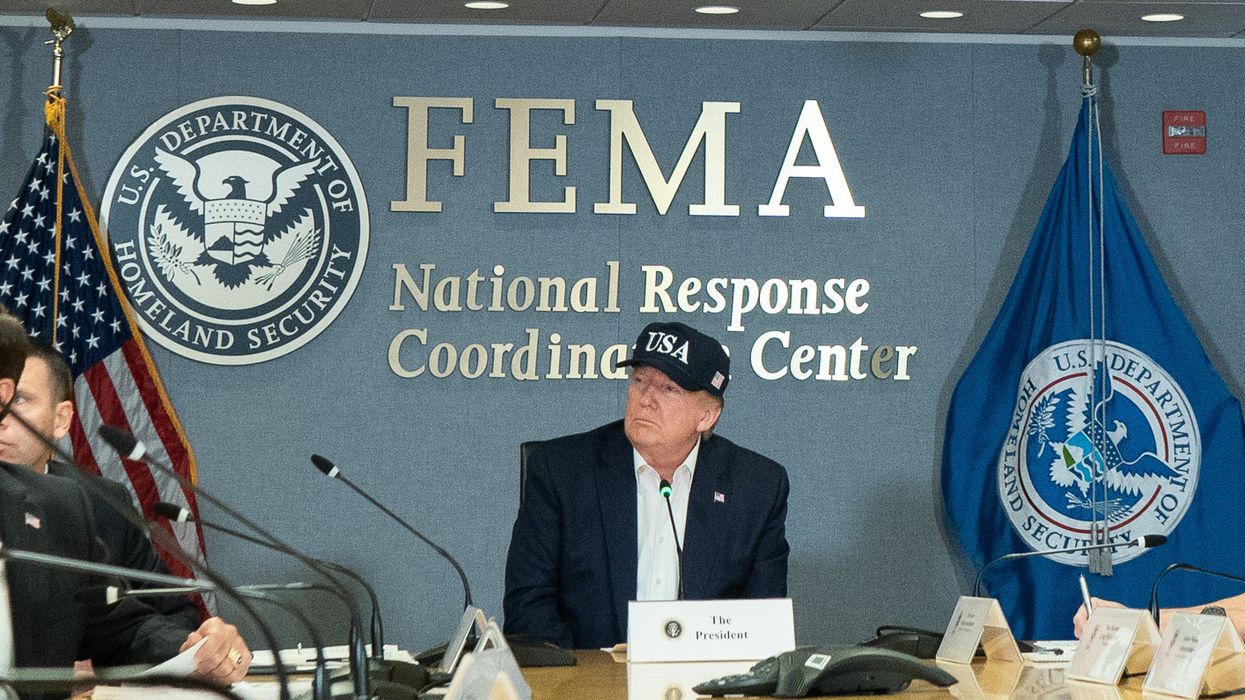
President Donald J. Trump, joined by Acting Secretary of the Department of Homeland Security Kevin McAleenan and Acting FEMA Administrator Pete Gaynor, attends a briefing Sunday, Sept. 1, 2019, on the current directional forecast of Hurricane Dorian at the Federal Emergency Management Agency (FEMA) headquarters in Washington, D.C.
 (Official White House Photo by Shealah Craighead)
January 24, 2025
THE NEW CIVIL RIGHTS MOVEMENT

President Donald Trump intensified his attacks on the Federal Emergency Management Agency during a visit to Hurricane Helene-damaged parts of North Carolina on Friday, announcing he is planning on reforming or “getting rid of FEMA,” and proposed an unprecedented move to condition disaster relief on the passage of a voter ID law by California’s lawmakers, “as a start.” Trump’s trip, which will include travel to California later Friday, appears designed to target the emergency management agency, which he has been criticizing for months.

In what appeared to be scripted remarks, Trump later elaborated that he would “sign an executive order to begin the process of fundamentally reforming and overhauling FEMA, or maybe getting rid of FEMA. I think frankly, FEMA’s not good. I think when you have a problem like this, I think you want to go and, uh, whether it’s a Democrat or Republican governor, you want to use your state to fix it and not waste time.”

“Calling FEMA and then FEMA gets here and they don’t know the area,” Trump claimed. “They’ve never been to the area and they want to give you rules that you’ve never heard about, they wanna bring people that aren’t as good as the people you already have,” he alleged.

“FEMA turned out to be a a disaster. And you could go back a long way, you could go back to Louisiana, you could go back to some of the things that took place in Texas. And it turns out to be the state that ends up doing the work. It just complicates it. I think we’re gonna recommend that FEMA go away. And we pay directly and we pay a percentage to the state, but the state should fix it.”

In his wide-ranging remarks, President Trump also claimed that “rather than going through FEMA,” disaster relief aid to California and North Carolina “will go through us,” meaning, through his administration. FEMA is a federal government agency under the wide umbrella of the U.S. Department of Homeland Security. The president nominates the HHS Secretary, a cabinet level official, and the FEMA administrator.

And Trump appeared to say that he will assign Republican National Committee chairman Michael Whatley to manage financial aid to North Carolina, removing FEMA from the state.


“Trump also said FEMA would not be involved in further relief efforts and instead suggested that Whatley, North Carolina Governor Josh Stein (D), and a trio of Republican House members would be working with the White House directly because the agency ‘hasn’t done the job,'” The Independent reported.

“I wanna see two things in Los Angeles,” Trump also told reporters late Friday morning, “voter ID so that the people have a chance to vote, and I want to see the water be released and come down into Los Angeles and throughout the state. Those are the two things. After that, I will be the greatest president that California ever has ever seen.”

“I want the water to come down and come down to Los Angeles and also go out to all the farm land that’s barren and dry,” Trump claimed. This week the President appeared to suggest that water runs only north to south.

“So, I want two things,” Trump repeated, “I want voter ID for the people of California. They all want it. Right now you have no, you don’t have voter ID. People want to have to voter identification. You wanna have proof of citizenship. Ideally, you have one-day voting, but I just want voter ID to start, and I want the water to be released, and they’re gonna get a lot of help from the U.S.”


Trump later responded to a reporter’s question about his remarks on ending FEMA, calling the agency “a very big disappointment” that costs “a tremendous amount of money.” He alleged, “they end up in arguments if they’re fighting, all the time over who does what, it’s just it’s just not a good system.”

“I think it’s, I think when there’s a, uh, when there’s a problem with the state, I think that that problem should be taken care of by the state. That’s what we have states for. They take care of problems, and a government can handle something very quickly,” Trump said, appearing to not mention the scope of FEMA’s actions, responsibilities, and resources.

Jordan Weissmann, reporter for Yahoo Finance covering federal agencies, offers this explanation on California water: “The water issue Trump is fixated on doesn’t really have anything to do with the wildfires. It’s a fight between Central Valley farmers and Northern California farmers and environmentalists about who gets more fresh water.”


Is Trump Using Project 2025 to Eliminate FEMA?


January 23, 2025
By David Badash

President Donald Trump, who made baseless attacks against FEMA during his 2024 campaign, suggested on Wednesday night that he wants to defund the Homeland Security emergency management agency and shift the burden for disaster relief to individual states. The move would revoke federal responsibility for managing crises like hurricanes, earthquakes, flooding, and wildfires. While his remarks appear to align with The Heritage Foundation’s Project 2025, he appears to have gone further in appointing an interim FEMA head who reportedly “does not appear to have experience coordinating responses to large scale disasters.”

Although he has repeatedly denied knowing anything about Project 2025, despite at least 140 of his former administration’s officials having been involved with the program, President Trump appears to be following the far-right plan to eliminate or largely downsize the 45-year-old agency. Its current incarnation was created by President Jimmy Carter, but the federal government of the United States has been assisting states with disaster relief for well over 200 years.

“Now, I will say that Los Angeles has changed everything, because a lot of money’s gonna be necessary for Los Angeles, and a lot of people on the other side want that to happen,” Trump told Fox News’ Sean Hannity in a pre-taped interview that aired Wednesday night (video below). In recent weeks, California’s wildfires, fueled in part by climate change according to Scientific American, have decimated large swaths of the Los Angeles area, killing dozens of people.


READ MORE: ‘Road to Chaos’: Trump Orders ‘Thousands’ of Troops and ‘Illegal’ Arrests at Border

“Well, they don’t care about North Carolina. The Democrats don’t care about North Carolina. What they’ve done with FEMA is so bad. FEMA is a whole other discussion. Because all it does is complicate everything,” Trump baselessly charged. “FEMA has not done their job for the last four years. You know, I had FEMA working really well, we had hurricanes in Florida, we had Alabama, tornadoes, we had. — but unless you have certain types of leadership, it’s really, it gets in the way.”

“And FEMA is gonna be a whole big discussion very shortly because I’d rather see the states take care of their own problems,” Trump declared, alluding to wanting to dismantle the agency. “If they have a tornado, someplace, and if they have — let that state, Oklahoma is very competent. I love Oklahoma. 77 out a 77 districts and uh that’s never been done,” he claimed, referring to his Electoral College win.

On Thursday, The Independent reported, “Trump wants to shut down the Federal Emergency Management Agency and let states handle their own disaster needs.”

Project 2025 describes the Department of Homeland Security as a “bloated” bureaucracy that would “provide real opportunities for a conservative Administration to cut billions in spending and limit government’s role in Americans’ lives


It calls for “privatizing” FEMA’s National Flood Insurance Program, and “reforming FEMA emergency spending to shift the majority of preparedness and response costs to states and localities instead of the federal government,” as well as “eliminating most of DHS’s grant programs, and removing all unions in the department for national security purposes.”

Trump’s remark, “I’d rather see the states take care of their own problems,” is similar to a portion of Project 2025’s proposal.

But Trump appears to have taken yet another step that could harm FEMA.

Trump has appointed a former Navy SEAL, Cameron Hamilton, who “does not appear to have experience coordinating responses to large-scale disasters, like the wildfires in California,” to be the interim head of FEMA, according to The New York Times.

“Mr. Hamilton is an unusual choice to lead the agency, even in a temporary capacity. Since Hurricane Katrina, when the federal response was severely criticized, FEMA has been led by disaster management professionals who have run state or local emergency management agencies, or were regional administrators at FEMA,” the Times reported. “Mr. Hamilton does not appear to have experience coordinating responses to large scale disasters like the wildfires that are raging in Los Angeles or the hurricanes, floods and earthquakes that FEMA typically manages.”

Watch the video below or at this link.


'Soaring': Price of grocery staple Trump promised to make cheaper hits new record high


Image: Shutterstock
January 23, 2025
ALTERNET

Donald Trump made the economy a major focus of his 2024 campaign, repeatedly blaming then-President Joe Biden and then-Vice President Kamala Harris for inflation. And that messaging worked: Trump narrowly defeated Democratic nominee Harris and returned to the White House on Monday, January 20, 2025.

The price of eggs was often mentioned during the 2024 race, and a recurring message from Trump was that he was "going to get the prices down" for "groceries, cars, everything." The price of eggs in particular was a major concern for voters, given how high prices soared under Biden's leadership during the Covid-19 pandemic.

But according to The New Republic's Edith Olmsted, the price of eggs has not decreased since Trump's inauguration. In fact, Olmsted — citing Consumer Price Index data — notes that egg prices hit an all-time high on the third day of Trump's second presidency.

Egg prices in the United States, Olmsted warns in an article published on January 23, could become even higher if the Trump administration drops the ball with the bird flu.

"Donald Trump's decision to press pause on communications from health organizations amid an escalating bird flu breakout could take America's soaring egg prices and make them even worse," Olmsted explains. "The consumer price index found that egg prices have increased 36.8 percent from this time last year, and experts believe the increase in price is the result of avian influenza, which is rapidly depleting the supply of chickens."

The New Republic reporter adds, "If one bird is infected, farms are required by law to cull the entire flock."

In an Axios article published on January 21, reporters Nathan Bomey and Kelly Tyko report that the "escalating bird flu crisis is ravaging the nation's supply of eggs, leading to increased prices and presenting an immediate challenge for the Trump Administration.

READ MORE: 'Where did he get this idea?' MAGA think tank behind 'reckless and ruthless' Trump policy

According to Bomey and Tyko, "Some retailers are limiting how many eggs consumers can purchase while others are having a hard time keeping shelves stocked."

Jason Hart, CEO of grocery chain Aldi, told Axios, "It's really a crazy situation and an unfortunate situation for consumers because the supply situation is what it is due to the bird flu."

Read The New Republic's full article at this link and Axios' reporting here.


Trump Rescinds Biden Order Aimed at Lowering Prescription Drug Prices

"Trump is again proving that he lied to the American people and doesn't care about lowering costs—only what's best for himself and his ultra-rich friends."


In a photo illustration, prescription drugs are seen in pill bottles on July 23, 2024 in New York City.
(Photo: Spencer Platt/Getty Images)


Jake Johnson
Jan 21, 2025
COMMON DREAMS

As part of a flurry of executive actions on the first day of his second White House term, President Donald Trump on Monday rescinded an order signed by his predecessor that aimed to develop programs to lower prescription drug prices in the United States—where residents pay far more for medications than people in peer countries.

News of Trump's rollback of Executive Order 14087—titled Lowering Prescription Drug Costs for Americans—was buried amid dozens of other rescissions the president ordered shortly following his inauguration.

The decision to scrap Executive Order 14087 brings to a halt several pilot programs undertaken by the Center for Medicare and Medicaid Innovation, including an experiment that involved offering generic medications for a $2 copay to Medicare Part D recipients.

"This act is a good indication of how Trump will approach lower drug prices," Social Security Works, a progressive advocacy group, wrote in response to Trump's rescission of President Joe Biden's executive order.

Larry Levitt, executive vice president for health policy at KFF, added that "the big question, which Trump hasn't addressed yet, is what he’ll do with government negotiation of drug prices under the Inflation Reduction Act."

Just days before Trump took office, the Biden administration announced a fresh slate of 15 medications set to be subject to direct price negotiations between the federal government and pharmaceutical companies, many of which have sued over the negotiation program—thus far unsuccessfully.

Reutersreported last week that the powerful pharmaceutical lobby has been pushing Trump's team to back changes to the Inflation Reduction Act that would weaken the price-negotiation provisions.

"Donald Trump is already following through on his dangerous plans to jack up the costs of drugs to appease his billionaire backers after the Biden-Haris administration took on Big Pharma and won," Alex Floyd, rapid response director for the Democratic National Committee, said in a statement. "Trump is again proving that he lied to the American people and doesn't care about lowering costs—only what's best for himself and his ultra-rich friends."

Responding more broadly to the president's day-one wave of unilateral actions—which included attacks on immigrants and the climate—Working Families Party national director Maurice Mitchell said Tuesday that "Trump's flood of executive orders is just a cheap spectacle meant to distract us while his administration moves to gut our healthcare and SNAP benefits."

"Immigrant families aren't the reason we can't afford eggs or prescription drugs; billionaire CEOs are," Mitchell added.

Friday, January 24, 2025

Colombian forces edge into guerrilla strongholds

Agence France-Presse
January 21, 2025

Army soldiers patrol in Tibu, Norte de Santander province, Colombia, on January 21, 2025, after recent clashes between rival left-wing guerrillas. Colombia vowed "war" against left-wing guerrillas Monday, declaring a state of emergency and deploying thousands of soldiers to contain violence that killed at least 100 people and threatens to scupper the country's fragile peace process. (AFP)

Colombian special forces edged into guerrilla-controlled territory near the border with Venezuela Tuesday, trying to reassert state control amid violence that has forced 20,000 people to flee their homes.

The mountainous northeastern Catatumbo region has been the epicentre of a sudden surge in fighting between armed leftist groups vying for territory and control of lucrative coca plantations and trafficking routes.

Over six days, the bloodshed has killed more than 100 people across three regions.

But it is the situation near the border that prompted the government to declare a state of emergency and deploy some 5,000 troops.

ALSO READ: Inside the parade of right-wing world leaders flocking to D.C. for Trump's inauguration

Special forces deployed to the town of Tibu on Tuesday pushed out from urban strongpoints in a convoy of camouflaged armoured personnel carriers.
It was a tentative show of force, designed to convince sceptical locals that the government is back in charge and that some of the worst violence Colombia had seen in years was being contained.

For many Colombians, the recent bloodshed carries echoes of a civil war that killed 450,000 over more than half a century and made the country a byword for armed violence.

In addition to the 20,000 people displaced, the United Nations on Tuesday reported about 30 people had been kidnapped and 1,000 trapped in their homes by the violence.

On the outskirts of Tibu, government soldiers set up temporary posts on crumbling asphalt roads flanked by thick vegetation.Troops -- warned by commanding officers to "remember, someone is waiting for you back home" -- nervously eyed the occasional rumbling truck or van that broke the jungle silence.

Others, with fingers close to the trigger, practised manoeuvrers or carried out foot patrols on empty lanes partially reclaimed by the equatorial forest.

- Factions -

Security officials say this spasm of bloodshed was caused by rivalry between Revolutionary Armed Forces of Colombia (FARC) dissidents and the National Liberation Army (ELN).

In empty settlements around Tibu, soldiers found ample evidence of who is usually in charge -- and of the rivalries between the two armed groups.

Stickers on sheds and shops celebrated late commanders of the once powerful FARC -- a Marxist group that signed a peace accord almost a decade ago.

On the same empty streets, scores of buildings were daubed with graffiti declaring "the ELN is present" or vowing to seek "liberty or death".

Most FARC members laid down arms from 2016, but dissident factions have continued to thrive in pockets of the country, enmeshing themselves in organised crime and the lucrative drug trade.

The ELN believed to number 6,000 fighters, has occasionally flirted with peace talks before walking away.

Experts say the ELN's leadership has been troubled by the FARC factions' growth in the region.

UN chief Antonio Guterres called Tuesday for Colombian non-combatants to be protected amid the fighting, urging "an immediate cessation of acts of violence against the civilian population."
Oyster ‘blood’ holds promise for combating drug-resistant superbugs: new research

The Conversation
January 21, 2025 

Oysters (Shutterstock)

Superbugs that are resistant to existing antibiotics are a growing health problem around the world. Globally, nearly five million people die from antimicrobial resistant infections each year. The annual toll of antimicrobial resistant infections is expected to rise by 70%, with an estimated 40 million deaths between now and 2050.

To address this, researchers must discover new antibiotics and agents that improve the efficacy of existing antibiotics.

Hope may come from a surprising source: oysters.

In new research published today in PLOS ONE, we show that antimicrobial proteins isolated from oyster hemolymph (the equivalent of blood) can kill certain bacteria responsible for a range of infections. The proteins can also improve the efficacy of conventional antibiotics against problematic bacteria species.
Robust, resistant bacteria cause common infections

Pneumonia is an acute infection of the lungs, commonly caused by Streptococcus pneumoniae. It is the leading cause of death among children under five years of age, and a common cause of hospitalisation and death in older people.

Upper respiratory tract infections, such as tonsillitis, are also common. In fact, they are the most frequent reason children are prescribed antibiotics.

Persistent skin and throat infections caused by Streptococcus pyogenes can lead to the development of acute rheumatic fever and rheumatic heart disease.

The high prevalence of these bacterial infections and overuse of antibiotics have contributed to the evolution of drug-resistant bacteria. This makes these infections difficult to treat.


The formation of biofilms compounds the problem.

Biofilms are populations of millions of bacterial cells embedded in a self-secreted substance that sticks to surfaces. They protect bacteria from the host’s immune system – and from antibiotics. Almost all bacterial infections involve biofilms.

Because of this, new antibiotic treatments that can inhibit, disrupt or penetrate biofilms are very valuable.


Sydney rock oysters from aquaculture in the Richmond River, New South Wales.
Kirsten Benkendorff


Oysters as a source of new antimicrobial agents

Over 90% of antibiotics we currently use are derived from nature. The same is true for over 65% of antibiotics under recent development.

In the search for new antimicrobial drugs, researchers will usually start by looking at organisms that produce antimicrobial chemicals for self defence.

Oysters are exposed to high concentrations of diverse microorganisms in their natural marine environment. Because of this, they have evolved strong immune defences. For example, they rely heavily on antimicrobial proteins and strings of molecules known as peptides in their hemolymph (blood) to protect them from infection.

Research over the past few decades has found that oyster hemolymph contains antiviral and antibacterial proteins and peptides. These are active against a range of human and marine pathogens.

Oysters, along with other molluscs, plants and animals, have a long history of use as traditional medicines to treat infectious diseases.

In traditional Chinese medicine, various preparations from oysters are recommended for treating symptoms of respiratory infection and inflammatory conditions. Oysters have also played a significant role in the health of Indigenous people in Australia for millennia. This provides useful clues for drug discovery.

Our latest research confirms that antimicrobial proteins in the hemolymph of Sydney rock oysters (Saccostrea glomerata) are particularly effective at killing Streptococcus spp. bacteria.

The proteins were also effective at inhibiting Streptococcus spp. biofilm formation and could penetrate biofilms that had already formed.


Extracting hemolymph from a Sydney rock oyster.
Kate Summer


Boosting the drugs we have

To improve how well currently available drugs work, they are increasingly combined with antimicrobial peptides and proteins.

These peptides and proteins can disrupt bacterial cell membranes, helping conventional antibiotics reach their targets more easily. Many of these proteins and peptides can also boost the host’s immune system, making treatment even more effective.

We tested Sydney rock oyster hemolymph proteins for activity against a range of bacterial pathogens in combination with different commercially available antibiotics. At very low concentrations, the proteins improved the effectiveness of antibiotics between two- and 32-fold.


The results were particularly promising for Streptococcus spp., Staphylococcus aureus (also known as “golden staph”, a primary cause of drug-resistant skin and bloodstream infections) and Pseudomonas aeruginosa (a major problem for immune-compromised patients with cystic fibrosis). There were also no toxic effects on healthy human cells.


The hemolymph proteins of Sydney rock oysters are able to kill Streptococcus spp. bacteria embedded in biofilms, as well as improve the efficacy of conventional antibiotics against a range of bacteria species.
Kate Summer

What next?

Overall, oyster hemolymph proteins hold promise for future development as an antimicrobial therapy. They can kill pathogens embedded in biofilms, work in synergy with conventional antibiotics, and are non-toxic.

However, more work is needed, including testing in animals and clinical human trials.

Sustainable supply of the proteins for research and medical use is an important consideration, but this is helped by the fact Sydney rock oysters are commercially available.

The results of this work present an opportunity for pharmaceutical and aquaculture industries to collaborate with researchers on new, more effective antibiotics development.

Kate Summer, Postdoctoral research fellow, Southern Cross University and Kirsten Benkendorff, Professor, National Marine Science Centre, Southern Cross University

This article is republished from The Conversation under a Creative Commons license. Read the original article.
Smog chokes Baghdad as oil-fired factories belch out smoke


By AFP
January 23, 2025


Smoke belches from the Dora power station, one of several plants that residents blame for poor air quality in Baghdad - Copyright AFP AHMAD AL-RUBAYE

Christy-Belle Geha

Iraqi grocery store owner Abu Amjad al-Zubaidi is grappling with asthma, a condition his doctor blames on emissions from a nearby power plant that fills his Baghdad neighbourhood with noxious smoke.

In winter, a thick smog frequently envelops the city of nine million people as the fumes belched out by its many oil-fired factories are trapped by a layer of cold air.

The stench of sulphur permeates some districts, where brick and asphalt factories run on heavy fuel oil, taking advantage of generous state subsidies in the world’s sixth biggest oil producer.

In a bid to tackle the worsening air quality, authorities recently shut down dozens of oil-fired factories and instructed others to phase out their use of heavy fuel oil.

“Every time I went to the doctor he told me to stop smoking. But I don’t smoke,” Zubaidi told AFP.

When his doctor finally realised that Zubaidi lived just metres from the Dora power plant in south Baghdad, he told him its emissions were the likely cause of his asthma.

Power plants and refineries spew thick grey smoke over several areas of Baghdad.

“We can’t go up to our roofs because of the fumes,” Zubaidi said.

“We appealed to the prime minister, the government and parliament. Lawmakers have come to see us but to no avail,” the 53-year-old complained.

He is not the only victim of air pollution. Many of his neighbours suffer from chronic asthma or allergies, he said.

Waste incineration and the proliferation of private generators in the face of patchy mains supply also contribute significantly to Baghdad’s air pollution.


– Sixth most polluted –


In 2023, the air monitoring site IQAir ranked Iraq as the sixth most polluted country in terms of air quality.

Levels of the cancer-causing PM2.5 pollutants, microparticles small enough to enter the bloodstream through the lungs, are seven to 10 times the World Health Organization (WHO) guideline values.

IQAir warned that exposure to PM2.5 “leads to and exacerbates numerous health conditions, including but not limited to asthma, cancer, stroke and lung disease”.

It found that air pollution levels in Baghdad were “unhealthy for sensitive groups”.

According to the US embassy, air quality in the capital frequently enters the red zone, leading to “health effects”, particularly for vulnerable groups.

In October, Prime Minister Mohammed Shia al-Sudani ordered a committee to investigate the causes of the “odorous sulphur emissions” so that they can be stopped.

Environment ministry spokesperson Amir Ali attributed the pollution to “industrial activities near the capital” — particularly the brickworks and asphalt plants in the Nahrawan industrial zone in southeast Baghdad.

There lie “the largest number of factories responsible for the emissions”, he said.

Ali also blamed private generators and refineries, including in Dora.

The pollution was exacerbated by “weather conditions, shifts in temperature, the direction of the wind, and increased humidity”, his ministry said.


– Green belt –


In December, authorities announced the closure of 111 brickworks “due to emissions” that breach environmental standards, along with 57 asphalt plants in the Nahrawan industrial zone.

The industry ministry has also instructed brickworks to phase out their use of heavy fuel oil within 18 months and replace it with liquefied natural gas.

The government has banned waste incineration inside and outside landfills and has said it will improve “fuel quality at Dora refinery and address gas emissions and wastewater discharges”.

Iraq is one of the world’s largest oil producers, and sales of crude oil account for 90 percent of state revenues, so its transition to renewable fuels remains a distant goal.

Environmental activist Husam Sobhi urged authorities to keep up their efforts to phase out heavy fuel oil.

“It is difficult for a country like Iraq to let go of oil but we can use better quality oil than heavy fuel oil,” Sobhi said.

He also called on planning authorities to put a stop to the city’s sprawl into the surrounding countryside.

“Baghdad is in dire need of a green belt which would serve as a lung for the city to breathe,” he said.


Major fire at Iraq’s Rumaila refinery injures four; flames uncontrolled


2025-01-24

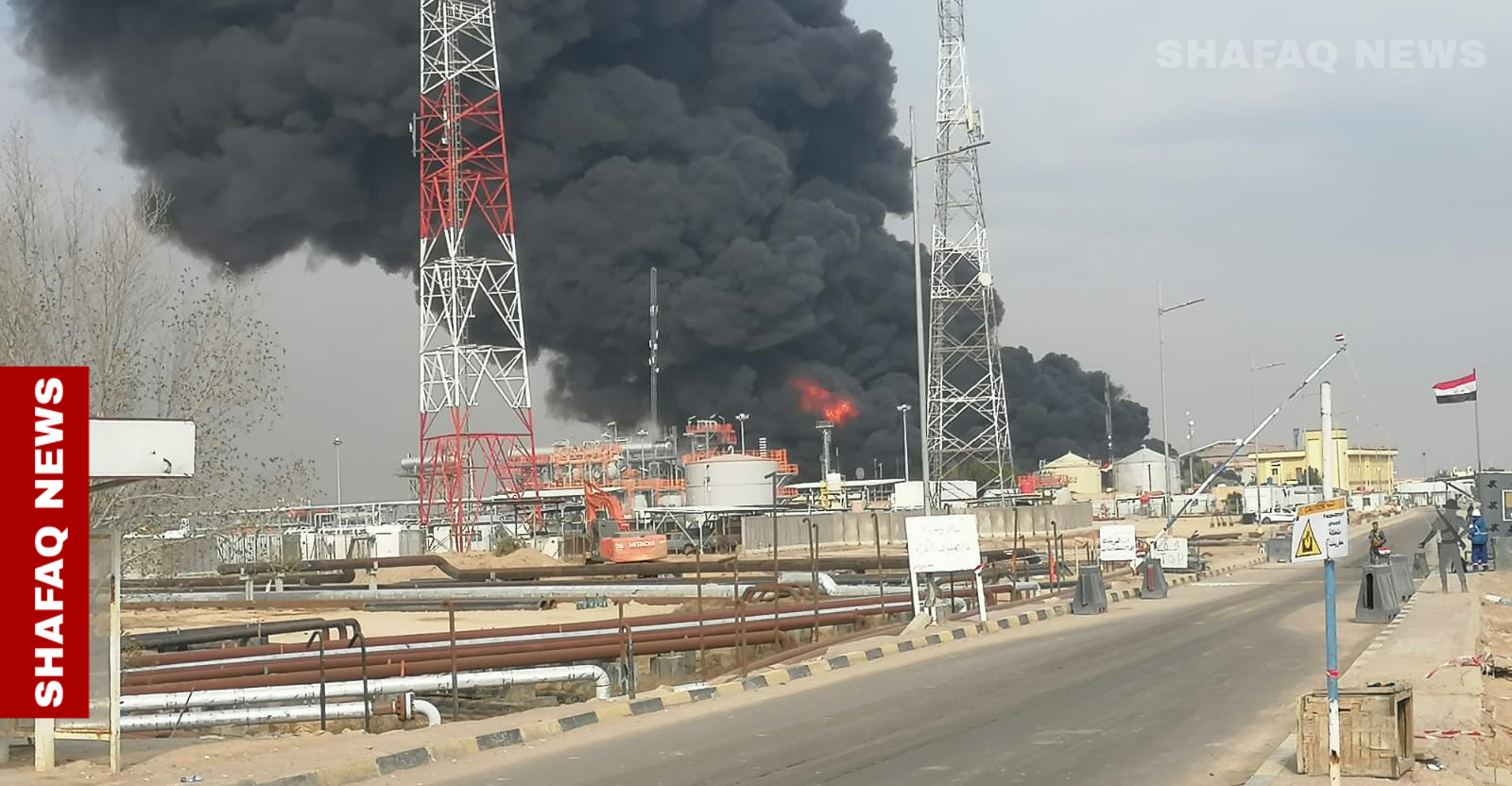
Shafaq News/ On Friday, a massive fire erupted at a refinery in the Rumaila oil field in southern Iraq, injuring several workers with varying degrees of severity, according to a source from the site.

The source told Shafaq News Agency, "Four refinery workers were injured, including one with a broken leg, another with facial burns, and two suffering from smoke inhalation."

The fire broke out at the fifth gas-oil separation station in the Rumaila field, the source added, noting that “the flames remain uncontrolled despite ongoing efforts by firefighting teams.”

Units from the Ninth Brigade of the Energy Police reportedly assisted in extinguishing the blaze, with a tight security cordon imposed around the affected area.

‘Nerve-racking’: Inside the aerial battle to tame Los Angeles fires


By AFP
January 24, 2025


The aerial firefight has been crucial in the battle to tame huge wildfires that roared through Los Angeles - Copyright AFP Peter PARKS


Paula RAMON

Helicopter pilot Tim Thomas has fought dozens of wildfires all over the world, but nothing prepared him for the scale and the challenge of the devastating blazes that ripped through Los Angeles.

“I’ve never seen anything the scale that we saw the first night,” he told AFP.

Fires erupted almost simultaneously in two separate neighborhoods during a furious windstorm on January 7.

Whole streets were engulfed as hurricane-force gusts flung fireballs from house to house.

Forecasters had been warning of extreme fire risk for days because of punishing dryness and winds up to 100 miles (160 kilometers) an hour, saying any small fire would quickly spread.

Extra resources were positioned all over the at-risk region, which extended for miles around the sprawling metropolis.

But the fires, when they came, were overwhelming, defeating the hundreds of firefighters on the ground.

Only an air assault would stop them.


– Transfixed –


A terrifying 24 hours after the first smoke blackened the air, winds dropped just enough for helicopters to take to the skies.

“It was some of the most turbulent wind I’ve seen,” said helicopter coordinator John Williamson.

Under the careful eye of experienced operators like Williamson, each pilot took turns in an elaborate airborne ballet.

The life-saving airshow they put on for nearly two weeks became a defining feature of the fires, watched with awe and gratitude by a terrified region.

Television viewers were transfixed by the incredible skills of helicopter pilots loading up hundreds of gallons (liters) of water into the bellies of their aircraft while hovering over a reservoir, then dumping it with pinpoint accuracy on a wall of flames.

The sight of huge jet planes swooping over a fire line and unleashing a trail of bright red retardant thrilled and relieved those whose homes were threatened.

But while they might have made it look easy, the pilots say the reality was far from it, with strong winds and unfamiliar terrain a constant challenge.

“There were definitely some uneasy moments going over the mountains where the crew was looking for me to see if I’m comfortable,” said Thomas.

“There’s definitely some times where the aircraft’s 23,000 pound (11.5 tons), and you’re getting rocked around, thrown around in the air.”


– ‘Takes your breath away’ –


Paul Karpus, who has overseen operations at an airbase in Camarillo, 45 miles (70 kilometers) west of Los Angeles, said the opening days of the firefight were like nothing he has experienced in 23 years.

“Every season, you say, I’ve seen it all… And then you’re surprised,” he told AFP.

“Seeing the amount of devastation for the first time, when the sun was coming up, and the amount of structures lost, it takes your breath away.”

Aerial teams operated 24 hours, pulling long shifts that left them exhausted and fraught.

“On a scale of one to 10, this one was a 10, stress-wise,” said Karpus.


– ‘Nerve-racking’ –


Williamson, whose job is to sit next to the pilot, guiding him to his designated zone and monitoring dozens of radio messages, said the complexity of the operation was a challenge.

“The first three nights, really was pretty nerve-racking,” he said.

Zach Boyce, who ran daytime operations said the sheer volume of aircraft in a tight space made things tricky.

“We’re coordinating a lot of helicopters in a very tight area, and then we introduce fixed wing operations and air tankers and air attack… and everything becomes super compressed,” he said.

More than two weeks after the fires erupted, killing more than two dozen people and reducing 40,000 acres (16,000 hectares) to ash, the biggest blazes are under control.

But the value of the aerial firefighters continues to be seen, with a fast-moving fire that erupted on Wednesday corralled by the time night fell after an airborne assault.

For the people of Los Angeles, the men and women who have fought this battle are second to none.

“We should never stop thanking them,” Los Angeles-based talk show host Jimmy Kimmel said.

“Real superheroes.”


No home, no insurance: The double hit from Los Angeles fires


By AFP
January 21, 2025

Sebastian Harrison was not insured when the huge Pacific Palisades fire erupted after premiums became unaffordable - Copyright AFP VALERIE MACON

Romain FONSEGRIVES

As he looks at the ruins of his home razed when deadly fires tore through the Los Angeles area, Sebastian Harrison knows it will never be the same again, because he was not insured.

“I knew it was risky, but I had no choice,” he told AFP.

Harrison is one of tens of thousands of Californians forced in recent years to live without a safety net, either because their insurance company dropped them, or because the premiums just got too high.

Some of them are now counting the crippling cost, after enormous blazes ripped through America’s second largest city, killing more than two dozen people and levelling 12,000 structures, Harrison’s home among them.

His own slice of what he called “paradise” stood on a mountainside overlooking the Pacific Ocean, where Malibu runs into the badly hit Pacific Palisades neighborhood.

The three-acre plot, which contained his home and a few other buildings, was always costly to insure, and in 2010 was already $8,000 a year.

When the bill hit $40,000 in the aftermath of the pandemic, he decided he simply couldn’t afford it.

“It’s not like I bought myself a fancy car instead of getting insurance,” the 59-year-old said.

“It’s just that food for myself and my family was more important.”

For Harrison, a former actor, the emotional strain of losing the home he had lived in for 14 years is magnified by the knowledge that without a handout from the state or the national government, he has lost everything — he even still has mortgage payments to make.

“I’m very worried, because this property is everything I had,” he said.

– Climate costs –

Insuring property in California has become increasingly difficult.

Well-intentioned legislation that prevents insurance companies from hiking prices unfairly has collided with growing risks from a changing climate in a part of the world that now regularly sees devastating wildfires near populated areas.

Faced with burgeoning claims — more damage, and higher repair costs because of the soaring price of labor and materials — insurance companies turned tail and left the state en masse, dropping existing clients and refusing to write new policies.

Even enormous names in the market, like State Farm and Allstate, have pulled back.

Officials in state capital Sacramento have been worried for a while.

Last year Insurance Commissioner Ricardo Lara introduced reforms aimed at encouraging companies to return, including allowing them more leeway to increase their premiums to better match their costs.

But huge and inevitably very expensive fires erupting in what is supposed to be California’s rainy season — it hasn’t rained for eight months around Los Angeles — have reinforced the idea that the state is becoming uninsurable.

“I don’t know now, because… my greatest fear was that we were going to have a catastrophe of this nature,” Lara told the San Francisco Chronicle at the weekend.

Even the state-mandated insurer of last resort, a scheme designed to provide bare-bones coverage for those locked out of the private sector, could be struggling.

The California FAIR Plan was created in 1968 and is underpinned by every insurance company that operates in the state, as a requirement of their license to operate.

But the number of people now resorting to the scheme means its $200 million reserves are dwarfed by its liabilities. (A reinsurance sector helps to keep it liquid.)

– ‘They’re going to drop me’ –

With the enormous losses expected from the Palisades and Eaton fires set to test the insurance sector even further, California has issued an edict preventing companies from dropping customers or refusing to renew them in certain affected areas, for one year.

That’s scant consolation for Gabrielle Gottlieb, whose house in Pacific Palisades survived the flames.

“My insurer dropped a lot of friends of mine… and I’m concerned that they’re going to drop me as well eventually,” he told AFP.

“They’re basically already putting it out there that ‘lots of luck after a year!'”

Even in a best case scenario, home insurance looks set to be a lot more expensive in California, as state reforms filter through allowing increased prices in places more susceptible to wildfire.

“Real estate and taxes are already very high in California,” said Robert Spoeri, a Pacific Palisades homeowner who was dropped by his insurer last year.

“If the insurance gets even higher, who is going to want to live in this state?”


Tajikistan launches crackdown on ‘witchcraft’ and fortune-telling


By AFP
January 24, 2025


Mountainous Tajikistan has recently launched a crackdown against fortune tellers, clairvoyants, mediums and 'witches' - Copyright AFP JADE GAO

Bruno KALOUAZ

In a block of flats in Tajikistan’s capital Dushanbe, a turbaned woman cautiously opened the door of her apartment a chink, letting out a waft of incense.

“I’m not taking on new clients. It could be a set-up,” she says, as she closes the door again and locks it.

“I risk a heavy fine. I do not want people outside on my landing,” speaking through the door.

A majority Muslim country in Central Asia, mountainous and impoverished Tajikistan has recently launched a crackdown against fortune tellers, clairvoyants, mediums and “witches”.

Practitioners of the occult are keeping a low profile to avoid arrest and public shaming because of a government-led campaign against them.

Tajik police have stepped up raids against what they call “parasites engaged in some of the most detestable activities imaginable — divination and witchcraft”.

Other countries in Central Asia are also cracking down on what have become widespread practices with roots in pre-Islamic traditions.

– Thousands of arrests –

The fight against occult practices is part of wider strict controls imposed in the authoritarian country, which is seeking to curb both radical Islam and ancestral beliefs.

“Illegal religious teaching leads to scams, divination and witchcraft. Tajiks! The Prophet categorically forbade going to diviners and sorcerers,” President Emomali Rakhmon, who has ruled the country since 1992, said last year.

Rakhmon also last year announced the arrest of 1,500 people “engaged in witchcraft and divination” as well as “more than 5,000 mullahs” who promised healing through prayer.

A repeat offence is now punishable by two years’ imprisonment and a fine of 12,800 euros ($13,300) — the equivalent of six years’ average salary for a Tajik.

Witches and fortune tellers have adapted to avoid police raids.

“I no longer receive people in my home. I go to them,” Adalat, a 56-year-old fortune teller, said during a session on the outskirts of Dushanbe.

She swung a string of pearls over some instructions scribbled on a piece of paper, mumbling a few words after asking her client some questions.

She said she is particularly skilled at reconciling fighting couples and seeing their future.

“Even as a child, I was tormented by nightmares which made me want to help people. But I only show my gift to people close to me,” she said.

The price of consultations can range from a few euros to gold jewels depending on the client requests but Adalat said she “cannot live” off her fortune telling and relies on money sent to her by her son who works in Russia.

– ‘Social inequality’ –


One of her clients, Gulbakhor, said she had “turned to fortune tellers and healers mainly because of health problems”.

“It’s cheaper than conventional medicine, which is very expensive,” the 42-year-old housewife told AFP.

Since the fall of the Soviet Union and a civil war in the early 1990s, Tajikistan has been plunged into poverty.

According to Mehrigiul Ablezova, a professor of sociology at the American University of Central Asia, “the attraction of witchcraft and fortune-telling may be linked to social inequality and a lack of access to public services”.

“In countries where health or welfare systems are limited, people may seek alternative sources of treatment and support,” she told AFP.

She said repression alone would not be enough to counteract these “deeply rooted traditions and beliefs in Central Asia that predate the introduction of Islam”.


Dushanbe,Stalin's capital for all of Asia

by Vladimir Rozanskij

It was founded in 1931 to transform a desert area into a model metropolis by mobilizing the best architects, engineers and builders of the Soviet Union. And despite the country's backwardness even today this city continues to be enriched with new streets, squares and city parks.


Dushanbe (AsiaNews) - Tajikistan's capital city of Dushanbe celebrated a very special anniversary on Jan. 21, that of its founding 93 years ago on this date in 1931. By then in the midst of the Soviet Stalinist regime, one of the most symbolic projects of the time, the so-called Tadžikgosproekt, of a city that was intended to become the “capital of all Asia,” was begun.

It concentrated the efforts of many architects, engineers and builders who came together in what was then still called Djušambe-Stalinabad, to transform a highland desert area into one of the most beautiful metropolises in Central Asia.

By 1930, by which time Stalin had taken full control of the party, it was decided to make Tajikistan's capital a pilot project, uniting centers and worker villages in a demonstration “five-year building plan” for the entire Soviet Union.

In the first three months of 1931 the project took off, and Dushanbe grew very fast, in ways that amazed even specialists in the field. Thus wrote in the early 1930s one of Tajikistan's leading scientists, the founder of modern mineralogy Nikolai Fedorovsky: “The city is being planned by ghost-architects, with houses far apart from each other, it is clear that they want to build the new capital of the whole of Asia.”

Famed Soviet geochemist Aleksandr Fersman gave an interview in 1935, in which he recounted that the “new Stalinabad, which is being built in the localities of DjuÅ¡ambe villages, represents a new type of particularly visionary planning,” as a model “for the Urals, for Siberia, the Polar Circle and other central regions of the Union.” It extolled the “special and original thinking of a new city, taking into account the special climatic conditions, with the excesses of sun and dust, positive and negative factors.”

In ten years, between 1931 and 1941, top Soviet specialists had hundreds of social and residential buildings built, including the “S. Ajni” Opera and Ballet Theater, the Supreme Soviet building that now houses the Olij Mažilis, the Parliament of Tajikistan, the Academy of Sciences, the Safina Philharmonic, and many other first-rate institutions.

In 1938 the Tadžikgosproekt was divided into two sectors, that of planning and building more cities and towns throughout the country. In 1941 most of the architects and other specialists were called into the Red Army troops to counter the invasion of Hitler's army in “Operation Barbarossa.”

Dušanbe was thus directed to wartime needs, including to house industrial companies evacuated from war zones. After the wartime phase, construction projects were resumed in 1957, incorporating Tadžikgosproekt into state institutions, where it remained until the end of the Soviet Union.

In the 1950s and 1960s, projects multiplied for many cities in Tajikistan, as a model for the entire region, resulting in the cities of Nurek, Rogun, Turnuzade, Javan, and others, with an exhaustive complex of social, production, logistical, and engineering infrastructure.

The project institute was transformed into a joint-stock company with the end of the USSR, and to this day it remains one of the key project organizations for urban management in Tajikistan.

What is now called the “ Å akhrodarCompany ” is in charge of the construction and development plans for a number of cities including Bokhtar, Khudžand, Kuljab, with continuous plans for new city spaces including in the capital Dushanbe, new streets and squares, city parks, and very contemporary suburbs with multi-story buildings and new office facilities.

Despite being the most economically backward country in Central Asia, Tajikistan shows more than most the progress inherited from the Soviet period, striving not to be marginalized, but to make a particularly significant contribution to the development of the entire region.
'Particularly dangerous': Concentration camp historian calls Musk a 'right-wing extremist'


Carl Gibson

January 24, 2025
ALTERNET

Elon Musk — the world's richest man and top advisor of President Donald Trump — is now being directly criticized by a historian who runs a memorial honoring the victims of one of the most notorious Nazi concentration camps.

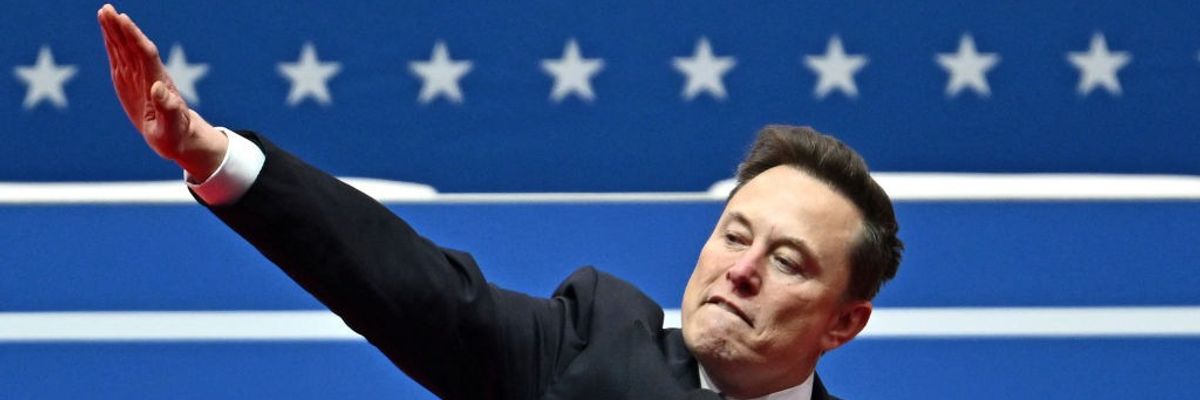
Newsweek recently reported on an interview professor Jens-Christian Wagner — who runs the Buchenwald concentration camp memorial and museum — gave to the Times of London. That interview came in the wake of Musk throwing up a gesture during an Inauguration Day rally that fascism expert Ruth Ben-Ghiat called a "Nazi salute," who added that it was "very belligerent."

"One can only say to him, 'Take a history book and withdraw for three days, read the history book and please be quiet with the poison he's spreading,'" Wagner told the Times. "I think Musk is a mixture of mad and right-wing extremist and that is particularly dangerous."


Wagner's comments come amid a wave of scrutiny over Musk's more recent controversial public statements. Earlier this week, Musk made puns referencing several Nazi leaders on his X account with a crying-laughing emoji, writing: "Don’t say Hess to Nazi accusations! Some people will Goebbels anything down! Stop GÅ‘ring your enemies! His pronouns would’ve been He/Himmler! Bet you did nazi that coming."

The Tesla and SpaceX CEO's tweet was met with swift condemnation from both the Anti-Defamation League and its CEO, Jonathan Greenblatt. In a quote-post, Greenblatt told Musk that "the Holocaust is not a joke," and added that it was "inappropriate and offensive to make light of it."

While Musk has yet to face any major consequences for his gesture or statements, a TV meteorologist was recently fired from her job after five years after criticizing the salute. WDJT-TV in Milwaukee, Wisconsin announced Thursday that Samantha Kuffel was no longer with the station after a conservative talk radio host highlighted two of Kuffel's posts to her personal Instagram account.

One of Kuffel's posts showed a video of the salute with the text: ""Dude Nazi saluted twice. TWICE. During the inauguration. You f— with this man, I don't f— with you. Full stop." The other was a screenshot from the sitcom It's Always Sunny in Philadelphia, with the character Mac saying: ""Screw that old b—. He's a Nazi."


Click here to read Newsweek's article, and click here to read Wagner's interview in the Times of London.

Congress' top antisemitism investigator: Musk's gesture clearly a 'Sieg Heil salute'

Matthew Chapman
January 21, 2025 
RAW STORY

Elon Musk gestures at the podium inside the Capital One arena on the inauguration day of U.S. President Donald Trump's second term, in Washington, U.S., January 20, 2025. REUTERS/Mike Segar

President Donald Trump's close ally, tech billionaire Elon Musk, caused an explosion of controversy on the day of Trump's swearing-in by repeatedly making an arm gesture that social media commentators and historians compared to a Nazi salute.

Trump allies quickly denied that Musk had any Nazi intentions, along with Musk himself, and some suggested he was just enthusiastically gesturing at his heart. But Rep. Dan Goldman (D-NY), a Jewish lawmaker who heads up the House's antisemitism task force, said in a statement there was no mistaking what we all saw.

"Elon Musk has repeatedly pushed for the racist and antisemitic 'Great Replacement' conspiracy theory, endorsed the Nazi-sympathizing German Political Party AfD, and allowed anti-Jewish hate to proliferate unabated on his website, X," said Goldman. "Viewed in that context, and regardless of any justification, his salute last night at Donald Trump's inauguration rally can only be interpreted as a Seig Heil salute that is synonymous with Nazi support for Hitler."

"Just as the Proud Boys understood Donald Trump's urging to 'stand back and stand by' as a direction to mastermind the January 6 riot, neo-Nazi and far-right extremists have interpreted Musk's salute to refer to the Seig Heil salute to Hitler," Goldman continued. "It is no coincidence that Musk's fascistic salute occurred just hours before President Trump pardoned far-right, violent domestic extremists who assaulted law enforcement officers at President Trump's direction in an effort to overturn the 2020 election."

In an environment where "Jews around the world are scared because of the contemptible rise in antisemitism," Goldman continued, the only acceptable recourse is for Musk to issue an "immediate apology," and for Trump to "disavow and denounce his actions."

"If not, Donald Trump cannot credibly claim to be a friend of the Jewish people with Elon Musk by his side," Goldman concluded.

'The gesture speaks for itself': German newspaper blasts Elon Musk’s 'Hitler salute'


Elon Musk gestures at the podium inside the Capital One arena on the inauguration day of U.S. President Donald Trump's second term, in Washington, U.S., January 20, 2025. REUTERS/Mike Segar

January 21, 2025
ALTERNET

Tesla and SpaceX CEO Elon Musk – who is one of President Donald Trump's top advisors — went viral on Monday for throwing up a gesture described by a fascism expert as a "Nazi salute." Now, a leading German newspaper is criticizing both the gesture itself and the American press for trivializing it.

In an op-ed published in Tuesday's edition of Berlin's Die Zeit newspaper, journalist Lenz Jacobsen said it was clear that anyone "who raises their right arm in a sweeping and diagonal manner several times during a political speech in front of a partly right-wing extremist audience is doing the Hitler salute," and that there was "no need to make this unnecessarily complicated." He added that terms like "allegedly" or "similar" or "controversial" were also unnecessary in describing what happened.

"The gesture speaks for itself, it is documented in the video," Jacobsen wrote in German. "Anyone who then wants to reinterpret it, anyone who does not want to see the Hitler salute, does so on their own account."


Jacobsen lamented that the future was "foreseeable," writing that "neo-Nazis and right-wing radicals can interpret the stretched right arm as a gesture of fraternization and encouragement." He also predicted Trump and Musk's more "well-meaning supporters" would view the salute "as an escalated gesture of celebration."

"Everyone else is faced with an impossible choice: Either ignore the taboo being broken and thus contribute to its removal. Or mark it as a taboo violation and thus produce outrage, which the other side then takes pleasure in and gets worked up about," he wrote. "One can complain about this, but one must probably expect that a significant part of humanity now sees scandalizing the Hitler salute as nothing more than virtue signaling."

After the video of Musk's salute spread on social media, hate groups — as Jacobsen predicted — viewed the gesture as a show of solidarity with their cause. Andrew Torba, who founded the far-right social media platform Gab (where the Pittsburgh synagogue shooter was radicalized), responded by writing: "Incredible things are happening already."

"I don’t care if this was a mistake. I’m going to enjoy the tears over it," neo-Nazi leader Christopher Pohlhaus posted to Telegram.


Click here to read Jacobsen's essay in Die Zeit (subscription required).


Lemkin Institute Issues 'Red Flag Alert for Genocide' After Musk's Nazi Salutes

"Trans people, refugees, and migrants are not the threats," the group said. "The billionaires with close ties to our new president who flash the Nazi salute and seek to replace the old elites with a new caste—that is the real threat to America."


Tesla CEO Elon Musk gestures as he speaks during the inaugural parade in Washington, D.C. on January 20, 2025.
(Photo: Angela Weiss/AFP via Getty Images)


Jake Johnson
Jan 21, 2025
COMMON DREAMS

A group named after the Polish-born lawyer of Jewish descent who coined the term genocide issued a "red flag alert" for the United States on Monday after billionaire Elon Musk—a top ally of President Donald Trump—twice flashed what was widely seen as a Nazi salute during a post-inauguration event.

The Lemkin Institute for Genocide Studies and Prevention said that "Musk's act is a frightening signal of things to come" and rejected the notion that the billionaire's gestures were unintentional.


"In light of Musk's important influence on the new administration," the group said in a statement, "the Lemkin Institute for Genocide Prevention is issuing a Red Flag Alert for genocide in the United States."


The Lemkin Institute urged Americans to "respond with critical thinking" to any suggestion that Musk's salutes were merely awkward or odd-looking—but ultimately benign—expressions of enthusiasm.


"Is it possible that any person—especially in South Africa (where support for Nazism was very strong) or the USA (where the History Channel has introduced almost all but the youngest generations to the Nazi salute)—is unaware of this salute or what it means?" the group asked. "It is almost impossible that this was an unfortunate mistake. Finally, can we really believe that someone who is so often in the public eye would risk an arm gesture—twice—that looks almost exactly like the Nazi salute while he is supposedly celebrating Donald Trump's election to president? We strongly believe that Elon Musk's gesture was intentional. We will be happy to be proven wrong."


"Musk's Hitler salute cannot and must not be swept under the rug. The U.S. press, cowed as it has been under President Biden, cannot be trusted to cover the new president's administration with any backbone or honesty. It is up to the American people to defend the Constitution and this country's core values against all threats," the organization continued. "Trans people, refugees, and migrants are not the threats. The billionaires with close ties to our new president who flash the Nazi salute and seek to replace the old elites with a new caste—that is the real threat to America."

Musk's salutes drew widespread alarm, including from public officials in Europe—where Musk has attempted to boost far-right parties.

"Such a gesture, given his already known proximity to right-wing populists in the fascist tradition, must worry every democrat," German Health Minister Karl Lauterbach wrote in response.

Far-right extremists, for their part, celebrated Musk's gestures, which they appear to have had no trouble interpreting.

As Rolling Stonereported, "The Proud Boys Ohio chapter posted a clip of the Musk video to its Telegram channel with the text, 'Hail Trump!'"

'Unthinkable': Trump FTC chair shuts down public comments on corporate pricing tactics


Image via Free Malaysia Today/Creative Commons.

Jake Johnson
Common Dreams
January 24, 2025

U.S. President Donald Trump's Federal Trade Commission chair began his stint at the helm of the key agency this week by shutting down requests for public comment on corporate surveillance pricing and other exploitative tactics that were a focus of the FTC under the leadership of Lina Khan.

Shortly after taking over as FTC chair earlier this week, Andrew Ferguson declared that "DEI is over" at the agency and demanded a swift vote on a motion giving him sweeping authority to "comply with President Trump's orders ending DEI across the federal government."

Meanwhile, with no such fanfare, Ferguson shuttered FTC requests for information and public comments on corporate mergers and acquisitions, "protecting workers from illegal business practices," "predatory pricing," and "surveillance pricing practices," which refer to companies' use of personal data to set individualized prices.

Democratic FTC commissioners expressed alarm over Ferguson's early actions and said they're a telling indication of his priorities.

"Andrew Ferguson could have made his first public act as chairman a motion to study the rising cost of groceries," Commissioner Alvaro Bedoya said in a statement Thursday. "He could have acted on a pending public petition from a group of wall and ceiling contractors to investigate how lawbreaking contractors can effectively rig contract competitions in the commercial construction industry."

"Chairman Ferguson could have done any number of things to actually lower the cost of living and create opportunities for American businesses and workers. He did none of them," Bedoya continued. "Instead, he canceled 'DEI.'"


Douglas Farrar, former director of the FTC's public affairs office, said it is "unthinkable that the new chair of the FTC starts his tenure by censoring small businesses facing down monopolies, and American consumers already struggling with high prices."

"The American people deserve to have a voice in government," Farrar added, "not just be dictated to by oligarchs."

Ferguson defended his focus on DEI on the grounds that Trump "campaigned openly" on ending diversity, equity, and inclusion initiatives across the federal government.

But Bedoya noted that Trump, on the day of his inauguration, also ordered "the heads of all executive departments and agencies to deliver emergency price relief, consistent with applicable law, to the American people and increase the prosperity of the American worker."

"Chairman Ferguson seems uninterested in the challenges that regular human beings face," Bedoya said Thursday. "One of his first actions as Chairman was to quietly remove the opportunity for the public to comment on five different requests for information."

"Rather than let the American people speak to him," Bedoya added, "Chairman Ferguson shut them out."