Sunday, February 02, 2025

Hedge funds bet billions on market crash in Trump’s America

Louis Goss
Fri, January 31, 2025


Hedge funds have bet billions of dollars against Donald Trump’s America amid fears of a market crash.

Data from Goldman Sachs show there has been a surge in “short” bets against US stocks, meaning traders will make money when they fall in value, in a sign of growing concerns about the market.

In January, investors have placed 10 times more bets on US stocks falling than equivalent bets that shares in leading American companies would rise, the investment bank said. It suggests many traders are sitting on huge profits from the chaos earlier this week, when shares in big tech stocks slumped following a panic over the success of rival Chinese AI DeepSeek.

The increase in short bets marks a major turnaround in sentiment from November, when hedge funds piled into long bets on US stocks, predicting they would rise.

Hedge funds ploughed billions into so-called “Trump trades” in the immediate wake of the US election in November, on expectations the new president’s tax cuts and tariff policies would boost America’s economy.

A surge in clients giving their money to the funds in the wake of Mr Trump’s victory helped lift the amount of money managed by the industry to all-time highs of over $4.5 trillion (£3.6 trillion).

Mr Trump has also received significant support from high profile fund chiefs, including Bill Ackman, who has become a major opponent to diversity, equity and inclusion (DEI) initiatives since the Oct 7 2023 attacks on Israel.

In the run-up to the elections, Mr Ackman, who founded Pershing Square Capital Management in 2004, publicly endorsed Mr Trump. The billionaire hedge fund manager had previously donated millions to Super PAC organisations supportive of the Democratic Party.

Mr Trump subsequently appointed hedge fund manager and Republican Party donor Scott Bessent as his treasury secretary. Mr Bessent started his career at George Soros’s hedge fund in the 1990s before launching his own investment fund Key Square Group in 2015.

Ken Griffin, who founded Citadel in 1990, later also came out in support of Mr Trump in December, having held back from financially supporting the Republican candidate’s campaign. Mr Griffin, who has donated millions to various Republican candidates and political, had earlier described Mr Trump as a “three-time loser.”

Speaking at the DealBook summit in December, Mr Griffin said Trump’s victory posed an opportunity to end the “regulatory and litigation-induced paralysis” of the Biden era and “bring America back to a nation of principles, of strength, of prosperity and possibility,” according to Politico.

‘Uncertainties persist about Trump’

Individual hedge funds do not typically make their positions public, so it is not known if any of the above are shorting the US market.

Bruno Schneller, managing partner at asset manager Erlen Capital Management, said the increase in short bets against US stocks likely reflect concerns about “macroeconomic uncertainty.”

Analysts at Swiss bank UBS, led by Karim Cherif, head of alternative investments, said: “As the new year unfolds, uncertainties persist regarding Trump’s policies, the global economic trajectory, and central bank actions.”

Separately, Elliott Management, which controls more than $70bn worth of investments, this week warned that Mr Trump’s presidency was fuelling speculative bubbles in markets that threaten to “wreak havoc” if markets crash, according to the Financial Times.

The concerns come as the “magnificent seven” tech companies – Alphabet, Amazon, Apple, Meta, Microsoft, Nvidia and Tesla – have seen their stock prices surge over the past two years on excitement surrounding artificial intelligence (AI).

Investors have become increasingly concerned about over-investment in leading technology companies. The launch of DeepSeek’s new chatbot earlier this month has heightened those concerns.

This week, concerns surrounding DeepSeek led a major sell-off of stocks in top American tech companies, including computer chip maker Nvidia, which saw almost $600bn knocked off its valuation.

DeepSeek itself is owned by Chinese hedge fund High Flyer, which uses algorithmic trading techniques to place bets on market movements. Liang Wenfeng, High Flyer’s chief executive, is also DeepSeek’s chief executive.

Top hedge fund Elliott Management fears Trump is inflating a crypto bubble that faces 'inevitable' collapse, report says

Filip De Mott
Fri, January 31, 2025 
Business Insider

Getty Images; Jenny Chang-Rodriguez/BI

Elliott Management said a crypto collapse could "wreak havoc in ways we cannot yet anticipate."


The White House's boosting of crypto is fueling speculation, it said in a letter.


The letter questioned why the administration would embrace alternative reserve assets that threaten the dollar's role.


Cryptocurrencies are riding a speculative mania bound for a dramatic collapse, and the Trump administration is only helping inflate the bubble further, Elliott Management wrote in a letter seen by the Financial Times.

The letter from the $70 billion hedge fund puts it at odds with Washington's embrace of crypto, warning of potential consequences to market stability and the dominance of the US dollar.

According to the letter, the current market landscape is unlike any other. Investors are "acting like a crowd of sports bettors," with widespread speculation evident in the AI investing frenzy and elevated stock valuations.

Crypto is at the heart of this risk-on surge, Elliott wrote, with speculators encouraged by the industry's deepening relationship with the White House. Since Donald Trump's inauguration, the president has installed industry-friendly regulatory heads and signed an executive order promoting digital assets.

Trump's campaign promises go even further, and investors are gearing up for more policies to come this year. Bitcoin has rallied 38% since Election Day, while some altcoins have soared much higher.


Despite the surge in value, these assets have "no substance," Elliott said. The hedge fund is bracing for the sector's "inevitable collapse," which "could wreak havoc in ways we cannot yet anticipate."

The letter also highlighted the greenback's dominance as a global reserve currency, and questioned the idea that Washington should turn toward alternative reserve assets. After all, other countries are already working to diversify away from the dollar.

This effectively amounts to a rejection of the national bitcoin reserve, a policy recommendation that would direct the government to buy and hold the flagship token as a hedge against inflation.

Elliott Management did not immediately respond to Business Insider's request for comment.

The fund's founder, Paul Singer, has been critical of crypto for years. In 2018, he called the assets "one of the most brilliant scams in history."

The firm's outlook contrasts starkly with Wall Street's rising enthusiasm for digital assets. While some, such as billionaire investor David Einhorn, also regard the crypto rally with skepticism, institutional demand for digital assets has been gaining more and more traction.

According to Standard Chartered, this should help push bitcoin toward $200,000 by the end of the year. Other altcoins are also projected to gain, especially if Trump policies unleash a meme coin bull run.


How Does Pete Hegseth Feel About Bitcoin? His Financial Filings Reveal The Answer

AJ Fabino
Sun, February 2, 2025 
BENZINGA


New Defense Secretary Pete Hegseth brings cryptocurrency holdings to the Pentagon’s top post, with financial disclosures showing he owns between $5,000 and $15,000 in Bitcoin amid his broader support for digital assets.

“Look at [Donald] Trump, making bitcoin great again,” Hegseth said during a Fox News segment in November after Bitcoin initially surged past $80,000. “All it took was signaling to that market that they weren’t going to be overregulated. Trump embraced them.”

The Senate confirmed Hegseth as defense secretary Friday in a 50-50 vote, with Vice President JD Vance breaking the tie. The narrow victory came despite concerns about his qualifications and personal conduct, marking only the second time a vice president has cast a deciding vote for a Cabinet nominee.

Built on the trusted network of Fortune 500 companies, this blockchain company partners with Salesforce to uproot lengthy and expensive B2B transactions, and you can invest with just $100.

Financial records released Jan. 13 show Hegseth earned over $5 million in the past two years, mostly from his Fox News hosting role and speaking engagements. Beyond his Bitcoin holdings, the documents reveal he collected $4.6 million from Fox News and up to $1 million from a Baltimore rental property.

The Army veteran and former Fox & Friends Weekend host has openly backed cryptocurrency, praising its independence from government control.

During Coinbase Global's (NASDAQ:COIN) 2021 IPO, he called it the “tip of the iceberg” for digital currency adoption.

Trending: Nancy Pelosi Invested $5 Million In An AI Company Last Year — Here's How You Can Invest In Multiple Pre-IPO AI Startups With Just $1,000

“Crypto has arrived. Bitcoin is not a person, it’s not a company, it’s not a place. It’s tougher to stop than you would think,” Hegseth said at the time, according to cryptocurrency publication The Block.

Hegseth takes control of the Pentagon as Bitcoin trades around $100,000, potentially reacting to shifting political winds. His dual role as both a Bitcoin investor and America’s new defense chief arrives as digital assets face less scrutiny from the federal government.

The position puts him among the highest-ranking U.S. officials to publicly hold cryptocurrency, though his Bitcoin stake represents a small portion of his multimillion-dollar portfolio.

According to Juniper Research, the total value of B2B cross-border payments stored on the blockchain is projected to exceed $4.4 trillion — Join the first company to bring blockchain payments to Salesforce early with just $100.


© 2025 Benzinga.com. Benzinga does not provide investment advice. All rights reserved.


Trump ally Peter Marocco behind evisceration of USAid: ‘He’s a destroyer’

Andrew Roth in Washington
Sat, February 1, 2025 


Peter Marocco in Bogota, Colombia, on 13 May 2019.Photograph: Gabriel Aponte/Getty Images for Concordia Summit


The Trump administration’s evisceration of US overseas aid has been presided over by a campaign ally who sowed a trail of enmity at multiple agencies during the first Trump presidency and has been publicly identified as allegedly having been present at the January 6 insurrection when rioters stormed the US Capitol.

Peter Marocco has accumulated power in the office of foreign assistance, informally called “F”, that traditionally has helped coordinate US foreign aid programs. But under Marocco, it has enforced a full-scale freeze on overseas aid and a stop-work order that has in effect halted operations and already led to hundreds of layoffs in the United States and overseas.

According to current and former USAid and state department officials, the office’s consolidation of power under Marocco has undermined congressional checks and balances and instead given authority to a non-Senate-confirmed appointee who is slashing and burning his way through overseas aid programs at USAid and the state department.

Related: Charities reeling from USAid freeze warn of ‘life or death’ effects

“He is not a disruptor. He’s a destroyer,” said a former USAid official, who like others spoke on the condition of anonymity to discuss Marocco. “And it’s clear to me. The plan is to come in, destroy USAid, take it down, and then build it up again, the way they want to do that.”

Marocco’s return to USAid has not been formally announced and the department website still lists a previous director for the office of foreign assistance. Many staff only learned that Marocco had been appointed from emails and cables drafted by him ordering them to stop work.

On Friday evening, senior Senate Democrats warned that the Trump administration’s decisions to place senior USAid officials on leave and freeze foreign assistance without engaging with Congress “have created a maelstrom of problems that have put our nation at risk and undermined American credibility around the globe”.

They warned Trump away from reported plans to downsize or even subsume the agency into the state department. “It is imperative that we maintain an independent development voice and capability within the US government,” wrote the senators. “USAid is, by statute, an independent establishment outside of the State Department. Any proposal to modify that structure would require an Act of Congress.”

A former marine and conservative activist from Dallas, Marocco served short stints of just a year each at the state department, commerce department, defense department and USAid during the first Trump presidency. In 2020, a 13-page complaint by USAid staffers was placed in its dissent channel – a framework for foreign service staff to express constructive criticism – accusing Marocco of undermining and micromanaging employees in a way that “rapidly degraded” a small department focused on political transitions. Critics say he is now applying the same playbook of laborious reviews and vague directives to all of USAid.

Marocco was also allegedly photographed and filmed inside the Capitol building during the January 6 riots, according to volunteer activists who have posted a widely cited investigation. Marocco has not been charged with a crime. Asked about the allegation by D Magazine, Marocco did not address whether he had been at the Capitol, but described it as “petty smear tactics and desperate personal attacks”.

He joined Trump’s transition team in December as an adviser on national security personnel matters.

“Democrats and their allies in the media who think they are going to obstruct our ability to deliver on this mandate by going back to the same January 6 playbook of smears and faux outrage that was soundly rejected by the American people will be disappointed,” Trump’s press secretary, Karoline Leavitt, told Politico at the time.

The state department declined to respond to questions regarding Marocco’s appointment, his alleged participation in the events of 6 January 2021, and the department’s review process for evaluating overseas aid and potential waivers to the program.

Former and current officials at USAid, the state department and the defense department told the Guardian that Marocco’s previous stints at those agencies had been characterized by secrecy, personal conflicts and arbitrary rules meant to hobble the bureaucracy. Some said they believed Marocco had returned to take revenge on his former colleagues.

“The reaction was recoil and horror,” said a former senior USAid official regarding Marocco’s appointment. “I don’t know if they really believe in development or humanitarian assistance unless it’s transactional.”

“He’s the most unqualified person to be sitting in any seat of government, let alone the person who has the keys to our foreign assistance,” said another former colleague who still works at USAid.

Marocco strode into the offices of USAid this week flanked by members of Elon Musk’s “department of government efficiency” (“Doge”), a special group Trump created, with clipboards in hand. Several hours later, almost 60 senior officials from the office had been put on paid leave. Veteran aid officials with decades of experience at the agency were escorted from the building by security, according to current and former USAid officials, and their email accounts were frozen.

“They wanted to decapitate the organisation,” said a current USAid employee. “And they did it by pushing aside the leadership and decades of experience.”

The purge followed confusion within USAid over the stop-work orders drafted by Marocco and signed by Marco Rubio, the new secretary of state, leading some to believe that limited actions could continue if funds had already been committed.

Related: Trump’s aid freeze will drive migration from Latin America, experts warn

“We have identified several actions within USAid that appear to be designed to circumvent the president’s executive orders and the mandate from the American people,” wrote Jason Gray, USAid’s acting administrator, saying the relevant staff would be put on administrative leave.

Some employees have openly rebelled. In an email to all staff seen by the Guardian, Nicholas Gottlieb, USAid’s director of employee and labor relations, said that appointees at USAid and “Doge” had “instructed me to violate the due process of our employees by issuing immediate termination notices”.

Calling the requests “illegal”, Gottlieb said he “will not be a party to a violation of [due process]”. Hours later, he was put on administrative leave.

In a separate email to the sidelined USAid senior staff, Gottlieb wrote that the “materials show no evidence that you engaged in misconduct”.

“I wish you all the best – you do not deserve this,” he wrote.

The chaotic rollout of the ban has led to whiplash for critical programs around the world, from emergency Aids relief (which has been granted a waiver), to clean-water and sanitation programs, to the Famine Early Warning Systems Network, which the Washington Post reported on Friday had gone offline.

Yet there are few details of a vast review program, which is supposed to evaluate thousands of foreign aid grants as well as an expected torrent of waiver requests. And a number of the senior USAid staff put on administrative leave were lawyers who had helped prepare requests for exemptions from the foreign aid freeze, sources said.

The state department has said the waiver process has been used “successfully dozens of times in the first several days alone; however, many requests failed to provide the level of detail necessary to allow a thorough evaluation”.

Previous cables indicated that the people involved would include Marocco or the new director of policy planning, Michael Anton, another political appointee. The state department declined to answer questions from the Guardian about who is evaluating the reviews and how many staff had been detailed to the process.

“The lack of clarity on the waivers has been a huge problem for partners,” said one current USAid official. “When it comes to USAid-funded programs, there’s, like, crickets. No one’s been able to get information.”

Insiders have told the Guardian that Marocco has sidelined career staff at the office of foreign assistance and that just a few employees had been brought in to work on evaluating the programs. Waiver requests to USAid are being sent to Marocco’s office of foreign assistance, from where they’re forwarded to the policy planning staff, which has recently suspended all of its career civil servants and foreign service officers, leaving only political appointees to review them.

“We’re all trying to figure out, is there a review process? Who’s part of that review?” said the former senior USAid official. “Is it Pete Marocco and his two best friends?”

At USAid, other directives have been enacted that have both defunded and demoralised staff. Photographs of aid programs around the world have been literally stripped off the walls after a “directive has been issued to remove all artwork and photographs from the offices and common spaces across all buildings”.

“Now all the pictures have to come down and I go: ‘Oh, good. Are we going to burn books next?’” said one current USAid employee.

Musk’s “efficiency department” has crowed about slashing $45m in scholarships for students from authoritarian Burma.

The $40bn a year that the US spends on foreign aid is less than 1% of its budget. But the US expends $4 out of every $10 spent globally on humanitarian aid, according to the state department, and the sudden cutoff has led to thousands of layoffs among US contractors and local partners around the world.

“Got that late Friday,” said one implementer, an American citizen, who received a stop-work order seen by the Guardian. “And was fired on Monday as a result.”

The 90-day stop-work order and financial freeze meant that there was no one to actually prepare the waiver request, that person said.

Devex, a media platform for news on the development community, reported this week that USAid’s bureau for humanitarian assistance had also furloughed about 500 institutional support contractors, or 40% of its team, undercutting its ability to react quickly to a humanitarian crisis.

A former USAid official said the decisions could put millions of people around the world at risk.

“If there’s a tropical cyclone that hits Cox’s Bazar tomorrow, then how are you going to save all those people, and then how are you going to rebuild if there’s a stop-work order?” said a former senior USAid official, referring to the city in Bangladesh where more than 1 million Rohingya refugees are living. “You could have people sitting there for 90 days and sitting and waiting for what? That’s what worries more.”


US aid agency is in upheaval during foreign assistance freeze and staff FORCED departures

MATTHEW LEE and ELLEN KNICKMEYER
Updated Fri, January 31, 2025 


WASHINGTON (AP) — Trump administration changes have upended the U.S. agency charged with providing humanitarian aid to countries overseas, with dozens of senior officials put on leave, thousands of contractors laid off, and a sweeping freeze imposed on billions of dollars in foreign assistance.

Democratic senators warned the Trump administration Friday against any effort to eliminate the U.S. Agency for International Development as an independent agency, responding to growing fears among its supporters that such plans may be in the offing.

Sen. Chris Murphy was one of a half-dozen Democrats on the Senate Foreign Relations Committee to argue in statements and on social media that President Donald Trump would have no legal authority to dissolve the agency.

Aid organizations say the funding freeze — and deep confusion over what U.S.-funded programs must stop work as a result — has left them agonizing over whether they could continue operating programs such as those providing round-the-clock nutritional support to extremely malnourished infants and children, knowing that closing the doors means that many of those children would die.

Current and former officials at the State Department and USAID say staffers were invited to submit requests to exempt certain programs from the foreign aid freeze, which Trump imposed Jan. 20 and the State Department detailed how to execute on Jan. 24.

Three days later, at least 56 senior career USAID staffers were abruptly placed on administrative leave.

Three officials said many of those put on leave were lawyers involved in determining what programs might qualify for waivers, helping write proposals and submitting those waiver requests as they believed they had been invited to do.

The officials spoke on condition of anonymity for fear of reprisal. A Trump administration directive that aid organizations interpret as a gag order has left them unwilling to speak publicly for fear of permanently losing U.S. funding.

In an internal memo Monday about the staffing changes, new acting USAID administrator Jason Gray said the agency had identified “several actions within USAID that appear to be designed to circumvent the President’s Executive Orders and the mandate from the American people.”

“As a result, we have placed a number of USAID employees on administrative leave with full pay and benefits until further notice while we complete our analysis of these actions,” Gray wrote.

A former senior USAID official said those put on leave had been helping aid organizations navigate the “confusing process” to seek waivers from the aid pause for specific life-saving projects, such as continuing clean water supplies for displaced people in war zones.

Others were identified as having been involved in diversity, equity and inclusion programming, which the administration has banned.

On Thursday, a USAID human resources official who tried to reverse the action, saying there was no justification for it, was himself placed on leave, according to two of the officials who had viewed internal emails and verified them as authentic. Reporters from ProPublica and Vox first reported the emails on X.

The State Department and White House didn’t respond to messages seeking comment about the staffing changes.

The new leaders at USAID also abruptly laid off contractors who made up about half the workforce in the agency’s humanitarian bureau Tuesday, knocking them out of systems so that some vanished in the middle of videoconferences, the former senior official said. The targeted institutional service contractors do everything from administrative and travel support to grant processing and data analytics.

The staffing changes came three days after the State Department issued guidelines last Friday for implementing Trump’s executive order freezing foreign assistance for 90 days. The department says it's reviewing the money the United States is spending to ensure it adheres to administration policy.

The guidelines initially exempted only military aid to Israel and Egypt and emergency food programs but also said program administrators and implementors could apply for waivers for programs that they believe would meet administration standards.

On Tuesday, new Secretary of State Marco Rubio issued a broader waiver for programs that provide other “life-saving” assistance, including medicine, medical services, food and shelter, and again pointed to the possibility of waivers. Rubio pointed to the broadened exemptions in an interview Thursday with SiriusXM host Megyn Kelly.

“We don’t want to see people die and the like,” he said.

Rubio said there would be a program-by-program review of which projects make “America safer, stronger or more prosperous.”

The step of shutting down U.S.-funded programs during the 90-day review meant the U.S. was “getting a lot more cooperation” from recipients of humanitarian, development and security assistance, Rubio said. “Because otherwise you don’t get your money.”

The State Department said that since the aid freeze went into effect, it has approved dozens of waivers, although many were returned because they did not include enough detail. It said waiver requests for programs costing “billions of dollars” have been received and are being reviewed.

The department did not specify how many waiver requests had been denied but said thus far its actions had stopped more than $1 billion from being spent on programs and projects that are “not aligned with an America First agenda.”

Even with the broadening of exemptions for life-saving care, uncertainty surrounds what U.S.-funded programs legally can continue. Hundreds of thousands of people globally are going without access to medicine and humanitarian supplies and clinics are not getting medicine in time because of the funding freeze, aid organizations warn.

——

AP reporter Rebecca Santana in Washington contributed.

The future of USAID remains uncertain amid Trump's funding freeze

Abigail Williams
Sat, February 1, 2025 

The front of the U.S. Agency of International Development headquarters building in Washington, D.C.

Just one week after the Trump administration initiated a near-total freeze of U.S. foreign aid, the future of the U.S. Agency for International Development — the agency at the heart of America’s humanitarian assistance operations overseas — remains uncertain.

Trump administration officials are actively discussing placing USAID under the authority of the State Department, according to more than a dozen current and former officials and sources familiar with the discussions, further crippling an agency that has already been brought to its knees.

In the past week, hundreds of USAID employees and contractors have been fired or furloughed, almost 60 senior career leaders at the agency have been sidelined and U.S. foreign missions have been brought to a standstill. Thousands of related jobs are also under threat of furlough or firing in the days ahead.

On Friday, prominent signs in the front lobby of the agency's Washington headquarters appeared to have been removed, leaving those still employed to brace for the possibility of USAID shutting down altogether.
ADVERTISEMENT


“It is imperative that we maintain an independent development voice and capability within the U.S. government. USAID is, by statute, an independent establishment outside of the State Department,” Democratic Sens. Jeanne Shaheen of New Hampshire and Brian Schatz of Hawaii and Democratic Reps. Gregory Meeks of New York and Lois Frankel of Florida wrote in a statement late Friday. “Any proposal to modify that structure would require an Act of Congress.”

“A president cannot eliminate an appropriated federal agency by executive order,” Sen. Chris Murphy, D-Conn., warned in a post on X.

Despite a rapid-fire social media storm naming dozens of secretaries, ambassadors, special envoys and senior advisers before taking office, President Donald Trump has yet to nominate a leader for the federal humanitarian aid agency.

According to multiple sources who spoke with NBC News, the downsizing of the agency has largely been directed by Pete Marocco, who was installed by the Trump administration as the head of the State Department’s Office of Bureau of Foreign Assistance. Marocco held several national security positions under the previous Trump administration, including at USAID, where his attempts to consolidate power and slash funding drove officials to write a dissent memo that ultimately pushed him out of office, the sources said.

“What he’s doing now is frighteningly similar to everything he was trying to do at USAID before, but this time he’s destroying it,” said one USAID official familiar with his past actions.

Critics of the Trump administration’s decision to pause U.S. foreign aid and dramatically downsize USAID argue that the cuts under the banner of "America First" ultimately benefit U.S. adversaries.

“Trump’s USAID purge and foreign aid pause is already hurting efforts to deliver aid and growing China’s world standing at our expense,” Sen. Chris Van Hollen, D-Md., said Friday.

“He’s effectively putting the Trump and Rubio foreign policy vision at risk,” another USAID official told NBC News, warning, “If you kill an institution, you are not going to revive it overnight.”

The State Department and USAID did not immediately respond to NBC News’ requests for comment.

Project 2025, the expansive report initiated by the Heritage Foundation and dozens of other Trump-aligned conservative organizations, foreshadowed the actions that Marocco has taken, including the decision to place almost 60 USAID policy-making career civil servants and foreign service officers on administrative leave.

The Project 2025 document said that USAID should “pilot-test” the transformation of those civil servant positions into political appointee roles and outlined a broader effort to consolidate USAID.

 NBCNews.com


Democrats slam Trump over reports he’ll merge USAID with State Department

Filip Timotija
Fri, January 31, 2025
THE GUARDIAN


Democrats on Friday slammed President Trump over recent news reports that he is considering merging the U.S. Agency for International Development (USAID) with the State Department.

“It is imperative that we maintain an independent development voice and capability within the U.S. government. USAID is, by statute, an independent establishment outside of the State Department. Any proposal to modify that structure would require an Act of Congress,” four congressional Democrats wrote in a Friday letter to Jason Gray, USAID’s acting administrator.

The three-page letter responded to multiple outletsreporting that the Trump administration is considering having USAID, which among other things sends aid to communities impacted by conflicts and assists developing countries on many aspects, be placed under the control of the State Department.

Sens. Jeanne Shaheen (N.H.), and Brian Schatz (Hawaii) alongside Reps. Gregory Meeks (N.Y.) and Lois Frankel (D-Fla.) expressed concern over the administration’s decision to place some USAID’s staff on leave, firing contractors and freezing foreign assistance which, they argued, put lives abroad and home at risk.

“The Administration’s decisions to place senior leaders throughout the agency on leave; to terminate ongoing programs without reviewing their efficacy and value simply because of how they were labeled under the previous Administration; and to freeze ongoing foreign assistance without engaging in meaningful consultation and transparency with Congress—including to ensure compliance with the law—have created a maelstrom of problems that have put our nation at risk and undermined American credibility around the globe,” they said in the letter.

Shaheen is the ranking member on the Senate Foreign Relations Committee while Schatz is the top Democrat on the Senate Appropriations Subcommittee on State, Foreign Operations and Related Programs. Meek is the ranking member on the House Foreign Affairs Committee, and Frankel is the top Democrat on the House Appropriations Subcommittee on National Security, Department of State and Related Programs.

Politico first reported that USAID independence is on shaky ground, citing five people close to the administration. The administration is looking at legal pathways that Trump could utilize to sign an executive order that would shutter USAID’s independence, Reuters reported on Friday, citing one source familiar with the matter.

The agency, which has a budget of over $50 billion, was formed in November 1961, and it is housed in the Ronald Reagan Building in Washington.

Since taking office, Trump signed an executive order to freeze foreign assistance for three months and directed officials to conduct a review of all of the programs to ensure they align with his vision of U.S. foreign policy.

A number of Senate Democrats have expressed their opposition to Trump’s reported interest in folding USAID under the umbrella of the State Department.

“Trump’s been purging and intimidating USAID employees,” Senate Minority Leader Chuck Schumer wrote in a Friday post on the social media platform X. “Now there’s a rumor he’ll dissolve USAID as an independent agency. It was created by JFK and established in law to further our national security and spread hope. This’d be illegal and against our national interests.”

The Hill has reached out to USAID and the State Department for comment.

Copyright 2025 Nexstar Media, Inc. All rights reserved. 

The Hill.


Inside the Chaos and Heartbreak of Trump's Foreign-Aid Freeze

Belinda Luscombe
Sat, February 1, 2025 


Sandra Ramos, 22, plays with her daughter Zoy Yamileth Ramos at an improvised shack she built with the help of the U.S. Agency for the International Development (USAID) on the banks of the Ulua River after the passage of hurricanes Eta and Iota in La Lima, Cortes department, Honduras, on July 15, 2022. Credit - Orlando Sierra—AFP/Getty Images

The dominoes fell really fast. On Monday, Jan. 20, shortly after his inauguration, President Donald Trump signed an Executive Order that called for a 90-day pause on new foreign-aid programs for efficiency and "consistency with U.S. foreign policy." The order got less attention than some of the others he signed that day but may have much more far-reaching effects.

By the evening of Friday, Jan. 24, Secretary of State Marco Rubio had issued a directive that went even further, effectively freezing operations at the United States Agency for International Development (USAID), the U.S. government's lead provider of nonmilitary foreign aid. No new projects were to be started, no contracts were to be extended, and work was to be stopped on most existing programs. By Monday, Jan. 27, at least 56 of USAID's top brass were sent home on paid administrative leave for 90 days, reportedly cut off from their email, and, in case the message was not clear, the photos from the walls of their office were removed.

Chaos and confusion began to spread through the ranks of USAID, both in Washington, D.C, where there are about 15,000 employees and abroad, where there are thousands more. It also spread among the many nongovernmental organizations and religious groups that receive funds from it, and the small businesses the agency contracts to provide services. Some of them had to guess whether their programs had to be paused under the terms of their agreement with the State Department and others received suspension notices and memos from a variety of different channels.

Read More: Federal Webpages Go Dark as Trump Administration Removes Public Data Sets

TIME spoke to several current and former senior officials at USAID and others who head up organizations it supports about the impact of the move on their activity. Almost all requested that TIME not use their names because they didn't want to jeopardize their future funding or employment.

On Tuesday morning one of those aid organizations, which runs dozens of child nutrition clinics in several extremely impoverished countries, had an emergency meeting to try to decide whether to close them. "Those kids have to be fed every three to four hours with therapeutic feeding products in order to reverse the effects of malnutrition, prevent long-term harm, and basically keep them alive," says an official at the NGO. "We had to make a decision: Do we close those centers? Or do we keep them open at the risk of being in violation of our suspension notice or stop-work order?"

Later that day, after the NGO opted to keep the clinic open by repurposing some non-USAID funding, Secretary Rubio released a clarification that "life-saving humanitarian assistance" could proceed. The organization believes, but is not sure, the clinics fall under that heading.

Charitable groups around the world told TIME they were making similar agonizing choices. One had to decide whether to abide by a stop-work order or deliver lunches to schoolchildren in impoverished communities, as it has for years. It decided to obey the order, wasting hundreds of thousands of dollars' worth of perishable food. Another is figuring out whether to close health clinics for pregnant mothers in Haiti, leaving them with scant alternatives for a place to give birth. Yet another was forced to pause a program that helped migrants fleeing Venezuela stay in South American countries (rather than continuing north to the U.S. border), through work training, housing, and support of the host community.

The U.S. plays an outsize role in responding to international crises, providing 40% of the world's humanitarian assistance. Most people in the humanitarian sector acknowledge that Washington has the right to review how the more than $40 billion it spends doing so every year is used. "The government has the prerogative to conduct a review of spending and programs against their priorities," says an executive of a major aid organization. "But the ways in which they're going about it, in my mind, would undermine the likelihood of them actually having an aid sector to work with as they go forward."

Questions emailed to the Department of State went unanswered by press time, but a media note posted online says that a pause is the only way to really "scrutinize and prevent" wasteful spending. (Foreign aid represents about 1% of the federal budget.) "It is impossible to evaluate programs on autopilot because the participants—both inside and outside of government—have little to no incentive to share programmatic-level details so long as the dollars continue to flow," the note said.

Here's what foreign-aid experts are saying about the outsize impact of the temporary pause.

It's Unprecedented


New administrations customarily have a period of review of government-funded programs. Every incoming government wants to save money and be more efficient, and to be seen doing it. But nobody TIME spoke to could recall the agency's funding being almost entirely frozen while such a review is taking place. “The scope of the Trump Administration’s freeze of USAID programs is unprecedented," says Tim Rieser, foreign-policy aide to former Senator Patrick Leahy, who chaired the Appropriations Committee. Many of the programs will cease to be effective if they're not consistent. If a medical clinic closes, infectious diseases can spread quickly. If security guards don't show up at a Syrian refugee camp because they've been told not to, it leaves an opening for local thugs to step in. "We stop work all the time as a result of the ends of contracts or the ends of our grant agreements," says the head of one aid organization. "So there's an orderly way of reinvesting U.S. foreign assistance. It's just not this."

The Agency Was in Need of Reform, But Not Dismantling

Most of the people TIME spoke to about USAID, both from within and outside the agency, agreed that it would benefit from a bit of a shake-up. "There's real reform needed in the sector," says the official at the NGO. "Many of us have been advocating for that." Programs are duplicated. Some initiatives have outlived their usefulness or have led to dependency rather than the development outcomes that were intended. There is waste, and oversight is often difficult. The system tends to favor bigger Western organizations and not smaller, more nimble local agencies. "If there was a process through which all of these programs could be reviewed, I think that everyone would be rolling up their sleeves to have the programs reviewed," says one former senior USAID official. "But there is no such process." Others were more damning. “There are certainly things that could be done to improve USAID," says Rieser, "but these people, who know next to nothing about USAID’s programs or dedicated personnel, are not the ones to do it.”
It's Chaotic

It's unclear from the government's directives which programs are affected by the freeze on funding and which are exempt. And it's difficult to ascertain whom to ask about it. Initiatives that advance diversity, equity, and inclusion are obviously disfavored, and collaboration with the World Health Organization is a no-go area. Emergency food programs and "core life-saving medicine, medical services, food, shelter, and subsistence assistance" are supposed to be exempt, but it is unclear what programs fall under that description. School lunches are sometimes the only food a child reliably gets in a day, but are they "core lifesaving food," for example?

Individual programs have to apply for a waiver to the pause, and thousands have, which according to TIME's sources, has caused a backlog, exacerbated by the absence of executives with the most knowledge of the programs. The media note from the State Department says, "The process was used successfully dozens of times in the first several days; however, many requests failed to provide the level of detail necessary to allow a thorough evaluation."

Because of the method by which USAID funds are disbursed, the only way to pause all of the funding was to issue a legion of individual stop-work orders, which came from various sources, some of which were foggy as to the degree or type of work that had to be paused. "I wish [current USAID leadership] would either make a more blanket statement, or that they empower their teams to interpret this, so that, say, a project in Nepal gets to hear from the mission in Nepal that this is what you should do and this is what you can't do," says the aid-organization head.

It's Provoking Fear

It's unclear what the USAID leaders did to provoke the ire of officials who enforced a sudden ejection. The stated reason from USAID acting director Jason Gray was that he had "identified several actions within USAID that appear to be designed to circumvent the president’s executive orders and the mandate from the American people,” but former USAID officials say none of the departees knows what action any of them took that would fall under that category. USAID's labor-relations director said he found no evidence of misconduct and was withdrawing this decision, but then he was put on leave himself hours later, a series of developments previously reported by the Washington Post and ProPublica.

Their unceremonious removal and the arrival of new unknown personnel in leadership has unnerved the employees who remain while at the same time increasing their workload. "People are scared, and whenever people are scared, they are on the side of being conservative, keeping their head down," says a former USAID executive. After the freeze one current employee reported receiving just one email in an entire workday. "People are going to work and they're just sitting there," says the same executive. "People are afraid to write emails, because all the work is stopped. And the U.S. taxpayer is paying for all this."

It's Wasteful

Leaders of organizations that have received USAID funding in the past have to guess whether their budgets will be affected long term and plan accordingly, so they are axing employees and closing programs just in case. "The kind of catch-22 that all organizations are in is if we advance the work by trying to understand and interpret what is meant, then we could be facing the risk of financial outlay of millions of dollars that wouldn't be reimbursed," said an NGO chief. "If we don't advance the work, then we potentially have perishable lifesaving support that is stranded and wasted. And so it's an impossible kind of paralysis that we face."

It's Against American Interests

Foreign aid is often said to be the third leg of the national-security stool, alongside defense and diplomacy. When people in difficult situations can be given assistance, it makes them less likely to want to leave, or destabilize a government, or try to use force to gain resources. "Foreign aid is one of the tools in your toolkit, and by destroying that toolkit, you're making America less safe, and you're also not achieving the goal of peace," says Susan Reichle, a former senior executive at USAID. Others point to the perils of removing a stable source of relief in an increasingly destabilized world. Among them was Sen. Chris Coons (D-Conn.) who told the Senate on Thursday, Jan. 30, just shy of a week after Secretary Rubio's first memo was released, that the real beneficiary of the move was China. "Our biggest global competitor and adversary is delighted that we’ve handed them an opportunity to say to communities and countries around the world that we are not a reliable partner," he said. "The administration may be claiming that this pause is temporary, but its effects will not be."


USAID website goes offline in Trump administration's 2-week-old freeze on foreign aid
 worldwide

ELLEN KNICKMEYER
Updated Sat, February 1,2025

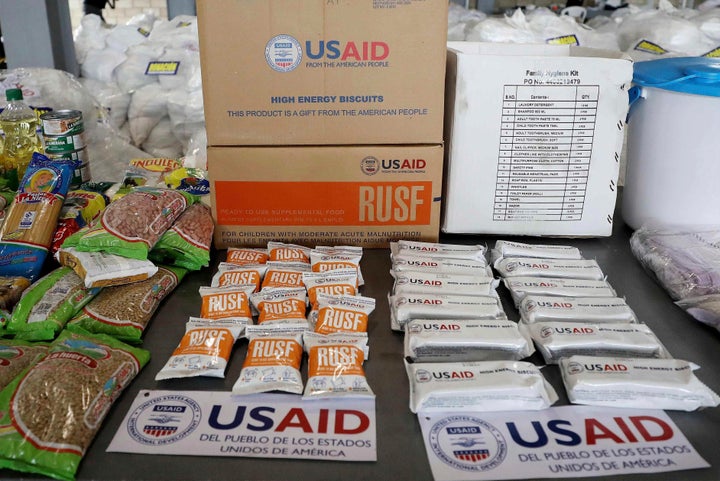
A man walks past boxes of USAID humanitarian aid at a warehouse at the Tienditas International Bridge on the outskirts of Cucuta, Colombia, Feb. 21, 2019, on the border with Venezuela. (AP Photo/Fernando Vergara)


WASHINGTON (AP) — The website of the U.S. Agency for International Development went offline without explanation Saturday as thousands of furloughs, layoffs and program shutdowns continued in President Donald Trump's freeze on U.S.-funded foreign aid and development worldwide.

Congressional Democrats battled the Trump administration increasingly openly, expressing concern that Trump may be headed toward ending USAID as an independent agency and absorbing it into the State Department. Democrats say Trump has no legal authority to eliminate a congressionally funded independent agency, and that the work of USAID is vital to national security.

Trump and congressional Republicans say much of foreign aid and development programs is wasteful. They single out programs they say advance liberal social agendas.

The fear of even tougher administration action against USAID comes two weeks into the administration's shutdown of billions of dollars of the United States' humanitarian, development and security assistance.

The U.S. is the world's largest donor of humanitarian aid by far. It spends less than 1% of its budget on foreign assistance, a smaller share overall than some other countries.

Administration officials had no comment Saturday when asked about concerns expressed by lawmakers and others that Trump may be planning to end USAID's separate status..

President John F. Kennedy created the organization at the height of the Cold War to counter Soviet influence. USAID today is at the center of U.S. challenges to the growing influence of China, which has a successful “Belt and Road” foreign aid program of its own.

Congress passed the Foreign Assistance Act in 1961, and Kennedy signed that law and an executive order establishing USAID as an independent agency.

USAID staffers spent Friday and Saturday in chat groups monitoring its fate, giving updates on whether the agency's flag and signs were still up outside agency headquarters in Washington. As of late Saturday afternoon, they were.

In a post on X, Democratic Sen. Chris Murphy said presidents cannot eliminate congressionally appropriated federal agencies by executive order, and said Trump was poised to “double down on a constitutional crisis.”

“That’s what a despot — who wants to steal the taxpayers’ money to enrich his billionaire cabal — does,” Murphy said.

Billionaire Elon Musk, advising Trump in a campaign to whittle down the federal government in the name of efficiency, endorsed posts on his X site calling for dissolving USAID.

“Live by executive order, die by executive order,” Musk tweeted in reference to USAID.

Trump placed an unprecedented 90-day freeze on foreign assistance on his first day in office Jan. 20. The order, a tougher-than-expected interpretation of Trump’s freeze order on Jan. 24 drafted by Peter Marocco, a returning political appointee from Trump’s first term, shut down thousands of programs around the world and forced the furloughs or layoffs of many thousands.

Secretary of State Marco Rubio has since moved to keep more kinds of strictly life-saving emergency programs going during the freeze. Aid groups say confusion surrounding what programs are still allowed to operate is contributing to paralysis in global aid organizations.

Rubio, in his first public comments on the matter, said Thursday that USAID’s programs were being reviewed to eliminate any that are not in the U.S. national interest, but he said nothing about eliminating it as an agency.

The shutdown of U.S.-funded programs during the 90-day review meant the U.S. was “getting a lot more cooperation” from recipients of humanitarian, development and security assistance, Rubio said.

Republicans and Democrats long have fought over the agency, arguing whether humanitarian and development aid protects the U.S. by helping stabilize partner countries and economies or is a waste of money. Republicans typically push to give State more control of USAID’s policy and funds. Democrats typically build USAID autonomy and authority.

A version of that battle played out in Trump’s first term, when Trump tried to cut the budget for foreign operations by a third.


When Congress refused, the Trump administration used freezes and other tactics to cut the flow of funds already appropriated by Congress for foreign programs. The General Accounting Office later ruled that it violated a law known as the Impoundment Control Act.

___

AP photographer Carolyn Kaster contributed to this report.
View comments (22)


Trump aid freeze disrupts global HIV/AIDS fight

Nathaniel Weixel
Fri, January 31, 2025


A legacy bipartisan initiative to combat HIV and AIDS in Africa is collateral damage from President Trump’s directive to halt all U.S. foreign assistance, despite efforts to exempt humanitarian assistance and lifesaving medication from being caught up in the three-month funding freeze.

The State Department issued a memo implementing the pause for new and obligated State and U.S. Agency for International Development (USAID) funding following Trump’s executive order calling for a 90-day pause on new foreign aid to allow the government to determine if programming aligns with Trump’s foreign policy.

The pause in global health funding has frozen activities at health clinics across Africa that rely on the President’s Emergency Plan for AIDS Relief (PEPFAR), raising immediate fears of a rapid spread of HIV around the continent.

It’s not unusual for a new administration to order a review of existing programs or even to pause new spending, and PEPFAR shouldn’t be immune from that, said Jirair Ratevosian, a fellow at Duke University’s Global Health Institute who formerly worked as a chief of staff for the PEPFAR program.
A
“But, you know, there’s a distinction between reviewing a program, asking questions about a program, and completely freezing its lifesaving mission,” Ratevosian said. “What’s transpired over the last [few days] is something completely different, which is chaos, confusion and potential reversal of one of America’s greatest accomplishments.”

The $6.5 billion PEPFAR is considered to be one of America’s most consequential programs in Africa. It is credited with saving 25 million lives and with scaling back the AIDS epidemic.

Experts and aid organizations are sounding the alarm over the sudden halt. The stop-work orders came without warning, sowing immediate chaos and confusion.

PEPFAR employs more than 270,000 health workers. They have been told to stop serving patients and not go to work.

Clinics shut their doors and turned patients away. The administration even told them to stop dispensing antiretroviral HIV medication that they had in stock because it was supplied with PEPFAR funds.

Some entities have private funding and other stopgap measures to fall back on, but for others the situation is more difficult.

“There are programs all over the continent providing treatment and prevention that are now not delivering what they normally do,” said Mitchell Warren, executive director of AVAC, an international nonprofit focused on HIV prevention. “There will be people, beginning this week, who come back into the clinic, or thought they had an appointment to come back to clinic to get more medication, and won’t be able to get it.”

Just as suddenly as the stop-work memo was released, the State Department appeared to somewhat reverse course, announcing Tuesday that lifesaving treatments and medications were not subject to the freeze. But the waiver provided no specific guidance on what services qualified for exemption, deepening the confusion on the ground.

Warren said the waiver appears to allow clinics to resume dispensing HIV medication, but it’s not entirely clear. Without clarification, he said clinics are continuing to withhold medication.

“If you said lifesaving medication, I would tell you that anyone on antiretroviral therapy or anyone getting antiretroviral prevention, it’s lifesaving. But it’s open to interpretation,” Warren said.
ADVERTISEMENT


“And we do not yet have any official notification from PEPFAR or from USAID or from [the Centers for Disease Control and Prevention] which programs qualify for that waiver,” he added.

If a person with HIV stops taking the medication, the virus is no longer suppressed and can multiply, leading to weakened immune systems, illness and then potential spread to others.

The foreign aid freeze comes at a precarious time for the PEPFAR program, as some of its authorizations expire in March. PEPFAR has traditionally been reauthorized for five-year periods, but the March 2024 omnibus funding bill only extended it for a year.

“Historically, PEPFAR has had tremendous bipartisan support that allowed it to kind of sit outside of regular politics,” said Jen Kates, a senior vice president and director of the Global Health & HIV Policy Program at KFF. “That is no longer the case.”

Republicans have put the aid program in their crosshairs in recent weeks following the State Department notifying Congress last month it discovered that nurses working in PEPFAR-funded clinics in Mozambique had carried out nearly a dozen abortions.
ADVERTISEMENT


While abortion is legal in Mozambique, U.S. law bars any PEPFAR aid recipients from providing abortion services.

Rep. Brian Mast (R-Fla.), the chair of the House Foreign Affairs Committee, has called for an investigation.

Mast entered the chair position promising to scrutinize U.S. foreign assistance abroad alongside Trump’s “America First” foreign policy push.

And Sen. Jim Risch (R-Idaho), chair of the Senate Foreign Relations Committee, said earlier this month that PEPFAR “is certainly in jeopardy.”

Yet Sen. Chris Coons (D-Del.), a member and former chair of the Senate Appropriations subcommittee that funds the State Department, said there are still Republican colleagues who support the program.

“Some very much so. I’ve spoken with a number of my colleagues who respect and recognize the decades-long impact PEPFAR has had on saving literally millions of lives across several administrations back to President George W. Bush, who launched it,” he told The Hill.

He said he hoped “decisions that are being made yesterday, today, going forward, do not hamstring the program from being able to continue to carry out its critical lifesaving mission.”

Sen. John Cornyn (R-Texas) spoke in support of the program during Robert F. Kennedy Jr.’s confirmation hearing on Wednesday before the Senate Finance Committee, and asked the Health and Human Services nominee if he supported PEPFAR.

Kennedy said he’d “absolutely” support the program and seek to strengthen it.

Copyright 2025 Nexstar Media, Inc. All rights reserved. 


USAID Security Leaders On Leave After Trying To Keep Musk's DOGE From Classified Info, Officials Say

Musk's DOGE crew lacked high-enough security clearance to access that information, so the two USAID security officials were legally obligated to deny access.

Ellen Knickmeyer
AP
Feb 2, 2025,

 USAID humanitarian aid destined for Venezuela is displayed for the media at a warehouse next to the Tienditas International Bridge on the outskirts of Cucuta, Colombia, Feb. 19, 2019.
 (AP Photo/Fernando Vergara, File)

WASHINGTON (AP) — The Trump administration has placed two top security chiefs at the U.S. Agency for International Development on leave after they refused to turn over classified material in restricted areas to Elon Musk’s government-inspection teams, a current and a former U.S. official told The Associated Press on Sunday.

Members of Musk’s Department of Government Efficiency, known as DOGE, eventually did gain access Saturday to the aid agency’s classified information, which includes intelligence reports, the former official said.

Musk’s DOGE crew lacked high-enough security clearance to access that information, so the two USAID security officials — John Vorhees and deputy Brian McGill — were legally obligated to deny access.

The current and former U.S. officials had knowledge of the incident and spoke on condition of anonymity because they were not authorized to share the information.

Musk on Sunday responded to a post about the news on X by saying, “USAID is a criminal organization. Time for it to die.” The White House did not immediately respond to a request for comment.

It comes a day after DOGE carried out a similar operation at the Treasury Department, gaining access to sensitive information including the Social Security and Medicare customer payment systems

Musk formed DOGE in cooperation with the new Trump administration with the stated goal of finding ways to fire federal workers, cut programs and slash federal regulations.

USAID, whose website vanished Saturday without explanation, has been one of the federal agencies most targeted by the Trump administration in an escalating crackdown on the federal government and many of its programs.

The Trump administration and Secretary of State Marco Rubio have imposed an unprecedented freeze on foreign assistance that has shut down much of USAID’s humanitarian, development and security programs worldwide — compelling thousands of layoffs by aid organizations — and ordered furloughs and leaves that have gutted the agency’s leadership and staff in Washington.

The U.S. is by far the world’s largest donor of humanitarian aid, with USAID administering billions of dollars in humanitarian, development and security assistance in more than 100 countries.

Peter Marocco, a returning political appointee from Trump’s first term, was a leader in enforcing the shutdown. USAID staffers say they believe that agency outsiders with visitors badges asking questions of employees inside Washington headquarters are members of Musk’s DOGE team.


___


AP Diplomatic Writer Matthew Lee in Panama City contributed to this report.


Opinion

Top Official Who Fought “Illegal” Trump Purge Now Being Pushed Out

Hafiz Rashid
Fri, January 31, 2025

On Wednesday, a career official at the U.S. Agency for International Development was placed on administrative leave after he undid an order from Elon Musk’s “Department of Government Efficiency” to immediately fire several career employees at the agency.

Nicholas Gottlieb, the USAID’s director of employee and labor relations, sent an email Thursday reversing the terminations of dozens of senior USAID staff, calling the firings “illegal” and a violation of “due process.”

“You may receive another email within the day reinstating your leave status. However, that notice will not come from me,” Gottlieb wrote. “I wish you all the best—you do not deserve this.”

Gottlieb later emailed the rest of USAID’s staff to notify them that he was being placed on leave, telling them that “it is and has always been my office’s commitment to the workforce that we ensure all employees receive their due process in any of our actions.

“I will not be a party to a violation of that commitment,” Gottlieb wrote.

X screenshot John Hudson @John_Hudson NEW: The order that removed dozens of senior USAID leaders earlier this week was rescinded today by a career USAID official who called the purge

The Trump administration on Monday fired more than 50 senior USAID officials after accusing the agency of attempting to “circumvent” the president’s executive order freezing all foreign aid. Gottleib then intervened, and has been sidelined for his efforts.

Trump and Musk, through the so-called “Department of Government Efficiency,” have attempted to overhaul and slash the federal workforce, with poor results. What happened to Gottlieb is an example of the consequences for opposing the tech mogul and fascism enthusiast, as well as the president’s ill-thought-out executive orders. And just like the president’s firing of several agency inspectors general last week, it’s probably illegal. Will there be any consequences?


Denmark stands firm on Greenland after Rubio says Trump's interest is no joke

Reuters
Fri, January 31, 2025

Danish Foreign Minister Lars Lokke Rasmussen addresses the media in Copenhagen

COPENHANGEN (Reuters) - Denmark said on Friday it meant seriously that Greenland is not for sale, after Secretary of State Marco Rubio said U.S. President Donald Trump's interest in acquiring the island was "not a joke".

Trump says he will make the autonomous territory of Denmark a part of the United States, and has not ruled out using military or economic power to persuade Denmark to hand it over.

Rubio told Sirius XM's The Megyn Kelly Show on Thursday that acquiring Greenland was in the U.S. national interest. Trump had not ruled out military coercion to acquire it so as not to take leverage off the table, he said.

"This is not a joke," Rubio said. "This is not about acquiring land for the purpose of acquiring land. This is in our national interest and it needs to be solved."

Responding to Rubio's interview, Denmark's Foreign Minister Lars Lokke Rasmussen said: "I would be more surprised if he had said it was a joke."

"We seriously mean - and this is also true in Greenland - that Greenland is not for sale."

The island has around 57,000 residents who govern their own domestic affairs. Denmark is responsible for Greenland's defence and security, and says only Greenlanders can decide their future. The United States operates an airbase there under treaty.

Opinion polls show most residents of Greenland favour a looser relationship with Denmark but also oppose the territory becoming part of the United States.

Greenland's Prime Minister Mute Egede, who has stepped up a push for independence from Denmark, has also repeatedly said the island is not for sale and its people must decide their own fate.

Rubio in the interview said the Arctic was going to become critical for shipping lanes and the United States needs to be able to defend this. He said U.S. rival China may seek to develop its presence.

Asked if the U.S. would own Greenland in four years, Rubio said: "Obviously that's the president's priority and he has made that point ... We're not in a position yet to discuss exactly how we'll proceed tactically. What I think you can rest assured of is that four years from now, our interest in the Arctic will be more secure."

Rasmussen said that the U.S. interests outlined by Rubio in the interview match those of the Kingdom of Denmark.

"If we can have a substantive discussion about this, then we will also find a solution," he said.

Referring to Rubio's comments, Rasmussen said: "It is summed up in this ambition that if the United States just owned the whole world, then everything would be under control. But that is not going to happen, so we have to find another form where we jointly accomplish these tasks."

(Reporting by Jacob Gronholt-Pedersen; Editing by Peter Graff)


'This is not a joke': Rubio confirms Trump's intentions to buy Greenland are genuine

Gustaf Kilander
Fri, January 31, 2025 


President Donald Trump’s new Secretary of State, Marco Rubio, confirmed during a Thursday interview that the commander-in-chief’s intentions to buy Greenland from Denmark are genuine and “not a joke.”

Rubio, a former Florida senator, told SiriusXM host Megyn Kelly that Trump’s desire to purchase the Arctic autonomous territory is based on national security concerns for the U.S. and the rest of the world as China increases its activities in the region.

“This is not a joke, like what he’s saying is pretty accurate. People have been talking about it for years,” Rubio said.

”This is not about acquiring land for the purpose of acquiring land. This is in our national interest, and it needs to be solved. President Trump’s put out there what he intends to do, which is to purchase it.”

Rubio said that even as China currently doesn’t have a heavy presence in the Arctic, it’s “realistic” to think that the country would “install facilities that give them access to the Arctic with the cover of a Chinese company, but that in reality, to serve a dual purpose, that in a moment of conflict, they could send naval vessels to that facility and operate from there.”

Marco Rubio said during an interview with Megyn Kelly that Trump’s wish to buy Greenland is ‘not a joke’

Trump has, both in private and in public, shared his willingness to purchase the island, and he has previously claimed that Denmark would “come along” in the end, even in the face of staunch opposition from the Danes.

Greenland’s Prime Minister Mute Egede previously appeared on Fox News, saying: “We don’t want to be Danes. We don’t even want to be Americans. We want to be Greenlanders.”

Danish Prime Minister Mette Frederiksen took part in an at times combative and antagonistic phone call with Trump on January 15, five days before he was sworn in for a second term in the White House.

“I wasn’t privy to that phone call, but I imagine the phone call went the way a lot of these phone calls go, and that is, he just speaks bluntly and frankly with people,” said Rubio on Thursday. “And ultimately, I think diplomacy, in many cases, works better when you’re straightforward, as opposed to using platitudes and language that translates to nothing.”

The SiriusXM interview was highlighted by The Hill.

The secretary also claimed that if China attacked Greenland, there would be no way for the Danes to stop them.


Greenland’s Prime Minister Mute Egede told Fox News that his countrymen don’t want to Danes or Americans. (REUTERS)

“Denmark can’t stop them. They would rely on the United States to do so,” said Rubio. “And so his point is, if the United States is on the hook to provide as we are now, we have a defense agreement with them to protect Greenland, if it comes under assault, if we’re already on the hook for having to do that, then we might as well have more control over what happens there.”

Earlier this week, the Danes announced that it would spend another $2 billion on defending its North Atlantic territories, including using long-range drones and new ships built for operating in Arctic waters.

The Danes recently rejected a proposal from the French to send E.U. troops to Greenland, and a Danish MP suggested that the island rejoin the union for security reasons following its 1985 departure.

Rubio Says Trump Greenland Bid ‘Not a Joke,’ Citing China Risks

Iain Marlow
Fri, January 31, 2025 


(Bloomberg) -- The top US diplomat said President Donald Trump’s proposal to buy Greenland “is not a joke” because of the risk that China would station resources on the island that threaten American security and the importance of Arctic shipping lanes for energy exports.

“Those conversations are going to happen, but this is not a joke,” Secretary of State Marco Rubio said about discussions between Trump and Danish authorities over potentially buying the island. He spoke in an interview on SiriusXM’s The Megyn Kelly Show posted online Thursday. Rubio also reiterated the Trump administration’s interest in the Panama Canal.

Rubio, who has previously defended Trump’s interest in Greenland, said Beijing may deploy Chinese companies to establish operations on the island that might one day be used by its military, adding that this was also a concern in Panama.

“It is completely realistic to believe that the Chinese will eventually, maybe even in the short term, try to do in Greenland what they have done at the Panama Canal and in other places,” said Rubio, a longtime China hawk. “And that is install facilities that give them access to the Arctic with the cover of a Chinese company, but that in reality serve a dual purpose — that in a moment of conflict they could send naval vessels to that facility and operate from there.”

Rubio said Arctic shipping routes were going to be crucial for the Trump administration’s plan to export more American energy. Greenland’s potential as a source of critical minerals also has been cited within Trump’s camp as a reason for its strategic value.

A spokesman for China’s embassy in Washington, Liu Pengyu, told Bloomberg in a statement that Rubio’s accusations about a possible dual-use facility on Greenland “are totally groundless and unfounded.” He added that Beijing “does not take part in managing or operating” the Panama Canal and respects the country’s sovereignty.

Meanwhile, Danish Foreign Minister Lars Lokke Rasmussen responded to the comments on Friday saying that American interests in the Arctic matches those of Denmark. But he reiterated that Greenland is not for sale.

“It’s also not a joke when we say that of course Greenland should not become American,” Rasmussen said in an interview with Danish national broadcaster DR. “The Kingdom of Denmark has no interest in that. Neither does Greenland, that is crystal clear.”

Earlier this week, Danish Prime Minister Mette Frederiksen sought to drum up support from European allies to stand up to Trump’s efforts to appropriate Greenland.

While Rubio was seen as the most conventional of Trump’s cabinet picks, he’s fully backed Trump’s foreign policy ideas, including a disruptive foreign aid freeze that has alarmed global aid organizations including the World Health Organization.

Trump has also called for the US to retake control of the Panama Canal unless the cost of passage for naval and merchant ships is slashed. He has falsely accused China of operating the waterway, exaggerating the significance of two ports on either side of the canal operated by a Hong Kong-based firm.

On Wednesday evening, Trump’s Pentagon chief, Pete Hegseth, said the US had the right to “do what is necessary” to ensure access to the Panama Canal


--With assistance from Sanne Wass.

The US military is still relying on Greenland for defense in the Arctic even as Trump's ambitions stir tensions

Chris Panella
Fri, January 31, 2025


US F-16s flew to Greenland for force posturing after Russian aircraft were detected in the Arctic.


The US and Greenland continue their standard agreement for presence in the Arctic region.

Tensions are high as President Trump continues pressing his desire to buy Greenland.

US F-16 fighter jets flew to Greenland earlier this week, highlighting the vast autonomous territory's long-standing role in supporting North American defense, even as the new administration complicates matters with new landgrab ambitions.

Right now is an unusually tense time between the US and Denmark, a longtime American ally, as President Donald Trump continues to push forward on ambitions to acquire Greenland. His newly confirmed secretary of state, Marco Rubio, says he's serious.

The North American Aerospace Defense Command confirmed Thursday that it monitored the activity of multiple Russian military aircraft in the Arctic earlier this week. The aircraft remained in international airspace and weren't seen as a threat, but as part of its defense mission, NORAD regularly scrambles patrol aircraft to monitor these situations.

Two patrols — one from the Canadian NORAD region and the other from the Alaskan NORAD region — were dispatched to track the activity. The Canadian patrol consisted of two Canadian CF-18s and KC-135 refueling aircraft, while the Alaskan patrol included two American F-35s, one E-3, and two KC-135 refueling aircraft.


Several hours after those patrols, NORAD "sent two F-16s from Alaska to Greenland exercising its standard agreement with Greenland to forward posture NORAD presence in the activity." The command said that the dispatch was not in response to any current threat.

Aircraft with the bilateral NORAD command regularly deploy to Pituffik Space Base on the western tip of northern Greenland. NORAD Public Affairs said that these aircraft "support various long planned NORAD activities with our allies and partners, building on the longstanding defense cooperation between the US, Canada, and the Kingdom of Denmark."

The routine activity highlights that Greenland isn't simply land; it is part of a strategic partnership.

In recent months, President Donald Trump has repeatedly expressed interest in a US acquisition of Greenland, a self-ruling Danish territory. He has called the island, which is rich in natural resources, an "absolutely necessity" and has even suggested using force or coercion to bring it under US control.

Trump's comments on Greenland have been met with a wide range of responses and confusion, especially with Greenlanders and US partners in Europe, but on Thursday, the newly sworn-in US secretary of state, Rubio, said on The Megyn Kelly Show on SiriusXM that Trump's desire to acquire the island is "not a joke."

He said "this is not about acquiring land for the purpose of acquiring land. This is in our national interest, and it needs to be solved."

Beyond its natural resources, Greenland is also primely located in an area of growing strategic competition: the Arctic. It could support the US force posture in the Arctic, making it easier to monitor and counter China and Russia's ambitions in the region. China is a critical factor in Trump's attitude on the Panama Canal, as well.

In response to Rubio's remarks on Trump's ambitions, Danish Foreign Minister Lars Løkke Rasmussen said Friday, "I would be more surprised if he said it was a joke," per Danish public broadcaster TV2. "We have no interest in selling Greenland to the US, it will not happen."