Wednesday, February 19, 2025

Video: Port of Charleston Sets New Record for Largest TEU Containership
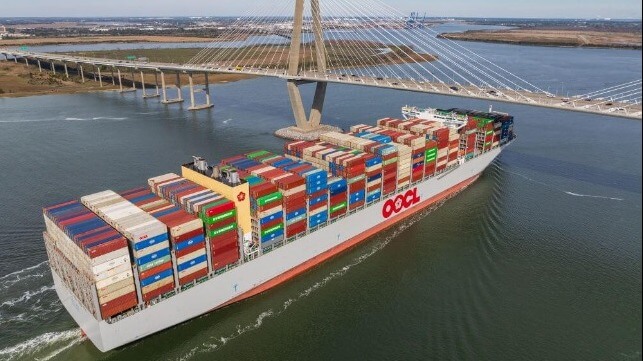
OOCL Iris arriving Charleston
With boxes stacked nine high, OOCL Iris created images of a tight fit under Charleston's Route 17 Bridge (SC Ports - Matthew Peacock photo)

Published Feb 18, 2025 6:15 PM by The Maritime Executive


SC Ports and the Port of Charleston, South Carolina set a new record on Tuesday, February 18, receiving their largest capacity containership to date. The new OOCL Iris (16,868 TEU) while a smaller vessel by dimensions, surpassed the capacity record set four years ago highlighting the benefits of investments the state is making in its ports and advancements in container shipping.

The OOCL Iris was recently delivered as the second of a class of 10 new NeoPanamax containerships Orient Overseas Container Liner (OOCL) is putting into service. The ship was named on December 3, 2024, at the Nantong COSCO KHI Ship Engineering Co. (NACKS) as the first of the class completed by this yard and the second overall as Dalian COSCO KHI Ship Engineering Co. (DACKS) is also building half the class.

OOCL highlights it is their first new NeoPanamax class in more than a decade with the prior vessels entering service in 2013 and 2014. Starting in 2023, the company also added a class of ultra-large container vessels, the industry’s first 24,000 TEU ships.

Representing the next generation of NeoPanamax containerships, OOCL Iris, along with NACKS-built sisters OOCL Bauhinia and OOCL Sunflower, not only comply with the latest environmental regulatory requirements, but also set new benchmarks in areas such as environmental design, energy efficiency, digital intelligence, safety, and onboard comfort by incorporating the latest technological innovations and intelligent solutions. These vessels feature an advanced energy efficiency system that provides recommendations for speed optimization and trim adjustments. The system monitors real-time fuel consumption and power usage of the main engine, generator, and boiler, offering valuable optimization suggestions. Additionally, the OOCL Iris has received three "Smart Ship" notations, as well as the Enviro-friendly notation (ENVIRO) and Sustainable notation (SUSTAIN-1) from the American Bureau of Shipping (ABS).

For Charleston, it means the vessel which is 1,204 feet in length (367 meters) has a rated carry capacity of 16,868 TEU surpassing the CMA CGM Marco Polo which at 16,020 set the previous record in May 2021. The CMA CGM vessel was the largest containership in the world when it was introduced in 2013 with an overall length of 1,299 feet (396 meters). Advancements in loading and stacking permit the new OOCL vessels to carry five percent more boxes (TEU) on a smaller-dimension vessel. 


The height of the new vessel made for some interesting images as it passed under Charleston’s Arthur Ravenel Jr. roadway bridge (Route 17). The bridge is listed with a clearance of 186 feet (57 meters).

The ship proceeded to Charleston’s Wando Welch Terminal as the last stop on its U.S. rotation. The port emphasizes its capital investments meaning a ship of this size has any time access regardless of tides. The berth now has a 54-foot depth and a 52-foot channel. The OOCL Iris has a design draft of 47.6 feet (14.5 meters).

“SC Ports’ strategic infrastructure investments allow us to continue welcoming the largest ships calling the U.S. East Coast,” said SC Ports President and CEO Barbara Melvin. “Charleston’s harbor depth and widened turning basins, taller ship-to-shore cranes and highly productive terminals and maritime community all work together to provide fluidity to our customers’ supply chains.”

SC Ports highlights an investment of nearly $3 billion to modernize port infrastructure, expand cargo capacity, and build rail infrastructure. Last year, it reached an agreement with its unions after a standoff that had delayed the use of its expanded terminals.

The OOCL Iris and her soon-to-be-introduced sister OOCL Sunflower will be taking advantage of the NeoPanamax sizing on a route from China and Far East ports to New York, Savannah, and Charleston. The first ship of the class, OOCL Bauhinia is on a different Pacific route calling at Long Beach, California in the U.S.


TEU

The twenty-foot equivalent unit (abbreviated TEU or teu) is a general unit of cargo capacity, often used for container ships and container ports.


German NGO Comes Up With AI-Based Tool to Find Ghost Nets

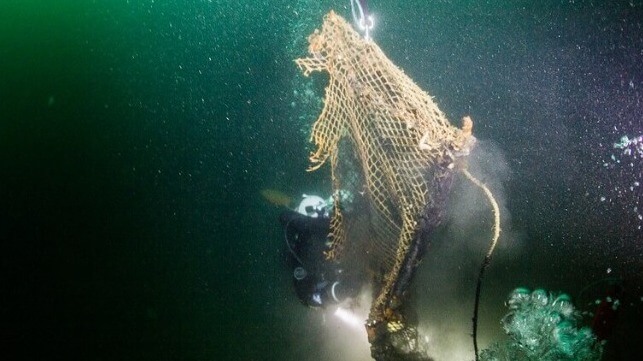
Divers recover a ghost net (Ghost Nets UK / Christine Grosart / Public domain)
Divers recover a ghost net (Ghost Fishing UK / Christine Grosart / Public domain)

Published Feb 18, 2025 9:57 PM by The Maritime Executive


A German NGO has come up with an AI-assisted tool for finding ghost nets - the drifting, abandoned fishing gear that hoovers up sea life indiscriminately.

About 50,000 tonnes of fishing gear end up in the ocean every year, accounting for nearly a third of all ocean plastic waste. The gear gradually decomposes into microplastic, which enters the marine food chain with unknown consequences for the ecosystem (and for consumers of seafood).  

But long before they break down, abandoned nets ensnare turtles, fish, sharks and other creatures, reducing the health of marine fisheries and taking a toll on threatened species. To fight this long-term threat, WWF Germany has worked with Accenture and Microsoft AI to put together an AI-driven ghost net identification platform. 

The process starts with sonar data, obtained by organizations of all kinds (oceanographic research groups, offshore energy companies, and government sources) and donated to the projcet. When this data is uploaded into the cloud-based AI identification platform - GhostNetZero - the system automatically scans the sonar data for the telltale signs of drifting ghost nets. Previously, the only way to do this was to search the data manually - a time-consuming process, if proven to work. WWF Germany has used manual sonar searches for its cleanup work in the past, and has removed more than 20 tonnes of abandoned nets from the bottom of the Baltic. 

But to maximize the platform's impact, WWF Germany says that it is looking for new participants from industry. Any group with high resolution sonar data to share can help out. In return, partners get the right to use the group's partnership logo.

"The combination of sonar search and AI-supported detection enables a quantum leap: the seabed is mapped all over the world and there is a huge amount of data. If we can specifically check existing image data from heavily fished marine zones, this is a real game-changer," WWF Germany project manager Gabriele Dederer told Oceanographic Magazine. 


Unknown Saboteurs Are Targeting German Navy Warships

Emden
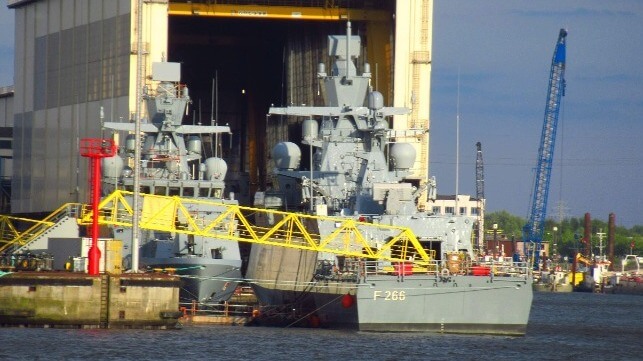
German Navy frigate Emden (F266) at Blohm+Voss, 2023 (Dkvtig / CC BY SA 4.0)

Published Feb 18, 2025 10:54 PM by The Maritime Executive


The German Navy has confirmed that unnamed saboteurs have attempted to damage more than one of its warships, and media reports from Germany suggest that at least two vessels have been affected.

In 2024, a German Navy minehunter was damaged by unknown personnel while in shipyard in Rostock. Several cable harnesses were severed, and an investigation is under way into a suspected sabotage attack, according to Spiegel. The Rostock prosecutor's office has confirmed that it is investigating the case. 

Late last year, an unknown saboteur dumped dozens of kilos of metal filings into the oil sumps of the main engines aboard the brand new corvette Emden, according to multiple German media outlets. The contamination was detected and cleaned out, but if it had not been spotted, it would have quickly destroyed the engines. 

Last week, German Navy Vice Adm. Jan Christian Kaack told the press that "more than one unit" had been sabotaged, without going into specifics. Troublingly, he added that German naval bases have reported a pattern of attempted security perimeter breaches, both from the shoreside and from the waterside. He added that uniformed German Navy personnel have been approached in public while en route from base to their homes. 

"The growing threat from Russia is more urgent at the beginning of 2025 than it was two years ago," Kaack told reporters, without specifying whether the suspected security threats within Germany were Russian. 

The suspected attacks are just part of a broader pattern of sabotage targeting Europe's security forces and its infrastructure. In early 2024, three German-Russian dual nationals were arrested on suspicion of planning an attack on the U.S. military base at Grafenwohr, a training facility for Ukrainian servicemembers. The main suspect, identified as Dieter S., stands accused of plotting an extensive series of arson and explosive attacks within Germany, with targets including rail lines and a manufacturing plant. 

Some NATO security forces also suspect - but have been unable to prove - that the four back-to-back subsea cable breaks in the Baltic over the past year are an intentional act of sabotage, potentially linked to Russian intelligence. 

Top image: German Navy frigate Emden (F266) at Blohm+Voss, 2023 (Dkvtig / CC BY SA 4.0)


China Surveys Vietnamese Naval Base Using U.S. Satellite Data

Vietnamese-occupied Barque Canada Reef
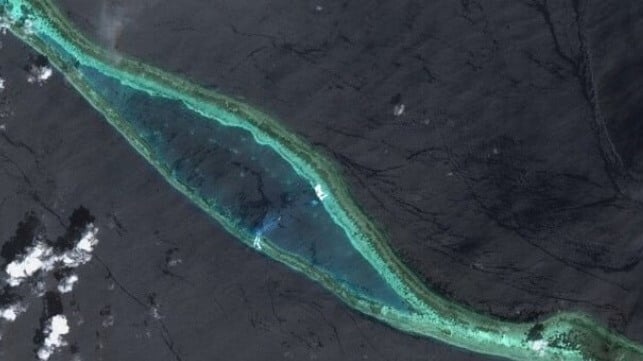
Barque Canada Reef before the start of major construction (NASA)

Published Feb 18, 2025 11:36 PM by The Maritime Executive


Over the past year, Vietnam has accelerated its land reclamation program in the Spratly Islands, building out acreage and enlarging its military bases at a faster pace than any other claimant. At its largest facility on Barque Canada Reef, it has dug out a ship channel large enough to accommodate the largest existing destroyers and cruisers, according to a new paper released by China's Ministry of Natural Resources. 

The paper, published in the latest edition of the Chinese-language Journal of Tropical Oceanography, describes a method to combine free data from American and European satellites to precisely chart out the depth of the channel - without the need for on-site surveying or permission from the base's operator. NASA's ICESat-2 satellite has laser sensing capabilities that can reach down to 30 meters below the surface, enabling depth detection with high precision. When combined with high-resolution optical imaging from the EU's Sentinel satellite constellation, this laser data enables unauthorized charting of sensitive installations like Vietnam's newly-built naval base.  

According to the ministry's measurements, the channel has enough depth to accommodate warships up to the size of the PLA Navy's Type 055 destroyers, which draw about 22 feet of water. This is significantly less than would be needed for the equivalent U.S. Navy vessels, the Ticonderoga-class and the Arleigh Burke-class, which both require more than 30 feet of depth. 

The paper also assessed the scale and speed of the land reclamation campaign. Vietnam appears to have added nearly 500 acres to Barque Canada Reef in just two years, and the harbor was added just last year. Coauthor Fu Dongyang wrote that the changes "have profoundly reshaped [the reef's] topography," but there is still room to grow. The shoal has about 16,000 acres of natural coral flats that could be converted to support strategic military uses, as China has done with the reef flats at nearby Mischief Reef, Fiery Cross Reef and Subi Reef.  

Vietnam has been clear about the purpose of the expansion. The Spratly Islands are contested by Vietnam, China, the Philippines, Taiwan and Malaysia, with the largest share located within the Philippine Exclusive Economic Zone (EEZ). China claims ownership over the entirety of the archipelago under its "nine-dash line" policy, and has the most extensive military presence.

For Vietnam, the bases provide a security perimeter far from home. “We will resort to every means possible to make sure we can defend and safeguard our legitimate interests in the [South China Sea]," Vietnamese foreign policy director Le Dinh Tinh told the Washington Post last year.

Chinese State Enterprise Buys Wison's Sanctioned Yard in Zhoushan

 said that it would sell its entire stake in its Zhoushan unit. It emphasized that Wison 
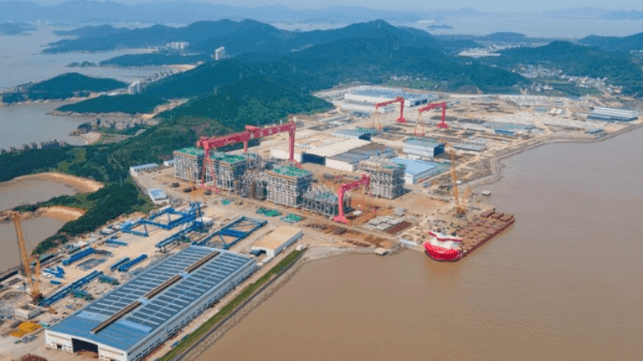
The giant Zhoushan Wison yard, now under new ownership and a new name (Wison)

Published Feb 17, 2025 6:20 PM by The Maritime Executive

A Chinese state-owned enterprise has taken over the ownership of Zhoushan Wison Offshore Engineering, the Wison Group unit that the Biden Administration sanctioned for supporting Russia's LNG export ambitions on the Arctic coast of Siberia.

According to the U.S. State Department, Wison supplied power generation modules for Novatek's Arctic LNG 2 project, which is heavily sanctioned. The modules were to be installed on Arctic LNG 2's barge-based liquefaction trains. After the modules were completed at Wison's plant, the company allowed them to be shipped to the Arctic LNG 2 construction site via a series of complex transshipment operations, which appeared designed to obscure the movements of the large and expensive project cargo. Two of the vessels involved - Hunter Star and Nan Feng Zhi Xing - have been sanctioned before for chartering activity in Russian energy projects.

After the Treasury announced that Zhoushan Wison would be sanctioned, parent company Wison New Energies pledged to avoid "any new Russian business" andNew Energies would not have any shareholding in the company after the sale.

Less than one month after sanctions on the yard were announced, a new owner has emerged: the state-owned Nantong Economic and Technological Development Zone Holding Group, a subsidiary of Nantong's municipal government. It is a Class I state-owned enterprise, with access to preferential credit terms. (Nantong is a five-hour drive away from Zhoushan, on the other side of Shanghai, but is home to another Wison facility.) The shipyard has been renamed Zhoushan Tongzhou Offshore Engineering.

The sanctions designation was limited to the Zhoushan unit, and Wison is still in the offshore construction industry. It broke ground in early February on a new, unsanctioned shipyard complex called Wison New Energies Qidong Yard. This plant will compete in the same market as the sanctioned Zhoushan yard, and will be a "strategic pillar" for completing the same large-scale EPCIC contracts, like FLNGs, FPSOs and plant modules.


Core Power Maps Effort for Nuclear Power Barges Leading to Commercial Ships

nuclear power barge
Core working with Gloster in developing the floating nuclear power barge concept (Core / Glosten)

Published Feb 17, 2025 4:48 PM by The Maritime Executive


Core Power, a startup that is working to develop opportunities in the maritime sector using a new generation of advanced nuclear technology, outlined its vision to develop floating nuclear power plants that can be levered into nuclear-powered merchant shipping. The company will develop a U.S.-anchored maritime program named Liberty in honor of the mass-produced World War II Liberty ships.

Last month, Core Power announced it was partnering with Glosten to design a floating nuclear power plant that could be installed at U.S. ports. Naval architects and marine engineers at Glosten are focusing on the barge operational concept, design, regulatory path, site location approvals, and identification of potential suppliers for fabrication and installation of the barges which could produce about 175GWh of power per year.

CEO Mikal Bøe of Core Power provided more details on the vision during a presentation in Houston last week. The first part of the Liberty program he said will see the mass production of floating nuclear power plants (FNPPs). The expertise gained in rolling out FNPPs on a large scale he predicted will pave the way for the second part of the program, which involves developing nuclear propulsion for merchant ships.

“The Liberty program will unlock a floating power market worth $2.6 trillion, and shipyard construction of nuclear will deliver on time and on budget,” said Bøe. The company expects to open the orderbook for the floating nuclear power plants in 2028 and reach full commercialization by the middle of the next decade.

Using well-established shipbuilding processes and leveraging an already-skilled workforce, he envisions a modular production line for the power barges. Mass production will be possible says Bøe because they will employ advanced nuclear technologies, such as molten salt reactors. He points out that the new technologies are inherently and passively safe meaning they do not require the larger facilities and exclusion zones.

Employing the floating concept will make it possible to move the barges to ports and coastal locations to supplement local power capacity. Larger-capacity generation units would be anchored further offshore. The central shipyard will carry out the commissioning, maintenance, refueling, and waste management, making it simpler to choose locations for the barges. They will not require extensive site preparations. Core Power will also support the creation of the necessary framework for licensing, insurance, and export control.

Learning from the first phase, they will then focus on developing the supply chain and workforce. They look to leverage the program internationally which will support the growth of the applications. They also believe it will lay the groundwork for nuclear-powered commercial vessels.

Core Power reported last November that it was working with Westinghouse, one of the pioneers in nuclear power. The companies are focusing on the reactors that would be placed aboard the barges.

Several companies are looking at applications of the new smaller reactor technologies to provide easily positioned power stations. Samsung Heavy Industries in partnership with Seaborg, a Danish start-up pursuing next-generation nuclear technologies, is also developing floating nuclear power plant barges using Compact Molten Salt Reactor technology developed by Seaborg. This concept is also targeted at the opportunities to bring new power sources to remote areas and developing countries.


Hong Kong Launches Ship-to-Ship LNG Bunkering Operation

LNG bunkering operation
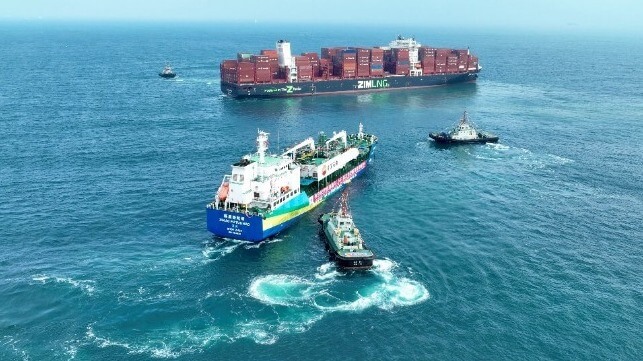
Zim's containership took placei n the launch of Hong Kong's LNG bunkering operations (Kunlun Energy)

Published Feb 17, 2025 8:13 PM by The Maritime Executive


Officials in Hong Kong are hailing the launch of bunkering operations to fuel LNG ships. It provides another competitive tool for the port which along with other major ports in the region including Singapore and Shanghai are offering LNG bunkering operations.

Kunlun Energy Co., controlled by PetroChina, reported the first official bunkering operation on February 14 taking place in the southern anchorage of Hong Kong’s Cheung Chau. The company’s bunker vessel was positioned alongside the Zim Aquamarine (81,681 dwt) to load 2,200 tons of ultra-low temperature LNG. Using an advanced bunker system, the operation took about seven hours.

The 7,000 TEU vessel was recently delivered from the shipyard and is now in service between the Far East and the Mediterranean. The companies report the refueling in Hong Kong will meet the ship’s fuel requirements for the entire voyage. 

The bunkering service will be offered with the company’s vessel. It is equipped with two independent "C"-type cargo tanks with a maximum capacity of 8,500 cubic meters, providing customers with one-stop customized services, including cold storage, degassing, and LNG bunkering.

In late January, a test bunkering was also carried out with a Zim vessel, Zim Amber, another ship of the same class. The service has now been officially inaugurated with Hong Kong port officials reporting the goal is to bunker 200,000 tons of green fuels annually by 2030. According to data provided by PetroChina, by the end of 2024, it had supplied approximately 15.8 billion cubic meters of gas to Hong Kong, with an annual supply of about 1.5 billion cubic meters. Adding ship bunkering is being called another important milestone.

Hong Kong joins as many as 100 bunkering ports worldwide with most major shipping ports now having capabilities to supply LNG. According to the trade group SEA-LNG, the bunkering infrastructure to support LNG as a marine fuel has developed rapidly. It can now be delivered to vessels in some 96 ports, including most of the main bunkering ports, with a further 55 ports in the process of facilitating LNG bunkering investments and operations. 

The group highlights the dramatic growth in the LNG bunker fleet. DNV calculates there are 65 supply ships now in service. This compares with just six LNG bunker vessels in 2019. DNV reports that an additional 16 LNG bunker vessels are currently on order. Europe and Asia each have about a third of the LNG bunker fleet, with the Americas third at 17 percent.

Globally there are over 650 LNG-fueled vessels now in service. The size of the fleet is expected to double over the next eight years to 2033.


 LAW OF THE SEA

USCG and Navy Rescue Crew from Iranian Ship Sinking in Persian Gulf

sinking Iranian vessel
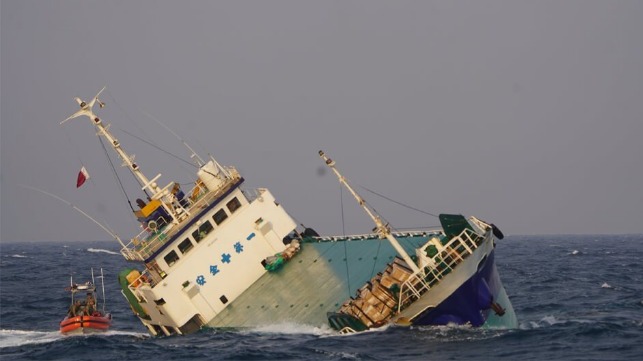
USCG took the crew of the Iranian vessel aboard after the cargo ship issued a MAYDAY call (CENTCOM)

Published Feb 18, 2025 2:19 PM by The Maritime Executive


U.S. Central Command (CENTCOM) is reporting the rescue of seafarers and the quick actions of the U.S. Coast Guard and a U.S. Navy ship to ensure the safety of the crew.

According to the report, the U.S. Navy Avenger-class mine countermeasures ship USS Devastator and U.S. Coast Guard Cutter Clarence Sutphin Jr. were operating in the Arabian (Persian) Gulf. Both vessels are assigned to CENTCOM based in Bahrain.

They provided assistance to the crew of an Iranian-owned vessel. The general cargo ship Shayesteh had developed a significant list and issued a mayday call for help. The U.S. vessels responded finding the ship in significant danger and the crew abandoning the vessel.

CENTCOM refers to the ship as an Iranian vessel but notes it was flying a Qatari flag, which CENTCOM says is customary when in territorial waters. Equasis reports the vessel has been owned by the Iranians since 2011. It is listed as 450 gross tons.

USCGC Clarence Sutphin Jr. took the five Iranian and two Indian seafarers from the vessel aboard. It was providing medical care but reported the crew of the Iranian ship was safe.

The Shayesteh has since sunk reports CENTCOM.

The Sutphin was delivered to USCG at the beginning of 2022 as one of six Sentinel-class fast response cutters designated to work jointly with the U.S. Navy from Bahrain. She was assigned to the 5th Fleet arriving in Bahrain in August 2022 as part of Patrol Forces Southwest Asia (PATFORSWA). It is the Coast Guard's largest unit outside the United States. The ships are forward-deployed to the U.S. 5th Fleet to help ensure maritime security and stability across the Middle East.

Today’s incident follows two other significant missions for the Sutphin in 2024. In January, the Sutphin located a suspect vessel and boarded it in the Arabian Sea. The boarding team discovered over 200 packages that contained medium-range ballistic missile components, explosives, unmanned underwater/surface vehicle (UUV/USV) components, military-grade communication and network equipment, anti-tank guided missile launcher assemblies, and other military components, which CENTCOM reported were being transported to the Houthi militants in Yemen.

USCGC Clarence Sutphin Jr. in April 2024, seized 257 kg of methamphetamines, 92 kg of heroin, 17 kg of amphetamines, 296 kg of hashish, and 15 kg of marijuana from a dhow in the Arabian Sea.


Video: U.S. Coast Guard Aircrew Rescues Man From Wave-Washed Rockface

Rescue swimmer
Image courtesy USCG

Published Feb 18, 2025 7:11 PM by The Maritime Executive


 In a dramatic rescue captured on video, a U.S. Coast Guard aircrew retrieved a man from a wave-washed rock pinnacle off the coast of Manati, Puerto Rico earlier this week. 

On Monday, the 911 call center in Manati received a report that a person had gone over the cliff face and into the water near Playa Esperanza, a rocky shoreline 30 miles west of San Juan. The man managed to stay afloat and reach a rock formation, and he clung to the cliffside as powerful waves washed over him from below, threatening to knock him back into the water. 

The call center notified Coast Guard Sector San Juan of the urgent need for a helicopter evacuation, and the sector dispatched a Jayhawk rescue crew out of Air Station Borinquen. The aircrew quickly found the survivor and lowered away a rescue swimmer. Within seconds, despite the waves, the swimmer got a rescue sling around the survivor and hoisted him to safety. 

After the hoist, the aircrew flew the survivor to a local airport for transfer to an awaiting ambulance. He was taken to the Centro Medico Hospital in San Juan for evaluation.

"This rescue is a testament to the intentional and continuous training we conduct at Air Station Borinquen to intervene on someone’s worst day and bring them to safety," said Lt. Luke M. Dewhirst, the pilot and commander for the mission. "I am incredibly proud of the safe and efficient work by the crew of 6038, as well as the expert coordination by our operations watchstander and personnel at Sector San Juan."


UK Sentences Master and Shipping Company for 2021 Fatal Incident

collision capsized vessel
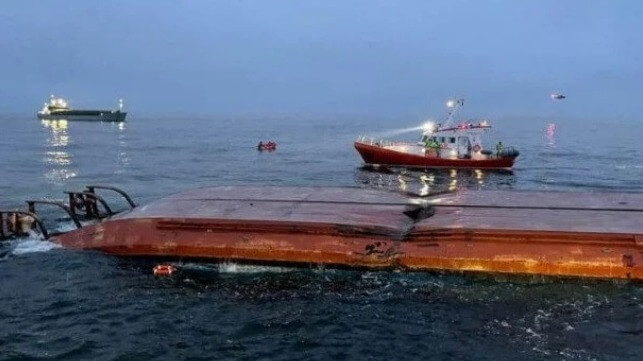
Capsized Danish barge with the Scot Carrier in the background (photo courtesy of Sjöräddningssällskapet)

Published Feb 17, 2025 2:07 PM by The Maritime Executive


The Southampton Crown Court, UK, on Friday, February 14, sentenced the master of a North Sea cargo ship and the company operating the vessel for their involvement in causing a fatal accident in 2021. The master, who was reported to have been on his first voyage in command, pleaded guilty to failing to operate the vessel following the safety management plan while the shipping company was found guilty in a four-week trial for failing to operate its ships safely.

The trial stemmed from the December 13, 2021, incident when the Scot Carrier, a 4,700 dwt general cargo ship, collided with a small, self-propeller Danish barge the Karin Høj. They were sailing in the busy shipping lane between Denmark and Sweden and the small barge capsized killing the two crewmembers aboard.

Swedish authorities immediately said they suspected drunkenness and detained the Scot Carrier after the vessel initially left the scene of the collision. The ship’s second officer who was navigating the vessel was extradited to Denmark for trial. The British officer, Mark Wilkinson, pleaded guilty to charges of negligent manslaughter for his role as helmsman. He was sentenced in 2022 to spend 18 months in a Danish prison.

“This was an accident waiting to happen,” said Southampton Crown Court Judge Peter Henry during Friday’s sentencing. He criticized the “laissez-faire attitude” toward safety aboard the ship and the operator’s culture which included regularly not maintaining lookouts despite requirements. 

Wilkinson was alone on the bridge of the vessel at 0325 when the collision occurred. The UK’s Marine Accident Investigation Branch (MAIB) had previously detailed that the second officer was distracted and that the warning alarms on the navigation systems were turned off. He was said to have been chatting with a woman over the internet and made what became the fatal course correction without checking his surroundings.

In the new trial, additional details came out. The master Sam Farrow, age 33 of London, confirmed that he suspected the first officer was intoxicated and had relieved him of his watch that night. According to the reports, Farrow was also distracted making a phone call to his mother when he handed over the watch to Wilkinson. The court was told basic safety requirements were being routinely ignored, but they believed that he was aware the Wilkinson had also consumed alcohol before coming on watch. Wilkinson in his trial said he did not believe he was intoxicated.

According to the court, Farrow did not take safety action despite being aware that Wilkinson was failing in his duties as officer-of-the watch and permitting consumption of alcohol on the ship. Farrow pleaded guilty and was sentenced to eight months in jail, suspended for 12 months, and £25,000 ($31,550) in costs. Media reports indicate he will have to carry out 200 hours of unpaid community work and pay a victim surcharge, to avoid prison time.

“The failure to provide lookouts was the undoubtedly the single biggest failure, but the failure properly to oversee and enforce bridge discipline amongst the crew introduced additional distractions from the safe operation of the vessel which aligned to create the hole in the model and led directly to the collision,” concluded Judge Henry.

Intrada Ships Management which operates Scotline was found guilty of failing to operate a ship in a safe manner. The judge sentenced the company to a £180,000 fine ($227,000) and a further £500,000 ($630,000) in costs. Media reports said Intrada spent £1 million (nearly $1.3 million) on legal fees. 

The issue of shipping companies not posting lookouts at night has been highlighted by the authorities regarding several incidents. In October 2023, another Scotline vessel managed by Intrada Ships Management, Scot Explorer, was involved in a collision off the Danish coast. The vessel hit an LPG carrier which was drifting while undertaking engine repairs. MAIB reported the master of the Scot Explorer was also alone on the bridge and distracted while the ship was on autopilot. Intrada was again cited for not maintaining proper watches with a lookout and committed to enhancing its safety protocols and training.


Shipping Companies and NGOs Warn of Harmful Consequences of Biofuels

palm oil harvesting
T&E argues shipping will overwhelm the palm and soy markets with demands for biofuels

Published Feb 17, 2025 7:15 PM by The Maritime Executive


The battle lines are being drawn for the next round of alternative fuel debate and the steps that will contribute to the IMO’s emission reduction goals. A group of NGOs, including the well-known T & E (European Federation for Transport and Environment), joined with major shipping lines including Hapag-Lloyd calling for the IMO to exclude biofuels from its list of green alternatives to traditional fossil fuels. They argue it would be unsustainable and could produce more harm than good.

A study commissioned by T&E and conducted by Cerulogy reports that nearly a third of global shipping could run on biofuel in 2030 up from less than 1 percent today. They point out that while well intention in its original concept to reuse waste oil, the price advantage of biofuels could result in unsustainable demand.

The report concludes that waste biofuels will likely be able to cover just a small portion of shipping’s projected biofuel demand as their availability is limited. They highlight that major carriers including MSC Mediterranean Shipping Company and CMA CGM have invested in the use of biofuels derived from used cooking oil and animal fats. However, with the supplies limited, they conclude that just 2.5 to 3 percent of shipping could run out of used cooking oil and animal fat biofuels by 2030.

The vast majority (60 percent) of biofuels they argue will have to come from palm and soy. This they theorize would put pressure on vegetable oil prices. They point to a doubling of the use of palm oil biofuels in the EU between 2010 and 2020 following the introduction of a law promoting biofuels in cars.

Countries such as France, Norway, and the Netherlands, T&E notes, have already restricted or stopped using palm and soy biofuels domestically, while the EU itself has excluded the use of food crops from its flagship shipping fuels regulation (FuelEU). There was a large debate on the competition for food supplies if the oils were also to be used as biofuels.

“As things stand the IMO risks doing more harm than good. Palm and soy biofuels are devastating for the climate and they take up vast amounts of land,” argues Constance Dijkstra, shipping manager at T&E. “Instead of creating new problems, the global shipping community must focus on green fuels made from hydrogen. Burning crops is never the answer.”

The report speculates that the fuel-intensive shipping industry would need vast amounts of farmland, possibly 34 million hectares in 2030 - the total area of Germany - to produce enough crops to meet the increased biofuel demand from the shipping industry. T&E argues this could have serious impacts on food supplies. Land that could be used for farming would need to be converted to growing biofuel crops while burning vegetable oil in ships will deprive supermarkets of a staple food item.

This poses a serious climate problem, warns T&E, as palm and soy are responsible for two to three times more carbon emissions than even the dirtiest shipping fuels today, once deforestation and land clearance are taken into account.

The release of the report coincides with the start of the Intersessional Working Group on Reduction of GHG Emissions from Ships (ISWG-GHG) in advance of the upcoming IMO Marine Environment Protection Committee (MEPC) meeting in April. The April session is a key step in designating the tactics the IMO will take to meet its goals for cutting shipping emissions. 


AURELIA Partners with The Ocean Cleanup to Explore Sustainable Propulsion

Ocean Cleanup

Published Feb 18, 2025 2:12 PM by The Maritime Executive


[By: AURELIA]

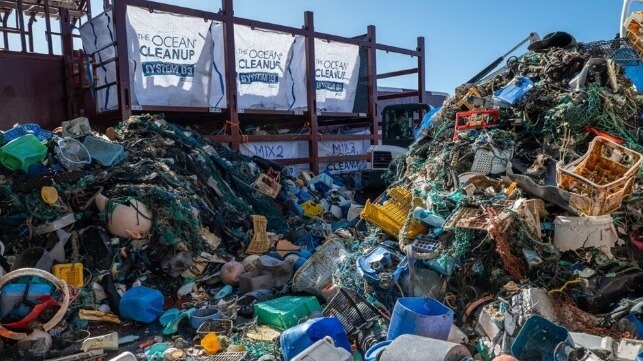
AURELIA, a leader in sustainable maritime solutions, is proud to announce its collaboration with The Ocean Cleanup to conduct a feasibility study for innovative propulsion systems. This partnership aims to explore and develop technologies that will support The Ocean Cleanup’s mission to remove plastic pollution from the Great Pacific Garbage Patch (GPGP) while leveraging the latest in sustainable maritime propulsion technologies.

 Raffaele Frontera, CEO of AURELIA, expressed his enthusiasm for the partnership: “At AURELIA, we believe in the power of collaboration to solve the world’s most pressing challenges. Working alongside The Ocean Cleanup is an incredible opportunity to contribute with our expertise in sustainable ship design to a mission that aligns so closely with our values. Together, we aim to redefine what’s possible for clean and efficient maritime operations.”

 The feasibility study will focus on identifying and analyzing propulsion systems that align with The Ocean Cleanup’s operational needs while adhering to the highest standards of environmental sustainability. The ultimate goal is to provide solutions that optimize performance and reduce the carbon footprint of vessels involved in this vital mission.

Mathijs Campman, Head of Offshore Project at The Ocean Cleanup, added: “In order for us to achieve our mission, we are now seeking support from AURELIA to secure new vessels for our extraction operations in the GPGP, which will enable us to utilise greater deck space and achieve higher fuel efficiency.’’

 “As part of the process, we are currently carrying out a feasibility study with AURELIA, a leader in sustainable maritime solutions, to develop technologies to support our ambitious plans.” 
 

The products and services herein described in this press release are not endorsed by The Maritime Executive.