It’s possible that I shall make an ass of myself. But in that case one can always get out of it with a little dialectic. I have, of course, so worded my proposition as to be right either way (K.Marx, Letter to F.Engels on the Indian Mutiny)
Wednesday, February 19, 2025
Indigenous leader in Peru says illegal miners use children as ‘human shields’ in the Amazon
The leader of an indigenous community in Peru asked for the government to declare a state of emergency on Monday and accused illegal miners of using children as “human shields” in the Amazon.
He will ask the Peruvian government to declare a state of emergency in the area to allow the eviction of illegal miners.
“They are using children between 5 and 10 years old as human shields when there is any action against illegal miners,” Teófilo Kukush, president of the Wampís community located in Amazonian regions on the border with Ecuador, told local radio station RPP.
Kukush said that the miners are “incentivizing” some local residents with payments and when authorities try to conduct armed raids, miners place children in front of the dredges they use to extract the gold from the river.
Government officials were not immediately available to comment on the complaint. There have been several clashes and attacks on established mines that have left at least thirty people dead in the past two years.
Last July, an indigenous land rights activist was found dead and indigenous leaders said dozens of community heads have been murdered due to conflicts with miners, loggers and drug traffickers.
According to the local financial regulator, the Superintendency of Banking, Insurance and Private Pensions, between January and October of last year, customs reported $1.096 billion in operations linked to illegal mining.
Peru produced 108 million grams of fine gold in 2024, 6.9% more than the previous year, with almost half supplied by small-scale miners, according to official data.
The government has 85,000 registered artisanal miners, most of them from poor and remote areas, but only 20% of these miners have formal permits according to government data.
The rest operate with suspended permits in areas belonging to formal companies, or illegally.
(By Marco Aquino and Alexander Villegas; Editing by Aurora Ellis)
Column: Green steel needs incentives to work and Japan has a plan
Decarbonizing steel production is one of the major challenges of the energy transition, especially given that consumers across the world show little appetite or capacity to pay more for green steel products.
This means that greening a sector responsible for around 8% of global carbon emissions is likely to rely on government policies and regulations to create price signals.
The debate is really over what policies are likely to produce the best and quickest results, with options ranging from subsidizing green steel plants, or products made with green steel, to instituting carbon taxes that encourage producers to change how they make steel.
Japan, the world’s third-largest steel and vehicle producer, has recently announced new policies that may provide an incentive to both consumers, manufacturers and steelmakers.
The Ministry of Economy, Trade and Industry (METI) has introduced a subsidy of 50,000 yen ($330) for clean energy vehicles (CEVs) built with low-emission steel.
This adds to consumer subsidies introduced last year of up to 850,000 yen for the purchase of an electric vehicle and up to 550,000 yen for a plug-in hybrid electric vehicle.
Under the plan, METI will evaluate submissions by automakers on their low-emission steel procurement and allocate subsidies based on the percentage of green steel being used, according to Matt Pollard, an analyst at clean energy consultancy Climate Energy Finance.
“In the broader context, it is important for METI to publicly release the carbon accounting methodologies, green product definitions and emission thresholds it will use to determine products and producers that will benefit from the models approved under the new subsidy scheme,” Pollard said.
Put simply, how all this works is likely to determine whether it is actually successful.
Japan’s steel sector produces about 85 million metric tons a year, the majority from coal-based blast furnaces, making it more polluting than the US, EU and China steel sectors, which all have more electric arc furnace capacity.
It’s possible that Japan’s steel sector will now have incentives to switch, but what technologies and processes will be key. Green options
Using hydrogen to turn iron ore that’s been upgraded into either direct reduced iron (DRI) or hot briquetted iron (HBI) is one method that’s been proposed, but the problem for Japan is that it doesn’t have the capacity to produce green hydrogen at scale, given the lack of renewable electricity generation.
Importing hydrogen is also unlikely given the challenges in liquefying and shipping what is a volatile substance.
Increasing the use of electric arc furnaces is also a possibility, but this needs high-grade iron ore, or DRI or HBI, to work.
Electric arc furnaces also need to be powered by renewables or nuclear to be considered green, and Japan’s current electricity generation is still mainly powered by coal and liquefied natural gas.
The trick to getting the subsidies to work is to make it possible to produce green steel at a price that is at least equal to, but preferably lower, than the level of the subsidy.
If Japan is providing $330 for an electric vehicle made with low-emission steel, can steel makers make a profit?
Research from clean energy think tank Transition Asia said the premium for producing steel with green hydrogen and DRI in China is about $225 a ton, which gives a cost per vehicle of about $203 assuming the typical passenger car uses 0.9 ton of steel.
Transition Asia data suggested a slightly higher cost than China for green steel in Japan and South Korea, but actually lower than in the European Union.
The costs will vary from country to country, but the research does suggest that even a modest subsidy can provide sufficient incentive for steel producers to make green steel, car makers to switch to using it and consumers to embrace buying the finished product.
(The views expressed here are those of the author, Clyde Russell, a columnist for Reuters.)
(Editing by Sonali Paul)
IRONY
Wind Turbine Installation Vessel
Photos: First U.S.-Built WTIV Completes First Trials
TRUMP HAS CANCELLED ALL WIND TURBINE PROJECTS
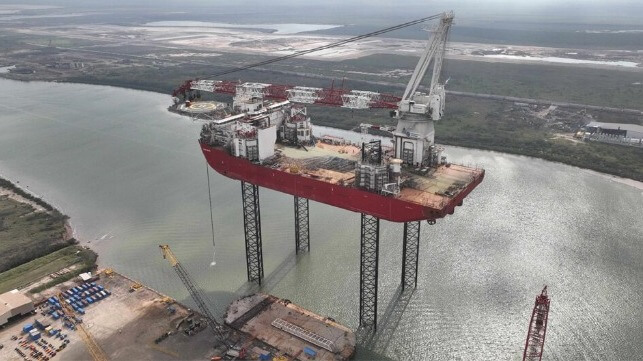
Charybdis standing tall during jacking trial in Texas (Seatrium)
The first wind turbine installation vessel, Charybdis for Dominion Energy, is nearly complete reports shipbuilder Seatrium. The company’s AmFELS shipyard in Brownsville, Texas released the first photos of the vessel as it undergoes trials.
“Charybdis is 96 percent completed and complies with U.S. Jones Act regulations, allowing it to operate seamlessly in U.S. waters for domestic offshore wind projects,” writes Seastrium. “One of the largest WTIVs of its kind globally, the Charybdis is designed to handle current and next-generation wind turbines up to 12 megawatts or larger.”
Dominion Energy had reported recently that the vessel was undergoing its trials as it moves toward commissioning. Seatrium reports that it recently completed jacking trial and main crane load testing. The vessel’s sea trials have also begun.
With a length of 472 feet, width of 184 feet, and depth of 38 feet, it is equipped with a 426-foot crane capable of lifting up to 2,200 tonnes. It will accommodate up to 119 people.
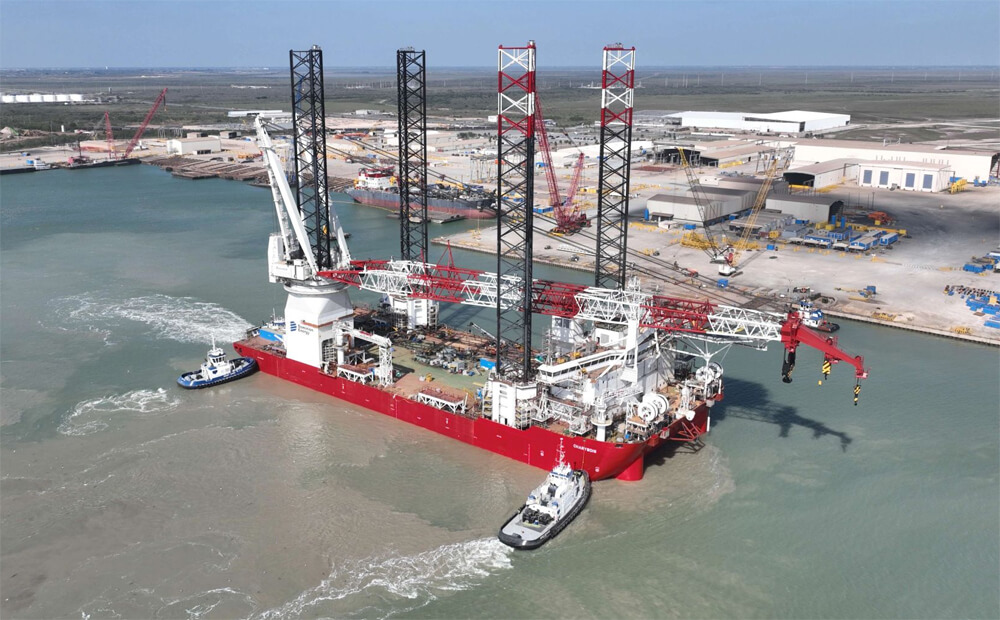
Charybdis is reportedly 96 percent complete and on schedule to deploy later in 2025 at Dominion's Virginia offshore wind farm (Seatrium)
Work began in December 2020 on the ship and it was launched in April 2024. It was originally reported that the target for delivery was late 2023, but it has fallen back with the companies now saying it remains on schedule for delivery in 2025. Later this year it is expected to begin work at Dominion Energy’s Coastal Virginia Offshore Wind project where it will continue to work through the completion of the wind farm expected by the end of 2026.
As the first of its kind in the U.S. and with domestic shipbuilding to meet the requirements of the Jones Act, the cost of the vessel has skyrocketed. Original estimates placed the cost at between $500 and $500 million but the company later adjusted it to an estimate of $625 million. In August 2024, the company told investors the latest estimated costs, including financing, was $715 million.
Despite the cost increases for the vessel and the project, Dominion Energy continues to espouse the value of offshore wind and the construction it will make to operations. The company says the overall project for the offshore work remains on budget, although it recently increased costs related to the transmission lines. It said the installation was past the 50 percent mark offshore and on schedule.
Other than a few currently permitted projects, the U.S. offshore wind energy market is expected to stall during the Trump second term. The vessel as the first U.S. vessel will be well-positioned for domestic installation projects and it is likely to enter the international market where large install vessels also remain in short supply.
WWIII
Video: Chinese Navy Helicopter Flies Within Feet of Philippine Aircraft
The Philippine Coast Guard has released a video of a new run-in with Chinese forces at Scarborough Shoal, a Chinese-occupied flash point within the Philippine exclusive economic zone. This time, a Chinese helicopter flew to within 10 feet of a Philippine patrol plane, endangering both aircraft.
At about 0700 hours Tuesday morning, the Philippine fisheries bureau (BFAR) conducted a patrol over Scarborough Shoal, with journalists and PCG officers on board. BFAR routinely patrols the area to document Chinese interference with Philippine fishing interests, and to monitor changes in the Chinese presence at the reef.
At about 0840 hours, a People's Liberation Army - Navy (PLA Navy) helicopter "performed dangerous flight maneuvers towards the BFAR aircraft," according to the PCG. The plane's pilots estimated that the helicopter came to within about 10 feet of the port side of the aircraft, above the wing.
Philippine and Chinese forces frequently clash at Scarborough Shoal and at other contested features in the western Philippine EEZ. China claims the area as its own under its historically-based "nine-dash line" policy; the Permanent Court of Arbitration in the Hague has ruled that these claims are invalid under international law, and that the Philippines is entitled to the standard 200-nautical-mile EEZ, as measured by distance from Philippine shores. China has dismissed the ruling and has pressed its claim through the use of force, deploying the China Coast Guard to interfere with Philippine navigation and fishing interests in the area.
Last week, the China Coast Guard sent a patrol to within 35 nautical miles of Palawan, outside of Philippine territorial seas but much closer to the nation's home islands than normal. An unusual three-ship CCG task force made the voyage. "Usually, they [the China Coast Guard] go sort of one or maybe two at a time, so taking three ships is sending a particular message of strength," maritime security analyst Ray Powell told GMA.
CMA CGM and MSC Beat a Path to India Following in Maersk’s Footsteps
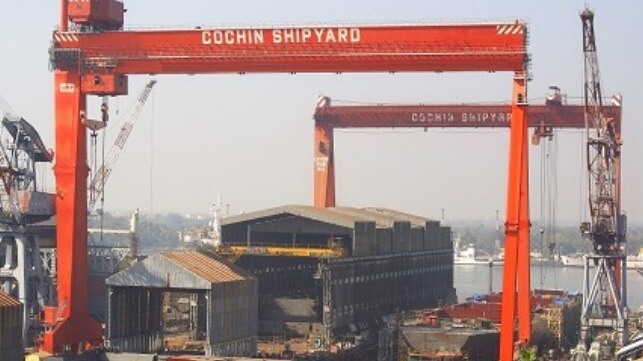
Cochin Shipyard has the largest facilities to offer but other yards are also likely to seek work from western owners (Cochin)
India’s efforts to become a world class shipbuilder are taking additional steps forward with media reports that executives from both MSC Mediterranean Shipping Company and CMA CGM Group are holding talks with the industry. It follows the news yesterday, February 17, that Maersk has entered into an agreement with Cochin Shipyard first for repairs of smaller vessels of the fleet and targeting shipbuilding.
Indian Prime Minister Narendra Modi last month spoke of the value of the planned investments into the sector and expected boosts to the economy. He has called for a mega cluster to focus on shipbuilding to take the country to a top 10 shipbuilding by the end of the decade and a top 5 by 2047. Modi said the business could be worth $62 billion by 2047.
The new budget for the country includes a Maritime Development Fund to provide financial assistance and level the costs for India’s shipbuilders to make the industry more competitive. They also provided a concept to leverage India’s well-established ship recycling operations primarily at Alang to attract newbuild business. The budget calls for a credit for shipowners that recycle vessels in India that would be applied to the cost of newbuilds at the Indian shipyards. A 10-year extension till 2025 was also provided on the duty charged on raw materials, components, and parts used in the manufacture of ships.
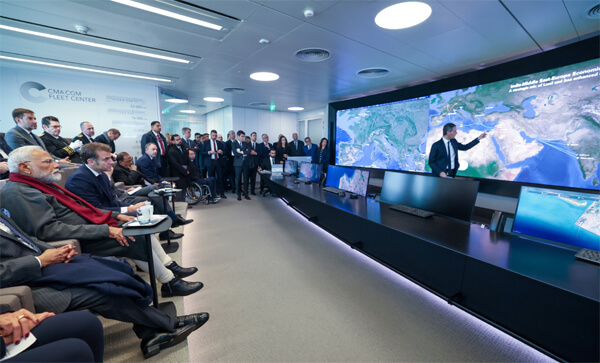
Modi and Macron received a presentation from Saadé at CMA CGM's Fleet Center (PM Modi)
During his visit to Europe, Modi met with French President Emmanuel Macron at the CMA CGM Group headquarters in Marseille. He also discussed issues with group Chairman and CEO Rodolphe Saadé. CMA CGM highlighted its 34 years of operations in India and Saadé made a presentation and provided a tour of the group’s fleet center.
India media is reporting that Saadé told Modi that CMA CGM was committed to sending a “study team” to look at the shipbuilding capabilities and repair opportunities. They also reportedly agreed to explore registering some ships in India.
The Indian media outlet ET Infra is reporting Christine Cabau Woehrel, Executive Vice-President for Assets and Operations, CMA CGM Group, will visit India this week to explore potential opportunities for shipbuilding and repairs in the country. It is also quoting sources that CMA CGM will sign a similar memorandum of understanding to the one Maersk announced yesterday. CMA CGM and Cochin will according to the report announce plans for ship repairs and newbuilding following Maersk’s lead.
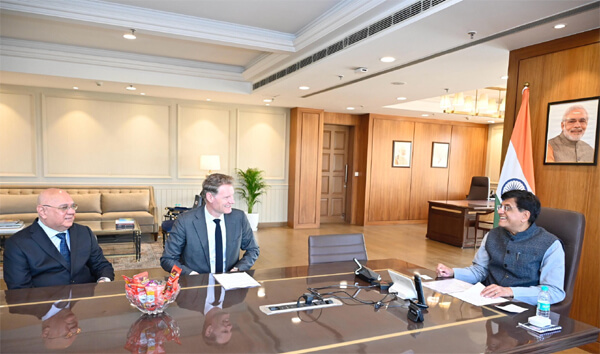
Toft meeting with India's Minister of Commerce and Industry (Piyush Goyal on X)
India’s Minister of Commerce and Industry, Piyush Goyal, posted messages on X this week showing a meeting with Soren Toft, Chief Executive of MSC Mediterranean Shipping Company. He wrote that they had a productive meeting discussing the vast growth potential in India’s shipping and logistics sector, focusing on investments in inland container terminals, shipbuilding, maintenance, and container manufacturing. He said the talks centered around “deep-sea vessel partnerships and policy reforms to enhance the nation’s global maritime competitiveness while fostering growth, innovation and self-reliance in the sector.”
The state-owned Cochin Shipyard is seen as the first beneficiary of the new interest because it is the only yard with a 300-meter dry dock according to ET Infra. However, it notes that Swan Defense and Heavy Industries is also expected to meet with CMA CGM. Another yard, L&T Shipbuilding (Larsen & Toubro) also broke into the international market in the past few years, first winning maintenance contracts for U.S. Navy support ships and recently from the UK Royal Fleet Auxiliary.
Indian shipbuilders have built smaller, specialized ships for Europeans. Maersk is set to start the next level with its agreement which calls for wet dock repairs for ships up to 7,000 TEU and dry dock for ships up to 4,000 TEU. Maersk said plans were underway for the first project to start in 2025.
Maersk Plans Repairs at India’s Cochin Shipyard Supporting Government Goals
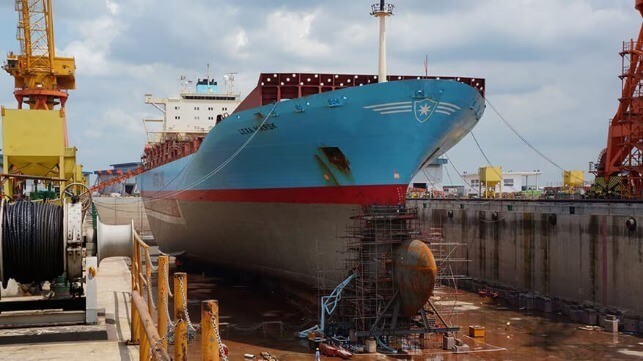
Maersk will send its first ship to India for repairs and overhaul in 2025 (Maersk)
Maersk and India’s Cochin Shipyard have entered into a memorandum of understanding to explore ship repair, maintenance, and shipbuilding in India. The Danish company becomes the first major carrier to plan regular maintenance activities in India which will be in support of the government’s goals to develop shipbuilding into one of India’s leading industries.
“The first Maersk vessel repair at Cochin, planned already for 2025, will mark the beginning of what we envisage as a long-term collaborative relationship,” said Leonardo Sonzio, Head of Fleet Management & Technology for A.P. Moller – Maersk. The collaboration the companies reported will initially focus on vessels up to 7,000 TEU for afloat repairs and up to 4,000 TEU for dry-docking, with capabilities expected to expand over time.
Cochin Shipyard, which was incorporated in 1972 as a fully owned Government of India company, is India’s largest shipbuilder both for the navy and private projects. Last year, the company invested more than $100 million to open a new ship repair facility encompassing more than 42 acres in Cochin Port. Media reports indicate that the company is currently repairing four to five ships at a time in the yard while it also has orders for 65 newbuilds.
Located on the southwest coast of India, the yard is close to major shipping lanes and can offer advantages in technology and low-cost labor. The agreement with Maersk will explore ship repair, dry docking, and new building opportunities as well as sharing technical expertise. The companies plan to work together on joint training programs and skill development.
India is reported to have 32 shipyards but a report cited inadequate policy support, limited private investment, and inefficiencies in the operations which are holding back the growth of the industry. The government however in 2024 outlined an aggressive plan to expand the shipbuilding industry.
The Ministry of Ports, Shipping and Waterways (MoPSW) is developing a new shipbuilding support program that will incentivize Indian shipyards to grow. Detailing the plan the ministry said the aim is to propel India into the top ranks of global shipbuilding nations, targeting a position among the top 10 by 2030 and the top five by 2047, from its current 22nd place. The government projected that the business could be worth $62 billion by 2047. It would also drive growth in related industries which would add $37 billion to the economy and create around 12 million jobs.
Media reports in India and South Korea noted recent activities designed to support the shipbuilding industry. The Indian government organized and led a delegation to meet with Korea’s shipbuilders. In a reciprocal visit, Hanwha Ocean is reported to have toured the shipbuilders including Swan Engineering, Cochin Shipyard, Hindustan Shipyard, and L&T Shipyard. Media reports in South Korea indicate that Hanwha Ocean is exploring an agreement with India’s shipbuilders.
Korean shipbuilders are currently handicapped by a lack of capacity with all the building slots booked years in advance. The industry is also focused on rising costs and competition from Chinese shipyards.
The U.S. Navy and the UK’s Royal Navy have also sought to build relationships with the Indian shipbuilders as part of a complex series of political moves to strengthen ties with India. The U.S. Navy sent an MSC vessel for the first time in 2022 for an overhaul at an Indian shipyard and now three of India’s yards are approved to bid for projects. The Royal Navy also started in 2024 sending auxiliary ships to Indian shipyards.
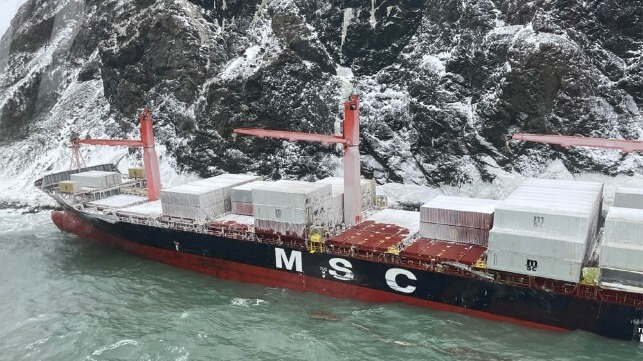
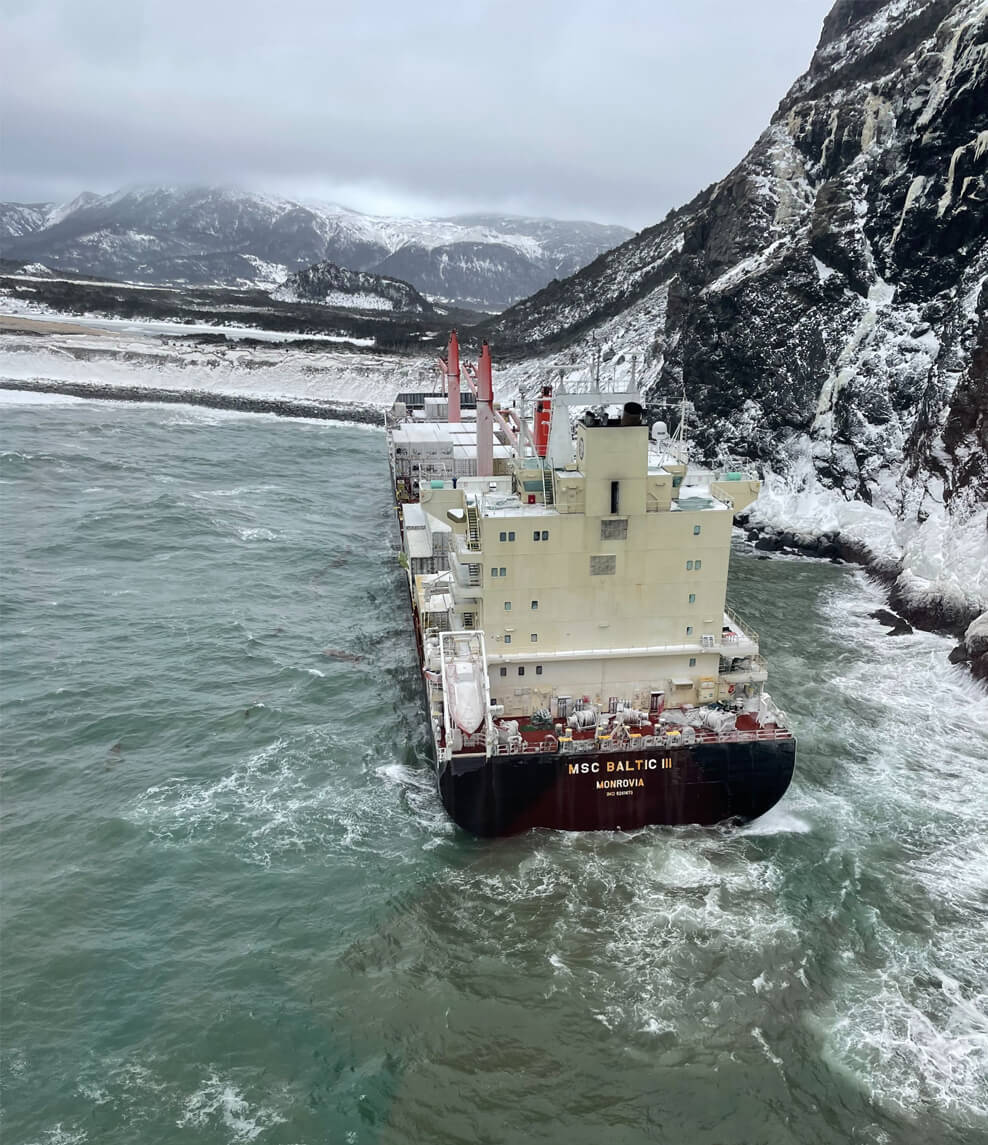
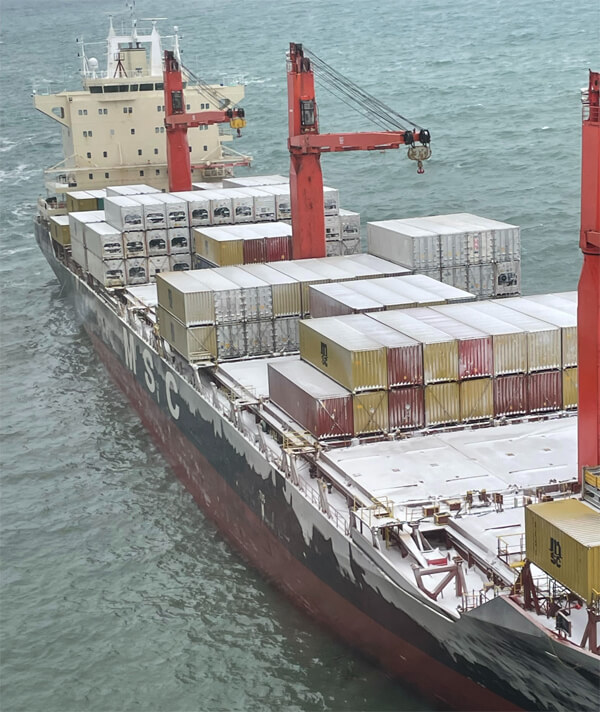
The Canadian Coast Guard reports that resources are being marshaled while teams were beginning surveys of the MSC Baltic III (53,000 dwt) after the ship was driven aground in a strong winter storm on Saturday. Efforts are coordinating with the owners of the vessel and a hired salvage contractor to survey the ship after the crew was rescued.
The MSC Baltic III blacked out and did not have time and distance to use its anchor to prevent the ship from going around on Saturday morning, February 15. Rescue teams said the efforts on Saturday were hampered by a snowstorm and blizzard-like conditions. Royal Canadian Air Force Captain Matthew Cox who was one of the pilots of the rescue helicopter told CBC it was among the “trickiest maneuvering” of his career. He called it “one of the most challenging things I’ve done as a pilot.”
Cox and the team were able to hoist 20 crewmembers from the grounded cargo ship during the storm. He told CBC that four of the crewmembers were in need of medical assistance but were stable when they got them ashore.
The Canadian Coast Guard set up a two-nautical mile emergency zone around the vessel and reports they are establishing a staging area in Lark Harbor, Newfoundland, on the west shore near where the vessel went aground. The CCGS Henry Larsen, which stood by during the rescue, is remaining in Corner Brook to facilitate operations. The CCGS Jean Goodwill loaded equipment in Canso, Nova Scotia, and is now in Charlottetown, Price Edward Island on her way to the scene. A third vessel, CCGS Ann Harvey, was on SAR patrol in the area as well.
An MSC containership, MSC Carmen was also showing from its AIS signal that it had approached the area of the grounding. MSC has not commented on the incident but the Canadian Coast Guard reports it has been cooperating and responsive. The hired salvage team was expected to access the area today.
The vessel is rated with a capacity of 2,478 TEU but claims consultant Dolphin Maritime & Aviation Services is reporting that there are approximately 400 boxes aboard currently. The Coast Guard was monitoring for environmental hazards but says so far there have been no signs of damage.
Weather conditions in the area however were hampering efforts. There continued to be a wind warning for the region with speeds of up to 75 mph possible (120 km/h). The winds appeared to have calmed by later Monday, but the air temperature remains below freezing, and there are continuing snow showers. The weather was predicted to moderate midweek.
Teams were reported to be evaluating the best approach to refloat the vessel and minimize dangers.
Grimaldi Conro Drifting in the English Channel After Fire is Extinguished
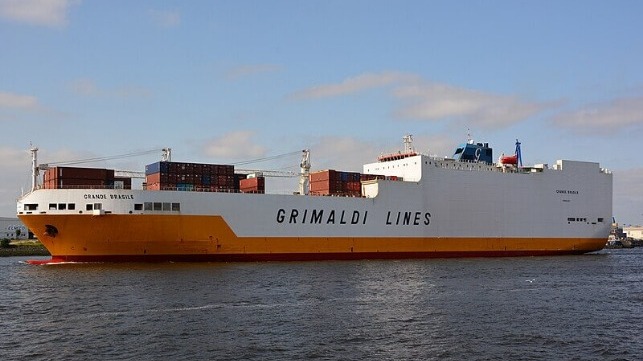
Grimaldi's Conro is reported drifting in the English Channel after the fire was suppressed (Huhu Uet photo - CC BY-SA 3.0)
Rescue teams from France, the Netherlands, and the UK cooperated to respond to a distress call this morning, February 18, from a Grimaldi vessel southbound in the English Channel. The vessel is still reporting that it is drifting while a tug and other resources are standing by after a fire was extinguished.
The Grande Brasile (26,000 dwt) issued a distress at 0935 the UK’s Maritime and Coastguard Agency reports. The vessel told the authorities that there was a fire aboard, and it was later reporting no propulsion or steering capabilities.
Built in 2000, the Malta-registered ship is a Conro, a unique combination of containership and RoRo, favored by Grimaldi. The Italian shipping firm is one of the few that continues to operate this type of vessel and the company recently built more ships of this style in China.
The UK MCA called the RNLI asking for lifeboats to be deployed. The stations in Dover and Ramsgate each launched and reached the Grande Brasile which was reported to be approximately 15 nautical miles from Ramsgate, England. The vessel was southbound in the Dover Strait traveling from Antwerp, Belgium to Le Havre, France when the fire occurred.
By the time the lifeboats reached the vessel, the ship reported its crew of 28 was all accounted for and there were no injuries. They reported the fire had been contained to one deck and the onboard fire suppression system had been used.
The lifeboat crews reported they did not have to board the vessel and were later given permission to stand down returning to station. The Dutch Coast Guard also dispatched one of its surveillance aircraft to monitor the situation.
The French rescue vessel Abeille Normandie is reported to be standing by the disabled cargo ship. The Dutch Multratug 35 has also arrived on scene.
Another Grimaldi Conro, Grande Costa d’Avorio, made headlines in July 2023 when a fire broke out while it was loading Port Newark, New Jersey. Two local firefighters were killed aboard the vessel and the fire burned for days destroying the garage section of the vessel. The U.S. Coast Guard has been leading the investigation focusing on a pusher vehicle being used to position cars being loaded on the Grimaldi vessel for causing the devastating fire. It also prompted the National Transportation Safety Board to issue an alert on the dangers of shipping used cars. The vessel was reconditioned for a return to service while a final report on the fire is still pending.
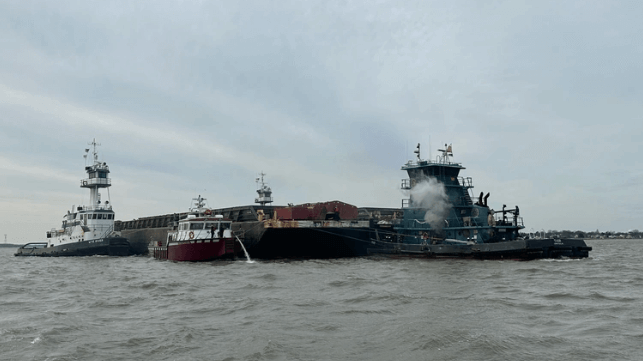
On Tuesday morning, a fire broke out aboard a tug on the Delaware River, prompting a rapid response from the Coast Guard and from good Samaritans.
At about 0930 hours, Coast Guard Sector Delaware Bay received a Channel 16 distress call from the crew of the tugboat, which was in transit with a two-barge tow.
At a position between Delaware City and Old New Castle, the vessel caught fire, and the crew asked for assistance. Initial reports indicated that the fire was in the engine room; that hatches had been secured; and that the tug had lost steering.
The crew abandoned ship, according to local media, and a good Samaritan vessel retrieved all four crewmembers safely. Boat crews from Station Philadelphia and a helicopter aircrew out of Air Station Atlantic City responded to the scene, along with assets from local partner agencies, including the Wilmington Fire Department's fireboat.
The fire has been put out, and the tug has been taken in tow, according to the Coast Guard. The cause of the blaze is under investigation.
Video: Port of Charleston Sets New Record for Largest TEU Containership
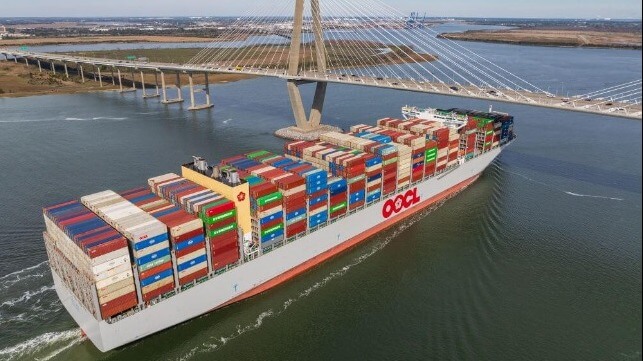
With boxes stacked nine high, OOCL Iris created images of a tight fit under Charleston's Route 17 Bridge (SC Ports - Matthew Peacock photo)
SC Ports and the Port of Charleston, South Carolina set a new record on Tuesday, February 18, receiving their largest capacity containership to date. The new OOCL Iris (16,868 TEU) while a smaller vessel by dimensions, surpassed the capacity record set four years ago highlighting the benefits of investments the state is making in its ports and advancements in container shipping.
The OOCL Iris was recently delivered as the second of a class of 10 new NeoPanamax containerships Orient Overseas Container Liner (OOCL) is putting into service. The ship was named on December 3, 2024, at the Nantong COSCO KHI Ship Engineering Co. (NACKS) as the first of the class completed by this yard and the second overall as Dalian COSCO KHI Ship Engineering Co. (DACKS) is also building half the class.
OOCL highlights it is their first new NeoPanamax class in more than a decade with the prior vessels entering service in 2013 and 2014. Starting in 2023, the company also added a class of ultra-large container vessels, the industry’s first 24,000 TEU ships.
Representing the next generation of NeoPanamax containerships, OOCL Iris, along with NACKS-built sisters OOCL Bauhinia and OOCL Sunflower, not only comply with the latest environmental regulatory requirements, but also set new benchmarks in areas such as environmental design, energy efficiency, digital intelligence, safety, and onboard comfort by incorporating the latest technological innovations and intelligent solutions. These vessels feature an advanced energy efficiency system that provides recommendations for speed optimization and trim adjustments. The system monitors real-time fuel consumption and power usage of the main engine, generator, and boiler, offering valuable optimization suggestions. Additionally, the OOCL Iris has received three "Smart Ship" notations, as well as the Enviro-friendly notation (ENVIRO) and Sustainable notation (SUSTAIN-1) from the American Bureau of Shipping (ABS).
For Charleston, it means the vessel which is 1,204 feet in length (367 meters) has a rated carry capacity of 16,868 TEU surpassing the CMA CGM Marco Polo which at 16,020 set the previous record in May 2021. The CMA CGM vessel was the largest containership in the world when it was introduced in 2013 with an overall length of 1,299 feet (396 meters). Advancements in loading and stacking permit the new OOCL vessels to carry five percent more boxes (TEU) on a smaller-dimension vessel.
The height of the new vessel made for some interesting images as it passed under Charleston’s Arthur Ravenel Jr. roadway bridge (Route 17). The bridge is listed with a clearance of 186 feet (57 meters).
The ship proceeded to Charleston’s Wando Welch Terminal as the last stop on its U.S. rotation. The port emphasizes its capital investments meaning a ship of this size has any time access regardless of tides. The berth now has a 54-foot depth and a 52-foot channel. The OOCL Iris has a design draft of 47.6 feet (14.5 meters).
“SC Ports’ strategic infrastructure investments allow us to continue welcoming the largest ships calling the U.S. East Coast,” said SC Ports President and CEO Barbara Melvin. “Charleston’s harbor depth and widened turning basins, taller ship-to-shore cranes and highly productive terminals and maritime community all work together to provide fluidity to our customers’ supply chains.”
SC Ports highlights an investment of nearly $3 billion to modernize port infrastructure, expand cargo capacity, and build rail infrastructure. Last year, it reached an agreement with its unions after a standoff that had delayed the use of its expanded terminals.
The OOCL Iris and her soon-to-be-introduced sister OOCL Sunflower will be taking advantage of the NeoPanamax sizing on a route from China and Far East ports to New York, Savannah, and Charleston. The first ship of the class, OOCL Bauhinia is on a different Pacific route calling at Long Beach, California in the U.S.
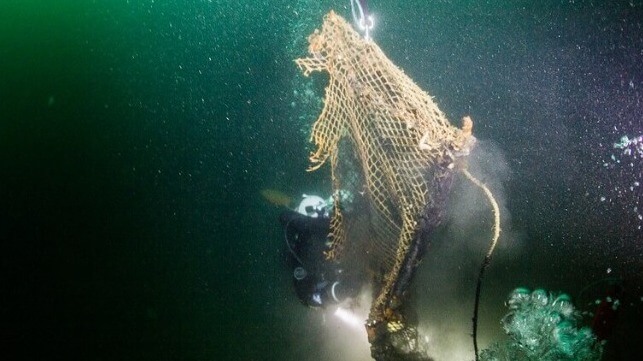
A German NGO has come up with an AI-assisted tool for finding ghost nets - the drifting, abandoned fishing gear that hoovers up sea life indiscriminately.
About 50,000 tonnes of fishing gear end up in the ocean every year, accounting for nearly a third of all ocean plastic waste. The gear gradually decomposes into microplastic, which enters the marine food chain with unknown consequences for the ecosystem (and for consumers of seafood).
But long before they break down, abandoned nets ensnare turtles, fish, sharks and other creatures, reducing the health of marine fisheries and taking a toll on threatened species. To fight this long-term threat, WWF Germany has worked with Accenture and Microsoft AI to put together an AI-driven ghost net identification platform.
The process starts with sonar data, obtained by organizations of all kinds (oceanographic research groups, offshore energy companies, and government sources) and donated to the projcet. When this data is uploaded into the cloud-based AI identification platform - GhostNetZero - the system automatically scans the sonar data for the telltale signs of drifting ghost nets. Previously, the only way to do this was to search the data manually - a time-consuming process, if proven to work. WWF Germany has used manual sonar searches for its cleanup work in the past, and has removed more than 20 tonnes of abandoned nets from the bottom of the Baltic.
But to maximize the platform's impact, WWF Germany says that it is looking for new participants from industry. Any group with high resolution sonar data to share can help out. In return, partners get the right to use the group's partnership logo.
"The combination of sonar search and AI-supported detection enables a quantum leap: the seabed is mapped all over the world and there is a huge amount of data. If we can specifically check existing image data from heavily fished marine zones, this is a real game-changer," WWF Germany project manager Gabriele Dederer told Oceanographic Magazine.
Unknown Saboteurs Are Targeting German Navy Warships
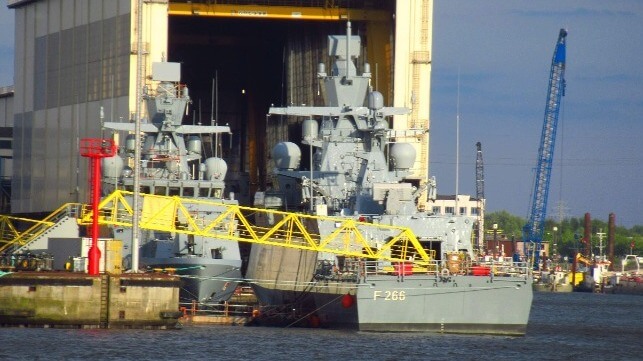
German Navy frigate Emden (F266) at Blohm+Voss, 2023 (Dkvtig / CC BY SA 4.0)
The German Navy has confirmed that unnamed saboteurs have attempted to damage more than one of its warships, and media reports from Germany suggest that at least two vessels have been affected.
In 2024, a German Navy minehunter was damaged by unknown personnel while in shipyard in Rostock. Several cable harnesses were severed, and an investigation is under way into a suspected sabotage attack, according to Spiegel. The Rostock prosecutor's office has confirmed that it is investigating the case.
Late last year, an unknown saboteur dumped dozens of kilos of metal filings into the oil sumps of the main engines aboard the brand new corvette Emden, according to multiple German media outlets. The contamination was detected and cleaned out, but if it had not been spotted, it would have quickly destroyed the engines.
Last week, German Navy Vice Adm. Jan Christian Kaack told the press that "more than one unit" had been sabotaged, without going into specifics. Troublingly, he added that German naval bases have reported a pattern of attempted security perimeter breaches, both from the shoreside and from the waterside. He added that uniformed German Navy personnel have been approached in public while en route from base to their homes.
"The growing threat from Russia is more urgent at the beginning of 2025 than it was two years ago," Kaack told reporters, without specifying whether the suspected security threats within Germany were Russian.
The suspected attacks are just part of a broader pattern of sabotage targeting Europe's security forces and its infrastructure. In early 2024, three German-Russian dual nationals were arrested on suspicion of planning an attack on the U.S. military base at Grafenwohr, a training facility for Ukrainian servicemembers. The main suspect, identified as Dieter S., stands accused of plotting an extensive series of arson and explosive attacks within Germany, with targets including rail lines and a manufacturing plant.
Some NATO security forces also suspect - but have been unable to prove - that the four back-to-back subsea cable breaks in the Baltic over the past year are an intentional act of sabotage, potentially linked to Russian intelligence.