Wednesday, February 19, 2025

The Economics of Solar Power

By Haley Zaremba - Feb 18, 2025

The Ivanpah solar plant, a large-scale concentrated solar power project, is set to close due to the cost-effectiveness of photovoltaic solar panels.

The plant's closure has ignited a political debate about government spending on renewable energy and the environmental impact of such projects.

Despite its closure, Ivanpah contributed to the research and development process that has led to significant advancements in solar power technology.


When the massive Ivanpah solar plant was finished in the Mojave Desert in 2014, it was touted as the future of solar power and a cutting edge approach to clean energy. The plant was the world’s largest solar thermal plant when it was built, spreading over 5 miles of federal land. It cost about $2.2 billion and received loan guarantees worth $1.6 billion from the U.S. Department of Energy. Now, barely over ten years later, it’s already closing.

Called ‘concentrated solar’ or ‘thermal solar,’ the technology used at Ivanpah involves hundreds of thousands of computer-controlled mirrors reflecting the sun’s rays at three enormous towers containing boilers. The idea was that beaming concentrated amounts of solar power onto these boilers will create steam to generate totally clean and renewable energy. Together, Ivanpah’s 3 boiler towers and 900,000 mirrors generate 386 megawatts of electricity, enough to power about 140,000 homes.

When plans for the plant were greenlit in 2010, ‘concentrated’ or ‘thermal’ solar technology was just one of many approaches being piloted around the world in a race to determine the best one. In addition to thermal solar power, other piloted systems included solar panels and other forms of mirror-centric solar generation including parabolic trough collectors and linear Fresnel reflectors.

And now the race is over, and it turns out that solar panels have completely lapped every other contender. Over the years since Ivanpah began construction, photovoltaic solar panels have become so cheap that no other solar technology can even hope to compete. Between 2014 and 2021, the cost of utility-scale PV solar plummeted by over 50%.

NRG, the company that built Ivanpah and now wants to decommission it, says that "it has been surpassed by solar photovoltaics due to much lower capital and operating costs in producing clean energy.” If NRG gets the regulatory approval it is currently seeking, it will close Ivanpah early next year, and potentially ready the site for a different form of solar power production.

Depending on where you stand, this is either a success story for photovoltaics and for the solar power sector in general, or it is a gigantic financial boondoggle and waste of funds for thermal solar and the taxpayers that supported it. “For some, Ivanpah now stands as a huge, shiny monument to wasted tax dollars and environmental damage — campaign groups long criticized the plant for its impact on desert wildlife,” CNN recently reported. “For others, failures like this are a natural part of the race to find the winning solutions for the clean energy transition.”

In today’s climate in which everything is political, and everything is partisan, the story of Ivanpah is being used to support many divergent claims. For the right, it supports the worldview that the government is overspending on useless clean energy projects. For the left, it’s normal collateral damage to avoid much bigger damage from fossil-fuel induced climate change. And for some environmentalists it's the happy end of a killer machine that purportedly roasted up to 6,000 birds a year.

While Ivanpah was certainly a failure in many regards, it was part of a research and development process that has inarguably been enormously successful. Solar power has grown more than any other renewable technology, and is almost on track with the Net Zero Emissions by 2050 (NZE) Scenario. Solar panels are becoming more efficient all the time, and solar energy has proven to be a critical part of affordable and reliable energy mixes around the world.

As Thomas Edison said, “I have not failed. I've just found 10,000 ways that won't work.” Granted, Edison’s experiments were a little bit cheaper than Ivanpah. But spending on clean energy research and development is critical if the United States wants to remain competitive in global energy markets. The West is rapidly losing its upper hand in energy technologies, and a willingness to invest in daring projects is a critical part of staying at the vanguard – just ask China.

By Haley Zaremba for Oilprice.com
Majority of Brits Support Green Taxes for Carbon Reduction

By City A.M - Feb 18, 2025,

A survey shows that just over half of Brits favor taxes to encourage a reduction in households’ carbon footprint, with a waste management levy being the most popular choice.

The UK's recycling rate is significantly lower than leading EU countries like Germany, due to factors such as lack of public knowledge and inconsistent recycling services.

Concerns have been raised that a flat recycling tax could disproportionately affect poorer areas, highlighting the need for a joint effort between producers and councils to improve UK recycling.


According to new research, just over half of Brits are in favour of introducing taxes to encourage a reduction in households’ carbon footprint.

According to a survey from EPC and energy efficiency platform epIMS, the most-favoured tax of those surveyed was a waste management levy, with a quarter of respondents supportive of a tax on the failure to recycle properly.

Just 44 per cent of UK household waste was recycled in 2022, according to government statistics, with this rate going down instead of improving in England.

While eight environmental taxes exist in the UK, no taxes exist to encourage environmentally friendly behaviour in homes.

“The government has been using tax to disincentivise environmentally harmful behaviour for decades,” COO of epIMS, Craig Cooper, said. “But over this time, the damage caused by our homes has been, by and large, ignored.”

EpIMS also suggested taxes could be applied on the failure to make necessary energy-saving improvements to the home, the installation or use of wood burners and open fires, and water and energy usage.

Green discounts could be applied to households with high energy performance ratings, the company added.

Why is the UK so poor at recycling?


Germany, the best country in the EU for recycling, had a recycling rate of nearly 70 per cent in 2021.

However, it has achieved this without the need for a recycling tax: the country relies on public engagement campaigns, holding manufacturers accountable for waste and easily accessible infrastructure for recycling.

In comparison, the UK has seen its deposit return scheme for bottles delayed for years, with the eventual scheme—coming in a decade after it was announced—excluding glass.

According to Wrap’s 2024 Recycling Tracker, less than one in 10 UK citizens feels “very confident” about what can and cannot be recycled, with the majority—58 per cent—only “mostly confident. “

This lack of knowledge leads to “high levels of missed capture and contamination”, Wrap added.

3.2m tonnes of packaging was put into recycling bins last year, according to the Local Government Association (LGA).

Less than half of UK citizens report receiving recycling information from their local council in the past year, while only 41 per cent of citizens in the UK have access to and use a food waste recycling service.

There’s also the concern that a flat recycling tax would unfairly target poorer areas, with residents of wealthier areas often have greater access to recycling services. For 2018-19, a majority – 85 per cent – per cent of deprived local authorities had a household recycling rate below the overall average, according to Guardian analysis.

LGA spokesperson, councillor Adam Hug, has said that improving UK recycling should be a joint effort from producers and councils.

“It is crucial that…councils continue to lead local waste and recycling services, and that the focus is on reducing unnecessary waste in the first place,” he said.

By City AM, UK


BP Shareholders Seek Vote on Fundamental Reset of Strategy

A group of four dozen institutional investors that hold a combined 2.5% stake in BP are urging the supermajor to put to vote any fundamental reset of its strategy that could include easing its climate targets, the Financial Times reported on Wednesday, citing a letter from the 48 investors it had seen.

“BP has previously offered a shareholder vote on its transition strategy and we expect a similar level of accountability to be maintained for future material strategy changes,” the institutional investors wrote this week in a letter to BP chair Helge Lund, seen by the FT.

BP last week pledged to fundamentally reset its strategy as it booked its lowest annual and quarterly profits in years and seeks to push up its stock performance and regain investor trust.

“Building on the actions taken in the past 12 months, we now plan to fundamentally reset our strategy and drive further improvements in performance, all in service of growing cash flow and returns,” BP’s chief executive Murray Auchincloss said in a statement.

BP’s leadership will communicate its new strategy, which “will be a new direction for bp”, at a Capital Markets Update on February 26, Auchincloss added.

Analysts and investors expect even more cuts to the low-carbon business and a pledge to boost oil and gas production at the capital markets day later this month.

The pressure on BP to improve performance became more intense earlier this month after reports emerged that activist investor Elliott Management had bought a stake in BP and would be pushing for changes in strategy, or even for board reshuffles.

Elliott’s stake in BP is estimated at nearly 5% as the activist investor is reportedly pushing for major asset sales to address the undervalued shares of the UK-based supermajor.

Elliott’s stake is twice as big as the 2.5% stake of the institutional investors who seek a vote on any rollback of climate goals.

By Tsvetana Paraskova for Oilprice.com

Exxon's Gas Project In Guyana To Include Fertilizer Plant

By Alex Kimani - Feb 19, 2025


U.S. oil and gas major Exxon Mobil Corp.’s (NYSE:XOM) large-scale gas project in Guyana will also include fertilizer plants, the head of the U.S. oil major in Guyana, Alistair Routledge, said on Wednesday. Exxon recently kicked off the process of seeking environmental permits for its eighth project in Guyana, the first that will generate gas not linked to oil production. Exxon is also looking to explore another well at its massive offshore block, the head of the U.S. oil major in Guyana revealed last week. Exxon is getting ready for what promises to be a very active year for exploration and production in Guyana following upgrades that increased the capacity of two of its three floating facilities.

Last year, Netherlands-based SBM Offshore (OTCPK:SBFFF) (OTCPK:SBFFY) completed the $1.23B sale of its fifth floating production, storage, and offloading (FPSO) unit to Exxon for use in offshore Guyana. With a production capacity of 250,000 barrels of oil per day, the FPSO Jaguar has a daily associated gas treatment capacity of 540 million cubic feet and a water injection capacity of 300,000 barrels per day. According to Exxon, the project will significantly reduce the cost of electricity in Guyana. The proposed project would bring associated gas from ExxonMobil Guyana-operated projects offshore (Liza Phase 1 and 2) via pipeline to onshore gas processing facilities. The pipeline would transport up to ~50 million standard cubic feet per day of natural gas to the facilities.

In November, Exxon announced that it has reached 500M barrels of oil produced from Guyana's offshore Stabroek block, just five years after it kicked off production at the location. According to the company, the first three projects--Liza Phase 1, Liza Phase 2 and Payara--are already pumping more than 650K bbl/day. The Exxon-led consortium which includes Hess Corp. (NYSE:HES) and China's Cnooc (OTCPK:CEOHF) have set a target to reach production of at least 1.3M bbl/day of oil by year-end 2027, a feat it hopes to achieve when six approved offshore projects come online. Data by the Guyana government has revealed that the consortium's agreement generated $6.33B for the partners last year, with Exxon netting $2.9B, Hess earning $1.88B, while Cnooc amassed $1.52B from Stabroek. Exxon Mobil owns 45% of the Stabroek block; Hess 30% while Cnooc owns a 25% stake.

By Alex Kimani for Oilprice.com
Can Uruguay Strike Black Gold? Offshore Drilling in Focus


By Felicity Bradstock - Feb 19, 2025


Uruguay, which has historically focused on renewable energy and currently sources over 90 percent of its electricity from renewable sources, is now initiating offshore oil and gas exploration.

The government of Uruguay hopes to reduce its dependence on imported oil, which currently accounts for a significant portion of its energy supply, and to strengthen the country's economy.

Despite the potential economic benefits, Uruguay's decision to pursue fossil fuel exploration has raised concerns about environmental impact and the nation's preparedness for managing oil and gas projects.


After decades of developing its renewable energy capacity, Uruguay is now looking to explore for oil and gas, having made no successful discoveries in the past. New hopes of offshore reserves have encouraged the government to welcome foreign oil majors into its waters to explore for crude, despite the potentially harmful environmental implications of these activities.

Uruguay is located between Brazil, Argentina, and the South Atlantic Ocean. It has a population of around 3.4 million people and, despite being one of Latin America’s richest countries, around one in five children and adolescents continue to live in poverty. Like many countries around the globe, Uruguay is facing a cost-of-living crisis.

In 2022, oil contributed 43.6 percent of Uruguay’s total energy supply, however, it accounted for just 8.9 percent of its total electricity generation. Uruguay imported 97.6 percent of its crude supply and, in 2023, Uruguay imported $1.07 billion of crude petroleum, making it the country’s most imported product. It imports around 50,000 bpd of crude, mainly from Nigeria, the United States, Brazil, and Argentina.

Uruguay’s government is now aiming to make Uruguay more energy-independent in the coming years by looking into its fossil fuel potential. Somewhat late in the game, Uruguay is exploring its Atlantic waters for oil. Uruguay has never found oil on or offshore, but, its former neighbour Namibia – from when the continents were joined as part of Pangaea – recently struck black gold. While Namibia, in the southwest of Africa, is over 7,000 km away, the recent discovery of 11 billion barrels of crude offshore has made Uruguay hopeful that it might have similar luck.

Santiago Ferro Castelli, an energy transition manager at the state-owned energy company Ancap, which is conducting the exploration activities, stated, “We have a very similar geology, very similar spaces.” Ancap estimates there is between a 3 and 23 percent probability that offshore areas will contain oil or gas. Uruguay’s government has awarded seven contracts for exploration projects to companies such as U.S.-based Apache, Argentina’s YPF and the U.K.’s Shell, with drilling expected to commence in 2026.

All 120km2 of Uruguay’s offshore acreage will now be explored for crude. Eytan Uliel, the CEO of Challenger Energy, stated, “In less than 18 months [Uruguay] went from being unheard of [in the oil world] to being 100 percent licensed by some of the biggest companies in the world.”

This move reflects the wave of exploration activities that have taken place across Latin America in recent years. Guyana has become a major area of exploration, with several international oil majors flocking to develop ‘low-carbon’ oil projects. Guyana’s neighbour Suriname has also garnered significant attention, with experts suggesting the region could replace Venezuela as Latin America’s main oil power.

However, many are criticising the move, as Uruguay has made strides in green energy production for several years. In 2022, over 90 percent of the country’s electricity production came from renewable energy sources, which few countries can claim. It is surprising, given Uruguay’s track record with clean energy, that the government would pursue new oil and gas exploration activities.

In the early 2000s, under former President Tabaré Vázquez, Uruguay was facing an energy crisis, relying heavily on neighbouring countries to import expensive oil to power the country. Vázquez enlisted the help of the physicist Ramón Méndez Galain to transform the country’s energy sector by developing its renewable energy capacity. Within a decade, Uruguay developed around 50 wind farms and rolled out hydropower projects across the country. At the time, many viewed green energy projects as too expensive or too intermittent, but the government persisted and eventually transformed the country’s power system.

Galain explained, “No one believed we could do it. We needed new solutions. We needed to do things differently… Today, even members of that cabinet say to me: ‘When you were saying those things on TV in 2008, we were thinking, how are we going to explain this when we fail?’”

In addition to fears of potentially undoing decades of hard work in terms of clean energy, some are concerned about the country’s lack of preparedness, having no history in oil and gas. There are no laws or regulations in place for the development of oil and gas projects, which leaves Uruguay open to be taken advantage of by foreign oil and gas companies unless the government establishes clear legislation before drilling commences.

The government is, nonetheless, hopeful that developing an oil industry will help bolster the country’s economy. In addition, it hopes that energy companies pursuing oil and gas activities will also take an interest in Uruguay’s green energy offerings, as many international oil majors look to expand their portfolios. The may extend to nascent industries such as green hydrogen, as well as conventional renewable energy projects.

By Felicity Bradstock for Oilprice.com
U.S. Aluminum Industry Navigates Tariff Changes

By Metal Miner - Feb 19, 2025

The Aluminum Monthly Metals Index saw a slight increase, but LME aluminum prices remained consolidated while the Midwest Premium surged due to tariff threats.

New tariffs on aluminum imports from Canada and Mexico, as well as a general tariff on all aluminum, have caused market disruption and concern over suppressed demand.

While the U.S. aluminum industry has shown support for tariffs to protect domestic production, there are also concerns about the need for exemptions and the potential for increased production costs.


The Aluminum Monthly Metals Index (MMI) continued to move sideways, with a modest 1.11% rise from January to February. In the face ongoing tariff threats, LME aluminum prices remained consolidated while the Midwest Premium surged.


Tariffs Add Chaos to the Aluminum Market

Since President Trump’s term started, the aluminum market has been squarely in the crosshairs of trade barriers. News of a 25% tariff on imports from Canada and Mexico set to go into effect on March 1, followed by a 25% tariff on all steel and aluminum beginning March 12, left markets scrambling ahead of the approaching enforcement dates.

While their outsized impact on aluminum prices surprised markets, the prospect of new tariffs was not new. The Midwest Premium and its three-month counterpart commenced new uptrends immediately following President Trump’s November election win. Within days, the premiums quickly had hurtled past their 2024 highs. By mid-February, both had broken above their 2023 peaks.

Aluminum Prices Consolidate While Premiums Turn Bullish

Ahead of the tariffs, import brokers estimated aluminum premiums could jump by as much as $0.20/lb. Since November 1, the Midwest Premium has risen by $0.0965/lb while its three-month futures contract rose by $0.1734/lb, reflecting respective 48.28% and 79.72% increases. Meanwhile, both remain in search of a new peak.


Source: MetalMiner Insights, Chart & Correlation Analysis Tool

While premiums appear decidedly bullish, LME aluminum prices remain consolidated, witnessing a modest 2.28% rise throughout January. This increase preceded an additional 1.17% gain during the first two weeks of February. Meanwhile, markets remain concerned that U.S. tariffs will suppress demand, potentially dragging global prices lower. This seems to be keeping a cap on aluminum prices.
Buyers Rush Back To the Market

Aluminum buyers have rushed into the market as the window before new tariffs go into effect closes, which has helped to boost the U.S. premiums. Although some remain hopeful that Canada and Mexico will negotiate carveouts, those tariffs currently seem poised to come on top of the 25% applied to global aluminum imports.

While tariffs on Mexico are not a significant concern, Canada is a different story. From 2020-2023, Canada accounted for 56% of total aluminum imports into the U.S. Data from the Census Bureau showed that Canada accounted for over 58% of total U.S. aluminum imports in 2024, far exceeding the roughly 6% shipped by the UAE, the nearest competitor.

Many Agree Imports Remain Essential to Meet Demand


Regardless of tariffs, the U.S. market requires imports to meet domestic demand. Data from the U.S. Geological Survey shows an increased reliance on the import market over the last decade. In 2013, the net U.S. aluminum import reliance as a percentage of apparent consumption totaled 47% in 2024, far exceeding the 21%.


Profitability constraints and global competition have reduced U.S. aluminum capacity significantly over the last decade. During that same period, domestic primary aluminum capacity has dropped by an estimated 60%. Meanwhile, there have been closures among primary producers, including Alcoa, Century Aluminum and Noranda Aluminum, resulting in a roughly 1,095,000 metric ton loss in U.S. primary aluminum capacity.


Revisiting the Purpose of Tariffs

While tariffs will have an immediate bullish effect on domestic aluminum prices, the long-term result remains less certain. In 2018, the original 10% Section 232 tariff placed on aluminum imports saw the Midwest Premium rise sharply. However, it had retreated to a historical low by 2020.

It is important to remember that the primary purpose of tariffs is multifold. Historically, the purpose of duties was to support domestic capacity threatened by profitability concerns and give the U.S. leverage in negotiations with its trade partners. However, their effectiveness and economic impact remain debated among economists, policymakers and industry participants. This is because higher domestic prices increase production costs among manufacturers, which can pressure demand among end users and stymie manufacturing growth.

Aluminum Association CEO Show Support, Stresses Exemptions


Market reactions to Trump’s recent tariff announcements have proven somewhat mixed thus far. In a statement from its CEO, the Aluminum Association appeared somewhat supportive, but urged the necessity for exemptions, particularly regarding Canada.

The Virginia-based group emphasized the importance of strong trade enforcement but also access to metal, stating, “In order for the more than $10 billion invested in recent years to be successful and for American firms to make the cars, trucks, beverage cans, fighter jets, body armor and more that our industry provides, we need ready and affordable access to metal from Canada and other vital trading partners. Today, there is not enough primary aluminum smelting capacity in the United States to supply the growing aluminum industry with the input materials it needs.”
Other U.S. Aluminum Industry Reactions

Meanwhile, the American Primary Aluminum Association (APAA) appeared decisively supportive. APAA President Mark Duffy noted, “Today marks a significant victory for American aluminum workers. President Trump’s leadership in strengthening the Section 232 program will safeguard thousands of jobs and help revitalize the domestic aluminum sector, which has long suffered from global trade imbalances.”

Century Aluminum also applauded the latest trade barriers. According to a February 10 press release, the company stated it “strongly supports President Donald Trump’s decisive action today to strengthen Section 232 tariffs and fight back against unfair trade practices that have for years disadvantaged the U.S. primary aluminum industry. Today’s executive order implements a 25% tariff on all primary aluminum imports into the U.S. from all foreign countries and closes a loophole in the existing tariff that allowed nearly 75% of imports to avoid the tariff. Closing these loopholes will protect good American jobs and our national security.”


By Nichole Bastin
METAL MINER
Kazakhstan Seeks Talks With Ukraine as Drones Hit Oil Pipeline

By Nariman Gizitdinov
February 19, 2025 

An oil refinery in Kazakhstan. 
Photographer: Andrey Rudakov/Bloomberg (Andrey Rudakov/Bloomberg)

(Bloomberg) -- Kazakhstan is seeking discussions with Ukraine after an attack by its drones on Russian territory affected flows through its important crude export conduit.

An oil pumping station on the Caspian Pipeline Consortium link, which ships about 80% of Kazakh oil exports, was halted after a drone attack Monday, possibly reducing flows by about 30% during about two months of repairs. The pipeline carries oil from Kazakhstan’s three largest fields, including the Tengiz project led by US oil major Chevron Corp., which just completed a $48.5 billion expansion project designed to boost production by about 260,000 barrels a day.

“This is a very important issue for Kazakhstan’s economy, and we, of course, will discuss this situation with our Ukrainian partners via diplomatic channels,” Astana-based Foreign Affairs Ministry spokesman Aibek Smadiyarov said by email Wednesday.

CPC carries crude through an onshore pipeline from Kazakhstan to a Black Sea tanker terminal near the Russian port of Novorossiysk. It also takes some Russian barrels, which enter the line at the Komsomolskaya pumping station near the Caspian Sea and at the Kropotkinskaya station, which was hit by Ukrainian drones.

Production from Tengizchevroil, the joint venture that operates the field, and its exports via CPC remain uninterrupted, a spokesperson for Chevron said Tuesday.


Ukraine has been attacking Russian oil infrastructure in an effort to disrupt fuel supplies to invading forces and reduce the petroleum revenue that has bankrolled Moscow’s military aggression against the country. Most of its drones have targeted refineries, and Monday’s strike was the first to affect the CPC conduit.

“Until the CPC attack, Ukraine had been careful (and advised repeatedly) not to strike energy infrastructure linked to Western energy companies,” Kate Mallinson, a partner at PRISM Strategic Intelligence Ltd. in London, said by email. “The risk of attacks on CPC, particularly during any upcoming negotiations over the war, will therefore remain high.”

It came just days after a telephone conversation between US President Donald Trump and Russian leader Vladimir Putin in which they discussed ending the war. This week, Russian and American officials met for a first round of talks and raised the possibility of broader cooperation — a process that, so far, has excluded Ukrainian President Volodymyr Zelenskiy and his European allies.

“Now that Ukraine sees Trump moving towards accommodation with Putin to the exclusion of Zelenskiy, the gloves are off,” Mallinson said. “However, the utility of attacks on CPC as leverage on the negotiations is questionable as it will cause anger in Washington and beyond.”

Putin Comments on Attack

The CPC facilities on the Russian territory weren’t protected by antimissile systems, Putin said in comments broadcast Wednesday on state-run Rossiya 24 TV. “We assumed it won’t be a target of an attack as strictly speaking it’s not a Russian facility, it’s part of international energy infrastructure.” The barrels shipped through the pipeline belong to Western producers, he said.

It will take a while before the damaged CPC facility receives the needed equipment and restores operations, Putin said. On Tuesday, Russia Deputy Prime Minister Alexander Novak estimated the repairs may take several months.

CPC crude has become an increasingly important supply alternative to Russian barrels for Europe. Since the invasion of Ukraine, it had suffered only brief interruptions, in the spring and summer of 2022, when Russian authorities said a storm damaged tanker-loading buoys.

Since then, Kazakhstan has been trying to diversify routes for its oil shipments, and this year it plans to send 1.5 million tons via the Baku-Tbilisi-Ceyhan pipeline, compared with 250,000 tons in 2022, when shipments started.

The central Asian nation also plans to send 1.2 million tons of crude to Germany via Russian pipelines. However, those volumes are dwarfed by the 63 million tons it sent via CPC last year.

--With assistance from Sherry Su and Julian Lee.

(Updates throughout with comments from Putin, analyst)

©2025 Bloomberg L.P.
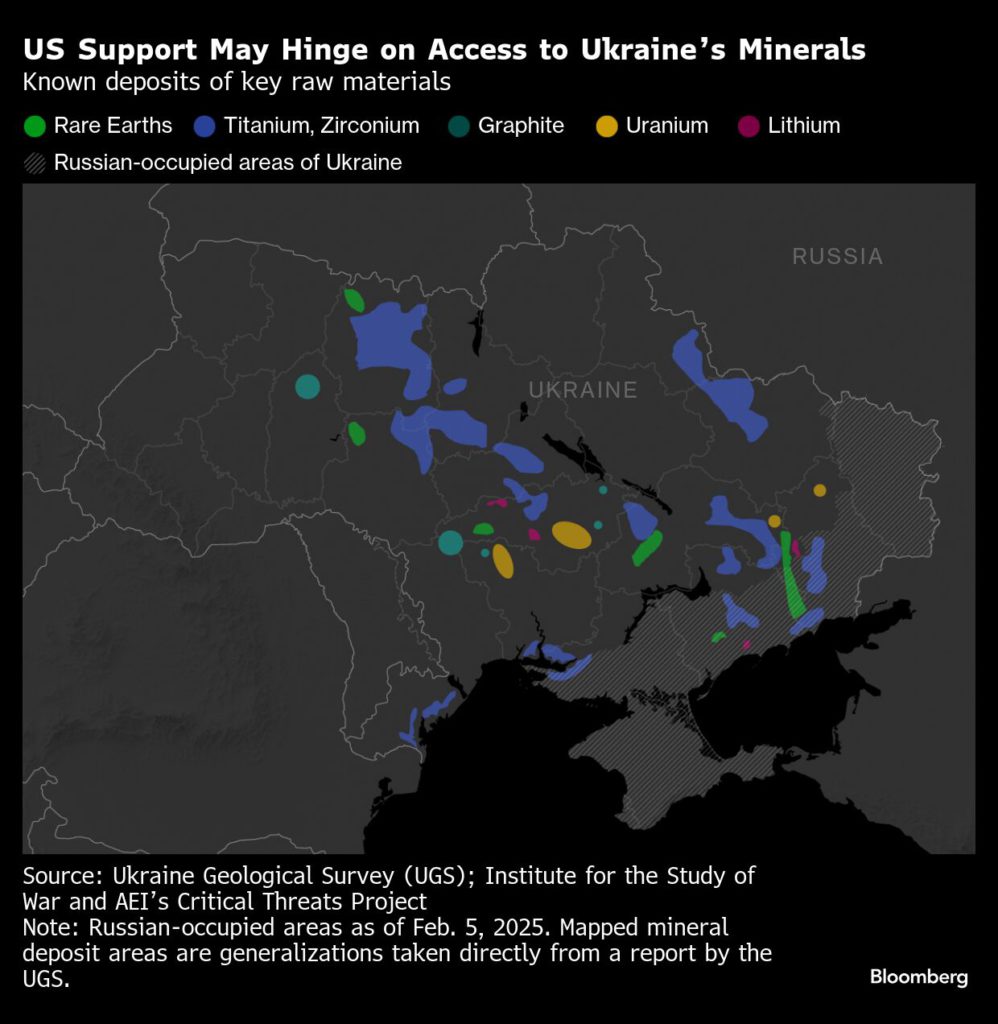
Trump wants Ukraine’s minerals.
But what exactly is up for grabs?

Bloomberg News | February 18, 2025 | 

Ukraine’s mineral wealth has been thrown into the spotlight as US President Donald Trump looks to seize control of its resources in return for military support. Yet very little is actually known about what’s up for grabs.


Various reports have suggested that Ukraine has mineral deposits worth upwards of $10 trillion, and President Volodymyr Zelenskiy’s government has been keen to promote crucial materials that can be exploited as it seeks more military and economic support.

Rare earth elements — which play a key role in defense and other high-tech industries — have become a particular focus for Trump as he seeks to secure supplies of critical minerals. The President said last week he wanted the equivalent of $500 billion worth of rare earth.

But Ukraine has no major rare earth reserves that have been internationally recognized as economically viable. While the country has reported a series of deposits, little is known about their potential — most of them appear to be by-products of producing materials like phosphates, while some are in areas of Russian control.

“Rare earths are so niche that they typically don’t produce the more detailed studies publicly, so there’s just not enough information,” said Willis Thomas, principal consultant at CRU Group.

The market for rare earths — which are mainly used in high-strength magnets — is minuscule compared with commodities like copper or oil. The numbers are still small even if other key specialty minerals found in Ukraine are added to the mix: Last year, the US imported about $1.5 billion of rare earths, titanium, zirconium, graphite and lithium combined, according to Bloomberg calculations based on data from the US Geological Survey.


Information on Ukraine’s rare earth deposits have primarily been drawn from government data, and even the former head of the country’s geological survey said that there had been no modern assessment of the countries resources, S&P Global reported last week.

Even if Ukraine does have any economically viable deposits, the West still has a bigger challenge to overcome — mining them is relatively easy, but processing the raw material is much harder.


China accounts for roughly 60% of mined supply, but crucially about 90% of separation and refining capacity. Beijing has also flexed its muscles in recent years as tensions ratcheted up with the US over access to semiconductors.

Any deal with Ukraine “doesn’t really solve that pain point,” Thomas said. The US “still needs to have a value chain that is primarily ex-China that is separation and magnet making and this simply doesn’t exist at this point.”

Western miners have largely failed to build their own rare-earth businesses, stifled by environmental issues, processing challenges, extreme price volatility and the difficulties in competing with Chinese producers.

For example, Australia’s Lynas Rare Earths Ltd., one of the few producers outside of China, has been dogged by concerns over radioactive waste and community opposition to a processing plant in Malaysia.

In the US, Molycorp Inc. dominated the industry there before collapsing. Its successor MP Materials Corp., which operates the Mountain Pass project in California, was criticized in the past for sending raw materials to be processed in China. Washington has provided funding to both Lynas and MP to develop processing in the US.

How rare?

Like many critical minerals, rare earths are relatively abundant globally, but don’t often exist in large enough concentrations to be extracted and refined economically. Outside of China, the largest reserves are found in Brazil, India, Australia, Russia, Vietnam, and the US, according to the USGS.

Rare earths play a key role in defense and other high-tech industries, being used in everything from iPhones to laser-guided missiles. A F-35 fighter jet requires more than 900 pounds of rare earth elements, while each Virginia-class nuclear submarine contains 9,200 pounds, according to the US Defense Department.

Ukraine had not received much interest before Russia’s full-scale invasion from the world’s biggest mining companies, who’ve spent much of the last two decades scouring the globe for untapped metal deposits.

The country’s main established miner is Ferrexpo Plc, a London-listed iron ore company that produces some of the highest grade pellets used to make steel. Steelmaker Metinvest BV mines coal and iron ore. The country also produces uranium.
Trump’s interest

Trump has made securing resources for the US and tackling China’s dominance of certain raw materials a cornerstone of his foreign policy so far. He has targeted Panama over access to its crucial waterway, homed in on Greenland’s mineral riches — mooting a potential takeover of the Danish territory — and now linked securing Ukraine’s resources as a key part of ongoing support in its war with Russia.

Ukraine has also been keen to promote its lithium, graphite and titanium deposits.

The country says it has the Europe’s biggest deposit of lithium, a material that is abundant around the world. Demand has surged because of its crucial use in rechargeable batteries, but production has risen far ahead of demand and prices have crashed in recent years.

In the case of titanium, Ukraine isn’t necessarily producing the form that America’s defense industry needs. Ukraine is a top-ten producer of two titanium-bearing minerals called ilmenite and rutile, and in the US, 95% of those materials are used to make a common white pigment. Ukraine has no capacity to produce titanium sponge, the form of the metal used in jet engines, armor plating, and other defense applications, according to USGS data.

“Titanium, the ilmenite and rutile, the main raw materials there, they’re found across the world and it’s really about ease of extraction, ease of processing and how easily it is shipped,” said Thomas.

(By Thomas Biesheuvel and Mark Burton)


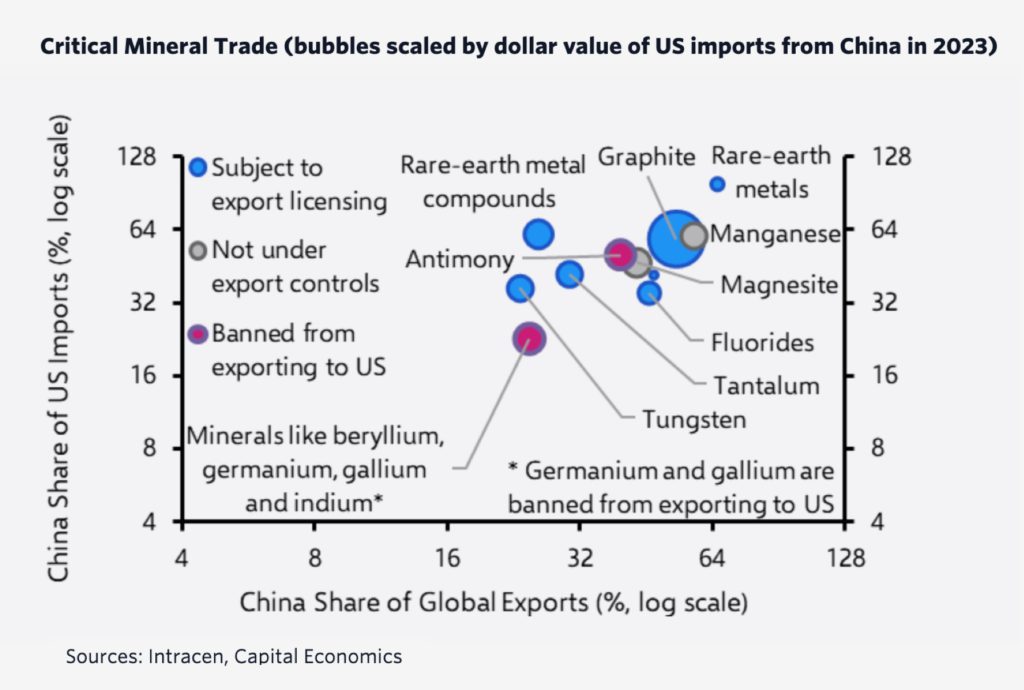
GRAPH: The critical minerals to watch in the US

Frik Els | February 17, 2025 | 

Another arrow in the quiver. Baotou City: Epicentre of China’s rare earth industry. 
Image by Matthew Stinson Creative Commons CC BY-NC 2.0


Statements that Trump’s plans to make Canada the 51st state is all about metals and minerals, a deal for Ukraine’s rare earths (now rejected) being included in peace talks, and the current US administration reiterating its desire to buy Greenland, have thrust critical minerals into the public view like never before.


Amid all this talk it’s easy to forget that anything to do with metals and minerals – whether deemed critical or not – is really about one country. China.

China unveiled a series of retaliatory measures against new US tariffs a fortnight ago, including restrictions on the export of tungsten, tellurium, bismuth, indium, and molybdenum, stating that export licenses will only be granted to companies complying with “relevant regulations.”

These measures fall short of the mineral export bans that China imposed on the US in December, which included gallium, germanium, antimony, and so-called superhard materials.

Antimony prices outside China have doubled this year while bismuth, even in the absence of an outright ban, has shot up to a decade-high.

Graphite is used in virtually all electric vehicle and energy storage batteries and Beijing’s tightening of export rules around graphite late last year could have bigger impacts. China dominates global production, and to an even greater extent, processing of the anode material.

The rules in effect around graphite are similar to those applied to rare earths in 2023, but so far Chinese supply of rare earth metals and magnets to the rest of the world has been ample and prices are subdued inside and outside the country.

More than a decade ago China’s imposition of export quotas saw rare earth prices skyrocket with, for example, dysprosium going from $118/kg to $2,262/kg between 2008 and 2011. China ended up in front of a WTO tribunal in 2010 and the industry calmed down.

While rare earth exploration and production outside China have boomed since then, the country’s grip on downstream permanent magnet and rare earth metal production will take many more years to fully prise.

While a relatively small market at the mining level, rare earth metals and magnets are used in the vast majority of EV motors and the 17 elements feed into a variety of high-tech industries including robotics, defence and aerospace.

Source: Capital Economics

China is dealing with its own rare earth problems with the collapse of imports from Myanmar, the country’s main source of particularly heavy rare earths, after rebel forces seized the country’s main producing region on the Chinese border. The turmoil has already led to higher REE prices.

Though there are no bans on graphite and rare earths exports, it’s a shot across the bow, and allows Beijing to keep its powder dry, for any future retaliation against US trade sanctions.

In a note, Capital Economics points out that the targeted goods in China’s latest round represent just $2 billion in annual exports – well below 0.1% of China’s total exports:

“But it adds to a growing arsenal of export controls that Beijing can use to throttle foreign access to key inputs. Around 9% of Chinese exports, including most of its shipments of critical minerals, are now subject to export licensing requirements.”


Ukraine Rejects Trump’s Proposal for Mineral Rights

By Alex Kimani - Feb 17, 2025

Ukrainian President Volodymyr Zelenskyy has rejected a U.S. proposal to acquire a significant stake in Ukraine's mineral resources.

Zelenskyy is seeking stronger security guarantees from the U.S. in exchange for any potential agreements regarding Ukraine's mineral resources.

This rejection highlights the ongoing tensions between Ukraine and the U.S. over the terms of future cooperation.


Ukrainian President Volodymyr Zelenskyy has declined a proposal by U.S. President Donald Trump to acquire approximately 50% of Ukraine’s rare earth mineral rights. Valued at several trillion dollars, Ukraine’s mineral reserves include lithium, titanium, and graphite which are essential for high-tech industries. The proposal was delivered by U.S. Treasury Secretary Scott Bessent as part of a bid to compensate Washington for assistance to Kyiv. Trump had suggested that Ukraine owed the United States $500 billion worth of resources for its past military support.

However, Zelenskyy is seeking better terms, including U.S. and European security guarantees. Trump’s proposal did not include provisions for future assistance, which Zelenskyy deems necessary. Zelenskyy’s team has developed an offer for a mineral partnership in exchange for security guarantees, which was announced earlier this month.

The EU has floated the idea of resuming purchases of Russian pipeline gas as part of a potential settlement of the Russia-Ukraine war. Backed by Hungarian and German officials, the proposal argues that the move could give both Russia and Europe incentives to maintain a peace deal while stabilizing the continent's energy market.

Last month, Slovakia’s Prime Minister Robert Fico revealed that he’s not ruling out the resumption of gas through Ukraine following the expiration of a 5-year transit deal between Moscow and Kyiv. Fico has been pushing President Volodymyr Zelenskiy to restart the transit, citing higher energy costs for Slovakia and the whole region.

‘‘The pipeline that runs through Slovakia has a capacity of 100 billion cubic meters,” Fico told reporters in Brussels on Thursday. “I want to do everything to ensure it is used in the future,’’ he added.

Europe’s vast natural gas inventories are currently depleting at the fastest clip since 2018 as cold weather ramps up heating needs. According to Gas Infrastructure Europe data, Europe’s gas storage was only 49% full on February 10, well below last year's 67% mark at a corresponding point and the 10-year average of 51% for the same period. The continent’s seasonal draw has been bigger than in the previous two winters due to colder weather, lower wind power generation due to low wind speeds and the termination of Russian gas imports via Ukraine. The situation is even more dire in Germany, Europe’s largest economy, with its underground sites currently only 48% full, a significant decrease from the 72% recorded at the same time last year.

By Alex Kimani for Oilprice.com


Ukraine's Critical Minerals and the Path to Peace

By Andrew Topf - Feb 16, 2025


The US is interested in Ukraine's large reserves of rare earth minerals as part of a potential peace agreement.

Ukraine holds significant deposits of strategic materials, including titanium, graphite, and lithium, which are valuable for various industries.

The US aims to secure these minerals to reduce its reliance on China for critical resources.


Ukrainians are learning the transactional nature of the Trump administration as the US president revealed a “critical” (pun intended) part of his plan for ending the three-year old conflict.

Media reports say that Scott Bessent, the US treasury secretary, met with Ukrainian President Zelensky on Feb. 12. The two discussed a minerals deal between Kyiv and Washington that would provide Ukraine with a post-war “security shield”.

At stake are $500 billion in rare earth minerals that Trump wants before offering a security guarantee from Washington.

Bessent said the minerals deal is part of a “larger peace deal that Trump has in mind”. Zelensky told reporters on Wednesday that the United States presented Ukraine with a first draft agreement he hoped could seal a deal at the February 14-16 Munich Security Conference.

“We had a productive, constructive conversation. For me, the issue of security guarantees for Ukraine is very important, and we talked about minerals in general,” said Zelensky, via Reuters.


Trump has said he wants a rapid end to the war between Ukraine and Russia but has not made clear whether he will continue vital military aid to Ukraine that was a cornerstone of President Biden’s foreign policy.

According to Radio Free Europe/ Radio Liberty, Trump spoke directly with Russian President Putin on Feb. 12 for more than an hour, agreeing to begin peace negotiations.

According to the Ukrainian Geological Survey, Ukraine holds 23 of the 50 strategic materials identified by the US as critical, and 26 out of the 34 recognized by the EU as critically important. Particularly, Ukraine holds competitive positions in titanium, graphite, lithium, beryllium, and rare earth elements.

There are currently 30 licenses issued for the development of this group of minerals. The Ukraine government holds over 30 unlicensed deposits and about 400 promising occurrences. It also manages several important industrial assets capable of fabricating titanium, aluminum, silicon, germanium and gallium.

Titanium and beryllium are used in aerospace and defense, with Ukraine holding the largest titanium reserves in Europe.


The country has reserves of lithium and graphite — used in lithium-ion batteries needed for a plethora of uses including electric vehicles and renewable energy storage. Graphite is used in the battery’s anode.

However, no lithium is currently mined in Ukraine, with two of four potential sites located in Russian-occupied territory.

Ukraine can reportedly supply battery factories with natural graphite concentrate, with six known deposits, one of which is operated by Australia-headquartered Volt Resources. Licenses were issued for three more graphite deposits in 2019 and 2021.

The extraction of tantalum, niobium and rare earth elements is centered around the Novopoltava phosphate deposit and the Azov REE deposit — both of which are in occupied territory.

The United States currently only has one producing rare earths mine — Mountain Pass in California owned by MP Materials. Australia-based Lynas is building a rare earths processing facility in Seadrift, Texas. In 2023, Nasdaq-listed coal miner Romaco Resources announced initial development work on the Brook rare earths mine in Wyoming would start in the fourth quarter.


Along with large percentages of rare earth oxides, the mine may contain meaningful amounts of gallium and germanium — said Mining Weekly — used widely in semiconductors and defense systems. China controls the supply of both, and in July 2023 introduced new export controls, followed by a ban on exports to the US in December 2024.

China also controls more than 85 percent of the world’s rare earth processing capacity and mines most of the minerals. According to the US Geological Survey, China holds 44 million tonnes of reserves, more than double the nearest competitor Brazil, and compared to the United States’ 1.9 million tonnes.

Between 2020 and 2023, the US imported 70 percent of its rare earth metals and compounds from China.

By Andrew Topf for Oilprice.com
Forget Ukraine: The Russia-U.S. Summit in Saudi Arabia is All About Money

By Cyril Widdershoven - Feb 18, 2025

Saudi Arabia may host a direct meeting between U.S. President Trump and Russia's President Putin.

Trump’s transactional diplomacy is not just about Ukraine but about securing business deals.

Trump’s proposal to meet with Putin in Saudi Arabia is tied to investments, a stronger U.S.-Saudi relationship, and a broader restructuring of the Middle East


The diplomatic onslaught by the Trump Administration during last weekend's Munich Security Conference is still reverberating across Europe. The unexpected affront by Trump’s representatives, Vice President JD Vance and Secretary of Defense Hegseth, has not only put the Transatlantic relationship on hold but is also seen as a significant move by the Administration to circumvent European partners and Ukraine—an unprecedented effort by the U.S. to impose a peace deal with Russia.

In the coming weeks, all eyes will be on Saudi Arabia, where the Kingdom is expected to host a direct meeting between U.S. President Donald Trump and his Russian counterpart, Vladimir Putin. While many see this as a Trumpian move to enforce a peace deal on Ukraine, analysts should look deeper. More is at stake—Trump’s transactional diplomacy is not just about Ukraine but about securing business deals, targeting not only Moscow but also Saudi Arabia and the broader Gulf Cooperation Council (GCC). The Riyadh Summit could be more about money than peace.

Amidst concerns from international media and European politicians about the security risks of Washington’s strategy, the Trump Administration's disruptive, business-centric approach is a crucial theme. The choice of Riyadh as the setting for the Trump-Putin Summit should be reassessed, as it underscores the Administration's push for alternative deals and the long-term goal of a Saudi-Israeli rapprochement—one of Trump’s long-standing ambitions.

Trump’s proposal to meet with Putin in Saudi Arabia is tied to investments, a stronger U.S.-Saudi relationship, and a broader restructuring of the Middle East. With one stroke, Trump has thrust Saudi Crown Prince Mohammed bin Salman (MBS) into the spotlight. Trump’s admiration for strong, young leaders plays a role, as does Saudi Arabia’s geopolitical influence in the region and its ability to balance relationships between Russia and the U.S.

Officially, the meeting is set to discuss a peace deal for Ukraine. However, the U.S. Administration understands that this will not be achieved in "one day"; the discussions could even have the opposite effect. Russia's demands are clear and not entirely aligned with Trump’s vision. Meanwhile, U.S. corporate interests—especially those of Elon Musk—are also at play. Trump's affinity for MBS and other Arab leaders will significantly influence negotiations. By spotlighting MBS, Washington appears to be pressing Riyadh to advance a deal with Israel while opening doors for Saudi and other Gulf investments in the U.S.

Trump also hopes to push MBS to reconsider his stance on Gaza and Hamas. A shift toward a more pro-U.S. position by MBS could also weaken Riyadh’s ties with Russia and China, which remain at the forefront of Trump’s concerns. Some expect the Trump Administration to encourage Saudi Arabia to take a harder stance against Iran—viewed as the ultimate adversary by Trump’s inner circle.

While diplomatic activity heats up in Riyadh, Trump is simultaneously preparing for a billion-dollar investment summit in Florida. The Saudi sovereign wealth fund, the Public Investment Fund (PIF), is hosting its Future Investment Initiative (FII) Priority Summit in Miami in the coming days. The event will bring together Saudi investors and global financial leaders to discuss potential deals, particularly in the U.S. and Saudi Arabia.

In the coming days, U.S. companies will be courting Saudi counterparts to secure multi-billion-dollar deals, a key political priority for Trump. PIF CEO Yasir Al-Rumayyan will lead discussions with U.S. counterparts, promoting economic partnerships. Trump’s goal for the FII Priority Summit is to secure Saudi investment commitments totaling $1 trillion in the U.S. Currently, MBS has pledged around $600 billion over the next four years, but Trump is pushing to raise the stakes.

Again, Trump’s transactional diplomacy is striking a chord with Arab power players, but significant unresolved issues remain. Behind closed doors in Miami, Trump—who is attending the summit in person—will likely discuss Gaza, Israel, and the potential for strengthened U.S.-Saudi cooperation, including military agreements. By playing on multiple fronts, Trump is positioning MBS and the Gulf Arab states in a delicate balancing act.

For Saudi Arabia, closer ties with an assertive U.S. are appealing, particularly in security and economic cooperation. However, as a leading force in OPEC, Riyadh will not overlook Washington’s demands on oil production and exports. Several deals are under negotiation, but none have been finalized. MBS will also seek to leverage Saudi Arabia's strategic position in the Middle East to ensure that any agreement serves his interests.

A potential wildcard in these negotiations is Saudi Arabia’s role as a source of critical minerals and metals. Trump has already signaled his interest in securing these resources, as evidenced by his demand that Ukraine hand over 50% of its reserves in exchange for continued U.S. military aid. Saudi Arabia is aggressively developing its mining sector, attracting foreign investment, and capitalizing on its vast mineral wealth. MBS could use this as a bargaining chip, as he is known for a more calculated and strategic approach than Trump’s blunt transactional style.

While the spotlight is on the Trump-Putin meeting and speculation about Ukraine’s future, the real story may be different. If Russia refuses to meet Washington’s undisclosed demands, Trump could shift his stance on Ukraine entirely.

However, analysts should look beyond the immediate headlines. Washington’s choice of Riyadh as the summit venue carries broader significance, and the potential fallout from Russia’s response should not be underestimated.

By Cyril Widdershoven for Oilprice.com
Trump Suggests Ukraine Could Have Avoided War

By RFE/RL staff - Feb 19, 2025, 


Donald Trump stated that Ukraine could have avoided the war with Russia and expressed confidence that he could broker a peace deal to end the conflict.

The United States and Russia held high-level discussions in Riyadh and agreed to form teams to negotiate a path to ending the war in Ukraine as soon as possible.

Various proposals have been made regarding Ukraine, including potential European peacekeeping troops and the suggestion that Ukraine should hold elections, although the latter faces constitutional challenges under martial law.


U.S. President Donald Trump seems to have blamed Volodymyr Zelenskyy for Moscow's invasion of Ukraine, saying he was “disappointed” that the Ukrainian president complained about being frozen out of U.S.-Russia talks in Saudi Arabia on ending the war.

"Today I heard, oh, well, we weren't invited. Well, you've been there for three years," Trump said, referring to Ukraine. "You should have never started it. You could have made a deal."

Trump did not clarify what he meant, but he has often blamed the war on Ukraine's desire to join NATO. Experts say Russia's full-scale invasion was driven by Russian President Vladimir Putin's imperial ambitions rather than Ukraine's NATO ambition, which had little support from the West at the time.

Speaking from his Mar-a-Lago home in Florida on February 18, Trump also said he now feels "much more confident" of reaching a deal to end the conflict in Ukraine.

"I think I have the power to end this war,” he said at a news conference after the high-level talks in Riyadh attended by U.S. Secretary of State Marco Rubio and Russian Foreign Minister Sergei Lavrov.

Trump also said he might meet Putin this month and that he would not oppose a European move to send peacekeeping troops to Ukraine, an idea discussed during a European summit in Paris on February 17.

“If they want to do that I’m all for it,” said Trump, before adding that the United States has no plans to contribute troops to any contingent sent to Ukraine to provide security guarantees.

Trump also said that Ukraine should hold elections, saying: "That's not a Russia thing, that's something coming from me and coming from many other countries also."

Other U.S. officials have suggested that Ukraine could hold elections following a cease-fire deal and this would be “good for democracy."

But Ukraine’s constitution bars it from holding elections under martial law, which was imposed when Russia launched its full-scale invasion in February 2022 and continues to this day after repeated extensions.

Ukrainian President Volodymyr Zelenskyy's five-year term was due to end in May 2024 after elections in March, and Putin has said he would not negotiate with Zelenskyy because he would not have the authority to sign a peace deal.

Earlier on February 18, after the talks in Riyadh, the first senior-level Washington-Moscow discussions since the 2022 invasion, Russia and the United States agreed to establish teams to negotiate a path to ending the war “as soon as possible,” Rubio said.

The U.S. secretary of state also said the European Union “is going to have to be at the table at some point” because of the sanctions the bloc has imposed.

Sanctions were imposed as a result of the conflict, he said, speaking in an interview with the Associated Press and CNN. “In order to bring an end to any conflict there has to be concessions made by all sides.”

Rubio noted the need for improvements in how the U.S. and Russian embassies "are able to work" in order to create missions to support peace talks, bilateral relations, and cooperation more broadly.

“If our diplomatic channels are broken, it’s going to be very difficult to consistently engage on a host of topics, including some unrelated irritants that could derail the broader talks on Ukraine,” Rubio said.

He called for quick action on restoring "normalcy" at the embassies, adding that it would be “important to set the table for the other two things that we want to do.”

Some European leaders, alarmed by the radical shift in U.S. policy toward relations with Russia, fear Washington will make serious concessions and rewrite the continent's security arrangement.

U.S. national-security adviser Michael Waltz said any postwar peace guarantee would have to be "European-led," echoing calls by U.S. officials for European allies to increase defense spending and praising Britain and France for "talking about contributing more forcefully to Ukraine's security."

During the February 17 summit in Paris, European leaders expressed a willingness to offer security guarantees to Ukraine, but they warned that the level of such assurances would have to be based on Washington's participation in the event of a comprehensive peace agreement, something the U.S. president now seems to have poured cold water on.

France is to host a second meeting on February 19 to discuss the war in Ukraine and European security. This time, Canada and other European countries not present at the earlier emergency summit will attend.

By RFE/RL