Thursday, February 20, 2025

A Whole Lot of Nuclear Madness in One Week


 February 19, 2025
Facebook

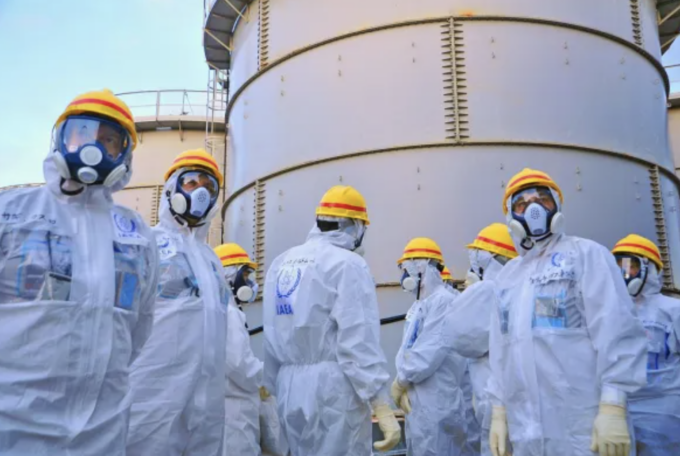
Water storage tanks at the Fukushima Daiichi nuclear site. (IAEA inspection photo.)

Remember that 1963 comedic caper movie, “It’s A Mad, Mad, Mad, Mad World”? Okay, maybe not. It was director Stanley Kramer’s escape from his more traditionally dark subject matter — Judgment at NurembergThe Defiant OnesInherit the Wind. The bridge from those more sober productions to “Mad” was his favorite and perennial lead actor, Spencer Tracy.

We’ve crossed that bridge now, into a world so mad, and decidedly not funny, that we’ll need a whole lot more “mads” in the title for the dystopian 2025 version.

In the space of just a few days, a slew of truly insane news broke — and I’m not even talking here about anything emanating from the Trump regime.

US Intelligence, if any such thing still exists, announced it foresaw an attack on Iran’s nuclear centers by Israel in the next six months. By ‘attack’, they mean ‘bomb’.

The Iranian government immediately barked back with an announcement that for every hundred such facilities destroyed they would “build a thousand other ones.”

This is no idle threat from either side. Just last October, according to US and Israeli officials, Israel reportedly destroyed a secret Iranian nuclear weapons research facility. (Iran continues to deny it is developing nuclear weapons.)

In 2010, the Stuxnet computer virus, a cyber attack likely launched by Israel and the United States, infected computers at Iran’s Bushehr nuclear power plant before spreading across other facilities including to the Natanz uranium enrichment complex. Israel has also assassinated at least five of Iran’s nuclear scientists, between 2010 and 2024.

No one really knows what if anything got destroyed by Israel (and the US) in Iran and what has been rebuilt at least once, if perhaps not one thousand times.

Iran is a signatory to the nuclear Non-Proliferation Treaty whose Article IV rashly gives the “inalienable” right to non-nuclear weapons states to develop “peaceful” nuclear energy. Iran has long-claimed that it’s doing precisely that. But because nuclear power provides a direct pathway to nuclear weapons development, Iran is at best doubted if not disbelieved by its enemies.

Also this week came the news that Japan would go for a “maximization” of nuclear power, aiming for a 20% energy share by 2040 with 30 reactors back up and running.

This is notwithstanding the fact that the country almost lost Tokyo when the Fukushima-Daiichi reactors exploded and melted down in 2011; that the destroyed reactors are still too dangerous to enter; that the prefecture and areas beyond are indefinitely contaminated with radioactive fallout; and that the reactor site has a more than one million tonne liquid radioactive waste problem that it’s currently dumping into the Pacific Ocean for the next 30 years.

Elsewhere on these “pages”, Karl Grossman writes that the U.S. could be considering a resumption of atomic testing, following the advice to do just that advocated by Robert Peters, a research fellow for nuclear deterrence and missile defense at the far-right Heritage Foundation, whose Project 2025 is the blueprint being followed by the Trump administration, never mind all their hollow denials before the election.

How many “mads” do these situations deserve? At least a couple, maybe more? But earning the full Monty of “mads” is surely a paper submitted last month by PhD student Andrew Haverly with the Rochester Institute of Technology — Nuclear Explosions for Large Scale Carbon Sequestration.

Haverly’s idea is to use a buried nuclear explosion in the seabed to accelerate carbon capture by pulverizing basalt and using Enhanced Rock Weathering, which, he says “can sequester significant quantities of atmospheric CO2 by accelerating the natural chemical breakdown of silicate rocks, such as basalt.”

But this would not just be any old nuclear explosion. It would have to be much larger than the biggest nuclear test ever — Russia’s Tsar Bomba — which, wrote Haverly, had “only a yield of 50 megatons of TNT.”

Just for context, that “only” was already 2,000 times more powerful than the 25 kiloton plutonium bomb that wiped out Nagasaki.

But Haverly’s seabed blast would be “in the gigaton range” and specifically, an 81 gigaton blast. Such a creation, should “not to be taken lightly,” he cautions. “Detonating a 81 Gt nuclear device could cause a global catastrophe if done improperly.”

Improperly? An exclamation invoking Sherlock Holmes springs to mind here. There are 1,000 kilotons in a megaton and 1,000 megatons in a gigaton. Do the math. Then multiply that by 81.

Not to worry though, insists Haverly because we already have so much radiation in our environment, what’s a little more from the most unimaginably massive nuclear explosion ever? It “should have minimal impact on the world,” he writes.

“The long-term effects of global radiation will impact humans and will cause loss of life, but this increased global radiation is ‘just a drop in the bucket’”.

Please read those words back to your readers. Out loud.

Why would anyone other than possibly a real life Dr. Strangelove, even consider this? There are plenty of faster, cheaper and way safer methods of reducing our carbon emissions, starting with using less and saving more, before we even talk about renewable technologies.

There is of course much debate about whether carbon capture itself even works or is a good use of the energy needed to achieve it. Mark Jacobson, a Stanford University-based world authority on climate change mitigation asserts that carbon capture reduces “only a small fraction of carbon emissions, and it usually increases air pollution.”

The fundamental thesis here is that because climate change is so extreme and so destructive, stopping it with something else, no matter how extreme the risks and destructive the potential outcome, pales in comparison to what we are already facing. So bombs away.

Haverly also argues that this giga-bomb would have “no strategic military value” because of its size. First, no nuclear weapon of any size has any strategic military value. They are all militarily useless. But it strains the boundaries of credulity to believe that a government that created an atomic bomb of this magnitude — if anyone ever would or could — in the name of addressing climate change, would not also threaten to use it as the ultimate way to keep the rest of the world in abeyance.

Could things get any worse. Or madder? Ignoring the White House for a moment, the answer is still “yes”, although maybe not madder, just more disastrously likely.

And so, in the early hours of last Friday morning, a missile-armed drone, launched as part of the current war initiated by Russia in Ukraine on February 24, 2022, exploded on the roof of the Chornobyl reactor dome. It was not sent as a Valentine but it does remain anonymous, with Ukraine accusing Russia of firing it and Russia in full denial.

The protective shield the drone hit, causing a subsequent fire, was built to cover the destroyed Unit 4 reactor that blew up and melted down on April 26, 1986. Ukrainian authorities insist radiation levels surrounding the plant have not increased as a result of the incident. It’s all too possible that the next Chornobyl could actually happen at Chornobyl.

This is not the first time the Chernobyl nuclear site — or other nuclear power plants in Ukraine — have come into danger because of the war there. The massive six-reactor Zaporizhzhia nuclear power plant in the southeast of the country, where the fighting has been most intense, has also suffered fires and hits from missiles. It has also been occupied by Russian forces since March 4, 2022.

Alarm bells have frequently been rung there, whether by the International Atomic Energy Agency concerned over the proximity of the fighting, or by Ukrainian operators, fearing long hours, a reduced workforce and the duress of occupation could lead to human error, in turn causing a potentially catastrophic accident.

Other reactors across Ukraine have also been put in danger and yet there too, the madness continues. (I’m finding it hard to believe that by the time this makes press Trump will have conjured a lasting peace treaty between Russia and Ukraine that both sides can live with.)

Speaking of Trump, last week also delivered an astonishing pronouncement, reported in The Guardian among other media, that the US president wants to talk to the leaders of China and Russia about nuclear disarmament.

“There’s no reason for us to be building brand-new nuclear weapons. We already have so many,” Trump said. “You could destroy the world 50 times over, 100 times over. And here we are building new nuclear weapons, and they’re building nuclear weapons.

“We’re all spending a lot of money that we could be spending on other things that are actually, hopefully, much more productive.”

This actually sounds sensible. Which is frightening in itself. Because we agree with this and would be trumpeting it and celebrating it and re-tweeting or BlueSkying it or whatever, except for the fact of its source, which makes it suspect. There’s a quid pro quo in here somewhere. We just don’t know what it is.

And in other news…

This piece first appeared in Beyond Nuclear.

Linda Pentz Gunter is a writer based in Takoma Park, Maryland. She is the international specialist at Beyond Nuclear. This article is written in her personal capacity. Views are her own.

Trump, Nukes and Cartoons


February 20, 2025
Facebook

Wouldn’t it be nice if the war in Ukraine were entirely one side’s fault, if the U.S. had one political party that did everything perfectly, if USAID had only ever caused either benefit or harm, and if all the self-contradictory gibberish coming out of Trump’s pie hole were either lies or holy gospel? A lot of people sure seem to think so.

Here in the real world, things are ever so slightly more complex than in a cartoon. A war can develop through evil actions by two — count ’em — sides. And that’s not all. Those evil actions can be — gasp! — very different and unequal to each other. I know. I know. It makes the brain just throb, right?

An agency can both feed the hungry and help overthrow governments for imperialist thugs. It seems impossible, if only because costume designers will have no idea how to dress such an agency. And yet.

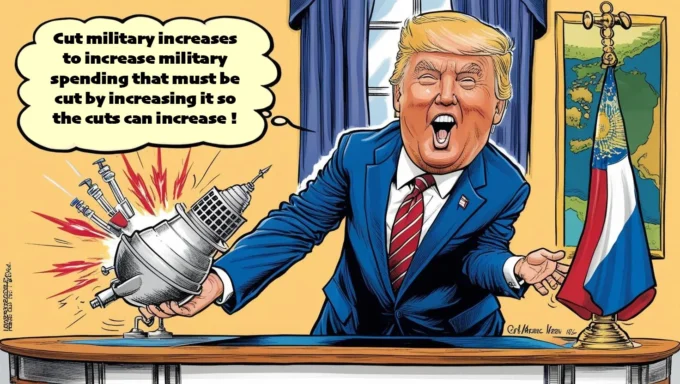
A president can demand that governments spend vastly more on wars and propose cutting war spending in half. The same skills that once made the holy Trinity both single and triple can make sense of this. The threats and demands are brilliant negotiating, or the proposed reductions are a brilliant distraction. But you cannot actually take enlarging and shrinking military spending at face value and proclaim them both right.

Of course, loyal Democrats can hear Trump back cutting military spending and decide that military spending must be maximized, but this requires ignoring the fact that Trump is also demanding vast increases to military spending around the world and through the work of his disciples in the United States Congress.

Of course, burnt out, frustrated peace activists can celebrate Trump’s cut-spending comment as a ray of glorious hope, if not the coming of the Savior, but that requires ignoring the same pieces of reality.

I suggest three simple steps.

First, accept that contradictory positions cannot both be right and that you will have to determine which, if either, you agree with based on something other than the identity of the fascist jackass who said them.

Second, once you’ve decided, for example, that reducing military spending is the way to go, feel free to indulge in only criticizing Trump, but criticize the Trump who wants more military spending, who is moving more nukes into Europe, whose DOGE charade is avoiding military spending, and whose Congressional court jesters are pushing legislation to move vast piles of what remains of non-military spending into the golden toilet of the Pentagon. Or feel free to indulge in only praising Trump, but praise the Trump who wants to get rid of nuclear weapons, make peace, end wars, and cut the Pentagon in half. Or do both the criticizing and praising as merited.

Third, demand action to back up the words you agree with. If a U.S. president who is in the midst of a mad power grab bending the federal government to his will wants to get rid of nukes, he doesn’t have to wait for other countries. He can begin a reverse arms race by halting the production of new weapons and taking a first step in reducing them, before waiting for that move to be matched in Moscow. If he wants to reduce military spending, he can send in the DOGE brownshirts to eliminate hoards of military officers as if they were hungry children in need of food. He can put a halt to efforts in the Congress to pass legislation vastly increasing military spending, and instead order the introduction of legislation to cut the beast in half.

Would such actions get more push-back from Congress Members than those targeting useful and humanitarian projects? Of course! But without any actions at all — in fact with actions to the contrary — why take the rare good Trumpism seriously at all?

Don’t want to demand action from Trump because that would involve communicating with Trump and he’s just too odious? OK. Go to Congress and tell your misrepresentatives and lords of the upper chamber to cut military spending in half, either because Trump said so or because your Congress critters themselves said so in the past (depending on your district) or because military spending deprives us of so much, impoverishes us, and is an immoral act that threatens our existence and that of all living things.

David Swanson is an author, activist, journalist, and radio host. He is executive director of WorldBeyondWar.org and campaign coordinator for RootsAction.org. Swanson’s books include War Is A Lie. He blogs at DavidSwanson.org and WarIsACrime.org. He hosts Talk Nation Radio. He is a Nobel Peace Prize nominee, and was awarded the 2018 Peace Prize by the U.S. Peace Memorial Foundation. Longer bio and photos and videos here. Follow him on Twitter: @davidcnswanson and FaceBook, and sign up for:


Serbia’s Mass Protests Against a Crony-Capitalist Government

Monday 17 February 2025, by Tamara Knežević

Serbia’s prime minister has resigned after months of protests over the deadly rail-station canopy collapse in Novi Sad. No isolated incident, the disaster has become the latest symbol of government subservience to unscrupulous multinational developers

Soon after the roof canopy of Novi Sad’s central train station collapsed last November 1, killing fifteen people, a TV reporter asked local journalist Igor Mihaljević to respond to the event. With devastating and incisive judgement, he offered the context missing in Western media coverage of the incident and the protests of the last few months.

For one, Mihaljević noted, this was the latest incident in the often tragic history of Serbia’s second-largest city. In its past, Novi Sad suffered the genocidal Hungarian army campaign that massacred Jews, Serbs, and Romani across the region. That was in the same era as the devastating military occupation of Yugoslavia by Nazi Germany and its client states. More recently, there was the seventy-eight-day NATO bombing campaign in 1999, which killed 527 Yugoslavs and hobbling major cities like Novi Sad by taking out key infrastructure. But this time, Mihaljević argued, was different — for now it was the Serbian state itself killing its people.

The train station collapse has left both the city and the nation in shock, triggering primal fears of the sky falling overhead. Many Serbs, especially in Novi Sad, now regard overhead structures with suspicion, with some even avoiding the newly constructed, Chinese-funded high-speed railway. However, the aftermath has also sparked a powerful wave of protests, so intense that they threaten to topple President Aleksandar Vučić, sending shock waves through his corrupt Serbian Progressive Party (SNS).
Student Protests

Led by student organizers from over thirty universities and faculties — most notably the faculty of dramatic arts in Belgrade, which began the call to action in late November — the movement has rallied around four key demands. One is the release of all internal documents related to renovations at the Novi Sad railway station, carried out by Serbian Railway Infrastructure, the Serbian state, China Railway International Co. Ltd., and China Communications Construction Company Ltd., which began the station’s construction in 2021. The other demands are the dismissal of all charges against arrested and detained students and young protesters who have been demonstrating since the canopy collapsed; the filing of criminal charges and the prosecution of those responsible for the attacks on students and professors; and a 20 percent increase in budget allocations for public higher-education institutions in Serbia to cover material expenses.

Since November, students have organized massive strikes, with such protests as a gathering of over 100,000 people at Belgrade’s Slavija Square on December 22. The protests continued into the New Year, with demonstrators declaring there was nothing to “celebrate” until justice was achieved. They demonstrations are still ongoing, having recently forced the resignations of prime minister Milos Vučević and Novi Sad’s mayor Milan Đurić on January 28.

Students have held assemblies and effectively conveyed their message to the media. With a keen sense for Instagramable moments, they have gracefully steered social media campaigns, often featuring overhead drone footage of the protests and eye-catching visuals. Their actions have not only challenged state power, but their demands — particularly for criminal charges and prosecution — offer a stark critique of the deeper systemic rot: a corrupt judicial system that upholds a mafia state and a government that not only fails its people but is complicit in their deaths.

What began as a response in Serbia’s major cities has now evolved into a nationwide movement, spreading to smaller towns as well. As noted by Novi Sad activist and scholar Aleksandar Matković on X/Twitter, a map of Serbia showing protests happening across almost all municipalities nationwide shows that the situation is likely to escalate into either a government crisis or more conflict.

The events have also sparked deep cultural anxieties tied to national identity. This Monday, the Serbian Orthodox Church published an article damning the student protests, asserting that they were pushing an “anti-Saint Sava, anti-Christian and anti-Serbian narrative and way of life.” This claim that students live in a “parallel universe” was walked back in a statement on Tuesday, which clarified that the text did not reflect the stance of the Church’s top cleric, Patriarch Porfirije.

Recently, the protests have intensified into violence, with protesters engaging in fierce clashes with supporters of the ruling SNS party. On Tuesday night at around 3:00 a.m., a group of SNS supporters launched an attack on students in Novi Sad. Many Serbians were especially shocked by a series of interviews widely covered in media in which SNS supporters from the city of Jagodina denounced the students. One older man even said that he would welcome attacks on his daughter if she were protesting.
Nationalists and Multinationals

This is a moment of growing interest in the power of mass movements to drive political change. Following Donald Trump’s return to the US presidency, obsessive media coverage often frames one man’s corruption and venality as redeemed by his inauguration as head of state. The parallels to Vučić are striking, particularly since Trump and his son-in-law Jared Kushner recently finalized a business deal to build a Trump-branded luxury hotel on the site of the former Yugoslav Ministry of Defense in Belgrade. This site, bombed by NATO in 1999, long stood as a symbol of the bombing and the dangers represented by this alliance.

Today the Kushner deal, brokered with real estate agents in Abu Dhabi, reflects a broader picture around the Balkans: real estate developments treated as megadeals between state and business leaders from the United States, European Union, China, and beyond. Such arrangements ultimately benefit only very few but are covered by judicial protection. In stark contrast, the student demands — focused on strengthening education and creating institutions that genuinely serve the people, as well as restoring legitimacy to the state prosecutor — directly challenge the interests of autocrats and the capitalist developers whom they protect.

Much Western media coverage of the Novi Sad deaths and resulting protests has been inaccurate, emphasizing Serbia’s strong ties to Russia and implying that the student protests follow a Maidan-like, anti-Russian tradition. While this framing may be intended to attract attention to the protests, it is misleading about what is really at stake. The concern here isn’t foreign interference in another state’s affairs but rather domestic corruption, crime, and the fundamental question of what and whom the state is truly serving.

Analysts like political scientist Florian Bieber, who emphasizes the need to align the resistance with Serbia’s opposition parties, overlook the fact that such challenges are not unique to Serbia but are part of a broader global crisis of governance in which capturing electoral victory cannot be the only aim of politics. As the late theorist Fredric Jameson noted, we are witnessing a global erosion of state power. Jameson instead called for a “dual power” in which alternative structures emerge to fulfill essential functions that the state has failed to provide. The student protests reflect this idea in practice, through soup kitchens, self-defense networks, and other forms of collective support. They are not just demanding change but actively demonstrating what a self-sustaining, community-driven alternative could look like.
Collapse

Many outcomes were possible after this incident. The business dealings between the Serbian state and China risked fueling xenophobia toward Serbia’s significant Chinese population. The collapse could have been forgotten as an isolated tragedy. Instead, Serbian students have demonstrated that it is possible to challenge corrupt systems. Success depends on our ability to embrace the potential of new and emerging forms of social cohesion.

Serbian student movements have led change before. In 1968, they won concessions from Josip Broz Tito, who acknowledged the validity of many of their economic and political demands. President Vučić may sometimes present himself as Tito’s successor, but he only offers empty promises, failing to implementing real changes. In 2000, president Slobodan Milosević was overthrown after a three-year internal struggle sparked by the student-led Otpor! movement.

More recently, protests against the Serbian government’s support for the British-based multinational Rio Tinto’s lithium mining project — ignoring well-documented environmental risks — have highlighted the growing resistance to state-backed corporate exploitation. In 2022, widespread public pressure ultimately forced a U-turn on allowing the company into the country. This incident further underscores how nationalist rhetoric often masks collusion with foreign corporate interests, prioritizing economic deals over public welfare. The current student protests have built on this momentum, digging deeper into these contradictions and challenging entrenched networks of political and economic power.

The Novi Sad station canopy is a grotesque metaphor for the uncertainty facing Serbia. First created in 1964, it symbolizes a time when the Yugoslav state was thriving and modernizing — an era of ambitious infrastructure projects and social progress. But its neglectful maintenance and ultimate collapse serve as stark reminders of Vučić’s inability to carry on such a legacy in substance. While he postures as a strong leader, his governance has been marked by economic inequality, political repression, and a failure to invest in the institutions and public goods that once defined Yugoslavia’s vision of collective progress.

The students in the streets today are not just protesting an isolated incident; they are confronting a system that has long prioritized political survival over public well-being. If they succeed, they may finally break this cycle and push Serbia toward a future where the state truly works for its people. If they fail, the collapse of the canopy may serve as a chilling warning of further decay to come. Now we can only hope that they succeed.

Jacobin 1 February 2025


Attached documentsserbia-s-mass-protests-against-a-crony-capitalist_a8859.pdf (PDF - 899.6 KiB)
Extraction PDF [->article8859]


Tamara Knežević
Tamara Knežević is an activist of SolidaritéS and secretary of the feminist strike collective in the Vaud canton of Switzerland.


International Viewpoint is published under the responsibility of the Bureau of the Fourth International. Signed articles do not necessarily reflect editorial policy. Articles can be reprinted with acknowledgement, and a live link if possible.


Ukraine

Understanding the Implications of US Vice President JD Vance’s Confrontational Speech at the Munich Security Conference

Tuesday 18 February 2025, by Daniel Tanuro

In a highly confrontational speech delivered at the Munich Security Conference opening on 14 February, US Vice President JD Vance declared that the “internal threat” facing Europe was more serious than that posed by Russia and China. He criticised the annulment of a recent election in Romania, the prosecution of an anti-abortion protester in the United Kingdom, and the exclusion of far-right and far-left German politicians from the event itself.


US Vice President JD Vance’s speech in Munich, Germany, is characterised by extreme clarity and brutality. According to Vance, “the greatest threat looming over Europe comes not from China or Russia”. Rather, it stems from Europe’s cancellation of elections rigged by the pro-Putin far-right in Romania, Britain’s prosecution of a far-right anti-abortion activist, and the EU’s (thus far) refusal to permit complete “free expression” of racist, fascist, and misogynistic hate speech on social networks, as well as electoral manipulation (as in Romania specifically). Putin is rubbing his hands with glee, and the Alternative für Deutschland (AfD) openly applauds JD Vance.

There can be no doubt: a strategic agreement exists between Trump and Putin aimed at dividing spheres of influence in Europe and establishing authoritarian far-right regimes in their respective zones. This agreement involves breaking the Ukrainian people’s resistance in the East whilst supporting the far-right that already dominates Hungary and Italy, or participates in government in several other countries, and risks coming to power in Germany and France. Trump and Putin are clearly collaborating toward this end, as demonstrated by Trump’s recent statements supporting the dismemberment of Ukraine and regime change in Kyiv.

This represents a major turning point. While it appears suddenly in broad daylight today, it hasn’t emerged from nowhere. It expresses capital’s necessity, in a context of intensified competition, to establish authoritarian regimes to continue destroying society and nature for profit—by liquidating democratic and social rights, and denying scientific warnings about the severity of the ecological-climate crisis.

Thus, we can clearly see the emergence of a project for a multipolar world dominated by the Trump-Putin-Xi Jinping triad. Within this triad, the struggle for hegemony between the USA and China will give Russia a pivotal role. Trump’s gifts to Putin are precisely aimed at distancing him from Xi. (In this context, note that Trump’s ramblings about defending Christian faith also carry certain meaning.) Simultaneously, all this is motivated not only by fear but also by Trump and US Big Capital’s admiration for the remarkable “efficiency” of Chinese high-tech despotism, which in just a few decades has built a capitalist economy capable of threatening the US empire’s global pole position... while keeping the masses under control. Hence the rallying of the Zuckerbergs and Bezoses to Musk’s crusade—the lumpen-capitalist making the fascist salute.

Faced with this project, some will believe they must mobilise to defend the EU as an embodiment of “democratic values”. This overlooks the fact that the EU is a profoundly despotic structure defined not by these “values” but as “an open market economy where competition is free”. As such, it actively participates in the world’s shift toward the far right, both through its anti-social policies (austerity, persecution of migrants, etc.) and by unravelling its very insufficient (and very unfair!) supposedly “ecological” policies.

The only way forward for a left worthy of the name is to fight for democratic and social rights, and against ecological destruction, whilst working to rebuild internationalism from below. This requires breaking with the campist poison of those who rejoiced at the prospect of a multipolar world, imagining this world would promote “peace” and the emancipation of peoples. Instead, it promotes war and oppression.

14 February 2025

Attached documentsunderstanding-the-implications-of-us-vice-president-jd_a8860-2.pdf (PDF - 905.8 KiB)
Extraction PDF [->article8860]
understanding-the-implications-of-us-vice-president-jd_a8860.pdf (PDF - 905.9 KiB)
Extraction PDF [->article8860]


Daniel Tanuro
Daniel Tanuro, a certified agriculturalist and eco-socialist environmentalist, writes for “La gauche”, (the monthly of Gauche-Anticapitaliste-SAP, Belgian section of the Fourth International). He is also the author of The Impossibility of Green Capitallism, (Resistance Books, Merlin and IIRE, 2010) and Le moment Trump (Demopolis, 2018).


International Viewpoint is published under the responsibility of the Bureau of the Fourth International. Signed articles do not necessarily reflect editorial policy. Articles can be reprinted with acknowledgement, and a live link if possible.
Argentina: ‘Anti-fascist and anti-racist pride’ against Milei

Wednesday 19 February 2025, by Fabrice Thomas

On Saturday 1 February, huge demonstrations took place across Argentina in response to President Javier Milei’s speech at the Davos forum the previous week. In a half-hour speech to the cream of the capitalist world, Milei, in a significant mimicry of Trump, unrolled the catalogue of his hatreds: feminists, ‘wokism’, gay couples (whom he accused of paedophilia), progressivism, the left and ‘leftists’ (who must be ‘driven out’). Hundreds of thousands of people across the country rose up not only against Milei and his ideology, but to assert their determination to fight for all democratic and social rights and to stop the wave of fascism sweeping the world.

Feminist and LGBT groups

Hundreds of thousands of people demonstrated in Buenos Aires under the banner of ‘Anti-fascist and anti-racist pride’, convened during the week by university assemblies (the one in Buenos Aires was attended by 5,000 people), initially at the initiative of feminist and LGBT groups, then at the call of a large number of social, cultural and political groups and organisations. The event was repeated in more than 120 towns and cities across Argentina.

Milei, who is still able to take advantage of political and macro-economic stabilisation that is generally favourable to him, has rekindled the fire that has been smouldering in all sections of the population since he came to power.

The vast majority of the population is suffering from a serious deterioration in their living conditions: inflation, which is still high, even if it is falling; redundancies; and a deterioration in public services. But apart from two days of trade union mobilisation in January 2024 and May Day, and numerous local struggles, the economic dimension has not been the dominant one in popular reactions to Milei’s policies. The biggest demonstrations over the past year have focused on social issues, the memory of the dictatorship and the defence of the university.
A groundswell of support for democracy

This time it was clear that there was a massive outpouring of head-on opposition to far-right ideology. All sections of the population (albeit predominantly the middle class), all types of opposition and all types of struggle against Milei were present. Young people, women and LGBT communities in particular. But all united by a common political will to defend democracy in all its aspects.

Faced with this groundswell of support, Milei backed down for the first time. Affirming that his words had been misrepresented, he declared that he ‘respects homosexuals’ and hinted that, contrary to the statements made by his Minister of Justice, he would not repeal a law that severely punishes feminicide.
The future of the movement will depend on its ability to sustain itself. In the absence of a political representative to embody it, it can count on the repetition of local and university assemblies and the preparation of the next street mobilisation dates, on 8 March for International Women’s Rights Day and on 23 March, the day of remembrance against the dictatorship.

L’Anticapitaliste 13 February 2025


Attached documentsargentina-anti-fascist-and-anti-racist-pride-against-milei_a8864-2.pdf (PDF - 904.7 KiB)
Extraction PDF [->article8864]

Fabrice Thomas
Fabrice Thomas represented the LCR (French section of the Fourth International) at the first meeting of the Constituent Committee of the PRS.


International Viewpoint is published under the responsibility of the Bureau of the Fourth International. Signed articles do not necessarily reflect editorial policy. Articles can be reprinted with acknowledgement, and a live link if possible.
Trump transforms global alliances and will establish a new era of colonialism

Thursday 20 February 2025, by Dan La Botz

President Donald Trump is fundamentally altering U.S. foreign policy and transforming global alliances that have been in place for eighty years. Trump has chosen Vladimir Putin over NATO. Trump and Putin apparently plan to impose a treaty that will force Ukraine to give up 20 percent of its territory and prohibit its membership in NATO. Trump points out that president Volodymyr Zelensky’s low poll numbers, suggesting that he has no right to speak for Ukraine. The United States and Russia have long been imperial powers, and now they are cooperating and isolating from peace negotiations the European powers who fear that if Russia gains territory in Ukraine, Putin’s next move will be to take Transnistria, Moldova, Estonia or Poland.

In the Middle East, Trump, who admires the authoritarian Benjamin Netanyahu and supports Israel, proposes to end the war there by turning Gaza into a U.S. colony and removing the two million Palestinians, in violation of international law. He suggests sending the Palestinians to Egypt and Jordan and hints that Saudi Arabia might pay for his plan. Egypt, Jordan, and Saudi Arabia have all objected to his plan, but Trump threatens to cut U.S. aid to them if they don’t go along. Once removed, the Palestinians, Trump says, will not be allowed to return to their country. With a realtor’s eye, he says Gaza will become “the Riviera of the Middle East,” an international resort, and one suspects that he himself might turn it into another Trump golf course.

In the western hemisphere, Trump wants to expand America’s control in the region that forms the base of its world empire. He says that he will by force, if necessary, take Greenland, a possession of Denmark, a member of NATO. Trump also wants control of the Panama Canal, claiming that China now controls the crucial waterway because a Chinese company has operations in ports on both the Atlantic and Pacific sides of the canal. Trump’s threat has led the country’s president José Raúl Mulino Quintero, in order to mollify Trump, to accept U.S. deportees of African and Asian origin in his country. Trump also wants to absorb Canada making it the fifty-first state, a statement that Prime Minister Justin Trudeau called, “a real thing,” that is, a genuine threat. But there’s “not a snowball’s chance in hell” that it will happen, says Trudeau.

In another break with past practice, Trump is using tariffs aggressively not only against competitors like China but also against allies like Canada, Mexico and the European Union. Trump has for the moment delayed the 25% tariffs he proposed for Mexico and Canada, but increased those on Chinese goods by 10%, to which China responded in kind.

Trump’s immigration policy has also caused conflict. When the United States deported undocumented Colombian immigrants’ home in military aircraft and bound in shackles, leftist president Gustavo Francisco Petro refused to allow the plane to land because the country’s citizens were not being treated with dignity. Threatened with 25% tariffs, Petro yielded and urged undocumented Colombians to return home to avoid further friction with the U.S., saying he would provide support for those who came back. Petro also canceled an $880 million contract with Occidental Petroleum to engage in fracking, stating, “I want that operation to be sold, and for the money to be invested in clean energies. We are against fracking, because fracking is the death of nature, and the death of humanity.”

Finally, the decision by Trump and his partner billionaire Elon Musk to shut down the U.S. Agency for International Development, or USAID, America’s 60-year-old soft-power arm, has led to the sudden cancellation millions of dollars in humanitarian aid—food, medicine, schools—in 100 countries and to the firing of many of the agency’s 10,000 international employees. Trump has thus become an enemy to millions. Detestable!

15 February 2025

Attached documentstrump-transforms-global-alliances-and-will-establish-a-new_a8866.pdf (PDF - 905.4 KiB)
Extraction PDF [->article8866]


Dan La Botz
Dan La Botz was a founding member of Teamsters for a Democratic Union (TDU). He is the author of Rank-and-File Rebellion: Teamsters for a Democratic Union (1991). He is also a co-editor of New Politics and editor of Mexican Labor News and Analysis.


International Viewpoint is published under the responsibility of the Bureau of the Fourth International. Signed articles do not necessarily reflect editorial policy. Articles can be reprinted with acknowledgement, and a live link if possible.


United States-Russia talks: Peace between neofascists and war on oppressed peoples


Published 

us russia talks

First published in Arabic at Al-Quds al-Arabi. Translation from Gilbert Achcar's blog.

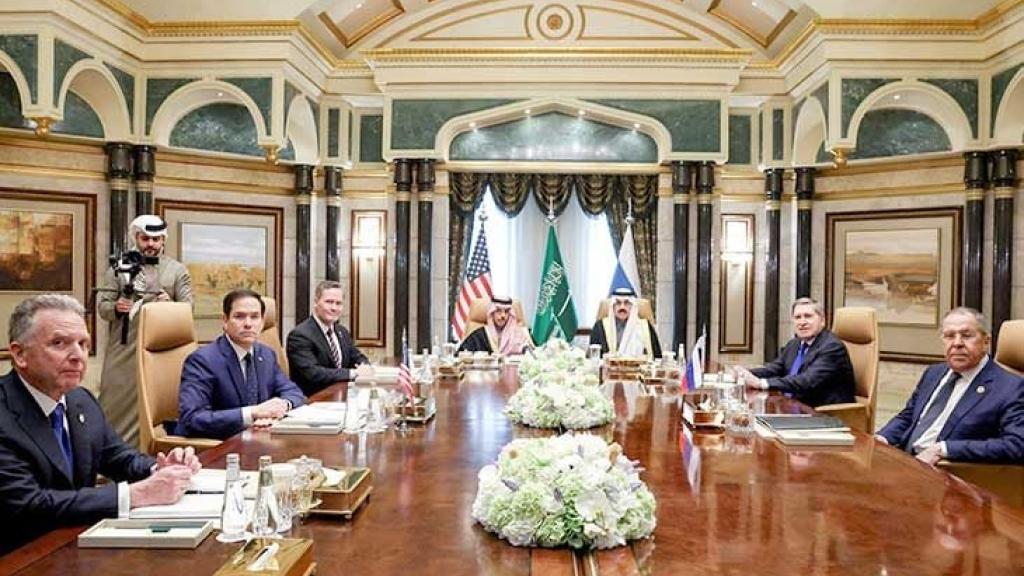
That Washington and Moscow have chosen the Saudi kingdom as the venue for a meeting between their delegations to discuss the prospects of the war that has been ongoing in Ukraine since Russian forces invaded that country three years ago, is evidence of the profound changes occurring in international affairs before our eyes. The manner of the meeting itself is entirely consistent with the venue: Donald Trump’s neofascist administration did not seek to promote peace between the warring parties within the framework of international law and the United Nations, as China has been calling for since the beginning of the conflict, but is rather seeking to conclude a direct agreement with the equally neofascist regime of Vladimir Putin, at the expense of the Ukrainian people. It is therefore only natural that the two parties did not choose a neutral arena consistent with international law, such as the United Nations, but one consistent with their nature, even if its despotic regime is of the traditional type.

What makes the scene even more hideous is that the United States is a full partner in the genocidal war that is waged against the Palestinian people in Gaza, with some of its momentum presently moving to the West Bank. The Trump administration has even rushed to cancel the limited measures that the previous administration had taken in an attempt to deflect the blame, especially the freeze on the export of one-ton bombs that contributed greatly to the destruction of the Gaza Strip and the extermination of its people, as well as to the war of elimination that Israel waged against Hezbollah in Lebanon. Rather, as expected, except for those who tried to escape the bitter reality by projecting their dreams onto it, the new administration has outdone its predecessor in Zionist bidding with Trump’s call to permanently displace the residents of the Strip, i.e. to implement what international law calls “ethnic cleansing” — a crime against humanity.

The Zionist-US neo-fascist axis converges with Putin’s Russia in the racial hatred of oppressed peoples. Moscow has excelled in this area, not only by its colonial aggression against Ukraine, repudiating its national sovereignty, but also in the Arab region, where it played a key role in the destruction of Syria and the extermination of a huge number of its inhabitants, while being openly complicit with the Zionist state in allowing it to bomb Iranian sites in Syria at will (as part of the rivalry between Russian and Iranian influences in that country). Moscow’s foreign minister even equated Russia’s war on Ukraine with Israel’s war on Gaza, comparing the Putinist description of Ukraine’s rulers as Nazis to the Zionist description of Hamas as Nazis. It was likewise noteworthy that Moscow’s reaction to the criminal deportation project uttered by Trump has been restrained, even compared to the explicit condemnation issued by some of Washington’s traditional allies, such as France.

Here are now the Americans involved in killing hundreds of thousands of Gazans meeting with the Russians involved in killing hundreds of thousands of Syrians, the two parties sharing with the Zionist state a common contempt for the territorial rights of peoples. They are meeting on the territory of an Arab state that, if it were truly concerned for the Syrian and Palestinian peoples, should have been so averse to the two parties that it would not even occur to them to ask it to host their meeting.

What we are witnessing in reality is nothing less than a redrawing of the world’s political map, moving from the Cold War confrontation between a Western bloc that claimed to uphold the values of liberal democracy (and has consistently betrayed them) and an Eastern bloc in which dictatorial regimes prevailed — from that confrontation to the dissolution of the Western system, after the Eastern system, as a result of the deadly crisis that struck liberal democracy and the global rise of neofascism. The era of the New Cold War that followed the collapse of the Soviet Union and the dissolution of its bloc, provided the transition by combining the law of the jungle with unrestrained neoliberalism. Washington played the main role in giving both features prevalence over international law and development based on welfare and environmental protection.

We are now witnessing a convergence between neofascists at the expense of oppressed peoples, as the new fascism, like the old one, openly denies the peoples’ right to self-determination. The remaining liberal governments in Europe are stunned, after having relied for eight decades on US protection of the Western system without daring to form a global pole independent of Washington — not only militarily, but primarily in the field of foreign policy. The result is that the oppressed peoples of the world are no longer able to benefit from the rift between great powers that existed in the past but must now wage their struggles of resistance and liberation under more difficult conditions than ever before. The case of Palestine is the clearest evidence of this.

Britain: Resisting Faragism means rescuing the Good Life


Published 

Starmer Farage

First published at Marx’s Dream Journal.

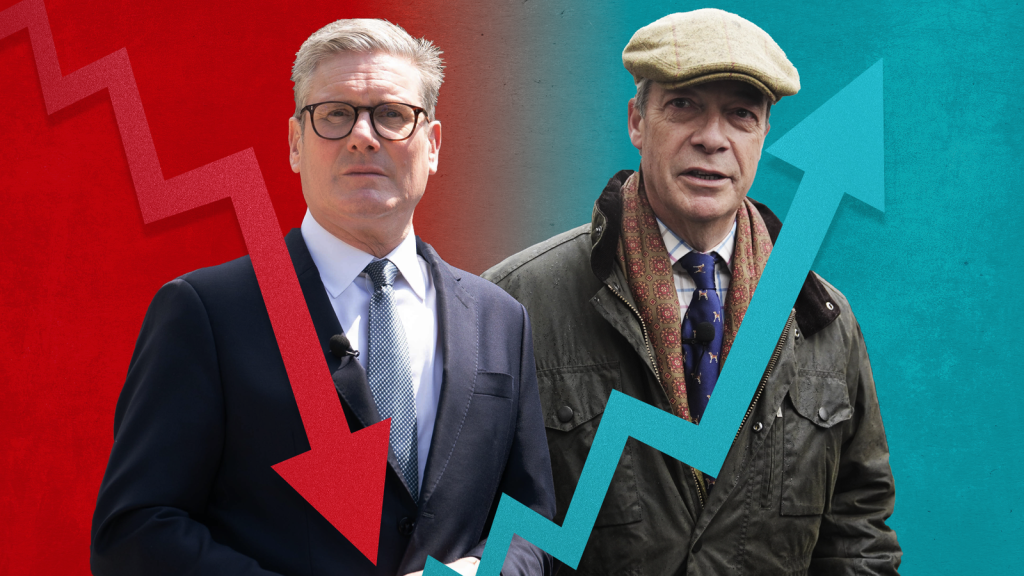
Over the past few weeks, the momentum has swung behind Reform just one bit further. In two council by-elections, in Lichfield and Torfaen, Farage’s party saw councillors elected, and in a poll by JL Partners, Farage’s outfit are projected to win 102 seats, a result which would see almost a third of Labour’s cabinet deposed. In a recent survey commissioned by Find Out Now, Reform are not just leading the poll (the third example of some such outcome), they are projected to win a majority. The polling company’s methodology stands out from other voting models, asking respondents whether they are likely to vote at all before garnering their voter intention. These developments should make us ponder the fundamental reorganisation underway in British politics.

This country’s electoral makeup is potentially undergoing a transformation of the like not seen since the franchise was expanded in 1922, when the newborn Labour Party overtook the Liberals. But rather than a reorganisation of national politics in which the condition of possibility is a growth in the electorate, this change is facilitated by depressed voter turnout. The striking possibility that an over-achieving insurgent far-right political party has a pool of disillusioned non-voters to try and attract is a phenomenon which should press us into action.

The left has been far too complacent for far too long now and our weaknesses are on display everywhere you look. In many instances we refrained from effectively weaponising a classed antiracism, distancing ourselves from class politics to hold together local institutionalised antiracist alliances, whilst shrinking from antiracism in other circumstances for fear of alienating people. We even fooled ourselves into thinking that simply defeating the far right on the streets implied their broad political defenestration. When we did not entertain that dubious falsehood, we lapsed into an impasse, unsure of how to break the animating cycle between escalating state racism and popular hostility towards migrants, refugees and ethnic minorities I have written about before. The parties of the explicitly fascist right may have not been able to force a breakthrough, but the ecology between state racialisation, media hostility and far-right agitation has created a fertile ground for Faragism to shift the Overton Window enough to take advantage in the event of a crumbling Tory voter base and a dysfunctional Labour government. This process of normalisation has not happened under our noses, but in our faces, from Blairism’s hostility towards asylum seekers and its vitriolic campaign against Muslim communities to Brexit and UKIP’s role as a conveyor belt for radicalising Labour voters into Tory cannon fodder. We now have to embrace sobriety and reckon with how to deal with the Faragist right in a moment when it has de-exceptionalised itself.

Nowhere can this process of normalisation best be witnessed than in the gathering rethink amongst the Labour Party hierarchy. At a recent away day, Keir Starmer lambasted his colleagues for their queasiness towards taking a harder position on Britain’s border system, raising the distinct likelihood that he wants to emulate the characteristics of Trumpianism so that he can smash its British interlocutor. In this spirit, Labour released a video on Monday, showing off its deportation of asylum seekers, with Home Secretary Yvette Cooper bragging that 19,000 individuals had now been kicked out of the country. This has been accompanied by Labour advertisements, in Reform colours (no, that’s not a metaphor), gloating, “Labour hits 5 year high in migrant removals”. According to The Times, the party of government now boasts that returns of those with no right to be in the UK are up 20 per cent, deportations from prison are up more than 30 per cent, and illegal working raids are up to 23 per cent. Relatedly, it has been revealed that Morgan McSweeney found Donald Trump’s inauguration speech, “impressive in some ways”, reigniting his passion for the Blue Labourist politics of racial communitarianism. Downing Street’s Chief of Staff is increasingly attracted to the proposition that Labour wear Maurice Glasman’s garments in its efforts to halt Farage.

In a Times exclusive with Gabriel Pogrund and Patrick Maguire, authors of a new title on Labour under Keir Starmer’s leadership, the Prime Minister is compared to the Docklands Light Railway (DLR), a driverless train: “Keir’s not driving the train. He thinks he’s driving the train, but we’ve sat him at the front of the DLR.” This metaphor is right in more ways than one. Transporting commuters between Bank, Canary Wharf and City Airport, Starmerism mirrors the DLR, as a shaky vehicle for the movement of financial and rentier interests. Expressing these interests without any meaningful compromise afforded workers, the party of Labour is throwing its historic coalition into jeopardy and shedding voters in a manner that would make François Hollande proud. In this environment, where racism and nationalism operate as the prisms through which decline is approximated, Starmerism clutching at Blue Labour’s cultural politics to rescue itself makes some sense.

Boosted by the emergence of a new caucus of Blue Labour MPs, led by ex-Socialist Campaign Group member Dan Carden, the dial is shifting. A project waged for redistributive economic policies, protectionism and reindustrialisation, against migration and identity politics, it is a project that has been tried and tested before. Glasman is seemingly back in vogue, invited to Trump’s inauguration, befriended by JD Vance and lauded by McSweeney. In a Politics Home piece, Glasman claimed that he took inspiration for the name from Miles Davis’ Kind of Blue and Bob Dylan’s ‘Tangled up in blue’ (a detail that would leave Stuart Hall, a Davis aficionado, turning in his grave). Explicit about the depressive melancholia that defines the Blue Labour mission, it is in many ways the politics of Old Labour, contorted towards a world in which the classic white male industrial worker subject does not exist, where proletarian identitarianism defines itself against the apparent wokeness of globalisation.

Jonathan Hinder, Blue Labour advocate and MP for Pendle and Clitheroe, evidences the extent of this defeatism when he lauds Starmer’s embrace of Blue Labour politics at the same time as he demands from it, “bold, left-wing economic policies, much lower immigration, a complete rejection of divisive identity politics, and proudly reclaiming our patriotism.” Whilst this cohort of Parliamentarians may claim that they combine social conservatism with left-wing economic policy, it is rarely ever anything but the ethnonationalism that is prioritised and triangulated upon. It is a politics of images, articulated to protect Labour’s embattled representatives in the rustbelt regions and inculcate its leadership into more parochial racial thinking.

Whilst it is certainly the case that adopting this anti-migrant politics of communitarian nostalgia will only validate Faragism and discombobulate the Labour coalition (especially without an accompanying embrace of redistributive policies), the movement of socialism in this country which values both its internationalism and its commitment to egalitarianism has no right to rest on its laurels in the face of the Blue Labour revival. The mission to resuscitate a national social-democratic dream of spatial rebalancing, dignity at work and national pride is a hauntology which begs the question of what our alternative is.

Dan Carden’s passing comment that the Blue Labour Parliamentary caucus is asking deeper, philosophical questions about what “the good life looks like”, frustrated me. One could take comfort in all kinds of truths about how distant the vision they conjure up may be, but if, as Karl Marx warned, revolutions draw their poetry from the future, the internationalist left is in a bind. We are faced with a dual problem: on the one hand, the historic orthodox Trotskyist claim that our side faces a “crisis of leadership” has been superseded by a far worse problem. Despite the mass Palestine solidarity movement of the past two years and 2023’s mini-strike wave, it seems to me that we face a crisis of subjectivity. The absence of independent working class political action on a societal scale, expressed through mass, collective, democratic institutions with power and clout, has perpetually hamstrung socialist politics throughout the 21st Century. We have seen mass movements rise fast, exhaust themselves, and leave little durable infrastructure in their wake.

Relatedly, the modesty of contemporary working class subjectivity strikes right at the heart of how we see the future. Simply put, we do not have a compelling rendering of the Good Life. Corbynism, in some of its more controversial policies, broached upon a notion of what this may look like. A four-day working week, ‘broadband communism’ and a publicly-funded pharmaceutical company for example, though all monstered in 2019, speak daringly today to the realities and anxieties of proletarians in a post-pandemic world. Against a conception of the future which simply wants to reheat the past, we should ask ourselves whether we want an industrial economy at all. Of course, a transitional society will require an expanded manufacturing sector to cope with the strains of climate change and mend our crumbling infrastructure. But the problem with an economy built around health, social care and reproduction is not that those kinds of work are the largest sector, rather it’s that decades of dominant ruling class power and naive commitments to growth have ensured that those jobs are predicated upon shit conditions, maximised exploitation, crap pay and rampant insecurity. A vision of the Good Life must prioritise interdependency against the productive/parasitic divide. It must seek to re-conceptualise space and time around leisure, care and public affluence against loneliness, sickness and privatised luxury. We need a notion of the Good Life which seeks out the transformation of human beings against the recriminatory, suspicious politics so innate to Reform and contemporary Labourism. Our sense of futurity must also speak to a set of class subjects increasingly fed up and conscious of the fact that work does not pay, is no longer the chief way in which we construct our everyday identities and routinely wrecks our bodies and brains.

But in making this a reality, our side must escape the straitjacket of capitalist realism. As I have argued before, Corbynism’s defeat in 2019 was in no small part what happens when our class has won so very little over such a prolonged time, making the ‘Get Brexit Done’ commitment far less remote than any social-democratic policy agenda. A good friend remarked to me the other day that what the Trumpian right has done so successfully is conjure up a “felt imagined community”. Without the luxury of ownership over the relations of representation, assembling a social majority in Britain requires us to forge a felt community that identifies in an antagonistic, furious idiom who our enemies are (Farage and Starmer: two cheeks of the same arse!), focuses on two or three areas of struggle that we can build a popular sense of confidence and capacity around (3-day weekend and price controls!), and generates through community self-repair and associational institutions (free breakfast programs and therapy for all!) a vision of what the Good Life is and how we will both prefigure and generalise it.