Friday, February 21, 2025

Case That Could Inflict 'Financial Ruin' on Greenpeace Heads to Trial

"This fight is bigger than Greenpeace. This lawsuit is a blatant attempt to silence critics and hide destructive practices," said the campaign director of Greenpeace USA.


A Greenpeace USA projection on a building in Washington, D.C. on February 14, 2025.
(Photo: Tim Aubry/Greenpeace)


Eloise Goldsmith
Feb 20, 2025
COMMON DREAMS

With a high-stakes court trial between the environmental organization Greenpeace and the developer of the Dakota Access Pipeline, Energy Transfer, set to begin Monday, the green group earlier this month lit up multiple locations in both Dallas and Washington, D.C. with giant projections that displayed messages such as, "You Can't Put a Movement on Trial" and, "Big Oil Is Suing Greenpeace."

The Dallas-based oil and gas company Energy Transfer—whose executive chairman Warren Kelcy is a donor to U.S President Donald Trump, according to the The Guardian—has accused Greenpeace and other activists of inciting protests that took place against the Dakota Access Pipeline in 2016 and 2017, as well as spreading misinformation about and vandalizing the project.

The lawsuit names Greenpeace International and two U.S. Greenpeace entities. Greenpeace maintains that the protests were directed by Indigenous leaders, not Greenpeace.

The Standing Rock Sioux tribe and its allies said the pipeline, which has been in operation since 2017 and carries crude oil from the Brakken oil fields in North Dakota to Illinois, would endanger the water supply for the reservation and violate the tribe's right to its land.

If successful, the $300 million lawsuit could inflict "financial ruin" on the group, according to Greenpeace. This would have a chilling effect on the organization's work, but leaders within the group have also cast it as an attack on the environmental movement and free speech more broadly.

"This fight is bigger than Greenpeace. This lawsuit is a blatant attempt to silence critics and hide destructive practices," said Rolf Skar, the campaign director of Greenpeace USA, in a Tuesday statement.

Of the projections in D.C. and Dallas, Skar said they "are a testament to that resilience, shining a light on the truth and reminding everyone fighting for a just and livable future that we will not back down."

In a similar vein, Deepa Padmanabha, Greenpeace's deputy general counsel, toldThe Guardian that "Energy Transfer and the fossil fuel industry do not understand the difference between entities and movements. You can't bankrupt the movement. You can't silence the movement. There will be a backlash and a price to pay when you pursue these kinds of tactics."

"People power is more powerful," she added.

The case has also been decried as an example of what are known as "Strategic Lawsuits Against Public Participation"—or "SLAPP" lawsuits, meritless cases whose goal it to bankrupt civil society groups and nonprofits with years of litigation and legal fees.

Greenpeace International, which is based in Amsterdam, has been the first group to initiate a lawsuit under the European Union's new anti-SLAPP directive. The group has sued in a Dutch court to recoup losses it has incurred as a result of its legal fight with Energy Transfer.

Of its bid under the anti-SLAPP directive, Daniel Simons, senior legal counsel at Greenpeace International, said in early February that "if we prevail, it will send a message to corporate bullies that the age of impunity is ending. That would be a boost for civil society in the E.U., and point to solutions for those battling the SLAPP phenomenon elsewhere."

There is no federal anti-SLAPP law on the books in the United States.

There has also been intrigue surrounding the circumstances of the upcoming trial in North Dakota. Greenpeace unsuccessfully sought to have the case moved to a different court over concerns of potential jury bias. The Guardian and the local outlet the North Dakota Monitor have reported on mysterious mailers that were sent to local residents that contain written material slanted against Dakota Access Pipeline protestors and in favor of Energy Transfer.

Energy Transfer Is Putting Free Speech and Climate Activism on Trial

A lawsuit against Greenpeace in North Dakota threatens the existence of all nonprofits.


Defiant Dakota Access Pipeline water protectors faced-off with various law enforcement agencies on the day the camp was slated to be raided.
(Photo: Michael Nigro/Pacific Press/LightRocket via Getty Images)

Davin Faris
Feb 21, 2025
Common Dreams

Imagine a world without effective nonprofit advocacy. When a corporation exploits a local community, no one speaks up or resists. Everyone is too afraid of the weaponized legal system, too vulnerable to liability. The ultra-wealthy take whatever they want and leave others to pick up the pieces. Opposition and resistance have been extinguished.

Those are the risks of a lawsuit against Greenpeace, now going to trial in North Dakota after a seven-year legal battle. Energy Transfer, the company behind the Dakota Access Pipeline, is seeking $300 million for tort damages, including defamation. Energy Transfer’s previous attempt to sue Greenpeace under federal anti-racketeering laws was blocked by the courts. But the state charges have been upheld, with a trial beginning on February 24, and free-speech advocates are raising alarms about the dangerous precedent that would follow a loss for Greenpeace, or even from the trial proceeding at all.

I recently spoke with Scott W. Badenoch, Jr., an attorney at the Environmental Law Institute. He’s part of a team of distinguished international legal scholars, including Steven Donziger and Jeanne Mirer, who have launched a Trial Monitoring Committee to ensure the case against Greenpeace proceeds fairly and transparently.

While the Trial Monitors and some activists will be on the ground in North Dakota, we need to make noise online and in the media, ensuring that as many people as possible know what’s at stake.

As Badenoch described it, the court is trying to maintain “as much of a black box as you could possibly create in the U.S. court system.” Judge James Gion recently denied a motion to allow live streaming of the trial proceedings.

Instead, Badenoch said the case should be dismissed immediately. The allegations attempt to hold Greenpeace responsible for the actions of activists and volunteers unaffiliated with the group. Legal advocates and climate organizers have called it an unconstitutional SLAPP suit, intended to burden Greenpeace with costly legal fees, shut them down, and restrict the free speech of nonprofits more broadly. “There is absolutely no justification for this trial happening in this court, at this time, with this judge,” Badenoch said. “Just none.”

In a press release from the Trial Monitoring Committee, Steven Donziger pointed to recent trends, writing that “this appears to be part of a broader strategy by the fossil fuel industry to weaponize the courts against activists and weaken organizations like Greenpeace in retaliation for their advocacy.”

While the trial itself presents dangers, the recent actions of Energy Transfer have also brought accusations of jury-tampering. In October, residents of rural Morton County, North Dakota, where the trial will be set, received what appeared to be a legitimate newspaper. However, it contained almost exclusively critical attacks on Greenpeace and the pipeline protests, while praising Energy Transfer. The “newspaper” was actually a political mailer from a company called Metric Media, with links to electioneering and fossil fuel companies, as reported in the North Dakota News Cooperative. Even more concerning, financial records link the CEO of Energy Transfer, Texas billionaire Kelcy Warren, to the creation of the fake newspaper. It looks a like blatant attempt to taint the jury pool. Despite this, Judge Gion refused to allow Greenpeace to investigate the origins of the biased mailer.

The crucial role of the Trial Monitoring Committee is to bring attention to these abuses of due process. “We are going to monitor this case one way or the other,” Badenoch told me. “But the more that [Judge Gion] withholds transparency and access from us, the more obvious it is that something is going on that they don’t want people to see.”

Meanwhile, the stakes of the case extend far beyond Greenpeace. If Energy Transfer is successful, Badenoch said, the precedent would be cataclysmic for nonprofit advocacy. An organization could be held liable for any actions by any activists, however tenuously affiliated. “Literally every social justice, climate justice, civil rights, human rights organization across the country—and maybe the planet—is at risk of legal murder in a courtroom, where an organization is put to death by a SLAPP suit.”

As members of the public, that means we all have a responsibility to advocate for transparency, fairness, and ideally dismissal of Energy Transfer’s lawsuit. While the Trial Monitors and some activists will be on the ground in North Dakota, we need to make noise online and in the media, ensuring that as many people as possible know what’s at stake. Badenoch was emphatic about this: “The number one thing is to bring attention to the case. Don’t let Greenpeace die with a whimper.”

In a time of chaos and distraction, it’s all too easy to let cases like this one go unnoticed. But the risks are simply too dire to ignore. “It’s absolutely terrifying for advocacy in this country and beyond. The risks are really hard to overstate,” Badenoch told me. “If Greenpeace is allowed to die in this field in North Dakota, then every single nonprofit is next in line.”
What We Can Learn From Leonard Peltier:
 ‘I Rise Only When I Help You Rise’

The release of Leonard Peltier after nearly half a century in prison offers a chance for a reflection on the nature of justice and how we treat each other.


Leonard Peltier was released from a federal prison in Florida on Tuesday, February 18, 2025.
(Photo: Angel White Eyes / NDN Collective)

Robert C. Koehler
Feb 20, 2025
Common Dreams

“...I write today from a position rare for a former prosecutor: to beseech you to commute the sentence of a man I helped put behind bars.”

Thus begins one of the most stunning letters I have ever read, written almost four years ago by former U.S. Attorney James H. Reynolds to then-President Joe Biden, pleading with him to exonerate former American Indian Movement (AIM) leader Leonard Peltier, who had been convicted of murdering two FBI agents at South Dakota’s Pine Ridge Reservation in 1975.

In one of his last acts before leaving office, Biden did so: freeing Peltier, now 80 years old and beset with health problems, after nearly half a century in federal prison, allowing him to serve the rest of his sentence—lifetime imprisonment—from the Chippewa reservation in North Dakota that is his home. Peltier was released from prison on February 18.

Hey, big news—kind of. Much of the mainstream coverage has been careful to present it as simply a kind-hearted act by the U.S. Department of Justice, allowing an elderly, convicted murderer to spend his final years under home incarceration. It has downplayed not only the serious flaws in the case against Peltier and the worldwide demands for his release—from Amnesty International, from Pope Francis, from Nelson Mandela, and so many others—it has avoided any mention of the larger context: that white America has long been at war with the continent’s Native population, taking their land and attempting to obliterate their culture, essentially declaring them to be subhuman.

For that reason, the fact that Reynolds’ letter is now poking itself into the present news cycle is utterly mind-boggling.

The Pine Ridge shootings occurred on June 26, 1975, when two FBI agents entered the reservation to arrest a resident for stealing a pair of cowboy boots. According to Peltier-supporters’ account, the agents entered private property without identifying themselves. Many AIM members happened to be present at the time. A shootout took place—the reason uncertain—and the two agents, along with a Pine Ridge resident, were killed. The reservation was soon surrounded by about 150 police and FBI officers. Peltier, a Native rights activist, was among those arrested and eventually became the focal point of the government’s case.

Reynolds’ letter to Biden continues: “Leonard Peltier’s conviction and continued incarceration is a testament to a time and a system of justice that no longer has a place in our society. I have been fortunate enough to see this country and its prevailing attitudes about Native Americans, progress dramatically over the last 46 years.”

He then goes into detail about the case itself, explaining: “We were not able to prove that Mr. Peltier personally committed any offense on the Pine Ridge Reservation. As a result, we shifted our stance on the theories of guilt throughout the prosecution and appeal.”

Ultimately, the entirety of the case against Peltier, he writes, was that he was present at the reservation and was in possession of a weapon. There was no evidence that he shot the agents—or evidence against anyone else at the reservation. Indeed, The Guardian, writing about the case, notes that a witness who testified that she saw Peltier shoot the agents “later said she had been coerced into testifying and recanted her testimony.”

All of which sets the context for the largest point Reynolds makes to Biden, transcending the case itself and looking directly at the country’s evolving social consciousness:

“I believe,” he writes, “that a grant of executive clemency would serve the best interests of justice and the best interests of our country. In my opinion, to continue to imprison Mr. Peltier any longer, knowing what we know now, would serve to continue the broken relationship between Native Americans and the government.”

“I urge you to chart a different path in the history of the government’s relationship with its Native people through a show of mercy rather than continued indifference. I urge you to take a step toward healing a wound that I had a part in making. I urge you to commute Leonard Peltier’s sentence and grant him executive clemency.”

All I can do is let these words sit there for a moment. My God, this is a larger look at the nature of justice than I would expect from at actual member of the Department of Justice. Mr. President, let us take action now to begin healing our broken relationship with Native Americans. Let us look at ourselves!

It took Biden several years to take action on Peltier’s incarceration, and it’s not as though Biden’s commutation was also an exoneration—a declaration of his innocence... nor was it an apology for the nation’s, or for Europe’s, five centuries of land theft and cultural dehumanization of Indigenous people of the Americas.

But let me dig for a moment into the words of Peltier himself, who has written an account of how, as a nine-year-old boy, he (along with his sister and a cousin) were taken from their homes and sent off to... uh, boarding school, perhaps more accurately called dehumanization school, the point of which was to take away their language, their culture, their humanity. Upon arrival, the children were stripped naked, forced into hot showers, then “they put DDT all over us. The poison even got in our eyes and mouths.”

The children were told it was to kill lice and other insects—but in reality it was no doubt to eliminate the “Indian” in them. “They made it clear we were hated,” he wrote. “With every look, with every cruel word, they continued a war our ancestors had fought since their ancestors landed here back in 1492.” Some of the kids wound up committing suicide; they were buried in unmarked graves on the school grounds.

Peltier also noted: “We spoke our language. We sang our songs. And we prayed in our languages, all in secret.”

Proof of his guilt—he broke the rules!

He concluded his boarding school memories by writing: “You don’t treat people badly like that. I rise only when I help you rise. Despite all those beatings, I still believe it. It’s a law, like physics, and it’s true. You get nowhere being mean and disrespecting the feelings of others, especially the most vulnerable. I have seen both kinds of people and more than my share of evil ones, and I know I’m right. I rise only when I help you rise.”

This isn’t what the boarding school taught, but apparently this is what he learned. And now, his intention is to teach it to the world.
'He's Selling Out': Teamsters President Faces Backlash for Cozying Up to GOP

HE SOLD OUT WHEN HE SPOKE AT THE GOP CONVENTION

One labor journalist called his comments regarding right-to-work "shameful" and "embarrassing."


President of the International Brotherhood of Teamsters Sean O'Brien (right) attends the confirmation hearing for Lori Chavez-DeRemer, President Donald Trump’s pick to lead the Labor Department
(Photo: Chip Somodevilla/Getty Images)


Eloise Goldsmith
Feb 20, 2025
COMMON DREAMS

International Brotherhood of Teamsters President Sean O'Brien faced backlash from labor movement voices on Wednesday for expressing his support for U.S. President Donald Trump's pick to lead the Department of Labor and for appearing to take a softer stance on so-called "right-to-work" laws—policies generally decried by organized labor because they allow employees to opt out of union expenses while working at a unionized establishment.

Labor journalist Alex Press called his comments regarding right-to-work "shameful" and "embarrassing."

Over the summer, Press spoke with rank-and-file Teamsters members about recent actions from O'Brien that signal a rightward shift, such as his decision to headline the first night of the 2024 Republican National Convention. "Some are undoubtedly thrilled," wrote Press, though "a growing number of members believe their president is offering a straightforward, if not always explicit, endorsement of a political party that wants to destroy them."

On Wednesday, O'Brien attended the Senate confirmation hearing of Oregon Republican Lori Chavez-DeRemer, Trump's labor pick, during which Chavez-DeRemer said she would support Trump's agenda, according to The New York Times. Chavez-DeRemer also told senators that she no longer supports a section of the Protecting the Right to Organize (PRO) Act—sweeping Democratic labor legislation that was introduced in Congress but never passed—which would have weakened state right-to-work laws.

Speaking later Wednesday on Fox News, O'Brien said of Chavez-DeRemer, "Not only do we support her appointment, we are going to the mat to make sure that she gets confirmed."

When asked about Chavez-DeRemer's stance on the right-to-work section of the PRO Act, O'Brien said that he is working with senators such as Sen. Josh Hawley (R-Mo.) to come up with a version of the PRO Act that "may not include that."

"That's the beauty of having conversations with people from the other side, where you can collaborate and actually find out what works for that state, what doesn't work for it—but more importantly, what's going to work for the American worker," O'Brien said.

A clip of these comments was reposted by the National Right to Work Committee, a group dedicated to "combating the evils of compulsory unionism," according to its website.

"The Teamsters union is as decentralized as the country. Like the median voter, most Teamsters aren't closely following what Sean O'Brien is saying," wrote labor journalist Luis Feliz Leon in response. "The press should ensure they know how he's selling out members to cozy up to anti-worker politicos and bolstering the power of bosses."

In the same Fox News interview, O'Brien also said the Teamsters do not want to see anyone losing their job, but that "[Trump] thinks he's within his right," when asked about the personnel-slashing Department of Government Efficiency and the Trump administration's widely decried deferred resignation program for nearly all federal employees. Multiple federal employees unions are currently battling the Trump administration in court over its actions targeting federal workers and federal agencies.

"What a shame. Teamsters deserve better than this," wrote Rep. Alexandria Ocasio-Cortez (D-N.Y.) in response on Bluesky.

Another labor journalist, Kim Kelly, denounced a video posted Wednesday by Sen. Markwayne Mullin (R-Okla.)—whom O'Brien nearly physically fought during a Senate hearing last year—in which Mullin and O'Brien chum it up and both express support for Chavez-DeRemer.

Also in response to the video, an observer on X with username katy, who indicates they are a part UFCW Local 371, wrote, "class traitor."

"I was raised in a Teamsters household, survived because of union benefits, and still do. I'd rather starve than lick a boot," katy wrote. "We're the union."


Trump Labor Secretary Pick Vows to Defend Anti-Union 'Right-to-Work' Laws

"How very not pro-worker of you," the Philadelphia Council AFL-CIO said in response to Lori Chavez-DeRemer's remarks.


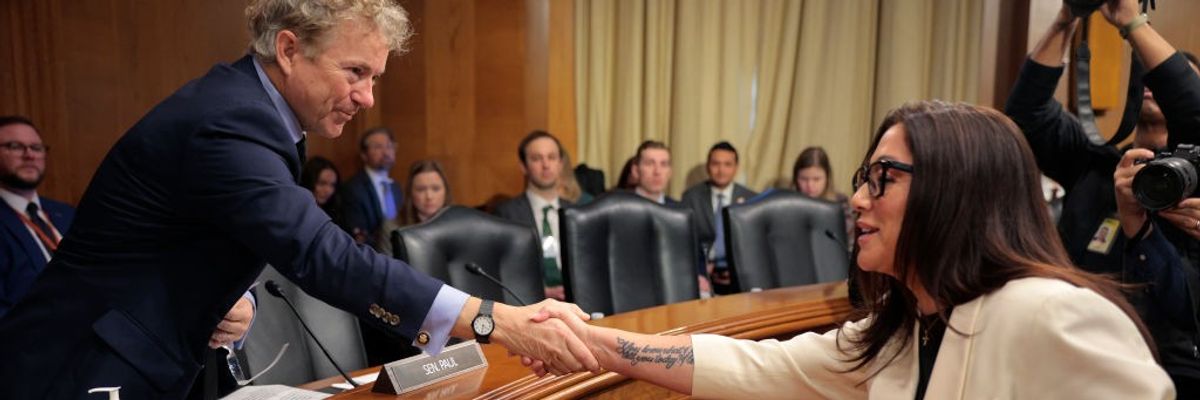
Lori Chavez-DeRemer, President Donald Trump’s pick to lead the Labor Department, greets Sen. Rand Paul (R-Ky.) as she arrives for her confirmation hearing on February 19, 2025.
(Photo: Chip Somodevilla/Getty Images)

Jake Johnson
Feb 19, 2025
COMMON DREAMS


U.S. President Donald Trump's pick to lead the Department of Labor made clear during her Senate confirmation hearing on Wednesday that she no longer supports legislation known as the PRO Act, which would bolster worker organizing and dramatically weaken anti-union "right-to-work" laws currently in place in over two dozen states.


Asked by Sen. Rand Paul (R-Ky.) whether she still supports the Protecting the Right to Organize Act—a bill she co-sponsored while in Congress—former Rep. Lori Chavez-DeRemer (R-Ore.) said she signed onto the bill because she "wanted to be at that table," not because she was fully supportive of its provisions.

Chavez-DeRemer answered "yes" when Paul—the lead sponsor of the National Right to Work Act—specifically asked her to confirm that she no longer supports "the aspect of the PRO Act that would have overturned state right-to-work laws."

"The right to work is a fundamental tenet of labor laws, where states have a right to choose if they want to be a right-to-work states," said Chavez-DeRemer.

"How very not pro-worker of you, Lori," the Philadelphia Council AFL-CIO wrote in response.

Watch the exchange:


In so-called right-to-work (RTW) states, employees in unionized workplaces can opt out of paying union dues while still benefiting from the union's collective bargaining efforts.

An Economic Policy Institute study published last year found that RTW states "have lower unionization rates, wages, and benefits compared with non-RTW states."

"RTW laws are designed to diminish workers' collective power by prohibiting unions and employers from negotiating union security agreements into collective bargaining agreements, making it harder for workers to form, join, and sustain unions," the study noted. "Consequently, workers in states with RTW laws have lower wages, reduced access to health and retirement benefits, and higher workplace fatality rates. On average, workers in RTW states are paid 3.2% less than workers with similar characteristics in non-RTW states, which translates to $1,670 less per year for a full-time worker."

In her opening remarks to the Senate Health, Education, Labor, and Pensions Committee on Wednesday, Chavez-DeRemer said her job if confirmed "will be to implement President Trump's policy vision"—which has thus far been glaringly anti-worker.

"In his first few weeks back in office, Trump fired the [National Labor Relations Board's] acting chairperson, leaving the board without a quorum to enforce laws that protect workers' right to unionize," Steven Greenhouse, a senior fellow at The Century Foundation, wrote Tuesday. "Trump has designated [Elon] Musk, a vehemently anti-union billionaire, to launch an all-out war against the federal bureaucracy and workforce, and Trump and Musk have essentially treated the nation's 2 million-plus federal employees as if they were disposable, low-quality widgets."

Trump also removed former NLRB General Counsel Jennifer Abruzzo, who was strongly pro-labor. The president's acting replacement has moved quickly to roll back NLRB guidance issued during Abruzzo's tenure, including a memo declaring that anti-union "captive audience meetings" amount to an "unlawful threat" aimed at deterring union organizing.

During Wednesday's hearing, Sen. Bernie Sanders (I-Vt.) raised Trump's termination of former NLRB member Gwynne Wilcox, who argues her dismissal was illegal and is suing Trump in federal court.

Sanders said he also views Wilcox's firing as unlawful and asked Chavez-DeRemer if she agrees.

In response, Chavez-DeRemer said that Trump "has a right to exercise his executive power."


Hurricane-proofed downtown skyscrapers unexpectedly vulnerable to ‘bouncing’ winds


Design to withstand hurricanes isn’t enough to protect tall buildings and façade systems against the climate crisis


Frontiers


Houston, we have a problem. The ‘Space City’ boasts 50 buildings over 150 meters tall. These were designed to withstand hurricanes, to which Texas is prone. But on May 16th, 2024, a derecho – a wide, long-lived windstorm associated with rapidly moving showers or thunderstorms – managed to cause unexpected damage to many of the tall buildings downtown. The socio-economic impact was significant, due to traffic disruptions, businesses temporarily closing, and the need for repairs.

Why was the structural damage so much larger than expected? A new study in Frontiers in Built Environment has now provided the answer to this conundrum. Its findings carry lessons for the future design of tall buildings and the planning of city centers, not only in Houston.

"Here we show that a type of highly localized strong winds called ‘downbursts’, which were generated during the May derecho, can significantly impact tall buildings and facades due to their unique characteristics in comparison to hurricanes,” said Dr Amal Elawady, an associate professor at Florida International University, and one of the study’s authors.

Downbursts are strong downward winds that blow outward in all directions once they hit the ground – and the reason why winds are often much more intense around the ground floor of tall buildings. Elawady leads a research project that utilizes the Natural Hazards Engineering Research Infrastructure’s ‘Wall of Wind’ experimental facility, funded by the US National Science Foundation, to study the impact of downbursts on tall and low-rise buildings in comparison to hurricanes.

An ill wind

Here, the authors analyzed the impact of the May derecho on five iconic buildings in Houston: the Chevron Building Auditorium, the CenterPoint Energy Plaza, the El Paso Energy Building, the RRI Energy Plaza, and the Wedge International Tower. Built between 1962 and 2003, these high-rises are 158 to 226 meters tall. All conformed to the construction standard which dictates that tall buildings be designed to withstand winds up to 67 meters per second, corresponding to a category 4 hurricane.

Wind speeds measured in downtown Houston during the derecho didn’t come close to this construction standard, as they peaked at 40 meters per second. Nonetheless, as illustrated by the study, facade panels on these tall buildings were dislodged while cladding was damaged, especially on corners and lower floors. Numerous windows cracked or shattered, raining dangerous debris down into the streets.

In contrast, these tall buildings sustained minimal damage during hurricane Beryl, which hit Houston on July 8th, 2024. The maximum wind speed measured in downtown Houston during Beryl was 36 meters per second, comparable to the derecho.

Seeing which way the wind blows

The researchers proceeded to simulate downbursts and hurricanes at the Wall of Wind experimental facility, whose 12 jet fans can generate wind speeds up to 70 meters per second. These were blasted against a revolving miniature representing a tall building on a 1:350 scale. An identical miniature stood at increasing distances ranging from 0.14 to 0.70 meters from the first, to mimic interference from neighboring buildings.

The authors compared two conditions which differed in the variation of the mean wind speed over time: a constant average speed typical of hurricanes, and a speed that at first rapidly ramped up, reached a plateau, and then ramped down, characteristic of downbursts. The results showed that there was far more suction on the sides of buildings during downburst events than during hurricanes.

"When strong winds move through a city, they can bounce due to interference between tall buildings. This increases pressure on walls and windows, making damage more severe than if the buildings were isolated," said Omar Metwally, a doctoral student who was the study’s first author.

"On top of this, downbursts create intense, localized forces which can exceed typical design values for hurricanes, especially on the lower floors of a tall buildings.”

This one-two punch effect of interference and downbursts on tall buildings is likely to become an even worse problem soon, as human-induced climate change is already hitting Houston especially hard. The Gulf of Mexico is warming at 0.19°C per decade, twice the rate of the global ocean. Higher temperatures are predicted to bring more frequent and more severe extreme weather.

“Accounting for the unique effects of downbursts and thunderstorm winds in derechos is essential in urban planning and building design, to protect tall buildings against damage. Current construction guidelines for facades should be re-revaluated to reflect this," concluded Metwally.

Can sandals be art? Birkenstock says yes, but a German court says no

February 20, 2025

A Birkenstock sandal is pictured in a Birkenstock store in Frankfurt, Germany
(AP Photo/Michael Probst, File)

BERLIN — Birkenstocks: they are ubiquitous in the summer, comfy and very German, come in many colors and shapes, look sometimes chic and sometimes shabby. But can these sandals be considered art?

That’s what Germany’s Federal Court of Justice had to decide on Thursday, and it ruled they’re just comfy footwear.

Birkenstock, which is headquartered in Linz am Rhein in western Germany and says its tradition of shoemaking goes back to 1774, had filed a lawsuit against three competitors who sold sandals that were very similar to its own.

The shoe manufacturer claimed its sandals “are copyright-protected works of applied art” that may not simply be imitated. Under German law, works of art enjoy stronger and longer-last intellectual property protections than ordinary consumer products.

The company asked for an injunction to stop its competitors from making copycat sandals and order them to recall and destroy those already on the market The defendant companies were not identified in the court statement.

Before Germany’s highest court for civil trials weighed in this Thursday, the case had been heard at two lower courts, which disagreed on the issue.

A regional court in Cologne initially recognized the shoe models as works of applied art and granted the orders, Cologne’s higher regional court later overturned the orders on appeal, German news agency dpa reported.

The appeals court said it was unable to establish any artistic achievement in the wide-strapped sandals with the big buckle.

On Thursday, the Federal Court of Justice sided with Cologne’s higher regional court and dismissed the case. In its ruling, it wrote that a product can’t be copyrighted if “technical requirements, rules or other constraints determine the design.”

So when it comes to Birkenstock’s sandals, functionality and craft trumps art — at least in the eyes of the law.

“For the copyright protection of a work of applied art — as for all other types of work — the level of design must not be too low,” the court wrote. “Purely technical creation using formal design elements is not eligible for copyright protection. Rather, for copyright protection, a level of design must be achieved that reveals individuality.”

Kirsten Grieshaber, The Associated Press
Unifor has 'grave concern' over Stellantis work halt in Brampton, Ont.
February 20, 2025 

Cars pass along the assembly line at the Stellantis plant in Brampton, Ont. 
 THE CANADIAN PRESS/Chris Young

BRAMPTON, Ont. — Unifor says it’s gravely concerned by Stellantis' unexpected announcement that it’s halting work at the Brampton Assembly Plant in Ontario.

The company has been retooling the plant for both electric and gas Jeep Compass vehicles and was set for production to start later this year.

Unifor says Stellantis has reassured it that production plans are still in place for the plant, but the union is concerned that the timing of the pause brings those plans into doubt.

Lana Payne, national president of Unifor, says the threat of tariffs and the repeal of electric vehicle initiatives are creating chaos and uncertainty in the North American auto industry.

Stellantis did not immediately respond to a request for comment.

The Brampton plant, which has been down since early 2024 to prepare for the new production line, had about 3,000 employees before closing.

This report by The Canadian Press was first published Feb. 20, 2025.
TECHNOLOGICAL CHANGE

Rogers cutting 'small percentage' of customer service employees

ALONG WITH TECHS, THEY ARE THE MOST IMPORTANT WORKERS
February 20, 2025 

Rogers Communications Inc. says it has laid off some of its customer service staff amid a shift in customer habits. Rogers store signage shown in Mississauga, Ont., Monday, Dec.16, 2024. THE CANADIAN PRESS/Richard Buchan

TORONTO — Rogers Communications Inc. says it has laid off employees from its customer service department amid a shift in customer habits.

The Toronto-based company says the cuts affect “a small percentage of roles in our customer service team,” however it declined to clarify how many employees were let go.

It says the majority of positions affected are based in Ontario.

Spokesman Zac Carreiro says Rogers is investing in digital tools and self-serve options that help customers “find what they’re looking for faster,
” noting this reflects evolving customer habits.

He says those investments have reduced interactions with Rogers' customer care chat team by 20 per cent over the past year.

Rogers, which has previously touted having its customer service team based entirely in Canada, also offers support through virtual assistant tools.

This report by The Canadian Press was first published Feb. 20, 2025.


What Trump aims to achieve with his tariff plans
February 20, 2025


After promising during his election campaign to put import taxes back at the center of U.S. economic policy, U.S. President Donald Trump has moved swiftly in that direction, announcing multiple plans for significant new tariffs aimed at U.S. trading partners.

Although many of the tariffs have yet to be implemented as the administration uses the threat of them to intimidate or gain leverage on other disputes, the tactics represent a dramatic shift in a global economy where most major economies have sought to reduce trade barriers.

What has Trump done so far?

Trump kicked off a barrage of tariff announcements in early February with a blanket 10% tax on imports from China. Following that move, he announced a plan, since delayed, to end tariff exemptions for “de minimis” merchandise from China and Hong Kong covering packages valued at less than $800.

Trump also ordered 25% tariffs on goods from Canada and Mexico but then paused them for 30 days, until early March, after leaders of the two countries committed to addressing demands he made on them.

Next, Trump unveiled plans for a 25% levy on US imports of steel and aluminum, and directed his administration to propose a round of so-called reciprocal tariffs customized for each trading partner to offset any perceived disadvantage for US manufacturers.

On Feb. 19, Trump said he would likely impose tariffs of around 25% on automobile, semiconductor and pharmaceutical imports.

Trump eyeing spring start for lumber tariffs; could new levy stack on current one?

Together, the announced measures have the potential to reshape global commerce.


What is Trump trying to achieve?

During his confirmation hearing in early January, Scott Bessent, Trump’s treasury secretary, told senators that people should expect Trump to use tariffs in three ways: to remedy unfair trade practices (which Trump has said would revitalize American industry), to raise revenue for the federal budget (important to help pay for Trump’s plans to extend his 2017 tax cuts), and to use as a lever in negotiations with foreign powers in place of sanctions, which Trump believes have been overused.

Boosting American manufacturing: Trump has talked about using tariffs to revitalize manufacturing and stop the US getting “ripped off” by other countries due to trade imbalances. He has floated the idea of using a mix of tariffs and incentives such as expedited permitting approval as a way to entice companies to build their facilities in the US.

“We’re going to bring the companies back,” he said during an interview with Bloomberg Editor-in-Chief John Micklethwait at the Economic Club of Chicago in October. “We’re going to lower taxes still further for companies that are going to make their product in the USA. We’re going to protect those companies with strong tariffs.”

Trump imposed several rounds of tariffs on Chinese goods during his first term and said he was just getting started using them to remake the US economy when the Covid-19 pandemic hit and scrambled his plans.

Howard Lutnick framed the tariff plan as a means to regain the world’s respect during his confirmation hearing as commerce secretary, telling senators that US allies and adversaries alike “are taking advantage of us, they are disrespecting us and I would like to see that end.”

Raising revenue: Income from tariffs could help pay for the tax cuts promised by Trump. He wants to extend reductions in income taxes that were approved in 2017 during his first presidency, many of which are due to expire at the end of 2025.

He’s even floated proposals for expanding these tax breaks, for example by exempting tips and social security earnings from taxation. He also aims to slash the corporate tax rate to 15% from 21%.

These measures are expected to lead to a loss in government revenue of $4.6 trillion over 10 years. “Tariffs can easily pay for that,” Peter Navarro, a Trump trade adviser, told CNBC on Jan. 31. “President Trump wants to move from the world of income taxes and countless IRS agents to the world where tariffs, like in the age of [President William] McKinley, will pay for a lot of government that we need to pay for and lower our taxes.”

Wielding a weapon of diplomacy: Trump has become skeptical of sanctions because they drive other countries away from the dollar, and sees tariffs as a way to gain leverage in negotiations, according to Bessent.

Trump’s brief January standoff with Colombia — in which he threatened to impose tariffs over repatriation flights for undocumented migrants — provided a glimpse of Trump’s strategy.

For a few hours, it seemed that a trade war between the US and one of its closest allies in Latin America was inevitable. Then Trump pulled back on his threat after an agreement was reached between the two countries.

The White House said Colombia had “agreed to all of President Trump’s terms” and would accept deportees on US military aircraft. Colombia sent military planes to the US to pick up dozens of nationals.

Trump’s tariff orders on imports from Canada, Mexico and China are intended to address what he calls a “threat to the safety and security of Americans, including the public health crisis of deaths due to the use of fentanyl.” Trump’s decision to delay tariffs on Mexico and Canada for a month came after their governments agreed to step up efforts to address illegal migration and drug trafficking at the border.

How radical is Trump’s approach?


Some preexisting US tariffs on goods from China, Canada and Mexico already approached or even exceeded the levels Trump set. But these only apply to select categories of goods. Levying them across the board is a major departure.

Those preexisting, relatively high tariffs apply to such a small portion of US trade that the US has had a trade-weighted average tariff rate of 2% for imported industrial goods. (That figure can be calculated by dividing the total value of imports by the total tariff revenue.) Such goods make up 94% of US merchandise imports by value, and half of them entered the US duty-free.

And on top of Trump’s proposed blanket tariffs are all the others.


Is Trump’s approach new?


The US taxed imports heavily for much of its history before largely abandoning the policy beginning in the 1930s, as government leaders embraced the idea of free trade.


A big reason for that was the reaction to the Smoot-Hawley Act of 1930, which led to an estimated increase of roughly 20% in average import duties. The act provoked retaliatory tariffs from foreign governments, resulting in a drop in global trade and a deepening of the Great Depression.


That debacle kicked off a multidecade period that saw the rise of free trade, which culminated in the creation of the World Trade Organization in 1995. During that time, tariffs became anathema to the Republican Party.

They made a comeback during Trump’s 2017-2021 presidency, when he turned to them in an effort to revitalize American industry and counter what the US regards as China’s unfair trade practices. President Joe Biden kept the trend going.

How does China figure into all of this?

For decades, the belief in free trade was backed by a bipartisan consensus in the US and by multinational corporations that wanted access to cheap and efficient supply chains overseas. China’s ascension as a global economic power broke that consensus.

Admitted to the WTO in 2001, China gained greater access to global markets even as its critics say it violated the letter and spirit of free-trade rules, for example by subsidizing its industries and compelling foreign companies operating in China to part with their know-how.

A number of researchers have concluded that competition from China triggered a decline in US employment among manufacturers that faced a surge in imports.

During Trump’s first presidency, his administration imposed new tariffs on Chinese imports that were worth about $380 billion in 2018 and 2019.

The Biden administration maintained those levies and raised more of them in 2024 on goods worth an additional $18 billion. The new enthusiasm for tariffs has spread to the European Union.

It voted in early October to impose duties as high as 45% on electric vehicles from China, which in turn has threatened to retaliate against European products.

Can Trump raise tariffs without congressional approval?


Yes. Through a number of statutes, Congress has empowered the US president to modify tariffs to address a variety of concerns.

These include a threat to national security, a war or emergency, harms or potential harms to a US industry, and unfair trade practices by a foreign country.

While companies might try to fight higher tariffs in court, because of past deference given to presidential powers, such challenges “would face a steep uphill climb,” according to an article posted by the Center for Strategic & International Studies and co-authored by Warren Maruyama, a former general counsel for the Office of the US Trade Representative.

How do tariffs work?


A tariff, also known as a duty or levy, is usually calculated as a percentage of a good’s value (as declared during the customs clearance process.) It can also be levied as a fixed amount on each item.

Goods that cross borders are given numeric codes under a standardized nomenclature called the “international harmonized system.”

Tariffs can be assigned to specific product codes relating to, for example, a truck chassis, or to broad categories, such as electric vehicles. Customs agencies collect tariffs on behalf of governments.

Who pays tariffs?


Tariffs are paid by the importer, or an intermediary acting on the importer’s behalf, though the costs are typically passed on. Trump argues that, ultimately, it’s the exporter who effectively ends up shouldering the cost of a tariff. Studies have shown the burden is more diffuse.

The foreign company that makes the product may decide to lower prices as a concession to the importer. Or it might spend significant sums to build a factory somewhere to sidestep the tariff.

Or an importer — Walmart and Target are among the biggest in the US — could raise prices of the item when it’s sold on. In this case, it’s the consumer who shoulders the tariff cost indirectly.

How do tariffs affect the economy?

It can be difficult to sort through the economic effects of tariffs. They can stimulate employment by attracting investment as companies try to get around tariffs by moving factories to the taxing country. At the same time, they can provoke retaliatory tariffs that cost jobs in other parts of the economy.

Moments after the new US tariffs on China took effect, Beijing blacklisted a handful of American companies, imposed import levies on some US oil and other goods and placed export controls on a selection of critical minerals. Before Trump delayed the tariff hikes on Canada and Mexico, those two countries had also said they would retaliate if the levies were increased.

When a country imposes import tariffs, domestic manufacturers don’t necessarily leap in to start making the products affected. And if the nation has no alternative domestic supply of the goods concerned, then prices of those goods can go up.

Economists are still untangling the inflationary effects of Trump’s initial tariffs from a much bigger shock to supply chains and economic activity that started not long after the US-China trade war began: the Covid-19 pandemic.

In February 2019, the Federal Reserve Bank of San Francisco estimated that the tariffs were adding 0.1 percentage point to consumer price inflation and 0.4 percentage point to a metric that measures the costs for businesses to invest.

Erica York, senior economist at the nonpartisan Tax Foundation, estimated that the higher tariffs imposed by Trump and Biden increased annual costs for the average US household by $625.

In addition, York estimated that the hikes would eliminate 142,000 full-time jobs and, over the long run, would reduce long-run gross domestic product by 0.2% on average. Critics of Trump’s further tariff increases say they will have the same kinds of effects at a greater scale.

Daniel Flatley and Brendan Murray, Bloomberg News


Teck says US tariffs could mean altered trade flows but not material hit

By The Canadian Press
February 20, 2025 

The Teck Resources logo is seen on a podium before the company's special meeting of shareholders in Vancouver on Wednesday, April 26, 2023. T
HE CANADIAN PRESS/Darryl Dyck

Teck Resources Ltd. says it expects to find other trade routes for some of the metals it refines in B.C. if the U.S. goes ahead with tariffs.

Chief executive Jonathan Price told a conference call with investors that border taxes shouldn’t have a material impact on Teck overall, but that it will adjust where need be.

The company exports most of its copper and zinc concentrates to Asia and Europe and so would avoid the proposed 25 per cent tariffs on Canadian goods, he said.

Output from Teck’s refinery in Trail, B.C., including zinc, lead and specialty metals like germanium, Idium, and sulphur products are sold into the U.S. and so it will likely find alternatives, Price said.

“In the event that tariffs are imposed, we expect trade flows to adjust.”

He said that while Teck is one of the largest suppliers outside of China of the group of metals, they make up less than 15 per cent of company revenue.

The threat of tariffs is also risking wider trade and economic disruptions, but Teck expects that trends like urbanization and electrification will underpin demand for its main products.


“Globally we are witnessing a period of significant economic uncertainty and change that will alter trade flows and potentially impact global supply chains and market dynamics,” Price said.

“Teck has a resilient business driven by the diversification of our products and operations.”

Copper exports remain a key driver for the company with record production helping push the company to swing to a profit in its last quarter.

The Vancouver-based mining company said Thursday it earned a profit from continuing operations attributable to shareholders of $385 million or 75 cents per share for the quarter ended Dec. 31. The result compared with a loss of $167 million or 32 cents per diluted share in the last three months of 2023.

On an adjusted basis, Teck says it earned 45 cents per diluted share from its continuing operations, up from an adjusted profit of four cents per share a year earlier.

Teck said the record copper production came as the company saw strong performance at its Quebrada Blanca operations in northern Chile.

Price said the boost to copper came in a year that saw the company transform into a pure-play energy transition metals company after it sold off its remaining stake in its steelmaking coal business to Glencore.

Revenue for the quarter totalled $2.8 billion, up from $1.8 billion last year.

Copper production in the quarter amounted to 122,000 tonnes, up from 103,000 a year earlier, while zinc in concentrate totalled 146,000 tonnes, down from 182,000 tonnes. Refined zinc production totalled 62,000 tonnes, down from 70,000 tonnes a year earlier.

The company has used the proceeds from the sale of its coal business to help reduce debt, fund its near-term copper growth, and reward shareholders in the form of buybacks and dividends.

Teck said Thursday that it returned $1.8 billion to shareholders through share buybacks and dividends in 2024, including $549 million in the fourth quarter.

It also said it reduced its debt by US$196 million in the fourth quarter, including a scheduled semi-annual repayment on the Quebrada Blanca project financing facility. Teck said it reduced its debt by US$1.8 billion last year.

This report by The Canadian Press was first published Feb. 20, 2025.
As Trump flags timber tariffs soon, B.C. minister says impact would be ‘devastating’

Provincial and federal governments need to continue to make the case that while such tariffs hurt Canadians, they will also hurt Americans. “Whether it’s the wildfires in California, the hurricanes in North Carolina, the cost of doing business, the cost of rebuilding their homes is going to skyrocket in those states.
February 20, 2025 

President Donald Trump steps off Air Force One upon arrival at Miami International Airport, Wednesday, Feb. 19, 2025, in Miami. (Photo image via AP)

B.C.‘s Forests Minister Ravi Parmar says the expectation of more duties and additional tariffs piled onto Canadian softwood lumber would “absolutely be devastating” for the country’s industry.

Parmar says the government expects the U.S. Commerce Department will issue anti-dumping duties by Friday of as much as 14 per cent, on top of the current 14.4 per cent duty.

It comes after U.S. President Donald Trump told media on Air Force 1 that his administration was eyeing a 25 per cent tariff on lumber some time around April.

Parmar says he knows many forestry workers are going to be worried about their jobs and he’ll continue to fight for them.

He says the extra tariffs are “very likely” and Canada should take Trump at his word.


Trump has paused his threat of tariffs until March 4, but says he still plans 25 per cent tariffs on all Canadian goods and a 10 per cent levy on imports of Canadian energy.

Canadian steel and aluminum have already been singled out for 25 per cent tariffs.

Parmar was recently in California, where 16,000 buildings were destroyed by wildfires, meeting with builder groups who said they need Canadian lumber, not only to rebuild, but to prepare for FIFA events next year and hosting the Olympic Games in 2028.

“Imagine the president going to Los Angeles in 2028 to host the Olympics — I understand the guy likes to host parties — and as part of that being in a city that hasn’t been able to rebuild because of the tariffs and duties he has put on goods from British Columbia, goods from Canada,” he told reporters in Victoria. “It’s ludicrous.”

Canada’s forestry sector recently described the threatened tariffs as unnecessary and unwarranted, given that the United States currently meets only about 70 per cent of its homebuilding lumber needs domestically and uses Canadian lumber to fill the gap.

If the threatened 25 per cent tariff is added to current and pending duties, the combined total on softwood exports to the United States will be closer to 50 or 55 per cent, Parmar said.

The U.S. last raised duties on softwood lumber from Canada last August from 8.05 per cent.

Parmar said he has already asked the federal government to support the industry under the threat of tariffs with loan guarantees and worker support.

“It’s important that we keep this industry going and those workers employed.”

He said provincial and federal governments need to continue to make the case that while such tariffs hurt Canadians, they will also hurt Americans.

“Whether it’s the wildfires in California, the hurricanes in North Carolina, the cost of doing business, the cost of rebuilding their homes is going to skyrocket in those states.

“It’s important for the residents in those communities to know that those are the actions of their president.”

This report by The Canadian Press was first published Feb. 20, 2025.