Monday, March 03, 2025


Restart of Kurdistan Oil Exports Still in Limbo

Despite assurances from the federal Iraqi government that the resumption of oil exports from Kurdistan is imminent, the foreign oil firms operating in the semi-autonomous Iraqi region said on Friday they would not be resuming oil exports today.

Last week, Iraq’s Oil Minister Hayyan Abdul Ghani said that Iraq and Kurdistan expect to complete all work to resume oil exports from the semi-autonomous region by the end of March, following a two-year hiatus due to a dispute over authority over crude flows.

Oil exports from Kurdistan have now been halted for nearly two years, after they were shut in since March 2023 due to a dispute over who should authorize the Kurdish exports.

The resumption of Kurdistan’s exports would add about 400,000 barrels per day (bpd) to overall Iraqi oil supply, although it is not clear yet how much of this would be allocated to international markets and how much would be kept for domestic consumption in Iraq.

On Friday, Iraq’s federal government said it would announce the resumption of Kurdistan’s oil exports within hours. Initially, 185,000 bpd of crude is expected to be exported by Iraq’s state oil marketing company SOMO.

However, the Association of the Petroleum Industry of Kurdistan (APIKUR), which groups foreign oil producers accounting for 60% of Kurdistan’s crude production, said on Friday that “APIKUR member companies do not have agreements that would lead to resuming oil exports today.”

“As has been repeatedly made clear, APIKUR member companies remain prepared to immediately resume exports as soon as formal agreements are reached to provide surety of payment for past and future exports consistent with our existing contractual legal and commercial terms,” the association said, adding that “There has not yet been any outreach in this regard to APIKUR member companies.”

Foreign oil producers in Kurdistan want firm agreements and assurances before resuming exports, while Baghdad is being pressured by the U.S. to allow Kurdish supply on the market, as the Trump Administration is looking to force a significant reduction of Iranian oil exports under the “maximum pressure” campaign.

By Tsvetana Paraskova for Oilprice.com


 Is Iraq Now Looking To Russia To Further Develop Its Huge Gas Potential?

  • Iraq has considerable unexploited natural gas reserves.

  • Around three-quarters of Iraq’s proven reserves consist of ‘associated gas’ – a by-product of oilfield development.

  • Russia's huge oil and gas presence in neighboring Iran may give it an advantage in creating synergies in Iraq.

Iraq is committed to increasing investment in its gas sector as a key driver for economic growth, according to Oil Minister Hayan Abdul Ghani recently. There is certainly sufficient potential there for the idea to become reality, with official estimates being that Iraq has proven reserves of conventional natural gas amounting to 3.5 trillion cubic metres (Tcm) or about 1.5% of the world total, placing Iraq 12th among global reserve-holders. Around three-quarters of Iraq’s proven reserves consist of ‘associated gas’ – a by-product of oilfield development. However, Iraq did not revise its figure for proven gas reserves in 2010 at the time of the upwards revision of proven oil reserves. Well-founded figures for non-associated gas were not provided at the time – or since – from the Iraqi oil and gas authorities either. However, the International Energy Agency (IEA) estimates that ultimately recoverable resources will be much larger than the official estimates of 3.5 Tcm – its estimate is 8.0 Tcm, of which around 30% is thought to be non-associated gas.

There are also three very good reasons for it to further develop these reserves, beginning with cold, hard cash. For many years, Iraq has essentially been burning billions of dollars of lost revenue every year by flaring off the gas produced from its oil drilling. However, in 2017 Baghdad signed up to the United Nations and World Bank's ‘Zero Routine Flaring’ initiative aimed at ending the routine flaring of associated gas by 2030. At that point, Iraq was second only to Russia in the amount of gas it wasted in this way, flaring 17.8 billion cubic metres (Bcm) of gas each year. That said, after six years in the programme, Iraq was still burning off 17.7 Bcm, although its position in the league table of global gas flaring offenders slipped to third, following a surge in flaring in Iran, which took second spot after Russia. This figure has reportedly fallen since the advent of TotalEnergies’ US$27bn four-pronged deal in Iraq, of which an initial investment of around US$10 billion is focused on the ‘Gas Growth Integrated Project’, as analysed in full in my latest book on the new global oil market order. The basic aim of this is to capture associated gas and use it instead for domestic power needs and later for exports to generate cash for the budget.

Related: Trump’s Oil Tariffs Could Cost Foreign Producers $10 Billion Annually

The second reason is that by developing its gas potential, Iraq could finally build a world-class petrochemicals sector, in the first instance the Nebras Petrochemical Plant (NPP). This would require sustainable gas volumes of up to an average 28.3 million cubic metres per day (mcm/d) so that ethane can be extracted on a reliable basis, providing sufficient volume for a viable petrochemicals plant of this scale. Ethane is preferable in this regard to naphtha (as Iraq’s Oil Ministry has often suggested) given that associated gas streams have a high concentration of ethane and when it is processed it yields the very-bankable ethylene with few by-products (mainly fuel gas) to process and manage. Additionally, the use of ethane would reduce the capital required for construction and minimise the complexity of the logistics and distribution requirements. Ethane was used in the development of Saudi Arabia’s master gas system that was also founded on associated gas, which was then fractionated and supplied as primary feedstock to the flagship Jubail Industrial City. The minimum volume required to lay the foundation for the advancement of Nebras was achieved as early as 2019/2020 in Shell’s gas project with the Basrah Gas Company. However, concerns over a lack of transparency in the contracts from various international oil companies interested in advancing the project over the years has hampered progress on the site. Nonetheless, according to several feasibility reports, a world-class petrochemicals sector in Iraq would require around US$40-50 billion to develop but would yield exponentially more than that in pure profits over the years.

The third good reason for Iraq to develop its associated gas rather than flare it off is that it will reduce its energy dependence on neighbouring Iran and encourage a surge of investment from U.S. firms into the bargain. As part of its relationship reconstruction efforts in Iraq as local resistance to its extended military presence in the country increased, the U.S. granted Iraq rolling exemptions to continue to use Iranian energy supplies. These continued even after Washington imposed further sanctions on such supplies following the U.S.’s unilateral withdrawal from the ‘Joint Comprehensive Plan of Action (colloquially, ‘the nuclear deal’) in May 2018. Iraq’s exemptions were granted on the very specific understanding between Washington and Baghdad that it would gradually taper down its energy imports from its sanctioned neighbour, as also fully detailed in my latest book on the new global oil market order. However, from 2018 to now, Iraq has continued to import around 40% of its power needs through gas and electricity from Iran and last year even recently signed the longest ever deal (five years) to keep doing so.

The U.S.’s response to these continued breaches of trust on Iraq’s part have ranged from anger to fury, with a notable recent example at the time of the signing of the five-year deal being the imposition of a raft of sanctions on Iraq itself. Washington cited several Iraqi persons and institutions as being instruments in the funnelling of money to Iran’s Islamic Revolutionary Guards Corps’ (IRGC) elite Quds Force, which was true. It added that the entities were continuing to exploit Iraq’s dependence on Iran as an electricity and gas source by smuggling Iranian petroleum through the Iraqi port of Umm Qasr and money laundering through Iraqi front companies, which was also true. And it concluded that it was extremely concerned that Iraq was continuing to act as a conduit for Iranian oil and gas supplies to make their way out into the world’s major export markets. This was true as well, as additionally analysed in my new book on the new global oil market order.

Having said all of this, and despite the presence of several Western firms still in Iraq – notably TotalEnergies and BP – the recent focus of Iraq’s discussions on further exploiting its gas resources has been on Russia, a source who works closely with Iraq’s Oil Ministry exclusively told OilPrice.com last week. The main reason for this is not just because it continues to allow Iraq to play the Global North off against the Global South for its own benefit, but also because of the synergies that would become available with Russia’s huge gas (and oil) presence in neighbouring Iran. In the context of Tehran, over four weeks running from the middle of last September, a flurry of high-level meetings between very senior Russia and Iranian figures occurred, including Russian Prime Minister Mikhail Mishustin, and Secretary of the Russian Federation Security Council Sergei Shoigu. The focus of these was to ratify key elements of the 20-year deal -- ‘The Treaty on the Basis of Mutual Relations and Principles of Cooperation between Iran and Russia’ – which in several key respects develops key policies of enhanced cooperation laid down in previous agreements between China and Russia on the one side and Iran -- and Iraq -- on the other, as analysed in full in my latest book on the new global oil market order.

A key part of the energy element of the new Russia-Iran deal that has application in neighbouring Iraq as well is the greater coordination of efforts on exploration, development, production, and marketing of gas (and oil) as delivered through regional pipelines and in LNG form. Russia will continue to split the first right of refusal on all Iran’s key gas (and oil) sites with China according to each country’s broader strategic interests in the region in which each site is located. The same would occur on a formalised basis in Iraq, although it has effectively been taking place in recent years albeit on a more ad hoc level. In fact, China alone currently manages over a third of Iraq’s proven reserves and two-thirds of its production, according to industry figures. A broader motive to increase the day-to-day synergies of Russia’s and China’s operations in Iran to Iraq is to greater coordinate the marketing and sales efforts for gas and oil produced in the two neighbours under the auspices of the Gas Exporting Countries Forum (GECF). Long-touted as a potential ‘Gas OPEC’, the GECF already controls about 71% of global gas supplies, 44% of its marketed production, 53% of its gas pipelines, and 57% of its LNG exports.

By Simon Watkins for Oilprice.com


Equinor Discusses Sale of Argentinian Shale Assets

Norway’s energy major Equinor has held early talks to sell stakes in Argentinian shale operations to Argentina’s state-owned oil firm YPF, its joint venture partner in the assets, Bloomberg reports, quoting an unnamed source with knowledge of the development.

Equinor, which entered Argentina in the 2010s, has both offshore and onshore interests in the South American country.

Onshore, the Norwegian oil and gas major holds interests in one exploration license and one producing block in the prolific Vaca Muerta shale formation, in the province of Neuquen.

Equinor’s partner in the joint venture, state firm YPF, has the right of first refusal in any stake sale, according to Bloomberg’s source.

The Norwegian firm appears intent on divesting stakes in its shale interests in Argentina as it has already launched a process to evaluate the assets, another source close to the plans told Bloomberg.

Equinor, like other European oil and gas giants, is betting on oil and gas again and cutting investments and targets in renewable energy, as it is “adjusting ambitions to realities” in the pursuit to grow cash flows and shareholder returns.

A sale of shale assets in Argentina suggests that Equinor may have found the Argentinian operations to be non-core to the business strategy.

In Vaca Muerta, interest in Argentina’s top shale play has increased since libertarian and business-friendly president Javier Milei took office a year ago.

But the new government has also announced an end to state financing for pipelines and other infrastructure projects. So companies have to rely on private investment and the new tax breaks and other incentives in the new free-market approach to the economy. They would also want to see capital and foreign currency controls lifted in the country before committing billions of U.S. dollars to developing export routes out of Vaca Muerta, analysts say.

By Charles Kennedy for Oilprice.com


Biden’s Methane Rule Is Dead   

By Charles Kennedy - Mar 02, 2025,

The U.S. Senate voted 52-47 to repeal the methane fee for oil and gas producers.

Major oil companies previously supported the rule since they could afford compliance, but smaller producers opposed it due to financial 

The repeal may complicate U.S.-EU energy trade, as the EU’s methane emissions regulations could make U.S. LNG exports non-compliant.


Oil and gas producers in the United States will no longer be obliged to pay a fee for the methane they emit in the course of their operations after Congress voted to axe one of the most celebrated moves of the Biden administration in the energy space.

With a 52-47 vote, senators repealed the fee, and now all that’s left is for President Trump to sign it, likely adding more fuel to environmentalist organizations’ frustrations with the new federal government.

The offensive against methane began early in President Biden’s term. Widely considered a much more potent greenhouse gas than carbon dioxide even though its effect is much more short-lived, methane got into the crosshairs of the federal government as a target in its transition policies. Oil and gas companies were the natural prime target for climate regulation in this respect, and the regulation promptly came, mandating financial penalties for so-called methane leaks.

The Environmental Protection Agency acted as the executive body in the matter, setting methane emission limits and penalizing any exceeding of these limits. The oil and gas industry, perhaps surprisingly, was on board with this. The American Petroleum Institute voiced its support for the methane rule, with its chief executive saying that, “This is a new position for API, but we think given where the industry is at this time and the continued importance of reducing methane, it was critical we update this position as the administration changes.”

Interestingly, the same American Petroleum Institute is now applauding the axing of the methane rule, saying that it was a “duplicative, punitive tax on American energy production that stifles innovation,” according to the AP.


Big Oil has also been on board with the methane regulations—because they can afford to invest in infrastructure upgrades to reduce methane leaks and because they have a reputational interest in doing so, in a world that has lately become quite hostile to the industry. Smaller oil and gas producers, however, would have been hit hard by the rule.

As the AP noted in its report on the news, “Most major oil and gas companies do not release enough methane to trigger the fee, which is $900 per ton, an amount that would increase to $1,500 by 2026.” This is why they were in support of the fee and this is why they probably wouldn’t care much about its repealment. Environmentalists will, however.

Last year, the Environmental Defense Fund published a report saying that methane emissions from the U.S. oil and gas industry were eight times above the target that the industry had set for itself. The report cited data showing that some 1.6% of gas produced in the U.S. was released into the atmosphere in methane leaks, which was eight times higher than what oil and gas operators had pledged in the Oil and Gas Climate Initiative and the Oil & Gas Decarbonization Chapter.

“It’s a sorry testament to the influence of Big Oil on Capitol Hill that one of the top priorities of Congress is a blatant handout to the worst actors in the fossil fuel industry,” the director of the energy program of Public Citizen told the AP.


“Republicans are helping out the absolutely worst offenders of methane leakage,’' Sen. Sheldon Whitehouse, head of the Senate’s environment panel said. “The companies only pay the methane fee if they don’t meet their own industry standard for ... avoiding leaks of a dangerous, explosive, poisonous greenhouse gas.” It bears noting methane is what natural gas is mostly made of. Sen. Whitehouse also said, as quoted by Reuters, that the scrapping of the rule would raise energy prices and “weaken environmental quality for consumers.”

“We should be expanding natural gas production, not restricting it. Instead, the natural gas tax will constrain American natural gas production, leading to increased energy prices and providing a boost to the production of natural gas in Russia,” the chair of the Senate Committee on Energy and Public Works told the AP.

“The Biden administration and Democrats in Congress passed the methane tax to single out and punish the oil and natural gas industry despite its already burdensome EPA regulatory framework,” said the president of the Independent Petroleum Association of America, Jeff Eshelman.

Once the methane rule is officially scrapped after President Trump signs the bill, the reaction that would be interesting to see would be that of the European Union. The EU, like the Biden admin, is on an offensive against methane emissions and has devised a regulation on the methane emissions print of energy imports, meaning natural gas imports. During his term, President Biden asked the EU to consider U.S. LNG imports complying with his methane rule as compliant with EU regulation but now that the rule is gone, the compliance will automatically be over—and the EU needs U.S. liquefied gas.

By Charles Kennedy for Oilprice.com

China's Debuts Record-Breaking 25-Megawatt Wind Turbines

By Alex Kimani - Mar 02, 2025,

China’s Dongfang Electric Corporation has rolled out a 26-megawatt (MW) offshore wind turbine, the world’s largest in both capacity and size.

Dongfang Electric Corp: The turbine boasts a blade wheel diameter of more than 310 meters.

One of these giants is capable of generating 100 GWh of power annually with average winds of 10 meters per second, enough to power 55,000 homes.


Last year, China’s renewable energy sales and investments hit a record 13.6tn yuan ($1.9tn), dwarfing the global fossil fuel funding total of $1.12 trillion. China’s installed capacity for renewable energy, including wind and solar, reached 1,410 gigawatts, surpassing coal. China has become especially dominant in solar energy manufacturing, having invested 10 times more than Europe in wafer-to-solar panel production lines and controls ~95% of the world’s polysilicon and wafers. China is, however, equally dominant in wind energy and currently operates almost half of the world's installed offshore wind turbines, with 26 GW of a total of 54 GW worldwide. It is, therefore, hardly surprising that Asia’s largest economy is also home to some of the most impressive feats of engineering in the renewable energy sector. China’s Dongfang Electric Corporation has rolled out a 26-megawatt (MW) offshore wind turbine, the world’s largest in both capacity and size. The state-owned manufacturer says the turbine boasts a blade wheel diameter of more than 310 meters (1,107 feet) and a hub height of 185 meters (607 feet). This offshore wind turbine is designed for areas with wind speeds of 8 meters per second and above. One of these giants is capable of generating 100 GWh of power annually with average winds of 10 meters per second, enough to power 55,000 homes. That’s enough to cut standard coal consumption by 30,000 tons and reduce CO2 emissions by 80,000 tons.Related: Petrobras Gears Up for Offshore Boom


The project marks a turning point in the global energy transition. Offshore wind turbines can be built far out at sea, where winds blow harder, making them an ideal solution to the clean energy mix that doesn't take up valuable land.

Trump’s offshore wind energy freeze

Unfortunately, America’s wind energy sector is now officially in limbo in Trump's second term in the Oval Office. In a highly controversial move that sent shockwaves through the clean energy sector, Trump issued an executive order on his first day back in the White House that effectively halted the growth of wind energy in the U.S. The sweeping order freezes approvals for both onshore and offshore projects, pauses offshore wind lease sales and calls for a comprehensive review of existing wind energy leases. This move has created significant uncertainty about the future of wind energy in the U.S., and drawn widespread criticism from environmental groups, industry stakeholders and renewable energy advocates.

The uncertainty is further compounded by the potential economic fallout. Wind power currently supplies 10% of U.S. electricity, and is currently one of the most cost-effective energy sources at approximately $27 per megawatt-hour. In comparison, gas plants have a levelized cost of electricity (LCOE) of ~$45 per megawatt-hour, while coal plants generate electricity at $69 per megawatt-hour. A suspension of wind energy development is likely to jeopardize this cost advantage, leading to higher energy and electricity prices.

Trump’s disdain for wind energy is well documented. Previously, Trump went on a bizarre tirade, labeling wind turbines as ‘windmills’ and the biggest bird slayers, so his latest stance against wind energy might not have come as a surprise.

That said, offshore wind energy has been a somewhat tough sell in the U.S. The country’s first offshore wind auction in the Gulf of Mexico by the Biden administration in 2023 ended with a paltry $5.6 million winning bid, highlighting just how tough it can be for renewables to gain traction in oil and gas strongholds. Germany's RWE was the winner of rights to 102,480 acres (41,472 hectares) off Louisiana. This marked the lowest winning bid for a federal offshore wind lease at auction since the Obama administration. The other two lease areas on offer off Texas received no bids. The Biden administration had set a goal to deploy 30 gigawatts (GW) of offshore wind by 2030, and the three Gulf leases combined had the potential to deliver more than 10% of that amount.

Although the Gulf’s waters haven’t sprouted any wind turbines yet, there are several reasons why the Gulf of Mexico is a perfect fit as an offshore wind hub.

First off, the Gulf Coast also has an abundance of companies and workers with decades of experience in producing energy offshore. According to the Energy Information Administration, Gulf of Mexico federal offshore oil production accounts for 15% of total U.S. crude oil production. Major fields include Eugene Island block 330 oil field, Atlantis Oil Field, and the Tiber oilfield (discovered 2009) while notable oil platforms include Baldpate, Bullwinkle, Mad Dog, Magnolia, Mars, Petronius, and Thunder Horse.

“We have a really mature base for energy. We’ve got the know-how,” Lefton said. The people, the companies, the manufacturers that know how to do [Outer Continental Shelf] energy development are in the Gulf of Mexico,” the Interior Department’s Bureau of Ocean Energy Management director Amanda Lefton has told Politico.


According to Hayes Framme, government relations manager for North America at Danish wind giant Ørsted A/S (OTCPK:DNNGY), the Gulf’s existing oil and gas infrastructure represents “a historic expertise.”

“One of the things that makes the Gulf area attractive is the fact that you’ve got a workforce that is accustomed to working on rigs in the ocean. It’s not like you have to build an industry. What you have to do here is basically help an existing industry evolve,’’ Dennis Arriola, CEO of the renewable energy company Avangrid Inc. (NYSE:AGR), has said.

Michael Hecht, the president and CEO of Greater New Orleans, says jobs in the Gulf’s traditional oil and gas industry have declined during the past decade, creating a sense of urgency to make a transition that allows people to retain their skills.

The Gulf could also become an important hydrogen hub, with wind power being used to generate green hydrogen to reduce greenhouse gas emissions from industries such as long-haul trucking, fertilizer manufacturing and aviation.

By Alex Kimani for Oilprice.com


Penn Undergraduate Solves Century-Old Wind Energy Problem

By Haley Zaremba - Mar 01, 2025

A Penn State student refined a century-old math problem, originally published in 1935, that determines the optimal aerodynamic performance of a wind turbine.

The student's work improves upon the original problem by including previously unconsidered elements such as total force and moment coefficients impacting the rotor’s movements.

Improving the power coefficient of a large wind turbine by just 1% can significantly increase its energy production, potentially powering an entire neighborhood.


It’s a turbulent time for wind energy. The sector is virtually paralyzed in the United States due to what seems to be Donald Trump’s personal vendetta against wind turbines, and the offshore wind industry is facing catastrophic delays and soaring costs thanks to inflation, high interest rates, and supply chain problems.

But it’s not all doom and gloom for the wind industry – a mathematical breakthrough thanks to a Penn State engineering student may have just paved the way for a new generation of more efficient wind turbines. Amazingly, Divya Tyagi refined and improved a century-old math problem determining the optimal aerodynamic performance of a wind turbine in her undergraduate thesis for Schreyer Honors College.

“Tyagi's work expands research in aerodynamics, unlocking new possibilities in wind turbine design that Hermann Glauert, a British aerodynamicist and the original author, did not consider,” Tech Xplore reported this week.

"I created an addendum to Glauert's problem which determines the optimal aerodynamic performance of a wind turbine by solving for the ideal flow conditions for a turbine in order to maximize its power output," said Tyagi, who is now a graduate student pursuing her master's degree in aerospace engineering.

Glauert’s problem, published in 1935, provides a mathematical formula to determine blade element momentum by “considering the effects of blade design ie. shape, section, twist, etc. Blade element theory models the rotor as a set of isolated two-dimensional blade elements to which we can then apply 2-dimensional aerodynamic theory individually and then perform an integration to find thrust and torque.”


But Tyagi found that there are additional critical elements that Glauert did not consider. Namely, he failed to take into account the total force and moment coefficients impacting the rotor’s movements, or the ways in which turbine blades bend in the wind.

"If you have your arms spread out and someone presses on your palm, you have to resist that movement," Tyagi’s adviser Sven Schmitz told Tech Xplore. "We call that the downwind thrust force and the root bending moment, and wind turbines must withstand that, too. You need to understand how large the total load is, which Glauert did not do."

Glauert’s problem is not the only math equation standing between the current wind power industry and optimal wind turbine design. In fact, the Millennium Prize is currently offering $1 million to anyone who can solve the Navier–Stokes Equation, first formulated in the 19th century. The unsolved mathematical model of fluid dynamics would allow us to reliably predict how air currents, breeze, and turbulence interact, revolutionizing atmospherically-reliant technologies such as wind power.

Establishing a better understanding of the intricacies of wind and weather through mathematical modeling, the better we can design wind turbines and wind farms for more efficient and therefore cheaper wind energy. But the models currently used in the sector lack the sophistication necessary to capture all of these real-world elements accurately. When a 2022 study applied more complicated atmospheric conditions (such as reduced wind at high altitudes) to their model than the more simplistic ones that are typically used, researchers found that the power output of some turbines dropped by as much as 30%.

Improving the efficiency of wind energy technologies would be a critical step toward meeting global climate goals. The globally recognized Net Zero Emissions by 2050 Scenario calls for 7900TWh of wind electricity generation worldwide in 2030. According to the International Energy Agency, this would require an increase in average annual wind power capacity additions to almost 250GW globally.


Tyagi says that her breakthrough is a step in the right direction. "Improving the power coefficient of a large wind turbine by just 1% has significant impacts on the energy production of a turbine, and that translates towards the other coefficients that we derived relations for," she said. "A 1% improvement in power coefficient could notably increase a turbine's energy output, potentially powering an entire neighborhood."

By Haley Zaremba for Oilprice.com


France and Spain Lead Europe's Onshore Wind Potential


By Felicity Bradstock - Mar 02, 2025, 

Europe generated more power from wind than coal for the first time in Q3 2023, and wind energy production was 20 percent higher than in the same period in 2022.

Larger wind turbines and relaxed regulations have doubled Europe’s potential for commercially viable wind power, with France and Spain having the potential to meet the EU’s 2050 energy demand.

Several European countries, including France, Germany, and the Netherlands, are actively developing wind projects, but government intervention could impact the sector’s growth.


Europe has been steadily ramping up its wind energy capacity in a bid to support a green transition and reduce its reliance on fossil fuels. In the last quarter of 2023, the region succeeded in producing more power from wind than coal for the first time, and it has since increased the number of wind farms.

In the Q3 of 2023, Europe generated a record 193 TWh of energy from wind turbines, compared to 184 TWh from coal plants. Wind power production stood at 20 percent higher than in the same period in 2022, despite several challenges contributing to lower-than-expected sectoral growth.

Europe’s wind energy capacity is expected to keep on growing as several governments introduce favourable climate policies and encourage private investors to develop new projects. Larger wind turbines and the relaxation of rules for the distance turbines must be placed from buildings have helped to double Europe’s potential for commercially viable wind power since a previous analysis was carried out seven years ago.

France and Spain alone could produce enough electricity equivalent to meet the EU’s 2050 energy demand forecast of 4,000 TWh, according to researchers at the Joint Research Centre (JRC). The new assessmentsees “substantially higher onshore wind potential” as many EU countries “double their installation capacity,” meaning, “onshore wind can play a much bigger role in the decarbonisation of Europe's energy system than previously thought.” The report states that if deployed to its full potential, onshore wind operations could generate 19,000 TWh of electricity a year in the EU based on current rules.

The strong potential reflects the improvements made in wind turbine technology in recent years. The assessment shows that using 100-metre-high turbines instead of the 80-metre-high models could significantly boost a site’s energy generation capacity. A spokesperson for industry association WindEurope stated, “Bigger, more efficient wind turbines are the key to more electricity generation… reduces the number of turbines in a wind farm by 25 percent, while more than tripling the output of the wind farm.”


Scandinavia, Spain, France, Poland and Romania lead the EU in wind energy potential. While major wind energy-producing countries, such as Germany, have a lower production potential. This suggests that Europe would benefit from the development of cross-border transmission infrastructure to support energy sharing.

Several European countries are already developing wind projects intending to fulfil their potential. In France, 1.4 GW of new wind capacity was installed onshore and 0.5 GW of capacity offshore in 2022, increasing the country’s total wind power capacity to 20.9 GW. In February, Siemens Gamesa commenced construction on its $210 million La Havre factory expansion. The French government is supporting the development under its green industries policy with a 25 percent government tax credit. The extension will allow the company to produce the latest generation of 14 MW turbines for offshore wind projects. The turbines are equipped with 115-meter-long blades and are constructed from fibreglass, reinforced epoxy resin and balsa wood.

Yara Chakhtoura, Siemens Gamesa’s Managing Director for France, stated, “The investment announced today confirms the importance of our French production site as a strategic production facility for the growth of the offshore wind market. We are increasing our capacity by strengthening the skills and infrastructure we already have locally.”

In Germany, a recent report from the German Wind Energy Association and engineering foundation VDMA Power Systems showed that the country achieved record levels of onshore wind energy production in 2024. Germany licensed over 2,400 onshore wind turbines last year, with a combined capacity of more than 14 GW. However, there are fears that the sector’s expansion could be hindered under a new government. Friedrich Merz, the leader of the newly elected centre-right Christian Democratic Union (CDU) said last year that he thought wind turbines were “ugly” and hoped they would be dismantled eventually.

Dennis Rendschmidt, the managing director of VDMA Power Systems, stated, “… momentum needs to be kept up by a new federal government.” Rendschmidt added, “All the conditions are really set for future growth.” He suggested that the only thing that may impede sectoral growth is government intervention aimed at slowing expansion.


Meanwhile, in the Netherlands, wind energy production almost doubled between September 2023 and 2024. This has resulted in periods of surplus energy, with the potential to support green hydrogen production and other projects. Wind is expected to be the biggest source of energy in the Netherlands by 2050, with the government supporting both onshore and offshore wind farm development.

Europe is rapidly expanding its wind energy capacity in pursuit of a green transition. This trend is set to continue as the region aims to decarbonise at a faster pace, as well as reduce reliance on oil, gas, and coal. There is significant potential to develop both onshore and offshore wind across the region, which could ultimately benefit other clean energy sectors, such as green hydrogen.

By Felicity Bradstock for Oilprice.com


Trump's Energy Policies Face Legal Challenges


By Felicity Bradstock - Feb 27, 2025

Environmental groups are increasingly using legal action to challenge President Trump's energy policies, which favor fossil fuels and reverse previous climate initiatives.

The Trump administration's efforts to reduce EPA staff could hinder its ability to weaken regulations, but also negatively impact climate progress.

Lawsuits have been filed to protect existing rules on air pollution and to prevent the reversal of offshore drilling protections enacted by the Biden administration.


As U.S. President Donald Trump rolls back the former government’s renewable energy initiatives in favour of fossil fuels, environmentalists and climate groups are not taking it lying down. Trump said throughout his electoral campaign that he intended to reverse former President Biden’s “green new scam”, referring to the Inflation Reduction Act (IRA) and related climate policies. He doubled down on this promise from his first week in office with the announcement of an “energy emergency” and the signing of executive orders favouring oil, gas, and coal, as well as restricting wind energy developments across the country. While many clean energy project developers are concerned about the shift in policy and the uncertain investment environment, several climate groups are beginning to fight back with legal action.

Environmental groups have increasingly taken to the courts in recent years to fight their cause using legal action. In 2024, an analysis found that Big Oil was facing a rising number of climate-focused lawsuits for their contribution to the climate crisis. The report from Oil Change International and the climate research organization Zero Carbon Analytics found that the number of cases filed against major oil and gas companies annually worldwide had almost tripled since 2015. This trend is set to continue as President Trump introduces a range of energy policies aimed at undoing climate progress and, instead, supporting new oil and gas projects.

In interviews with more than six of the most prominent environmental groups with the New York Times, executives said that some legal challenges could take time to develop, as many of Trump’s orders have not yet been put into action. However, there is a clear intent from several of those interviewed to fight Trump’s energy policies and climate action. Several environmental organisations have already begun to file briefs for cases aiming to protect existing rules on air pollution.

Meanwhile, some organisations are hopeful that Trump will not be able to achieve many of the energy and climate aims stated during his first month in office. The U.S. president has already begun to dismantle the Environmental Protection Agency (EPA) and other federal offices, putting 168 employees in its Office of Environmental Justice on leave, and this is thought to be just the beginning. However, massively reducing the number of staff in government agencies could work against Trump’s aims, as it will make it more difficult to rewrite and weaken regulations.

Bethany Davis Noll, the executive director of the State Energy and Environmental Impact Centre at New York University School of Law, explained, “To change a rule, an agency has to carefully demonstrate the benefit of the change and respond to public comments, including from industry and environmental groups. Officials in the Biden years put together detailed records to support their rules, she said, and those could prove to be difficult to challenge in court or reverse, even with fully staffed offices.”


However, reducing the number of people working in these departments is also expected to have a detrimental impact on climate progress. “If you don't have people working at the EPA, it's pretty hard to keep the air clean, the water clean,” stated Brett Hartl, government affairs director at the Centre for Biological Diversity.

In January, Before the end of his presidential term, Biden moved to protect the Atlantic and Pacific Coasts from offshore oil and gas drilling under the Outer Continental Shelf Lands Act. President Trump is now trying to undo these ocean protections to allow for new oil and gas operations. In February, several environmental organisations launched a lawsuit aimed at stopping Trump from withdrawing the protections.

Martha Collins, the Executive Director of Healthy Gulf, stated, “Protecting the eastern Gulf has long been a bipartisan effort in Florida. President Trump used the same authority as President Biden to protect the eastern Gulf and Florida coastline from offshore oil and gas. President Biden simply made those protections permanent, something President Trump did not do.” Collins added, “Unfortunately, we have to file suit to stand up against the rash and inconsistent policies of the Trump administration to enforce what both Florida Republicans and Democrats have fought for years on. Permanent protections from offshore oil and gas in Florida.”

Sam Sankar, senior vice president at Earthjustice, suggested that legal action will be taken against more of Trump’s recent executive orders. "We are looking at and developing lawsuits aimed at ensuring that the money flows to the intended recipients," Sankar said. In addition, several lawsuits challenging the authority of DOGE are reported to be under development. Although we can expect more climate lawsuits under Trump’s presidency, environmental groups will be biding their time to see whether the executive orders are translated into action, as several of the orders Trump signed during his first term as president never came into effect.

By Felicity Bradstock for Oilprice.com


Saskatchewan Pre-Approves All Pipelines Through Its Territory

By Charles Kennedy - Feb 27, 2025, 9:00 AM CST


Saskatchewan Premier Scott Moe announced all pipeline permits in the province would be considered pre-approved.

Alberta is exploring ways to align with Saskatchewan’s policy, while other provinces push for pipeline approvals.

Canada’s energy landscape is shifting due to trade tensions with the U.S. and renewed interest in pipeline expansion.


The province of Saskatchewan in Western Canada will consider all permits for pipelines crossing its territory as “pre-approved” in a move that could greatly ease Canada’s access to markets other than the U.S. in light of the trade disputes and tariff threats from its top oil customer, the United States.

Saskatchewan Premier Scott Moe announced on X that “Effective Immediately: All pipeline permits going east, west, or south received in Saskatchewan will be considered pre-approved.”

“We encourage all provinces and the federal government to do the same,” wrote Moe, tagging Canadian Prime Minister Justin Trudeau and U.S. President Donald Trump in his post on the social media platform.

Saskatchewan, a province in Western Canada, is bordered on the west by the Canadian oil-producing province of Alberta, and on the east by Manitoba.

Earlier this week, Saskatchewan’s Premier Moe also voiced support to the construction of new pipelines in North America, including Keystone XL, which U.S. President Donald Trump seeks to resurrect, again.


“The path to continental energy dominance is to increase non-tariff North American trade,” Moe commented on a President Trump post, adding “This includes the construction of new pipelines like Keystone XL.”

Alberta Premier Danielle Smith said that officials in Canada’s top oil-producing province were looking into how Alberta could align with the new Saskatchewan policy to consider all permits pre-approved.

Earlier this week, Smith said that “It’s time for Team Canada to get serious about our domestic energy security, nation building, and growing our economy.”

Smith added she joins Nova Scotia Premier Tim Houston on his request to immediately approve the Energy East pipeline.

Energy East would have delivered oil from Alberta east to Ontario and Quebec shores, but it was scrapped in 2016-2017 when Canada’s federal government led by Trudeau was rejecting oil and gas projects on environmental grounds.


However, with tariffs and trade war back on the table for Canada’s economy, politicians and pipeline industry executives say that the narrative has shifted.

By Charles Kennedy for Oilprice.com

Can Donald Trump Resurrect Keystone XL?

By Andrew Topf - Feb 26, 2025

Trump: “We want the Keystone XL Pipeline built.”.

Analysts highlight the inconsistency between Trump’s pro-tariff stance on Canadian imports and his push for Keystone XL.

The idea of a new Canada-US pipeline is incongruous in the face of pending 25 percent tariffs on all Canadian imports.


The controversial Keystone XL pipeline to bring more US and Canadian oil to Gulf Coast refineries is back in the news.

US President Donald Trump is pitching the company behind the project, TC Energy, to return to the US and “get it built – NOW!”

“I know they were treated very badly by Sleepy Joe Biden, but the Trump Administration is very different — easy approvals, almost immediate start!” Trump wrote on his platform Truth Social Monday night.

The rationale for Keystone was a way to bring together booming US oil production, and to a lesser extent, production from the oil sands in Northern Alberta, to Gulf Coast refineries that were facing declining imports from Mexico and Venezuela. The project was first proposed in 2008 and was supposed to begin carrying 830,000 barrels a day in 2012.

But the Obama administration struck it down on environmental grounds. Trump then revived it during his first term, before Democratic President Joe Biden killed it again by revoking the pipeline’s permit on his first day in the White House in 2021.


A network of pipelines called the Keystone Pipeline already exists and moves oil within the United States. The pipeline expansion would allow more oilsands crude to flow to the US Gulf Coast, cutting through Montana, South Dakota and Nebraska before heading south.

Trump on Monday pledged easy regulatory approvals for the project, saying in the Truth Social post, “We want the Keystone XL Pipeline built.”

Related: Trafigura: Iran Sanctions Are Biggest Bullish Catalyst On Oil Prices

The idea received a warm reception from Canadian Premiers Danielle Smith of Alberta and Scott Moe of Saskatchewan.

“That project should have never been cancelled. Lower fuel costs for American families is a big win,” Smith posted on X, Tuesday.


“The path to continental energy dominance is to increase non-tariff North American trade,” Moe chimed in. “This includes the construction of new pipelines like Keystone XL.”

If the idea of a new Canada-US pipeline seems incongruous in the face of pending 25 percent tariffs on all Canadian imports, and 10 percent duties on Canadian energy, that’s because it is.

BNN Bloomberg quoted Richard Masson, executive fellow with the University of Calgary’s School of Public Policy, who said the interest in resuscitating Keystone XL doesn’t jibe with Trump’s plans to ramp up domestic oil production while slapping US neighbors with tariffs.

“It seems inconsistent to say we’re going to tariff the existing oil that’s coming in and still try and get somebody to build a pipeline,” he said. “It just doesn’t make a lot of sense.”

Rafi Tahmazian, a retired energy manager with Canoe Financial, suggested that Trump might be reacting to the recently floated idea that Canada revisit plans for an Energy East pipeline.


“He's worried that if we build a pipeline east, we start to look at sending our oil to other places and diminishing our dependency on the U.S.,” said Tahmazian via CBC News. “And that is a very big problem for his refiners and the products that they produce for the U.S.”

The Canadian government hasn’t ruled out the possibility of a renewed Keystone XL. A spokesperson for Natural Resources Minister Jonathan Wilkinson said the government is “open to having a productive conversation” about advancing the project.

Joanne Sivasankaran added the project in its current form has all the Canadian permits it needs and the infrastructure north of the border remains in the ground.

However, she said a private sector proponent would need to step forward to advance the project and there is not currently one expressing any interest.

Several oil producers would also have to sign up to ship significant volumes on the line for decades, “and there just isn’t that much oil planned to be produced in Canada these days,” said Masson.


TC Energy spun the oil pipeline component of its business out to South Bow Corp. last fall to concentrate on natural gas and power.

South Bow currently owns the existing Keystone Pipeline. But according to a company spokesperson, South Bow is no longer interested in advancing Keystone XL, saying it has “moved on”.

“We continue to engage with customers to develop options to increase Canadian oil supplies to meet growing demand,” Katie Stavinoha said in an email to Bloomberg Tuesday.

By Andrew Topf for Oilprice.com
Panama’s $10 billion copper mine faces tough road to restart

Bloomberg News | March 1, 2025 | 


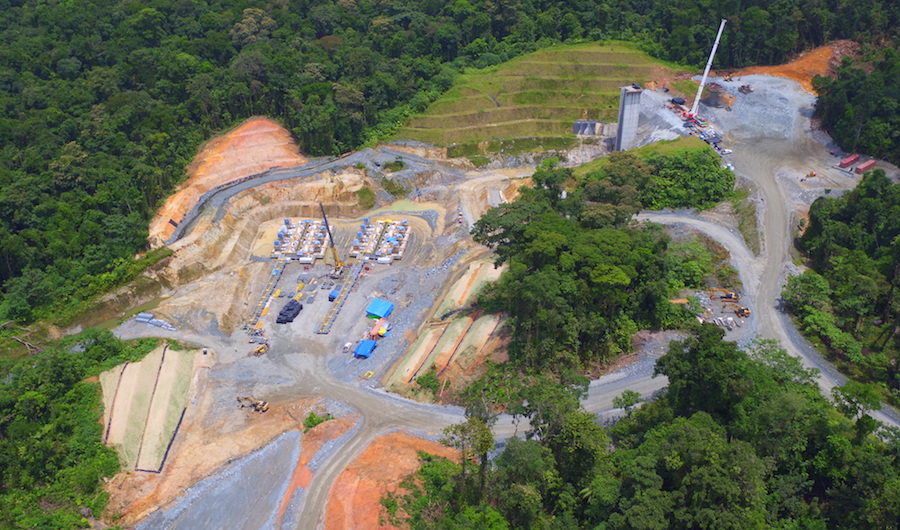
Cobre Panama mine. (Image: First Quantum Minerals.)

Panama’s President Jose Raul Mulino flew over the nation’s flagship copper mine this week, getting a good look at the idled project — and raising investor hopes for a restart of the $10 billion operation.


It was a “truly impressive” sight, Mulino told reporters in Panama City on Thursday as he vowed to explore “novel ideas” for the mine ordered shut in late-2023 after an eruption of environmental protests and political turmoil.

The president’s comments following his return flight from an unrelated trip along with a renewed campaign by mine owner First Quantum Minerals Ltd. hint at a possible new start for the venture, whose closure shook the copper world and hurt the Central American nation’s economy. First Quantum’s shares and Panama’s sovereign bonds both rallied this week.

But the prospect of a reopening remains highly uncertain. Mulino — fresh from a tussle with US President Donald Trump and embroiled in another domestic battle over social security reforms — has yet to meet First Quantum’s executives. He said he won’t negotiate with the Canadian firm until it drops arbitration proceedings against Panama.

The project is still unpopular among segments of the population due to pollution fears and the belief that First Quantum got too good a deal. The union that led anti-mine protests in 2023 remains opposed, and there are formidable legal, political and practical hurdles in the way of a reopening.

Cobre Panama accounted for about 5% of the country’s economy before its closure. A restart could create jobs and boost state coffers and would also offer some relief to a tightening global copper market. Anti-mining sentiment is shifting as the economy suffers and First Quantum intensifies its outreach campaign.

“At a government institution level, we are discussing what we are going to do with the mine,” Mulino said. “It’s a very, very complex topic.”

Lost jobs

Dozens of mining trucks built by Germany’s Liebherr-International capable of hauling 360 tons of material sit idle, alongside Caterpillar Inc. bulldozers and green John Deere & Co. tractors. Salty, humid air from the Caribbean Sea is starting to corrode and rust equipment. The company has laid off thousands of workers and warned of more cuts if the mine remains shut.

Just a few miles from the mine, the economic fallout from its closure was on show during a media tour organized by First Quantum.

Rudi Sedeño, a 34-year-old mother of one toddler and a teenager, said she was part of a textiles cooperative of 20 women making workwear including shirts, hats and masks for miners. They used to gets orders for thousands of items, she said; now business has dwindled to sporadic requests from a few small customers.

Some of the cooperative’s members have quit to seek work elsewhere, and a school that received financial support from First Quantum had to close. Protesters in Panama City, a four-hour drive from the mine, didn’t fully understand its importance for local communities, Sedeño said.

The closure led to the loss of 54,000 jobs, according to estimates by the National Council of Private Companies.

“In part, what Panama is suffering is the absence of the source of employment and the generation of wealth that the mine provided,” Mulino said in the capital. He didn’t offer details of what options he is mulling for Cobre Panama.

First Quantum’s Panama troubles stem from its efforts to extend its operating contract for the massive mine. The company negotiated a 40-year extension under the previous government, which included a minimum annual payment of $375 million.

The government of then-President Laurentino Cortizo ratified the deal in October 2023, triggering protests that paralyzed the economy. The Supreme Court deemed the agreement unconstitutional and, ahead of looming elections, Cortizo made a U-turn on his position and initiated plans to shutter the mine.

For the global copper market, the controversy over a mine in Panama carried important ramifications. First, it cut about 1.5% of global supply when demand is growing. More fundamentally, it was a clear warning about the social and political complexities that stand in the way of boosting future supply.

Protests against the mine have abated since the 2023 riots, but the leader of the local construction workers’ union — which led anti-mine protests in 2023 — said the union is still against the mine. “Opening Cobre Panama is unacceptable,” Saul Mendez wrote in response to questions, and the union will be “in the fight with the people.”
What next?

A series of hurdles must be cleared before the mine — which used to account for 40% of First Quantum’s revenue — can reopen.

Mulino said he needs to complete his controversial social security reforms, currently in the “final stretch” in Congress, before fully turning his attention to Cobre Panama’s future.


The moratorium on open-pit mining passed by the previous administration would need to be lifted, and Mulino’s government isn’t guaranteed enough votes in the opposition-controlled National Assembly for that.

Most importantly, the company and authorities will have to ease concerns that led to public outcry.

“Any reopening will need to entail a lengthy consultation process and local debate that addresses environmental concerns, along with a state ownership share and clear economic benefits for Panama,” said Risa Grais-Targow, Eurasia Group’s director for Latin America.

The government and the mine’s backers insist President Mulino has sufficient political capital and will use it for big issues like resolving the mine debacle.

“We have hot blood and we tend to have heated arguments, but at the end of the day after some protests we will sit down like we’ve done before and we will figure it out,” Gabriel Diez, president of the National Council of Private Companies, told reporters.

During a visit to Cobre Panama on Tuesday, mine manager Carlos Hubner said it would likely take six months for the mine to return to full operation. The company would need to rehire thousands of workers, and fix machinery that has been sitting idle for a year or more.

“The economic situation in the country, nearby communities and for workers and former workers is getting complicated,” said Michael Camacho, head of the mine worker’s union, which has marched in favor of reopening. “We are waiting.”

(By Michael McDonald)

Panama’s ‘novel ideas’ comments offer hope for giant copper mine


Bloomberg News | February 27, 2025 | 


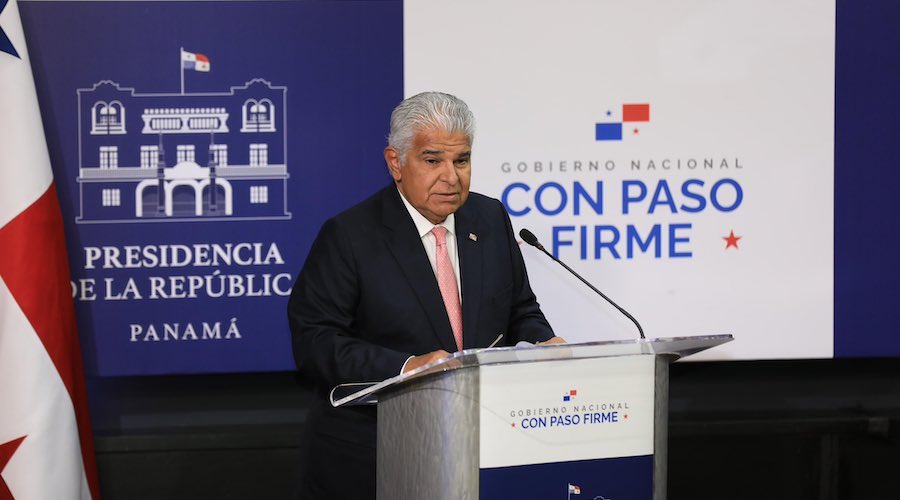
Panama’s President José Raúl Mulino. (Image: Mulino’s X account.)


Panama’s President said his government is exploring “novel ideas” on handling First Quantum Minerals Ltd.’s giant copper mine while reiterating that the firm must drop its arbitration cases against the country.


Speaking to reporters in Panama City Thursday, Jose Raul Mulino said he will visit towns near the mine that have been affected by its closure. The president said he and his closest advisors are exploring “novel ideas on changing the framework of what the mine was to what the mine can be,” adding he’ll begin dealing with the issue as soon as social security reform — which is in “the final stretch” is settled in Congress.

“At a government institution level, we are discussing what we are going to do with the mine,” Mulino said. “It’s a very, very complex topic. Have faith that, once social security is over, we are going to deal with the mine.”

First Quantum’s shares jumped after the comments, which offer renewed hope that a deal could be done to reopen one of the world’s biggest copper mines. Still, restarting a mine that was shut in the wake of mass protests represents a delicate dance for Mulino, who needs to maintain public support to help push through reforms and find new sources of water for the Panama Canal.


Shares in the Vancouver-based company rose as much as 6.9%, the biggest intraday jump since Feb. 4.

Mulino reiterated that First Quantum must drop arbitration before talks can begin on the Cobre Panama mine, which represents 5% of the country’s gross domestic product and accounted for about 40% of First Quantum’s revenue. An arbitration tribunal at the International Chamber of Commerce scheduled a final hearing on the mine for February 2026.

First Quantum declined to comment.

Mulino said he met with suppliers to the mine this week, many of whom have shut down or written off large amounts of inventory since the late-2023 closure following a constitutional court ruling against its operating contract.

“The situation is sad and depressing, the state they are in,” Mulino said of the suppliers. “Overnight, someone flipped a switch and the mine was turned off. In part, what Panama is suffering is the absence of the source of employment and the generation of wealth that the mine provided.”

(By Michael McDonald)