Bloomberg News | March 1, 2025 |
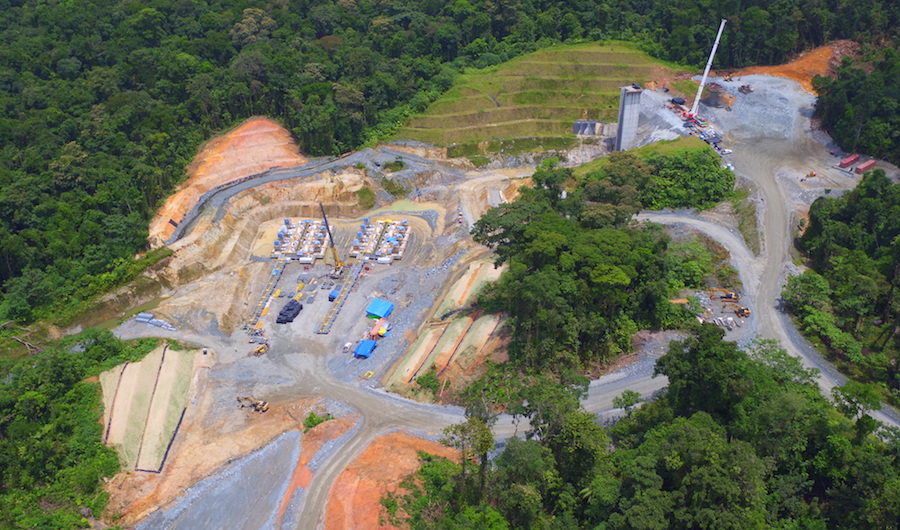
Cobre Panama mine. (Image: First Quantum Minerals.)
Panama’s President Jose Raul Mulino flew over the nation’s flagship copper mine this week, getting a good look at the idled project — and raising investor hopes for a restart of the $10 billion operation.

It was a “truly impressive” sight, Mulino told reporters in Panama City on Thursday as he vowed to explore “novel ideas” for the mine ordered shut in late-2023 after an eruption of environmental protests and political turmoil.
The president’s comments following his return flight from an unrelated trip along with a renewed campaign by mine owner First Quantum Minerals Ltd. hint at a possible new start for the venture, whose closure shook the copper world and hurt the Central American nation’s economy. First Quantum’s shares and Panama’s sovereign bonds both rallied this week.
But the prospect of a reopening remains highly uncertain. Mulino — fresh from a tussle with US President Donald Trump and embroiled in another domestic battle over social security reforms — has yet to meet First Quantum’s executives. He said he won’t negotiate with the Canadian firm until it drops arbitration proceedings against Panama.
The project is still unpopular among segments of the population due to pollution fears and the belief that First Quantum got too good a deal. The union that led anti-mine protests in 2023 remains opposed, and there are formidable legal, political and practical hurdles in the way of a reopening.
Cobre Panama accounted for about 5% of the country’s economy before its closure. A restart could create jobs and boost state coffers and would also offer some relief to a tightening global copper market. Anti-mining sentiment is shifting as the economy suffers and First Quantum intensifies its outreach campaign.
“At a government institution level, we are discussing what we are going to do with the mine,” Mulino said. “It’s a very, very complex topic.”
Lost jobs
Dozens of mining trucks built by Germany’s Liebherr-International capable of hauling 360 tons of material sit idle, alongside Caterpillar Inc. bulldozers and green John Deere & Co. tractors. Salty, humid air from the Caribbean Sea is starting to corrode and rust equipment. The company has laid off thousands of workers and warned of more cuts if the mine remains shut.
Just a few miles from the mine, the economic fallout from its closure was on show during a media tour organized by First Quantum.
Rudi Sedeño, a 34-year-old mother of one toddler and a teenager, said she was part of a textiles cooperative of 20 women making workwear including shirts, hats and masks for miners. They used to gets orders for thousands of items, she said; now business has dwindled to sporadic requests from a few small customers.
Some of the cooperative’s members have quit to seek work elsewhere, and a school that received financial support from First Quantum had to close. Protesters in Panama City, a four-hour drive from the mine, didn’t fully understand its importance for local communities, Sedeño said.
The closure led to the loss of 54,000 jobs, according to estimates by the National Council of Private Companies.
“In part, what Panama is suffering is the absence of the source of employment and the generation of wealth that the mine provided,” Mulino said in the capital. He didn’t offer details of what options he is mulling for Cobre Panama.
First Quantum’s Panama troubles stem from its efforts to extend its operating contract for the massive mine. The company negotiated a 40-year extension under the previous government, which included a minimum annual payment of $375 million.
The government of then-President Laurentino Cortizo ratified the deal in October 2023, triggering protests that paralyzed the economy. The Supreme Court deemed the agreement unconstitutional and, ahead of looming elections, Cortizo made a U-turn on his position and initiated plans to shutter the mine.
For the global copper market, the controversy over a mine in Panama carried important ramifications. First, it cut about 1.5% of global supply when demand is growing. More fundamentally, it was a clear warning about the social and political complexities that stand in the way of boosting future supply.
Protests against the mine have abated since the 2023 riots, but the leader of the local construction workers’ union — which led anti-mine protests in 2023 — said the union is still against the mine. “Opening Cobre Panama is unacceptable,” Saul Mendez wrote in response to questions, and the union will be “in the fight with the people.”
What next?
A series of hurdles must be cleared before the mine — which used to account for 40% of First Quantum’s revenue — can reopen.
Mulino said he needs to complete his controversial social security reforms, currently in the “final stretch” in Congress, before fully turning his attention to Cobre Panama’s future.
The moratorium on open-pit mining passed by the previous administration would need to be lifted, and Mulino’s government isn’t guaranteed enough votes in the opposition-controlled National Assembly for that.
Most importantly, the company and authorities will have to ease concerns that led to public outcry.
“Any reopening will need to entail a lengthy consultation process and local debate that addresses environmental concerns, along with a state ownership share and clear economic benefits for Panama,” said Risa Grais-Targow, Eurasia Group’s director for Latin America.
The government and the mine’s backers insist President Mulino has sufficient political capital and will use it for big issues like resolving the mine debacle.
“We have hot blood and we tend to have heated arguments, but at the end of the day after some protests we will sit down like we’ve done before and we will figure it out,” Gabriel Diez, president of the National Council of Private Companies, told reporters.
During a visit to Cobre Panama on Tuesday, mine manager Carlos Hubner said it would likely take six months for the mine to return to full operation. The company would need to rehire thousands of workers, and fix machinery that has been sitting idle for a year or more.
“The economic situation in the country, nearby communities and for workers and former workers is getting complicated,” said Michael Camacho, head of the mine worker’s union, which has marched in favor of reopening. “We are waiting.”
(By Michael McDonald)
Panama’s ‘novel ideas’ comments offer hope for giant copper mine
Bloomberg News | February 27, 2025 |
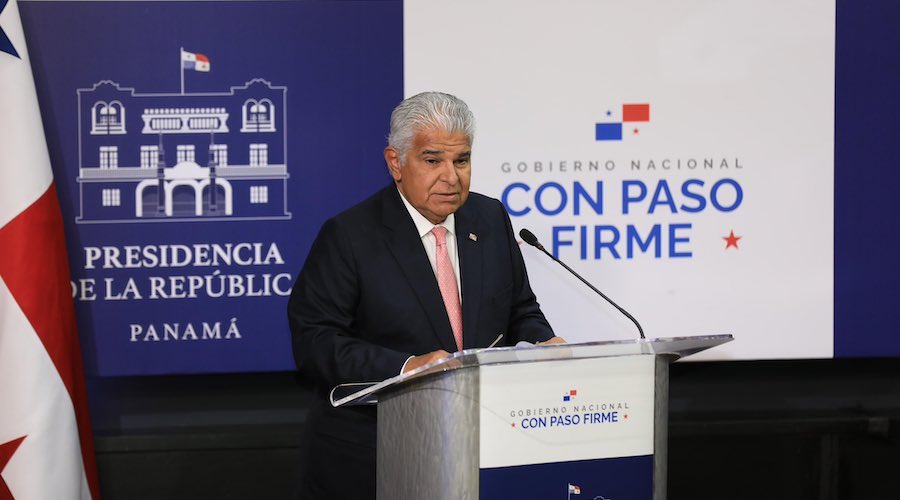
Panama’s President José Raúl Mulino. (Image: Mulino’s X account.)
Panama’s President said his government is exploring “novel ideas” on handling First Quantum Minerals Ltd.’s giant copper mine while reiterating that the firm must drop its arbitration cases against the country.
Speaking to reporters in Panama City Thursday, Jose Raul Mulino said he will visit towns near the mine that have been affected by its closure. The president said he and his closest advisors are exploring “novel ideas on changing the framework of what the mine was to what the mine can be,” adding he’ll begin dealing with the issue as soon as social security reform — which is in “the final stretch” is settled in Congress.
“At a government institution level, we are discussing what we are going to do with the mine,” Mulino said. “It’s a very, very complex topic. Have faith that, once social security is over, we are going to deal with the mine.”
First Quantum’s shares jumped after the comments, which offer renewed hope that a deal could be done to reopen one of the world’s biggest copper mines. Still, restarting a mine that was shut in the wake of mass protests represents a delicate dance for Mulino, who needs to maintain public support to help push through reforms and find new sources of water for the Panama Canal.
Shares in the Vancouver-based company rose as much as 6.9%, the biggest intraday jump since Feb. 4.
Mulino reiterated that First Quantum must drop arbitration before talks can begin on the Cobre Panama mine, which represents 5% of the country’s gross domestic product and accounted for about 40% of First Quantum’s revenue. An arbitration tribunal at the International Chamber of Commerce scheduled a final hearing on the mine for February 2026.
First Quantum declined to comment.
Mulino said he met with suppliers to the mine this week, many of whom have shut down or written off large amounts of inventory since the late-2023 closure following a constitutional court ruling against its operating contract.
“The situation is sad and depressing, the state they are in,” Mulino said of the suppliers. “Overnight, someone flipped a switch and the mine was turned off. In part, what Panama is suffering is the absence of the source of employment and the generation of wealth that the mine provided.”
(By Michael McDonald)

No comments:
Post a Comment