It’s possible that I shall make an ass of myself. But in that case one can always get out of it with a little dialectic. I have, of course, so worded my proposition as to be right either way (K.Marx, Letter to F.Engels on the Indian Mutiny)
Saturday, March 08, 2025
Strikes Against Royal Navy’s Tug Operator Postponed
Unions delayed the strike against Royal Navy's tug operator while consultations proceed (Royal Navy)
The two unions representing the masters and crews of the tugs that support the UK’s Royal Navy announced they were postponing planned strikes. The actions would have impacted the support for vessels that the Navy’s bases as well as other critical services such as the delivery of supplies and munitions.
At issue were the complaints by the two unions, Unite and Prospect, that their members were not being consulted as part of the new services contract being negotiated by operator Serco Marine and the UK’s Ministry of Defense. The contract covers services at Navy bases in Devonport, Portsmouth, Faslane, Great Harbour Greenock, and Kyle of Lochalsh.
The company has a 10-year contract valued at £1.2 billion ($1.5 million) which is up for renewal. Serco provides navigational support for everything from the pride of the fleet aircraft carriers and nuclear subs to all other naval vessels and is also responsible for delivering fuel, water, and munitions at all Royal Navy ports, tank cleaning, and passenger transportation. Serco took over these critical roles in 2008 as part of the government’s move to privatize the Royal Maritime Auxiliary Service.
Promise, which mainly provides services at Faslane, Portsmouth, and Devonport, began the strikes with a 24-hour stoppage on February 3 and continued with actions short of a strike, which include adherence to work rules and a ban on overtime. Unite was scheduled to start a series of walkouts as well refusing overtime as of today, March 6.
Following talks with the MoD, Serco, and the Royal Navy, Unite reported that it had agreed to suspend its strike action at Devonport, Portsmouth, Faslane, Great Harbour Greenock, and Kyle of Lochalsh. Serco has agreed to delay signing its new contract with the MoD to allow for 30 days of union consultations.
“There will now be a consultation period to ensure the service is fit for purpose under the new contract. During this period, strike action will be suspended but action short of strikes will continue,” said Unite national officer John McGookin.
The unions contended that the government was looking to reduce the contract by £250 million ($310 million) which Unite says is putting nearly 100 jobs at risk. Unite has 300 members which represent about half of the workforce. It said among the steps being discussed was a proposal to reduce the number of tugs used to move nuclear submarines to four from the current six.
Serco had confirmed to the BBC that negotiations regarding the in-port contract were ongoing while emphasizing that no changes had been agreed. The MoD said it was an issue between the employer and the unions and a strike would not impact the Royal Navy’s operations. Serco had promised to keep the unions apprised of the negotiations.
In the Know 66: Montreal Port Authority's Julie Gascon on Tariffs & Trade
Tariff uncertainties are a top concern for port authorities in North America, given the potential effects on trade flows with the United States. To get a Canadian perspective on the impact of tariffs and the broader picture of trade in the Seaway-Great Lakes region, TME spoke with Julie Gascon, who recently completed her first year as the President and CEO of the Montreal Port Authority. She is a master mariner and spent most of her career on Canadian Coast Guard ships on the West Coast fleet. She also sailed on VLCC crude carriers and large passenger vessels.
Ms. Gascon was a regulator, including a Senior Marine Safety Inspector, and became the Executive Director of Domestic Vessels and Regulatory Oversight with Transport Canada. Gascon was appointed to regional and national roles with the Canadian Coast Guard, and served as Assistant Commissioner for its Central and Arctic regional operations.
Gascon became the Montreal Port Authority's President and Chief Executive Officer in February 2024. She holds a Bachelor’s degree in Business Administration from the University of Montreal and a Bachelor’s degree in Technology in Nautical Sciences from the University College of Cape Breton.
For all the details, listen in on the conversation below.
The opinions expressed herein are the author's and not necessarily those of The Maritime Executive.
Canada Places Order with Seaspan for Construction of Heavy Polar Icebreaker
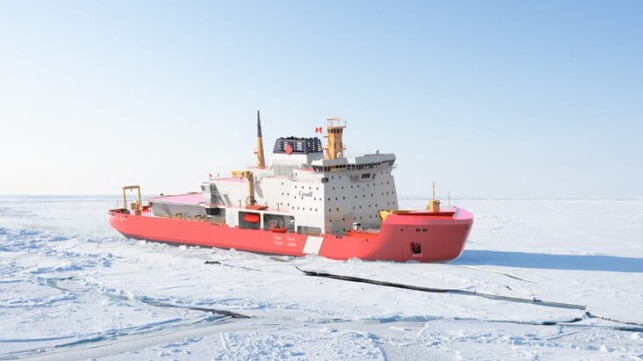
Canada placed the order with Seaspan for a new heavy heavy polar icebreaker (Seaspan)
The Canadian government today, March 7, marked the contract signing for a new polar icebreaker to be built at Seaspan Shipyard making official an order first announced in 2021. Under the National Shipbuilding Strategy, the government is renewing the fleets of the Royal Canadian Navy and the Canadian Coast Guard including two heavy polar icebreakers providing the Canadian Coast Guard the ability to operate self-sufficiently year-round in the high Arctic down to temperatures at -50° C.
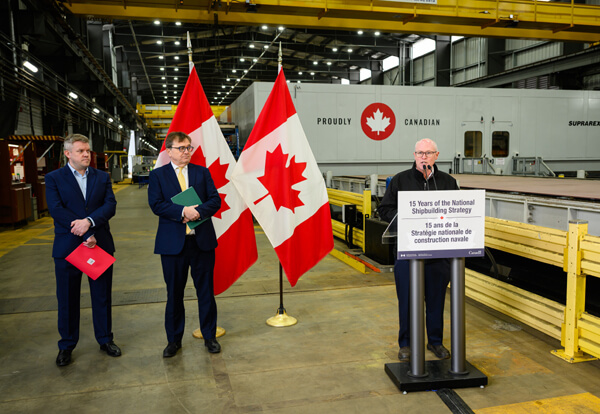
The contract ceremony was led by the Jonathan Wilkinson, Minister of Energy and Natural Resources, on behalf of the Jean-Yves Duclos, Minister of Public Services and Procurement and Quebec Lieutenant. The government of Canada reported the value of the contract at C$ 3.15 billion (before tax) (US$2.2 billion) with the vessel to be built at Seaspan’s Vancouver Shipyards in British Columbia.
“The contract awarded to Seaspan's Vancouver Shipyards for the build of a new polar icebreaker underscores our dedication to ensuring safe and efficient navigation in Arctic regions,” said Wilkinson. “This state-of-the-art vessel will not only strengthen our icebreaking fleet, but will also support critical scientific research and environmental protection efforts, and ensure national security in the Arctic."
John McCarthy, CEO of Seaspan, along with Minster Wilkinson at the contract ceremony (Seaspan)
With the contract now in place, Seaspan reports it is ready to cut steel on this ship and begin full-rate construction. It has scheduled the official start of construction for April 2025. The other polar icebreaker is being built by Chantier Davie Canada located in Quebec. That shipyard was awarded a contract valued at C$16.47 million (including taxes) (US$11.5 million) in September 2024 to advance work on a Polar-class icebreaker.
Seaspan highlights it will mark the first time a polar icebreaker has been built in Canada in more than 60 years. Building the complex and densely-outfitted multi-mission ship they report represents a significant challenge for the shipbuilders and when completed the vessels will have more advanced capabilities than the Canadian Coast Guard’s current heavy icebreakers.
The polar icebreakers will be 158 meters (518 feet) with a design displacement of 26,00 tons. They will have more than 40 MW of power with an ice-class azimuthing propulsion system. Functional design of the polar icebreaker was completed in 2024 by Seaspan working alongside established Finnish companies who have extensive experience in designing Arctic-going vessels.
Canada in November 2024 signed the ICE Pact Memorandum of Understanding with the United States and Finland to deepen existing cooperation, strengthen their shipbuilding industries, and allow new equipment and capabilities to be produced more quickly. The three countries committed to working more closely together to engage to help meet future global demand for Arctic and polar vessels.
The United States approved the contract for the construction of its first heavy polar icebreaker, Polar Sentinal, in December. It is the first of three heavy Polar icebreakers the U.S. ordered from VT Halter, which was later acquired by Bollinger. After long delays in the design phase, the U.S. expects to complete its first polar icebreaker in 2029.
Weather Continues to Delay Salvage Efforts for MSC Baltic III
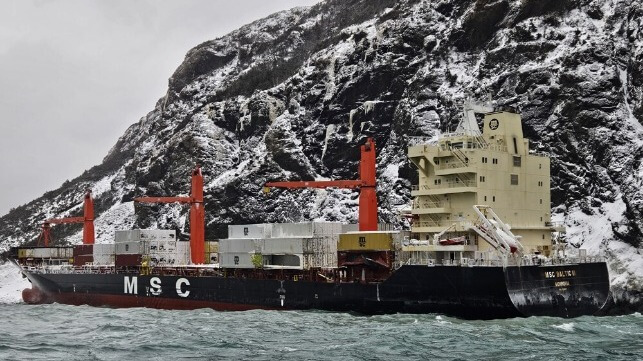
Operations are focusing on removing oils from the grounded containership MSC Baltic III (Canadian Coast Guard)
The Canadian Coast Guard provided an update on the ongoing operations to salvage the grounded containership MSC Baltic III saying the focus remains on the fuel aboard the ship and the prevention of environmental damage. While there is daily activity, the Coast Guard reports weather and ice conditions are impacting the operations about 50 percent of the time and many days teams are not able to get aboard the vessel.
The 37,636 dwt containership blacked out on February 15 while approximately 12 nautical miles outside the entrance to Bay of Islands, Newfoundland. The crew was removed uninjured in a challenging operation involving a Canadian rescue helicopter while the vessel was driven ashore in a remote cove on the western side of the island.
Based on the current conditions, Bruce English, Senior Response Officer, Marine Environmental and Hazards Response, for the Canadian Coast Guard, said their focus is not on speed but on minimizing the impact of the incident. He was unable to provide a timeline while speculating the operation would involve a combination of overland and a barge alongside first to remove the fuel oil and then the cargo.
Lose ice has clogged the remote cove where the vessel is located with temperatures and winds challenging the operation (Canadian Coast Guard)
MSC Mediterranean Shipping Company as the operator of the vessel has appointed T&T Salvage and the Eastern Canada Response Corporation to develop the salvage plan and manage the environmental dangers. English reports those companies have brought in resources from around the world and are staging equipment on Newfoundland for the response. An ice class tug and barge arrived in Corner Brook carrying tanks some of which will be put onshore for eventual use as they remove the approximately 1.7 million liters of heavy fuel and marine gas oil onboard. The Coast Guard believes the majority of the required equipment is now onsite for the operation.
Accessing the vessel from the shoreside with heavy equipment requires upgrades to a road into the area. The operation is in the final approval stages from Canada for the roadwork and English reports a draft plan showed that it would take approximately two weeks of work to make the road usable for the trucks and other equipment. Previously they had said the salvage operation might also build a walkway to the bow of the vessel to increase access.
The salvage teams have been aboard and they confirmed to the Canadian Coast Guard that the vessel has significant hull and structural damage although it is now resting solidly on the seabed. English said that they have been advised there is flooding in the three of the holds, the tanks, and the engine room. The vessel can not be safely refloated at this stage.
When the operation can commence, the fuel oil in the tanks will need to be heated before it can be pumped off the ship. However, the salvage teams have determined the cranes aboard the ship are operational which will be helpful for the cargo operations.
MSC in a statement reported that “we have secured the hazardous containers still aboard to avoid any risk of marine pollution and have a plan for their removal.” The Canadian Coast Guard said that MSC had informed it that two empty containers were damaged but posed no risks. The vessel has approximately 470 containers, over half of which are empty, aboard.
Under Canadian law, the vessel owner is responsible for the costs. The Canadian Coast Guard declined to speculate on the cost of the operation.
Lauritzen Bulkers Buys Canadian Breakbulk Firm and Looks to Positive 2025
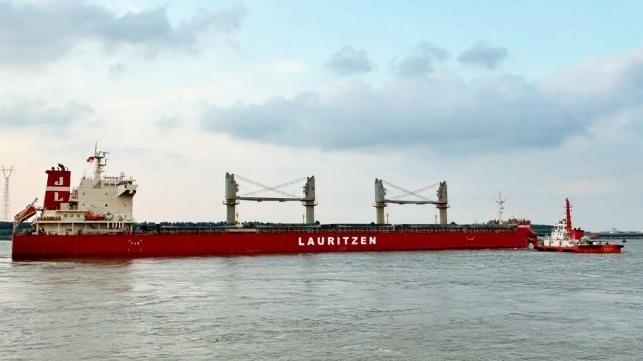
Lauritzen acquired a Canadian breakbulk firm as it expects positive net results in 2025 (Lauritzen)
Denmark’s Lauritzen Bulkers, one of the oldest operators tracing its roots back 140 years, reports it has acquired Alexander & Blake, a Canadian breakbulk and parcel shipping company. The deal comes as the company looks to rebound from what it called “unpredictable and complex market conditions,” in 2024.
Alexander & Blake is a Canadian-owned and operated shipping company. Its main activities are in the breakbulk and parcel service segments, with clients and core trades in the North and South American markets. The company was started in 1990 to focus both on breakbulk and dry cargo.
“The discussions we have in the past months with the Alexander & Blake team have confirmed to us their excellent competencies and how they will add value to Lauritzen Bulkers' global shipping services from day one,“ says Rasmus Francis Jensen, Vice President, Chartering and Lauritzen Bulkers Parcel Service.
David Linden, founder and CEO of Alexander & Blake cited a very good fit between the Alexander & Blake values and the corporate culture, commercial mindset, and customer focus of Lauritzen Bulkers. The company will continue as Alexander & Blake - by Lauritzen Bulkers with Lauritzen Bulkers continuing the breakbulk and parcel service offering under the future brand name Lauritzen Bulkers Parcel Service.
Lauritzen Bulkers said during its year-end financial report at the end of February that it expects a positive net result for 2025 after seeing earnings decline dramatically to $17.9 million in 2024. It cited numerous underlying challenges commercially and operationally in 2024 including the draft restrictions at the Panama Canal and the de facto closure of the Red Sea due to the Houthi attacks. The company said it looks to increase business activity across its segments, regions, and trades.
Antimicrobial resistance in soil bacteria without the use of antibiotics
Overuse of antibiotics is currently the primary reason for the rise of antimicrobial resistance (AMR). Researchers at the Indian Institute of Science (IISc) and Kiel University, however, have shown that AMR can surprisingly be found in soil bacterial communities due to microbial interactions too, driven by a species of predatory bacteria.
Published in Current Biology, the study looked at how the presence of the bacterium Myxococcus xanthus affects the number of antimicrobial-resistant bacteria in soil samples. M. xanthus is a predatory species which is known to release antimicrobials and other molecules to kill its prey. The presence of this bacteria in soil microbial communities raises the question: Do other bacteria living with M. xanthus acquire resistance to these molecules over time?
“Human-driven [antibiotic] resistance is a major problem, but the question is: Are there other aspects that we completely ignore? This was very exciting [to explore],” says Samay Pande, Assistant Professor at the Department of Microbiology and Cell Biology (MCB), IISc, and corresponding author of the study.
Pande and others found that the death of M. xanthus in soil bacterial communities increased the frequency of resistant isolates – bacterial cells resistant to antibiotics – in many different species of soil bacteria. These cells also showed resistance to certain antibiotics even without exposure to these drugs.
When faced with starvation, populations of M. xanthus die en masse. In famine-like conditions, which are very common in soil environments, these bacterial cells form stress-resistant structures called fruiting bodies that are filled with spores. During the development of fruiting bodies, only a minority of cells succeed in becoming spores, whereas the majority of the bacterial cells undergo lysis (rupture) and release growth-inhibitory substances into the environment. The researchers believe that exposure to these growth inhibitory molecules is the reason behind the increased frequency of resistant isolates in the soil bacterial community. Interestingly, not all strains of M. xanthus triggered enrichment of resistance; it was the ones with higher diversity of biosynthetic clusters that seem to drive it.
When analysing these inhibitory molecules, the researchers found something even more interesting. “We identified multiple different molecules and did a very crude classification,” explains Saheli Saha, PhD student at MCB and co-first author of the study. “Individually, these molecules might not do anything, but when you put them together, they suddenly do this strange thing where they can enrich other resistant isolates.” The researchers found that resistance was enriched against several antibiotics, which include commonly used drugs such as tetracycline and rifampicin.
“It is important to test whether the observations derived from culturable bacteria are also applicable for unculturable microbes,” explains Jyotsna Kalathera, PhD student at MCB and one of the authors of the study. Therefore, the team also analysed the genomes of the bacterial communities in the soil. They found that AMR enriched through this phenomenon could be extended to unculturable bacterial species via similar exposure to growth inhibitory molecules.
The fact that AMR can be maintained by microbial antagonism even in the absence of human-driven contamination of antibiotics is a new and unexpected discovery, the researchers say. “We need to explore and find out if this is more common,” says Pande.
Understanding this phenomenon better might also help predict where such antibiotic-resistant bacteria live in nature, Saha suggests. “This is something that we have just tested with soil samples from India. Testing soil samples from different locations would help us understand more about this phenomenon.”
Raytheon's $2 million gift commitment fuels student leadership in engineering
Raytheon’s commitment names the leadership suite within the University of Arizona's Student Design and Innovation Center and brings its construction closer
Construction on the new 100,000-square-foot Student Design and Innovation Center is expected to begin on East Speedway Boulevard east of North Mountain Avenue in the next two to four years. The SDIC, seen here in a rendering, will include collaborative classrooms, an advising center, makerspaces for designing and constructing projects and more.
Raytheon, an RTX business, is expanding its University of Arizona support with a $2 million gift commitment for the College of Engineering's Student Design and Innovation Center.
The 100,000-square-foot center, to be called the SDIC, will include collaborative classrooms, an advising center and the Raytheon Student Leadership Suite. Located on East Speedway Boulevard east of North Mountain Avenue, the building also will house makerspaces for designing and constructing projects, in alignment with the college's focus on experiential learning.
University of Arizona President Suresh Garimella expressed his gratitude for the gift during a recent tour of Raytheon led by Barbara Borgonovi, president of Naval Power at Raytheon, which produces technology to protect U.S. and allied ships and sailors. Borgonovi is also a member of the College of Engineering Dean's Advisory Board.
"It was such a pleasure to meet Barbara and to gain a deeper understanding and appreciation of the long history of partnership with Raytheon," Garimella said. "I look forward to building on the history of collaboration between Raytheon and the university as we work together to develop engineers who are uniquely prepared to take on the national security and other significant challenges of the future."
Raytheon is excited to help foster the next generation of engineering leaders, Borgonovi said.
"The University of Arizona College of Engineering's Student Design and Innovation Center is a testament to the university's dedication to nurturing future engineers, equipping them with the resources and environment they need to turn concepts into groundbreaking solutions," Borgonovi said.
"Having met President Garimella, I feel even more optimistic about the real impact we can have on preparing students to develop innovative solutions to serious global challenges," she said.
Raytheon's gift helps the College of Engineering accommodate its considerable growth in recent years, according to David W. Hahn, the Craig M. Berge Dean of the college. And it brings the college closer to realizing its goal of opening a space where students can access academic support programs and gain experience with high-tech equipment and learning methods.
"This named space is a key part of the SDIC plan," Hahn said.
The space will also house dozens of student clubs, including the Engineering Ambassadors and Wildcat Robotics. These groups provide opportunities for students to serve communities, create networks and apply classroom learning in national competitions.
"Students begin their professional development in clubs and organizations," said Hahn. "And involvement teaches them to lead and to build community, honing the soft skills that foster their futures as leaders and innovators."
Raytheon has contributed to the university for decades, including gifts that support experiential learning in engineering and STEM initiatives across campus.
More engineers, deeper engagement
Construction on the center should begin in the next two to four years, with timing dependent on fundraising, Hahn said.
"Raytheon's generous gift brings us closer to realizing this critical goal. The SDIC will provide many benefits for our students and for industries like defense, which urgently needs well-trained engineers," Hahn said. "I'm deeply grateful for Raytheon's support."
U of A engineering enrollment has risen in recent years, helping the college address labor gaps statewide and nationally. The incoming class has grown 25% over the past five years.
Hahn says the building will be a key recruitment tool to help train more engineers.
The SDIC will have large makerspaces with 3D printers, electronic tools, machines for woodworking and metalworking, and laser cutters, among other equipment. These resources aid the college's strategy to engage students in hands-on projects throughout their undergraduate years and beyond, said Larry Head, director of the Craig M. Berge Engineering Design Program.
Head led the effort to open the college's Engineering Design Center in 2023. The center – where students not only design and build but also become certified to safely operate machines and tools – is a smaller, temporary version of the SDIC.
"We have seen such engagement from students. It's having a major impact on their development as engineers," he said. "The SDIC will give us even more ability to improve the educational experience and keep our graduates in high demand with employers."
Raytheon's investment adds to infrastructure, such as the Peter and Nancy Salter Medical Device Design Lab. The college partnered with donors to open the lab in 2018, giving students the space and equipment to fabricate biomedical instruments.
"Raytheon is a longtime U of A partner and deeply connected to this institution in many ways," said John-Paul Roczniak, president and CEO of the University of Arizona Foundation. "Its philanthropic support helps ensure that students have the resources they need while on campus. This new gift to the College of Engineering is crucial to providing hands-on experiences that prepare students for life after college."
Raytheon's $2 million gift commitment is part of the Fuel Wonder campaign, the university's $3 billion fundraising effort. Gifts already made to the campaign are giving every student access to a cohesive ecosystem of support while powering new insights through research in areas including cancer engineering and space sciences.
Plastics, which are polymeric materials composed of long chains of small molecules called monomers, are widely used in everyday life and industry due to their lightweight, good strength and flexibility. However, with approximately 52 million tons of plastic waste generated annually, plastic pollution has become a major environmental concern. To address this issue, research efforts have focused on developing sustainable polymeric materials. Unfortunately, most materials developed so far suffer from complex synthesis processes or difficulties in separating them from other polymers during waste disposal.
To overcome these limitations, a research team led by Dr. Tae Ann Kim of the Convergence Research Center for Solutions to Electromagnetic Interference in Future-mobility (SEIF) at Korea Institute of Science and Technology (KIST) has developed a new polymeric material with self-healing capabilities and high recyclability. The team designed a unique pentagonal ring-structured molecule that can not only be freely converted between monomers and polymers but also facilitates dynamic covalent exchange reactions in response to heat, light, and mechanical forces. This molecule enables creating polymeric materials with a wide range of properties, as flexible as a rubber band or as rigid as a glass bottle.
The newly developed polymer is easy to manage, as it exhibits fluorescence at damaged sites, enabling real-time damage detection, and self-heals when exposed to heat and light. Upon disposal, this material can selectively depolymerize into its monomers, even when mixed with conventional plastics. The recovered monomers can then be used to regenerate polymers that retain their original properties. These features present an innovative solution for enhancing both sustainability and recyclability of polymeric materials.
Beyond its recyclability, this material dynamically change its thermal, mechanical, and optical properties in response to heat, light, and mechanical forces. When used as a protective coating, it demonstrates outstanding performance, with a hardness up to three times and an elastic modulus more than two times higher than conventional epoxy coatings. Additionally, exposure to ultraviolet light strengthens molecular interactions, enabling the material to fix specific shapes. This shape memory capability opens up potential applications in smart clothing, wearable devices, and advanced robotics.
With its high mechanical strength, damage resistance, self-healing, damage detection, and selective recyclability, this polymeric material presents a promising solution to reduce economic costs associated with sorting and processing mixed plastic waste. Furthermore, by replacing industrial coatings with this eco-friendly alternative, the maintenance costs of coating can be significantly reduced while mitigating environmental pollution.
Dr. Tae Ann Kim, a principal researcher of the Soft Materials Research Group, emphasized, "This research introduces a new approach to designing materials with autonomous functionalities, such as damage detection and self-healing, while overcoming the thermal and mechanical limitations of recyclable plastics derived from pentagonal ring monomers" He further added, "We are striving to pioneer the market for eco-friendly functional coatings that require minimal maintenance and generate no waste."
(Left) Closed-loop recycling process of the newly synthesized raw material (monomer). (Right) Selective raw materials recovery from mixed plastic waste
(Top) Images of Fluorescence-based damage detection and self-healed polymeric film (Bottom) Images of multi-shape morphing in polymeric films induced by local UV irradiation
Credit
Korea Institute of Science and Technology
###
KIST was established in 1966 as the first government-funded research institute in Korea. KIST now strives to solve national and social challenges and secure growth engines through leading and innovative research. For more information, please visit KIST’s website at https://eng.kist.re.kr/
This research was supported by the National Research Council of Science and Technology (NST) grant (CRC22033-230) of the Ministry of Science and ICT (Minister Sang-im Yoo) and the Nano & Material Technology Development program (RS-2024-00448445) of the National Research Foundation of Korea. The research was published in the latest issue of Advanced Functional Materials, a leading international journal in materials science (IF 18.5, JCR top 4.329%).