Tuesday, March 11, 2025


Why US Automakers Make Vehicles And Source Parts In Canada – OpEd


By 

President Trump is blowing up the global economy with threats of extortionate tariffs being placed on imports from foreign countries to the US. He sometimes makes the ludicrous claim as in the case of Canada, that it is because Canada “isn’t doing anything” to stop the fentanyl that is allegedly “pouring across the border” into the US with no effort made to stop it. More often, he accuses Canada of unfair trade policies.


He claims for example that Canada is shipping Canadian-made GM and Ford  vehicles made in Canada into the US, tariff free and that these should be made in the US by American workers, at the same time that he complains Canada is dumping cheap steel into the US, where much of it is used to make  cars! (How vile is that?). In both cases his solution is to slap the Canadian imports with a 25% tariff penalty.

The thing is, there is a reason so many US cars get built in Canada, and probably why so much of the steel used in the US is produced in Canada and sold to US manufacturers. And that reason is not that Canadian workers make less than workers in the US or that Canadian automakers and steel plants are subsidized by Canada. In fact Canadian workers do quite well, because they have much stronger unions than does the US. In fact the Canadian chapter of the United Auto Workers split off from their American UAW parent in 1985 largely because its leaders and members correctly felt that the US parent union wasn’t militant enough).

No, the reason a lot of auto and truck manufacturing was shifted away from Michigan and other parts of the US to Canada was because of the enormous cost per vehicle the US car companies were paying for health care coverage for their workers and dependents — which is now thousands of dollars per vehicle, and that’s not counting the cost of retiree health care. Canadian companies’ employee health care costs are a pittance compared to US companies.

These days those numbers are not easy to find, but a 2006 article in the Lancet, a noted British medical journal, reported that year that GM President Rick Wagoner had told a Senate committee in Washington that the US cost of healthcare system (a third of which goes to administrative costs ad the profits of insurance company middlemen, was causing the near bankruptcy of his company. Speaking at an industry conference the year before Wagoner noted that expenditures for health care accounted for 15% of total US economic output, 50% more than Canada was spending on its government funded health system. GM he said, was spending close to $6 billion on health for its employees and their families. The situation in the US has only gotten worse since then.

Today , US healthcare spending is running at a $4.9 trillion level, representing a record 16.9% of the nation’s $29-trillion GDP, and is headed towards 20% of GDP by 2030.


None of the major car producers, whether in low-wage countries like China and Korea or high wage countries like Japan, Germany, France of Italy face those kinds of costs to cover for their employees, who all live in countries where there is some form of nationally funded health care system in which the costs of health care are funded through universal taxation, not by individuals or by employers.

This is why German automobiles and French automobiles are able to compete in the US auto market, even though their workers are paid higher hourly wages than their counterparts in the US.

If Trump, an ignorant rentier for whom the idea of paying decent wages to his workers is I am sure anathema, genuinely wanted to make America competitive again, he wouldn’t be screwing around with protective tariffs. That would just let America’s greedy capitalists continue as before. Instead he would be using one of his Executive Orders to actually do something good and expand Medicare to cover all Americans of all ages, immediately freeing not just the  auto industry, but all American manufacturers from the enormous cost burden of paying for their employees’ health benefits.

Of course the ancillary benefits of such a shift would also be that Medicaid, the federal program for low income people, which he reportedly wants to slash, would no longer even be needed, because everyone in the country, employed or not, would have their health costs covered by Medicare, currently the program for the elderly and permanently disabled. The same is true for with the Affordable Care Act, which we know Trump hates because it was an Obama administration creation.

The huge share of national economic activity going to providing (and avoiding providing!) health care would plummet dramatically and in short order to the level it is at in less benighted nations. This would result in an enormous savings for almost all Americans, who would no longer have to pay insurance premiums, copays and deductibles. Equally important, with the major threat of loss of health coverage during a strike, workers would be more willing to join unions and unions would gain power because their members would be more willing to go out on strike. Meanwhile the national economy would boom as newly competitive US manufacturing and service industries would see their exports surge into international markets.

For all this to happen, though, we need the corporate media, which have been ignoring this story, to honestly explain it, instead of, as they are now doing, focussing on the pointless question of whether Trump’s tariff threats are real or just a “negotiating tactic.”

Honestly it doesn’t matter what the reason is for their silence, but for the media to do their job, they must inform the public about what is going on here, and so far the Fourth Estate is dropping the ball. Possibly this is because editors and reporters at what these days are mostly struggling and hollowed-out news organizations, their experienced staffs long since having accepted buyouts and departed, don’t even understand it. Also the corporate owners of the media conglomerates that own the remaining news outlets like the Washington Post that is owned by pirate capitalist Jeff Bezos, or the Los Angeles Times, owned by health industry entrepreneur Patrick Soon-Shiong, are happy to be able to keep their own employees in line by holding their health care over them should they think of striking for better pay or demanding to bee able to write and publish the truth.

When I was writing my articles about this issue a decade ago, I interviewed the CEOs and CFOs of a number of major US subsidiaries in Canada, including GM,, Costco and Ford . All told me that they and the US Chamber of Commerce branch in Canada were supporters of Canada’s universal Medicare system and in fact were at the time lobbying the government to broaden its coverage to include dental and long-term care. The CFO of Ford Canada actually told me about how much he “loved the Canadian health system,” debunking the claims that it was slow to deliver care — a trope of US free-market health care propagandists. He related to me how when his son had suffered a broken leg during a school sporting event, he was rushed off to a Canadian hospital and fixed up beautifully with no waiting and no bill.

I asked him why, if Canadian executives of US subsidiaries were in favor of Canada’s publicly funded health care system, their bosses in Detroit were opposing solutions like single-payer government health care or Medicare for All. He, like other such executives in US subsidiaries in Canada, laughed and replied, “It’s ideological. They can’t bring themselves to advocate for a socialist idea.”

Trump’s tariffs, whether targeting Canada, Mexico, the European Union or China, are going to have a huge upward impact on inflation in the US which will particularly hurt people on fixed-income and low-income people, including many of the MAGA types who narrowly voted him into the White House.

It’s important for those impacted people to to understand how and why this is all his and his billionaire backers’ fault, and that in fact, it’s also their fault that working class people are in danger of losing their access to Medicaid and ACA subsidized insurance. Fixing that by expanding Medicare to cover every American would simultaneously obviate the need for tariff protections for American industry.

Although to be fair, it is also the Democratic Party leadership’s fault, since they and the neoliberal Democrats in Congress as well as Presidents Obama and Biden had multiple chances when they had control of both House and Senate to adopt the Medicare for All bill pushed by Vermont Senator Bernie Sanders, but the majority of that party too prefer the huge campaign contributions the party and its candidates receive from the health care industry, which loathes the idea of socialized medicine.

Heres a suggestion: If you have an Uncle Bob or Aunt Julie who is a Trumper or, or a friend at work who sports a red MAGA baseball cap, send them a link to this article and then talk to them about it. Tell friends who dont like Trump about it too, and send them to this site, or write a letter to your local paper and make the case. We need publicly funded health care, not tariffs.


Dave Lindorff is a Philadelphia-based journalist and columnist. He is a founding member of ThisCantBeHappening!, an online newspaper collective. Lindorff is a contributor to "Hopeless: Barack Obama and the Politics of Illusion" (AK Press) and the author the author of “The Case for Impeachment” (St. Martin’s Press). He can be reached at dlindorff@mindspring.com

 

The Erosion Of Judicial Independence: Is India’s Judiciary An Extension Of Hindutva? – OpEd


By 

Once the last bastion against executive overreach, India’s judiciary today stands accused of capitulating to the ideological project of Hindutva—an ethno-nationalist vision that seeks to establish India as a Hindu-first nation.


The creeping erosion of judicial independence is not merely a matter of conjecture; it is evident in the actions, statements, and post-retirement sinecures of those who once wielded the gavel. With an increasing number of verdicts and judicial appointments aligning seamlessly with the ruling Bharatiya Janata Party’s (BJP) ideological imperatives, one must ask: Has the judiciary become an extension of Hindutva?

Judicial Praise as Political Currency

The subservience of sections of the Indian judiciary to the executive has been exposed in recent years through a series of statements and verdicts that show an unmistakable pattern. Justice M.R. Shah, then Chief Justice of the Patna High Court, called Prime Minister Narendra Modi a “model and a hero” in 2018, only to be elevated to the Supreme Court months later. In 2021, during the Gujarat High Court’s Golden Jubilee celebrations, Justice Shah doubled down, effusively praising Modi as “our most popular, loved, vibrant and visionary leader.” The pattern of judicial adulation extends beyond Shah. Former Supreme Court Justice Arun Kumar Mishra went as far as to call Modi a “versatile genius who thinks globally and acts locally.” This thinly veiled obsequiousness raises a fundamental question: When judges turn into cheerleaders for the executive, how can they be trusted as impartial arbiters of the law?

Post-retirement rewards have only deepened suspicions of judicial compromise. Justice Arun Mishra was appointed Chairperson of the National Human Rights Commission (NHRC) soon after retirement, despite protests from rights groups who cited his questionable judicial record. His tenure at the NHRC has been marked by a reluctance to hold the government accountable for human rights violations, reinforcing fears that his appointment was not a coincidence but a reward for loyalty.

The Judiciary’s Complicity in Institutionalizing Hindutva

It is not just statements but legal rulings that reveal a judiciary bending to Hindutva’s ideological demands. Consider the controversial appointment of former Chief Justice of India P. Sathasivam as the Governor of Kerala—an appointment widely perceived as political compensation for quashing an FIR against BJP leader Amit Shah in the Sohrabuddin Sheikh murder case. Sathasivam had also commuted the death sentence of Dara Singh, a Bajrang Dal militant who burned Australian missionary Graham Staines and his two sons alive, to life imprisonment, citing that his intent was merely to “teach a lesson.” Such judicial decisions are not mere anomalies; they fit into a broader pattern of rulings that have helped sanitize the violent pasts of Hindutva foot soldiers while reinforcing the BJP’s narrative of victimhood.

The judiciary’s handling of Modi’s alleged complicity in the 2002 Gujarat pogrom is another case in point. In 2012, the Supreme Court-appointed Special Investigation Team (SIT) granted Modi a clean chit, ignoring the fact that amicus curiae Raju Ramachandran had found sufficient grounds to prosecute him under multiple sections of the Indian Penal Code. This judicial absolution proved crucial in Modi’s reinvention from a Hindutva hardliner to a globally palatable leader, smoothing his path to the Prime Minister’s office.


Exonerations, Delays, and Double Standards

Judicial double standards have become glaringly obvious in politically charged cases. When BJP leaders or their affiliates are accused of wrongdoing, verdicts miraculously swing in their favor. Consider the case of Maya Kodnani, a former Gujarat minister convicted of orchestrating the murder of 97 Muslims during the 2002 riots. Her conviction was overturned in 2018, while fellow accused Babu Bajrangi also saw a reduction in sentence. When it comes to crimes against Muslims, the judiciary’s sluggishness in delivering justice is telling. The 1987 Hashimpura massacre, where police murdered 42 Muslims, took 31 years for convictions to be handed down. The 1987 Maliyana massacre, where 72 Muslims were killed, remains unresolved, with over 900 adjournments spanning three decades.

In stark contrast, cases that threaten the BJP’s interests are dismissed with alarming speed. In 2019, the Supreme Court upheld the Modi government’s controversial Rafale fighter jet deal, despite glaring irregularities and evidence of kickbacks uncovered in France. In 2022, the Pegasus spyware case, which implicated the Indian government in snooping on journalists and opposition leaders, was buried under the pretext of “national security.” The judiciary’s reluctance to scrutinize the executive’s overreach raises a disturbing possibility: has it willingly surrendered its independence?

The Ayodhya Verdict: A Watershed Moment

Perhaps the most consequential instance of the judiciary aligning with Hindutva was the Supreme Court’s 2019 verdict on the Babri Masjid-Ram Janmabhoomi dispute. While acknowledging that the mosque’s demolition by Hindutva mobs in 1992 was illegal, the court nonetheless awarded the disputed land to Hindu petitioners, effectively legitimizing the destruction. This decision sent an unmistakable message: majoritarian impulses could dictate judicial outcomes. It was a resounding victory for the BJP, which had built its political career on the promise of constructing a temple on the disputed site.

Manufacturing Legitimacy for Authoritarianism

A judiciary that should act as the final check against authoritarian overreach now appears to be manufacturing legitimacy for it. The Supreme Court’s validation of Modi’s 2016 demonetization, despite its catastrophic economic consequences, is a prime example. Rather than questioning the legality of an executive order that wiped out 87% of India’s currency overnight, the court waited six years to deliver a verdict that essentially rubber-stamped the move. The judiciary’s deference to the government has reached a point where even blatant policy failures are shielded from legal scrutiny.

Judicial Bias and the Persecution of Dissenters

While BJP-affiliated individuals find themselves exonerated, critics of the regime face relentless judicial harassment. Activists, journalists, and intellectuals have been imprisoned under draconian laws like the Unlawful Activities (Prevention) Act (UAPA) and sedition charges, with little to no judicial relief. The arrests of intellectuals like Anand Teltumbde, Sudha Bharadwaj, and Umar Khalid reflect how the judiciary has become a willing accomplice in the state’s crackdown on dissent.

The recent move by 55 Rajya Sabha MPs, led by senior advocate and politician Kapil Sibal, to impeach Justice Shekhar Kumar Yadav for his inflammatory anti-Muslim remarks exemplifies the growing discontent with judicial bias. But such initiatives remain largely symbolic in a system where judicial accountability has become an afterthought.

Can the Judiciary Redeem Itself?

For a democracy to function, an independent judiciary is non-negotiable. However, India’s judiciary is increasingly being viewed as a mere appendage of the Hindutva state—an institution that serves not as a check on executive excesses but as an enabler of them. The rot runs deep, but reform is not impossible. Ensuring judicial independence requires structural overhauls, starting with a transparent appointment process insulated from executive influence. Stronger post-retirement restrictions must also be put in place to curb the quid pro quo culture that incentivizes judicial sycophancy.

India’s judiciary today stands at a crossroads. It can either reclaim its role as the guardian of constitutional democracy or continue its descent into ideological subservience. If the latter path is chosen, history will not judge it kindly.


Debashis Chakrabarti

Debashis Chakrabarti is an international media scholar and social scientist, currently serving as the Editor-in-Chief of the International Journal of Politics and Media. With extensive experience spanning 35 years, he has held key academic positions, including Professor and Dean at Assam University, Silchar. Prior to academia, Chakrabarti excelled as a journalist with The Indian Express. He has conducted impactful research and teaching in renowned universities across the UK, Middle East, and Africa, demonstrating a commitment to advancing media scholarship and fostering global dialogue.


Could Europe conscript 300,000 troops needed to deter Russia without US?

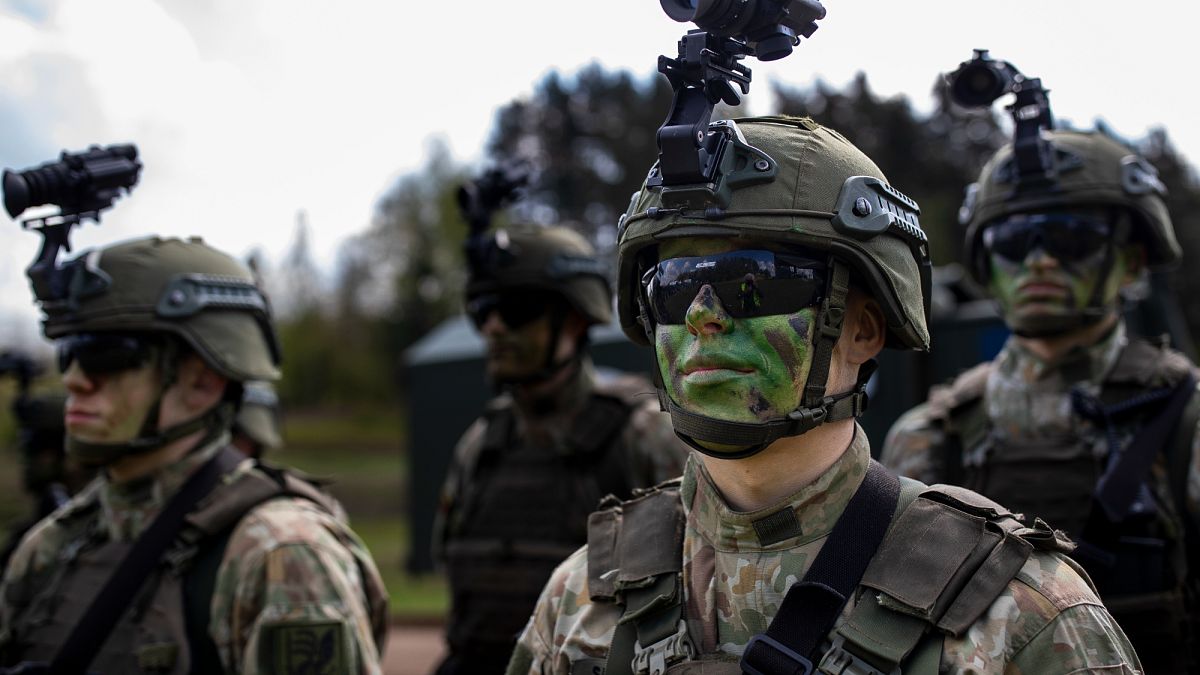
Lithuanian Army soldiers take part in a Lithuanian-Polish Brave Griffin 24/II military exercise.
Copyright AP Photo
By Paula Soler
Published on 

As armed forces across Europe remain stretched and defence budgets constrained, could European nations reinstate compulsory military service? NATO allies are considering conscription.

After the Cold War, European countries systematically downsized their armies, with key players such as France suspending conscription and seeing a corresponding fall in the size of its armed forces - by 38% from the 1990s till today.

Only Austria, Cyprus, Denmark, Estonia, Finland, Greece, Norway, Switzerland, and Turkey never suspended conscription.  

“Now, the more urgent thing is essentially having enough troops to hold the line, not necessarily to fight the Russians, but to send a strong deterrence message," Dr. Alexandr Burilkov, researcher at the Leuphana University of Lüneburg, told Euronews.

That message would be: 'Should you try what you did in February 2022, it won't succeed,' according to Burilkov, citing the date of Russia's full-scale invasion of Ukraine.

Burilkov is one of the co-authors of a joint analysis by the Bruegel think-tank and the Kiel Institute, which estimates that Europe will need 300,000 additional troops to defend itself, on top of the current 1.47 million active military personnel, including those in the UK. 

“In the past two years, the Russians have put their economy and society largely on a war footing,” Burilkov said, adding that “when collectively done, boosting defence capabilities is not an unfeasible expense, especially considering the consequences.” 

NATO allies are currently discussing how to do this, both in terms of equipment and military personnel - and conscription is part of the debate, a NATO official told Euronews, adding that in order to ensure collective effective defence in the current environment, more forces are needed to carry out the alliance's defence plans. 

“How to generate these forces, whether to utilise conscription system, reserve forces or other model, is a sovereign national decision taken by allies,” the same official said.  

The transatlantic military alliance does not mandate national military policies, but it can play a role in defining a demand signal and facilitating exchanges among allies. The official added that debates on best practices, lessons learned, and NATO's potential role in addressing recruitment and retention challenges will be elevated on the alliance’s agenda in the coming months. 

Following Russia’s military aggression against Ukraine, Baltic states such as Latvia and Lithuania have implemented various conscription models to expand their armed forces. 

Croatia also plans to reintroduce compulsory military service this year, and more countries could follow, as intelligence services warn of a potential Russian attack on a NATO member state within five years and uncertainty grows over Donald Trump’s commitment to NATO and European security. 

“In order to have resilient militaries that cannot just last at the opening stages of the conflict but continue fighting if necessary, it is very much necessary to be able to introduce any kind of system that would both increase the quantity of the available personnel and increase the resilience of that system,” Burilkov argued, referring to conscription, as well as well-trained and efficient reserves.  

Lessons from the Baltic model

Finland and Estonia have mandatory military service. Denmark, Lithuania, and Latvia use a lottery-driven conscription system, while Norway and Sweden have selective compulsory service in place. 

There is no one-size-fits-all solution, but Carnegie Europe researchers argued in a 2024 policy paper that lessons can be drawn from the Nordic and Baltic states. These countries have introduced various incentives to make military service more attractive, including financial benefits and employment opportunities. 

Lithuania, for instance, offers financial support to those who voluntarily join the service, as well as employment and educational assistance during and after military duty. And the Estonian Defence Forces work with private employers in programmes such as the Forces' Cyber Conscription, where they send their employees to the cyber service to improve their skills and then apply them to their jobs. 

“A lot of militaries are going through a process of kind of reconsidering what roles need to be military and what roles need to be civilian, because the nature of warfare and national security is changing,” Linda Slapakova, researcher at RAND Europe, noted.  

Yet not everybody agrees on the need to bring back compulsory military service, an option legally impossible in some countries, and politically implausible or practicably unlikely in others.  

“Looking just at the military, there's a lot required in terms of the training infrastructure, getting people through medical checks and getting people signed up to do their training and their service,” Slapakova told Euronews, stressing that that kind of infrastructure doesn't exist in many countries. 

“If the goal is just to improve capability of the armed forces, I think there's a lot of kind of other issues that countries can be looking at before they start considering something like mandating young people to join the military or civilian service,” she added. 

Gallup poll conducted last year found that only 32% of EU citizens would be willing to defend their country in the event of war. 

In major EU economies such as Italy, Germany, and Spain, the numbers were even lower: just 14% of Italians, 23% of Germans, and 29% of Spaniards said they would be willing to fight for their country in wartime. 


Hungarian special forces reportedly planned covert operation to rescue separatist Bosnian Serb leader

Hungarian special forces reportedly planned covert operation to rescue separatist Bosnian Serb leader
Milorad Dodik has been given a one-year prison sentence for refusing to comply with the decisions of the international community's high representative.Facebook
By bne IntelliNews March 11, 2025

A team from Hungary's Counter-Terrorist Centre (TEK) was deployed to Bosnia & Herzegovina in late February with the mission to help Bosnian Serb leader Milorad Dodik escape in the event of a court-ordered arrest, investigative news site VSquare reported on March 7.

Dodik faced charges for refusing to comply with the decisions of the international community's high representative under the Dayton Peace Agreement.

On February 26, a Bosnian court handed down a one-year prison sentence to Dodik and imposed a six-year ban from public life. After the ruling, Serbian President Aleksandar Vučić and Viktor Orban had both called to express their support for the Bosnian Serb leader.

The TEK operation with a staff of 70, deployed in what the government said was a joint exercise and training, was authorised after Dodik's visit to Hungary in February. The operation never occurred, partly because Dodik appealed his conviction, postponing any prison sentence until the final ruling, and because both Croatia and the US were made aware of the plan.

The US warned Hungary that any attempt to abduct Dodik would result in the organisation's exclusion from international cooperation. The State Department welcomed the conviction and strongly condemned any actions that could destabilise the region.

US Secretary of State Marco Rubio in a tweet said that Dodik's actions are undermining Bosnia's institutions and threatening its security and stability, and he called on US partners in the region to join Washington in "pushing back against this dangerous and destabilising behaviour".

According to VSquare, a few days before the court ruling, Orban visited Dodik with head of TEK János Hajdu, the former bodyguard of the prime minister. After the meeting, Dodik issued a statement saying that Bosnia is finished.

In late February, a Hungarian military plane was refused landing in the country. "I am deeply convinced that the military plane arrived from Hungary to provide some kind of support to Milorad Dodik and the clique gathered around him in the dismantling of Bosnia and Herzegovina," Bosnia's Defence Minister Zukan Helez said. Foreign ministry state secretary Levente Magyar was on board the plane, according to local media.

VSquare reached out to TEK and the US embassy in Hungary but did not get a reply.

Officially, both Hungarian and Republika Srpska authorities maintain that the TEK operation in the country was a joint training exercise.

In related news, Bosnia has formally requested the withdrawal of the Hungarian EUFOR contingent from the European Union's peacekeeping force amid concerns over Budapest's close ties to the Bosnian Serb leader.

Zeljko Komsic, the Bosnian Croat member of Bosnia's tripartite presidency, has sent an official letter to European Council President António Costa calling for the removal of the Hungarian troops, according to regional media reports.

In his letter, Komsic argued that the EUFOR-Althea mission must remain completely neutral and operate strictly within its mandate. He cited the Hungarian government's open support for Dodik as incompatible with this neutrality.

"Dodik has been undermining Bosnia's constitutional and legal order for some time, causing permanent instability in the country and the region due to his separatist ideas and aspirations," Komsic wrote.