It’s possible that I shall make an ass of myself. But in that case one can always get out of it with a little dialectic. I have, of course, so worded my proposition as to be right either way (K.Marx, Letter to F.Engels on the Indian Mutiny)
Friday, March 28, 2025
PETER NAVARO 'KNOW NOTHING' 'Want me to answer?' CNN host pushes back as Trump aide says 'Ford isn't really American'
CNN host Kasie Hunt (left) and Peter Navarro, counselor to the president (right) (Photo: Screen capture via CNN video)
Peter Navarro, a counselor to President Donald Trump, clashed with CNN's Kasie Hunt on Thursday after he attempted to claim that American automakers weren't really American.
Navarro claimed that the tariffs would ultimately put more money in Americans' pockets, as much as $1,000, he said at one point.
CNBC reported Thursday, "Prices that consumers pay on the lot could increase by $4,000 to $15,000 per vehicle, depending on how much of the car is imported, according to several analysts’ estimates."
"I understand the big picture argument, but again, if you're an American family and you need a new car, is this weekend the best weekend to go out and get one?" asked Hunt. "Because I understand you're making a long-term play, but I don't understand how you can plausibly say that in the short term, car prices are not going up."
Navarro laughed, saying, "We've seen these concerns before," with economists warning of "massive inflationary shocks." However, Navarro toed the Trump line that tariffs will be paid for by the importing country.
"We've already had $3 trillion across our economy, and we feel really good," Navarro said. He did not provide a source for the number.
Hunt asked about the "big three" automakers in the U.S. and whether tariffs would cost the companies so much that they could respond by making staffing cuts.
"So, so, the first thing that's really important to understand is that the big three so-called American companies, GM, Ford, Stellantis, they're not, they're not really American companies," Navarro said, making quotation marks with his fingers.
"General Motors isn't an American company?" Hunt pushed back.
"They have, well, in this sense, Kasie, this is really interesting," Navarro continued.
"Ford isn't an American company?" she asked.
"Hang on," Navarro tried to interject.
"They built Ford tough?" Kasie quipped.
"Kasie, you want me to answer the question?" Navarro said.
"Go ahead," she replied, shaking her head at Navarro's comments.
"This is really interesting. They have less American content in their cars than some of the other companies that are operating in America, like Honda. Okay. So, when you ask about—" he continued before she cut him off.
"So, Honda is a more American car company?" she questioned.
Navarro went on about engines made in Korea and drivetrains with better-paying jobs in Germany. He ultimately pledged that everything Trump does will become a "golden age" for America.
Man charged with destroying Teslas in Las Vegas, amid anti-Musk wave
Agence France-Presse March 27, 2025 The March 18 attack on a Tesla collision center in Las Vegas was one of a number against Tesla cars and businesses. (AFP)
A man who allegedly set fire to five Teslas and sprayed them with bullets from a semi-automatic rifle appeared in a US court Thursday to face federal arson charges, the Department of Justice said.
Paul Hyon Kim, 36, is suspected of being behind the assault on a Tesla business in Las Vegas, among a wave of attacks targeting Elon Musk's electric car brand as anger rises over government funding cuts he is overseeing.
The DoJ said in a statement that emergency services were called to the Tesla repair center on March 18 after reports of gunshots.
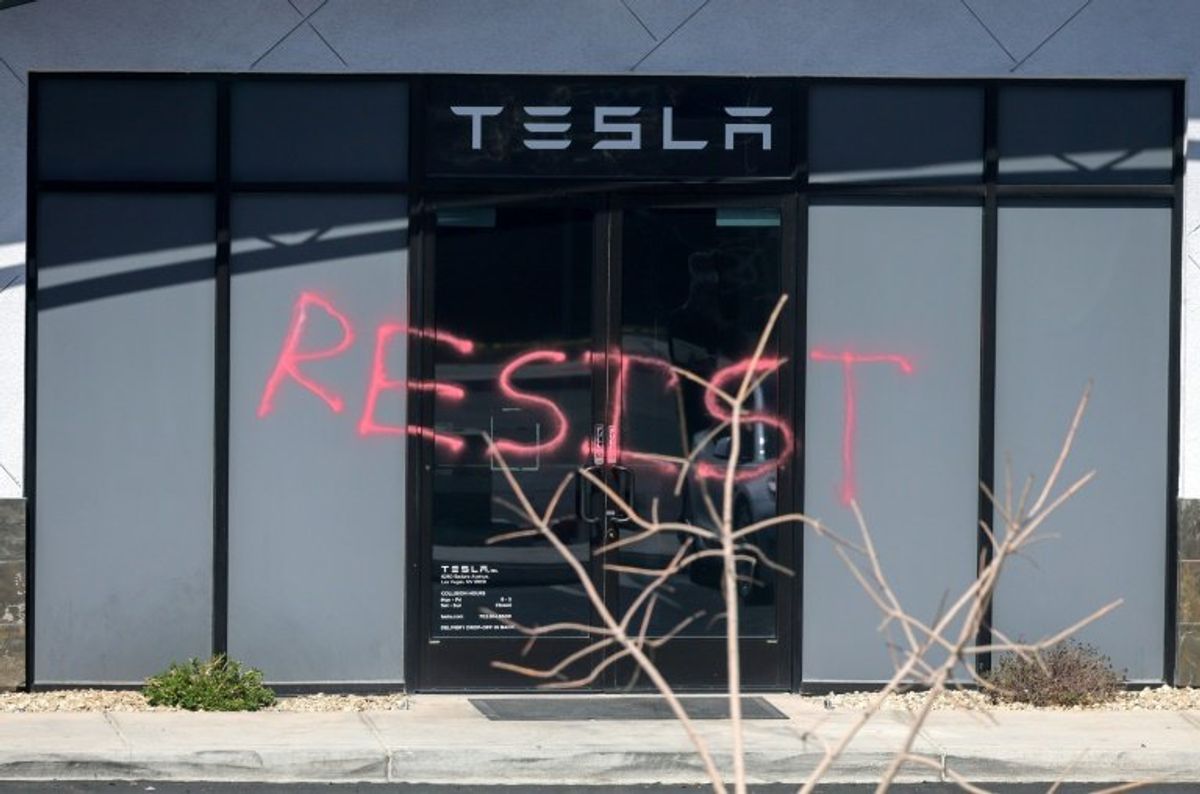
"During the investigation, it was determined that Molotov cocktails and a .30 caliber AR-style firearm were used to damage and destroy five Tesla vehicles, and graffiti was sprayed to write 'Resist' on the front of the building," the statement said.
Kim was arrested a week later. He has been charged with one count of unlawful possession of an unregistered firearm and one count of arson.
He faces up to 20 years in prison on the arson charge alone.
"The Department of Justice has been clear: anyone who participates in the wave of domestic terrorism targeting Tesla properties will suffer severe legal consequences," said US Attorney General Pamela Bondi.
"We will continue to find, arrest, and prosecute these attackers until the lesson is learned."
Musk, the South African-born billionaire chief of Tesla and SpaceX, is leading Donald Trump's ruthless cost-cutting drive at the head of the so-called Department of Government Efficiency (DOGE).
Several Tesla dealerships and a number of cars around the country have been vandalized in recent weeks and the company's stock price has plummeted over the past month.
'Tributes are required': Foreign leaders and CEOs 'privately' insult 'mob boss' Trump
FILE PHOTO: Former U.S. President Donald Trump, flanked by attorneys Todd Blanche and Emil Bove, arrives for his criminal trial at the Manhattan Criminal Court in New York, NY on Wednesday, May 29, 2024. Trump was charged with 34 counts of falsifying business records last year, which prosecutors say was an effort to hide a potential sex scandal, both before and after the 2016 presidential election. Trump is the first former U.S. president to face trial on criminal charges. Jabin Botsford/Pool via REUTERS/File Photo
Donald Trump's transactional nature has carried over into his second presidency, leading CEOs and world leaders to whisper behind his back, according to a report.
Axios reported early Friday morning that, "If you're a foreign leader or a CEO about to meet with President Trump — or if you want to avoid his vengeance — come bearing gifts."
"Government officials and business leaders around the world have gotten the message and are strategizing about how to give Trump real or perceived wins to try to smooth out any relationship bumps with the new administration, and avoid economic or legal penalties," the report states.
The report goes as far as to state that, "Some privately have compared him to a mob boss: Tributes are required, and the shakedowns come with the full weight of the U.S. government."
"Many foreign and domestic corporations alike fear tariffs and potential changes to the tax code this year, and have tried to assuage Trump with offerings," Axios reports, noting that "Apple, Hyundai, Johnson & Johnson, Eli Lilly, Nvidia, Softbank and more have announced large investments in the U.S. since Trump was elected in November."
"Some of those investments were already in the works, but splashy public announcements gave Trump the chance to boast that he was bringing business back to America," it states. "After Hyundai this week announced a $21 billion investment in the U.S., Trump praised the company and made clear what the company would get in return: 'Hyundai won't have to pay any tariffs.'"
The report goes on to note other offerings to Trump, including from the leader of Mexico as well as Meta, which owns Facebook and Instagram, as well.
According to the report, "Trump and his team believe they're just using the levers of power in ways that other presidents didn't, but should have."
As Earth heats up, the growing frequency and intensity of disasters like catastrophic storms and heat waves are becoming a mounting problem for the people who grow the planet’s food. Warming is no longer solely eroding agricultural productivity and food security in distant nations or arid climates. It’s throttling production in the United States.
Farmers and ranchers across the country lost at least $20.3 billion in crops and rangeland to extreme weather last year, according to a new Farm Bureau report that crowned the 2024 hurricane season “one of the most destructive in U.S. history” and outlined a long list of other climate-fueled impacts.Grist Weekly | Can’t keep up with every climate headline? Here’s One Big Thing that really matters each week.Sign up now
Texas experienced the highest losses for the third year in a row. Extreme drought, excessive heat, and high winds took out more than $3.4 billion worth of crops like cotton and wheat, and damaged rangeland. Flooding cost Minnesota some $1.45 billion in corn, soybeans, and forage, among other crops. California endured nearly all the same weather challenges as the south-central U.S. and the upper Midwest, costing its agricultural sector $1.4 billion.
And then there was the one-two punch of hurricanes Helene and Milton that tore through the Southeast. Georgia’s agricultural sector sustained over $459 million in losses as Helene wiped out crops like peanuts, pecans, and cotton. The same storm destroyed some $174 million worth of tobacco, blueberries, and apples in North Carolina. Florida’s ag industry lost nearly twice that to the two hurricanes, adding to the problems pummeling citrus production, all of them caused by previous storms, water scarcity, and disease.
Those tallies are but a snapshot of the economic impact of last year’s disasters on U.S. farm production, as they only account for damages wrought by major weather events such as billion-dollar disasters. They also don’t figure in most livestock or infrastructure losses following Helene and Milton, which significantly hike up total agricultural economic impacts for states like Georgia and Florida.
By the end of the year, farmers from coast to coast were left with diminished income, unpaid bills, and little recourse. Those financial stressors were compounded by inflation, surging labor and production costs, disruptions to global supply and demand, and increased price volatility. So in December, Congress authorized nearly $31 billion in emergency assistance to help struggling producers.
Last week, the USDA opened those disaster aid applications and said it was expediting disbursements. But there’s a catch: The funding pot the agency is gearing up to distribute makes up just a third of the assistance Congress approved.
That $10 billion is intended for farmers growing traditional commodities, such as corn, cotton, and soybeans, and is available to those who experienced most any kind of loss, not just those stemming from extreme weather. Payouts are determined by multiplying a flat commodity rate, based on calculated economic loss, with acres planted. It significantly limits eligibility, said Billy Hackett, policy analyst at the National Sustainable Agriculture Coalition, and funnels help away from smaller farmers into the pockets of industrial-scale operations. Fewer than 6 percent of U.S. farms sold more than three-fourths of all agricultural products between 2017 and 2022. “[The program] works exceedingly well for the largest farms, but leaves behind smaller farms,” said Hackett.
The USDA has not yet said when or how the remaining $21 billion will be distributed. That funding was, in fact, allocated for producers impacted by weather-related disasters in 2023 and 2024. But unlike the package structured for commodity growers, which had a 90-day timeline for implementation, Hackett noted that the USDA doesn’t necessarily have to act quickly on it. The American Relief Act that authorized the funding gives the USDA 120 days to begin reporting on its implementation progress, but no hard deadline for actually disbursing money. That means the $21 billion program isn’t on the same ticking congressional clock.
Ultimately, lawmakers did not provide clear reasoning for why they split the pot and crafted different disbursement mechanisms, with one measure of relief pushed through over the other. Hackett noted that it could be a reflection of who policymakers in Washington are hearing from most: “Who is the loudest? Who has the most meetings? It doesn’t always reflect who is in the most need.”
That lack of a deadline also doesn’t mean the agency shouldn’t move quickly, said Hackett. The $21 billion program is primed to help many more farmers, he said, particularly those that are underserved and passed over by other federal programs such as crop insurance. Farms without crop insurance tend to be small and medium-sized, while the bulk of larger farms have coverage. Speciality crop farms — those producing fruits, vegetables, nuts, horticulture, and nursery crops — are also less likely to be covered than those that produce commodities. Just 15 percent were insured in 2022, compared to nearly two-thirds of oilseed and grain farms.
Hackett worries that the application process may end up being unduly demanding or complicated, and that small or uninsured operators and historically excluded farmers that have faced issues with federal disaster relief eligibility and coverage in the past will be shut out. That has been the case with previous supplemental disaster relief programs, including the Wildfire, Hurricane, and Indemnity Program enacted in 2017 under the first Trump administration.
In a briefing last week, Brooke Appleton, the deputy undersecretary for farm production and conservation, told reporters that more information on the $21 billion program should be “coming soon.” This followed remarks Agriculture Secretary Brooke Rollins made late last month when she noted the agency would hit the congressional deadline of March 21 for sending out the full $31 billion — despite that deadline not applying to two-thirds of the money. The USDA did not respond to Grist’s request for comment.
Meanwhile, farmers like Daniel Spatz are left wondering what’s next. Last spring, he lost roughly $20,000 because “intense” rain waterlogged his central Arkansas fields, leaving him unable to plant 70 acres of rice. The year before, a prolonged drought cost him much more. Spatz is among the 13 percent or so of farmers with crop insurance, but recouped no more than $2,000 after the heavy rains. He’s unsure if he’s eligible for this disaster aid program, which he sees as another sign that the Trump administration is supporting large farmers “at the expense” of small operators like himself. Above all, he’s concerned about calamities yet to come.
“It appears to me that we’re depending more and more on the government to bail us out of these climate-induced disasters,” he said. The USDA shelled out more than $16 billion to farmers from 2022 through 2024 for crops lost to extreme weather events alone. “My question to the Trump administration would be, ‘How much do we have to spend as a society, bailing out people, rebuilding and putting public funds into rescuing people, citizens? What does that price tag have to be before climate change is understood as real, and a public threat, a threat to our future?’”
Latest Trump order seen as message to workers: 'Fall in line or else'
Hard hats and a strike sign. (Photo credit:: Stella_E / Shutterstock)
President Donald Trump's latest attack on the working class was delivered in the form of an executive order late Thursday that seeks to strip the collective bargaining rights from hundreds of thousands of federal government workers, a move that labor rights advocates said is not only unlawful but once again exposes Trump's deep antagonism toward working people and their families.
The executive order by Trump says its purpose is to "enhance the national security of the United States," but critics say its clear the president is hiding behind such a claim as a way to justify a broadside against collective bargaining by the public workforce and to intimidate workers more broadly. "President Trump's latest executive order is a disgraceful and retaliatory attack on the rights of hundreds of thousands of patriotic American civil servants—nearly one-third of whom are veterans—simply because they are members of a union that stands up to his harmful policies," said Everett Kelley, president of the 820,000-member American Federation of Government Employees (AFGE), the nation's largest union of federal workers.
"The labor movement is not about to let Trump and an un-elected billionaire destroy what we’ve fought for generations to build. We will fight this outrageous attack on our members with every fiber of our collective being." —Liz Shuler, AFL-CIO
The far-reaching order, which cites the 1978 Civil Service Reform Act as the source of his presidential authority, goes way beyond restricting collective bargaining and union representation at agencies with a national security mandate, but instead tries to ensnare dozens of federal agencies and classifications of federal workers who work beyond that scope.
According to the Associated Press, the intent of the order "appears to touch most of the federal government."
AFL-CIO president Liz Shuler responded with disgust to the order, pointing out that the move comes directly out of the pre-election blueprint of the Heritage Foundation, which has been planning this kind of attack against the federal workforce and collective bargaining for years, if not decades.
"Straight out of Project 2025, this executive order is the very definition of union-busting," said Schuler in a Thursday night statement. "It strips the fundamental right to unionize and collectively bargain from workers across the federal government at more than 30 agencies. The workers who make sure our food is safe to eat, care for our veterans, protect us from public health emergencies and much more will no longer have a voice on the job or the ability to organize with their coworkers for better conditions at work so they can efficiently provide the services the public relies upon."
Shuler said the order is clearly designed as "punishment for unions who are leading the fight against the administration's illegal actions in court—and a blatant attempt to silence us."
The White House practically admitted as much, saying in a statement that "Trump supports constructive partnerships with unions who work with him; he will not tolerate mass obstruction that jeopardizes his ability to manage agencies with vital national security missions." In effect, especially with a definition of "national security" that encompasses a vast majority of all government functions and agencies, the president has told an estimated two-thirds of government workers they are no longer allowed to disagree with or obstruct his efforts as they organize to defend their jobs or advocate for better working conditions.
Describing the move as "bullying tactics" by Trump and his administration, Kelley said the order represents "a clear threat not just to federal employees and their unions, but to every American who values democracy and the freedoms of speech and association. Trump’s threat to unions and working people across America is clear: fall in line or else."
"These threats will not work. Americans will not be intimidated or silenced. AFGE isn't going anywhere. Our members have bravely served this nation, often putting themselves in harm’s way, and they deserve far better than this blatant attempt at political punishment," he added.
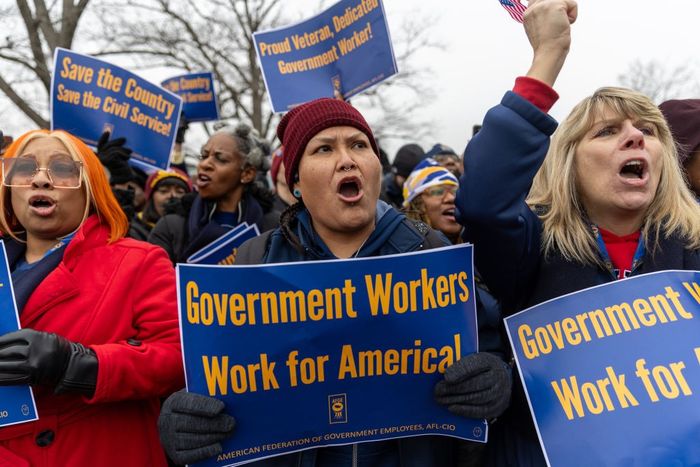
WASHINGTON, DC - FEBRUARY 11: Members of the American Federation of Government Employees (AFGE) union protest against firings during a rally to defend federal workers in Washington, DC on February 11, 2025.Photo by Nathan Posner/Anadolu via Getty Images
Both AFGE and the AFL-CIO said they would fight the order tooth and nail on behalf of federal workers—and all workers—who have a right to collective bargaining and not to be intimidated for organizing their workplaces, whether in the public or private sector.
"To every single American who cares about the fundamental freedom of all workers, now is the time to be even louder," said Shuler. "The labor movement is not about to let Trump and an un-elected billionaire destroy what we've fought for generations to build. We will fight this outrageous attack on our members with every fiber of our collective being."
Kelley said AFGE was "preparing immediate legal action" in response to Trump's order, and vowed to "fight relentlessly to protect our rights, our members, and all working Americans from these unprecedented attacks."
'Tyranny of the bosses': How Musk plans to trample workers’ rights across the board Elon Musk at the 2025 Conservative Political Action Conference (CPAC) in National Harbor, Maryland on February 20, 2025 (Gage Skidmore)
Billionaire Elon Musk, leader of Tesla, SpaceX and X.com and head of the Department of Government Efficiency (DOGE), is making it clear that no federal government agency in the U.S. is safe from mass layoffs. The Trump Administration and DOGE are drawing criticism not only from liberals and progressives, but also, from some Never Trump conservatives on the right.
MSNBC's Joe Scarborough and former Republican National Committee (RNC) Chairman Michael Steele, for example, are saying that while they are fine with fat and pork being trimmed from the federal government, the U.S. is facing a dangerous threat when vital experts — such as air traffic controllers, food inspectors and health officials — are being arbitrarily laid off.
In an article published by Salon on March 28, journalist James Hassett argues that the damage being inflicted by the DOGE layoffs goes way beyond putting so many federal employees out of work at once — it is an attack on workers' rights across the board.
"From arbitrary layoffs to intimidation tactics to targeted harassment," Hassett warns, "Elon Musk has brought the tyrannical practices of the corporate Americaworld to the federal government…. Musk has led his legally ambiguous 'Department of Government Efficiency,' known as DOGE, on a rampage across the federal services — an attack that resembles the ruthless cost-cutting of private equity acquisitions, or rather, Musk’s own disastrous takeover of Twitter."
Hassett adds, "With Trump's fawning approval, Musk is dismantling the American constitutional system, flouting federal law to purge perceived ideological enemies from the civil service and circumventing congressional authority by cutting off appropriated federal funding — and doing so in open defiance of the courts."
Describing Musk as a "corporate hatchet man," Hassett stresses that the DOGE head favors a workplace in which employees have few, if any, rights.
"Musk doesn't just bring Silicon Valley's 'disruptor' mindset to DC — he embodies the idea that the executive, whether a CEO or a president, should be the unbridled sovereign of his domain," Hassett explains. "A boss can hire and fire at will, cancel contracts and direct funding without any checks to his power. Now, Musk threatens to remake the federal government into a business — with the president as an all-powerful boss. Musk and Trump don’t just want the government to run like a business, they want to rule it like one. Welcome to the tyranny of the bosses…. It's not efficiency that Musk pursues, but authority."
James Hassett's full article for Salon is available at this link.
Lines of wounded at Myanmar hospital after powerful quake
Agence France-Presse March 28, 2025 A hospital bed is pushed down a corridor. (Shutterstock)
by Joe STENSON with Chayanit ITTHIPONGMAETEE in Bangkok
A stream of casualties were rushed to the hospital in Naypyidaw -- some in cars, others in pickups, and others carried on stretchers, their bodies bloody and covered in dust after a huge quakeRows of wounded lay outside the emergency department of the 1,000-bed hospital in Myanmar's capital Naypyidaw on Friday, some writhing in pain and others in shock after a powerful earthquake.
A stream of casualties were brought to the hospital -- some in cars, others in pickups, and others carried on stretchers, their bodies bloody and covered in dust.
"This is a mass casualty area", a hospital official said, as they ushered journalists away from the treatment area.
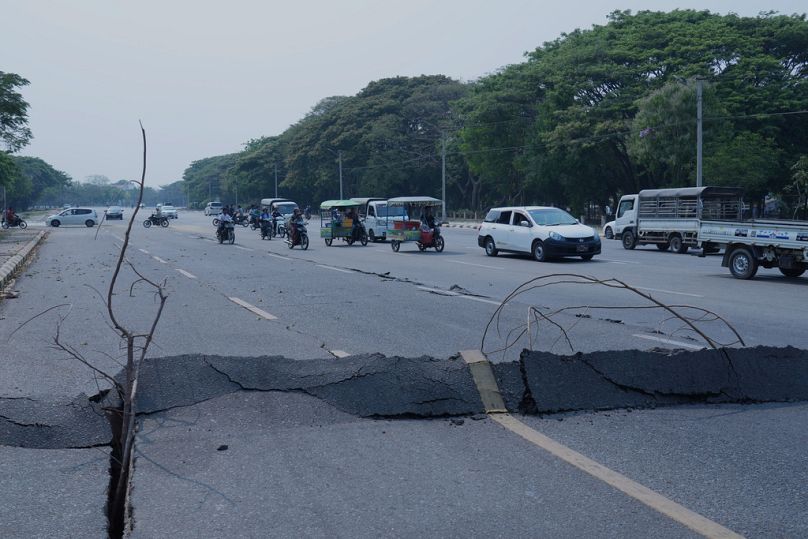
The hospital itself was hit by the terrifying tremors, which buckled roads and ripped tarmac apart as the ground vibrated violently for around half a minute.
The hospital's emergency department was itself heavily damaged, a car crushed under the heavy concrete of its fallen entrance.
"Many injured people have been arriving, I haven't seen anything like this before," a doctor at the hospital told AFP.
"We are trying to handle the situation. I'm so exhausted."Some cried in pain, others lay still as relatives sought to comfort them, intravenous drips from their arms.
"Hundreds of injured people are arriving... but the emergency building here also collapsed," security officials at the hospital said.
Others sat stunned with their head in their hands, blood caking their faces and limbs.
Myanmar's military chief Min Aung Hlaing visited the hospital, surveying the wounded lying on stretchers.
- 'Help me' -
The Myanmar capital is some 250 kilometres (150 miles) south from the epicentre of the 7.7-magnitude shallow tremor, that hit northwest of the city of Sagaing on Friday afternoon, according to the United States Geological Survey.
A 6.4-magnitude aftershock hit the same area minutes later.
A team of AFP journalists were at the National Museum in Naypyidaw when the earthquake struck, with chunks of the ceiling falling and cracks running up the walls.
The road to one of the biggest hospitals in Naypyidaw was jammed with traffic.
As ambulance weaved between vehicles, and shouting paramedic pleaded to be allowed to get through to reach the care of doctors.
Those inside ran outside, many trembling and tearful, and frantically trying to call family members on their phones to check if they were alive.
Powerful tremors were also felt in neighbouring China and in Thailand, where buildings in the capital Bangkok were shaken violently.
Worapat Sukthai, deputy police chief of Bangkok's Bang Sue district, said he could hear the sound of people screaming for aid trapped in the debris after a 30-story under-construction tower block collapse.
"I heard people calling for help, saying help me," he told AFP. "We estimate that hundreds of people are injured but we are still determining the number of casualties."
"I fear many lives have been lost. We have never experienced an earthquake with such a devastating impact before."
Bangkok residents are used to tremors -- and know to find a safe space outside if possible -- but many said the force on Friday came as a shock.
"I was shopping inside a mall when I noticed some signs moving, so I quickly ran outside," said Attapong Sukyimnoi, a broker. "I knew I had to get to an open space -- it was instinct."
Tremors from the powerful quake caused deaths and damages in the Thai capital of Bangkok, thousands of miles away from the earthquake's epicentre.
A strong 7.7 magnitude earthquake struck early afternoon in Myanmar on Friday, causing officials to declare a state of emergency in Myanmar and Bangkok, the capital of neighbouring Thailand.
At least three people were killed and 90 construction workers remain missing after the quake caused a 30-storey building in the capital to collapse in Bangkok's Chatuchak Park area.
Seven were rescued from the rubble of the collapsed building, the National Institute for Emergency Medicine said in a Facebook post.
A video circulated on social media showed the multi-story structure sway and crumble into a cloud of dust as onlookers screamed and ran.
Thai authorities have declared a state of emergency in response to the major earthquake hitting the city, Prime Minister Paetongtarn Shinawatra said on Friday.
The US Geological Survey (USGS) said the earthquake was shallow with a depth of 10 kilometres. Its epicentre was near the Burmese city of Sagaing, close to Mandalay.
A second quake, with a magnitude of 6.4, shook the area 12 minutes later.
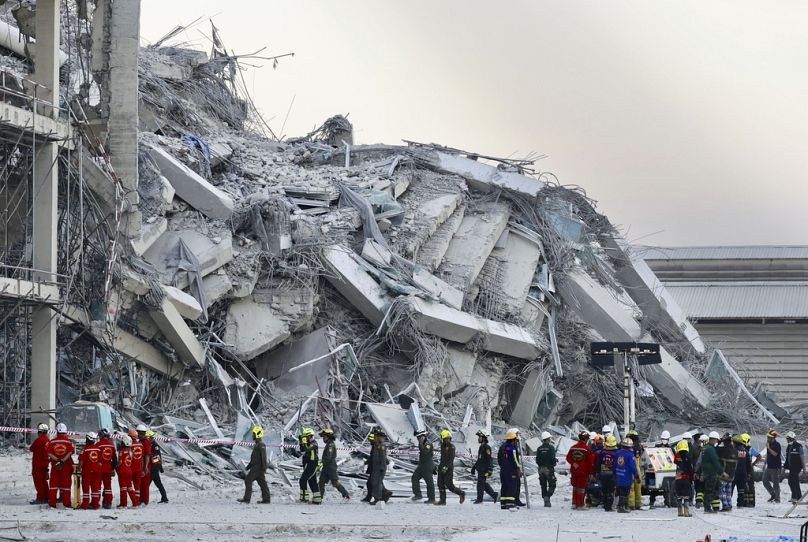
Rescuers work at the site a high-rise building under construction that collapsed after a 7.7 magnitude earthquake in Bangkok, Thailand, Friday, March 28, 2025. Wason Wanichakorn/Copyright 2025 The AP. All rights reserved
State of emergency in Myanmar
In Myanmar, state-run MRTV said the the military-run government declared a state of emergency across six regions and states.
Major General Zaw Min Tun, a military government spokesperson said blood was in high demand in the hospitals in earthquakes-hit areas, especially Mandalay, Sagaing, and Naypyitaw.
He urged blood donors to contact the hospitals as soon as possible.
The Red Cross said initial reports from the ground suggested the earthquake caused "significant damage", adding that damaged power lines were preventing their teams from reaching the affected Mandalay and Sagaing regions.
It is not yet known how many casualties there are as a result of the quake hitting the country, where many areas are not easily accessible and the government is embroiled in civil war after a coup in 2021.
AFP reported that the ruling miltary junta made a rare request for international humanitarian aid, leaving aid agencies scrambling to assess the humanitarian needs and work out how to reach the country, which is isolated from the outside world.
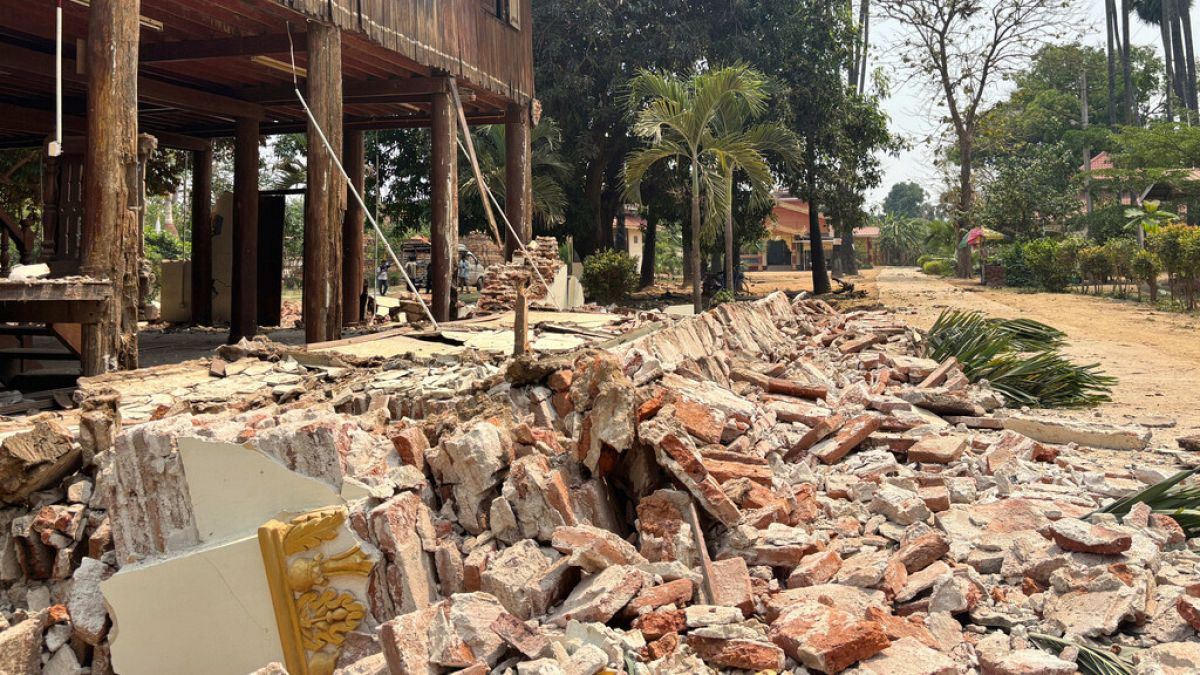
In the Saigaing region, a 90-year old bridge collapsed as sections of the highway connecting Mandalay to Yangon were damaged. In the capital Naypyitaw, religious shrines were damaged, with parts toppling to the ground.
Vehicles make their way near a road damaged by an earthquake Friday, March 28, 2025, in Naypyitaw, Myanmar.Aung Shine Oo/Copyright 2025 The AP. All rights reserved.
The quake caused alarms to go off in buildings across Bangkok, and thousands of residents ran down the staircases of high-rise apartments and hotels onto the street. Videos on social media showed people gathering in the streets of the Thai capital.
The tremors were forceful enough to send water sloshing out of pools, some high up in high-rises, as the tremor shook.
Paul Vincent, a tourist visiting from England, was at a streetside bar when the quake struck.
“When I saw the building, oh my God, that’s when ... it hit me,” he said. “There was people crying in the streets and, you know, the panic was horrendous really.”
Thai Prime Minister Paetongtarn Shinawatra warned Bangkok residents to remain calm as the city prepared an emergency response.
“I’d like to ask everyone to stay calm and do not panic, but please be careful,” Shinawatra said, warning that there could be possible aftershocks.
More than 17 million people live in the greater Bangkok area, many of whom are in high-rise apartments.
Powerful earthquake rocks Myanmar and Thailand, killing at least 3 in Bangkok high-rise collapse
DAVID RISING and JINTAMAS SAKSORNCHAI Fri, March 28, 2025
BANGKOK (AP) — A powerful earthquake rocked Myanmar and neighboring Thailand on Friday, killing at least three people in Bangkok and burying dozens when a high-rise building under construction collapsed. Footage shared on social media from Myanmar's second-largest city showed widespread destruction, raising fears that many were trapped under the rubble or killed.
The 7.7 magnitude quake, with an epicenter near Mandalay in Myanmar, struck at midday and was followed by a strong 6.4 magnitude aftershock.
The extent of death, injury and destruction — especially in Myanmar, which is embroiled in a civil war and where information is tightly controlled at the best of times — was not yet clear.
Myanmar's government said blood was in high demand in the hardest-hit areas. Images of buckled and cracked roads and damaged highways as well as the collapse of a bridge and dam raised further concerns about how rescuers would even reach some areas in a country already enduring a widespread humanitarian crisis.
Near Bangkok’s popular Chatuchak market, a 33-story building under construction, with a crane on top, crumpled into a cloud of dust, and onlookers could be seen screaming and running in a video posted on social media.
The sound of sirens echoed throughout central Bangkok and vehicles filled the streets, leaving some of the city’s already congested streets gridlocked. The elevated rapid transit system and subway shut down.
While the area where the quake struck is prone to earthquakes, they are usually not so big and it is rare for them to felt in the Thai capital, which sits on a river delta and is at moderate risk for quakes.
April Kanichawanakul, who works in an office building in Bangkok, initially didn’t even realize it was an earthquake, the first she’d ever experienced. “I just thought I was dizzy,” she said.
She and her colleagues ran downstairs from the 10th floor of their building and waited outside for a signal that it was safe to go back in.
Crane-topped building collapsed in a cloud of dust
In Bangkok, at least three people were killed in the building collapse and 90 were missing, according to Defense Minister Phumtham Wechayachai. He offered no more details about the ongoing rescue efforts but first responders said that seven people had been rescued so far from the area.
At least two of the dead were construction workers who were killed by falling rubble or debris, rescue worker Songwut Wangpon told reporters. The building was being built by the China Railway Construction Corporation for Thailand’s government auditor general.
Elsewhere, people in Bangkok evacuated from their buildings were cautioned to stay outside in case there were more aftershocks.
The U.S. Geological Survey and Germany’s GFZ center for geosciences said the earthquake was a shallow 10 kilometers (6.2 miles), according to preliminary reports. Shallower earthquakes tend to cause more damage.
Screaming and panic as buildings swayed
Bangkok's city hall declared the city a disaster area to facilitate the response. The greater Bangkok area is home to more than 17 million people, many of whom live in high-rise apartments.
“All of a sudden the whole building began to move. Immediately there was screaming and a lot of panic,” said Fraser Morton, a tourist from Scotland, who was in one of Bangkok's many malls.
“I just started walking calmly at first but then the building started really moving, yeah, a lot of screaming, a lot of panic, people running the wrong way down the escalators.”
Like Morton, thousands of people poured into Benjasiri Park from nearby shopping malls, high rises and apartment buildings along Bangkok’s busy Sukhumvit Road.
Many were on phones trying to reach loved ones as others sought shade from the hot early afternoon sun.
“I got outside and then looked up at the building and the whole building was moving, dust and debris, it was pretty intense,” Morton said. “Lots of chaos.”
Voranoot Thirawat, a lawyer working in central Bangkok, said her first indication that something was wrong came when she saw a light swinging back and forth. Then she heard the building creaking as it moved back and forth.
She and her colleagues ran down 12 flights of stairs. “In my lifetime, there was no earthquake like this in Bangkok,” she said.
Paul Vincent, a tourist visiting from England, was at a streetside bar when the quake struck.
“The next thing, everybody came on the street, so there was a lot of screaming and panicking, which obviously made it a lot worse,” he said.
As he came onto the street himself, he said he saw a high-rise building swaying and water falling from a rooftop pool.
“There was people crying in the streets and, you know, the panic was horrendous really,” he said.
Bridge and monastery collapse and dam bursts in Myanmar
In Mandalay, the earthquake reportedly brought down multiple buildings, including the Ma Soe Yane monastery, one of the largest in the city, and damaged the former royal palace. Meanwhile, Christian Aid said its partners and colleagues on the ground reported that a dam burst in the city, causing water levels to rise in the lowland areas in the area.
A video posted online showed robed monks in the street shooting video of the multistory monastery before it suddenly fell into the ground. It was not immediately clear whether anyone was harmed.
In the Sagaing region just southwest of the city, a 90-year-old bridge collapsed, and some sections of the highway connecting Mandalay and Myanmar’s largest city, Yangon, were also damaged.
The military seized power from the elected government of Aung San Suu Kyi in February 2021, and is now involved in a bloody civil war with long-established militias and newly formed pro-democracy ones.
Government forces have lost control of much of Myanmar, and many places are incredibly dangerous to access or simply out of reach for aid groups. More than 3 million people have been displaced by the fighting and nearly 20 million are in need, according to the United Nations.
The Red Cross said downed power lines added to challenges for their teams trying to reach several hard-hit areas.
“This disaster will have left people devastated and in need of drinking water, food and shelter," said Julie Mehigan, head of Asia, Middle East & Europe for Christian Aid. “Myanmar is one of the least developed countries in the world. Even before this heartbreaking earthquake, we know conflict and displacement has left countless people in real need.”
Myanmar’s government declared a state of emergency in six regions and states including the capital Naypyitaw and Mandalay. It was not clear what the declaration meant since the entire country has been under a state of emergency since 2021.
Residents in Yangon rushed out of their homes when the quake struck. In the capital Naypyitaw, the quake damaged religious shrines, sending parts toppling to the ground, and some homes.
Maj. Gen. Zaw Min Tun, the military government’s spokesperson, told state television MRTV that blood was in high demand in the hospitals in earthquakes-hit areas, especially Mandalay, Sagaing, and Naypyitaw. He urged blood donors to contact the hospitals as soon as possible.
Injuries reported in China
To the northeast, the earthquake was felt in Yunnan and Sichuan provinces in China and caused damage to houses and injuries in the city of Ruili on the border with Myanmar, according to Chinese media reports.
Videos that one outlet said it had received from a person in Ruili showed building debris littering a street and a person being wheeled in a stretcher toward an ambulance.
The shaking in Mangshi, a Chinese city about 100 kilometers (60 miles) northeast of Ruili, was so strong that people couldn’t stand, one resident told The Paper, an online media outlet.
_____
Adam Schreck, Haruka Naga, Jerry Harmer, Grant Peck and Penny Wang in Bangkok, Jamey Keaten in Geneva and Ken Moritsugu in Beijing contributed to this report.
Rescuers work at the site a high-rise building under construction that collapsed after a 7.7 magnitude earthquake in Bangkok, Thailand, Friday, March 28, 2025. (AP Photo/Wason Wanichakorn)ASSOCIATED PRESS Hospital patients lay on beds outdoors after a 7.7 magnitude earthquake in Bangkok, Thailand, Friday, March 28, 2025. (AP Photo/Sakchai Lalit)ASSOCIATED PRESS Rescuers carry an injured from the site of a high-rise building under construction that collapsed after a 7.7 magnitude earthquake in Bangkok, Thailand, Friday, March 28, 2025. (AP Photo/Sakchai Lalit)ASSOCIATED PRESS A woman reacts as she watches rescuers at the site of a high-rise building under construction that collapsed after a 7.7 magnitude earthquake in Bangkok, Thailand, Friday, March 28, 2025. (AP Photo/Wason Wanichakorn)ASSOCIATED PRESS A rescuer walks at the site of a high-rise building under construction that collapsed after a 7.7 magnitude earthquake in Bangkok, Thailand, Friday, March 28, 2025. (AP Photo/Sakchai Lalit)ASSOCIATED PRESS Damaged pagodas are seen after an earthquake, Friday, March 28, 2025 in Naypyitaw, Myanmar. (AP Photo/Aung Shine Oo)ASSOCIATED PRESS Rescuers work at the site of a high-rise building under construction that collapsed after a 7.7 magnitude earthquake in Bangkok, Thailand, Friday, March 28, 2025. (AP Photo/Sakchai Lalit)ASSOCIATED PRESS Children walk near a damaged monastery compound after an earthquake, Friday, March 28, 2025 in Naypyitaw, Myanmar. (AP Photo/Aung Shine Oo)ASSOCIATED PRESS Rescuers tend to injured from the site of a high-rise building under construction that collapsed after a 7.7 magnitude earthquake in Bangkok, Thailand, Friday, March 28, 2025. (AP Photo/Sakchai Lalit)ASSOCIATED PRESS People who evacuated from buildings following earthquake in Bangkok, Thailand, Friday, March 28, 2025. (AP Photo/Chutima Lalit)ASSOCIATED PRESS The bodies of victims of a high-rise building under construction that collapsed after a 7.7 magnitude earthquake lie on the ground in Bangkok, Thailand, Friday, March 28, 2025. (AP Photo/Wason Wanichakorn)ASSOCIATED PRESS A crane is seen damaged on the facade of an under-construction building after a 7.7 magnitude earthquake in Bangkok, Thailand, Friday, March 28, 2025. (AP Photo/Sakchai Lalit)ASSOCIATED PRESS People who evacuated from buildings following earthquake in Bangkok, Thailand, Friday, March 28, 2025. (AP Photo/Chutima Lalit)ASSOCIATED PRESS Rescuers work at the site of a high-rise building under construction that collapsed after a 7.7 magnitude earthquake in Bangkok, Thailand, Friday, March 28, 2025. (AP Photo/Sakchai Lalit)ASSOCIATED PRESS A bridge that connects two high-rises is seen damaged after a 7.7 magnitude earthquake in Bangkok, Thailand, Friday, March 28, 2025. (AP Photo/Sakchai Lalit)ASSOCIATED PRESS Damaged pagodas are seen after an earthquake, Friday, March 28, 2025 in Naypyitaw, Myanmar. (AP Photo/Aung Shine Oo)ASSOCIATED PRESS People take shelter outdoors after an earthquake shook nearby high-rises in Bangkok, Thailand, Friday, March 28, 2025. (AP Photo/David Cohen)ASSOCIATED PRESS People who evacuated from buildings following earthquake in Bangkok, Thailand, Friday, March 28, 2025. (AP Photo/Chutima Lalit)ASSOCIATED PRESS A Buddhist monk walks near a damaged building at a monastery compound after an earthquake, Friday, March 28, 2025 in Naypyitaw, Myanmar. (AP Photo/Aung Shine Oo)ASSOCIATED PRESS Workers at the Ikea in a nearby high-rise shopping mall and others seek shelter in Bangkok's Benjasiri Park after an earthquake on Friday, March 28, 2025. (AP Photo/Adam Schreck)ASSOCIATED PRESS Rescuers work at the site a high-rise building under construction that collapsed after a 7.7 magnitude earthquake in Bangkok, Thailand, Friday, March 28, 2025. (AP Photo/Wason Wanichakorn)ASSOCIATED PRESS A damaged monastery is seen after an earthquake, Friday, March 28, 2025 in Naypyitaw, Myanmar. (AP Photo/Aung Shine Oo)ASSOCIATED PRESS
Understanding the energy transition: How models shape the future
Veit Hagenmeyer (KIT) and Klaus Stierstorfer (University of Münster) receive funding for a Reinhart Koselleck project on critical analysis of energy transition models and their effects
“Our projections about future energy use are developed using models, and the models are used to make policy. But if we don’t understand how these models work, then we have to believe what we’re told. That’s a dangerous situation,” said Professor Veit Hagenmeyer, head of KIT’s Institute for Automation and Applied Informatics, in explaining the need for a thorough examination of current practices for modeling the energy transition. In the transdisciplinary research project entitled Poetik der Modelle (poetics of models), Hagenmeyer is working with literary scholars Professor Klaus Stierstorfer and Professor Matthias Erdbeer from the University of Münster to examine how energy transition models are not only technical calculations and constructs but also narratives for shaping the future. The DFG is funding the research as a Reinhart Koselleck project for exceptionally innovative, high-risk research with EUR 1 million over a period of 5 years.
Hidden Premises of Energy Transition Models
Technical models are a central tool in energy research. They are used to calculate energy requirements, manage supply networks and inform decision-making in government and business. But their underlying assumptions are often hidden. “Models aren’t neutral. They’re based on assumptions about technology trends, political conditions, and human behavior. Many of these assumptions remain hidden,” Hagenmeyer said, adding that this lack of visibility could cause scientific findings to be uncritically adopted or completely called into question. Aims of the project include revealing the hidden mechanisms of model building, determining which narrative patterns are included in the models, and finding new ways to make energy transition models more transparent, participative, and inclusive.
An important driving force behind this innovative approach was Professor Armin Grunwald, who heads KIT’s Institute for Technology Assessment and Systems Analysis (ITAS) and the Office of Technology Assessment at the German Bundestag. “We often need models when advising policymakers, for example in the German parliament. We need to understand those models, especially their assumptions and premises. If we don’t, our advice could be biased and lead to poor policy decisions,” Grunwald said. Along with Grunwald, Professor Daniel Lang, also from ITAS, is another partner in the project. His expertise in real-world lab research complements the project’s transdisciplinary perspective and helps to ensure that the social dimension of the energy transition is given thorough consideration.
Real-world Labs at KIT Involved
To ensure that the assumptions behind models are not only scientifically convincing but also successful in practice, researchers are trying to simulate future energy systems under conditions that are as realistic as possible. With real-world labs for energy transition research, such as the Energy Lab (Europe’s largest research infrastructure for renewable energy) or the Karlsruhe Real-World Lab for Sustainable Climate Protection (for a participative energy transition), KIT has created an extensive infrastructure that is being integrated into the research project. “So the project isn’t only investigating which assumptions energy transition models are based on, it’s also investigating how real-world labs work as places of scientific and social give-and-take about the models,” Hagenmeyer said. “Real-world labs are test centers for technical scenarios, and as such they’re now becoming objects of scientific analysis themselves. How does the way they’re presented affect thinking about the models implemented there? Which narratives arise when the public interacts with these models?”
Overcoming Reservations about the Energy Transition
“The energy transition is both a technical and a narrative challenge,” Hagenmeyer noted. Accordingly, the Poetik der Modelle research project looks beyond the technical issues of transforming the energy system, beginning precisely where reservations about the energy transition arise: in communicating about a desirable future among scientists, policymakers and the public. “As long as people don’t understand where scenarios about the future of the energy supply come from, the public discourse will be marked by uncertainty, mistrust, and simplistic demands. Our project aims to remove these uncertainties and show new ways for scientists, policymakers and the public to work together to develop viable energy strategies. We can only actively shape the future when we understand how it’s modeled,” Hagenmeyer said.
Being “The Research University in the Helmholtz Association”, KIT creates and imparts knowledge for the society and the environment. It is the objective to make significant contributions to the global challenges in the fields of energy, mobility, and information. For this, about 10,000 employees cooperate in a broad range of disciplines in natural sciences, engineering sciences, economics, and the humanities and social sciences. KIT prepares its 22,800 students for responsible tasks in society, industry, and science by offering research-based study programs. Innovation efforts at KIT build a bridge between important scientific findings and their application for the benefit of society, economic prosperity, and the preservation of our natural basis of life. KIT is one of the German universities of excellence.
Soil carbon-degrading enzyme activities were more sensitive to warming in the alpine meadow than swamp meadow
Soil extracellular enzyme activities in the surface (0-5 cm) and subsurface (5-20 cm) layers of alpine meadow (A-F) and swamp meadow (G-L) under different warming treatments.CK: control treatment; 3-yr W: 3-year warming treatment; 6-yr W: 6-year warming treatment. Yellow, blue, and red dots indicate control, lower, and higher warming treatments, respectively, and while grey dots represent raw data collected before the warming experiment started. Different lowercase letters indicate significant differences (p < 0.05) between treatments at the same depth; non-significant differences are not marked. The straight lines indicate significant relationships (p < 0.05) between soil enzyme activities and warming duration under lower (blue line) and higher (red line) warming.
The continuously increasing temperature is expected to accelerate soil organic carbon (SOC) decomposition and release additional CO2 into the atmosphere by stimulating microbial activity. However, there remains significant uncertainty regarding the response of microbial activity to warming, which hinders accurate predictions of the SOC-climate feedback. Extracellular enzymes produced by soil microbes are the primary agents of SOC decomposition. Investigating soil carbon-degrading enzymes has improved our understanding of the physiological mechanisms underlying the SOC response to warming. This study demonstrates that the activities of soil extracellular enzymes were significantly altered in the alpine meadow, but not significantly in the swamp meadow, which coincided with the SOC content of these grasslands. The observed disparities can be attributed to variations in enzyme types, as well as the unique physicochemical and microbiological properties of each meadow type. The researchers' findings were published on March, 2025, in Soil Ecology Letters.
An in-situ warming experiment, involving the manipulation of both warming magnitude and duration, was conducted in alpine and swamp meadows simultaneously in a representative permafrost zone of the Tibetan Plateau by Ruiying Chang's team at the Institute of Mountain Hazards and Environment, Chinese Academy of Sciences. They measured the activities of three typical soil carbon-degrading enzymes (β-1, 4-glucosidase (BG), peroxidase (PER), phenol oxidase (POX)) after 3 and 6 years of warming at magnitudes of +2.4 and +4.9°C above the ambient temperature, respectively.
In this study, they found that the duration of warming plays a varying role in regulating the responses of enzyme activities and SOC storage in different types of alpine grasslands. A time-cumulative effect of warming on carbon-degrading enzyme activities was observed in the alpine meadow. After six years of warming, BG activity was significantly increased, while POX activity and the ratio of oxidase to hydrolase activities were decreased. These changes coincided with an increase in SOC content in the grassland. In contrast, neither the warming intensity nor the duration had a consistent impact on soil enzyme activities or SOC content in the swamp meadow. The primary factors influencing soil enzyme activities under warming in the alpine meadow were dissolved organic carbon and above-ground biomass, while soil water content was the main factor influencing enzyme activities in the swamp meadow. The variation in above-ground biomass, soil physicochemical, and microbiological properties can account for the discrepancies (a negative correlation (p < 0.05) between SOC and oxidase/hydrolase activity was found in the alpine meadow but not in the swamp meadow) between the two meadows. This indicates that carbon input and enzyme characteristics jointly determine how SOC responds to warming in alpine grasslands.
The study investigated the responses of SOC and soil carbon-degrading enzyme activities to different warming magnitudes and durations and revealed the enzymatic mechanisms underlying SOC responses. Furthermore, they emphasized the need to consider the time-cumulative effects of warming on plant growth and enzyme ratios in carbon models to improve the accuracy of model predictions for soil carbon dynamics in permafrost regions.