Thursday, April 24, 2025

Oil Markets Are Bracing for Another External Shock

Oil markets are bracing for the next big external shock as Trump's trade war with China continues to escalate and talks of a potential nuclear deal with Iran threaten to bring fresh supply to markets.


oil prices

oil

rig

oil

- The start of trade negotiations between the United States and Asia Pacific countries has been marked by evident interest in US LNG projects, whilst the likes of South Korea and Japan kept relatively mum about crude. 

- Taiwan’s President Lai Ching-te announced that Taipei would seek to increase the share of US LNG imports from the current 10% to 33%, potentially discontinuing some term supplies from Australia and Qatar.

- South Korea, too, is considering a 20-25% increase in US LNG imports, currently accounting for 12% of its liquefied gas needs, seeking to wind down Qatari contractual commitments that are linked to Brent rather than traded against JKM or Henry Hub. 

- China is moving in the opposite direction, completely halting its imports of US LNG in March and signing three long-term deals with the UAE for the supply of liquefied gas over the next 10 years, seeking further term options in the region. 

Market Movers

- US investor James Cameron has offered $5 billion to buy Kazakhstan’s mining giant Eurasian Resources Group, 40% part-owned by the Kazakh government, as the miner intends to expand into rare earths.

- UK energy firm BP (NYSE:BP) has become the only foreign oil company to bid in India’s OALP-IX bidding round, landing the most coveted GS-OSHP block alongside Indian partners Reliance and ONGC. 

- US oil major Chevron (NYSE:CVX) is reportedly looking to divest some of its upstream interests in Angola, potentially exiting Block 14K that currently produces some 42,000 b/day across Angola and Congo.

- Argentina’s second-largest oil company, Vista Energy (NYSE:VIST), bought Petronas’ 50% stake in the La Amarga Chica shale play in the country’s Vaca Muerta basin for a total of $1.5 billion.

Tuesday, April 22, 2025

Oil producers are preparing for another external shock to oil markets as Brent futures took some collateral damage from Monday’s equity sell-off and remain pressured by the prospect of a potential US-Iran nuclear deal. For the time being, the $66-67 per barrel price for ICE Brent seems to be a temporary resting place for crude before the next big thing happens.

Rome Hosts High-Level Nuclear Talks. Negotiators from the United States and Iran met in Italy’s capital, Rome, over the weekend to continue negotiations started a week ago in Oman over Tehran’s nuclear programme, with both sides lauding the progress the talks had made over the past week.

US Wants to Make the Gulf Great Again. As the US Bureau of Ocean Energy Management recently upped the Gulf of America’s untapped reserves to 5.77 billion barrels, the Trump administration has launched a new 5-year offshore oil and gas leasing plan, which might include blocks in the Arctic.

Gold Continues to Edge Higher. Amidst widespread speculation of Donald Trump wanting to fire US Fed chair Jerome Powell, gold prices touched $3,500 per ounce for the first time on record in Tuesday’s intraday trading, up 32% since the beginning of the year.

China Loads Up On Middle Eastern LNG. China’s state-controlled oil majors CNOOC and Zhenhua Oil, as well as privately owned ENN Natural Gas, have all signed term deals with the UAE’s state oil company ADNOC, ranging from 5 to 15 years and coming into effect as early as 2026.

Egypt’s Hyped Exploration Boom Fails. An array of international energy firms have exited their respective concessions in Egypt’s offshore zone in the Red Sea after US oil firm Chevron relinquished its stake in Block 1, with rumours also suggesting Shell is set to give up on the adjacent Block 3.

P66 Fights Back Against Activist Investor. Leading US refiner Phillips 66 (NYSE:PSX) has issued a letter demanding that activist investor Elliott Investment Management back down from its push to break up the company due to a conflict of interest, as it is separately seeking to buy distressed Citgo. 

India Slaps Tariffs on Chinese Steel. The government of India announced a 12% tariff on some steel imports from China that would be valid for the next 200 days, arguing that a flood of cheaper Chinese steel products put domestic mills under immense pressure and forced job cuts.

South Korea Dreams Big to Impress Trump. South Korea’s leading steel manufacturer, Posco Holdings (NYSE:PKX), is reportedly planning to join its peer, Hyundai Motor Group (KRX:005380), to build a $5.8 billion steel mill in the US, expected to start operations in 2029 in Louisiana.

Using Oil, Russia Seeks to Stay in Syria. The ouster of former Syrian President Bashar al-Assad has led to a complete halt in Iranian oil deliveries to the Levantine nation. In its stead, Damascus has opted for Russian crude and diesel deliveries as Moscow wants to keep its Tartus naval base. 

China’s Copper Grows Despite Low Profits. Chinese production of refined copper surged to 1.25 million tonnes in March, up 8.6% from a year ago and hitting a new all-time monthly high, with minimal profitability somewhat cushioned by higher gold prices, a co-product of copper smelting.

Saudi Aramco Eyes Automotive Roles. Saudi Aramco, the national oil firm of Saudi Arabia, inked a deal with China’s leading EV producer BYD (SHE:002594) to develop new energy vehicle technologies, seeking to benefit from the proliferation of battery-powered cars across Asia.

Heavy Rains Resuscitate Rhine Shipping. Easter precipitation has finally allowed German shippers to transport full cargoes along the River Rhine, the country’s main energy transportation artery, with water levels in Kaub rising by 40% to 125cm.

Morocco to Build an LNG Import Terminal. The North African country of Morocco is preparing to begin tendering procedures for its first-ever liquefaction terminal, to be located in the port of Nador, as its gas requirements are expected to soar from 1 Bcm currently to 8 Bcm by 2027.

By Michael Kern for Oilprice.com


Drill, Baby, Drill... But for Water

  • Water scarcity is emerging as a major constraint for resource industries.

  • Satellite data reveals long-term declines in global water storage capacity, especially in dry regions like the U.S. Southwest.

  • Water is becoming an investable commodity, with increasing demand from agriculture, industry, and even data centers.

A while ago, in a article about investment opportunities, we concluded that water was the new oil, the commodity that would provide one of the the best returns in the future. A bit hyperbolic, maybe? But there is another aspect of water relevant to resource industries, namely that its scarcity will inhibit or raise costs of resource development, including that of oil and gas.

Take fracking, which made America’s petroleum industry great again. It requires large quantities of water. And after the fracking, the drillers have to do something with the frack-produced water, which now contains chemicals and other pollutants. They can reuse some of it for more fracking, but what about the rest? How much treatment will it require to spray on fields, to drink, or to return to the aquifer? How much will treatment cost? The debate on that may, to some, read like something out of Ibsen’s “Enemy of the People,” a play we suspect is not often produced in the Oil Patch. There is, however, still another issue, beyond polluted water.  Many frackers operate in dry regions with diminishing underground water supplies, and that, we suspect, will become a growing issue in the oil business.

But you knew all that. What attracted our attention were two journal articles. One (by Islam, et. al., Science, 14 March 2025)  examined the water requirements for the production of 38 minerals. It predicted that water needs for the production of key minerals would exceed sustainable water supplies. In the case of copper, 37% of production is in places where it already “exceeds available water capacity.” There is some good news, though. Coal demand will taper off, making its water supplies available. But the bad news is that saving water here is not the same as making water available there, because we can’t economically move surplus water from a closed coal mine in Germany to a copper mine in Chile. The article, being focused on resource use, though, does not even consider the voracious water consumption of data centers. You may remember the old song about how the farmer and the cowman should be friends. Nowadays, the farmer and the data center owner won’t be friends once they get started arguing about water. 

The second article (by Seo, et.al.,Science, 28 March 2025) provides evidence from satellite surveys  that, global warming and long droughts have reduced terrestrial water storage and may have irreversibly reduced water storage capacity in the soil. The big decline seems to have begun in 2000. Both articles show most stress or damage in the American Southwest, and over parts of the Ogallala Aquifer. In other words, the Oil Patch. If these studies are even half correct, water will become increasingly scarce in those regions for purposes other agriculture and human consumption. 

This brings us back to our original bullish investment thesis on water. A rising population needs more of the product. The industry, to maintain operations or grow, needs more products. Supply of product remains steady, globally, but pollution and changing climate make the available supply less dependable on a regional basis. On the plus side, nobody claims that the product is destroying the world, shadowy foreign cartels do not control its price, and nobody, so far, has cried “hoax” when shortages require action. The American Society of Civil Engineers said that water-related spending in the USA was way below what was required, and they made their estimate several years before this new information came along. Our conclusion: if you need water to operate, don’t take it for granted that you can get it, and if you have the money and the assets (expertise in hydrology, geology, construction, pipelines, operation of large installations, and capital for long term investment) move in before the action. Drill, baby, drill. But for what?

By Leonard Hyman and William Tilles for Oilprice.com

Turkey Eyes Oil & Gas Exploration In Bulgaria, Iraq And Libya

  • Turkey is pursuing oil and gas exploration in Bulgaria, Iraq, and Libya
  • Ankara aims to boost domestic production and become a key energy hub linking East and West.

  • Turkey’s energy strategy includes influence in post-conflict Libya and potential pipeline links through Syria.

Turkey is currently in talks to explore for oil and gas in Bulgaria, with similar plans for exploration in Iraq and Libya, Turkish Energy Minister Alparslan Bayraktar has revealed. According to the minister, state-owned energy company Turkiye Petrolleri AO (TPAO) will sign an agreement with an unnamed foreign partner within the next month to conduct exploration in Bulgaria’s section of the Black Sea. 

Turkey not only wants to boost domestic oil and gas production, but also harbors ambitions to become a regional energy hub. Turkish President Recep Tayyip Erdo?an has been trying to position Turkey as an energy hub, connecting natural gas producers to its east and south with markets to the west. The country’s strategic geographical position and infrastructure give it an advantage in this regard.

Turkey and Bulgaria signed a deal in 2023 to permit Bulgaria’s state-owned Bulgargaz to import 1.85 billion cubic meters of gas per year-- good for ~60% of Bulgaria's annual demand--through the Strandzha-Malkoclar interconnection border point with Turkey. Bulgargaz has to pay a €2 billion service fee to Turkish gas firm Bota? over a 13-year period, regardless of whether it makes use of this capacity. According to Bayraktar, the capacity to export via Bulgaria right now is only around 3.5 billion cubic meters a year but capabilities can be boosted. 

What we need is an increase in the capacity of the interconnection between Turkey and Bulgaria”, which currently can only receive about half of the amount of seven billion cubic meters per year that, from a technical point of view, Turkey can provide it,” Bayraktar told Bloomberg.

But Libya is probably Erdogan’s biggest gamble, that is just as much about power and influence as it is about energy.

After more than a decade of instability, Libya is expanding oil production, despite extreme political fragility that has analysts increasingly worried about a return to civil war.

According to Chairman of Libya’s National Oil Corporation Masoud Sulaiman, Libya plans to increase oil output from 1.4 mb/d currently to 2 mb/d in 2028. However, ramping output to that level will require considerable capital outlays: Abdulsadek estimates that Libya needs between $3 billion and $4 billion to reach its intermediate goal of oil production rate of 1.6 mb/d, adding that a new license bidding round is expected to be approved by the cabinet. The Libyan economy relies heavily on oil, with fossil fuels accounting for more than 95% of its economic output.

Last year, Turkey announced that it was prepared to significantly increase natural gas exports to the European Union, desperate to further wean itself off Russian gas. In order to do that, the most likely route is to re-export Azeri natural gas from Turkey. That, in turn, would require Turkey to take in more Russian gas to make up for the shortfall. Ankara is keen to play the role of savior and boost its leverage with respect to Brussels, but it wants some demand guarantees before it starts spending on the necessary infrastructure. The Trans-Anatolian Natural Gas Pipeline, which forms part of the Southern Gas Corridor bringing Azerbaijani gas to Europe, is a strategic advantage for Turkey. The country is also home to five LNG terminals, seven gas pipelines, three floating storage units, and two underground storage facilities, as well as considerable excess import capacity that could be used for trading.

On the other hand, over the past couple of years, Europe has been trying to secure alternative gas supplies to replace Russian gas transiting through Ukraine. Russian gas stopped flowing to EU states via Ukraine after a five-year deal expired on January 1 2025, marking the end of a decades-long arrangement. Ukrainian President Volodymyr Zelensky declared that his country would not allow Russia to "earn additional billions on our blood", with a cross-section of leaders describing it as yet"another victory" against Moscow.

Russia can still send gas to Hungary, Turkey and Serbia through the TurkStream pipeline across the Black Sea. Azerbaijan’s natural gas sold to Turkey could be re-exported to Europe, possibly through Bulgaria, but not without effort and expense. In an interview with Bloomberg,  Bayraktar pushed hard for a Bulgaria route, noting a potential for increasing volumes to the EU up to 10 billion cubic meters per year, while sending a clear message to Brussels: It won’t happen without some demand guarantees.

Turkey’s ambitions to become a leading energy hub in Europe also gathered momentum after the sudden collapse of the 54-year Assad dynasty in Syria. Turkish companies are well-placed to secure major contracts should Syria transform into a free market, with the cost of reconstruction estimated at $400 billion. Turkey could construct a gas pipeline to the west of Syria and connect to the Arab Gas Pipeline network (which links Syria, Jordan, and Egypt). This would help Turkey to offer regional gas producers such as Israel and Egypt a more commercially viable route to European markets compared to current LNG alternatives. 

By Alex Kimani for Oilprice.com


New Trade Rules Set to Disrupt Global Air Freight

  • The air cargo industry is projected to lose billions in revenue due to new US tariffs and the end of tariff exemptions for low-value parcels from China and Hong Kong.

  • Small online sellers with direct-to-consumer fulfillment models are particularly vulnerable to the new trade rules, which increase costs and create customs clearance challenges.

  • The changes in US trade policy are expected to significantly reduce air freight demand and alter the dynamics of global e-commerce shipping.


U.S. plans next month to cancel tariff-free access for low-value parcel shipments from China and Hong Kong, coupled with a new 145% tariff rate on Chinese imports, could bleed more than $22 billion in revenue from the air cargo sector over three years and put thousands of online sellers with direct-to-consumer fulfillment models out of business, according to an e-commerce and logistics consulting firm. 

Derek Lossing, the founder of Cirrus Global Advisors, has previously said the Trump administration’s recent trade actions against China would “decimate” air cargo out of China because demand for products on the Temu and Shein platforms would plummet. His Seattle-based consultancy has now quantified the downstream effects of the changes on the air cargo sector. 

The Cirrus Global Advisors model shows the airfreight industry revenue could contract $22 billion if the White House maintains tariffs at 125% for a substantial period of time, based on assumptions about lower consumer demand, excess airline capacity and downward pressure on yields. Large cargo airlines and freighter forwarders, like Atlas Air and Kuehne+Nagel subsidiary Apex Logistics, with heavy exposure to large Chinese marketplaces, as well as Amazon and smaller online brands, are expected to experience downward pressure on revenues, Losing said in a phone interview.

The estimate was made before the U.S. clarified that China tariff rate was actually 145%, to include a previous tariff, but it’s unclear if the higher rate would further drag down industry revenue.

E-commerce shipments account for an estimated 50% to 60% of China-U.S. air volumes and an estimated 20% of global air cargo volumes, according to logistics providers and the International Air Transport Association. Experts agree that dozens of widebody freighters are dedicated to hauling e-commerce shipments across the Pacific each day from China, but Lossing said he believes an estimate of 100 such aircraft by Netherlands-based consultant Rotate is high.

Total air cargo revenue on the China-U.S. trade lane will decrease more than 30% because of the lower volumes caused by the new U.S. trade policies and the lower yields that will follow, Lossing, a former Amazon logistics executive, predicted. 

When the Biden administration last fall proposed tighter rules for a subset of Chinese goods to qualify for de minimis, a program that allows the duty and tax-free entry of shipments with an aggregate value of $800 or less per person, per day, Cirrus Global Advisors estimated the impact to global air cargo revenue at $3 billion over three years. The estimate for revenue loss has steadily increased with Trump’s aggressive posturing against China before and after his inauguration, culminating with a complete ban of all Chinese goods from duty-free treatment, effective May 2. Starting next Friday, retailers will need to file formal customs entries, which require much more information and time than the fast-track de minimis process, to clear individual shipments

U.S. Customs and Border Protection says lax data requirements for de minimis shipments makes it difficult to screen for entry of illicit and unsafe goods. Trump canceled de minimis on the grounds that it enables smuggling of the opioid fentanyl and cheap imports that undercut U.S. retailers and manufacturers. 

Limiting de minimis when tariffs were relatively low was mostly considered an inconvenience for large Chinese marketplaces like Temu, Shein and Alibaba because their prices are so low consumers likely wouldn’t change their shopping habits if a piece of clothing increased in price by $2 or $3. But the imposition of 145% tariffs has blown up the model of fulfilling orders in China and shipping them by air directly to the customer’s residence, which was cheaper and faster than shipping in bulk by ocean to a U.S. warehouse for pick, pack and delivery. 

Temu, a hugely popular market for cheap goods, and fast-fashion brand Shein last week notified customers on their websites that they will raise prices starting April 25 in response to new trade rules and rising tariffs. The South China Morning Post reported that Temu has already sharply reduced online advertising in the U.S. Despite this, both sites have seen a spike in orders recently as shoppers try to get goods before the tariffs kick in. 

In addition to higher prices from tariffs, digital markets could lose sales as new customs clearance requirements create friction for customers during checkout, Lossing predicted Friday on LinkedIn.

“How comfortable will U.S. online consumers be to provide more, personal sensitive information to shop on a Chinese website, to facilitate a customs declaration for a B2C shipment,” he wrote. If e-commerce hassles and privacy concerns deter consumers from completing purchases the decline in cross-border parcel volumes and air cargo revenues could be even greater than currently forecast.

The Cirrus model, like others, assumes that the steep drop in China e-commerce shipments to the U.S. will significantly reduce demand for freighter aircraft. Airlines will respond by accelerating the retirement of older aircraft and relocating assets to other markets, resulting in excess capacity there and lower average freight rates. The degree to which express carriers and freighter operators reduce flight schedules or remove aircraft from China service will depend on how much consumers pullback from shopping. 

And If the European Commission follows through on intentions to remove the de minimis exemption for goods valued below $170 and impose a customs handling fee on individual B2C packages the harm to cross-border e-commerce players, including all-cargo airlines, could be severe, Losing told FreightWaves. 

“That’s kind of the one-two punch that actually would potentially push the revenue loss for air cargo over our current estimate,” he said. 

And the potential damage to the industry could spread if the Trump administration, as threatened, eliminates de minimis benefits across all nations once systems are in place to collect tariffs from millions of extra shipments per day. But the harm could also be less severe if the President follows a pattern of quickly undoing policy pronouncements and relaxes the tariffs or de minimis rules.

Small online sellers at high risk

The crackdown on Chinese e-commerce shipments poses an existential threat for many small-and-medium e-tailers with storefronts selling goods directly from China, as well as logistics providers that handle customs clearance and last-mile delivery for B2C shippers, said Lossing.

Large Chinese marketplaces were already preparing for more restrictive de minimis rules by building millions of square feet of U.S. warehouses the past couple of years to support a more traditional B2B2C fulfillment model, logistics executives said. Temu, for example, will consign goods to its U.S. entity, clear them via a formal customs entry, pay duty and truck them to a fulfillment center, where they will be stored, picked, packed and delivered.

Another reason for consolidating air or ocean shipments on one customs entry is to reduce the cost for customs brokerage and merchandise processing fees paid to the government per shipment. The cost for customs brokers to file entries will shoot up from 10 cents to $3 per package once the special de minimis pathway is eliminated. 

The National Foreign Trade Council calculates that without de minimis the average $50 package would require about $31 in paperwork, a brokerage fee of $20, plus tariffs and taxes, which would more than double the delivery cost.

In addition to significantly higher import costs, air shipments are expected to take longer for CBP to process under the standard entry process. 

Lossing said there are tens of thousands of small companies in China that sell on Amazon and other platforms that won’t be able to pay the 145% tariff and don’t have the resources to use a traditional containerized export model. And many customers will switch to countries like Vietnam, where tariffs are lower, for their online orders. 

He shot down arguments that the direct-to-consumer model for e-commerce from China is still viable because it allows merchants to defer tariffs until the actual time of sale versus paying them at a U.S. port of entry and it avoids the risk of having cash tied up in unsold inventory while paying for warehousing. 

On LinkedIn he challenged the assertion on Bloomberg Television by Izzy Rosenzweig, CEO of e-commerce logistics provider Portless, that the benefits of fulfilling individual orders from China to U.S. residents still made economic sense. Rosenzweig said Shein has plenty of margin to absorb higher import costs, while Temu’s goal is to fulfill 80% of its orders in the domestic U.S. 

“There are some pretty significant data points that show that the China D2C model will not survive at these tariff rates and de minimis closure. I guess only time will tell what happens….The only upside we see for the China-US e-commerce model is air freight rates are set to drop 30%-40% on the trade lane, bringing the cost per parcel down over $1 per unit,” Lossing posted.

Aaron Rubin, founder and CEO of ShipHero, a warehouse management software provider for e-commerce brands, said on LinkedIn that FedEx is charging an additional 45 cents per pound on airfreight from China because so many companies are running sales to liquidate their Chinese products for de minimis expires on May 2.

New tariffs, higher shipping rates and customer friction together “will force all companies to create and implement B2B2C clearance models because asking for sensitive customer information at checkout is a nail in the coffin” for direct-to-consumer fulfillment, Lossing said on LinkedIn. 

By Zerohedge.com


Will Magnesium Disrupt the Electric Vehicle Industry?

  • Researchers are developing magnesium batteries to address the environmental and geopolitical issues associated with lithium-ion batteries, which currently dominate the electric vehicle market.

  • Magnesium offers advantages such as abundance, lower cost, and less complex supply chains compared to lithium.

  • Recent breakthroughs in magnesium battery technology, including advancements in electrolytes and anodes, show promise for a more sustainable and efficient energy storage solution.

On an international scale, researchers have been hard at work making magnesium batteries a feasible replacement for lithium-ion batteries and hydrogen fuel cells, in a development that could upend the electric vehicles industry on a worldwide scale. 

Currently, the global EV fleet runs on lithium-ion batteries, but these fundamental building blocks of the decarbonization movement carry some critical drawbacks. As it stands lithium production and refining for use in lithium-ion batteries and other applications is all but monopolized by China. China alone is responsible for more than more than 98% of the world’s lithium iron phosphate, and “the country dominates almost the entire value chain of lithium-ion batteries - from raw material extraction to battery production - and controls both national and international production capacities,” according to research from the Fraunhofer Research Institution for Battery Cell Production FFB. 

This supply chain concentration generates major risks for the global economy. China has already shown that it’s not afraid to cause global disruption of lithium supplies in response to the intensifying trade war and punitive tariffs being imposed by the Trump administration in the United States.

Moreover, the production of lithium – while broadly associated with clean energy – causes considerable environmental damage in the localities where it’s extracted. The process requires the use of chemicals and heavy metals that can leach into the soil and groundwater of surrounding communities, causing public health crises and threatening local wildlife. It’s also an incredibly thirsty business, requiring around 500,000 gallons of water per tonne of lithium extracted. 

“Like any mining process, it is invasive, it scars the landscape, it destroys the water table and it pollutes the earth and the local wells,” said Guillermo Gonzalez, a lithium battery expert from the University of Chile, in a 2009 interview. “This isn’t a green solution – it’s not a solution at all.”

To this end, researchers have been hard at work finding alternative solutions to lithium-ion batteries. Potential breakthroughs have ranged from hydrogen fuel cells to iron-air batteries to proton batteries. But new breakthroughs in the sector show that magnesium may hold the answer for a more sustainable EV battery. 

Historically, magnesium has not seemed to be a promising alternative as it’s an incredibly difficult material to work with. It’s highly reactive to oxygen, causing major challenges for its handling and regulating power surges within battery technologies. Plus, previous experiments have yielded far lower voltages than lithium. But researchers at the University of Waterloo may have cracked the code by designing an electrolyte that facilitates high efficiency within a magnesium anode.

“The electrolyte we developed allows us to deposit magnesium foils with extremely high efficiency and it is stable to a higher voltage than successfully tested before,” said  Chang Li, a postdoctoral fellow in the Nazar Group. “All we need now is the right cathode to bring it all together.”

Scientists at the Korea Institute of Science and Technology (KIST) have also made recent breakthroughs in magnesium-air battery technology for enhanced energy density, safety and efficiency, and longevity, according to reporting from EcoNews. 

Together, these advances could have major disruptive potential, as magnesium is extremely abundant in the Earth’s crust and much less costly than lithium. It also is much less geopolitically fraught, as value chains are not as well (and unevenly) established. EcoNews also reports that these breakthroughs could not only oust lithium-ion batteries, but the potential of hydrogen fuel cells as well. “Hydrogen fuel cells have been hailed as an attractive alternative to lithium-ion batteries but are plagued by infrastructure, storage, and cost problems, they report. “Magnesium batteries, however, offer a more realistic and efficient solution. [...] Magnesium batteries utilize more standard materials and don’t need specialized infrastructure, making them simpler and less costly to realize on a large scale.”

By Haley Zaremba for Oilprice.com

China Plastics Makers Risk Closures as Tariffs Hit Feedstock Imports

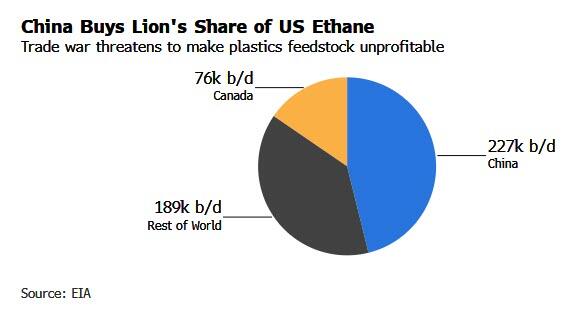
  • Data from the U.S. Energy Information Administration shows that China takes in about half of U.S. exports of ethane.

  • IndraStra: The United States has been virtually the only supplier of ethane to Chinese petrochemical makers since 2018.

  • With tariffs looming large over this trade, Chinese ethane consumers may have to close shop.

Plastics manufacturers in China are facing some tough times ahead due to their dependence on imports of U.S. feedstock. These imports are already running at record highs. This year, they were expected to surge by 20%, but then Trump started his tariff offensive. And there are no suppliers of this feedstock that compare in terms of production size with the United States.

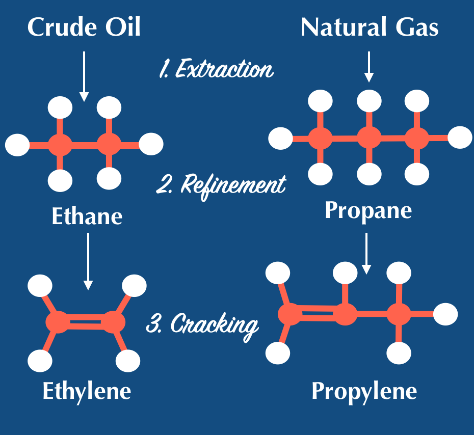
Ethane is a component of natural gas. Its production in the U.S. took off with the shale gas boom and is still booming thanks to the relentless growth in petrochemical demand on a global scale. This turned the U.S. into a major exporter to the biggest plastics maker in the world: China. Now, the flow of ethane to Chinese plastics manufacturers is set to shrink significantly as Washington and Beijing trade tariffs instead of commodities.

“The situation is dire for China’s ethane crackers as they have no alternative to US supply,” Manish Sejwal, Rystad Energy analyst, told Bloomberg this week. “Unless they are granted tariff exemptions, they may have to stop production or close shop.”

Data from the U.S. Energy Information Administration shows that China takes in about half of U.S. exports of ethane, or 248,000 barrels daily. The rest of the world, per that data, takes in 277,000 barrels daily. For U.S. gas producers, this is not a huge volume of exports—especially compared with the export of another natural gas constituent: propane. Those exports from the U.S. run at some 1.87 million barrels daily. And those ethane exports to China were set to soar.

Reuters reported back in February that Chinese plastics makers’ already substantial reliance on U.S. ethane supply, which is cheaper than alternatives thanks to the shale boom, was about to grow. The reason: slimming profits that those companies were looking to boost by cutting costs. Several Chinese petrochemical makers were investing in ethane cracker expansion, storage buildout, and the construction of ethane carriers for the increased import flows. Now, based on the latest reports, these plans are all in jeopardy, with all that investment risking ending up wasted.

Analysts forecast in February that China’s imports of ethane were set to rise by between 9% and as much as 34% this year, which would drive an overall increase in U.S. ethane exports, according to the EIA. The agency saw total U.S. ethane exports this year hitting 520,000 bpd, or 8% higher than the 2024 average daily, for a total annual 11.2 million tons. That 11.2 million tons of exports is no small potatoes for gas producers in the shale patch, especially with domestic gas prices where they are.

The United States has been virtually the only supplier of ethane to Chinese petrochemical makers since 2018, strategic analysis provider IndraStra noted in a recent report on the ethane and propane situation between the United States and China. The propane and ethane trade between the two is worth a not insignificant $18 billion annually. In fact, IndraStra says, the size of the U.S.-China liquid petroleum gas trade ranks second only to their agricultural trade.

So, with tariffs looming large over this trade, Chinese ethane consumers may have to close shop—but U.S. producers will be hit as well because there are precious few alternative destinations for this amount of gas. “The U.S. needs to be able to send its propane to China. For a large portion of it, the propane has nowhere else to go except China,” Kristen Holmqvist, analytics managing director at RBN Energy, said, as quoted by IndraStra. In other words, the situation with ethane is, while not equally bad, perhaps, certainly fraught with unpleasant potential developments for both buyers and sellers of the petrochemical feedstock if the tariffs remain in place.

By Irina Slav for Oilprice.com


Trade War Threatens to Shut Down Chinese Plastics Factories

By ZeroHedge - Apr 22, 2025

  • Chinese plastics factories heavily reliant on US ethane imports are at risk of widespread shutdowns due to tariffs implemented during the US-China trade war.

  • The lack of alternative ethane suppliers and existing long-term contracts make it difficult for Chinese factories to find alternative solutions, leading to financial losses.

  • Economic indicators suggest a potential slowdown in China's GDP growth, further exacerbating the challenges faced by the plastics industry and the overall economy.

Previously we explained that the US-China trade war has been unique in that the US was hit fast and hard, mostly through capital markets and financial linkages, which travel instantaneously with acute consequences (the recent dump of US treasuries by China and subsequent purchases of the yuan and perhaps gold took effect in milliseconds, and prompted a cottage industry of narratives how the US dollar is losing its reserve currency status). At the same time, the impact to the Chinese economy takes a while to propagate, as supply chains take weeks if not months to normalize to a new status quo; the period is even longer when the frontrunning of tariffs meant China would overproduce in the days leading up to the outbreak of the trade war, and keep economic output artificially inflated, as demonstrated by the paradoxically strong Q1 GDP numbers out of Beijing. Yet once the slowdown hits, as it inevitably will, the consequences for China - which unlike the US has no social safety net - will be far more dire. It also means that the trade war with China will apex only once Beijing suffers max pain, at which point Xi will be far more amenable to talks with Trump. The only question is when will said max pain moment hit.

We don't know yet, although we are keeping a close eye on alternative Chinese economic indicators (one can't trust official Chinese data in normal times, and one certainly can't trust any local "data" at a time when gepolitical leverage is measured in growth basis points, even if they are completely fabricated) for the tipping point. 

Until then, however, there are growing signs that the first wave of pain has already landed, and as Bloomberg reports, Chinese plastics factories that depend on a gas they mainly import from the US are contending with the prospect of widespread shutdowns as the world’s two largest economies bunker down for a prolonged trade war.

The world’s dominant plastics manufacturer gets almost all its ethane, a petrochemical feedstock that is also a component of natural gas, from the US. But eye-watering tariffs on American goods mean plants that cannot process substitute raw materials will bleed money; their only alternative is to mothball production for the near (or not so near) future.  

"The situation is dire for China’s ethane crackers as they have no alternative to US supply,” said Manish Sejwal, an analyst at Rystad Energy AS, using an industry term for such facilities. "Unless they are granted tariff exemptions, they may have to stop production or close shop."

Needless to say, that would be catastrophic for China's plastics industy.

Most so-called crackers in China use naphtha as a feedstock, with processors that solely use ethane as raw material for petrochemicals making up is less than 10% of the total at about 4 million tons, according to Rystad. China is by far the biggest buyer of American supply, according to the US Energy Department.

But with 125% tariffs in place, factories would have lost $184 for every ton of US ethane they processed in the week ending April 11, according to Rystad data. That compares with more than $100 they would have made in profits if there were no tariffs. 

According to Bloomberg, the extra costs are another blow for China’s plastics sector, which is already dealing with a glut as the growth in production capacity exceeds demand. The tussle is also threatening other feedstocks, including natural gas liquids and propane, and has led to sharp drops in US prices, hardly the inflationary shock so many have predicted.

Across China, domestic ethane production won’t be able to plug the gap, with the nation producing around 120,000 tons in 2024, according to industry consultancy JLC International.

Furthermore, the ethane market “is marked by long-term contracts, with little to no opportunity to resell cargoes on the spot market,” Rystad said April 10, making it tough for the Chinese to obtain alternative supplies from non-US sources.

While China has so far avoid widespread closures of production across sectors, it appears likely that the plastics industry in general, and the ethane and propane supply chains in particular, will be among those hit first and hardest. So for those seeking to time the moment of max pain, and greatest malleability of Beijing, keep an eye on Chinese plastic prices and/or labor strikes in the region.

The lower the former goes, the higher the latter will move, and the faster the trade war will come to an end. And come to an end it will, because as even Goldman forecast in its latest China forecast (available to pro subs here), the country's GDP is about to fall off a cliff: the bank now expects China's Q2 GDP growth to crater to just 0.8% QoQ from 4.9% in Q1. And that's just the start, if China is unable to unleash a stimulus similar in size to what it did during covid.

By Zerohedge.com