Tuesday, May 20, 2025


Federal Stop-Work Order Puts Pause on Research to Help Navy Divers
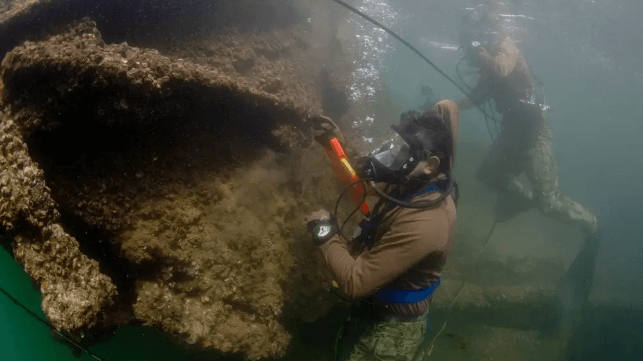
Navy divers inspect mooring platforms at the wreck of USS Arizona, 2024 (USN)

Published May 19, 2025 5:00 PM by David Nutt, Cornell Chronicle


Everybody needs a buddy – especially Navy divers. Working underwater is physically taxing, visibility is low, and divers can easily become exhausted or suffer from insufficient oxygen or nitrogen narcosis, resulting in cognitive impairment. The problem with relying on a partner who can come to your rescue, however, is that they are vulnerable to the same conditions.

That’s why Cornell researchers are working to understand how robots can assist humans in dangerous and physically challenging environments.

“We have these tools with amazing capacity, but for them to work with people, they need to be able to understand people,” said Andrea Stevenson Won, associate professor of communication in the College of Agriculture and Life Sciences. “So if we have a robot buddy that can work with a diver when they’re doing these dangerous, challenging tasks in this really stressful setting underwater, then we can leverage all of the strength of the person – their intelligence, their ability to make good decisions quickly, to change strategies on the fly – and we can have a robot buddy that can keep them safe so that they can do that job again the next day.”

In April, Won’s research, funded by the U.S. Department of Defense, came to a halt when she received a stop-work order.

“We were told that more information would be forthcoming, and we’ve heard nothing,” she said. “It’s frustrating because we can’t continue the work that we had started on, but we haven’t heard anything that would let us know how to continue. Without this funding, we don’t have the opportunity to help push the research forward.”

Through her Virtual Embodiment Lab, Won uses virtual reality simulations to understand how people’s nonverbal behavior can provide insight into their states of mind and their interactions with their teammates.

Won’s team was working with an array of collaborators, including Shiri Azenkot, associate professor at Cornell Tech, whose research into assistive technology for blind and low-vision users has helped the group think about ways to communicate with a robot when a diver can’t see or hear well.

The research is relevant for other environments and tasks, such as fighting fires, which has more in common with diving than one might think, according to Won.

“Divers and firefighters both work in dangerous situations, where they’re used to working with teammates, but where a robot could be really helpful to help protect the humans and make their work more efficient,” she said.

A second project focuses on identifying and predicting “inflection points” in human teams when something unexpected occurs, such as when equipment breaks or someone is injured. By better understanding human movement and physiological data when the team’s rhythm is disrupted, robots can recognize when they need to offer assistance.

The inflection point project was funded by the Navy but translates to many domains, Won said. “It relates to health care, it relates to emergency responders, and those are also both examples of circumstances that are really time sensitive,” she said. “We hoped to take it to those environments, specifically to the hospital environment, as a next step. So that’s been delayed.”

Won’s collaborators on the inflection point project include Poppy McLeod, professor of communication (CALS), who studies communication and decision making in task-oriented groups, a neuroscientist at Pennsylvania State University and an expert on artificial intelligence at Stanford University.

“Both of these projects are bringing together people who have different skillsets to bring to the same problem,” Won said. “They are working together. Their students are working together. Now, without that federal level support, we’re all just working individually again. So it’s a real lost opportunity in that respect.” 

David Nutt is a senior staff writer at the Cornell Chronicle, which provided reprint permission for this article. The story may be found in its original form here

The opinions expressed herein are the author's and not necessarily those of The Maritime Executive.

 

Ports: USTR Fees on Chinese Cranes Will Not "Magically" Revitalize Industry

cranes arriving from China
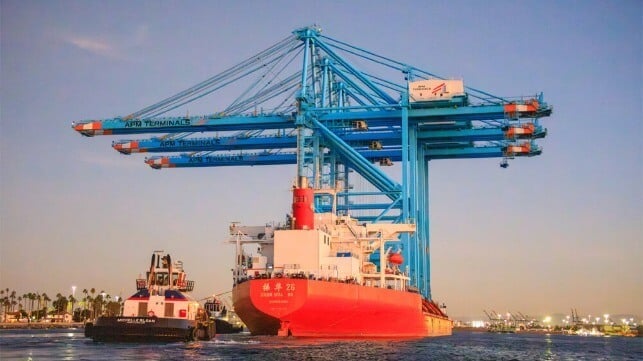
Ports continue to advocate for a more strategic approach to reshoring crane manufacturing from China (file photo)

Published May 19, 2025 6:51 PM by The Maritime Executive


The American Association of Port Authorities continued to fiercely advocate for ports during its testimony and response to the U.S. Trade Representative’s proposal to add fees on Chinese-built ships, car carriers, and Chinese-manufactured port cranes. AAPA, which has been fighting against the fees on cranes, said today, May 19, during the USTR testimony, “raising tariffs on Chinese cranes another 100 percent will not magically revitalize an American crane manufacturing industry that has been nonexistent for decades.”

Advocating on behalf of port operators, AAPA CEO Cary Davis said the industry “still has serious concerns about the economic consequences” of the revised USTR proposal issued in April for the fees to punish China for its policies to control the shipping industry and logistics through its subsidies of shipbuilders and ZMPC, China crane manufacturer which dominates the industry. Davis acknowledged positive changes versus the first draft, but voiced strong opposition to the fees on crane imports and all foreign-built vehicle carriers. AAPA estimates the proposals could cost ports nearly $7 billion in fees.

"Applying a new 100 percent tariff to Chinese STS cranes will not create a domestic crane manufacturing industry out of thin air," stated Davis in official comments submitted to the Federal Register. "It will only increase costs for public port authorities."

AAPA called the proposed additional fees on Chinese-manufactured port cranes “a tax on port development.” It highlights that port operators can not “easily shop around for a better price,” because ZMPC controls 70 percent or more of the market, and the other manufacturers do not have the production capacity to replace ZMPC. It highlights that the only options are Mitsui, Konecranes, and Liebherr.

The trade group is calling on the USTR not to make the fees retroactive so that they cover cranes ordered before the April 17 release of the proposal. “Applying this tariff to cranes that are already contracted for delivery will not discourage China’s unfair manufacturing practices or encourage American manufacturing of STS cranes,” said Davis.

As an example, it cites the Port of Houston, which it says is facing “grim circumstances.” Houston has eight cranes at a cost of $14 million each ($112 million total) contracted for delivery in the spring of 2026. AAPA says that with all the proposed tariffs, Houston’s cost would skyrocket to over $302 million.

It is also calling for a one-to-two-year delay on the tariff while supporting an effort to have Congress establish a tax credit to encourage domestic production. It also points out ambiguities in the rules, such as whether cranes would also face the reciprocal tariffs and fentanyl tariffs separately imposed by Donald Trump. In 2024, the Biden administration also imposed 25 percent tariffs on Chinese STS cranes.

AAPA is equally strong in its opposition to the fees on cars carried on foreign-built vessels, saying that if it had been in the first draft, there would have been strong opposition broadly across the industry. It says those fees will impose “severe harm on the port communities that specialize in the automotive trade.” While questioning if these fees are within the authority of USTR, it also points out that there is no method to distinguish imports from exports, as these car carriers offload foreign cars and load U.S. cars for export.

Similarly, it asserted to USTR that the quota of exported LNG on U.S.-built vessels is “infeasible and will cause instability.”

AAPA told USTR it supports the idea of reshoring to the U.S. but said it must be done more strategically, not to hurt ports, American industry, and consumers. It was one of the speakers commenting today on the second draft of the fee proposal. USTR is expected to finalize the proposal and move forward with implementation, which could happen as early as mid-October.


Houthis Reboot Red Sea Crisis With "Blockade" on Port of Haifa

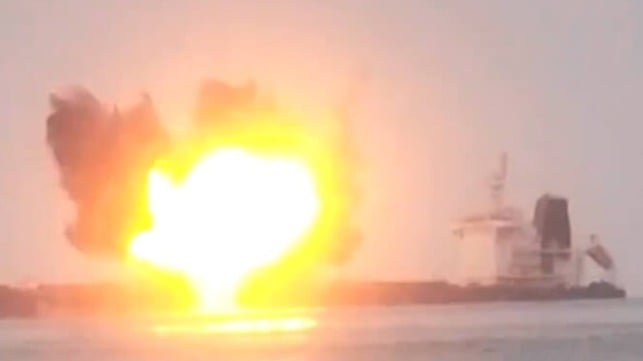
Attack on the bulker Tutor in the Red Sea, 2024 (Houthi Military Media)
Attack on the bulker Tutor in the Red Sea, June 2024 (Houthi Military Media)

Published May 19, 2025 8:12 PM by The Maritime Executive


Resolving any ambiguity about whether Yemen's Houthi rebels may have agreed to a shipping ceasefire, the group announced Monday that it will begin targeting shipowners who serve the port of Haifa, effective immediately. The group said that its decision to re-escalate was motivated by Israeli military operations in Gaza. 

The Houthi communications center for Red Sea traffic said that going forward, the group will impose a long-distance naval blockade on Haifa. All vessels are "prohibited" from loading or unloading at Israel's largest seaport, spokesman Ahmed Salah said in a statement. Israel's other two major ports, Ashdod and Eilat, do not appear to be included in the "blockade" at this time. 

The Houthis do not have the naval might to enforce a direct blockade in the Eastern Mediterranean, but they can target the fleets belonging to shipowners who trade to Haifa. Shipping interests who use the Suez route have to run the gauntlet past Houthi territory in Yemen, and even after a weekslong campaign of round-the-clock U.S. bombardment in March and April, the Houthis still have a meaningful capability to launch attacks on vessels passing by in the Red Sea.

"The presence of any vessels heading to the Port of Haifa, or having any indirect connection thereto, will expose your company and its fleet to sanctions," Salah said. "In the event that your company is listed on the sanctions list, its fleet will be prohibited from transiting the Red Sea, Bab al-Mandab Strait, the Gulf of Aden, the Arabian Sea, and the Indian Ocean. Moreover, it will be subject to targeting by the Yemeni Armed Forces wherever reachable."

The statement raises the risk level for all international shipping (with the possible exception of U.S.-flagged vessels, which were covered by the group's recent ceasefire agreement with the Trump administration). The Haifa "blockade" could easily result in collateral damage: while the Houthis have attacked vessels with documented links to Israel, they have also repeatedly attacked ships that have no clear Israeli ties - and they have even hit vessels linked to their own allies. Shipping interests have learned that almost any ship could become a targeted "Israeli-linked ship" in the southern Red Sea.


Russian Forces Release Greek Tanker After Brief Detention off Estonia

Green Admire
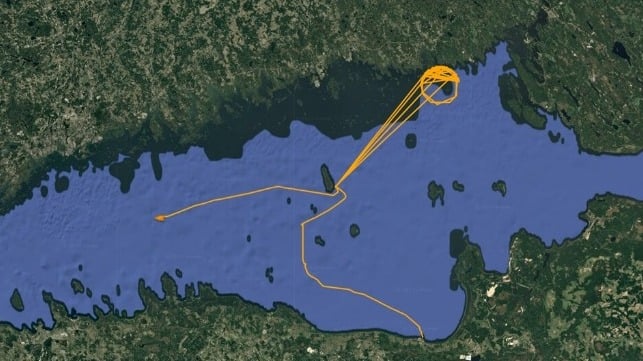
Green Admire outbound through the Gulf of Finland, May 19. The circular pattern at upper left is a typical indication of AIS interference, common near Russia (Pole Star)

Published May 19, 2025 4:29 PM by The Maritime Executive


Russian authorities have released a Greek tanker that they briefly detained off the coast of Estonia on Sunday. The vessel's AIS signal suggests that it has resumed its commercial voyage and is headed outbound through the Gulf of Finland. 

Estonia's transport ministry reported that Russian forces had intercepted the Liberian-flagged, Greek-owned tanker Green Admire in the early hours of Sunday morning, shortly after the vessel departed the Port of Sillamäe. The seaport is right next to the Russian border, and the tanker's route took it into Russian territorial seas, where Russian forces detained it. The vessel was diverted to Gogland, a Russian-controlled, heavily militarized island northwest of Sillamäe. 

The route that Green Admire used is an internationally-approved safety corridor for deep-draft shipping, but it passes through Russian territorial seas. Estonia's transport board has recommended against transiting through Russian waters en route to and from Sillamäe since 2022, the year that Russia invaded Ukraine.

On this particular voyage, the pilot advised against the vessel's planned course through Russian territorial seas, Estonian Transport Board maritime chief Kristjan Truu told ERR. The final decision on routing is always up to the master.

Russian authorities also warned Green Admire repeatedly not to navigate into a designated "dangerous area" for shipping, and the vessel disregarded the warnings, Deputy Chief of the Navy Johan-Elias Seljamaa told ERR. The area closure had been in place for some time, and Russia had never enforced it before, he said. The ship had taken the same route on its arrival in Estonia without incident. The brief detention was the first time in recent history that Russian forces have interfered with Estonia's merchant shipping traffic, the transport ministry told ERR. 

There is an alternative route through Estonian waters to reach Sillamäe, but it is surrounded by shoals and requires more course changes, and many vessel operators do not prefer it. For now, Estonian authorities are recommending that deep-draft shipping take the more complicated route and stay out of Russian waters. 


EU Begins Planning a New Strategy to Boost its Maritime Sector

EU shipping ministers' meeting
Courtesy EU Transport

Published May 19, 2025 8:27 PM by The Maritime Executive


Last week, shipping ministers from EU member states gathered in Szczecin, Poland to lay out a strategy for boosting the competitiveness of European shipbuilding and shipping in the face of ever-rising competition from Asia.

During the "informal" meeting, the ministers talked through the possibilities for a future EU maritime industrial strategy, taking into account political and market factors. The conference concluded with a joint declaration by member states, which received welcome approval from EU shipbuilders and shipowners. 

“The Szczecin Declaration is a pivotal moment for Europe’s maritime industries, especially for the maritime manufacturing industry, which has been lacking political support and impactful measures for far too long, despite unfair competition from Asia," said Alberto Maestrini, chairman of shipbuilders' association SEA Europe. "Europe must protect its maritime industrial base and cannot do without commercial shipbuilding if it wants to secure its naval capabilities, cross-fertilization between commercial and naval industry, and sovereignty."

The European Community Shipowners' Associations (ECSA), the voice of EU shipping, emphasized that - unlike comparable efforts in the United States - the Szczecin Declaration is not protectionist. Instead, it centers on investments in innovation and competitiveness, and emphasizes the "level playing field" of global (rather than European) regulations on shipping. 

The declaration contains much to like for EU owners, ECSA said, including an endorsement of some of the association's main priorities:

- a call for regulatory action to stimulate production of green fuels, which will be needed for compliance but are currently hard to source

- measures to underwrite the cost of expensive clean fuel using ETS revenues

"We welcome the support for key priorities for the European Shipowners such as the need to de-risk investments in clean fuels and technology and to maintain a fit-for-purpose regulatory and taxation framework," said ECSA Secretary General Sotiris Raptis in a statement. 

SEA Europe welcomed the declaration's focus on key problems for European shipbuilding. The association thanked EU ministers for recognizing the strategic security and defense role of EU shipyards; the key role of decarbonization tech in positioning EU maritime manufacturing for leadership; the distortionary effects of non-EU nations' shipbuilding subsidy programs; the full dependence of EU owners on Asian yards for tonnage; and the restrictive effects of EU banking rules on EU ship financing. 


Coast Guard Investigates Two Separate Engine Room Fires in Puerto RIco

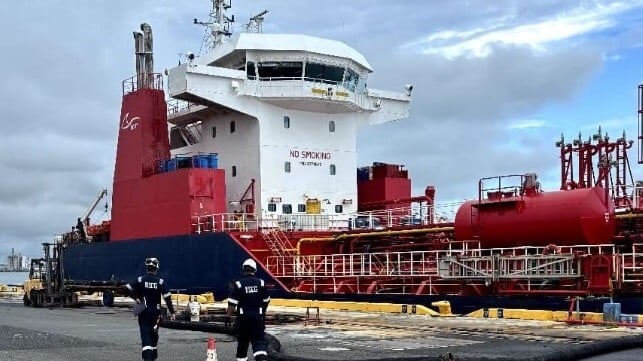
Coast Guard investigators arrive to board Scot Stuttgart (USCG)

Published May 19, 2025 6:57 PM by The Maritime Executive


The U.S. Coast Guard has launched investigations into a pair of separate vessel fires that occurred in Puerto Rico over the weekend, according to agency representatives.

The more recent incident unfolded early Saturday at Puerto Nuevo Channel's N Wharf, where the Marshall Islands-flagged chemical tanker Scot Stuttgart suffered an engine room fire while berthed alongside. The tanker first reported an auxiliary engine fire to the Coast Guard at about 0345 hours. 

Crewmembers deployed the vessel's built-in fire suppression system, and the situation initially appeared resolved. However, about two hours later, dark smoke began coming out of the same area, suggesting a possible reflash. 

The crew sealed off the compartment and activated the suppression system again. Shortly after, local firefighting teams arrived to confirm the blaze had been successfully contained.

This emergency followed an earlier incident involving the ferry Breezy Point, which transports passengers between mainland Puerto Rico and Vieques Island. According to officials, the vessel experienced a fire in the port side engine compartment Friday evening, shortly after arriving at Vieques with travelers aboard.

The Coast Guard received notice of the ferry incident shortly after 2100 hours, by which point all passengers had safely disembarked. When initial attempts to control the flames with portable equipment proved inadequate, crew members activated the vessel's integrated suppression system, successfully extinguishing the fire before municipal emergency responders arrived.

The incidents resulted in no reported injuries or environmental contamination, though monitoring continues as a precautionary measure. Coast Guard investigators from Sector San Juan continue examining both incidents.

“Each of these vessel fires warrant investigations to learn causative factors and prevent future incidents from occurring with potential risk to human lives and impacts to Puerto Rico’s maritime transportation and marine environment," said Capt. Luis J. Rodriguez, Coast Guard Sector San Juan commander. "I commend the crews from both vessels for their initial actions that led to the fires being extinguished, as well as the efforts of responding firefighting crews, which collectively led to preventing the loss of life and averting a more catastrophic outcome.”


U.S. Interior Department Lifts Empire Wind Stop-Work Order

install offshore wind farm
Work will start offshore after BOEM lifted the stop-work order (file photo)

Published May 19, 2025 7:54 PM by The Maritime Executive


In a surprising reversal, the Trump administration has lifted the stop-work order on New York’s Empire Wind offshore energy project. Norway’s Equinor issued a brief statement reporting that it has been informed by the Department of the Interior’s Bureau of Ocean Energy Management (BOEM) that the order was lifted allowing construction activities to resume.

Equinor had threatened to walk away from the project while a concerted effort was underway to permit the project to proceed. Reports are indicating that a broad array of political pressure came from a wide range of fronts, all calling for the project, which was reported to be 30 percent complete, to proceed. Contractors working for Equinor were set to start the offshore work at the site when the Secretary of the Interior Doug Burgum instructed BOEM on April 16 to suspend the license pending further review. It was alleged that information showed the permitting process had been rushed by the Biden administration, although all the permits were issued by mid-2024, and the financial decisions were made before the end of 2024.

Norwegian Finance Minister, Jens Stoltenberg, is reported to have participated in a meeting between Equinor and White House officials seeking to clarify the stop-work order and what would be required to resume work. Unconfirmed media reports, however, had said there was no clear indication at the end of that meeting.

New York State Governor Kathy Hochul had issued a strong statement condemning the stop-work order. Late on Monday, May 19, the Governor issued a statement on X saying, “I’ve been working with President Donald Trump to save this project and today learned we’ve been successful. Grateful for his partnership on projects that create jobs here in New York.”

Equinor, in its announcement, included a statement from Anders Opedal, President and CEO of Equinor ASA, highlighting the breadth of the coalition that had developed. In addition to thanking Donald Trump, Opedal cited the support of Governor Hochul for her constructive collaboration with the Trump Administration, New York City Mayor Adams, congressional leaders including Senator Schumer, Senator Gillibrand, Representative Garbarino, and Representative Goldman, as well as labor groups and other advocates that have maintained their steadfast support for the project. 

“I would like to thank the Norwegian Prime Minister Støre and Minister of Finance Stoltenberg for their support at a critical time, and that the Minister of Finance raised the situation with the U.S. administration,” added Opedal.

The restoration of Empire Wind 1 secures jobs for more than 1,500 construction workers, drives economic development, and advances one of the largest energy infrastructure undertakings in the past 50 years for New Yorkers, commented Doreen Harris, President and CEO of New York’s regulator NYSERDA.

Equinor had called the situation “urgent and unsustainable,” with reports it was costing the company $50 million a week. It had 11 vessels on standby and more than 100 people who had been scheduled to start the offshore portion of the project this spring. Equinor said it has invested about $2.7 billion so far in the project that was budgeted to cost $5 billion and would be liable to repay $1.5 billion in project financing as well as potential cancellation fees from suppliers.

After the stop-work order was lifted, Equinor reported that it will perform an updated assessment of the project economics in the second quarter. Empire Wind, it said, aims to be able to execute planned activities in the offshore installation window in 2025 and reach its planned commercial operation date in 2027. Empire reports it will engage with suppliers and regulatory bodies to reduce the impact of the stop-work order.

The project, which will be located 15-30 miles south of New York’s Long Island, will consist of up to 130 wind turbines. It will have a capacity of 2.1 GW.

News of the reversal is also likely to relieve some anxiety in the industry, which was surprised by the Trump administration's unexpected efforts to stop a project that was underway. The administration, however, is still reviewing the industry and has also taken steps to stop a pre-construction project in New Jersey by removing an EPA permit that impacted construction.


Final Construction Permits Issued for First Gulf Coast LNG Bunker Port

Galveston LNG
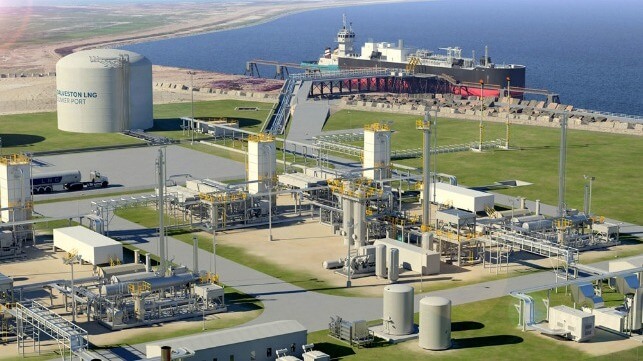
LNG terminal is expected to be operational in 2027 (Galveston LNG)

Published May 19, 2025 8:27 PM by The Maritime Executive


The Galveston LNG Bunker Port is now fully permitted for construction to start after receiving authorization from the U.S. Army Corps of Engineers and a recommendation from the U.S. Coast Guard. The project, which is being developed as the first LNG bunker port on the Gulf Coast, is advancing to a financial investment decision from partners Pilot LNG and Seapath Group, a Libra Group subsidiary.

To be located on the Texas City Ship Channel in the Texas City industrial area, and will supply LNG by fuel barge to the rapidly expanding fleet of LNG-fueled vessels in the greater Houston-Galveston region. According to the partners, the bunker hub will be optimally located to serve major ports, including Port Houston, the Port of Galveston, and the Port of Texas City. 

The plan calls for the terminal to be developed in two phases. The first would involve a 140-acre site and will target an initial capacity of 360,000 gallons per day. The companies are targeting the second half of 2027 for the initial product deliveries. A second phase would require an additional eight to 12 months and provide a total capacity of 720,000 gallons per day. It will be supported by two 3-million-gallon storage tanks.

“After several years of challenging and complex work bringing together the engineering, permitting, and third party supplies for gas and power to the project, we are now comfortably ahead in the marketplace to be the first dedicated LNG marine fuels supplier in the U.S. Gulf,” said Josh Lubarsky, President of Seapath Group. “We have made a significant financial commitment to this project and, over the course of the last several years, have positioned GLBP to be the foremost clean fuel supply hub in the Galveston Bay/Gulf region.”

The project, which is expected to cost more than $300 million, had received the necessary authorization from Texas earlier this year. Currently, LNG is being supplied by JAX LNG located in Jacksonville, Florida. It has a capacity of 360,000 gallons per day and is supplying LNG to the ports in South Florida as well.


U.S. Navy Plans to Remove Salvage Platforms From USS Arizona's Hull

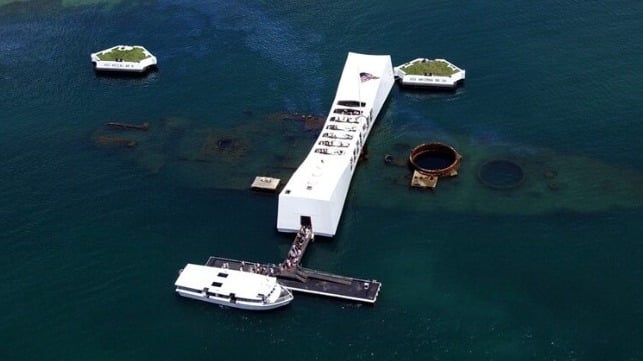
The two small salvage platforms are visible on either side of the USS Arizona Memorial building. The white concrete dolphins in the background will remain intact (USN)

Published May 19, 2025 9:59 PM by The Maritime Executive


The U.S. Navy is preparing to remove two salvage platforms that were welded onto the wreck of the USS Arizona in the aftermath of the Pearl Harbor attacks. The rusting platforms are part of Arizona's history, but they are deteriorating, and one has already partially collapsed. 

USS Arizona is a symbol of the sacrifices that American servicemembers made in the Second World War. On December 7, 1941, the battleship came under intense attack by Japanese bombers; the fourth bomb that hit the deck detonated Arizona's forward powder magazines, tearing apart the bow and sinking the ship at her berth.

Today, the USS Arizona Memorial honors the 1,177 crewmen who died in the attack. More than two million people come to pay their respects every year, and every sitting president has visited the site since the memorial's installation. 

The two platforms that can be seen above the water at the memorial site were not part of the battleship when it was sunk; they were only attached to the ship to help salvors remove Arizona’s main guns and other equipment for the war effort. Workboats would tie up to the platforms to support dive operations and to carry away much-needed materials salvaged from the wreck. Three gun barrels from USS Arizona were later relined and fitted aboard USS Nevada, which used them against Japanese positions on Iwo Jima and Okinawa.

In October 2023, one of the aging salvage platforms partially collapsed, prompting the Navy to assess their condition. It became apparent that the platforms now pose a risk to the sunken battleship, and must be removed for purposes of preservation and environmental protection. From the Navy's perspective, the removal signals the completion of the heroic salvage operation that began in 1942. 

This week, U.S. Navy salvors plan to start the work of placing containment buoys and anchors in the waters surrounding the memorial site, a preparatory step for the removal of the two mooring platforms. As the work proceeds, the Pearl Harbor National Memorial and local officials are closely involved to ensure that the project fully respects the ship’s historic importance and its sacred status.


Port of San Juan's Mystery Spill Returns

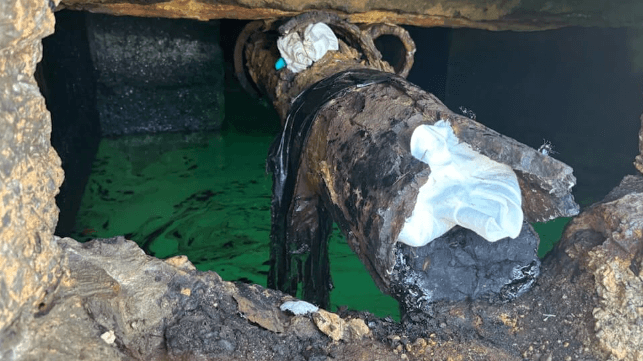
A corroded pipe was leaking oil between piers 2 and 3 (Courtesy USCG)

Published May 19, 2025 11:16 PM by The Maritime Executive


The long-running mystery spill at the Port of San Juan is back, but this time, the Coast Guard has found the culprit and implemented a solution. 

On April 11, Station San Juan conducted a patrol in San Juan Harbor and discovered oil pollution in the water between piers 2 and 3. The Coast Guard discovered an aging, badly corroded steel pipe that was slowly leaking heavy black oil into the harbor. It is far from the first such occurrence in the port, so the Coast Guard response team collected samples from the pipe to be analyzed at the Coast Guard Marine Safety Lab for comparison against past spills. 

To deal with the leak, the service tapped the Oil Spill Liability Trust Fund and contracted Clean Harbor Environmental Services as the spill response contractor. On April 15, Clean Harbor crews plugged the aging pipe and placed containment booms around it.  

On May 5, Sector San Juan received the lab results on the spill samples. The material had similar characteristics to the oil from the spills at Pier 9 (in 2024) and Pier 4 (in 2021), indicating a common source of petroleum oil for all three.

Sector San Juan and Clean Harbor crews continue to monitor the site and replace the sorbent material as needed. The interagency response team plans to conduct a subsurface assessment to look for a possible source, and will come up with a plan to clean up any remaining free oil to reduce the odds of future leakage on the waterfront. 

“The source of the oil discharge is being contained and, while contained, will allow normal port operations to continue at Piers 2 and 3 as our investigation and response efforts continue,” Lt. Cmdr. Ray Lopez, Coast Guard Sector San Juan Incident Management Division chief.