Behind Trump and DOGE’s Reckless Destruction Is a Determination to Crush Workers
The future of collective bargaining and labor rights in the United States is on the table.
May 17, 2025
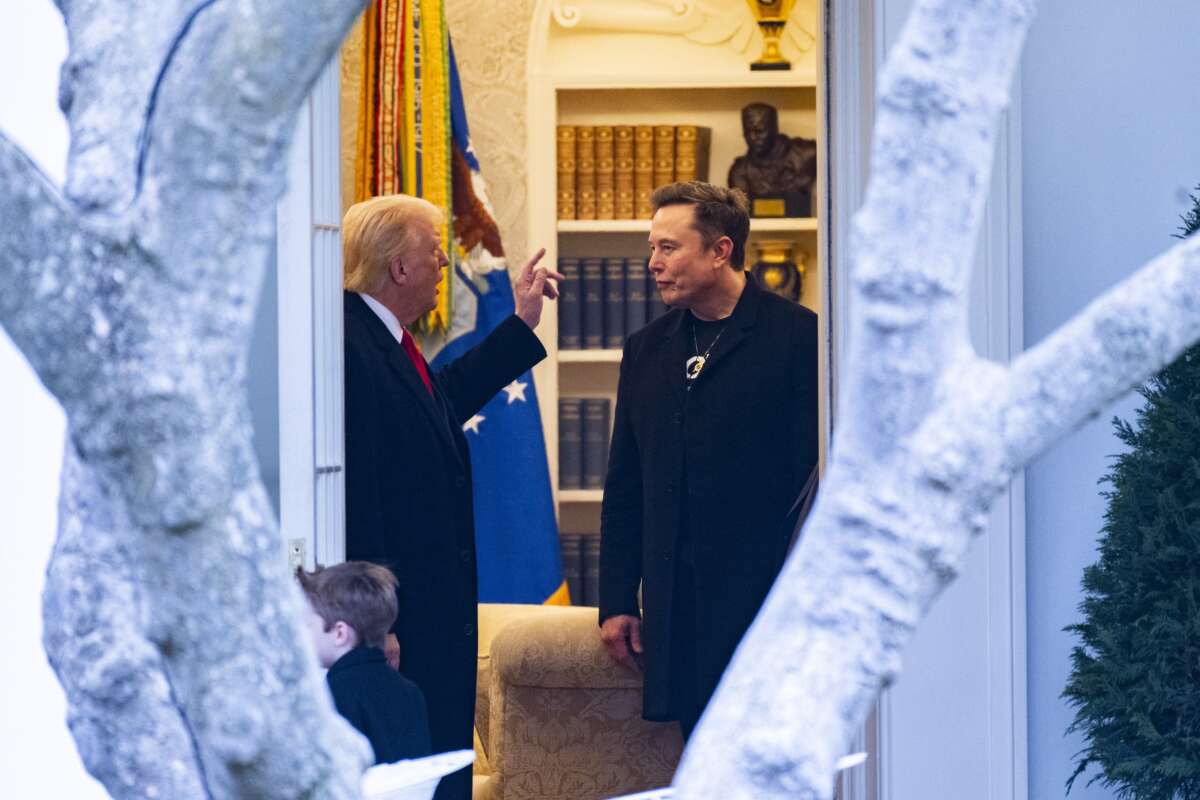
Donald Trump speaks to Elon Musk before departing the White House on his way to his home in Mar-a-Lago in Florida on March 14, 2025.ROBERTO SCHMIDT / AFP via Getty Images
Even the most alarmed predictions of left-leaning commentators failed to capture the extremity of the onslaught that flooded forth from the second Trump administration in its first few months. Only recently has the real severity of that opening assault come into better focus. That relentlessness was very much by design, a well-worn page of Steve Bannon’s playbook: To “flood the zone” is to leave your opponents reeling and unable to mount a response to any single atrocity.
But looking past the immediate fray, the routes taken by the Trump administration’s bewildering blitzkrieg do have a common logic. What unites these excesses is that they all represent new fronts in the waging of unrestricted class warfare against labor and working people, a strategy calibrated to the interests of capital. This administration has tactically dispensed with long-standing precedents, trampled guardrails against authoritarianism, thrown open the door for wanton profiteering and maneuvered to strike a severe blow to the labor movement.
If history is any indication, the capitalist class is willing to accede to dictatorship as long as it can secure the regime’s collaboration in pursuing its unattainable aim of infinite profit. The first 100 days of the second reign of Trump unambiguously set the terms: Agents of capital can be certain they can count on the administration’s help in the struggle against workers’ collective power. Trump and his collaborators have already signaled that they are willing to discard with democracy and sacrifice human life without compunction — even if the lives lost potentially number in the millions. They proceed as if they’re entering the final stretch, and before them lies the realization of the ultimate aims of the reactionary right: permanent hierarchy and corporate rule, mutually interlocking with untrammeled powers of state repression.
Heightening the Contradictions
In thinking about the second Trump administration’s abuses of power, it’s difficult to get a handle on the full implications. Are we really witnessing the unfolding of a neo-fascist regime? Even if we set aside the most ominous portents and parallels, it’s impossible to avoid the conclusion that the extent of damage already impacting civil rights and U.S. institutions is staggering, thanks in no small part to Elon Musk’s so-called “Department of Government Efficiency” (DOGE).
Timi Iwayemi is a research director at the Revolving Door Project, a legal and media watchdog for corporate influence that has been tracking the fusillade of DOGE news. “All this is essentially what the Revolving Door Project has preached against,” Iwayemi said. “It’s the logical endpoint of governing by corporate power.”

“We know that there is a real material impact from these cuts which really affect the lives of Americans all over the country,” he said. “For people who have criticized [the notion of] the ‘revolving door’ and said it’s fine to install businesspeople in government — I think this should be a moment of reflection for them.”
Iwayemi said that programmatic class warfare lies behind the apparent reckless folly. Above all, what unites the administration’s chaotic gestures is a deep hostility to labor. We’re witnessing, he said, the expression of the ruling class’s “impulses to push back against workers and discipline workers, and to satisfy the forces behind this project.” This, Iwayemi says, “is a scheme to discipline workers — a scheme to crown the executive and the president as essentially the Supreme Leader.”
The many assaults on federal civil servants are serving as a way to undermine public-sector unions, which comprise about half of unionized workers in the U.S. and have been not quite as badly gouged by decades of anti-union attacks as the decimated private sector membership. While federal public sector workers are legally barred from striking, many other public workers are not, and the sector remains a major bastion of the labor movement, in large part by persisting as unionization rates have drastically collapsed. Capital is hoping to land a decisive blow akin to the PATCO strikebreaking, when Ronald Reagan’s infamous firing of air traffic controllers heavily curtailed public sector strikes.
Trump is pursuing an analogous plan, but his administration’s ambitions are larger by orders of magnitude. A recent advance is Trump’s new, second effort to institute a rule that would deem a large number of federal employees “at-will” and therefore fireable without reason. Trump now claims he can fire workers who “refuse to advance the policy interests of the President” — a threat he has already made good on elsewhere, perhaps nowhere as egregiously as in his dismissal of the Justice Department officials who had been tasked with criminally investigating him. In a show of unrestrained contempt, he’s already illegally canceled union contracts for tens of thousands of TSA employees and hundreds of thousands of workers elsewhere, citing “national security,” a nonsensical rationale for what amounts to an obscene abuse of power.
Even more extreme are the administration’s moves to neutralize the National Labor Relations Board (NLRB). The NLRB is an inevitable target, but its current position is extraordinarily precarious. Trump, in a heedless violation of the National Labor Relations Act, fired Biden-appointed board members, rendering the NLRB nonfunctional. The wholesale elimination of the NLRB is a worst-case scenario that is now on the verge of being realized, with the likely complicity of the Supreme Court.
Writing on Substack, labor journalist Hamilton Nolan warned of severe and imminent consequences: If labor regulation enforcement ceases, he argued, there will follow an implosion of labor rights, a lock-in of massive unaccountable corporate power, and finally the proliferation of deeply entrenched corruption into institutions.
As a prologue to this, it would seem, Trump is already lining his pockets with cryptocurrency by openly selling access to the White House to his top investors. Not to mention that his new regime is essentially defined by its yawning multitude of conflicts of interest. It’s clear that its strikes on labor are coming in tandem with the sort of systematic corporate-government melding (which is, incidentally, a definition of fascism, offered by someone who would know) that is intended to enrich investors at the expense of the civil service and the U.S. public. It’s often been noted that the central characteristic of the Trump administration, reflective of the man himself, is its eagerly corrupt self-dealing; this ends up pairing nicely with an extreme hostility to labor that also pleases the capitalist class, such that those two overarching ambitions go, naturally, hand in hand.
And there are other signs of sabotage and dirty tricks: A whistleblower revealed that the DOGE team has been illicitly siphoning confidential data about ongoing labor dispute cases — information that would be of obvious utility to labor’s opponents. DOGE has attempted similar data grabs at the Department of Labor and the Social Security Administration (SSA), but the exact motives remain unclear.
Though they also have a strong basis in racist ideology and are in many ways a political stunt aimed at pleasing a reactionary base, the Gestapo-like disappearances executed by Immigration and Customs Enforcement (ICE) have been no exception. There is clear evidence that, in addition to asylum seekers, green card and visa holders, U.S. citizens, and innocent families (which is not to say that criminals should be extrajudicially kidnapped and rendered to El Salvador either), deportations and arrests have explicitly targeted labor organizers.
In the case of the detentions in Albion, New York, as The Intercept reported, ICE agents deliberately and knowing targeted workers actively engaged in a major precedent-setting labor rights battle against agricultural industry interests. The agents showed up, according to a witness, with an actual list of names of union workers.
Another telling sign of Trump’s sanctioning of outright criminal risks and hostilities against workers was the recent literal decimation of the Occupational Safety and Health Administration — the agency has been effectively eradicated as a regulatory force, losing the vast majority of its staff and halting numerous active investigations and oversight procedures. Clearly, Trump is signaling that corporations should feel free to take the gloves off in their treatment of their workers and their product and safety standards.
As the Trump administration goes out of its way to advertise that it will condone and facilitate companies’ running roughshod over labor, capital can be observed salivating at the prospects. In the same article, Nolan described how the business lobby has already sent Attorney General Pam Bondi at least one literal wish list of labor law decisions they’d like overturned. This made-to-order corruption would grant bosses sweeping new powers to propagandize workers in “captive audience” meetings and ignore obligations to recognize unions, among others. Without Trump’s utter contempt for the rule of law, achieving such gains would have been the slow procedural work of many years, if doing so was even possible.
Nolan wrote that the presumptuous wish list is “a well-thought-out attempt by an organization representing the majority of America’s business class to opportunistically use the poisonous lawlessness of the Trump administration [so] they can more easily exploit and oppress their own employees.… This is organized crime in action, except that none of it is ‘crime’ anymore, because the government charged with enforcing the law has decided that laws are not real.”
To further prepare the ground for corporate despotism, the Trump administration is plotting vast, aggressive and unprecedented deregulatory schemes. But capital also wants to expand its reach and colonize new territories for profit. This is the idea behind the eternal quest to privatize the SSA in order to open up a lucrative retirement plan market. If the ruling class gets its way, Medicare and Medicaid would share that fate: condemned to absorption into the abysmal and fatally inadequate private health care system.
But some companies, tech in particular, are working a different angle for extracting profit by slashing and selling off the last of the nation’s stalwart but ragged social programs. It’s become clear that even several of the biggest names in the industry, among them Musk’s X, still fail to make anything like a profit. Some, Tesla included, rely on absurdly large federal subsidies and overvaluations — indicative of a tech bubble. The same is true in the AI field; OpenAI operates at a staggering loss.
However, as Iwayemi shrewdly pointed out, the savvier operators may be formulating an exit plan. “Tech folks have realized that government contracts are a very smart way to secure long-term sustainability, like [startup defense contractors] Palantir and Anduril,” he said. Already there are active plans to force the adoption of AI systems into some SSA functions, and the intrusion of AI into state administration will not stop there.
If we really are witnessing the advent of the most significant existential threat to labor rights in living memory, we might ask: Where is the outcry from those targeted? Nolan argued in an article for In These Times that the U.S. labor movement evolved around a supporting legal framework for bargaining and has consequently found that its ability and willingness to strike have atrophied with disuse.
Iwayemi also described sensing an uncomfortable silence. “There’s an expectation that the unions would come together and respond to these attacks on their workers and their people,” he said. And in their defense, they are not immobilized. It’s true that court challenges have been filed, and judicial challenges are steadily mounting. But these are slow processes, and Trump is already off inflicting damage elsewhere. The administration has unambiguously ceased to play by the rules. Despite the risks, argued Nolan, even federal worker unions are left with no choice but to strike — against the law, in some cases, but also against the wishes of intractable and immobilized union leadership if necessary.
The gravity of the circumstances — and, in many cases, an intractable and sluggish, and anti-militant labor leadership — may justify a more confrontational approach. To those who comprehend the extreme and unprecedented nature of the threat to the movement, it’s hard to argue otherwise.
Joe Burns, a veteran labor lawyer, union leader, negotiator and author, has long argued in his numerous writings that modern unions are in desperate need of a militant revitalization, a recognition of their true power — otherwise, they’re at risk of being dismantled and neutralized entirely in capital’s unrestricted class war. This has never been more true than in this moment. After decades of undermining by corporations and a complicit state, contemporary unions have been hampered by “decades of bureaucratization and business unionism” and are now, in many cases, simply, “not up to the fight,” as Burns told C.J. Polychroniou in an interview with Truthout. “Many opted for accommodation with employers in labor management programs rather than fighting our way out of the problem.”
In his books Class Struggle Unionism and Strike Back, Burns has made a convincing and influential case for militant and active leaderships and rank-and-file and grassroots labor action that does not always conform to frameworks imposed from the top down; those frameworks, after all, have been designed and installed to systematically sap labor of its primary weapon. This is “class struggle unionism” — i.e. organizing that is rooted in an understanding of capital’s antagonism to labor, over more accommodationist tactics.
It is time, many would argue, for public employee unions, now facing a potentially existential threat, to surpass self-imposed boundaries in response. A 2023 strike at Rutgers University by three unions, Rutgers AAUP-AFT, Rutgers Adjunct Faculty Union and AAUP-Biomedical and Health Sciences of New Jersey, was notable for being a major action by employees of the public university — the first strike in Rutgers’s over 250 years. After five days, the historic walkout won a new contract with 43 percent and 33 percent pay raises for adjunct professors and graduate student workers, respectively. The effort was led by a newly militant adjunct union that pursued a strike in lieu of the less organizing-focused bargaining of previous leaderships, representative of a wave of militant nontenured adjunct and graduate student organizing at the time.
The power of a union ultimately reduces to its ability to threaten and act on the stoppage of work. Engaging that power is far easier said than organized and done, of course. Still, it’s worrying to feel like this time around we may be erring on the side of the timid, passive and (if understandably) scared. Yet we’re at a time when the only thing that seems appropriate is for everyone to make the loudest noise that they possibly can. These are uniquely threatening and extenuating circumstances.
“None of [Trump’s] Republican predecessors in the White House for the past half century ever considered doing something this outrageous.… Through every step of an increasingly aggressive series of tests of the labor movement’s power, the administration has learned that there are no real consequences,” Nolan writes. Capital speaks only the language of profit. The only thing it fears is that profit’s interruption.
Burns, Nolan, and others in this dire moment are calling upon organized labor to again realize its fundamental structural power, and to cease to play by the rules of an already rigged game — rules that the Trump administration has stopped even making a show of respecting. It is time for labor to answer in kind. “We need a fundamentally different type of labor movement. One willing to violate the restrictions of labor law, confront the powers that be and is deeply rooted in the working class,” as Burns told Truthout:
When workers get in motion, great things can happen. Whether it be private sector workers in the 1930s or public employees in the 1960s, when workers begin striking in large numbers, they can quickly transform the landscape.… Only class struggle unionism, with its worker-led militancy and willingness to challenge the status quo, holds any hope for changing the political equation.
The cause of labor remains the hope of the world. That hope remains, if we can seize it. Beyond union members, we should hope that all organizers, protesters and everyday people can access a sense of their own power, as the moment calls for nothing less than everything we’ve got. At this juncture, perhaps we should remind ourselves of all that is now on the table. The future of collective bargaining and workers’ rights in the United States is one thing. Another is the scale of human harm and suffering that is being inflicted and that we must allay amid the reckless closures, layoffs, funding cuts and administrative havoc. Solidarity against that suffering is all we have and all we need.
This article is licensed under Creative Commons (CC BY-NC-ND 4.0), and you are free to share and republish under the terms of the license.
Tyler Walicek is a freelance writer and journalist in Portland, Oregon.
Americans don’t want 'hazardous' jobs Trump is pushing: report

(REUTERS)May 19, 2025
ALTERNET
The Wall Street Journal reports many Americans may not care to adopt the kind of factory work President Donald Trump’s is pledging to bring back to the U.S.
“The jobs are tiring, feature hazards not found at desk jobs and are tough to fill. Once workers are recruited, it can be difficult to get them to stay,” reports WSJ. “… The work represents the type of gritty, physically demanding labor … Trump envisions will recast the U.S. as the manufacturing powerhouse it once was.”
The Wall Street Journal reports the U.S. already has nearly half a million unfilled manufacturing jobs, according to the U.S. Labor Department. A 2025 National Association of Manufacturers survey also shows nearly half of manufacturing companies say their biggest challenge is recruitment and retention in jobs with rigid hours, hard work, and risk of significant physical injury. Additionally, the pay is 7.8% lower on average than the private sector, according to the Bureau of Labor Statistics, following a decline in union representation.
“A lot of people say they wouldn’t work in a place like this because of how hard it is,” said Quaker City Castings employee Zachary Puchajda, who is a metal caster.
Carolyn Lee, president of the Manufacturing Institute, a nonprofit focused on workforce development for the sector, told WSJ that the significant labor shortage makes scaling up production a challenge.
Quaker City Castings President Dave Lordi told reporters his company saw a brief 25% surge in orders after Trump announced tariffs, but he would need to add a second work shift. This, say analysts, would not be easy without manufacturers adding better pay and schedule flexibility, among other things that Americans have come to expect from work. Plus, many of the incentives it would require to coax Americans into factories could drive up purchase prices for U.S. factory-made goods. American-made Viking stoves already cost more than $5,000 for a low end model, and those are made in Greenwood, Mississippi, which is known for its record low cost of living.
Lee says the U.S. manufacturing industry is nowhere near the level of evolution it needs to be to engage growth.
“You can’t just plop a factory down and hope people will miraculously appear,” Lee said.
Read the full Wall Street Journal report here. SUBSCRIPTION REQUIRED
How to Fight Trump Without Caving to Corporatists
Can the progressive movement display leadership and vision in forming a united front at a time when those qualities seem to be lacking elsewhere?
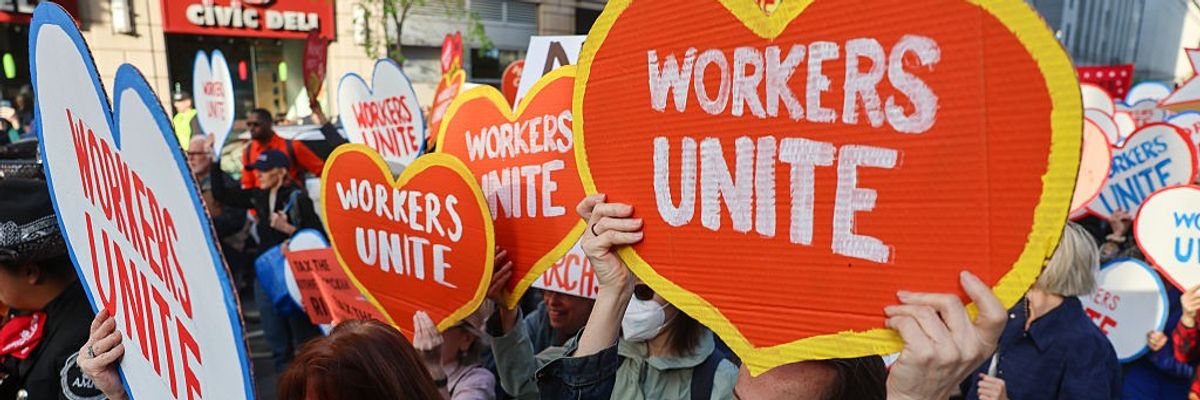
Thousands of people participate in a rally and march on May Day in Manhattan on May 01, 2025 in New York City. The march, which went on for dozens of blocks and included over ten thousand people, was against the current Republican administration and its policies on immigration, the environment, science, and other issues.
(Photo by Spencer Platt/Getty Images)
Richard EskowMay 19, 2025
Common Dreams
RICHARD ESKOW: In a recent column you asked, “What’s preventing a united front against the Trump regime?” You say, “America desperately needs a united front to restrain the wrecking ball of the Trump regime.” I get the “wrecking ball,” but why do we need a united front? What’s wrong with a multi-pronged approach from various groups and actors?
NORMAN SOLOMON: There’s a serious lack of coordination at the political level. The Democratic Party is a constellation of 50-plus state and other local parties, and there are many organizations which are—or should be—independent of the party.
To the extent there is any governing body, it's the Democratic National Committee. The DNC should provide leadership at times like these. But there’s still no leadership, several months into a second Trump regime that’s much worse than the first. There's energy to oppose, but it’s uncoordinated.
Rethinking the Left and the Party
ESKOW: Here’s a challenge. For too long, the American left looked to the Democratic Party for leadership and guidance instead of considering it an instrument that’s available to movements. I think a lot of people assume that “a united front” against Trump means making the left fall in line yet again behind the institutional party’s corporate, so-called “centrist” politicians.
SOLOMON: It’s dubious, and not very auspicious, to follow “leadership” that isn’t leading. I think your word “instrument” is an excellent one. The left should consider the Democratic Party a tool that not only can be used but, under this electoral system, must be used to stop the right and advance progressive causes. No other party can win federal elections and stop what has become a neo-fascist Republican Party.
Most of the people who serve as administrative or elected Democrats consider social movements subordinate to their electoral work. They see progressives—the grassroots activists, the ones with deep concerns, who do research, who communicate, who organize in local communities, who provide hope—as fuel for them to win elections.
That's backward. Campaigns and candidates should be subordinated to progressive social movements, not the other way around. That's how we win. Change doesn't come from the top. The great advances—Social Security, Medicare, Medicaid, antiwar, gay rights, civil rights, women's rights, reproductive freedom—came from people who weren’t held into check by the party apparatus. They came from the grassroots, the social movements.
Big Money, Big Problems
ESKOW: Progressives inside the party have told me how complicated it is to work within the party. Each state party has its own rules and its own representatives to the DNC, and there are also other appointed members and other centers of power. They’re up against complex machinery whenever they try to change anything.
Worse, the party allows dark money in its primaries and is heavily reliant on it in general elections. Party operatives—thousands of them, in think tanks and consulting firms and so on—depend on that money for their livelihood.
Kamala Harris raised more money than perhaps any candidate in history. I think that money actually hurt her. It dissuaded her from saying the things she needed to say to win, whether she meant them or not.
How can a popular front incorporate and influence a party that’s dominated by big donors? Isn't that the elephant in the room?
SOLOMON: Well, certainly the money is huge, but we want to be realistic without being defeatists. With the state supreme court election in Wisconsin a few weeks ago, Elon Musk literally tried to buy the election and failed. That was a victory against the tide of big money. But yes, money typically correlates with victory.
I attended the DNC’s so-called Unity Reform Commission meetings in 2017, when the power of the Bernie Sanders forces was at high ebb. The party’s centrists, corporatists, and militarists felt it necessary to give the left some seats on that commission. But they kept a voting majority, which they used to kill some important reforms for transparency and financial accountability.
Jennifer O’Malley Dillon, who was then the Clinton-aligned chair, helped defeat those proposals. And what happened to her? She became deputy chief of staff in the Biden White House, then effectively ran Biden’s reelection campaign. And, after Biden belatedly pulled out and left chaos behind, suddenly Jen O’Malley Dillon was running the Harris campaign.
As you said, a lot of money was sloshing around. It’s hard to spend a billion dollars-plus in a few months and not have a lot of pockets being lined. Lots of it goes to consultants who broker deals, hire other consultants, and arrange TV advertising. They love advertising because it's easy and you don't have to relate to people. (Note: Many consultants are also paid a percentage of each ad buy.)
Meanwhile, we heard afterwards that African-American organizers in places like Philadelphia had been asking Where's our help? Where are our resources?—while TV stations in their states were filled with Harris ads.
That’s not to villainize Jen O’Malley Dillon. She's just an example. Certain people will always win. They’ll always make tons of money, no matter what happens on Election Day.
Would the Party Rather Lose Than Change?
ESKOW: Let me underscore that point about insiders. I think they would all prefer winning to losing. I don't know anyone who’d rather lose. But their incentives are misaligned. There are times when, consciously or not, they feel there are worse things than losing. Take Bernie Sanders, whose policies and fundraising model threatened the Democratic ecosystem that feeds them. In a choice between winning with Bernie or losing—even to Trump—they’d rather lose. Their incentives make losing preferable to turning the party over to unruly Sanders types like—well, like you.
SOLOMON: I think that's a fair point. Remember, when Bernie was at high ebb in primaries, a lot of traditional Democrats on Wall Street and elsewhere were quoted as saying if Sanders is the nominee they might go with Trump.
Imagining a “Popular Front”
ESKOW: Let's try to envision a popular— well, I call it a “popular front.” I don't think others use that term, but I think of the wartime alliance under FDR that included everyone on the left—including Communists, socialists, mainstream labor, radical labor, moderate Democrats—everyone. From the radical left to the center, people made common cause against fascism. I think there is common cause again. You can see it in the threats to the judicial system, to media independence, educational independence, and other pillars of civil democracy. Those pillars were already tattered, and many are already broken, but what remains is endangered.
How can the left build that alliance without either surrendering leadership on its ideas or being subsumed by the “Vote Blue, no matter who” rhetoric that always gives us the same failed party leadership?
SOLOMON: It's a challenge. To use a word that might seem jargony, we should take a dialectical approach. We should look at these contrary, sometimes seemingly contradictory realities and see them all. Fred Hampton was a great young leader of the Black Panther Party, murdered with the collusion of the FBI and Chicago police. There’s video of him saying that nothing is as important as stopping fascism because fascism is gonna stop us all. Malcolm X said that if somebody is holding a gun on you, your first job is to knock the gun out of the hand.
The right is holding a gun on you. There are neoliberals and there are outright fascists. Neoliberalism is a poison. It’s a political economy that makes the rich ever richer and immiserates everybody else, while destroying the environment and creating more and more militarism. But the fascists are holding a gun to our head.
We have an opportunity to creatively acknowledge that two truths exist simultaneously in 2025. We have a responsibility and imperative to join with others to defeat this fascistic group, which means forming a de facto united front with militarists and corporatists. And, at the same time, we need to fight militarists and corporatists.
So, there we are.
A Time for Left-Populism
ESKOW: This may be blue-sky thinking, but it occurs to me that the progressive movement can display leadership and vision in forming that front, at a time when those qualities seem to be lacking elsewhere. It could build a broad alliance while simultaneously attracting people to the left’s ideas and leadership. We wouldn’t try to subordinate people to our will in this alliance, as has been done to us in the past. Instead, in this admittedly optimistic scenario, some people will be attracted by the left’s vision and leadership.
SOLOMON: Absolutely. One of the recent dramatic examples is AOC and Bernie going to state after state, often in deep red districts, and getting huge turnouts. In 2016’s primary, Bernie went to the red state of West Virginia and carried every county against Hillary Clinton.
These examples undermine the mainstream media cliches about left and right because they’re about populism. It's about whether people who are upset and angry—and a lot of people in this country are—are encouraged to kick down or kick up.
The right wing—the fascists, the militarists, the super pseudo masculinists—they love to kick down. That's virtually their whole program: attacking immigrants, people of color, women, people who have been historically shafted. Progressives should kick up against the gazillionaires and the wealthy power brokers who hate democracy.
ESKOW: That kind of populism resonates. Expanding Social Security resonates. Healthcare for everyone resonates. It resonates among self-described conservatives, Republicans, whatever, as well as liberals and progressives. We could be saying to people, “They’re distracting you. It's not trans kids who are ripping you off and making your life so miserable. It's those guys over there.”
It’s been striking to see how passive the party was in the face of this year’s onslaught, and how passive so much of it continues to be. The right got off to a running (or crawling) start on demolishing what remains of democracy. And yet, we were flooded with Democratic operatives like James Carville, who openly use the phrase “playing possum” when describing how the party should respond. Hakeem Jeffries, Minority Leader of the House, said we can't do anything because we don't have the votes. Senate Minority Leader Chuck Schumer helped pass Trump’s budget.
It felt like the party leadership had wiped its hands and walked away from the catastrophe it helped create. People who want to fight Trump will also have to fight this inertia—even though many of the party’s presumptive presidential candidates are distinguishing saying, no, no, I'm going to come out swinging. I'm going to be the candidate who comes out swinging against the right.
I always tell people that if they’re going to work in Democratic Party politics, they should heed the biblical injunction about the world: be in it, but not of it. And I think that activists should go where their inclinations and their talents lead them. They should follow the path that calls out to them.
Working Inside the Party
ESKOW: But if people are called to do Democratic Party activism, what exactly does that look like, given what they’re up against? What’s the mechanism of activist involvement?
SOLOMON: I think the right wing has in the last decades been much more attentive and attuned to the reality that everybody in Congress is elected from somewhere else, not DC. You wouldn't know that when you talk with a lot of the Democrats and Democratic-aligned groups there. Some people in that bubble think that's where the action is, where power is wielded. But, as you say—to the extent we have democracy and there are still some democratic structures as of now—the action is in the grassroots, in communities.
There are well over 1,000 different congressional offices. Members of the House have district offices. They are, in a nonviolent way, sitting ducks to be confronted. Voters are facing questions of life and death, whether it's healthcare or the genocidal war on Gaza that the U.S. continues to arm, or so many other concerns. We could be confronting these people in Congress when they don't do what they should be doing.
Those folks are not gods. They should be confronted. And there's often a dynamic on the left where, if Congressperson X does some things that we appreciate and a couple of things that we think are terrible, there's a tendency to say, “Well, I appreciate the good things. I don't want to be mean just because I differ on one or two things.”
The right wing rarely takes that tack. They go to the mat. They fight for exactly what they believe. That’s been successful for them—very successful.
We have the chance to really make an impact right now. But we’re often told, “Cool your jets. You don't want to be divisive.” Bernie got a lot of that. AOC gets a lot of that. We’re told, “You don't want to be like the Tea Party from the last decade.” And the astute response is, “Oh, yeah, what a disaster. The Tea Party took over the Republican Party. That must have been just a terrible tactical measure.”
It's a way of being told to sit down and do what you're told. The right doesn't do that—maybe because, ironically, they have less respect for authority figures. We don't need deference to leaders who don't provide leadership.
Can We All Just Get Along?
ESKOW: On the right, the nastiness is directed against what was the institutional party establishment. But a lot of centrist Democrats, leaders and supporters alike, seem to get angriest at the left for bringing up certain ideas. It’s like we’re just like spitting in the punch bowl, that it's wrong and rude and who the hell do you think you are? The left has the ideas, but I also think we have to deal with a kind of professional/managerial class culture that can be quite hostile.
It feels like we have to say, “No, we're actually your friends, because a) we can help you and b) in your hearts, you want these things too. Don't be annoyed. We’re not ‘indulging ourselves’ by speaking up. We're helping.”
I struggle with that all the time. And I wonder what your thoughts are.
SOLOMON: That’s the corrosive culture of thinking the people in charge know best. That culture includes a substantial proportion of the Congressional Progressive Caucus. And it also happens because the financial and party pressures on elected officials are intense.
A few minutes ago I mentioned my admiration for Bernie Sanders and Alexandria Ocasio-Cortez and their anti-oligarchy tour. They've been great. But we should not erase the historical memory that, even after Joe Biden’s disastrous debate last summer and up until the day he withdrew from the race, Bernie Sanders was publicly adamant that Biden should stay in the race. AOC was adamant that Joe Biden should stay in the race.
That made no sense whatsoever. And as someone on the RootsAction team, that isn’t just hindsight. RootsAction launched the Don't Run Joe campaign at the end of 2022. You didn't have to be a rocket scientist or a political scientist to know that Joe Biden was incapable of running an effective campaign for reelection.
ESKOW: We also saw the Congressional Progressive Caucus leadership endorse Biden a year before the election, if I recall correctly.
SOLOMON: Oh, absolutely. The chair at the time, Pramila Jayapal, endorsed him two years ahead of the 2024 election day.
ESKOW: It’s also striking what wasn't said during those two years. We heard virtually nothing about Medicare for All, which went off the political radar. We didn't hear much about expanding Social Security. Joe Biden promised to expand it in the campaign and never said another word about it.
“Inside/Outside”
ESKOW: We could go on. But to me, and speaking of embracing contradictions, this speaks to the ongoing need for activists. Because here’s the ultimate irony for me about the phenomenon we've just described. Capitol Hill progressives, many of whom I respect, essentially replicated what party insiders did to them in 2015 and 2016 when they were told not to challenge Hillary Clinton.
SOLOMON: Good point.
ESKOW: It says to me we’ll always need outside activists pounding on the door, however annoying they may find us to be from time to time. It’s an “inside/outside” game.
SOLOMON: Jim Hightower said it's the agitator that gets the dirt out in the washing machine.
ESKOW: He also said there's nothing in the middle of the road except yellow lines and dead armadillos.
Call for an Emergency DNC Meeting
ESKOW: Let’s close with this. RootsAction has been calling for an emergency meeting of the DNC to address the crisis of fascism, or what I would join you in calling neo-fascism. What's the thinking there and what's the status of that?
SOLOMON: I think of a quote from James Baldwin. He said that not everything that is faced can be changed, but nothing can be changed unless it's faced. We're in an emergency, and we're getting very little from what amounts to the party’s governing body, the Democratic National Committee—even acknowledging that it is an emergency. There's pretty much a business-as-usual ambience, although the rhetoric is ramped up.
The DNC, which has 448 members, normally meets twice a year. If, in the midst of emergency year 2025, you remain committed to meeting only twice a year, you're conveying something very profound. You’re communicating that you're not operating in the real world of an emergency.
That's where we are right now. So, in partnership with Progressive Democrats of America, RootsAction has launched a petition (which people can find at RootsAction.org) urging the DNC to hold an emergency meeting. People can still sign it. And we know that the chair of the DNC, who has the power to call such a meeting, knows full well about this petition.
But right now it’s still business as usual. So, I think we need to ramp up these demands.
ESKOW: And meanwhile the party is at historic levels of unpopularity. You'd think that’s one emergency they would recognize.
SOLOMON: One would think so. The latest polling showed only 27 percent of voters had a favorable view of the Democratic Party. You would think that one or two alarm bells would go off. Maybe the “same old, same old” isn't going to do it anymore.
The above dialogue was adapted from a discussion on The Zero Hour podcast.
Our work is licensed under Creative Commons (CC BY-NC-ND 3.0). Feel free to republish and share widely.
Richard Eskow
Richard (RJ) Eskow is a journalist who has written for a number of major publications. His weekly program, The Zero Hour, can be found on cable television, radio, Spotify, and podcast media.
Full Bio >
Pete Hegseth Has Banned 3 of My Books From the US Naval Academy
Censorship is an act of cowardice and a direct refusal of the mirror I hold up to the US’s racist past and present.
By George Yancy ,TruthoutMay 18, 2025

Defense Secretary Pete Hegseth attends a ceremony to present the Commander-in-Chief's Trophy to the U.S. Naval Academy football team in the East Room of the White House on April 15, 2025, in Washington, D.C.BRENDAN SMIALOWSKI / AFP via Getty Images
Not one, not two, but three of my books have been removed and banned from the United States Naval Academy’s Nimitz Library by the order of President Donald Trump’s appointed defense secretary and former Fox News host Pete Hegseth. The New York Times reports that 378 others were also removed.
Naval students and sailors must feel insulted by Hegseth’s lack of confidence in their intellectual ability to read challenging material that encourages self-examination and renders visible the subtle ways in which racism manifests itself. My books lay a foundation for the capacity to think critically and compassionately about those suffering under the toxicity of racism. Navy sailors need to be able to think for themselves and not be immobilized by fear of speaking out against forms of social injustice.
Some have suggested I should feel honored by the removal. There’s a sense that one has done something right to garner such negative attention. That’s one way of positively framing an alarming situation, but, for me, that sense of honor gave way quickly to frustration, outrage and righteous indignation. I take it that these books were banned because of their capacity to disturb those who’d rather erase certain truths from memory. After all, memory can function as a weapon and threat to those who prefer we forget the horrible history of unfettered power.
The removal of my books is also an attack on my free speech: It is a violation of my First Amendment rights against the government to intervene and engage in censorship. The move is likewise an affront to my civic responsibilities, an injury to my democratic freedom, an assault on the integrity of my written work — a form of silencing that violates my democratic agency to share knowledge, to critique structures of power, and to intervene in processes of racial injustice. Indeed, this censorship isn’t just an act of cowardice but a direct refusal of the mirror I hold up to this country’s racist past and present.
It says, in no uncertain terms, that my work, my academic scholarship, my philosophical calling, will not be tolerated by those who’d rather live in ignorance and wield a false narrative of the U.S. as “a shining city on a hill.” If the U.S. is on a hill, then it was partly built upon the backs of enslaved Black people and the genocide of Indigenous peoples. Those harsh and brutal realities are inextricably linked to U.S. history. To remain steadfast in one’s effort to seek the truth about this history, one is confronted by a “shining city” steeped in political and moral rot. It’s my constitutional right to point that out, and no government, no policy and no would-be authoritarian should be allowed to silence me.
Related Story 
Frederick Douglass’s Words Ring True: “Power Concedes Nothing Without a Demand”
Let’s draw on the defiant wisdom of Frederick Douglass as Trump carries out a blitzkrieg against democracy in the US. By George Yancy , Truthout February 15, 2025
As a philosopher, my vocation is to engage in critical thought, to exercise a robust imagination, and to seek beauty, virtue and justice. It is to refuse wanton ignorance, especially the kind that solidifies into mindless lockstep. This censorship represents the kind of shameful and dangerous ignorance found in the dystopic pages of George Orwell’s 1984, where ignorance and anti-intellectualism are glorified in the name of intolerance and authoritarian rule. What we’re witnessing is an attack on freedom of thought itself, which is linked to a deep fear and hatred directed at those who stand ready to engage in truth-telling practices.
Banning books (or even, eventually burning them) is an anathema to a society predicated upon the free exchange of ideas, the value of political dissent, and the critique of authoritarian political actors and policies. This is why history is so important. As philosopher Jason Stanley reminds us, “The Nazis infamously maintained strict control over the publication and dissemination of books. The Nazi propaganda minister, Joseph Goebbels, kept lists of books to be censored on the grounds that they were ‘alien’ or ‘decadent.’” The emphasis upon “alien” and “decadent” speak powerfully to Trump’s broad deployment of the phrase, “the enemy from within.” I assume I too am now such an “enemy” — what Trump calls “some sick people, radical left lunatics.”
The aim of Trump’s discourse is to conjure those seen as “traitorous” and committing acts of “sedition.” “Us versus them” is par for the course when it comes to fascist indoctrination. We are in the throes of a dangerous form of 21st-century McCarthyism. In our contemporary moment, however, it’s not fear of communism manifesting alarm and paranoia: What’s under attack is anything that resembles critical thought that refuses to be policed by fear and hegemonic governmental machinations.
The disappearance of these books is the result of unconstitutional control, and their dissemination and availability are restricted on the grounds that they are “un-American,” and support diversity, equity and inclusion efforts which are now deemed something “alien” and “decadent,” even though those efforts were precisely designed to correct historical injustices. What was once understood as progressive is now being attacked and reframed as something divisive and oppressive.
Banning books is not just about silencing people — it is about silencing critical thinking and introspection.
As Orwell wrote in 1984: “Every record has been destroyed or falsified, every book rewritten, every picture has been repainted, every statue and street building has been renamed, every date has been altered. And the process is continuing day by day and minute by minute. History has stopped. Nothing exists except an endless present in which the Party is always right.” You get the point. Trump is always right.
After all, Trump believes that he “was saved by God to make America great again.” Here we have a case where God is deployed to underwrite his actions, including banning books. Not only, then, am I the “enemy from within,” but I’m also apparently “an enemy of God.” Needless to say, I reject that implication, and I consider Trump’s theology a form of white Chistian nationalism — one that is idolatrous and based on xenophobia, hatred, and the refusal and denigration of the “stranger.” In referring to undocumented immigrants, Trump has said “in some cases, they’re not people.” For Trump’s God, the concept that we are made in the image of God only applies to some. That is a racist conception of God.
Because I am a Black philosopher, it is not lost on me that it is my Blackness that is also deemed as “alien” and “decadent.” After all, an attack on my books is also an attack on what it means for me to be Black within a white supremacist society. Why? My published work is an expression of my knowledge, and the latter is an expression of my racially embodied existence as Black. Within this context, I am reminded of James Baldwin’s line that, “This color [this Blackness] seems to operate as a most disagreeable mirror.” I take the removal of my books from the Nimitz Library as more than merely an academic affair. Their removal is an existential threat: If my books are being erased, then I, too, can be erased, as history has shown time and again.
Trump, after all, has a predilection for all things white (white nativism, white Christianity, white renters, white insurrectionists, white extremism, white pilots, white people from Norway, white South Africans). All three of my now-banned books speak critically about what it means to be white in the U.S. and what that means in terms of white privilege, white complicity and the false claim of white innocence.
This is also the conceptual terrain that I cover within the context of my classes and seminars. It’s not about indoctrination but inviting students, especially white students, to begin to think beyond white racism as the expression of intentional hatred toward “racialized others.” I encourage them, through the critical examination of texts, and through robust dialogue, and deep vulnerability, to think in terms of the historical systemic processes of whiteness that they inherit and thereby knowingly or unknowingly perpetuate. By the end of my courses, white students often share with me that they now begin to see how whiteness operates in quotidian ways, though by no means any less consequential for those who are not privileged by whiteness.
If the U.S. is committed to the maintenance of the existence of whiteness as a structure of power and violence, then what I teach is “un-American.” But I am not a national security threat; I’m a philosopher-citizen who desires to make sure that human creative capacities aren’t imprisoned, that the imaginative capacities of my students aren’t stifled, that they’re unafraid to speak with courage and identify injustices where they exist, and that they’ll never be seduced by vacuous political slogans designed to suppress their ethical integrity. Speaking of the purpose of education, Baldwin writes that, “What societies really, ideally, want is a citizenry which will simply obey the rules of society.” He then warns, “If a society succeeds in this, that society is about to perish.”
Socrates, whom Martin Luther King Jr. saw as a fellow gadfly, was not the kind of citizen the Athenian society really wanted around. This is why he was condemned to drink hemlock. King was also seen as a nuisance, a threat to the social order of U.S. racism, militarism and capitalism, what he described as the three evils of U.S. society. King, as we know, was assassinated for his efforts to hold the U.S. to its word. Both Socrates and King held their fellow citizens accountable. Both practiced courageous speech in the face of danger.
I care for my students. I encourage students to never make peace with mediocrity, injustice or authoritarian rule. I teach them to question their teachers and academic institutions, and to refuse to accept what I say as “sacrosanct.” A critical educational experience doesn’t involve worshipping ideas. In my classroom, I encourage open expression of moral emotions vis-à-vis social injustice and forms of political and physical violence used against those who have been marginalized and dehumanized based on identities deemed “alien” and “decadent.”
In my philosophy courses, we learn how to suffer together, how to name forms of injustice that others would like to invisibilize, and how to never be silenced in the face of social misery and systemic injustice. That, and so much more, is what I teach. In Trump’s U.S., that form of pedagogy is a threat to conformism. Philosopher and educational reformer John Dewey writes, “Education is not an affair of ‘telling’ and being told, but an active and constructive process.” Philosopher and educator Paulo Freire, meanwhile, reminds us that “to glorify democracy and to silence the people is a farce.” Banning books is not just about silencing people — it is about silencing critical thinking and introspection.
Socrates was defiant until the very end: “As long as I draw breath and am able, I will not cease to practice philosophy,” he said. This meant refusing the peddling of lies and deceptions, and making sure Athenians engaged in honest and relentless self-examination. The refusal to be silenced is what is necessary at this moment, especially as universities are caving in and other governmental structures are being dismantled through fiat. I too will continue to embolden students who so desperately need our courage at this moment, to resist authoritarian rule, and the captivity of their imaginations. That is what love sounds like pedagogically. As Freire writes, “Dialogue cannot exist … in the absence of a profound love for the world and for people. The naming of the world, which is an act of creation and re-creation, is not possible if it is not infused with love.”
In the spirit democratic practice, a steadfast dedication to the value of the free exchange of ideas, and the refusal to perpetuate the silencing of different perspectives, I would challenge the U.S. Naval Academy to invite me to engage in an exchange with Navy sailors regarding how race and racism continue to function in U.S. society.
There is an aphorism that states, “There are no atheists in foxholes.” Perhaps, but I assure you that race exists in foxholes, at universities, in classrooms and in all our daily encounters. Navy sailors, like my students, are racialized before they become college students. They have already internalized and been exposed to the racist stereotypes, assumptions and biases that are part of U.S. DNA.
This article is licensed under Creative Commons (CC BY-NC-ND 4.0), and you are free to share and republish under the terms of the license.

George Yancy is the Samuel Candler Dobbs professor of philosophy at Emory University and a Montgomery fellow at Dartmouth College. He is also the University of Pennsylvania’s inaugural fellow in the Provost’s Distinguished Faculty Fellowship Program (2019-2020 academic year). He is the author, editor and co-editor of over 25 books, including Black Bodies, White Gazes; Look, A White; Backlash: What Happens When We Talk Honestly about Racism in America; and Across Black Spaces: Essays and Interviews from an American Philosopher published by Rowman & Littlefield in 2020. His most recent books include a collection of critical interviews entitled, Until Our Lungs Give Out: Conversations on Race, Justice, and the Future (Rowman & Littlefield, 2023), and a coedited book (with philosopher Bill Bywater) entitled, In Sheep’s Clothing: The Idolatry of White Christian Nationalism (Roman & Littlefield, 2024).
Trump’s Order to Expand Logging Threatens to Increase Climate-Fueled Wildfires
The president’s push to expand timber and fossil fuel production “is a double whammy on the climate.”
May 17, 2025
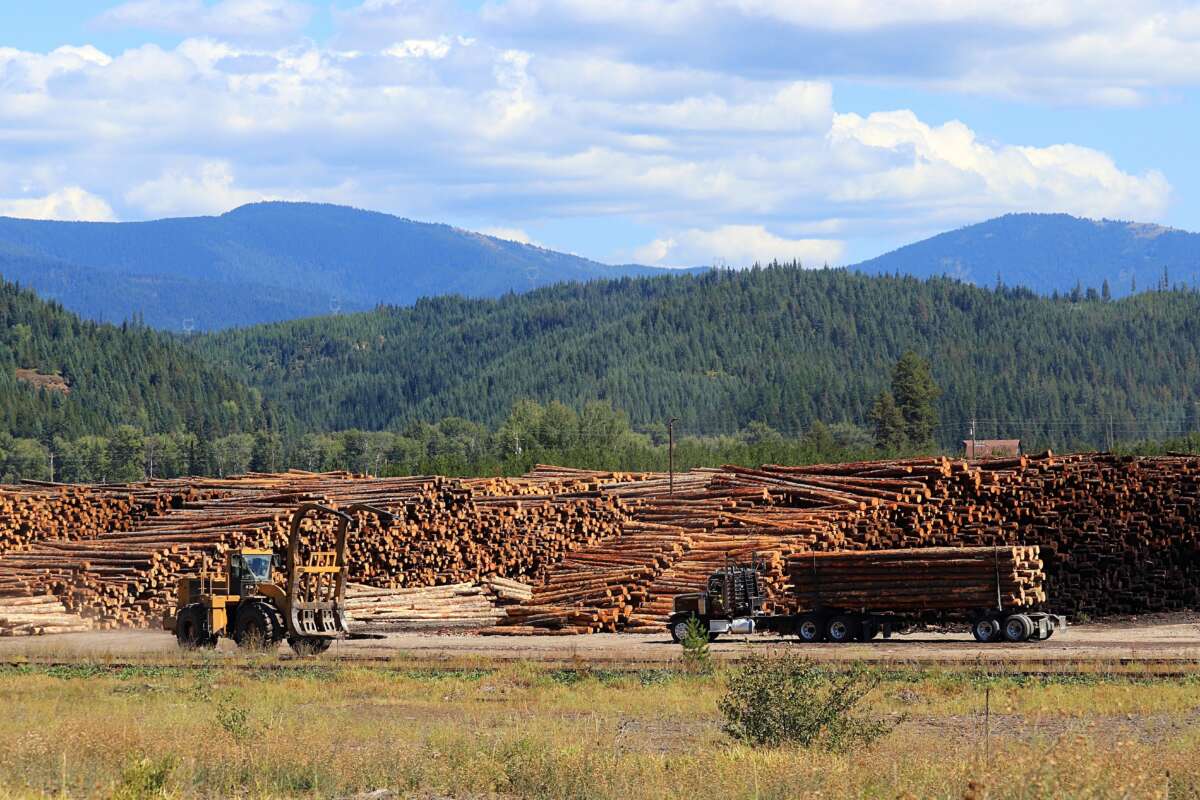
Workers add freshly harvested logs to the piles in a timber company log yard near Clarkia, Idaho.Don and Melinda Crawford / UCG / Universal Images Group via Getty Images
On March 1, President Donald Trump signed an executive order titled “Immediate Expansion of American Timber Production.” The order claimed “onerous Federal policies” have hindered domestic timber production and that expanding logging was a matter of protecting “national and economic security.” It ordered the secretary of the Interior and head of the U.S. Department of Agriculture (USDA), who oversee the Bureau of Land Management (BLM) and the U.S. Forest Service (USFS) respectively, to develop a plan to expand timber targets and streamline permitting “to suspend, revise, or rescind all existing regulations, orders, guidance documents, policies, settlements, consent orders, and other agency actions that impose an undue burden on timber production.”
The responsible departments and agencies were instructed to find categorical exclusions to the National Environmental Policy Act and use “emergency regulations” to circumvent the Endangered Species Act (ESA).
After Trump’s order, the United States Fish and Wildlife Service continued the assault on endangered species by proposing a new rule that would redefine “harm” under the ESA to only include directly killing species, replacing the current definition that includes destruction of a species’ habitat. Habitat destruction is the greatest source of species extinction.
In April, USDA head Brooke Rollins directed the stripping of forest protections on more than half of all national forests and called for expanding timber production by 25 percent to address a “wildfire emergency,” and restore forest “resources.” A report from the Associated Press says the directive “exempts affected forests from an objection process that allows outside groups, tribes and local governments to challenge logging proposals at the administrative level before they are finalized.”
A map of forests Rollins has targeted includes all national forests in Washington State and California, and large sections throughout the west and other parts of the country. It even includes some wilderness areas. These forests contain some of the most cherished old-growth and mature forest ecosystems remaining in the U.S.
In the Pacific Northwest, millions of acres of older and mature forests and old-growth dependent species like the northern spotted owl were finally protected by the Northwest Forest Plan (NWFP) in the 1990s after a century of logging that had reduced the forest to about a fourth of its historical extent. The NWFP happened as a result of intense forest defense and protest by Earth First! and many other environmental groups, studies by forest ecologists and court injunctions. The idea that these forests of immense trees, stunning natural beauty, rich biodiversity and crucial reserves of carbon sequestration could now, once again, be opened to logging is stomach-turning.
In late April, Idaho Gov. Brad Little issued his own executive order in line with Trump’s, aiming to ramp up logging with the same “rationale” as the Trump order, combatting increased wildfire danger. The order appears to replace federal responsibility for forest management in that of the state.
Jeff Juel, forest policy director for Friends of the Clearwater (FOC) said, “The state of Idaho has not earned the trust of the American public to manage forests while preserving old growth, assuring wildlife populations are robust and healthy, or maintaining hunting and fishing opportunities.… They are, on the other hand, experts at clearcutting and making state lands resemble a war zone.”
Climate Change and Wildfire
Trump’s order called for “forest management and wildfire risk reduction projects” to “save American lives and communities.” Yet none of the administration’s orders even gave lip service to the overwhelming preponderance of evidence that climate change is the main driver of more severe wildfire that has resulted in the destruction of whole communities in the west in recent years, including parts of Los Angeles.
Dominick DellaSala, chief scientist with Wild Heritage, whose stated mission is to protect and restore forests and safeguard biocultural diversity around the world, told Truthout that Trump’s policies are “a double whammy on the climate. By beginning the process of withdrawing from the Paris climate agreement, they’re going to continue to drill for fossil fuels and increase our emissions to the atmosphere. At the same time, they’re talking about an executive order that would increase logging on 280 million acres of forests across the U.S., bypassing the nation’s … landmark environmental laws, even the Endangered Species Act.”
DellaSala led an international team of scientists in doing the first nationwide mapping of mature and old-growth forests in the U.S. Their analysis found these forests sequester 9 percent of the nation’s total emissions.
“These big, fast-moving fires are the combination of extreme fire weather caused by anthropogenic climate change interacting with heavily logged landscapes. So it’s that double whammy again, by doing more logging and contributing to more emissions, you have a feedback on fire weather over the long run, that’s what’s really driving these big fires,” DellaSala told Truthout. “The latest climate attribute models are showing now that we can explain a lot of the causality around these big fires because of the increase in spring and summertime temperatures, especially heat domes, high winds and extreme droughts.”
As the Trump administration cited wildfire mitigation as a reason to increase logging to “save communities” from wildfire, it was busy axing programs, agencies and employees who were researching or seeking ways to combat the climate crisis driving increased wildfire. Trump also declared an “energy emergency” justifying elimination of government environmental regulations on energy production.
Wildfire Science and “Mitigation”
A growing body of knowledge in fire ecology understands wildfire is a natural phenomenon that ecosystems have evolved in relation to. Trees and plants have evolved strategies for flourishing with fire — such as conifers which have serotinous cones that require fire to open them so seeds are distributed.
Fire plays a key role in ecosystem restoration. It is increasingly understood among fire ecologists that a century of fire suppression in the U.S. has failed, and has been damaging in preventing fire from playing its role in maintaining forest health.
Traditionally, Indigenous cultures in the U.S. burned the landscape to control larger, more dangerous wildfires and to generate better growing conditions for native plants they harvested. Cultural burning is credited by most scientists as well as tribes with helping maintain healthy forest ecosystems and biodiversity.
A member of the Karuk tribe in California told CalMatters “Fire, for us, is not just a tool — it’s a lifeline, a means of renewal, and a vital part of our culture.” Indigenous burning was suppressed in California and in the U.S. as a whole in the 19th century by the government as part of destruction of Native culture, theft of land and genocide.
Wildland fire is a very complex phenomenon. Different types of forests have very different fire regimes. Degrees of fire intensity differ greatly between forests and even within forests of the same general type, depending on rainfall, climate, and other factors. Historically, fire intensity varied, even within forest patches.
Decades of fire suppression by the USFS has led to a buildup of denser forests in some western dry forests. In the era of climate crisis, this has contributed to more intense and widespread fires. There is basic agreement among scientists on the role of climate change as a prime driver that must be addressed. Many agree on the need to curtail fire suppression in the backcountry to help restore the natural function of fire on the landscape. Steps here include allowing certain backcountry fires to burn and to increase prescribed burning, especially during seasons of lower fire risk.
There’s also a clear need to develop programs for home hardening, vegetation clearing near structures and better escape plans for threatened communities.
But the science on using mechanical thinning of forests to manage wildfire is not settled. There is ongoing debate about how effective it is at lowering the severity of wildfire or its threat to communities. Disagreements remain over the degree and type of thinning that should occur, where and when it should be done if at all, if it should only be undertaken in tandem with prescribed burning and whether it is beneficial or harmful to the ecosystem.
Scientists do in general agree that if done, thinning should focus on dry forests, removing smaller trees and protecting more fire-resilient older and mature trees. A USFS study showed that older forests that have been protected from logging to preserve nesting area for the northern spotted owl under the NWFP can act as “fire refugia,” burning at lower intensity than surrounding landscape. A 2016 study in Ecosphere showed forests with high levels of protection from logging in dry and mixed-conifer forests burn with lower intensity than unprotected forests or those subjected to logging, even though they generally contain more forest biomass.
Forest Service Fuel Treatment
No matter the scientific debate, the reality is that over recent decades, government policy has largely continued to rely on fire suppression. This strategy has failed to lower the risks to communities or to save forested ecosystems. At the same time, the USFS has, in recent years, begun to use thinning and prescribed burning on hundreds of thousands of acres of land each year and has plans for tens of millions more.
Environmental groups that are watching this on the ground say some mitigation projects have been done more judiciously and can be helpful, but now a great deal of USFS projects are just clear-cutting of forests to produce revenue for timber companies.
Karen Coulter of Blue Mountains Biodiversity Project (BMDP), which works to protect and restore the ecosystems of the Blue Mountains and Eastern Oregon Cascades, told Truthout she has been monitoring public lands in eastern Oregon and southwest Washington for 33 years. She said in the 1990s, average timber sales were smaller-scale, legitimate commercial thinning. “Sometimes I could agree with it. Because it was thinning from below, and it wasn’t hacking down the large trees and so forth. It was more reasonable. Now it’s virtual clear-cutting, much more intense logging, and it’s on a landscape scale.”
BMDP’s website has many photos of USFS projects termed “free selection,” “commercial” thinning or “understory removal” in the Malheur and Umatilla National Forests that are essentially clear-cuts. Everything is mowed down. Some of these include old-growth trees.
Right now, the organization is contesting a USFS project in an Inventoried Roadless Area, (public lands without roads that have high conservation value), that includes Walla Walla, Washington’s, municipal watershed and old-growth trees. They say logging here could cause damage to water quality for the city and streams that support threatened salmon, steelhead and bull trout.
Nick Cady is the legal director with Cascadia Wildlands (CW) in Eugene, Oregon. CW works to defend and restore wild ecosystems in the Pacific Northwest. Cady told Truthout that another issue is often Forest Service proposals are turned over to timber companies to execute, giving them leeway. Meanwhile, he said the BLM is “just logging as much as they can.”
Cady said of USFS “mitigation” proposals, “If you log to maximize value, you dramatically increase fire risk. That is what the data on the ground has shown time and time again…. So if you say you’re going to maximize logging to improve fire, it’s just not real.”
USFS did not respond to a request for comment in time for publication.
In Montana, the Alliance For The Wild Rockies recently sued and stopped a USFS project planning to cut and burn 15,000-45,000 acres covering the whole eastern side of the Bitterroot National Forest over 20 years, claiming “categorical exclusions” from protecting threatened species.
The amount of timber sold from logging USFS lands in the U.S. from 2014 to 2023 has varied between 2.8 and 3.2 billion board feet a year. Expanding timber production by 25 percent would increase sales to 3.75 billion board feet a year from its current 2024 level of around 3 billion board feet.
Internal USFS documents obtained by WildEarth Guardians (WEG) show top officials under both Trump and former President Joe Biden have pressured foresters to streamline the process for timber sales. At a June 2017 meeting, the USFS leadership team for the Pacific Northwest said the head of USFS was calling to “increase our restoration activities” so as to “increase acres treated and volume output as a consequence.”
USFS has also been undertaking plans to revamp the NWFP in ways that would increase the cut of older trees. One proposal would, among other things, change the age of trees protected in wet forest Late Successional Reserves from 80 to 120 years, opening up 824,000 acres to logging. WEG says this would “eviscerate the entire concept of [the reserves] which were originally intended to provide large blocks of older forests for species like the northern spotted owl.”
What’s Next?
The Trump regime now threatens to worsen the devastation of some of our most important older forests, gutting the most fire-resilient ecosystems, increasing the threat of climate change and more dangerous wildfire. It does so while slashing environmental protections across the board and gutting key agencies and programs that offer some protection to humans and the planet.
Cady and Coulter both told Truthout that the regime is going to run into all kinds of problems with accomplishing their plan — shuttered lumber mills, previous legal decisions against timber interests in court and real difficulties with the process of designing these sales after firing thousands of forest service employees.
Cady said Cascadia Wildlands has “a massive body of supporters” that can be mobilized to act regardless of decisions in the courts. He said, “People live here, they don’t want massive amounts of logging.”
In cooperation with court challenges and active public engagement by these and other groups, forest defense efforts including active tree sits have increasingly jumped off in Pacific Northwest forests recently. These include two tree sits in southern Oregon on BLM land, one of which helped precipitate a court ruling canceling logging in the Poor Windy Project in May 2024. Another tree sit has just begun to protect legacy forest on Department of Natural Resource land in Washington State near the Elwha River on the Olympic Peninsula.
Coulter said what Trump’s order is attempting “would be illegal and challenged in court, but the problem is their strategy seems to be that they could wrench these destructive timber sales through first before there’s any final legal outcome. And this is kind of what they’re doing, is wrecking everything as fast as they can, dismantling the agencies,” she said. “We need to raise the profile of the forest defense movement…. We need to raise the profile of forests, along with everything else that they’re targeting.”
This article is licensed under Creative Commons (CC BY-NC-ND 4.0), and you are free to share and republish under the terms of the license.
Curtis Johnson is a retired research scientist, freelance writer and activist. He has reported and written on the Gulf oil spill, western wildfires, the extinction and climate crisis, and analysis of Trumpian fascism. Follow him on Bluesky: @curtisjohnson97404.bsky.social or on his blog.
A Fraction of What We Pay in Fossil Fuel Subsidies Could Fund a Just Transition
Phasing out fossil fuel subsidies must be tied to new subsidies that raise living standards for working and poor people.May 19, 2025

A view of the Lusk fracking facility in Scenery Hill, Pennsylvania, on October 22, 2020.NICHOLAS KAMM/AFP via Getty Images
Truthout is an indispensable resource for activists, movement leaders and workers everywhere. Please make this work possible with a quick donation.
The bad news on climate change is plentiful. For one, there is no sign of a decline in global carbon dioxide emissions and the Earth is getting hotter faster than ever before, despite constant pledges of government action. And now, of course, the second Trump administration is implementing policies that represent the biggest attack on nature, climate and people ever.
Yet, as world-renowned progressive political economist Robert Pollin shows in this exclusive interview with Truthout, there are also hopeful signs on the climate front. There is indeed an energy transition underway. Pollin also tackles the challenge that fracking represents, which is still widespread across the U.S. energy landscape, and the problem with the persistence of fossil fuel subsidies. In this context, he advances a concrete green transition program for phasing out fracking operations in the state of Pennsylvania and proposes alternative measures of support for working people and the poor to meet their energy needs.
Pollin is Distinguished University Professor of Economics and co-director of the Political Economy Research Institute (PERI) at the University of Massachusetts Amherst. He is the author of scores of books and academic articles, and was selected by Foreign Policy magazine as one of the “100 Leading Global Thinkers for 2013.” The interview that follows has been lightly edited for clarity and length.
C.J. Polychroniou: Global carbon dioxide (CO2) emissions have increased by nearly 70 percent since 1990 and hit a record high of 37 billion tons in 2023. And now the Trump White House wants to increase oil and gas production, which is a further blow to the urgent task of rapidly reducing the flow of heat-trapping greenhouse gas emissions. Considering this, is it realistic to expect that CO2 emissions can be reduced by 45 percent by 2030 and reach net zero by 2050?
Robert Pollin: The goals of reducing global CO2 emissions by 45 percent relative to the 2010 level of about 33 billion tons and to achieve net zero emissions by 2050 was first advanced by the Intergovernmental Panel on Climate Change (IPCC) in a 2018 report called “Global Warming of 1.50C.” The IPCC is a UN agency focused on advancing credible research on all aspects of climate change, including, in particular, what we need to accomplish to stop the ever-deepening calamities resulting from rising average global temperatures, such as what we saw only a few months ago with the devastating fires that devoured major sections of Los Angeles. In this 2018 report initially, and in several subsequent studies, the IPCC has been making the case that achieving their 2030 and 2050 CO2 emission reduction targets was necessary to prevent the average global temperature from rising by more than 1.50 Celsius than the global average between 1850 and 1900 — i.e., the pre-industrial level.
Given that global CO2 emissions have not fallen at all since the 2018 IPCC report came out, it is clear that the world will not succeed in bringing emissions down from the current level of 37 billion to about 18 billion tons in the next 4.5 years. This was obvious even before Donald Trump returned to the White House in January and launched his campaign, as promised, to obliterate any and all policies, regulations or even any words in any federal government documents that in any way gesture toward a U.S. climate stabilization program. Thus, in February, The Guardian reported that, “The Trump administration is stripping away support for scientific research in the US and overseas that contains a word it finds particularly inconvenient: ‘climate.’” As just one follow-up in March, Lee Zeldin, Trump’s Environmental Protection Agency administrator, pronounced that, “Yesterday was the most consequential day of deregulation in American history. …Today marks the death of the Green New Scam.”
And yet, even in the face of these assaults from Trump and company, we can still point to some positive developments on which we build.
First, while it is true that global CO2 emissions have not fallen since 2018, they also have risen only slightly since 2013, from 35 to 37 billion tons. This is while overall global economic activity — as measured by global GDP — has expanded by 31 percent. So there is some evidence emerging — absolutely too slowly to be sure, but emerging nonetheless — of global CO2 emissions decoupling from overall economic activity.
Second, the average costs of generating electricity from solar and wind power have plummeted since 2010, making them the low-cost alternatives, without subsidies, relative to fossil fuel energy. Thus, on average, generating electricity from onshore wind sites was 23 percent more expensive than fossil fuel alternatives in 2010, but was 67 percent cheaper in 2023. Electricity from solar panels was, on average, 414 percent more expensive than fossil fuel alternatives in 2010, but was 56 percent cheaper in 2023.
Moreover, global investments in renewable energy reached about $2 trillion in 2024. This was about equal to 2 percent of 2024 global GDP. According to my own estimates, and those of other researchers, we need to reach an annual clean energy investment level of about 2.5 percent of GDP per year, every year, to achieve a zero-emissions global economy by 2050. So, at least as of this past year, we have started to approach that necessary investment scale.
One of the most important components of this overall renewable investment expansion is that small-scale solar electricity installations — i.e., mini-grids — are growing rapidly in rural sub-Saharan Africa. This is where, at present, roughly 80 percent of the 680 million people throughout the globe still have no access to electricity.
Finally, within the U.S., clean energy investments were expanding rapidly while Joe Biden was still in office, induced in large part by the Biden-era programs such as the Inflation Reduction Act. Thus, even in West Virginia, a state that is very poor, still dependent on its fossil fuel industry, and deep red in its politics (Trump won West Virginia in 2024 with 70 percent of the vote), $5.3 billion had been committed by the time Biden left office to build a low-emissions steel mill; a battery storage equipment manufacturing facility; a renewable energy microgrid industrial site; a hybrid vehicle transaxle manufacturing plant; and multiple solar farms. Trumpite bluster aside, I am guessing that the people of West Virgina are not inclined to chase these projects out of the state, even allowing that the word “climate” is likely to slip into some of the documents supporting them.
Many countries across Europe have banned fracking, but hydraulic fracturing remains at the heart of the U.S. energy landscape. Even Kamala Harris opposed a fracking ban during her 2024 presidential campaign, after having supported a ban during her brief initial presidential run in 2019. How do we move away from fracking without disrupting the economies of those states that rely heavily on fracking operations?
Fracking is a technology used to extract oil and natural gas from underground rock formations, such as sandstone, limestone, or shale rock deposits. This technology is employed as a means of increasing the rate at which oil and gas can be extracted profitably from such rock formations. But fracking operations also generate severe environmental and health impacts through water and soil contamination as well as noise pollution. This is why five U.S. states have banned fracking (California, New York, Washington, Maryland and Vermont). But within the U.S., fracking operations continue in up to 30 other states, and are most extensive in Texas, Pennsylvania and North Dakota. In political terms, the case of Pennsylvania was most important for the 2024 election, since it was the largest and most important swing state over which Trump and Harris were competing for votes. The Harris campaign had obviously calculated that supporting a fracking ban was a strategic nonstarter, since they believed that a fracking ban would inflict major damage to Pennsylvania’s economy.
In fact, the Pennsylvania economy would experience a major hit if fracking were banned and no large-scale alternative economic activities were introduced to substitute for the jobs and incomes that would be lost through shutting down fracking. But a fracking ban should not be understood as an isolated, one-off policy measure. It should rather be recognized as one component of a much larger green transition program, in Pennsylvania and everywhere else.
My own research with co-authors on this specific question of comparing the economic impacts of continuing with fracking versus advancing a green transition project in Pennsylvania produced the following major results:A green transition program capable of bringing CO2 emissions in Pennsylvania down to zero by 2050 would generate approximately 160,000 jobs in the state. These would be jobs resulting from investments in building a high-efficiency, renewable energy-dominant energy infrastructure in the state. Meanwhile phasing out fracking and all other fossil fuel activities in Pennsylvania will entail job losses in the range of 1,700 per year — that is, a little more than one one-hundredth of the total number of jobs that will get created through clean energy investments.
Policies will certainly need to be enacted to provide robust transition support for these 1,700 displaced fossil fuel industry workers per year — what the late, great U.S. labor leader and environmentalist Tony Mazzocchi first termed “just transition” policies. One critical point that flows from Mazzocchi’s idea is that providing generous adjustment assistance to today’s fossil fuel industry workers will represent a major contribution toward making a zero-emissions climate stabilization project politically viable. Without such adjustment assistance programs operating at a major scale, the workers and communities facing retrenchment will, predictably and understandably, fight to defend their communities and livelihoods.
The specific transition support program that I developed with co-workers for Pennsylvania includes three major elements: 1) pension guarantees; 2) guarantees of new jobs at pay levels comparable to what they had been receiving in the fossil fuel industry; and 3) generous retraining and relocation support for the workers who will need these. We estimated that providing these forms of support for all displaced fossil fuel industry workers in Pennsylvania would cost the state an average of about $167,000 per worker, totaling up to about $240 million per year. This is real money, to be sure. But it also amounts to about 0.02 percent of Pennsylvania’s current GDP. From this perspective, it is a tiny price to pay for establishing a just transition for fossil fuel industry-dependent workers and communities as a fundamental principle of any green transition program worthy of our support.
Governments across the world continue to subsidize the production and consumption of fossil fuels, as you and co-authors show in a new extensive study. How large are global fossil fuel subsidies, and how should we understand the political economy of fossil fuel subsidies, given that there are obvious benefits in removing them?
Fossil fuel subsidies constitute a massive obstacle to advancing a viable climate stabilization path, i.e., to reach zero global emissions by 2050. This is because they create perverse incentives, making it cheaper for consumers to continue purchasing oil, coal and natural gas to meet their energy needs and for producers to continue profiting off of selling the stuff. At the same time, fossil fuel subsidies represent a huge financial resource that could be mobilized to help pay for the transition to a global clean energy-dominant infrastructure. As of the most recent 2023 figures, global fossil fuel subsidies amounted to $1.1 trillion, equal to about 1 percent of global GDP. To put this figure in perspective, as noted above, I estimate that we need approximately 2.5 percent of global GDP per year devoted to clean energy investments to build a 100 percent clean energy, zero-emissions global economy by 2050. So, if we could transfer this 1 percent of global GDP out of subsidizing fossil fuels and into building a clean energy economy, those funds alone would cover roughly 40 percent of the entire funding level that is needed.
And yet, unfortunately, matters aren’t quite so straightforward. In fact, it would be both undesirable and unrealistic to move all $1.1 trillion out of fossil fuel subsidies and into clean energy investments. This is because, in many countries, fossil fuel subsides provide critical support to low-income and working-class people, by reducing the costs these people must pay to meet their energy needs. As such, any workable program to phase out fossil fuel subsidies must also be committed to enacting alternative measures to maintain support for working people and the poor. Such alternative forms of support could include food, housing or cash subsidies. These alternative subsidies would have to be generous enough and maintained over time, so that, at a minimum, the overall living standards of working people and the poor would be defended when the fossil fuel subsidies are eliminated. Better still would be to make the alternative subsidies generous enough so that the living standards for working people and the poor would rise through the substitution of the alternative subsidies for fossil fuel subsidies.
In fact, in terms of providing the necessary money to support generous alternative subsidy measures, eliminating fossil fuel subsidies can release formidable levels of funds to both deliver generous alternative subsidies for working people and the poor, and to still provide large-scale funding for clean energy investments. This is because, by far, the largest beneficiaries of fossil fuel subsidies are high-income households and the fossil fuel corporations themselves — two groups who don’t need or deserve such subsidy support but are nevertheless happy to pocket the money if governments continue to hand it to them.
I can illustrate this point by considering the case of Indonesia, which is one of the case studies we review in our study. As of the most recent 2023 data, total fossil fuel subsidies in Indonesia — including the funds received by both consumers and fossil fuel corporations — amounted to about $35 billion. This was equal to about 2.5 percent of Indonesia’s 2023 GDP. Of the $35 billion total, we estimate that the poorest 10 percent of Indonesian households received an average of $110 in subsidies while the richest 10 percent received $1,248. That is, the richest 10 percent of Indonesian households received 11 times more support than the poorest 10 percent through the country’s fossil fuel subsidy program. This massive disparity resulted because rich households spend much more money buying oil, coal, or natural gas than poor households, but all households — rich, poor, and those in between — are able to purchase all of their fossil fuel energy at reduced costs due to the country’s subsidy program.
What if, as an alternative, all Indonesian households, at all income levels, received a cash, food or housing subsidy equal to what had been the fossil fuel subsidy amount received by the country’s middle-income households? In that scenario, all Indonesian households would have received about $380. Subsidies for the poorest 10 percent of households would then have increased more than 300 percent. At the same time, under this alternative subsidy plan, Indonesia would still have freed up about $8 billion in funds that could then be channeled into building the country’s clean energy infrastructure. This level of clean energy investments would amount to about a 500 percent increase over Indonesia’s clean energy investment spending level for 2023.
The overall points that emerge from this Indonesia case are basically the same as with the program to eliminate fracking in Pennsylvania and establish a just transition program for the state’s fossil fuel industry-dependent workers and communities. That is: 1) phasing out fossil fuel subsidies is an absolute imperative that must be accomplished as one centerpiece of a global climate stabilization program; and 2) for the fossil fuel phase-out to be accomplished according to any reasonable standard of social and economic justice, the overall project must include robust measures to defend and improve the living standards of working people and the poor.

