Tuesday, May 20, 2025

'Red meat and cars': French men’s carbon footprint 26% higher than women's, study finds


Explainer


A study released on Wednesday investigating the gender gap in carbon emissions found that women in France emit 26 percent less carbon than men with their diet and transport choices. Researchers say household structure plays a “key role” in shaping the carbon footprint gap.


Issued on: 14/05/2025 - 
By: Joanna YORK
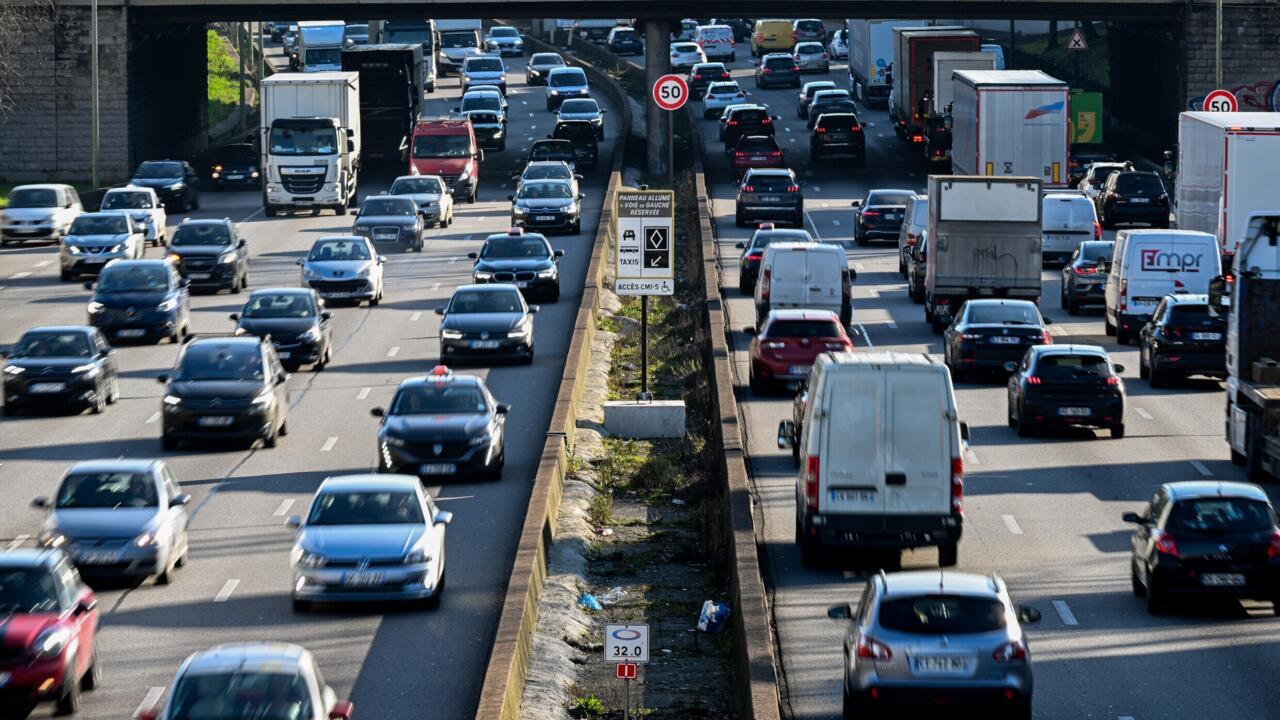

Photograph from March 5, 2025, shows cars driving on the Paris ring road. 
© Anna Kurth, AFP


The average man in France has a 26% higher carbon footprint than the average woman largely due to increased car usage and red meat consumption, a study released on Wednesday by the Grantham Research Institute on Climate Change and the Environment at the London School of Economics (LSE) and the Center for Research in Economics and Statistics (CREST) found.

Researchers analysed French consumption data from more than 2,000 car models and food products matched with detailed environmental information to shed light on the “underexplored factor” of how gender might impact carbon emissions.

It found men in France had an annual average carbon footprint associated with food and transport of 5.3 tonnes, compared with 3.9 tonnes for women, largely due to differences in consumption.

After accounting for socioeconomic, calorific and travel differences, there remained a 25% food footprint gap and 38% transport footprint gap between men and women, which the working paper put down to two “gender stereotypical” goods: red meat and cars.

“Women have substantially lower carbon footprints than men in the food and transport sectors,” said one of the study authors, Ondine Berland, a fellow in environmental economics at LSE. “We identify household structure, biological differences, higher red meat consumption and car usage among men as key factors driving this gap.”

Red meat – namely beef and lamb – is the most carbon intensive of all foods and road travel accounts for three quarters of global transport emissions – more than any other form of transport. In France, the food and transport sectors account for 50% of household carbon footprints.


Part of the reason people who identified as women had a smaller carbon footprint on average was due to wider lifestyle factors. The study found women in France were “more likely to live in large cities and poorer households and are more often unemployed or outside the labour force – all characteristics associated with lower carbon footprints".

Single men and women also had lower and more equal carbon footprints than those living in dual-adult households, for whom traditional household structures played a “key role” in shaping carbon consumption.

Women – especially women with children – were less likely to work and more likely to seek out work with shorter commutes, reducing their work-related carbon emissions. As a result, men’s “work-related trips – which include both commuting and other business-related trips – explain most of the gender gap in transport carbon footprints”, the study found.

“We did not find a gender gap in carbon footprints for planes, a transport mode seen as more gender-neutral than car," said study author Marion Leroutier, assistant professor at CREST Paris. “This suggests that the gap is explained by gender differences in preferences pre-dating climate concerns.”
'Traditional gender norms'

The opposite was true when it came to food, with women in couples having more carbon-intensive diets than their single counterparts. This is probably because women are more likely to adapt their eating habits to match their male partners’, including eating more red meat.

“Shared meals and joint decision-making may limit the expression of gendered dietary preferences,” the study said.

The overall findings indicate that “traditional gender norms, particularly those linking masculinity with red meat consumption and car use, play a significant role in shaping individual carbon footprints", Leroutier said. In other words, who people live with and how they divide household roles can significantly shape their climate impact.

For climate activists and politicians, the findings may shed light on how climate policies impact men and women differently, contributing to their success or failure.

For example, there could be an opportunity to counter carbon-intensive “cultural trends that promote raw meat or ‘all-meat’ diets – often accompanied by rhetoric dismissive of plant-based options” by “reframing plant-based alternatives as compatible with strength and performance”, Leroutier said.

While the study found that women on average have a smaller carbon footprint, it did not determine whether this is because they are more likely than men to want to minimise their environmental impact.

“More research is needed to understand whether these differences in carbon footprints are also partly due to women’s greater concern about climate change and their higher likelihood of adopting climate-friendly behaviours in daily life,” Leroutier added.
‘A direct attack’: US, European anti-rights groups descend on ‘family values’ events in Africa


Analysis


Ultra-conservative groups from the US and Europe are attending a “family values” conference in Kenya this week – one of several planned in Africa this year – in what activists are describing as a “direct attack” on LGBT and women’s rights.


Issued on: 17/05/2025 
By: Joanna YORK

A man holds a rainbow flag during a protest organised by The Queer Republic advocacy group in Nairobi on January 13, 2022. © Patrick Meinhardt, AFP

The Pan-African conference on Family Values began in Nairobi on Monday with a call to wage a “biblical” fight for the family unit from Anne Mbugua, chairperson of event organiser the Africa Christian Professionals Forum.

The conference is one of several planned across Africa this year, backed by wealthy US ultra-Christian groups, including Family Watch International, Christian Council International, the Center for Family and Human Rights, and the Family Policy Institute.

Together the groups have spent more than a decade channelling millions of dollars into funding anti-LGBT and anti-abortion narratives in Africa in a bid to spread influence and change laws to align with their conservative values.

“There is nowhere that they have been anywhere in Africa where good has followed,” says women’s rights lawyer and Amnesty International Kenya board member, Tabitha Saoyo. Their presence in Nairobi this week likely means “they will influence law and they will influence policy", she adds.


In a first, they are publicly joined at the conference in Kenya by European counterparts.

Listed as speakers at the event are France’s Ludovine de la Rochère, president of anti-LGBT group La Manif Pour Tous, Poland’s Jerzy Kwasniewski, president of anti-abortion organisation Ordo Iuris, and Margarita de la Pisa Carrion, an MEP for Spain’s far-right Vox party.

Read moreIn the name of the family: Yes, Europe could be headed for a ‘Project 2025’ too
‘An alignment of businesses’

Billed as a networking event for global organisations “committed to shared values”, Kenyan rights activists say the conference is an attempt to impose Western far-right values that endanger women, girls and the LGBT community.

“It's a direct attack on women and girls,” adds Elsy Sainna, associate director of advocacy and external relations for Africa at the Center for Reproductive Rights. “Kenya already has national values of dignity, human rights and family values. The conference is a Trojan horse trying to impose a religious perspective on our Constitution.”

Under Kenyan law, there is legal provision for abortion in emergencies or if the life or health of the mother is at risk.

Sex between two people of the same sex is illegal in Kenya. However, advocacy groups point out that it is not illegal to identify as LGBT and cite a 2023 ruling enabling LGBT advocacy organisations to register as NGOs in the country as a significant sign of progress.

When the five-day “family values” conference was first announced promotional materials showed a panel composed entirely of white men, none of whom were from Africa; proof to critics that the event was an attempt to import values that are not part of the Kenyan national debate.

“The protection of family values does not look like what they're trying to force upon us. These are not the concerns of everyday Kenyans,” says Ivy Werimba, communication and advocacy officer at GALCK+, a coalition of Kenyan LGBT organisations. “This event highlights that homophobia is an importation being pushed by Western thought to gain control politically and socially, while putting LGBTQ+ lives at risk.”


Even so, the conference has attracted influential figures from national politics.

Among the attendees in the first few days were Kenyan politicians Joseph Mogosi Motari and Peter Kaluma, who in a speech on Wednesday accused international actors of “recruiting” young Kenyan university graduates and paying them to take up LBGT lifestyles.

His approach typified a narrative that has long been championed by foreign ultra-conservative organisations “that African people do not want queerness or queerness is un-African”, says Werimba. “They are using African bodies and African voices to push this narrative and build credibility.”

Kaluma is currently spearheading a drive to get a Family Protection bill through Kenya’s parliament that would outlaw same-sex relationships, queer activities and related advocacy campaigns.

An influx of support from powerful international backers may give his campaign a boost.

“There is a genuine, legitimate fear amongst groups like the queer community that the conference will lead to their criminalisation in law,” says Saoyo.

Kaluma has been through an acrimonious divorce and spoken in favour of adultery, making him an unlikely ally for advocates of radically conservative Christian values. Saoyo says their partnership is “not an alignment of values, but an alignment of businesses” that is replicated across Africa.

In Uganda, a 2023 conference sponsored by US ultra conservatives was attended by first lady Janet Museveni. The following month President Yoweri Museveni signed one of the world’s toughest anti-homosexuality acts into law.

Ugandans now face life imprisonment for sexual acts between two people of the same sex and the death penalty for cases of “aggravated homosexuality”.
‘Emboldened’

Directly prior to this week's conference in Kenya, the Uganda hosted its third edition of the African Regional Inter-Parliamentary Conference, once again attended by the president.

In the coming months similar meetings are planned in Sierra Leone, where first lady Fatima Maada Bio will attend the Strengthening Families conference, in Rwanda where the Advocates Africa conference will take place in Kigali, and in Ghana at the African Bar Association annual meeting in October.

Read moreGhana's Supreme Court clears path for anti-LGBT law amid human rights concerns

The timing of the Sierra Leone conference coincides with a ground-breaking bill to legalise abortion up to 14 weeks currently being debated by parliament – a natural target for the ultra-conservative groups.

“They've mapped out who are their strategic partners in the countries they want to go, and they mobilised participants to attend,” says Sainna. “It's a very clear agenda and very well calculated, whether it's in Uganda, Kenya or West Africa.”

While the ultra-conservative groups have been championing the same anti-rights messages in Africa for years, they are now “emboldened”, Saoyo says. “This is the highest number of conferences we’ve had from these groups in Africa in a year.”

The programme for the conference in Nairobi clearly lists the foreign groups sponsoring the event and names individuals speaking.

“The US organisations used to work very silently in Africa, now their logo is on the programme,” Saoyo says. ”European organisations like Ordo Iuris have never had any interest in Africa, but we saw its president here addressing us on Monday.”

As many of the US groups are in league with President Donald Trump, she sees “a direct link between [the far-right initiative] project 2025, Trump’s re-election and what we are seeing in Africa today”.

But the groups are also working in alignment with “African states that are increasingly becoming not only dictatorial but authoritarian, and hugely influenced by religious movements", Sainna says. “These groups are capitalising on that, accelerating and gaining more momentum.”

On the ground, activists and lawyers are braced for what’s to come. “Human rights lawyers watching this space are clearly aware of the agenda,” Sainna adds. “We are intentional around defending the grounding principles of our Constitution, our laws and our policies.”


South Africa challenges US persecution claims ahead of talks with Trump

Issued on: 20/05/2025 - 

FRANCE 24's Yinka Oyetade speaks to Ray Hartley, Research Director at the Brenthurst Foundation, about the upcoming meeting between South African President Cyril Ramaphosa and US President Donald Trump. The meeting on Wednesday comes with bilateral relations at an all-time low, with the US repeating unproven claims of a "white genocide" in South Africa to attack the government.


Brazil Supreme Court opens landmark coup trial against Bolsonaro


Brazil's top court on Monday began hearing key witnesses in the trial of ex-far-right President Jair Bolsonaro, accused of plotting a coup to overturn his 2022 election loss. A former army commander told the court he had discussed a ‘state of siege’ with Bolsonaro after his election defeat. If convicted Bolsonaro could spend decades in jail.


Issued on: 20/05/2025 -
By: FRANCE 24


Brazil's former President Jair Bolsonaro is accused of plotting a coup after his election loss © SERGIO LIMA, AFP


A former army commander told Brazil's Supreme Court Monday he had attended a meeting with Jair Bolsonaro where a "state of siege" was discussed as a possible means of overturning the far-right ex-president's election defeat.

General Marco Antonio Freire Gomes, who was army commander under Bolsonaro, was one of the first witnesses to testify in an initial phase of the long-anticipated trial of Bolsonaro on coup charges.

After leftist Luiz Inacio Lula da Silva's election victory in 2022, but before he was inaugurated as president in January 2023, Gomes said he took part in a meeting with Bolsonaro where the possibility of declaring a "state of siege" was discussed.

"I warned him (Bolsonaro) that he could have serious problems, with judicial implications," the general said of that discussion.

Bolsonaro, 70, joined the hearings clad in a yellow Brazilian football jersey, a symbol of patriotism for his right-wing supporters.

He could face up to 40 years in prison if convicted of plotting to remain in office after leftist rival Luiz Inacio Lula da Silva narrowly defeated him in October 2022 elections.

Read moreBolsonaro vows to 'continue the fight' at site of 2023 Brazil insurrection

More than 80 people -- including high-ranking military officers, former government ministers and police and intelligence officials -- are set to testify in a preliminary trial phase that opened Monday and is expected to last at least two weeks.

Former air force chief Carlos de Almeida Baptista Junior is set to give evidence on Wednesday.

Monday's hearings were opened by Bolsonaro's arch-foe, Judge Alexandre de Moraes, via video link.

Bolsonaro joined the proceedings in a yellow Brazilian football jersey, a symbol of patriotism for his right-wing supporters.

Plot to assassinate Lula


Prosecutors say Brazil's 2019-2022 leader led a "criminal organisation" planning to declare a state of emergency so new elections could be held.

He is already banned from seeking office until 2030 over his baseless criticism of Brazil's electronic voting system.

Prosecutors in the current case say those attacks were aimed at discrediting the election and laying the ground for a military intervention.

Bolsonaro is also accused of being aware of a plot to assassinate Lula, his vice president Geraldo Alckmin, and Judge de Moraes.

Bolsonaro has always denied any role in a coup attempt, blaming the charges on "political persecution."

Last week he told Brazil's UOL news site that prosecutors were fabricating a "telenovela scenario," a reference to the melodramatic TV soap operas popular in Latin America.

01:44© France 24


'Death penalty'


The former army captain will be tried along with seven former aides accused of playing key roles in the alleged plot.

They include four former ministers, one former navy commander and the head of intelligence services during Bolsonaro's presidency.

Several former Brazilian presidents have had legal entanglements since the end of the 1964-1985 dictatorship, but Bolsonaro, who has expressed nostalgia for military rule, is the first to face coup charges.

A 900-page report by the federal police lays out the alleged coup plan in detail, saying it called for a decree ordering a new election -- and for Lula's assassination.

But the attempt failed to draw crucial military support and ultimately collapsed, prosecutors say.

The charges cover the riots of January 8, 2023, when thousands of Bolsonaro supporters invaded and ransacked key government buildings, demanding a military intervention to oust Lula a week after his inauguration.

Bolsonaro was in the United States at the time, but is accused of instigating the riots, which prosecutors say were the coup plotters' "last hope."

Despite his ban on running in elections, Bolsonaro has insisted he plans to be a candidate in next year's vote.

But after recent abdominal surgery -- his latest of many rounds to repair persistent damage from a knife attack in 2018 -- he has also said that a conviction now would be a "death penalty, political and physical."

Building a case


Key figures in the drama will be questioned during the preliminary trial phase.

During those hearings "it will be possible to identify any contradictions, either between different witnesses or from the same witness," Rogerio Taffarello, an expert in criminal law at the Getulio Vargas Foundation, told AFP.

"Only after that step can a case for conviction be built," he said.

The former army and air force commanders under Bolsonaro, Freire Gomes and Baptista Junior, admitted having been present in meetings in which Bolsonaro "raised the hypothetical possibility of using legal instruments" to overturn the 2022 election result and justify a military intervention.

But both officers said they refused to go along, and Freire Gomes said he even threatened to have Bolsonaro arrested if he proceeded with the plan.

Following the introductory phase, the trial will continue in coming months with testimony from the accused, followed by a summation from prosecutors and final arguments by defense attorneys.

Only then will the five high-court magistrates -- including Judge de Moraes -- vote on the fate of the accused and, if they are found guilty, sentence them.

(FRANCE 24 with AFP)
EU agrees to lift economic sanctions on Syria, Kallas says


The European Union on Tuesday agreed to lift economic sanctions against Syria, said the bloc's top diplomat Kaja Kallas. It came a week after the US lifted its sanctions against Damascus. Syrian Foreign Minister Asaad al-Shaibani said the EU's decision showed an “international will” to support the country after the fall of Bashar al-Assad.


Issued on: 20/05/2025 -
FRANCE 24


People walk past a chocolate advertisement in Damascus on May 20, 2025.
 © Louis Beshara, AFP

EU countries agreed Tuesday to lift all their remaining economic sanctions on Syria in a bid to help the war-torn country recover after the ouster of Bashar al-Assad.

“Today, we took the decision to lift our economic sanctions on Syria,” the EU’s top diplomat Kaja Kallas posted on X after a meeting of the bloc’s foreign ministers in Brussels.

“We want to help the Syrian people rebuild a new, inclusive and peaceful Syria,” she said.

The move from the European Union comes after US President Donald Trump announced last week that Washington was lifting its sanctions against Syria.

The country’s new rulers have been clamouring for relief from the crushing international punishment imposed after Assad’s crackdown on opponents spiralled into civil war.

EU diplomats said the agreement should see the lifting of sanctions cutting Syrian banks off from the global system and freezing central bank assets.


25:30© France 24


But diplomats said the bloc intended to impose new individual sanctions on those responsible for stirring ethnic tensions, following deadly attacks targeting the Alawite minority.

Other measures targeting the Assad regime and prohibiting the sale of weapons or equipment that could be used to repress civilians are set to remain in place.

Syria’s foreign minister Asaad al-Shaibani said after the EU decision that the lifting of the economic sanctions showed an “international will” to support Damascus.

Shaibani added that “the Syrian people today have a very important and historic opportunity to rebuild their country”.

The latest move from the EU comes after it took a first step in February of suspending some sanctions on key Syrian economic sectors.

Officials said those measures could be reimposed if Syria’s new leaders break promises to respect the rights of minorities and move towards democracy.

(FRANCE 24 with AFP)
WHO adopts landmark pandemic accord, US not bound by pact after opting out

The World Health Organization on Tuesday adopted an accord that aims to prevent the disjointed international response that occurred during the Covid-19 outbreak by improving global coordination and access to vaccines in the event of a future pandemic.

20/05/2025 - 
By: FRANCE 24

WHO chief Tedros Adhanom Ghebreyesus addressed the opening of the 78th World Health Assembly. © Fabrice Coffrini, AFP

The UN health agency on Tuesday adopted a landmark Pandemic Agreement on tackling future health crises, struck after more than three years of negotiations sparked by the Covid-19 crisis.

The accord aims to prevent the disjointed response and international disarray that surrounded the Covid-19 pandemic, by improving global coordination and surveillance, and access to vaccines, in any future pandemics.

The World Health Organization's decision-making annual assembly adopted the plan on Tuesday at its Geneva headquarters.

"It's an historic day," WHO chief Tedros Adhanom Ghebreyesus told AFP after the vote.


The text of the agreement was finalised by consensus last month, following multiple rounds of tense negotiations.

The United States pulled out of those talks, following US President Donald Trump's decision to withdraw his country from the WHO, a process that takes one year to complete.

"The world is safer today thanks to the leadership, collaboration and commitment of our member states to adopt the historic WHO Pandemic Agreement," Tedros said in a statement.

"The agreement is a victory for public health, science and multilateral action. It will ensure we, collectively, can better protect the world from future pandemic threats.

"It is also a recognition by the international community that our citizens, societies and economies must not be left vulnerable to again suffer losses like those endured during Covid-19."

World Health Organization announces 'significant' layoffs

01:25© France 24


Path to ratification


The agreement aims to better detect and combat pandemics by focusing on greater international coordination and surveillance, and more equitable access to vaccines and treatments.

The negotiations grew tense amid disagreements between wealthy and developing countries, with the latter feeling cut off from access to vaccines during the Covid-19 pandemic.

The agreement faced opposition from those who thought it would encroach on state sovereignty.

Countries have until May 2026 to thrash out the details of the agreement's Pathogen Access and Benefit-Sharing mechanism.

The PABS mechanism deals with sharing access to pathogens with pandemic potential, and then sharing of benefits derived from them: vaccines, tests and treatments.

Once the PABS system is finalised, the agreement can then be ratified. Sixty ratifications are required for the treaty to enter into force.

Precious Matsoso of South Africa, and France's ambassador for global health Anne-Claire Amprou, co-chaired the talks process that led to the agreement.

"It is intended to create a rules-based, future-proof system that will stand the test of time. It does not, and will not, undermine the sovereignty of countries," she told the assembly on Monday.

"In a time of growing geopolitical tensions and seismic changes, this agreement is proof that the world is still together."

(FRANCE 24 with AFP)
Dominican Republic expels hundreds of pregnant women to Haiti, says UN

The Dominican Republic has expelled hundreds of pregnant and breastfeeding women to Haiti in the past month, violating international standards, the UN said Tuesday. The deportations come amid Haiti's escalating gang violence. President Luis Abinader, reelected in May 2024, had pledged to increase removals to the crisis-hit neighbor.


Issued on: 21/05/2025 - 00:01
1 minReading time

By:FRANCE 24

Haitian women are being rounded up at Dominican hospitals © Erickson Polanco, AFP

The Dominican Republic has expelled hundreds of pregnant and breastfeeding women to Haiti over the past month despite its mounting insecurity and "in violation of international standards," the United Nations said Tuesday.

Boosting deportations to neighboring Haiti -- the region's poorest nation which is ravaged by gang violence -- was a campaign promise of Dominican President Luis Abinader, reelected in May 2024 for a second term.

The UN humanitarian team in Haiti "expresses deep concern over the rising number of pregnant and breastfeeding women being deported from the Dominican Republic to Haiti, in violation of international standards," the group said in a statement.

It said the UN migration agency (IOM), in partnership with Haitian authorities and others, had "assisted an average of 15 pregnant women and 15 breastfeeding mothers per day" at two border crossings since April 22.

The two countries share the island of Hispaniola, the second-biggest in the Caribbean after Cuba.

"Nearly 20,000 individuals -- including a growing number of highly vulnerable women -- were deported by land in April 2025, marking a record number for a one-month period," according to the IOM.

"It is imperative that commitments to protecting vulnerable populations are upheld," said Ulrika Richardson, UN Humanitarian Coordinator in Haiti.

Haiti has long suffered from political instability and gang violence, but the situation has significantly worsened over the past year, particularly in the capital Port-au-Prince.

Last month, the UN's special representative to Haiti, Maria Isabel Salvador, warned the country was approaching a "point of no return" and was in desperate need of international aid.

The UN estimates over a million Haitians have been internally displaced due to the violence.

(FRANCE 24 with AFP)
PKK rejects 'exile' of its members from Turkey after agreeing to disband


A spokesman for the Kurdistan Workers’ Party (PKK) said its members should not be forced into exile as a result of any future peace deal with the Turkish government. Imprisoned PKK leader Abdullah Ocalan on May 12 called for the group to disarm and disband after a decades-long insurgency against the Turkish state that cost more than 40,000 lives.


Issued on: 20/05/2025 
By: FRANCE 24
A man holds a poster of Abdullah Ocalan, Turkish-jailed founder of the Kurdistan Workers' Party (PKK), during a gathering of Turkish Kurds for Nowruz celebrations marking the New Year of the Persian calendar and the first day of spring in Diyarbakir, south-eastern Turkey, on March 21, 2025. © Ilyas Akengin, AFP

The Kurdistan Workers’ Party (PKK) has said Turkey should ease prison conditions for its founder Abdullah Ocalan, declaring him the group’s “chief negotiator” for any future talks after a decision to disband.

The Kurdish group, blacklisted by Ankara and its Western allies, announced on May 12 it had adopted a decision to disarm and disband after a decades-long insurgency against the Turkish state that cost more than 40,000 lives.

The group’s historic decision came after an appeal by Ocalan, made in a letter from Istanbul’s Imrali prison island where he has been held since 1999.

"Real peace requires integration, not exile," Zagros Hiwa, spokesman for the PKK's political wing, told AFP in an interview on Monday, adding that "if the Turkish state is sincere and serious about making peace, it should make the necessary legal amendments so that PKK members would be integrated" into society.


07:40© France 24


The disbanding mechanisms are unclear yet, but the Turkish government has said it would carefully monitor the process to ensure full implementation.

Hiwa also said that “we expect that the Turkish state makes amendments in the solitary confinement conditions” to allow Ocalan “free and secure work conditions so that he could lead the process”.

He said the PKK has shown “seriousness regarding peace”, but “till now the Turkish state has not given any guarantees and taken any measure for facilitating the process” and continued its “bombardments and artillery shellings” against the Kurdish group’s positions.

The PKK operates rear bases in Iraq’s autonomous northern Kurdistan region, where Turkey also maintains military bases and often carries out air and ground operations against the Kurdish militants.

Turkish media reports have suggested that militants who had committed no crime on Turkish soil could return without fear of prosecution, but that PKK leaders might be forced into exile or stay behind in Iraq.

Hiwa said the PKK objects to its members or leaders being forced to leave, saying that “real peace requires integration, not exile”.

(FRANCE 24 with AFP)


3 Years Into War, Ukrainian Leftists Fight for Labor Rights Under Martial Law


Ukrainian leftists face a double bind, caught between anti-labor governance in Ukraine and military attacks from Russia.

May 16, 2025

Sotsialnyi Rukh leads a demonstration in downtown Kyiv during the war.Sotsialnyi Rukh

As Russia’s invasion of Ukraine enters its third year, Ukraine’s left-wing community is continuing its work fighting both neoliberalism and Russian aggression.

Sotsialnyi Rukh or “Social Movement” is Ukraine’s largest and oldest democratic socialist organization. Founded in the aftermath of the Euromaidan protests of 2013-14, Sotsialnyi Rukh has held steadfast to its principled leftist politics in the wake of Russia’s invasion. Euromaidan was as foundational to Sotsialnyi Rukh as it was to the ongoing war. Euromaidan was the result of then-President Viktor Yanukovych’s decision to soften ties with Moscow and reject the European Union–Ukraine Association Agreement, functionally charting Ukraine on a path away from the European Union and toward Russia and war in the eastern regions. Since President Volodymyr Zelenskyy imposed martial law after the start of Russia’s full-scale invasion in February 2022, left-wing activism in Ukraine has come to a functional standstill, as protests are largely forbidden and Zelenskyy’s Servant of the People party embraces neoliberal and anti-union policies.

Vitaliy Dudin, 37, leader of Sotsialnyi Rukh, has been active with the organization since its inception. Dudin joined Truthout for an interview in downtown Kyiv, two days after a Russian attack on the outskirts of the city killed 12 and injured at least 90. Sotsialnyi Rukh is closely associated with Ukraine’s various trade unions, including Confederation of Free Trade Unions of Ukraine and Federation of Trade Unions of Ukraine, and Dudin considers himself first and foremost a trade unionist.

Dudin shared that before the interview he was at a court proceeding where he is representing a client pro bono in a labor dispute. “I expected that we will [sic] have a court ruling today. But an air alarm was announced and the proceeding was adjourned. The next hearing will be on May 26.  A lot of labor disputes are being resolved without calling up the parties to this proceeding. Why? ‘Cause it’s more effective.” Dudin emphasized that since the start of the war, there has been a significant escalation in anti-labor rhetoric and policies by the Ukrainian government. He was lucky to have a hearing, he emphasized, even though it was postponed due to the missile attack.
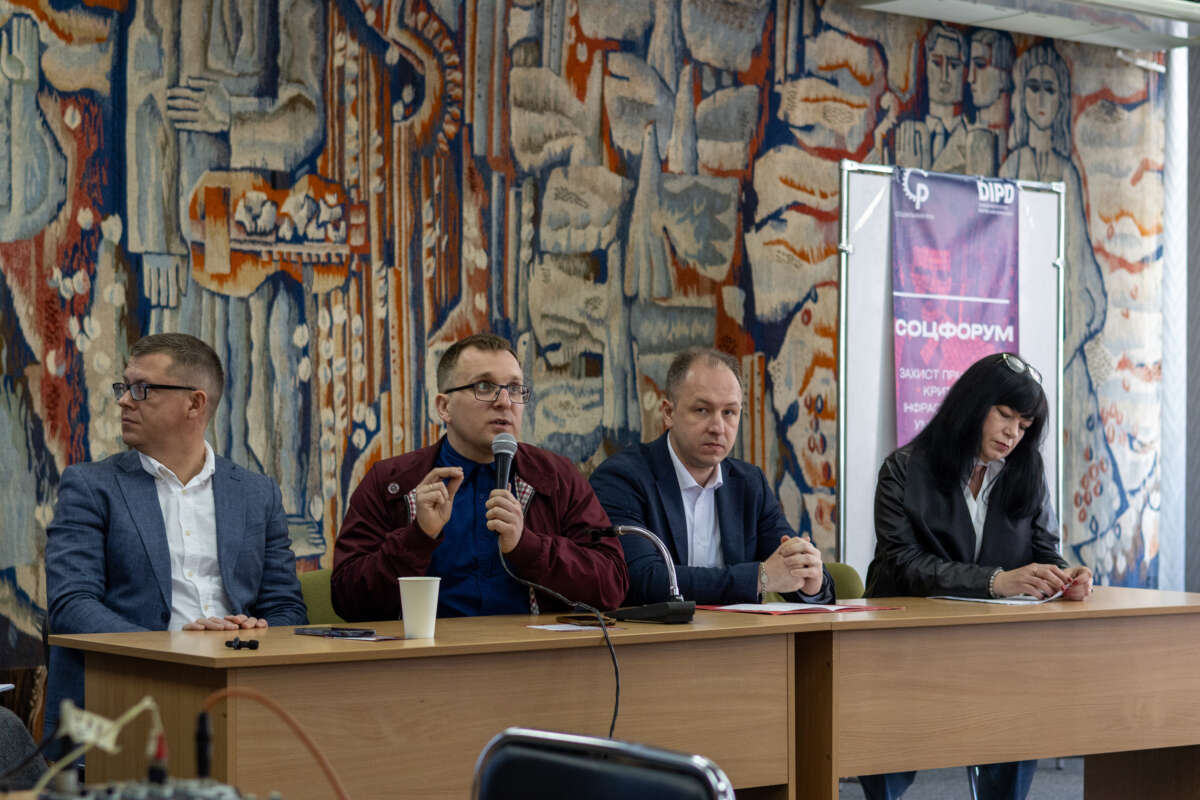
Vitaliy Dudin speaks at the April 27 conference, “Protection of Critical Infrastructure Workers in Wartime” hosted by Sotsialnyi Rukh.  Theia Chatelle

Visibly exhausted from his day at court, Dudin explained that this is the reality of leftist activism in Ukraine, post-Russian invasion. “Class struggle in Ukraine now, it’s so boring. It’s boring. Because it’s not about protest, it’s judicial and other official procedures.” Since February 24, 2022, Ukraine has been in a state of martial law which has permitted authorities to limit public gatherings and impose a standing curfew, among other restrictions. In many cases, these regulations have been weaponized against left-wing activists fighting for labor rights.

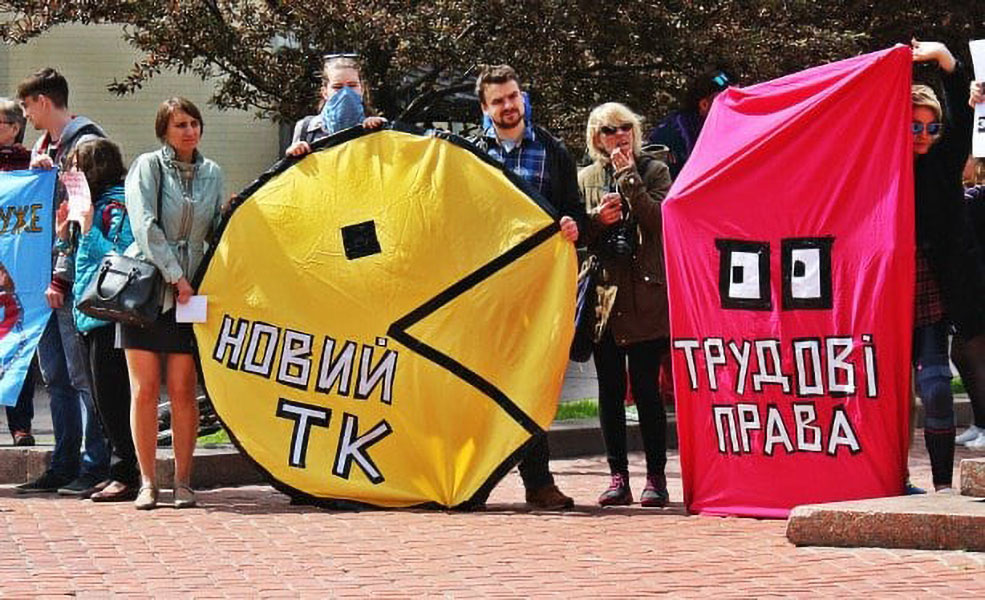
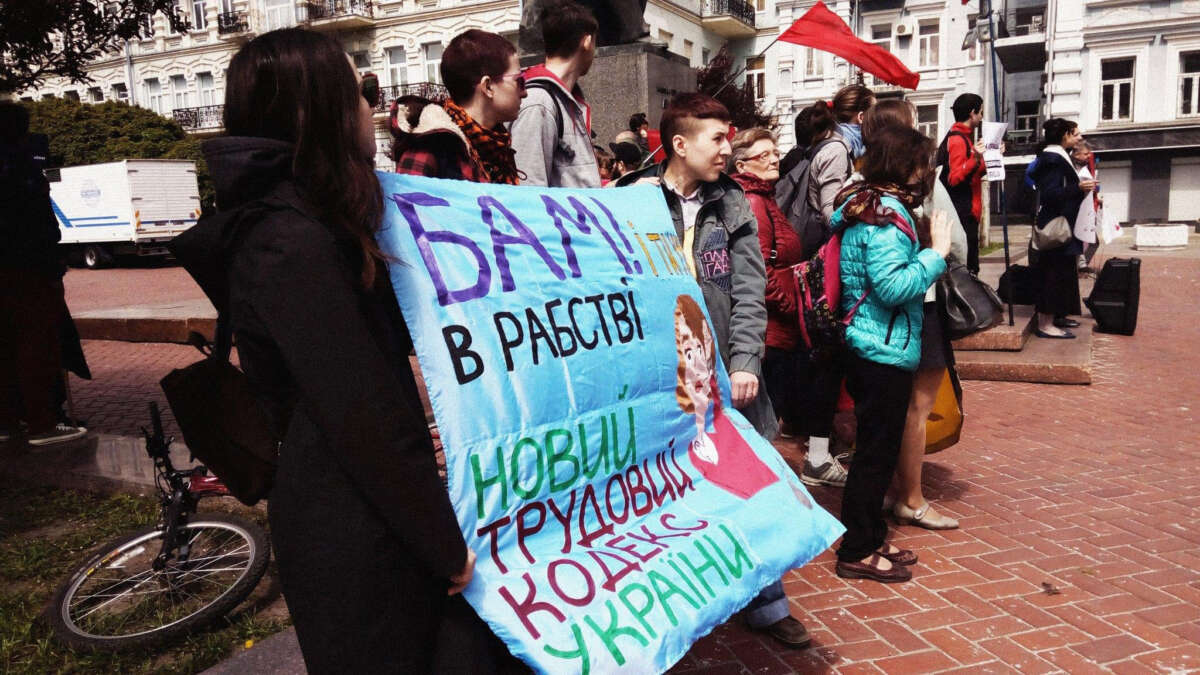
Sotsialnyi Rukh activists hold a poster decrying the implementation of the Amended Code of Labor Laws.Sotsialnyi Rukh

A law that passed parliament in March 2022 further cemented this erosion of labor rights. Among other changes, the law allows employers to fire employees who are on sick leave or vacation, expands working hours to 60 hours a week and requires employees to do work outside the terms of their contract if it is for defense purposes. All of this was justified by Russia’s invasion and the defense of the country. However, such alterations to longstanding labor policy have tipped the scale drastically in favor of employers, and there is to time limit to the law, so as Dudin emphasized, these alterations are meant to stay in effect even after the war. Ana Babić, 27, who is a student activist and member of a student trade union in Kyiv, told Truthout, “We have a problem now that the military can do basically anything. They can total a car, and there will be no consequences because they are the military. And what can you do?”

In the last week of April, Sotsialnyi Rukh hosted a conference on workplace injuries during the war. Since the start of Russia’s full-scale invasion, 2,747 workers have been injured and 677 killed while performing work-related duties according to the State Labour Service. “And a lot of them haven’t received the compensation from the state that was promised [in the collective bargaining agreement],” Dudin told Truthout. An MP of Zelenskyy’s Servant of the People party, Pavlo Frolov, was in attendance and said that his party can and should do more to support the rights of Ukrainian workers. The conference featured a wide array of attendees, from railway and other transportation workers who had been injured since Russia’s invasion to teenage activists espousing pro-labor politics. “To win a court proceeding together with the independent trade union of railway workers against the biggest railway company is possible. We did it. So in Ukraine, it’s still possible to challenge people who have money, who have power, and so on,” Dudin said during his speech at the conference.

Related Story

As Ukraine War Reaches Violent New Heights, US Boosts Weapons Production
Casualties on both sides have reached roughly 1 million as the US races to expand production of artillery shells.By Mike Ludwig , Truthout October 23, 2024


“In Ukraine, it’s still possible to challenge people who have money, who have power.”

While active since 2015, Sotsialnyi Rukh came to a newfound prominence in the first months of the war due to its support for LGBTQ+ rights, socialist politics and the right of the Ukrainian people to engage in armed struggle against the Russian invasion. Dudin said that the extent of the U.S.’s involvement in the war can and should be discussed, as well as the government’s neoliberal policies, but as long as Ukraine is an independent state, Ukraine has a right to defend itself in a war that has claimed the lives of at least 12,000 civilians (and perhaps as many as 70,000 Ukrainian soldiers and 260,000 Russian soldiers.) Some of the international left has repeated Putin’s line that Ukraine is rife with Nazi ideology — a pretext which was used by Russia to justify the invasion to “denazify Ukraine.” Babić says that right-wing populism and far right ideology is on the rise, but added, “We are at war. And in any war in any region, you will have a rise of right-wing extremism.” Sotsialnyi Rukh’s commitment to a left-wing politic that is inclusive of all gender identities and sexualities strives to be an antidote to this rise in reactionary politics. Only by offering Ukrainians a logical alternative to the nationalistic and xenophobic right-wing political parties can Sotsialnyi Rukh counter this shift, according to Babić.

The sign on the left reads “Amended Code of Labor Laws” and the sign on the right reads, “Workers Rights.”Sotsialnyi Rukh

“We unite about 100 people in different cities of Ukraine, and we are the only openly left-wing organization which promotes ideas of democratic socialism, of anti-fascism, of gender and social equality. And 10 people, maybe more than 10 people are now in the armed forces of Ukraine,” Dudin said.

Dudin emphasized that first and foremost Sotsialnyi Rukh is concerned with humanitarian efforts, including supporting soldiers on the front lines. Sotsialnyi Rukh not only allies with trade unions and provides pro bono support to workers in labor disputes, it also provides material assistance for soldiers fighting to maintain Ukraine’s territorial integrity. It also supports the efforts of other left-wing organizations in Ukraine, such as Solidarity Collectives, which frequently post fundraising drives for flak jackets and medical kits for soldiers.

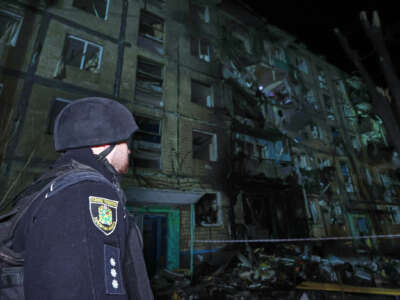
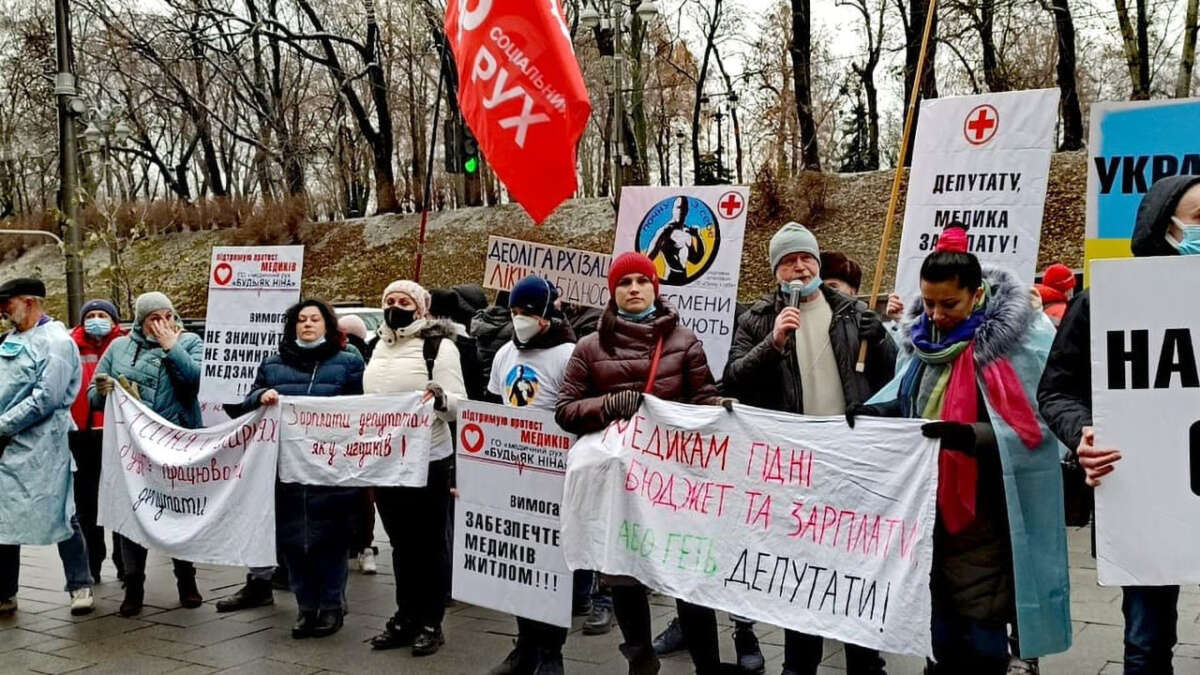
But every aspect of their work has grown more difficult as the war has entered its third year. “Now, organizing a protest is much more emotionally taxing. Why? Because you should prove that you have a right to go on the street because we have martial law and protests are banned, they’re prohibited. If you have a clear clash against central authorities, you should be prepared that this public rally can be stopped by the police,” Dudin stated matter-of-factly. During a Sotsialnyi Rukh demonstration at the Ministry of Health, demanding better compensation and protections for health care employees, the police blocked them from entering the facility and attempted to break up the demonstration

.
A Sotsialnyi Rukh demonstration in support of healthcare workers. Sotsialnyi Rukh

On the ground in Kyiv it is obvious that there is fatigue from the war, and with ceasefire negotiations between Kyiv and Moscow continuing with no end in sight, Sotsialnyi Rukh’s activists are digging in for the long haul. “I refuse to give any thought on when the war will end. I prefer to live as [if] the war always was and always will be. That way I can focus on humanitarian efforts,” Babić said.

This article is licensed under Creative Commons (CC BY-NC-ND 4.0), and you are free to share and republish under the terms of the license.


Theia Chatelle is a conflict correspondent based between Ramallah and New Haven. She has written for The Intercept, The Nation, The New Arab, etc. She is an alumnus of the International Women’s Media Foundation and the Rory Peck Trust.


'Targeted to break them': Federal workers despair — and report claims that was Trump's aim

Travis Gettys
May 20, 2025 
ALTERNET


Some federal employees have reported traumatic experiences since President Donald Trump slurred them as “crooked” and “dishonest" and Elon Musk's Department of Government Efficiency slashed their jobs from the payroll, according to a new report.

The federal government employed 2.4 million workers when Trump returned to office Jan. 20, but Trump and his chainsaw-wielding sidekick Musk have chopped off entire chunks of that workforce. More than 30 of those current and former employees told the Washington Post they have experienced insomnia, panic attacks and suicidal thoughts.

And that seems to be the cruel point of the budget cuts, the report stated.

“We want the bureaucrats to be traumatically affected," said Trump budget director Russell Vought in a 2023 recording. "When they wake up in the morning, we want them to not want to go to work because they are increasingly viewed as the villains ... We want to put them in trauma.”

That's exactly what has happened to many of the workers culled from the government by Trump and Musk as part of the budget cuts laid out in the Project 2025 blueprint that Vought helped write.

"Caitlin Cross-Barnet had struggled with depression, and now her husband, Mike, found her on their narrow, third-floor fire escape," the Post reported. "As he tried to coax her back in, she replied: 'It’s not high enough to jump.'"

"On the 26th day of Trump’s term, Richard Midgette, 28, was fired from his IT job at Yellowstone National Park," the report continued. "He drove to the only bridge in his town, stopping just past its edge. From the car, he listened to the rushing of the water and, for the first time, contemplated whether to end his life."

"On the 30th day of Trump’s term, Monique Lockett, 53, tried to block out the stress," the Post added. "The U.S. DOGE Service was demanding access to sensitive databases she worked on at the Social Security Administration. Her top boss had just been forced to resign, and rumors of layoffs were brewing. Monique settled into her cubicle just before 8 a.m. then slumped to the floor."

About a third of the 30 workers who spoke to the newspaper had been fired, while the rest feared layoffs or reassignments to offices hundreds of miles away, and mental health professionals in the Washington, D.C., area report a spike in federal workers seeking support since Trump entered the White House.

“To so many people, it feels targeted to injure and break them,” Rosalyn Beroza, a therapist in the D.C. suburbs. “With natural disasters, we have mental health workers helping people on scene. This one’s a man-made disaster, but it’s no less traumatizing.”

One employee at the National Institutes of Health, who worried for weeks that she'd lose her job, told the Post she had checked her government benefits to determine how much money her family would receive if she killed herself, and she and her husband have taken guns and some medications out of the house to limit those risks.

“Federal workers aren’t just numbers on a spreadsheet,” she said. “We’re real people with families who are hurting and, in the worst cases, dying. Why don’t people out there see that? Why doesn’t anyone care?”