The colonised university: Destruction of knowledge in Palestine, denial of coloniality in France
First published in French at Contretemps. Translation by Gwenaël Velge (with input from Insaf Rezagui) for Academics for Palestine WA.
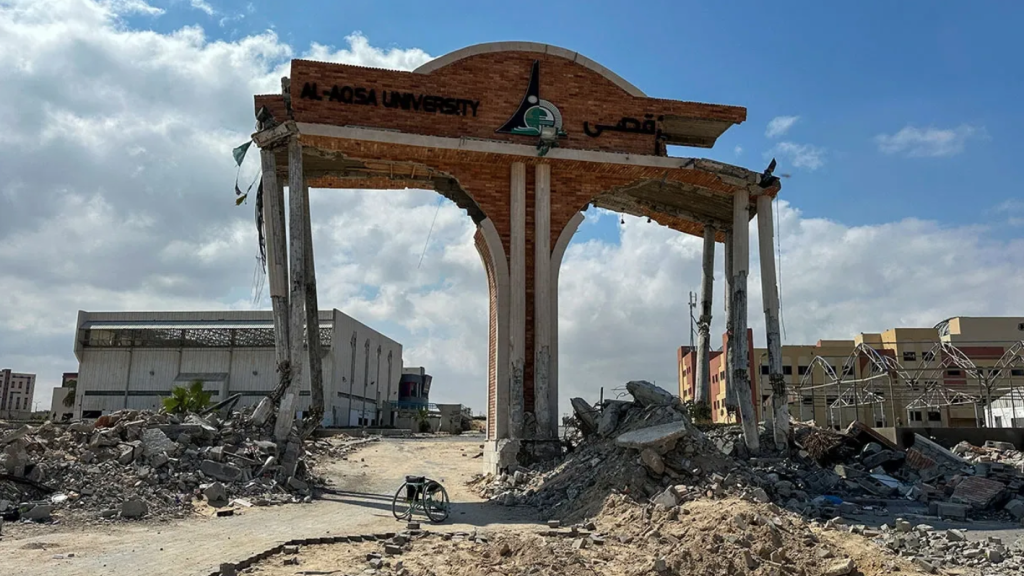
Since October 7, 2023, articles and reports documenting the systematic destruction of the education system in the Gaza Strip have multiplied. The terms scholasticide, educide, and epistemicide are now used to refer not only to the destruction of educational infrastructure, but also to the annihilation of the conditions for the emergence of autonomous Palestinian thought (Benraad 2024; Rabaia & Habash 2024; Saeed 2024; Dader, Ghantous, Masaad & Joronen 2024). The toll, still not final, is undeniable: thousands of pupils, students, and professors (including university presidents) have been killed, the universities in the Gaza Strip are entirely destroyed, to which are added hundreds of schools, and approximately 600,000 children who have been out of school for a year and a half.
From the outbreak of the war, the official Israeli narrative justified this systematic destruction of the education system — and that of healthcare, as was the case with Al-Shifa Hospital — by the alleged presence of Hamas military bases. This discourse was relayed without reservation by several Western media outlets. However, this justification strategy was quickly abandoned by the Israeli army, particularly after a soldier broadcast a video (Israeli Army 2024) documenting the destruction of the twelfth and last standing university in Gaza, Al-Israa University.
Occupied in December 2023, the University was taken over for 70 days, during which the Israeli army used the site as a military base and a centre for detention and interrogation. Before the building's destruction, more than 3,000 historical artefacts were confiscated from the University's museum. On January 17, 2024, the Israeli army carried out a controlled explosion of the main building, filmed and widely disseminated online. At this stage, it was no longer a matter of concealing or justifying the crime: we had entered the era of its banalisation. The world sees, legitimises the justifications, and in dominant discourses, even calls for a ceasefire are now equated with a form of apology for terrorism.
October 7 thus imposes itself as a moment of rupture. A new periodisation emerges, presenting Israeli actions as legitimate reactions, falling under the “right to self-defence.” However, this rupture, as constructed in the discourses of the spokespeople of the dominant order, is only apparent. It masks the continuity of a long history of epistemic erasure, material and symbolic dispossession of the Palestinian people, at the heart of the Israeli colonial project implemented for a century.
The Palestinian novelist and researcher Ghassan Kanafani, before being assassinated in Beirut by Israeli services in 1972, was already addressing the issue of “cultural siege” and the annihilation of Palestinian culture. What has truly changed is the intensification, normalisation, and banalisation of this colonial violence. As Ilan Pappé (2025) summarises, the “new Zionism” now strives to achieve, in a short time, what historical Zionism sought to accomplish over a long period.
After addressing this long-standing systematic destruction, I will return to the role of Israeli universities in the colonisation of reality and the denial of the Palestinian people, as well as the echo of this negation in the discourse of scholarly common sense in France.
The war against Palestinian knowledge and the colonisation of reality
The populated land of Palestine did not correspond to Zionism's founding slogan “a land without a people for a people without a land.” To transform this founding myth of the State of Israel (Pappé 2017), the first Zionists set about erasing the traces of this people and their history. Thanks to archives, historians describe the strategy of “organised transfer” of Palestinians in the 1930s (Masalha 1992) before the ethnic cleansing by military violence in 1948 (Pappé 2008). Archives, knowledge, personal photos, and books thus became targets to be annihilated.
During the 1948 Nakba, Israeli forces looted 30,000 books and manuscripts from the homes of Palestinians expelled from West Jerusalem, while the total number of books looted and stolen during this period is estimated at 70,000. They include the private collection of the renowned Palestinian educationist Khalil Al Sakakini (Saeed 2024).
This confiscation was accompanied by criminalisation related to the possession of books dealing with Palestine. During regular searches of Palestinian homes, possessing Palestinian works or other books on Palestine exposed their owners to violence, humiliation, and imprisonment.
The looting of cultural institutions and their documentary collections continued during the Israeli invasion of Beirut in 1982, with the ransacking of the Palestine Liberation Organisation (PLO) Research Centre and its Palestinian Cinema Institute. The erasure does not only concern the past; it extends to the present and the future. The invisible war against Palestinian knowledge and its production continues. What distinguishes Palestinian campuses are the “martyrs' monuments” installed in the centre of these places. These monuments are adorned with engravings bearing the names of students killed by the Israeli army, a silent testimony to the daily life of a student in Palestine. Cases where Israeli army special services invade these campuses to arrest students are numerous.
During my studies at Birzeit University in 1997-98, soldiers systematically asked for student cards, in addition to identity cards, at the checkpoints that fragment the West Bank. Being a student in Palestine immediately arouses soldiers' suspicion, humiliation, and arrest. It was to avoid this permanent control and the risk of suffering the same fate as my classmates that I had to abandon my studies at Birzeit to return to live at my home in Bethlehem.
Some fellow students, whom we called liberated prisoners, were ten years older than us due to periods of detention in Israeli prisons. Khader Adnan, whom we met once or twice a year on campus, spent the rest of the time in administrative detention (without trial). I was lucky enough to obtain my degrees in France, while he lost his life in Israeli prisons. Released in 2012 after leading a highly publicised hunger strike, he was arrested again and did not survive his last hunger strike. He died in prison in May 2023. His children are still waiting to receive his body to say goodbye — an imprisoned body — as is the case for hundreds of others.
This experience I lived through as a student was re-imposed on me as a professor in 2014. The number of martyrs inscribed on campus monuments continues to increase, and my students suffer the same fate as their professors. Structural constraints quickly affected foreign colleagues who used to teach in Palestine. Roger Heacock, a pillar of Birzeit University since the 1990s, is no longer allowed to stay in the West Bank. The Israeli authorities refused to renew his visa, and since then, he has been “expelled”, like dozens of other foreign colleagues who came to support Palestinian universities.
All of this concerns the so-called ‘normal’ and ‘peaceful’ times. This is the daily life of students and professors in Palestine. However, during the first Intifada in 1987, universities, as well as many schools, were entirely closed by military order. Students, not without risk, stayed with each other to be able to attend their classes. The second Intifada, in 2000, also revealed indescribable suffering for students and their professors, who were forced to struggle to get to universities. Palestinian cities turned into veritable cantonments, which could literally be locked. The risk of being killed, arrested, and assaulted during travel characterises the life of every student in Palestine.
The Palestinian university is thus directly targeted because of its essential role as a place for producing the representation of reality and the national narrative. A colonial power that relentlessly seeks to erase the traces of a people's existence, their memories, and their resistance deploys systematic violence against these spaces of knowledge, transforming them into privileged targets for the erasure of any form of a people's existence, its critical thinking, and its national and identity claims.
On the other hand, in addition to their contribution to the development of the military industry, surveillance technology, and intelligence techniques, Israeli universities play a fundamental role in producing the discourse justifying crimes. This consolidates the negation of the Palestinian people's existence and strives for the monopoly, even the colonisation, of reality. Israeli universities are not just places of knowledge, but active nodes in the military-academic system that supports and optimises colonisation, through cartography, urban planning, intelligence, and behavioural analysis.
The Israeli university proves to be a pillar of the colonial project, in which the erasure of the colonised is a fundamental mechanism. Maya Wind (2024) thoroughly deconstructs the role of the Israeli university in the Judaisation of Jerusalem, the Galilee, the Naqab (Negev), and the West Bank. She describes this process by confronting the official narrative of Israeli universities — Hebrew University, University of Haifa, Ben-Gurion University, Ariel University — with the realities on the ground (Wind 2024: 60-88). For example,
According to the Hebrew University’s official narrative, the campus at Givat Ram was built on 'a rocky deserted hilltop.' But, in fact, Givat Ram was built on the ruins of the Palestinian village of Sheikh Badr, whose residents were forced out of their homes by the Haganah paramilitary in 1948. The name Givat Ram' is in fact derived from the Hebrew acronym Rikuz Mefakdim (officers’ assembly), named for the military base established on the hill where Sheikh Badr once stood (Wind 2024: 63).
Then, it is through epistemic occupation (Wind 2024) that the Israeli university takes on the task of monopolising the narrative and justifying colonial crimes. This colonisation of reality through scholarly discourse goes as far as justifying crimes. The words of Benny Morris, professor emeritus at Ben-Gurion University, during an interview published in the newspaper Haaretz on January 9, 2004, are an example:
There are circumstances in history that justify ethnic cleansing… If [David Ben-Gurion] was already engaged in the expulsion, maybe he should have completed the job. I know that this stuns the Arabs and the liberals and the politically correct types. But my feeling is that this place would be quieter and know less suffering if the matter had been resolved once and for all. If Ben-Gurion had conducted a big expulsion and cleansed the entire country. All the land of Israel, to the Jordan River. (Wind 2024: 119).
For his part, the co-founder of the University of Haifa, Abba Hushi, emphasises the necessity for Jews to take charge of the educating methods of Arabs to avoid “raising snakes” (Wind 2024: 146).
The destruction of Palestinian universities is thus accompanied by the monopolisation of discourse taken on by Israeli universities. This process of colonising reality demonstrates not only that these institutions are closely linked to political power, but also that they constitute a central pillar in transforming the founding myths of the colonial state into legitimate and established truths. Despite this role, they continue to benefit from multiple partnerships and collaborations with Western universities — notably in France — made possible by political, media, and academic power structures.
Scholarly common sense in France and the colonial paradigm
The maintenance of the partnership between IEP (Sciences Po) Strasbourg and Reichman University in Israel, despite the unanimous recommendations of an internal review committee calling for its termination for ethical and legal reasons (AURDIP 2025), cannot be explained solely by external political pressure.
This decision resonates with an internal discourse within the French academic field, which can be described as scholarly common sense on Palestine. This discourse is characterised by a marked reluctance to question the colonial nature (colonialité) of the State of Israel, unlike Anglophone academic circles, where this issue is frequently raised in critical works (Séguin 2016).1 Deeply entrenched, this discourse nonetheless requires rigorous and ongoing scrutiny of its core tenets. The reactions to Didier Fassin's (2023a) article, The Spectre of Genocide in Gaza (published in AOC, November 1, 2023), aptly illustrate this point.
In their response to Fassin’s article, B. Karsenti, J. Ehrenfreund, J. Christ, J-P. Heurtin, L. Boltanski, and D. Trom (2023) begin by recalling what they consider to be self-evident: the sovereignty of the State of Israel, recognised by the adoption of Resolution 181 of the United Nations General Assembly on November 29, 1947. According to them, Israel is merely defending itself against an attack on its own territory. They thus reproach Fassin for “imputing to the victims the responsibility for the crime they suffered.”
It is astonishing that scholars adopt a “so-called legal argument” as if it were a scientific fact, without taking into account the geopolitical power relations and diplomatic pressures that weighed on the adoption of this resolution2 (Forrestal 1951; Pappé 2000). It is especially surprising — and this is no small thing for proponents of pragmatic approaches, who dedicate their work to emancipation and constantly praise the freedom of actors and their capacity for awareness — to overlook the lack of consultation with those primarily concerned, the Palestinians, and the demand made of the colonised to cede more than half of their territory to share it with their colonisers.
This 1947 resolution, often cited as a founding text, is nevertheless among the myths that Ilan Pappé (2017) deconstructs in his work on the founding of the State of Israel. Even more surprising, the authors of this response confuse the borders proposed within the framework of the UN resolution with those drawn by violence during the Nakba in 1948. A simple consultation of historical maps (L'histoire, 2023) is enough to highlight the wandering borders of the State of Israel.3
Fassin, far from having made a mistake, was warning about the plausibility of an ongoing and future genocide in Gaza. His analysis is now supported by numerous reports from civil society (Amnesty International 2024; ECCHR 2024) and the United Nations (Albanese, 2024), as well as by the positions taken by legal scholars:
Rarely in history has a high state official, in charge of military operations, so openly expressed an intention to destroy part of a human group. And never, to our knowledge, had such an intention been formulated so clearly as by the recent message from the Israeli Minister of Defence (Fernandez & de Frouville 2025).
Others go so far as to describe the situation as a “moral abyss” (Howse 2025). Fassin was neither a visionary nor a prophet; he merely analysed the mechanisms of colonial domination. This earned him the crossing of a line that the guardians of the academic field deem uncrossable. Yet, Maxime Rodinson (1967) had already defined Israel as a colonial fact, a European colonisation project. The paradigm of settler colonialism and of replacement is indeed indispensable for understanding the Palestinian reality.
Two main characteristics must be retained. The first is the expansionism specific to this colonialism, visible in the permanent conquest of space, what I call the “wandering borders”.4 The second lies in the erasure of the colonised, which translates into a confiscation of their time — past, present, future.5 These dynamics are perpetuated by violence, whatever its justification.
We are indeed in a colonial situation, as defined by G. Balandier (1955), with a genocidal dimension (Wolfe 2006), aiming to replace one ethnic group with another — in other words, settler colonialism and replacement. “Erasing Palestine to build Israel” (Pirinoli 2005) describes a colonial policy at work for a century, of which genocide is a fundamental principle.
Even the founders of Zionism, as Lena Salaymeh (2023) points out, conceived their project in colonial terms. Theodor Herzl wrote in The Jewish State (1896):
Should the Powers declare themselves willing to admit our sovereignty over a neutral piece of land, then the Society will enter into negotiations for the possession of this land. Here two territories come under consideration. Palestine and Argentine.
He suggested that the “colonisation” of these territories would be done by a “gradual infiltration of Jews” (cited in Salaymeh 2023). For his part, Vladimir Jabotinsky — an inspiration for Benjamin Netanyahu, who follows in the footsteps of his father, Jabotinsky's former personal secretary — stated in The Iron Wall (Jabotinsky 1923):
Zionist colonisation, even the most restricted, must either be terminated or carried out in defiance of the will of the native population. This colonisation can, therefore, continue and develop only under the protection of a force independent of the local population – an iron wall which the native population cannot break through. This is, in toto, our policy towards the Arabs. To formulate it any other way would be pure hypocrisy. (Salaymeh 2023)
The discourse of scholarly common sense in France, however, resists integrating this colonial paradigm, even though it constitutes the dominant analytical framework among Palestinian researchers (Seurat 2025). As Bourdieu said, “the dominated do not speak, they are spoken for and about.” The Palestinian, denied in the colonial narrative, is also denied in this scholarly discourse — including by one of the founders of pragmatic theory, meant to be centred on the consciousness of actors and the need to rely on their words to describe and understand the social order.
This discourse of apparent objectivity and false methodological neutrality contributes to maintaining a forced peace, which normalises injustice. The debate on agent and actor, which divided French sociology, seems to be sinking into what Bourdieu called the scholastic danger. The pragmatic theorist abandons his own analytical framework as soon as he is confronted with the bloody reality of Palestine.
In the debate sparked by Didier Fassin's article, he was criticised for comparing the situation in Gaza with the genocide of the Herero and Nama, committed by German colonial forces at the beginning of the 20th century in present-day Namibia. In his response (Fassin 2023b), the author clarifies that he is not making a comparativist argument, but is instead using a heuristic comparison (in Paul Veyne's sense), allowing “to use one case to shed light on the one being studied.” It is therefore not a matter of saying: “it's the same thing,” but rather: “we can learn from one to interpret the other.”
The debate sparked by Fassin's article indeed reveals the singular status that the name “Jew” has taken on, co-opted by the State of Israel, as Badiou (2005) demonstrates. For him,
Hitler exalted, over-multiplied, the name of the Jews. He made the Jew, incessantly named, an emblem — the black emblem of his policy of universal conquest. With the Nazis defeated, the name 'Jew' became, like any name of the victim of an appalling sacrifice, a sacred name (Badiou 2005: 24).
Cécile Winter, in an appendix to Badiou, concurs and specifies that as the State of Israel constructs itself as a colonising power in the Middle East, it becomes increasingly necessary to sacralise the term “Jew”. She emphasises that
to maintain the moral benefit of the destruction of European Jews, it has become necessary to attribute a capital letter to the term 'Jew,' making this signifier an absolute, timeless, and indisputable value (Winter in Badiou 2005: 115).6
Winter thus highlights how this sacralisation allows Israelis to obtain “the right to be bastards like everyone else.” But, as she adds,
it is claimed that Israelis, owners of the transcendental signifier, must be able to exercise their 'right' without there being a right to criticism (Winter 2005: 116).
Consequently, any comparison with other colonial or apartheid contexts is rejected in the name of this sacralisation surrounding the State of Israel. This is why Badiou asserts that
the State of Israel is the gravest threat that can weigh on the name of the Jews (...). [It] is the external form, of a colonial nature, that the sacralisation of the name of the Jews has taken (Badiou 2005: 25).
In this logic, it is not so much a researcher's own position as the effect of a system of institutional validation, which makes certain discourses acceptable — even legitimate and valued — in the French academic space. Any criticism of the State of Israel, even rigorously founded, is disqualified in the name of this sacralisation. The State of Israel, within this framework, escapes all moral and political questioning.
This dynamic constitutes a major obstacle to the emergence of a critical debate on the violence perpetrated in Gaza, and in Palestine in general, as well as on the legitimacy of Israeli actions, insofar as any criticism is interpreted as a symbolic transgression, a desecration of the sacred name of the “Jew,” and is therefore deemed unacceptable.
Thus, it is indeed E. Illouz (2024) who must be proven right — but in reverse to her intention — when she invokes the “moral and intellectual duty” in the choice of words: it is precisely this duty that authorises the qualifying of the situation in Palestine as a colonial situation, and to warn, as Fassin did, about the spectre of genocide.
Finally, in this context, it becomes crucial not only to document the destruction of Palestinian knowledge, but also to ask: what does it mean to continue producing critical scholarship from within institutions that remain complicit or silent in the face of this colonial enterprise? It is time to break with a doxa that, under the guise of knowledge and objectivity, continues to feed the world's misfortune.
A university in France deprived of all autonomy — particularly epistemological — cannot contribute anything to the university in Palestine, nor can it claim to contribute to a solidly founded scholarly discourse. This autonomy is threatened today, particularly by legislative proposals such as the one relating to the fight against antisemitism in higher education (Senate 2024), which tend to confuse antisemitism and anti-Zionism, and seek to criminalise any criticism of the State of Israel.
The real task incumbent upon us is to make the fight against antisemitism a lever for solidarity with the Palestinians, rather than an instrument of their delegitimisation. This would make it possible to unify individual efforts, currently dispersed but multiplied since October 7, by crystallising them — to use Durkheim's language — in order to mark a profound and institutionalised mutation in the face of the discourse of scholarly common sense.
It is up to researchers, teachers, editorial committees, and heads of academic institutions to restore the university's critical function. Rather than systematically dismissing articles mobilising the colonial paradigm to analyse Palestine, or euphemising the statements of critical researchers, it is urgent to open an in-depth debate within the French university on the founding myths of scholarly common sense relating to Palestine. This also presupposes questioning the sacralisation of the legitimacy of the State of Israel, particularly when it serves to justify, in the name of “legitimate self-defence,” policies aimed at the annihilation of the Palestinian people.7
Bibliography
Albanese, Francesca 2024: L’effacement colonial par le génocide. Rapport de la Rapporteuse spéciale sur la situation des droits de l’homme dans les territoires palestiniens occupés depuis 1967, Organisation des Nations unies, Conseil des droits de l’homme.
Amnesty International, 2024: “You Feel Like You Are Subhuman’: Israel’s Genocide Against Palestinians in Gaza”, Amnesty International, 5 décembre 2024.
Armée Israélienne, 2024: “Gaza University destroyed: Israel accused of targeting education centers” [Video]. YouTube, Al Jazeera English.
AURDIP, 2024: “IEP Strasbourg : un partenariat contre l’éthique validé par procuration”, AURDIP, 3 avril 2024.
Badiou, Alain, 2005: Circonstances 3 : Portées du mot “juif", Paris : Léo Scheer.
Balandier Georges, 1955: Sociologie actuelle de l’Afrique noire : Dynamique des changements sociaux en Afrique centrale. Paris : Presses Universitaires de France.
Benraad, Myriam, 2024: “Scholasticide, éducide, épistimicide : la guerre d’Israël à Gaza, une ‘vengeance contre le savoir’”. Confluences Méditerranée, vol. 131, p. 27-36.
Bourdieu, Pierre, 2003 [1997]. Médiations pascaliennes. Paris : Éditions du Seuil.
Dader Khalid, Ghantous Wassim, Masad Danna, & Joronen Mikko, 2024: “Topologies of scholasticide in Gaza: education in spaces of elimination”. Fennia: International Journal of Geography, vol. 202, n° 1, p. 1-12.
European Center for Constitutional and Human Rights (ECCHR), 2024: “Universal Jurisdiction Annual Review 2024”, Berlin : ECCHR.
Fassin, Didier, 2023a: “Le spectre d’un génocide à Gaza”, AOC Media, 31 octobre 2023,
Fassin, Didier, 2023b: “Génocide à Gaza ? Didier Fassin répond à Eva Illouz”, Philosophie Magazine, 28 novembre 2023.
Fernandez Julian, & De Frouville, Olivier, 2025: “Les déclarations du ministre israélien de la défense sont l’expression transparente d’une intention génocidaire à Gaza”, Le Monde, 11 avril
Forrestal, James, 1951: The Forrestal Diaries, New York : Viking Press.
Howse, Rob, 2025: “No Legal Term – Even Genocide – Can Fathom Israel’s Atrocities in Gaza”, Novara Media, 2 janvier.
Illouz Eva 2024: “Génocide à Gaza ? Eva Illouz répond à Didier Fassin”, Philosophie Magazine, 29 février.
Jabotinsky, Vladimir, 1923: “Le Mur de fer”, Rassvyet 4 novembre 1923.
L’histoire, 2023: “Israël : évolution des frontières, du partage de l’ONU aux accords d’Oslo (1947-1993)”, L’Histoire [en ligne], Portfolio, 28 novembre.
Masalha, Nur, 1992: Expulsion of the Palestinians: The Concept of “Transfer” in Zionist Political Thought, 1882-1948. Washington, DC : Institute for Palestinian Studies.
Pappé, Ilan, 2000: La guerre de 1948 en Palestine, Paris : La Fabrique.
Pappé, Ilan, 2008: Le nettoyage ethnique de la Palestine. Paris : Fayard.
Pappé, Ilan, 2017: Ten Myths About Israel. Londres & New York : Verso Books.
Pappé, Ilan, 2025: “Israeli historian Ilan Pappé: ‘This is the last phase of Zionism’”, Al Jazeera, 14 janvier 2025.
Pirinoli, Christine, 2005: “Effacer la Palestine pour construire Israël : Transformation du paysage et enracinement des identités nationales”, Études rurales, n° 173-174, p. 67-85.
Rabaia, Ibrahim, & Habash, Lourdes, 2024: Destruction of Higher education (educide) in the Gaza Strip: Assessment and support mechanisms”, Institut français du Proche-Orient.
Rodinson, Maxime, 1967: “Israël, un fait colonial”, Les Temps Modernes, vol. 21, n° 215, p. 1691-1708.
Saeed, Samara, 2024: “Scholasticide in Gaza”, CCAS Newsmagazine, 30 mai.
Salaymeh, Lena 2023: “Demystifying the neo-colonialism of international law”, Critical Legal Thinking, 19 décembre 2023.
Sbeih, Sheih, 2018: “Le temps du développement en Palestine : rationalisation économique dans un espace confisqué”, Temporalités, n° 27, juillet 2018.
Séguin, Michaël, 2016: “Conceptualiser la colonialité d’Israël : retour sur la trajectoire d’une analyse polémique”, Cahiers d’histoire. Revue d’histoire critique, vol. 131, p. 135-154.
Seura, Leïla, 2025: “Palestine. La recherche au défi du discours colonial”, Orient XXI, 14 janvier 2025.
Wind, Maya, 2024: Towers of Ivory and Steel: How Israeli Universities Deny Palestinian Freedom. Londres & New York : Verso.
Wolfe, Patrick, 2006: “Settler colonialism and the elimination of the native”, Journal of Genocide Research, vol. 8, n° 4, p. 387-409.
- 1
Translator’s note: the contrast is presumably in part due to the settler colonial nature of much of the Anglophone world (e.g. the United States of America, Canada, Australia, New Zealand, etc).
- 2
Of the 57 UN member states in 1947, 56 participated in the vote on Resolution 181 at the General Assembly, and only 33 voted in favour. A majority of these states were still colonial powers. The Truman administration considered support for the partition plan a strategic priority. The United States exerted significant diplomatic and financial pressure on several countries, notably the Philippines, Liberia, Haiti, Greece, and Ethiopia, and promised substantial aid to all Latin American states to ensure their favourable vote.
- 3
Translator’s note: Sbeih Sbeih uses the term “frontières errantes” for ‘wandering borders’. There is reason to pause. The English term ‘erring’ would work here too but with a slightly altered meaning: to fail to adhere to the proper or accepted standard; having done wrong. The Latin root is ‘errare’, which indeed means to wander, to roam and to stray, but it also means to make a mistake, to be in error, to go wrong. Both meanings can easily be interpreted physically but also morally and intellectually. To add to this, there can also be a causal (and moral) link between the ‘wandering’ and the ‘erring’. Indeed, I am reminded of the Israelites condemned by divine decree to ’wander’ in the desert for 40 years following their ‘error’ (lack of faith). In psychological terms, the causality could be reversed: the anxiety/trauma caused by the wandering (displacement) could lead a people to err (again, physically, intellectually, and morally) if it is not careful. These questions are central to ongoing debates in religious Judaism as well as in both the Israeli and Palestinian societies at large. This intrication is then reflected in the wandering/erring of the borders through which a people seeks to assert its identity (or even mere existence) – borders which were originally thought to restrict the risk/possibility for straying or erring.
- 4
The borders proposed in 1947 as part of the UN partition plan were reduced by mass military violence and ethnic cleansing in 1948. The city of Gaza was transformed into an encircled "strip" and became a refugee camp after the Nakba. This was followed by the 1967 war, which once again redrew the borders. The West Bank was fragmented by the Oslo Accords into Areas A, B, and C, a categorisation that became obsolete with the outbreak of the second Intifada in 2000, when the Israeli army began to invade all Palestinian territories. Even today, these borders continue to be modified according to the ongoing war against the Gaza Strip, military operations, as well as the relentless colonisation in the West Bank.
- 5
The confiscation of Palestinians' time (past, present, future) (Sbeih, 2018) occurs through the erasure of their history, their placement in a permanent state of waiting under threat and uncertainty – notably through the multiplication of checkpoints, sieges, and the transformation of refugee camps into permanent places of residence – and finally, by depriving them of any capacity to project themselves into the future. If, according to P. Bourdieu (2003 [1997]: 328), imposing waiting is a prime way of asserting power, the confiscation of time here is part of a will to assert colonial superiority.
- 6
Translator’s note: in French, the rules for capitalising words referring to nationalities or religious groups are as follows:
- Lowercase j for juif (adjective or common noun for a religious adherent): when used as an adjective: un homme juif (a Jewish man), la religion juive (the Jewish religion). Or, when referring to an individual as an adherent of the religion (as a common noun): Il est juif. (He is Jewish/a Jew.)
- Uppercase J for Juif (noun referring to the people/ethnic group): When referring to the Jewish people as a collective or ethnic group: les Juifs de France (the Jews of France), l'histoire des Juifs (the history of the Jewish people).
Winter's point is precisely that the capitalisation of "Juif" (with a capital 'J') became a deliberate act to sacralise the term, to give it a special, absolute status in the post-Holocaust context, particularly in relation to the State of Israel. I stick here to the common English use of the capital letter to avoid confusion.
I will note however that in English, we lowercase antisemitism, whereas we uppercase anti-Zionism. This is both tied to the general rules of English grammar (i.e. proper nouns and adjectives derived from them are capitalised), but it is also inherently a political choice (as are grammatical rules themselves for that matter), albeit not always a conscious one. For example, antisemitism (lower case) is a conscious attempt to counter the legitimisation of the racial category ‘Semite’, which was used in the 19th Century racial (and racist) theories. Antisemites co-opted the (pseudo) science and spelt it ‘anti-Semitism’ to give ‘scientific’ legitimacy to their (unfounded) hatred.
- 7
Translator’s note: I here use the term ‘legitimate self-defence’ to keep some of the meaning carried by the French ‘légitime défense’, which translates to ‘self-defense’ in English. I do this because it is obvious but not explicit in the English language that ‘self-defence’ is inherently legitimated – morally and legally.
Further, in French, self-defence courses are talked about as ‘cours de self-défense’, not as ‘cours de légitime défense’, highlighting the legal and moral argument captured by the term ‘légitime défense’ rather than the action itself which precludes us from examining the specifics of the ‘response’: e.g. its reasonableness and proportionality, in contradistinction to its excessiveness and indiscriminateness. Incidentally however, the Israeli Krav Maga is one of the most popular ‘cours de self-défense’, showing that even there the Israeli Army discourse is pervasive.