December 15, 2025
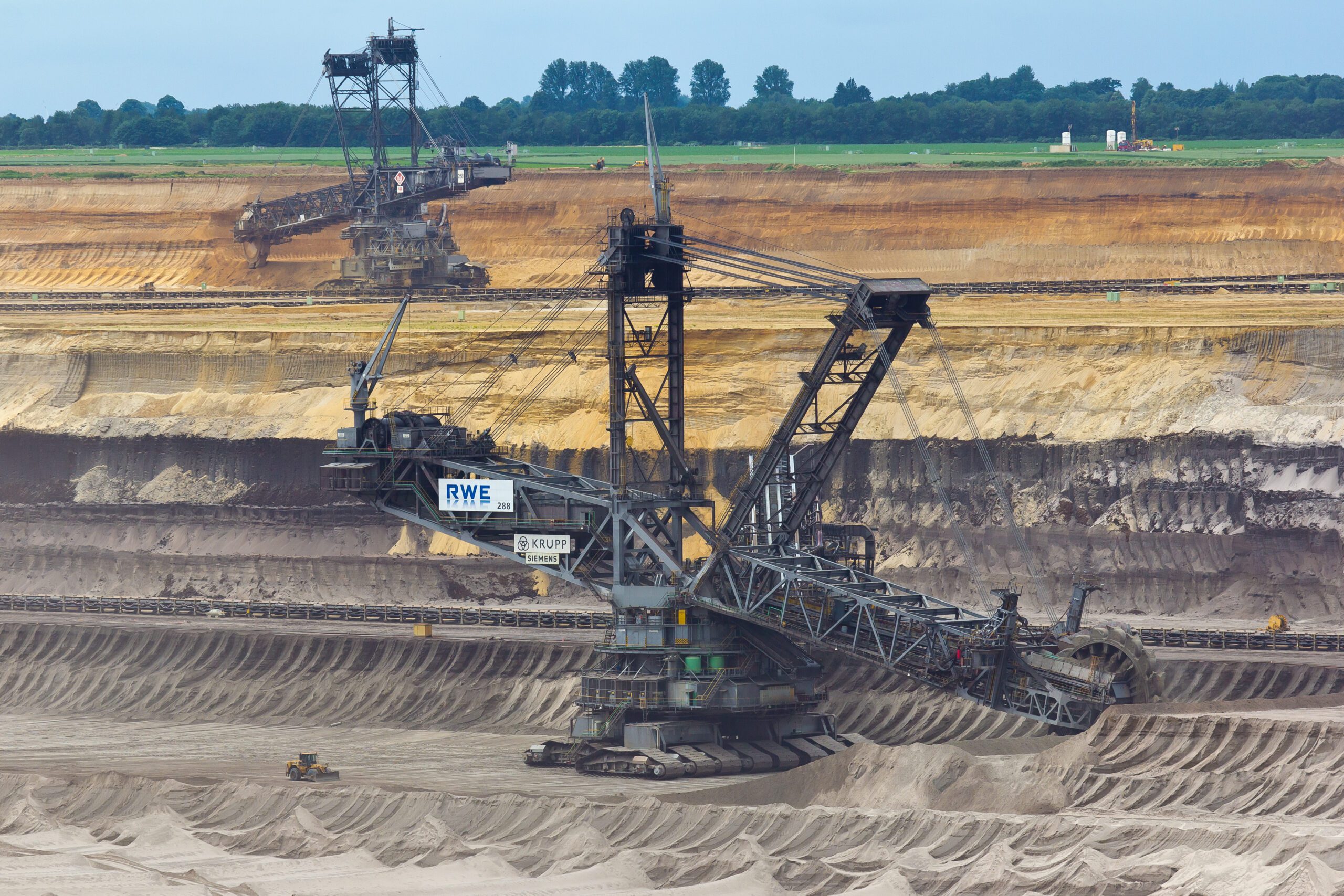
Garzweiler Tagebau
The recent confirmation that 43 million tons of Lithium Carbonate Equivalent (LCE) lie beneath the Altmark region in Germany’s state of Saxony Anhalt sparked a wave of enthusiasm about the prospect of German and EU resource independence, especially from China. Lithium is a critical component in lithium-ion batteries used, for instance, in electric vehicles (EVs). It is therefore crucial for reaching the transport-related 90 percent emissions reductions by 2050 anchored in the European Green Deal.
China together with Australia and Chile – part of the “lithium triangle” in South America with Argentina and Bolivia – account for over 90 percent of global lithium mining. The EU imports 81 percent of raw lithium and 100 percent of processed lithium, making it highly dependent on external sources and supply chains. The lithium find in Germany is considered one of the largest worldwide but will it be the holy grail that allows the EU to de-risk and re-balance its trade relations with China? Two caveats need to be considered.
The recent confirmation that 43 million tons of Lithium Carbonate Equivalent (LCE) lie beneath the Altmark region in Germany’s state of Saxony Anhalt sparked a wave of enthusiasm about the prospect of German and EU resource independence, especially from China. Lithium is a critical component in lithium-ion batteries used, for instance, in electric vehicles (EVs). It is therefore crucial for reaching the transport-related 90 percent emissions reductions by 2050 anchored in the European Green Deal.
China together with Australia and Chile – part of the “lithium triangle” in South America with Argentina and Bolivia – account for over 90 percent of global lithium mining. The EU imports 81 percent of raw lithium and 100 percent of processed lithium, making it highly dependent on external sources and supply chains. The lithium find in Germany is considered one of the largest worldwide but will it be the holy grail that allows the EU to de-risk and re-balance its trade relations with China? Two caveats need to be considered.
Economic and Technical Feasibility
First, there is a difference between lithium resources and reserves. While the first are the overall amounts of deposits in the ground, mineable or not, the reserves are the actual amounts that are extractable with the available technology and in an economically viable way. The British company Neptune Energy, which announced the latest assessment of the lithium potential in Germany, has described the 43 million tons as a “potential resource”, not reserves. Accordingly, experts caution about the lack of evidence that these will be extractable and promise economic gains.
Whether the generated lithium carbonate would be cheap enough for the German EV industry to be competitive against China is still an open question. Expert Michael Schmidt from the German Mineral Resources Agency outlined that production costs in Europe are significantly higher because of higher wages, stricter environmental regulations, and longer licensing processes.
Furthermore, global lithium prices might fall given the current trend towards more lithium extraction. A 2024 report by IRENA (International Renewable Energy Agency) highlights that current supply capacity of processed lithium will likely meet demand up to 2030; and afterwards, battery recycling, battery size reduction, and potentially increased use of sodium-ion batteries might ease demand for lithium.
These factors combined might limit an economically beneficial extraction in the Altmark and thereby greater independence from China. Higher production costs would lower profit margins, making it harder to compete with imports from China or other lower-cost producers. Future global supply and demand trajectories risk further reducing revenues, and thereby potential return on investment. Germany faces a limited window in which global demand is strong enough to justify large investments – but this window might be too limited if commercial production in the Altmark only kicks off at scale from 2029 onwards, as planned by Neptune Energy.
Supply Chain Independence
Second, resource extraction does not equal supply chain independence. Much of the euphoria about Germany’s lithium resources is about independence from other suppliers. As Neptune Energy highlights: “our project contributes directly to the goals of the German government’s raw materials strategy, which calls for a strengthening of domestic raw materials security and extraction.” Especially after China restricted rare earths exports to the US this year, which also hit the EU, Germany experienced a “rare earths shock”. Hence, the overall purpose of the strategy is to improve the competitiveness of German industry and reduce dependencies on China.
However, as Elaine Dezenski (Foundation for Defense of Democracies) pointed out, having the raw material is good news but the big question is how and where the lithium will be processed to make it useable in EV batteries. With the EU importing 100 percent of processed lithium, it is still dependent on China’s dominance in the lithium refining part of the supply chain. Moreover, the actual manufacturing of cells and batteries is another part of the supply chain where China is concentrating manufacturing in its own borders. This also includes other materials needed for battery cell production, such as graphite, copper, nickel, cobalt, and manganese. Hence, even though China is not the dominant exporter of lithium as a raw material, it is a critical node in the midstream and downstream supply chain for lithium-ion batteries and EVs: over 50 percent of the global final EV production takes place in China.
The Potential
Still, there is potential for the German lithium find to influence the balance in the battery and EV supply chain between the EU and China. It opened a window of opportunity for Germany to invest heavily in the needed infrastructure for lithium processing and to integrate this infrastructure with the battery cell production industry as well as with EV manufacturing. Different lithium extraction techniques influence where the lithium can be processed. Lithium extracted from rock can be shipped to other countries for processing. For instance, 99 percent of Australia’s lithium is processed in China. Lithium extracted from brine with DLE technology – as planned in Germany’s Altmark – allows for integrated extraction and refining processes that can be done in situ. This requires investments in the technology, research and development, and infrastructure.
In the federal state of Hesse, Vulcan Energy is already building a conversion plant for turning the raw material into battery-grade lithium. Hesse’s Minister of Economic Affairs, Kaweh Mansoori (SPD), signaled political support: “with this technology, we are setting a milestone for more independence, sustainability, and competitiveness in battery cell production”. In Saxony Anhalt, the Minister of Economic Affairs, Sven Schulze (CDU), acknowledges the potential of the Bundesland regarding its raw materials – and a historically already developed extraction industry. But he also cautioned that “there won’t be lithium mining in the Altmark from tomorrow on” because there are many questions still unanswered, especially environmental and economic ones.
Regarding battery and EV production, Germany-based cell production capacity (Northvolt, PowerCo (Volkswagen), ACC, Cellforce Group (Porsche)) is currently either planned or under construction – here again, the one big player already operating in Germany is Chinese company CATL. However, BMW owns a stake in CATL and has a battery cell order of the magnitude of €7.3 billion from the manufacturer until 2030. Tesla promised to build the “world’s largest” battery cell factory in Brandeburg; now put on hold due to tax breaks for shifting production to North America under the US Inflation Reduction Act. Volkswagen is starting to produce cells this year at its Lower Saxony EV engine plant to develop the required integration capacity.
The EV car-making ecosystem is evolving fast. The German lithium find could mean reliable local raw material provision for European battery manufacturers, thereby reducing dependence on other suppliers – though China is not the biggest one here. In this sense, it is less about possessing the raw material but more about how and where it gets processed to battery-grade lithium, where the batteries components are made, assembled to cells and the final battery product, as well as integrated into EV engines.
Headwinds in the battery industry in Germany could also be countered by diversifying within Europe, for instance, by processing German-mined lithium in France (conversion and refinery plants are planned by Imerys), and importing more battery cells from intra-EU suppliers like Slovakia, Poland and Hungary. The latter are logistically well-placed and gaining traction due to fast-developing production bases. LG Energy Poland has the EU’s largest cell production facility, while SK Innovation Hungary is expanding its capacity to supply VW and BMW. In Slovakia, a large-scale EV battery production facility is currently built – though majority-owned by Chinese company Gotion High-Tech.
A Gamechanger?
Germany’s lithium discovery has certainly increased hopes for altering Europe’s strategic vulnerabilities, but it does not fundamentally change the EU’s dependencies on China in the near term. Germany’s lithium offers a more sustainable raw material supply within Europe, very much in line with the objectives of the EU’s Critical Raw Materials Act. Yet the true geoeconomic bottleneck vis-à-vis China lies not in the availability of raw lithium, but in China’s long-standing dominance of midstream and downstream segments in refinement, battery, and EV manufacturing.
Germany’s 2024 battery imports had a value of US$9.41 billion (€8.14 billion), of which the largest share – almost 37 percent – was imported from China. Reducing this amount would already make a dent in the current €305.8 billion EU trade deficit with China. But Germany and Europe are on a tight schedule and need to deliver fast if they want to be competitive against China. Unless Europe rapidly builds competitive refining capacity, scales up battery production, and secures alternative supplies of graphite and other raw materials, the Altmark find will do little to erode China’s central position in global battery supply chains. In other words, lithium in the ground will not automatically translate into strategic autonomy. The German lithium should therefore be viewed less as a “geoeconomic gamechanger” but more as a strategic opening for a rapid and aggressive value chain development in Europe.
Written by

Kim Vender
Dr Kim Vender is an Affiliated Researcher at the Centre for EU-Asia Connectivity (CEAC) at Ruhr University Bochum, Germany. Her research interests encompass the complexities of climate change and biodiversity governance, climate finance (especially Loss and Damage), development cooperation, the concept of international leadership, and China’s engagement with the EU and Latin America. Kim holds a PhD in Politics and International Relations from the University of Edinburgh, an MA in East Asian Politics from Ruhr University Bochum, and a BA in China Studies from the Free University of Berlin. She recently published her book "China and Climate Leadership: A Role Theory Analysis" with Routledge.

No comments:
Post a Comment