SPACE/COSMOS
Scientists have for the first time mapped the 3D structure of an exoplanet’s atmosphere, uncovering violent winds and bizarre weather patterns.
byTibi Puiu
December 14, 2025
ZME
Edited and reviewed by Zoe Gordon

December 14, 2025
ZME
Edited and reviewed by Zoe Gordon

Illustration of Tylos’ extreme atmosphere.
Credit: ZME Science/Midjourney AI.
Image an alien planet where savage winds rip through the atmosphere carrying molten iron and titanium particles. Such a planet actually exists. Known as WASP-121b, this exoplanet is located 900 light-years away in the constellation Puppis. Using the European Southern Observatory’s Very Large Telescope (VLT) in Chile, astronomers have mapped the 3D structure of the atmosphere of WASP-121b, marking the first study of the atmosphere of an exoplanet in such depth and detail.
It’s one of the wildest exoplanets astronomers have ever encountered.
“This planet’s atmosphere behaves in ways that challenge our understanding of how weather works — not just on Earth, but on all planets,” says Julia Victoria Seidel, a researcher at the European Southern Observatory (ESO) and lead author of the study. “It feels like something out of science fiction.”
Image an alien planet where savage winds rip through the atmosphere carrying molten iron and titanium particles. Such a planet actually exists. Known as WASP-121b, this exoplanet is located 900 light-years away in the constellation Puppis. Using the European Southern Observatory’s Very Large Telescope (VLT) in Chile, astronomers have mapped the 3D structure of the atmosphere of WASP-121b, marking the first study of the atmosphere of an exoplanet in such depth and detail.
It’s one of the wildest exoplanets astronomers have ever encountered.
“This planet’s atmosphere behaves in ways that challenge our understanding of how weather works — not just on Earth, but on all planets,” says Julia Victoria Seidel, a researcher at the European Southern Observatory (ESO) and lead author of the study. “It feels like something out of science fiction.”
A World of Extremes
WASP-121b, also known as Tylos, is an ultra-hot Jupiter, a gas giant that orbits its host star so closely that a year there lasts just 30 Earth hours. The planet is tidally locked, meaning one side perpetually faces the star, reaching scorching temperatures of up to 2,500°C — hot enough to vaporize metals like iron. The other side, shrouded in eternal night, is significantly cooler. This extreme temperature difference drives a chaotic and violent atmosphere.

Artist’s rendering of the exoplanet WASP-121b. It shows only a portion of the exoplanet, showcasing the three layers of its atmosphere with more detail. Credit: ESO/M. Kornmesser
By combining the light from all four telescope units of the VLT, the team used the ESPRESSO instrument to observe Tylos during a full transit across its star. This allowed them to probe the planet’s atmosphere in unprecedented detail, detecting the signatures of iron, sodium, hydrogen, and even titanium. These elements acted as tracers, enabling the researchers to map winds across three distinct layers of the atmosphere, with iron winds at the bottom, followed by a very fast jet stream of sodium, and finally an upper layer of hydrogen winds.
“What we found was surprising: a jet stream rotates material around the planet’s equator, while a separate flow at lower levels of the atmosphere moves gas from the hot side to the cooler side,” says Seidel. “This kind of climate has never been seen before on any planet.”
The jet stream, which spans half the planet, reaches speeds of up to 70,000 kilometers per hour — nearly double the speed of the fastest winds previously recorded on an exoplanet earlier this year. “Even the strongest hurricanes in the solar system seem calm in comparison,” Seidel adds.
“It’s truly mind-blowing that we’re able to study details like the chemical makeup and weather patterns of a planet at such a vast distance,” says Bibiana Prinoth, a PhD student at Lund University and ESO, who led a companion study published in Astronomy & Astrophysics. “This experience makes me feel like we’re on the verge of uncovering incredible things we can only dream about now.”
Tylos is obviously not your typical exoplanet. But it’s so bizarre and strange that it’s defying what astronomers thought they knew about planetary formation. Unlike the atmospheres of planets in our solar system, where jet streams are typically driven by internal temperature differences, Tylos’s jet stream appears to be influenced by its star’s intense heat and possibly its magnetic field. “What we see now is actually exactly the inverse of what comes out of theory,” says Seidel.
It’s a strange world, indeed — and many more like it likely lie beyond our solar system. While the VLT has proven capable of studying the atmospheres of hot Jupiters like Tylos, smaller, Earth-like planets remain out of reach — for now. The construction of next-generation telescopes, such as ESO’s Extremely Large Telescope (ELT) in Chile’s Atacama Desert, promises to bridge this gap. Best of all, with its advanced instruments, the ELT will be able to probe the atmospheres of rocky exoplanets, potentially uncovering signs of habitability or even life.
“The ELT will be a game-changer for studying exoplanet atmospheres,” says Prinoth. “This is just the beginning of what we can achieve.”
The findings appeared in the journal Nature.
By combining the light from all four telescope units of the VLT, the team used the ESPRESSO instrument to observe Tylos during a full transit across its star. This allowed them to probe the planet’s atmosphere in unprecedented detail, detecting the signatures of iron, sodium, hydrogen, and even titanium. These elements acted as tracers, enabling the researchers to map winds across three distinct layers of the atmosphere, with iron winds at the bottom, followed by a very fast jet stream of sodium, and finally an upper layer of hydrogen winds.
“What we found was surprising: a jet stream rotates material around the planet’s equator, while a separate flow at lower levels of the atmosphere moves gas from the hot side to the cooler side,” says Seidel. “This kind of climate has never been seen before on any planet.”
The jet stream, which spans half the planet, reaches speeds of up to 70,000 kilometers per hour — nearly double the speed of the fastest winds previously recorded on an exoplanet earlier this year. “Even the strongest hurricanes in the solar system seem calm in comparison,” Seidel adds.
“It’s truly mind-blowing that we’re able to study details like the chemical makeup and weather patterns of a planet at such a vast distance,” says Bibiana Prinoth, a PhD student at Lund University and ESO, who led a companion study published in Astronomy & Astrophysics. “This experience makes me feel like we’re on the verge of uncovering incredible things we can only dream about now.”
Tylos is obviously not your typical exoplanet. But it’s so bizarre and strange that it’s defying what astronomers thought they knew about planetary formation. Unlike the atmospheres of planets in our solar system, where jet streams are typically driven by internal temperature differences, Tylos’s jet stream appears to be influenced by its star’s intense heat and possibly its magnetic field. “What we see now is actually exactly the inverse of what comes out of theory,” says Seidel.
It’s a strange world, indeed — and many more like it likely lie beyond our solar system. While the VLT has proven capable of studying the atmospheres of hot Jupiters like Tylos, smaller, Earth-like planets remain out of reach — for now. The construction of next-generation telescopes, such as ESO’s Extremely Large Telescope (ELT) in Chile’s Atacama Desert, promises to bridge this gap. Best of all, with its advanced instruments, the ELT will be able to probe the atmospheres of rocky exoplanets, potentially uncovering signs of habitability or even life.
“The ELT will be a game-changer for studying exoplanet atmospheres,” says Prinoth. “This is just the beginning of what we can achieve.”
The findings appeared in the journal Nature.
XMM-Newton Sees Interstellar Comet 3I/ATLAS in X-ray Light
By Keith Cowing
ESA
December 13, 2025
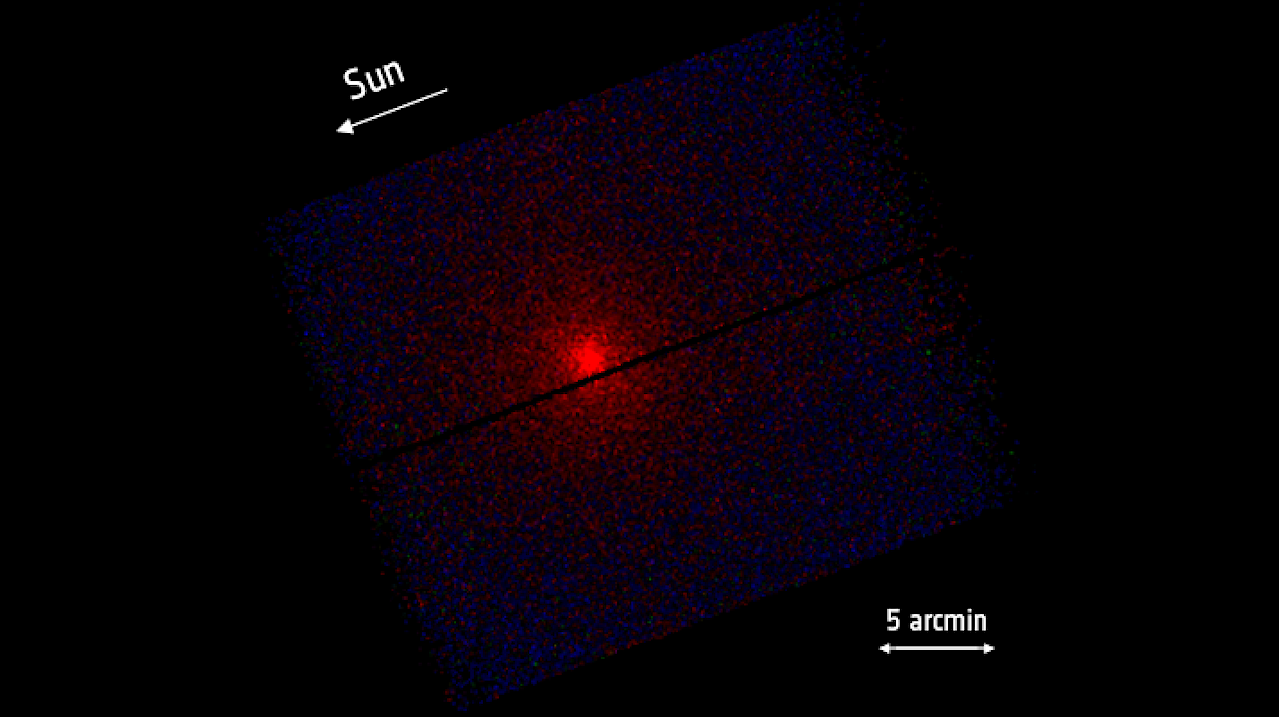
XMM-Newton observed the comet with its European Photon Imaging Camera (EPIC)-pn camera ESA/XMM-Newton/C. Lisse, S. Cabot & the XMM ISO Team larger image
The European Space Agency’s X-ray space observatory XMM-Newton observed interstellar comet 3I/ATLAS on 3 December for around 20 hours. During that time, the comet was about 282–285 million km from the spacecraft.
XMM-Newton observed the comet with its European Photon Imaging Camera (EPIC)-pn camera, its most sensitive X-ray camera.
This image shows the comet glowing in low-energy X-rays: blue marks empty space with very few X-rays, while red highlights the comet’s X-ray glow. Astronomers expected to see this glow because when gas molecules streaming from the comet collide with the solar wind, they produce X-rays.
These X-rays can come from the interaction of the solar wind with gases like water vapour, carbon dioxide, or carbon monoxide – which telescopes such as the NASA/ESA/CSA James Webb Space Telescope and NASA’s SPHEREx have already detected. But they are uniquely sensitive to gases like hydrogen (H₂) and nitrogen (N₂). These are almost invisible to optical and ultraviolet instruments, such as the cameras on the NASA/ESA Hubble Space Telescope or ESA’s JUICE.
This makes X-ray observations a powerful tool. They allow scientists to detect and study gases that other instruments can’t easily spot.
Several groups of scientists think that the first detected interstellar object, 1I/’Oumuamua (found in 2017), may have been made of exotic ice like nitrogen or hydrogen.
While 1I/’Oumuamua is too far away now, 3I/ATLAS presents a new opportunity to study an interstellar object, and observations in X-ray light will complement other observations to help scientists figure out what it is made of.
For the latest updates and FAQs related to comet 3I/ATLAS, see esa.int/3IATLAS

Keith Cowing
Explorers Club Fellow, ex-NASA Space Station Payload manager/space biologist, Away Teams, Journalist, Lapsed climber, Synaesthete, Na’Vi-Jedi-Freman-Buddhist-mix, ASL, Devon Island and Everest Base Camp veteran, (he/him)
By Keith Cowing
ESA
December 13, 2025
XMM-Newton observed the comet with its European Photon Imaging Camera (EPIC)-pn camera ESA/XMM-Newton/C. Lisse, S. Cabot & the XMM ISO Team larger image
The European Space Agency’s X-ray space observatory XMM-Newton observed interstellar comet 3I/ATLAS on 3 December for around 20 hours. During that time, the comet was about 282–285 million km from the spacecraft.
XMM-Newton observed the comet with its European Photon Imaging Camera (EPIC)-pn camera, its most sensitive X-ray camera.
This image shows the comet glowing in low-energy X-rays: blue marks empty space with very few X-rays, while red highlights the comet’s X-ray glow. Astronomers expected to see this glow because when gas molecules streaming from the comet collide with the solar wind, they produce X-rays.
These X-rays can come from the interaction of the solar wind with gases like water vapour, carbon dioxide, or carbon monoxide – which telescopes such as the NASA/ESA/CSA James Webb Space Telescope and NASA’s SPHEREx have already detected. But they are uniquely sensitive to gases like hydrogen (H₂) and nitrogen (N₂). These are almost invisible to optical and ultraviolet instruments, such as the cameras on the NASA/ESA Hubble Space Telescope or ESA’s JUICE.
This makes X-ray observations a powerful tool. They allow scientists to detect and study gases that other instruments can’t easily spot.
Several groups of scientists think that the first detected interstellar object, 1I/’Oumuamua (found in 2017), may have been made of exotic ice like nitrogen or hydrogen.
While 1I/’Oumuamua is too far away now, 3I/ATLAS presents a new opportunity to study an interstellar object, and observations in X-ray light will complement other observations to help scientists figure out what it is made of.
For the latest updates and FAQs related to comet 3I/ATLAS, see esa.int/3IATLAS
Keith Cowing
Explorers Club Fellow, ex-NASA Space Station Payload manager/space biologist, Away Teams, Journalist, Lapsed climber, Synaesthete, Na’Vi-Jedi-Freman-Buddhist-mix, ASL, Devon Island and Everest Base Camp veteran, (he/him)

No comments:
Post a Comment