Sunday, June 22, 2025


Lawyers decry arrest of Rwandan opponent Ingabire as 'unlawful and arbitrary'

Lawyers for Rwandan opposition leader Victoire Ingabire say she is being targeted by a biased justice system after her arrest on Thursday evening, claiming there is no evidence linking her to an alleged plot to incite public unrest.

Victoire Ingabire returned from exile to run for president in 2010, however she was arrested, charged with terrorism and treason and sentenced to 10 years in jail. This file picture from April 7, 2010, shows the Rwanda opposition leader at her home in Kigali. AFP/File


“We are gravely concerned by this unlawful and arbitrary re-arrest, and the ongoing pattern of political intimidation of our client Victoire Ingabire Umuhoza," her team of international lawyers said in a statement Friday.

"There is, again, no lawful basis for her arrest and detention and we call for her immediate release.”

Ingabire was arrested on Thursday and is being detained in the Rwandan capital Kigali.

The Rwanda Investigations Bureau (RBI) links Ingabire to alleged subversion after her name was mentioned in an ongoing criminal case against nine people accused of plotting to remove President Paul Kagame's government without using military force.

She appeared in court on Thursday to be questioned by prosecutors who charged that she had been communicating with the nine suspects.

Prosecutors also allege Ingabire has provided financial support and training to teach them how to overthrow the government without using weapons.

Her lawyers said that she appeared in court on Thursday to deny the accusations.

Following the hearing at the High Court, judges said they were not satisfied with Ingabire’s answers and ordered the RIB to launch an investigation, the court said in a statement.

The judges gave prosecution lawyers two weeks to return to court with formal charges against her.

Dissent on trial

"The reason why these nine people are on trial at the moment is because in October 2021, nine members of Madame Ingabire's political party took part in an online training presented by a European NGO called the Centre for Applied Nonviolent Action and Strategies," Iain Edwards, one of her lawyers from 1MCB Chambers in London, told RFI.

"This trial has been dragging on for months and months," he added.

Edwards said that during the hearing one of the accused was asked specific questions about Ingabire.

"The accused was saying she's not behind it at all. It's got nothing to do with her. The judge didn't pay any attention to his protestations, turned to the prosecution and said: 'Well, we've been hearing all about Victoire Ingabire. Why was she not charged?'

"But there's nothing to charge her with," said Edwards.

Some of the defendants are also accused of planning to attend "Ingabire Day", which her supporters hold every year in October to commemorate her imprisonment in 2012 and release six years later.

Journalist ‪Michela Wrong‬, author of several books on Rwanda, said Ingabire's arrest suggests the regime is seriously rattled.

"If the arrest of opposition leader Victoire Ingabire is meant to show strength, it does the opposite," she wrote on social media platform Bluesky.

"With rumours swirling about Paul Kagame's health and the regime under intense US pressure to sign a peace deal with the DRC, the Rwandan regime feels beleaguered," Wrong added.

Rwandan opposition leader asks court to restore her civic rights

One of Rwanda's rare opponents

Ingabire, 56, left Rwanda in March 1994 to study and live in the Netherlands, where she founded the DALFA-Umurinzi party in 2006. The party, led by Ingabire, is not recognised by the Rwandan authorities.  

She returned to Rwanda in January 2010 to participate in the presidential elections scheduled to take place later that year.

Instead, she was arrested and faced an array of charges including active participation in a criminal organisation.

She was jailed in 2012 for 15 years but Kagame pardoned her in 2018.

Rwandan politician Victoire Ingabire and lawyer Gatera Gashabana at the Mageragere Prison in Kigali, Rwanda, when she was release, on 15 September 2018.
Rwandan politician Victoire Ingabire and lawyer Gatera Gashabana at the Mageragere Prison in Kigali, Rwanda, when she was release, on 15 September 2018. REUTERS/Jean Bizimana

Late last year, Ingabire's lawyers living outside Rwanda said they were concerned for her safety after comments Kagame reportedly made on 16 November 2024.

"Their days are numbered," the Rwandan leader said, referring to people who were pardoned and released from prison but who repeat the same crimes.

“Those who must be corrected, we correct them,” he said, speaking to party faithful at the Unity Club in Kigali.

Ingabire's legal team say the remarks echo public statements Kagame made in July 2024, where he said Ingabire “will not end up well”, and that the Rwandan government “would find an appropriate solution” for her.  He has publicly described her as a “small woman of a genocidaire” and ridiculed her for viewing herself as a political opponent.

Judiciary 'subject to pressure'

"It is well established that the judiciary in Rwanda is not independent," said Edwards. "It is absolutely subject to pressure from the Rwandan government, especially in these big political cases."

He says Ingabire risks imprisonment for crimes she has not been involved with. 

Last July, Kagame tightened his 25-year grip on power when he was re-elected after securing 99 percent of the vote.

Though he has been praised for the way he helped transform Rwanda after the 1994 genocide, his reputation has been tarnished by repeated accusations of rights abuses and supporting M23 rebels in neighbouring Democratic Republic of Congo.


65 years on, Belgium edges closer to trial over Lumumba’s assassination

Sixty-five years after the 1961 assassination of Patrice Lumumba, a key figure in the Congolese independence movement, the Belgian federal prosecutor’s office hopes that a trial may finally take place – possibly in 2026 – as part of the investigation into “war crimes” opened in Belgium, the former colonial power.

Patrice Lumumba in 1960. © AFP


The Belgian federal prosecutor’s office announced during the week that it had requested the referral of former Belgian diplomat Étienne Davignon to the Brussels criminal court, as part of the investigation into the 1961 assassination of former prime minister Patrice Lumumba.

Aged 92, Étienne Davignon is the only person still alive among the ten suspects named in the 2011 war crimes complaint filed by Lumumba’s children.

The referral to trial is requested notably for the “illegal detention and transfer” of Lumumba at the time he was taken prisoner, and for “humiliating and degrading treatment”, a spokesperson for the prosecutor’s office, Ann Lukowiak, told French news agency AFP.

An 'intent to kill' charge has not been retained - a dismissal is sought on that aspect, she added.

Last remains of Congolese independence hero Lumumba to return home

The arrest and death of Lumumba

Patrice Lumumba was the first prime minister of the former Belgian Congo, after it became independent on 30 June 1960, but he was overthrown in mid-September 1960 by a coup d’état.

He was executed on 17 January 1961 along with two comrades by separatists from the Katanga region, in the south of what is today the Democratic Republic of Congo (DRC), with the support of Belgian mercenaries. He was 35 years old. His body, which was dissolved in acid, has never been found.

In 2011, on behalf of the children, eldest son François Lumumba filed a complaint in Brussels, accusing various Belgian administrations of having taken part in “a vast conspiracy aimed at the political and physical elimination” of the Congolese leader.

The investigation is now complete, and the prosecutor’s indictment targets the only living individual among the ten initially named in the complaint - former officials, police officers or Belgian intelligence agents.

Étienne Davignon was at the time of Congo’s independence a diplomatic trainee at the foreign affairsm ministry. He is suspected of having been present when a plan to arrest Lumumba was discussed. He has always denied Belgian authorities’ involvement in the crime.

He had joined the foreign affairs ministry in 1959, attended as an observer the round table bringing together Belgian and Congolese leaders in Brussels in early 1960, an event he later described as “a decisive turning point” in his career".

Hearing scheduled

Following the indictment, it will be up to an investigating chamber to decide whether to proceed to trial. A hearing for pleadings, allowing the defence to present its arguments, has been scheduled for 20 January 2026.

“We are moving in the right direction; what we are seeking above all is the truth,” said Juliana Lumumba, the daughter of the former Congolese prime minister, in an interview with RTBF.

Christophe Marchand, lawyer for the Lumumba children says, “[Davignon] was aware of the plan to eliminate the former prime minister, and he participated actively despite what he says.”

After his diplomatic career, Davignon notably served as vice-president of the European Commission from 1981 to 1985, responsible for industry, during a period marked by the decline of European steelmaking. He also had a business career, as former head of the holding company Société Générale de Belgique.

As part of this investigation in Belgium, investigators seized a tooth of Patrice Lumumba in 2016, which was returned to the Democratic Republic of Congo in a coffin in June 2022 during an official ceremony in Brussels.

Remains of independence hero Patrice Lumumba returned to Congo

The then Belgian prime minister, Alexander De Croo, reiterated the “apologies” already made by the Belgian government in 2002 for its “moral responsibility” in the disappearance.

Reflecting on the conditions of this “terrible” assassination, De Croo pointed to Belgian officials who at the time “chose not to see” and “not to act.”

 (with AFP)

DR Congo extends cobalt export ban by three months


DRC produces an estimated 70% of the world's cobalt and most of it comes from the city of Kolwezi, where the Shabara artisanal mine (photo) is situated. 
AFP - JUNIOR KANNAH


The Democratic Republic of Congo has extended by three months a ban on exports of cobalt in a bid to curb oversupply of the electric vehicle battery material, the country's regulatory agency has said.


Issued on: 22/06/2025 -

By:RFI

DR Congo, the world's top cobalt supplier, imposed a four-month suspension on exports in February after prices had hit a nine-year low at just $10 a pound. The ban was due to expire on Sunday.

"The decision has been taken to extend the temporary suspension due to the continued high level of stock on the market," the Authority for the Regulation and Control of Strategic Mineral Substances' Markets (ARECOMS) said in a statement Saturday.

ARECOMS said it expected to announce a subsequent decision to either modify, extend or terminate the suspension before the new three-month window closes in September.

The Democratic Republic of Congo produces over 70 percent of the global supply of cobalt. The metal is a critical component of batteries and seen as key to the renewable energy transition. 

Cobalt hydroxide produced at Tenke Fungurume Mine – one of the largest copper and cobalt mines in the world, in southeastern DRC.
Cobalt hydroxide produced at Tenke Fungurume Mine – one of the largest copper and cobalt mines in the world, in southeastern DRC. AFP - EMMET LIVINGSTONE

UN panel seeks to stem mining abuses in global rush for critical minerals

Mining companies divided

The price of cobalt has dropped due to a big rise in production and a drop in demand for cobalt in electric vehicle batteries.

Congolese authorities had been considering extending the ban as they explore how to distribute quotas for shipments of cobalt among mining companies.

A proposal to implement quotas has backing from miners including Glencore, the world's second-largest cobalt-producing company. But Glencore's position differs from that of the number one producer, China's CMOC Group, which has lobbied for the ban to be lifted.

Eurasian Resources Group, another key producer in Congo, also wants the ban lifted.

DRC mineral contract with China slammed by NGOs citing 'major losses'

The government is not fully united on extending the ban, according to Zack Hartwanger at Swiss-based commodity trader Open Mineral.

"Some [in government] raised concerns about revenues, employment, and informal supply chains," Hartwanger said. "There’s tension between industrial policy goals and economic realities."

(with Reuters)


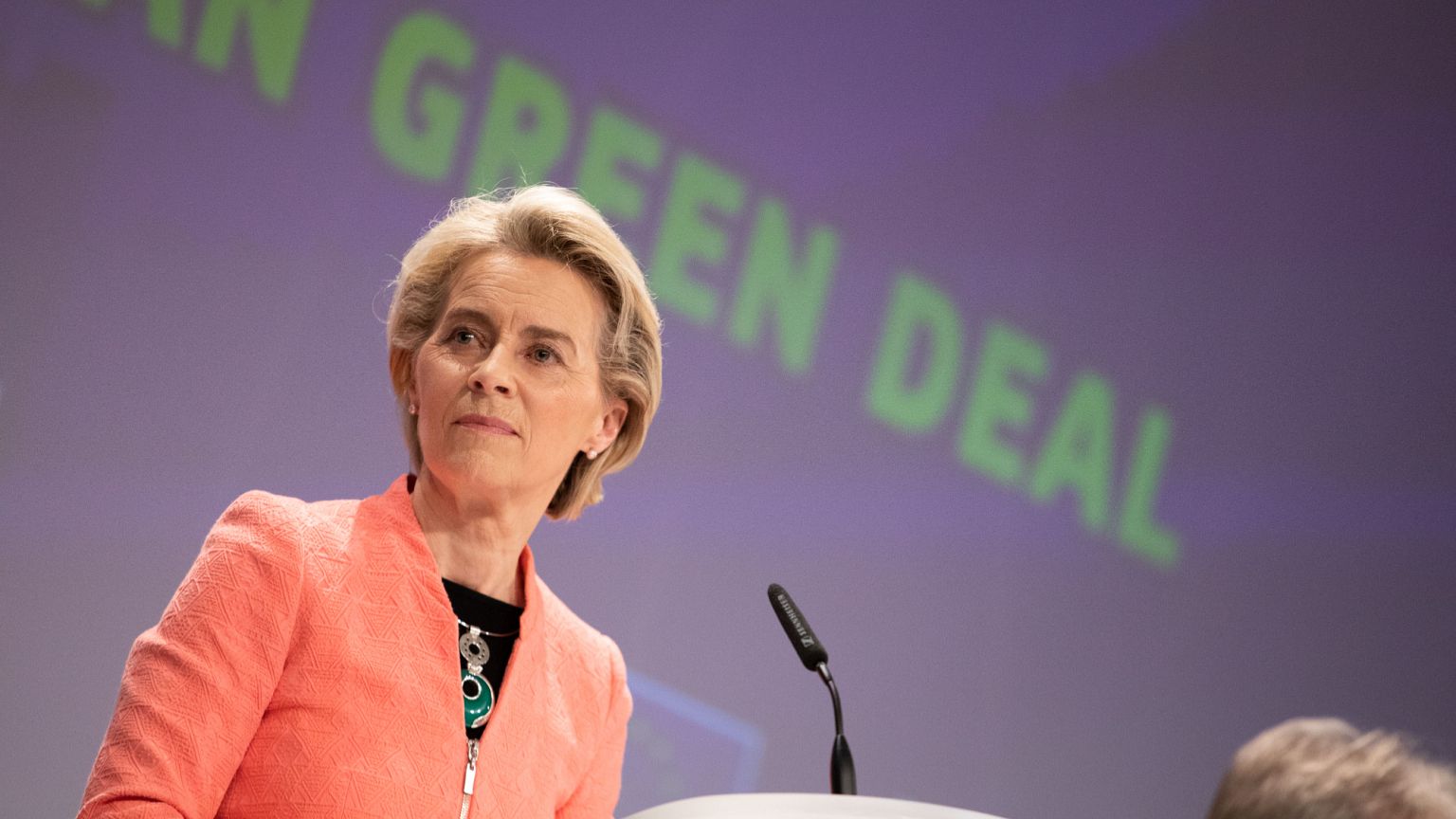
EU Commission moves to withdraw greenwashing proposal in another blow to Green Deal


Copyright Xavier Lejeune - European Union

By Gerardo Fortuna
Published on 20/06/2025 - 


In a surprise decision, the European Commission has announced it's withdrawing another key component of the once-flagship Green Deal policy, despite the legislation being close to final approval.

The European Commission intends to withdraw a proposal aimed at combating so-called "greenwashing" by ensuring companies' environmental claims are accurate, substantiated and independently verified, an EU executive spokesperson told reporters today.

The proposal on Green Claims was initially presented in March 2023 as part of the broader European Green Deal legislative framework. 

This move marks the latest in a series of rollbacks of major Green Deal initiatives, after so-called "Omnibus" papers intended to simplify EU legislation effectively narrowed the scope of measures such as the Carbon Border Adjustment Mechanism.

The announcement on the Green Claims Directive came ahead of a final meeting between the Polish EU Council presidency and MEPs scheduled next Monday, which was expected to give the proposal the green light ahead of formal adoption.

Its withdrawal at this late stage has taken many by surprise, including the negotiators. When questioned by reporters, Commission officials declined to provide detailed reasons for the decision, saying only that more information would follow.

According to parliamentary sources close to the file, chief negotiators socialist MEP Delara Burkhardt and liberal MEP Sandro Gozi still intended to proceed with the trilogue negotiations on Monday, noting that the talks were nearing a successful conclusion.

“It is unacceptable that the Commission blatantly interferes with the progress made by co-legislators on this file,” a member of the Parliament’s negotiating team told Euronews, expressing frustration at what they see as a unilateral and premature move.

Likewise, Poland's presidency of the EU Council “is ready to enter constructively into the trilogue and go ahead as planned until there is a clear decision from the Commission [on the withdrawal],” a Polish spokesperson tol Euronews.

It remains unclear whether the decision to withdraw the proposal has been formally adopted by the Commission’s College, the weekly meeting of the 26 Commissioners and EU President Ursula von der Leyen.

Beyond the immediate legislative impact, the move raises broader questions about the Commission's authority to retract its own proposals.

While EU treaties do not explicitly grant this power, a 2015 ruling by the Court of Justice of the European Union affirmed that the Commission may withdraw proposals as part of its right of initiative.

However, the Court also made clear that this power is limited and subject to both substantive and procedural constraints.

The ruling emphasised that withdrawal should only occur in justified cases, such as institutional deadlock or the proposal becoming obsolete.

Neither condition appears to apply in the case of the Green Claims Directive, prompting concerns that the Commission could be overstepping its role and upsetting the institutional balance by exercising a de facto veto over the legislative process.