Sunday, June 22, 2025

Global decline in freedom of expression over last decade, watchdog warns

According to monitoring organisation Article 19, more than two-thirds of the world's population has less freedom of expression than a decade ago. RFI spoke with the NGO's senior director David Diaz-Jogeix about the results of its report.


Article 19's Global Expression Report 2025, in which France takes 19th place.
 © Screenshot Article 19


More than 5.6 billion people have experienced "a decline in their freedom of expression over the last 10 years," according to Article 19, which published its annual Global Expression Report this week.

Scores have dropped in 77 countries, with only 35 now ranked as "open".

According to the report, just 4 percent of the world's total population – fewer than 300 million people – across 15 countries have seen an improvement in freedom of expression over the last decade.

For every one person who has experienced an improvement, 19 people have faced a deterioration.

Article 19 grades freedom of expression using a ranking of five terms – open, less restricted, restricted, highly restricted and crisis.

The three highest ranked countries this year are Denmark, Switzerland and Sweden (with 94, 93 and 93 points respectively) and at the bottom are Belarus, Nicaragua and North Korea (1, 1 and 0 points).

Article 19

Article 19 of the Universal Declaration of Human Rights states: "Everyone has the right to freedom of opinion and expression; this right includes freedom to hold opinions without interference and to seek, receive and impart information and ideas through any media and regardless of frontiers."

The NGO Article 19, which monitors threats to freedom of expression around the globe, was founded in 1987 and is based in the United Kingdom.

RFI spoke to David Diaz-Jogeix, Article 19's senior director of programmes.

RFI: What are the main drivers behind the decline in freedom of expression as registered by your report? 

David Diaz-Jogeix: We have an overall trend of authoritarian regimes and authoritarian policies by democratic governments that is really taking [hold]. We have the big perpetrators in terms of repressing freedom of expression, countries like China, Russia, Saudi Arabia, Iran, United Arab Emirates, India, Egypt, Turkey, Rwanda. These countries continue to persevere in a total repression on terms of freedom of expression and that makes the bulk of the big perpetrators.

But ironically, you see a very clear pattern of deterioration of the freedom of expression in western countries. The United Kingdom, which used to be in the "open" category is now in the "less restricted" category and we have a myriad of countries within the European Union that have gone through a solid deterioration of the freedom of expression.

Can you elaborate on the situation in France, Germany and the UK?

France ranks 19th globally. We would expect France to perform higher. But [Paris issued] pre-emptive bans on pro-Palestine protests in Paris, Lyon and Alençon. We saw how journalists, politicians, human rights defenders, trade union representatives, academics, medical practitioners were victims of gross misuse of counter-terrorism legislation, where they were investigated under the [guise of] terrorism. Those details do matter, because in Western Europe, it's clearly not going well.

Germany is the seventh top decliner last year – they have gone from scoring 91 out of 100, down to 85. We see this trend also in Portugal, Italy, the Netherlands, Austria, Cyprus, Greece, Romania and other countries. In the UK, there's legislation against the right to protest. 

Are there any countries which have seen notable improvements to freedom of expression in 2025? And what factors have contributed to that?

Brazil – we saw the country going through [the leadership of] Jair Bolsonaro, and then the return of Lula turned that [country's status] from "restricted" to "open". It's not the fact that Lula came back to power, it's what he does in terms of policies, legislation and reinforcing the checks and balances that has turned Brazil back into an open country.

There's about two thirds of the population in the world, that has experienced a decline in freedom of expression.

01:48

REMARKS by David Diaz-Jogeix of Article 19

Jan van der Made

We've seen the same pattern in Poland, where the return of a more pro-democratic government has turned the country back into an "open" country. [Although we note] that the recent election of a new [conservative] president might reverse that pattern.

Guatemala is one of the global advancers, with a government that has led policies to reinforce the rule of law, stop the attacks against journalists, strengthen respect of minorities and come up with policies that create the right environment for freedom of expression.

What specific role do governments, but also tech companies and civil society, play in either advancing or restricting freedom of expression worldwide?

A big role. Governments regulating social media, in terms of the human rights and freedom of expression framework, clearly puts limits on freedom of expression, but those have a very high threshold.

There are the EU Digital Markets Act and the Digital Service Act – a very good way to try to keep a balance between allowing Big Tech to operate, [while] making sure that different views of society can go out without facing censorship.

How do you respond to critics from the extreme ends of the political spectrum, for instance the US Make America Great Again pro-Trump activists, who argue that combating hate speech or disinformation conflicts with promoting freedom of expression?

There are very clear standards for freedom of expression and its limits, how to combat hate speech and speech that incites violence, discrimination and marginalisation. 

Your report refers to the chilling impact of surveillance and censorship. Can you elaborate on how these mechanisms are evolving?

For that we want to look at China or India, where you have highly repressive models in which the state is actually controlling how Big Tech and social media platforms are operating, in order to then be able to control not only the content but also access to the data of millions of people, which infringes the right to privacy.

Our [2024] report, the Digital Silk Road, explains how China exports their telecomms infrastructure into [third] countries, as it is relatively cheap [to do so] and very appealing to the receiving country to accept China's offer.

But it is not only the creation of the infrastructure, but [the fact that it] comes with a request to [amend local] legislation that would allow China to access all the private data, while pushing for pro-China narratives and legislation that borders on the authoritarian spectrum of these laws.

Countries such as Pakistan are under massive influence from China, to where they export these technologies – AI, facial recognition – really infringing on the right to privacy of so many citizens beyond China.

MAGA KILLS VOICE OF THE COLD WAR

Kari Lake makes it official: Hundreds of Voice of America employees given pink slips

Justin Baragona
Fri, June 20, 2025 
THE INDEPENDENT


Kari Lake announced on Friday that 639 employees from Voice of America and its parent agency would be terminated effective September 1. (Getty Images)


In its latest attack on Voice of America, the Trump administration sent out layoff notices to hundreds of the government-funded news network’s employees, making official what had long been expected after all contractors were fired last month.

This latest move, which eliminates 639 full-time staffers from VOA and the U.S. Agency for Global Media, the network’s parent bureau, comes just days after USAGM Senior Adviser Kari Lake called back dozens of employees for the network’s Persian-language service amid Israel’s conflict with Iran.

A significant portion of the VOA Farsi staff recently brought back to work are included in Lake’s reduction-in-force order, two sources familiar with the matter told The Independent.

Since mid-March, the vast majority of VOA employees have been on paid administrative leave following President Donald Trump’s executive order calling for USAGM and the state-run media outlets it oversees to be gutted of all “non-statutory components and functions.” At the time, Trump called VOA “the voice of radical America” and accused it of peddling “anti-American” and liberal propaganda.

Lawsuits brought by VOA staffers and executives have sought to stop the administration’s efforts to effectively dismantle the network, claiming that the president didn’t have the constitutional authority. While a federal judge issued an injunction in April that would have allowed VOA employees to return to work, an appellate court stayed most of that ruling, leaving the majority of the staff in limbo.

In recent weeks, Lake brought back a skeleton crew to keep Voice of America staffed at a “statutory minimum,” a move that left those employees “angry most of the time” as the “amount of programming that’s being produced is not a credible replacement for what was on air before.” Additionally, Lake cut a deal with MAGA cable news channel One America News to become a content provider for VOA down the road.

Earlier this month, Lake – a former local TV anchor and twice-failed Arizona political candidate – sent Congress a letter detailing her reduction-in-force plan to eliminate most of the 800 full-time jobs at VOA. This came after she had terminated roughly 500 contract employees. Based on the proposal to Congress, Voice of America would be reduced to just 18 employees and 81 staffers across USAGM.


Still, just last week, Lake frantically recalled roughly 75 employees to staff up Voice of America’s Farsi news division, as well as the network’s Pashto and Dari services, following Israel’s missile strikes on Iran’s nuclear facilities. Those divisions had previously been stripped down to just a handful of journalists in an effort to demonstrate to the federal courts that the administration was fulfilling its statutory mandate. “History is being made, and VOA Persian news service is rising to the occasion to cover it,” Lake boasted to Fox News.

On Friday, however, the vast majority of Voice of America employees received a “special notice of reduction in force” letter from Lake. The Trump aide then followed that up by releasing a letter announcing that the USAGM had “completed a significant workforce reduction” that eliminated 85 percent of the agency’s personnel.

“Today, we took decisive action to effectuate President Trump’s agenda to shrink the out-of-control federal bureaucracy,” Lake wrote in the letter. “Reduction in Force Termination Notices were sent to 639 employees at USAGM and Voice of America – part of a long-overdue effort to dismantle a bloated, unaccountable bureaucracy.”

She added: “American taxpayers have been forced to bankroll an agency that's been riddled with dysfunction, bias, and waste. That ends now.”

Letter from Kari Lake announcing that 85 percent of the workforce of Voice of America has now been reduced following Friday's layoffs. (USAGM)

The layoffs will leave USAGM with roughly 200 employees, and the terminations will take effect on September 1. In her announcement, Lake noted that employees who had been placed on paid leave in March had been given opportunities to take the “Fork in the Road” offer – which would pay staffers through the end of September if they resigned.

Patsy Widakuswara, VOA’s White House Bureau Chief who is suing the administration alongside VOA Press Freedom Editor Jessica Jerreat and USAGM Director of Strategy and Performance Assessment Kate Neeper, is calling on Congress to intervene.

“USAGM has launched its mass layoff of VOA and USAGM staff, including some of our Persian colleagues they called back to work just last week to cover Israel’s war with Iran. Their last day on the payroll will be Sept 1, Labor Day,” she said in a statement to The Independent.

“This move follows USAGM’s firing of more than 500 contractors last month. It spells the death of 83 years of independent journalism that upholds U.S. ideals of democracy and freedom around the world,” Widakuswara continued.

Expressing concern that authoritarian regimes are “flooding the global information space with anti-American propaganda” now that Voice of America is silenced, she urged Congress “to continue its long tradition of bipartisan support for VOA” amid the ongoing lawsuit.

Meanwhile, all three plaintiffs in the lawsuit confirmed that they have now received reduction-in-force notices from Lake.


Voice of America parent terminates over 600 more staff in likely death knell


Reuters
Fri, June 20, 2025 


FILE PHOTO: The Voice of America building in Washington


WASHINGTON (Reuters) -The parent agency of Voice of America said on Friday it had issued termination notices to over 639 more staff, completing an 85% decrease in personnel since March and effectively spelling the end of a broadcasting network founded to counter Nazi propaganda.

Kari Lake, senior advisor to the U.S. Agency for Global Media, said the staff reduction meant 1,400 positions had been eliminated as part of U.S. President Donald Trump's agenda to cut staffing at the agency to a statutory minimum.

"Reduction in Force Termination Notices were sent to 639 employees at USAGM and Voice of America, part of a long-overdue effort to dismantle a bloated, unaccountable bureaucracy," Lake said in a statement.

She said the agency had been "riddled with dysfunction, bias, and waste."

Lake said the move meant USAGM now operated near its statutory minimum of 81 employees. She said 250 employees would remain across USAGM, Voice of America, and the Office of Cuba Broadcasting, which transmits news into communist-run Cuba. She said none of OCB's 33 employees had been terminated.

The move likely marks an end to VOA, which was founded in 1942 to counter Nazi propaganda, operated in nearly 50 languages and reached 360 million people a week, many living under authoritarian regimes.

In May, nearly 600 VOA contractors were dismissed.

Some Republicans have accused VOA and other publicly funded media outlets of being biased against conservatives, and called for them to be shuttered as part of wider efforts to shrink the government.

Another USAGM station, Radio Free Asia, which has already been reduced to skeleton staffing, said in a staff email on Friday that it was implementing additional furloughs in its human resources, ordinance, journalist security, and research, training & evaluation teams.

Various court cases are in train against the USAGM cuts.

(Reporting by David Brunnstrom, Editing by Rosalba O'Brien)


Hundreds of Voice of America reporters fired as Trump guts outlet

Max Matza - BBC News
Sat, June 21, 2025


[Getty Images]


Hundreds of journalists for Voice of America (VOA) - most of its remaining staff - have been fired by President Donald Trump's administration, effectively shutting down the US-funded news outlet.

The administration said the layoffs were because the agency was "riddled with dysfunction, bias and waste".

Steve Herman, VOA's chief national correspondent, called the dismantling of the outlet, which was set up during World War Two to counter Nazi propaganda, a "historic act of self-sabotage".

Among those axed were Persian-language reporters who had been on administrative leave, but were called back to work last week after Israel attacked Iran.

According to the Associated Press news agency, the Persian reporters had left the office on Friday for a cigarette break, and were not allowed to re-enter the building after the termination notices went out.

"Today, we took decisive action to effectuate President Trump's agenda to shrink the out-of-control federal bureaucracy," Kari Lake, whom the president appointed to run VOA, said in a statement on Friday announcing the layoffs of 639 employees.

In total, more than 85% of the agency's employees - about 1,400 staff - have lost their jobs since March.


She noted that 50 employees would remain employed across VOA, the Office of Cuba Broadcasting, and VOA's parent company, the US Agency for Global Media (USAGM).

A statement issued by three VOA journalists who have been suing to stop the elimination of the network said about the latest firings: "It spells the death of 83 years of independent journalism that upholds US ideals of democracy and freedom around the world."

The move had been expected since March when Trump ordered VOA, as well as USAGM, which oversees VOA and funds outlets such as Radio Free Europe and Radio Free Asia, to be "eliminated to the maximum extent consistent with applicable law".

The agencies have won acclaim and international recognition for their reporting in places where press freedom is severely curtailed or non-existent, from China and Cambodia to Russia and North Korea.

But Dan Robinson, a former VOA news correspondent, wrote in an op-ed last year that the outlet had become a "hubris-filled rogue operation often reflecting a leftist bias aligned with partisan national media".

Trump's criticisms of VOA come as part of his broader attacks against the US media, which studies suggest American news consumers view as highly polarised.

The president has also urged his fellow Republicans to remove federal funding for National Public Radio (NPR) and the Public Broadcasting Service (PBS).

'Discarded like a dirty rag': Chinese state media hails Trump's cuts to Voice of America

Judge halts Trump's shutdown of Voice of America


Kari Lake claws back $17M for ‘mission support’ amid deep cuts to US-funded media

Anthony Adragna
Sat, June 21, 2025 
POLITICO


The United States Agency for Global Media is reprogramming more than $17 million in various agency funds already subject to deep cuts for unspecified “mission support,” according to a memo from senior adviser Kari Lake obtained by POLITICO on Friday.

Lake, a close ally of President Donald Trump, has looked to slash USAGM — which either directly controls or gives grants to media outlets that report predominantly for international audiences — as part of the administration’s campaign to slash the size of government and punish media outlets it views as hostile toward the president.

The memo says the agency is taking back $7.2 million from Radio Free Europe/Radio Liberty, $3 million from Radio Free Asia, $5 million from the Middle East Broadcasting Networks and $2.18 million from the Open Technology Fund. Lake’s letter says the funds will go toward “mission support” without providing further details.

Lake’s letter offered a briefing to senators on the financial transfers.

The move comes as Lake on Friday delivered termination notices to hundreds of employees at Voice of America, which lies under the control of the USAGM — an overall cut of roughly 85 percent of her agency’s workforce.

“Kari Lake’s actions are a gift to Iran’s Supreme Leader, the [Chinese Communist Party] and the Kremlin,” said Senate Foreign Relations Committee ranking member Jeanne Shaheen (D-N.H.) in a post Friday about the job cuts. “Her decimation of US broadcasting leaves authoritarian propaganda unchecked by US backed independent media and is a perversion of the law and congressional intent.”

Lake’s decision also landed as a federal district court judge on Friday ordered the agency to fund the Open Technology Fund, a technology nonprofit promoting global internet freedom, as intended by Congress for the rest of the fiscal year.

Lake’s agency did not respond to a request for comment on Friday night, nor did the offices of Sens. Lindsey Graham (R-S.C.) and Brian Schatz (D-Hawaii), the top Senate appropriators for the agency.

Congress won’t have to wait long for answers, though. The House Foreign Affairs Committee is scheduled to receive testimony from Lake on June 25.


‘Dark day for truth’: Kari Lake slashes U.S. global media agency by 85%


CK Smith
Sat, June 21, 2025 
SALON


Kayla Bartkowski / Getty Images

Once a Cold War-era powerhouse for U.S. diplomacy, the U.S. Agency for Global Media has been gutted under a Trump executive order — slashing 1,400 jobs, or 85% of its workforce — in a move Kari Lake calls a win for taxpayers and critics warn is a death knell for press freedom.

Lake, senior adviser to the agency, said the cuts fulfill the March 14 directive from President Donald Trump to shrink the federal workforce and eliminate non-essential operations. “This is a decisive action to shrink the out-of-control federal bureaucracy,” Lake said Friday, calling USAGM “bloated, unaccountable” and plagued by “dysfunction, bias and waste.”


Only 250 employees remain across USAGM and its affiliates, including Voice of America, the Office of Cuba Broadcasting and Radio Free Asia. The latest round included 639 layoff notices, following earlier buyouts and retirements. No OCB employees were terminated, though staffing was capped.

Lake also terminated a $250 million lease for a Pennsylvania Avenue media facility, which the agency says lacked proper studio space. She is set to testify before the House Foreign Affairs Committee next week regarding what the agency describes as years of “self-dealing and national security failures.”

But journalists and press advocates say the move silences independent reporting and undermines U.S. credibility abroad. “This spells the death of 83 years of independent journalism,” said VOA White House bureau chief Patsy Widakuswara. Sen. Jeanne Shaheen, D-N.H., called it “a dark day for the truth.”

Elizabeth Warren demands answers over reports of $500m deal for controversial Gaza Health Foundation

Andrew Roth in Washington
The Guardian
Fri, June 20, 2025 


Elizabeth Warren at the US Capitol on 11 February 2025.Photograph: Allison Robbert/AFP/Getty Images


Elizabeth Warren has confronted the US secretary of state, Marco Rubio, over reports that the state department is considering redirecting $500m from USAID to the controversial Gaza Humanitarian Foundation (GHF).

In a letter addressed to Rubio and USAID’s acting administrator, Kenneth Jackson, the Massachusetts senator argued that the GHF, a self-proclaimed aid organisation that is backed by the Israeli and US governments, “marks an alarming departure from the professional humanitarian organizations that have worked on the ground, in Gaza and elsewhere, for decades”.

Related: Israel-backed Gaza delivery group names US evangelical leader as chair

“The questions surrounding GHF – its funding sources and connection to the Trump Administration, its use of private contractors, its ability to serve and be seen as a neutral entity, its abandonment by its founders, and its basic competence in providing aid – must be answered before the State Department commits any funding to the organization,” Warren wrote in the letter, a copy of which was provided exclusively to the Guardian.

The letter from Warren requested answers by 2 July on whether USAID is considering awarding any funds to the GHF, the terms of a possible agreement and the GHF’s connections to the Boston Consulting Group, which reportedly helped set up the group’s operations. BCG canceled its cooperation with the GHF after the organisation was embroiled in controversy following a series of shootings by Israeli forces at its food distribution sites.

Reuters first reported that funds directed to USAID, which is being rolled into the state department, could be rerouted to the GHF in an important boost to a troubled organisation that opened food distribution centres in Gaza last month. The GHF has struggled to partner with major aid organisations, even as Israeli and US officials have put pressure on NGOs to route their humanitarian aid through the GHF or face having no access to Gaza at all.

Major aid organisations have boycotted the GHF, which was forced to temporarily close some of its food distribution centres shortly after its launch last month due to security concerns. Israeli forces have opened fired into crowds near the food distribution sites several times in mass casualty events that Israeli officials have said took place in self-defence. Hundreds of Gazans have been killed.

Jake Wood, the former executive director of the GHF, resigned last month shortly before operations began. He said that he could not guarantee the organisation’s “independence” from political influence. Critics have argued that the GHF is a tool for the Israeli and US governments to politicise humanitarian aid and to distribute it in ways that will depopulate sectors of Gaza in apparent violation of international law.

The Guardian has approached the state department for comment.


Medical sources report 23 killed at Gaza aid distribution point

DPA
Fri, June 20, 2025

Palestinians mourn their loved ones killed in Israeli attacks, as bodies are taken from the morgue of Al-Shifa Hospital for burial following funeral prayers. Omar Ashtawy/APA Images via ZUMA Press Wire/dpa

The Israeli military has reportedly killed dozens of Palestinians near humanitarian aid distribution centres in the Gaza Strip.

According to medical sources in the coastal area on Friday, 23 people were killed in central Gaza while waiting for aid supplies from the Gaza Humanitarian Foundation (GHF).

There were initially no Palestinian reports on exactly how the people were killed.

In addition, according to medical sources, at least 11 people were killed by Israeli shelling near a GHF distribution point in Rafah in the south of the Gaza Strip. They too had been waiting for food.

When asked about the incident in the centre of the Gaza Strip, the Israeli army said that a group had gathered near Israeli soldiers during the night.

"According to an initial investigation, the troops sensed a threat and fired warning shots. Despite repeated warnings and warning shots, several suspects continued to advance towards the troops," a statement said. An aircraft then attacked and killed the suspects.

The incident is currently being investigated, the Israeli army said. It said it was not aware of the second incident.

The information provided by both sides cannot currently be independently verified.

The GHF, which is supported by Israel and the United States, began its mission in the Gaza Strip last month after an almost three-month Israeli blockade of aid deliveries.

The distribution is intended to be an alternative to the efforts of the UN and international aid organizations. Israel and the US say they want to use the foundation to prevent Hamas from appropriating humanitarian aid supplies

However, the distribution mechanism and the foundation are controversial. There have been repeated reports of deaths caused by Israeli shelling in the area around the GHF centres.

According to medical sources, a total of 70 people have been killed in Israeli attacks in the Gaza Strip since Friday morning. This information could not be independently verified.


Palestinians mourn their loved ones killed in Israeli attacks, as bodies are taken from the morgue of Al-Shifa Hospital for burial following funeral prayers. Omar Ashtawy/APA Images via ZUMA Press Wire/dpaMore

US-backed Gaza aid group says people 'desperately need more aid'

Adam PLOWRIGHT
AFP
Sat, June 21, 2025


People carry supplies from a Gaza Humanitarian Foundation distribution centre in the central Gaza Strip (Eyad BABA)Eyad BABA/AFP/AFP


A privately run aid organisation brought in to distribute food rations in war-hit Gaza last month with US and Israeli backing said Saturday that people in the Palestinian territory "desperately need more aid".

The admission by the Gaza Humanitarian Foundation (GHF) that it has been unable to meet demand came after severe criticism from other aid groups and near-daily deadly shootings near distribution points.

Gaza's civil defence agency said Saturday that Israeli troops had killed at least 17 people, including eight who were seeking food in the territory which is suffering from famine-like conditions due to Israeli restrictions, according to aid groups.

In a statement on Saturday, GHF interim executive director John Acree said that the organisation was "delivering aid at scale, securely and effectively... But we cannot meet the full scale of need while large parts of Gaza remain closed."

He said the GHF was "working with the government of Israel to honour its commitment and open additional sites in northern Gaza".

"The people of Gaza desperately need more aid and we are ready to partner with other humanitarian groups to expand our reach to those who need help the most," Acree said.

GHF's operations have been slammed as a "failure" by the United Nations, while other aid groups have raised concerns about the group's opaque structure and neutrality in the conflict that has been raging since October 2023.

According to figures issued Saturday by the health ministry in the Hamas-run Gaza Strip, at least 450 people have been killed and nearly 3,500 injured by Israeli fire since GHF began distributing meal boxes in late May.

GHF has denied responsibility for deaths near its aid points, contradicting statements from witnesses and Gaza rescue services.

It has said deaths have occurred near UN food convoys.

On Monday, the head of aid group Doctors Without Borders, Christopher Lockyear, said that the "imposed system of aid delivery" in Gaza was "not only a failure, but it is dehumanising and dangerous".


Israel's military has continued its operations in Gaza, even as attention has shifted to its ongoing war with Iran since June 13.
- Restrictions -

Israel's ban on foreign media entering the Gaza Strip and difficulties for local journalists to travel in the territory mean AFP is unable to independently verify the tolls and details provided by rescuers and authorities.

The Israeli army told AFP Saturday it was "looking into" the deaths which the civil defence agency reported near GHF distribution centres.

In the past, the military has said that its troops have fired on crowds approaching them in a threatening fashion and only after warning shots.

Witnesses have told AFP about injuries caused by drones and tank rounds.

Civil defence spokesman Mahmud Bassal told AFP that three people were killed by gunfire in the southern Gaza Strip, with another five killed in a central area known as the Netzarim corridor, where thousands of Palestinians have gathered daily in the hope of receiving rations from a GHF centre.

Earlier this week, the UN's World Health Organization warned that Gaza's health system was at a "breaking point", pleading for fuel to be allowed into the territory to keep its remaining hospitals running.

The Hamas attack on Israel in October 2023 that sparked the war resulted in the deaths of 1,219 people, mostly civilians, according to an AFP tally based on official figures.

Israel's retaliatory military campaign has killed at least 55,908 people, also mostly civilians, according to the Gaza health ministry. The UN considers these figures reliable.

az-crb/adp/ds/ami


Aid seekers in Gaza continue to be targeted as Israeli attacks kill 26

Al Jazeera
Sat, June 21, 2025

Palestinian children react as they receive food cooked by a charity kitchen, in Gaza City [Mahmoud Issa/Reuters]

At least 26 people, including more aid seekers, have been killed in the latest Israeli attacks on Gaza.

The attacks come as desperate Palestinians under Israeli blockade continue to wait at food distribution points amid an ongoing hunger crisis.

Among those killed during Israeli attacks on the besieged enclave on Saturday, 11 were aid recipients at distribution centres run by the United States-and-Israel-backed Gaza Humanitarian Foundation (GHF), which the United Nations has condemned for its “weaponisation” of aid.

Meanwhile, Wafa news agency reported that at least three people were killed and several others wounded by an Israeli drone strike that targeted displaced Palestinians in al-Mawasi, southern Gaza.

The report said that the attack targeted a tent sheltering displaced members of the Shurrab family. The tent was located in an area the Israeli military had previously designated as a “safe zone”.

In the last 48 hours, at least 202 people have been killed, including four recovered bodies after Israeli attacks, and 1,037 wounded by Israeli attacks across Gaza, the Health Ministry reported.

Since Israel launched its war on Gaza in October 2023, at least 55,908 people have been killed, and 131,138 have been wounded in Israeli attacks.

In recent days, Israeli attacks on aid distribution sites in Gaza have ramped up as thousands of Palestinians gather daily in the hope of receiving food rations following a two-month Israeli blockade of aid deliveries.

On Saturday, three people were killed at a GHF site in Khan Younis after Israeli forces opened fire. Several people were also wounded and taken to medical facilities.

Omar al-Hobi, a displaced Palestinian in Khan Younis, told Al Jazeera from a hospital that walking to those sites means you “enter the point of death”.

“I call it the point of death. The tank is in front of us, the machinegun is in front of us, and the quadcopter is above us, and there are soldiers on the ground with snipers. Anyone who moves before the time is shot, and the moment the tank retreats, we start running,” al-Hobi said.

Israel claims its attacks at the aid sites have been to control crowds, but witnesses and humanitarian groups have said that many of the shootings took place unprovoked, resulting in hundreds of casualties.

The Red Cross said on Thursday, the “vast majority” of patients who arrived at its field hospital in the enclave since the GHF aid system began at the end of last month had reported that they were wounded while trying to access aid or around distribution points.

Meanwhile, Wafa, citing the Telecommunications Regulatory Authority in the Gaza Strip, reports that there has been a disruption in internet and landline services affecting the governorates of Gaza, which include Gaza City, and north Gaza.


‘A shell fell metres away’: one man’s attempt to reach GHF food hub in Gaza

Jason Burke and Malak A Tantesh in Gaza
Sun, June 22, 2025
 The Guardian

Palestinians walk with aid supplies supplied by the Gaza Humanitarian Foundation in al-Bureij in the Gaza Strip on 8 June 2025.Photograph: APAImages/Shutterstock

Just after midnight on Thursday morning, Abdullah Ahmed left his sleeping wife and children in their small and crowded home in the battered al-Bureij camp in central Gaza and headed north. The 31-year-old vegetable seller had heard that the nearby aid distribution site recently opened by the Gaza Humanitarian Foundation (GHF), a secretive Israeli- and US-backed private organisation that began operations in the territory last month, would be handing out food at 2am.

To get there early and maximise his chance of grabbing a box of flour, oil, beans and other basics, Ahmed and some friends set out across the dangerous rubble-strewn roads.

Just reaching the vicinity of the aid hub, one of four run by the GHF, was dangerous. “All the time we could hear the sound of shells and stray bullets flying over us. We kept taking cover behind the ruins of houses. Whoever doesn’t take cover is exposed to death,” he said.

All last week, every night and most mornings, there were similar scenes across Gaza, as tens of thousands of hungry, desperate people converged on the GHF sites or waited at points where aid trucks loaded with UN flour were expected.

Every day, somewhere in the devastated territory, these gatherings had a similarly lethal conclusion when Israeli forces open fire.

Related: Israeli forces kill 11 Palestinians awaiting food trucks, say Gaza officials

The exact toll over the last 12 days is unclear. Medical authorities in Gaza say about 450 have died and thousands more have been injured. The Israel Defense Forces (IDF) admit that some have been hurt by their fire but have not admitted any deaths in shootings, which they say are directed at “suspects” who have posed a threat to their forces and only ever follow warning shots.

But 10 witnesses interviewed by the Guardian last week all broadly corroborated reports from civil defence agencies in Gaza and other official bodies of repeated lethal incidents involving high numbers of casualties.

When Ahmed came close to the GHF site north of al-Bureij, he heard “heavy but intermittent gunfire from tanks, artillery and quadcopters”. “As we got closer to the site, gunfire resumed and a shell fell just a few metres away from me, and then shrapnel scattered, some of which hit me in my chest, neck and leg,” Ahmed said.

“I fell to the ground … I was trying to stop the blood flow from my neck using pieces of my clothes. My friends carried me a long distance until we reached the entrance of al-Bureij city, and there we found a car to take us to al-Aqsa Martyrs hospital.”

The witnesses, many interviewed in hospital after being wounded, described similar scenarios. The records of medical aid groups working in Gaza also support the reports.

Between 27 May and 19 June, the Red Cross field hospital in Rafah received 1,874 “weapon-wounded patients” and recorded 18 “mass casualty incidents”, in which the vast majority of the patients reported to medical staff that they had been wounded while trying to access aid at or near GHF sites.

According to MĂ©decins Sans Frontières, most of the 285 casualties treated at its primary health clinic in al-Mawasi, Khan Younis and the Red Cross field hospital in Rafah on 11 and 12 June had been seeking aid at the GHF’s distribution sites. These included 14 people who were declared dead upon arrival or shortly after.

Related: EU cites ‘indications’ Israel is breaching human rights obligations over conduct in Gaza

Food has become extremely scarce in Gaza since Israel imposed a tight blockade on all supplies throughout March and April, threatening many of the 2.3 million people who live there with a “critical risk of famine”. A kilo of sugar now costs 60 times more than before the war and a 25kg bag of flour is up to $500. Fuel for cooking is scarce, fresh vegetables almost unobtainable for many and there is no fresh meat.

Since the blockade was partly lifted last month, the UN has tried to bring in aid but it has faced major obstacles, including rubble-choked roads, Israeli military restrictions, continuing airstrikes and growing anarchy.

Many of the deaths in recent weeks have occurred when rumours spread of the possible arrival of aid trucks sent into Gaza by the World Food Programme (WFP), which was recently given permission by Israel to use northern entry points to Gaza, allowing more direct access to the areas where the humanitarian crisis is most acute.

But none of these deliveries have reached their destinations, all being stopped and offloaded, sometimes by criminal gangs but for the most part by desperate ordinary Palestinians, aid officials said.

The WFP said on Wednesday it had been able to dispatch just 9,000 tonnes of food aid into Gaza over the last four weeks, “a tiny fraction of what a population of 2.1 million hungry people needs”.

Even those who get aid are at risk. Once supplies at the hubs run out, some of those who came too late rob those leaving.

Witnesses described adults beating and robbing children to take their food outside one of the three GHF hubs in Rafah. Thieves stabbed an older man in the arm when he tried to hold on to a sack of food, weeping that his children had no food, one said.

Israel hopes the GHF will replace the previous comprehensive system of aid distribution run by the UN, which Israeli officials claim allowed Hamas to steal and sell supplies.

A spokesperson said the IDF “will continue to facilitate humanitarian assistance in the Gaza Strip while making every effort to ensure that the aid does not reach the hands of the Hamas terrorist organisation”.

UN agencies and major aid groups, which have delivered humanitarian aid across Gaza since the start of 20-month-long war, have rejected the new system, saying it is impractical, inadequate and unethical. They deny there is widespread theft of aid by Hamas.

Aid workers in Gaza said some of the aid provided by GHF was reaching Hamas, which has been seriously weakened but remains a major actor in the increasingly fractured and chaotic territory.

“They send people in to get it direct from the hubs, which is pretty simple because GHF are not vetting anyone,” said one senior UN official working in Gaza.

Palestinian witnesses said Israeli troops fired to prevent crowds from moving past a certain point before the centres opened or because people left the road designated by the military.

The IDF said its “operational conduct … is accompanied by systematic learning processes”. It said it was looking into safety measures such as fences and road signs.

The GHF says no shootings have taken place in or near its hubs. A spokesperson, speaking on condition of anonymity under GHF rules, said incidents took place before sites opened, involving aid-seekers who moved “during prohibited times … or trying to take a short cut”. The GHF says it is trying to improve safety, in part by changing opening times to daylight hours.

In a statement on Wednesday, the GHF said it had distributed 30m meals in Gaza “safely and without incident”.

The war was triggered by Hamas’s 7 October 2023 attack on southern Israel, in which militants killed about 1,200 people, mostly civilians, and took 251 hostage, of which 53 remain in Gaza, fewer than half of whom are believed to be still alive.

The death toll in Gaza since the war broke out has reached 55,600, mostly civilians, according to the health ministry.


What to know about the Supreme Court ruling 10 years ago that legalized same-sex marriage in the US


JULIE CARR SMYTH
Sun, June 22, 2025 
4

FILE - Demonstrators hold a rainbow pride flag outside the Supreme Court as justices deliberate Obergefell vs. Hodges, the case that legalized same-sex marriage nationwide, in Washington, April 28, 2015. (AP Photo/Jose Luis Magana, File)ASSOCIATED PRESS

FILE - Same sex couples from Madison and surrounding counties celebrate as they get their marriage licenses and get married in Huntsville, Ala., Feb. 9, 2015, during a Wedding Week Huntsville event honoring the legalization of same-sex marriage. (Sarah Cole/The Huntsville Times via AP, File)ASSOCIATED PRESS

FILE - James Obergefell of the Human Rights Campaign speaks to a journalist as the campaign delivers copies of the "People's Brief," calling for full nationwide marriage equality, in Washington, March 6, 2015. (AP Photo/Andrew Harnik, File)ASSOCIATED PRESS

COLUMBUS, Ohio (AP) — A landmark U.S. Supreme Court ruling 10 years ago this month, on June 26, 2015, legalized same-sex marriage across the U.S.

The Obergefell v. Hodges decision followed years of national wrangling over the issue, during which some states moved to protect domestic partnerships or civil unions for same-sex partners and others declared marriage could exist only between one man and one woman.

In plaintiff James Obergefell's home state of Ohio, voters had overwhelmingly approved such an amendment in 2004 — effectively mirroring the federal Defense of Marriage Act, which denied federal recognition of same-sex couples. That laid the political groundwork for the legal challenge that bears his name.

Here's what you need to know about the lawsuit, the people involved and the 2015 ruling's immediate and longer term effects:

Who are James Obergefell and Rick Hodges?

Obergefell and John Arthur, who brought the initial legal action, were long-time partners living in Cincinnati. They had been together for nearly two decades when Arthur was diagnosed with ALS, or amyotrophic lateral sclerosis, in 2011. Obergefell became Arthur's caregiver as the incurable condition ravaged his health over time.

When in 2013 the Supreme Court struck down the federal Defense of Marriage Act, which had denied federal recognition of same-sex marriages, the pair acted quickly to get married. Their union was not allowed in Ohio, so they boarded a plane to Maryland and, because of Arthur's fragile health, married on the tarmac.

It was when they learned their union would not be listed on Arthur's death certificate that the legal battle began. They went to court seeking recognition of their marriage on the document and their request was granted by a court. Ohio appealed and the case began its way up the ladder to the nation's high court.

A Democrat, Obergefell made an unsuccessful run for the Ohio House in 2022.

Rick Hodges, a Republican, was director of the Ohio Department of Health from August 2014 to 2017. The department handles death certificates in the state. Before being appointed by then-Gov. John Kasich, Hodges served five years in the Ohio House. Acquainted through the court case, he and Obergefell have become friends.

What were the legal arguments?


The lawsuit eventually titled Obergefell v. Hodges argued that marriage is guaranteed under the U.S. Constitution's Fourteenth Amendment, specifically the due process and equal protection clauses.

The litigation consolidated several lawsuits brought by same-sex couples in Ohio, Kentucky, Michigan and Tennessee who had been denied marriage licenses or recognition for their out-of-state marriages and whose cases had resulted in conflicting opinions in federal circuit courts.

In a 5-4 decision, the Supreme Court ruled the right to marry is fundamental, calling it “inherent in the liberty of the person,” and therefore protected by the Constitution. The ruling effectively nullified state-level bans on same-sex marriages, as well as laws declining to recognize same-sex marriages performed in other jurisdictions.

The custody, property, tax, insurance and business implications of of the decision have also had sweeping impacts on other areas of law.

How did the country react to the decision?

Same-sex marriages surged in the immediate wake of the Obergefell decision, as dating couples and those already living as domestic partners flocked to courthouses and those houses of worship that welcomed them to legalize their unions. Over the ensuing decade, the number of married same-sex couples has more than doubled to an estimated 823,000, according to June data compiled by the Williams Institute at the University of California Los Angeles School of Law.

Not all Americans supported the change. Standing as a national symbol of opponents was Kim Davis, a then-clerk in Rowan County, Kentucky, who refused to issue marriage licenses on religious grounds. She was briefly jailed, touching off weeks of protests as gay marriage foes around the country praised her defiance.

Davis, a Republican, lost her bid for reelection in 2018. She was ordered to pay thousands in attorney fees incurred by a couple unable to get a license from her office. She has appealed in July 2024 in a challenge that seeks to overturn Obergefell.

As he reflects of the decision’s 10th anniversary, Obergefell has worried aloud about the state of LGBTQ+ rights in the country and the possibility that a case could reach the Supreme Court that might overturn the decision bearing his name.

Eight states have introduced resolutions this year urging a reversal and the Southern Baptist Convention voted overwhelmingly at its meeting in Dallas earlier this month in favor of banning gay marriage and seeing the Obergefell decision overturned. Meanwhile, more than a dozen states have moved to strengthen legal protections for same-sex married couples in case Obergefell is ever overturned.

In 2025, about 7 in 10 Americans — 68% — said marriages between same-sex couples should be recognized by the law as valid, up from 60% in May 2015.


Does the U$ Supreme Court Exist to Protect the Power of Straight White People?

A reflection on Juneteenth


June 20, 2025
Source: Robert Reich Substack


The Supreme Court’s recent unanimous ruling in Ames v. Ohio Department of Youth Services hasn’t gotten nearly the attention it deserves.

On the surface, the ruling seems innocent enough. The court merely decided that white and straight employees who allege they’ve been discriminated against don’t need to meet a higher standard of proof than do Black or LGBTQ+ employees who sue for discrimination under Title VII of the Civil Rights Act.

(Prior to this ruling, some courts had required that white or straight employees demonstrate not only that they were discriminated against but that they also worked in a discriminatory environment.)

The court’s decision in Ames appears a logical extension of the 2023 ruling by its six conservative justices ending race-conscious admission programs at colleges and universities across the country.

But seen against Trump’s bigoted agenda and the widening discrepancies between the political power of Black or LGBTQ+ people relative to the power of straight white people, the Ames case should trouble everyone.

Trump and his lackeys have argued that discrimination against white and straight Americans occurs under the cover of diversity, equity, and inclusion. And Trump has gone to great lengths to undo what he calls “illegal DEI”: ousting diversity officials from federal agencies and removing DEI references from government websites.

The Ames ruling could be the death knell for DEI because it makes it easier for white and straight people to argue that a DEI policy at the workplace caused an employer to discriminate against them.

The Supreme Court I got to know in the 1970s when I worked in the solicitor general’s office understood its responsibility to balance the scales of justice in favor of the less powerful — including Black people, women, and gay people.

That court understood that as majoritarian institutions, Congress and the executive branch could not always be counted on to reflect the needs of people with far less political power than straight white men.

Hence, they assumed that one of the court’s essential roles in our system of self government — indeed, the core of its moral authority — was to give extra weight to the challenges and aspirations of such minorities.

Even Nixon’s appointees — Harry Blackmun, Lewis Powell, and Warren Burger — seemed to understand this important counter-balancing role. Blackmun wrote the court’s decision in Roe v. Wade, and Powell and Burger joined him.

Blackmun, William Douglas, and Thurgood Marshall were the intellectual leaders of that Supreme Court. Their opinions gave the court its moral heft. They drew not only from the Constitution as written but also from their understanding of how the nation had evolved, and of the distribution of power.

Like an earlier Supreme Court that unanimously decided in Brown v. Board of Education of Topeka that separate schooling for Black and white children was inherently unequal and therefore unconstitutional, the Supreme Court I argued before understood that America must rely on the court to protect the less powerful.

Today’s Supreme Court majority doesn’t have a clue about the court’s moral authority or its essential role in counter-balancing a distribution of power disadvantaging Black, brown, and LGBTQ+ people.

The Republican appointees to today’s Supreme Court are political hacks intent on entrenching the power of the already powerful. They have no interest in counter-balancing the majoritarian tendencies of Congress and the president.

To the contrary, as demonstrated by the Ames decision, today’s court is at best the third majoritarian branch of government.

On Juneteenth — the day we commemorate the end of slavery in the United States — it is well to ponder that there is no longer any branch of government dedicated to protecting the life chances of those with less political power due to their race, ethnicity, gender, sexual preference, or sexual orientation.


Robert Reich
Robert Bernard Reich is an American professor, author, lawyer, and political commentator. He worked in the administrations of Presidents Gerald Ford and Jimmy Carter, and served as Secretary of Labor from 1993 to 1997 in the cabinet of President Bill Clinton. He was also a member of President Barack Obama's economic transition advisory board. Reich has been the Chancellor's Professor of Public Policy at the Goldman School of Public Policy at UC Berkeley since January 2006. He was formerly a lecturer at Harvard University's John F. Kennedy School of Government and a professor of social and economic policy at the Heller School for Social Policy and Management of Brandeis University.


In a scathing dissent, Justice Jackson says the Supreme Court gives the impression it favors 'moneyed interests'

Lawrence Hurley
Fri, June 20, 2025 


Judge Ketanji Brown Jackson at her confirmation hearing to join the Supreme Court in Washington in 2022. (Kent Nishimura / Los Angeles Times via Getty Images file)


WASHINGTON — Liberal Supreme Court Justice Ketanji Brown Jackson criticized her colleagues Friday in a scathing dissent in a case involving vehicle emissions regulations.

In her dissenting opinion, she argued that the court's ruling gives the impression it favors “moneyed interests” in the way it decides which cases to hear and how it rules in them. The court had ruled 7-2 in favor of fuel producers seeking to challenge the Environmental Protection Agency's approval of California clean vehicle emissions regulations.

She also said she was concerned that the ruling could have "a reputational cost for this court, which is already viewed by many as being overly sympathetic to corporate interests."

With the Trump administration reversing course on many of former President Joe Biden's environmental policies, including those about California's electric vehicle mandates, the case is most likely moot or soon will be, Jackson wrote, making her wonder why the court felt the need to decide it.

"This case gives fodder to the unfortunate perception that moneyed interests enjoy an easier road to relief in this court than ordinary citizens," she wrote.

The case said the producers had legal standing to bring their claims, resting on a theory "that the court has refused to apply in cases brought by less powerful plaintiffs," she added.

The decision has little practical importance now, but in the future, it "will no doubt aid future attempts by the fuel industry to attack the Clean Air Act," she said.

"Also, I worry that the fuel industry's gain comes at a reputational cost for this court, which is already viewed by many as being overly sympathetic to corporate interests," she added.

The court, which has a 6-3 conservative majority, has often faced claims that it is particularly receptive to arguments made by big business. The conservative justices have been especially skeptical of broad government regulations, and they have consistently made it harder for consumers and workers to bring class action lawsuits.

Last year, the court overturned a 40-year precedent much loathed by business interests that empowered federal agencies in the regulatory process.

Some legal experts have pushed back, saying such allegations are misleading.

Jackson concluded her dissent by noting what she called the court's "simultaneous aversion to hearing cases involving the potential vindication of less powerful litigants — workers, criminal defendants, and the condemned, among others."

Conservative Justice Brett Kavanaugh, who authored the majority opinion, responded that a review of standing cases "disproves that suggestion." He mentioned several recent rulings in which liberal justices were in the majority, including one last year that found that anti-abortion doctors who challenged the abortion pill mifepristone did not have standing to sue.

The bottom line, he added, is that the government "may not target a business or industry through stringent and allegedly unlawful regulation, and then evade the resulting lawsuits by claiming that the targets of its regulation should be locked out of court as unaffected bystanders."

Jonathan Adler, a professor at Case Western Reserve University School of Law whose scholarship pushes back against Jackson's theory, said it was notable that no other justices, including her two fellow liberals, signed on to her dissent.

"I don’t think this case is an example of the court being inconsistent or somehow more favorable to moneyed interests than other sorts of interests," he said in an interview. "It's not like the court has closed the door on environmental groups."

Adler, whom Jackson cited in her dissent, said it can be "very simplistic" to classify cases as pro-business or anti-business simply because there can often be wealthy interests on both sides.

The underlying case stems from the EPA's authority to issue national vehicle emissions standards under the federal Clean Air Act.

In recognition of California’s historic role in regulating emissions, the law allows the EPA to give the state a waiver from the nationwide standards so it can adopt its own. The case focused on a request made by California in 2012 that EPA approve new regulations, not the state's 2024 plan to eliminate gasoline-powered cars by 2035, for which it also sought a waiver.

The Republican-controlled Congress voted this month to revoke that waiver.

This article was originally published on NBCNews.com

Justice Ketanji Brown Jackson blasts 'narrow-minded' judging on SCOTUS: 
ANALYSIS

DEVIN DWYER
Fri, June 20, 2025 


Justice Ketanji Brown Jackson blasts 'narrow-minded' judging on SCOTUS: ANALYSIS

Justice Ketanji Brown Jackson unloaded on her Supreme Court colleagues Friday in a series of sharp dissents, castigating what she called a "pure textualism" approach to interpreting laws, which she said had become a pretext for securing their desired outcomes, and implying the conservative justices have strayed from their oath by showing favoritism to "moneyed interests."

The attack on the court's conservative majority by the junior justice and member of the liberal wing is notably pointed and aggressive but stopped short of getting personal. It laid bare the stark divisions on the court and pent-up frustration in the minority over what Jackson described as inconsistent and unfair application of precedent by those in power.

Jackson took particular aim at Justice Neil Gorsuch's majority opinion in a case brought by a retired Florida firefighter with Parkinson's disease who had tried to sue under the Americans with Disabilities Act after her former employer, the City of Sanford, canceled extended health insurance coverage for retirees who left the force before serving 25 years because of a disability.


Erin Schaff/Pool/Getty Images - PHOTO: Associate Justice Neil Gorsuch stands during a group photo of the Justices at the Supreme Court, April 23, 2021.

Gorsuch wrote that the landmark law only protects "qualified individuals" and that retirees don't count. The ADA defines the qualified class as those who "can perform the essential functions of the employment position that such individual holds or desires."

"This court has long recognized that the textual limitations upon a law's scope must be understood as no less a part of its purpose than its substantive authorizations," Gorsuch concluded in his opinion in Stanley v. City of Sanford. It was joined by all the court's conservatives and liberal Justice Elena Kagan.

Jackson fired back, accusing her colleagues of reaching a "stingy outcome" and willfully ignoring the "clear design of the ADA to render a ruling that plainly counteracts what Congress meant to -- and did -- accomplish" with the law. She said they had "run in a series of textualist circles" and that the majority "closes its eyes to context, enactment history and the legislature's goals."

"I cannot abide that narrow-minded approach," she wrote.


Alex Wong/Getty Images - PHOTO: Associate Justice Ketanji Brown Jackson poses for an official portrait at the East Conference Room of the Supreme Court building, Oct. 7, 2022.

Gorsuch retorted that Jackson was simply complaining textualism didn't get her the outcome she wanted, prompting Jackson to take the rare step of using a lengthy footnote to accuse her colleague of the same.

Saying the majority has a "unfortunate misunderstanding of the judicial role," Jackson said her colleagues' "refusal" to consider Congress' intent behind the ADA "turns the interpretative task into a potent weapon for advancing judicial policy preferences."

"By 'finding' answers in ambiguous text," she wrote, "and not bothering to consider whether those answers align with other sources of statutory meaning, pure textualists can easily disguise their own preferences."

Justice Sonia Sotomayor, who joined parts of Jackson's dissent, explicitly did not sign-on to the footnote.

Justice Elena Kagan, a member of the liberal wing, joined the conservative majority in all three cases in which Jackson dissented, but she did not explain her views. In 2015, Kagan famously said, "we're all textualists now" of the court, but years later disavowed that approach over alleged abuse by conservative jurists.


Alex Wong/Getty Images - PHOTO: United States Supreme Court pose for their official portrait at the East Conference Room of the Supreme Court building, Oct. 7, 2022.

MORE: Supreme Court allows Trump to begin removing 500,000 immigrants from Cuba, Haiti, Nicaragua and Venezuela

In two other cases decided Friday, Jackson accused her colleagues of distorting the law to benefit major American businesses and in so doing "erode the public trust."

She dissented from Justice Amy Coney Barrett's majority opinion siding with major tobacco manufacturer, R.J. Reynolds Vapor Co., that gives retailers the ability to sue the Food and Drug Administration over the denial of new product applications for e-cigarettes.

Barrett concluded that a federal law meant to regulate the manufacture and distribution of new tobacco products also allows retailers who would sell the products to seek judicial review of an adverse FDA decision.

Jackson blasted the conclusion as "illogical" again taking her colleagues to task for not sufficiently considering Congress' intent or longstanding precedent. "Every available indictor reveals that Congress intended to permit manufacturers -- not retailers -- to challenge the denial," she wrote.

Of the court's 7-2 decision by Justice Brett Kavanaugh, giving gasoline producers the right to sue California over limits on emission-producing cars, Jackson said her colleagues were favoring the fuel industry over "less powerful plaintiffs."

"This case gives fodder to the unfortunate perception that moneyed interests enjoy an easier road to relief in this Court than ordinary citizens," she wrote.

Jackson argued that the case should have been mooted, since the Trump administration withdrew EPA approval for California's emissions standards thereby eliminating any alleged harm to the auto and fuel industry.


Al Drago/Getty Images - PHOTO: The Supreme Court, Sept. 28, 2020, in Washington, D.C.

"Those of us who are privileged to work inside the Court must not lose sight of this institution's unique mission and responsibility: to rule without fear or favor," she wrote, admonishing her colleagues.

The court is next scheduled to convene Thursday, June 26, to release another round of opinions in cases argued this term. Decisions are expected in a dispute over online age verification for adult websites, parental opt-out rights for kids in public schools exposed to LGBTQ themes, and, the scope of nationwide injunctions against President Donald Trump's second-term policies.

Justice Jackson mounts a lonely crusade at the Supreme Court

Jordan Rubin
Fri, June 20, 2025 

Welcome back, Deadline: Legal Newsletter readers. What can a footnote, of all things, tell us about the state of the Supreme Court and various splits among the justices?

Justice Ketanji Brown Jackson wrote the footnote in question. It came in her dissent from a decision Friday in a case called Stanley v. City of Sanford. Led by Justice Neil Gorsuch (Jackson’s sometimes-partner in certain libertarian-ish side-quests), the majority ruled against Karyn Stanley, a former firefighter who had sued a Florida city over health-insurance retirement benefits.

But disagreement over statutory interpretation prompted a heated exchange between the majority and the dissent. Gorsuch said Jackson bucked “textualism,” referring to the strict reading of statutes without regard to other considerations, like congressional intent behind the law. The Trump appointee accused the Biden appointee of doing so in an attempt to “secure the result” she sought.

That amounts to fighting words in a profession that prides itself on the narrative that judges decide cases through neutral mechanisms without regard to outcomes.

Jackson fought back in that footnote — footnote 12, to be exact. She said Gorsuch’s accusation of motivated reasoning “stems from an unfortunate misunderstanding of the judicial role.” Indeed, she said, accounting for congressional intent helps avoid injecting one’s view into the law. “By contrast,” she wrote, “pure textualism’s refusal to try to understand the text of a statute in the larger context of what Congress sought to achieve turns the interpretive task into a potent weapon for advancing judicial policy preferences.” That is, it’s the majority’s approach that lets judges reach their preferred results.

To be sure, debates over textualism and the judicial role aren’t new. Indeed, Jackson’s predecessor, Stephen Breyer, famously dueled on the subject with Gorsuch’s predecessor, Antonin Scalia.

But Jackson wasn’t speaking on behalf of the court’s beleaguered Democratic minority. In fact, she was all alone. Justice Elena Kagan joined Gorsuch in the majority, while Justice Sonia Sotomayor joined parts of Jackson’s dissent but explicitly didn’t join her footnote.

What’s going on here? Keep in mind that an intra-Democratic split, tame as it may be, has been brewing for some time. I had just written about its appearance in the Skrmetti case on gender-affirming care on Wednesday, and it also surfaced in multiple cases decided Friday. In one of those new decisions, on emissions regulations, Kagan joined Justice Brett Kavanaugh’s majority opinion, while Sotomayor and Jackson each dissented separately. Jackson lamented in hers that the environmental case “gives fodder to the unfortunate perception that moneyed interests enjoy an easier road to relief in this Court than ordinary citizens.”

Again, the intra-Democratic split didn’t start this week. We’ve seen it throughout the term, like when the court sided with the Trump administration on legal protections for more than 500,000 immigrants in May, while only Jackson and Sotomayor dissented. Those two justices were likewise the only dissenters from the court’s recent rejection of an appeal claiming racial discrimination.

So, we have Kagan sometimes joining the Republican appointees while Sotomayor and Jackson go the other way and sometimes each goes their own way within that departure.

What does it mean? There are different ways to look at it — many more than can fit in this brief reflection. And we should be careful not to draw any extreme conclusions, because Kagan isn’t shy about taking the majority to task when she thinks it’s warranted. But one way to look at it is simply that Kagan is the most moderate of the three Democratic appointees, and it’s not more complicated than that. Another way, which isn’t mutually exclusive from the first, is that Kagan seeks to build goodwill with the entrenched Republican-appointed supermajority — though, if true, it’s unclear what she has won, or will win.

Have any questions or comments for me? Please submit them on this form for a chance to be featured in the Deadline: Legal blog and newsletter.
Opinion

The National Guard is a tool of tyranny where we need justice

(RNS) — Too often in America, we deploy troops not in response to harm, but in response to hope.


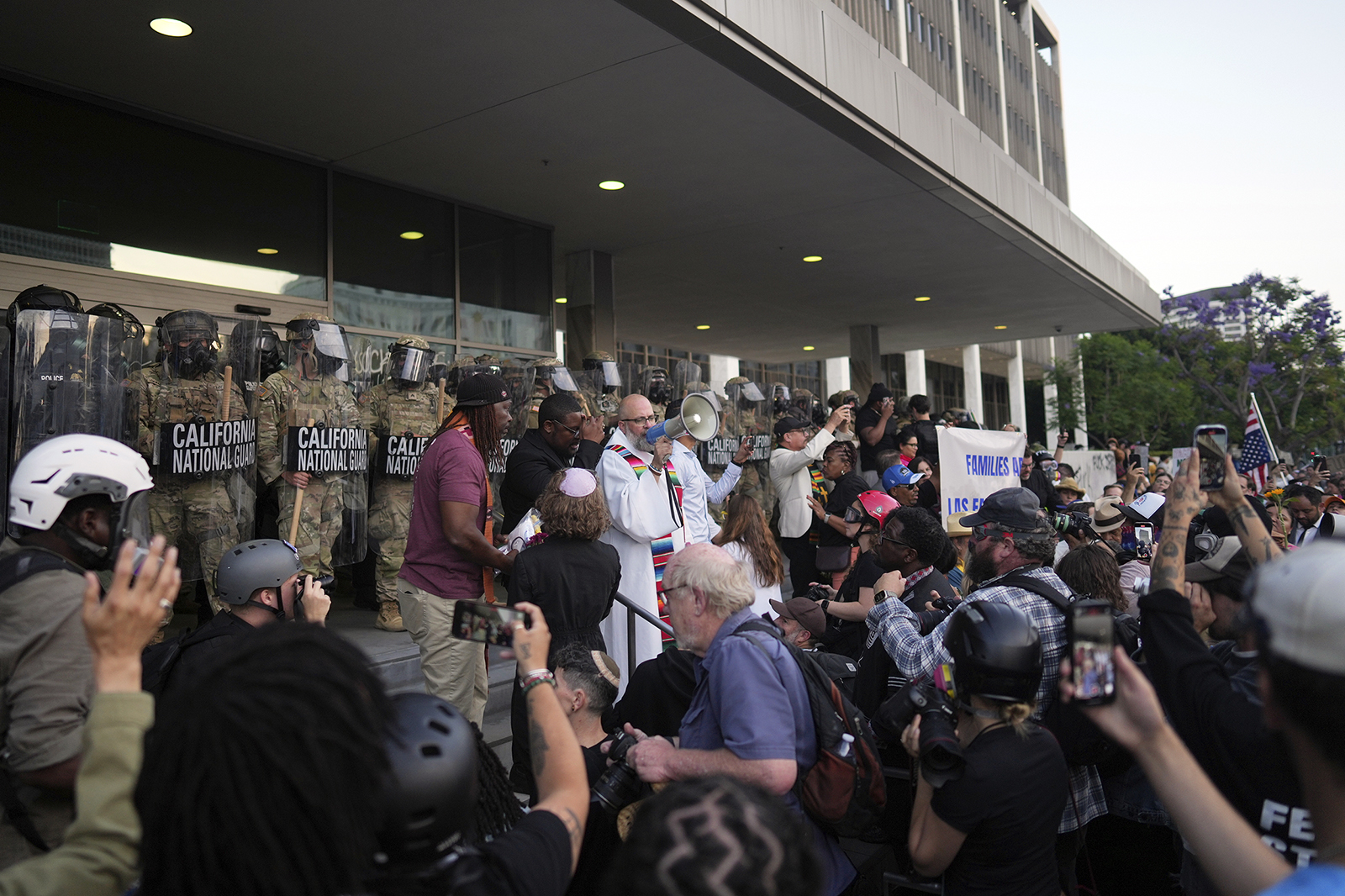
A clergy person addresses protesters as California National Guardsmen stand in line in front of a federal building in downtown Los Angeles, June 10, 2025. (AP Photo/Eric Thayer)

Traci Blackmon
June 20, 2025


(RNS) — In a democracy, the National Guard should represent both protection and presence — a sign that government stands ready to defend its people, not dominate them. But how, when and why we deploy the guard tells a deeper story about our national priorities, and about whose lives, griefs and demands we take seriously.

In just over a decade, the National Guard has been deployed in dramatically different ways, each revealing who we believe is worth protecting in this nation, and who is seen as a threat to be subdued.

In May 2025, a devastating tornado tore through North St. Louis, an overwhelmingly Black community still bearing the scars of redlining, disinvestment and environmental neglect. The state sent 41 National Guard troops to help with cleanup. No tanks, no tear gas, just people in uniform doing the slow, quiet work of lifting debris, clearing roads and restoring dignity. It was a small gesture, but a righteous one.

Compare that with 2014, when I stood in Ferguson, Missouri, after the police killing of Michael Brown. There, more than 2,200 National Guard troops were deployed — not to protect a grieving community, but to patrol it. The sin was not looting, but lament. Young people cried out for justice, and the state answered with armored trucks and rubber bullets. The very people whose pain should have called forth compassion were instead treated as enemies of the state.

And again, in June 2025, as families in Los Angeles protested U.S. Immigration and Customs Enforcement raids that tore loved ones from their homes, nearly 4,000 National Guard troops were sent to secure federal buildings and silence protest. I do not recall the parable where Jesus called in soldiers to stop a crowd demanding mercy.

These three deployments tell a troubling story: Too often in America, we deploy troops not in response to harm, but in response to hope. Hope that the world could be more just. Hope that our laws might finally reflect our values. Hope that this nation might someday live up to its highest ideals.

And instead of meeting that hope with courage, our government meets it with control.

RELATED: California pastor says apparent immigration agents waved a weapon at her in church parking lot

When communities cry out for justice, we respond with soldiers. When natural disasters devastate the most vulnerable, we respond with silence or scarcity. When Black or brown bodies protest their treatment at the hands of the state, the state doubles down on its power.

That’s not democracy — it’s a pattern of militarized suppression masquerading as order. It reveals how readily we treat dissent as danger, and how often we forget that protest, in its truest form, is patriotic.

Tyranny in America doesn’t always wear a crown or wave a flag. Sometimes, it wears camouflage and stands quietly behind a shield labeled “security.” And when troops are sent to suppress protest rather than provide relief, when the machinery of the state is deployed to silence the people it purports to serve, that, too, is tyranny — one that thrives not on chaos, but on selective order.

If we can mobilize soldiers in a matter of hours to patrol our streets, we can mobilize just as quickly to rebuild crumbling schools, to protect voting rights and to address the root causes of the rage we so often fear but rarely understand. We need the kind of leadership that doesn’t fear protest, but listens to it. The kind that understands that real peace is not the absence of tension, but the presence of justice.

As a pastor, I see the spiritual violence in this pattern and what it does to a people when their cries are met with cuffs. I see what it does to a democracy when dissent is mistaken for danger, and order becomes a substitute for justice. Militarized silence is not peace. And repression dressed in uniform is still tyranny.

There is a reason the Hebrew prophets cried out against unjust rulers, and a reason Jesus turned over tables in the temple. And there is a reason faith leaders have stood with those whose voices are ignored, whose communities are criminalized, whose suffering is legislated rather than healed.

If we can send the National Guard to clean up after a tornado, we can demonstrate the same urgency to clean up systemic injustice. We can send troops to build, protect and listen — not to break, punish and silence.

Faith and democracy demand more of us. God demands more of those in power than brute strength and fear-based governance.

So, no, we don’t need more troops. We need more truth. We need leaders who understand that righteousness is stronger than riot gear. That public safety begins with public trust. And that real peace is not the absence of protest, but the presence of justice.

Until that day, I will keep praying, preaching and standing with the people. Because tyranny, in any form, has no place in a nation that dares to call itself free.

(The Rev. Traci Blackmon is the CEO and founder of HopeBuilds, LLC, and the former associate general minister of justice and local church ministries for the United Church of Christ. The views expressed in this commentary do not necessarily reflect those of Religion News Service.)