Wednesday, August 13, 2025

 “They Poisoned the World”: The Corporate Cover-Up & Fightback Against PFAS, “Forever Chemicals”


Story
August 08, 2025

This is viewer supported news. Please do your part today.  Donate

Topics Environment

GuestsMariah Blake
investigative journalist and author.

Links"They Poisoned the World: Life and Death in the Age of Forever Chemicals"
"This Is How to Win an Environmental Fight: Meet the Unlikely Warriors on the Front Lines of a Major Environmental Battle"


In a major victory for environmental advocates, chemical giant DuPont and its related companies have agreed to pay $2 billion to clean up four industrial sites in New Jersey that are contaminated with “forever chemicals,” or PFAS, which have been found to persist in everything from rainwater to human breast milk. It is the third such settlement New Jersey has reached in less than three years, and marks a growing movement against the widespread use of PFAS, a class of chemicals still used to produce countless industrial and consumer goods, even though they have been linked to cancer and birth defects for over half a century. For more, we’re joined by investigative journalist Mariah Blake, the author of a new book on PFAS and the fight against them, to discuss the history of the pervasive toxins and the dangers they pose to human health.


Transcript
This is a rush transcript. Copy may not be in its final form.


AMY GOODMAN: This is Democracy Now!, democracynow.org. I’m Amy Goodman.

Officials in New Jersey have won what they say is the largest environmental settlement ever achieved by a single state, when chemical giant DuPont and its affiliates agreed to pay $2 billion to clean up four industrial sites contaminated with forever chemicals, or PFAS, which are widely used in industrial and consumer products, even though they’re linked to cancer and birth defects. It’s the third PFAS-related settlement New Jersey has reached in less than three years.

This is Maya van Rossum of the Delaware Riverkeeper Network, which is part of the litigation.


MAYA VAN ROSSUM: We have PFAS contamination of the fish that live in the Delaware River. It’s so insidious. And, of course, PFAS, PFOA, various members of this man-made family of chemicals, is literally in the bodies of people in New Jersey and nationwide, having devastating health consequences. … I think that this case really is going to send a message loud and clear that’s going to reverberate across the nation.

AMY GOODMAN: Studies show how PFAS contamination is now so ubiquitous that forever chemicals have been found in rainwater and the blood of almost all humans. This comes as the Trump administration has shuttered the Environmental Protection Agency’s Office of Research and Development, which helped test for PFAS.

And we’re going to talk about just what PFAS are with our next guest, Mariah Blake, investigative journalist and author of the new book, They Poisoned the World: Life and Death in the Age of Forever Chemicals. It’s on Ralph Nader’s list of books to read this summer. Her guest essay for The New York Times is headlined “This Is How to Win an Environmental Fight: Meet the Unlikely Warriors on the Front Lines of a Major Environmental Battle.” In her book, Mariah Blake reveals how the U.S. government’s top-secret Manhattan Project, that developed the atomic bomb that was dropped 80 years ago this week on Hiroshima and Nagasaki, was also responsible for the development of PFAS.

A lot to go through here. Mariah, welcome back to Democracy Now! First, start off by telling us what PFAS — P-F-A-S — are, and then talk about the victory in New Jersey. And then we’ll talk about this historic week, 80th anniversary of the dropping of the bombs on Japan, and how that links to PFAS. Start with what they are.

MARIAH BLAKE: OK. So, PFAS, also known as forever chemicals, are a large family of substances that have some pretty remarkable properties. They’re extremely resistant to heat, stains, water, grease, electrical currents. They stand up to chemicals that are so corrosive they burn through most other materials. And this has made them extremely useful. So, they helped usher in the aerospace travel and high-speed computing. They’ve transformed thousands of everyday items, from cookware to dental floss to kitty litter.

On the other hand, they are probably the most insidious pollutants in all of human history. So, we are talking about a class of chemicals that do not break down in the environment; in fact, they persist for hundreds, thousands or even millions of years. Those that have been studied are highly toxic even in the most minuscule doses. And they are literally polluting the entire planet, including human blood and ecosystems in the remotest parts of the world. And I think —

AMY GOODMAN: And, Mariah, I just want to say that PFAS actually stands for “per- and polyfluoroalkyl substances.” That’s the P-F-A-S. Keep going.

MARIAH BLAKE: That is correct. That is correct. So, yeah, I think the clearest example of their ubiquity comes from the study you mentioned of rainwater around the world. So, a group of prominent European scientists in 2022 looked at the levels of just the two best-studied PFAS in rainwater around the world, and they found everywhere in the world, including the remotest regions, places like the Tibetan Plateau, the levels were high enough to endanger human health and the environment. So, the levels were higher than the EPA’s safety standards for those chemicals in drinking water. The same is true of breast milk in many countries. So, not only are these chemicals ubiquitous, they’re ubiquitous at levels that — you know, that are potentially harmful to our health.

AMY GOODMAN: Explain what happened this week in New Jersey.

MARIAH BLAKE: So, this week, New Jersey, which is really — New Jersey is where PFAS were initially invented and mass produced. New Jersey settled with DuPont and other companies for $2 billion. This is in response to PFAS contamination. So, the companies have agreed to pay $2 billion in compensation, and there’s also a cleanup fund. And this is, as I understand it, the largest settlement paid to any state in the history of litigation.

AMY GOODMAN: And so, let’s go back in time. You know, just a few days ago, August 6th, you had the bells ring out, as they do every year, in Hiroshima, as they remember what happened. This year, it’s 80 years ago, August 6th, 1945. On Saturday, that’s the 80th anniversary of the dropping of the atomic bomb. The U.S. dropped the atomic bomb on Nagasaki. Talk about what PFAS, what these forever chemicals, have to do with the secret Manhattan Project that developed the atomic bomb.

MARIAH BLAKE: So, this is one of the things I found most surprising in my reporting. This class of chemicals, that are now ubiquitous in the environment and consumer goods, was actually developed by the U.S. government as part of the Manhattan Project. And the reason the government needed them is for uranium enrichment. So, uranium enrichment involved a highly corrosive chemical called uranium hexafluoride, and almost nothing could contain it, and so they needed substances that could stand up to this chemical. And they determined that the only ones that could were ones that combined carbon and fluorine, which together form the strongest bond in chemistry. And that is what PFAS are. So, they developed them during the Manhattan Project, and they were put into mass production during the Manhattan Project at a factory in New Jersey, a DuPont factory, in fact.

And it was clear from the beginning that these were dangerous chemicals. So, the plants where they were produced commonly had fires and explosions. Workers who worked in these plants were constantly being hospitalized with breathing problems and chemical burns. And in fact, Manhattan Project inspectors warned their supervisors that the fear of injury was causing unrest at these plants and that people in other parts of the DuPont facility had come to fear an assignment to this, to the fluorocarbon or PFAS production, as an exile to devil’s island.

But it wasn’t just workers who were affected. So, around 1943, farmers downwind of this plant in New Jersey began to complain that their peach crops were burning up, that their cows were so crippled, they couldn’t stand. They had to graze by crawling on their bellies. And in some cases, farmers were also falling ill after eating the produce that they picked.

Now, the farmers’ complaints really alarmed Manhattan Project officials. They worried that the farmers would sue and that it would compromise the secrecy of the Manhattan Project, but also that it would open the government and its contractors up to liability. So, in 1943, they launched the secret medical research program that researched the health effects of various Manhattan Project special materials, including uranium and plutonium. In fact, as part of this program, Manhattan Project scientists injected unknowing cancer patients with plutonium. But they also researched the health and environmental effects of PFAS.

And Manhattan Project scientists had determined, as early as 1947, that these chemicals were highly toxic and that they were accumulating in human blood. So, one of the things that makes these chemicals so harmful is that they build up in human blood, and they stay there for a long time. Now, this program continued after the war under the auspices of the Atomic Energy Commission, and by 1970, scientists within this program had determined that PFAS were accumulating in the blood of people all over this country.

AMY GOODMAN: So, if you can talk about — because, I mean, this book exposes so much. The title of your book is They Poisoned the World: Life and Death in the Age of Forever Chemicals. Can you talk about who “they” are? Talk about the role of the U.S. government and also the corporate cover-up of known dangers. One of your points is that you show how DuPont established the principle, “All new chemicals are safe until proven otherwise.” Mariah?

MARIAH BLAKE: So, after the war, a company called 3M acquired a license for technology to produce PFAS, and it hired Manhattan Project chemists to develop them for use in commercial production and, you know, for manufacturing purposes and also for use in consumer goods. So, one of the first PFAS-based products was Scotchgard, the fabric protector, which is ubiquitous. Yeah, so, and then DuPont also began producing them.

And these two companies also began studying the health effects very early on. So, as early as 1960, they knew these chemicals were toxic. As early as 1970, they knew they were accumulating in the blood of people all over the United States. They subsequently examined thousands of blood samples from people all over the world, including remote rural China. The only samples they could find that didn’t contain these chemicals were collected from Korean War vets before 1952. So, decades ago, these companies knew that these chemicals were ubiquitous in human blood.

Now, the findings about their presence in human blood alarmed insiders in DuPont and 3M, and they began intensively studying the health effects of these chemicals. They quickly discovered — well, A, they discovered that they didn’t break down in the environment, and that is one of the things that makes these chemicals uniquely harmful. But they also discovered that they had a devastating effect on lab animals. So, in one case, 3M tested these chemicals on monkeys, which were chosen because they’re more biologically similar to humans than lab rats. The study had to be aborted because all of the monkeys died.

When they started examining the effects on their workers, they found, you know, similarly alarming findings. So, as early as the 1970s and ’80s, they were linking these chemicals to leukemia, kidney cancer, immune suppression, organ damage, dramatic drops in testosterone. Even more alarming, they had begun to connect these chemicals to birth defects. So, in the 1970s, 3M conducted a study that found that a certain PFAS caused birth defects in the eyes of rats who were exposed in utero. And DuPont decided that it would start to monitor the pregnancies of workers in its Teflon factories — Teflon is made with PFAS — to see if their children also developed birth defects. And in fact, two of seven women who gave birth during the course of the program gave birth to children with facial deformities very similar to those found in rats.

But rather than inform workers or regulators or the public, DuPont simply canceled the study and continued exposing workers to these chemicals and continued releasing these chemicals into the environment, even though there were very simple steps the company could have taken to filter them out of, you know, the air and wastewater that was coming out of their plants.

AMY GOODMAN: Finally, you wrote a piece in The New York Times, “This Is How to Win an Environmental Fight: Meet the Unlikely Warriors on the Front Lines of a Major Environmental Battle.” In this last minute we have left, who are these warriors?

MARIAH BLAKE: So, there’s an unlikely network of activists all over this country — farmers, factory workers, suburban moms — whose lives have been personally affected by PFAS contamination, and they have been aggressively lobbying for action, and they have been remarkably effective. So, largely as a result of their activism, hundreds of laws restricting these chemicals have either passed state legislatures or are pending in state legislatures. And many of these laws, not only — they ban the entire class of chemicals in consumer products. So, this is revolutionary, because, traditionally, the way we regulate chemicals in this country is one by one, but these state-level laws are banning the entire class of chemicals. We also have a tsunami of litigation, driven largely by individuals.

And the combination of these two factors, the state level legislation — there’s a ban in the works in the EU, as well — and this huge volume of litigation against PFAS manufacturers, is prompting large swaths of the economy to voluntarily move away from PFAS. So, 3M, the world’s largest manufacturer of these chemicals, has announced that it will quit producing them by the end of this year. And dozens of major retail chains, like Apple, McDonald’s, Amazon, Target, have done the same. So, they have announced that they will reduce or eliminate PFAS in their products and packaging. So, there is a hopeful dimension to the story.

AMY GOODMAN: Mariah Blake, we want to thank you so much for being with us and —

MARIAH BLAKE: Thank you.

AMY GOODMAN: — for writing this book. Mariah Blake is author of They Poisoned the World: Life and Death in the Age of Forever Chemicals.

Coming up, we speak with a survivor of Jeffrey Epstein. Where are the survivors when it comes to the whole debate around the release of the Epstein files? We’ll talk to Jess Michaels. Back in 20 seconds.

[break]


The original content of this program is licensed under a Creative Commons Attribution-Noncommercial-No Derivative Works 3.0 United States License. Please attribute legal copies of this work to democracynow.org. Some of the work(s) that this program incorporates, however, may be separately licensed. For further information or additional permissions, contact us.

Neurotoxic? New chemical screening approach provides rapid answers


UFZ researchers develop efficient testing procedure using the zebrafish model


Helmholtz Centre for Environmental Research - UFZ

photo1 

image: 

UFZ scientist Dr David Leuthold uses the zebrafish model to test whether environmental chemicals have neurotoxic effects.

view more 

Credit: André Künzelmann / UFZ


"To date, only about 200 substances worldwide have been tested for neurotoxic effects through official regulatory studies", says UFZ ecotoxicologist Dr. David Leuthold, lead author of the study. "The reason for this is that these testing procedures are complex, time-consuming, and expensive. In addition, there is the ethical aspect, as these studies are predominantly conducted using rats and mice." What is lacking is a rapid and cost-effective screening method that can quickly and reliably detect neurotoxic effects of chemicals and complex chemical mixtures without the need for conventional animal experiments. And this is precisely where the UFZ study comes in to close this gap.

The UFZ team used the zebrafish embryo model, which is widely applied in toxicological research. One advantage of this model is that around 70 percent of the genes found in the zebrafish (Danio rerio) are also found in humans. The findings from the zebrafish embryo model are therefore likely transferable to humans. Additionally, embryos of the zebrafish are well-suited for high-throughput applications due to their small size and rapid development, providing valuable insights into the function of the nervous system.

Using the zebrafish model, the researchers have designed a screening procedure that allows chemicals to be rapidly tested for neurotoxic effects – including the identification of chemicals that disrupt learning and memory processes. But how can learning and memory be studied in a fish embryo? "We use what is essentially one of the simplest forms of learning: habituation to a re-occurring stimulus," explains Leuthold. "If an acoustic signal is heard, it triggers a startle or escape reflex. However, if it is heard repeatedly, the fish gets used to it and eventually stops responding to the non-threatening stimulus." Alternating between light and dark stimuli also leads to altered swimming behavior in zebrafish embyos. The researchers combined acoustic and visual stimuli in terms of frequency, order, temporal sequence, duration, and intensity, thus designing a defined test procedure.

They initially tested this method using chemical substances whose effects on zebrafish behavior toward visual or acoustic signals were known. "Neurotoxic substances can have very different effects. Some, for example, prevent fish embyos from habituating to an acoustic stimulus, causing their escape reflex to be repeatedly triggered. Other substances can cause habituation to occur much more quickly. Additionally, other visual and acoustic behaviors can be altered," explains Leuthold. "Using these known substances, we were able to generate a kind of behavioral fingerprint, which we can then use to draw conclusions about the way the chemical exposure disrupts nervous system function."

Using their zebrafish platform, the researchers then tested ten selected substances known to influence a receptor system (NMDAR), which plays a special role in learning and memory. Whether they also exhibit neurotoxic effects in zebrafish was not yet known. "With our screening approach, we were able to demonstrate significant effects on learning behavior for six substances. They therefore clearly exhibited a neuroactive effect," says Leuthold. One substance in particular caught the researchers' attention: Chlorophene, a chemical belonging to the group of biocides. Unlike the other substances, chlorophene did not lead to faster habituation to acoustic stimuli, but instead blocked learning behavior entirely. And another interesting finding emerged: Under the influence of chlorophen, the fish embryos still responded to acoustic stimuli, but not to visual ones. "This phenomenon is called paradoxical excitation and occurs with certain narcotics," says Leuthold. It was previously unknown that chlorophene could also have this effect, which is why the researchers wanted to further investigate the underlying mechanism of action.

They came across a study by US-American colleagues in which narcotics were tested in the zebrafish model. The study showed that paradoxical excitation can be mediated by specific receptors (GABAA), which play an important role in our central nervous system and are pivotal for controlling behavior. Could the effect of chlorophene be inhibited if GABAA receptors are blocked? Leuthold: "When GABAA receptors were blocked, the fish embryos exposed to chlorophene recovered their ability to respond to visual stimuli. However, blocking the receptors could not reverse the altered learning behavior. We learned that chlorophene has multiple molecular mechanisms."

But first, the researchers wanted to validate their hypothesis regarding chlorophene's mechanism of action via GABAA receptors through further tests. For this, they used neurons isolated from mice and human neuronal cell models. In collaboration with colleagues from the University of Leipzig and the Leibniz Institute for Environmental Medicine in Düsseldorf, the researchers were able to demonstrate that chlorophene also acts via GABAA receptors. Computer models that match the chemical structure with possible receptors also predicted binding to GABAA receptors. Chlorophene's mechanism of action via GABAA receptors was thus proven.

But what about chlorophene's other mechanism of action, which alters learning behavior? Could the first-mentioned NMDA receptor system be behind this? Further studies indicated that chlorophene probably doesn't interact directly with the receptor. In the US study with the narcotics tested in the zebrafish model, the researchers found evidence of another receptor system that could play a role in paradoxical excitation: certain potassium channels. "So we came up with the idea of testing the painkiller flupirtine, which acts via these potassium channels, in our zebrafish platform," explains Leuthold. "And indeed – flupirtine elicited almost the same behavioral patterns as chlorophene, including reduced learning behavior! Chlorophene presumably acts in a very similar, if not identical, way via these potassium channels."

The researchers hope that their screening approach will help enable chemicals and chemical mixtures to be tested for neurotoxic effects on a large scale – quickly, cost-effectively, and without the need for conventional animal testing – so that risks to humans and the environment can be identified at an early stage. "Our zebrafish platform is in line with the EU Chemicals Strategy and the concept of the European Green Deal, as it can identify hazardous chemicals early, before they cause harm," says Leuthold.

Prof Dr Tamara Tal, who heads the working group at the UFZ where the study was conducted, emphasises: "Regulatory authorities are generally skeptical about using toxicity data generated in zebrafish to make chemical regulations for humans. When we demonstrate that the way these chemicals disrupt how the brain develops and functions is specifically conserved in zebrafish, mouse, and human models, we build confidence in the use of zebrafish behavior-based data to fill the vast void in neurotoxicity testing to ultimately improve human health from the harmful effects of neurotoxic chemicals.”

Well plate containing 96 zebrafish embryos for the automated analysis of their swimming behavior via video tracking.

Credit

André Künzelmann / UFZ

THE FINAL SOLUTION

Israeli military approves plan for expanded offensive in Gaza

Israeli armed forces chief Lieutenant General Eyal Zamir has “approved the main framework” for a new offensive in the Gaza Strip, a statement released by the army said. Prime Benjamin Minister Netanyahu has not provided a timetable for when Israeli troops will enter Gaza City, where thousands of Gazans have taken refuge after fleeing Israel's previous offensives.


Issued on: 13/08/2025 - 
By:  FRANCE 24
Video by: Noga TARNOPOLSKY

Palestinian watch as a plume of smoke rises during an Israeli strike on Gaza City's southern al-Zeitoun neighbourhood on August 8, 2025. © Bashar Taleb, AFP
01:26


The Israeli military said on Wednesday it had approved the framework for a new offensive in the Gaza Strip, as Hamas condemned what it called “aggressive” Israeli ground incursions in Gaza City.

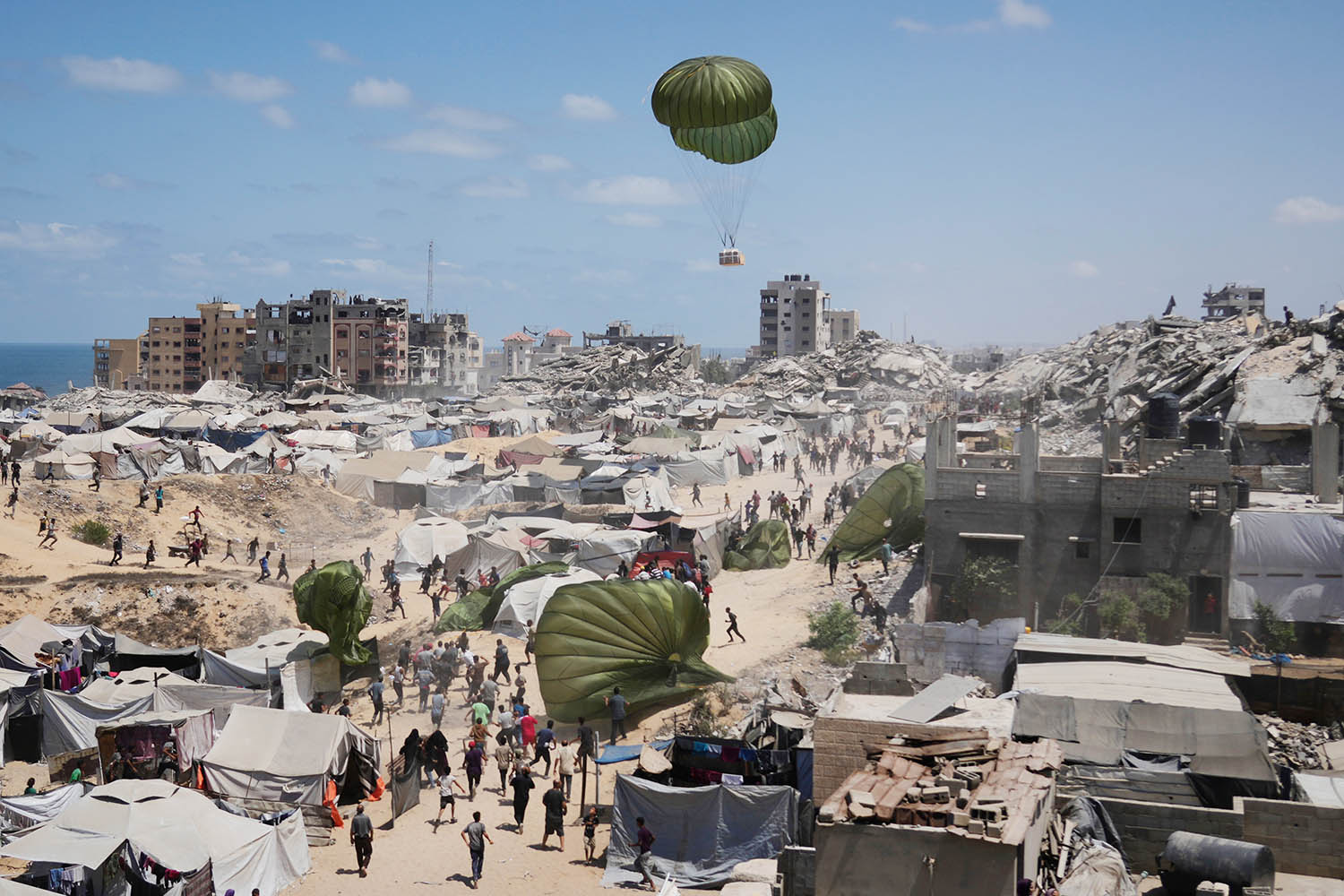
The approval for the expanded offensive comes days after Israel’s security cabinet called for the seizure of Gaza’s largest city, following 22 months of war that have created dire humanitarian conditions in the Palestinian territory. Israeli continues to severely restrict the amount of food and other supplies that it allows to enter the besieged enclave.

Israeli armed forces chief Lieutenant General Eyal Zamir “approved the main framework for the IDF’s operational plan in the Gaza Strip,” a statement released by the army said.

Prime Benjamin Minister Netanyahu’s government has not provided a precise timetable for when Israeli troops will enter Gaza City, where thousands have taken refuge after fleeing previous offensives.

Read more Netanyahu pushes for Palestinians' departure from Gaza as Egypt seeks 60-day truce

Ismail Al-Thawabta, director general of the Hamas government media office in Gaza, told AFP on Wednesday that “the Israeli occupation forces continue to carry out aggressive incursions in Gaza City”.

“These assaults represent a dangerous escalation aimed at imposing a new reality on the ground by force, through a scorched-earth policy and the complete destruction of civilian property,” he added.

Sabah Fatoum, 51, who lives in a tent in the Tal al-Hawa neighbourhood of Gaza City told AFP by phone that “the explosions are massive” in the area.

There are “many air strikes and tanks are advancing in the southern area of Tal al-Hawa with drones above our heads,” she said.

“The tanks are still there, and I saw dozens of civilians fleeing” to the west of the city, she added.

Gaza’s civil defence agency said Israeli air strikes on Gaza City have intensified in recent days, with the residential neighbourhoods of Zeitoun and Sabra hit “with very heavy air strikes targeting civilian homes, possibly including high-rise buildings”.

Agency spokesman Mahmud Bassal told AFP that Israeli strikes or fire had killed at least 35 people across Gaza on Wednesday.
‘Just escaped death’

AFP footage from Gaza City on Tuesday showed Palestinians fleeing Israeli strikes on the Zeitoun and Asqoola using overladen carts, vans and bikes.

“I didn’t bring a mattress or anything and we just escaped death and now we’re running away and we don’t know where to go,” said displaced Palestinian Fidaa Saad.

Israel’s plans to expand its offensive into Gaza City come as diplomacy aimed at securing an elusive ceasefire and hostage release deal has stalled for weeks, after the latest round of negotiations broke down in July.

Egypt said Tuesday it was working with fellow Gaza mediators Qatar and the United States to broker a 60-day truce “with the release of some hostages and some Palestinian detainees, and the flow of humanitarian and medical assistance to Gaza without restrictions, without conditions”.

Hamas said early Wednesday that a senior delegation had arrived in Cairo for “preliminary talks” with Egyptian officials.

Israel’s plans to expand the Gaza war have sparked international outcry as well as domestic opposition.

Reserve and retired pilots who served in the Israeli air force on Tuesday rallied in Tel Aviv to demand an end to the conflict.

“This war and expansion will only cause the death of the hostages, death of more Israeli soldiers, and death of many more innocent Palestinians in Gaza,” said Guy Poran, a former Israeli air force pilot.

Read moreIsrael's security cabinet approves plan to take over Gaza City
Dire conditions

UN-backed experts have warned of widespread famine unfolding in the territory, where Israel has drastically curtailed the amount of humanitarian aid it allows in.

The health ministry in Hamas-run Gaza says at least 235 people including 106 children have died of hunger since the war began in October 2023, with many cases recorded in recent weeks.

Netanyahu on Tuesday revived calls to “allow” Palestinians to leave Gaza, telling Israeli broadcaster i24NEWS that “we are not pushing them out, but we are allowing them to leave”.

Past calls to resettle Gazans outside of the war-battered territory, including from US President Donald Trump, have sparked concern among Palestinians and condemnation from the international community.

Hamas’s October 2023 attack on Israel which triggered the war resulted in the deaths of 1,219 people, according to an AFP tally based on official figures.

Of the 251 hostages taken during the attack, 49 are still held in Gaza, including 27 the Israeli military says are dead.

Israel’s offensive has killed at least 61,722 Palestinians, according to figures from the health ministry in Gaza which the United Nations considers reliable.

(FRANCE 24 with AFP)


Russia slams Israel's plans to occupy Gaza, warns of consequences for Middle East region

'We believe that implementing such plans is extremely risky because it may lead to further degradation of the situation in occupied territories, with very serious negative consequences,' says Foreign Ministry deputy spokesman


Elena Teslova |13.08.2025 - TRT./AA


MOSCOW

Russia on Wednesday denounced Israel's plans to expand its military operation and occupy the entire Gaza Strip, warning that it would have far-reaching consequences for the Middle East region.

"We believe that implementing such plans is extremely risky because it may lead to further degradation of the situation in occupied territories, with very serious negative consequences both for Israel's own security and for the entire Middle East region," Foreign Ministry deputy spokesman Alexey Fadeyev said in response to an Anadolu question at a press briefing in Moscow.

Fadeyev said that despite efforts by mediator countries, indirect contacts between the Palestinian group Hamas and Israeli authorities have produced no tangible results.

"Our immediate priority now is to prevent the complete destruction of Gaza and avoid an increase in civilian casualties. The only way to achieve these goals is through urgent agreement on a ceasefire," he stressed.

The official also urged both sides to urgently find mutually acceptable solutions and transition to a sustainable cessation-of-fire regime, noting that doing so would allow for practical steps toward long-term resolution of the Palestinian issue based on the well-known two-state international legal framework.

Israel is facing mounting condemnation for its genocidal war on Gaza, where it has killed nearly 61,600 victims since October 2023.

Last November, the International Criminal Court issued arrest warrants for Israeli Prime Minister Benjamin Netanyahu and his former Defense Minister Yoav Gallant for war crimes and crimes against humanity in Gaza.

Israel also faces a genocide case at the International Court of Justice for its war on the enclave.
Israel says U.N. threatened to add it to its sexual violence blacklist

Guterres complained that Israel's consistent refusal to allow U.N. monitors access to verify abuse


Israel said U.N. Secretary-General Antonio Guterres had threatened to add it to a blacklist of countries and groups, including Hamas, for which there was credible reason to believe used sexual violence as a weapon of war. File Photo by COP28/UN Climate Change/UPI | License Photo


Aug. 13 (UPI) -- Israel received a formal warning from United Nations Secretary-General Antonio Guterres that its military and security agencies faced being added to an annual "blacklist" of countries and groups believed to be committing acts of sexual violence in armed conflict.

Israel escaped inclusion in this year's U.N. Report on Conflict-Related Sexual Violence, but Guterres wrote Danny Danon, Israeli Ambassador to the U.N., placing Israel on notice over "grave concerns" regarding allegations in the report of sexual violence by its security forces against Palestinians in Israeli detention.


In the letter, shared by Danon, Guterres warned that Israel was on watch and could be added to the blacklist in next year's report, saying consistently documented patterns had triggered "significant concerns."

Guterres complained that Israel's consistent refusal to allow U.N. monitors access to verify abuse had made the task of making a "definitive determination regarding patterns, trends and systematicity" of sexual violence very problematic.

"I urge the government of Israel to take the necessary measures to ensure immediate cessation of all acts of sexual violence," he wrote.

Danon accused Guterres of spreading a serious accusation against the State of Israel, saying that in doing so, he had "again chosen to adopt baseless accusations, relying on biased publications."

"The U.N. should focus on the shocking war crimes of Hamas and the immediate release of all hostages. Israel will not be deterred from defending its citizens and will continue to act in accordance with international law," Danon said in a post on X.

Inclusion on the list would place Israel in the same company as Hamas, which was confirmed on Tuesday to have earned a place on the list for the first time, both in relation to sexual violence perpetrated in the Oct. 7, 2023, attacks on Israel and against hostages in captivity.

Leading Israeli human rights group B'Tselem alleged routine meting out of sexual violence against Palestinian detainees by Israeli soldiers and guards in an August 2024 report that claimed the Israeli penal system operated a "network of torture camps."

In March, a report by the U.N.'s human rights watchdog accused Israel of increasing sexual violence against Palestinians and genocidal acts "through the systematic destruction of sexual and reproductive healthcare facilities," in Gaza and the West Bank.

The 49-page U.N. Human Rights Commission report, which was presented to Human Rights Council hearings in Geneva, detailed violations perpetrated against Palestinian women, men, girls and boys across the Occupied Palestinian Territory.

It said the abuses constituted "a major element in the ill-treatment of Palestinians and are part of the unlawful occupation and persecution of Palestinians as a group."
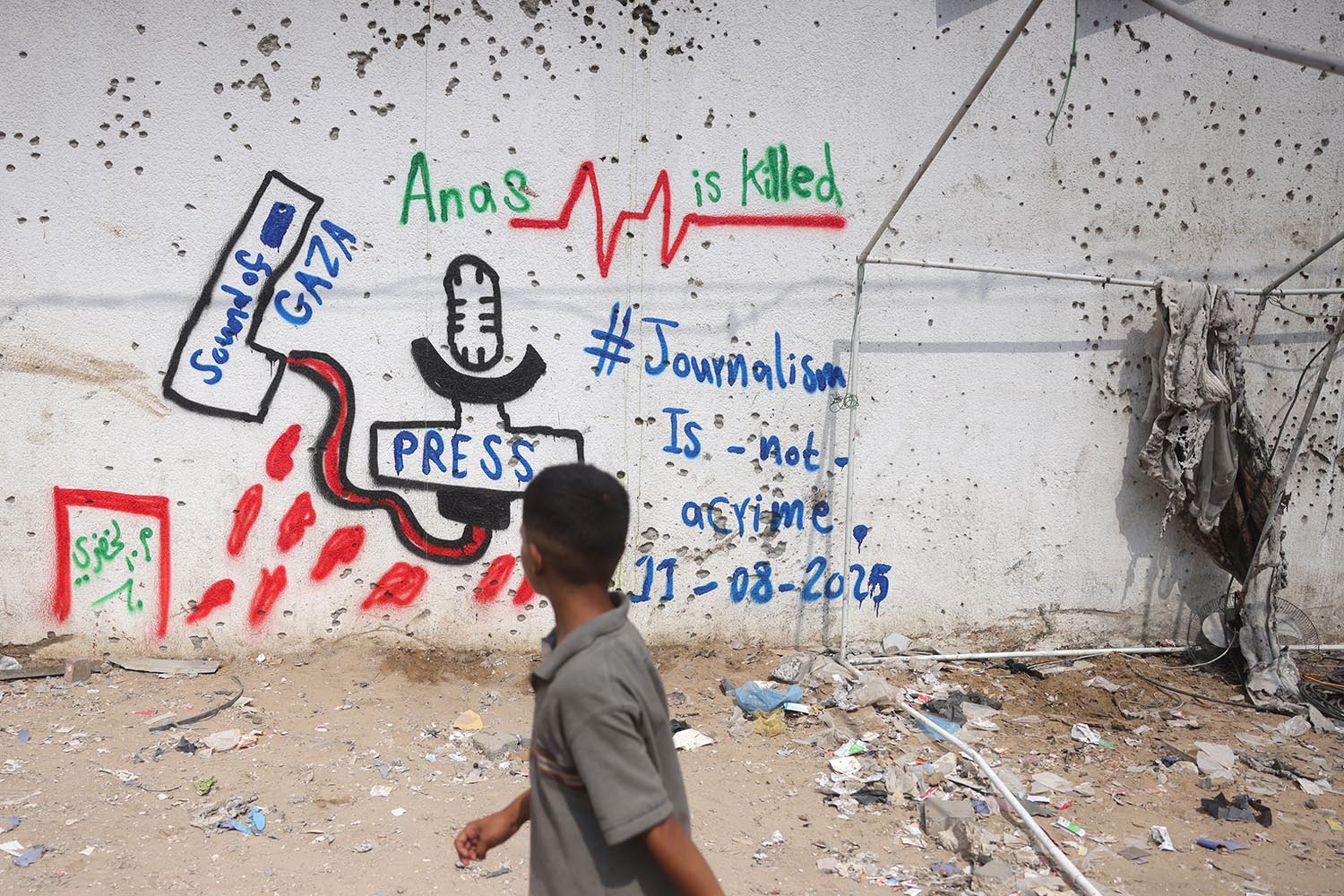
The killing of Anas al-Sharif is part of a “deadly pattern”
THE OBSERVER, UK


Six reporters were killed in a single strike in Gaza last Sunday, bringing the total to at least 242 since the 2023 Hamas attacks


The first Israeli missile exploded close to the al-Shifa hospital in Gaza City just after 11pm on Sunday night. The second slammed directly into the media tent close to the entrance, killing four Al Jazeera journalists.


Cameraman Mohammed Noufal, correspondent Mohammed Qreiqeh, cameraman Ibrahim Zaher and correspondent Anas al-Sharif all died instantly. Six journalists were killed in the attack that night.


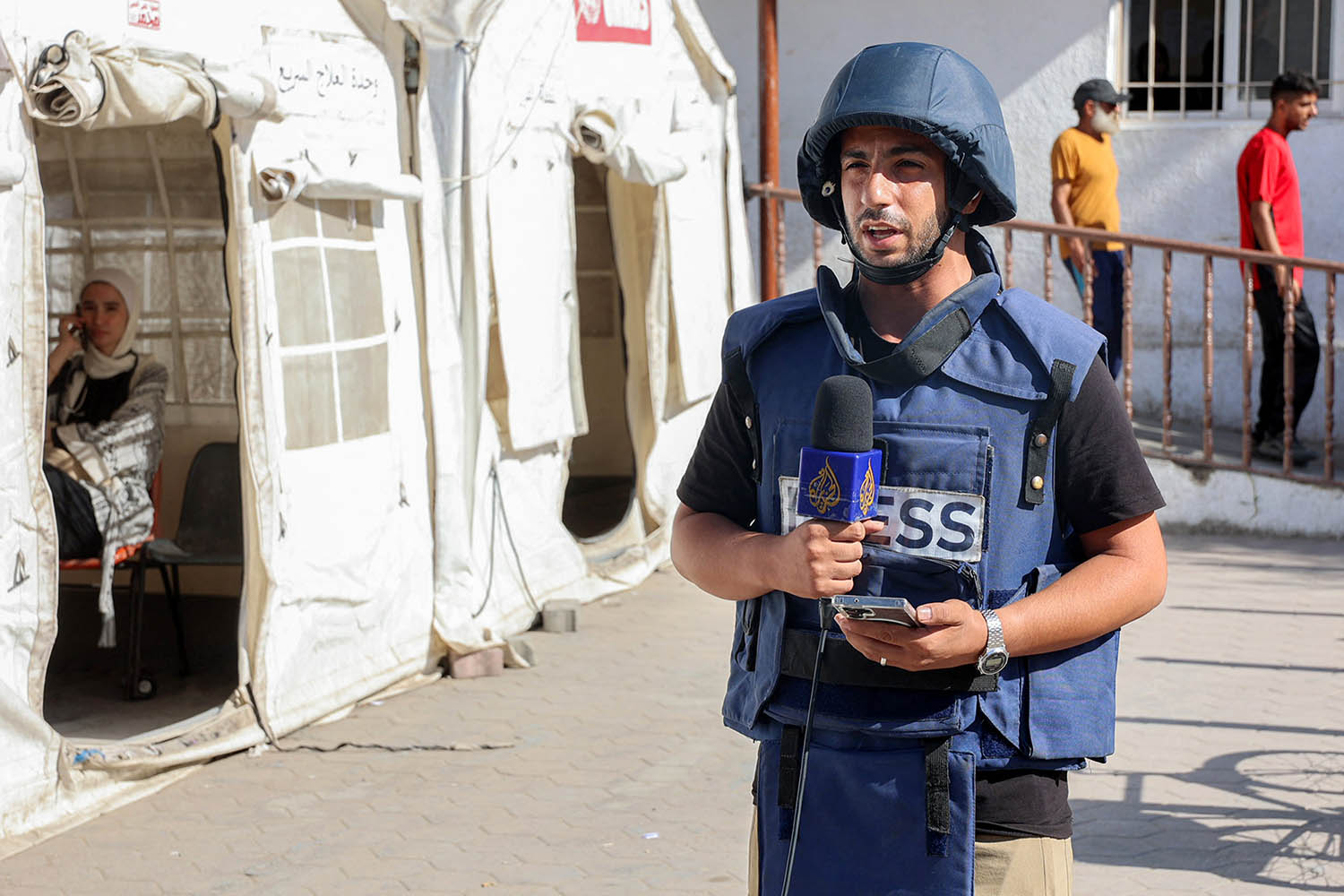
Al-Sharif, a 28-year-old father of two, became one of the besieged enclave’s most famous correspondents. His boyish face and neatly combed hair, often at odds with the horrors he was relentlessly covering, faltered only once when he broke down live on air while reporting on the starvation of the Palestinian people in Gaza. Onlookers encouraged him to keep working, calling him the “voice” of the strip.


On 24 July, Avichay Adraee, the Israeli military Arabic spokesperson, branded al-Sharif a long-time operative of Hamas’s military wing. Specifically, he accused him of being a member of Al-Qassam Brigades since 2013, and said he had since moved during the war “to work for the most criminal and offensive channel”. Israel has failed to provided concrete and credible evidence for this claim.

Anas al-Sharif was one of the best-known Palestinian journalists in the Gaza strip.

The Committee to Protect Journalists described Adraee’s statements as “unfounded accusations” that “represent an effort to manufacture consent to kill al-Sharif”.


Related articles:

Family of Israeli hostages call government’s decision to annex Gaza ‘profoundly disturbing’
Sharone Lifschitz


Obituary: Jim Meyer, mentor for young journalists in Africa
Erick Kabendera


Jon Williams, executive director of journalism charity the Rory Peck Trust, condemned the air of impunity that surrounds Israel. “Not in a single case of a Palestinian journalist being killed by Israel, has anybody ever been held to account, before or after 7 October 2023.”


According to the UN, 242 journalists have been killed since the outbreak of Israel’s war on Gaza, following Hamas’s attacks on 7 October, including three journalists in Lebanon and two in Israel, making it the deadliest conflict for journalists since records began.


The war on Gaza has eroded conventions on press protection in war. International humanitarian law shields journalists as civilians in war and therefore considers their targeting a war crime. With so many journalists being killed with impunity it risks normalising the notion that journalists are fair game in conflict.


With foreign press barred from entering Gaza to report, except on embed organised by the Israei Defence Forces, and so many Palestinian journalists killed, the ability to gather first-hand, verified information is dwindling. Actors, either state or non-state, create powerful narratives unchecked, and propaganda thrives. As each death shrinks first-hand coverage, misinformation fills the gap.


Reporters Sans Frontières, an independent French non-profit organisation that safeguards the right to freedom of information, believes that stronger enforcement of international law needs to be implemented, with thorough independent investigations put in place and automatic war crimes enquiries when journalists die in conflict zones. The precedent in Gaza will deter frontline reporting elsewhere – unless accountability mechanisms strengthen.


To date, the CPJ has documented 26 murders in Gaza and Lebanon – cases in which international investigations and IDF public messaging declared deliberate targeting of journalists.


“What we’re documenting are not claims and are not hearsay. These are deadly patterns and horrific realities that are happening now, as the world watches,” Sara Qudah, CPJ regional director for the Middle East and North Africa, told The Observer. “Our chance to change and uphold the international law is now, before it’s too late, before the massacre takes more lives, before journalism is doomed, and killing journalists becomes the norm.”

If we don’t put an end to these atrocities and hold Israel accountable then we have failed humanity and all our fallen colleagues
Christina Assi, AFP reporter

In the past 22 months, hundreds of journalists from local and international outlets have been killed in Gaza, Israel and Lebanon. Before the recent targeting of al-Sharif, Al Jazeera’s Hamza Dahdouh — son of bureau chief Wael Dahdouh — and video journalist Mustafa Thuraya died when an Israeli missile struck their car in al-Mawasi last January. They had been heading to interview residents in what was then deemed a safe zone. Israel later alleged, without evidence, that both were members of terrorist groups.

On 13 October 2023, five days into the war, Reuters journalist Issam Abdallah was killed when Israeli tank fire struck a group of clearly identified reporters in south Lebanon. Colleagues from Reuters, AFP and Al Jazeera were covering clashes between Hezbollah and Israeli forces. A Human Rights Watch investigation concluded that an Israeli drone circled the group 11 times before the attack. AFP’s 29-year-old Christina Assi was critically wounded and lost a leg. No Israeli soldier has faced accountability.

“If we don’t put an end to these atrocities and hold Israel accountable then we have failed humanity and all our fallen colleagues,” Assi told The Observer.

“Media organisations need to stop copy pasting Israeli press releases, which have been proven to be misleading and fake countless times. ‘Israel says’ isn’t journalism. Israel executed all these journalists with full confidence that their deaths would be ignored.”

The rate of killing in Israel’s war on Gaza has forced almost every journalist working there to either write their own obituaries or leave a message to be published posthumously.

In a post published on X after his death, al-Sharif wrote: “If these words reach you, know that Israel has succeeded in killing me and silencing my voice… I gave every effort and all my strength to be a support and a voice for my people… do not forget Gaza.”


Photograph by Bashar Taleb/AFP
YouTube Star Ms. Rachel on Her Gaza Advocacy: “My Deep Care for Children Doesn’t Stop at Any Border”

August 13, 2025
DEMOCRACY NOW!

This is viewer supported news. Please do your part today. Donate

Topics Palestine

Guests Rachel Griffin Accurso
children’s entertainer and educator, known professionally as Ms. Rachel.
Tareq Hailat
director of the Treatment Abroad Program for the Palestine Children’s Relief Fund.

Links Palestine Children's Relief Fund: Treatment Abroad Program


We speak with Rachel Griffin Accurso, the educator known to millions around the world as Ms. Rachel, who has become a leading advocate for children in Gaza. Her YouTube channel for young children became wildly popular during the COVID-19 pandemic and today has more than 16 million subscribers. Since the start of Israel’s war on Gaza, Accurso has used her social media reach to speak out for Palestinian children facing hunger, disease, injury and death. She has been hailed as the heir to Mister Rogers, the legendary PBS children’s entertainer who also used his position in families’ living rooms to speak out on social issues.

“I see all children as precious and equal. My deep care for children doesn’t stop at any border,” Accurso tells Democracy Now! in a wide-ranging interview.

We also speak with Tareq Hailat, director of the Treatment Abroad Program for the Palestine Children’s Relief Fund, who helped connect Accurso with a 3-year-old girl from Gaza named Rahaf who lost both her legs in an Israeli airstrike. Accurso and Rahaf filmed a video, in which they sing a dance together.

Hailat describes Accurso as “one of the most significant, if not the most significant, voices for Palestinian human rights” in the world. “Her advocacy has touched the hearts of people that never would have ever heard about Gaza or the Palestinian children, and that’s why her voice is so vital,” he says.


LONG READ


Transcript
This is a rush transcript. Copy may not be in its final form.


AMY GOODMAN: Well, if you’ve spent any time around young children in recent years, our first guest may need no introduction. The Washington Post has called her the Mister Rogers of our era. Her YouTube channel has about, oh, 16 million subscribers and more than 10 billion views. In January, Netflix began licensing episodes. Her show is now the seventh most watched on Netflix in the first half of 2025.

We’re talking about Ms. Rachel, the children’s entertainer, educator and mother, who has become a worldwide sensation over the past six years, since she began posting videos for toddlers on YouTube. Much like Mister Rogers before her, Ms. Rachel has not shied away from speaking out about injustice, most notably about Gaza and the plight of Palestinian children. She recently wrote on Instagram:

“I want my taxes to help children

not kill them

I want my taxes to feed children

not starve them

I want to build a better world

not bomb it,” unquote.

In another Instagram post, Ms. Rachel said she would refuse to work with anyone who’s not spoken out against the treatment of Palestinians in Gaza. She’s also featured Palestinian children on her show.

So, now we’re going to go back to that video we just played of Ms. Rachel singing with Rahaf, a 3-year-old girl from Gaza who lost her legs in an Israeli airstrike.


MS. RACHEL: Let’s go back to sleep, Rahaf. We’re so tired.


[singing with Rahaf] See the bunnies sleeping 'til it's nearly noon. Shall we wake them with a merry tune? They’re so still. Are they ill? Wake up soon.


Let’s pretend to sleep. [snoring]


Wake up, little bunnies!


[singing] Skip, little bunnies! Skip, skip, skip! Skip, little bunnies! Skip, skip, skip! Skip, little bunnies! Skip, skip, skip! Skip, skip, skip and stop!


Let’s hop again!


[singing] Hop, little bunnies! Hop, hop, hop! Hop, little bunnies! Hop, hop, hop! Hop, little bunnies! Hop, hop, hop! Hop, hop, hop and stop!


Yay! That was so much fun! Thank you!

AMY GOODMAN: That video of Ms. Rachel and Rahaf has been liked over a million times on Instagram.

Well, today, Ms. Rachel — that’s Rachel Griffin Accurso — joins us in our studio.

Welcome to Democracy Now! It’s an honor to have you here. Can you talk about who Rahaf is, this little girl, how you met her, and why the children of Palestine are so important to you?

RACHEL GRIFFIN ACCURSO: Thank you so much for having me, Amy. It’s an honor to speak with you.

Rahaf is an adorable, bright, loving 3-year-old girl. She came here through the Palestine Children’s Relief Fund, PCRF, and she was evacuated with her mom, Israa, and they’re getting therapies and treatment at the hospital and living with a host family. And she’s absolutely delightful. She’s similar to 3-year-olds I’ve worked with, because she loves to pretend, and she’s just adorable and just taking in the world, and so sweet and innocent. And then she’s unlike 3-year-olds I’ve worked with across communities, because she has lost her legs. She’s away from her dad and her brothers right now. Her —

AMY GOODMAN: They’re in Gaza?

RACHEL GRIFFIN ACCURSO: Yeah. And so, yeah, just seeing her — and also, she’s having more of her human rights respected right now. So, she’s getting medical care, and she’s getting food, and she’s absolutely thriving. This girl is going to change the — she has changed the world, and she’s going to go so far. She just has that chance now, because she has her human rights respected.

And I saw videos of her in Gaza on the hospital floor. I saw videos of her looking extremely depressed. And one of the things her mom told me is “Thank you for helping her with her mental health,” because in Gaza, she just looked so distraught. And she’s 3 years old. And 3-year-olds are so, so delightful and happy. And she just — yeah, it was just really, really hard seeing her in Gaza, what — how she looked and the amputations. And she’s been through so much, and she’s 3.

JUAN GONZÁLEZ: You rarely make overt political statements, but instead stress helping children, regardless of where they live and who they are. What made you decide to speak out more forcefully on the Palestinian children? And what’s been the reaction that you’ve gotten from your millions of followers?

RACHEL GRIFFIN ACCURSO: Well, as an early childhood educator, I know what children need to thrive. They need food, and food is being blocked from them. They need water, and water is being blocked. They need to be in school, and they’ve been out of school for two years because most of their schools have been bombed. They need medical care, and most of their hospitals have been bombed. So, I see precious children, and I see them just like I see my children, and I see all children as precious and equal. My deep care for children doesn’t stop at any border. And I saw these human rights violations, and I had to speak up, because I — it’s who I am. That’s who I am as Ms. Rachel. I love all kids.

JUAN GONZÁLEZ: And you’ve also spoken out on social media about Ariel and Kfir Bibas, Jewish children whom Hamas took hostage. And after the Bibases’ deaths were announced, you wrote in a post in February, quote, “My heart is with the Bibas family, the Jewish community, and people all over the world who are grieving. We need to protect children always.” But despite your speaking out that way, you’ve been labeled an antisemite by some, some organizations of — pro-Israeli organizations. Can you talk about that?

RACHEL GRIFFIN ACCURSO: Yeah. So, that is — that’s really painful, because, obviously, it’s not true, and I care so much about Jewish children and all children. And it is — it is difficult to receive criticism, but I know who I am. And that pain will never compare to the pain of not speaking out during a genocide and what would happen if I didn’t try to help.

And obviously, that pain is nothing compared to a mom in Gaza, who I put myself — I sat with a mom from Gaza. She is a teacher, like me, and I sat with her while her child doesn’t have legs. I sat with her while she FaceTimed her children, who she can’t eat anymore on FaceTime with them, because they’re so hungry. And I pictured my little boy there with my husband, and I pictured myself with my little girl having lost her legs and have that happen. And I will do anything for her. And I thought, “What would I want her to do for me if we were switched?” Because I was just born here, and she was born there. We’re not different. I saw her look at the pride on her son’s face when she saw her beautiful sons in Gaza, and she had the same pride that I have when I look at my wonderful Thomas. And she is so broken about what’s happened to Rahaf, but so supportive and sweet, and all she thinks about every day is getting back to her boys.

And I think, as a mom, the most excruciating thing in the world would be being separated from your children. And I think about Israeli moms who have children still held hostage. And I just — I think about mothers all the time, everywhere, whose children don’t have what they need, because if I couldn’t provide milk for my daughter, and it was miles away, and my baby — I have a 6-month-old, and she cries for milk, you know? And every time I feed her, I think, “Why is milk miles away and not — and not getting to them?” And my son said, “Mommy, could the kids of Gaza — could they take a car to get the milk to the babies?” And our kids are watching us. They’re taking in what us grown-ups are doing, and we’re not protecting children.

AMY GOODMAN: So, Rahaf’s mom is with her here. Why weren’t her father and brothers able to come?

RACHEL GRIFFIN ACCURSO: I believe Tareq can speak better to this, but I don’t think that men are often approved to come. I’m not sure. It’s — they weren’t approved.

AMY GOODMAN: And we are going to ask him in a moment, the Palestine Children’s Relief Foundation. Tareq Hailat is the director of the Treatment Abroad Program for Palestine Children’s Relief Fund, and he is joining us, as well. Tareq, can you address that issue? Why isn’t Rahaf’s family all together here?

TAREQ HAILAT: Yeah, first of all, thank you. Amy and Juan. Hello, Rachel. It’s good seeing you.

RACHEL GRIFFIN ACCURSO: It’s great to see you.

TAREQ HAILAT: So, obviously, it is a really difficult situation, and Rachel was actually 100% correct on the reasoning as to why we were not able to bring her other children and the father. The medically evacuating children needs the approval of the Israelis to be able to take them out. And actually, both Rahaf, her mother and her siblings and father were all rejected the first time that we tried to evacuate them. And it didn’t take until three other months of advocacy and petitioning to get the approval to at least Rahaf and her mother to then finally receive that approval from the Israeli military to be able to take them out and evacuate them with all the other children that we brought here to the United States.

And it’s really unfortunate, because I don’t think in any other war, conflict, genocide, would you ever see the side that is causing the harm on these children have to provide the approval for them to be medically evacuated. You know, I think about it in the context of Ukraine and Russia. You would never need the Russian approval to take a Ukrainian child out to receive medical treatment. However, it’s unique in this particular case, where we do need the Israeli military’s approval to take out an injured child that was injured by the Israeli military.

JUAN GONZÁLEZ: And, Tareq, your organization has evacuated over 250 children out of Gaza, but the estimates are that there were — that 40,500 children have been injured since October 2024, and that includes 940 children who have had limbs amputated. What kind of medical care is necessary for amputees, especially for children amputees?

TAREQ HAILAT: Yeah, so, we are the largest Palestinian-led organization to medically evacuate children. And that is only 250 children. I mean, that is a drop in the bucket. And if we had the say on how we wanted to treat these children, it would not be evacuating them all the way to the United States to receive a prosthetic device. What we would do is — part of our other programs, like our medical missions or our infrastructural program, where we build hospitals inside of Gaza, like the only pediatric oncology center currently in Gaza, that was bombed twice — we would build infrastructure inside of Gaza to treat the children inside of Gaza. However, due to these restrictions, and due to the crumbling healthcare infrastructure, due to the constant dangers of our buildings being destroyed, we have to evacuate children out.

And again, it’s only 250 children, and you’re talking about the largest organization. That should just show how many months of hard, hard work it takes just to evacuate one child like Rahaf. I mean, at the end of the day, this is the largest population of child amputees in modern history. I mean, just saying that statement alone is insane, let alone trying to imagine just all the conflicts and the wars that have happened during our lifetime and before, and this is right now the largest population of childhood amputees. And we can’t even bring in — we can’t even bring in prosthetics to Gaza, because they won’t even allow that.

AMY GOODMAN: I want to go back to the issue of hunger. Ms. Rachel posted on Instagram, you — she addresses the crisis of child starvation in Gaza, mom to mom. Ms. Rachel, you say, as you respond to a video of a mother in Gaza, you are — she is holding her emaciated daughter, and you’re holding your daughter, Susie. Let’s go to the clip.


MS. RACHEL: I wanted to talk mom to mom. I saw the video of you and your beautiful daughter, Aya.


AYA AZIZ’S MOTHER: [translated] Look at her. You can see her bones. Look at her legs.


MS. RACHEL: This is what a baby about that age should look like.


AYA AZIZ’S MOTHER: [translated] There’s no baby formula available anywhere in the country. What am I supposed to do? Is it just because she’s from Gaza? Do our children have to go through this just because they’re from here?


MS. RACHEL: And yes, it’s because she’s from Gaza. It’s because she was born in Gaza that she is being starved. She’s being punished because of where she was born. I’m so sorry that my baby has formula and yours doesn’t. I’m going to do everything I can to try to help.


AYA AZIZ’S MOTHER: [translated] Our children are like any other children, like the children of the world. Look at my daughter. Her life is at risk.


MS. RACHEL: Your beautiful daughter, Aya, is just like any other baby in the world. I want you to know that I see you and Aya, and I am so sorry. And the whole world needs to just stand up and say, “This is wrong.” I see you. I love you.

AMY GOODMAN: So, that’s the Instagram post that you, Ms. Rachel, put up. Can you talk about the response to it?

RACHEL GRIFFIN ACCURSO: I think it’s shocking for people to see what a baby that age should look like. I mean, we all love the little chunky rolls on babies’ thighs. And I think I have a huge audience of parents. That’s what my platform is. And I think the majority of people around the world, they want babies to be fed. And they were heartbroken seeing Aya, and they wanted to send formula themselves. A mom said, “Is there any way I could send my own breast milk to Aya?” and asked me for information. And I just — that they wanted to send their own breast milk there, it’s just beautiful.

AMY GOODMAN: I wanted to go to another little girl who is known around the world posthumously, and that’s Hind Rajab. Now, Hind Rajab came up today in the news, because the Hind Rajab Foundation, along with another group, has filed a complaint with the International Criminal Court against six senior Israeli commanders over the killing of the Al Jazeera reporter Anas al-Sharif and four of his colleagues at Al Jazeera, as well as a freelance journalist who was killed along with them in that well-marked press tent against Al-Shifa Hospital. The foundation is named for Hind Rajab, that 5-year-old Palestinian little girl who was killed in 2024 along with five of her family members and two rescue workers who were attempting to reach them during an attack on Gaza City. On January 29th last year, Hind Rajab climbed into a car with her aunt, her uncle and cousins in Gaza City as they prepared to flee to the southern part of Gaza. But as they were in the car, an Israeli tank approached them and opened fire. Hind’s 15-year-old cousin Layan called the Red Crescent for help.


LAYAN HAMADEH: [translated] Hello?


OMAR AL-QAM: [translated] Hello, dear.


LAYAN HAMADEH: [translated] They are shooting at us.


OMAR AL-QAM: [translated] Hello.


LAYAN HAMADEH: [translated] They are shooting at us. The tank is next to me.


OMAR AL-QAM: [translated] Are you hiding?


LAYAN HAMADEH: [translated] Yes, in the car. We’re next to the tank.


OMAR AL-QAM: [translated] Are you inside the car?


LAYAN HAMADEH: [translated] [screaming]


OMAR AL-QAM: [translated] Hello? Hello?

AMY GOODMAN: So, that was 15-year-old Layan, who was killed along with the rest of her family. The only one who remained alive in the car was little Hind. Wounded, she called the Red Crescent back, pleading with the dispatcher to be rescued.


HIND RAJAB: [translated] Come take me. You will come and take me?


RED CRESCENT DISPATCHER: [translated] Do you want me to come and take you?


HIND RAJAB: [translated] I’m so scared. Please come. Please call someone to come and take me.


RED CRESCENT DISPATCHER: [translated] OK, dear, I will come and take you.

AMY GOODMAN: After seeking approval from the Israeli military, two emergency workers with the Palestine Red Crescent, Yusuf Zeino and Ahmed al-Madhoun, went to try and rescue Hind. But dispatchers lost contact with the medics. Nearly two weeks later, Israeli forces finally withdrew from the area, and Hind’s surviving family ventured back to the neighborhood. They found the little girl dead inside the car alongside the bodies of five of her family members, the car riddled with bullet holes. The bodies of the two emergency workers were also found in an ambulance nearby, and who appear to have been killed by Israeli fire just yards from the car. After this, the Hind Rajab Foundation was formed. Her name became known around the world. You had a takeover protest at Columbia, and they renamed the building Hind Hall. Talk about hearing that story, Ms. Rachel. Talk about what it meant to you, of this little — conflicting reports of whether she was 5 or 6 years old.

RACHEL GRIFFIN ACCURSO: When I heard the phone call of her begging for help, I mean, there’s nothing to describe how I felt. And I posted about Hind, and then I actually heard from her mom. And Hind, she calls her her angel baby. Hind loved to play doctor and take care of everyone. And Hind loved school. And she has a brother, and they’re a family just like anyone’s family. And I’m just so devastated at that profound loss and how it happened. And I’m so glad that you’re telling her story. But it was just hearing — hearing her on the phone, there’s nothing like that.

JUAN GONZÁLEZ: And, Ms. Rachel, you’ve been compared by many to Mister Rogers in terms of your influence on children around the world. You grew up watching his show. Talk about what he means to you, and his political advocacy and his courage.

RACHEL GRIFFIN ACCURSO: Yeah, I grew up loving Mister Rogers, and I used to go up to the TV and try and block the trolley from leaving, because I didn’t want the show to end. He just meant so much to me as a kid. And then I continued to read his books and watch his documentaries. And there’s a — in one part in the documentary, he swims back and forth and prays for people. And, yeah, he had such deep care for children, and he took media so seriously, that it should — it should really serve children and that it’s a big responsibility. So I think about that responsibility all the time. And then, people say, you know, he wasn’t political. And he did — he was political, and he — as you’re showing now, he shared the pool with Officer Clemmons during that time. Are we going to speak about that?

AMY GOODMAN: Actually, let’s play that clip.

RACHEL GRIFFIN ACCURSO: OK.

AMY GOODMAN: This was 1969. Mister Rogers used his massive platform, as Ms. Rachel does today. He used it to advocate for desegregation at a time when many white Americans were fiercely against integration of schools, swimming pools and public spaces. In this episode, Mister Rogers invited an actor portraying an African American policeman, Officer Clemmons, to share his wading pool and towel.


MISTER ROGERS: Oh, there’s Officer Clemmons. Hi, Officer Clemmons. Come in.


OFFICER CLEMMONS: Hello, Mister Rogers. How are you?


MISTER ROGERS: Fine. Won’t you sit down?


OFFICER CLEMMONS: Oh, sure, just for a moment.


MISTER ROGERS: It’s so warm, I was just putting some water on my feet.


OFFICER CLEMMONS: Oh, it sure is.


MISTER ROGERS: Would you like to join me?


OFFICER CLEMMONS: That looks awfully enjoyable, but I don’t have a towel or anything.


MISTER ROGERS: Oh, you share mine.


OFFICER CLEMMONS: OK, sure. Oh, man!


MISTER ROGERS: Hold on. I’ll put some more water in here.


OFFICER CLEMMONS: This is going to turn into a beautiful day.


MISTER ROGERS: You like bare feet?


OFFICER CLEMMONS: Well, yeah, as I grew older, I liked it more and more.


MISTER ROGERS: Uh-huh. Good for you. You’re pulling up your pants. I forgot to do that at first.


OFFICER CLEMMONS: Oh, I don’t want them to get wet.


MISTER ROGERS: Right.


OFFICER CLEMMONS: Well, that was so enjoyable. I’m sorry I couldn’t stay longer.


MISTER ROGERS: Well, I know how busy you are, but sometimes just a minute like this will really make a difference.

AMY GOODMAN: Who would have thought that this was so revolutionary? And for people who are listening on the radio or just audio, there is Mister Rogers, there is Officer Clemmons, Black and white feet in the wading pool. And then Mister Rogers shares that towel for Officer Clemmons to dry his feet. An incredible moment in television history. Who would have thought that would be so controversial?

RACHEL GRIFFIN ACCURSO: Yes, and I’ve seen that they were throwing chemicals into the pools where Black people were swimming. And I’ve also seen that a family was interviewed after seeing that, and that was the end of the conversation of whether pools should be segregated, because they said, “If Mister Rogers wants to share his pool, you know, we can share our pools.” So, I think that’s — I think that’s really beautiful.

And I will share, when Rahaf came to visit, that I tried to rent a space to be with Rahaf, a private space, and some people didn’t want Rahaf and her family to come to the space, and we were denied. And so, it made me think about just how horrible that is to say, because of who you are and where you come from, you’re not — you’re not welcome. And I have so many Palestinian friends now, and they’re just amazing people. And it’s just — it’s just awful that there’s dehumanization, which I’ve seen, and it’s just so painful, I can’t imagine.

JUAN GONZÁLEZ: Yeah, I wanted to ask Tareq if you could talk about the work of the Palestine Children’s Relief Fund and how people who want to support the children of Gaza can get involved.

TAREQ HAILAT: Yeah, thank you for that question. The Palestine Children’s Relief Fund has been an ongoing organization, a trusted organization, transparent organization, for the last 30-plus years. It’s older than I am. And it serves multitude of functionalities. Obviously, you know about our Treatment Abroad Program, which is the one that I led, that evacuates children like Rahaf. We’ve evacuated thousands of children in the last 30 years. We also have a Medical Missions Program, where we bring physicians from the United States to treat children in Palestine, in Jordan and the Levant area. We have infrastructural program, where our mission is to build the infrastructure and the medical complexes within Gaza and Palestine and the Levant area, so that we don’t need to bring children all the way here to receive medical treatment. And we have now been distributing aid, something that we have been doing as part of the Gaza Urgent Relief Project. We’ve been on the ground for the last two years nonstop. Not a single day have we not been distributing aid. We’ve spent over $45 million since October 7th in distributing aid, like baby formula milk, to children such as Aya and many others that don’t get their story highlighted.

And in terms of how to help people, how to help the Palestine Children’s Relief Fund, you can volunteer. You can donate on our website. And you can just speak about what’s happening.

And I want to touch on this, very importantly, because I know Rachel probably won’t say this. But Rachel has been, I would say, one of the most significant, if not the most significant, voices for Palestinian human rights. Her advocacy has touched the hearts of people that never would have ever heard about Gaza or the Palestinian children. And that’s why her voice is so vital and been so important. And I remember, prior to reaching out to her, I was really sad at how everything was conveyed, and I felt like it was hopeless. And when Rachel began to speak out, I saw a tide shift like no other, I mean, to the point where I’m a medical student here, and I remember going to my medical class and some of the surgeries, and the nurses and the surgeons, and some of them just medical students, would say, “Oh, you know, I just saw this poor child” — talking about Rahaf — “and this is just so sad about what’s happening over there,” all because Ms. Rachel shared the post and spoke about it, because she touches a crowd of people that never once knew about these Palestinian children, everything that they’re going through. So, I’m eternally grateful.

RACHEL GRIFFIN ACCURSO: Can I please just give Tareq some love back? Tareq, you’ve become such a dear friend. And Tareq is one of the helpers that Mister Rogers was talking about. And I’ll text Tareq a baby, and he’s a full-time medical student, and he’ll text back right away, and he’ll find the child. And he’s just — he’s my hero. And he texts me pictures of him and his cats, which I enjoy. And I just — you’ve become such a dear friend. And Tareq is actually going to be on our show with Rahaf. And Tareq’s — I talk about how he’s my friend, and he talks about how he’s always wanted to be a doctor, because he wants to be — he wants to help others. And Tareq is just amazing. And I love you, Tareq. Sorry.

AMY GOODMAN: We have to break, but we’re —

TAREQ HAILAT: Love you, too.

AMY GOODMAN: — going to come back to this conversation. Tareq Hailat is with us, director of the Treatment Abroad Program for the Palestine Children’s Relief Fund. And for those children who are listening, you don’t need me to say that Ms. Rachel is on with us, because you recognize her. But yes, we’re joined by Rachel Griffin Accurso, aka Ms. Rachel. I also want to ask, when we come back, the two of you about children in the rubble in Gaza watching Ms. Rachel, and also what it was like to have Rahaf be in the studio, for her, as you were dancing and sleeping together, and how she did that. Was she actually nervous as she stood there and danced on her two prosthetics? This is Democracy Now! Back in a minute.

[break]

AMY GOODMAN: That’s Roger Waters, yep, Pink Floyd, performing “We Shall Overcome,” accompanied by a young Alexander Rohatyn on cello in our Democracy Now! studio years ago. This is Democracy Now!, democracynow.org, The War and Peace Report. I’m Amy Goodman in New York. Juan González is in Chicago. We’re continuing our conversation with Ms. Rachel, the children’s entertainer and educator, who’s become a worldwide sensation over the past six years. In March, Ms. Rachel posted video of two children watching one of her videos. That’s not unusual at all, most places in the world. But this was watching one of her videos in the rubble of Gaza. The caption read, “My friends Celine and Sila in what used to be their home in Gaza. They deserve to live in a warm, safe home again.” Ms. Rachel is still with us, along with Tareq Hailat, medical student and director of the Treatment Abroad Program for the Palestine Children’s Relief Fund. Talk about that video, Ms. Rachel.

RACHEL GRIFFIN ACCURSO: Oh, Celine and Sila are so precious. I’ve gotten to know many families, and I just wish that our leaders got to know these families and sat with them, as well, seeing them smile and feel a little bit of joy in the midst of unimaginable suffering. It’s such an honor to be their friend. And yeah, it’s just unbelievable.

AMY GOODMAN: And, Tareq, before the break, you were talking — I mean, you are Palestinian. Talk about her effect in Gaza. Talk more about that, what it means for kids to be sitting in the rubble and watching video of Ms. Rachel.

TAREQ HAILAT: I think it’s the fact that they feel seen, more than anything. I mean, I think this is — you know, you were talking about one of the revolutionary moments. I think this episode will be one of those revolutionary moments, because Rahaf’s mother would tell me all the time, “Never in my wildest dream did I ever imagine that Rahaf is going to be on an episode with Ms. Rachel.” I mean, you have to understand that they have lived in a blockade for God knows how long now. Never did they ever imagine to come to the United States, let alone to be on an episode with their hero, right? So, I think that is probably one of the most important thing, is for the first time ever, these children truly feel seen on a large scale. And that is what Ms. Rachel’s platform is providing for these children.

JUAN GONZÁLEZ: And, Rachel, you posted a quote from James Baldwin on social media that said, quote, “The children are always ours, every single one of them, all over the globe; and I am beginning to suspect that whoever is incapable of recognizing this may be incapable of morality.” Do you sometimes lose hope that our leaders in the West have — are incapable of morality?

RACHEL GRIFFIN ACCURSO: You know, I do have moments where I lose hope, to be honest. But it’s really — what brings me back to hope is another beautiful quote, and that one I hold dear all the time. I can’t remember who it’s by, but it says that we have to hold on to hope for the children in these situations, and we have to keep speaking out. And we have to hold on to hope, because we have everything right now, and they have nothing. So, it’s our responsibility.

AMY GOODMAN: Ms. Rachel, can you talk about how other celebrities have responded? Start there. You have said that you don’t want to work with people who don’t speak out on Gaza. And can you talk about people changing, if you feel that people are changing and more willing?

RACHEL GRIFFIN ACCURSO: I do think things are changing, and I think that it’s really important for celebrities and leaders to know that you can handle some criticism for saving human lives and that nothing is more precious than their lives. And the criticism, I think that there’s a narrative that there’s so much criticism and not support. But there’s so much support. I have had so many people come up to me, from all walks of life, and start crying about these kids.

And I think leaders think, “Oh, you’re not connected to Palestinian people and Gaza.” And what’s true is we are connected to them, and you’re not connected to us. You’re not hearing us, that we want to feed children, and we want children to have education, and we know it’s just the right thing to do, to help children. But it also serves everyone, and it serves our children. We know that because of research, that when you take care of children and they have education, they’re going to become happier, healthier adults and societies. And so, I just think it’s so important that we take care of the world’s children. And I think it’s — I think it’s such a huge failing of us adults that we’re not.

AMY GOODMAN: Talk about — I mean, you’re often doing social media, for example, on the children of Sudan. We just did in our headlines the effect on children, the horror there. And then, also, just how you got your start? Who is Ms. Rachel?

RACHEL GRIFFIN ACCURSO: Oh, my heart breaks every day for Sudan. And I actually — one of my first things I ever did was work teaching music with Sudanese and Somali refugee children in Maine. And they actually inspired me to become a music teacher. And I did some work with kids with disabilities, and I worked at daycares, and I worked at schools, and so, for 20 years, working with so many different kids. And kids give us so much. I mean, I went in, “I’m going to help kids,” and they transform you. Service to others transforms you, and it brings you lasting joy. And it’s really what matters. And so, I just — I just love kids, and I see them all as equal and wonderful, and I just wish everyone did. And I hope things change soon.

AMY GOODMAN: And talk about how you got your start.

RACHEL GRIFFIN ACCURSO: I started at a preschool for kids with disabilities, and then I worked with the kids at the Boys and Girls Club. And then — do you mean the start of the show, or the start of, like —

AMY GOODMAN: How you got your start in just doing the show and —

RACHEL GRIFFIN ACCURSO: Oh, doing the show, yes, OK. Well, I was inspired —

AMY GOODMAN: — going from a couple people watching to over a billion.

RACHEL GRIFFIN ACCURSO: — by my amazing little boy, who’s — him and my little baby, Susie, are my world, And I would stay up 'til 2 a.m. learning about speech to try and help my little guy with a severe speech delay. And I think, as we've talked about in this program today, that, as a mom, when you see your child struggling, you’ll do anything. Go, moms. So, I learned so much about development and speech and milestones. And then I was looking for a program for him, and that I couldn’t find. So, my husband has a very extensive Broadway background in composing, and we joined together to create something that would meet some of the needs that we weren’t seeing met.

JUAN GONZÁLEZ: And, Tareq, I wanted to ask you whether you feel that after this long, continued genocide by the Israelis in Gaza, that you feel that we are reaching a turning point, especially after that massive protest, hundreds of thousands of people in Australia in the pouring rain, and now one country after another, even in the West, beginning to recognize the Palestinian state and demand the end to the genocide. Do you feel that we’re finally reaching a turning point in this conflict?

TAREQ HAILAT: I do. I do. And I say that with a lot of reflection on the past, because one of the biggest missions that we’ve had at PCRF and with the Treatment Abroad Program was that we didn’t just want to evacuate children to the United States. We wanted to globalize it, and we wanted to open up new pathways. And we wanted to do it in a humanitarian way. And so, we said that our mission was to try to convince these governments to open up their borders to receive children to receive medical care in those countries. And countries such as Britain, Australia, Canada, we were able to convince to open up their borders to take in the first few children from Gaza. And I’m so thankful, because now it’s opened up these pathways for other organizations to also evacuate children. I just saw that another child was just recently evacuated to Britain.

But, yes, I do feel like the tide is shifting. I think that — again, I think Rachel has been a really, really big part of that. And I genuinely mean this, because the narrative is beginning to change. New people are beginning to hear about what’s happening. More voices are starting to speak on the subject. More celebrities are starting to see that joining this cause is not going to be detrimental to your reputation, but, in fact, not speaking up on what’s happening is what’s most likely going to be detrimental on your reputation in the future and how our children and grandchildren see these celebrities. So, yes, in short.

AMY GOODMAN: We have 30 seconds. Ms. Rachel, your final thoughts? You can share them with children around the world, with their parents, with humanity.

RACHEL GRIFFIN ACCURSO: Well, quickly, I want to say that I’m so relieved that people are starting to talk about the starvation of this population. And I just want to honor the 18,000 children that have been killed, because it should have been so much — it should have been — like, these children mattered, and they were — they are not just numbers. They’re 18,000 precious children, and they were everyone’s universe, as a Jewish Czech says, said they were somebody’s whole world and somebody’s whole universe.

And I just want to say to the kids: Hi! I’m so proud of you. You have great ideas and a brilliant mind and a wonderful heart, and you’re so kind. And you’re welcome, and I adore you.

AMY GOODMAN: Rachel Griffin Accurso, known as Ms. Rachel to millions of children around the world who watched her videos and listened to her songs. Oh, The Washington Post calls her the Mister Rogers of her era. She has 16 million subscribers, more than 10 billion views, one of the most popular people on Netflix. And, Tareq Hailat of the Palestine Children’s Relief Fund, thank you so much.


Gaza Takeover: Mouin Rabbani on Israel’s “Indefinite, Genocidal Military Campaign”


DEMOCRACY NOW!

Story
August 08, 2025

This is viewer supported news. Please do your part today.Donate

TopicsGaza
Israel & Palestine
Israel
Palestine

GuestsMouin Rabbani
Middle East analyst, co-editor of Jadaliyya and nonresident fellow at the Center for Conflict and Humanitarian Studies.

Links
"Deluge: Gaza and Israel from Crisis to Cataclysm"
Jadaliyya


Israel’s security cabinet has announced the approval of a plan to occupy Gaza City, moving its ongoing military offensive north and displacing hundreds of thousands of civilians to camps in central Gaza. Middle East analyst Mouin Rabbani emphasizes that the new strategy is simply “the first phase of a larger plan” for the permanent displacement, occupation and annexation of the entire Gaza Strip, as confirmed by Israeli Prime Minister Benjamin Netanyahu in a recent interview with Fox News. “We are dealing here with a genocide,” says Rabbani, where “Israel is acting in the full confidence that whatever it does, it will enjoy, if not the support, at least the consent of its key sponsors and allies in the West.”


Transcript

This is a rush transcript. Copy may not be in its final form.


AMY GOODMAN: Israel’s security cabinet has approved plans by Prime Minister Benjamin Netanyahu to take over Gaza City, spurring international condemnation as world leaders warn of the catastrophic humanitarian consequences of a full-scale Israeli military occupation.

In response to Israel’s intensifying military campaign, German Chancellor Friedrich Merz announced today Germany will suspend the export of military weapons to Israel that could be used in Gaza. The move stopped short of a full arms embargo but marks a significant shift in Germany’s position.

Meanwhile, British Prime Minister Keir Starmer called the decision “wrong,” adding, quote, “It will only lead to more bloodshed.” U.N. human rights chief Volker Türk urged for the plans to be “immediately halted,” and that the move, quote, “runs contrary to the ruling of the International Court of Justice that Israel must bring its occupation to an end as soon as possible … and to the right of Palestinians to self-determination,” unquote.

Israeli opposition leader Yair Lapid also condemned the decision to seize Gaza City, saying on social media, “This is a disaster which will lead to many more disasters … a disaster for generations to come,” he said.

Ahead of the late-night security [cabinet] meeting, Netanyahu told Fox News he, quote, “intends to take over all of Gaza.” Netanyahu spoke to Fox News’ Bill Hemmer in Jerusalem Thursday.


BILL HEMMER: Will Israel take control of all of Gaza?


PRIME MINISTER BENJAMIN NETANYAHU: We intend to, in order to assure our security, remove Hamas there, enable the population to be free of Gaza, and to pass it to civilian governance that is not Hamas and not anyone advocating the destruction of Israel. That’s what we want to do. We want to liberate ourselves and liberate the people of Gaza from the awful terror of Hamas.

AMY GOODMAN: Netanyahu claimed Israel would not seek to govern Gaza, but rather turn the territory over to unnamed Arab forces. Palestinians in Gaza reacted to Netanyahu’s calls to take over the besieged strip.


MAHMOUD AL-QURASHLI: [translated] Netanyahu’s decision to occupy Gaza — it’s like there’s nothing left to occupy in the first place. We’re already dying, a hundred thousand deaths every day. Around 100 to 150 people die daily, from starvation, on top of everything else we’re going through. Practically all of Gaza has been squeezed into the western part of Gaza City, and that’s all that’s left, just that, west Gaza City. At this point, for the people, there’s no difference anymore whether he occupies it or not.

AMY GOODMAN: This comes as the Israeli TV station Channel 13 revealed Netanyahu deliberately imposed starvation in Gaza, restricting aid to the besieged enclave, as part of a strategy to force Hamas to surrender. Internal government transcripts from March show Netanyahu repeatedly ignored calls from senior ministers to move to the second phase of the ceasefire agreement to release the Israeli hostages.

For more, we’re joined by Mouin Rabbani, Middle East analyst, co-editor of Jadaliyya and a nonresident fellow at the Center for Conflict and Humanitarian Studies, also a nonresident senior fellow at the Middle East Council on Global Affairs. Mouin Rabbani is a contributor to the book Deluge: Gaza and Israel from Crisis to Cataclysm.

Mouin, welcome back to Democracy Now! First, respond to the Security Council’s [sic] endorsement of Netanyahu saying he’s taking over Gaza City, and then respond to the international outcry that has ensued, including a voice we haven’t heard condemning Israel before, and that’s Germany.

MOUIN RABBANI: Yes. It wasn’t the Security Council. It was Israel’s security cabinet that took this decision to seek to seize physical control of the entirety of Gaza City. And I think it needs to be seen as the first phase of a larger plan, enunciated by the Israeli Prime Minister Benjamin Netanyahu in the clip you just showed, where the objective is to take control, physical control, of the entirety of the Gaza Strip in the context of unachievable objectives, basically ensuring there isn’t even so much as a water pistol left in the Gaza Strip. And it’s really a recipe for permanent occupation, annexation in all but name, until Israel’s international partners agree to that. And I think we have to recall what Israel’s strategy has been from the outset, which is the expulsion of the Palestinian population of the Gaza Strip outside the territory and retaining this territory under permanent Israeli control. That’s really what’s going on here.

As far as these statements of criticism and condemnation are concerned, I think we have now reached — in fact, we long ago reached — the point where words are entirely meaningless. In the context of a genocide, if all you can do is to criticize and condemn, while continuing, as in the case of Britain, intelligence overflights over the Gaza Strip that directly benefit the Israeli military, or now, even in the case of Germany, banning the export of weapons that can be used in the Gaza Strip — and good luck figuring out which can and which can’t — these are basically political theater, performative acts. Yes, they do signal a shift in the position of this or that government, but they still fall very, very far short of meaningful, concrete measures that can persuade or force the Israeli government to change course.

AMY GOODMAN: I should correct myself. I didn’t — Germany didn’t exactly condemn what Israel is doing, but they did for the first time say they were stopping weapons to Israel that could be used in Gaza.

MOUIN RABBANI: Correct, yes. I was referring specifically to Germany, and the condemnation has come from some other quarters. But, you know, we have to recall now that Israel has been very clear that it intends to force the evacuation of the entire population that remains in Gaza City southwards, then to take full control of that area in order to seek to eliminate the remaining Hamas fighters that are based there.

You know, just earlier this year, Israel implemented a very similar plan, known as Gideon’s Chariots, and that was supposed to produce precisely the result Israel now says it is seeking to achieve. It’s been two years now where Israel has been unable to achieve its declared military objectives. And this should also lead us to question: What are its real objectives? Is it simply to seek to militarily defeat Hamas, or is it to destroy the Gaza Strip, to reduce it to rubble, as we’ve seen from these recent images that have emerged? And perhaps it’s time to start taking Israel at its word when it says that its objective is to, in its words, implement Trump’s vision of expelling the entire population of the Gaza Strip. Maybe that is exactly what they’re seeking to do. And maybe responses to Israel’s statements and actions should be based on that.

AMY GOODMAN: Israelis also took to the streets in Tel Aviv and Jerusalem Thursday to protest Netanyahu’s plans to occupy all of Gaza.


AMI DROR: We are here demanding the end of the war, the immediate return of the hostages, end of the atrocities in Gaza, atrocities about the children in Gaza and atrocities against our own soldiers and against our own hostages. This war is a political war. The only person that benefits from this war is Benjamin Netanyahu, that’s trying to avoid jail.

AMY GOODMAN: So, that was Ami Dror. Mouin Rabbani, the response within Israel at this point, do you see it changing? And then I want to ask you about what Netanyahu is talking about when he talks about these unnamed Arab forces he’s hoping will take over Gaza.

MOUIN RABBANI: Yes, so, two points. If you look at the internal Israeli debate about this issue, on the one hand, there are objections to this plan from the military leadership, which have now been essentially overridden by the government, and that is based on the military’s estimation, you know, that it is — it is not capable of a prolonged war, a prolonged insurgency. It’s designed for short, sharp, decisive wars. It lacks sufficient manpower and materiel for the task that has been assigned to it. And on the other hand, you have those from some of the Israeli opposition parties and sectors of Israeli public opinion basically stating that Israel has a choice: It can either continue this indefinite, genocidal military campaign, or it needs to reach an agreement with the Palestinians that puts an end to this war and results in an exchange of captives, because that will be the only way that Israel can successfully retrieve its remaining captives from the Gaza Strip. What I find telling in this debate is that no one is saying, “We shouldn’t do this because of international sanctions that could result.” In other words, Israel is acting in the full confidence that whatever it does, it will enjoy, if not the support, at least the consent of its key sponsors and allies in the West.

Regarding this other point, there’s a fundamental contradiction here. On the one hand, Israel refuses any form of Palestinian administration in the Gaza Strip, not Hamas administration — it equally rejects any Palestinian Authority administration or any other Palestinian governance — while at the same time it is seeking to recruit, essentially, an Arab expeditionary force to take control of the Gaza Strip. But no Arab state has volunteered. Even Israel’s closest Arab allies have refused to participate in this scheme, because, from their point of view, they’re only willing to participate in any initiative that is embedded within a credible and irreversible political initiative that leads to the end of the occupation and Palestinian sovereignty in the Gaza Strip. And given that Israel’s project is precisely to prevent that from happening, I don’t see it getting off the ground.

AMY GOODMAN: The Economist wrote a piece this week, “How much of Gaza is left standing?” It says, quote, “The broader demographic toll is hard to grasp. The studies imply that estimated life expectancy has fallen by more than 35 years, to roughly half the pre-war figure. In percentage terms, this drop is bigger than the one recorded during China’s Great Leap Forward; in absolute terms, it is similar to the one in the Rwanda genocide.” Your thoughts, Mouin?

MOUIN RABBANI: Well, it’s more proof, if proof were indeed needed almost two years after this began, that what we’re dealing here is not a military campaign in which civilians are inadvertently being killed as a result of what’s called collateral damage, but that it is in fact the civilian population which is the premeditated and intended target of this very wide-scale killing spree that Israel has been engaged in. And that is precisely why every major human rights organization, whether Palestinian, international, and now even Israeli, has concluded that we are dealing here with a genocide.

And most recently, in the context of the intensifying famine in the Gaza Strip, we now also have a report from Doctors Without Borders saying that, basically, this scheme that has been established by the United States and Israel, known as the Gaza Humanitarian Foundation, is, in fact, an orchestrated campaign to weaponize urgently needed humanitarian supplies, and that this mechanism is effectively acting as a death squad. I know you recently spoke with the whistleblower Anthony Aguilar about this, so I won’t comment further.

AMY GOODMAN: But people can go to our interview with Anthony Aguilar at democracynow.org. Mouin Rabbani, we want to thank you so much for being with us, Middle East analyst, co-editor —

MOUIN RABBANI: Thank you.

AMY GOODMAN: — of Jadaliyya, nonresident fellow at the Center for Conflict [and Humanitarian Studies], nonresident senior fellow at the Middle East Council on Global Affairs.

Coming up next, we go to a new book, They Poisoned the World: Life and Death in the Age of Forever Chemicals. We’ll speak with investigative journalist Mariah Blake. Stay with us.

[break]

The original content of this program is licensed under a Creative Commons Attribution-Noncommercial-No Derivative Works 3.0 United States License. Please attribute legal copies of this work to democracynow.org. Some of the work(s) that this program incorporates, however, may be separately licensed. For further information or additional permissions, contact us.

South Sudan denies talks with Israel on Palestinian resettlement, refutes Israeli media reports

Claims are ‘baseless and do not reflect the official position or policy’ of the government, says Foreign Ministry

Mevlut Ozkan and Betul Yilmaz |13.08.2025 - TRT/AA

(Photo by Ali Jadallah)

ANKARA / ISTANBUL

South Sudan on Wednesday denied reports that it is holding talks with Israel to relocate Palestinians from Gaza, saying it “firmly refutes” recent claims in Israeli media suggesting such plans.

South Sudan “firmly refutes recent media reports claiming that the Government of the Republic of South Sudan is engaged in discussion with the State of Israel regarding the resettlement of Palestinian nationals from Gaza in South Sudan,” a Foreign Ministry statement said.

The ministry said the claims are “baseless and do not reflect the official position or policy” of the South Sudanese government.

It urged media to “exercise due diligence” and confirm with official sources before sharing news.

Israeli media reported that Deputy Foreign Minister Sharren Haskel arrived in South Sudan early Wednesday, in the first official visit by an Israeli government official.

The Times of Israel news outlet, citing sources, said the visit is aimed at discussing Israeli plans to displace the Palestinian population of the war-torn Gaza Strip to South Sudan.

The daily Yedioth Ahronoth claimed that Tel Aviv has ongoing discussions with five countries, including South Sudan, regarding the resettlement of Palestinians to their territories.

In February, US President Donald Trump said Washington would “take over” Gaza and resettle Palestinians elsewhere under an extraordinary redevelopment plan that he claimed could turn the enclave into “the Riviera of the Middle East.”

His proposal was met with condemnations from the Palestinians, Arab countries and many other nations across the world, including Canada, France, Germany, and the UK.

The Israeli army has pursued a brutal offensive against Gaza since October 2023, killing over 61,700 Palestinians, most of them women and children.

The International Criminal Court issued arrest warrants last November for Israeli Prime Minister Benjamin Netanyahu and his former Defense Minister Yoav Gallant for war crimes and crimes against humanity in Gaza.

Israel also faces a genocide case at the International Court of Justice for its war on the enclave.