Monday, November 10, 2025


Lukoil Declares Force Majeure at Huge Iraqi Oilfield After U.S. Sanctions

Russian oil giant Lukoil has declared force majeure at the 400,000-barrels-per-day West Qurna-2 oilfield in Iraq after the U.S. sanctions on Russia’s top oil firms, sources familiar with the matter told Reuters on Monday. 

Following the October 22 U.S. sanctions on Lukoil and Rosneft, Iraq has stopped all cash and crude payments to Lukoil, according to Reuters’ sources. 

Last week, reports emerged that Iraq’s state oil marketing company SOMO had canceled three crude loadings from Lukoil this month after the U.S. sanctioned the second-biggest Russian oil producer last month. 

The three loadings from Lukoil from its production at West Qurna-2 were scheduled for November 11, 18, and 26, but Iraq apparently doesn’t want to handle the now-sanctioned barrels, market sources told Reuters last week. 

Lukoil has a 75% equity stake in Iraq’s giant West Qurna-2 oilfield, which produces more than 400,000 barrels per day (bpd) of crude oil.

Following the U.S. sanctions on Lukoil and Rosneft, oil traders and operators globally are steering clear of any cargoes of the two biggest Russian oil firms to avoid drawing the attention of the Trump Administration and being slapped with secondary sanctions.

After the U.S. sanctions on Lukoil and Rosneft, “as a result of Russia’s lack of serious commitment to a peace process to end the war in Ukraine,” Lukoil announced it would sell all of its international assets, and reached a preliminary agreement with Switzerland-based commodity trader Gunvor to sell these.

However, Gunvor last week pulled the $22-billion bid for Lukoil’s international business after the U.S. Treasury Department signaled it was not happy with the deal, calling the company a Russian “puppet”. 

“President Trump has been clear that the war must end immediately. As long as Putin continues the senseless killings, the Kremlin’s puppet, Gunvor, will never get a license to operate and profit,” the U.S. Treasury said in an X post.

With no immediate deal for Lukoil to sell international assets, West Qurna-2 being one of the biggest, the near-term production and supply from the giant Iraqi oilfield looks increasingly uncertain.  

By Charles Kennedy for Oilprice.com 


Force majeure refers to extraordinary events or circumstances beyond the control of the parties involved in 
contract, which can prevent them from fulfilling their contractual obligations.


Sanctions Force Lukoil Into Force Majeure at Giant Iraqi Oilfield
Lukoil
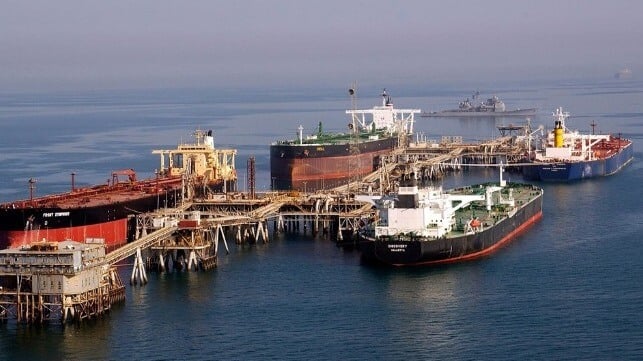
Iraqi officials had reportedly blocked three Lukoil export loadings at Iraqi terminals, among other measures (USN file image)

Published Nov 10, 2025 5:39 PM by The Maritime Executive


American sanctions on Russian oil giant Lukoil have forced the company to declare force majeure for its Iraqi operations, taking nearly 10 percent of the nation's entire production offline through the closure of the giant West Qurna-2 oilfield, according to local and international media sources. The move follows the Iraqi government's decision to cancel payments and export loadings for Lukoil over sanctions concerns. 

West Qurna-2 is a supergiant 12.9 billion barrel reservoir near the port of Basra, Iraq. It was developed by Lukoil and Statoil (now Equinor) in the 2010s, and currently produces about 480,000 bpd of crude. It is part of the braoder West Qurna Field, one of the largest oilfields in the world (by total recoverable barrels). 

Lukoil owns 75 percent of West Qurna-2, and it is the firm's most valuable foreign asset. It had planned to invest billions of dollars to increase the field's output in the years ahead, but given Iraq's strict application of U.S. sanctions on the Russian firm, those plans appear off the table unless there is a change in regulatory circumstances. Iraq has cut off cash payments and in-kind oil allocations to Lukoil, and has reportedly canceled three of the firm's export loadings for the month of November. Lukoil has also reportedly had to lay off its international staff at the West Qurna-2 field, though it has been able to retain its Russian and Iraqi workforce. 
  
If the sanctions situation does not change, local officials told Reuters that Lukoil could exit the field entirely within six months. If the company seeks a buyer for its Iraqi holdings, any would-be purchaser could encounter U.S. compliance difficulties: Russian-linked commodity trader Gunvor was in talks to buy all of Lukoil's international holdings, including West Qurna-2, but backed out after threats of sanctions from the U.S. Treasury Department. 

If Lukoil exits the West Qurna-2 field without selling its rights to a successor, it could clear the way for a Western operator to step in, according to Oilprice.com. American, British and French oil majors might all take an interest in West Qurna-2's abundant reserves. 

In the meantime, the force majeure declaration will lower Iraq's oil production by about 480,000 barrels per day, about 0.5 percent of the global oil market. Brent futures were largely unaffected, closing at $64 per barrel. 


Norway’s $2.1 Trillion Oil Fund Seeks Renewables Deals in U.S.

Norway’s $2.1-trillion oil fund is looking to invest in renewable energy assets in the U.S. and expand its clean energy portfolio in Europe, a senior executive at the world’s largest sovereign wealth fund told Bloomberg in an interview published on Monday.

The fund has recently hired three people in New York, Harald von Heyden, global head of energy and infrastructure at the Norwegian fund, told Bloomberg.  

The Government Pension Fund Global (GPFG), which is commonly referred to as ‘Norway’s oil fund’ because it was created with oil and gas revenues, sees bright prospects of owning solar, wind, and grid projects in the U.S. despite the unfavorable current political climate, according to the executive.

“You have political risk everywhere, you just have to be smart,” von Heyden told Bloomberg, when asked whether the Trump Administration’s assault on renewable energy, especially offshore wind, would weigh on market prospects.  

“We have to find good deals, first and foremost, but we are optimistic,” von Heyden said. 

“This year and last, you’re seeing gigantic projects becoming a reality, not just on the drawing board.”

The manager of the Norwegian fund, Norges Bank Investment Management, in September said it would commit $1.5 billion to Brookfield Asset Management’s latest energy transition fund, in fund’s latest investment in unlisted renewable energy infrastructure. 

The commitment to Brookfield’s Global Transition Fund II (BGTF II) “will enable us to invest in projects that develop renewable energy infrastructure while also supporting the broader transition to low-carbon solutions across industries,” von Heyden said back then. 

The largest energy asset deal for Norway’s fund so far was a transaction announced in September, in which it agreed to buy 46% in grid operator TenneT Germany from its Dutch owner TenneT in a deal worth up to $11 billion (9.5 billion euros), in consortium with APG, investing on behalf of Dutch pension fund ABP and Singapore’s sovereign wealth fund GIC.   

By Michael Kern for Oilprice.com 

Petronas and Partners Break Ground on Malaysia’s First Large-Scale Biorefinery

PETRONAS, Enilive, and Euglena have begun construction of a 650,000-tonne-per-year biorefinery in Pengerang, Malaysia, marking a major step toward scaling up sustainable fuel production in Asia by 2028.

Pengerang Biorefinery Sdn. Bhd., a joint venture between Malaysia’s PETRONAS, Italy’s Enilive S.p.A., and Japan’s Euglena Co., Ltd, has officially broken ground on a new biorefinery complex within the Pengerang Integrated Complex (PIC) in Johor. Once operational in the second half of 2028, the facility will process up to 650,000 tonnes of renewable feedstocks annually to produce Sustainable Aviation Fuel (SAF), Hydrogenated Vegetable Oil (HVO), and bio-naphtha. Feedstocks will include waste oils, animal fats, and residues from vegetable oil processing.

The project positions Malaysia as a key regional hub for advanced biofuel production at a time when Southeast Asia’s aviation and transport sectors are under growing pressure to decarbonize. The refinery will leverage PIC’s strategic location near major international shipping routes to distribute biofuels efficiently across Asia.

PETRONAS Executive Vice President and Downstream CEO Datuk Sazali Hamzah described the project as central to the company’s strategy of developing a “holistic bio-based value chain,” reinforcing PETRONAS’ ambition to become an integrated energy leader by the next decade.

For Enilive, the facility extends its global biofuel footprint, which already includes biorefineries in Italy and the U.S., and projects under development in Italy and South Korea. CEO Stefano Ballista said the new site would contribute toward Enilive’s target of over 5 million tonnes of bioproducts and 2 million tonnes of SAF annually by 2030.

Euglena’s President Mitsuru Izumo highlighted the venture as a milestone in the company’s broader efforts to commercialize algal biofuels and expand decarbonization solutions in the ASEAN region. He noted that the project’s evolution reflects the “rapidly changing energy landscape” and the shared goal of advancing a sustainable energy supply chain.

Located within the Pengerang Integrated Complex—Malaysia’s largest downstream oil and gas facility—the new biorefinery will benefit from established infrastructure, logistics, and feedstock supply networks. The investment underscores Malaysia’s broader push to attract green industry development while positioning Johor as a regional leader in clean fuels manufacturing.

By Charles Kennedy for Oilprice.com


Renault in Talks with Chinese Supplier for Next-Gen EV Motor Technology

Renault is in talks with a Chinese supplier to develop electric-vehicle motors that do not rely on rare earth elements, Reuters reported on Monday, in a move that comes as China lifts a nearly year-long ban on exports of gallium, germanium, and antimony to the United States and a day after Beijing said it would suspend new restrictions on rare-earth and battery-metal exports for one year.

Sources told Reuters the French carmaker seeks a long-term technology partnership to replace permanent-magnet motors with copper-based designs already in pilot production in China.

Renault’s current E-Tech hybrid and EV lineup already uses wound-rotor synchronous motors built at its Cléon plant in France, without using rare earths. The proposed Chinese partnership would focus on lowering costs and preparing next-generation rare-earth-free systems for high-volume models.

Last week, Beijing announced new export restrictions on tungsten, antimony, and silver, materials critical to advanced magnets and EV components, describing them as environmental measures. Industry analysts view the controls as part of a broader strategic effort to retain leverage over global supply chains.

China still dominates refining capacity for rare earths and related minerals, accounting for more than 80% of global tungsten production and the majority of rare-earth magnet output. The new rules apply to the 2026-2027 period and could intensify competition for non-Chinese sources and magnet-free motor designs.

Beijing’s latest export controls follow a brief “rare earth truce” with Washington. After agreeing to lift some limits on rare earth exports to the United States, China moved almost immediately to restrict shipments of other key materials such as tungsten and antimony. Efforts in Europe and Japan to rebuild refining capacity remain small in scale, leaving automakers reliant on Chinese intermediate products even when ores are mined elsewhere.

Renault and the prospective supplier declined to comment to Reuters. Industry analysts said automakers are reviewing sourcing plans as China’s new export limits take effect and could influence the price and availability of materials for electric-motor production.

By Michael Kern for Oilprice.com 


Marubeni to invest in Australian critical minerals project

Credit: RZ Resources

Japan’s Marubeni Corp will invest in a mineral sands project owned by Australia’s RZ Resources, it said on Monday, following in the footsteps of compatriot JX Advanced Metals, which struck a similar deal with RZ earlier this year.

If the project’s feasibility is confirmed, Marubeni will contribute A$15 million ($9.75 million) for options granting it up to 5% equity participation in RZ’s Copi mineral sands mine project in New South Wales along with certain marketing rights.

RZ, which owns the Copi project and a mineral separation and processing plant in Brisbane, Queensland, plans to produce heavy mineral sands products such as rutile, ilmenite, zircon and monazite. These minerals are used in industries including aerospace, defence and permanent magnets.

Alternatives to China

The alliances come as Japan and its Western allies step up efforts to secure critical minerals supply chains outside China, which has been tightening export restrictions on key resources.

JX, a producer of advanced materials from copper and rare metals used in chips and telecommunications parts, became a strategic partner of RZ in June.

Marubeni, RZ and JX will jointly work on developing the Copi mine project, upgrading RZ’s mineral separation plant, and enhancing RZ’s definitive feasibility study and environmental impact statement, Marubeni said in a statement.

JX said in a separate release that its participation in the project aims to secure a long-term, diversified supply of minerals, including minor metals and rare earths. It also cited the project’s location in a geopolitically stable region with well-established transport infrastructure, including shipping routes.

The project has received expressions of support from the Export-Import Bank of the United States and the Export Finance Australia, it added.

“Through Marubeni’s participation, we expect to leverage its network to secure sales channels for minor metals and rare earths, which we believe will further advance the project,” JX said, adding that it plans to expand similar partnerships.

($1 = 1.5389 Australian dollars)

(By Yuka Obayashi; Editing by Muralikumar Anantharaman and Joe Bavier)


Vale gearing up to meet Indian demand as China steel output stagnates, CEO says


Vale CEO Gustavo Pimenta. (Image courtesy of Vale.)

Brazilian miner Vale is preparing to meet rising iron ore demand from India, which could double its steel production by the end of the decade, chief executive Gustavo Pimenta told Reuters.

Rising sales to India and other Asian markets should help to offset stagnant demand from China, where steel production has flattened to near 1 billion metric tons annually and could decline slightly in coming years, he said.

“India has 1.6 billion people, has surpassed China, and needs massive infrastructure investments, which means a lot of steel,” Pimenta said in an interview at Vale’s Rio de Janeiro headquarters on Friday.

He said the capacity of India’s steel producers is likely to double to around 300 million tons in the next five to seven years.

Vale’s high-grade ore blends well with India’s lower-quality supply, Pimenta added, creating opportunities for both markets.

“We bring quality to the Indian mix. As steel output doubles, we see a big growth opportunity,” Pimenta said.

India is expected to import about 10 million tons of Vale’s ore this year, up from almost none a few years ago, but still a small fraction compared to China, which accounts for around 60% of Vale’s sales.

While China will remain the world’s top steel producer, Vale sees its output stabilizing. “We don’t see growth ahead. Chinese production will probably remain steady, perhaps even decline,” Pimenta said, contrasting that with India’s 12% annual growth.

Vale also expects rising demand from other Asian markets, with sales to Vietnam projected at 8 million tons in 2025, up sharply from previous years.

Vale Day

Strong third-quarter performance, including 5% sales growth and its highest iron ore output since 2018, positions Vale well ahead of a long-term strategy update to be detailed at its annual “Vale Day” investor event in New York on December 2.

Pimenta declined to comment on new production targets, but said Vale will outline projects to boost iron ore and copper capacity in its key Northern System operations.

Vale plans to invest 70 billion reais ($12.95 billion) by 2030 in its “Novo Carajas” program in Brazil, including a project to raise annual iron ore capacity by 20 million tons. Now 80% complete, the initiative is set to begin operations in late 2026.

“As we explore more of Carajas, we get increasingly optimistic about its potential,” Pimenta said. “At Vale Day, we’ll give investors more visibility and confidence.”

Vale also aims to double its copper output by 2035.

Amid expansion plans, Vale expects to reclaim the title of world’s largest iron ore producer this year, surpassing Rio Tinto, which took the lead after Vale’s 2019 Brumadinho dam disaster.

Outside Brazil, Vale is considering selling its Thompson nickel mine in Canada amid market interest and weak prices due to Indonesia’s surging output.

“It’s an asset we struggled to bring to the cost level we wanted,” Pimenta said. “We’re assessing if there’s a better owner.”

The mine produced about 10,000 tons in 2024, or 6% of Vale’s total.

($1 = 5.4039 reais)

(By Marta Nogueira, Roberto Samora and Marcela Ayres; Editing by Brad Haynes and Chris Reese)


Botswana president reiterates plan to buy majority of De Beers

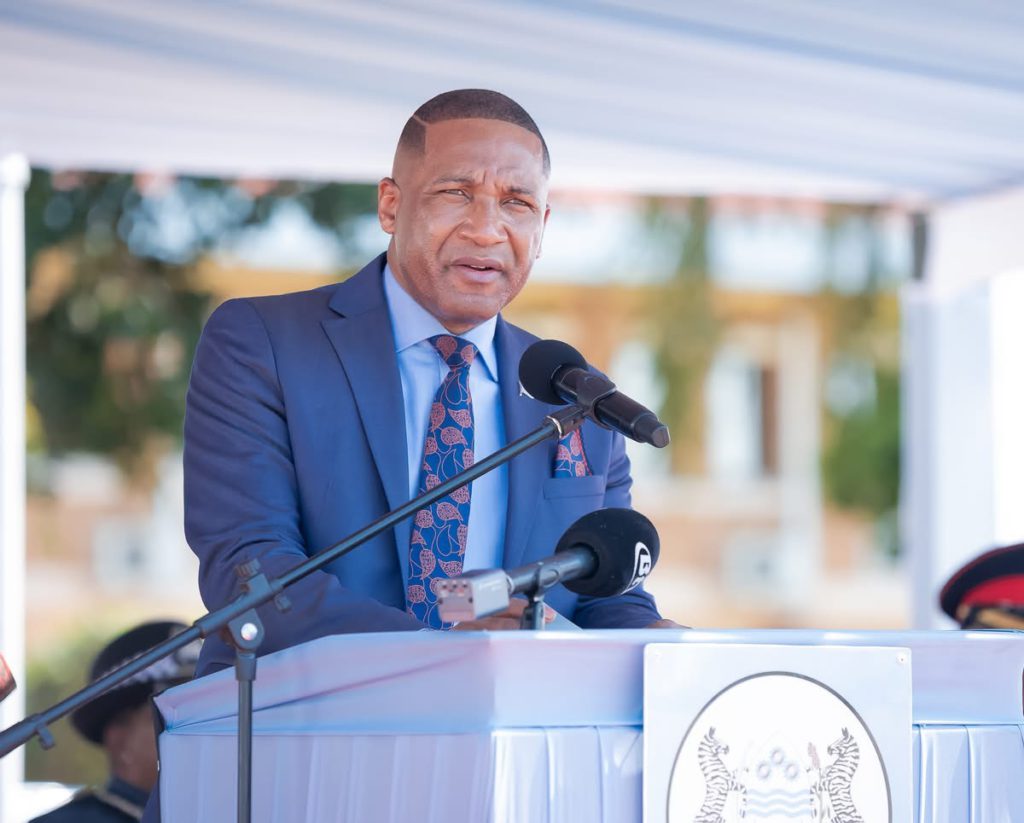
Botswana President Duma Boko. Image source: Duma Gideon Boko’s official X account

Botswana’s president reiterated his plan to acquire a majority stake in De Beers, as Anglo American Plc looks to offload its controlling interest in the iconic diamond company.

“Government will leverage a majority stake,” Duma Boko said Monday in an annual address in Botswana’s capital, Gaborone. “Concrete steps are under way towards the acquisition of Anglo-American shares in De Beers.”

Anglo is divesting its 85% shareholding in De Beers, as part of a sweeping restructuring that began almost 18 months ago. Botswana, which owns the rest of the company, relies on diamonds for about 80% of its exports.

London-listed Anglo is selling De Beers amid a prolonged slump in the diamond market, with fierce competition from cheaper lab-grown stones. Most of the company’s diamonds are mined in Botswana, which has been hammered by the downturn. Still, gems remain pivotal to the economy, according to the president.

“While this administration is pushing for diversification of the mining sector, diamonds will continue to be a main contributor of economic growth and transformation for our country,” Boko said.

The president told Bloomberg in September that he wanted to conclude a deal for the state to buy a majority interest in De Beers by the end of October. He said Botswana was in talks with a number of parties, including a sovereign wealth fund in Oman, to help fund any acquisition.

However, Botswana faces competition for the De Beers stake. The chief executive officer of Angola’s state-owned diamond producer Endiama EP told Bloomberg last month that his company had offered to buy Anglo’s entire stake.

Following a meeting last week of the two countries’ minerals ministers in Gaborone, the Angolan official said both nations were “perfectly aligned” on De Beers and focused on reviving demand for natural stones.

Investor groups led by former De Beers executives have also shown interest in buying the diamond giant since a formal sales process kicked off in June.

(By Mbongeni Mguni and William Clowes)