Friday, November 14, 2025

The Ritual Roots of Animism, Drama and Sports: The Work of Jane Harrison and the Cambridge Ritualists
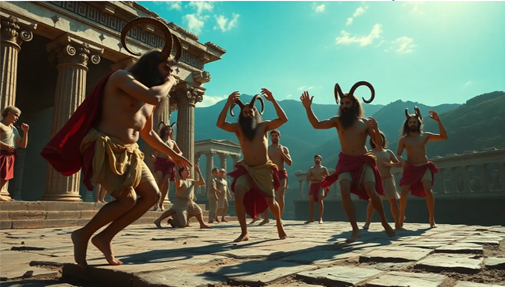

My friends claim that I am irreverent to the Olympian gods. My interests I am told are unduly focused on ghosts, bogies and pillar cults. I prefer savage disorders, Dionysian origins, the tearing of wild bulls to the ordered and stately ceremonial of Panathenaic processions….The gods who once mirrored human unity with nature came to mirror human individuality. The Olympians, in their triumph of humanity kicked down the ladder from earth to heaven by which they arose….The Olympias seemed like a bouquet of cut flowers whose bloom is brief because they have been severed from their roots.

— Jane Harrison, Ancient Art and Ritual

Orientation

The diversity or unity of animism, drama and sports

In the modern world we think of the world of art, whether it be drama, tragedy or comedy, sports and religion as all different endeavors. After all, the arts and sports are secular while religion is sacred. Therefore, all must seem to have different roots. Some historians might say that they come after each other in linear time: first religion, then arts and then sports. But where does ritual come in? A ritualist seems to be, for the secularist of today someone who might be obsessed with fixed forms and ceremonies, rigidity and mindlessness. Furthermore, rituals are seen as most prominent in the sacred world. At the other extreme, the artist – whether in drama or sculpture – is someone who would seem to be free in thought and less inhibited  in convention and practice. Lastly, it would seem that art and ritual have diverged today and have little to do with each other. The same seems to be true of sports.

My argument chain
My argument chain in this article is that:

  • religion (specifically animism), drama, and sports closely follow each other in history,
  • it doesn’t matter whether these activities have come down to us as secular or sacred,
  • they all have a common root in ritual,
  • ritual is rooted in Sir James Frazer’s agricultural cycle of an ever present goddess and finite dying god,
  • the theorists who supported ritual origins of animism, drama and sports were called the Cambridge rituals led by Jane Harrison with the support of Gilbert Murray and Francis Cornford. Harrison was the center of the group because she always seemed to have a broader conception of their common subject matter than any of the others and
  • the polytheism of the skygod Olympians which were the darlings of the Greek classists were a rather superficial interpretation of a deeper Greek animism and which had chthonic roots.

What Does the Ritual School Advocate?
Ritual precedes myth
When discussing sacred experience we must consider the rituals that are performed, the myths that are the foundation of sacred worlds and the sacred beings that inhabit that world.
Theorists of comparative religion have argued historically which of these three came first. Some theorists argue that storytelling (myth) came first and then primitive societies acted out the myths in ritual.  Sounds pretty rational. First you think of a story and then you act it out. The Cambridge ritualists were materialists. For them as for Goethe, in the beginning was the deed, or the ritual dance. The stories followed from the dance. But what were they dancing about? The Cambridge ritualists argued that initially their first activities were hunting and gathering or some kind of planting. The rituals that followed, were stylized re-enactments of their labor, the successful hunts or harvests. Only later did they make up story myths of how their collective actions were meant to be about.

Sacred roots are chthonic, not sky bound
When we speak of sacred presences the Greek classists begin and end with the polytheism of the Olympians. The Cambridge ritualists challenged the serenity of the almost playful depiction of the gods as ignoring the thunder and lightning of what occurred in the sacred realm in the Archaic iron Age. Jane Harrison dismissed theology and emphasized the prerational, socioemotional dimensions of the sacred. Her sense of the superficiality of Homer’s gods had been so deep that she no longer felt them to have any religious content at all. Instead, she was drawn to the mystery cults of Dionysus and Orpheus which seemed genuinely and deeply serious. By that time her partner in crime, Gilbert Murray had come out with The Rise of the Greek Epic which had shown that Homer represented a smoothing out of the old, rough sacred presences into a more civilized Olympian from.

Sacred world is animistic before it was polytheist
Harrison argued that Zeus is a later projection of the group of dancing participants ritual frozen into a being. The sacred spirits are really dancers embodying movement more than they are beings with stable characteristics. It is safe to say that the Cambridge ritualists saw sacred presences as verbs rather than nouns, animists rather than polytheists. In her book Themis basing themselves on the work of Sir James Frazer, the Cambridge ritualists argued all rituals were enactment of the cycles of the year with the female goddesses giving birth to gods, mating and then the males dying in the Autumn.

On the other hand, Homer’s poems were the summing up of a later heroic age in which outstanding individualsdistinguished themselves as being opposed to the collectives of earlier times before the invaders descended on Mycenean Greece. The first primitive gods are personifications of the rite as in Dionysius.  Harrison says the Olympian gods are cut clean from earth and from local bits of earth out of which they grew like sacred trees, the holy stones, rivers and still holier beasts. The Olympian skygods stand back far enough to see the picture of the earth from a distance. They are not lost in the earth ritual as it was earlier in the Dionysius ritual. Metaphorically, the dancing ritual is like a verb which later becomes a noun in the static image of the Olympians.

Rituals have roots not only in animism but also in theater and sports

Lastly, the Cambridge ritualists were ambitious. They believed the ritual origin of human activities was deeper than just their sacred practices. They applied ritual origins to the arts and even  sports. The Cambridge ritualists started around the turn of the 20th century. Their work permanently transformed and revitalized the field of the classics.

Why should Socialists Care?
Primitive communism is the foundation of material social evolution
If you can remember a high school or college class in world history you might recall that it usually begins with the civilizations of Egypt and Mesopotamia. These agricultural states are considered  “civilizations” which is synonymous with the growth of cities. But anthropologists have pointed out that the history of civilizations is not the origin of human societies. Long before agricultural states there were hunter-gatherers and physical anthropologists who told us that they go back from100,000 to 200,000 years ago. As it turns out, Marx was right that these “primitives” practiced primitive communism where resources were shared and there was no private property or social classes. We have been robbed of the knowledge of this history. For Marxists, the discovery of primitive communism nicely fits with our dialectical view of history In the beginning as a primitive whole – communist society. Then there are 5000 years of alienation moving from the emergence of social classes, slavery, feudalism and capitalism. What is happening today is the emergence of a seeds of a communist society  most exemplified in China. Chinese socialism is a return of primitive communism but on a higher level. Advanced communism is a synthesis because it is based on the wealth, technological, economic and political that has been inherited from the long antithetical alienation of class societies.

Animism is the foundation for sacred social evolution
Just as we have been robbed of our material history we have been robbed of our real sacred  evolution. Textbooks on the history of religion used to begin with Judaism and a short nod to the Egyptians and Mesopotamians. The long magical practices of tribal societies were never taken seriously. While modern historians of religion insist for politically correct reasons that tribal religion be included, they present these traditions as existing next to the “People” of the book. They are less willing to examine the sacred evolution from animism to polytheism to monotheism and why they might have evolved in the direction they did. The Cambridge Ritualists not only defend the existence of animism but they defend it as a sacred life which  was filled with life, movement, participation and self-confidence. Animism like primitive communism involves no class of priests, no private property in the use of sacred objects.  If Marxian socialists want to see material history as a dialectical spiral we owe it to ourselves to see our sacred history as also a dialectical process. The Cambridge ritualists help us to understand and appreciate animism, not just as a worthy in interesting way of life. We Marxists need to appreciate the relationship between animism and primitive communism.

Precursor of Cambridge Ritualists in Nietzsche’s Birth of Tragedy
On the European continent the earliest and most important theorist of the sacred roots of tragedy was Nietzsche. Thirty years before the Cambridge ritualists formed as a school Nietzsche grasped the sacred origins of drama. The Birth of Tragedy Out of the Spirit of Music was written in 1872. Nietzsche sensed that the famous serenity of the Greeks gods was only superficial.  For him, tragedy is the product of the Dionysian spirit that is collective in origin. Tragedy did not begin with spectators, stages and playwrights. Tragedy starts with of the chorus. Dionysian dancers were attempting to break through encapsulating egos and merge with the power than animates the world. The chorus in which the tragedy interlaced constitute a matrix of a future dialogue, the entire stage world of the actual drama.  In the first stage tragedy was acted out the in chorus before drama even existed. There was no audience but only participating dancers. Only when there was a separation between the active celebrant of Dionysius and those who looked on as necessary to demonstrate the reality of a god to those who were not possessed by the god. Nietzsche anticipated the direction which the Cambridge rationalists were going to move. It began a trend in classical studies toward searching for and emphasizing nonrational factors in determining human behavior. We will begin by discussing drama and then proceed backwards to talk about sacred animism.

Ancient vs Modern Theatre
Probably people tend to imagine that modern theatre and ancient theatre are more or less the same. But in her book Ancient Art and Ritual Jane Harrison points out how different they are. To begin with, the entrance gate of the theatre was sacred ground dedicated to various gods such as Dionysus, Apollo and Zeus. Modern theatres are housed in secular buildings. When you enter the building, you pay for your ticket – right? However, in ancient theatre there was no payment. In ancient theatre the whole purpose of entering was to participate in an act of reverence. Making a monetary payment would undermine the altered state of consciousness that is being cultivated. Money and ritual don’t mix. In modern theatre what are you paying for? Entertainment at worst, inspired contemplation at best.

In modern theatre the seating arrangements are dictated by social class, but where people sit is not controlled by the sacred and state officials as in ancient theatre. In modern theatre if you want to attend, you can go at least on Friday, Saturday and Sunday throughout the year. Ancient theatre was only open during festivals which were tied to the agricultural seasons of the year. Even before entering the theatre in the ancient world, you participated in a great procession by torchlight which was the necessary preliminary to the sacredness of the play. Modern theater has no preliminary ceremonies. Spectators enter on their own and the play begins only when the lights are dimmed. In ancient theatre everyone participates because the theatre itself is sacred activity. In modern theatre people come in and leave as spectators. They have no responsibility to anyone else. Who are the participants in the theatre?

In modern theatre there are playwrights, actors and actresses, along with lighting and stage direction all of which are perceived as secular jobs. In ancient theatre, the gods are evoked by those magicians who have prepared the ritual. The clothes of the participants of the ancient ritual were vestments like those who celebrated the Eleusinian mysteries. In modern theatre the clothes worn by the actors have nothing sacred about them. They are the clothes which are consistent with the time period of the play, together with the roles they are in. Here is a summary of the differences between ancient and modern theatre.

Table 1 Ancient vs Modern Theatre

Ancient TheatreCategory of comparisonModern Theatre
Holy ground dedicated to a god – Dionysus, Apollo or ZeusEntrance gateSecular building
No paymentCost of entryPay for a ticket to get in
Act of reverencePurposeEntertainment
Seating controlled by sacred and state officialsSeating arrangementsBased on social class
Only at certain festivals of the yearWhen is it open?Year-round mostly at night
Torchlight, great processionPreliminaries activitiesNone – individuals enter theatre on their own without fanfare
Gods, young men from AthensPractitioners Playwrights, actors, actresses
Use of ritual vestments like those of the celebrates of the Eleusinian mysteriesVestmentsThe clothes are rooted in the script and the role being played
No spectators, all are participantsParticipationSpectators

I hope it is clear that ancient theatre was much more sacred and special but why could it be? Jane Harrison and Gilbert Murray argued this theatre was once part of a magical ritual

From Human Laboring to Rituals
Jane Harrison points out that the two great interests in primitive humanity are food and children. The tribesperson must eat so that they and their tribe must grow and multiply. The seasons are related to this food supply. Forest people depend on the fruit trees and berries. They will construct a maypole and imagine a tree spirit is responsible for life. Agriculturalists will look to the earth for its returning life and food. At certain times of the year the animals and the plants which form their food base are appearing and disappearing. It makes little sense to study a ritual of a people without knowing facts about their climate and their surroundings. Seasons vary from place to place. In some places there is no sign of animate life but thousands of ants. Later in the year suddenly the rainy season kicks in. These hunting and planting procedures are re-enacted in stylized ritual and then retold as myths. Tribespeople perform rites to the sun and moon when they notice their relationship to the seasons

When humans go out to hunt some hunts are successful and some aren’t. Naturally, the band or tribe wants to remember the successful hunts. The way you increase the collective memory of the act is to capture a simulation of it in a ritual. So, they will hunt and catch their game in pantomime. For primitive humanity, beast, bird and plant and humans were not sharply divided. The men acting as kangaroos danced and leaped. They did not imitate, they were kangaroos. The mimes are not mimicking thunder out of curiosity, they are making thunder and enacting it. The dancers of the dance got generalized and  many were a re-combination of actual hunts and battles which arose during a hunt dance and war dance. Many men dressed up as trees facing men dancing as tree spirits. The rite is performed by a band or chorus who dance together with a common leader (the protagonist.) From a being perceived by the senses year by year, they are eventually conceived more abstractly as an image or being.

Ancient Traditions of Spell-Casting and Movement
Jane Harrison writes that the tribespeople are people of action who do not ask a monothetic deity  to do what they want done. They do it or try to do it themselves. When a tribesperson wants sun or wind or rain, they do not go to a church and prostate themself before God. They don’t even go to the Oracle of Delphi and ask Apollo about the future. Instead they summon their tribe and dance a sun or a rain dance. In the monotheist religions dancing is either frowned upon or kept in the background. On the contrary, tribespeople are dancing fools. A tribesperson passes from childhood to youth to mature manhood, so the number of their dances increase. For example, when dancing within the hoop, each girl has to waver her arms vigorously and crow “flax grow”. When she is done, she leaps out of the hoop or is lifted out of it by her partner.

Dromenon as a Sacred Animistic Rite
The Greek word for a rite is Dromenon, but Dromenon is also the physical site in which the ritual takes place. Dromenon, Harrison tells us is called the “thing done”. But what is it? A magical enactment for altering consciousness. It is the rite that can be done collectively by a number of people feeling the common emotions about a successful hunt or harvest. Unless these movements are made by the tribe together they will not become rhythmical intense for a successful ritual. All things done are not rites. You may shrink back over and over again in reaction to a fire – that is an expression of emotion and a reaction to a stimulus, but that is not a rite. You might digest your dinner every night but is not a rite. It is a routine.

Dromenon, Dithyramb and the Dancing Dionysus
The tragedies of Aeschylus, Sophocles and Euripides were all performed in Athens at a festival known as the Great Dionysus. Aristotle in his treatise on the Art of Poetry raised the question of the origins of drama. He declared that a structure so complex and a Greek tragedy must have arisen from a simpler from of ritual. So what is the relationship between Dionysius and drama? Dionysius dances in what is called the dithyramb. The dithyramb was the song and dance of the new birth of Dionysius in the Spring. In the beginning there were the dancing ritualists. Over the course of history this dancing “cools” and assumes a concentrated form of maypole. A more abstract concentration of the maypole leads the god Dionysius. On the whole The evolution moves from:

  • the laboring of hunting or planting perception;
  • dancing ritualists – perception;
  • maypole – concentrated conception and
  • god Dionysius – more abstract conception.

Dionysius, the tree god, the spirit of vegetation, was once but a maypole perceived and then conceived as a god. The dithyramb is also the song of the second or new birth. The dithyramb is twice born. In the first birth he comes into the world; by the second birth he is born into his tribe.

Jane Harrison tells us at first birth the initiate belongs to his mother and the women folk. There is then a second birth where he becomes a full-fledged man and passes into the society of the warriors of his tribe. In preparation for his second birth the boy is to put away childish things in order to prepare to become a grown and competent tribesman. The mother stands up with the boy crouching at her feet. She pretends to go through all the labor pains and the boy metaphorically being reborn cries like a baby and is washed.  In totemistic societies and secret societies that seems to grow out of them the novice is born again as the sacred animal.

The rites of birth, marriage and death, which to us seem so different from each other are to tribal humanity all similar. For the most part they were family rituals needing little or no social emphasis. But the rite that concerned the whole tribe was the rite of initiation at puberty or the hunting, planting and war rituals. Harrison informs us in her book Prolegomena to the Study of Greek Religion that the magical dance of the Kouretas is a primitive form of dromenon. It is from these that both drama and sports arose. Gilbert Murray’s Excursus explains the relation between Homer, who supplied the tragedians with their plots and the spring dromenon which determines the form of tragedy. Francis Cornford in his book The Origin of Attic Comedy explains the ritual origins of comedy.

From Dromenon to Drama
The centrality of the chorus and the orchestra
So how does Jane Harrison answer the question about how drama arose out of ritual? After all, art in most people’s mind is a sort of luxury, not a necessity. Drawing, music and dancing are no part of training for ordinary life. When we say art is impractical, we mean the art is cut loose from immediate necessary action. This wasn’t always the case. For example, how do we make sense of the chorus? In modern theatre there is no chorus. If there is a chorus as in opera in the ballet, the chorus dances are to amuse and excite in the intervals of operatic action. But what’s left are prologues and messengers’ speeches, which were once rituals, still surviving at a time when drama has not fully developed out of the dromenon. Central to this is the chorus and the orchestra. There was once a rude platform from which the prologue was spoken. There was no need to look at a distance as in drama. They were too busy dancing together to contemplate from a distance.

Believe it or not it was not the stage on which the chorus danced. They danced in the orchestra. What is the relationship of that space to the rest of the theatre, to the stage and place where the spectators sat? Originally the dramas of Aeschylus, Sophocles and Euripides were not played on a stage and not in the theatre but in the orchestra. The stage and the theatre were to the Greek a place of seeing—where the spectators sat – the scene, the tent. But the kernel and center of the whole was the orchestra, the circle and dancing place of the chorus. The orchestra was the kernel and center of the theatre. There were no divisions at first between the actors and spectators. All were actors, dancing the dance danced. The drama, like ritual, is a thing done but abstracted (represented) from hunting, planting or warring.

The rise of the theatre and the stage
In drama the theatre or spectator place is added to the orchestra. Not only was there a place for the orchestra and spectators, but there was also a stage. Originally the word for stage was “scene”. It was a tent in which players could put on their ritual dresses. At first, a stage is not necessarily a raised stage, but a place apart from the dancers when you have new material for your players, something you need to look at, attend to. There new plots were introduced, not of spirits but of individual heroes. This was the death of dromenon and ritual. The new wine that was poured into the old bottes of the dromenon at the Spring festival and was the heroic saga. The history of the Greek stage is a long story of the encroachment of the stage on the orchestra. The stage first stands outside the orchestra. Then bit by bit the scene encroaches till the sacred circle of the dancing place is cut clean across the orchestra. As the theater and stage expand the orchestra and the chorus wane.

The drama is based on a decay in the belief of certain magical rites. Yet in a tragedy there must be pathos. However, it is still rooted in the cycle of the year because in the Winter, the Old year must die. There must be a swift transition from sorrow to joy. All these old ritual forms haunt and shadow the play, whatever its plot like the ancient traditions of ghosts.

The Emergence of the Heroic Saga

Aeschylus was born in 456 BCE. His first play was a plot from the heroic saga, Seven Against Thebes. The word “hero” calls up such figures as Achilles and Hector, figures of passion and adventure. They occur in every heroic age. What are the conditions that produce a heroic age? In Heroic poems almost no one is safely and quietly at home. The heroes are fighting in far-off lands or voyaging by sea. We hear little of tribal or family ties. The real center is not the hearth but the leader’s tent or ship. The epic poet is all taken up with what heroes’ authors called glorious deeds of men. The hero acquired deathless fame for their great deeds. The hero must win his followers by bravery and keep them by generosity. The heroic spirit, as seen in heroic poetry is the outcome of a society cut loose from its earthly roots. It is about migrations of the shifting of populations as seen in Chadwick’s Heroic Age. The amazing development of the 5th century drama is the old vessel of the ritual of dithyramb filled with the new wine of heroic saga. Such were the attitudes of the Athenians towards the doings and sufferings of Homeric heroes. The right distance for them would be remote, but not too remote. Heroes should be in between humanity and the gods. In the old ritual dance of tribal society the individual was insignificant. The chorus, the group, was everything. In the heroic saga the individual is everything. The group is but a shadowy background.

From Drama to Sculpture

Hopefully you have come to be convinced that drama was once rooted in sacred ritual. After all, drama is also a social art. But painting and sculpture are the private acts of individuals. Surely, they have no roots in ritual. It might seem that here at last we have nothing primitive; we have art pure and simple, the ideal art cut loose from ritual. Finally we have secular art. After all, we pass from the living thing, the thing done in ritual or in the play, acted by real people, whether it be dromenon or drama to a thing made a painting or sculpture. How can a sculpture or painting be part of a ritual? We must at last differentiate the artist, the work of art and the spectator.

However Jane Harrison tells us that the Greek sculpture of Apollo, like Dionysus arose as part  of a rite. The ancient Apollo wore wreaths and carried boughs, not because the sculptor wanted to be artistic or poetic but because the sculpture was part of a ritual. For the place of sculpture was inside the shrine, dwelling with the gods and goddesses themselves. For the frieze is nothing but a great ritual procession transferred into stone. The Panathenaic procession or the procession of all the Athenians was rituals turned into stone. This was the purpose of the Panathenaic procession. Drawing is at bottom like all the arts, a kind of gesture, a method of dancing on paper either preparing for a ritual but ever separate from it.

Table 2 Transition from Ritual to Art: From The Dromenon to the Drama

DromenonCategory of ComparisonDrama
Mimesis embodiment of person or thing that is an identityMimesis vs MasqueradeMasquerade
A copy of something that is separate
PresentationalMaking sense of repeated actionsRepresentations
Dithyramb—spring ritual inspiring danceType of festivalPanathenaic procession in the summer
Chorus dances in orchestraRelationship between orchestra, stage and theatreSpectators in theatre, actors on stage, Chorus gets smaller
No division between actors and participantsRelationship between actors and spectatorsActors separated out from spectators
Group is everything, individual is nothingRelationship  between the group and the individualHeroic sage individual

Group a shadowy background. Epic poet

Magical circleWhere might it be done/?Hero’s tent
Magical is importantPlace of magicConfidence in it wanes

The Ritual Origins of Sports
Besides the ritual aspects of animism and drama the third area that has its roots in ritual is sports. Again, as in drama, sports seem like a completely autonomous and secular endeavor. But Allen Guttman in From Ritual to Record points out that primitive cultures rarely have a word for sports in our sense. He references Carl Diem in his world history of sports said that all physical exercises were originally cultic. Running, jumping, throwing, wrestling and ball playing were organized so as to please the gods with the object of securing fertility, causing rain, giving and prolonging life, expelling demons or curing sickness. The Apache of the American Southwest used sports in conjunction with solar-lunar symbolism as part of a yearly fertility rite. Apache myth dramatizes the delicate balance between the two main sources of food: animal sources that were associated with the sun and male while vegetable sources are connected with the moon and female.

There is an  enactment of a kind of relay race in which all males participated at least once between puberty and marriage. One side represented the sun the other side the moon. Abstinence from meat and sex was required prior to the race. The track was called the Milky Way after the heavenly path over which the sun and moon had originally raced. The Milky way connected two circles around whose circumference small holes were dug clockwise. Trees were then planted in the holes. This was accompanied by drums representing the sun and the moon, by flags, dances, songs and feasts. The race was on the third day of the festival at which time a fire was ignited in the center of each circle. The boys were painted and adorned with feathers and led to their circles by two young girls carrying an ear of corn in one hand and an eagle feather in another. The ceremony was clearly more important than the question of winning or losing

Among the Zulus there is a preseason and post season sacrifice of a goat. Pregame ritual requires that coaches and dedicated supporters of the team spend the night before the game together in a special place sleeping in a huge group around the campfire, all naked but there are no sexual relations. Among the Aztecs there are ball courts in Guatemala and Honduras which were considered symbols of the heavens. In Aztec times the game itself was under the protection of the goddess Xochiquetzal. Archeological evidence indicated that the game was literally for life or death. Each of the six reliefs at the great ball court of Chichén Itzá shows the decapitation of a player. Every tennis court was a temple.

When we turn to the Greeks, Guttmann claims the physical contests of Olympia and Delphi were culturally closer to those of primitive peoples than to our own Olympics. The Olympic games were sacred games, stages in a sacred place and at a sacred festival. They were a religious act in honor of a deity. Those who took part did so in order of reverence to the god or goddess and the prizes which they won were thought to come from a god. Olympic games had their roots in Greek polytheism and the games at Olympia were a homage to them.

The fertility myth is the common thread of every version of the founding of the games. The athletic events were held to persuade the god to return from the dead to reappear in the form of a new shoot emerging from the dark womb of the earth into the light of day. The time of the games was as sacred to the Greeks as the place in which the games occurred at the time of the second or third full moon, after the summer solstice. The athletes gathered at the nearby town of Elis and spent thirty days in the final preparation for their exertion.

Richard Mandell, author of Sport: A Cultural History agrees with Guttmann. He points out that the first sport was spear throwing, obviously connected to practicing for a successful hunt. But this practice was all in the service of a magical ritual. Formal games were like theatre and dance and ritual. Native American board games with victors and losers were treated as signs of the players’ status with the gods. Early ball games were preceded by processions of priest and accompanied by musicians and dancers. The subjection of an actor or dancer in theatre to director or choreographer with costumes and masks is paralleled in sports today. The adaptation by players to coaches and managers whose baseball uniforms and team names parallels theatrical role. The participants in early sports games and theatre might be in trances induced by rhythmic dance, breath control, drugs or hypnotic suggestion of animistic sacred dancers. For the Aztecs winners of the games were celebrated as the favorites of the gods while were losers punished or even sacrificed.

When we look at professional sports today its connection with theatre and the animistic rituals of Harrison are not hard to find just a little way below the surface. The baseball or football field is a large-scale magical dancing ground or the orchestral set. The crowd agrees to suspend judgment and make believe what is going on in the field is more real than their lives. They identify with certain players who easily qualify as gods and goddesses. Each team has a history or mythology of having had a “dynasty” if they have a history of winning and a reputation for losing. In both baseball and football there is a Hall of Fame which fans reverently attend. The degree of loyalty of fans to their team today goes way beyond loyalty to religion or politics. Fans memorize statistics in baseball and football and can be strategically very sharp at analyzing what went right or wrong in a game. Attending a game is full of theatrics with food, music, chanting and singing that helps to alter the state of consciousness of the spectators. The players in turn are impacted by the joy or loathing of a crowd.

Conclusion
I began this article by asking about how diverse religion, theatre and sports were from each other. I claimed that surprisingly that if we go back far enough animism, drama and sports are all rooted in ritual that follows Sir James Frazer’s goddess and dying god. The major theorists of the ritualistic school are called the Cambridge Ritualists who included Jane Harrison, Gilbert Murray and Frances Cornford. I claim that the polytheism of the Greek Olympians was a late development of the animism that was part of Greek culture before and during the Archaic Iron Age.

Before proceeding I make a case briefly about why socialists should care about these ritualistic origins of animism, drama and sports. Just as the full story of material world history was suppressed by capitalist historians, so the full story of sacred world history is suppressed by monotheist theologians and Greek classical scholars who sing the praises of the Olympians.
Marxist historians claim that knowing about primitive communism gives us ground for claiming there is a dialectic in history moving from primitive to advanced communism. So too, I argue that knowing that animism preceded polytheism and monotheism in sacred evolution shows that very early sacred practices were lively, interactive and confident. The sacred world of animism has the same lack of hierarchy, obedience, private property or reification of polytheism and monotheism. Animism provided real meaning and that less emotional, patriarchal later religions did not.

I begin with Nietzsche’s Birth of Tragedy and show how his insistence on the sacred origins of tragedy was the chorus and with Dionysius, not with the Olympians. I then contrast nine different ways of how different ancient theatre is from today’s secular form. I then begin at the beginning by arguing that ritual itself is a reenactment of successful hunting or planting rituals in the hopes of adding predictably to human life. I discuss the animistic dancing ground which is called Dromenon. I discuss how gradually the dancing rituals of the participants becomes congealed over time, first in their form of the Maypole and later into the form of the god Dionysius.

I then turn to the question of how the drama came out of the animistic ritual. I discuss how the roots of drama lay not in theatre of spectators nor the stage, but in the orchestra. It was only as drama evolved out of animism that the stage and the theatre became primary and the orchestra became mere background. The heroic sagas that emerged with the Olympian gods were a late development and by no means the beginning of Greek sacred life. I also point out that it was not just drama that emerged from ritual but also even the seemingly individual arts such as sculpture and drawing which were also once in the service of animistic ritual even as a method of “dancing” on stone or paper.

I close my article by arguing that just as Greek sacred practices and art are ultimately connected to ritual, so is sports. I use the work of Allen Guttmann and Richard Mandell to back me up.

This movement of from ritual to sports happens in this sequence:

  • the laboring of hunting or planting perception,
  • dancing ritualists – perception,
  • the emergence of Maypoles – conception,
  • the emergence of the god Dionysius – further conceptions and
  • the emergence of drama—conception,
  • sculpture – conception and
  • sports – conception.

Below is a summary of the areas in which the Cambridge ritualists did their work. Though theoreticians of sports were not part of the Cambridge ritualists, these sports historians confirmed the Cambridge ritualists arguments.

Origins of Drama/
Tragedy
Origin of ComedyOrigin of ReligionOrigin of ArtOrigin of PhilosophyOrigin of Sports
Gilbert MurrayFrances CornfordGilbert MurrayJane HarrisonFrancis CornfordAllen Guttman
Rise of the Greek EpicOrigin of Attic ComedyFive stages of Greek ReligionAncient  Art and RitualFrom Religion to PhilosophyFrom Ritual to Record


HarrisonRichard Mandell
ProlegomenaSport, a Cultural History
Themis
Bruce Lerro has taught for 25 years as an adjunct college professor of psychology at Golden Gate University, Dominican University and Diablo Valley College in the San Francisco Bay Area. He has applied a Vygotskian socio-historical perspective to his three books found on Amazon. He is a co-founder, organizer and writer for Socialist Planning Beyond Capitalism. Read other articles by Bruce, or visit Bruce's website.
‘Black Klimt’ steps out of shadows and into political tug-of-war


ByAFP
November 13, 2025


Gustav Klimt's lost 1897 portrait of Ghana's Prince William Nii Nortey Dowuona 
- Copyright AFP Marcel van Hoorn


Blaise GAUQUELIN

A man walked into a Viennese gallery one day in the summer of 2023 looking to sell a Gustav Klimt painting. The person who greeted him thought it was a joke, and gently sent him on his way.

But when the owner of the W&K gallery was told what had happened, he ran down the street after the man.

Ebi Kohlbacher is an expert on the great Austrian symbolist artist and knew some Klimt paintings had been lost.

He caught up with the man, who showed him a photo of a canvas lost for eight decades — a portrait of Prince William Nii Nortey Dowuona, an African aristocrat who is known to have met Klimt and posed for him.

It is “one of the rare paintings of a black person in European art created by a great artist”, Kohlbacher told AFP.

Experts say Dowuona was the head of a group of the Ga people from near Accra in Ghana who were part of a notorious “human zoo” exhibition of African village life that drew huge crowds in Vienna in 1897.

The painting vanished after World War II, having been owned by a wealthy Jewish Austrian family, the Kleins.

“We had to determine where the work came from without a trace of doubt,” Kohlbacher told AFP.

Another expert Alfred Weidinger helped confirm the portrait was genuine and mapped out its history.

The Kleins, who were wine dealers, acquired the painting after Klimt’s death in 1918. They fled Austria after the Nazi annexation of in 1938, entrusting the painting to a woman, who later moved to Hungary.

But when the communists took power in Budapest in 1949, the woman ignored all the family’s pleas to give it back and the painting vanished from the public eye.

It had four known owners in Hungary between 1988 and 2023, when it was taken back to Austria for expert analysis after Hungary granted an export licence.


– Klimt ‘respected’ him –


Klimt’s work now sells for astronomical sums — his “Lady with a Fan” sold for $108 million in 2023 — and Weidinger hailed it as one of the artist’s “prominent” works.

The oil painting’s floral elements, which later became one of Klimt’s characteristic traits, show “a key phase in the evolution of his artistic language”, Weidinger said.

“This transition phase is defined in particular by the tension between the meticulously detailed and naturalist figure” of the prince and the “vibrant, almost expressionist rendering of the background”, he added.

Kohlbacher said Klimt must have known and respected the prince.

“It is obvious that the painting radiates his admiration,” he said.

The prince led a delegation of 120 Africans who travelled through the Austro-Hungarian empire and posed for six months in a show that was visited by up to 10,000 people a day.

The painting marked a turning point in the European perception of Africans, Weidinger said.

Despite problematic colonial prejudices and the obvious “voyeurism” of the show, the Africans “were no longer separated from the public”, the expert said.

“The Viennese bourgeoisie took them to cafes and shopping, and showed them the local monuments,” he added.


– Enter Viktor Orban’s Hungary –


But the tale has another twist thanks to Hungary’s new-found passion for the lost African prince.

The last owner of the painting is allowed to sell it under an agreement signed in line with the 1998 Washington Principles for the return of assets seized from Holocaust victims.

He has a confidential deal with the descendants of Ernestine Klein, the original owner who died in 1973.

But Budapest will have none of that as it insists the export licence was not valid, arguing that an item of such value should never have left the country.

While the W&K gallery hopes that Hungary will respect the Washington Principles, the Vienna prosecutor confirmed to AFP he has received a seizure order from Budapest, which wants the “Black Klimt” back.
Swiss Gruyere crowned world cheese champ


By AFP
November 13, 2025


Swiss cheesemaker Pius Hitz, managing director of Bergkaserei Vorderfultigen, lifts the title - Copyright AFP CHANDAN KHANNA


Elodie LE MAOU

A Swiss Gruyere was crowned the 2025 World Cheese Champion on Thursday, seeing off competition from more than 5,000 rivals from 46 countries.

The 18-month-old Vorderfultigen Spezial produced by Bergkaserei Vorderfultigen won the title at the World Cheese Awards, held in the Swiss capital Bern.

The winning cheese came from a mountain dairy in the pre-Alps region of Gantrisch, just south of Bern.

Grand final judge Perry Wakeman said it was the kind of cheese “that would make people get excited about cheese”.

“It’s a big old cheese — there’s a lot going on. The texture is beautiful: it’s flinty as you break it apart; the crystalline in there are so delicate,” he said.

“It is massive. It makes an impact.”

It was the first time that the contest, created by the British-based Guild of Fine Food in 1988, has been staged in cheese-loving Switzerland — though Gruyere cheeses have scooped the top prize five times before.


– Appearance, nose, flavour –


Laid out on seemingly endless tables draped in white tablecloths, 5,244 cheeses were tasted by an international jury of 265 experts made up of cheesemakers, chefs, buyers, sellers and journalists from more than 40 countries, recognisable by their yellow aprons.

“First of all, we’re looking at the visual appearance of the cheese: how it looks like from the inside and outside,” Polish cheesemaker Kuba Maziarczyk, one of the judges in the final, told AFP.

The second step “is the nose: so all the aromas that the cheese is actually giving us”.

And then, it comes down to flavour.

The judges made an initial selection of the most outstanding cheeses before a second and then a final evaluation by a “super jury” of judges from 14 different countries.

“Cheese must reflect its terroir; it must be balanced in terms of taste, aroma and flavour,” said French judge Laurent Dubois.

“It shouldn’t be too aged or too young. Cheese is always a question of harmony. That’s why good cheeses are often those with a long tradition,” he said.


– The joy of cheese –


Around 2,000 people watched the action inside Bern’s Festhalle exposition hall.

“We’ve got blues. We’ve got hard cheeses. We’ve got all different styles. That makes it really interesting,” said British judge Nigel Barden, a food and drink broadcaster for the BBC.

“Just when you think your palate’s getting a little bit tired, suddenly a cheese comes along and really excites you,” he said. “And that’s the joy of the World Cheese Awards.”

The Guild of Fine Food’s managing director John Farrand told AFP that the awards were originally founded to raise the profile of small cheesemakers.

In the 1980s, dairy production had become “quite consolidated”, he said.

“I think perhaps we’d forgotten the connection between the land, the milk, the animal, and the farm”, and ultimately the cheese, he said.

The awards were established “to try and remind the world that small can be beautiful in cheesemaking terms”.

Next year’s World Cheese Awards will be held in Cordoba, Spain.
Tobacco conference to weigh up stubbing out cigarette butts

By AFP
November 14, 2025


An estimated 4.5 trillion cigarette butts are littered every year
 - Copyright AFP OLEKSII FILIPPOV


Robin MILLARD

Next week’s global conference on tobacco control will consider what to do about the sheer volume of cigarette butts trashing the planet, with some recommending banning them completely.

“The best thing that we could see for the environment is getting rid of filters altogether,” Andrew Black, acting head of the secretariat of the World Health Organization Framework Convention on Tobacco Control (FCTC), said Thursday.

Plastic cigarette filters are the world’s most littered item, leaching toxic chemicals into the environment and breaking down into microplastics — while doing very little for the smoker, the secretariat said.

The 11th conference of the parties to the FCTC is being held in Geneva from November 17-22.

The WHO warned Wednesday that the tobacco industry was trying to infiltrate and undermine the conference.


– Litter and pollution –


Black said that, among other topics, the gathering would look at the environmental damage wrought by the tobacco industry and its products.

“An estimated 4.5 trillion cigarette butts are littered each year worldwide, making them the most common form of litter on the planet,” he told reporters.

“These discarded butts are toxic and a significant source of plastic pollution, due to their filters, which do not biodegrade.”

Furthermore, plastic filters “don’t provide any meaningful increase in the safety of cigarettes”, he said.

Rudiger Krech, the WHO’s environment and climate change chief, said it was “high time to ban those plastics… because they are the highest pollutants in waters” and are “contaminated also with toxicants”, he told a press conference.

Ultimately, it will be down to countries what measures they want to take.

To date, around 180 states have ratified the FCTC, which came into effect in 2005.

The landmark treaty brought in a package of tobacco control measures, including picture warnings on cigarette packets, smoke-free laws and increased taxes.


– Death toll –


The conference will take decisions that will set the trajectory of the global tobacco epidemic for future generations, said Black.

He said more than seven million deaths a year were down to tobacco — an “entirely preventable” body count.

Other major agenda items include the “aggressive marketing” of tobacco products, as well as widespread concerns about the numbers of children being lured in to a life of addiction via new means of getting kids hooked.

More than 100 million people are vaping, including at least 15 million teens aged 13 to 15, according to the WHO’s first global estimate of e-cigarette use.

WHO chief Tedros Adhanom Ghrebreyesus said: “Although e-cigarettes are often promoted as safer alternatives to conventional tobacco products, there is no evidence of their net benefit for public health — but mounting evidence of their harm.”


– Infiltration attempts –


Tedros claimed Wednesday that the tobacco industry was motivated by “one thing only: generating profit”.

“We are aware of attempts by the tobacco industry to infiltrate and undermine” next week’s conference, he told journalists.

Benn McGrady, head of the WHO’s public health law and policies unit, said the tobacco industry was “lobbying like crazy” and “trying to sow division”.

He said their new products were being marketed as consumer products of harm reduction, but in fact bore characteristics that are “specifically attractive to children”, such as bright colours and sweet flavours.

Highlighting the “alarming rise in use among children” of e-cigarettes, he said the industry was launching new products on social media — “spaces in which children and young people shape their identities”.

WHO wants comprehensive bans on tobacco advertising, promotion and sponsorship, including for e-cigarettes and nicotine pouches.
AI in 2026: Challenging the status quo at work


By Dr. Tim Sandle
SCIENCE EDITOR
DIGITAL JOURNAL
November 12, 2025


Image by © Tim Sandle.

AI is challenging the traditional hierarchies in technology, measurement, and talent. However, many uncertainties remain regarding the future of AI’s impact on business.

In 2026, Andy Sen, CTO of AppDirect, has told Digital Journal how the decentralization and democratisation of AI in business will progress. In particular, Sen envisages an explosion of AI tools and this will mark the end of the ERP era.

However, Sen also suspects that organisations will not be able to measure AI’s impact on the bottom line. Overall, Sen considers the future of AI innovation as talent-fluid – in other words, you no longer need to be an engineer to innovate.

The shift from ERPs to explosion of AI tools

In terms of enterprise resource planning, Sen sees a major contribution coming from AI: “We’re seeing the end of the big enterprise software suite era. While ERPs and similar systems won’t disappear, they’ll become less strategic. The focus is shifting to smaller, flexible AI-driven tools that evolve faster and can better match the pace of business.”

This will be in the form of new offerings. Here Sen foresees: “Expect an explosion of AI products next year – both consumer-facing and internal. Some of these solutions will inevitably overlap or even duplicate each other, but this is a good problem to have. In the early phases of AI development, this abundance of innovation will enable wide experimentation. Eventually, we will reach a point where consolidation makes sense. But for now the trend is clear: decentralized AI tools will outpace centralized systems.”

The ROI of AI in 2026

While firms will invest heavily into AI and expand the number of applications, there will not be any immediate ‘return on investment’. It’s a longer ball game, notes Sen: “In 2026, organizations still won’t be able to measure AI’s impact on the bottom line. Instead, we will see ROI measurement at the project level – how many transactions were AI-assisted, how many contracts were reviewed faster, how many deliveries were automated. With time, those incremental metrics will add up to something more transformative, but we can expect it to be a few more years before AI’s ROI shows up in traditional profit-and-loss terms.”

The future of AI innovation is talent-fluid

A key advantage of AI is with breaking down functional specialisms, observes Sen. As examples: “One of the biggest takeaways from this year is how fast AI is accelerating as its development becomes more decentralized. You no longer need to be an engineer to innovate. People across departments are creating tools that solve problems specific to their work, and that kind of innovation is something we’ve never seen before in enterprise tech.” In terms of how this innovation wave will manifest itself, Sen predicts: “This means the next wave of AI innovation won’t just come from the researchers building frontier models. Some of the biggest success stories will come from people who never saw themselves as ‘AI experts’ but had the outside perspective and imagination to apply it in powerful ways.”


AI, language, and the future of work


By Dr. Tim Sandle
SCIENCE EDITOR
DIGITAL JOURNAL
November 12, 2025


Image: — © AFP Drew ANGERER

Generation Alpha’s “brain rot” slang is creating real income opportunities (this is one of the worlds of 2024, as Digital Journal reported). From meme consulting to AI language training, young creators are turning viral words like “rizz” and “skibidi” into digital jobs and new forms of communication currency.

There’s been some buzz recently about Gen Alpha brain rot — words like “skibidi,” “rizz,” and “6-7” that confuse adults and drive teachers mad.

What if this digital slang fluency could actually make money?

From TikTok slang to translation gigs, words are driving income in unexpected ways.

According to the firm Notta.ai bilingual professionals fluent in French top the U.S. pay chart with average salaries of $145,836, followed by Italian ($94,640) and German ($87,814). Meanwhile, popular languages like Spanish, English, and Japanese dominate job openings across tech, customer service, and content localisation.

While most adults dismiss Gen Alpha slang as “nonsense,” it’s shaping how younger audiences engage online. Marketers, teachers, and brands are scrambling to keep up. From “delulu” to “skibidi,” these viral codes are rewriting the rules of digital attention, and the people who understand them are getting paid to translate them.

Fei Chen, financial strategist and CEO ofIntellectia.ai, has a deep insight into how communication, AI, and culture converge in the future of work. Chen has explained this to Digital Journal.

“Language is evolving faster than ever, and the smartest earners are those who learn how to translate culture into opportunity. Whether it’s a foreign language or a viral meme, fluency creates value,” says Chen.

Chen looks at the current trends:

Social Media Copywriting for Brands

Instead of avoiding slang, smart marketers use it strategically by creating captions, ads, and campaigns built around viral words like “slay” or “W” to make brands feel relatable and current. According to digital marketing insights and the rise of AI-native Martech tools, this fusion of human creativity and AI personalization allows brands to connect with each customer as a “segment of one,” driving higher engagement and sales.

“People see ‘Gen Alpha brain rot’ as a problem, but it’s really a new kind of cultural fluency,” Chen explains. “These kids aren’t zoning out because they’re redefining how communication works online. The creators and professionals who can translate that humour and energy into real-world strategy will lead the next wave of creative industries.”

Trend Consulting and Meme Strategy

Freelancers are turning Internet humour into income through the growing meme economy, where brands pay experts to translate viral culture into marketing strategy. According to a report, memes have become powerful tools for engagement and brand awareness.

Trend consultants now use data, social listening, and creativity to craft shareable campaigns that feel authentic to Gen Alpha audiences. These specialists, found on platforms like Upwork and Toptal, blend analytics with humour to help companies stay relevant online while earning a steady income through social media marketing projects.

Content Creation and Monetisation

By building videos around trending slang, memes, or sounds and using AI tools to speed up scripting, visuals, and editing, freelancers can quickly produce high-volume, engaging content that taps into cultural moments. The smartest creators monetize through multiple streams: platform ad revenue, brand sponsorships, affiliate marketing, and merchandise featuring viral phrases.

Some even sell digital products or license original characters inspired by these trends. In today’s fast-moving algorithmic landscape, those who blend cultural awareness with AI efficiency are turning “nonsense” slang into real income and sustainable digital careers.

Language & AI Localisation Jobs

As tech companies race to train smarter chatbots and virtual assistants, AI language trainers and data annotators who understand evolving Gen Alpha slang like “rizz,” “skibidi,” or “fanum tax” are in demand to teach models real-world conversational context.

“Understanding how slang spreads is no longer a fun side note, but rather a competitive skill,” Chen clarifies. “It shapes algorithms, builds communities, and fuels virality. When combined with AI and translation tools, it turns from a local trend into a global opportunity.”

Digital Merch & Meme Products

Entrepreneurs are using print-on-demand sites like Printful and Redbubble to sell apparel and accessories featuring viral words such as “Skibidi,” “Gyatt,” and “Rizz,” while others design digital sticker packs, AR filters, and in-game items inspired by meme culture. Top sellers even gamify their creations through Roblox mini-games or customizable merch where fans can add their favourite phrases.

This trend thrives on speed and authenticity; those who capture a meme’s energy before it fades can earn thousands each month through apparel, digital goods, and affiliate campaigns that mirror Gen Alpha’s chaotic, shareable humour.

Writing & Journalism

Journalists and copywriters can earn through explainer pieces that decode slang for parents and brands, or by producing youth-focused articles and video scripts that use the language authentically. Others monetise by crafting branded content that integrates slang naturally, creating humorous commentary on social trends, or analysing the evolution of Gen Alpha’s digital dialect for media and academic outlets.

“Language has always been the ultimate currency,” Chen concludes. “Whether you’re fluent in French or fluent in TikTok, communication drives connection and connection drives income. That’s the real power of words in today’s digital economy.”


AI is promising, but it is not a replacement for scientists


By Dr. Tim Sandle
SCIENCE EDITOR
DIGITAL JOURNAL
November 12, 2025


Scientists using laboratory instruments. — Image by © Tim Sandle

Generative AI can process information at incredible speed, but it cannot yet think like a scientist. In biopharma R&D, its real value lies in assisting scientists, automating routine tasks, interpreting data in context, and moving research faster.

AI can add value to science in certain context. This need has led to the emergence of third-generation Electronic Lab Notebooks (ELNs), sometimes referred to as Artificially Intelligent Lab Notebooks (AILNs) – AI-native platforms that go beyond documenting experiments.

Yet there are limitations: Many models often fail to distinguish between a sample and a reagent, and cannot interpret assay results in context or anticipate whether a protocol step is valid or flawed. They know a lot, but do not think like scientists.

This author has demonstrated this when assessing microbiological data in the context where increasing numbers of bacteria is a bad thing, AI has indicated that the growth is good – a conclusion unsuited to the task.

To understand these mixed results in a scientific context, Digital Journal has heard from Andrew Wyatt, who is the chief growth officer at Sapio Sciences.
AI complements, it doesn’t replace

Wyatt says: “In biopharma R&D, however, the question is not simply what AI can do, it is how it should help. Since the release of modern generative AI tools, there has been speculation about whether these systems could one day replace scientists, with suggested use cases ranging from accelerating literature reviews to protocol drafting. While these models are capable of impressive analysis and pattern recognition, they struggle to apply true scientific reasoning, understand experimental intent, interpret results in context, and link data to hypotheses.”

So, what can be done with AI as it currently stands. Wyatt thinks “the real opportunity for AI today is not as a replacement; it is as a complement to the tools and scientists already driving innovation. The issue is not that generative AI models aren’t powerful, it’s that they are designed to be broadly useful across many domains. They are trained using public content and generalised data, not the proprietary, structured, and experimental data that drives biopharma R&D.”

This is because, Wyatt points out: “Generative AI may excel at handling language, but it still lacks scientific fluency. These models often fail to distinguish between a sample and a reagent, and cannot interpret assay results in context or anticipate whether a protocol step is valid or flawed. They know a lot, but do not think like scientists.”
From assistance to agency

On the plus side, Wyatt says: “AI can help streamline repetitive or administrative lab tasks, assist in drafting workflows, and suggest possible interpretations of structured data. For most scientists, decision-making and creative problem-solving are core to their work. There is little appetite and no current need to give that up.”

In terms of examples: “Some of the most impactful AI applications today are focused on accelerating the gap between idea and execution. Rather than automating science itself, AI can reduce the manual burden of tasks that pull scientists away from research. This helps scientists stay focused on the science itself, rather than getting pulled into administrative or technical detail.”

AI can:Translate high-level experiment descriptions into structured steps and protocol templates
Retrieve data based on contextual, natural-language queries, rather than requiring complex filters or forms
Track materials and consumables based on protocol logic
Guide scientists through unfamiliar lab software, reducing the learning curve for new tools

However, Wyatt observes: “To do this well, the AI must not only understand language. It must understand science, and it must be embedded in scientific software that reflects real-world research environments.”
FacebookTwitterLinkedInEmailShare
Ghost growth: Return of these labour process tactics spells bad news for employees


By Dr. Tim Sandle
SCIENCE EDITOR
DIGITAL JOURNAL
November 13, 2025


Image:— © AFP STR

‘Ghost Growth’ is the new workplace buzzword, meaning that employees are getting more responsibilities which don’t come with rewards or promotions. It is, however, along-established tendency and one simply re-packaged. In 1974, the economist Harry Braverman covered this aspect of the labour process in his seminal book Labor and Monopoly Capital: The Degradation of Work in the Twentieth Century.

Nonetheless, it is timely to re-examine this tendency in industrial sociology. Peter Duris, CEO and Founder of AI-based career tool Kickresume, has told Digital Journal about the impact of ‘Ghost Growth’ for both employees and businesses.

‘Ghost Growth’ warns employees about responsibilities that don’t come with rewards

A new career term, ‘Ghost Growth’, has resurfaced in business news lately. It describes employees being given extra responsibilities and tasks at work without receiving a raise or promotion. This is a practice that some employers are adept at, and it has been instilled in management practice and theory for decades. What does the resurfacing of this tendency mean?

Duris explains about the adverse impact on employees: “It can be very frustrating for workers to take on extra tasks when they don’t feel like their work is being recognised or rewarded. Sometimes in many businesses there will be periods when people find themselves stepping up to tackle an unexpected problem or increased workload. However, if this becomes a new, constant expectation, they might start to feel unappreciated.”

There is also a risk of losing workers from the firm, as Duris notes: “Sometimes managers might be reluctant to promote their best team members because it can be hard to find someone to fill their current roles. However, holding onto someone short term won’t make them stay—if they don’t feel fulfilled they might start to look for other opportunities elsewhere.”

In other words, this aspect of labour process theory signals impoverishment and debasement of the quality and experience of work
.
Tips for employees

When faced with a situation where extra duties can be fostered upon you, Duris recommends:Make a note of extra work you take on. If you record what you’ve worked on, you can share it with your manager as justification for a raise or promotion. Ideally, you’ll need to make a note of any evidence of your impact, to help strengthen your argument.
Take time to decide what you want. Reflect on where you’d like to be in five years’ time. What kind of responsibilities would you like to take on—are they similar to what you’re being asked to do now? Map out what your route to your dream job in five years’ time might look like. It could be that ‘Ghost Growth’ work is holding you back from developing in the direction you want to go in.
Don’t get taken advantage of. If you find yourself frequently working unpaid overtime, called upon to handle stressful work that’s above your pay grade, or doing the work of several people at once, this isn’t sustainable long term. Overworking is a surefire route to burnout—if no promotion or raise in pay is on the horizon, it might be time to start looking for a new job or at least setting some boundaries.

Tips for managers

Similarly, Duris has sound advice for managers. This includes:Don’t take staff for granted. If you have a team member who shows a lot of promise and is always willing to help, show them you appreciate them. Putting them forward for a raise or mentoring them for future career development at your organization are two ways to show these employees that their work is valued.
Book in regular one-to-ones. In these meetings, you can find out how your employees currently feel about the work they’re doing. At annual performance reviews, you can go into more detail on their future aspirations and what support they need from the business to get there.
Consider promoting from within. An internal candidate could be just the right fit for that upcoming team leader role, or they might be perfect for a sideways move into another department with more responsibility. As a bonus, internal candidates already know the business and may have already developed working relationships across different departments.

While Ghost Growth may look like success on paper, it clearly does not provide tangible benefits. Employees simply end up shouldering more work for little return.
Op-Ed: Ukraine vs corruption – Unavoidable tough calls in tough times


By Paul Wallis
EDITOR AT LARGE
DIGITAL JOURNAL                                                                                                                                                            November 13, 2025


Ukrainian authorities have been urging civilians to flee frontline regions since Russia invaded in 2022 - Copyright AFP Ed JONES

War and corruption are inseparable. Profiteering, graft, and black markets are inevitable in any war. Ukraine is currently involved in a maze of corruption probes, allegations, and a decidedly un-Ukrainian series of internal negative images of apparent blatant greed and self-interested parties operating at the expense of the nation.

At the center of this unsightly mess is, of course, the energy sector. It’s not the only issue, but it’s the highest profile. Oil and gas, and to a lesser extent nuclear power, are big-money businesses. All state-owned companies are now to be audited to pin down the actual extent of the problems.

To his credit, Zelensky isn’t playing favourites. “Allies” and former associates of Zelensky are also under intense scrutiny. The corruption allegations are far too serious for leniency. Former Zelensky business associate Tymur Mindich fled to Israel prior to anti-corruption agency raids.

It’s difficult to visualize any situation more utterly useless, disloyal, and counterproductive for Ukraine. Of all the absolutely idiotic situations this war has generated, internal corruption would be exactly what Ukraine doesn’t need.

There are other long-term ramifications. Ukraine hopes one day to join the EU. Corruption is a serious issue obstructing EU membership. The independence of the corruption agencies was a major issue earlier this year. At one point, they were to be under direct political control, but then they were reinstated as independent agencies.

Meanwhile, the war oozes on in a series of stagnant, underachieving Russian offensives, mass drone strikes, and highly selective, unbalanced, spectator-level commentary from the media. Al Jazeera, for some reason, equates the corruption issues and Russia’s routine winter strikes against Ukrainian energy as potentially leading to Ukraine’s defeat. They’ve done this for years, and it hasn’t worked.

“Defeat”? Unlikely. Russia’s complete and utter total failure to achieve any sort of decisive victory anywhere in Ukraine doesn’t seem to get a mention. The scale of Russian efforts, given the mediocre results, indicates that, overall, not much has changed. Russia has effectively been losing since day one.

Crimea has become a huge liability for Russia, with multiple tactical failures, a questionable water supply, and Russians fleeing the peninsula. The Prokovsk offensive isn’t exactly doing much but causing huge casualties, and they haven’t even taken most of the town.

This war has been made far worse by a mix of inept third parties. The timid, highly equivocal US position has made it much worse. Europe is taking a far stronger anti-Russian position. The Russian economy is, to put it mildly, in a questionable state. on just about all levels. If we’re talking survival, Ukraine is more likely to survive than Russia.

Defeat isn’t an option for Ukraine. Corruption must go.

____________________________________________________________

Disclaimer
The opinions expressed in this Op-Ed are those of the author. They do not purport to reflect the opinions or views of the Digital Journal or its members.
Mexican car industry fears higher tariffs on China will drive its demise


By AFP
November 13, 2025


Mexico sends nearly three million automobiles to the United States every year, including cars and trucks assembled on its soil by US companies - Copyright AFP Ulises Ruiz


Yussel GONZALEZ

Mexico’s car assembly industry, one of the biggest in the world, fears US President Donald Trump’s tariff war will impede access to an increasingly indispensable component: digital dashboard touchscreens for which parts are sourced mainly in China.

As Washington has engaged Beijing in a commercial tug-of-war, Mexico has come under pressure to act in step with its wealthier northern neighbor, and its Congress is considering hiking tariffs on Chinese imports.

President Claudia Sheinbaum insists the measure is meant to boost domestic manufacturing.

One problem: Mexico does not produce most of the electronic parts used in car assembly — particularly for the dashboard screens that provide drivers with real-time navigation and music at their fingertips.

China does.

And even if alternative sources could be found, it would take time while prices go up in the short term, undermining a mainstay of the country’s export economy, industry players told AFP.

One company that has expressed concern is Germany headquartered Aumovio, which assembles dashboard displays in Guadalajara in Mexico’s west for car companies including Ford, and General Motors and Stellantis.

“We have had talks with the Secretary of Economy as a group, not just Aumovio but the entire automotive industry, and we…explained to them the dependence we have” on Chinese parts, Aumovio purchasing director Carlos Gomez told AFP.

He said building an alternative supply chain would require a significant investment in machinery and skills training and would take years.

– ‘An opportunity’ –

Amapola Grijalva of the Mexico-China Chamber of Commerce told AFP the government risked harming the car industry, which has thrived under the USMCA free-trade deal between Mexico, the United States and Canada.

“There are components such as electric batteries and electronic components that we believe are very difficult to obtain from other places,” she said.

“Nowadays, especially…electronics, photovoltaic generation, and batteries for all kinds of applications, including motorcycles and motor vehicles, come from China because they are truly very efficient.”

The Trump administration has said Chinese producers are abusing the USMCA to send goods northward over the Mexican border tariff-free.

Many interpreted Sheinbaum’s proposal of a tariff hike on China and other countries with which Mexico has no free-trade agreements as a capitulation to her powerful northern counterpart.

According to Luis de la Calle, a Mexican economist who was involved in negotiating the NAFTA trade deal that preceded the USMCA, Sheinbaum’s tariff increases were at least partly driven by a desire to protect the domestic industry.

Mexico’s trade deficit with China rose to a record of nearly $120 billion last year.

“Not all the increases made were for reasons related to the United States,” de la Calle told AFP.

One company that could benefit, for example, is Kold Roll, a manufacturer of steel bars used in cars and other products.

“We see it as an opportunity,” said general manager Eric Gonzalez.

Mexico replaced China in 2023 as the largest trading partner of the United States, which bought more than 80 percent of its exports.

Mexico sends nearly 3 million automobiles to the United States every year, including cars and trucks assembled on its soil by US companies.
Amazon robotics lead casts doubt on eye-catching humanoids

By AFP
November 13, 2025


China's Unitree wowed Web Summit visitors with its agile androids - Copyright AFP Ulises Ruiz
Tom BARFIELD

Flashy humanoid robots that have awed attendees at Web Summit in Lisbon this week are still far from revolutionising physical labour in factories and warehouses, Amazon’s chief roboticist told AFP.

“It’s a bit of doing technology for technology’s sake,” Tye Brady said in a Wednesday interview.

“Whenever we think about robotics, we think about, A, what’s the problem we’re trying to solve? And, B, then function. From function, we derive form. And it kind of gets it backwards if you start with form.”

Breakdancing androids from Chinese manufacturer Unitree were cited by Web Summit organiser Paddy Cosgrave as he declared that “the era of Western tech dominance is fading” on Monday.

Brady, by contrast, pointed to the more than one million robots already deployed by Amazon in its e-commerce operations.

These range from arms for picking and sorting items to wheeled haulers that carry heavy loads around warehouse spaces — sensing and avoiding human workers as they go.

Amazon’s fleet compares with around two million industrial robots in service across the whole Chinese economy in 2024 and more than 4.5 million worldwide, according to a September report from the International Federation of Robotics.

The company also boasts of the ecosystem and supply chain it has built up in Massachusetts for developing and building its robots within US borders.

Brady said that the world is still “in the early stages of robotics, of physical AI”.

But “there is no such thing as 100 percent automation,” he added, saying that Amazon’s machines are designed “to provide utility and augmentation to people” and “eliminate the menial, the mundane, and the repetitive” from human work.

– Sense of touch –

Brady acknowledged that elements of the humanoid form might prove useful — such as bipedal locomotion for “uneven terrain or the ability to go up and down stairs”.

But as exciting as robots getting around on two legs may be, their value is determined by the tasks they are able to perform when they reach their destination.

“I can move to wherever… but once you get there, there’s probably a task that you need to do. And that task is going to now involve some sort of sense of touch, some sort of manipulation,” Brady said.

The rush to bring humanoid robots to market has led some firms to race ahead of the technology.

California startup 1X last month drew both excitement and derision by offering a home help android for pre-order at $20,000 — including an “expert mode” operated remotely by a human for complex tasks.

Brady said that work is still needed before robots are able to interact with the whole range of objects they might encounter in the environment.

Announced earlier this year, Amazon’s Vulcan robot — which sports sensing technology allowing it to avoid damaging items it is gripping or nudging aside — is able to pick and stow around 75 percent of items the giant web store offers.

But the system is for now a large floor-mounted assembly, rather than a lithe humanoid.

Looking to the future, “if you start to combine… aptitude in mobility and manipulation, and free yourself from form and focus more on the function, that’s actually going to be really great,” Brady said.

Rise of the robots: the promise of physical AI


By AFP
November 13, 2025


Tech firms are pouring massive sums into physical AI, and Morgan Stanley predicts the world could have more than a billion humanoid robots by 2050 - Copyright AFP Jade GAO

Katie Forster, with Luna Lin in Guangzhou

A pair of swivelling, human-like robotic arms, built for physical artificial intelligence research, mirror the motions of an operator in a VR headset twirling his hands like a magician.

With enough practice, arms like these can complete everyday tasks alone, says Tokyo company Enactic, which is developing humanoid robots to wash dishes and do laundry in short-staffed Japanese care homes.

Welcome to the future of AI as it starts to infiltrate the material world in the form of smart robots, self-driving cars and other autonomous machines.

“The next wave of AI is physical AI,” Jensen Huang, head of US chip giant Nvidia, said last year.

That’s “AI that understands the laws of physics, AI that can work among us” and understands “how to perceive the world”, Huang added.

Tech firms are pouring massive sums into physical AI, and Morgan Stanley predicts the world could have more than a billion humanoid robots by 2050.

The buzz is only heightened by videos showing advanced androids, often Chinese-made, dancing to Taylor Swift or pulling heavy objects with ease.

Beyond the promise of sci-fi robot butlers, the race has sparked concern over job losses, privacy and how long these innovations will take to actually be useful.

Hiro Yamamoto is the 24-year-old CEO of Enactic, whose OpenArm physical AI training devices are used by Nvidia and at top universities such as Stanford.

He plans to begin deploying new robots, currently under development, from next summer to “live alongside people in environments that are very chaotic, and where conditions are always changing” like care homes.

“So it has to be safe,” with a soft exterior that won’t injure anyone, Yamamoto said.

– ‘Any human role’ –

In the Chinese city of Guangzhou, a female figure with a glowing oval-shaped visor for a face, clad in white woven fabric like a fencing athlete, walked slowly across a stage last week to cheers and whispers.

It was the latest humanoid robot to be unveiled by Chinese electric vehicle maker XPeng, which is also pushing into physical AI.

Nimble machines made by US companies, such as Boston Dynamics’ dog-like robots, have grabbed headlines over the years.

But government support and strong domestic supply chains are helping Chinese rivals, also including Unitree Robotics and EngineAI, race ahead.

“I haven’t given much thought to how many robots we will sell annually in 10 years’ time, but I think it would be more than cars,” XPeng CEO He Xiaopeng told reporters.

XPeng’s robots walk and even dance autonomously — but how well they handle objects, a more complicated feat, has not been widely demonstrated.

Their dexterous fingers and flexible skin are unlikely to replace workers on China’s factory floors soon, He said.

The cost of one robot hand, which needs to be replaced regularly for heavy-duty work, could pay a Chinese worker’s salary for years.

But with enough data and training, AI humanoid robots could one day perform “almost any human role”, from nanny to home chef or gardener, XPeng co-president Brian Gu told AFP.

– On-the-job training –

Text-based AI tools like ChatGPT are trained on huge volumes of words, but physical AI models must also grapple with vision and the spatial relationship between objects.

For now, remotely operating AI robots to teach them how to do something like picking up a cup “is by far the most reliable way to collect data”, Yamamoto said.

Just 30 to 50 demonstrations of each task are needed to fine-tune “vision-language-action” AI models, he added.

Enactic has approached several dozen care facilities in Japan to propose that its teleoperated robots take over menial tasks, so qualified care workers have more time to look after elderly residents.

This on-the-job experience will train physical AI models so the robots can act autonomously in future, Yamamoto said.

US-Norwegian startup 1X is taking a similar approach for its humanoid home helper NEO, which it will deliver to American homes from next year.

NEO costs $20,000 to buy, but so far its performance is shaky, with one video in US media showing the robot struggling to close a dishwasher door, even when teleoperated.

– Physical limits –

In another embarrassing moment, a Russian humanoid robot, said to be the country’s first, staggered then fell flat on its face as it made its debut on stage earlier this week.

There is currently a “big gap” between robots’ AI systems and their physical abilities, which lag behind, said Sara Adela Abad Guaman, assistant professor in robotics at University College London.

“Nature has shown us that in order to adapt to the environment, you need to have the right body,” Abad told AFP, giving the example of a mountain goat that stumbles on ice.

Nevertheless, big deals are being struck, even as booming investment in artificial intelligence feeds fears of a stock market bubble.

Japan’s SoftBank recently called physical AI its “next frontier” as it said it was buying industrial robot maker ABB Robotics for $5.4 billion.

Automation raises questions about the future of human labour, but Abad is not too worried.

At the end of the day, “our sense of touch is incomparable,” she said.
US jury: Boeing owes $28 mn to family of Ethiopian Airlines crash victim


By AFP
November 12, 2025


A man stands before photographs of victims of the Boeing 737 MAX crash in Ethiopia in March 2019, at a protest outside the US aircraft manufacturer's office in Arlington, Virginia - Copyright AFP/File OLIVIER DOULIERY


Leigh GIANGRECO with Elodie MAZEIN in New York

A US jury in the first civil trial over a fatal Boeing 737 MAX crash determined Wednesday that the aircraft manufacturing giant owes $28.45 million to the family of a newly-wed Indian victim.

The case involves the survivors of Shikha Garg of New Delhi, who died in the March 2019 Ethiopian Airlines crash, one of two fatal MAX crashes that together claimed 346 lives.

After about two hours of deliberation, a jury in federal court in Chicago returned with an award that included $10 million for grief, $10 million for Garg’s pain and suffering, and other compensation.

“We happily accept the verdict. We came here for a jury trial and it’s absolutely acceptable,” Garg’s widower, Soumya Bhattacharya, told AFP.

Boeing expressed regret about the deadly accidents.

“We are deeply sorry to all who lost loved ones on Lion Air Flight 610 and Ethiopian Airlines Flight 302,” a Boeing spokesperson said.

“While we have resolved the vast majority of these claims through settlements, families are also entitled to pursue their claims through damages trials in court, and we respect their right to do so.”

Attorneys representing Bhattacharya had argued the estate should receive between $80 and $230 million, while Boeing’s counsel had proposed $11.95 million.

The lawsuits stem from the March 10, 2019 flight that crashed six minutes after departing Addis Ababa for Nairobi, killing all 157 people on board.

Garg’s was the first case to go to trial after Boeing reached dozens of other civil settlements in cases brought by family members from the Ethiopian Airlines crash and from the Lion Air 737 MAX crash in 2018.

Boeing had accepted responsibility for the Ethiopian Airlines crash and acknowledged the need to pay damages to Garg’s survivors.

But the trial weighed the sum, with Boeing’s attorney contesting testimony from a plaintiff witness on the extent that Garg suffered prior to dying.

– Courtroom apology –


During this closing argument, Boeing attorney Dan Webb stressed the company’s remorse, turning to Bhattacharya to express Boeing’s apology in court.

Webb also told the jury that they must decide on one issue: fair and reasonable amount of damages. He added that the jury must not base their decision on sympathy, echoing trial instructions from Judge Jorge Alonso.

“This trial for example does not involve damages punishing Boeing, this trial only has to do with compensation,” Webb said.

“There is nothing in this case to punish Boeing and yet when I sat here and heard Mr. Specter asking for $80 to $230 million, that’s not fair and reasonable compensation. He is asking to punish Boeing.”

Garg had been a consultant for the United Nations Development Program, and had been traveling to Nairobi for a UN Environment Assembly.

She married three months earlier and had planned to travel with her husband, who canceled his flight at the last minute because of a meeting.

In a closing statement, plaintiffs attorney Shanin Specter emphasized the loss of Garg’s potential when she died. He touched on Bhattacharya’s comments on the witness stand, when he described his late wife as a “brilliant” young professional studying renewable energy.

“Part of Soumya’s grief is knowing that he doesn’t get to see her do that,” Specter said. “He doesn’t get to share that with her.”