Monday, December 01, 2025

Trump RX: The Merger of Pharma Corruption and Trump Crazy

 December 1, 2025

Photo by Isaac Quesada

I haven’t given my diatribe on cheap drugs for a while, but what the hell. It’s a huge deal and no one in a position of power gives a damn (just like the housing bubble), but I’ll keep trying.

Just to remind everyone of where things stand, drugs are cheap. The government makes them expensive with patent monopolies and other forms of protection.

There are all sorts of self-imagined progressive types who see their goal in life as getting the government to rein in the market to end poverty and reduce inequality. In the case of prescription drugs, the problem is the government, not the market.

Drugs are almost invariably cheap to manufacture and distribute. They would sell for $10, $20, or $30 per prescription in a free market. The reason people end up paying tens or even hundreds of thousands of dollars for drugs they need for their health or life is because the government prevents competition that would bring prices down close to the drug’s cost.

We need to pay for the development of drugs, but we don’t need patent monopolies for that. We used to spend over $50 billion a year for biomedical research through the NIH and other government agencies. We would need to spend perhaps three times that amount to replace the research now supported through patent monopolies.

That additional $100 billion sounds like a lot of money, except we would likely save on the order of $550 billion a year on what we spend on drugs. We currently spend over $720 billion a year for drugs that would likely sell for around $150 billion in a free market.

The difference of more than $550 billion a year comes to more than $4,000 per household. It’s more than the tax breaks in Trump’s big bill. This is a huge amount of money that the government is transferring every year from the rest of us to the people in a position to benefit from patent monopolies. But somehow, we are all just supposed to accept that this is the free market.

I was reminded of how corrupt and immoral this system is when I recorded a podcast with Joe Stiglitz, who has written extensively on intellectual property, as well as many other areas. In addition to making drugs expensive or altogether unaffordable for hundreds of millions of people around the world, these monopolies hugely hampered the response to the pandemic.

Rather than trying to get vaccines, tests, and treatments produced and distributed as widely as possible, the international community focused on setting up structures to ensure that the pharmaceutical industry would be adequately compensated. Arguably the structure already existed with the compulsory licensing terms that were put in place in the Doha round of the WTO, but that is really beside the point.

The issue of distribution of vaccines and drugs is completely separable from the question of appropriate compensation for the pharmaceutical industry. Common sense would have dictated that the countries with the necessary technology and expertise do everything possible to maximize production of pandemic related vaccines and treatments immediately.

The debate over appropriate compensation could have proceeded on a separate track and taken as long as necessary. There was no emergency in determining compensation for Pfizer or Moderna. If it took a year or two to iron out a fair level of compensation, that would be no big deal. Getting out the vaccines and treatments was an emergency involving tens of millions of lives.

Some of us had vague hopes that Trump might actually do something to rein in the pharmaceutical industry. In his campaign he complained about high drug prices. Robert F. Kennedy Jr., his Secretary for Health and Human Services, has made a career complaining about corruption in the industry, so there was some basis for thinking he might look to fundamentally change the industry’s business model.

Patent monopolies don’t just lead to high prices; they also provide an enormous incentive for corruption. When a drug company can sell a drug that costs $10 to manufacture, for $2,000 a prescription, they have incentive to push sales as widely as possible, even if it means lying about the drug’s safety and effectiveness.

The most prominent case of such misrepresentations was the opioid crisis where manufacturers allegedly concealed evidence of the addictiveness of the new generation of opioids in order to push their sales. This led to hundreds of thousands of deaths and millions of ruined lives. This is an extreme case, but these sorts of abuses occur all the time, as would be predicted given the incentives created by patent monopoly profits.

Unfortunately, it turns out RFK Jr. had no real interest in eliminating corruption in the pharmaceutical industry. He apparently sees his job as promoting half-baked conspiracies, most with no evidence whatsoever, challenging the safety of long-proven vaccines and now Tylenol.

Rather than having any real interest in bringing drug prices down, Trump has actually moved to make patent monopolies stronger. He has weakened the inter partes review process, which allowed dubious patents to be challenged without an expensive court suit. Weakening this process will allow the pharmaceutical industry to secure more and longer patent protection by filing bogus patent applications. That means higher drug prices.

The one dubious victory Trump got for those interested in lower drug prices was the creation of Trump RX, which will offer drugs at discounted prices for drugs not covered by an insurance plan. This is a small subset of the population and it’s not clear these discounts will be larger than ones that were already available, but they allow Trump to get his name on something.

It is too bad that we can’t have a serious debate on patent monopoly financed research. The benefits from funding research upfront instead of relying on these monopolies would be immense. In addition to the money saved, the research could all be open source so that researchers all over the world would quickly benefit from new breakthroughs and be warned away from dead ends.

This would also eliminate tens of billions of dollars wasted on duplicative research, where drug companies look to develop a drug to gain a portion of the patent rents of a breakthrough drug, even if their product provides no substantial new benefit. And cheap drugs would mean that doctors could freely prescribe the drug they consider best for a patient without the concern that insurance wouldn’t cover it or they wouldn’t be able to afford it.

But as the old saying goes; intellectuals have a hard time dealing with new ideas. And paying for drug development with upfront funding, instead of government-granted patent monopolies, is a new idea for most people involved in policy debates. And it also upsets a very powerful industry. It’s going to be a while before it can get anywhere.

This first appeared on Dean Baker’s Beat the Press blog.

Dean Baker is the senior economist at the Center for Economic and Policy Research in Washington, DC. 


Afro-Descendant Communities Offer a Living Blueprint for Amazon Conservation


 December 1, 2025

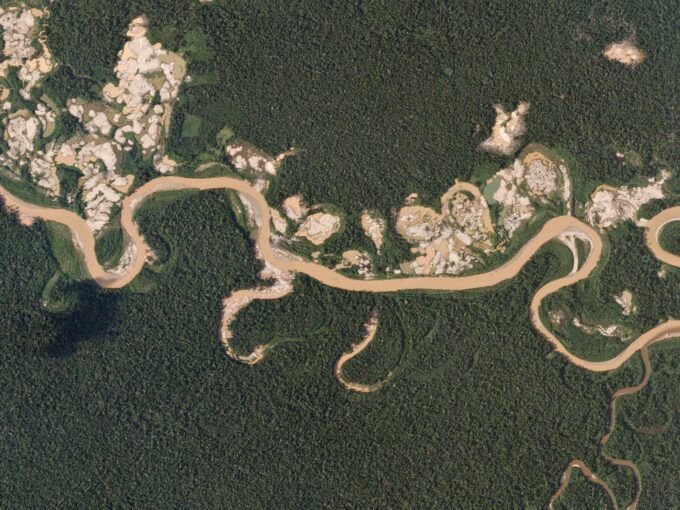
Photograph Source: Planet Labs, Inc. – https://www.planet.com/gallery/mining-peru/ – CC BY-SA 4.0

Spanning nine nations and covering more than 5.5 million square kilometers—roughly the size of the continental United States—the Amazon is the world’s largest rainforest. Often called the “lungs of the Earth,” it regulatesthe global climate, maintains freshwater cycles, and sustains life on a planetary scale. Yet the Amazon is not a single uniform forest. It is a vast mosaic of interconnected ecosystems, each with its own character and species. Dense tropical rainforests form the iconic canopy, towering over extraordinary biodiversity. Seasonally or permanently flooded forests—known locally as várzea and igapó—support plants and animals adapted to the rising and falling waters. The Amazon River and its extensive network of tributaries form the largest freshwater system on Earth, dotted with wetlands, swamps, and oxbow lakes. Beyond the forest, savannas, mangroves, and cloud forests along the Andes’ foothills provide additional habitats, collectively harboring at least 10 percent of all known species—from jaguars and macaws to pink river dolphins and black-headed uakari monkeys.

The Amazon is home to more than 30 million people. Indigenous populations settled the region as far back as 39,000 years ago, while Afro-descendant communities arrived more than 300 years ago. Afro-descendant communities—descendants of enslaved Africans, as well as those who escaped bondage to establish settlements in remote forests, mangroves, and marshlands—have cultivated a unique and enduring relationship with the land. Over generations, they developed “escape agriculture,” a subsistence strategy that kept communities hidden from colonial powers while sustaining them. These systems integrated traditional African knowledge with local ecosystems, incorporating food forests and agroforestry techniques that provided food security while maintaining ecological balance. Over centuries, these practices evolved into landscapes that are both productive and resilient, preserving biodiversity and storing carbon.

Cultural and spiritual ties to the land remain central to environmental stewardship. “For centuries, Afro-descendant communities have managed landscapes in ways that sustain both people and nature, yet their contributions remain largely invisible in mainstream conservation,” saidSushma Shrestha, director of Indigenous Science, Research, and Knowledge at Conservation International and lead author of a landmark 2025 study. Hugo Jabini, a Maroon leader from Suriname’s Saamaka Afro-descendant Tribe, adds: “Our land management practices combine traditional African knowledge with the Amazon Rainforest. The areas where we have lived have become healthier and sustained entire communities.”

Afro-descendant territories are among the most biodiverse in the Amazon and contain exceptionally high concentrations of “irrecoverable carbon”—carbon that, once released, cannot be reabsorbed for decades. Most of the world’s irrecoverable carbon—nearly 140 billion metric tons—is stored in peatlands, mangroves, marshes, and old-growth forests, ecosystems that often overlap with Indigenous and Afro-descendant lands. By maintaining traditional practices that conserve forests, wetlands, and mangroves, these communities help lock away carbon that would otherwise accelerate global warming.

Governments and funders are beginning to acknowledge this. In 2025, more than 35 countries and philanthropic organizations renewed a $1.8 billionglobal pledge to strengthen land rights for Indigenous Peoples, local communities, and—for the first time—Afro-descendant peoples. The effort reflects growing recognition that securing community tenure is one of the most effective, evidence-based strategies for protecting forests and stabilizing the climate.

Recent research underscores these findings. A landmark 2025 studypublished in Communications Earth & Environment found that deforestation rates on Afro-descendant lands are dramatically lower than in surrounding areas, and that more than half of these territories rank among the most biodiverse regions on Earth. The Forest and Land Tenure Pledge, renewed in 2025, builds on earlier commitments and directs more funding toward Afro-descendant territories across forests, savannas, and mangroves—ecosystems that support high biodiversity and climate benefits. Leaders caution that funding must flow directly to communities and be paired with strengthened land titling processes to translate global promises into on-the-ground protection.

Legal recognition of Afro-descendant lands remains scarce. Many territories are unrecognized or only partially protected, leaving communities vulnerable to land grabs, industrial agriculture, logging, and extractive projects such as mining and oil development. Jasmine Hardy, associate editor at Atmos, notes: “Approximately 77 percent of Afro-descendant peoples’ territories in Latin America and the Caribbean are located within biodiversity hotspots… Only 5 percent, however, are officially recognized as owned by these communities, leaving their homes open to exploitation.” Political marginalization compounds these challenges. Afro-descendant voices are often excluded from national decision-making and global climate forums, meaning policies are developed without their input, threatening both human rights and ecological integrity. Jabini observes: “Through our deep cultural and spiritual connection to the land, we have sustained vital forest areas. We hope this raises awareness, so that political leaders no longer see us as mere claimants of land.”

“Indigenous Peoples from all over the world are here to confront the global climate emergency,” said Kleber Karipuna, executive coordinator of the Articulation of Indigenous Peoples of Brazil, in a November 2025 press statement in advance of COP30. “What we are demanding is that governments finally secure Indigenous territories, because it has already been proven to be an effective measure to protect the forests, the rivers, and life.”

Across the Amazon, Afro-descendant communities implement stewardship tailored to local conditions. In Brazil, agroforestry systems blend native trees, crops, and livestock, reducing soil erosion, maintaining forest cover, and ensuring food security. In Colombia, communities in Buenaventura restore mangrove ecosystems that protect coastlines, sequester carbon, and sustain fisheries. In Ecuador, nearly all Afro-descendant lands are located within biodiversity hotspots and are managed through rotational farming, forest gardens, and community reserves. In Suriname, Maroon peoples—including the Saamaka—combine spiritual practices with environmental stewardship, preserving some of the region’s most intact forests. Women play a leading role in restoration projects, seed-saving networks, and local advocacy. Many communities also engage in sustainable livelihoods, from small-scale fisheries to carbon-credit cooperatives, demonstrating that ecological protection and economic well-being can advance hand in hand.

Despite these successes, Afro-descendant communities face ongoing threats: lack of formal land tenure, encroachment from agriculture, mining, and infrastructure development, socioeconomic pressures, and political marginalization. Conservation works best when rooted in local knowledge and reinforced by secure land tenure. Secure rights empower communities to defend their territories, ensuring forests, wetlands, and mangroves remain intact. Cultural values and spiritual practices reinforce stewardship, intertwining conservation with tradition, identity, and deep connection to the land. Equitable policy that includes marginalized voices produces solutions that are both fairer and more effective.

As the world confronts climate change and biodiversity loss, Afro-descendant communities offer a living blueprint for sustainable development. Protecting their lands, supporting their leadership, and amplifying their voices in international forums is both a moral imperative and a pragmatic strategy. When these communities thrive, the Amazon—and the planet—thrives with them.

This article was produced by Earth | Food | Life, a project of the Independent Media Institute.

Reynard Loki is a writing fellow at the Independent Media Institute, where he serves as the editor and chief correspondent for Earth | Food | Life