Sunday, December 21, 2025

Four Elderly Activists Face Charges for Antiwar Civil Disobedience in Northampton, Massachusetts

Source: Nobody's Voice

Courtrooms create great theater. We recognize the dramatic tension between static, formal systems of protocol that protect vested interests, and the contrary movement – the human passion to tell grim stories without flinching. We live in a country that has evolved as the world’s most rapacious empire by concealing the suffering that transpires beyond the horizon. Today (December 18) in Northampton, Massachusetts the court has been reserved for a case that – in rare fashion – features global themes. Northampton may be the venue, but the issues play out far away. Our small idyllic town can’t hide from the ferocity of a cruel country that can no longer conceal its ugliest intentions. Nothing will be resolved today, but you still feel the anxiety, the excitement. For that reason the room has been packed with spectators and members of the press. The outside hallway teems with latecomers and picketers line the sidewalk outside.

In Northampton we have the rare chance to see the irreconcilable meeting of money, murder and conscience – four elderly Massachusetts residents have their judgement day for staging an act of civil disobedience in the lobby of munitions profiteer L3Harris last March, 19th. These four tossed play money soaked in red paint (blood money) on the floor of the munition icon’s lobby and brandished an improvised arrest warrant for L3 CEO, Chris Kubasik, for war crimes in Gaza. Mind you, the defendants in this episode do not struggle for their own lives as people in court often do. They come as messengers, as entertainers perhaps (for civil disobedience has a long tradition of joyful improvisation), as proxies for the wholly absent dead and dying.

One of the defendants requires a walker, another uses a cane. Such frailty facing off against the force of the greatest military on earth, staged in a place designed to reduce emotional tension into the arcane formulae of the law, promises to be strange, compelling, unpredictable and absurd. The ages of the four, draped in Palestinian scarves, and the advanced age of many court spectators today remind us that the generation associated with Donald Trump, Joe Biden, Mitch McConnell and Nancy Pelosi have not all quietly acquiesced to the values of the US Empire.

If the defendants lose they will pay a small fine, but these three women and one man have come for a chance to bare their souls, to report, on the internal misery that most of us manage with basic denial. We are a perverse species blessed with the ability to manage cognitive dissonance with self-deception, but sometimes unusual individuals lose this precious ability and suffer the excruciating agonies of their own vigilance. For one reason or another, a few people experience vicarious pain from far away. Most of us distract ourselves with addictions or rationalizations, but some can’t quite escape – these people come to a crossroads where one turn leads to fatalistic resignation and the other requires confrontation. All four defendants took the latter path, and we gather in the packed courtroom to listen to their stories.

Nick Mottern, age 86, is the first to testify. For almost half a year Nick and I have been the only two people almost invariably present at 6:30 AM each Wednesday morning at L3Harris to hold up signs, wave Palestinian flags, and, in Nick’s case, hoist up an enormous cutout of Bibi Netanyahu dressed in an orange jump suit. I am, informally (as a “kid” in my waning 70’s) Nick’s apprentice in the art of civil disobedience. I am in court to support Nick, but all four defendants came to the lobby of L3Harris by means of a shared, intuitive moral roadmap. One defendant, Priscilla Lynch, had been a Massachusetts Department of Children and Families (DCF) case worker prior to retirement. She testifies that a career of protecting children had led her inevitably to the doorway of L3Harris – the perpetrator implicated in the murder of well over 20,000 Gazan children. The court learns that more than half of the childhood amputees on earth reside in Gaza. “Mandated reporters” once called Priscilla Lynch to report suspected child abuse and neglect, but how do we fathom the scale of child abuse in Gaza as being within the oversight of DCF?

Nick Mottern has placed himself in harm’s way before the power of authority as a matter of being – like breathing, like gazing curiously at clouds on the horizon at sunrise. His so called twilight years have been given to the art and science of resistance, and his mind spins ceaselessly to imagine strategies and targets to confront. Yesterday he mulled over the idea of seeking out and picketing the homes of local billionaires – “these criminals are at the root of everything,” he thinks aloud. Most people toss ideas to the wind in order to pass time – Nick plans with intent. His resolve is almost disconcerting. With countless hours of shared banter, philosophical reflection and political digression, Nick’s testimony reveals him to me in ways I have not imagined. His fearless exterior gives way to a vivid complexity – vulnerable, tortured, pursued by the images of war experienced firsthand.

Nick, a military veteran once stationed on a Navy ship out of Pearl Harbor, testifies that he had witnessed nuclear tests in the Pacific. While describing the oddly hued colors of the sky during nuclear events, he begins to sob. He recovers slowly but tears return while talking about seeing three young Vietcong soldiers killed in Saigon where he worked as a civilian correspondent for an English Language newspaper. He struggles to tell the court about seeing a shirt pulled open to expose a bullet wound to a female fighter’s chest. The grief of a half century old flashback leaps with sudden, private intimacy. Soldiers and war correspondents have the unique task of staring into the bottomless well of human cruelty, and Nick has done both jobs at a steep price.

The defense lawyer asks Nick moments later if he has ever seen starving children. Once a couple of months ago, Nick and I and another protester, Mike, blocked a food delivery truck at the L3Harris entrance while holding up a sign Nick had made reading, “L3 eats while Gaza starves.” Nick had impulsively initiated the confrontation and I had marveled at how nonchalantly he had orchestrated the whole thing. The food truck driver waved – seemingly with an air of approval – and sped on toward another entrance.

Nick tells the court that he had worked in Ethiopia in 1985 for Maryknoll Fathers and Brothers gathering information on the famine that was caused partially by a protracted civil war and indirectly by the influx of US and Soviet weapons into the horn of Africa. He could not bring himself to photograph a starving 11 year old girl, “she looked so awful,” he states with an apologetic air. One can bear witness and yet find that particular point where the witnessing becomes permanently entrenched, like a scar. I imagine that Nick has seen the gears and pulleys animating the US Empire at such an inordinately intimate proximity that only direct action offers relief. For him, I speculate, civil disobedience isn’t about guilt or even about morality in the ordinary, abstract sense – it is about making sense of gruesome realities, about preserving his own mental health. Fellow defendant, Patricia “Paki” Wieland, quoted in The Daily Hampshire Gazette, says it like this, “Once you know, then you have to take an action if you have conscience.”

I learn at our L3 protest the day prior to the trial that the group’s lawyer, Jamie Rogers, will employ the “necessity defense.” He will argue that the murderous practices of L3Harris offers no means of redress other than civil disobedience. Nick explains the necessity defense to me – breaking the law can be justifiable if the “illegal” act prevents a far greater harm, he states. He describes the hypothetical example of a person who trespasses on private property to dive into a pool to save a drowning person. The University of Chicago Law School website describes the necessity defense like this:

“If the defendant demonstrated that he perpetrated his crime in order to avert a greater evil, he would be acquitted. This defense was controversial at common law and poses a perennial challenge to the rule of law even as it introduces flexibility into the criminal justice system. Today, the question of whether the defense exists in modern federal criminal law remains an open question.”

The judge, Mary Beth Ogulewicz converted the case into a civil one. She stated that the defendants should not be tried criminally. Her decision deprived the four of a jury trial but gave them more latitude to employ the necessity defense.

Toward the end of consolidating the “necessity” strategy, attorney Rogers has impressively assembled a collection of affidavits from world class experts – these reinforce two critical prongs of the defense case: 1) that L3Harris products are being utilized to commit genocide and war-crimes, and 2) that civil disobedience has a long history of successfully addressing human rights violations that could not be mitigated in any other manner.

One of the signed affidavits comes from Joshua Paul who stated on his enclosed affidavit CV that he served as “U.S. Department of State, Bureau of Political Military Affairs Director” from 2012 -2023. Paul further stated that, “specific products manufactured by L3Harris, including parts and components in the JDAM (Joint Direct Attack Munitions – “smart bombs”), have been used against Palestinian civilians in Gaza in violation of international humanitarian law, according to multiple press reports and nongovernmental reporting.”

Another signed affidavit by Stellan Vinthagen, makes the claim that this author is, “as far as I am aware, the only endowed chair in the world of a university-level program focused on nonviolent direct action and civil disobedience.”

Vinthagen, a professor at local Umass, Amherst states in this affidavit that:

“Through several studies utilizing all available data, it has convincingly been shown throughout at least the last 108 years of history, that the overthrow of autocracy and the creation of democracy and civil peace is linked to mass participation of ordinary people in disruptive acts of nonviolent resistance.”

The two prosecutors for “The Commonwealth of Massachusetts” appear to have not read this affidavit. These two, young, good looking, well dressed representatives of state protocol (a man and a woman) listlessly belabor the point, to no seeming purpose, that the act of tossing “blood money” on the L3Harris lobby floor, has no chance of altering company policy. In contradictory fashion they both grill the defendants about whether they had first written letters about their concerns to L3Harris brass. One prosecutor wonders aloud where futile civil disobedience might lead – the obvious implication being that eventually, frustrated resistance would morph into violence. The absurdity of this sort of reasoning, considering the age of defendants whose walkers and canes lay propped against their seats, resembles a poorly timed standup punchline. Nobody laughs although all of us might have. Attorney Rogers explains patiently that civil disobedience unfolds in its own unique rhythms, and seldom creates instantaneous change.

The prosecution seems to be content to lazily go with the argument that unsuccessful civil disobedience merits a verdict of guilty. Why disturb the routine order of things if genocide has no remedy? But this ho-hum conclusion runs straight into a powerful assertion by codefendant, Patricia Gallagher – she tells the court that she sees her actions as being akin to resisting the inhumanity of the Nazi regime. That frames the context for me – the limitless power of the military industrial complex demands resistance whether such actions succeed or not. The more entrenched that state violence becomes, the more critical it is to fight back. These four activists from Demilitarize Western Mass are all the more courageous for confronting a predicament that may have no solution. To dramatically oppose violent, criminal governmental acts becomes proportionately heroic as odds of success decrease. We know that Sophie Scholl and The White Rose have become immortal in our collective memory precisely because of Nazism’s heartless intransigence. But Judge Mary Beth Ogulewicz is no Roland Freisler. She does not make a decision today. She says that she first needs to study the affidavits. I cross my fingers.

A verdict in favor of the defendants will reverberate well beyond Northampton. We nervously await the decision.Email

Phil Wilson is a retired mental health worker and union member. His writing has been published in ZNetwork.org, Current Affairs, Counterpunch, Resilience, Mother Pelican, Common Dreams, The Hampshire Gazette, The Common Ground Review, The Future Fire and other publications. Phil's writings are posted regularly at Nobody's Voice (https://philmeow.substack.com/).


USA-Venezuela

Trump reveals the real reasons behind the war on Venezuela

Sunday 21 December 2025, by Luís Bonilla-Molina

Venezuela and its people are the first direct victims of the "Trump Corollary to the Monroe Doctrine." This war, which has already been declared, is not against drug trafficking or the Maduro regime, but rather for oil and rare earth minerals, military bases, information, and misgovernment. All democratic, progressive, popular, and leftist forces must denounce and confront the US offensive against Venezuela, which in no way means defending the Maduro government.


"America First" is the expression that sums up the neo-fascist and neo-colonial attitude of present-day US imperialism. Trump’s declaration on Tuesday, December 16, 2025, is a radical deepening of the imperialist offensive against Venezuela. It no longer wants to "go after drug cartels" or bring about a simple regime change, but demands absolute US control of Venezuelan oil, demanding the "return of territories" – which is nothing more than changing the condition of dependence to a neocolonial territorial relationship. The US is threatening to annex part or all of Venezuelan territory, something unprecedented and of dramatic significance.

In November 2025, the Trump administration published a document entitled National Security Strategy, in which it defined its priorities, emphases, purposes, and course of action. Reviving and relaunching the Monroe Doctrine, this document is a roadmap for the political moment of building a global capitalist reordering, in which the United States needs to consolidate its power.

The new world order that is struggling to emerge is incredibly capitalist and militaristic, and the United States aspires not only to be part of it, but to remain the hegemonic nation. In this realignment, control of energy and inputs for innovation (oil, uranium, lithium, rare earths) play a central role.

The Trump administration has clearly defined its territorial priorities in what it calls the Western Hemisphere, a kind of expanded border that includes all of Latin America and the Caribbean, Canada, and Greenland. In this scenario, Venezuela acquires strategic value due to its mineral wealth—the largest oil reserves, potential for rare earths in the southern/Orinoco region, biodiversity, water, and genetic reserves—as well as its privileged military location in northern South America, south of the Caribbean with a coastline on the Atlantic, and a few kilometers from the Panama Canal, which allows it access to the Pacific. The United States does not want to share these privileges with China, Russia, or any emerging nation. In other words, Venezuela is a target for the Americans, as stated in the Trump Doctrine. This is an unprecedented violation of territorial and political sovereignty.

To achieve this, since August 2025, the most impressive military and troop deployment known in the region for decades has been generated. The attack on fishing boats, accused of being drug mules, has been the tragic melody of the presentation of its offensive against Venezuela, which is intensifying every day. The intervention in Venezuelan airspace, with a NOTAM issued by the US air traffic authority and Trump’s direct presidential order to ban flights to the country, was escalated with the maritime piracy of the capture and confiscation of an oil tanker. On December 16, Donald Trump himself declared that he demands Venezuela "return oil, land, and other assets to the United States." In other words, he has publicly declared his decision to seize oil reserves and his desire to directly colonize part of Venezuelan territory.

This can only be achieved through direct military occupation of the territory, establishing military bases. But he wants to do so at the lowest possible cost in terms of the loss of American soldiers’ lives, operational expenses, and political impact. Therefore, the decision to confiscate all oil tankers not authorized by the US Treasury Department is another escalation to suffocate Maduro’s government and create the conditions for its downfall, either through internal implosion, a coup d’état from within Maduro’s own camp to initiate a transition agreed upon in the terms of the National Security Strategy. Or as a result of a "surgical operation" that would allow the Edmundo González Urrutia-María Corina Machado duo to take power. The economic suffocation of the country seems to be the ideal tool to bring any of these colonial initiatives to fruition. We would be talking about the risk of unprecedented famine for the Venezuelan population.

The establishment of US military bases on Venezuelan territory would allow the US to establish a colonial relationship close to oil reserves, ensuring exclusive access to them. In a country like Venezuela, where even its historical ally Rómulo Betancourt did not accept the establishment of US military bases on its territory due to the effects that Venezuelan nationalism would have on the electoral will of the people, this can only be achieved through a long and chaotic transition—one that prolongs and, incredible as it may seem, tes the misery and tragedy of the material living conditions experienced by the population during the Maduro period, something that is becoming increasingly clear in the US offensive.

The immediate collateral damage is being felt in Cuba, which is unable to receive Venezuelan aid in the form of fuel and oil for its economy and the maintenance of its electrical system. The United States is betting on a domino effect in the region, which will produce the "carom" of displacing the governments of Caracas, Havana, and Managua in one fell swoop. In other words, the positioning is for total control of the so-called Western Hemisphere.

Additionally, using the latest technological advances in data capture and processing, the United States is moving forward with the implementation of a predictive control regime by having extremely valuable information on the behavior of the population (of the Western Hemisphere in general and Venezuela in particular) in response to its military deployment in the southern Caribbean. That is why it generates rumors and counter-information on social media every day, to elicit responses from the population, which it can then segment and classify in order to construct its scenarios for action.

We are experiencing the first regional military offensive with technology, techniques, and purposes typical of the fourth industrial revolution, which makes it extremely difficult to interpret using the paradigmatic keys of the first three industrial revolutions.
The impossible transition

María Corina Machado has undisputed leadership among the Venezuelan population, even in sectors that historically supported Chavismo. This is largely due to Maduro, who, in his eagerness to polarize in order to prevent the consolidation of a left-wing opposition, has played the game that suits MCM best. But socially rooted leadership is not the same as the ability to govern, especially if the diagnosis of the Venezuelan crisis and the path to overcoming it is wrong.

MCM’s bet is on promoting an illiberal government that will continue and deepen the neoliberal policies applied by Maduro, especially those implemented since 2018. Its strategy of absolute liberalization of the market economy as a formula for generating employment turns its back on the central problem facing Venezuelans in the short term: wages and the return of minimally decent material living conditions. The "post-Maduro bonanza" of an economy without sanctions is seen by MCM in terms of privatization , labor flexibility, and attracting international capital, which is only possible by keeping wages low.

The United States knows this, which is why its commitment to a transition via González-Machado is to pave the way for a long and chaotic transition that will allow it to establish its openly colonial relationship with Venezuelan territory and wealth. In fact, MCM has repeatedly stated that the "recovery of Venezuela" will require deeper levels of cooperation with the United States.
The miscalculations of Madurismo

Maduroism’s anti-imperialism is limited by its survival in power. Maduroism is not leftist, much less revolutionary. Since the war in Ukraine, it has sought a strategic agreement with the United States, trading oil in exchange for remaining in power. The problem is that now the Trump administration wants to go much further.

Maduro’s government has been a disaster for the Venezuelan people and working class. Not only in terms of wages and material living conditions, but also in terms of restrictions on basic democratic freedoms, such as the right to express opinions, freedom of expression, the possibility of organizing autonomously in unions and political parties, territorial roots, and comprehensive human development. Maduro has been a terminator of the advances made during the Chavista period and a deepener of its mistakes. No Venezuelan alive has known a worse government than Maduro’s.

Amid these conditions of imperialist offensive, Maduro continues with his authoritarian line of action and the survival of the new bourgeoisie he represents. An imperialist offensive such as the one unleashed since August 2025 in the southern Caribbean can only be confronted with a large national anti-imperialist front resulting from a minimum nationalist consensus, but this requires reversing his own policies, freeing political prisoners — who include social, progressive, and leftist leaders — a general amnesty for all those prosecuted, imprisoned, and subject to restrictive measures, the return of political parties to their legitimate members, and a reorientation of dwindling national revenues toward wages and salaries.

But Maduro has done the opposite, deepening repression, increasing the number of detainees and those prosecuted, deepening the fall in wages and the concentration of wealth in a few hands. He does the opposite of what logic demands, because his commitment is not to the people but to sustaining a model of accumulation that favors the rich.

Maduro’s rhetoric does not correspond to what is happening socially. For ordinary citizens, the US attack is fundamentally against Maduro, and there is no reason to defend him. Given this situation, the desperation to survive has led large sections of the population to believe that Maduro’s departure, by any means, would be the beginning of a recovery from the oppressive situation in which they live. For the general population, the US National Security Strategy is of little importance, because Maduro has destroyed their hope for a better tomorrow.

This is a complex situation for nationalist and progressive forces and those who have not renounced their leftist identity, refusing to place themselves under the leadership of EGU-MCM. What is significant is that the country is currently experiencing, from the world of labor and the working class, initiatives for depolarization based on the construction of a minimum program for the defense of wages and basic democratic freedoms. The question is whether there will be enough time to build an autonomous pole for another possible transition.
What should be done?

Continue to bet on (and work for) the constitution of an autonomous political pole of workers, unreservedly supporting initiatives such as the formation on December 12 of the Unitary Agreement of six trade union centers, federations, guilds, and unions for the rescue of wages. An event like this, amid military tensions in the Caribbean, speaks to the instinct of the working class in the face of any scenario in the short and medium term.

In addition, the campaign for a General Amnesty must be intensified, to free all those detained, prosecuted, and subjected to restrictive measures, paving the way for multiple voices to come together to reflect on national sovereignty in times of imperialist attack. Demand the return of parties, unions, and union federations to their legitimate representations.

Any differences with Maduro, political parties, or personalities cannot serve as an excuse for not developing authentic anti-imperialism, based on the interests of the working class. All democratic, progressive, popular, and leftist forces must denounce and confront the US offensive against Venezuela, which in no way means defending the Maduro government. The departure of Madurismo must be a decision and process of the Venezuelan people, led by its working class. In this sense, these are days of promoting an anti-imperialist policy without hesitation or doubt.

Whether facing Maduro, EGU-MCM, or any other government, the working class must defend its autonomy and reaffirm that only its capacity for struggle will allow it to emerge from the current crisis. We revolutionaries must humbly and decisively contribute to this cause and direction.

16 December 2025


Attached documentstrump-reveals-the-real-reasons-behind-the-war-on-venezuela_a9321.pdf (PDF - 919.2 KiB)
Extraction PDF [->article9321]

Luís Bonilla-Molina is a Venezuelan university lecturer, critical pedagogue and president of the Venezuelan Society of Comparative Education.


International Viewpoint is published under the responsibility of the Bureau of the Fourth International. Signed articles do not necessarily reflect editorial policy. Articles can be reprinted with acknowledgement, and a live link if possible.


The Problem with Machado: Assange Sues the Nobel Foundation


The Swedish police have promised it will go nowhere, but the attempt by WikiLeaks founder Julian Assange to draw attention to the inappropriateness of María Corina Machado as a Nobel Peace Prize recipient raises a few salient matters. On December 17, Assange submitted a criminal complaint to the Swedish Economic Crime Authority and the Swedish Crimes Unit. The legal complaint is directed against the Nobel Foundation, arguing that the pending transfer of 11 million SEK ($US 1.18 million) and the award of the prize medal to Machado violate the terms of Alfred Nobel’s will of November 27, 1895.

The will, binding under the terms of Swedish law, stipulates that the award of the prize and monies be given to a person who, during the preceding year, “conferred the greatest benefit to humankind” in pursuing “the most or the best work for fraternity between nations, for the abolition or reduction of standing armies and for the holding and promotion of peace congresses.”

Given that the peace prize laureates are selected by the Norwegian Nobel Committee, seeking to hold them accountable for their poor choice of awardee might have been a better starting point. But the complaint is alert to this, noting that the Swedish funds administrators have a fiduciary duty to disburse the funds. “The Norwegian committee’s selection does not grant them criminal immunity.” Indeed, it was up to the administrators to consider such a decision made “in flagrant conflict with the explicit purpose of the will, or where there is evidence that the awardee will use or is using the prize to promote or facilitate the crime of aggression, crimes against humanity, or war crimes”.

Whatever the administrative minutiae, Assange’s effort is worth noting. Machado has become the unsavoury alternative to the Venezuelan incumbent, Nicolás Maduro, a figure who refused to accept the electoral returns for his opposing number, Edmundo González, in July 2024. González was essentially a pick by Machado, who has emerged as the empurpled, plumed candidate seeking Maduro’s overthrow. That she was the 2025 choice of prize recipient was galling enough for 21 Norwegian peace organisations to boycott the ceremony and prompt Nobel Peace Prize laureate Adolfo Pérez Esquivel to remark that, “Giving the prize to someone who calls for foreign invasion is a mockery of Alfred Nobel’s will.”

Machado has made no secret of her approval of the buildup of US military personnel (around 15,000) off the coast of Venezuela since August, including a nuclear-powered attack submarine and the world’s largest aircraft carrier, the USS Gerald R. Ford.  She has “incited and defended the Trump administration’s use of lethal military force and preparation for war.” The US military has already committed, charges Assange, “undeniable war crimes, including the lethal targeting of civilian boats and survivors at sea, which has killed at least 95 people.” (President Donald Trump has liberally designated such individuals as narco-terrorists.) The Central Intelligence Agency has been authorised to conduct covert actions in Venezuela. Parts of the Venezuelan military have been classified by the Trump administration as a Foreign Terrorist Organisation (FTO).

Since Assange submitted his complaint, Trump has ordered a complete blockade of sanctioned oil tankers entering or exiting Venezuela. The US has thus far seized two tankers, though the authorities have failed to distinguish which tankers are sanctioned or otherwise. The Panama-flagged Centuries, for instance, was not officially sanctioned by the US, showing that this administration is not one to be, as US Secretary of War Pete Hegseth put it, legally tepid.

A list of incitements to war by Machado is enumerated. They include the dedication of the award to President Trump for having “Venezuela in where it should be, in terms of a priority for United States national security”; a heartfelt endorsement of US military escalation as maybe being “the only way” in dealing with Maduro; warm appreciation for Israeli Prime Minister Benjamin Netanyahu’s “decisions and resolute actions in the course of the [Gaza] war” and the endorsement of extrajudicial killing of civilian boats in the Caribbean Sea as “visionary”. Hardly the résumé for a peacemaker.

Assange argues that the failure of the funds administrators to stop pertinent disbursements to Machado, in light of the material submitted in the complaint, “indicates ongoing criminal intent”. Such funds aided “a conspiracy to murder civilians”, violated national sovereignty through using military force, and advanced resource theft (Machado’s promised reward to US firms of oil and gas resources amounting to US$1.7 trillion). In doing so, Nobel’s will and charitable purpose had been violated through “gross misappropriation, aiding international crimes […] and conspiracy.” They also breached Sweden’s obligations under the Rome Statute. By way of remedy, the “immediate freezing of all remaining funds and a full criminal investigation lest the Nobel Peace Prize be permanently converted from an instrument of peace into an instrument of war” was sought.

In an email to AFP, Swedish detective inspector Rikard Ekman showed little interest in taking up the matter. “As I have decided not to initiate a preliminary investigation, no investigation will be conducted on the basis of the complaint.”

While this complaint remains a purist’s attempt to return the peace prize to a more conventional reading (Assange thinks the UN Secretary General António Guterres and UN human rights chief Volker Turk are eminently more suitable candidates), the practice of awarding this inflated award to figures of ill repute and sullied reputation will be hard to shake. The ghost of former US security advisor and Secretary of State Henry Kissinger, a man lauded for bringing peace to Indochina when he covertly indulged illegal bombing campaigns, not to mention war crimes, torture, and an assortment of other blood sports, continues to loom large. It might well be time to abolish the Nobel Peace Prize altogether, and the committee responsible for it. It was never a strong indicator of merit, even if it offers the chance for some very dark humour for the reptiles to revel in.

Binoy Kampmark was a Commonwealth Scholar at Selwyn College, Cambridge. He lectures at RMIT University, Melbourne. Email: bkampmark@gmail.comRead other articles by Binoy.

Deception from the White House to justify a war? We’ve seen this movie before.


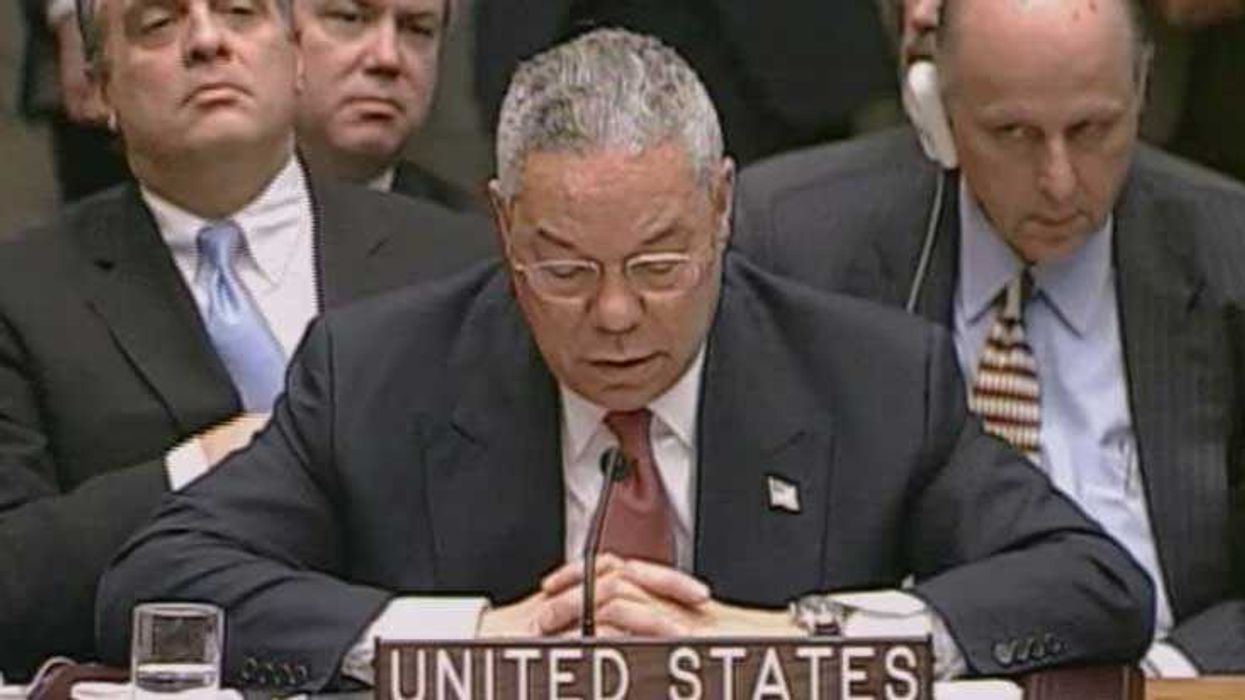
Collin Powell testifies at the United Nations. (Screenshot)
December 21, 2025

Are Americans about to be led again into a war based on misrepresentations and lies? It’s happened before, most recently with the wars in Iraq and Vietnam.

President Donald Trump and his administration have presented the country’s growing military operations against Venezuela as a war against drug trafficking and terrorism. Trump has designated the government of Venezuela President Nicolas Maduro as a foreign terrorist organization, the first country to ever receive that designation.

The U.S. military has killed at least 99 crew members of small boats that Trump claims, without presenting evidence, were carrying illegal drugs destined for the U.S. The New York Times reports, however, that “Venezuela is not a drug producer, and the cocaine that transits through the country and the waters around it is generally bound for Europe.”

Trump’s administration has justified the bombing of these boats by declaring they are manned by combatants. U.S. Sen. Jack Reed, a Democrat from Rhode Island, told the Intercept news outlet that the administration “has offered no credible legal justification, evidence or intelligence for these strikes.”

There is no war. Yet.

On Dec. 12, 2025, Trump said, “It’s going to be starting on land pretty soon” and announced four days later a “total and complete blockade of all sanctioned oil tankers going into, and out of, Venezuela.”

As Trump increasingly sounds like he is preparing to go to war against Venezuela, it might be helpful to examine the run-ups to the wars in Iraq and Vietnam – two wars based on lies that led, together, to the deaths of 62,744 Americans.

As an investigative journalist who has written about the vast, secret operations of the FBI and the man who ran it for decades, I am well aware of the dangerous ability the government has to deceive the public. I also covered the opposition to the Vietnam war and the release of information years later that revealed that lies were at the heart of the start of both the Vietnam and Iraq wars.

Fear used to gin up public support

Consider the run-up to the Iraq War.

Fear was the main tool used to convince the public that it was essential for the U.S. to go to war in Iraq. The manufacturing of fear was evident in a speech by Vice President Dick Cheney in August 2002 to a convention of the Veterans of Foreign Wars.

In 2003, Secretary of State Colin Powell addressed the U.N. Security Council on information and intelligence that he believed showed the possibility of weapons of mass destruction in Iraq.

Cheney said, without evidence, that Iraq’s Saddam Hussein was planning to use weapons of mass destruction against the United States and its allies. If the U.S. did not go to war against Iraq, he said, it might experience another Pearl Harbor.

President George W. Bush chose Secretary of State Colin Powell to make the administration’s most prominent public case for going to war in Iraq in a televised speech at the United Nations. Powell was perhaps the most respected official in the Bush administration.

The White House provided Powell with a draft speech. But Powell pressed the CIA regarding what he thought were unsupported claims in the White House draft. Despite his efforts, his speech on Feb. 5, 2003, contained significant unsupported claims, including that Hussein had authorized his military to use poison gas if the U.S. invaded.

“Leaving Saddam Hussein in possession of weapons of mass destruction for a few more months or years is not an option, not in a post-September 11th world,” Powell solemnly declared that day.

He later expressed regret for making the case for war.

“I’m the one who presented it on behalf of the United States to the world,” Powell later said. By then, he said, the speech was “painful” for him personally and would forever be a “blot” on his reputation.

Intelligence agencies pressed to justify war

No weapons of mass destruction existed in Iraq, nor was Hussein connected with al-Qaida, as the Bush administration had said it was. And Iraq did not release poison gas when the U.S. invaded the country. Early postwar assessments of how the U.S. could have invaded Iraq on the basis of serious false claims suggested it happened because the CIA and other intelligence agencies gave President Bush false or inadequate intelligence.

But as extensive official records of pre-war deliberations became available to journalists and others in response to Freedom of Information Act requests, a different explanation emerged.

John Prados, historian at the National Security Archives, discovered an explanation in hundreds of official records that meticulously document the run-up to the war.

They revealed that U.S. intelligence agencies had let themselves be used, he wrote, as “a tool of a political effort, vitiating the intelligence function … They all yielded intelligence predictions of exactly the kind the Bush administration wanted to hear … The intense focus on achieving the conditions for war instead of solving an international problem led to crucial faults in military planning and diplomatic action.”

The administration did not attempt to engage in diplomacy before deciding to go to war. There never was a serious effort, even within the administration, to consider alternatives to war.

George J. Tenet, director of the CIA at the time, later wrote that “based on conversations with colleagues, in none of the meetings can anyone remember a discussion of the central questions: Was it wise to go to war? Was it the right thing to do?”

Most journalists accepted PR at face value

A dearth of serious reporting contributed to the public being ill-informed.

Dan Kennedy, professor of journalism at Northeastern University, recently wrote that only one news organization, the Washington bureau of Knight Ridder – later known as McClatchy – exposed the Bush-Cheney “administration’s lies and falsehoods during the run-up to the disastrous war in Iraq.”

Other reporters relied on the public relations push for war being made to journalists by high-level political appointees in the military, foreign service and intelligence agencies. But Knight Ridder journalists relied on expert, longtime career officers in those agencies who were “deeply troubled by what they regarded as the administration’s deliberate misrepresentation of intelligence, ranging from overstating the case to outright fabrication.”

Lies to Congress and the public also were at the heart of the run-up to the war in Vietnam.

President Johnson reports to Congress and the American people on the Gulf of Tonkin incident, which he said happened off the coast of Vietnam but which was later disputed.

Of the two attacks on a destroyer that the administration of President Lyndon Johnson said required an immediate vast buildup of troops in August 1964, one was provoked by the United States and the other one never happened.

Few if any questions were asked when the House and Senate voted – with only two no votes – on the request for what would be known as the Gulf of Tonkin Resolution. The resolution was used by Johnson and his successor, President Richard Nixon, to keep expanding the war for nearly a decade. By mid-1969, there were 543,400 American troops in Vietnam.

Truth and transparency are crucial

It may seem obvious that the most important lesson to be learned from those wars is that the president and all who contribute to decisions to go to war should tell the truth. But, as shown by the presidents who led the U.S. into wars in Iraq and Vietnam and from Trump’s daily remarks, truth is a frequent casualty.

That increases the need for Congress, the public and the press to demand to be fully informed about these decisions that will be carried out in their name, with their money and with the blood of their sons and daughters. That’s necessary to prevent a president and Congress from making decisions that lead to consequences like these:
In the Iraq War, 4,492 American military members were killed and approximately 200,000 Iraqi civilians were killed. In the Vietnam War, 58,252 American military members were killed, 1.1 million Vietnamese military members were killed, and a staggering 2 million Vietnamese civilians were killed.


Betty Medsger, Professor Emeritus of Journalism, San Francisco State University

This article is republished from The Conversation under a Creative Commons license. Read the original article.


Source: Originally published by Z. Feel free to share widely.

If we take a bird’s-eye view of Serbia, Bosnia and Herzegovina, and Montenegro—where the largest share of the Serbian people lives today—we see a strikingly similar structure: three small economies neatly integrated into a semi-peripheral role—stable enough to service debt and function as markets, yet insufficiently developed for people to live off their own work without loans, relatives in the diaspora, and the routines of seasonal survival.

The common denominator is almost shameful in its simplicity: these societies are structured so that a thin stratum of political-business elites and capital owners can preserve, consolidate, and expand their positions, while the majority lives in permanent insecurity—caught between precarious contracts, overpriced housing whose purchase pushes them into clientelist dependence on those who can “make sure” the monthly loan instalment gets paid, comprador political parties, and the persistent belief that salvation lies somewhere else.

Instead of a serious public debate about who appropriates the fruits of labour and what a fairer economic order might look like, people are fed myths about “foreign investment,” the “European path,” and “stability,” while hollow speeches about “statehood” are endlessly rehearsed.

Serbia cannot be pacified

In Serbia, that exhaustion is increasingly taking the form of a student-led—and broader popular—uprising against the technocratic order of the Serbian Progressive Party (SNS): against a system that grounds its power in a mix of statistical sleight of hand, public relations, and projects designed for someone else’s capital, while persistently underestimating the intelligence and dignity of its own citizens.

The SNS regime itself, which presents as “national” and “state-building,” is in fact the clearest evidence that an authentic Serbian politics has long since disappeared from Belgrade. It operates as the local exponent of a knot of corporate, imperial, and intelligence interests tied together in the capital; as a result, the fate of the people, of Kosovo, and of the wider space inhabited by Serbs is increasingly viewed through the lens of other people’s agendas and domestic marketing needs.

Figures about growth, debt, and inflation are raised like a decorative wall around the ruling class, yet the public mood suggests something else: people still endure far more than they truly accept. That is why what began as resistance to “economic experts” is ever more often turning into resistance to the entire political framework—one that has long ceased to function as a system of governance and has been reduced to bare, endlessly repeated propaganda about an economic miracle that never quite arrives.

Republika Srpska: Between Self-Humiliation and Humiliation

In Republika Srpska—presented here as part of a UN-mandated territory, the Dayton-era Bosnia and Herzegovina, where the largest share of Bosnia and Herzegovina’s Serbs live (31 percent of their total population)—the response to the same economic misery is not revolt but lethargy. The politics of the Alliance of Independent Social Democrats (which has nothing in common with social democracy except its name) and its long-time leader Milorad Dodik not only exploits this lethargy; it actively manufactures it: the less people trust that change is possible, the easier it is to rule by combining periodic chauvinistic outbursts against Bosnian Muslims—“Turks”—and other designated internal enemies, with gestures of auto-colonial deference and a simulated sovereigntism, reinforced by symbolic alliances with a whole spectrum of right-wing obscurantists across the world, from Washington to Budapest. The miserable turnout—only 31 percent—in the recent RS presidential elections imposed by the colonial administration is not merely a statistic; it is a diagnosis: a people formally invited to decide have, in practice, been convinced that everything has already been decided.

Montenegro’s Double Catastrophe  

In Montenegro, meanwhile, the overall social and economic crisis is refracted through a false duel between two losing affiliations: one, a chauvinistic Dukljan–Montenegrin camp, openly anti-Serb and provincially pro-Western, which has “kidnapped” and reserved for itself the antifascist legacy of the Second World War People’s Liberation Struggle; and the other, a Ravna Gora–Chetnik camp, which turns its historical defeat and moral collapse into a kitsch cult and political impotence.

Seeking shelter from the antiserbian Dukljan recoding of Montenegrin history and identity, the Serbian community has largely—and tragically—imprisoned itself in an artificially stoked Ravna Gora nostalgia which, by affirming collaboration with an occupying power on the model of the Second World War, cancels out any serious chance for a sober, modern, and emancipatory Serbian politics.


The Federation of Bosnia and Herzegovina: A Place of Meaningless Politics  

It should be stated plainly that Serbs in the larger Bosnian-Herzegovinian entity – the Federation of Bosnia and Herzegovina (a composite, decentralized structure consisting of ten Bosniak, Croat, and mixed Bosniak–Croat cantons) – are most often reduced to two equally degrading roles. On the one hand, those who are politically active are largely turned into a client base of the Dodik’s SNSD: a kind of “diaspora” of Republika Srpska and Serbia inside their own birthplace, and as such they are pushed to the limits of political instrumentalization—most often as bargaining chips in arrangements with the Croatian Democratic Union of Bosnia and Herzegovina (HDZ BiH), led by figures who publicly posture as guardians of a Croatian neo-nazi tradition. On the other hand, those who do not fit into that framework often drift through life in anonymity and self-erasure, accepting Bosniak-nationalist and so-called “pro-Bosnian” narratives about themselves as the only permitted form of social existence. These narratives, as a rule, cast the Serbian people as intruders in their own country—an anomaly in Bosnian history—which, however absurd, becomes for many the only viable mode of survival.

Their political representatives are, to a significant extent, little more than individuals who opportunistically put their names and surnames into circulation: they say what the Bosniak majority wants to hear, rather than what the people they supposedly represent actually think, feel, and live through.


Serbs in Croatia: Guilty for Their Leftist Partisan Legacy  

Serbs in Croatia today make up a minority of just over three percent of the population, demographically decimated by war, emigration, and assimilation, yet politically and symbolically subjected to an almost monstrous demonization by the Croatian right—with the tacit or half-hearted support of the ruling HDZ and a significant segment of the Roman Catholic Church. Though small in number, they remain a constant target of hate speech, revisionist narratives, and structural discrimination precisely because they carry the emancipatory legacy of the Second World War: the uprising against the Ustaša order and the idea of an antifascist Croatia. The fact that Serbs, together with Croatian antifascists, formed the backbone of resistance and the foundation of a different vision of Croatia makes them especially intolerable to the radical right today. They are not attacked as a real “threat”—they are, after all, already on the edge of disappearance—but as a living reminder that Croatian society contains a better, fairer, and more humane potential whose political articulation is meant to be suppressed.

Kosovo: Between Belgrade’s Compradors and Albanian Chauvinism

The position of Serbs in Kosovo today is shaped by a double pressure: on the one hand, Belgrade’s ongoing exploitation of their insecurity as a tool for masking the true nature of the regime in Belgrade; on the other, real fear and day-to-day tensions in their encounters with Albanian chauvinism and institutional coercion. Serbs—especially in the north—have for years lived in an atmosphere of recurring crisis: withdrawal from Kosovo’s institutions, election boycotts, the installation of mayors without genuine legitimacy, clashes with the police, and the closure of “parallel” Serbian institutions in coordination with the SNS regime—developments which, as both the OSCE and the EU have noted, have further undermined their access to salaries, pensions, and basic services.


It is precisely from this composite experience—revolt in Serbia as a hub of a broader system of managed dependence, lethargy in Republika Srpska, hollow elections in Montenegro, clientelization and self-erasure in the Federation of Bosnia and Herzegovina, demonization in Croatia, and the double pressure in Kosovo—that we should begin if we want to understand how the Serbian people are entering a multipolar world, and what any politics of emancipation could realistically mean under such conditions.

What could such a politics actually be?

A Croatian Member of the European Parliament, Tomislav Sokol, recently wrote—with a dose of contempt and racism—that “Serbian nationalism is forged from a mixture of Saint-Sava mythology and communist dogmas.” Yet if we strip that claim of its day-to-day political malice and read it seriously, it is precisely in that junction that one might discern the outline of a different, more elevated horizon—provided we also draw a clear line of distance both from “Svetosavlje” as seen through the Ljotićite lens and other currents of Serbia’s radical and neo-Nazi right, and from rigid Stalinist and Stalinist-adjacent understandings of communism. If we return the concept of Svetosavlje to its source, it becomes clear that the figure of Saint Sava—in its original historical and traditional meaning—can only be associated with universal Orthodoxy and with a Christian ethos of love, openness, and compassion toward every human being.

In the same way, the re-examination of communism that matters here cannot be a renewed cult of the state and the party, but rather a hunger for freedom and democracy—a striving for a society without the exploitation of human beings by human beings—along the lines recalled by liberation theology: sin begins as a “no” addressed to one’s neighbour, as self-deification that turns private interest into an idol, and then produces an order in which “the princes of this world” direct economic, cultural, and aesthetic currents in ways that inevitably oppress the poor and the dispossessed. (Enrique Dussel, Beyond Philosophy: Ethics, History, Marxism, and Liberation Theology, ed. Eduardo Mendieta (Lanham, MD: Rowman & Littlefield Publishers, 2003).)

A politics of emancipation for Serbs in a multipolar world crowded with predators and scavengers could—and must—mean a break with those idols, whether they come in the form of national chauvinism, Stalinist rigidity, or neoliberal servility, and a persistent “yes” addressed to one’s neighbour: the building of communities that defend both the survival of the people and the dignity of every human being—without hatred toward others and without submission to the logics of capital, empire, and domestic corruption.

In that sense, it is no accident that democracy proves to be modern humanity’s most important achievement—not as a mere ritual of turnout in elections that have already been stolen in advance, but as the hard-won, ongoing possibility for ordinary people to control power, replace it, and constrain it. Democracy has never been a gift: from the earliest citizens’ assemblies, through the bourgeois revolutions, the labour and trade-union movements, antifascist struggle, and decolonization, it has always arrived as the outcome of conflict with those who believed they had the right to decide on behalf of everyone. That is why it still makes sense to speak of democracy today only if we understand that it must be continually conquered—against the arbitrariness of the state, against the diktat of capital, against every ideology that would suspend, once and for all, the people’s capacity to say “no.”

Without that historical memory, invocations of democracy collapse into an empty formula—no less false on the lips of Brussels bureaucrats than on the lips of domestic authoritarian “patriots.” For all the groups of Serbs listed here—those in Serbia, Bosnia and Herzegovina, Montenegro, Croatia, and Kosovo—this kind of democracy, a “democracy of unceasing struggle,” is not merely one possible solution; it is the only framework capable of bringing them into a shared political story at all. It is the only point of convergence that does not demand that anyone renounce their identity, their homeland, or their historical experience, but instead asks for a minimum that constitutes human and political decency: that power be removable, accountable to citizens, that the law apply equally to all, and that the exploitation of human beings by human beings—and of peoples by peoples—be unacceptable.

And for that very reason, it is not a project that matters only for Serbs. A consistent, inclusive democracy—one that defends their right to survive and to have a voice—would at the same time strengthen everyone who lives with them and around them—Bosniaks, Croats, Albanians, Montenegrins, and others—because it offers the only realistic exit from the vicious circle of ethnic hierarchies and colonial tutelage.

A Major Rally That Deserves Global Attention

 On 21 December, Novi Pazar—Serbia’s largest city with a Bosniak/Muslim majority—is set to host a major anti-government protest initiated by students of the State University in Novi Pazar, with students announced to be coming from Belgrade, Novi Sad, Kragujevac, and Niš as well. This is more than another date on the protest calendar: it is a public display of solidarity that cuts across the lines on which the region’s rulers have long tried to keep young people divided.

Its message is regional and unmistakable: the future will not be built by ethnic gatekeepers, clientelist parties, or imported “stability,” but by citizens who refuse to be managed as competing tribes. In that sense, the gathering in Novi Pazar also renews an old emancipatory maxim from early twentieth-century Serbian political thought—“The Balkans for the Balkan peoples”—not as a slogan of exclusion, but as a call for dignity, self-government, and mutual recognition in a space too often treated as someone else’s chessboard.