Iranian protests expand beyond the economy as students demand freedom, end to regime rule
Some protestors chanted "death to Islamic Republic" as they took to the streets.
By Somayeh Malekian
December 30, 2025
Some protestors chanted "death to Islamic Republic" as they took to the streets.
By Somayeh Malekian
December 30, 2025
ABC
University students in different cities in Iran joined protests against the regime Tuesday by chanting slogans that included “student, be the voice of your people,” and “death to Islamic Republic.”
The protests began Sunday in downtown Tehran as the Iranian currency hit a new low, but they have since expanded in size and scope, moving beyond the narrower cause of the economy to "freedom and equality" and an end to the regime, evident in the slogans protesters are chanting.
Many shop owners in two major malls in downtown Tehran and in other cities have closed their stores and joined the demonstrations, as severe uncertainty remains in the country’s currency trade market following a sharp decline in the value of the rial, the national currency. The rial has been fluctuating in value between 1.38 million and 1.45 million per U.S. dollar since Sunday.
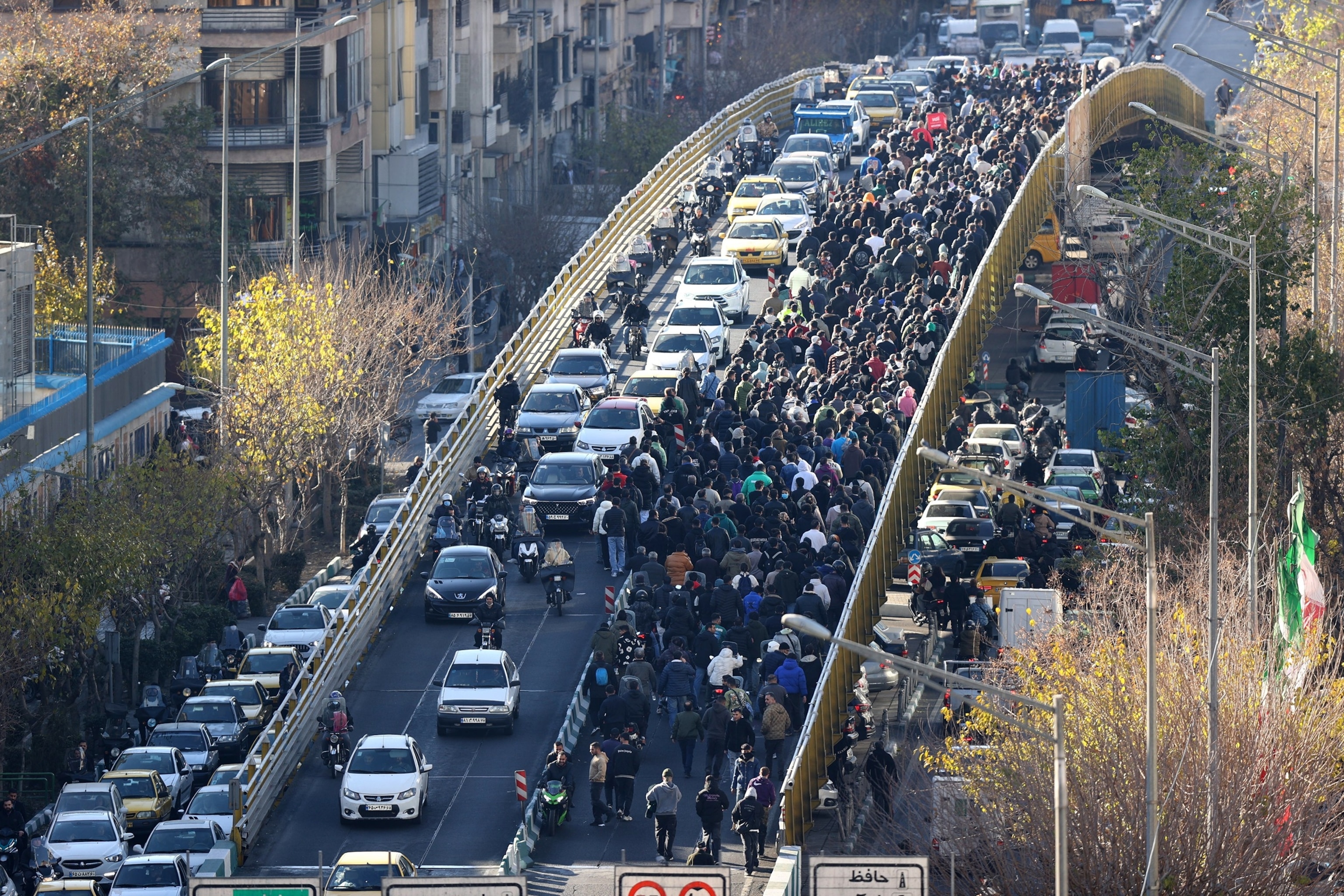
Protesters march in downtown Tehran, Iran, on Dec. 29, 2025.
Fars News Agency via AP
Reports from across the country indicate that shop owners in other cities, including the western city of Hamedan and the southern island of Qeshm, have also joined the protests by closing their stores. Slogans such as “death to the dictator” and “Seyyed Ali (Khamenei) will be toppled this year,” referring to Iran's supreme leader, were heard in Qeshm and Zanjan, according to reports.
Amid the widespread protests and the currency plunging to a new record low, Iranian President Masoud Pezeshkian accepted the resignation of the head of the country's Central Bank on Monday, IRNA reported.
Most Iranians struggle to keep up with the constantly rising prices in the country due to the rapid fall of the rial, which declined in value from 34,000 rials against the U.S. dollar in July 2016 to 165,000 rials against dollar in May 2020. Its value has plummeted more than 800% since then.
Iranian President Masoud Pezeshkian acknowledged the protesters' demands in a post on his X account on Monday, saying in part that “the livelihood of the people” is his "daily concern."
“We have fundamental actions on the agenda to reform the monetary and banking system and preserve the purchasing power of the people,” he added. "I have tasked the Minister of the Interior to hear the legitimate demands of the protesters through dialogue with their representatives, so that the government can act with all its might to resolve problems and respond responsibly."
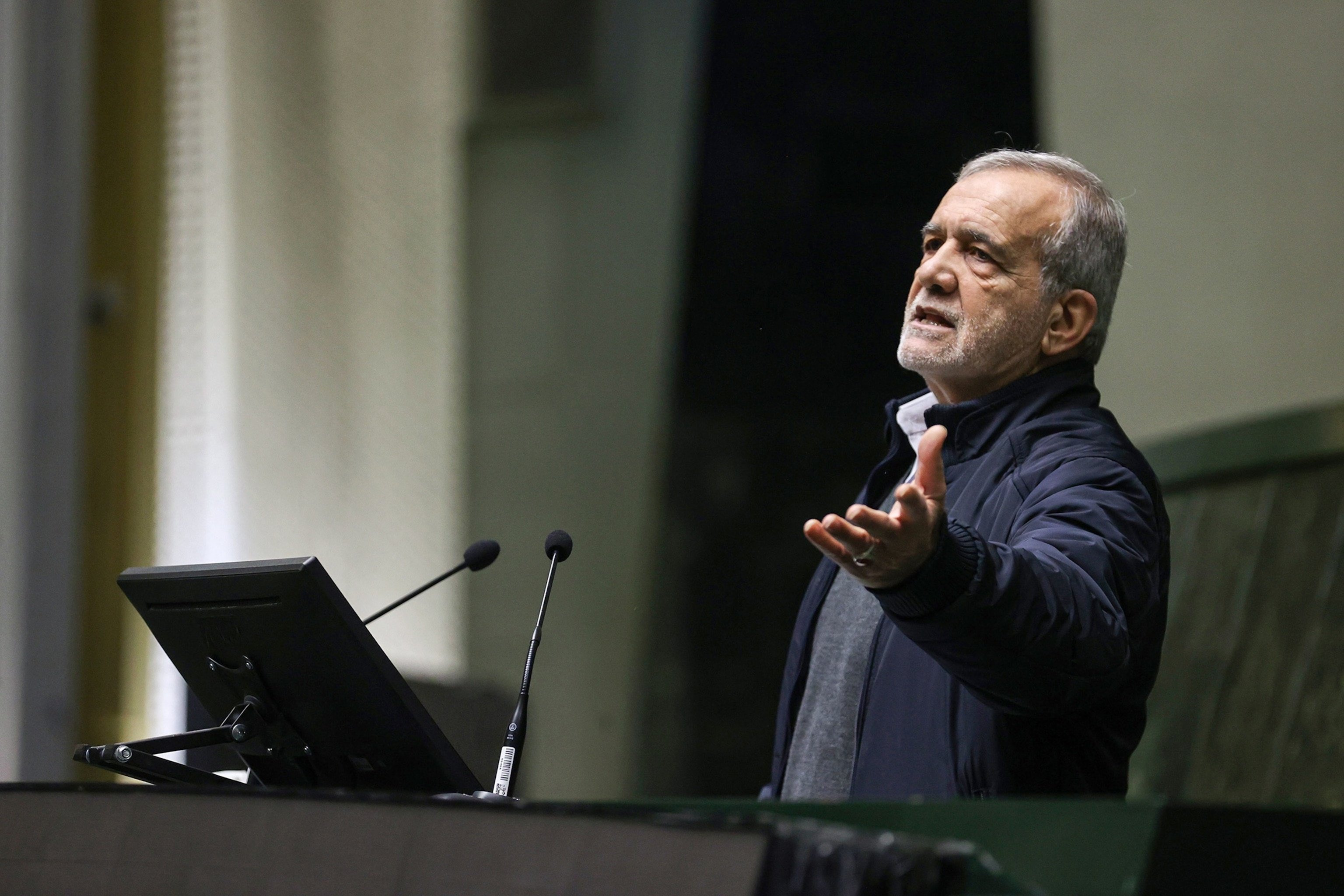
Iranian President Masoud Pezeshkian speaks during the parliamentary session discussing the 2026 budget bill in Tehran, Iran, on Dec. 28, 2025.
Iranian Presidency via Anadolu via Getty Images
Pezeshkian's comments, however, do not appear to have appeased protesters on the street, whose demands do not stop at resolving economic hardships.
Students at Khajeh Nasir University of Tehran shouted slogans including “No to scarf, no to suppression. Freedom and equality,” targeting the regime’s suppression of personal and political freedom over the last decades.
The ongoing protests are the biggest Iran has seen since the nationwide protests in 2021 and 2022 following the death of 22-year-old Mahsa Amini, who died in a hospital in Tehran after she was arrested by police for not fully following the sharia-based law of the Islamic Republic that women wear the hijab. Hundreds were killed and tens of thousands were arrested in the resulting outcry across the country
Video and pictures coming from different cities in Iran show a heavy police and security force presence at the ongoing protests, with some video showing the police using tear gas against protestors.
A widely shared video from Tehran shows a solitary protester sitting in the middle of a street, hunched over and covering his head, as a large number of police on motorcycles face him just a few yards away. The scene has quickly become symbolic of the ongoing protests.
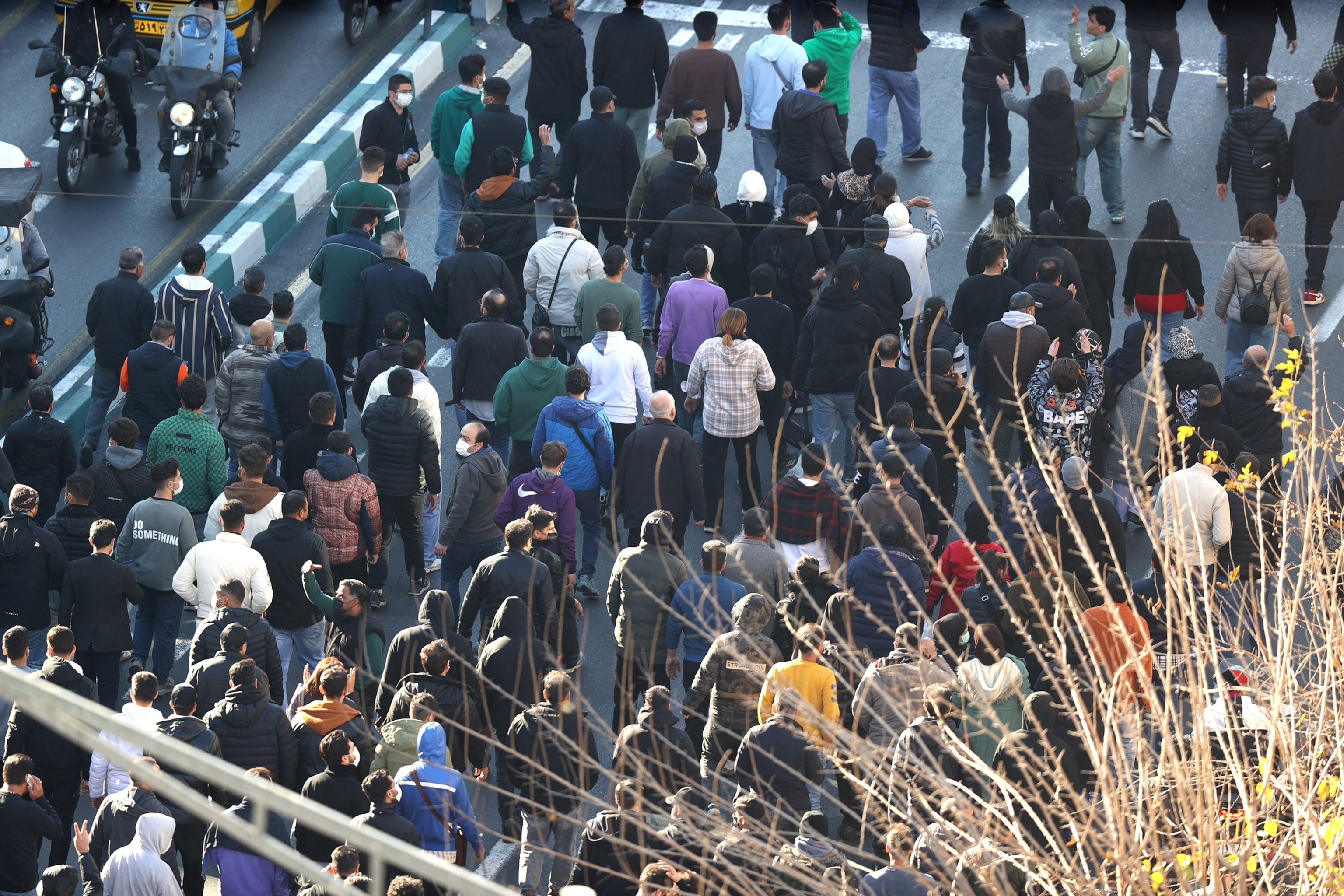
Protesters march in downtown Tehran, Iran, on Dec. 29, 2025.
Fars News Agency via AP
The protests come as Pezeshkian said Iran is in a "full-scale war" with the U.S., Israel, and Europe, claiming that the West does not want Iran to stand on its feet. President Donald Trump on Monday responded that the U.S. would "knock the hell" out of Iran if Tehran attempted to rearm itself following U.S. attacks earlier this year on Iran’s nuclear facilities.
Asked if he would support an overthrow of the Iranian regime, Trump said Monday that he was not going to discuss it.
"I mean, I'm not going to talk about overthrow of a regime. They've got a lot of problems they are in. They have tremendous inflation. Their economy is bust, they’re economy is no good. And I know that people aren't so happy," Trump said.
University students in different cities in Iran joined protests against the regime Tuesday by chanting slogans that included “student, be the voice of your people,” and “death to Islamic Republic.”
The protests began Sunday in downtown Tehran as the Iranian currency hit a new low, but they have since expanded in size and scope, moving beyond the narrower cause of the economy to "freedom and equality" and an end to the regime, evident in the slogans protesters are chanting.
Many shop owners in two major malls in downtown Tehran and in other cities have closed their stores and joined the demonstrations, as severe uncertainty remains in the country’s currency trade market following a sharp decline in the value of the rial, the national currency. The rial has been fluctuating in value between 1.38 million and 1.45 million per U.S. dollar since Sunday.
Protesters march in downtown Tehran, Iran, on Dec. 29, 2025.
Fars News Agency via AP
Reports from across the country indicate that shop owners in other cities, including the western city of Hamedan and the southern island of Qeshm, have also joined the protests by closing their stores. Slogans such as “death to the dictator” and “Seyyed Ali (Khamenei) will be toppled this year,” referring to Iran's supreme leader, were heard in Qeshm and Zanjan, according to reports.
Amid the widespread protests and the currency plunging to a new record low, Iranian President Masoud Pezeshkian accepted the resignation of the head of the country's Central Bank on Monday, IRNA reported.
Most Iranians struggle to keep up with the constantly rising prices in the country due to the rapid fall of the rial, which declined in value from 34,000 rials against the U.S. dollar in July 2016 to 165,000 rials against dollar in May 2020. Its value has plummeted more than 800% since then.
Iranian President Masoud Pezeshkian acknowledged the protesters' demands in a post on his X account on Monday, saying in part that “the livelihood of the people” is his "daily concern."
“We have fundamental actions on the agenda to reform the monetary and banking system and preserve the purchasing power of the people,” he added. "I have tasked the Minister of the Interior to hear the legitimate demands of the protesters through dialogue with their representatives, so that the government can act with all its might to resolve problems and respond responsibly."
Iranian President Masoud Pezeshkian speaks during the parliamentary session discussing the 2026 budget bill in Tehran, Iran, on Dec. 28, 2025.
Iranian Presidency via Anadolu via Getty Images
Pezeshkian's comments, however, do not appear to have appeased protesters on the street, whose demands do not stop at resolving economic hardships.
Students at Khajeh Nasir University of Tehran shouted slogans including “No to scarf, no to suppression. Freedom and equality,” targeting the regime’s suppression of personal and political freedom over the last decades.
The ongoing protests are the biggest Iran has seen since the nationwide protests in 2021 and 2022 following the death of 22-year-old Mahsa Amini, who died in a hospital in Tehran after she was arrested by police for not fully following the sharia-based law of the Islamic Republic that women wear the hijab. Hundreds were killed and tens of thousands were arrested in the resulting outcry across the country
Video and pictures coming from different cities in Iran show a heavy police and security force presence at the ongoing protests, with some video showing the police using tear gas against protestors.
A widely shared video from Tehran shows a solitary protester sitting in the middle of a street, hunched over and covering his head, as a large number of police on motorcycles face him just a few yards away. The scene has quickly become symbolic of the ongoing protests.
Protesters march in downtown Tehran, Iran, on Dec. 29, 2025.
Fars News Agency via AP
The protests come as Pezeshkian said Iran is in a "full-scale war" with the U.S., Israel, and Europe, claiming that the West does not want Iran to stand on its feet. President Donald Trump on Monday responded that the U.S. would "knock the hell" out of Iran if Tehran attempted to rearm itself following U.S. attacks earlier this year on Iran’s nuclear facilities.
Asked if he would support an overthrow of the Iranian regime, Trump said Monday that he was not going to discuss it.
"I mean, I'm not going to talk about overthrow of a regime. They've got a lot of problems they are in. They have tremendous inflation. Their economy is bust, they’re economy is no good. And I know that people aren't so happy," Trump said.
Iran president urges government to heed economic protests
By AFP
December 30, 2025

A shopkeeper tidies his stall in Tajrish Bazaar in the Iranian capital. Some traders have protested the rising price of imports as the rial falls against the dollar - Copyright AFP ATTA KENARE
Iran’s president urged his government to listen to the “legitimate demands” of protesters, state media reported Tuesday, after demonstrations by shopkeepers in Tehran over economic hardship.
Shopkeepers in the capital shut their stores on Monday, after Iran’s embattled currency hit new lows on the unofficial market.
Photos from the Fars news agency had shown tear gas being used to disperse protesters but by Tuesday most shops and cafes in the city centre were open and antiriot police were keeping watch on the main squares, AFP reporters saw.
The US dollar was trading at around 1.42 million rials when the shutdown began on Sunday — compared to 820,000 rials a year ago — and the rial strengthened only slightly by Tuesday.
According to the Etemad newspaper, one trader who did not give his name, complained that officials had offered no support to storekeepers battling soaring import costs.
“They didn’t even follow up on how the dollar price affected our lives,” he complained.
“We had to decide to show our protest. With this dollar price, we can’t even sell a phone case, and the officials don’t care at all that our lives are run by selling mobile phones and accessories.”
It was into this atmosphere, President Masoud Pezeshkian — who has less authority under Iran’s system of government than Supreme Leader Ali Khamenei — made his statement.
“I have asked the interior minister to listen to the legitimate demands of the protesters by engaging in dialogue with their representatives so that the government can do everything in its power to resolve the problems and act responsibly,” he said, in a social media post.
According to state television, parliamentary speaker Mohammad Bagher Ghalibaf, also called for “necessary measures focused on increasing people’s purchasing power”.
“People’s concerns and protests regarding livelihood problems must be responded to with full responsibility, and dialogue,” he said.
Price fluctuations are paralysing the sales of some imported goods, with both sellers and buyers preferring to postpone transactions until the outlook becomes clearer, AFP correspondents reported.
– Battered economy –
Iranian Chief Justice Gholamhossein Mohseni Ejei called for “the swift punishment of those responsible for currency fluctuations”, the justice ministry’s Mizan agency reported Monday.
The government has also announced the replacement of the central bank governor.
“By decision of the president, Abdolnasser Hemmati will be appointed governor of the Central Bank,” presidency communications official Mehdi Tabatabaei posted on X.
Hemmati is a former economy and finance minister who was dismissed by parliament in March because of the sharp depreciation of the rial.
In December, inflation stood at 52 percent year-on-year, according to official statistics. But this figure still falls far short of many price increases, especially for basic necessities.
The country’s economy, already battered by decades of Western sanctions, was further strained after the United Nations in late September reinstated international sanctions linked to the country’s nuclear programme that were lifted 10 years ago.
Western powers and Israel accuse Iran of seeking to acquire nuclear weapons, a charge Tehran denies.
By AFP
December 30, 2025
A shopkeeper tidies his stall in Tajrish Bazaar in the Iranian capital. Some traders have protested the rising price of imports as the rial falls against the dollar - Copyright AFP ATTA KENARE
Iran’s president urged his government to listen to the “legitimate demands” of protesters, state media reported Tuesday, after demonstrations by shopkeepers in Tehran over economic hardship.
Shopkeepers in the capital shut their stores on Monday, after Iran’s embattled currency hit new lows on the unofficial market.
Photos from the Fars news agency had shown tear gas being used to disperse protesters but by Tuesday most shops and cafes in the city centre were open and antiriot police were keeping watch on the main squares, AFP reporters saw.
The US dollar was trading at around 1.42 million rials when the shutdown began on Sunday — compared to 820,000 rials a year ago — and the rial strengthened only slightly by Tuesday.
According to the Etemad newspaper, one trader who did not give his name, complained that officials had offered no support to storekeepers battling soaring import costs.
“They didn’t even follow up on how the dollar price affected our lives,” he complained.
“We had to decide to show our protest. With this dollar price, we can’t even sell a phone case, and the officials don’t care at all that our lives are run by selling mobile phones and accessories.”
It was into this atmosphere, President Masoud Pezeshkian — who has less authority under Iran’s system of government than Supreme Leader Ali Khamenei — made his statement.
“I have asked the interior minister to listen to the legitimate demands of the protesters by engaging in dialogue with their representatives so that the government can do everything in its power to resolve the problems and act responsibly,” he said, in a social media post.
According to state television, parliamentary speaker Mohammad Bagher Ghalibaf, also called for “necessary measures focused on increasing people’s purchasing power”.
“People’s concerns and protests regarding livelihood problems must be responded to with full responsibility, and dialogue,” he said.
Price fluctuations are paralysing the sales of some imported goods, with both sellers and buyers preferring to postpone transactions until the outlook becomes clearer, AFP correspondents reported.
– Battered economy –
Iranian Chief Justice Gholamhossein Mohseni Ejei called for “the swift punishment of those responsible for currency fluctuations”, the justice ministry’s Mizan agency reported Monday.
The government has also announced the replacement of the central bank governor.
“By decision of the president, Abdolnasser Hemmati will be appointed governor of the Central Bank,” presidency communications official Mehdi Tabatabaei posted on X.
Hemmati is a former economy and finance minister who was dismissed by parliament in March because of the sharp depreciation of the rial.
In December, inflation stood at 52 percent year-on-year, according to official statistics. But this figure still falls far short of many price increases, especially for basic necessities.
The country’s economy, already battered by decades of Western sanctions, was further strained after the United Nations in late September reinstated international sanctions linked to the country’s nuclear programme that were lifted 10 years ago.
Western powers and Israel accuse Iran of seeking to acquire nuclear weapons, a charge Tehran denies.
Issued on: 30/12/2025 -
Iranian traders and shopkeepers staged a second day of protests on December 29 after the country’s currency plummeted to a new record low against the U.S. dollar. The overall inflation rate in December rose to 42.2%, but foodstuff prices rose 72% and health and medical items were up 50% compared to the same period in 2024. FRANCE 24's Philip Turle breaks it down for us.
Video by: Philip TURLE