Thursday, January 15, 2026

US records first negative net migration in at least 50 years: Report

Decline driven by sharp drop in arrivals rather than removals, researchers find


Seyit Kurt |15.01.2026 - TRT/AA


ISTANBUL

The US recorded negative net migration in 2025 for the first time in at least 50 years, driven largely by a sharp decline in entries amid tightened immigration policies, according to a report released on Tuesday by the Brookings Institution.

The study estimated net migration fell by between 10,000 and 295,000, marking a reversal after decades of immigration-driven population growth. Researchers said heightened enforcement and policy uncertainty under the Trump administration were key factors.

While the administration has emphasized removals as part of its immigration crackdown, the report said the decline was primarily the result of fewer people entering the country. The authors attributed the shift to reduced admissions, increased enforcement activity and higher levels of voluntary departures.

The analysis said the suspension of many humanitarian programs, including most refugee admissions, along with a drop in temporary visas, contributed significantly to the downturn. Removals in 2025 were estimated at between 310,000 and 315,000, only modestly higher than the roughly 285,000 removals estimated for 2024, the report said.

That estimate is substantially lower than figures cited by Department of Homeland Security officials, who have said more than 600,000 people have been removed during the enforcement campaign, according to ABC News. The agency did not immediately respond to a request for comment.

The report also found that, unlike the previous year, most removals were initiated by US Customs and Border Protection rather than Immigration and Customs Enforcement, despite heightened public attention on ICE activity.

Negative net migration is likely to continue into 2026, the authors said. They projected an increase in removals as new funding becomes available under legislation approved by President Donald Trump, which they said would expand enforcement capacity through additional staffing and infrastructure.


Amazon wildfire smoke may boost rainforest growth, study finds

Researchers say phosphorus carried by smoke acts as natural fertilizer, increasing tree growth, carbon absorption in intact forest areas

Melike Pala |15.01.2026 - TRT/AA


​​​​​​​BRUSSELS

Smoke from forest fires in the Amazon, while highly destructive, may have an unexpected effect by accelerating growth in parts of the rainforest, a new study suggests.

Researchers from Belgium's Antwerp University and the CREAF research center in Barcelona found that smoke releases nutrients, particularly phosphorus, which act as a natural fertilizer when deposited on untouched rainforest areas, the Belga news agency reported Tuesday.

The process promotes tree growth and increases carbon dioxide absorption, the researchers said.

Most fires occur in the heavily deforested southern Amazon. During the dry season, winds carry smoke north and east, where phosphorus settles on intact forest soils.

The study found phosphorus had a stronger impact on tree growth than temperature or rainfall. Using satellite data, researchers observed higher photosynthesis rates in regions receiving greater phosphorus deposition.

On average, each additional milligram of phosphorus per square meter increased annual carbon storage by about 7.4 grams, the researchers said. Trees also developed denser canopies, allowing them to capture more sunlight and carbon dioxide.

The scientists stressed that forest fires remain a major environmental threat but said the findings highlight the interconnected nature of ecosystems. While fires release carbon locally, they may inadvertently enhance carbon uptake in distant forest areas.
Dutch court orders Fortnite online video game creator to pay fine for manipulating children

Court agrees with watchdog that in-game advertising directly encourages children to make purchases

Burak Bir |15.01.2026 - TRT/AA


​​​​​​​LONDON

A Dutch court ruled Wednesday that Epic Games, the creator of the popular online game Fortnite, must pay a fine previously imposed by a Dutch watchdog for manipulating children to spend money in the game, according to media reports.

The Rotterdam Court ordered Epic Games to pay a more than €1.1 million ($1.2 million) fine that was previously imposed by the Netherlands' Authority for Consumers and Markets (ACM), Dutch public broadcaster NOS reported.

It came after Epic Games announced in May 2024 that it would appeal the ACM's decision that contained “significant factual errors."

Fortnite is normally free but earns money from selling virtual items, has hundreds of millions of players worldwide and user purchases generate billions of dollars for the company annually, according to the report.

The court agreed with the ACM that the in-game advertising directly encourages children to make purchases.
Left-wing European lawmakers launch petition to suspend EU-Israel agreement

‘EU citizens cannot tolerate that the EU maintains an agreement that contributes to legitimize and finance a State that commits crimes against humanity and war crimes,' Left group says

Melike Pala |15.01.2026 - TRT WORLD


​​​​​​​By Melike Pala

BRUSSELS (AA) - Members of the European Parliament (MEP) from the Left group launched a European Citizens' Initiative (ECI) on Tuesday, demanding the full suspension of the EU-Israel Association Agreement, citing Israel's violations of human rights and international law in the Gaza Strip.

The initiative urges the European Commission to propose to the EU Council the suspension of the agreement, which forms the legal basis for political dialogue and trade relations between the European Union and Israel.

According to the initiative's objectives, Israel is responsible for an "unprecedented level of killing and injury of civilians," mass displacement and the systematic destruction of hospitals and medical facilities in Gaza, referring to assessments by EU bodies.

The campaign also points to Israel's blockade of humanitarian aid that could "amount to starvation as a method of war."

"Israel is in breach of multiple rules and obligations under international law and fails to prevent the crime of genocide as ordered by the International Court of Justice," said the statement.

The initiative cites the International Court of Justice's (ICJ) order on Jan. 26, 2024, which instructed Israel to take all measures within its power to prevent acts that could fall under the scope of genocide.

Despite the developments, "the EU has still not suspended its association agreement with Israel, which is the cornerstone of EU-Israel bilateral trade, economic and political cooperation," it said.

"EU citizens cannot tolerate that the EU maintains an agreement that contributes to legitimize and finance a State that commits crimes against humanity and war crimes," it stated.

French MEP Emma Fourreau announced the launch of the initiative on US social media platform X. "Let's end Europe's complicity in the genocide in Gaza," she wrote.

She added that the campaign aims to collect 1 million signatures across the EU.

Under rules, a European Citizens' Initiative must gather at least 1 million valid signatures and meet minimum thresholds in at least seven EU member states to be considered by the European Commission.

Once the conditions are met, the EU Commission is required to examine the proposal and decide whether to take action, though it is not legally obliged to introduce legislation.

The EU-Israel Association Agreement, which entered into force in 2000, includes a human rights clause stating that relations between the parties are based on respect for human rights and democratic principles.

The Israeli army illed more than 71,000 victims, most of them women and children, and injured over 171,000 in a brutal offensive since October 2023 that has left Gaza in ruins.

Israel has also continued to violate a UN Security Council Resolution adopted in November that calls for a permanent and comprehensive ceasefire in Gaza, unimpeded delivery of humanitarian aid and reconstruction of the territory.

ANTI-D.E.I.

US Justice Department sues Minnesota in latest salvo against state

'Making hiring decisions based on immutable characteristics like race and sex is simple discrimination,' says Attorney General Pam Bondi


Darren Lyn |15.01.2026 - TRT/AA


​​​​​​​HOUSTON, United States

The US Department of Justice (DOJ) filed a lawsuit Wednesday against the state of Minnesota, challenging its affirmative action plans, more commonly known as Diversity, Equity and Inclusion (DEI) policies.

The suit marks the latest action taken by the Trump administration against the state amid an escalating immigration crackdown that has prompted thousands of demonstrators to take to the streets, particularly in the largest city of Minneapolis.

The DOJ's Civil Rights Division announced that the lawsuit is challenging Minnesota's requirement that all state agencies implement sex- and race-based affirmative action plans and consider "affirmative action goals on all staffing and personnel decisions."

The state program directs agencies to engage in employment practices that "balance" the sex and race composition of its workforce with the civilian labor force.

"Making hiring decisions based on immutable characteristics like race and sex is simple discrimination, and the Trump Administration has no tolerance for such DEI policies," Attorney General Pam Bondi said in a statement.

Assistant Attorney General Harmeet Dhillon echoed that sentiment.

"For far too long, courts have allowed employers to discriminate based on race and sex when it is packaged as 'affirmative action,'" said Dhillon. "The Supreme Court put an end to using race as a factor in college admissions through its Students for Fair Admissions v. Harvard decision. This case is the next logical step."

"Title VII protects all people from race and sex discrimination in employment," he said. "There is no exception that allows discrimination against employees who aren’t considered 'underrepresented.'"

The lawsuit was filed in the US District Court for the District of Minnesota and alleges that the state's affirmative action mandate discriminates against, limits, and classifies employees and prospective employees on the basis of race and sex in violation of Title VII of the Civil Rights Act of 1964.

"Because staffing is a zero-sum game, when Minnesota gives preferences to employees or prospective employees on the basis of their race, color, national origin, and sex, it inevitably and necessarily discriminates against other employees or prospective employees because of their race, color, national origin, and sex," said the lawsuit.

Bondi certified the case as a matter of general public importance. According to DOJ officials, the designation invokes a provision of Title VII that entitles the US to an expedited review by a three-judge district court and direct appeals to the United States Supreme Court."

Canada urges India to extradite key accused in $20 million gold heist case

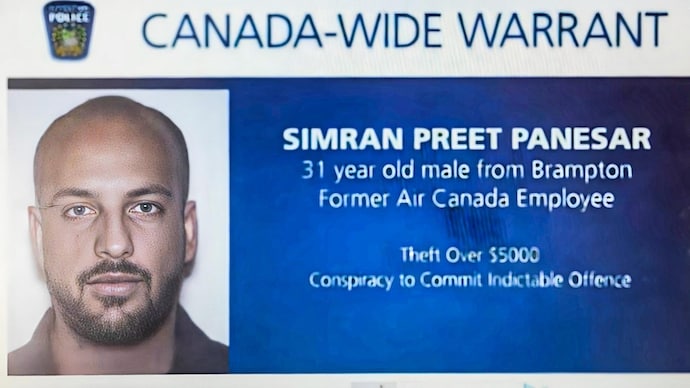
Canada has formally sought India's help to extradite Simran Preet Panesar, accused of orchestrating the $20 million Toronto gold heist. Canadian authorities said he used insider access to commit the crime and remained at large in India.


What role did Simran Preet Panesar play in the Toronto gold heist?


How does Canada's extradition request impact India-Canada judicial cooperation?


How much gold was stolen in the Sabarimala temple theft case?


Simran Preet Panesar is facing charges including Theft Over $5,000 and Conspiracy to Commit an Indictable Offence.


Arvind Ojha
Toronto/New Delhi
Jan 15, 2026 10:47 
Edited By: Sahil Sinha


Canadian authorities have formally requested India to extradite Simran Preet Panesar, a prime suspect in what officials call the country's largest gold theft, involving cargo worth over $20 million.

Panesar, 33, a former Air Canada employee from Brampton, is accused of orchestrating the April 2023 heist at Toronto Pearson International Airport. Police alleged he played a pivotal role in diverting a high-value shipment containing nearly 400 kilograms of .9999-pure gold -- around 6,600 bars and $2.5 million in foreign currency. Canadian authorities believe Panesar fled to India after the theft, prompting a Canada-wide arrest warrant and the formal extradition request.

The operation, codenamed Project 24K, involved a shipment that had arrived from Zurich, Switzerland, and was temporarily stored in a secure airport holding area before being reported missing the next day. Officials described the theft as highly coordinated, involving both insiders and external accomplices. To date, ten people have been charged, facing more than 21 criminal counts, while the stolen gold remains largely unrecovered.

Peel Regional Police Chief Nishan Duraiappah stressed the significance of the extradition request. "No matter where you run or hide, we will find you," he said, noting that Project 24K highlighted Canadian law enforcement's ability to tackle complex cross-border crime.

Panesar is facing charges including Theft Over $5,000 and Conspiracy to Commit an Indictable Offence. Canadian authorities alleged that his insider access as an airline employee was instrumental in identifying and diverting the cargo. Police have urged him to seek legal counsel and surrender voluntarily, warning that the investigation will remain active and additional arrests are possible.

The extradition request now tests India-Canada judicial cooperation. Indian authorities are expected to evaluate the request under existing treaties and domestic law before deciding on Panesar's surrender.

The gold heist occurred on April 17, 2023, at Air Canada's cargo facility at Toronto Pearson Airport. Officials said that a suspect arrived in a five-tonne delivery truck and removed the shipment from the warehouse. Earlier in January, Canadian police arrested a 43-year-old man linked to the theft after he arrived from Dubai.

Authorities continue to search for Panesar, whose alleged manipulation of airline systems reportedly enabled the theft.

- Ends
Labubu toy manufacturer exploited workers, labour group claims

Osmond Chia
Business reporter
BBC
January 15, 2026


A labour rights organisation claims it has found evidence of worker exploitation in a Chinese factory that makes the viral Labubu dolls.

China Labor Watch (CLW), a US-based non-governmental organisation, alleges that its investigation found that one of Pop Mart's suppliers made employees work excessive overtime shifts, sign blank or incomplete contracts and did not give them paid leave.

The furry Labubu dolls have surged in popularity around the world in recent years and are best known for selling toys in "blind boxes", which hide its content from buyers until it is opened.

Pop Mart told the BBC that it is investigating the claims.

The Beijing-based toy retailer said it appreciated the details from the review and that it will "firmly" require companies making its toys to correct their practices if the allegations are found to be true.

Pop Mart added that it conducts regular audits of its suppliers, including yearly independent third-party reviews carried out by internationally recognised inspectors.

CLW said in its report that it had carried out the in-depth probe into Labubu-maker, Shunjia Toys Co Ltd, in the southern Chinese province Guangdong.

The BBC has been unable to contact Shunjia Toys Co Ltd for comment.

CLW said its researchers conducted 51 in-person interviews with the factory's employees to discuss matters of recruitment, contracts and their working conditions.

The factory is a "core manufacturing facility" of Pop Mart toys and employed more than 4,500 workers, according to CLW.

The organisation flagged labour issues at Shunjia Toys Co Ltd's factory in Xinfeng County, including what it said were illegal overtime hours, unclear contract practices and a lack of safety training and protections.

No child labour was identified at the factory, but it had employed 16-year-old workers who were subject to the same working conditions as adults, without special care that is required under Chinese law, said CLW.

It urged Pop Mart to take "immediate action" to address the issues in its supply chain. The non-profit said the firm should compensate affected workers and ensure that its production line complies with Chinese labour laws and internationally recognised labour standards.

Such facilities, called original equipment manufacturers (OEM), make products according to pricing and production schedules set by the client.

"As a result, labour conditions in OEM facilities are closely shaped by brand sourcing practices," said CLW.

Labubus - the fictional elf-like creatures with a row of jagged teeth have become hugely popular. The craze has sparked long queues in shops worldwide.

Celebrity endorsements from the likes of Kim Kardashian and Lisa from K-pop group Blackpink have helped Pop Mart to become a major toy retailer.
Is America surrendering Antarctica to its rivals?

While US designs on Greenland are entirely deliberate, withdrawal of influence in Antarctica appears to be accidental. Could Donald Trump live to regret it?

Tom Clarke
Science and technology editor @t0mclark3
Thursday 15 January 2026, UK
Sky News


Why Trump is losing in Antarctica


As Donald Trump fights for control of arctic Greenland, is he losing at the other end of the world and leaving it open for rivals like China?

While US designs on Greenland are entirely deliberate, withdrawal of influence in Antarctica appears to be accidental.

Proposed cuts to climate-related research - which covers much of what is done in the rapidly melting Antarctic - are "catastrophic", according to Prof Ted Scambos, a glaciologist at the University of Colorado and veteran of US Antarctic research.

Image:America has long been one of the most dominant players in the region. Pic: PA

In Antarctica, cuts to science have wider implications because research is how nations have long maintained their influence in the continent.

The 1959 Antarctic treaty prohibits military or commercial activities on the frozen continent.


Prior to that, the UK along with Argentina, Australia, Chile, France, New Zealand and Norway had territorial claims on parts of the continent.

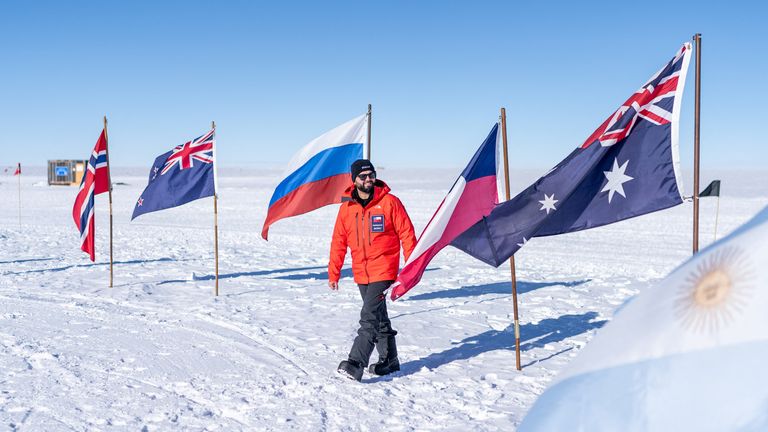
Chile's president visited the South Pole in January last year. Pic: Presidential Palace/Reuters

Those claims are "in abeyance" - effectively suspended - under the treaty, but any nation can do scientific research.

Those with interests in the region, maintain their presence via scientists, research stations and the hardware like icebreakers and aircraft needed to support them.

The UK is no exception.


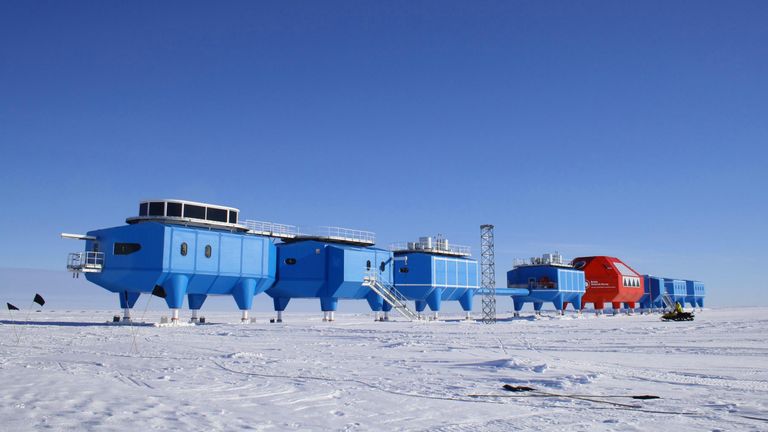
Its research bases at Rothera on the West Antarctic Peninsula and Halley VI further east, are located at the boundaries of its wedge-shaped claim to the continent extending from the coast to the South Pole.

It makes no secret of the fact the scientific presence serves two purposes. "The Antarctic treaty says that Antarctica is a continent for peace and science," said Prof Dame Jane Francis, director of the British Antarctic Survey.

"We are contributing to the treaty by doing world-class science, but also by having a UK presence in Antarctica."

The British Halley research station. Pic: BAS

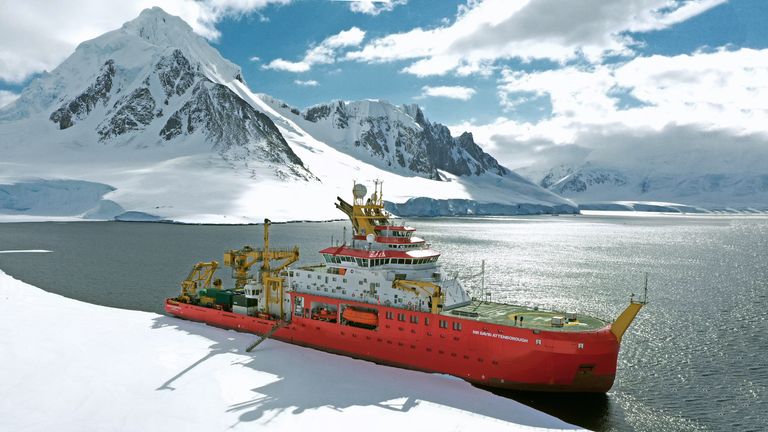
Sir David Attenborough is the UK's muscle when it comes to Antarctic geopolitics - well, the £200m research icebreaker named after him that serves as floating laboratory and re-supply vessel for British bases on the continent is.

America has long been one of the most dominant players on a continent one and half times larger than the contiguous US.

Its South Pole Station is one of the largest and best-funded on the continent.

A base that's strategically located where all other territorial claims to Antarctica converge: at the pole.


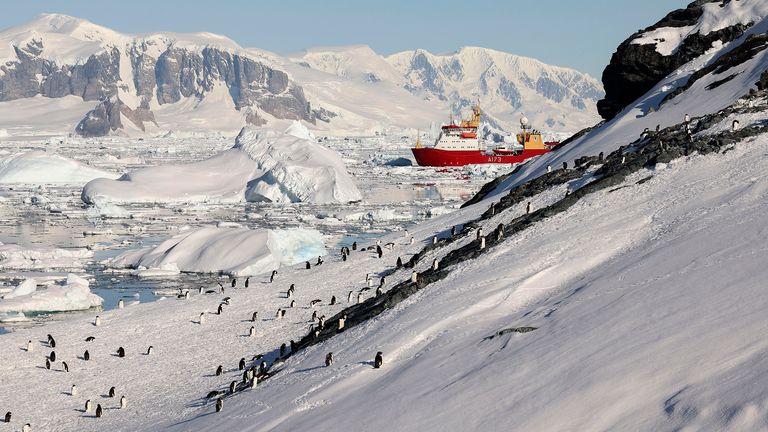
HMS Protector (top) and RRS Sir David Attenborough are Britain's main polar ships. Pic: MOD/BAS

Read more:
Antarctica's underwater tsunamis
What's happening in Antarctica that worries scientists most?

But this year, as a result of Mr Trump's cuts and a decision not to renew the lease for its only Antarctic icebreaker, the US has no dedicated ship and far fewer scientists in Antarctica.

It's left America in the unusual position of having to lease an icebreaker owned by Ukraine to help maintain its operations this year.

A situation that hasn't gone unnoticed.

"There is a change in the leadership and the balance of power, if you like," said Prof Francis.

It presents a potential opportunity for the UK to forge new research partnerships.

But others too.

China has been rapidly expanding its presence in Antarctica.

China's Antarctic research agency, CHINARE, now has five bases on the continent and opened a new year-round facility last year. Beijing recently announced another is in the works.

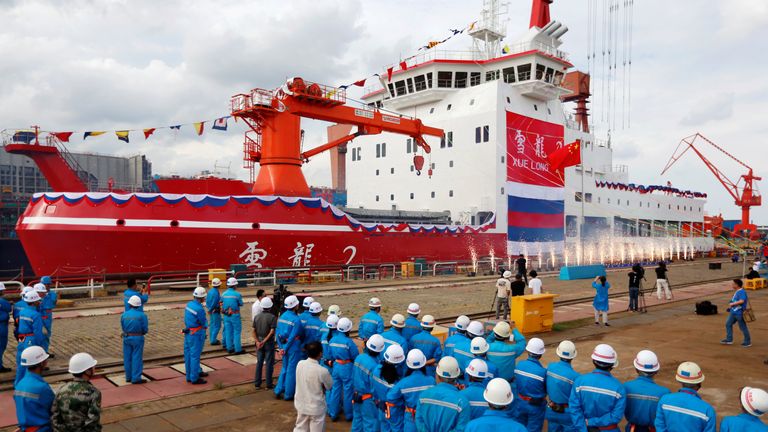
In 2024, it commissioned a new icebreaking ship which, along with its predecessor, are both working around Antarctica this year.

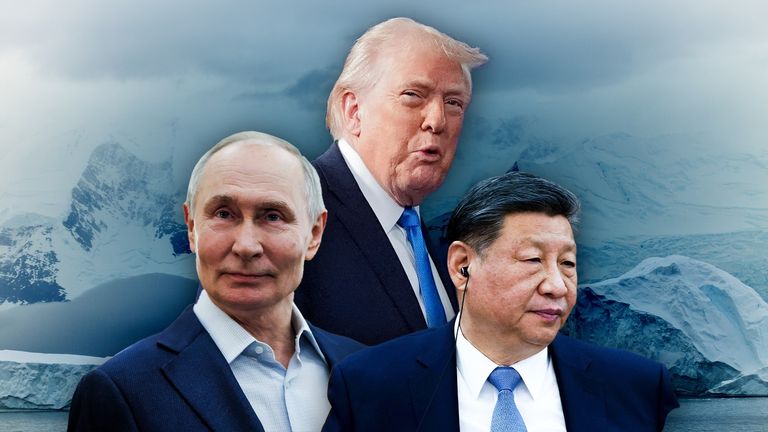
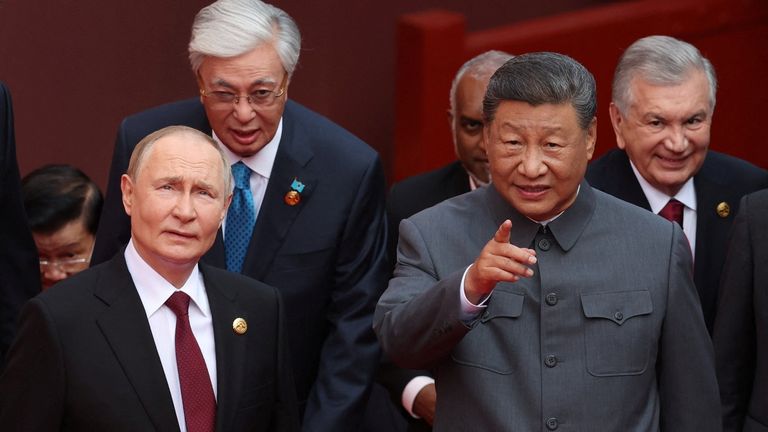
Russia's Putin and China's Xi are keen to maintain and expand their influence in the North and South poles. Pic: Reuters

Like other signatories to the Antarctic Treaty, China conducts research, sometimes in partnership with other states.

There have been signs China, as well as Russia, may have interests in the region outside the scope of the treaty.

China has resisted efforts to increase protection for fisheries in the Southern Ocean.

In 2020, Russia announced the discovery of what it claims was the world's largest oil reserve on the seabed close to Antarctica.

Xuelong 2 (Snow Dragon 2) was China's first domestically built polar icebreaker - it was launched in 2018. Pic: Reuters/Stringer

Moscow insisted the survey work required to find it was scientific in nature and has, so far, made no moves towards exploiting it.

"Countries that have signed the Antarctic Treaty, are there to do scientific research," said Prof Scambos.

"But they have an eye on…any sort of future for Antarctica. Be it to maintain the treaty or to rethink the treaty in terms of exploitation."

No country has made formal moves to withdraw or modify the treaty.

Unlike the Arctic, it's distance from most of the world's major powers make it less important geopolitically.

While China is rapidly expanding its polar fleet with new icebreakers, the US recently had to lease a Ukrainian one. Pic: Reuters

Its inaccessibility, not to mention year-round sea ice and six months of darkness, also explains why its natural resources have been largely ignored.

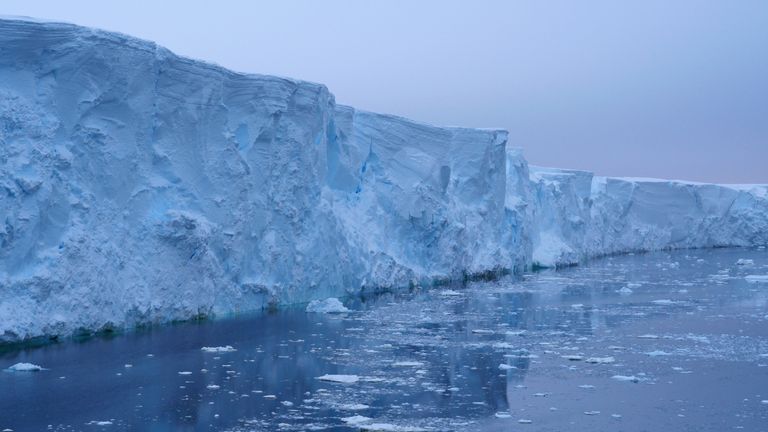
But like the Arctic, it is warming and its ice sheets melting.

And with the Trump administration threatening to ignore territorial conventions when it comes to places like Greenland, who's to say how long the Antarctica will remain unspoilt?


Level 4 self-driving cars may come to Europe next year, says Nvidia executive

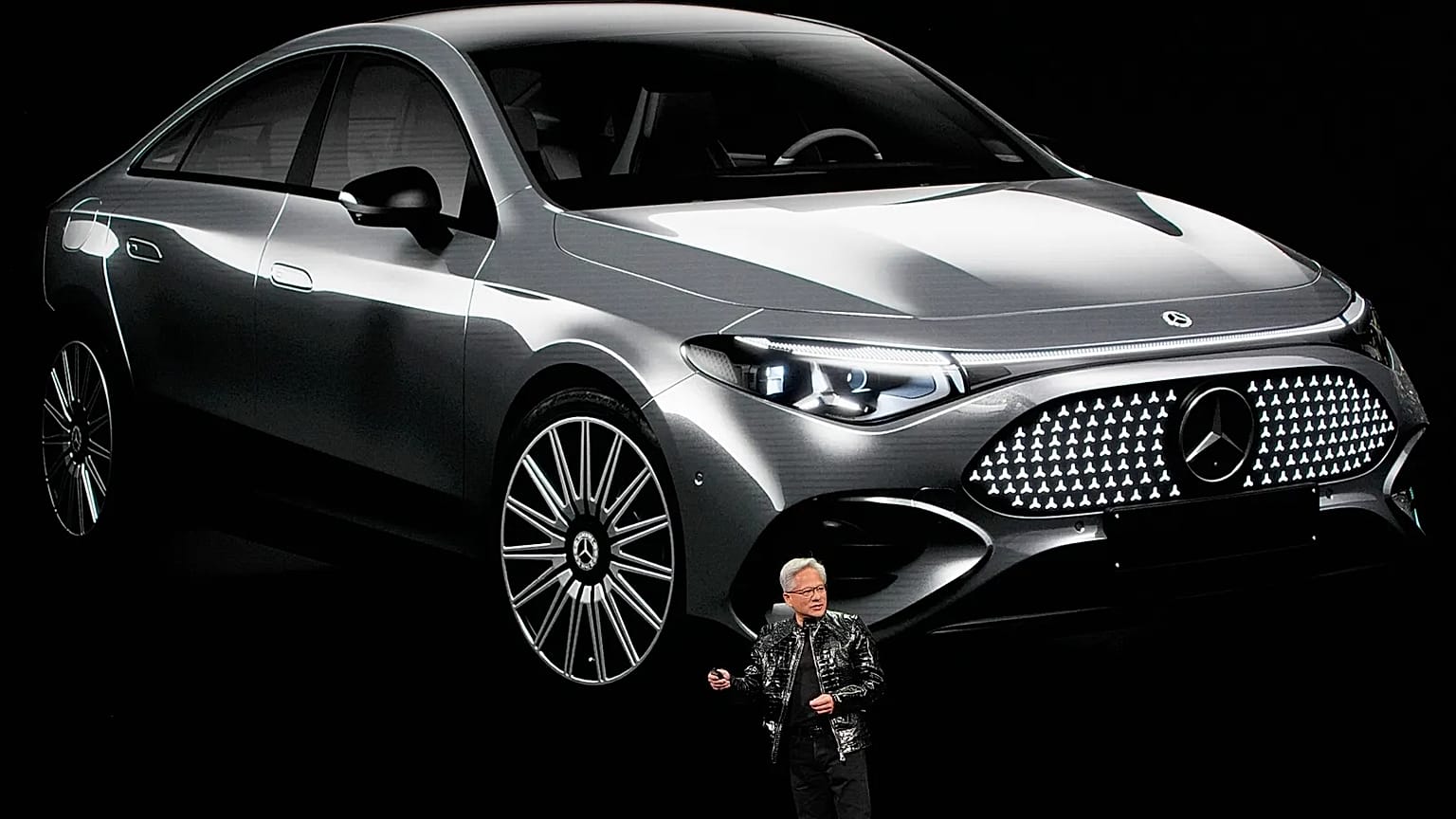
Nvidia founder and CEO Jensen Huang speaks during a Nvidia news conference ahead of the CES tech show Monday, Jan. 5, 2026, in Las Vegas.
Copyright AP Photo/John Locher

By Pascale Davies
Published on 

Euronews Next sat down with Nvidia's vice president of the automotive team and spoke about how AI is changing the gears of self-driving cars, what it will mean for Europe, what we would do when we commute, and how it may change infrastructure.

Partial autonomous driving may come to Europe this year, and more advanced self- driving cars could arrive on the continent as soon as next year, vice president of Nvidia's automotive team, Ali Kani, told Euronews Next in an interview.

The chip leader and artificial intelligence (AI) giant revealed last week that, instead of building its own car, it has developed the software that supplies the intelligence layer for autonomy that robotaxi companies can purchase and build on.

AI is becoming a key accelerator behind self-driving technology and could cut the costs of the technology. However, Europe in particular stands at a critical juncture in determining how and when self-driving cars will navigate its streets and there may need to be infrastructure changes.

“We need to go as fast as regulation allows us, and I think what we see is it's opening up,” Kani said.

“My guess is in Europe it might end up being the end of this year,” he said, referring to Level 2+ driving, which means that the driver is still responsible for monitoring the driving environment, but the vehicle can steer, brake, and accelerate

As for Level 4, which means the vehicle operates completely autonomously under certain conditions and humans do not need to be ready to get involved, it could come in 2027, Kani said.

You can just redesign a city so that we have more space for people to live and put parking lots further away.
 Ali Kani 
Nvidia VP autonomotive team

Trials are already being announced in major European cities, including London, though the timeline for full regulatory clearance depends on how well the systems perform in real-world conditions.

Europe currently allows Level 2 systems universally and has already approved Level 3 for controlled conditions. But this is not without its challenges.

This week, it was reported that Mercedes-Benz was pausing its Drive Pilot, an “eyes off” conditionally automated driving feature that was available in Europe and the US, according to the German publication Handelsblatt.

Nvidia announced last week that it will use its new technology in a new robotaxi alliance between Lucid, Uber, and Nuro.

Meanwhile, Mercedes-Benz, which also works with Nvidia, said it will launch a new advanced driver-assistance system in the US this quarter that will let vehicles operate autonomously under driver supervision. Nvidia’s founder and CEO Jensen Huang said the Mercedes-Benz technology will come to Europe and Asia in Q2 of this year.

Safety first

One of the biggest hurdles for deploying autonomous vehicles in Europe is the different regulations across different countries

But Nvidia’s technology can cleverly swerve the various laws, as while the core end-to-end model is consistent globally, the rules-based safety stack is customised for each country’s driving requirements.

Kani said that the company also has a different philosophy from its competitors, which is key to safety.

“Some other players talk about how we want to make sure we drive better than a human.

“We don't architect our system like that. We actually think of it in terms of how do we design this system so it doesn't ever cause an accident,” he said.

Nvidia achieves this by first, by using diverse sensor sets, so that if one camera isn’t working, there are other sensor options.

Secondly, it runs two stacks simultaneously: an end-to-end AI model alongside a dedicated safety stack that acts as a type of guardian. The stacks refer to a linear data structure that stores and manages data.

“The foundation is that two things are running, and the safety stack will make sure you never make a mistake. That means the AI model on its own is not something we depend on. We have a Safety Guard built into the system,” Kani said.

Nvidia’s Drive AV software recently earned a five-star safety rating from the European New Car Assessment Programme (Euro NCAP) in the Mercedes-Benz CLA, which is a notable accomplishment for a first-time production autonomous vehicle stack.

The long road

In five to 10 years, the Nvidia executive said one of the main challenges will be “long tail scenarios”—unexpected situations that systems haven't encountered before.

Such anincident occurred in December, when the robotaxi service Waymo was suspended for hours as vehicles struggled to read malfunctioning stoplights amid a power outage in San Francisco. Those in the driverless vehicles then found themselves stuck at darkened traffic lights.

One possible incident in the future could occur on European country roads. While Kani admitted he didn’t know much about the continent's road infrastructure, he said that he doesn’t think there would need to be a major overhaul for Europe’s roads to accommodate autonomous vehicles, but changes may be needed in more rural areas.

I just feel like there are so many things we could do with our time if we had that [autonomous driving].
 Ali Kani 
Nvidia

Kani said that while Nvidia’s technology can adapt to existing conditions on roads, he suggested it could be harder for autonomous vehicles to pull over on small, narrow country roads, as there is no shoulder.

“If that happens to be the case that on these country roads, there really is nowhere for you to pull over, you really have to stop in the lane. That's not safe because then there's another car that comes,” Kani said.

But despite these potential scenarios, there are many reasons to be optimistic about autonomous driving.

Kani said that self-driving vehicles make roads safer as human error or fatigue while driving is eliminated. But the vehicles could also reshape urban planning and how we manage our time.

He said an autonomous car could drop you off, go back home, and then pick you up when needed, effectively getting rid of the need for parking lots and using the space for society’s other needs, such as housing.

“You can just redesign a city so that we have more space for people to live and put parking lots further away,” Kani said.

For him personally, he is most excited about what he would do while commuting to work. He said he has a second home an hour and 40 minutes away from the Nvidia office.

With an autonomous vehicle, he said he could work in the car, or on longer journeys, or even travel overnight and sleep on the journey and arrive at the destination in the morning.

“I just feel like there are so many things we could do with our time if we had that [autonomous driving], and I would love that," he said.

“So I'm looking forward to that when we get there.”

Islamophobia

India shuts Kashmir medical college – after Muslims earned most admissions

Hindu groups insisted that Muslims shouldn’t benefit from institutions funded by Hindu charity.


Women supporters of right-wing Hindu groups shout slogans demanding revocation of admissions at the Shri Mata Vaishno Devi Institute of Medical Excellence in Jammu, outside the residence of the the governor of Indian-administered Kashmir on December 27, 2025 [Channi Anand/ AP Photo]

By Al Jazeera Staff
 15 Jan 2026

India has shut down a medical college in Indian-administered Kashmir in an apparent capitulation to protests by right-wing Hindu groups over the admission of an overwhelming number of Muslim students into the prestigious course.

The National Medical Commission (NMC), a federal regulatory authority for medical education and practices, on January 6 revoked the recognition of Shri Mata Vaishno Devi Medical Institute (SMVDMI), located in Reasi, a mountainous district overlooking the Pir Panjal range in the Himalayas, which separates the plains of Jammu from the Kashmir valley.

Of the 50 pupils who joined the five-year bachelor’s in medicine (MBBS) programme in November, 42 were Muslims, most of them residents of Kashmir, while seven were Hindus and one was a Sikh. It was the first MBBS batch that the private college, founded by a Hindu religious charity and partly funded by the government, had launched.

Admissions to medical colleges across India, whether public or private, follow a centralised entrance examination, called the National Entrance Examination Test (NEET), conducted by the federal Ministry of Education’s National Testing Agency (NTA).

More than two million Indian students appear for NEET every year, hoping to secure one of approximately 120,000 MBBS seats. Aspirants usually prefer public colleges, where fees are lower but cutoffs for admission are high. Those who fail to meet the cutoff but meet a minimum NTA threshold join a private college.

Like Saniya Jan*, an 18-year-old resident of Kashmir’s Baramulla district, who recalls being overwhelmed with euphoria when she passed the NEET, making her eligible to study medicine. “It was a dream come true – to be a doctor,” Saniya told Al Jazeera.

When she joined a counselling session that determines which college a NEET qualifier joins, she chose SMVDMI since it was about 316km (196 miles) from her home – relatively close for students in Kashmir, who often otherwise have to travel much farther to go to college.

Saniya’s thrilled parents drove to Reasi to drop her off at the college when the academic session started in November. “My daughter has been a topper since childhood. I have three daughters, and she is the brightest. She really worked hard to get a medical seat,” Saniya’s father, Gazanfar Ahmad*, told Al Jazeera.

But things did not go as planned

.
Supporters of right-wing Hindu groups protesting against the governor of Indian-administered Kashmir, demanding that admissions to the Shri Mata Vaishno Devi Institute of Medical Excellence be revoked, in Jammu on Saturday, December 27, 2025 [Channi Anand/ AP Photo]


‘No business being there’

As soon as local Hindu groups found out about the religious composition of the college’s inaugural batch in November, they launched demonstrations demanding that the admission of Muslim students be scrapped. They argued that since the college was chiefly funded from the offerings of devotees at Mata Vaishno Devi Temple, a prominent Hindu shrine in Kashmir, Muslim students had “no business being there”.

The agitations continued for weeks, with demonstrators amassing every day outside the iron gates of the college and raising slogans.

Meanwhile, legislators belonging to Prime Minister Narendra Modi’s Bharatiya Janata Party (BJP) – which has been accused of pursuing anti-Muslim policies since coming to power in 2014 – even wrote petitions to Kashmir’s lieutenant governor, urging him to reserve admissions in SMVDMI only for Hindu students. The lieutenant governor is the federally appointed administrator of the disputed region.

In the days that followed, their demands escalated to seeking the closure of the college itself.

As the protests intensified, the National Medical Commission on January 6 announced that it had rescinded the college’s authorisation because it had failed to “meet the minimum standard requirements” specified by the government for medical education. The NMC claimed the college suffered from critical deficiencies in its teaching faculty, bed occupancy, patient flow in outpatient departments, libraries and operating theatres. The next day, a “letter of permission”, which authorised the college to function and run courses, was withdrawn.

Hindu pilgrims on their way to the Vaishno Devi shrine rest under a shade and wait for transport outside a railway station on a hot day in Jammu, India, Wednesday, June 12, 2019. Far-right Hindu groups argue that because the Shri Mata Vaishno Devi Medical Institute is funded by donations from Hindu believers, the presence of Muslims as the majority in the student body is offensive to them [Channi Anand/ AP Photo]


‘The college was good’

But most students Al Jazeera talked to said they did not see any shortcomings in the college and that it was well-equipped to run the medical course. “I don’t think the college lacked resources,” Jahan*, a student who only gave her second name, said. “We have seen other colleges. Some of them only have one cadaver per batch, while this college has four of them. Every student got an opportunity to dissect that cadaver individually.”

Rafiq, a student who only gave his second name, said that he had cousins in sought-after government medical colleges in Srinagar, the biggest city in Indian-administered Kashmir. “Even they don’t have the kind of facilities that we had here,” he said.

Saniya’s father, Ahmad, also told Al Jazeera that when he dropped her off at the college, “everything seemed normal”.

“The college was good. The faculty was supportive. It looked like no one cared about religion inside the campus,” he said.

Zafar Choudhary, a political analyst based in Jammu, questioned how the medical regulatory body had sanctioned the college’s authorisation if there was an infrastructural deficit. “Logic dictates that their infrastructure would have only improved since the classes started. So we don’t know how these deficiencies arose all of a sudden,” he told Al Jazeera.

Choudhary said the demand of the Hindu groups was “absurd” given that selections into medical colleges in India are based on religion-neutral terms. “There is a system in place that determines it. A student is supposed to give preference, and a lot of parameters are factored in before the admission lists are announced. When students are asked for their choices, they give multiple selections rather than one. So how is it their fault?” he asked.

Al Jazeera reached out to SMVDMI’s executive head, Yashpal Sharma, via telephone for comments. He did not respond to calls or text messages. The college has issued no public statement since the revocation of its authorisation to offer medical courses.

Supporters of right-wing Hindu groups shout slogans demanding the revocation of admissions at the Shri Mata Vaishno Devi Institute of Medical Excellence in Jammu on Saturday, December 27, 2025 [Channi Anand/ AP Photo]
‘They turned merit into religion’

Meanwhile, students at SMVDMI have packed their belongings and returned home.

Salim Manzoor*, another student, pointed out that Indian-administered Kashmir, a Muslim-majority region, also had a medical college where Hindu candidates are enrolled under a quota reserved for them and other communities that represent a minority in the region.

The BJP insists it never claimed that Muslim students were unwelcome at SMVDMI, but encouraged people to recognise the “legitimate sentiments” that millions of Hindu devotees felt towards the temple trust that founded it. “This college is named after Mata Vaishno Devi, and there are millions of devotees whose religious emotions are strongly attached to this shrine,” BJP’s spokesman in Kashmir, Altaf Thakur, told Al Jazeera. “The college recognition was withdrawn because NMC found several shortcomings. There’s no question of the issue being about Hindus and Muslims.”

Last week, Omar Abdullah, chief minister of Indian-administered Kashmir, announced that SMVDMI students would not be made to “suffer due to NMC’s decision” and they would be offered admissions in other colleges in the region. “These children cleared the National Entrance Examination Test, and it is our legal responsibility to adjust them. We will have supernumerary seats, so their education is not affected. It is not difficult for us to adjust all 50 students, and we will do it,” he said.

Abdullah condemned the BJP and its allied Hindu groups for their campaign against Muslims joining the college. “People generally fight for having a medical college in their midst. But here, the fight was put up to have the medical college shut. You have played with the future of the medical students of [Kashmir]. If ruining the future of students brings you happiness, then celebrate it.”

Tanvir Sadiq, a regional legislator belonging to Abdullah’s National Conference party, said that the university that the medical college is part of received more than $13m in government aid since 2017 – making all Kashmiris, and not donors to the Mata Vaishno Devi shrine – stakeholders. “This means that anyone who is lawfully domiciled in [Indian-administered Kashmir] can go and study there. In a few decades, the college would have churned out thousands of fresh medical graduates. If a lot of them are Muslims today, tomorrow they would have been Hindus as well,” he told Al Jazeera.

Nasir Khuehami, who heads the Jammu and Kashmir Students’ Association, told Al Jazeera the Hindu versus Muslim narrative threatened to “communalise” the region’s education sector. “The narrative that because the college is run by one particular community, only students from that community alone will study there, is dangerous,” he said.

He pointed out that Muslim-run universities, not just in Kashmir but across India, that were recognised as minority institutions did not “have an official policy of excluding Hindus”.

Back at her home in Baramulla, Saniya is worried about her future. “I appeared for a competitive exam, which is one of the hardest in India, and was able to get a seat at a medical college,” she told Al Jazeera.

“Now everything seems to have crashed. I came back home waiting for what decision the government will take for our future. All this happened because of our identity. They turned our merit into religion.”