Sunday, February 15, 2026

'Let me not mince words': DC insider blasts Kristi Noem in scathing open letter


U.S. Homeland Security Secretary Kristi Noem,
 January 24, 2026. REUTERS/Nathan Howard

February 15, 2026 
ALTERNET

The New York Times reports that the Department of Homeland Security has sent Google (owner of YouTube), Meta (Facebook and Instagram), and other media corporations subpoenas for the names on accounts that criticize ICE enforcement. The department wants to identify Americans who oppose what it’s doing.

I’ll save them time.

Hello? Kristi Noem?

Robert Reich here. I hear you’re trying to find the names of people who are making negative comments on social media about ICE enforcement.


Look no further. I’ve done it frequently. I’m still doing it. This note to you, which I’m posting on Substack, is another example.

If you want more details, just type “Robert Reich” into an internet browser, followed by YouTube or Facebook or Instagram or X or TikTok or Reddit. Or Substack. Then type in your name, or ICE, or the Department of Homeland Security. That will give you plenty of evidence.

If you read what I’ve said, you’ll find it’s very critical. I’ve done some videos that are very critical of you and ICE, too.


Let me not mince words: I really truly believe you’re doing a s----- job.

I’ve said and will continue to say that many of the things you and ICE are doing are unconstitutional.

For example: Pulling people out of their homes in the middle of the night without search warrants. Arresting people without giving them due process of law to defend themselves. Putting innocent people into detention camps. Not giving them adequate food or medical care. Not letting their families know where they are. Sending them out of the country to brutal prisons in other lands. Even jailing children. Arresting journalists reporting on protests against you. And murdering two innocent Americans and not allowing a full criminal investigation of those murders.


All this is forbidden by the Constitution of the United States, Madam Secretary. The federal courts keep telling you this, but you and your department keep defying the courts. This is unconstitutional, too.

You’re even violating the Constitution by sending administrative subpoenas to Google, Meta, and all the rest, seeking accounts like mine that criticize what you’re doing.

I have a right under the First Amendment to criticize you without fear of the consequences.

It’s my government, Madam Secretary. You see the possessive pronoun I’m using? My government. It’s your government because you’re a citizen of the United States, not because you’re a government official.


You and your boss are supposed to be working for me and every other American. You swore an oath. The people of the United States hired the two of you to do your jobs, which doesn’t including spying on us or jailing us or trying to intimidate us or murdering us.

I was once a Cabinet officer like you are, Madam Secretary. I had a big office like you do. I had a big staff, like you do. Taxpayers paid for all of it, as they do for everything you’re up to — except when Congress stops the funding, as they have now, because you’re doing so many despicable things.

When I was in the Cabinet, Madam Secretary, I was acutely aware of my responsibilities to the Constitution of the United States. I told myself every day that I had sworn an oath to uphold it. I worked very hard every day to fulfill that responsibility.

I’m not boasting or bragging. I merely did my duty.

I visited communities where my department’s inspectors were attempting to keep people safe, to make sure they were doing what they were supposed to be doing.

I did what federal judges told me to do.

I invited criticism of me and my department. That was an important way to get feedback on what we were doing, to learn if we were making mistakes, to improve the way we served the public. Feedback is very useful in a democracy. You might even say it’s essential to democracy.

What the h--- are you doing, Madam Secretary?

Robert Reich is a professor of public policy at Berkeley and former secretary of labor. His writings can be found at https://robertreich.substack.com/

‘Most Vile Scumbags on Earth’: Critics Appalled by Explosive Report on Kristi Noem’s Corruption


“Noem and Lewandowski are like the most toxic couple you have ever met given full rein of a government agency.”


US Homeland Security Secretary Kristi Noem speaks during a press conference in Nogales, Arizona, on February 4, 2026.
(Photo by Olivier Touron / AFP via Getty Images)


Brad Reed
Feb 13, 2026
COMMON DREAMS


An explosive report published by the Wall Street Journal on Thursday shed fresh light on what critics have described as “outrageous corruption” by US Homeland Security Secretary Kristi Noem.

Among other things, the Journal report highlighted Noem’s relationship with top adviser Corey Lewandowski, whom sources said is romantically involved with the Trump Cabinet official despite both of them being married.

‘Easy Way or the Hard Way’: Democratic Leaders Escalate Noem Impeachment Push

Of particular note, the Journal wrote, is the way Lewandowski has taken over the contracting process at the US Department of Homeland Security (DHS) despite being classified as a special government employee whose service is supposed to be capped at a maximum of 130 days per year.

“Given Lewandowski’s continuing business interests in the private sector, his role in awarding contracts has raised alarm bells inside the White House and DHS,” reported the Journal. “Several officials inside the department said contracts and grants are being awarded in an opaque and arbitrary manner, and some are being held up without explanation.”

The report also claimed that Noem and Lewandowski have been flying around the country together on a luxury 737 MAX jet, complete with a private cabin.

DHS has been leasing the plane, although the Journal’s sources said it is in the process of buying it for $70 million, which “would be double the cost of each of seven other commercial planes the department is also buying at the pair’s direction to carry out deportations.”

Additionally, the report outlined allegedly abusive behavior by Noem and Lewandowski toward DHS staff members, as sources said they “frequently berate senior level staff, give polygraph tests to employees they don’t trust, and have fired employees,” including one incident where “Lewandowski fired a US Coast Guard pilot after Noem’s blanket was left behind on a plane.”

The report generated fierce reaction from critics on social media.

“Noem and Lewandowski are like the most toxic couple you have ever met,” wrote New York Times columnist Jamelle Bouie, “given full rein of a government agency.”

Veteran foreign policy journalist Laura Rozen described Noem and Lewandowski as “the most vile scumbags on Earth” after reading the report, highlighting the details about the pair flying on the luxury jet as particularly egregious.

Investigative journalist Sarah Posner found herself floored by the conduct outlined in the Journal’s report.

“There is so much crazy shit, outrageous corruption, and naked, ham-fisted ambition in this WSJ piece about Noem, Lewandowski, and DHS,” she wrote. “Read and take note of the of eye-popping number of sources who have knives out for Kristi and Corey.”

Former Rep. Barbara Comstock (R-Va.) argued the report showed Noem and Lewandowski “are wholly unqualified and a disaster at DHS,” and have been “been very effective in driving [President Donald] Trump’s ratings into the ditch.”

Ron Filipkowski, editor-in-chief of MeidasTouch, expressed disbelief at how much power Lewandowski had accumulated despite only being a special government employee.

“How the fuck is Corey Lewandowski in any position to fire a Coast Guard pilot?” he asked. “What is his title? What is his job? What is his official position in the US government? If you are Kristi Noem’s boyfriend you get to fire Coast Guard officers?”


Congressional Report Warns TrumpRx May Lead ‘Families to Pay More to Big Pharma’

“The president should work with Democrats and Republicans to actually lower prescription drug costs for families,” said Sen. Maggie Hassan, “rather than helping Big Pharma line its pockets.”


US President Donald Trump speaks about TrumpRx at the White House in Washington, DC on February 5, 2026.
(Photo by Saul Loeb/AFP via Getty Images)


Jessica Corbett
Feb 13, 2026
COMMON DREAMS

Democratic members of the congressional Joint Economic Committee on Friday released a report warning that US families could end up spending thousands of dollars more on prescription drugs because of a website recently unveiled by President Donald Trump.

Launched last week with pharmaceutical companies, TrumpRx.gov is marketed as an aggregator to help patients save on prescription drugs by using manufacturer coupons or buying directly from manufacturers.


RECOMMENDED...

TrumpRx Denounced as Corrupt Scheme to Line Pockets of Big Pharma—and Don Jr.

Senate Democrats Expose Trump’s Latest ‘Fraud’ and Lay Out Plan to Reduce Drug Costs as Prices Surge

However, as the new report highlights, “many of the brand-name drugs listed on TrumpRx have significantly cheaper generic alternatives, which are excluded from TrumpRx. This means that TrumpRx steers families to pay more to Big Pharma when they could be getting the same medication at a much lower price.”

“No matter what the president says, the bottom line is that TrumpRx directs families to buy expensive brand-name drugs when generic versions are available elsewhere at a fraction of the cost.”

The report provides a chart comparing TrumpRx and generic prices, both for one prescription fill and the full annual cost. It also notes the difference. In some cases, the president’s option is $10-50 more a year. However, there are also examples in which families could save hundreds or thousands of dollars with generic drugs.

For example, Colestid, a medication that lowers cholesterol, would cost $2,771.21 a year through TrumpRx, compared with $856.70 for the generic option, a difference of $1,914.51. The antidepressant Pristiq is $2,401.20 on the president’s website, versus just $320.88 for the generic, a potential yearly savings of $2,080.32.

The biggest difference featured in the document is for Tikosyn, which helps patients maintain a normal heart rhythm. The TrumpRx annual cost is $4,032, whereas the generic is only $192.68, a difference of $3,839.32.

The report also stresses how extra costs from the president’s site could stack up for households in which multiple people need medication:For example, if in one family a parent gets treatment for high cholesterol and their child gets treated for seizures, over the course of 2026 this family would pay $2,142 more if they use TrumpRx versus generic drug alternatives.
For another family where one adult gets treatment for depression while the other receives treatment for menopause symptoms, over the course of 2026 this family would pay $2,493 more if they use TrumpRx versus generic drug alternatives.

“No matter what the president says, the bottom line is that TrumpRx directs families to buy expensive brand-name drugs when generic versions are available elsewhere at a fraction of the cost,” said Sen. Maggie Hassan (D-NH), ranking member of the Joint Economic Committee and the Senate Finance Subcommittee on Health Care.

“The president should work with Democrats and Republicans to actually lower prescription drug costs for families,” Hassan argued, “rather than helping Big Pharma line its pockets.”

While the Trump White House responded defensively to the Democratic report, with spokesperson Kush Desai claiming to MS NOW that “product listings on TrumpRx.gov are in no way an endorsement for use of any prescription drug over another” and accusing Democrats of “resorting to idiotic or simply ignorant lines of attack instead of simply giving the president credit where it’s due,” the panel members aren’t alone is highlighting such cost differences.


The added cost for US families also isn’t lawmakers’ only concern about TrumpRx. Last month, shortly before the site’s launch, Democratic Sens. Dick Durbin (Ill.) Elizabeth Warren (Mass.), and Peter Welch (Vt.) sent a letter to the US Department of Health and Human Services Office of Inspector General raising concerns about the new direct-to-consumer (DTC) platform.

“There appear to be possible conflicts of interest involved in the potential relationship between TrumpRx and an online dispensing company, BlinkRx, on whose board the president’s son, Donald Trump Jr., has sat since February 2025,” they wrote. “Moreover, legitimate concerns about inappropriate prescribing, conflicts of interest, and inadequate care have been raised about the exact types of DTC platforms to which TrumpRx would route patients.”

The trio also expressed alarm about high prices, noting that “pharmaceutical manufacturers who will reportedly be participating in TrumpRx have spent billions of dollars in combined advertising expenses for drugs sold on existing DTC platforms.”

“The pharmaceutical industry’s outrageous DTC advertisements fuel demand for specific medications, which balloon healthcare expenses,” the senators wrote. “We are concerned that DTC advertising, including in relation to TrumpRx, will steer customers to prescriptions that may be reimbursed by federal health programs, creating the potential for unnecessary or wasteful spending.”
Trump Has Spent $40 Million in Secretive Deals Deporting Hundreds of People to Third Countries

“Through its third country deportation deals, the Trump administration is putting millions of taxpayer dollars into the hands of foreign governments, while turning a blind eye to the human costs,” reads a new Senate report.


Shackled people board a deportation flight at the Minneapolis-Saint Paul International Airport in Minneapolis, Minnesota, on February 5, 2026.
(Photo by Charly Triballeau/AFP via Getty Images)


Julia Conley
Feb 13, 2026
COMMON DREAMS

Using secretive agreements, often with countries that have histories of human rights abuses, the Trump administration has “expanded and institutionalized” a system in which the government deports migrants to nations where they have never lived, according to a report released Friday by Democrats on the US Senate Foreign Relations Committee.

The report, titled At What Cost? Inside the Trump Administration’s Secret Deportation Deals, was commissioned by Sen. Jeanne Shaheen (D-NH) and is the first comprehensive review of the administration’s coercive and secretive agreements with countries including El Salvador, Equatorial Guinea, and Eswatini.

Third-country deportations were “previously a rare tool used only in exceptional circumstances,” said the authors, but “the Trump administration has broadened this practice into a sprawling system of global removals,” sending direct financial payments of $32 million in taxpayer money to foreign governments.

Five countries, which also include Palau and Rwanda, entered into those deals and have taken 300 people. In all, the administration has spent more than $40 million on the deportations, according to the report.


“This report outlines the troubling practice by the Trump administration of deporting individuals to third countries—places where these people have no connection—at great expense to the American taxpayer and raises serious questions,” said Shaheen, the ranking member of the committee. “Through its third country deportation deals, the Trump administration is putting millions of taxpayer dollars into the hands of foreign governments... For an administration that claims to be reigning in fraud, waste, and abuse, this policy is the epitome of all three.”

The senators conducted a 10-month review of the administration’s agreements and third country deportations through January 2026, with staff traveling to the countries and meeting with people who have been deported, attorneys, US and foreign officials, and human rights organizations.

The agreements, said the senators, amount to an “expensive and dangerous form of shadow diplomacy that prioritizes the appearance of toughness over the security of Americans” and includes little oversight over whether public funds are being used to finance human trafficking or rights abuses.

While the agreements include “blanket language” on upholding international human rights laws, the report states, the senators’ extensive review uncovered no evidence that the administration is conducting systemic monitoring or follow-up enforcement, “raising serious concerns that the assurances made by foreign governments exist only on paper and that the United States is turning a blind eye to what happens to migrants in third countries.”

Cart Weiland, a deputy assistant secretary at the US State Department, was questioned by the Senate Foreign Relations Committee about his work helping to establish the third country agreements and “could not articulate whether any oversight on their treatment had been conducted. Instead, he reiterated that ‘the agreement has a provision that explicitly mandates adherence to international human rights treaties and conventions.’”

Committee staff members also heard from US officials in one country that they had been instructed “not to follow up on the treatment of deportees.”

A Trump administration attorney even acknowledged in a federal court case regarding deportations to Ghana, another country that has entered into agreements with the administration, that it appeared “Ghana was violating assurances it had provided the United States, including that it would comply with the Convention Against Torture, after sending a migrant onward to a country where they would likely be tortured.”

The senators also found that the administration is likely using third countries to circumvent US immigration law—carrying out removals “that US law would otherwise prohibit, such as sending protected individuals onward to countries where they may face persecution or death.”

The majority of migrants flown to third countries have had court-ordered protections prohibiting the US from sending them back to their home countries, where they could face persecution or torture.

“One migrant with protective orders stated: ‘While at the fuel stop in the US Virgin Islands, the apparent head [US Immigration and Customs Enforcement] official on the plane... told me that those on the plane were being sent to Ghana and that Ghana would send us to our home countries,” according to the report.

The document said that “the Trump administration’s defense is that the United States ‘does not have the power to tell Ghana what to do,’” a claim it also made after garnering condemnation for its use of the Alien Enemies Act to deport about 250 Venezuelan migrants to El Salvador, where they were imprisoned in the notorious Terrorism Confinement Center (CECOT).

The report also details how the administration has threatened some countries with increased tariffs, travel bans, or cuts to US foreign aid if they don’t enter into the deals.

“The Trump administration is expending political capital in its bilateral relationships that could instead be used to advance more pressing USb national security interests, while not being transparent about the full extent of its deal-making, including what is being offered to foreign governments,” reads the report.

The senators emphasized that they released their report “as the administration is aggressively seeking to strip hundreds of thousands of migrants of legal status in the United States through the ending of temporary protected status and humanitarian parole, among other avenues, increasing the risk of expanded third country deportations.”

The Democrats on the committee said they would continue to conduct oversight of the agreements and demand transparency.

“The Trump administration should cease its use of these third country deportation deals,” they said, “which are putting millions of taxpayer dollars into the hands of foreign governments without oversight while turning a blind eye to the potential human cost.”
‘Masked Engagement’: Leaked Docs Reveal DHS Infiltrating Private Online Spaces


One senior DHS official said the program “is just the first step in breaching people’s privacy settings in ways that they are not even aware of.”


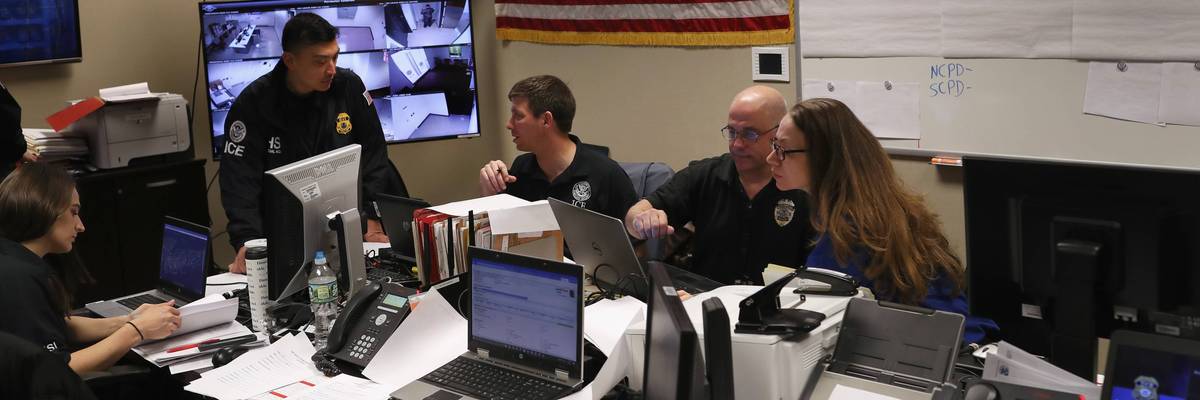
US Immigration and Customs Enforcement (ICE) agents work in a control center in Central Islip, New York on March 29, 2018.
(Photo by John Moore/Getty Images)

Brett Wilkins
Feb 13, 2026
COMMON DREAMS

US Department of Homeland Security agents are increasingly infiltrating social media platforms to monitor users, collect intelligence, and target people, according to new reporting based on leaked documents.

Ken Klippenstein exposed the open source monitoring program, which DHS calls “masked engagement,” with new reporting Thursday that details how agents “assume false identities and interact with users—friending them, joining closed groups, and gaining access to otherwise private postings, photographs, friend lists, and more.”

“A senior [DHS] official tells me that over 6,500 field agents and intelligence operatives can use the new tool, a significant increase explicitly linked to more intense monitoring of American citizens,” Klippenstein wrote.

The so-called “masked engagement” by DHS operatives online comes as actual masked federal agents are engaged in the Trump administration’s deadly deployments in communities nationwide.


Masked engagement adds a new level to DHS’ open source intelligence (OSINT) collection regime, which previously consisted of overt engagement, overt research, overt monitoring, masked monitoring, and undercover engagement. Masked engagement, in which agents conceal their government affiliation without assuming a false identity while interacting with a target, is a step below undercover engagement, in which DHS operatives use false identities and cover stories.

According to Klippenstein:
Masked monitoring allows officers at agencies like [Immigration and Customs Enforcement] and Border Patrol to use alias accounts to passively observe public online activity. Crucially, this level of monitoring bars DHS representatives from interacting with other users directly. Under masked monitoring, officers are not allowed to ask an admin for entry into a private group or to “friend” a target to see non-public posts.

But with masked engagement (separate from masked monitoring), that firewall has now been dismantled. The only restriction imposed on masked engagement is that DHS officers [note] the threshold of “substantive engagement”—a term the rules leave conveniently ill-defined.

“By labeling this a ‘middle ground’ between monitoring and full-blown undercover work, the DHS allows agents to infiltrate private digital spaces without the rigorous internal approvals and legal checks required for a formal undercover ‘sting,’” Klippenstein explained.

Sources told Klippenstein that DHS has been using masked engagement tactics to infiltrate pro-Palestine groups in the United States and to compile databases of suspected Mexican and Mexican American transnational criminals.

“Open source monitoring has become so ubiquitous that we even have databases of identities used by the department to track our own online engagements,” the senior DHS official said.

“Yes, we have safeguards against violating people’s privacy, but masked engagement is just the first step in breaching people’s privacy settings in ways that they are not even aware of,” they added.

Rachel Levinson-Waldman, director of the Brennan Center for Justice’s Liberty and National Security Program, told Klippenstein that “CBP’s expansion into what they’re calling ‘masked engagement’ is cause for real concern.”

“This new capability is being shoehorned in one step below undercover engagement (which already allows for a lot of overreach), it appears CBP believes that friending someone, following them, or joining a group is not as invasive as directly engaging or interacting with individuals,” she continued.

“In addition, doing so through an alias account—an account that doesn’t reveal the user’s CBP affiliation, and pretends to be someone else—will weaken trust in government and weaken the trust that is critical to building community both online and off,” Levinson-Waldman added.

A DHS spokesperson told Klippenstein that the agency “has utilized its congressionally directed undercover authorities to root out child molesters and predators for years.”

“We will continue using every tool at our disposal to protect the American people as our agents and officers Make America Safe Again,” they added.

Those tools include an error-plagued mobile facial recognition application, mass phone surveillance technology, data broker platforms that allow operatives to circumvent warrant requirements, forensic extraction to bypass phone locks, artificial intelligence and predictive analytics, and more.

Civil liberties groups, digital rights advocates, and some Democratic lawmakers are pushing back.

Last week, Sens. Ed Markey (D-Mass.), Jeff Merkley (D-Ore.), Ron Wyden (D-Ore.), and Rep. Pramila Jayapal (D-Wash.) introduced the ICE Out of Our Faces Act, legislation that would ban ICE and Customs and Border Protection “from acquiring and using facial recognition technology and other biometric identification systems.”

The bill would “also require the deletion of all data collected for use in or by biometric identification systems and allow individuals and state attorneys general to seek civil penalties for violations.”
‘Corruption Couldn’t Be More Obvious’: Trump Stacks Key Panel With Crypto and Gambling CEOs

“President Trump has given up on caring about protecting working class Americans and has given the keys to our economy to billionaire scammers.”


Cryptocurrency coins, including the $Trump meme coin and bitcoin, seen in a photo illustration in Brussels, Belgium, on February 8, 2026.
(Photo by Jonathan Raa/NurPhoto via Getty Images)


Brad Reed
Feb 13, 2026
COMMON DREAMS

Alarms are being raised amid reports that President Donald Trump is stacking a key regulatory committee with CEOs of online prediction markets, cryptocurrency firms, and sports betting apps.

As reported on Thursday by the right-wing Daily Wire, the Commodity Futures Trading Commission (CFTC) is launching a new initiative called the Innovation Advisory Committee, which CFTC Chairman Michael Selig said would be tasked with ensuring “the CFTC’s decisions reflect market realities so the agency can future-proof its markets and develop clear rules of the road for the Golden Age of American Financial Markets.”

Among the members of the committee are Tarek Mansour, CEO of online betting market Kalshi; Brian Armstrong, CEO of cryptocurrency hub Coinbase; Christian Genetski, president of the FanDuel sports betting app; and Matt Kalish, president of sports betting app DraftKings North America.

Emily Peterson-Cassin, education fund policy director at Demand Progress, said the committee’s composition has deeply concerning implications for the future of the US economy.

“The corruption couldn’t be more obvious,” said Peterson-Cassin. “It’s hard to see the CTFC succeeding at its mission to prevent a repeat of the 2008 financial crisis when it is influenced from the inside by a rogues’ gallery of billionaire CEOs responsible for monetizing and gamifying virtually every aspect of everyday life.”

Peterson-Cassin added that the latest move shows that “President Trump has given up on caring about protecting working class Americans and has given the keys to our economy to billionaire scammers.”

The creation of the Innovation Advisory Committee wasn’t the only news made by CFTC this week, as Barron’s reported on Monday that the commission’s enforcement division based in Chicago has now been completely gutted, as its entire litigation team has either resigned or been laid off.

One laid-off former CFTC attorney told Barron’s that the gutting of the office will make it much easier for financial scammers to rip off Americans.

“If I was a different person I would launch a crypto scam right now,” said the attorney, “because there’s no cops on the beat.”

Warren Says Trump DOJ Ouster of Antitrust Chief ‘Looks Like Corruption’ as Lobbyists, Wall St Rejoice

“Every antitrust case in front of the Trump Justice Department now reeks of double-dealing,” said Democratic Sen. Elizabeth Warren.


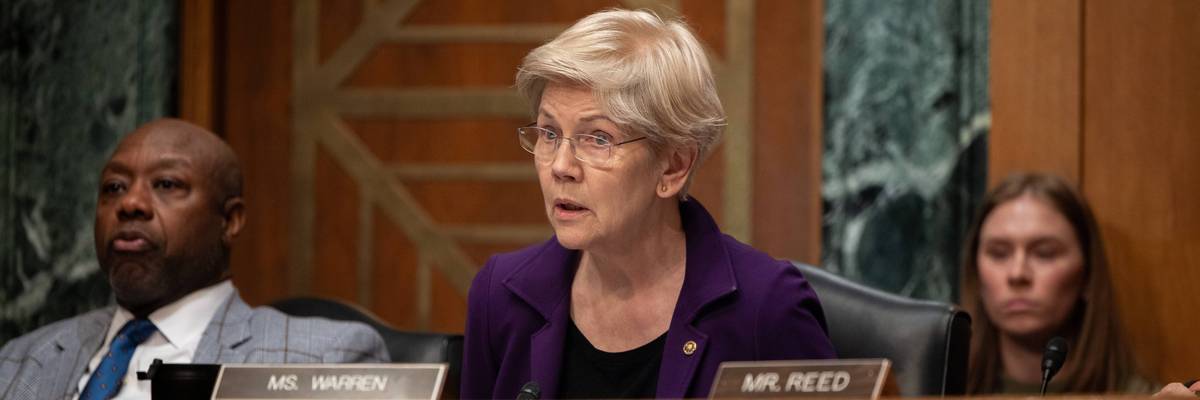
US Sen. Elizabeth Warren (D-Mass.) speaks during a Senate Banking Committee hearing on February 5, 2026.
(Photo by Nathan Posner/Anadolu via Getty Images)

Jake Johnson
Feb 13, 2026
COMMON DREAMS

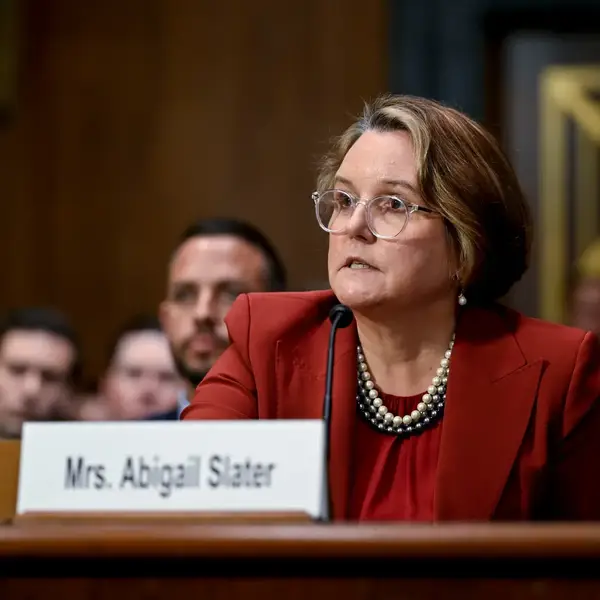
US Sen. Elizabeth Warren on Thursday raised alarm over what she described as the highly suspicious circumstances surrounding Gail Slater’s ouster as the Trump administration’s top antitrust official, a move that was cheered by Wall Street investors and lobbyists working to shield corporate monopolists.

“It looks like corruption,” Warren (D-Mass.) said in a statement after Slater announced her departure on Thursday following a behind-the-scenes power struggle with pro-corporate Trump officials. “A small army of MAGA-aligned lawyers and lobbyists have been trying to sell off merger approvals that will increase prices and harm innovation to the highest bidder.”


‘Pure Corruption Reigns’ at Trump DOJ as Top Antitrust Official Gail Slater Ousted


“Every antitrust case in front of the Trump Justice Department now reeks of double-dealing,” the senator added, noting that Live Nation—the owner of Ticketmaster—saw its stock price surge following news of Slater’s removal.

“Americans’ top concern is affordability, but one of Trump’s few bipartisan-supported nominees—the top law enforcement official responsible for stopping illegal monopolies and protecting American consumers—was just ousted,” said Warren. “Congress has a responsibility to unearth exactly what happened and hold the Trump administration accountable.”

In recent weeks, Live Nation has been in talks with top Justice Department officials to avoid an antitrust trial that’s supposed to begin next month. The negotiations have reportedly bypassed the DOJ antitrust division previously headed by Slater, who was once viewed as the leader of a supposedly burgeoning “MAGA antitrust movement” but was abandoned by her top ally within the Trump administration, Vice President JD Vance, and forced out.

Influence peddlers reportedly on Live Nation’s payroll include Mike Davis—who welcomed Slater’s departure in a post on social media—and Kellyanne Conway, a former adviser to President Donald Trump. The American Prospect noted that Davis “reportedly earned a $1 million ‘success fee’ for getting DOJ to drop its challenge to the $14 billion Hewlett Packard Enterprise-Juniper Networks merger,” a settlement in which Attorney General Pam Bondi’s chief of staff overruled Slater.

“Davis also earned at least $1 million by persuading the Justice Department to allow a merger between Compass and Anywhere Real Estate, the two largest real estate brokerages by volume in 2024, despite objections from antitrust division attorneys,” according to the Prospect.

One of Slater’s deputies who was fired from the antitrust division last year later alleged that lobbyists are effectively dictating antitrust policy at the DOJ under Bondi’s leadership.

Sen. Amy Klobuchar (D-Minn.), the former chair of the Senate Subcommittee on Competition Policy, Antitrust, and Consumer Rights, said Thursday that Slater’s removal represents “a major loss for bipartisan antitrust enforcement.”

“She received significant bipartisan support in the Senate and has continued important cases brought by administrations of both parties, including winning a landmark monopolization case against Google and preparing the vital case to break up Live Nation-Ticketmaster for trial next month,” said Klobuchar. “Her departure raises significant concerns about this administration’s commitment to enforcing the antitrust laws for the betterment of consumers and small businesses, including seeing through its cases against monopolies.”


ABOLISH
Private Prison Firm GEO Group Reports Record $254 Million Profit After New ICE Contracts

“Trump’s donors are making money from this violent separation of our immigrant families,” said Rep. Rashida Tlaib. “This is corruption.”


People rally against the US Immigration and Customs Enforcement detention center at North Lake Correctional Facility in Baldwin, Michigan—which is operated by the private prison company GEO Group—on July 4, 2025.
(Photo by Jim West/UCG/Universal Images Group via Getty Images)

Brett Wilkins
Feb 13, 2026
COMMON DREAMS

Private prison company GEO Group on Thursday reported a company record of $254 million in profit last year—a roughly 700% increase over 2024—driven by asset sales and contracts with the Trump administration to build several new US Immigration and Customs Enforcement detention facilities across the US.

GEO Group secured approximately $520 million in new or expanded contracts in 2025, based on annualized revenue, according to company founder and executive chairman George Zoley.

“This represents the largest amount of new business we have won in a single year in our company’s history,” Zoley said during an earnings call on Thursday. “We have entered into new contracts to house ICE detainees at four facilities totaling approximately 6,000 beds.”

Those facilities are: Delaney Hall in Newark, New Jersey; North Lake Processing Center in Baldwin, Michigan; Folkston Processing Center at the D. Ray James Correctional Institution in Georgia; and a so-called “deportation depot” at the Baker Correctional Institution in Sanderson, Florida.

“The census across our active ICE facilities has continued to steadily increase from the third quarter at approximately 22,000 to presently approximately 24,000, which is the highest level of ICE populations we have ever had,” Zoley said. “This past year, we also significantly expanded the delivery of our secure transportation services on behalf of both ICE and the US Marshals Service, valued at approximately $60 million in incremental annualized revenue.”

“We continue to be optimistic about the importance and growth potential of the ICE contract,” he added. “The new two-year contract includes pricing for 361,000 participants in year one and 465,000 participants in year two. With the capital investment we made in 2025, we believe we have the capability in scaling monitoring devices and case management services to achieve those significantly increased participation levels and far beyond if desired by ICE.”

The so-called One Big Beautiful Bill Act signed last July by President Donald Trump contained a massive increase in funding for the Department of Homeland Security (DHS), ICE’s parent agency, including about $45 billion for expanding immigrant detention capacity.

Days after Trump’s 2024 reelection—which private prison companies funded to the tune of over $1 million—Zoley hailed the “unprecedented opportunity” of the incoming administration’s mass deportation campaign.

“The GEO Group was built for this unique moment in our company’s [and] country’s history, and the opportunity that it will bring,” he beamed.


Unlike state prisons or county and local jails, which are accountable to oversight agencies, privately operated ICE detention centers are not subject to state regulation or inspection. These facilities are plagued by a history of abuse, often sexual in nature, and sometimes alleged deadly medical neglect—problems that carried over from previous administrations.

Thirty-two people died in ICE custody last year, the agency’s deadliest in two decades. Most of these deaths reportedly occurred in privately operated detention centers, and 10 immigrants died in GEO Group facilities, according to data collected by attorney and independent journalist Andrew Free.

GEO Group’s earnings call came just days after three detainees at one of the company’s facilities in Washington state filed a lawsuit accusing two guards there of sexually assaulting and beating them, and then trying to cover it up. The company has been previously sued for alleged inadequate medical care, wrongful deaths, and forced labor.

This, in a system in which immigrant detention is meant to be nonpunitive and in which only a tiny fraction of those detained have been charged or convicted of any violent crime, according to a leaked DHS document exposed earlier this week.

Another private prison company, CoreCivic, on Thursday reported $116.5 million in 2025 profits, a nearly 70% increase from the previous year. The operator of ICE facilities including the notorious Dilley Immigration Processing Center in Texas—which detainees describe as a measles-infested “living hell” where they’ve been served moldy food full of worms and forced to drink putrid water—said it expects 2026 to be even more profitable.

Some private prison investors expressed frustration that ICE isn’t jailing enough people to generate even more revenue.


“One of the big questions, I think... has been the pace of detention by ICE, that it’s been below what people... thought [it] was going to be,” Joseph Gomes of NOBLE Capital Markets, Inc. said on Thursday’s CoreCivic earnings call. “I think... people thought we’d be at that 100,000 level. We’re at... a little over 70,000.”
US cattle farmers caught between high costs and weary consumers


By AFP
February 14, 2026


Chris Stem warns that the cost of doing business is almost outpricing his ability to raise cattle in the United States - Copyright AFP ANDREW CABALLERO-REYNOLDS


Beiyi SEOW

In rural Virginia, dozens of young cows belonging to Chris Stem graze by a frozen pond. He is living his childhood dream of being a farmer — but reality is starting to bite.

Despite soaring beef prices as the US cattle population hit a 75-year low, farmers like Stem are feeling the squeeze from steeper business costs, budget-conscious consumers and President Donald Trump’s trade policy.

“The cost of doing business is almost outpricing (our ability) to continue to raise cattle,” Stem told AFP.

“From cutting hay to feeding the cattle to maintaining equipment, maintaining staff, feed, everything has gone up,” he said. “When does that stabilize and stop?”

Trump’s latest move to boost Argentine beef imports is adding to concerns, vexing a key support base of the Republican president as midterm elections approach.

Stem, 40, has a herd of around 250 cattle in Ashland, Virginia.

Most are sold at larger markets where they are purchased and fed to slaughter weight, while around 15 percent is processed nearby and sold at Stem’s butcher shop.

For him, higher beef prices have been a double-edged sword.

His revenue from selling cattle has risen, but so have operational costs.

And there are limits to how much he can hike consumer prices at his shop to make up the margins.

“They will only spend but so much on a cut of beef, especially when you have imported meats that you can purchase for 50 percent to 60 percent less at a larger store,” Stem said.

Already, ribeye that sold for $14.99 a pound in 2019 now sells for $32.99, he said. His customer sales have dropped by 30 percent.

To afford the property, he has diversified operations at Oakdale into winemaking and hosting events like weddings.


– ‘State of crisis’ –


Steeper beef prices have become a symbol of high living costs in the world’s biggest economy, which has fueled voter frustration. Last fall, Trump demanded that ranchers slash their prices.

Trump has since exempted Brazilian beef from sharp tariffs, and moved this month to expand imports of trimmings from Argentina to cool ground beef prices.

Yet, officials predict costs will keep creeping up.

Beef and veal prices were up 15 percent year-on-year in January while ground beef prices, which hit a new high in December, have continued climbing.

Costs will likely stay elevated as consumer demand remains robust, while it takes years to rebuild American herds depleted by drought and import restrictions over a parasite.

Meanwhile, American farmers and ranchers fear Trump’s policies will undercut their production and profits.

“We do need to feed the people of the United States,” said Stem. “But we’re opening a door that’s going to, I think, significantly harm farmers.”

“I’m a supporter of the Republican administration,” he added. “I’m not a supporter of the of the unknowns that we get right now.”

The Ranchers Cattlemen Action Legal Fund United Stockgrowers of America warned recently: “Our industry is in a state of crisis and needs protection against price-depressing imports.”

Iowa farmer Lance Lillibridge told AFP that cattle producers have been “living off very skinny margins” for years.

“People are getting tired of working this hard for nothing,” he added. “Right now, our cattle prices are exactly where they should be.”


– ‘Cut back’ –


But households are feeling the pinch.

Endawnson Nungo, 56, a South Carolinian in the railroad industry, told AFP “we’ve cut back a lot” due to beef prices.

At a butcher shop in Washington, scientist Caleb Svezia, 28, said he started noticing higher meat prices around six months ago.

He has cut back on snacks when grocery shopping, to save up for better quality meats.

Jamie Stachowski, who runs Stachowski’s Market, said customers have pulled back. Like Stem, he has had to raise prices, lifting them by 30 percent over the past year.

In turn, his sales dropped by 15 percent.

Some consumers also pivoted from prime cuts to secondary ones — or buy other meats altogether.

“The beef industry is billions and billions of dollars,” he said. “Yet everybody just makes pennies on the pound.”

GOP Ripped for ‘Grotesque’ Farm Bill Full of ‘Industry-Backed Poison Pills’

“Chairman Thompson appears poised to check off industry’s cruel wish list,” one critic warned.


Farmers gather sweet peppers at Hungry Heart Farm in Kingston, New Hampshire, on September 23, 2025.
(Photo by Jessica Rinaldi/The Boston Globe via Getty Images)

Jessica Corbett
Feb 13, 2026
COMMON DREAMS

Advocates for animal welfare, environmental protection, public health, and small family farms fiercely condemned various “industry-backed poison pills” in the long-awaited Farm Bill draft unveiled Friday by a key Republican in the US House of Representatives.

“A new Farm Bill is long overdue, and the Farm, Food, and National Security Act of 2026 is an important step forward in providing certainty to our farmers, ranchers, and rural communities,” said House Committee on Agriculture Chair Glenn “GT” Thompson (R-Pa.) in a statement.


Agriculture Experts Warn of ‘Widespread Collapse’ in US Farms Thanks to Trump Policies


While Thompson has scheduled a markup of the 802-page proposal for February 23, critics aren’t waiting to pick apart the bill, which aligns with a 2024 GOP proposal that was also sharply rebuked. The panel’s ranking member, Rep. Angie Craig (D-Minn.), said that from what she has seen so far, the new legislation “fails to meet the moment facing farmers and working people.”

“Farmers need Congress to act swiftly to end inflationary tariffs, stabilize trade relationships, expand domestic market opportunities like year-round E15, and help lower input costs,” Craig stressed. “The Republican majority instead chose to ignore Democratic priorities and focus on pushing a shell of a farm bill with poison pills that complicates if not derails chances of getting anything done. I strongly urge my Republican colleagues to drop the political charade and work with House Democrats on a truly bipartisan bill to address the very real problems farm country is experiencing right now—before it’s too late.”

Brett Hartl, government affairs director at the Center for Biological Diversity, similarly blasted the GOP legislation on Friday, declaring that “this Republican Farm Bill proposal is a grotesque, record-breaking giveaway to the pesticide industry that will free Big Ag to accelerate the flow of dangerous poisons into our nation’s food supply and waterways.”

“This bill would block people suffering from pesticide-linked cancers from suing pesticide makers, eviscerate the EPA’s ability to protect rivers and streams from direct pesticide pollution, and give the pesticide industry an unprecedented veto over extinction-preventing safeguards for our nation’s most endangered wildlife,” he said, referring to the Environmental Protection Agency.

“If Congress passes this monstrosity, it will speed our march toward the dawn of a very real silent spring, a day without fluttering butterflies, chirping frogs, or the chorus of birds at sunrise,” Hartl warned. “No one voted for Republicans to allow foreign-owned pesticide conglomerates to dominate the policies that impact the safety of the food every American eats. But this bill leaves no doubt that’s exactly who is calling all the shots.”

Food & Water Watch (FWW) managing director of policy and litigation Mitch Jones also sounded the alarm about industry-friendly poison pills, arguing that any draft containing the “Cancer Gag Act” that would shield pesticide companies from liability or the Ending Agricultural Trade Suppression Act—which would block state and local policies designed to protect animal welfare, farm workers, and food safety—“must be dead on arrival.”

Sara Amundson, president of Humane World Action Fund—formerly called Humane Society Legislative Fund—also made a case against targeting state restrictions for animals like Proposition 12 in California, which the US Supreme Court let stand in 2023, in response to a challenge by the National Pork Producers Council and the American Farm Bureau Federation.

“Once again, the House Agriculture Committee Republican majority is bending to the will of a backwards-facing segment of the pork industry by trying to force through a measure to override the preferences of voters in more than a dozen states, upend the decisions of courts all the way up to the Supreme Court, and trample states’ rights all at the same time,” Amundson said Friday.


The National Family Farm Coalition highlighted that “instead of addressing the widespread concerns of family-scale farmers—ensuring fair prices for farmers, improving credit access, addressing corporate land consolidation, and creating a trade environment that benefits producers—this draft perpetuates the status quo that enriches and empowers corporate agribusiness. The result is an accelerating farm crisis that continues to hollow out rural communities across the US.”

Thompson also faced outrage over other policies left out of the GOP legislation—particularly from those calling for the restoration of $187 billion in cuts to the Supplemental Nutrition Assistance Program (SNAP) that congressional Republicans and President Donald Trump forced through last year with their so-called One Big Beautiful Bill Act (HR 1).

“HR 1 shifts unprecedented costs to already cash-strapped states, expands time limits, and strips food benefits away from caregivers, veterans, older workers, people experiencing homelessness, and humanitarian-based noncitizens,” noted Crystal FitzSimons, president of the Food Research & Action Center.

“HR 1 is an unforgiving assault on America’s hungry, deliberately dismantling our nation’s first line of defense against hunger,” she continued. “Yet, when given the opportunity to correct this harm in the latest Farm Bill proposal, Chairman Thompson unveiled a package that will only deepen hunger instead of fixing it. Hunger is not something Congress can afford to ignore.”


Jones of FWW said that “families and farmers are hungry for federal policy that supports small- and mid-sized producers and keeps food affordable. Instead, Chairman Thompson appears poised to check off industry’s cruel wish list.”

“America needs a fair Farm Bill,” he emphasized. “It is imperative that this Farm Bill repeal all Trump SNAP cuts and restore full funding to this critical nutrition program; stop the proliferation of factory farms; and support the transition to sustainable, affordable food.”
No Concessions’: San Francisco Teachers End 4-Day Strike After Winning Raise, Family Healthcare

“This historic strike built an unbreakable solidarity across our city, among families, students, educators, and community,” said San Francisco’s teachers union.


San Francisco teachers and allies rally for a fair contract that includes fully funded family healthcare outside Mission High School on February 9, 2026.

(Photo by Brontë Wittpenn/San Francisco Chronicle via Getty Images)


Brett Wilkins
Feb 13, 2026

San Francisco public school teachers and their union celebrated Friday after negotiating a tentative agreement for a new contract with higher pay and fully funded family healthcare, ending a four-day walkout that was the city’s first educator strike in nearly half a century.

United Educators of San Francisco (UESF) said its bargaining team reached a two-year tentative deal with the San Francisco Unified School District (SFUSD) at around 5:30 am local time Friday. The 120 public schools that were closed due to the walkout by around 6,000 teachers are set to reopen for classes next Wednesday.


31,000 Kaiser Nurses Strike as Their Union Says Employer Puts ‘Profit Over Patients’


‘Now Is Your Time of Need’: Bernie Sanders, Mayor Mamdani Join Striking Nurses in NYC

“This historic strike built an unbreakable solidarity across our city, among families, students, educators, and community,” UESF said in a statement. “This strike has made it clear what is possible when we join together and fight for the stability in our schools that many have said was out of our reach.”


The tentative agreement, which follows 11 months of bargaining, includes the union’s main demand for fully funded health coverage for dependents; raises of between 5-8.5%; caseload reductions for special educators; sanctuary protections for students and staff; limits on the use of artificial intelligence; preservation and expansion of the Stay Over program for unhoused students and their families; and better working conditions for librarians, substitute teachers, counselors, and other staff.

“By forcing SFUSD to invest in fully funded family healthcare, special education workloads, improved wages, sanctuary and housing protections for San Francisco families, we’ve made important progress towards the schools our students deserve,” said UESF president Cassondra Curiel “This contract is a strong foundation for us to continue to build the safe and stable learning environments our students deserve.”

SFUSD Superintendent Maria Su said in a statement: “I recognize that this past week has been challenging. Thank you to the SFUSD staff, community-based partners, and faith and city leaders who partnered with us to continue centering our students in our work every day.”

“I am so proud of the resilience and strength of our community,” Su added. “This is a new beginning, and I want to celebrate our diverse community of educators, administrators, parents, and students as we come together and heal.”

However, Su also warned that “we do not have enough funds to pay for this year and the next two years,” citing SFUSD’s over $100 million budget deficit.

The striking teachers enjoyed widespread support and solidarity across the city, including at a massive rally outside City Hall on Monday.


San Francisco teachers cheered the tentative agreement—especially its coverage of 100% of premiums on family health plans, which run about $1,500 per month, beginning next January.

“That amount of money is life-changing to us,” Balboa High School English teacher Ryan Alias said during a Thursday press conference.

“If we had that in our pocket, we would be able to save for retirement,” added Alias, who has two children in SFUSD schools. “We would be able to save for college funds. We’d be able to save for student loans. We’d be able to pay for art classes for our kids. This is the thing that is going to keep educators in the city.”
As US Firms Secure Deals for Congo’s Minerals, Its Citizens Fight Back in Court

This legal challenge in the Congo highlights the stakes for millions of people around the world, including many Indigenous communities, who find their lands targeted by big powers for mineral extraction.


Miners pull up a bag of cobalt their colleague is digging underground inside the CDM (Congo DongFang Mining) Kasulo mine.
(Photo by Getty Images)

Frederic Mousseau
Feb 14, 2026
Common Dreams

President Donald Trump hailed “historic” the agreement signed in Washington on December 4, 2025, between President Félix Tshisekedi of Congo and Rwanda’s President Paul Kagame. Brokered by the US administration, this Washington Accord was supposed to end the devastating conflict in Congo that has taken millions of lives over the past three decades.

Alongside this deal, a Strategic Partnership Agreement was signed between the US and Congo. The agreement gives the US preferential access to Congolese mineral reserves, requires Congo to amend its laws and potentially its Constitution, and gives Washington a level of control over the management of mining resources through the establishment of a joint mechanism involving the two governments.

In October 2025, analyzing the pre-accord signed in June 2025 and a Regional Economic Integration Framework between Rwanda and Congo negotiated in the following months, the Oakland Institute released Shafted: The Scramble for Critical Minerals in the DRC. The report raised serious concerns about US maneuvers to control Congolese critical minerals under the guise of bringing peace to the region.

The Partnership Agreement signed in December makes these concerns legitimate. The Congolese people have been sidelined, with an agreement focused on extraction and exploitation of critical minerals and a peace deal that shockingly overlooks the need for justice and for holding perpetrators accountable. Soon after the signing of the deal, the US mining firms were already striking deals, while promises of peace and security remain wishful thinking with Rwanda and its proxy M23 continuing to occupy large swaths of land in mineral-rich eastern Congo. As a matter of fact, fighting has continued to rage with a fresh offensive launched by Rwanda and M23 in the days that followed the agreement, resulting in thousands of people killed and the capture of the strategic city of Uvira.

The lawyers and human rights defenders who have filed the case are urging the mobilization of Congolese people to preserve the sovereignty of their nation and calling on the international community to support their action and defend international law at a time it is under unprecedented threat.

While the prospect of peace remains uncertain, the government of Congo has not waited to take significant steps in the implementation of the agreement. Mid-January, it provided Washington with a shortlist of state-owned assets—including manganese, copper-cobalt, gold, and lithium projects—available to US investors. A major deal was announced soon after with US government-backed Orion Critical Mineral Consortium acquiring 40% of Glencore’s DRC copper and cobalt.

Congolese may legitimately wonder whether they are being fooled by the deal, seeing their mineral resources offered to the “peacemaker” whereas Rwanda, undeterred, continues its aggression and the extraction of Congolese minerals in Eastern Congo. This has led some to act.

On January 21, 2026, a collective of Congolese lawyers and human rights defenders filed a petition at the Constitutional Court of the Congo to challenge the constitutionality of the agreement. The lawyers argue that the partnership violates the Constitution since amendment of laws or the Constitution requires a democratic review and approval by the Congolese parliament or citizens through referendum. Specifically, it contravenes Article 214 of the Congo’s Constitution, which sets out the ratification process for international agreements that involve amending national laws. The petition also contends that the agreement violates Articles 9 and 217, which uphold the principle of Congo’s sovereignty over natural resources, and Article 12, which upholds the principle of equality before the law.

According to Attorney Jean-Marie Kalonji, one of the plaintiffs: “By filing this case with the Constitutional Court, we are assuming our responsibility as Congolese citizens to protect the sovereignty of our country and safeguard our patrimony for future generations.” The lawyers and human rights defenders who have filed the case are urging the mobilization of Congolese people to preserve the sovereignty of their nation and calling on the international community to support their action and defend international law at a time it is under unprecedented threat.

This legal challenge has major significance for Congo, a country that has large reserves of several critical minerals, such as copper and cobalt, and a long history of mineral extraction plagued by corruption, embezzlement, and predatory wars. The country’s mineral wealth has hardly benefited its people—still lagging behind most countries in terms of human development indicators such as access to health, education, and other standards of living. It is therefore totally legitimate for citizens to stand up for their basic rights and ensure that mining operations actually benefit the population.

Beyond Congo, this legal action has implications for other mineral-rich countries as global competition for the control of critical minerals intensifies and projections indicate steep increases in demand as well as shortfalls to be expected for some key minerals such as copper and lithium as early as the 2030s. Whereas China dominates both extraction and refinery activites, the US and other industrialized countries have set the supply of critical minerals as a vital priority for so-called green technologies as well as defense.

The 2022 Intergovernmental Panel on Climate Change report warned that mining has “severe environmental impacts” with “often […] few if any redistributive benefits for communities in regions where extraction takes place,” and instead of local development, the extraction of strategic minerals is often linked to violence, human rights abuses, and conflict. This legal challenge in the Congo highlights the stakes for millions of people around the world, including many Indigenous communities, who find their lands targeted by big powers for mineral extraction. It is essential that their rights are recognized and that they have a say in the future of their land—which is intertwined with their own future.


Our work is licensed under Creative Commons (CC BY-NC-ND 3.0). Feel free to republish and share widely.


Frederic Mousseau
Frederic Mousseau is policy directory of the Oakland Institute.
Full Bio >