
About Freedom—It’s About Their Own Egos
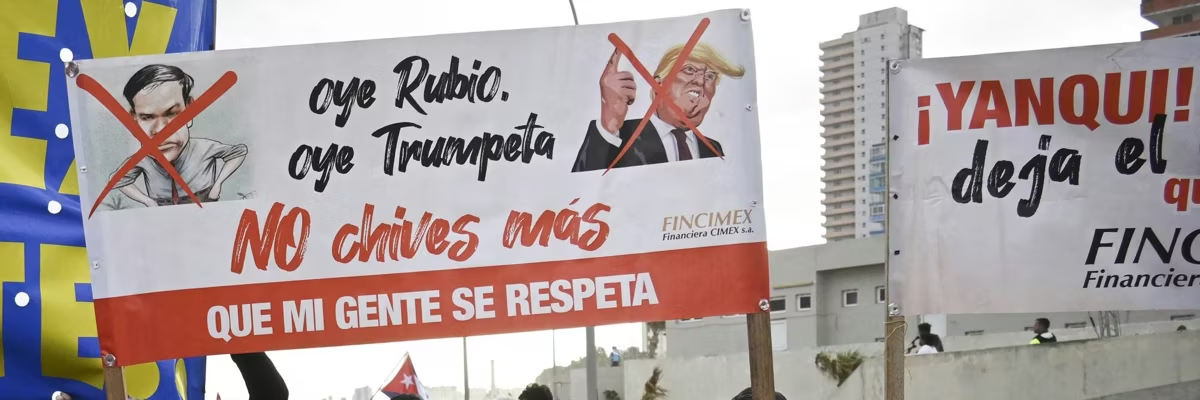
Cubans hold a banner against US President Donald Trump and Secretary of State Marco Rubio during an “Anti-Imperialist” protest in front of the US Embassy against the US incursion in Venezuela, where 32 Cuban soldiers lost their lives, in Havana on January 16, 2026.
(Photo by Yamil Lage / AFP via Getty Images)
Jordan Liz
Feb 14, 2026
Common Dreams
The Trump administration’s total blockade on oil imports to Cuba is jeopardizing the lives of millions across the island. It is resulting in severe blackouts that are disrupting food production, hospitals, schools, public transport, and tourism.
Despite this, the people of Cuba remain defiant. As Cuban President Miguel Díaz-Canel remarks: “The collapse lies in the imperial mindset, but not in the mindset of the Cubans. I know we are going to live through difficult times, but we will overcome them together with creative resilience.”
The Trump administration’s total blockade on oil imports to Cuba is jeopardizing the lives of millions across the island. It is resulting in severe blackouts that are disrupting food production, hospitals, schools, public transport, and tourism.
Despite this, the people of Cuba remain defiant. As Cuban President Miguel Díaz-Canel remarks: “The collapse lies in the imperial mindset, but not in the mindset of the Cubans. I know we are going to live through difficult times, but we will overcome them together with creative resilience.”
Cuba Is Not A Threat—Trump Is
President Donald Trump alleges that Cuba poses “an unusual and extraordinary threat” for two reasons. First, its relationship with “hostile countries” and “transnational terrorist groups,” including Russia, China, Iran, and Hamas. Second, Trump alleges that Cuba’s “communist ideas, policies, and practices” are a threat to the region and endanger the lives of its citizens.
Neither of these is the real reason, however. In January 2026, Trump praised Canada’s trade deal with China as “a good thing.” He told reporters, “If you can get a deal with China, you should do that.” While Trump did threaten retaliatory tariffs against Canada a few days later, his own administration has boasted about the “historic agreement” it reached with China on trade. Trump himself raves about his “extremely good” relationship with Chinese President Xi Jinping. He even invited Xi to join his Board of Peace.
For Trump, colonialism is not solely about exploitation and systematic theft—it is a means of reshaping the world in his self-obsessed image.
Likewise, Trump purports to have a good relationship with Russian President Vladimir Putin. Trump has described Putin as a “genius” and a “strong leader,” and their relationship as “very, very good.” He even praised Putin’s invasion of Ukraine. During a radio interview, Trump said: “Putin declares a big portion of the Ukraine—of Ukraine—Putin declares it as independent. Oh, that’s wonderful. He used the word ‘independent’ and ‘we’re gonna go out and we’re gonna go in and we’re gonna help keep peace.’ You gotta say that’s pretty savvy.” Despite his war crimes, Trump also invited Putin to be part of the Board of Peace.
Clearly, Trump has no issue forming close relationships with “hostile countries.”
Concerns about destabilizing the region or harms to the Cuban people are also false flags. The Trump administration has issued illegal military strikes on boats in the Caribbean Sea and Pacific Ocean that have killed at least 130 people; violated international law by invading Venezuela and kidnapping President Nicolás Maduro; threatened several nations in the region including Colombia, Mexico, Panama, Greenland, Canada, as well as Cuba and Venezuela. Compared to Cuba, the Trump administration is, in orders of magnitude, a significantly greater threat to regional stability.
Moreover, Trump does not care whatsoever about the well-being of Cubans. If he did, he would not have undone President Barack Obama’s attempts at normalizing US-Cuba relations. If he cared, then his administration would not have paused a humanitarian program that allowed Cubans to enter the US and remain here legally for two years. Rather than protecting a group that has overwhelmingly supported him, the Trump administration is mass deporting Cubans back to the very country it is now economically asphyxiating.
This vile disregard, however, is not surprising—Trump does not care about global stability. He does not care about American citizens. And he especially does not care about the peoples of Asian, African, Caribbean, and Latin American countries.
No, Trump’s blatant act of global terrorism against Cuba is not about national security, communism, or saving lives. This act of deprived cruelty masquerading as foreign policy is about narcissism, private interest, and personal grievances.
Donald Trump: Where Narcissism Meets Colonialism
According to a US official, Trump believes that successfully ending the Castro era would cement his legacy by accomplishing what presidents since John F. Kennedy have failed to do. This is among his chief motivations.
Whether it’s adding his name to the Kennedy Center, building the “Arch de Trump,” or whining about the Nobel Peace Prize he thinks he deserves, Trump is obsessed with himself and his legacy. At Turning Point USA’s 2025 AmericaFest Conference, conservative commentator Jesse Watters recounts asking Trump about why his “big, beautiful ballroom” is so extravagant—“four times the size of the White House.” Watters told the audience, “[Trump] said, ‘Jesse, it’s a monument. I’m building a monument to myself—because no one else will.’”
For Trump, colonialism is not solely about exploitation and systematic theft—it is a means of reshaping the world in his self-obsessed image. In his mind, colonized lands are monuments to his greatness and ego; another property upon which he can stamp his name and expand his golden empire; further proof that only he can bring peace and order to the world.
Trump’s narcissism is why he labelled himself the “Acting President of Venezuela” after his administration kidnapped Maduro—a blatant violation of international law reduced to self-aggrandizement.
This is why he posted a video of an ethnically cleansed “Trump Gaza” filled with palm trees, luxury buildings, and, of course, a towering golden statue of himself. Mass displacement and genocide are simply steppingstones in his pursuit of more self-praise.
Cuba will be no different. He will torture Cuba in the hopes of forcing them to submit to his will and cement his legacy. To force them to “make a deal, before it is too late.” For Trump, all this cruelty is business as usual. As he puts it, “Sometimes, part of making a deal is denigrating your competition.”
President Donald Trump alleges that Cuba poses “an unusual and extraordinary threat” for two reasons. First, its relationship with “hostile countries” and “transnational terrorist groups,” including Russia, China, Iran, and Hamas. Second, Trump alleges that Cuba’s “communist ideas, policies, and practices” are a threat to the region and endanger the lives of its citizens.
Neither of these is the real reason, however. In January 2026, Trump praised Canada’s trade deal with China as “a good thing.” He told reporters, “If you can get a deal with China, you should do that.” While Trump did threaten retaliatory tariffs against Canada a few days later, his own administration has boasted about the “historic agreement” it reached with China on trade. Trump himself raves about his “extremely good” relationship with Chinese President Xi Jinping. He even invited Xi to join his Board of Peace.
For Trump, colonialism is not solely about exploitation and systematic theft—it is a means of reshaping the world in his self-obsessed image.
Likewise, Trump purports to have a good relationship with Russian President Vladimir Putin. Trump has described Putin as a “genius” and a “strong leader,” and their relationship as “very, very good.” He even praised Putin’s invasion of Ukraine. During a radio interview, Trump said: “Putin declares a big portion of the Ukraine—of Ukraine—Putin declares it as independent. Oh, that’s wonderful. He used the word ‘independent’ and ‘we’re gonna go out and we’re gonna go in and we’re gonna help keep peace.’ You gotta say that’s pretty savvy.” Despite his war crimes, Trump also invited Putin to be part of the Board of Peace.
Clearly, Trump has no issue forming close relationships with “hostile countries.”
Concerns about destabilizing the region or harms to the Cuban people are also false flags. The Trump administration has issued illegal military strikes on boats in the Caribbean Sea and Pacific Ocean that have killed at least 130 people; violated international law by invading Venezuela and kidnapping President Nicolás Maduro; threatened several nations in the region including Colombia, Mexico, Panama, Greenland, Canada, as well as Cuba and Venezuela. Compared to Cuba, the Trump administration is, in orders of magnitude, a significantly greater threat to regional stability.
Moreover, Trump does not care whatsoever about the well-being of Cubans. If he did, he would not have undone President Barack Obama’s attempts at normalizing US-Cuba relations. If he cared, then his administration would not have paused a humanitarian program that allowed Cubans to enter the US and remain here legally for two years. Rather than protecting a group that has overwhelmingly supported him, the Trump administration is mass deporting Cubans back to the very country it is now economically asphyxiating.
This vile disregard, however, is not surprising—Trump does not care about global stability. He does not care about American citizens. And he especially does not care about the peoples of Asian, African, Caribbean, and Latin American countries.
No, Trump’s blatant act of global terrorism against Cuba is not about national security, communism, or saving lives. This act of deprived cruelty masquerading as foreign policy is about narcissism, private interest, and personal grievances.
Donald Trump: Where Narcissism Meets Colonialism
According to a US official, Trump believes that successfully ending the Castro era would cement his legacy by accomplishing what presidents since John F. Kennedy have failed to do. This is among his chief motivations.
Whether it’s adding his name to the Kennedy Center, building the “Arch de Trump,” or whining about the Nobel Peace Prize he thinks he deserves, Trump is obsessed with himself and his legacy. At Turning Point USA’s 2025 AmericaFest Conference, conservative commentator Jesse Watters recounts asking Trump about why his “big, beautiful ballroom” is so extravagant—“four times the size of the White House.” Watters told the audience, “[Trump] said, ‘Jesse, it’s a monument. I’m building a monument to myself—because no one else will.’”
For Trump, colonialism is not solely about exploitation and systematic theft—it is a means of reshaping the world in his self-obsessed image. In his mind, colonized lands are monuments to his greatness and ego; another property upon which he can stamp his name and expand his golden empire; further proof that only he can bring peace and order to the world.
Trump’s narcissism is why he labelled himself the “Acting President of Venezuela” after his administration kidnapped Maduro—a blatant violation of international law reduced to self-aggrandizement.
This is why he posted a video of an ethnically cleansed “Trump Gaza” filled with palm trees, luxury buildings, and, of course, a towering golden statue of himself. Mass displacement and genocide are simply steppingstones in his pursuit of more self-praise.
Cuba will be no different. He will torture Cuba in the hopes of forcing them to submit to his will and cement his legacy. To force them to “make a deal, before it is too late.” For Trump, all this cruelty is business as usual. As he puts it, “Sometimes, part of making a deal is denigrating your competition.”
Marco Rubio’s Childhood Fantasy
That said, Trump’s is not the only ego at play here. Reportedly, Secretary of State Marco Rubio is deliberately blocking negotiations between high-level officials from Havana and Washington. This, despite both Trump and Díaz-Canel insisting that they are open to talks.
Rubio has long since advocated for total regime change in Cuba. In his memoir American Son, Rubio writes about the profound impact his Castro-hating grandfather and President Ronald Reagan’s militant anti-communism had on his political beliefs. He writes that, as a child, “I boasted I would someday lead an army of exiles to overthrow Fidel Castro and become president of a free Cuba.” When applying to law school, his personal essay expressed his “intention to use [his] law degree one day to help construct a new legal and political system for a free Cuba.”
We were too late to stop Trump’s illegal invasion of Venezuela; but we can still save Cuba. From Argentina to Canada, we must unite.
Throughout his life, Rubio has expressed the same sentiment: For Cuba to be free, the Castro regime must end and be replaced with a new political system. For Rubio, Díaz-Canel is no different than Castro. As he sees it, “The dictatorship of Díaz-Canel follows the same tactics as the Castro regime, censoring and repressing members of the opposition.” As such, there can be no negotiations: “Every concession made to the [Díaz-Canel] regime is a betrayal of those who are fighting for freedom on the island.” Thus, Rubio opposed Obama’s attempts at normalizing relations with Cuba, warned against President Joe Biden recommitting to the “failed Obama Administration policy of rewarding Raúl Castro and Miguel Díaz-Canel,” and is now actively blocking negotiations between the two nations. For Rubio, there is only one way forward. The current regime must end, and the era of President Rubio must begin—an illicit inauguration that Trump has already endorsed.
Beyond his own twisted personal desires, many of Rubio’s constituents and backers are also anti-Castro and anti-communist. As journalists Ryan Grim, Noah Kulwin, and José Luis Granados Ceja with Drop Site News write, “If Trump successfully lands a deal with the Cuban government that Rubio would have to sign off on, Rubio would be left to either betray his life’s cause and that of his backers in Miami, or resign in protest.”
The stakes are much higher and far more personal for Rubio than Trump. But in the end, neither care about Cuba nor its people. For Trump, regime change in Cuba will cement his legacy. For Rubio, it will mark the culmination of his childhood dream. In their equation, they win and Cuba—like Venezuela, Puerto Rico, Hawai’i, Guam, and so many nations before it—loses its independence and freedom.
America vs. Trump
Now is the time for nations across the Americas and the Caribbean to band together against Trump’s vile Donroe Doctrine. President Claudia Sheinbaum should be praised for her efforts to aid Cuba, but this is not a fight Mexico can win alone. Nor should it have to; this impacts all of us.
Let’s be clear: Regardless of current US relationships, no country is safe from Trump’s colonial aggression and narcissistic whims. Whether it’s betraying the Kurds in Syria or threatening NATO allies, Trump will do whatever it takes to satisfy his own ambitions. Trump’s allies in the region, like Dominican Republic President Luis Abinader and Argentine President Javier Milei, would do well to remember this.
We were too late to stop Trump’s illegal invasion of Venezuela; but we can still save Cuba. From Argentina to Canada, we must unite. We cannot allow ourselves to be at the mercy of Trump’s delusions of grandeur. We must act now to save Cuba.
Our work is licensed under Creative Commons (CC BY-NC-ND 3.0). Feel free to republish and share widely.
Jordan Liz
Jordan Liz is an Associate Professor of Philosophy at San José State University. He specializes in issues of race, immigration and the politics of belonging.
Full Bio >
In defence of Cuba against the neocolonial blockade and starvation imposed by Trump

By Ana Cristina Carvalhaes, Israel Dutra, João Machado & Manuel Rodríguez Banchs
Published date 14 February, 2026
First published at International Viewpoint.
The neo-fascist in the White House is attempting to bring the Caribbean island and its government to its knees, strangling it economically once and for all, killing its people with darkness and scarcity.
But this is not “just” a war against Cuba and its revolutionary tradition. It is the continuation of the war against the sovereignty of all Latin American countries and Latino peoples within the United States. In particular, Lula da Silva, Gustave Petro, Yamandú Orsi and the foreign governments of social democracy must emphatically oppose this crime in all international forums and organizations.
Following the de facto “takeover” of Venezuela by the United States, with the kidnapping of Nicolas Maduro and Cilia Flores on January 3, the main target of the far-right strategists around Donald Trump is the Caribbean island, which has been the scene of resistance against two empires since the 19th century and the scene of the world’s last victorious anti-capitalist revolution, between 1959-61, led by the 26 July Movement (Fidel Castro’s movement) and the working masses of the sugar cane fields and factories.
From Washington and from a Caracas transformed — by force of arms and sanctions — into a kind of capital of a viceroyalty in the 21st century, the Yankee hawks have declared war on Cuba, a small country, isolated by nature and geopolitics, whose development has been limited by decades of US blockade and energy and food dependence on the outside world. (Many will say, as we do, combined with the mistakes of its own successive governments.)
The first step in the ongoing attack was to cut off the supply of Venezuelan oil, which since Hugo Chávez’s first government (1998) had guaranteed the functioning of Cuba’s economy. An order quickly carried out by Delcy Rodríguez. Cuba needs 100,000 barrels of oil a day and produces 40,000. The current phase of the attack involves intense pressure on Cuba’s last oil supplier, Mexico, to stop sending oil tankers, which Claudia Sheinbaum has so far refused to do.
At the same time, in a festival of media provocations typical of a genocidal showman, Trump calls on Cuban leader Miguel Díaz-Canel to “negotiate” nothing less than the end of the country’s sovereignty. He says that Cuba will surrender, thanks to the fact that he is starving Cubans, just as, with the support of Israel and its bombings, he starved the inhabitants of Gaza. (For now, there is no equivalence between one and the other, but the inhumane method is the same.) Everything indicates that the Yankee government expects one of two things: the capitulation of Havana or an internal popular rebellion.
At an international press conference on February 6, Díaz-Canel described the suffering of his people and denounced what is happening as an attempt at genocide. Unfortunately, although China and Russia, considered by many to be “alternative powers”, have issued formal statements criticising Washington, they have so far not contributed even a gallon of petrol to prevent the worst in Cuba.
Rodríguez’s cut-off of oil supplies to Cuba should also give pause to those who continue to repeat the “mantra” that the Venezuelan government still has something to do with the “revolution”, when in reality it has become the administrator of the protectorate. As for Lula and the Workers Party (PT), it is regrettable that they do not order the wealthy Petrobras to break the energy blockade on Cuba, as the National Federation of Oil Workers (FNP) rightly demands.
Fascist revenge
Why is a weakened David such as little brave Cuba the object of so much hatred from the neo-fascist Goliath? Unlike what was correctly observed about Venezuela, that the immediate objective was to secure oil — to the point that imperialism discarded its long-time friend María Corina Machado and kept a Maduro-style regime without Maduro in power — in the Cuban case, the explanation is pure neo-fascist geopolitics, with an overdose of ideological and class revenge. Trump and his Secretary of State, Marco Rubio, a descendant of Cuban counterrevolutionaries, need to defeat the country that dared, in the past, to fight capitalism 150 kilometres from Miami, and which was a symbol and inspiration for generations of fighters for national sovereignty and, in the first decades after 1961, for social transformation.
Cuba was the only Latin American country in which the bourgeoisie was expropriated, more specifically with Castro’s proclamation of the socialist character of the revolution in 1961. It is worth remembering that in the early years of the Sandinista revolution in Nicaragua, at certain moments during the Chávez government (particularly after the defeat of the pro-US coup in 2002), and during the first government of Rafael Correa in Ecuador, local and international capitalists were displaced from power, and governments were temporarily formed without the bourgeoisie. In another stage of imperialism, they were also the target of imperial hatred — particularly Nicaragua, with the US-financed Contras. But the radicalism of the Cuban revolution was never completely imitated.
It is true that decades ago, decisively influenced by the then Soviet bureaucracy (from 1961 to 1991) and harassed by US economic persecution, the Cuban leadership abandoned the only path that would remove the country from its isolation and economic fragility: it worked hard to ensure that the mass struggles in Nicaragua and El Salvador between the 1970s and early 1990s, and in this century among the peoples of Venezuela and Bolivia, did not advance towards a course similar to its own, of direct confrontation with capitalism through the expropriation of bourgeois groups. In any case, the island continued, with great difficulty, as a sovereign country. And it is this autonomous nature that imperialism cannot tolerate.
The current situation in Cuba must be addressed as an unprecedented humanitarian crisis and a threat of a new military operation by Trump’s imperialism against another sovereign Latin American nation. These two elements are more than enough to warrant a strong and unified national and international campaign in defence of Cuba. At a time when the US government is facing growing internal opposition, mobilizations against ICE, and a feeling of solidarity with immigrants, particularly Latinos, it is necessary to prevent Trump from winning again, as in Venezuela.
Regardless of the balance sheet of the Cuban revolution, what is at stake is the sovereignty and independence of a historically oppressed Latin American country. It is urgently necessary to press for the resumption of oil supplies to Cuba and for food and medicine to be sent to the island. All those who support the idea of sovereignty, the principle of non-interference and the right of peoples to decide their own destiny must be called upon to speak out, take a stand and mobilize against the blockade!
• Trump and Rubio, hands off Cuba!
• For an immediate end to the energy and food blockade against the island! Lula, Petro, Orsini, mobilize with force. Notes of condemnation are not enough. Work for a front of governments opposed to the blockade and siege of Cuba.
• For a continental humanitarian campaign of solidarity with the Cuban people.
The authors are members of the Executive Bureau of the Fourth International.
Cuba cancels cigar festival amid economic crisis
By AFP
By AFP
February 14, 2026

Cuba's cigar festival will not take place in 2026 - Copyright AFP/File ADALBERTO ROQUE
Cuba on Saturday announced the cancellation of its iconic cigar festival, amid a major energy crisis sparked by US pressure on the cash-strapped island.
In a message to participants seen by AFP, organizers said they were postponing the annual event, scheduled to take place from February 24-27, but did not give a new date.
The cigar festival typically raises millions of dollars from auction sales that are then funneled into the country’s health care system. Last year, it took in about $19.5 million.
International sales of Cuban cigars, the island nation’s most emblematic export, bring much needed income to its struggling economy, with Europe the main market for the luxury smokes.
The United States cut off oil deliveries to Cuba from Havana’s key ally Venezuela following the ouster of longtime president Nicolas Maduro in early January.
US President Donald Trump also signed an executive order allowing his country to impose tariffs on countries selling oil to Havana.
International airlines including Air Canada have halted Cuba flights due to a lack of fuel on the island, and several governments have urged citizens to reconsider travel there, warning they could be stranded.
Cuba's cigar festival will not take place in 2026 - Copyright AFP/File ADALBERTO ROQUE
Cuba on Saturday announced the cancellation of its iconic cigar festival, amid a major energy crisis sparked by US pressure on the cash-strapped island.
In a message to participants seen by AFP, organizers said they were postponing the annual event, scheduled to take place from February 24-27, but did not give a new date.
The cigar festival typically raises millions of dollars from auction sales that are then funneled into the country’s health care system. Last year, it took in about $19.5 million.
International sales of Cuban cigars, the island nation’s most emblematic export, bring much needed income to its struggling economy, with Europe the main market for the luxury smokes.
The United States cut off oil deliveries to Cuba from Havana’s key ally Venezuela following the ouster of longtime president Nicolas Maduro in early January.
US President Donald Trump also signed an executive order allowing his country to impose tariffs on countries selling oil to Havana.
International airlines including Air Canada have halted Cuba flights due to a lack of fuel on the island, and several governments have urged citizens to reconsider travel there, warning they could be stranded.
UN Human Rights Chief Calls for End of Trump Oil Embargo on Cuba as Crisis Deepens
The demand came after a group of United Nations experts condemned the embargo as “a serious violation of international law and a grave threat to a democratic and equitable international order.”
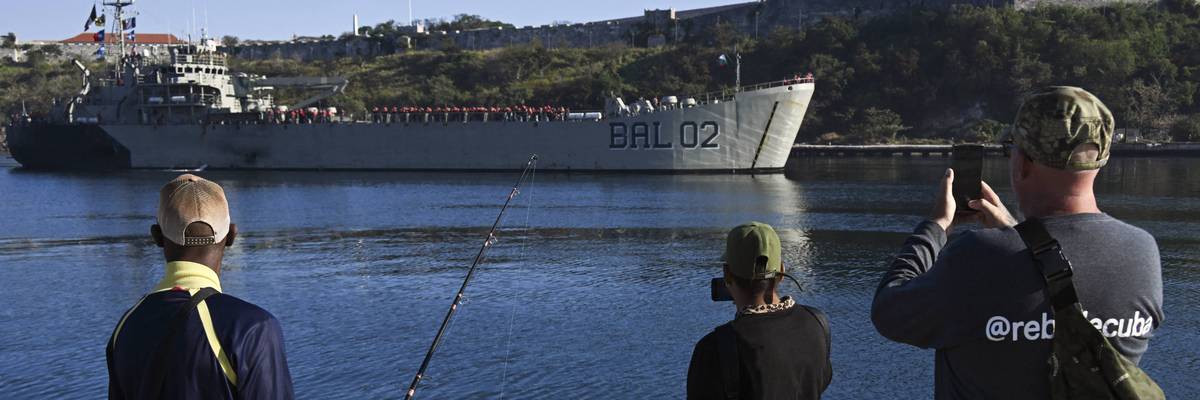
A Mexican Navy ship arrives at Havana Bay with humanitarian aid on February 12, 2026.
(Photo by Yamil Lage/AFP via Getty Images)
Jake Johnson
Feb 13, 2026
COMMON DREAMS
The United Nations’ human rights chief on Friday called on the Trump administration to lift its oil embargo against Cuba as the humanitarian crisis on the island deepens, with fuel shortages disrupting critical functions on the island and food and medicine shortages leaving families desperate for relief.
Marta Hurtado, a spokesperson for UN High Commissioner for Human Rights Volker Türk, said in a statement that “we are extremely worried about Cuba’s deepening socio-economic crisis—amid a decades-long financial and trade embargo, extreme weather events, and the recent US measures restricting oil shipments.”
Pushing for Regime Change, Trump Accused of ‘Asphyxiating’ Cuba With Fuel Embargo
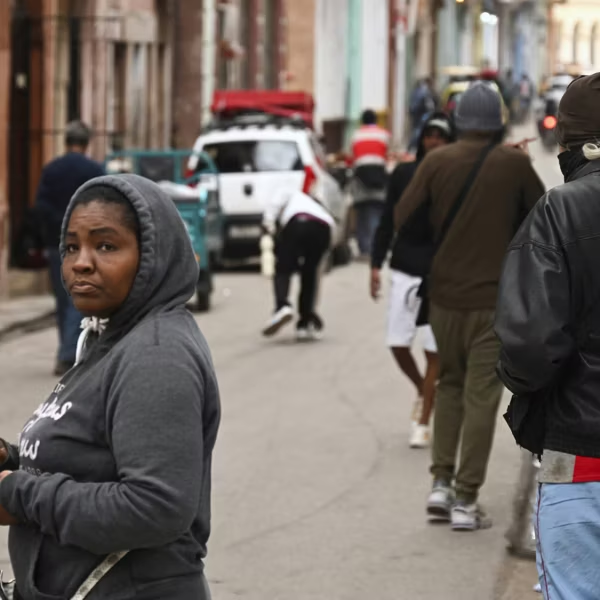
‘War by Another Means’: Union Movement Condemns Trump Economic Siege of Cuba
“This is having an increasingly severe impact on the human rights of people in Cuba,” Hurtado said. “Given the dependence of health, food, and water systems on imported fossil fuels, the current oil scarcity has put the availability of essential services at risk nationwide. Intensive care units and emergency rooms are compromised, as are the production, delivery, and storage of vaccines, blood products, and other temperature-sensitive medications.”
The spokesperson noted that more than 80% of Cuba’s water-pumping equipment depends on electricity, which has been undermined by widespread power cuts stemming from fuel shortages.
“The fuel shortage has disrupted the rationing system and the regulated basic food basket, and has affected social protection networks—school feeding, maternity homes, and nursing homes—with the most vulnerable groups being disproportionately impacted,” said Hurtado. “Access to essential goods and services, including food, water, medicine, and adequate fuel and electricity, should always be safeguarded, as they are fundamental in modern societies to the right to life and the ability to enjoy many other rights.”
In the face of the growing humanitarian catastrophe, Turk “reiterates his call on all states to lift unilateral sectoral measures, given their broad and indiscriminate impact on the population,” Hurtado said.
“Policy goals cannot justify actions that in themselves violate human rights,” she added.
The US has been economically suffocating Cuba for decades, but the Trump administration intensified the assault last month by cutting the island off from its primary source of oil—Venezuela—and threatening to slap tariffs on countries that send fuel to the beleaguered Caribbean nation, which has long been in the crosshairs of Secretary of State Marco Rubio and other right-wing supporters of regime change.
“Cuba is ready to fall,” US President Donald Trump declared in early January after his administration kidnapped Venezuelan President Nicolás Maduro.
In a statement on Thursday, a group of UN human rights experts said that Trump’s January 29 executive order imposing a fuel blockade on Cuba represents “a serious violation of international law and a grave threat to a democratic and equitable international order.”
“It is an extreme form of unilateral economic coercion with extraterritorial effects, through which the United States seeks to exert coercion on the sovereign state of Cuba and compel other sovereign third States to alter their lawful commercial relations, under threat of punitive trade measures,” the experts said. “A democratic international order cannot be reconciled with practices whereby one State claims the authority to dictate the internal policies and economic relations of others through threats and coercion.”
The demand came after a group of United Nations experts condemned the embargo as “a serious violation of international law and a grave threat to a democratic and equitable international order.”
A Mexican Navy ship arrives at Havana Bay with humanitarian aid on February 12, 2026.
(Photo by Yamil Lage/AFP via Getty Images)
Jake Johnson
Feb 13, 2026
COMMON DREAMS
The United Nations’ human rights chief on Friday called on the Trump administration to lift its oil embargo against Cuba as the humanitarian crisis on the island deepens, with fuel shortages disrupting critical functions on the island and food and medicine shortages leaving families desperate for relief.
Marta Hurtado, a spokesperson for UN High Commissioner for Human Rights Volker Türk, said in a statement that “we are extremely worried about Cuba’s deepening socio-economic crisis—amid a decades-long financial and trade embargo, extreme weather events, and the recent US measures restricting oil shipments.”
Pushing for Regime Change, Trump Accused of ‘Asphyxiating’ Cuba With Fuel Embargo
‘War by Another Means’: Union Movement Condemns Trump Economic Siege of Cuba
“This is having an increasingly severe impact on the human rights of people in Cuba,” Hurtado said. “Given the dependence of health, food, and water systems on imported fossil fuels, the current oil scarcity has put the availability of essential services at risk nationwide. Intensive care units and emergency rooms are compromised, as are the production, delivery, and storage of vaccines, blood products, and other temperature-sensitive medications.”
The spokesperson noted that more than 80% of Cuba’s water-pumping equipment depends on electricity, which has been undermined by widespread power cuts stemming from fuel shortages.
“The fuel shortage has disrupted the rationing system and the regulated basic food basket, and has affected social protection networks—school feeding, maternity homes, and nursing homes—with the most vulnerable groups being disproportionately impacted,” said Hurtado. “Access to essential goods and services, including food, water, medicine, and adequate fuel and electricity, should always be safeguarded, as they are fundamental in modern societies to the right to life and the ability to enjoy many other rights.”
In the face of the growing humanitarian catastrophe, Turk “reiterates his call on all states to lift unilateral sectoral measures, given their broad and indiscriminate impact on the population,” Hurtado said.
“Policy goals cannot justify actions that in themselves violate human rights,” she added.
The US has been economically suffocating Cuba for decades, but the Trump administration intensified the assault last month by cutting the island off from its primary source of oil—Venezuela—and threatening to slap tariffs on countries that send fuel to the beleaguered Caribbean nation, which has long been in the crosshairs of Secretary of State Marco Rubio and other right-wing supporters of regime change.
“Cuba is ready to fall,” US President Donald Trump declared in early January after his administration kidnapped Venezuelan President Nicolás Maduro.
In a statement on Thursday, a group of UN human rights experts said that Trump’s January 29 executive order imposing a fuel blockade on Cuba represents “a serious violation of international law and a grave threat to a democratic and equitable international order.”
“It is an extreme form of unilateral economic coercion with extraterritorial effects, through which the United States seeks to exert coercion on the sovereign state of Cuba and compel other sovereign third States to alter their lawful commercial relations, under threat of punitive trade measures,” the experts said. “A democratic international order cannot be reconciled with practices whereby one State claims the authority to dictate the internal policies and economic relations of others through threats and coercion.”


No comments:
Post a Comment