Thursday, February 26, 2026

 Israeli settlers kill 19-year-old Palestinian American, officials and witnesses say

MUKHMAS, West Bank (AP) — The Palestinian Ministry of Health confirmed Nasrallah Abu Siyam's death from critical wounds sustained Wednesday afternoon near the village east of Ramallah.

MUKHMAS, West Bank (AP) — Israeli settlers in the occupied West Bank shot and killed a Palestinian American man during an attack on a village, the Palestinian Health Ministry and a witness said Thursday.

Raed Abu Ali, a resident of Mukhmas, said a group of settlers came to the village Wednesday afternoon where they attacked a farmer, prompting clashes after residents intervened. Israeli forces later arrived, and during the violence armed settlers killed 19-year-old Nasrallah Abu Siyam and injured several others.

Abu Ali said that the army shot tear gas, sound grenades and live ammunition. Israel’s military acknowledged using what it called “riot dispersal methods” after receiving reports of Palestinians throwing rocks but denied that its forces fired during the clashes.


“When the settlers saw the army, they were encouraged and started shooting live bullets,” Abu Ali said. He added that they clubbed those injured with sticks after they had fallen to the ground.

The Palestinian Ministry of Health confirmed Abu Siyam’s death from critical wounds sustained Wednesday afternoon near the village east of Ramallah.

Abu Siyam’s killing is the latest in a surge in violence in the occupied West Bank. Israeli forces and settlers killed 240 Palestinians last year, according to the United Nations Office for the Coordination of Humanitarian Affairs. Palestinians killed 17 Israelis over the same period, six of whom were soldiers. The Palestinian Authority’s Wall and Settlement Resistance Commission said Abu Siyam was the first Palestinian killed by settlers in 2026.

Mukhmas and its surrounding area — most of which lies under Israeli civil and military administration — have become a hot spot for settler attacks, including arson and assaults, as well as the construction of outposts that Israeli law considers illegal.

The Israeli military said late Wednesday that unnamed suspects shot at Palestinians, who were later evacuated for medical treatment. It did not say whether any were arrested.

Abu Siyam’s mother told The Associated Press that he was an American citizen, making him the second Palestinian American person to be killed by Israeli settlers in less than a year.


A U.S. embassy spokesperson said they “condemn this violence.”

Palestinians and rights groups say authorities routinely fail to prosecute settlers or hold them accountable for violence.

UN says Israel’s acts in West Bank may be ethnic cleansing

The U.N. human rights office on Thursday accused Israel of war crimes and said practices that displace Palestinians and alter the demographic composition of the occupied West Bank “raise concerns over ethnic cleansing.”

The Office of the High Commissioner for Human Rights, citing findings collected November 2024 to October 2025, said Israel was engaged in “concerted and accelerating effort to consolidate annexation” while maintaining a system “to maintain oppression and domination of Palestinians.”

Residents of Palestinian villages and herding communities have been increasingly displaced as Israeli settlements and outposts expand. Since the start of the Israel–Hamas war, the Israeli rights group B’Tselem says about 45 Palestinian communities have been emptied out completely amid Israeli demolition orders and settler attacks.

Additionally, the office said Israeli military operations in the northern West Bank “employed means and methods designed for warfare” including lethal airstrikes and forcibly transferring civilians from their homes. It also said Israel “forbade” residents from returning to their homes in northern West Bank refugee camps. The operation, which Israel said was aimed against militants, displaced tens of thousands of Palestinians.

The report also accused Palestinian security forces of using unnecessary lethal force in the same areas, killing at least eight people, and noted that the Palestinian Authority had engaged in “intimidation, detention and ill-treatment of journalists, human rights defenders and other individuals deemed critical of its rule.”


Neither Israel’s Foreign Ministry nor the Palestinian Authority responded to requests for comment. Israel has repeatedly accused the U.N. rights office of anti-Israel bias.

Last year, the U.N. human rights monitor warned of what it called “an unfolding genocide in Gaza” with “conditions of life increasingly incompatible with (Palestinians’) continued existence.” Their report on Thursday also warned of demographic shifts in Gaza raising concerns of ethnic cleansing.

Report finds imprisoned Palestinian journalists were tortured

The Committee to Protect Journalists said that dozens of Palestinian journalists who were detained in Israel during the war in Gaza experienced conditions including physical assaults, forced stress positions, sensory deprivation, sexual violence and medical neglect.

CPJ documented the detention of at least 94 Palestinian journalists and one media worker during the war, from the West Bank, Gaza and Israel Thirty are still in custody, CPJ said.

Half of the journalists, the report found, were never charged with a crime and were held under Israel’s administrative detention system, which allows for suspects deemed security risks to be held for six months and can be renewed indefinitely.

Israel’s prison services did not immediately respond to a request for comment about the report, but rejected a similar report in January about conditions for Palestinian prisoners as “false allegations,” contending it operates lawfully, is subject to oversight and reviews complaints.


UN development chief says removing Gaza rubble will take 7 years

The vast destruction across Gaza will take at least seven years just to remove the rubble, according to the United Nations Development Program.

Alexander De Croo, the former Belgian prime minister who just returned from Gaza, said that the UNDP had removed just 0.5% of the rubble and people in Gaza are experiencing “the worst living conditions that I have ever seen.”

De Croo said 90% of Gaza’s 2.2 million people live in “very, very rudimentary tents” in the middle of the rubble, which poses health dangers and a danger from exploding weapons.

He said UNDP has been able to build 500 improved housing units, and has 4,000 more that are ready, but estimates the true need is 200,000 to 300,000 units. The units are meant to be used temporarily while reconstruction takes place. He called on Israel to expand access for goods and items needed for reconstruction and the private sector to begin development.

___ Lidman reported from Tel Aviv, Israel. Associated Press writers Edith Lederer at the United Nations, Sam Metz in Jerusalem and Natalie Melzer in Nahariya, Israel contributed to this report.


___

Find more of AP’s coverage at https://apnews.com/hub/israel-hamas-war

 Minnesota faith groups sue DHS over access to immigrant detainees

(RNS) — It's at least the second lawsuit challenging the federal government's policy of barring faith leaders from accessing some DHS facilities.
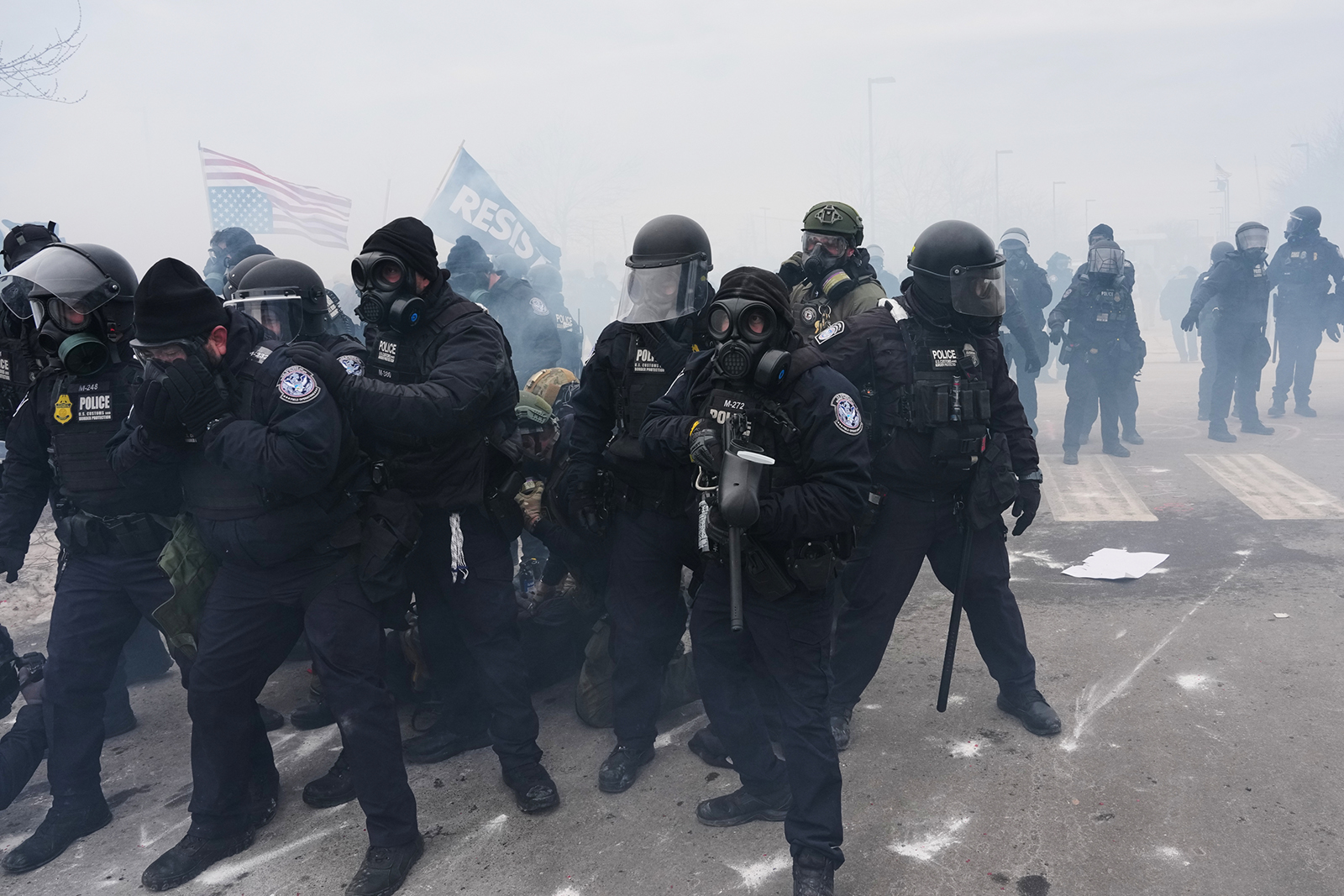
Federal immigration officers confront protesters outside the Bishop Henry Whipple Federal Building, Jan. 15, 2026, in Minneapolis. (AP Photo/Adam Gray)

(RNS) — A group of religious organizations and faith leaders in Minnesota has filed a lawsuit against the Department of Homeland Security, alleging the agency is violating their religious freedom by denying them access to immigrant detainees at a local federal building.

The lawsuit was filed Monday, Feb. 23, by the Minneapolis Area Synod of the Evangelical Lutheran Church in America, the Minnesota Conference of the United Church of Christ and the Rev. Christopher Collins, a Jesuit priest. It alleges the government’s refusal to allow faith leaders access to the Bishop Henry Whipple Federal Building, which houses the local offices of the U.S. Immigration and Customs Enforcement, is a violation of their rights under the First Amendment and the Religious Freedom Restoration Act.

“Pastoral care is the heart and soul of what our Pastors and Deacons are called to provide in their congregations and around the community. We walk together, listening, praying, guiding, and offering the peace and presence of Jesus Christ,” Bishop Jen Nagel, of the ELCA’s Minneapolis Area Synod, said in a statement. “This is particularly important during times of stress, grief, isolation, and transition.”


Clergy have been denied access to Whipple as recently as Monday morning, according to Irina Vaynerman, CEO of Groundwork Legal, one of the law firms representing the plaintiffs along with the firm Saul Ewing.

“Faith leaders and clergy across the state have been attempting to access the Whipple building since the beginning of Operation Metro Surge,” Vaynerman said in an interview, referring to the immigration enforcement campaign that began in Minneapolis in December. Clergy, she added, were even denied access on Ash Wednesday, a Christian holy day.

“There was permanent damage done when they were not able to provide that care on Ash Wednesday, but the need and desire to provide the care — and receive the care — extends beyond even one of the holiest days of those in the Christian faith,” she said.

The lawsuit alleges that preventing clergy from entering the facility to offer pastoral care to migrants infringes on their religious freedom.

“By categorically barring faith leaders from praying with detainees, offering sacraments, or providing spiritual guidance, the government imposes a profound and unjustified burden,” the complaint reads. “The ability to provide pastoral care ensures that even in the most dire legal processes that could result in deportation or prolonged detention, individuals are treated with dignity and humanity, not as mere inventory.”

DHS did not immediately respond to a request for comment on the lawsuit, but the complaint alleges agency officials told Bishop Nagel that Whipple is a processing facility, not a detention facility, and that “no one is allowed access to provide pastoral care, purportedly for safety reasons.”


The Revs. T. Michael Rock, from left, Susie Hayward and Rebecca Voelkel pray in the lobby of the Bishop Henry Whipple Building while attempting to minister to detainees, Tuesday, Jan. 13, 2026, in Minneapolis. (RNS photo/Jack Jenkins)


The agency made a similar argument last year to justify barring faith leaders from entering an ICE facility in Illinois. Vaynerman alleged that the Whipple building is not simply a processing center, but a place where detainees have been held for hours and sometimes days.

A Religion News Service reporter was present last month when the Rev. Susie Hayward, a UCC minister, and two other UCC pastors entered the Whipple building and attempted to minister to detainees. While the trio was allowed into the building, they were denied access to the detainees, with the group eventually praying in the building’s foyer before leaving. 

The trio was told by an official at the building that they should call a number to arrange a visit to the detainees. But Vaynerman said faith leaders have tried that and hit a brick wall.

“When (clergy) finally were able to reach someone on that number, they were again categorically barred from providing pastoral care,” she said. “Ultimately, upon speaking with someone, they were told, ‘No, you cannot come in.’”

Hayward, who has been active in faith-based pushback to Trump’s mass deportation efforts in Minneapolis, celebrated the new lawsuit.


“Pastoral care is not optional for us,” she said in a statement. “It is a sacred duty. Blocking clergy from ministering to people in detention violates their rights and ours. It reveals the contradiction between the government’s rhetoric and its actions.”

Hayward added: “Religious freedom cannot be selectively applied. It must protect both those detained and those called to care for them.”

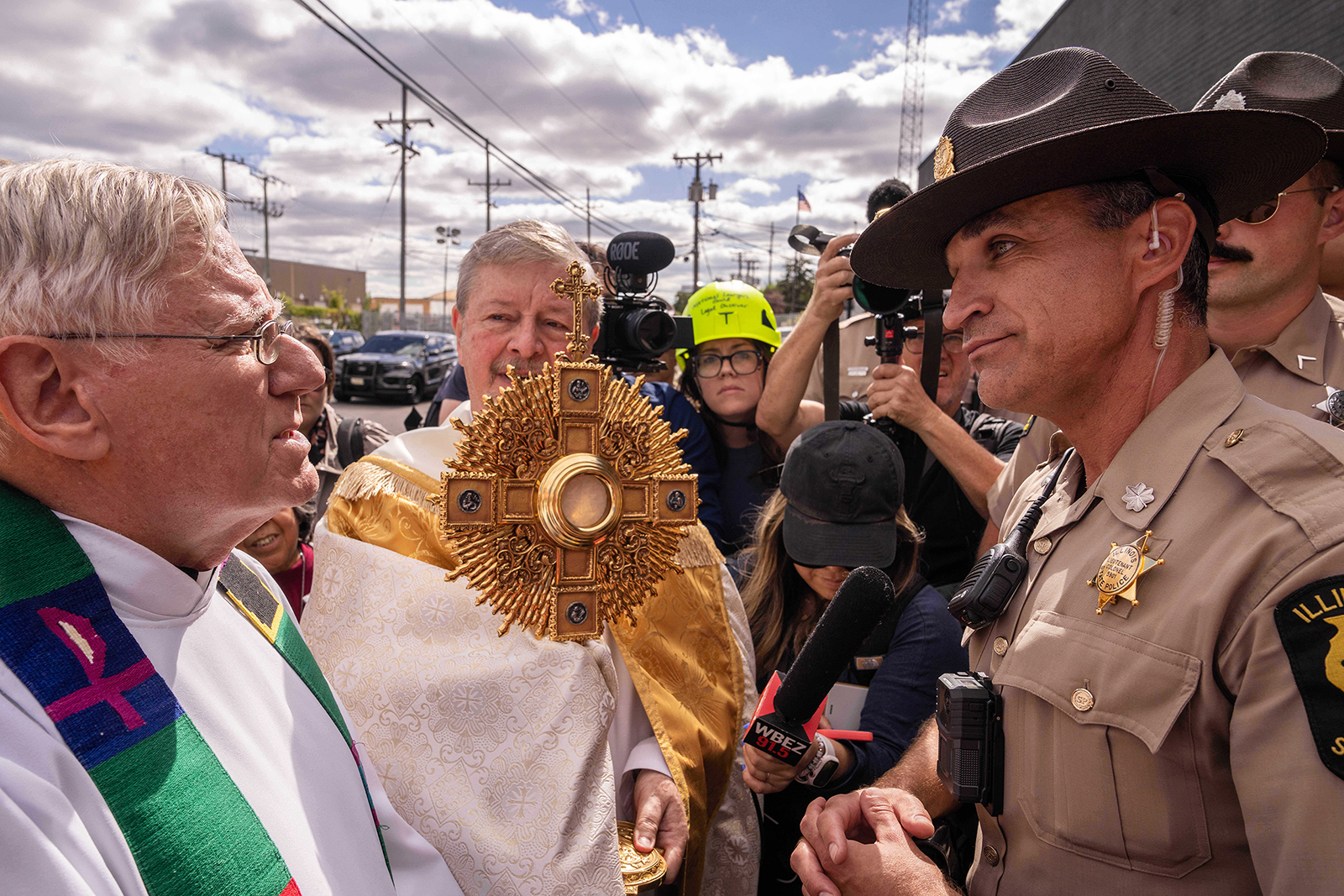
FILE – A member of the Illinois State Police, right, relays the message to clergy that U.S. Immigration and Customs Enforcement denied them access to detainees to provide them Communion, outside an ICE facility in Broadview, Ill., Oct. 11, 2025. (AP Photo/Adam Gray)

The faith leaders’ lawsuit is similar to a separate ongoing legal battle in Illinois, where a group of Catholic priests, nuns and organization leaders filed suit last year insisting they be granted access to detainees at an ICE facility in Broadview, just outside of Chicago. The government’s refusal to allow the faith leaders to enter the facility — which plaintiffs allege is a shift from years past — sparked a series of protests at the site that resulted in the arrest of at least eight faith leaders from a range of religious traditions.

Faith-based pushback to Trump’s mass deportation efforts in general has been far-reaching, with religious leaders in Minnesota, in particular, staging major protests and training hundreds of clergy from across the country on how to resist ICE. The issue of access for faith leaders to detainees reached all the way to the Vatican: Pope Leo spoke out on the topic in November, saying, “I would certainly invite the authorities to allow pastoral workers to attend to the needs of those people.” What’s more, Catholic bishops — including at least two associated with Trump’s own Religious Liberty Commission — have voiced concern about the denial of access.


Last week, a federal judge issued an order requiring the federal government to coordinate with the Coalition for Spiritual and Public Leadership — a Chicago-area Catholic advocacy organization and one of the plaintiffs in the case — to allow clergy to access the site on Ash Wednesday. The government ultimately granted two Catholic priests and a nun access to the facility, but for reasons that remain unclear, they initially found the building empty. After an hour wait, a small group of detainees were brought to the facility, where they met with the faith leaders.


In an interview, the Rev. Leandro Fossá, who was part of the delegation allowed into the facility, described an emotional meeting with the detainees — young men and women “just past their teens.”

“We saw their tears, confusion. For them, their dreams were just about to end, they had to start all over, so you could see the anxiety on their faces — the battle is lost,” he said. 

But Fossá, who has long worked in prison ministry, said that as he and others offered the group Communion and rubbed ashes on their foreheads, the value of their ministry was made clear. “Our presence, our words, our journeying with them — it was a moment where they could feel that they are not alone,” he said. “The community is with them. God walks with them.”

Fossá said he and others discussed with officials in the building the possibility of a weekly or even daily delegation at the facility, but a formal agreement has yet to materialize, and the lawsuit is ongoing.

“We have to follow our gospel: ‘I was in prison and you visited me. I was naked and you clothed me,’” he said. “We cannot choose to love someone only when that person has papers. We love — love doesn’t choose.”