UK
People freeze, companies profit – but more renewables will weaken their grip
FEBRUARY 20, 2026
New official figures from the UK Health Security Agency reveal that more than 2,500 people died in England last winter in connection with cold weather. The National Pensioners Convention joined anti-fuel poverty campaigners in pointing out that the government’s decision to end Winter Fuel Payments for many pensioners was a factor in the new figures.
Simon Francis, coordinator of the End Fuel Poverty Coalition, said the figure laid bare ”the awful reality that far too many pensioners are still trapped in cold, damp homes that put their health and lives at risk.
“Volatile gas prices, poor quality housing and a lack of adequate support have all contributed to this crisis. And in 2024/25 the situation was made worse by decisions to remove Winter Fuel Payments from many pensioners. We warned this would leave vulnerable older people exposed, and these figures show the deadly consequences of failing to protect those most at risk.
“These deaths also underline the need to go further with cold weather support. Cold Weather Payments too often arrive only after prolonged freezing conditions, when the damage is already being done. Support should be automatic and triggered in advance of forecast cold snaps, not weeks later.
“Ultimately, the only lasting way to stop people dying in cold homes is to tackle the root causes. That means targeted financial support for those most at risk, rapid upgrades to the coldest and leakiest homes through the Warm Homes Plan and wider reform of energy pricing so households are not left paying the price of volatile gas markets. No one should be facing another winter where staying warm is a matter of life and death.”
Centrica profits – and why they matter
The shocking statistic came as Centrica, the largest supplier of gas to domestic customers in the United Kingdom, and one of the largest suppliers of electricity, announced its profits. The company reported a sharp fall in profits – but that did not it awarding its chief executive a £3.6m bonus, bringing his annual pay to £4.7m.
Centrica, operating under the trading names British Gas in England and Wales and Scottish Gas in Scotland, is no longer simply a retail supplier, but a major player across gas imports, storage and wholesale markets, with significant influence over the energy system and therefore household energy bills.
Analysis shows the UK will soon be unable to meet heating demand from domestically extracted gas by 2027, making imported gas and the companies that control its supply even more critical to national energy security. Through a strategic import arrangement with Equinor, Centrica effectively controls around 10% of the UK’s gas supply, a share that gives it influence over the market just as the country becomes increasingly reliant on gas imports.
Centrica also has part-ownership of a key gas import terminal, further underpinning its position at the heart of UK gas flows, pricing and security. It is a major player in the market trading and optimisation of energy supply. This means it can profit from the volatility in the energy system. In July 2023, it was reported that market price movement meant that its energy marketing and trading division alone made £1.4 billion in profit during the year.
Centrica remains the owner of the Rough gas storage facility, a key piece of infrastructure that helps balance supply in winter and mitigate price volatility, yet storage has sat below optimal levels in recent seasons, exposing households to supply risks and higher costs, as the firm argues it needs state support.
British Gas, owned by Centrica, was at the centre of the forced prepayment meter scandal, where vulnerable households were switched onto pay-as-you-go energy or faced the threat of disconnection. A formal investigation into the firm is still ongoing, almost three years after it was opened.
Simon Francis again: “Centrica is becoming a profit-hungry gas giant with real leverage over the nation’s energy supply and security. Through gas import deals, control of storage, stakes in key facilities and role in energy trading and price setting, Centrica sits at the centre of a market most of us only feel when the bills arrive.
“This influence matters because the country is becoming more reliant on imported gas as North Sea output declines. In that context, huge annual profits are not an accident, they reflect a system where utility companies extract value from high bills while households struggle, especially as millions live in cold, damp homes. Ministers must ask whether the energy system really works for people, not for the big energy giants that have generated over £125bn in UK profits since 2020.”
Uplift Deputy Director Robert Palmer said: “The latest profits add to the over £9 billion that Centrica has made since the start of the energy crisis in 2020, all while millions of people have struggled to afford their gas bills.
“The British Gas owner wants us to stay hooked on expensive gas, even though the UK has burned most of the gas that was in the North Sea. Regardless of any new drilling in the UK, we will be dependent on gas imports for nearly two thirds of our gas needs in just five years time and almost 100 per cent by 2050.
“British Gas’s new slogan is ‘fair’s fair’, but there is nothing fair about a company extracting excessive profits from households, while also driving the climate impacts we’re all now witnessing, whether that’s worsening flooding or rising food prices.”
Changes to the price cap
The End Fuel Poverty Coalition are also warning consumers to check their bills carefully, as significant changes are being made to the next Ofgem price cap.
Simon Francis said: “Budget decisions to remove costs from bills and Government moves to alter how the Warm Home Discount is paid for, will mean changes across standing charges and unit costs. Even those on fixed tariffs will need to look carefully to check that energy firms pass on the changes and potential savings to these customers.
“Meanwhile, volatile gas prices earlier this year also make the wholesale element subject to uncertainty and may create an upward pressure on bills for those on the standard variable tariff.”
Uplift Deputy Director Robert Palmer said: “The only real, long-term route to lowering bills is to get off volatile gas, whether that’s supplied by Putin, Trump’s America or profit-hungry oil and gas companies.
“It’s not just our bills that will benefit from more renewables, it’s our planet. Already we’re seeing the impacts of climate change caused by our oil and gas dependency and the costs it imposes on everyone, whether that’s flooded homes and businesses or rising food prices.”
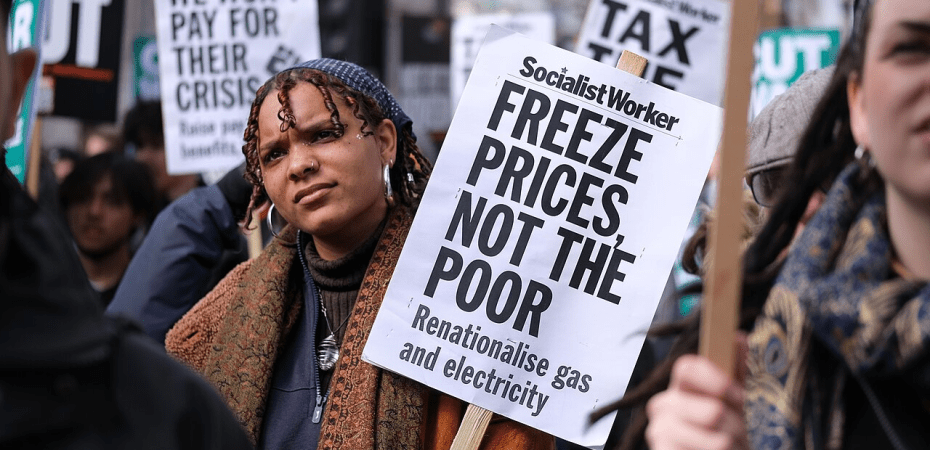
Image: https://commons.wikimedia.org/wiki/File:Freeze_Prices_-_Not_the_Poor._(51981171207).jpg Source: Freeze Prices – Not the Poor. Author: Alisdare Hickson from Woolwich, United Kingdom, licensed under the Creative Commons Attribution-Share Alike 2.0 Generic license.

.jpg)
No comments:
Post a Comment