In Contrast to Trump’s Claim, Iran Has Openly Vowed to Never Have Nuclear Weapons
Hours before the SOTU, Iran’s foreign minister said: “Iran will under no circumstances ever develop a nuclear weapon.”
By Sharon Zhang ,
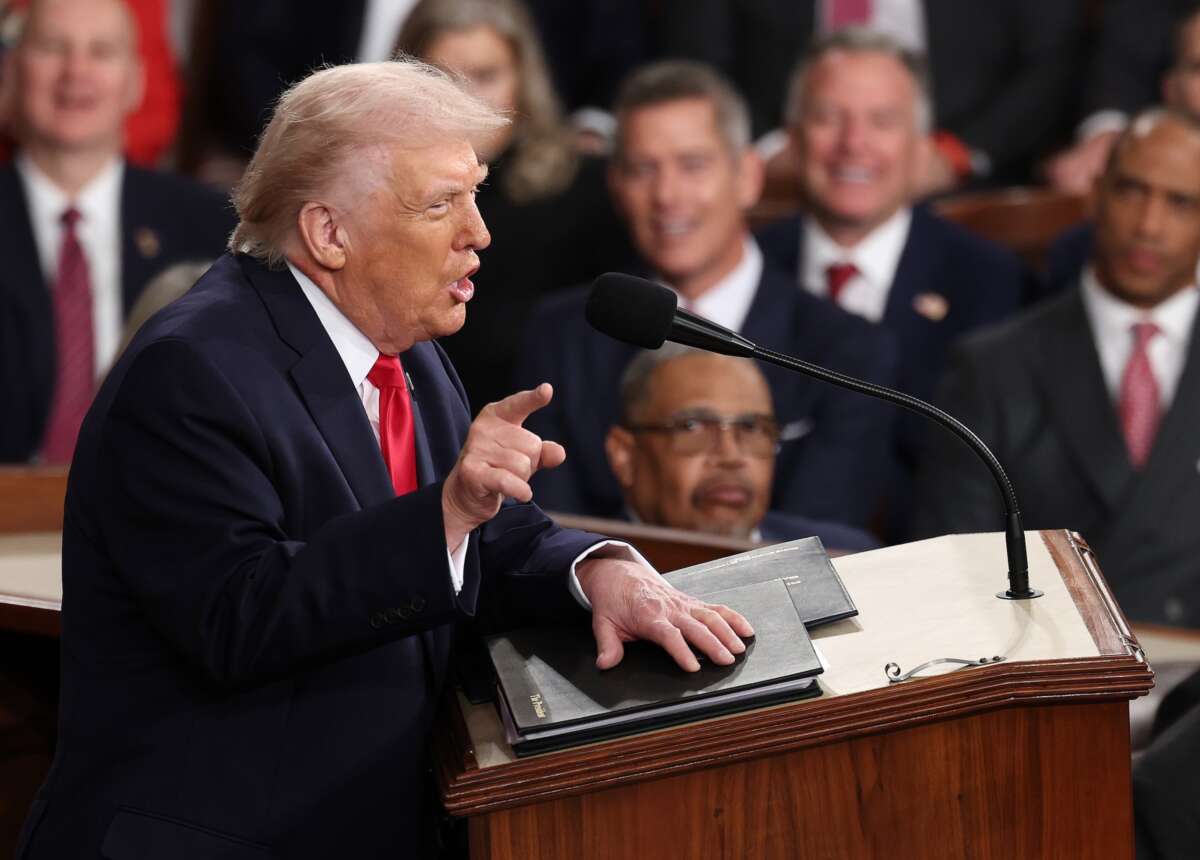
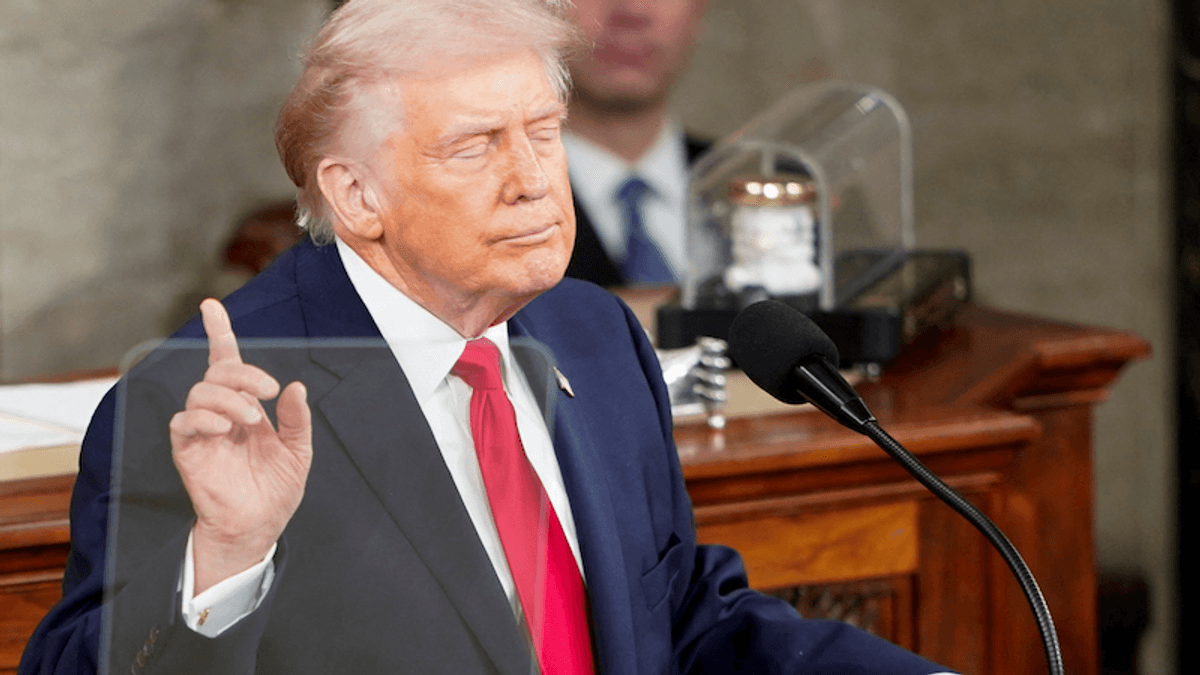
President Donald Trump continued to push for war with Iran during his State of the Union address on Tuesday night, falsely asserting that Iranian officials have not disavowed nuclear weapons development.
Trump repeated the claim that his administration “obliterated” Iran’s nuclear program, adding that Iranian officials are “terrible people” who are “starting it all over.”
“We wiped it out and they want to start it all over again and are at this moment again pursuing their sinister ambitions. We are in negotiations with them. They want to make a deal, but we haven’t heard those secret words, ‘We will never have a nuclear weapon,’” Trump said. “I will never allow [it].”
Iranian officials have repeatedly insisted that their government is only interested in peaceful uses for nuclear enrichment, a stance that they have maintained throughout negotiations.
Indeed, Iran’s foreign minister, Seyed Abbas Araghchi reiterated the government’s position just hours before Trump’s speech in a post on social media.
The White House cites Iran’s nuclear capabilities — while maintaining their nuclear facilities were “obliterated.” By Sharon Zhang , Truthout February 20, 2026
“Our fundamental convictions are crystal clear: Iran will under no circumstances ever develop a nuclear weapon; neither will we Iranians ever forgo our right to harness the dividends of peaceful nuclear technology for our people,” Araghchi wrote. “A deal is within reach, but only if diplomacy is given priority.”
The two countries are slated to have indirect talks in Geneva on Thursday. Trump’s State of the Union comments, however, incensed Iranian officials, who called them “big lies.”
“‘Repeat a lie often enough and it becomes the truth’, is a law of propaganda coined by Nazi Joseph Goebbels. This is now systematically used by the U.S. administration and the war profiteers encircling it, particularly the genocidal Israeli regime, to serve their sinister disinformation & misinformation campaign against the Nation of Iran,” said Iranian foreign ministry spokesperson Esmail Baghaei in a statement on X. “No one should be fooled by these prominent untruths.”
Still, Trump is inching closer to war, and lawmakers appear unwilling to stop him.
Following a classified briefing between party leaders and Secretary of State Marco Rubio on Tuesday, top Democrats signalled that the administration is ready for war.
“I’m very concerned,” said Rep. Jim Himes (D-Connecticutt), the top Democrat on the House Intelligence Committee. “Wars in the Middle East don’t go well for presidents, for the country, and we have not heard articulated a single good reason for why now is the moment to launch yet another war in the Middle East.”
“This is serious, and the administration has to make its case to the American people,” said Senate Minority Leader Chuck Schumer (D-New York).
Polls have found that the prospect of a war with Iran is extremely unpopular with the U.S. public. But many Democrats in Congress seem to be in support of a war, and reports say some Democratic leaders are actively pushing against efforts to stop or stymie military action.
Trump’s warmongering remarks earned him a rare bipartisan standing ovation on Tuesday night. It’s unclear how many Democrats stood and clapped, but among them appeared to be even left-leaning figures like Sen. Elizabeth Warren (D-Massachusetts) as well as the usual suspects like Sen. John Fetterman (D-Pennsylvania).
Analysts say war with Iran would be utterly disastrous like previous U.S. wars in the Middle East. Even Trump’s top military officials, including Gen. Dan Caine, chairman of the Joint Chiefs of Staff, warned of the risks, reports said this week. Notably, military officials present at the State of the Union, including Caine, appeared to not have stood for Trump’s nuclear weapon remark, unlike other many lawmakers in the room.
Such warnings have not deterred Democrats. Capital & Empire reported Tuesday that Democrats on the House Foreign Affairs Committee are working to prevent a vote on Representatives Ro Khanna (D-California) and Thomas Massie’s (R-Kentucky) war powers resolution. seeking to get members of Congress on the record on war with Iran.
Meanwhile, Schumer and House Minority Leader Hakeem Jeffries (D-New York) are only demanding a better justification for war from Trump.
“Part of the concern that I’ve articulated, and will continue to do so, is that the president made the representation that Iran’s nuclear program was completely and totally obliterated last year as a result of actions that the administration has taken,” Jeffries said after the briefing with Rubio. “And so if that, in fact, was true, what is the urgency as of this moment? That’s an open question, and the American people need a real explanation.”
Schumer, a staunch supporter of Israel – which has long sought a U.S.-led war on Iran – has demurred at calls that he take action to prevent a war. When the Trump administration was discussing whether to strike Iran last June, Schumer taunted Trump, calling him “TACO” Trump, referring to an acronym meaning “Trump Always Chickens Out.”
True Support for Iranians Means Saying No to War
I spent nearly two years in the prison for my political activism in Iran. I fled to Turkey and arrived in Chicago as a refugee. I started rebuilding my life from scratch. I was young and I risked everything for freedom. I also know what war does to countries like mine since I was born middle of Iran-Iraq war; the war destroyed the Iranian civil society that makes democracy possible.
Tensions between the United States and Iran escalate once again, and I’m witnessing a group of the Iranian diaspora, mainly monarchists, who live comfortably in western democracies, are lobbying for regime change policy and calling for US and Israel intervention in Iran. While they claim representation for all Iranians, but they don’t represent me, all Iranian diaspora, and millions of Iranians who are still living under the Islamic regime and fighting for changes and reform.
Frankly, as an Iranian dissident who has paid the price for my political activities to bring a permanent democracy in Iran, I believe an anti-war position, is the best support to Iranians and building a democracy since no wars has ever brought a democracy in any countries. A war with Iran will demolish the fragile networks of activists, and the naive civil society who can fight for changes.
It is important to understand why some diaspora voices push for regime change from inside democracies. I explain it with the concept of “Exit Capital.” When a regime declines, people face two choices either to protest and call for reform (Voice) or exit leave the county or their political filed (Exit).
The tragedy of Iranian society is that the warmonger diaspora coming from that class which possesses exclusive “exit capital”. Their socioeconomic status, sometimes their dual citizenship and international connections give them the ability to leave whenever fighting for changes, gets difficult.
They don’t risk their life for incremental changes. They simply exit whenever tensions heat up with the regime. This ability to shield them completely from the consequences of the hostile policies they call for. While they lobby for “maximum pressure” and military strikes, they know their families are safe in democracies if the conflict gets darker. They will not stand in lines for food in Tehran or look for bomb shelters.
Their life is amphibious and “transnational” or dual life. In their online and real life in democracies, they apply the most radical rhetoric, calling for striking Iran. However, in they still conscientiously maintain their Iranian passports, travel back and forth to take advantage of their open-door commute to their home country. They even get Iranian passport for their abroad born babies. They are revolutionaries online and in favor of the status quo with the regime.
It is obvious that Iran’s regime use “globalized” citizens to its advantage. The regime drains Iran of people who have the resources and social capital to organize effective movements by allowing them to exit. The streets of Iran are cleared of influential critics.
In an unwritten collaboration with the regime, this diaspora provides a powerful propaganda tool. The regime media always show footage of diaspora meeting with hawkish western politicians, and it helps to label all internal dissent as they are “foreign agents” who want regime change by bombing Iran.
The diaspora, also, try to outsource Iran’s domestic struggle for democracy to the U.S. military. They draw a distorted picture, yelling Iranians are “begging” for international intervention. I can tell you from my experience that they are not. Iranians want to build their own democracy, and free from both domestic dictatorship and foreign “freedom operations”.
That being said, a true support for Iranians is call for diplomacy and strengthening their civil society, not war. Studies consistently shows that economic sanctions actually empowers the regime leaders while depleting the middle class which is the main engine of leading for democratic transitions. War with Iran would be far worse.
I am an Iranian dissident. I am not seeking rapid change through violence or foreign invasion. I am seeking patience, difficult work of building democracy, wisdom, and bringing politics from streets to table. It might take years, even generations, but lasts. Many of us who have lived through the dictatorship and carry the scars of resistance, understand that real change is slow and costly.
Saying no to war is not appeasement. It is the only way to return agency and power to the real protesters inside Iran; the students, workers, women, and activists who are building Iran’s future with their bravery.
Ali Tarokh is a refugee rights advocate and former political prisoner from Iran.
Matthew Chapman
February 24, 2026
President Donald Trump has long been posturing toward military action in Iran — but one of his top generals pumped the brakes on the whole thing, enraging him, Slate reported on Tuesday.
"The military warning — first reported in the Washington Post, then confirmed in the New York Times — must be particularly rankling," wrote Fred Kaplan. "According to the reports, in a recent White House meeting with many top officials present, Gen. Dan Caine — whom Trump selected, and has since highly lauded, as chair of the Joint Chiefs of Staff — said that a shortage of munitions and the absence of any allies would make a prolonged war with Iran very difficult."
"It is unusual for Trump’s advisers to dampen his fantasies of easy wins, and it is less common still for high-level discussions of military plans to be leaked," the report continued. "The fact that Caine confronted Trump on this plan, and that someone spilled this to the public, suggests a growing concern among some inside players that the president’s increasingly casual adventurism could engulf the armed forces, the region, and the nation in danger."
Trump, for his part, has said that Caine “has not spoken of not doing Iran” in response to the article — but, Kaplan notes, the original reports never actually said Caine told Trump not to attack Iran, but simply explained why it would be extremely difficult.
Caine, for his part, did oversee the Trump administration's strike on Iran's nuclear facilities last year, which, while controversial, did not come at a great cost to the United States.
However, said the report, "Operation Midnight Hammer, as the attack was known, was a speedy one-off venture where three B-2 bombers dropped bunker-busting bombs, watched them hit their targets, and sped back home, the end ... A larger attack on Iran — whether to wipe out more of its nuclear infrastructure, destroy its ballistic-missile fleet, or overthrow the regime — would be a much more elaborate, time-consuming business."
A War With Iran Would Not Be a One-Off Event But a Disastrous Ongoing Rupture
If Congress cedes its power to stop a war with Iran, it will fully erode any lingering promise of democratic restraint.
By Hanieh Jodat ,

As the U.S. slowly continues its brokered negotiations with Iran over its nuclear program and ballistic missiles, it is also expanding its military posture across the Middle East — amounting to the biggest military buildup in the region since the 2003 invasion of Iraq.
Indirect talks between Iran and the U.S. took place in Geneva on February 17 with little progress and plenty of details left to discuss. According to U.S. officials, the Islamic Republic offered to come back within two weeks with a proposal which addresses some core issues and gaps in the positions by both parties. Meanwhile, Donald Trump’s actions play a different tune. On February 19, Trump announced he would give Iran 10 to 15 days to reach a deal, otherwise the U.S. claims to be fully prepared to take military action, the consequences of which could lead to a regional catastrophe. The next talks are set to take place on February 26.
Ahead of those talks, Donald Trump has deployed the USS Gerald R. Ford, the world’s largest aircraft carrier, which is set to join the Abraham Lincoln carrier strike group in the Arabian Sea. The United States has also significantly increased air power in the Middle East; according to open-source intelligence analysts and flight-tracking data, over 120 U.S. aircraft have deployed to the region. With each warship it repositions, each military personnel it places on alert, and all of the air power it has amassed in the region, the U.S. sends a message that diplomacy may no longer be on the table.
Both U.S. officials and international partners have voiced concern over the likelihood of a war with Iran. The United Kingdom has reportedly said that the United States would not be allowed to use British airbases, including Diego Garcia and Royal Air Force Fairford, for strikes against Iran, citing concerns that such action would violate international law.
Meanwhile, in Congress, Kentucky Republican Thomas Massie and California Democrat Ro Khanna have joined forces again to push a war powers resolution. The 1973 War Powers Act grants Congress the authority to check President Trump’s ability and power to enter an armed conflict without legislative approval.
Op-Ed |
As Trump Threatens Iran, We’re On the Brink of a Generational Catastrophe
A US war with Iran would be illegal, immoral, and dangerous. We can still stop it.
By Negin Owliaei , Truthout February 20, 2026
However, with both the House and the Senate under Republican control, the chances of the Iran War Powers Resolution passing remain slim. Senate Republicans Tom Cotton and Lindsey Graham and Secretary of State Marco Rubio have all been proponents of striking Iran. While Rubio and Cotton have expressed desire to strike Iran’s nuclear sites in the past, Lindsey Graham has emerged as the strongest MAGA cheerleader for a war with Iran — so much so that he has been urging Trump to ignore the call from his advisors not to strike.
On the other side of the aisle, Democratic lawmakers, Reps. Josh Gottheimer of New Jersey and Rep. Jared Evan Moskowitz of Florida have both expressed their concerns with the Iran War Powers Resolution, saying that it would limit United States military flexibility against Iran. While the U.S. public is overwhelmingly opposed to a war with Iran, a recent poll conducted in January revealed that 50 percent of Trump voters back military “intervention” in Iran over any other foreign target, including Greenland, Cuba, Colombia, China, and Mexico. That number rose to 61 percent among self-described “MAGA Republicans.”
A military strike on Iran would not be a one-off event, but a catastrophic rupture in the region. Iran is not some isolated target on a map. It is a nation of 90 million-plus people with populated cities, hospitals, universities, and families who have suffered repression for over 47 years under the current regime and sanctions that have destroyed Iran’s economy. Infrastructure damages alone from a war would cascade into loss of electricity, water shortages, and severe impacts to medical care.
During the 12-day war, Israeli forces launched explosive weapons that damaged a children’s facility as well as a number of hospitals, health centers, and emergency health buildings, including Farabi hospital in Kermanshah city. Furthermore, the conflict damaged critical aging water pipes in Tehran and other provinces.
It is difficult to imagine what a regional war would do to a population already exhausted by decades of loss, but one thing that is clear is that a war with Iran will permanently scar those who survive it.
Iranians living inside the country have become accustomed to harsh repression over nearly half a century. Every bit of hope for reform and every popular uprising has been crushed and silenced by violent crackdowns from the Iranian state. At the same time, opportunistic neocons, influenced by the United States’s biggest ally in the region, Israel, have sought to co-opt the uprisings. They encourage unrest and issue calls of support for Iranian protestors, while at the same time backing hawkish U.S. policies and pushing lawmakers to take a tougher stance toward Iran. This will only create more repression for Iranians seeking freedoms and human rights and drive the country further into chaos.
At the same time, unilateral sanctions imposed during the first Trump administration have hollowed out the economy, driving the rial to record lows against the dollar in Tehran and turning everyday necessities like food, fuel, and medicine into luxuries families can no longer afford. Iranians overseas with families living in Iran can no longer financially help their loved ones due to sanctions and financial restrictions. It is difficult to imagine what a regional war would do to a population already exhausted by decades of loss, but one thing that is clear is that a war with Iran will permanently scar those who survive it.
A war with Iran will not stop at its borders and will not remain where it is aimed. Such impulsive and reckless military actions never do. The Middle East is an ecosystem of lives, alliances, and fragile balances that will draw in neighboring countries and global powers.
And while the momentum towards a war with Iran accelerates, we must be reminded of the invasion and occupation of Afghanistan in 2001, which accomplished little outside the brutalization of one of the most economically starved countries on earth. Similarly, we must remember the collapse of Iraq’s infrastructure and civil society alongside the imposition of a farcical democracy after the 2003 invasion — a collapse that was fueled in part by years of devastating sanctions that predated the invasion. And, of course, we cannot forget the recent commando abduction and leadership change in Venezuela, which was openly explained by Trump himself as a blatant oil grab. Often, outside powers and hegemonic nations decide what is in the best interest of another nation’s people. They intervene using military force and, when they fail, leave a vacuum of leadership instability and suffering among the general public.
The urgent push toward a military confrontation with Iran may also be shaped in part by domestic unrest in the United States. With an all-time low approval rating, the Trump administration has been pushing attention away from the growing body of evidence emerging from the release of the Jeffrey Epstein files. After publicly encouraging Iranians to take to the streets, promising his administration’s full backing and support, Trump may have also backed himself into a corner, one he has been ushered toward thanks to Israeli Prime Minister Benjamin Netanyahu, who has been pushing for a war with Iran for decades.
Some argue that now, while the Iranian state might seem particularly vulnerable, is the time to strike. This approach overlooks the reality that Iran is deeply embedded in a global power alliance that includes Russia and China, meaning any attempt at forced regime change would not occur in isolation.
In response to the United States military buildup in the region, Iran and Russia have carried out joint military drills, conducting rescue operations and deploying missile-launching warships, special operations teams, helicopters, and at least one Iranian destroyer. Tehran, Beijing, and Moscow have carried out joint exercises for several years, but the latest military exercise was in direct response to U.S. military pressure. In addition to joint drills, Iran has briefly closed the Strait of Hormuz, which is the waterway separating Oman and Iran and is crucial for transporting global oil supplies in the region.
Rather than a one-off strike or a clean operation, a war with Iran would almost certainly widen conflict in the region and produce consequences far beyond what could be intended or repaired.
This is why the War Powers Resolution exists, not as a symbolic gesture but as a bulwark to slow the rush towards catastrophe. The framers of the Constitution understood what modern politicians seem to ignore: that war is too consequential to be left in the hands of one person, one branch of the government, or an executive order. The power to start a war with another country was placed in the hands of Congress to ensure transparency, force dialogue, and demand accountability.
If Congress fails to take action now, before Trump strikes the first town, before the first city loses power and water, before a mother loses a child, then the promise of democratic restraint becomes hollow and meaningless.
Even though some Iranians may hope for war as the means to collapse a regime that has trapped them for decades, Iran is not a single voice. Iran is a country of over 90 million people who want their basic needs to be met, and even in their desperation no foreign intervention or strike could deliver the revolution they hoped for. History has shown time and time again that wars imposed from without will destroy hospitals, schools, and other vital infrastructure before the bombs ever reach those in power.
This article is licensed under Creative Commons (CC BY-NC-ND 4.0), and you are free to share and republish under the terms of the license.

Hanieh Jodat
Hanieh Jodat is a political strategist and a key strategist with Defuse Nuclear War, an initiative of RootsAction. She also serves as the Chair of Progressive Democrats of America – Middle East Alliances, focusing on fostering dialogue and progressive policies on critical global issues.
“The stakes are clear,” said the National Iranian American Council. “There’s a chance to avert war and disastrous outcomes for the people of Iran, but time may be running out.”
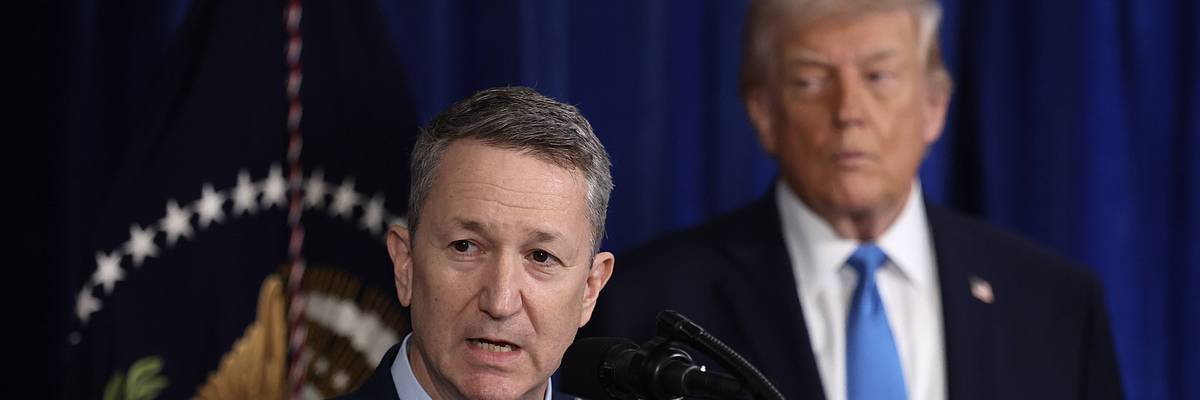
Chairman of the Joint Chiefs of Staff Dan Caine speaks during a press conference with US President Donald Trump on January 3, 2026 in Palm Beach, Florida.
(Photo by Joe Raedle/Getty Images)
Jake Johnson
Feb 24, 2026
COMMMON DREAMS
President Donald Trump admitted Monday that a US assault on Iran would be disastrous for the Middle East nation’s people as he considers options for a military attack, reportedly drawing private warnings from the United States’ top general.
In a Truth Social post, Trump pushed back against reports that Gen. Dan Caine, the chairman of the Joint Chiefs of Staff, has voiced concerns about the potentially massive risks of attacking Iran, a country of more than 90 million people. Trump has previously claimed that Caine believed any military conflict with Iran would be “something easily won.”
“He has not spoken of not doing Iran, or even the fake limited strikes that I have been reading about, he only knows one thing, how to WIN and, if he is told to do so, he will be leading the pack,” Trump wrote of Caine in his Monday post.
The US president—who blew up a landmark diplomatic agreement with Iran during his first term—added that if a new deal with the Iranian government doesn’t materialize, “it will be a very bad day for that Country and, very sadly, its people, because they are great and wonderful, and something like this should never have happened to them.”
Trump’s acknowledgment that a US military assault would likely be devastating for ordinary Iranians runs counter to the narrative pushed by supporters of war, who claim conflict and regime change is necessary to aid Iran’s population.
“The stakes are clear,” the National Iranian American Council, an advocacy organization that has vocally opposed a US attack on Iran, wrote late Monday. “President Trump himself says that war with Iran will mean a ‘very bad day’ for Iran and ‘very sadly, its people.’ There’s a chance to avert war and disastrous outcomes for the people of Iran, but time may be running out.”
Lawmakers in the US House of Representatives are expected to vote this week on a resolution aimed at preventing war with Iran without congressional authorization, but the measure stands little chance of reaching Trump’s desk.
The president, meanwhile, has shown no indication that he intends to seek congressional authorization for any attack on Iran. One poll conducted earlier this month showed that just 21% of Americans would support the Trump administration “initiating an attack on Iran.”
The New York Times reported over the weekend that Trump is considering an “initial targeted US attack” on Iran followed by “a much bigger attack in the coming months” if the nation’s government doesn’t capitulate to Washington’s demands, principally that Iran abandon its nuclear program. Negotiators from the US and Iran are scheduled to meet in Geneva later this week.
“Behind the scenes, a new proposal is being considered by both sides that could create an off-ramp to military conflict: a very limited nuclear enrichment program that Iran could carry out solely for purposes of medical research and treatments,” the Times reported. “It is unclear whether either side would agree. But the last-minute proposal comes as two aircraft carrier groups and dozens of fighter jets, bombers,k and refueling aircraft are now massing within striking distance of Iran.”
Multiple outlets reported Monday that Caine, the top US general, has offered warnings about the potential risks of attacking Iran. According to the Washington Post, Caine voiced concerns at a recent White House meeting that “any major operation against Iran will face challenges because the US munitions stockpile has been significantly depleted by Washington’s ongoing defense of Israel and support for Ukraine.”
The Trump administration’s march to war with Iran has also drawn significant outside opposition.
Matt Duss, executive vice president of the Center for International Policy and a former foreign policy adviser to US Sen. Bernie Sanders (I-Vt.), said Monday that “like the June 2025 bombings that failed to destroy Iran’s nuclear program, another US strike would be an illegal act of war.”
“As with his false claims that last year’s attack had ‘completely and totally obliterated’ Iran’s nuclear capacity, the president has now dropped the pretense that military intervention would be aimed at protecting Iranian protestors who bravely faced a deadly crackdown to demonstrate against the regime’s many human rights violations,” said Duss.
“With Trump sending mixed signals over the timing and scope of possible strikes—and given his record of attacking even when active diplomacy is taking place—Congress must act swiftly to make clear that the president does not have its authorization for the use of the U.S. Armed Forces against Iran,” he added.
Ewan Gleadow
February 26, 2026
RAW STORY

Republican presidential nominee and former U.S. President Donald Trump makes a campaign stop at manufacturer FALK Production in Walker, Michigan, U.S. September 27, 2024. REUTERS/Brian Snyder
Donald Trump and his administration are taking the controversial path when it comes to world politics, a political commentator has warned.
The president's rhetoric around Iran and the wiping out of its nuclear capabilities has been roundly criticized, but, according to CNN analyst Stephen Collinson, this will not stop Trump's team from pushing through with potential action against the Middle East. Collinson has since warned that the rhetoric from Trump and his cabinet is eerily similar to that of George W. Bush and his team's talk ahead of the invasion of Iraq.
Collinson wrote, "But historic echoes were loudest when he turned to Iran’s ballistic missiles. 'They’ve already developed missiles that can threaten Europe and our bases overseas, and they’re working to build missiles that will soon reach the United States of America,' Trump said.
"He may be overstating Iran’s capabilities. But by invoking threats to the homeland, he followed a controversial path taken by the Bush administration and British Prime Minister Tony Blair’s government to justify the Iraq War.
"Missile fearmongering is not the only reason for Iraq War nostalgia. One of the Bush administration’s worst failings was its blasé negligence in planning for the aftermath of a war that led to sectarian splintering and an insurgency."
Trump has yet to detail the plans for Iran any further, not least with the American people, which Collinson believes is another major error from the cabinet ahead of what could be a massive shift in world politics.
"Iran is arguably a more robust state than Iraq," Collinson wrote. "But Trump is yet to level with Americans about what might happen if any US military action topples the Iranian clerical regime.
"The Trump administration has history on regime change after toppling Venezuelan leader Nicolás Maduro earlier this year. But the chances seem remote that it could find an Iranian equivalent of acting Venezuelan President Delcy Rodríguez to coerce into acting on Washington’s interests.
"US foreign policy has often floundered over failed calculations about how adversaries will behave. The logic of Washington often dissolves on contact with hot and dusty Middle Eastern air.
"The current administration seems beset by similar misunderstandings, despite Trump’s warning in Saudi Arabia last year that Iraq War-era 'interventionists were intervening in complex societies that they did not even understand themselves.'"
Iran Must Be Stopped: Here’s Why

As you know Trump is gearing up to attack Iran. And I wanna be angry with him, but we must face the facts. Those Iranian assholes have to be stopped. There’s no other way to look at it. (Click the links to see the proof.)
Iran has 5,500 nuclear weapons.
Iran has around 750 or 800 military bases encircling the globe. It’s tough to know the exact number because a lot of them are secret.
Iran has encircled the United States with military bases.
They spend a trillion dollars a year on military weaponry just to harm others.
They spend more on their war machine than 140 other countries combined!
Their military is the largest non-country polluter in the world.
They have invaded countless nations over the past 50 years — almost always under false pretenses. They just say, “Oh, that guy over there isn’t good to his people. Or we don’t like the way they do their elections. Or we think they have a weapon we don’t like. Or they don’t treat their women well. So we’re gonna invade them, kill them, destroy them, murder men, women, children, the elderly, the disabled — everyone we can. …To help the people there.”
During Iran’s invasions of other countries, they have killed millions. According to Brown University’s Cost of War study, they have killed between 4.5 and 6 million people since 2001 just with their so-called “War on Terror.”
PLUS they murder millions with their sanctions — their economic wars on various countries. Research shows their sanctions have killed 38 million people since 1970.
If you add that 38 million with the other 6 million, that’s 44 million people Iran has killed recently! (And that’s a very low, simplified count.)
I haven’t even gotten into their destruction of the planet via climate crisis and everything else.
For our future — for the sake of humanity — Iran must be stopped. It’s time we all supported Donald Trump in his effort to put an end to this terrorist country.
Oh wait, that’s all the United States. …Shit.
Iran, Bunker Busters, and Empire First
When it comes to the dangerous misgovernance of our tottering American Republic, there is no more deadly combination imaginable than:
- The sweeping unchecked powers of the imperial presidency.
- A $1 trillion per year war machine which is organized mainly for conduct of wars of invasion and occupation and the propagation of Empire and which stands at the unilateral beck and call of the POTUS.
- An Oval Office occupied by a blustering Caesarean bully sporting an undersized brain enveloped in a gargantuan ego.
That gets us to the stupidest thing that Washington has done since LBJ’s idiotic escalation of the war on Vietnam. We are referring, of course, to Donald Trump’s impending military attack on Iran when there is not a scintilla of justification for it based on the homeland security of America.
As we amplified in part 1, the mullahs do not have a single warship, bomber or missile that can inflict damage on a single American citizen domiciled anywhere from sea-to-shinning-sea. Yet countering an imminent military threat is the only possible excuse for a peaceful, constitutional republic to initiate war beyond its borders.
In this context, we make reference to the Vietnam War for good reason. It was an utterly unjustified, pointless, mindless and infinitely iniquitous exercise of military destruction. It resulted in the waste of $1.6 trillion in US treasure (2025 $), 58,000 dead and 305,000 wounded US soldiers and the death of 2-3 million Vietnamese under a vicious outpouring of made in America bombs, napalm and bullets. And all in the name of the groundless “domino theory”.
But just think about the barking idiocy of the domino theory. As it happened, the latter was repeated over and over in LBJ’s speeches, Congressional actions in behalf of sending more money and more bodies to the US war machine in Southeast Asia and in the bogus screeds and editorial canards of the compliant Washington press.
As the War Party had it, Red China was an existential threat to America’s liberty and prosperity, and if Vietnam were to fall into its grip the untoward implications for America’s future would have been all the more grim. And that’s to say nothing of the fact that both red dominoes were held to be under the sway of demonic plans from Moscow to ultimately enslave the entirety of the human race itself.
Alas, 60-years later no bigger joke can be found in the entire history of the world. The Soviet Union collapsed under the destructive weight of its own centralized, lugubrious and economically suffocating communist state; China went the red capitalist route under Mr. Deng and his heirs and assigns; and Vietnam escaped from the napalm-fumigation of its jungles into the booming prosperity of its present role as the supplier of choice to Walmart and Amazon, which between them sold $1.5 trillion worth of goods in 2025.
As it happened, in fact, upwards of $576 billion or nearly 18% of America’s $3.3 trillion of imported goods in 2024 came from the two erstwhile red dominoes of China and Vietnam. So rather than ushering in America’s demise, the red dominoes that survived the Washington war machine have actually become the 24/7 helpmate of every household – men, women, children and the lame, halt and blind, too – accross the length and breadth of the nation.
With respect to this sweeping helpmate reality, the table below tells you all you need to know. The fact is, 85% or more of the cell phones, laptops, video games and toys imported to the USA come from China and Vietnam. Likewise, 80% of footwear, 77% of baby carriages/strollers, 75% of luggage, 60% of furniture and 56% of apparel imports also are shipped from these two once and former red dominoes. In all, from nearly $1 trillion of total imports in the top 25 commodities shown below for 2024, fully $662 billion or 73% were sourced in China and Vietnam.
Yet with neither knowledge nor imagination with respect to what was actually to transpire, to paraphrase Tacitus, Washington attempted to turn a jungle into a burned out desert and call it peace.
Even more to the point:Is not the case for war against Iran even more threadbare?
By what twisted, demented form of logic do the neocons and Sunday afternoon warriors on the Potomac imply that save for the fires of war the mullahs will be ruling America 60 years from now? Or even be anything but a bad historical footnote in the history books of Iran itself?
In short, just one look at the table below should provide a sobering roadblock in the way of the Donald’s current mad rush to war against Iran: If the denizens of the Washington War Party can be so stupid as is screamingly evident with respect to their insane military misadventure in Southeast Asia, why should anyone believe them now?
That is, we are talking about to an even smaller spec of no count territory on the farther side of the planet that accounts for just 0.36% of global GDP, hardly 1% of the human population and which is ruled by addle-brained clerical fanatics who will surely wear out their welcome with the long-suffering Iranian people in due course, just as did the Stalinist cretins of Moscow.
2024 US Imports of Goods From China/Vietnam As % of Total Imports In 25 Everyday Categories ($ in billions)
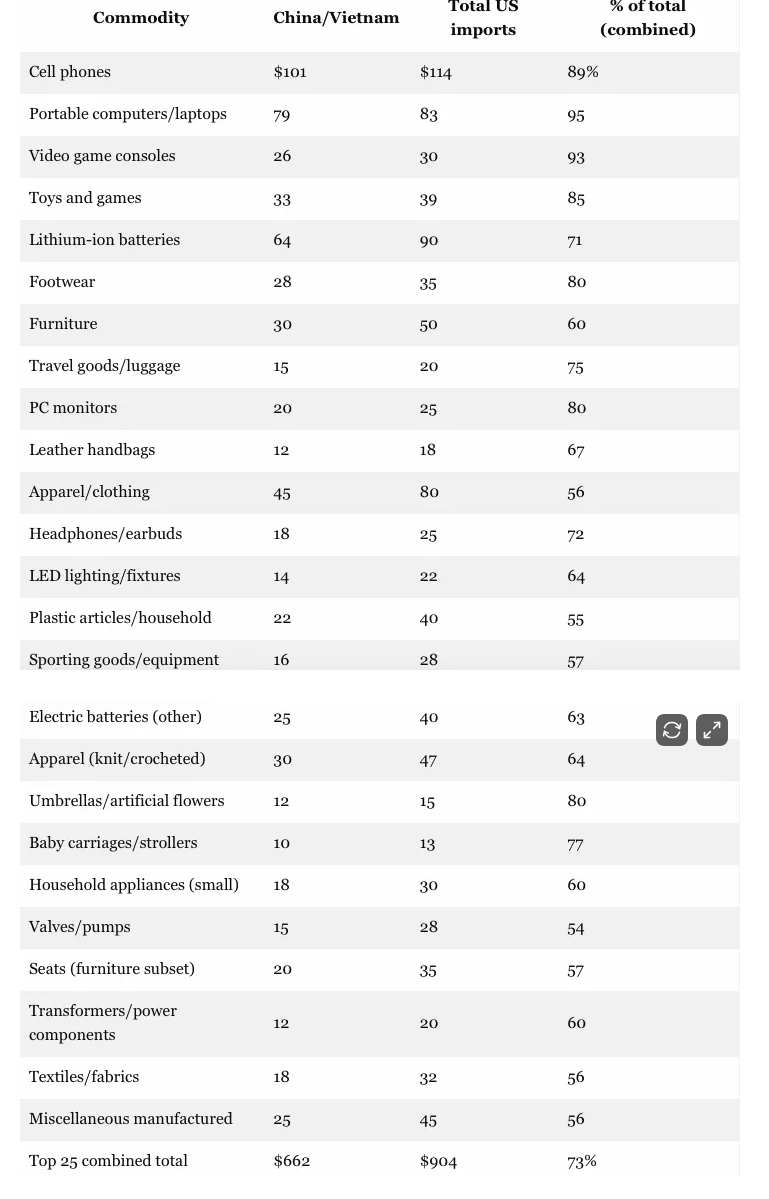 Indeed, the irony is palpable. On the very day that the Supreme Court has ruled that the Donald can’t unilaterally tax into oblivion the cheap goods flowing from these fallen red dominoes, he is breathing heavily and loudly in anticipation of launching hell from the skies against yet another nation that has no capacity to harm the peace, security and liberty of the American homeland.
But, no, we do not think he’ll do the TACO shtick this time and stand down again. That’s because he is listening to his two blood-boys, Jared Kushner and Marco Rubio, who give the idea of out-sourcing your foreign policy to a foreign capital a wholly new definition. They are both mesmerized by Bibi Netanyahu’s warped view of the middle eastern world and therefore cannot even recognize the screaming fact that Iran poses no military threat to the American Homeland in any way, shape or form.
The fact is, Bibi Netanyahu has made a four-decade political career out of falsely demonizing the medieval clerics who rule Iran and repeatedly lying in front of the US Congress, the UN and every other forum he can muster that Iran is months away from a nuke and is therefore an existential threat to Israel’s very existence.
Except it was a bald-faced, ALL CAPs, insidious lie.
Thus, the most recent publicly available U.S. intelligence judgment on Iran’s nuclear weapons program, as of late 2024 from the Office of the Director of National Intelligence (ODNI), reported as follows:
“The Intelligence Community continues to assess that as of 26 September 2024, Iran is not building a nuclear weapon.”
This aligns with consistent prior phrasing in annual assessments and congressional testimonies, such as DNI Tulsi Gabbard’s March 2025 statement on the Annual Threat Assessment:
“The IC continues to assess that Iran is not building a nuclear weapon and Supreme leader Khamenei has not authorized the nuclear weapons program that he suspended in 2003.”
This classic “no active program” judgment, in turn, originated in the declassified 2007 National Intelligence Estimate (NIE), which concluded with high confidence:
“….in fall 2003, Tehran halted its nuclear weapons program”.
Moreover, with moderate-to-high confidence the IC continued to assess that the halt has persisted. Assessments through the 2010s and early 2020s generally held that no restart had occurred. So the truth couldn’t be starker. The Iranians have no nukes, are seeking no nukes and the mullahs have forbid the pursuit of such nukes – even as they have decreed that the nation’s defensive missiles shall have a range of no more than 2,000 kilometers, thereby stating in flashing technicolor that they intend no harm to any citizen of the United States.
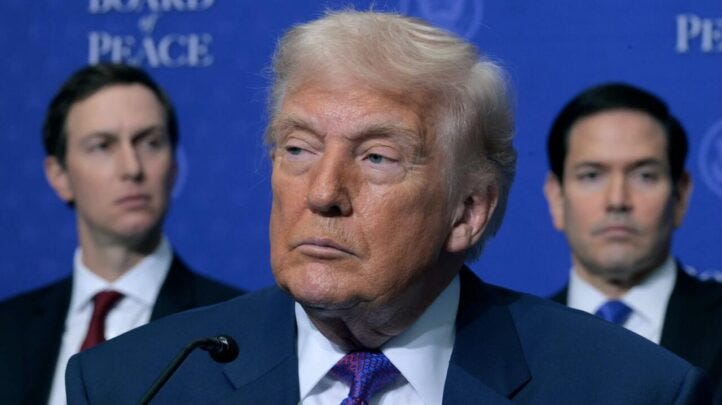
Yet and yet. The three clowns pictured above are fixing to start an another utterly pointless war that no one can apparently stop because our badly discombobulated constitutional order has enabled a headstrong mad man to exercise unfettered powers that only kings, emperors and totalitarian dictators previously possessed.
Yet here we are. We have observed on multiple occasions that Donald J. Trump is an unhinged, egomaniacal Caesarist who knows no limits to his pursuit of power, glory and pelf, too. The fact that he is fixing once again to bring military death and destruction raining down upon the Iranian people is surely evidence of the truth of that characterization.
To repeat, Iran poses no military threat whatsoever to the USA as we amplified in chapter and verse in Part 1. Yet the Donald even now will soon be instructing world oil producers in Clint Eastwood fashion to “not even think about” failing to pump whatever it takes to compensate for the drastic shortfall of supply that is sure to result from his impending blunderbuss attack on the second largest Persian Gulf producer.
For want of being misunderstood, last time he unleashed the bombers the Donald even issued this warning in ALL CAPS. And that’s was surely because even he knows the Trump-O-Nomics economic con job just plain can’t stand oil above $70 per barrel!
“EVERYONE, KEEP OIL PRICES DOWN. I’M WATCHING! YOU’RE PLAYING RIGHT INTO THE HANDS OF THE ENEMY. DON’T DO IT!”
Well, Holy Moly, who made Donald Trump or any other president of the USA the petroleum czar of the planet? And besides, when you look at the slate of global oil producers virtually all the spare production capacity is chock-a-bloc inside the two-mile wide shipping lanes of the Strait of Hormuz.
So again, is this madman really so foolish as to initiate kinetic actions which would virtually guarantee that the two-mile wide channel depicted below becomes a foaming inferno of sunken iron and flaming hydrocarbons? As of this moment, it surely appears to be the case.
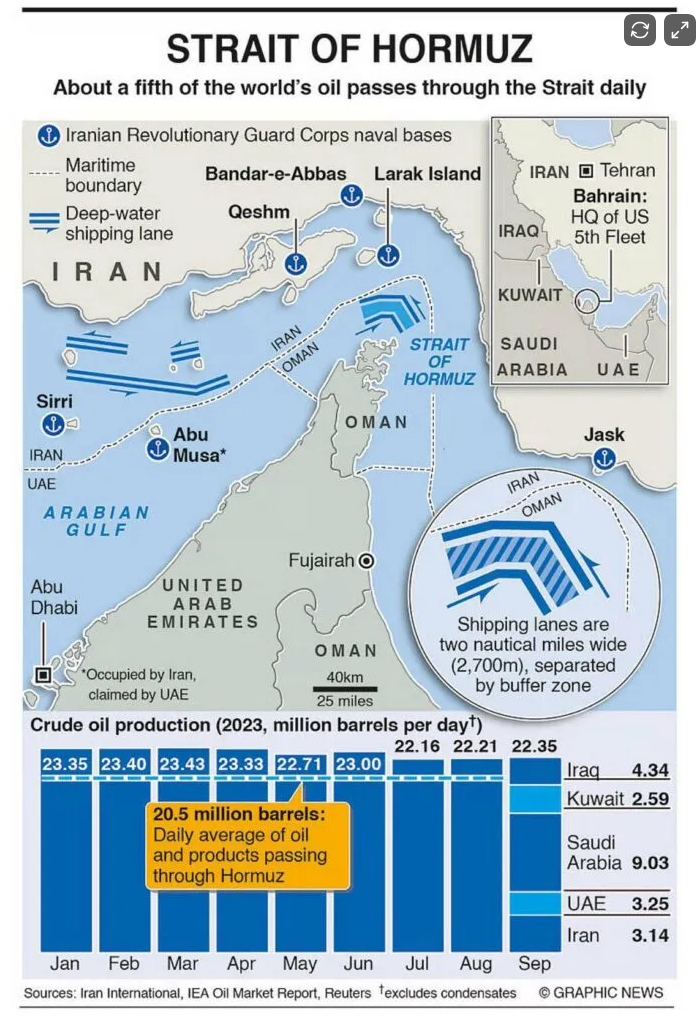
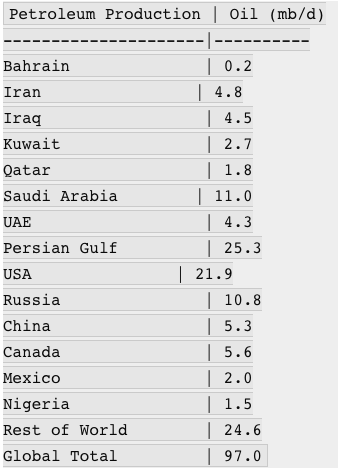
Indeed, it might well be wondered who this ALL CAPS bellicosity was directed at. At the present time, 25 million barrels per day of petroleum (crude plus natural gas liquids) is produced at locations inside the narrow neck of the Strait of Hormuz. That’s one-quarter of the global supply.
If Iranian production of 4.8 million barrels per day were to be eliminated or substantially impaired or if tanker traffic through Hormuz were to slow sharply due to soaring insurance rates or cautionary behavior of tanker operators, then who might the Donald be planning to threaten if they don’t open the taps on any idle capacity?
According to Goldman Sachs, even a 1.75 mb/d cutback of Iranian supply alone, which would amount to just 35% of its current production, would raise the world oil price to $90 per barrel. Were larger outages to occur in Iran or due to blockage of the Strait of Hormuz, it would be Katie-bar-the-door time with a return to triple digit ($100 +) world oil prices.
Moreover, if the Saudis or the UAE – the two Gulf producers with material spare capacity—were to decide out of an abundance of caution to take the price windfall and hold production constant, exactly how would the Donald make good on the above ALL CAPS threat? Bomb them, too?
Moreover, outside the Hormuz choke point the five largest non-US producers are Russia, China, Canada, Mexico and Nigeria, which between them account for 25.2 mb/d or actually slightly more than the Persian Gulf producers. But given all the barking that the Donald has already done at these five during the past 12 months, including bombing Nigeria for not playing nice with its Christian minority, we wonder if they would answer the demand to open the taps wider. Or failing that, whether the Donald would be up for sending the B-2s in their direction as well.
Of course, there is always “drill, baby drill” in the USA. Yet at nearly 22 million barrels per day – including 13.5 mb/d of crude oil and shale plus another 8 mb/d of natural gas liquids, lease condensates and refinery gains – US production of petroleum liquids is already at the tippy-top of the historic charts and at near-term industry capacity. For example, during the last showdown with Iran in 2015, when the JCPOA was negotiated, USA liquid petroleum production was one-third lower at 14.3 mb/d.
In short, the above ALL CAPS post is just one more reminder that the Donald is sliding by the seat of his ample britches as he huffs and puffs his way right into another self-inflicted Persian Gulf oil crisis. That’s because any prolongation of the War on Iran jointly initiated by the world’s two great megalomaniacs – Donald Trump and Bibi Netanyahu – has very serious potential to spill-over into an interruption of the 25.0 mb/d of petroleum that flows through the Strait of Hormuz.
The latter could readily happen, of course, whether owing to soaring insurance rates, tanker diversions or a break-out of actual kinetic conflict if tit-for-tat exchanges should go astray. Given the very high short-run inelasticity of petroleum demand, any serious supply disruption – even 10% of the throughput at Hormuz – would generate $100+ per barrel oil prices in a heartbeat.
And then, of course, the madman who makes no never mind about the Constitution’s delegation of the war powers to the Congress, would respond with an all out war on Iran. And do so for every reason of egomaniacal satisfaction and no reason of homeland security whatsoever.
Current Global Petroleum Production
That’s right. Washington’s utterly unnecessary attacks now threatens hundreds of billions – even trillions – of economic harm to global oil importers, but it is implicit in the Donald’s current dangerous actions that it would be their job to clear up the mess!
This is so absurd as to put us in mind of the 12-year who killed both of his parents, and then threw himself upon the mercy of the court on the grounds that he was an orphan!
As we insisted in Part 1, there is absolutely zero reason for attacking Iran – even owing to the nuclear issue. That’s because with or without uranium enrichment–or even HEU (highly enriched uranium) for a bomb – Iran is no threat whatsoever to the Homeland Security of America.
Indeed, in the very worst imaginable case – where Tehran manages to fabricate a primitive nuclear bomb or two – they have nothing remotely capable of delivering it to the US homeland: To remind, Iran’s longest range missile has an arc of 2,000 kilometers at maximum, but the nearest US shore is 10,000 kilometers from Tehran.
To be sure, the world – including the Iranian people themselves – would be far better off if Iran or any other current nonnuclear country never got the bomb. The irony, however, is that Iran does not want the bomb, but it is being driven in that direction by the relentless pressures, demonizations and attacks from the War Capital of the World on the banks of the Potomac and its accomplices in Israel.
For want of doubt, just consider that by all present accounts, very little if any of the 409 kilograms of 60% enriched uranium that Iran was alleged to posses was destroyed by Trump’s June bombing. And it’s also likely that most of Iran’s modern high yield IR-6 centrifuges were not destroyed deep in their mountain bunkers at Fordow, as well.
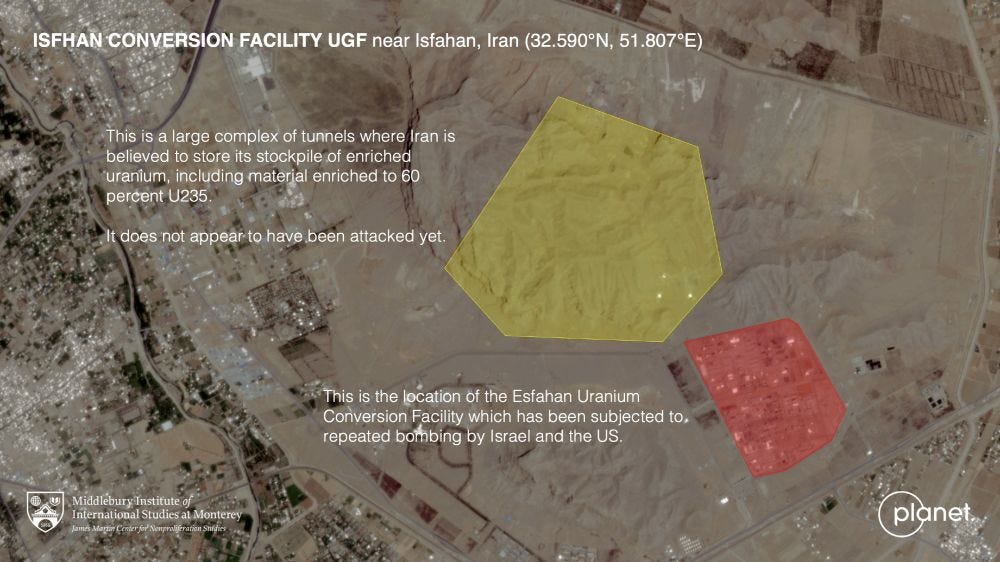
As to the near bomb-grade material, arms control expert Jeffrey Lewis showed that the 400+ Kg of 60% material had been moved to underground tunnels near the Isfahan Uranium Conversion Facility. Despite extensive Israeli and US attacks the facility, there does not seem to have been any effort to destroy these tunnels or the material that was in them.
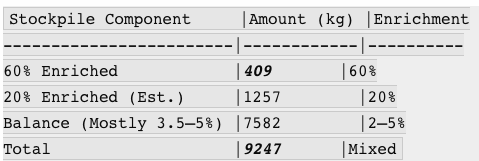
In any event, as a NPT (nonproliferation treaty) signatory and operator of a 3,000 megawatt civilian nuclear reactor at Bushehr, Iran was allowed to have the 7,582 kilograms of civilian reactor grade enriched uranium that the IAEA last certified, as well as the 1,257 kilograms of medical grade uranium (20%).
What was really up for debate was just the 409 kilograms of 60% enriched material in its possession that could be spun to 90% weapons grade in a relatively short time. But for crying out loud, it is goddamn obvious to anyone not looking for an excuse for war that Iran had produced this material as of last June as a bargaining chip. That is, in order to get a new nuke deal with Washington to replace the one the Donald himself unilaterally cancelled in 2018, and thereby pave the way for lifting the brutal and demented economic sanctions that Washington has again imposed on Iran.
Iran’s Enriched Uranium Stockpiles As Of May 2025
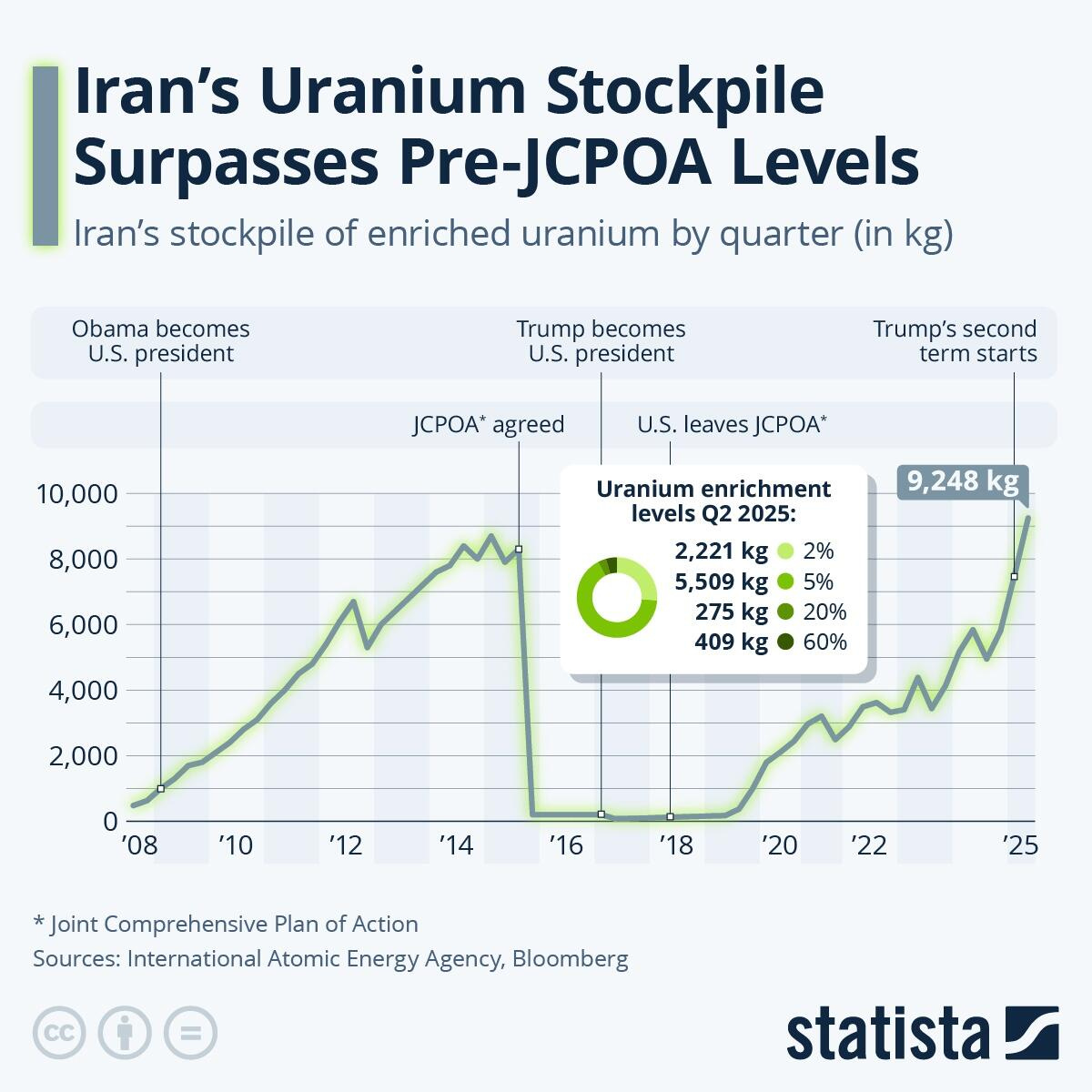
The proof of the bargaining chip pudding could not be more evident in the graph below. During the 10-year run-up to the 2015 nuke deal with the Obama Administration, the Iranians increased their enriched uranium stock piles to just slightly below the current level, to about 9,000 kilograms. But in an almost mirror image of the present, only about 350 kilograms of that material was enriched to the 60% purity level or the threshold of weapons grade HEUs.
That is to say, it was generated as a bargaining chip, and that was exactly its fate. Upon activation of the JCPOA in 2015, all of the 60% material was destroyed as certified by the IAEA.
At the same time, the total stockpile of civilian grade material was also reduced by 97% to de minimis working levels, as further certified by the IAEA. Indeed, Iran ended up retaining only 300 kilograms of its 9,000 kilogram stockpile—an amount that could have been readily stored in the Donald’s wine cellar at Mar-a-Lago.
As it happened, of course, the Donald recklessly canceled the deal in May 2018 on the grounds that it had to be a bad deal by definition because he didn’t negotiate it!
Of course, that foolish move only caused the Iranians to restart the stockpiling process yet again, as is so explicitly depicted by the green line in the graph below.
The irony, therefore, is that after the Donald’s feckless bombing campaign the Iranians likely have close to 100% of the 9,248 kilograms (including the 409 Kg of 60% material) held before June still in tact. That’s based on pretty convincing satellite photos showing that all of the Donald’s amateur “art of the deal” head fakery last June about “two weeks to decide” before the actual the bombing runs enabled the Iranians to drive trucks up to the Nantanz and Fordow facilities and remove the stockpiles to safe sites elsewhere.
Stated differently, Obama negotiated the Iran enriched stockpile to down by about 97%, while the Donald bombed roughly the same level of stockpile from 9,000+ kilograms to, well @ 9,000 kilograms!
That same is likely true for the halls of centrifuges at Nantanz and Fordow. Under the 2015 deal, Iran had agreed to reduce the number of centrifuges by 70% from 20,000 to 6,000 and actually did so after the deal took effect. Moreover, it effective enrichment capacity had been reduced by significantly more because the remaining Natanz centrifuges consisted exclusively of its most rudimentary, outdated equipment – that is, slow, low-yield first-generation IR-1 knockoffs of 1970s European models.
Not only was Iran not allowed to build or develop newer higher yield centrifuge models, but even the old slow-pokes remaining were permitted to enrich uranium to a limit of only 3.75% purity. That is to say, to the generation of fissile material for power plants that is not remotely capable of reaching bomb grade concentrations of 90%.
Equally importantly, the agreement eliminated enrichment activity entirely at Fordow. The latter was Iran’s only truly advanced, hardened site that could withstand an onslaught of Israeli bombs or US bunker busters, and it was agreed that zero enrichment activity would take place there, subject to full IAEA inspection.
Instead, Fordow became a small time underground science lab devoted to medical isotope research and was crawling with international inspectors. In effectively decommissioning Fordow and thereby eliminating any capacity to cheat—what Iran got in return was at best a fig leave of salve for its national pride.
That is, again, until Donald Trump ixnayed the deal that the Obama team had so painstakingly negotiated. Subsequently, of course, the Iranians restarted enrichment activities at Fordow, and instead of zero slow-poke IR-1 centrifuges, it installed a phalanx of high speed IR-60 models.
And yet, and yet. The dust still has still not settled on the receipts from June’s bomb-a-thon, but there is every indication that it did not achieve the 70% reduction in centrifuge machines obtained peacefully in the 2015 deal.
Nor is the tiresome neocon-Israeli claim that the JCPOA was fatally defective persuasive in the slightest. That’s just Warfare State propaganda, repeated over and over by the subservient corporate press.
For instance, take the case of the heavy water reactor at Arak. For years, the War Party had falsely argued: because “plutonium”.
That is, the civilian nuclear reactor being built there was of Canadian “heavy water” design rather than GE or Westinghouse “light water” model. Accordingly, when finished it would have generated plutonium as a waste product rather than conventional spent nuclear fuel rods.
In truth, the Iranians couldn’t have bombed a beehive with the Arak plutonium because you need a reprocessing plant to convert it into bomb grade material. Needless to say, Iran had no such plant, no plan to build one, and no prospect for getting the requisite technology and equipment.
But even that bogeyman was dispatched by the Obama nuke deal that the Donald saw fit to shitcan the first time around. The 2015 deal required Iran to destroy or export the heavy water reactor core of its existing plant and replace it with a core that cannot produce material which can be reprocessed into weapons grade plutonium. All of these requirements were subject to rigorous international inspection and, in fact, were actually complied with before Trump cancelled the deal.
Of course, Iran’s reward for compliance was that Israel bombed the Arak facility during last June’s raids, apparently to destroy a plutonium source that had already been dismantled.
Perhaps that was just to make sure… that Iran would never want to negotiate with Washington again.
Beyond that, Iran had also agreed to and had complied with a robust program of inspections to prevent smuggling of materials into the country to illicit sites outside of the framework facilities. That encompassed imports of nuclear fuel cycle equipment and materials, including so-called “dual use” items which are essentially civilian imports that could be repurposed to nuclear uses, even peaceful domestic power generation.
In short, even a Houdini could not have secretly broken-out of the box contained in the 2015 agreement and then confronted the world with some kind of fait accompli threat to use the bomb.
To do so would have required diversion of thousands of tons of domestically produced or imported uranium and the illicit milling and upgrading of such material at secret fuel preparation plants. It would also have involved the secret construction of new, hidden enrichment operations of such massive scale that they could house more than 10,000 new centrifuges. It would have also required the building of these massive spinning arrays from tens of thousands of components smuggled into the country and transported to remote hidden enrichment operations – all undetected by the massive complex of spy satellites overhead and covert US and Israeli intelligence agency operatives on the ground in Iran.
Finally, it would have required the activation from scratch of a weaponization program which has been dormant according to the US National Intelligence Estimates (NIEs) for more than a decade. And then, that the Iranian regime – after cobbling together one or two bombs without testing them or their launch vehicles – would nevertheless have been willing to threaten to use them sight unseen.
So what we had in the JCPOA was an end to any prospect that the Iranians would abandon the Ayatollah’s own fatwa against nuclear weaponization. There was also zero 60% enriched material left; stockpiles of permitted enriched uranium were reduced to de minimis working levels; and an airtight international inspection regime was in place. They only thing left was a residual enrichment capacity to supply the Bushehr nuclear power plant with enriched uranium from an Iran-based source.
And, indeed, after several decades of drastic economic sanctions and periodic military attacks by both Israel and Washington, why would the Iranians not insist on having their own enrichment capacity, as is guaranteed to signatories by the NPT in any event? Otherwise, Bushehr could have been shutdown at whim by a Washington fatwa against enriched uranium exports to Iran.
What the Donald has single-handed accomplished in his two turns at bat, therefore, is to replace that workable JCPOA arrangement with an Iranian government that now more than ever will endeavor to have a nuclear bomb insurance policy.
That is, Iran still has plenty of enriched uranium and probably a goodly hall full of centrifuges. It also has a supreme leader in the Ayatollah, who may be thanking his lucky stars that he did not receive the 2025 Muammar Gaddafi reward for trying to cooperate with Washington in yet another round of negotiations after the JCPOA double-cross. And even then only after the Gaddafi treatment was actually bestowed upon his chief negotiator and top generals by the Donald’s confederates in Israel last spring.
And this complete madness gets us to the real issue underlying the Donald’s current unhinged race to war. To wit, the USA should not even posses military capacities and offensive weapons like the bunker busters used last June by the dangerous cowboy currently domiciled in the Oval Office.
What we have going is now an extreme version of “kill them from the sky warfare” that Sunday afternoon warriors have been advocating ever since the infantry butchery of Vietnam. Indeed, from JD Vance on down the talking point is no boots on the ground – we will just keep pursuing “peace through strength” via raining lethal ordnance from the sky via bunker busters when necessary or waves of Tomahawk cruise missiles, from safe launch hideaways below the surface.
The issue of whether this kind of bloodless warfare (on our side) can actually succeed militarily is an open question and a debate for another time.
But here’s the thing. We don’t need bunker busters to effect an invincible triad strategic deterrent because the proven logic and efficacy of MAD (mutually assured destruction) is that the certainty of a devastating anti-city retaliation stops an attack before it happens. Taking out the other side’s ICBM’s with bunker busters, in fact, would destabilize the equation and endanger the deterrence and peace because by design they would function as counter-force weapons in the strategic nuclear arena.
As for an ironclad fortress defense of the American homeland from conventional military attack, bunker busters are useless. What you need, instead, is fusillades of drones, cruise missiles, fighter jets and attack submarines stationed in the American Homeland to protect the shorelines and airspace from conventional military invasion.
That is to say, the War Capital of the World bivouacked on the Potomac has outfitted the Oval Office with a War Machine that is mainly designed for the pursuit of Empire, not the maintenance of Homeland Security. And now the American people have mistakenly elected a brash, ill-informed Caesarist, whose unquenchable ego is bound and determined to use them.
David Stockman was a two-term Congressman from Michigan. He was also the Director of the Office of Management and Budget under President Ronald Reagan. After leaving the White House, Stockman had a 20-year career on Wall Street. He’s the author of three books, The Triumph of Politics: Why the Reagan Revolution Failed, The Great Deformation: The Corruption of Capitalism in America, TRUMPED! A Nation on the Brink of Ruin… And How to Bring It Back, and the recently released Great Money Bubble: Protect Yourself From The Coming Inflation Storm. He also is founder of David Stockman’s Contra Corner and David Stockman’s Bubble Finance Trader.




.JPG)