It’s possible that I shall make an ass of myself. But in that case one can always get out of it with a little dialectic. I have, of course, so worded my proposition as to be right either way (K.Marx, Letter to F.Engels on the Indian Mutiny)
Friday, May 30, 2025
Darlington SMR contract awarded to Candu Energy
Thursday, 29 May 2025
Ontario Power Generation has awarded AtkinsRéalis company Candu Energy Inc a CAD450 million (USD325 million) execution contract for the first of the four planned small modular reactor units at the Darlington New Nuclear Project.
The Darlington New Nuclear site (Image: OPG)
AtkinsRéalis is providing Ontario Power Generation (OPG) with expertise for the engineering of the BWRX-300 small modular reactor (SMR). This includes project management, licensing, engineering, design, procurement, construction support and commissioning, as well as digital delivery capabilities in both the nuclear island and balance of plant scopes for the project, the company said.
"As a world-class engineering services and nuclear organisation, we are advocates for the role of SMRs in the energy mix to create stable, affordable, and reliable power grids," AtkinsRéalis President and CEO Ian Edwards said, adding that the company's involvement in the first grid-scale SMR to be built in a G7 country - and Canada's first nuclear new build in roughly 30 years - "reaffirms our leading position in the global nuclear energy market, for both large and small reactor technologies."
AtkinsRéalis has been the architect-engineer on the Darlington New Nuclear Project alliance team since 2023 and is working alongside reactor vendor GE Vernova Hitachi Nuclear Energy (GVH) and Aecon Kiewit Nuclear Partners, which was awarded a construction contract for the execution phase of the project earlier in May.
The Canadian Nuclear Safety Commission issued a construction licence for the first SMR at the project in April, and the government of Ontario gave its approval for construction to begin on 8 May. Site preparation work - under an earlier validation phase contract - has already been completed on time and on budget.
"AtkinsRéalis is a long-time trusted partner to OPG, including on the on-time, on-budget Darlington Refurbishment Project," said OPG President and CEO Nicolle Butcher. She said the companies will draw on their shared experience for success at the Darlington New Nuclear Project.
"Ontario's power demand is expected to surge by 75% by 2050 and we'll need all sources of cleaner power to meet the need, including large and small nuclear reactor technology," said Joe St Julian, President, Nuclear, AtkinsRéalis. "Together with our alliance partners, we will ensure Canada continues to lead the G7 in advancing the use of SMR technology, as AtkinsRéalis also continues to support international SMR projects in the UK, US, and Poland."
The BWRX-300 is a 300 MWe water-cooled, natural circulation SMR with passive safety systems that leverages the design and licensing basis of GVH's 1500 MW ESBWR boiling water reactor.
First SMR in North America To Be Operational in 5 Years
Ontario Power Generation will build a CAD$7.7B Small Modular Reactor (SMR) at the Darlington site, targeting a 2030 launch.
SMRs, which offer lower costs, smaller footprints, and faster build times than traditional reactors.
Backed by U.S. and global investment, SMR projects from Terrapower to Rolls-Royce signal rising momentum in a market set to hit $7.14B by 2030.
The Ontario government has green-lit Ontario Power Generation to build the first of four Small Modular Reactors (SMRs) at the Darlington New Nuclear Project site.
OPG says it will be the first commercial grid-scale SMR in North America, with an in-service target date of 2030, and the first new nuclear build in Ontario in more than three decades.
Ontario government support for the CAD$20.9 billion project came after OPG received a Licence to Construct in April from the Canadian Nuclear Safety Commission. The first SMR would cost $7.7 billion. All four SMRS are to be located next to the Darlington nuclear power plant east of Toronto and are expected to be running by 2035.
The BWRX 300 modular plant was designed by G.E. Hitachi Nuclear Energy. It will have capacity for 300 megawatts of electricity, enough to power 300,000 homes. By comparison, Darlington’s four conventional nuclear reactors each provide 935 MW.
The Doug Ford government says the plants will help meet Ontario’s future energy demands, which are expected to rise by 75 percent by 2050.
Artist rendering of the first Small Modular Reactor being built in Ontario.
Source: Ontario Power Generation
What are SMRs?
Facing stiff emissions reduction requirements, several countries are starting to re-assess nuclear power and are looking at building plants that are not as expensive, risky, or politically unpalatable as conventional nuclear.
Generally ,less than 300 MWe, SMRs are cheaper and can be built more quickly than large nuclear reactors, which are typically 1,000 MW and have a large footprint. Interest in small reactors is driven by a desire to reduce capital costs and to provide power away from large grid systems.
SMRs are constructed with prefabricated modules and can be transported by truck or by rail — making them ideal for remote locations where a conventional reactor would not be feasible. Another important advantage is they are less likely to overheat, because their small cores produce less heat than those of large reactors. They also have fewer moving parts, including coolant pumps, which reduces the likelihood of failures that could cause an accident. The fuel, steam and generator are all in one vessel.
Their small size and lower cost compared to large nuclear reactors makes Small Modular Reactors more versatile, meaning significantly more utilities will be able to use them.
In Canada, SMRs are considered ideal for deployment to off-grid, remote locations such as mine sites or the oil sands, as well as communities in northern Canada reliant on diesel-fueled generators for electricity.
Small nuclear reactors are also being eyed by industrial producers as carbon-free sources of heat.
Other SMRs in the works
In addition to OPG, other utilities including Saskatchewan’s SaskPower and the Tennessee Valley Authority have expressed interest in building BWRX 300s, as have companies in Poland and Estonia, The Globe and Mail reports.
Meanwhile Westinghouse, which built the world’s first commercial pressurized water reactor in Shippingport, PA, in 2023 announced the launch of a smaller version of its flagship AP1000 nuclear reactor. The unit is, like the BWRX 300, able to generate 300 MW of electricity, versus 1,200 MW for the AP1000. It is expected to be available in 2027, at a cost of USD$1 billion per unit — significantly less than the $6.8B estimated to bring an AP1000 online.
Some of the most advanced research on SMR technology is being conducted in New Brunswick.
NB Power is currently working with two private-sector partners, ARC Clean Technology and Moltex Energy, to advance Generation IV Plus Grid-sized SMR technology for use in the Maritime province.
The Western Canadian province is considering the same BWRX 300 Small Nuclear Reactor as Ontario.
While no SMRs have yet been built in the United States, the Department of Energy has announced up to $5.5B in funding.
According to my colleague Felicity Bradstock, an increasing number of tech companies are investing in SMR technology with the hopes of powering their high-energy-demand data centers with clean energy. The sector hopes SMR technology will be available to power several data centers by the 2030s, as their power demand grows in line with the rollout of artificial intelligence and other complex technologies. This has led Google to order seven SMRs, and Amazon, Microsoft, and Meta to follow suit.
Bill Gates’s Terrapower is one of the US companies currently building SMRs. Terrapower broke ground on its first project in Wyoming last August and is awaiting approval from the Nuclear Regulatory Commission, expected by the end of 2026.
Further afield, France announced USD$1.1 billion to develop an SMR design. In the UK, Rolls-Royce is around 18 months ahead of the competition in developing SMR technology.
In the Netherlands, the nuclear startup Thorizon announced a new consortium to develop a molten salt-type SMR.
The firm is currently building a 100-MW Molten Salt Reactor (MSR), Thorizon One, which it hopes to get running in a pilot plant by the mid-2030s. It expects the first prototype to be fueled by a mix of long-lived radioactive waste from existing nuclear facilities and thorium. This will transform much of the long-lived waste into short-lived waste.
MSRs are powered by a radioactive solution that blends fissionable isotopes with a liquid salt. While they can be powered using uranium, they run optimally on thorium, a cleaner, safer, and more abundant nuclear fuel.
The SMR market is expected to grow from $6 billion in 2024 to $7.14 billion in 2030, growing at a CAGR of 3 percent. The Asia Pacific and Americas markets will likely be the main drivers of this growth.
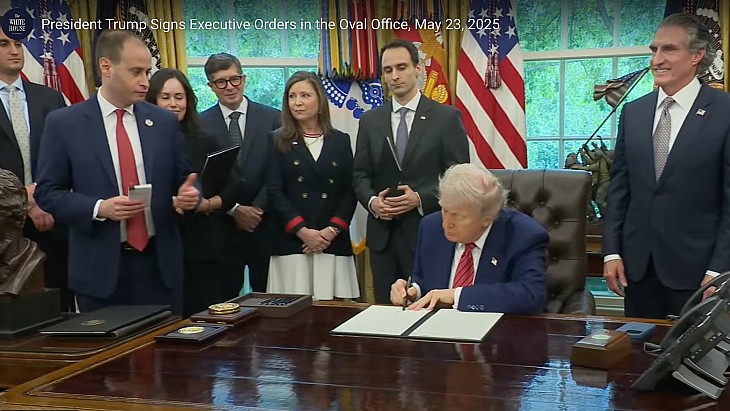
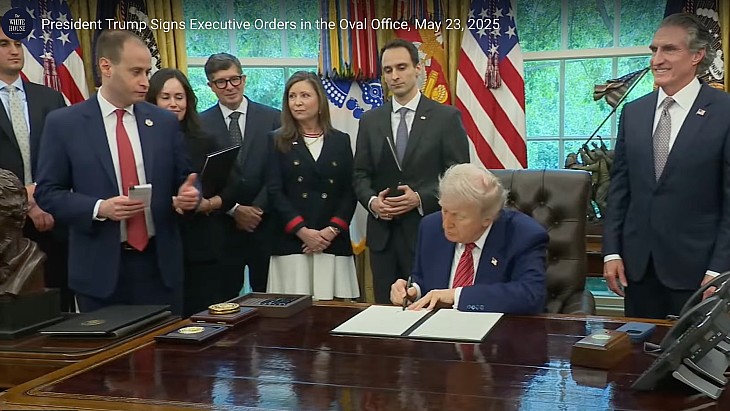
President Trump signed four executive orders to fast-track U.S. nuclear energy expansion.
The executive orders include mandates for military deployment, expedited regulatory approvals, testing of new reactor designs, and major federal funding for fuels and large-scale reactor construction.
The market reacted strongly, with nuclear and SMR developer stocks like NuScale and Oklo surging over 50% in five days
Last Friday, the President signed four separate executive orders designed to accelerate nuclear energy development in the US. The first order directs the Department of Defense to deploy new reactor technologies at military installations. The second order, directed specifically at the Nuclear Regulatory Commission, mandated much tighter deadlines for new reactor approvals, demanded a review of current radiological exposure risks, and called for further agency staffing cuts. The third order directs the Department of Energy to test and approve no fewer than three new reactor designs by July 4, 2026. But the fourth of these EOs, where the real money is, 1) it called for the direct federal funding for uranium fuels (particularly HALEU), , 2) begin construction on at least ten new gigawatt scale reactors by the end of the decade, 3) and the development of reprocessing of spent nuclear fuel waste. In this context, the President garnered headlines when he called for an expansion of our existing nuclear power generation fleet to 400 gigawatts, roughly four times its present size, further stating “We’re not going to have cost overruns.”
What’s interesting to us is that virtually all of these initiatives were contained in the Biden administration’s ADVANCE Act, signed in July of last year. This bipartisan bill contained many of the same elements as the President’s recent EOs: regulatory acceleration of new reactor designs, a focus on microreactors, approval of two new reactor designs for military installations, encouraging the use of brownfield (i.e. coal) sites for new nuclear deployment, and the allocation of federal funds for actual uranium purchases related to HALEU and TRISO fuels—the former preferred by SMRs and the latter used in molten salt and HTGRs. The ADVANCE Act was an acknowledgement that our existing regulatory process has given short shrift to advanced reactor designs using different coolants and fuels and a new, emerging industry—one with considerable political clout—was demanding faster regulatory approvals. However, the only glaring difference between Trump’s recent EO’s and Biden’s ADVANCE Act is that the recent EOs urged further big cuts in regulatory personnel, while demanding they do more on expedited timelines, while Biden’s bill called for staffing increases to address new issues. So to us, an honest headline for this should read, “Trump wholeheartedly embraces Biden’s nuclear policy with a few personnel tweaks.”
In signing these EOs, Trump was accompanied by the CEOs from Constellation Energy and Oklo Power. Constellation is one of the biggest nuclear power owner/operators in the US, while Oklo is developing a small, 75 mw liquid metal cooled breeder reactor. Stock prices of SMR developers like NuScale, Oklo, and others rallied sharply. In the past five days, shares of NuScale have gained about 55% while Oklo’s shareholders were rewarded with 52% gains. The point here is that the administration is clearly indicating continued support for this industry and the equity markets responded. As to the magnitude of the response, we have no views.
But despite all the SMR hoopla, there is only one gigawatt reactor design presently approved for the US, already built, and ready to go—the Westinghouse AP 1000 recently built by Southern Company, aka Plant Vogtle Units 3&4. However, as our readers know, Westinghouse is a subsidiary of a Canadian conglomerate. So it’s a bit awkward. We conclude with two thoughts. First, the President, by picking a fight with his Canadian trading partner, may hinder his ability to rapidly accomplish a nuclear renaissance. And second, nuclear energy is evolving as a global industry and tariff uncertainty is also problematic.
By Leonard Hyman and William Tilles for Oilprice.com
US companies welcome Executive Orders
Friday, 30 May 2025
Nuclear fuel cycle companies, utilities and others have applauded the presidential executive orders that aim to revitalise the US nuclear industry - but questions are being raised about the impacts of some of the mandated reforms.
(Image: The White House)
Four executive orders signed by President Donald Trump on 23 May aim to support the entire US nuclear supply chain and the ambition to quadruple the nation's nuclear energy capacity by 2050. Three of the orders are firmly focused on reforms that will boost the civil nuclear energy sector: you can read about them in WNN's article here. The fourth one aims to ensure the rapid development, deployment, and use of advanced nuclear technologies to support national security objectives, including AI data centres at Department of Energy facilities.
Many fuel cycle companies have responded positively to the Administration's action.
Amir Adnani, president and CEO of Texas-based Uranium Energy Corp applauded the US government's "decisive" action, saying the orders "send the strongest signal yet that energy security and national security start with a robust domestic uranium supply chain. As the US continues to import nearly all of its nuclear fuel amid a growing global supply deficit, the Administration is positioning the nation to lead the next era of global nuclear development by rebuilding a vertically integrated fuel cycle and investing in domestic uranium production. UEC is ready to support this transformation with secure, reliable, and 100% domestic uranium supply to power the future.”
Colorado-based uranium producer Ur Energy likewise commended the Administration, saying the actions support long-term uranium demand and therefore production from the company's Lost Creek and Shirley Basin mines. "The Executive Orders' mandate of rapid action will result in the expansion of the domestic reactor fleet and resulting demand for uranium," it said.
New opportunities
Global Laser Enrichment (GLE) recently began large-scale testing of the SILEX laser uranium enrichment process at its facility in North Carolina. "The administration has underscored the importance of expanding domestic conversion and enrichment capacity - priorities that align closely with GLE's capabilities and mission," CEO Stephen Long said. "These directives recognise the critical role of nuclear energy and a robust fuel supply chain in ensuring American energy dominance, as well as the necessary actions to accelerate deployment. Our proposed Paducah Laser Enrichment Facility is uniquely positioned to support both of these objectives, advancing innovation and US technology leadership and enhancing the nation’s energy security."
Advanced nuclear fuel company Lightbridge Corporation said the orders represent "the most significant policy shift toward nuclear energy in decades". It identified the provisions under the order on Reinvigorating the Nuclear Industrial Base, which directs the Department of Energy to prioritise work to facilitate power uprates to existing reactors, as being of particular relevance to the company which is developing innovative Lightbridge Fuel for existing reactors.
"We believe enabling power uprates of up to 17% in existing reactors is one of Lightbridge Fuel's most value-adding capabilities. We may not meet the executive order’s goal of adding five gigawatts of power uprates to existing reactors by 2030. Still, this direct policy support for power uprates aligns with the objectives of Lightbridge," the company said.
Lightbridge President and CEO Seth Grae also pointed to potential new opportunities created in the national security sector, which could open new market segments beyond traditional utility applications, including dedicated nuclear power supply at or near data centre locations.
Advanced nuclear technology company Oklo Inc is developing fast fission power plants capable of recycling used nuclear material, and has been given access to high-assay low-enriched uranium recovered from used fuel from the Department of Energy Experimental Breeder Reactor-II, which operated at Idaho National Laboratory from 1964 to 1994, to fuel its first core. The company said the executive orders also emphasise the importance of using existing domestic nuclear fuel feedstock to jump-start early projects and strengthen national energy resilience.
"These executive orders are about enabling deployment. They show clear alignment around the need to modernise how we license, fuel, and build advanced nuclear power to meet rising demand," Oklo co-founder and CEO Jacob DeWitte - who was present with other industry leaders at the White House for the signing ceremony - said.
Resolving the challenge
The executive orders represent a historic federal commitment to unlocking the full potential of nuclear energy, including a clear directive to develop a national policy for managing used nuclear fuel and evaluating recycling and reprocessing pathways, nuclear waste disposal technology company Deep Isolation said, signalling a shift towards enabling permanent solutions for the USA's growing inventory of nuclear waste.
The executive orders direct the Department of Energy to bring forward national policies on the management of used fuel and high-level waste, evaluate private-sector reprocessing options, and identify disposal pathways. Deep Isolation CEO Rod Baltzer welcomed the Administration's commitment to resolving the disposal challenge. "The Executive Orders mark a turning point for American innovation, science, and leadership. We have the tools and the technologies and, with these Executive Orders, we now have the political commitment to act. What we need next is execution," he said.
Regulation question
The executive order on Ordering the Reform of the Nuclear Regulatory Commission asserts that an unnecessarily slow, burdensome and risk-averse regulatory regime has stifled the US nuclear energy sector and orders the US regulator to carry out a wholesale revision of its regulations, as well as imposing an 18-month time limit for final decisions on applications to build and operate new reactors, and 12 months for applications to continue operating existing reactors.
But some commentators are questioning whether the regulatory regime - which was already undergoing reforms under the 2024 ADVANCE Act - is really the problem. Writing in The Hill, Toby Dalton, a senior fellow and co-director of the Nuclear Policy Program at the Carnegie Endowment for International Peace, and Ariel Levite, a senior fellow at the Endowment, said the orders "grossly exaggerate the delays to new deployment legitimately attributable to excessive nuclear regulation. They underestimate the addition of time to market due to limitations on workforce availability, supply chain, financing, specialty fuels and community buy-in.
"What Americans need is confidence that any nuclear power plant built and operated in the US is safe, secure and ultimately beneficial to American and host community prosperity."
Article researched and written by WNN's Claire Maden
Trump sets out aim to quadruple US nuclear capacity
Saturday, 24 May 2025
US President Donald Trump has signed a series of executive orders titled Reinvigorating the Nuclear Industrial Base, Reforming Nuclear Reactor Testing at the Department of Energy and Ordering the Reform of the Nuclear Regulatory Commission with the goal of "re-establishing the United States as the global leader in nuclear energy".
(Image: The White House)
The aim is to increase US nuclear energy capacity from 100GW to 400GW by 2050, including the Department of Energy (DOE) prioritising work "with the nuclear energy industry to facilitate 5 gigawatt of power uprates to existing nuclear reactors and have 10 new large reactors with complete designs under construction by 2030".
Among the measures included are a reorganisation and cuts to the Nuclear Regulatory Commission and an order for licence decisions on the construction and operation of new reactors to be taken within a maximum 18 months.
The president was joined in the Oval Office on Friday afternoon for the announcements by representatives from the US nuclear industry and Secretary of the Interior Doug Burgum, who is Chairman of the National Energy Dominance Council, and Secretary of Defense Pete Hegseth.
A White House statement summarising the impact of the orders, said: "Today's executive orders allow for reactor design testing at DOE labs, clear the way for construction on federal lands to protect national and economic security, and remove regulatory barriers by requiring the Nuclear Regulatory Commission to issue timely licensing decisions."
'Reinvigorating the Nuclear Industrial Base'
The executive order Reinvigorating the Nuclear Industrial Base's purpose is described as: "The United States originally pioneered nuclear energy technology during a time of great peril. We now face a new set of challenges, including a global race to dominate in artificial intelligence, a growing need for energy independence, and access to uninterruptible power supplies for national security ... as American deployment of advanced reactor designs has waned, 87 percent of nuclear reactors installed worldwide since 2017 are based on designs from two foreign countries. At the same time, the Nation’s nuclear fuel cycle infrastructure has severely atrophied, leaving the United States heavily dependent on foreign sources of uranium as well as uranium enrichment and conversion services. These trends cannot continue.
"Swift and decisive action is required to jumpstart America’s nuclear energy industrial base and ensure our national and economic security by increasing fuel availability and production, securing civil nuclear supply chains, improving the efficiency with which advanced nuclear reactors are licensed, and preparing our workforce to establish America’s energy dominance and accelerate our path towards a more secure and independent energy future."
It aims to strengthen the domestic fuel cycle with a report required within 240 days to "recommended national policy to support the management of spent nuclear fuel and high-level waste and the development and deployment of advanced fuel cycle capabilities to establish a safe, secure, and sustainable long-term fuel cycle". This includes "recommendations for the efficient use of the uranium, plutonium, and other products recovered through recycling and reprocessing; recommendations for the efficient disposal of the wastes generated by recycling or reprocessing through a permanent disposal pathway; a recommended process for evaluating, prior to disposal, nuclear waste materials for isotopes of value to national security, or medical, industrial, and scientific sectors".
It also calls for a programme "to develop methods and technologies to transport, domestically and overseas, used and unused advanced nuclear fuels and advanced nuclear reactors containing such fuels in a safe, secure, and environmentally sound manner, including any legislation required to support this initiative" and within 120 days the Energy Secretary "shall develop a plan to expand domestic uranium conversion capacity and expand enrichment capabilities sufficient to meet projected civilian and defense reactor needs for low enriched uranium (LEU), high enriched uranium (HEU) and high assay, low enriched uranium (HALEU), subject to retention of such stockpiles as are necessary for tritium production, naval propulsion, and nuclear weapons".
There will also be an end to the general "surplus plutonium dilute and dispose" programme and instead a programme will be established to dispose of surplus plutonium by processing and making it available to industry in a form that can be utilised for the fabrication of fuel for advanced nuclear technologies, the order says.
There will also be energy-defence department work to "assess the feasibility of restarting or repurposing closed nuclear power plants as energy hubs for military microgrid support, consistent with applicable law, focusing initially on installations with insufficient power resilience or grid fragility".
There is also a section on expanding the nuclear energy workforce, saying that "within 120 days of the date of this order, the Secretary of Labor and the Secretary of Education shall seek to increase participation in nuclear energy-related Registered Apprenticeships and Career and Technical Education programs".
Reforming Nuclear Reactor Testing at the Department of Energy
The Reforming Nuclear Reactor Testing at the Department of Energy executive order says "commercial deployment of new nuclear technologies has all but stopped. The Idaho National Laboratory has principal responsibility for constructing and testing new reactor designs; it concluded construction of new reactors in the 1970s. Our proud history of innovation has succumbed to overregulated complacency".
It adds "the United States needs a reliable, diversified, and affordable supply of energy to drive development of advanced technologies, manufacturing, transportation, agriculture, and defense industries, and to sustain modern life and national security. Nuclear energy both is vital to this effort and has never held so much promise ... advanced reactors - including microreactors, small modular reactors, and Generation IV and Generation III+ reactors - have revolutionary potential. They will open a range of new applications to support data centers, microchip manufacturing, petrochemical production, healthcare, desalination, hydrogen production, and other industries".
It says that "within 90 days of the date of this order, the Secretary shall take appropriate action to revise the regulations, guidance, and procedures and practices of the Department, the National Laboratories, and any other entity under the Department’s jurisdiction to significantly expedite the review, approval, and deployment of advanced reactors under the Department’s jurisdiction. The Secretary shall ensure that the Department’s expedited procedures enable qualified test reactors to be safely operational at Department-owned or Department-controlled facilities within 2 years following the submission of a substantially complete application".
There will also be a pilot programme established for reactor construction and operation outside of the National Laboratories, with the goal of three reactors reaching criticality by 4 July 2026.
There will also be action taken "consistent with applicable law" to "use all available authorities to eliminate or expedite the Department’s environmental reviews for authorizations, permits, approvals, leases, and any other activity requested by an applicant or potential applicant".
Ordering the Reform of the Nuclear Regulatory Commission
The executive order Ordering the Reform of the Nuclear Regulatory Commission says that between 1954 and 1978 the US "authorised the construction of 133 since-completed civilian nuclear reactors at 81 plants. Since 1978, the Nuclear Regulatory Commission (NRC) has authorized only a fraction of that number; of these, only two reactors have entered into commercial operation".
The order says that "instead of efficiently promoting safe, abundant nuclear energy, the NRC has instead tried to insulate Americans from the most remote risks without appropriate regard for the severe domestic and geopolitical costs of such risk aversion".
It proposes that the NRC working with the Department of Government Efficiency "reorganize the NRC to promote the expeditious processing of license applications and the adoption of innovative technology. The NRC shall undertake reductions in force in conjunction with this reorganization". It proposes fixed deadlines for its evaluation and approval of licences, including "a deadline of no more than 18 months for final decision on an application to construct and operate a new reactor of any type, commencing with the first required step in the regulatory process, and a deadline of no more than 1 year for final decision on an application to continue operating an existing reactor of any type, commencing with the first required step in the regulatory process".
Answering questions from reporters after signing the orders. President Trump said that nuclear was "safe and clean" and said the country aimed to build small modular reactors but "we'll build the big ones too ... I think we're going to be second to none because we are starting very strong. But it's time for nuclear and we're going to do it very big".
Among those attending the Oval Office event was Nuclear Energy Institute (NEI) President and CEO Maria Korsnick who thanked the president for "leaning in" to support and bring attention to commercial nuclear energy.
And in a statement after the signings event, an NEI spokesperson said: "We appreciate the Administration’s ongoing actions to preserve existing nuclear plants and usher in the deployment of next generation nuclear. Policies to strengthen nuclear are essential to bolstering our national security and meeting our energy goals. We look forward to working with the Administration and other stakeholders to ensure the implementation of the orders will help us build a reliable, affordable, and increasingly clean energy system."
US President Donald Trump has unveiled a series of executive orders aimed at quadrupling the country's nuclear energy capacity by 2050. In this podcast episode, we replay the announcements and pick out the key points and broader impact they could have.
The three nuclear-focused executive orders were entitled Reinvigorating the Nuclear Industrial Base, Reforming Nuclear Reactor Testing at the Department of Energy and Ordering the Reform of the Nuclear Regulatory Commission with the goal of "re-establishing the United States as the global leader in nuclear energy".
The aim is to increase US nuclear energy capacity from 100 GW to 400 GW by 2050, including the Department of Energy (DOE) prioritising work "with the nuclear energy industry to facilitate 5 gigawatt of power uprates to existing nuclear reactors and have 10 new large reactors with complete designs under construction by 2030".
As well as the president, the announcement also featured contributions from Secretary of the Interior Doug Burgum, who is also Chairman of the National Energy Dominance Council, Secretary of Defense Pete Hegseth, Joe Dominguez, CEO of Constellation Energy, Maria Korsnick, CEO of the Nuclear Energy Institute, Jacob DeWitte, founder and CEO of Oklo, and Scott Nolan of uranium enrichment company General Matter.
World Nuclear News'sClaire Maden picks out some of the key points and the reaction to the announcement and Jonathan Cobb, World Nuclear Association senior programme lead, climate, considers the broader implications of the USA adopting a goal to quadruple nuclear energy capacity.
Listen and subscribe on all major podcast platforms:
Cenovus Energy is reducing non-essential staffing at its Foster Creek oil sands facility in northern Alberta as wildfires continue to threaten key energy-producing regions of the province.
The move comes amid a broader response to a growing wildfire crisis in Alberta, where several blazes have led to production shutdowns and community evacuations. Cenovus, one of the operators in the Bonnyville-Cold Lake area, said the measure is precautionary as fires near Chipewyan Lake—around 130 km west of Fort McMurray—spread across an estimated 2,900 hectares.
While Alberta officials stated there was no immediate danger to Chipewyan Lake, residents were placed on a one-hour evacuation notice on Wednesday due to changing wind conditions. Elsewhere in the province, a separate 1,600-hectare fire continues to burn out of control just 7 km north of Swan Hills.
Roughly 1,200 residents in Swan Hills were ordered to evacuate earlier this week. In response, Aspenleaf Energy temporarily shut down operations and curtailed approximately 4,000 barrels of oil equivalent per day of output.
The wildfire emergency has now extended beyond Alberta. The neighboring province of Manitoba declared its own state of emergency on Wednesday as multiple fires threatened communities and critical infrastructure in northern and eastern regions. Evacuations and alerts remain in place across affected areas.
Cenovus emphasized it is actively monitoring the situation and remains committed to protecting personnel and assets. While operations continue where safe, the unfolding wildfire threat is adding to volatility in Canadian energy production just as summer demand begins to build.
Tungsten is a smaller market, with an estimated value of around $5 billion in 2023. But the industries that depend on it are getting exponentially bigger, and it is the material of choice for a key defense application – what the military calls penetrators – high-density, armour-piercing projectiles. Its also required in US Department of Defence (DoD) contracts.
Tungsten production in the US ceased in 2015. The US had been mining tungsten, but it was no longer commercially viable due to low prices and competition from China.
The Asian giant dominates global tungsten production, accounting for over 80% of last year’s total output of 81,000 tons, according to the USGS.
In a report published early this year by Hallgarten & Company: Tungsten Review: A Matter of Urgency, the authors point out there were few survivors of the tungsten slump that had ravaged the sub sector since the start of last decade.
“Now, Tungsten has “turned on a dime” with its role as the prime military metal prompting a rush to restock supplies and reestablish non-Chinese supply-lines in this critical metal for Western defense and industry,” the authors write.
Aiming to fill the domestic production gap, this week, American Tungsten started construction and building work for the mine plan at its Ima project in Idaho. Between 1945 and 1957, the property produced approximately 199,449 metric ton units of tungsten trioxide (WO3).
Primary producer outside China to redomicile to the US
Almonty Industries, (TSX: AII) (ASX: AII) (FSE: ALI) the largest tungsten mining company in the world outside of China, is nearing first production at its Sangdong mine in South Korea, with material bound for US markets.
“We’re now almost completed the full construction,” Almonty Industries CEO Lewis Black told MINING.com in an interview.
Almonty Industries is a niche player in tungsten, servicing mainly heavy industries, and also has operating mines in Spain and Portugal.
Black said Almonty is planning to redomicile in the US while keeping its listing on the ASX, FSE and TSX.
“We’re redomiciling because we have two critical metals in a supersized mine, two mines in a safe jurisdiction,” Black said.
“All of our material pretty much goes to the US anyway, and some will go into Korea.”
“It just felt like the right time,” Black said about the decision to redomicile. “You never know what’s going to go on with these tariffs. We all have differences, but…politics just gets weirder across the world. So geopolitics is no longer about national interest.
“This tension between the US and China – you have to ask yourself, when is it going to end? How is it going to end? I think as a strategic metal producer, you have to now look at ways of staying out of the fight. Finding a safe haven while the politicians duke it out.”
“I firmly believe that national security arguments are only a heartbeat away from being utilized to look at these strategic metals that we all need,” Black said.
“I think that we’ve, whether we like it or not, we’ve transitioned now into more of a defense stock.”
Almonty Industries has now attained membership in the Critical Minerals Forum (CMF), a US Defense Advanced Research Projects Agency (DARPA)-funded not-for-profit trade association dedicated to building resilient and diversified critical minerals supply chains.
Almonty was invited to join the CMF as the main Western tungsten producer and accepted membership into the DoD-sponsored policy think tank.
Black said the spotlight was shone on tungsten as China was already pulling most of the non-Chinese concentrate into China last year, and then Biden put tariffs on the industry the month before he left office.
“Then we saw them put up this barrier of saying no dual use.So restricting all exports. Then we saw guys who thought, ‘well, I’ve been buying from China for 25 years. It doesn’t apply to me,” Black said.
“But then the problem is this is a CCP decision. It doesn’t matter how great friends you are – no Chinese company is going to go around the CCP.”
“And what we’ve seen from our shareholders and from our customers, predominantly, is that there’s no other source,” Black said.
“We really are at a huge disadvantage in terms of diversification. But tungsten, there isn’t an option. So it’s entered into a very uncomfortable phase.”
Sangdong ramp up in South Korea
Almonty has been working to bring the Sangdong mine back into production since acquiring it in 2015. Ore is currently brought to the surface, and the processing plant is expected to be commissioned in July.
“When it’s fully expanded, it will produce close to 40% of non-Chinese supply, Black said, noting the inevitable hurdles to be overcome to bring a mine into production.
“Ten years ago, you got a permit, you started mining, you produced some ore, some concentrate, happy days. Now, I would say mining is less than 50% of what I have to do in a day. The other 50% is filled with, stay[ing] on top of regulations, because I only work in democracies.
“Regulations are constantly being amended, changed or reinterpreted. So you have to stay very cognizant of the fact that things can change very quickly.”
The DARPA- funded Critical Minerals Forum Almonty Industries joined last week is focussed on facilitating the collaboration needed for “increased and reliable production of critical minerals by convening leading critical mineral miners, processors, and end-users across the minerals supply chain as well as investors and government institutions.”
Black said the plan, as the Sangdong mine in South Korea comes back online, is to ship concentrate to a smelter in Korea, and then the moly oxide is going to be utilized in specialty steel, which then goes to plants in Texas – all part of what could be an emerging, more diversified supply chain.
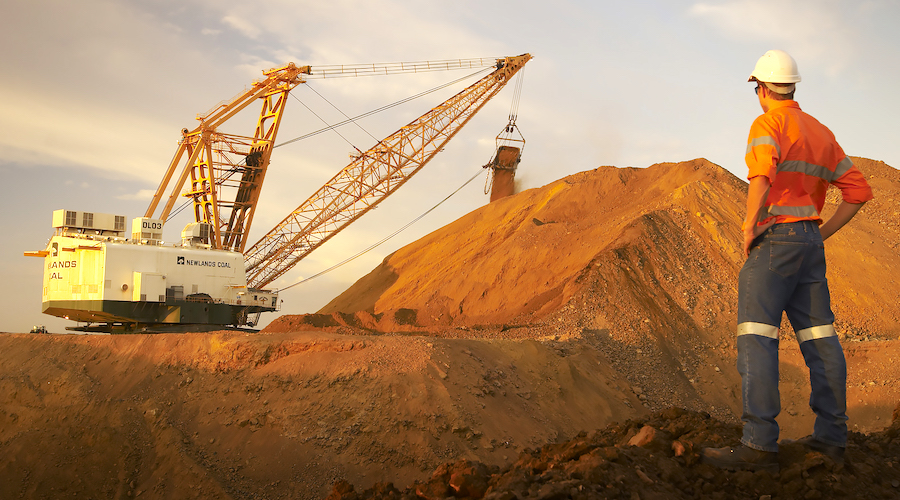
The Newlands coal mine produced thermal and metallurgical coal for export for 40 years, ending its mine life in February 2023. (Image courtesy of Glencore Australia.)
Glencore (LON: GLEN) has transferred almost $22 billion in foreign assets into its Australian subsidiary in a sweeping global restructure, laying the groundwork for a future mega-merger with a rival mining heavyweight.
The move, disclosed by the Australian Financial Review, means the total assets held by Glencore’s Australian entity have doubled to $42 billion. The shift required $3.8 billion in internal cash transfers and $614 million in intra-company share issuances to facilitate the asset migration.
The restructure consolidates coal mines in Canada, South Africa and Colombia, a major copper project in Argentina, and South African manganese, chrome and vanadium operations under Glencore Investment Pty Ltd, its Australia-based entity.
The strategic transfer of assets to Glencore’s Australian entity likely signals more than just operational streamlining. Investors say it positions the company squarely for a future merger. By centralizing key assets in a single jurisdiction, which is close to Asian markets, Glencore creates a more attractive and simplified structure for potential partners – or a mega-merger.
“Glencore coal assets would trade at a much higher multiple in Australia than London. There won’t be much reason to go to London other than cricket if Glencore and Anglo get knocked off,” Ben Cleary, a portfolio manager at Tribeca Investment Partners, told AFR.
Market observers noted the asset realignment follows months of behind-the-scenes discussions with Rio Tinto (ASX, LON: RIO), marking a dramatic shift in tone from earlier failed efforts. In 2014, Rio rejected a merger proposal outright, sparking a very public standoff between then-CEO Ivan Glasenberg and Rio’s leadership. But Glencore’s 2024 outreach met a warmer reception. Outgoing Rio chief Jakob Stausholm remained hesitant, but several senior executives, one of whom may succeed him, according to the AFR, were reportedly more receptive to the idea.
Despite shelving earlier plans to spin off its coal division, which delivered 38% of Glencore’s earnings last year, chief executive officer Gary Nagle has centralized all coal operations within the Australian unit. That includes its Canadian subsidiary Elk Valley Resources, which operates four steelmaking coal mines in British Columbia: Elkview, Fording River, Greenhills, and Line Creek. EVR also holds a 46% stake in Neptune Terminals, a key bulk export facility.
In Colombia, Glencore owns the Cerrejón open-pit coal mine. In South Africa, it controls the Impunzi thermal coal complex and holds stakes in the Mokala manganese mine, the Glencore–Merafe Chrome Venture, and the Rhovan-Bakwena Vanadium Venture. Joining the list of transferred assets is the MARA copper project in Argentina, which it acquired from Pan American in 2023.
The Australian arm also holds the company’s thermal and metallurgical coal assets in New South Wales and Queensland.
Doubling down on critical minerals
As merger speculation simmers, Glencore is also deepening its presence in Australia’s critical minerals sector. The Swiss miner and commodities trader has inked a three-year supply agreement with Cobalt Blue (ASX: COB) to provide cobalt hydroxide feedstock for the Kwinana refinery in Western Australia, which is set to become the country’s first cobalt refinery.
The deal will see Glencore supply up to 50% of the refinery’s cobalt input, starting once the facility begins commercial operations. It guarantees a minimum of 3,750 tonnes of cobalt hydroxide over the contract period, with 750 tonnes in the first year and 1,500 tonnes annually in the second and third years. The feedstock will come from Glencore’s operations in the Democratic Republic of Congo, specifically Kamoto Copper Company, in which it holds a 75% stake, and Mutanda Mining SARL.
The assets shift and cobalt supply deal show Glencore positioning itself for consolidation and growth, with Australia at the heart of its strategy.
CMB.TECH and Golden Ocean Finalize Merger Terms to Create Shipping Giant
After the merger with Golden Ocean, CMB.TECH will be one of the largest publicly traded diversified shipping groups (Golden Ocean)
A month after announcing the intent to merge their shipping operations, the Saverys family reported that terms have been reached for the combination of Golden Ocean into the family company CMB.TECH. The resulting combination is set to create one of the largest publicly traded diversified maritime groups.
The transaction is valuing Golden Ocean, the largest listed owner of large-size dry bulk vessels, at approximately $1.4 billion. Under the agreed terms, the shareholders will receive .95 shares of CMB.TECH. After the merger, CMB.TECH shareholders will own approximately 70 percent of the shares of the combined company which will continue as CMB.TECH with Golden Ocean becoming an operating subsidiary.
Presenting the rationale for the combination, management cites the creation of a diversified shipping company that will be more resilient and positioned to lead in the industry’s decarbonization efforts. CMB.TECH currently has more than 160 vessels, including, 30 dry bulk carriers as well as tankers, containerships, offshore wind, and workboats. Golden Ocean has more than 90 dry bulk vessels with an aggregate capacity of approximately 13.7 million dwt. With a fleet of more than 250 vessels and a projected market cap of $3.2 billion, the combined company will rival Frontline as the largest publicly traded shipping company and dwarf other shipping companies.
The deal, however, has been called into question by analysts and investors after pressures emerged on the dry bulk sector. Golden Ocean reported a week ago a net loss of $44 million for the first quarter of 2025.
“Our first quarter results reflect a weaker market environment, with softer charter rates and lower trading activity impacting our performance, in addition to our current intensive drydocking schedule. These headwinds were not unexpected given the seasonal slowdown and increased macroeconomic uncertainty, including the disruption caused by recently announced trade tariffs,” said Peder Simonsen, Chief Executive Officer and Chief Financial Officer of Godel Ocean.
He however asserted that the fundamentals underpinning of dry bulk shipping remain intact, in particular for the Capesize segment. He points to limited fleet growth, shifting trade patterns, and infrastructure-led demand in key regions as continuing to support a constructive medium-term outlook for the group.
Alexander Saverys, who will remain CEO of the combined company, has in the past spoken of a strategy of using conventional shipping to drive the company's efforts to become a leader in ammonia and hydrogen as maritime fuels. CMB.TECH has established ammonia and hydrogen fuel offerings and some of the first ships to operate on the emerging alternative fuels.
The merger remains subject to customary conditions, including regulatory approval and a vote by Golden Ocean shareholders. The companies report they expect to complete the merger in the third quarter of 2025.
_16098.jpg)