Iran war threatens Trump fight with inflation
By AFP
March 3, 2026

Economists expect US gas prices to rise following attacks on Iran and Tehran's retaliation - Copyright AFP Frederic J. BROWN
Beiyi SEOW
US-Israeli strikes in Iran, and Tehran’s retaliation, are set to trigger a surge in US gas prices with a potential knock-on inflationary hit that could pile pressure on President Donald Trump domestically as midterm elections approach.
Economists warn that costs at the gas pump — a politically sensitive issue — could jump in just days, while inflation risks would make the Federal Reserve more cautious of cutting interest rates.
The conflict started with strikes over the weekend that killed the Iranian supreme leader, and oil prices have soared as the war disrupted supplies.
The crucial Strait of Hormuz, through which 20 percent of global oil transits, has been effectively closed and energy infrastructure across the Middle East hit.
“Prices at the pump are likely to rise within days,” Oxford Economics lead analyst John Canavan told AFP.
Gas prices have been “slowly but steadily increasing since early January,” he said, adding that “retailers are typically quick to respond to any developments pushing prices higher.”
Already, the price of Brent crude has momentarily jumped to its highest level since July 2024.
Additional costs will stretch US households, threatening consumer spending which makes up two-thirds of US GDP, analysts say.
– ‘Pain point’ –
As steeper prices filter through the economy, this could mean higher fares on airlines and other modes of transport, alongside elevated logistic costs, said economist James Knightley of ING.
Even if the United States is self-sufficient in natural gas, these costs still take their cue from global markets. This means higher international prices could also push up electricity costs.
“This is undoubtedly going to be a pain point for the US economy,” Knightley said.
The US energy sector might get a boost but that could be offset by a hit to consumer confidence that is already weak from tariff and job security worries.
“If you’ve suddenly got to spend a whole lot more filling up your gas tank and paying more for your utility bills, that’s only going to intensify the pressure on consumer finances,” he said.
All of this could weigh on US economic growth if the war lasts for more than a couple of weeks, he added.
The Trump administration is likely wary and will try to mitigate energy price hikes, Nationwide chief economist Kathy Bostjancic told AFP.
“They know affordability is an issue for many households,” she said. “They’re very aware and would be sensitive that higher gasoline prices would negatively impact consumer confidence and sentiment.”
“That could show up in the voting booth in November,” she added.
– Fed caution –
For the US central bank, the risk of higher inflation and the chance of weakening growth and employment pull policymakers in different directions.
While the Fed would be inclined to keep interest rates elevated to rein in inflation, a deteriorating economy could trigger the need for cuts.
“We’ll have to wait and see,” New York Fed President John Williams told reporters Tuesday.
While the conflict affects prices, he said: “We’ll have to see how persistent this is and how long this is.”
Higher rates in the meantime would mean elevated borrowing costs, sustaining the pressure that firms and consumers face.
Bostjancic expects that if the rise in oil prices is largely contained and reverses soon, the Fed would have reason and room to cut rates still.
“We haven’t changed our baseline forecast yet,” she added. She expects two rate cuts in 2026, starting mid-year.
Inflation risks could make rate cuts “a difficult sell” for the Fed for now, said ING’s Knightley.
The bank has to “optimize policy for two very different goals” of low inflation and maximum employment, he added.
“I still think there is a case for rate cuts, but the near-term inflation dynamics mean that it’s more likely to be delayed,” he said.
By AFP
March 3, 2026
Economists expect US gas prices to rise following attacks on Iran and Tehran's retaliation - Copyright AFP Frederic J. BROWN
Beiyi SEOW
US-Israeli strikes in Iran, and Tehran’s retaliation, are set to trigger a surge in US gas prices with a potential knock-on inflationary hit that could pile pressure on President Donald Trump domestically as midterm elections approach.
Economists warn that costs at the gas pump — a politically sensitive issue — could jump in just days, while inflation risks would make the Federal Reserve more cautious of cutting interest rates.
The conflict started with strikes over the weekend that killed the Iranian supreme leader, and oil prices have soared as the war disrupted supplies.
The crucial Strait of Hormuz, through which 20 percent of global oil transits, has been effectively closed and energy infrastructure across the Middle East hit.
“Prices at the pump are likely to rise within days,” Oxford Economics lead analyst John Canavan told AFP.
Gas prices have been “slowly but steadily increasing since early January,” he said, adding that “retailers are typically quick to respond to any developments pushing prices higher.”
Already, the price of Brent crude has momentarily jumped to its highest level since July 2024.
Additional costs will stretch US households, threatening consumer spending which makes up two-thirds of US GDP, analysts say.
– ‘Pain point’ –
As steeper prices filter through the economy, this could mean higher fares on airlines and other modes of transport, alongside elevated logistic costs, said economist James Knightley of ING.
Even if the United States is self-sufficient in natural gas, these costs still take their cue from global markets. This means higher international prices could also push up electricity costs.
“This is undoubtedly going to be a pain point for the US economy,” Knightley said.
The US energy sector might get a boost but that could be offset by a hit to consumer confidence that is already weak from tariff and job security worries.
“If you’ve suddenly got to spend a whole lot more filling up your gas tank and paying more for your utility bills, that’s only going to intensify the pressure on consumer finances,” he said.
All of this could weigh on US economic growth if the war lasts for more than a couple of weeks, he added.
The Trump administration is likely wary and will try to mitigate energy price hikes, Nationwide chief economist Kathy Bostjancic told AFP.
“They know affordability is an issue for many households,” she said. “They’re very aware and would be sensitive that higher gasoline prices would negatively impact consumer confidence and sentiment.”
“That could show up in the voting booth in November,” she added.
– Fed caution –
For the US central bank, the risk of higher inflation and the chance of weakening growth and employment pull policymakers in different directions.
While the Fed would be inclined to keep interest rates elevated to rein in inflation, a deteriorating economy could trigger the need for cuts.
“We’ll have to wait and see,” New York Fed President John Williams told reporters Tuesday.
While the conflict affects prices, he said: “We’ll have to see how persistent this is and how long this is.”
Higher rates in the meantime would mean elevated borrowing costs, sustaining the pressure that firms and consumers face.
Bostjancic expects that if the rise in oil prices is largely contained and reverses soon, the Fed would have reason and room to cut rates still.
“We haven’t changed our baseline forecast yet,” she added. She expects two rate cuts in 2026, starting mid-year.
Inflation risks could make rate cuts “a difficult sell” for the Fed for now, said ING’s Knightley.
The bank has to “optimize policy for two very different goals” of low inflation and maximum employment, he added.
“I still think there is a case for rate cuts, but the near-term inflation dynamics mean that it’s more likely to be delayed,” he said.
Mideast war exposes fragile oil, gas dependency
By AFP
March 3, 2026

Image: © Saudi Aramco/AFP JOE LYNCH
Ali BEKHTAOUI
As in 2022 when Russia invaded Ukraine, the new war in the Middle East is exposing once again how far Europe and others lag in replacing imported fossil fuels with domestic solar and wind power, specialists say.
The Russian invasion in 2022 triggered a massive energy crisis, particularly in Europe, where gas prices — then largely dependent on imports from Russia — soared.
Four years later, the continent is instead importing liquid natural gas (LNG) in large volumes, notably from Qatar — one of the countries caught up in Iran’s retaliation against US and Israeli attacks.
Europe also remains dependent on oil from the Middle East, where ships have been blocked and sometimes targeted by Iranian strikes.
Regarding its energy security, “Europe is facing the biggest wake‑up call since the invasion in Ukraine”, said Ana Maria Jaller‑Makarewicz, analyst for the Institute for Energy Economics and Financial Analysis (IEEFA).
For Jan Rosenow, professor of energy and climate policy at the University of Oxford, the latest conflict prompted a sense of “deja vu”, recalling 2022.
“What this shows is that we haven’t really learned the lessons that we should have learned from that experience. When you look at the dependency rate of Europe on oil and gas — it hasn’t really gone down.”
– Energy transition –
Despite countries’ pledging to reduce their burning of planet-warming fossil fuels, Europe remains dependent on them for more than two-thirds of its energy consumption — primarily for vehicles, heating and industry — according to the International Energy Agency.
Only electricity generation has clearly decarbonised in recent years. Fossil fuels produced just 29 percent of the European Union’s electricity last year, according to research group Ember.
Across Europe, political appetite for further investment in renewable energy for the wider economy has faded.
Countries are far short of global targets for shifting away from fossil fuels despite pledges under the 2015 Paris climate agreement, with some countries — notably the United States — even rolling back commitments.
The new war meanwhile drove up oil prices by about seven percent on Monday, while European gas prices skyrocketed by more than 30 percent.
For climate leaders, this highlights the need to get the transition back on track.
“The global transition is still too slow,” United Nations climate chief Simon Stiell warned on LinkedIn.
Renewables, he wrote, are now “the obvious pathway to energy security and sovereignty”.
– Fossil fuel reliance –
Even if gas dependency has shifted from Russia to suppliers such as the United States, the fresh unrest exposes Europe’s “continued reliance on imported fossil fuels traded on volatile global markets”, said Simone Tagliapietra, a researcher at European think tank Bruegel.
“Rather than slowing down the low-carbon transition, the new tensions show that the deployment of clean, domestically produced energy sources should be accelerated,” he said.
“Only by reducing structural dependence on oil and LNG imports can Europe durably shield its economy from recurrent external shocks.”
Between 10 and 15 percent of Europe’s gas imports come from Qatar.
European gas prices jumped after QatarEnergy, the state‑owned energy company, announced a halt in LNG production following an Iranian drone attack.
“Historically, fossil fuels were promised to deliver… some form of freedom, some form of democracy, some form of growth, and above all, some form of security,” said Pauline Heinrichs, a climate diplomacy specialist at King’s College London.
“I think this illegal and unnecessary war is both a reminder that this is obviously false and, second, that this is, at least in security terms, an illusion.”
By AFP
March 3, 2026
Image: © Saudi Aramco/AFP JOE LYNCH
Ali BEKHTAOUI
As in 2022 when Russia invaded Ukraine, the new war in the Middle East is exposing once again how far Europe and others lag in replacing imported fossil fuels with domestic solar and wind power, specialists say.
The Russian invasion in 2022 triggered a massive energy crisis, particularly in Europe, where gas prices — then largely dependent on imports from Russia — soared.
Four years later, the continent is instead importing liquid natural gas (LNG) in large volumes, notably from Qatar — one of the countries caught up in Iran’s retaliation against US and Israeli attacks.
Europe also remains dependent on oil from the Middle East, where ships have been blocked and sometimes targeted by Iranian strikes.
Regarding its energy security, “Europe is facing the biggest wake‑up call since the invasion in Ukraine”, said Ana Maria Jaller‑Makarewicz, analyst for the Institute for Energy Economics and Financial Analysis (IEEFA).
For Jan Rosenow, professor of energy and climate policy at the University of Oxford, the latest conflict prompted a sense of “deja vu”, recalling 2022.
“What this shows is that we haven’t really learned the lessons that we should have learned from that experience. When you look at the dependency rate of Europe on oil and gas — it hasn’t really gone down.”
– Energy transition –
Despite countries’ pledging to reduce their burning of planet-warming fossil fuels, Europe remains dependent on them for more than two-thirds of its energy consumption — primarily for vehicles, heating and industry — according to the International Energy Agency.
Only electricity generation has clearly decarbonised in recent years. Fossil fuels produced just 29 percent of the European Union’s electricity last year, according to research group Ember.
Across Europe, political appetite for further investment in renewable energy for the wider economy has faded.
Countries are far short of global targets for shifting away from fossil fuels despite pledges under the 2015 Paris climate agreement, with some countries — notably the United States — even rolling back commitments.
The new war meanwhile drove up oil prices by about seven percent on Monday, while European gas prices skyrocketed by more than 30 percent.
For climate leaders, this highlights the need to get the transition back on track.
“The global transition is still too slow,” United Nations climate chief Simon Stiell warned on LinkedIn.
Renewables, he wrote, are now “the obvious pathway to energy security and sovereignty”.
– Fossil fuel reliance –
Even if gas dependency has shifted from Russia to suppliers such as the United States, the fresh unrest exposes Europe’s “continued reliance on imported fossil fuels traded on volatile global markets”, said Simone Tagliapietra, a researcher at European think tank Bruegel.
“Rather than slowing down the low-carbon transition, the new tensions show that the deployment of clean, domestically produced energy sources should be accelerated,” he said.
“Only by reducing structural dependence on oil and LNG imports can Europe durably shield its economy from recurrent external shocks.”
Between 10 and 15 percent of Europe’s gas imports come from Qatar.
European gas prices jumped after QatarEnergy, the state‑owned energy company, announced a halt in LNG production following an Iranian drone attack.
“Historically, fossil fuels were promised to deliver… some form of freedom, some form of democracy, some form of growth, and above all, some form of security,” said Pauline Heinrichs, a climate diplomacy specialist at King’s College London.
“I think this illegal and unnecessary war is both a reminder that this is obviously false and, second, that this is, at least in security terms, an illusion.”
Will US oil companies be the big winners from the Iran war?
By AFP
March 3, 2026

Image: — © AFP/File Hussein FALEH
John BIERS
Energy prices have surged dramatically since the United States and Israel launched their attack on Iran Saturday, and that will almost certainly translate into bigger profits.
But the question remains whether the new war in the Middle East also leads to increased oilfield investment.
– What does the Middle East war mean for US oil industry profits? –
Geopolitical crises lift oil industry profits if a supply disruption causes commodity prices to spike. That’s what happened after Russia invaded Ukraine.
In the third quarter of 2022, ExxonMobil and Chevron reported more than $30 billion in profits between the two companies. The results were boosted by a surge in crude and natural gas prices.
Brent oil futures briefly surged above $85 a barrel Tuesday, while European natural gas prices reached their highest level in 2023.
These increases show the market’s response to the effective shutdown of the Strait of Hormuz, a waterway accounting for some 20 percent of global crude supplies. The jump in the natural gas market is due to QatarEnergy’s suspension of liquefied natural gas (LNG) production.
“Certainly, the producers get a benefit when prices go up like this,” said Again Capital’s John Kilduff. “This will definitely help their bottom lines.”
The question is whether commodity prices will stay high.
– Will US companies invest to produce more oil and natural gas? –
Energy industry analysts don’t expect companies to drill more wells or increase capital budgets unless they conclude the outages will be lengthy. Investments in projects that don’t come online for months or years requires confidence prices will stay high.
“What US companies would need to see would be a sustained higher price,” said Dan Pickering of Pickering Energy partners in Houston, who thinks oil prices could reach $100 a barrel if the Strait of Hormuz stays empty for a meaningful duration.
But such a lengthy outage is far from a sure thing.
President Donald Trump — closely attuned to the political implications of gasoline prices ahead of mid-term elections — said Tuesday that the US navy would escort oil tankers through the Strait of Hormuz if needed, and ordered Washington to provide insurance for shipping.
The announcement prompted a modest pullback in oil prices, which finished below session highs.
Oil prices could retreat further if the United States, China and other countries tap emergency stockpiles, said Ken Medlock, a fellow at the Baker Institute for Public Policy at Rice University in Houston.
Futures markets currently show oil prices retreating gradually in the second half of 2026, implying “the market is seeing it as a short-term” disruption, Medlock said.
– How much could US energy supply grow and where would investments go? –
While the US energy industry is poised to benefit from Middle East oil and gas outages, the United States “cannot simply ‘flip a switch’ to replace large, sudden Middle Eastern outages,” said Brian Kessens, portfolio manager at Tortoise Capital.
Some elements of the petroleum industry have already benefited from the upheaval. Kessens said refined products dislocated by the Hormuz outage has boosted profit margins for Gulf Coast refiners.
Other short-term winners include LNG exporters who have capacity not committed in contracts.
Despite this, “meaningful incremental supply typically requires months to years,” Kessens said.
Among the potential upstream oil and gas candidates, analysts said the most likely pick for incremental additional investment would be shale properties such as the Permian Basin in the US, where oil companies are already active and which have a shorter payback compared with other prospects.
“The focus would be on short-cycle, quick results activity. US shale, maybe a little bit of Venezuela,” Pickering said. “Then it would move to longer-term projects like exploration and offshore.”
By AFP
March 3, 2026
Image: — © AFP/File Hussein FALEH
John BIERS
Energy prices have surged dramatically since the United States and Israel launched their attack on Iran Saturday, and that will almost certainly translate into bigger profits.
But the question remains whether the new war in the Middle East also leads to increased oilfield investment.
– What does the Middle East war mean for US oil industry profits? –
Geopolitical crises lift oil industry profits if a supply disruption causes commodity prices to spike. That’s what happened after Russia invaded Ukraine.
In the third quarter of 2022, ExxonMobil and Chevron reported more than $30 billion in profits between the two companies. The results were boosted by a surge in crude and natural gas prices.
Brent oil futures briefly surged above $85 a barrel Tuesday, while European natural gas prices reached their highest level in 2023.
These increases show the market’s response to the effective shutdown of the Strait of Hormuz, a waterway accounting for some 20 percent of global crude supplies. The jump in the natural gas market is due to QatarEnergy’s suspension of liquefied natural gas (LNG) production.
“Certainly, the producers get a benefit when prices go up like this,” said Again Capital’s John Kilduff. “This will definitely help their bottom lines.”
The question is whether commodity prices will stay high.
– Will US companies invest to produce more oil and natural gas? –
Energy industry analysts don’t expect companies to drill more wells or increase capital budgets unless they conclude the outages will be lengthy. Investments in projects that don’t come online for months or years requires confidence prices will stay high.
“What US companies would need to see would be a sustained higher price,” said Dan Pickering of Pickering Energy partners in Houston, who thinks oil prices could reach $100 a barrel if the Strait of Hormuz stays empty for a meaningful duration.
But such a lengthy outage is far from a sure thing.
President Donald Trump — closely attuned to the political implications of gasoline prices ahead of mid-term elections — said Tuesday that the US navy would escort oil tankers through the Strait of Hormuz if needed, and ordered Washington to provide insurance for shipping.
The announcement prompted a modest pullback in oil prices, which finished below session highs.
Oil prices could retreat further if the United States, China and other countries tap emergency stockpiles, said Ken Medlock, a fellow at the Baker Institute for Public Policy at Rice University in Houston.
Futures markets currently show oil prices retreating gradually in the second half of 2026, implying “the market is seeing it as a short-term” disruption, Medlock said.
– How much could US energy supply grow and where would investments go? –
While the US energy industry is poised to benefit from Middle East oil and gas outages, the United States “cannot simply ‘flip a switch’ to replace large, sudden Middle Eastern outages,” said Brian Kessens, portfolio manager at Tortoise Capital.
Some elements of the petroleum industry have already benefited from the upheaval. Kessens said refined products dislocated by the Hormuz outage has boosted profit margins for Gulf Coast refiners.
Other short-term winners include LNG exporters who have capacity not committed in contracts.
Despite this, “meaningful incremental supply typically requires months to years,” Kessens said.
Among the potential upstream oil and gas candidates, analysts said the most likely pick for incremental additional investment would be shale properties such as the Permian Basin in the US, where oil companies are already active and which have a shorter payback compared with other prospects.
“The focus would be on short-cycle, quick results activity. US shale, maybe a little bit of Venezuela,” Pickering said. “Then it would move to longer-term projects like exploration and offshore.”
Mideast war risks sending global economy into stagflation
By AFP
March 2, 2026

The duration of the conflict will be key to determining its impact on the global economy, say economists - Copyright US NAVY/AFP -
Sophie LAUBIE
An extended conflict in the Middle East after the US and Israel launched strikes on Iran could trigger global stagflation — a troublesome blend of high inflation and anaemic growth — due to spiking oil and gas prices, economists warned.
– Will there be an oil shock ? –
The conflict has nearly halted traffic through the Strait of Hormuz, through which around 20 percent of global seaborne oil passes, with several ships attacked.
Global oil prices shot higher on Monday, with the Brent crude international reference oil contract up nearly nine percent at $79.30 per barrel at 1410 GMT.
It briefly surpassed $80 per barrel earlier in the day, and was up considerably from the $61 per barrel at the start of the year.
Economist Sylvain Bersinger said the war risks “creating a third oil shock after those in 1973 and 1979 and the 2022 gas shock”.
Europe’s benchmark gas price shot more than 50 percent higher on Monday.
He said the price of oil could rise to $110 per barrel, but added that was no longer exceptional as oil prices had risen over $140 in 2008 and were above $100 in the 2010s.
Adam Hetts at asset manager Janus Henderson said that while oil prices would certainly rise, the increase should remain “at reasonable levels”.
– What impact on global trade? –
The conflict could act as a shock to trade “at the worst possible moment”, said economists at ING bank.
The global trading system is already under stress from US President Donald Trump’s tariff offensive as well as the fragmentation of supply chains since Covid and the war in Ukraine.
Moreover the closure of the Gulf airspace is disrupting aviation between European and Asia, they noted.
For Ruben Nizard, head of political risk research at Coface, a trade credit insurance company, this crisis could also “throw another wrench into the works by driving up maritime freight costs” and pushing up inflation.
“At the global level, this would open the door to an economic scenario of stagflation,” he added, referring to a situation with high inflation and weak or non-existent growth.
– What impact on the global economy? –
According to economists at Natixis bank, a prolonged disruption of traffic in the Strait of Hormuz “would have major implications for markets, but also for inflation dynamics and overall economic stability”.
They added that “China would be particularly affected by this war.”
Cyrille Poirier-Coutansais, director of the research department at the French Navy’s Centre for Strategic Studies, agreed that China is particularly dependent upon oil shipped through the Strait of Hormuz.
“The question is whether there will be enough fuel to keep the world’s factory running,” he told AFP.
For the economist Sylvain Bersinger the impact on Europe will likely be less than the 2022 gas shock, which would help France in particular to avoid a recession.
In a sign of declining investor confidence, the interest rate on European sovereign bonds climbed on Monday.
The yield on 10-year German government bonds, the benchmark in the eurozone, stood at 2.70 percent in afternoon trading, compared with 2.64 percent on Friday.
– What risks in a long war? –
The intensity and duration of the conflict will be key in determining its impact.
“In a prolonged conflict, the combination of higher energy costs, disrupted logistics, and a generalised confidence shock would constitute a meaningful drag on global trade volumes at precisely the moment the world economy was still digesting the inflationary and growth consequences of the tariff shock,” said economists at ING bank.
Coface’s Nizard said they estimated that “an increase of roughly 15 dollars in the price of Brent over a prolonged period could shave about 0.2 percentage points off global growth and add almost half a point to inflation.”
These are “not insignificant” effects in a context of “fairly fragile global economic growth”, he added.
By AFP
March 2, 2026
The duration of the conflict will be key to determining its impact on the global economy, say economists - Copyright US NAVY/AFP -
Sophie LAUBIE
An extended conflict in the Middle East after the US and Israel launched strikes on Iran could trigger global stagflation — a troublesome blend of high inflation and anaemic growth — due to spiking oil and gas prices, economists warned.
– Will there be an oil shock ? –
The conflict has nearly halted traffic through the Strait of Hormuz, through which around 20 percent of global seaborne oil passes, with several ships attacked.
Global oil prices shot higher on Monday, with the Brent crude international reference oil contract up nearly nine percent at $79.30 per barrel at 1410 GMT.
It briefly surpassed $80 per barrel earlier in the day, and was up considerably from the $61 per barrel at the start of the year.
Economist Sylvain Bersinger said the war risks “creating a third oil shock after those in 1973 and 1979 and the 2022 gas shock”.
Europe’s benchmark gas price shot more than 50 percent higher on Monday.
He said the price of oil could rise to $110 per barrel, but added that was no longer exceptional as oil prices had risen over $140 in 2008 and were above $100 in the 2010s.
Adam Hetts at asset manager Janus Henderson said that while oil prices would certainly rise, the increase should remain “at reasonable levels”.
– What impact on global trade? –
The conflict could act as a shock to trade “at the worst possible moment”, said economists at ING bank.
The global trading system is already under stress from US President Donald Trump’s tariff offensive as well as the fragmentation of supply chains since Covid and the war in Ukraine.
Moreover the closure of the Gulf airspace is disrupting aviation between European and Asia, they noted.
For Ruben Nizard, head of political risk research at Coface, a trade credit insurance company, this crisis could also “throw another wrench into the works by driving up maritime freight costs” and pushing up inflation.
“At the global level, this would open the door to an economic scenario of stagflation,” he added, referring to a situation with high inflation and weak or non-existent growth.
– What impact on the global economy? –
According to economists at Natixis bank, a prolonged disruption of traffic in the Strait of Hormuz “would have major implications for markets, but also for inflation dynamics and overall economic stability”.
They added that “China would be particularly affected by this war.”
Cyrille Poirier-Coutansais, director of the research department at the French Navy’s Centre for Strategic Studies, agreed that China is particularly dependent upon oil shipped through the Strait of Hormuz.
“The question is whether there will be enough fuel to keep the world’s factory running,” he told AFP.
For the economist Sylvain Bersinger the impact on Europe will likely be less than the 2022 gas shock, which would help France in particular to avoid a recession.
In a sign of declining investor confidence, the interest rate on European sovereign bonds climbed on Monday.
The yield on 10-year German government bonds, the benchmark in the eurozone, stood at 2.70 percent in afternoon trading, compared with 2.64 percent on Friday.
– What risks in a long war? –
The intensity and duration of the conflict will be key in determining its impact.
“In a prolonged conflict, the combination of higher energy costs, disrupted logistics, and a generalised confidence shock would constitute a meaningful drag on global trade volumes at precisely the moment the world economy was still digesting the inflationary and growth consequences of the tariff shock,” said economists at ING bank.
Coface’s Nizard said they estimated that “an increase of roughly 15 dollars in the price of Brent over a prolonged period could shave about 0.2 percentage points off global growth and add almost half a point to inflation.”
These are “not insignificant” effects in a context of “fairly fragile global economic growth”, he added.
Energy infrastructure emerges as war target, lifting prices
By AFP
March 2, 2026

Qatar's state-run energy firm said it had halted liquefied natural gas production following Iranian attacks on facilities at two of its main gas processing bases - Copyright AFP/File Fadel SENNA
Théo MARIE-COURTOIS with Pol-Malo LE BRIS in London
Energy prices surged Monday as the war in the Middle East led to outages of key energy production operations and a critical waterway was essentially emptied of traffic.
European natural gas prices finished the day up more than 39 percent after surging more than 50 percent earlier in the day.
Brent oil futures rose to above $82 dollars a barrel, a gain of more than 13 percent early in the session. The benchmark finished up 7.3 percent at $77.74 a barrel, up around $15 compared with the start of 2026.
US benchmark West Texas Intermediate ended at $71.23 a barrel, up 6.3 percent.
– Suspended output –
The surge in prices comes as key energy facilities emerge as targets in the war.
Qatar’s state-run energy firm said it had halted liquefied natural gas production following Iranian attacks on facilities at two of its main gas processing bases.
Earlier, the massive Ras Tanura refinery on Saudi Arabia’s Gulf coast went into partial shutdown after a strike by drones led to a fire.
A terminal in Abu Dhabi was also attacked by a drone.
– Hormuz exodus –
In parallel, energy markets are also absorbing a de facto halt to traffic in the Strait of Hormuz, through which about 20 percent of global supply of oil and LNG travel.
The waterway has not technically been closed, but major maritime companies have suspended travel through it as insurance costs soar amid heightened risk.
Since Israel and the United States launched strikes on Iran on Saturday, the world’s largest shipping firms — Italian-Swiss MSC, Denmark’s Maersk, France’s CMA CGM, Germany’s Hapaq Lloyd and China’s Cosco — have ordered their ships to find shelter and stay safe.
The exodus of ships from the waterway will prevent some 15 million barrels per day of oil from reaching global markets, estimated Rystad Energy senior vice president Jorge Leon.
“Whether the Strait is closed by force or rendered inaccessible by risk avoidance, the impact on flows is largely the same,” Leon said in a note. “Nations with strategic petroleum reserves may take action and release volumes if the disruption of the Strait risks being extended.”
– Asia, Europe impacted –
The upheaval in the Middle East poses particular risks for Asian countries, the market for about 80 percent of the petroleum through the Hormuz, according to the International Energy Agency.
But the conflict also poses risks to Europe, a major market for LNG from Qatar.
“The closure has potentially severe implications for Europe’s energy security,” said a note from Eurasia Group that pointed out that European gas markets are “very tight” after a cold winter.
– $100 oil? –
Petroleum-importing countries within the Organization for Economic Co-operation and Development are required to keep 90 days of emergency crude stockpiles that in theory should limit price increases.
But under a “worst-case scenario” gamed out by Eurasia Group, damage to Iran’s oilfields permanently hits the country’s exports, while the precarity to Hormuz traffic persists.
“In that case, the combination of heightened risk to traffic, the long-term loss of Iranian exports, and the short-term loss of other regional production would be enough to push the Brent per barrel price close to $100 per barrel,” said Eurasia, which projected prices of $75-$85 a barrel as a more likely outcome.
The last time oil prices topped $100 a barrel was at the start of the Ukraine war, when natural gas prices also spiked well above Monday’s level.
Kpler analyst Michelle Brouhard described high oil prices as “the Achilles heel of (US President Donald) Trump,” adding that Iran was likely to look to keep crude prices lofty to pressure the US president ahead of midterm elections in November.
Trump himself has said he expects the operation to go four or five weeks.
After a bad start, Wall Street stocks finished Monday’s session mixed, a sign investors don’t expect an especially lengthy impact.
Oxford Economics predicted that Iran would struggle to keep the Strait of Hormuz quiet for long, but that a period of “lower-level disruption to trade flows” was more plausible.
Oxford expects oil prices to rise to almost $80 a barrel in the second quarter before eventually dropping back to $60.
“The duration of the conflict and the nature of any regime change in Iran is key to understanding the economic impact, but these remain highly uncertain,” Oxford said.
By AFP
March 2, 2026
Qatar's state-run energy firm said it had halted liquefied natural gas production following Iranian attacks on facilities at two of its main gas processing bases - Copyright AFP/File Fadel SENNA
Théo MARIE-COURTOIS with Pol-Malo LE BRIS in London
Energy prices surged Monday as the war in the Middle East led to outages of key energy production operations and a critical waterway was essentially emptied of traffic.
European natural gas prices finished the day up more than 39 percent after surging more than 50 percent earlier in the day.
Brent oil futures rose to above $82 dollars a barrel, a gain of more than 13 percent early in the session. The benchmark finished up 7.3 percent at $77.74 a barrel, up around $15 compared with the start of 2026.
US benchmark West Texas Intermediate ended at $71.23 a barrel, up 6.3 percent.
– Suspended output –
The surge in prices comes as key energy facilities emerge as targets in the war.
Qatar’s state-run energy firm said it had halted liquefied natural gas production following Iranian attacks on facilities at two of its main gas processing bases.
Earlier, the massive Ras Tanura refinery on Saudi Arabia’s Gulf coast went into partial shutdown after a strike by drones led to a fire.
A terminal in Abu Dhabi was also attacked by a drone.
– Hormuz exodus –
In parallel, energy markets are also absorbing a de facto halt to traffic in the Strait of Hormuz, through which about 20 percent of global supply of oil and LNG travel.
The waterway has not technically been closed, but major maritime companies have suspended travel through it as insurance costs soar amid heightened risk.
Since Israel and the United States launched strikes on Iran on Saturday, the world’s largest shipping firms — Italian-Swiss MSC, Denmark’s Maersk, France’s CMA CGM, Germany’s Hapaq Lloyd and China’s Cosco — have ordered their ships to find shelter and stay safe.
The exodus of ships from the waterway will prevent some 15 million barrels per day of oil from reaching global markets, estimated Rystad Energy senior vice president Jorge Leon.
“Whether the Strait is closed by force or rendered inaccessible by risk avoidance, the impact on flows is largely the same,” Leon said in a note. “Nations with strategic petroleum reserves may take action and release volumes if the disruption of the Strait risks being extended.”
– Asia, Europe impacted –
The upheaval in the Middle East poses particular risks for Asian countries, the market for about 80 percent of the petroleum through the Hormuz, according to the International Energy Agency.
But the conflict also poses risks to Europe, a major market for LNG from Qatar.
“The closure has potentially severe implications for Europe’s energy security,” said a note from Eurasia Group that pointed out that European gas markets are “very tight” after a cold winter.
– $100 oil? –
Petroleum-importing countries within the Organization for Economic Co-operation and Development are required to keep 90 days of emergency crude stockpiles that in theory should limit price increases.
But under a “worst-case scenario” gamed out by Eurasia Group, damage to Iran’s oilfields permanently hits the country’s exports, while the precarity to Hormuz traffic persists.
“In that case, the combination of heightened risk to traffic, the long-term loss of Iranian exports, and the short-term loss of other regional production would be enough to push the Brent per barrel price close to $100 per barrel,” said Eurasia, which projected prices of $75-$85 a barrel as a more likely outcome.
The last time oil prices topped $100 a barrel was at the start of the Ukraine war, when natural gas prices also spiked well above Monday’s level.
Kpler analyst Michelle Brouhard described high oil prices as “the Achilles heel of (US President Donald) Trump,” adding that Iran was likely to look to keep crude prices lofty to pressure the US president ahead of midterm elections in November.
Trump himself has said he expects the operation to go four or five weeks.
After a bad start, Wall Street stocks finished Monday’s session mixed, a sign investors don’t expect an especially lengthy impact.
Oxford Economics predicted that Iran would struggle to keep the Strait of Hormuz quiet for long, but that a period of “lower-level disruption to trade flows” was more plausible.
Oxford expects oil prices to rise to almost $80 a barrel in the second quarter before eventually dropping back to $60.
“The duration of the conflict and the nature of any regime change in Iran is key to understanding the economic impact, but these remain highly uncertain,” Oxford said.
By AFP
March 2, 2026

Dubai suspended operations after its international airport was hit - Copyright US NAVY/AFP -
Tangi QUEMENER
Air routes closed, airports damaged and hundreds of thousands of passengers stranded: the new war in the Middle East has again highlighted the global aviation sector’s vulnerability to geopolitical upheaval.
Much of the region’s airspace has been shut after the US and Israeli attack on Iran and its retaliatory strikes in the region — further disrupting a global air-traffic scene already complicated by Russia’s war in Ukraine.
Dubai International Airport, Kuwait’s main airport and a British military airbase in Cyprus were hit during Iran’s response.
Iran, Iraq, Israel, Syria, Kuwait, Qatar and the United Arab Emirates all announced at least partial closures of their skies.
The International Air Transport Association (IATA) on Monday called on all sides to refrain from targeting civilian aircraft and airports.
For commercial airlines, the conflict raised memories of disasters such as that of Malaysia Airlines flight MH17, destroyed by a missile over Ukraine in 2014 with 298 people killed, or the Ukrainian Boeing accidentally shot down by Iran in 2020, killing 176.
“It is critical that states respect their obligation to keep civilians and civil aviation free from harm,” said the head of IATA, Willie Walsh, head of the International Air Transport Association.
“We all hope for an early peaceful resolution to the current hostilities.”
– Thousands of flights cancelled –
Dubai’s airports announced they would resume limited flights on Monday evening but Air France said it was extending its suspension of flights to that and three other airports until March 5.
According to the aeronautical data provider Cirium, at least 1,560 inbound flights to the Middle East out of 3,779 were cancelled on Monday.
On Sunday, 2,000 cancellations were recorded out of 4,000 flights — representing about 900,000 aircraft seats.
Beyond Iran, no civil aircraft were flying on Monday afternoon over the Emirates, Qatar, Kuwait or Iraq, according to the online mapping tool of the website Flightradar24.
The major air corridor over the Euphrates Valley in Iraq was empty.
Aircraft connecting Europe to Asia were flying either via the Gulf of Suez and then through central Saudi Arabia and Oman, or much further north through the narrow Armenia–Azerbaijan corridor.
These two countries, lying between Iran and the Russian Caucasus, have become essential to aviation since Russia’s invasion of Ukraine in 2022.
Moscow barred Western and Japanese airlines from its airspace in retaliation for similar measures targeting its own carriers.
No-fly “red zones” have multiplied in recent years — notably linked to the war in Gaza and clashes between Israel and Lebanon’s Hezbollah, but also in Africa, Afghanistan and Pakistan.
Strait of Hormuz impasse squeezes world shipping
By AFP
March 2, 2026

The conflict has upended shipping in the region - Copyright AFP Karim SAHIB
Isabel MALSANG
With few captains willing to brave the Strait of Hormuz as war rages around the Gulf, companies will have to do business without one of the world’s most vital shipping lanes, especially for oil and gas.
– What is the strait’s importance to world markets? –
The strait is especially key to the world energy markets, with around 20 percent of global seaborne oil passing through.
That said, analysts believe that cutting off access, as Iran has threatened to do, will not affect the major Asia-Europe shipping route, with the Gulf ending in a cul-de-sac by the shores of Kuwait, Iraq and Iran.
But the strait is essential to all regional trade as it allows access to Dubai’s Jebel Ali port, the world’s 10th-largest container port and a redistribution hub for more than a dozen countries in the region.
In Jebel Ali, container ships are unloaded onto smaller vessels bound for countries ranging from east Africa to India, noted Anne-Sophie Fribourg, vice-president of France’s TLF freighters union.
– Has it ever been closed? –
The Strait of Hormuz has always been open for business.
Even during the Iran-Iraq war between 1980 and 1988, commercial passage was maintained despite attacks on oil tankers, said Paul Tourret, director of the French High Institute for Maritime Economy.
The current “freeze” on goods transiting through the strait is “unprecedented”, said Cyrille Poirier-Coutansais, research director at the French Navy’s Strategic Studies Centre.
Since Israel and the United States launched strikes on Iran on Saturday, the world’s largest shipping firms — Italian-Swiss MSC, Denmark’s Maersk, France’s CMA CGM, Germany’s Hapaq Lloyd and China’s Cosco — have ordered their ships to find shelter and stay safe.
On the Marine Traffic map, which tracks world shipping movements, you can make out clusters of ships, mainly tankers, anchored far to the north near Kuwait, as well as off the coast near Dubai.
The Iranian merchant navy is likewise visible off the Iranian port of Bandar Abbas on the other side of the strait.
Several other distinct groups of ships can be seen just before the entry to Hormuz, Tourret said.
– What goods transit through Hormuz? –
Germany ships cars, machinery and industrial products via the strait, while France mainly sells cereals and agricultural products, cosmetics, luxury goods and pharmaceuticals.
Italy, meanwhile, exports food, large quantities of marble and ceramics, said TLF’s Fribourg.
In the other direction, besides oil and gas, from which fertilisers and plastics are derived, the Middle East accounts for nine percent of the world’s primary aluminium production, nearly all of which is exported, according to TD Commodities.
– Will there be delays? Price increases? –
Several online shopping platforms have warned their clients that delivery times may increase.
Temu and Shein have warned of delays of several days, while Amazon forecast even longer waits, according to Bloomberg.
Freight costs are already rising as a result of the additional charges shipping companies are imposing for transit in the region.
For the Europe-Asia route, ships are also no longer using the passage through the Red Sea and the Suez Canal due to fears of renewed attacks by Iran’s allies in Yemen, the Houthis.
Rounding the Cape of Good Hope, at the tip of South Africa, adds around 10 extra days at sea and increases costs by roughly 30 percent.
By AFP
March 2, 2026
The conflict has upended shipping in the region - Copyright AFP Karim SAHIB
Isabel MALSANG
With few captains willing to brave the Strait of Hormuz as war rages around the Gulf, companies will have to do business without one of the world’s most vital shipping lanes, especially for oil and gas.
– What is the strait’s importance to world markets? –
The strait is especially key to the world energy markets, with around 20 percent of global seaborne oil passing through.
That said, analysts believe that cutting off access, as Iran has threatened to do, will not affect the major Asia-Europe shipping route, with the Gulf ending in a cul-de-sac by the shores of Kuwait, Iraq and Iran.
But the strait is essential to all regional trade as it allows access to Dubai’s Jebel Ali port, the world’s 10th-largest container port and a redistribution hub for more than a dozen countries in the region.
In Jebel Ali, container ships are unloaded onto smaller vessels bound for countries ranging from east Africa to India, noted Anne-Sophie Fribourg, vice-president of France’s TLF freighters union.
– Has it ever been closed? –
The Strait of Hormuz has always been open for business.
Even during the Iran-Iraq war between 1980 and 1988, commercial passage was maintained despite attacks on oil tankers, said Paul Tourret, director of the French High Institute for Maritime Economy.
The current “freeze” on goods transiting through the strait is “unprecedented”, said Cyrille Poirier-Coutansais, research director at the French Navy’s Strategic Studies Centre.
Since Israel and the United States launched strikes on Iran on Saturday, the world’s largest shipping firms — Italian-Swiss MSC, Denmark’s Maersk, France’s CMA CGM, Germany’s Hapaq Lloyd and China’s Cosco — have ordered their ships to find shelter and stay safe.
On the Marine Traffic map, which tracks world shipping movements, you can make out clusters of ships, mainly tankers, anchored far to the north near Kuwait, as well as off the coast near Dubai.
The Iranian merchant navy is likewise visible off the Iranian port of Bandar Abbas on the other side of the strait.
Several other distinct groups of ships can be seen just before the entry to Hormuz, Tourret said.
– What goods transit through Hormuz? –
Germany ships cars, machinery and industrial products via the strait, while France mainly sells cereals and agricultural products, cosmetics, luxury goods and pharmaceuticals.
Italy, meanwhile, exports food, large quantities of marble and ceramics, said TLF’s Fribourg.
In the other direction, besides oil and gas, from which fertilisers and plastics are derived, the Middle East accounts for nine percent of the world’s primary aluminium production, nearly all of which is exported, according to TD Commodities.
– Will there be delays? Price increases? –
Several online shopping platforms have warned their clients that delivery times may increase.
Temu and Shein have warned of delays of several days, while Amazon forecast even longer waits, according to Bloomberg.
Freight costs are already rising as a result of the additional charges shipping companies are imposing for transit in the region.
For the Europe-Asia route, ships are also no longer using the passage through the Red Sea and the Suez Canal due to fears of renewed attacks by Iran’s allies in Yemen, the Houthis.
Rounding the Cape of Good Hope, at the tip of South Africa, adds around 10 extra days at sea and increases costs by roughly 30 percent.
“We have never been in such a difficult situation,” Thierry Oriol, a senior representative of French airline pilots’ union SNPL, told AFP.
“Even during the Cold War, everyone flew all over the place. There weren’t all these no-fly zones.”
– EasyJet cancellations –
The fallout from the conflict extended beyond the Gulf, with a British military airbase in Cyprus hit on Monday by an Iranian drone.
UK low-cost airline EasyJet later said it was cancelling three flights to Britain scheduled from the Mediterranean island, while Paphos Airport in the west was evacuated.
IATA says Middle Eastern airlines accounted for 9.5 percent of global air traffic last year.
Via hubs such as of Dubai and Doha, Gulf-based carriers such as Emirates, Etihad and Qatar Airways with their long‑haul fleets connect Europe and the Americas with Asia and Oceania.
With annual revenues exceeding a trillion dollar among its 360 airline members, IATA had forecast records in traffic and profits this year, with 5.2 billion passengers.
It warned on Monday that the war unleashed uncertainty over air traffic levels and — crucially — fuel costs.
Maersk suspends vessel transit through Strait of Hormuz
By AFP
March 1, 2026

State media in Oman said Sunday an oil tanker off its coast had been targeted - Copyright UGC/AFP -
Maersk, the major container shipping company, said Sunday it was halting passage through the Suez Canal and the narrow Strait of Hormuz in the Gulf, next to Iran, for “safety” reasons.
The Danish group was the latest of several shipping groups to make similar announcements after Iran’s Revolutionary Guards declared the strait closed on Saturday.
“We have decided… to pause future Trans-Suez sailings through the Bab el-Mandeb Strait for the time being,” Maersk said in an online advisory.
“We are suspending all vessel crossings in the Strait of Hormuz until further notice,” it added.
“The safety of our crews, vessels and customers’ cargo remains our key priority.”
The Strait of Hormuz is a strategic waterway through which passes nearly a quarter of the world’s seaborne oil supplies, as well as a significant amount of cargo to and from Gulf ports.
Egypt’s Suez Canal is the region’s other vital waterway, connecting the Mediterranean Sea to the Red Sea, a long relied-on shortcut from Europe to Asia’s ports on the Indian Ocean.
Maersk said it would be rerouting ships around the Cape of Good Hope — the southern tip of Africa — adding thousands of miles to the journey.
It also said it would be closing its offices in the United Arab Emirates, Qatar and Oman.
– ‘Maximum caution’ –
MSC, another big shipping company, told its vessels in the Gulf “to proceed to designated safe shelter areas until further notice”.
State media in Oman, which sits on the other side of the strait, said Sunday an oil tanker off its coast had been targeted and four of its crew hurt.
And the United Kingdom Maritime Trade Operations (UKMTO) Centre said Sunday that another ship, this one off the UAE’s coast also near the Strait of Hormuz, reported being hit “by an unknown projectile causing a fire”.
International Maritime Organization chief Arsenio Dominguez said in a statement Sunday: “I urge all shipping companies to exercise maximum caution.
“Where possible, vessels should avoid transiting the affected region until conditions improve,” he added.
Already on Saturday, two other major shipping firms had warned its vessels away from the area for security reasons.
German shipowners Hapag-Lloyd, the fifth largest in the world, said it was suspending traffic by its vessels through the Strait of Hormuz.
And France’s CMA CGM told its vessels in the Gulf to “take shelter” and also suspended passage through the Suez Canal.
By AFP
March 1, 2026
State media in Oman said Sunday an oil tanker off its coast had been targeted - Copyright UGC/AFP -
Maersk, the major container shipping company, said Sunday it was halting passage through the Suez Canal and the narrow Strait of Hormuz in the Gulf, next to Iran, for “safety” reasons.
The Danish group was the latest of several shipping groups to make similar announcements after Iran’s Revolutionary Guards declared the strait closed on Saturday.
“We have decided… to pause future Trans-Suez sailings through the Bab el-Mandeb Strait for the time being,” Maersk said in an online advisory.
“We are suspending all vessel crossings in the Strait of Hormuz until further notice,” it added.
“The safety of our crews, vessels and customers’ cargo remains our key priority.”
The Strait of Hormuz is a strategic waterway through which passes nearly a quarter of the world’s seaborne oil supplies, as well as a significant amount of cargo to and from Gulf ports.
Egypt’s Suez Canal is the region’s other vital waterway, connecting the Mediterranean Sea to the Red Sea, a long relied-on shortcut from Europe to Asia’s ports on the Indian Ocean.
Maersk said it would be rerouting ships around the Cape of Good Hope — the southern tip of Africa — adding thousands of miles to the journey.
It also said it would be closing its offices in the United Arab Emirates, Qatar and Oman.
– ‘Maximum caution’ –
MSC, another big shipping company, told its vessels in the Gulf “to proceed to designated safe shelter areas until further notice”.
State media in Oman, which sits on the other side of the strait, said Sunday an oil tanker off its coast had been targeted and four of its crew hurt.
And the United Kingdom Maritime Trade Operations (UKMTO) Centre said Sunday that another ship, this one off the UAE’s coast also near the Strait of Hormuz, reported being hit “by an unknown projectile causing a fire”.
International Maritime Organization chief Arsenio Dominguez said in a statement Sunday: “I urge all shipping companies to exercise maximum caution.
“Where possible, vessels should avoid transiting the affected region until conditions improve,” he added.
Already on Saturday, two other major shipping firms had warned its vessels away from the area for security reasons.
German shipowners Hapag-Lloyd, the fifth largest in the world, said it was suspending traffic by its vessels through the Strait of Hormuz.
And France’s CMA CGM told its vessels in the Gulf to “take shelter” and also suspended passage through the Suez Canal.
Strait of Hormuz closure to impact global fertiliser market
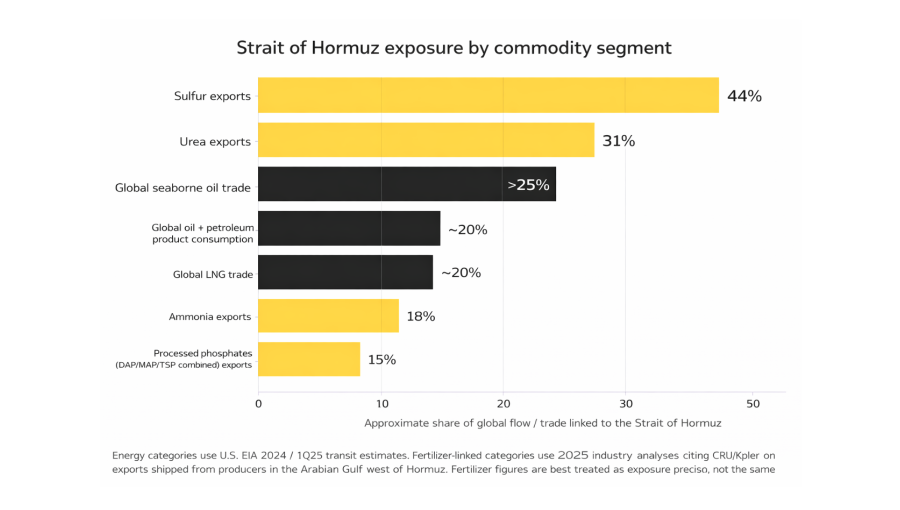
Closure of the Strait of Hormuz threatens global fertiliser supplies as nearly half of sulphur and a third of urea shipments transit the corridor. / bne IntelliNews
By Ben Aris in Berlin March 3, 2026
The closure of the Strait of Hormuz will impact the global fertilizers market as more fertilizers traverse the straits on the way to the international market than hydrocarbons do.
The straits were closed by the Iranian Revolutionary Guard Corps (IRGC) on March 2 and reportedly no ships are currently moving in the tight bottleneck that sees a large share of the world’s energy and commodities pass through on the way to customers around the globe.
With nearly half of global sulphur flows and close to a third of urea shipments moving through the corridor the impact of the conflict will reverberate around the world.
Roughly 44% of globally traded sulphur, a critical input for phosphate fertilisers, passes through the strait. The route also handles about 31% of urea flows, 18% of ammonia shipments and 15% of phosphates, according to industry estimates. That compares to a fifth of the world’s oil and LNG that is shipped from Gulf producers to worldwide customers.
Any disruption to maritime traffic in the corridor has immediate implications for fertiliser supply chains and farm input costs everywhere.
Sulphur is primarily produced as a by-product of oil and gas processing in Gulf states, making exports heavily dependent on uninterrupted energy production and shipping. Urea and ammonia, both nitrogen-based fertilisers, are widely used in staple crop production including wheat, maize and rice, while phosphates are essential for maintaining soil fertility.
The concentration of these exports in the Gulf region means that a halt to exports via the Strait of Hormuz can quickly translate into price volatility. Fertiliser markets are already sensitive to energy prices, as natural gas is a key feedstock for ammonia and urea production. Disruptions to transport routes add an additional layer of risk.
Agricultural producers in major importing regions such as south Asia, sub-Saharan Africa and parts of Latin America rely on steady fertiliser supplies to sustain crop yields. Higher fertiliser prices can feed through into food inflation, particularly in countries dependent on imports.

No comments:
Post a Comment