Friday, December 12, 2025

CU

How tight supply, AI demand propelled copper price towards $12,000


Copper is closing in on the $12,000 a metric ton mark as expectations of soaring demand from data centres that power artificial intelligence and tight supplies collide with shortages outside the United States.

Valued for its exceptional electrical conductivity, copper wiring is vital in power grids that feed data centres, electric vehicles and the infrastructure needed for the energy transition.

Copper prices are up 35% so far this year and heading for their largest gain since 2009, due to mining disruptions and stockpiling in the US. On Friday, they touched $11,952 a ton.

“Investors who want a broad basket of AI interests will also buy into financial products which include hard assets that feed into data centres,” said Benchmark Mineral Intelligence analyst Daan de Jonge. “Investors will buy copper-related assets such as ETFs.”

Canada’s Sprott Asset Management launched the world’s first physically backed exchange-traded copper fund in mid-2024. The fund, which holds nearly 10,000 tons of physical copper, has shot up by almost 46% this year to nearly 14 Canadian dollars per unit.

A recent Reuters survey of analysts’ forecasts shows the copper market will see a deficit of 124,000 tons this year and 150,000 tons next year.

Copper demand growth is being driven by billions of dollars being invested worldwide to modernize and expand power grids. Data centres and clean energy require vast amounts of electricity.

The energy transition, which includes renewable energy technology such as wind and solar, is also expected to boost copper demand.

Macquarie expects global copper demand at 27 million tons this year, up 2.7% from 2024, with demand in top metals consumer China rising 3.7%. It forecasts global demand growth outside China at 3% next year.

“Bullish sentiment is being driven by the narrative around tight supply, supported by macro news flows,” said Macquarie analyst Alice Fox.

A magnet for traders

Supply disruptions include an accident at Freeport McMoRan’s giant Grasberg mine in Indonesia in September, while miners such as Glencore have cut production guidance for 2026, reinforcing expectations of tight supplies.

The overall amount of copper stored in exchange warehouses – the London Metal Exchange, US-based Comex and the Shanghai Futures Exchange – is up 54% so far this year at 661,021 tons.
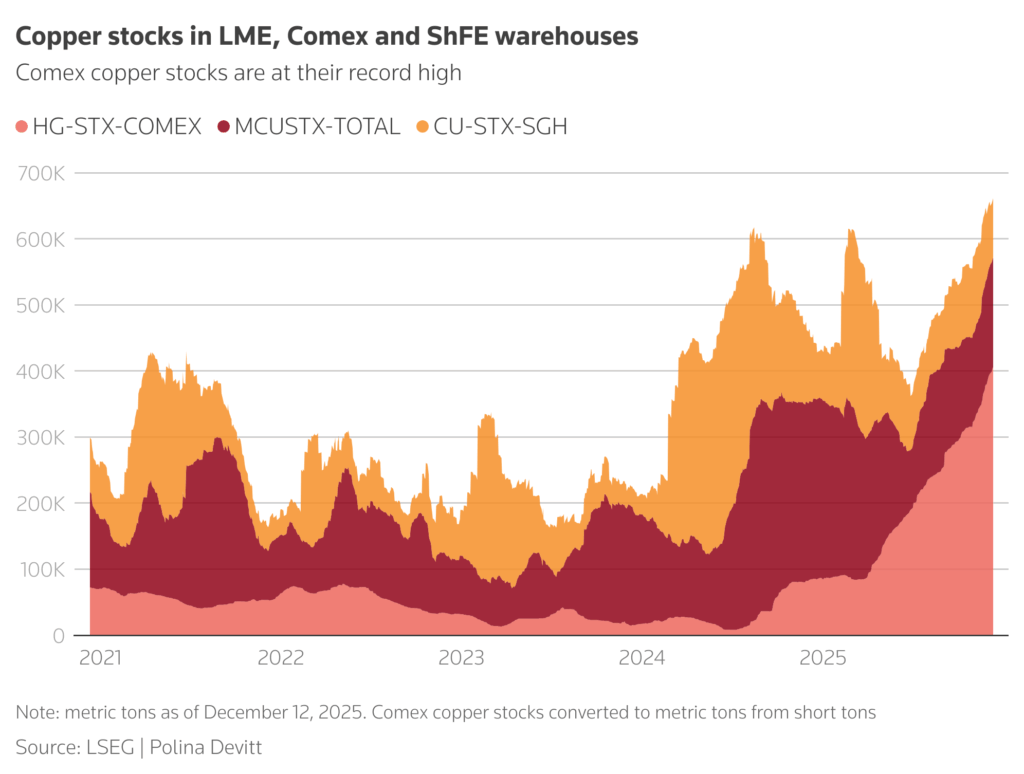
Traders have been shipping copper to the United States since March due to higher prices on Comex ahead of US President Donald Trump’s planned import tariffs. Higher prices are needed to cover the import tariff.

Stocks on Comex at a record high of 405,782 tons amount to 61% of total exchange stocks versus 20% at the start of 2025.

“It feels incredibly tight because all of this material is going to the US,” said BMI’s de Jonge.

Refined copper was given an exemption from the 50% import tariffs that came into force on August 1, but US levies on the metal remain under review with an update due by June.

(By Polina Devitt, Pratima Desai and Tom Daly; Editing by Nia Williams)

SolGold weighs higher $1.1B Jiangxi bid as copper M&A heats up


Cascabel copper-gold project in northern Ecuador. (Image courtesy of SolGold.)

Ecuador-focused miner SolGold (LON: SOLG) has opened the door to a takeover from China’s Jiangxi Copper (JCC), which returned with a higher all-cash proposal valuing the company at about £842 million ($1.13 billion).

JCC, already SolGold’s largest shareholder with 12.2%, first approached the company in November 23 with a non-binding proposal that was rejected. On November 28, it came back with a 26-pence per share offer that the board also rebuffed. The latest 28-pence bid marks JCC’s third attempt and lifts the price by 7.7%. 

SolGold said it would recommend shareholders accept the fresh bid if JCC tables it as a firm offer on those terms. 

A successful acquisition would hand JCC full control of SolGold’s flagship Cascabel copper-gold project in northern Ecuador, one of South America’s largest undeveloped copper-gold resources.

The new bid comes as copper assets attract intense interest on expectations of a looming supply crunch driven by electrification. The heightened demand has sparked major dealmaking attempts, including BHP’s unsuccessful runs at Anglo American (LON: AAL).

Investors unsure

Despite the sweetened proposal, SolGold’s shares fell more than 10% to 25.1 pence on Friday. They were last trading at 25.75p, still below the bid price, as investors show caution toward large mining deals.

The offer still faces Chinese regulatory approval for outbound investment, a process JCC has started but one that has become more complex under tighter scrutiny in Beijing.

BHP (ASX: BHP) and Newmont (NYSE: NEM), which each own about 10% of SolGold, showed acquisition interest five years ago, then looked elsewhere after funding disputes and changes in scope at Cascabel.

JCC, which operates in countries including Peru, Kazakhstan and Zambia, has support from major SolGold shareholders BHP, Newmont and Maxit Capital, which together hold 40.7%.

Argentina’s Mendoza province approves $559M copper mine

Argentina’s Mendoza province has approved its first large-scale mining project in more than two decades after giving the greenlight to PSJ Cobre Mendocino, a joint venture between Switzerland’s Zonda Metals and Argentine company Alberdi Energy.

This week, Mendoza’s Senate endorsed Cobre Mendocino’s environmental impact statement, ending a lengthy review process that attracted groups such as Greenpeace over water and waste concerns. The project will now enter the feasibility reports stage. It follows more than 13 years of studies, a recent 10-day public hearing and more than 9,500 written submissions with public support exceeding 60%.

“This institutional decision allows us to take another step in a process that has been long, transparent and highly participatory,” CEO Fabián Gregorio said in a statement. “We are now entering a technical feasibility stage, during which we will continue building the project together with the community, institutions and productive stakeholders.”

Argentina, despite boasting an abundance of copper resources, has not produced the metal since the closure of the Alumbrera mine in 2018. On the federal level, Argentine President Javier Milei is keen to attract mining development through an incentive program known as RIGI. Recipients include McEwen’s (TSX, NYSE: MUX) Los Azules copper project. 

16-year mine

Located in Uspallata, in the department of Las Heras, the Cobre Mendocino mine is expected to produce 40,000 tonnes of copper concentrates annually over a 16-year life. It contemplates an initial capital investment of $559 million and a construction period of 18 to 24 months.

The company has maintained that the project will use a conventional flotation process to produce copper concentrates without using any illegal substances. The project is expected to generate 3,900 jobs during construction and about 2,400 while operating, including both direct and indirect employment.

With legislative approval, Cobre Mendocino is planning detailed engineering studies, cost and financing analysis to feed into feasibility reports. Operations, closure planning and markets will also be assessed before a potential construction decision.

Kazakhmys says it will have new controlling shareholder
Credit: Kazakhmys

Kazakh copper producer Kazakhmys said on Wednesday it had signed a framework agreement that would transfer control of the company to a new shareholder.

“The signing of the document is the starting point for the transfer of control. In the near future, all necessary measures and obligations under the agreement will be carried out in accordance with established procedures, followed by the signing of a share purchase agreement,” the company said in a statement.

The agreement was inked by Kazakhmys’ president, Vladimir Kim, and its board chair Eduard Ogay.

Kazakhmys did not say who would take control. Local media named construction company Qazaq Stroy, founded and majority-owned by Nurlan Artykbayev, as the new shareholder of Kazakhmys. The preliminary transaction amount was $3.85 billion, local media reported.

Kazakhmys declined to name the new owner when asked by Reuters and referred journalists to its published statement. Qazaq Stroy did not immediately respond to a comment request.

Kazakhmys ranks 20th in the world in terms of copper concentrate production, producing 271,000 tonnes annually, and 12th in terms of crude and cathode copper production, producing 377,000 tonnes and 365,000 tonnes respectively, taking into account tolling raw materials.

In its statement, Kazakhmys said the change of shareholder would not affect its production or contractual obligations.

(By Mariya Gordeyeva and Lucy Papachristou; Editing by Mark Trevelyan)


Zn

Chinese zinc smelter breaks contract with Teck’s Alaska mine amid tariffs

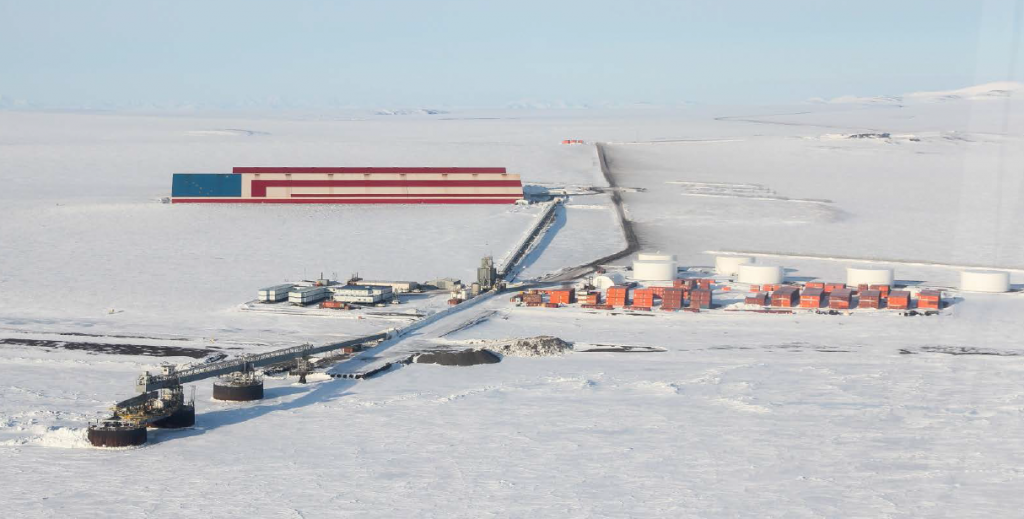
Red Dog mine. Photo courtesy of Teck.

Zhuzhou Smelter Group, one of China’s largest zinc smelters, broke a supply contract with Teck Resources’ Red Dog mine in Alaska earlier this year due to hefty tariffs fueled by Beijing and Washington’s trade war, two sources familiar with the matter told Reuters.

Vancouver-based Teck supplies zinc concentrate from Red Dog, one of the world’s largest zinc mines, to global clients including in Asia.

The world’s two largest economies imposed triple-digit tariffs on imported goods from each other at the height of a trade war earlier this year.

Both reached a trade truce and trimmed the whopping tariffs after multiple rounds of trade talks and a meeting between US President Donald Trump and his Chinese counterpart, Xi Jinping, in South Korea in late October.

But the existing double-digit reciprocal tariffs still make it hard for Chinese smelters to import zinc concentrate from the United States, said the first source.

“As long as the tariffs are in place, it’s impossible to import zinc concentrate from the US,” said the first source, adding that it also applies to the imports of lead concentrate.

Both sources requested anonymity as they are not authorized to talk about sensitive commercial matters.

Zhuzhou Smelter Group found it hard to fulfill the contract with Teck amid the current tariffs and had to pay a break-up fee, the first source said, while declining to disclose details on the fee.

Zhuzhou Smelter, a subsidiary of the state-run China Minmetals, and Teck did not respond to a Reuters request for comment.

The Chinese zinc smelter typically buys 30% of needed concentrate from abroad, according to the first source.

China only imported 2 kilograms of zinc concentrate from the US in the first 10 months of this year, compared with 78,871 tons over the corresponding period in 2024, customs data shows.

But China’s total zinc concentrate imports from January to October jumped by 37% year-on-year, according to customs data.

Zhuzhou Smelter, headquartered in eastern China’s Hunan province, boasts a production capacity for zinc products at 680,000 metric tons per year.

(By Amy Lv, Lewis Jackson, Ernest Scheyder and Tom Daly; Editing by Leslie Adler)


China's Trade Surplus Blows Past $1 Trillion

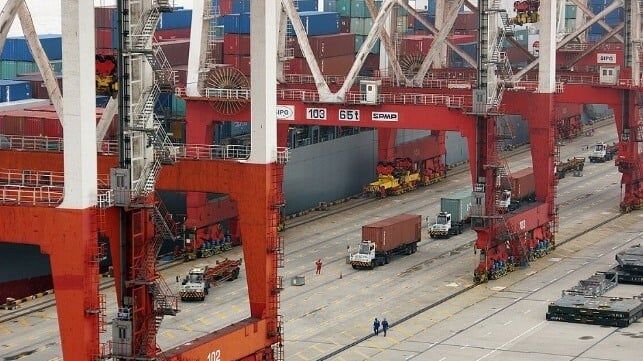
Cargo operations at the busy port of Shanghai Yangshan (file image courtesy Bruno Corbet / CC BY SA 3.0)

Published Dec 8, 2025 11:19 PM by The Maritime Executive


In the first half of 2025, the Trump administration made an unprecedented effort to shake loose China's grip on the American import market, employing sky-high tariffs to deter importers from buying Chinese goods. It worked, but not by reducing China's exports overall. Chinese manufacturers are making and shipping more finished goods than ever before - but they're now selling to other countries.  

China's trade surplus in goods has broken an annual record: Chinese exports exceeded imports by $1.1 trillion in the first 11 months of the year, and the gap is still widening. For comparison, this amount is roughly equal to the GDP of Poland, or the annual total of U.S. holiday season retail spending. 

China's exports to the U.S. market dropped by about 20 percent year-over-year, but this was more than offset by a substantial growth in sales to Europe, Southeast Asia, Latin America and Africa. Given the prevalence of re-packaging and transshipment operations in overseas markets, some of this cargo surge ended up in the U.S. market by circuitous means - but far from all of it. China has been making inroads with consumers in alternate markets all over the world, from developing nations to high-GDP European countries. 

The lopsided trade imbalance is driven by burgeoning industrial capacity, promoted and sponsored by China's government. Manufacturing rose six percent in the year through November, despite tariffs. Persistently low consumer purchasing and fierce domestic competition give Chinese companies a powerful incentive to find overseas customers - often to the annoyance of China's trade partners.

"I’m trying to explain to the Chinese that their trade surplus isn’t sustainable because they’re killing their own clients, notably by importing hardly anything from us any more," said French President Emmanuel Macron last weekend, speaking to French outlet Les Echos. 

As for the U.S. market, those Chinese goods are not expected to start flooding back soon, at least not in the near term. The latest version of the National Retail Federation (NRF) Global Port Tracker report predicts continued import volume declines through the first half of 2026 at U.S. container ports. The White House's early tariff hikes may have been smoothed down, but the effects of tariffs (and tariff uncertainty) on import cargo demand will continue to be felt for months, per Hackett Associates, the firm that conducts the survey for NRF. Double-digit percentage declines in import trade volume could be seen in the first quarter.


DP World to Consolidate ID Ending P&O and Unifeeder Brands

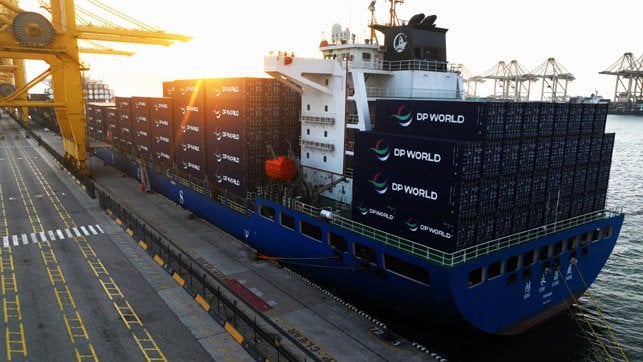
DP World containership
DP World will unify its operations replacing the brand names of P&O and Unifeeder (DP World)

Published Dec 9, 2025 7:37 PM by The Maritime Executive


DP World reports it will unify its global operations in an effort to elevate its image as an integrated global logistics provider. In the process, the company’s legacy brand, including the storied names of P&O and Unifeeder, will be phased out.

The company highlights the changes in the global marketplace, saying customers increasingly expect seamless, end-to-end service delivery. It says the unification of the brands is designed to strengthen its positioning, but behind the scenes, the operations will remain the same.

“We are building a future where trade flows effortlessly,” said Sultan Ahmed bin Sulayem, Group Chairman and Chief Executive Officer at DP World. “Unifying these brands complements the next natural step in our transformation journey from a leading port operator into a fully integrated global logistics provider.”

DP World began in the 1970s as a port operator. In addition to its global port terminal operations, the company moved to make acquisitions in major segments. It acquired the operations of P&O in 2006, giving it the ferry operations as well maritime logistics business. P&O had spun off its cruise ship operations into a separate company, which merged with Carnival Corporation in 2005.

P&O Ferrymasters will become DP World Multimodal Solutions, an operation that includes more than 100 rail modalities, 14 inland terminals, and provides a broad range of logistics services. P&O Maritime Logistics becomes DP World Maritime Solutions, with a fleet of more than 400 ships, including 17 specialized multi-purpose cargo vessels. It also provides pilot and otage services.

Separately, DP World acquired Unifeeder in 2018. The company dates to 1977 when it was started in Denmark, and with operations of 37 vessels in Northern Europe with a capacity of over 37,000 TEU. Unifeeder will become part of DP World Shipping Solutions, which will have a fleet of 150 vessels, ranging between 350 to 8,500 TEU. 

According to DP World, together, the unified businesses will provide integrated, multimodal connectivity across continents, enabling customers to move cargo efficiently, sustainably, and reliably. It said the transformation represents a major step in DP World’s journey from a leading port operator into a fully integrated global logistics provider. Each business the company notes plays a vital role in connecting global trade flows, from feedering and shortsea shipping to inland logistics and offshore services. Now they will deliver the full spectrum of solutions under a single, global brand, DP World.


Hanwha Gets Nods from Australia to Increase Investment in Austal

Austal shipbuilding
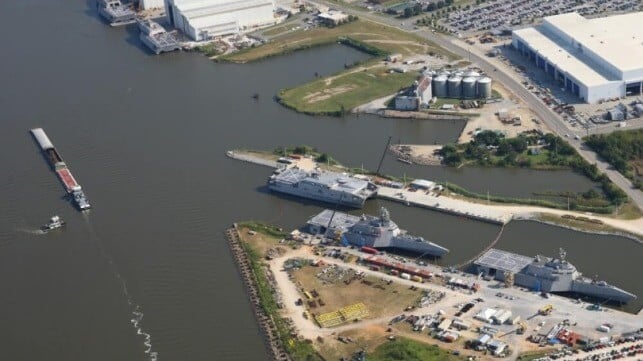
Hanwha gained approval to invest in Austal as it seeks partnerships for naval shipbuilding (Austal Mobile file photo)

Published Dec 12, 2025 4:31 PM by The Maritime Executive


Australia’s Treasurer Jim Chalmers said that the government has decided to let South Korea’s Hanwha Group increase its investment to become the largest investor in shipbuilder Austal. The reports said the government will place restrictions on the operations to ensure the confidentiality of sensitive information pertaining to national security matters.

Austal’s CEO, Paddy Gregg, said the company had not yet been officially notified by the government about the approval and the terms of the restrictions. He, however, said they would respect the decision of the government. 

The company had previously rejected overtures from Hanwha for a possible acquisition, citing national security issues in its role as a strategic builder for the Australian Navy. The company questioned whether the South Korean company could gain approvals from the Australian government and also noted its growing role in the United States as a supplier to the U.S. Navy and the U.S. Coast Guard.

Hanwha had indicated it was willing to pay more than A$1 billion to acquire Austal but said the company had set onerous conditions to proceed with a due diligence. Austal had demanded that Hamwha prove the ability to gain the necessary government approvals before it would share operational and financial data. 

The strategy shifted to a proposal for a strategic partnership, and in June, Hanwha announced it had acquired 9.9 percent of Austal’s shares in open market transactions. It also entered into a swap arrangement to obtain an additional 9.9 percent of the shares pending government approval.

Chalmers said that after extensive discussions with defense and foreign affairs officials, he had decided to grant the approval for Hanwha to increase its position to a maximum of a 19.9 percent ownership stake in Austal. Anything over 10 percent requires government approval, and it was noted that the company would have to seek further approvals if it sought to increase its position further.

U.S. officials in June had indicated they did not object to the deal, according to reports from Hanwha. It said in fact the U.S. would not object if it acquired 100 percent of Austal. Gregg said in today’s statement that Austal had sought clarifications for the U.S. and has never received a reply from the U.S.’s Committee on Foreign Investment in the United States. The company now considers it “unlikely to receive” information from the U.S. authorities.

Hanwha told the Korean media that it was pleased to receive the approval and would comply with the approval conditions placed by the Australian government. It said it would “strengthen strategic cooperation with Austal by leveraging Hanwha’s capabilities and insights.” The acquisition of the shares is being made through an Australian entity set up by Hanwha Aerospace and Hanwha Systems. The company had previously said it would also seek a board seat at Austal after the share acquisition.

The South Korean company has been working to grow its share in naval shipbuilding since acquiring Daewoo Shipbuilding & Marine Engineering and then the Philly Shipyard in the United States. Its systems division is already a supplier of electronics for naval shipping.

Austal highlights that it has never been in a stronger position in its business. The company currently has an orderbook exceeding A$13 billion (more than US$8.6 billion). In addition, it says it expects a significant enhancement when the contracts are signed for Australia’s Landing Craft medium and Landing Craft Heavy projects for which it has already been selected.


Public-Private Partnership Develops First Methanol-Powered Cement Carrier

green methanol fueled cement carrier
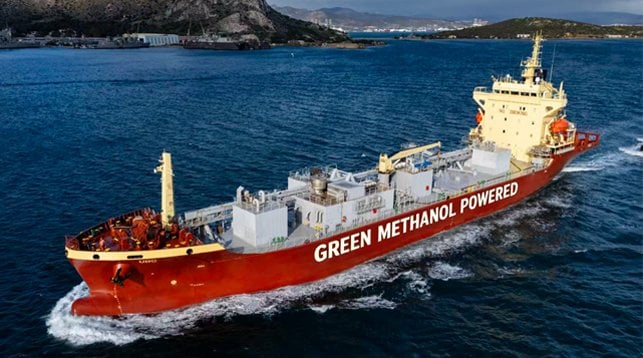
Vessel will be able to run on a mix of green methanol and deisel to reduce emissions and manage operating costs (Heidelberg Materials)

Published Dec 11, 2025 8:22 PM by The Maritime Executive


A new project supported by the Norwegian government, along with German shipping company Hartmann Group, will demonstrate new opportunities in sustainable shipping, distributing cement in Norway’s domestic market. The vessel, which is due to enter service in the first quarter of 2028, will primarily use green methanol as its fuel, reducing CO2 emissions and demonstrating the emerging potential for sustainable shipping in smaller segments of shipping.

In early 2025, Heidelberg Materials Norway, part of one of the world's largest building materials companies, applied for the necessary funding from the Norwegian NOx Fund, a government initiative launched in 2008 to support projects that reduce emissions from shipping, industry, and offshore operations. It has funded over 1,000 projects, including LNG shipping, hybrid vessels, and shore power installations.

Heidelberg Materials is also a long-term member of the Green Shipping Program, which was launched in 2015 by the Norwegian Ministry of Climate and Environment. Administered by DNV, it seeks to promote low- and zero-emissions shipping in Norway. It has also supported the launch of 50 pilot projects within its focus on alternative fuels, vessel innovation, and scalable logistics.

Heidelberg was proposing a replacement vessel to carry the cement that would be larger and more efficient than its current fleet of seven to nine ships. A competitive tender was launched involving six companies, and the Hartmann Group was selected to design, own, and operate the vessel. InterMaritime, a former Hartmann company, will be the technical manager for the ship.

“This vessel is a tangible result of public-private collaboration. A NOK 60 million (approximately $6 million) investment from the Norwegian NOx Fund has enabled the development of a highly energy-efficient ship that sets a new benchmark for low-emission bulk transport,” says Tommy Johnsen, Managing Director, Norwegian NOx Fund.

Adding to the feasibility of the project, Heidelberg Materials has agreed to a 10-year charter for the ship.  The ship will primarily serve the Norwegian domestic market, transporting cement from a plant in Brevik to cities including Oslo, Bergen, Kristiansand, and Stavanger.

The ship will have the capacity to transport 9,000 tons of cement, over 1,000 tons more than its predecessor, but it will use less fuel due to an optimized design. It will be able to run on a variable mix of methanol and diesel to balance operating costs vs. emissions. Using the fuel mix, they anticipate the ship will cut CO2 emissions by 80 percent, up to 6,000 tons annually.

The Green Shipping Program called the project a milestone that expands its portfolio of contracted vessels. It seeks to demonstrate by supporting solutions, including hydrogen, ammonia, and battery-electric powered vessels, that there are multiple pathways toward zero emissions.


British Shipbuilder Babcock to Make Assemblies for U.S. Navy Attack Subs

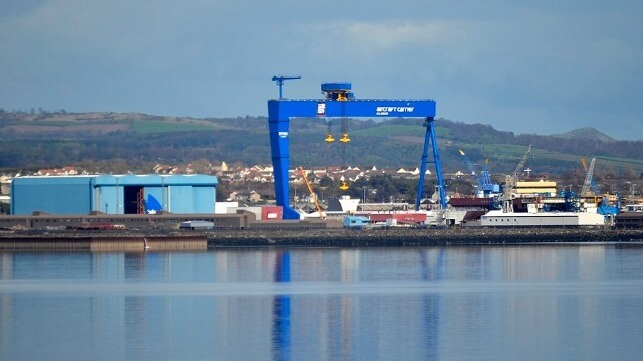
Babcock's Rosyth Dockyard, where the assemblies for HII will be produced (Guinnog / CC BY SA 3.0)

Published Dec 9, 2025 9:52 PM by The Maritime Executive


Amidst reports of troubles and delays inside Britain's nuclear-submarine program, UK shipbuilder Babcock has announced plans to construct more submarine components for American defense prime contractor Huntington Ingalls Industries. Babcock already constructs missile tube assemblies for American subs, and will now begin building additional complex assemblies for incorporation into HII's Virginia-class attack submarines. As described, the deal could help de-bottleneck nuclear submarine production in the United States, a key priority for the Trump administration. 

"Leveraging Babcock’s reach and expertise in the U.K. will reinforce our supplier base, strengthen submarine production in the U.S., and support the trilateral AUKUS partnership," said HII president Chris Kastner in a statement. 

British Secretary of State for Defence John Healey endorsed the deal as well, calling it a "vote of confidence in the workers and skills of Scotland’s defense industry" and a sign that the UK is a "global leader for advanced marine and submarine engineering."

The announcement follows on the heels of a critical review from Rear Admiral Philip Mathias (ret'd), former director of nuclear policy at the UK Ministry of Defence, who told The Telegraph that the UK's overall submarine program had suffered from "a catastrophic failure of succession and leadership planning." 

"The UK is no longer capable of managing a nuclear submarine program," Rear Adm. Mathias said in an interview published last weekend. "Performance across all aspects of the program continues to get worse in every dimension. This is an unprecedented situation in the nuclear submarine age."

Delivery delays affect the ballistic-missile Dreadnought-class and the Astute-class attack subs, and the existing Astute-class boats face delays for maintenance as well, he said.  

Babcock has been helping address the problem. It is building the missile tube assemblies for Dreadnought, and its Rosyth yard is getting a $460 million upgrade to enable future drydocking and maintenance of the UK's nuclear ballistic missile submarines. Its infrastructure division recently completed a much-needed overhaul of a drydock at the Royal Navy's Devonport sub base, where the Dreadnought-class and the Astute-class boats are repaired. Drydock availability is a critical factor limiting Astute-class readiness, as the at-sea strategic deterrent provided by the Dreadnoughts takes priority in the queue for repairs. 

Top image: Guinnog / CC BY SA 3.0


Tech Startup Wants to Reward Generational Transfer of Shipbuilding Skills

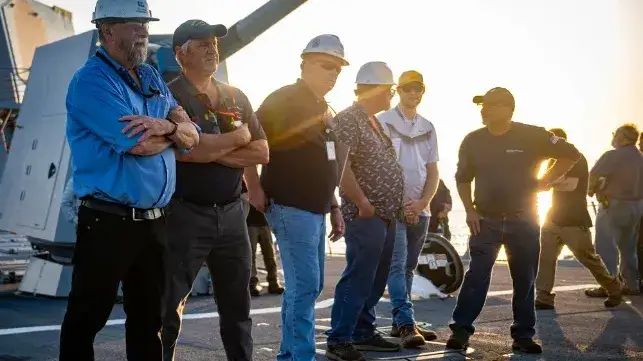
Bath Iron Works shipyard workers aboard the future USS Harvey C. Barnum Jr. (DDG 124) during sea trials, July 15 (USN file image)

Published Dec 10, 2025 8:29 PM by The Maritime Executive


A new startup supported by NOAA's tech accelerator program believes that it has a solution to the loss of older, more skilled workers from America's shipyards: an AI-powered training platform for the next generation, designed to capture and reward the expertise of retirement-age employees before they leave. 

Since the pandemic, a generational cycle of retirement has swept the American shipbuilding industry, taking with it the accumulated knowledge of thousands of experienced engineers, welders, fitters and electricians. Their replacements have to figure things out again, and the learning curve is steep. And departing workers with decades of experience may not always be willing to help pass on the knowledge for free. "Gatekeeping" behaviors are common in the trades, since older hands have a financial disincentive to help younger personnel compete for work at equivalent or lower wages. 

Florida-based Dolgo wants to short-circuit this problem with a private AI software service for shipyards. Aimed at engineering divisions, the software is a communications platform for personnel to collaborate on technical problems. The information shared in this way is captured by a large language model (LLM) AI platform, which incorporates the expertise into its knowledge base. Each item is tagged with the name of the person who contributed it, and they receive a bonus or benefit every time someone accesses their contribution. In this way, they receive a financial incentive for training the next generation, based on how useful the rest of the workforce finds the information. 

“We’re very excited to report positive testing on the prototype ahead of formally launching for the market in February 2026,” said Dolgo founder Mr. Nithesh Wazenn. “It is well established that one of the biggest challenges facing the shipyard industry is the looming cliff edge of large numbers of workers retiring and taking their expertise with them. We believe Dolgo’s AI software holds an answer. Retaining precious expertise will not only drive efficiency and improve safety - it can help prevent costly and time-consuming mistakes and equipment damage.”

Dolgo's development is supported by NOAA's Ocean Enterprise Accelerator, the Miami-based Seaworthy Collective, and by the University of South Florida College of Marine Science. The demand for a solution is substantial, the company says: the average age of American shipbuilders is about 55 years old, and attrition among the new hires that must replace them is unusually high, leading to escalating costs for training. Against this backdrop, shipyard demand is expected to double in the next decade, Dolgo says - so in addition to offsetting retirements, yards may have to grow their workforce in tough hiring conditions.

NTSB: Finding Loose Wire in Dali's Switchboard Took a Month

NTSB wires
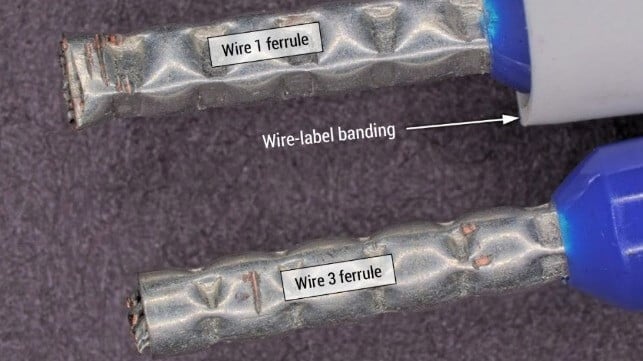
Wire 1 shows crimping at far end of the tip, indicating a tenuous connection (Courtesy NTSB)

Published Dec 11, 2025 9:09 PM by The Maritime Executive


The National Transportation Safety Board (NTSB) has reported the probable cause of the container ship strike that took down the Francis Scott Key Bridge: a loose wire buried inside a switchboard. The agency has now released its complete report, detailing the findings of its forensic team - and the challenging, monthlong effort to find one loose wire on a 10,000-TEU boxship.

In the early hours of March 26, 2024, as the container ship Dali got under way outbound from the port of Baltimore, a high voltage breaker for a transformer tripped and shut down the ship's auxiliary power. This cut out the vessel's propulsion and steering, leaving Dali helpless and adrift. Efforts to restart were unsuccessful. Without a tug to assist, Dali drifted into a pier supporting the Francis Scott Key Bridge and destroyed it, collapsing the structure and killing six people. 

After the accident, the National Transportation Safety Board began an intensive effort to determine the cause of the blackout, and it summoned Dali's shipbuilder - HD Hyundai Heavy Industries - to send experts to assist. The ship was still in the channel, trapped in the wreckage of the bridge, but was accessible by boat for investigators to come aboard.

On April 1, representatives from HHI, the shipowner, the crew and the NTSB gathered at the Dali's switchboard to see if they could recreate the circumstances of the electrical fault. The high voltage breaker would not close, so HHI dispatched a circuit breaker specialist to the scene for another attempt. 

On the next try, on April 10, the breaker closed successfully. The transformer was left energized and the breaker left closed to see if it would trip again in the manner of the casualty voyage. Two days later, without warning, the breaker tripped and caused a blackout - just like it had on the morning of the accident. On April 29, as testing continued, it tripped for a third time.

At this point, HHI opted to remove and dig into the breaker. They found that an undervoltage release circuit (a safety control signal) was de-energized, a condition that would disconnect the high voltage breaker and cause the fault. Only at this point - after disassembling the electrical panel and dispatching three separate teams of experts from the OEM - did the investigators discover a loose wire in a single terminal block, one of hundreds in the panel. 

The panel was built with standard spring-grip terminal blocks for each wire connection. To make a connection, the spring is pushed back with a tool, a bare ferrule on the tip of the wire is inserted down into the terminal block, and the spring is released, forcing the ferrule against a contact. 

Aboard the Dali, each individual wire had a cylindrical label with the wire number on it. The label on this particular wire had been clamped too far down towards the tip, NTSB found, preventing it from being fully inserted. On lab inspection, the agency's technicians discovered evidence of scraping and arcing on the metal terminal and on the wire tip - a sign of a loose connection - and crushing at the very end of the ferrule, where the spring clamp had made a tenuous contact.

"Any shipboard movements or vibrations could have moved the wire, resulting in an interruption in the connection and causing electrical arcing," NTSB concluded. "Any interruption in the Wire 1’s connection would have caused the HR1 breaker to open, resulting in a [low voltage] blackout." 

According to NTSB, "HHI also stated that they did not have any specific materials, instructions, or training for their electrical installation technicians related to the installation of HV switchboards."

HHI, the shipowner and the shipmanager are currently engaged in litigation over the cause of the casualty. Owner Grace Ocean and shipmanager Synergy - which face massive liability claims for the destruction of the bridge - have filed a lawsuit claiming that HHI "defectively designed the switchboard in such a manner that wiring connections were not secure, could not be verified as secure, and could lose connection during normal operation." HHI disputes this allegation and is contesting the claim in court. 

In a statement, HHI said that the loose wire inside the panel should have been caught by technical inspectors post-delivery, and alleged that the resulting fault was a product of "inspection failures" during the ship's service life. The shipbuilder's maintenance guidance at the time of delivery included a recommendation to check terminal connections every three years, and HHI asserted that this was not properly performed.

"After the ship was delivered and continuing after subsequent re-sales, it was incumbent on the ship’s owner and operator to engage in regular and appropriate inspection and maintenance to ensure that the systems and components on the ship remained in seaworthy condition," HHI said in a statement. "Routine inspection over the past decade should have identified a wire that came loose over time." 

NTSB has recommended that the shipbuilder should "incorporate proper wire-label banding installation methods into [its] electrical department’s standard operating procedures" to ensure that wires can be fully inserted in terminal connections. It has also advised the vessel operator to incorporate "the use of infrared thermal imaging for routine monitoring of electrical components" in order to detect poor terminal connections during a vessel's service life.

Configuration errors

The loose wire tripped the breaker, but several additional configuration choices caused the situation to spiral. 

First, the breakers for the vessel's two transformers were set to manual mode, and so the shutdown of transformer 1 did not automatically prompt a switchover to transformer 2. If they had been in automatic mode, the initial blackout would have been shortened from 58 seconds to 10 seconds, giving the crew more time to react, NTSB said.

Second, the engine control system was set up to shut off the main engine if cooling water pressure dropped. When the cooling water pump shut off, this automatic safety system shut down the main engine to avoid damage, per class rules at the time of the vessel's construction. Though this met original class requirements, it "endangered the vessel because it prevented the main engine from being available following the initial underway blackout, thus reducing the vessel’s maneuverability," NTSB concluded. The agency called for more research on redundant / backup power systems to ensure that the ship maintains emergency maneuvering capabilities. 

Third, the crew had been using a flushing pump to supply fuel oil pressure to the auxiliary engines. The pump was not designed for this purpose, and was not set up to restart automatically when emergency generator power came back online. The pump was located two decks below the engine control room, too far away to access and restart manually in an emergency. Fuel pressure for the auxiliaries dropped, they shut down, and the vessel went into a second blackout - just as it approached the bridge pier. This pump configuration was not approved by class, according to NTSB.

"Using the flushing pump as a fuel supply pump sacrificed both redundancy and automation of the fuel supply system and violated established classification rules," said shipbuilder HHI in a statement, agreeing with NTSB's assessment. "Had the shipowner and operator used the ship’s transformer in automatic mode and the fuel supply system as designed and manufactured, power would have been restored within seconds, and the second blackout, which led to the tragedy, would not have happened."

Fourth, NTSB noted serious issues with the software of the vessel's Voyage Data Recorder, or "black box." The manufacturer's proprietary playback software limited access to just 36 hours of bridge audio data. To get more, NTSB extracted its memory and took it to the VDR OEM's headquarters, where the data was pulled out in a painstaking process over the course of a day and a half, then reassembled from thousands of one-minute snippets.

"The functional limitations of the software posed barriers to the NTSB’s efficient extraction and analysis of VDR data from the accident in the time-critical early stages of the investigation," the agency said. "While IMO regulations require that a VDR continuously records audio for at least 30 days, the . . . software made exporting the full 30-day audio dataset with commercially available software unfeasible."

Lastly, NTSB noted that the Francis Scott Key Bridge was not equipped to survive a vessel strike of a modern ship like Dali. The bridge had been hit before in 1980, but the ships of that earlier era were small, and the bridge's light fendering had been enough for protection. The replacement bridge will have to be built to a more robust standard for surviving contact with a Post-Panamax boxship, and NTSB has notified all owners of similarly vulnerable bridges to implement long-known safety standards for allision protection. 


CBO: Better Planning Could Cut Down U.S. Navy's Drydock Delays

USS Milius in drydock
Courtesy USN

Published Dec 11, 2025 10:46 PM by The Maritime Executive


The U.S. Navy surface fleet's maintenance-delay woes continue to worsen, according to a new review by the Congressional Budget Office (CBO). Challenges during yard periods have been building for years, and are a key impediment to generating readiness and deterrence. Known difficulties in planning and parts procurement are exacerbated by an aging fleet, CBO found in a review of maintenance data for destroyers and amphibs - and some vessels have experienced man-hour labor overruns in the range of 40 percent, raising cost and consuming scarce workforce resources. 

For its analysis, CBO looked at 14 years of U.S. Navy schedule data for destroyers and amphibs across the fleet. It compared the initial estimate of days in shipyard with the actual outcome, and the same for labor hours. On average, the Navy's yard-period estimates were longer in duration than what NAVSEA engineers had predicted for downtime when planning and building each ship class, indicating that real-world maintenance plans were more intensive than the designers' expectations. On top of that, actual shipyard periods were longer than estimates, by up to another 60 percent. 

On average, destroyer overhauls took 26 percent longer than estimated and used eight percent more labor hours, driving up cost, CBO found. Annual maintenance funding per destroyer has risen from about $7 million per year to more than $25 million per year since 2009. 

A big part of the reason is simply an aging combatant fleet, requiring deeper maintenance and more modernization in each yard period. Arleigh Burkes now average about 20 years of age, and many of the hulls are going through the scheduled time period for midlife refits. Deferred maintenance - due to extended deployments or other reasons - also adds to scope and cost growth. 

Other problems are essentially administrative and could be resolved with planning and supply chain improvements. Delays in pre-contract inspections lead to delays in finalizing scope of work and signing yard contracts; delayed yard contracts lead to delayed parts orders; delayed parts orders lead to slowdowns while waiting for deliveries. Skipped or poorly-done inspections lead to surprises mid-project, requiring more price negotiations and more delays for parts orders. 

In parallel with the repair work, modernization contractors for ship system upgrades were historically allowed to operate without full schedule coordination with the shipyard, leading to conflicts and delays. Repair yards and modernization contractors work on the same ship at the same time, but are hired and supervised by two different groups of Navy officials: Modernization contractors are overseen by Naval Sea Systems Command, while repair yards are overseen by regional maintenance centers (RMACs), leading to a bifurcated chain of command and difficulties in coordination. The Navy is attempting to smooth this out by requiring more advance planning for modernization contracts.

Over time, the Navy has been increasing its estimates for yard period times, reflecting the realities in drydock, CBO found. But the delays in drydock have been increasing too, so the gap between estimate and actual duration has persisted. In the amphib fleet, some egregious examples have been delayed for several years - even longer for USS Tortuga, which spent more than six years in one yard period.