Showing posts sorted by date for query Cockroach Party. Sort by relevance Show all posts

Tuesday, July 21, 2026

India's opposition leader calls for Modi to step down as youth-led 'Cockroach' protests press on

Rahul Gandhi, India's opposition leader, called for Prime Minister Narendra Modi to resign on Tuesday "for destroying the future" of the country's youth. The youth-led Cockroach movement continued their protests in New Delhi, refusing to leave their sit-in site a day after police used tear has and batons to disperse demonstrators marching towards parliament.


Issued on: 21/07/2026 
By: FRANCE 24
Video by: Delano D'SOUZA

Cover image: India's opposition leader Rahul Gandhi stands with hands tied as he participates in a sit-in protest outside Modi's residence in New Delhi on July 21, 2026. © Shekhar Yadav, AP
01:47


India's main opposition leader, Rahul Gandhi, demanded on Tuesday that Prime Minister Narendra Modi step down over the police crackdown against student protests demanding reforms in the education system.

Modi must resign "for destroying the future of India's youth", the Congress Party leader said in a post on social media as he led a march with other MPs towards the prime minister's residence in New Delhi.

"The government doesn't want to take any accountability, nor does it want to have a debate on it in parliament," said Gandhi.

Along with dozens of his Congress party lawmakers, Gandhi staged a sit-in protest outside Modi's residence. Several were seen fastening zip ties around their wrists.

Gandhi's comments came after police said 60 protesters were injured in clashes with security forces in the heart of New Delhi on Monday, marking the biggest street rally in the capital for about five years.

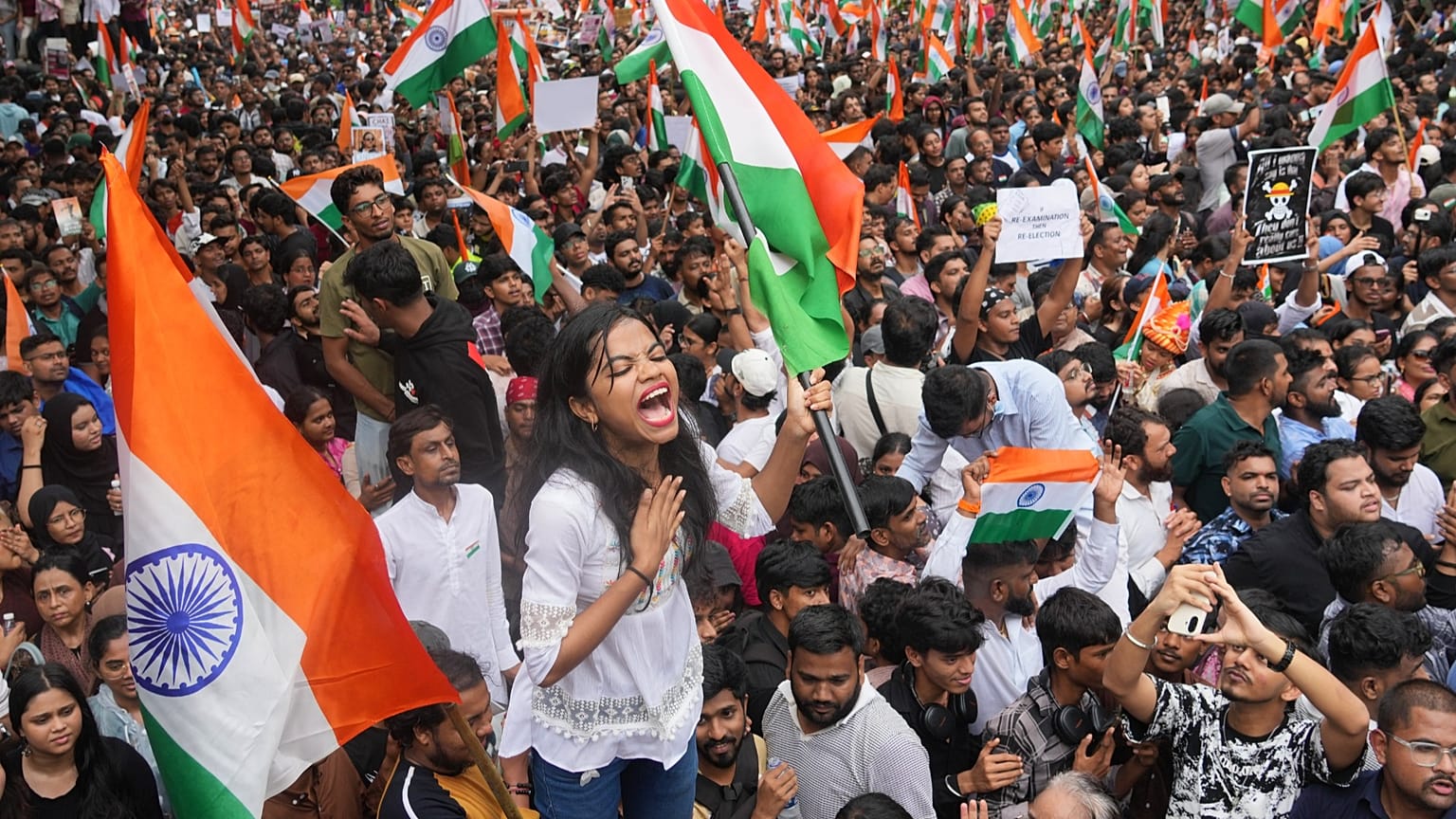
Thousands of protesters had gathered to demand the resignation of Education Minister Dharmendra Pradhan, following an appeal by the Cockroach Janta Party (CJP) online movement.

Police fired tear gas and charged with batons at protesters, who responded by pelting stones. At least 118 police personnel were also injured, Delhi Police said.

The CJP vowed to press on with its demands for Pradhan's removal as hundreds of protesters remained camped at Delhi's Jantar Mantar protest site on Tuesday, many of them calling for changes to the wider education system.

The CJP has won millions of followers on social media since its launch in May, fuelling one of the biggest challenges to Hindu-nationalist leader Modi since he won his third term in office in 2024.

'Shameful day'


"We won't stop. Pradhan has to be sacked," CJP spokesman Ashutosh Ranka said on social media.

There were far fewer protesters at Jantar Mantar than on Monday, when the CJP mobilised huge crowds to march on India's parliament.

CJP founder Abhijeet Dipke urged protesters on Tuesday not to lose hope.

"They want to break our spirit," he said, perched on top of a lorry. "Do not let them silence you."

Protest organisers condemned the "high-handedness" of the authorities and said hundreds of protesters had been injured.

"It's a shameful day in the history of Indian democracy that people, honest students, who had come for a genuine issue were brutally beaten by the Delhi police," Ranka told AFP.

Ranka, who met senior minister JP Nadda on Monday, said the government had yet to respond to their demands.

Protesters said they would not relent.

"We have become even more fearless now," said 25-year-old law student Chandra Pratap Sishwi.

"When I saw people being beaten up by the police like that, my blood boiled."

Parliament was adjourned on Tuesday after the opposition benches demanded a discussion on the alleged "brutality unleashed on students".

Despite rapid economic growth, millions of people in the world's most populous nation still struggle to find stable and well-paying jobs, fuelling discontent.

The protests follow a series of examination scandals that have shaken confidence in India's testing system.

Some 2.2 million aspiring medical students sat for a re-examination under tight security last month after the previous test was scrapped following the leak of a question paper.

That came on top of another scandal related to the online marking of tests taken by nearly two million high school students.

Parliamentary Affairs Minister Kiren Rijiju defended the government on Tuesday, saying it had acted swiftly after the exam paper leaks by arresting several people.

He said Modi had called for a "foolproof system" to prevent irregularities in the future at a closed-door meeting with his allies on Tuesday.

Modi has yet to comment directly on the protests.

(FRANCE 24 with AFP and AP)


‘Black Day for Democracy’: Indian Police Bash and Gas Youth-Led ‘Cockroach’ Protesters

“It’s just shocking to see that the people we elected have turned a blind eye to youth dying,” said one protester.


Delhi police officers beat Cockroach Janta Party protesters during a July 20, 2026 protest in New Delhi demanding the resignation of India’s education minister.
(Photo by Arun Sankar/AFP via Getty Images)

Brett Wilkins
Jul 20, 2026
C0MM0N DREAMS

Indian protesters rallying Monday in New Delhi under the banner of the youth-led Cockroach Janta Party were brutally attacked by police as they marched toward the country’s Parliament demanding the resignation of the country’s education minister and denouncing the right-wing government of Prime Minister Narendra Modi.

Tens of thousands of protesters took to the streets of the Indian capital despite police bans, barricades, internet shutdowns, and a heavy security presence. Police, some of them in plain clothes, attacked the overwhelmingly peaceful demonstrators with baton charges and tear gas. Delhi police are controlled by the Bharatiya Janata Party (BJP)-ruled central government.

The Wire reported that thousands of people were injured—some seriously—by police. Despite video footage and photos showing officer brutality, Delhi Police denied “sporadic use of violence” against protesters.


The protesters are seeking the resignation of Education Minister Dharmendra Pradhan following repeated leaks of National Eligibility Entrance Test papers that have upended the lives of millions of students by forcing them to retake the grueling exams and delaying university admissions. Protest organizers say more than 20 students have killed themselves over the matter.

Late last month, Pradhan dismissed the protesters as “the B-team of terrorists.”

“Already more than 20 students have died by suicide, but this government is not done yet,” Cockroach Janta Party (CJP) founder Abhijeet Dipke said on social media. “This government has resorted to hooliganism now.”

Protester Rhythm Katoch told The Guardian on Monday: “They are calling this protest illegal, they are calling us anti-national. But I am 22 years old, and I am standing here to fight for our education system, for the rights of the young people, and for our democracy. Is it too much to ask for the government to listen to us?”

The CJP and other student groups have been leading hunger strikes at the Jantar Mantar, an 18th-century astronomical observatory designated as the protest site. Three students from the leftist All India Students’ Association ended their fast on Monday, while environmentalist Sonam Wangchuk, who has been on a hunger strike since June 28, was taken by authorities on Saturday to Safdarjung Hospital, where he continues his fast.

“I am touched and moved by how the youth have held on to peace despite provocation,” Wangchuk said Monday.

The movement began in May after Chief Justice of India Surya Kant reportedly compared unemployed young people to “cockroaches.” The protesters satirically reclaimed the slur as the symbol of a movement that has grown into a broader challenge to Modi’s increasingly authoritarian Hindu nationalist rule, which has seen mounting repression of protest and dissent, including restrictions on journalists and activists, and the use of legal measures to target critics.

On Monday, protesters chanted “Go, Pradhan, Go, Saat Mein Modi Ko Bhi Lo! (Take Modi along with you too!),” banging plastic bottles on the ground to keep the beat.

“It’s just shocking to see that the people we elected have turned a blind eye to youth dying… because of their incompetency,” Sajal, a 22-year-old law student, told The Straits Times.


Another protester, yoga instructor Jyoti Rajput, told The Associated Press that she joined the demonstration because “this rotten system refuses to take action.”

“It cannot see the pain of students, and that’s why so many people have joined this movement,” she added.

Amid Monday’s demonstration, CJP leaders met Union Minister JP Nadda at his Delhi home.

“The minister assured us he will discuss this at the appropriate level,” CJP spokesperson Saurav Das said on social media. “However, no commitments have been made so far.”

Responding to the brutal crackdown, Amnesty International India board chair Aakar Patel said in a statement that “the images and reports emerging from the protest at Jantar Mantar show how peaceful dissent is being suppressed in India.”

“The role of the authorities is to protect and facilitate peaceful protests, not to suppress them,” he continued. “The right to freedom of peaceful assembly is recognized under international human rights law and the Indian Constitution.”

“The Delhi Police’s actions raise serious questions about whether their response met the requirements of legality, necessity, and proportionality under international human rights standards,” Patel added. “We call on the Delhi Police to exercise restraint and immediately cease the use of unlawful force against peaceful protesters. Authorities must ensure that all allegations of unlawful conduct, including the reported excessive use of batons, tear gas, and stone-throwing by police personnel, are promptly, independently, and impartially investigated.”


India's Cockroach party leads thousands of youth in protest to parliament

Issued on: 21/07/2026  - FRANCE24

Demonstrators in the Indian capital have marched to parliament as they demand the sacking of the country's education minister. The youth-led Cockroach movement, started as a satirical youth platform, but has morphed into something larger. Protesters are more galvanised after a hunger-striking social activist was forcibly moved to hospital, against his will.

Video by:  Delano D'SOUZA


India's Cockroach protests vow to continue despite police crackdown


Issued on: 21/07/2026 - FRANCE24

The leaders of India's youth-led Cockroach movement are vowing to continue protesting a day after police cracked down on demonstrators. They have been demanding the country's education minister, Dharmendra Pradhan, resign amid repeated leaks for entrance tests to medical schools. While two of the movement's members met with a government minister on July 20th, India's prime minister, Narendra Modi, is failing to address the issue for now. Delano D'Souza reports.

Video by: Delano D'SOUZA


Indian police shift Cockroach Party activist on hunger strike to hospital against his wish


Indian police on Saturday forcibly moved environmentalist Sonam Wangchuk to hospital after his health deteriorated during a weeks-long hunger strike in New Delhi. Wangchuk, a prominent activist tied to the viral, opposition Cockroach Janata Party, is seeking education reforms. His family has denounced the “lack of transparency" and trust in Indian authorities.

Issued on: 18/07/2026 - 
By: FRANCE 24
Video by: 
Navodita KUMARI

Cover image: Abhijeet Dipke, founder of the Cockroach Janta Party, center, talks to activist Sonam Wangchuk, on an indefinite hunger strike in New Delhi, July 10, 2026. © Manish Swarup, AP
04:20


Police forcibly transferred a prominent activist to a hospital in New Delhi on Saturday after his health deteriorated during a 20-day hunger strike tied to India’s viral Cockroach Janta Party movement for education reform.

Authorities tightened security around New Delhi’s Jantar Mantar, a designated public protest ground enclosed by police barricades, where activist Sonam Wangchuk has been camped along with students and Cockroach Party activists who demand the resignation of India's Education Minister Dharmendra Pradhan, after allegations that exam papers were leaked in advance.

The movement also seeks sweeping reforms to the examination system and compensation for families of students who died by suicide over the leaks or exam results.

The 59-year-old engineer and education reformer’s strike has become a rallying point for the party, which began in May after Supreme Court Chief Justice Surya Kant compared some unemployed young people to “cockroaches” during a hearing on another issue. Supporters embraced the insult as a badge of resilience, turning it into a satirical political campaign that amassed more than 21 million Instagram followers in a few days.


Delhi Police said Wangchuk was taken to hospital after his health worsened during the hunger strike, and that a brief commotion occurred when some protesters tried to block the move.

Sachin Sharma, a deputy commissioner of police, said Wangchuk’s hospitalisation was carried out following medical advice and a court directive.

“Mr. Sonam Wangchuk has been taken from here to an appropriate government hospital, a much-needed medical intervention, under medical supervision,” Sharma said.

The Cockroach Party said in a social media post that the government “forcefully abducted” Wangchuk “without his or his family’s consent” two days before their planned march to India’s Parliament.

Saurav Das, chief spokesperson of the Cockroach Party, disputed the police account, saying the court had not ordered Wangchuk’s forcible removal. He questioned the medical grounds for the move, noting that no doctor had examined him shortly before he was taken away, and alleged that authorities were trying to curb a protest movement that had been gaining momentum.

Shortly after the incident, Abhijeet Dipke, a Boston University student and founder of the Cockroach Party, announced he would begin a hunger strike and called for nationwide protests.


Dipke told The Associated Press at the protest ground that police used force while removing Wangchuk and alleged that he was “kidnapped by the police like criminals and goons” after “covering him in sheets".

The party founder reaffirmed the movement’s plan to march to India’s Parliament, scheduled for Monday, when its session begins.

“The resolve and the movement will only get stronger from here,” Dipke said.

Meanwhile, Wangchuk’s wife, Gitanjali J. Angmo, in a letter to Delhi’s Safdarjung Hospital, said “lack of transparency has shaken their trust” and sought her husband be shifted to a medical centre of their choice. She said nothing should be given to Wangchuk orally or intravenously without her consent.

Authorities deployed additional police and paramilitary soldiers and erected barricades around Jantar Mantar. Police said the heightened security measures were precautionary and urged protesters to cooperate with authorities.

(FRANCE 24 with AP)


How India's youth-led 'Cockroach' movement challenges Modi

Murali Krishnan in New Delhi
DW
21/07/2026

What started as a satirical protest against exam leaks in India has grown into a wider movement voicing young Indians' anger over jobs and education.

The Cockroach Janta Party accused police of a brutal crackdown following the New Delhi protest
Image: Manish Swarup/AP Photo/picture allianc


Riot police fired tear gas and used batons in New Delhi as tens of thousands of supporters of the satirical Cockroach Janta Party (CJP) marched towards India's Parliament on Monday (July 20).

Police in the Indian capital said 60 protesters and 118 police officers were injured in the clashes between demonstrators and security forces. Mobile internet was suspended in parts of the city, including around the Jantar Mantar protest site, during the violence.

Protesters are demanding the resignation of Education Minister Dharmendra Pradhan. Earlier this year, authorities canceled the high-stakes NEET medical entrance exam over a leaked question paper, affecting millions of students and sparking outrage across India.
What is India's Cockroach Janta Party?

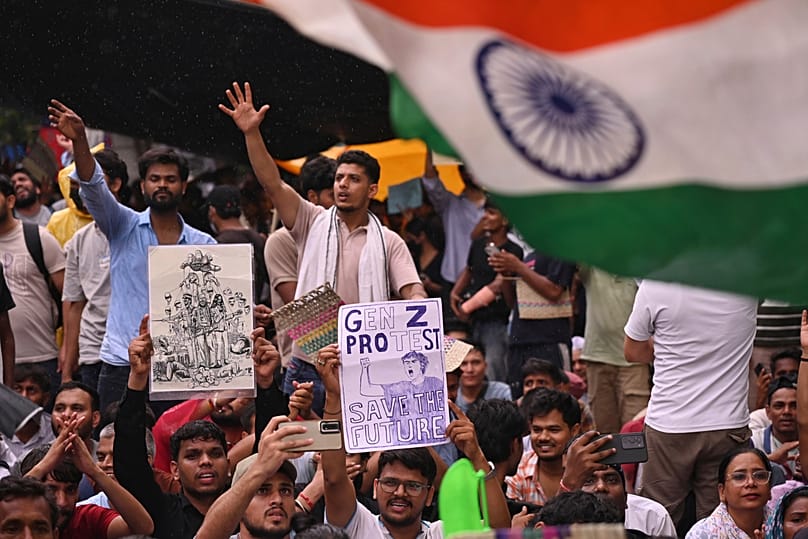
The CJP began as an online campaign in May and rapidly evolved into a Gen Z street movement, giving a voice to a generation frustrated by unemployment, shrinking opportunities and a failing education system.


The protesters attempted to march toward India's ParliamentImage: Manish Swarup/AP Photo/picture alliance

The youth-led "Cockroach" party is now posing an unexpected challenge for Prime Minister Narendra Modi's government, prompting a response that combines political outreach with police action.

Modi's rivals have also tried to step in and take advantage of the youth's frustrations.

"Is this how a government behaves? Using tear gas and baton charges against students? This is a worthless government," Renuka Chowdhury, an MP from India's opposition Congress party, told DW.


Lessons from earlier protests in India


The CJP movement gained fresh momentum over the weekend after veteran reform activist Sonam Wangchuk, whose three-week hunger strike has become a symbol of the protests, was forcibly taken to a hospital by police.

It is not the first time India has experienced major protest movements. Hunger strikes, famously used by Mahatma Gandhi, remain a common and peaceful form of protest in India.

India Against Corruption (IAC) led by veteran activist Anna Hazare, managed to mobilize millions in 2011 and reshape the country's political landscape. A decade later, yearlong farmers' protests forced Modi to repeal controversial farm laws. However, a 2023 Olympic wrestlers' protest over allegations of sexual harassment achieved few of their goals, despite widespread sympathy.

Analysts say the CJP lacks a nationwide organizational network, which the farmers had at their disposal. Yet like the IAC movement, it has tapped into a broader public mood.

"This protest is different because it reflects a much broader cross-section of Indian society," said Yamini Aiyar, an analyst and senior visiting fellow at Brown University. "They are expressing their frustration with a country whose long-atrophied education system has left them with very little hope of a better future."

"Like the IAC movement, it has drawn the middle class onto the streets," Aiyar told DW. "But this is a far more coercive political environment. From the anti-citizenship protests to the farmers' movement, citizens have increasingly looked beyond political parties to hold governments to account."

Police response sparks backlash among Indian protesters

This week's clashes have done little to quell the anger among India's Gen Z.

"Like many young people across India, I am angry about a lack of jobs and an education system that crushes my aspirations. Even though my family supports the BJP, I managed to get away," Rukmini Singh, a student from Meerut, told DW.

"This was an attack against our children. I saw many young boys and girls hurt and bleeding. They will never forget it but the courage these people displayed gives me hope," Vasundara Singh, a teacher from Bihar, told DW.

As during the farmers' protests, leftist parties and student organizations have become visible on the ground, helping mobilize supporters and giving the movement organizational backing.

"After 50 years, youth have occupied the road to parliament," political activist Yogendra Yadav told DW. "This energy by the students shows that the path to parliament goes through the streets. It is remarkable."
Can CJP mobilize India's villages as easily as its cities?

The surge in protest numbers forced the government to engage with the movement after weeks of dismissing it.

Alongside the police action, senior ministers opened talks with CJP leaders. Home Minister Amit Shah met cabinet colleagues while Health Minister J P Nadda held discussions with representatives of the movement.

"We will decide on how best to address the students' demands," a senior Bharatiya Janata Party (BJP) MP, told DW on condition of anonymity.

Most CJP support appears to come from students and India's urban middle class. The BJP's strongest electoral base remains in rural India and smaller towns, where the CJP has yet to prove that its message resonates with young voters.

However, some experts believe that the CJP will do just fine beyond India's urban centers.

"This movement is likely to resonate beyond India's cities because the aspirations of young people in small towns and villages are no different," political analyst Radhika Ramaseshan told DW.

India's 'cockroach' protests meet with batons and tear gas  02:24


"For a generation that saw education as the route to a better life, the failure of the education system has become a deeply political issue," she said.

"Young people in rural India no longer see farming or traditional occupations as their only future. Whether the CJP itself survives is another matter, but the anger and frustration it has tapped into have the potential to reshape politics."

'The anger is now directed at the government'

A movement focused on India's cities may generate headlines without altering the BJP's political fortunes. But if the CJP spreads to rural youth, it could become a much broader political challenge.

"I don't think this will remain an urban movement," said commentator Apoorvanand.

"People constantly move between villages and cities, and those who witnessed the police action will carry those experiences home," Apoorvanand told DW.

"The anger is now directed at the government. Whether it becomes a broader political movement depends on the CJP's ability to widen its appeal."

For now, the CJP has already achieved something unusual. It has transformed satire into sustained street mobilization, forced the government into talks, and ensured that the concerns of India's young people remain firmly in the national spotlight.

"This is a long fight. We will have to engage in a very long struggle for this. Because you have to change an entire system, the nexus of that system is very deep-rooted," said Saurav Das, CJP's chief spokesperson.


Edited by: Keith Walker


Murali Krishnan Journalist based in New Delhi, focusing on Indian politics, society and business@mkrish11


Monday, July 13, 2026

 INDIA

‘All Youth Are Equal?’: Animal Farm, CJP and New Nationalism


Atman Shah |


The CJP protests are a unique way of expressing dissent that mixes humour with sharp political criticism to highlight the disparity between political promises and lived realities.

Image Courtesy: AISA Facebook


Young Indians calling themselves ‘cockroaches’ are asking an unfashionable question in today’s India: in a democracy, does the government owe its youth answers, or only slogans?

The Cockroach Janta Party (CJP) started with a courtroom remark and an Instagram post, but it quickly became a symbol of wider frustration among young people in India. The term ‘cockroaches,’ first used as an insult for unemployed youth, was taken up as a shared identity. The question, “What if all cockroaches came together?” turned into a movement with millions of followers, organised protests, and a unique way of expressing dissent that mixes humour with sharp political criticism.

What began as an internet meme now serves as a pointed response to a government that wants to appear strong but often seems defensive when questioned by those it has not managed to employ, protect, or treat fairly.

In George Orwell’s Animal Farm, the animals on Manor Farm start by demanding something basic: respect for their labour and a say in how their world is run. Over time, their revolution is hollowed out by a small group of pigs who master language, spin, and selective memory. The story is not simply about dictatorship. It is about how power justifies itself while quietly rewriting the rules.

The CJP moment invites us to read India’s youth politics through this lens. If the older language of protest was ideological, Left versus Right, secular versus communal, the new language is practical: paper leaks, re-exams, coaching debt, and the mental health toll of repeated failure in systems young people did not design but must survive.

This change has sparked a strong, defensive response from groups who see themselves as protectors of the ‘national interest.’ So-called nationalist commentators and social media influencers have quickly called CJP anti-national, foreign-funded, or accused them of being part of a Deep State plot against the government. We have seen this before.

In Orwell’s Animal Farm, any animal that questions the pigs is called a traitor or a fool. Today, whenever a group of angry young people steps outside the limits of respectful patriotism, they are shown as leading a hostile narrative war. The message to the public is clear: ignore what these groups say and focus instead on who might be influencing them.

The concerns raised by CJP supporters are not unusual. They want to know why high-stakes entrance exams still leak, why students are blamed for failures rather than institutions, and why a government that talks about ‘Amrit Kaal’ cannot ensure a fair and transparent selection process. Their demands are not radical; they want things to work properly. The movement’s satire is more about highlighting problems than causing trouble. It shows that the agreement between India’s youth and the State is breaking down, not because of big ideas, but because everyday governance is falling short.

Animal Farm’s warning remains highly relevant. Orwell critiques not only authoritarianism but also the manipulation of language that enables injustice to be justified as a necessity and to be reframed as a privilege, even as a sacrifice. The statement, “All animals are equal, but some animals are more equal than others,” highlights how language can prompt citizens to question their own sense of fairness.

When unemployed graduates are advised to be patient and patriotic by individuals whose own children are exempt from poorly administered examinations, they encounter a subtler manifestation of this logic. In such contexts, inequality is reframed as virtue, and those who highlight disparities are accused of undermining national unity.

Critics often attack such movements for inconsistency, dismiss them as ‘internet drama,’ or attempt to co-opt or discredit them by evaluating them solely in terms of conventional political parties. However, this perspective overlooks a crucial issue. A bigger question is why so many young Indians find more genuine emotion in a cockroach meme than in the official stories of empowerment that surround them.

In a democracy that emphasises its electoral magnitude and stability, the true measure of its strength lies not solely in the conduct of elections but in its response to the challenging questions posed by the most marginalised. When dissent is consistently policed, and every protest is characterised as a law-and-order issue or attributed to external conspiracies, the State may achieve temporary control but will raise lasting cynicism. This approach implies that young people are valued more as voters than as active citizens between elections.

Drawing on the allegory in Animal Farm, where the distinction between oppressor and oppressed becomes blurred, and language fails to capture injustice, there is a risk of creating a political environment in which injustice cannot be discussed openly.

However, the CJP moment indicates that Indian youth have not reached this point; through humour, memes, and symbolic expression, they continue to highlight the disparity between political promises and lived realities. A confident democracy would answer that issue not by crushing the ‘cockroaches’ but by repairing the cracks that drove them into the open.

The writer is Assistant Professor of Economics, St. Xavier’s College (Autonomous), Ahmedabad. The views are personal. Email: atman.shah@sxca.edu.in

Monday, July 06, 2026

From memes to political movement, India's 'Cockroach' party leads youth revolt

India's Cockroach Janata Party began life as a series of internet memes and has grown into a real-life movement, bringing together young people angry about unemployment and alleged exam fraud. What began five weeks ago as a satirical response to comments by India's chief justice has become a fast-growing campaign which now has political ambitions, even as observers question whether it can survive without more effective organisation.


Issued on: 05/07/2026 - RFI

Abhijeet Dipke, founder of the Cockroach Janata Party, holds a portrait of anti-colonial revolutionary Shaheed Bhagat Singh at a protest in Amritsar against alleged irregularities in India's national entrance exams on 13 June. AFP - NARINDER NANU

Protesters have been camping out day and night beneath the trees at Jantar Mantar, New Delhi's best-known protest site, despite a ban by authorities. Many are wearing cockroach masks and carrying placards inspired by satirical internet memes, and carrying copies of the Indian constitution.

A few weeks earlier, nothing suggested those memes would grow into such a movement.

Most of the protesters are students or recent graduates protesting against unemployment and alleged fraud in medical college entrance exams.

"There are no more opportunities for young people," Devika, who was attending her second rally, told RFI. "We are worried about the future of Generation Z. Our fight is a fight against corruption."

From Instagram to the streets

The Cockroach Janata Party (CJP) was launched on 16 May by Abhijeet Dipke, a 30-year-old communications specialist educated at Boston University.

Based in the United States, he was reacting to comments by India's chief justice, who compared unemployed young people to "cockroaches" and "parasites". Shocked, he decided to turn the insult back on its author.

"We created this party as satire," Dipke said. It quickly exceeded every expectation.

Within four days, its Instagram account drew almost 10 million followers. Within a few weeks it had reached 22 million, overtaking the account of Indian Prime Minister Narendra Modi's Bharatiya Janata Party (BJP).

"That made me realise the enormous frustration among young people over unemployment and the fraud that tainted the medical entrance exam," Dipke said.

The movement quickly spread beyond social media.


Abhijeet Dipke, 30, founder of the Cockroach Janata Party. He says the movement is ready to protest for as long as necessary after its rapid rise on social media. 
© Abdoollah Earally/RFI

Dipke returned to India at the end of May and organised seven rallies across six states and territories before returning to Delhi, where supporters decided to occupy Jantar Mantar.

Psychiatrist Rajendra Prasad, who attended the first rally, said the movement's spontaneous nature stood out. "No one brought them here," he said. "They came by themselves."

However, Prasad also questioned whether it could survive without clearly identified leadership.

This concern is echoed by other observers. Nandita Narain, a former professor at Delhi University and president of the Federation of Central Universities Teachers Associations (Fedcuta), said she had not seen student mobilisation on this scale for several years.

"These young people rise above political loyalties," Narain said. "Many probably come from families that support the government. They have little experience and everything seems improvised, but they are expressing real anger and, above all, they are beginning to overcome their fear."

Political ambitions


While the CJP had succeeded in capturing the anger of part of India's educated youth, it still lacked a clear ideological foundation, said Mehina Fatima, a researcher at Delhi University.

"The question is where it will be in five years," she said.

Dipke rejected that assessment.

"Our ideology is based on secularism, social justice and the constitution," he argued. "We draw inspiration from Ambedkar, Gandhi and Nehru."

Those references to India's founding figures mark a change for a movement that only weeks earlier was an Instagram account parodying official posters, government slogans and AI-generated images.

Its organisers now openly say they have political ambitions and have taken their campaign into public spaces.

However the movement remains highly decentralised. Decisions are made through online discussions that students join and leave freely. Meanwhile teachers, doctors and retirees supporting the protests do not always speak with one voice.

That flexibility appeals to young people who distrust traditional political parties, but it is also seen as the movement's greatest weakness.

Uncertain future

Even its name remains a joke. Asked why it was called Cockroach Janata Party – with the CJP initials echoing those of the ruling Bharatiya Janata Party – Dipke smiled.

"It was a satire," he told RFI. "A wink at the ruling party."

Dipke insisted, however, that the CJP was more than just a communications exercise.

"Everything we do is political," he said. "If we stop doing politics, then the government is no longer held accountable."

Five weeks after its creation, the Cockroach Janata Party remains difficult to define. Its rapid rise has exposed deep frustration among young Indians, but its political future remains uncertain.

This article has been adapted from the original version in French by Abdoollah Earally


Saturday, June 20, 2026

Resistance, renewal and the future of the INDIA bloc


INDIA bloc meeting

[Editor’s note: Communist Party of India (Marxist-Leninist) Liberation activist N Sai Balaji will be speaking at Ecosocialism 2026, September 11-13, Magan-djin/Brisbane, Australia. For more information visit ecosocialism.org.au.]

First published at The Hindu.

It is perhaps the first time that Congress leader and Leader of the Opposition in the Lok Sabha Rahul Gandhi has released his speech delivered at a meeting of Indian National Developmental Inclusive Alliance (INDIA) bloc leaders to the public. While his focus on building a united resistance to the Sangh-Bharatiya Janata Party (BJP)’s assault on the constitutional foundations of the Indian republic, as well as on the liberties and livelihoods of millions of Indians, is welcome, a few constructive observations may be in order in the interest of building a truly powerful and sustained resistance.

This writer has attended all INDIA bloc meetings, including the formative gathering in Patna, Bihar, in June 2023 before the alliance adopted the INDIA name. Mr. Gandhi’s impassioned speech, delivered at a time when the BJP’s ‘double-engine’/National Democratic Alliance (NDA) governments span over 20 States and Union Territories, was both reassuring and somewhat concerning. While it would have resonated strongly at a Congress meeting, parts of it seemed somewhat discordant in a gathering of 23 parties representing diverse ideological streams united in defence of India’s sovereign, socialist, secular and democratic republic.

Mr. Gandhi is right in reminding us that the Congress became a movement of resistance after Purna Swaraj (complete independence) became the official goal of the Congress. The resolution, introduced in the 1927 Madras session, and adopted two years later in the 1929 Congress session in Lahore, did propel the Congress into the leading position in India’s freedom movement, with communists, socialists, and what is now known as the Phule-Ambedkar-Periyar stream serving as other prominent stakeholders. We must not however forget that the Purna Swaraj idea was first presented in the Ahmedabad session of the Congress in 1921 by two communist delegates, Maulana Hasrat Mohani and Swami Kumarananda. And Bhagat Singh and his comrades made a clear and bold ideological statement with the launch of the Hindustan Socialist Republican Association in 1928.

The battle against authoritarianism

The battle today is between the only ideological stream that stayed away from, and often opposed, the freedom movement and the diverse ideological currents that fought for and won India’s independence. The INDIA alliance represents a regrouping of these forces against the Hindutva school of the Rashtriya Swayamsevak Sangh (RSS)-BJP, which is seeking to reshape state institutions and the architecture of parliamentary democracy to advance its ideological agenda.

If the BJP gets a free hand in its push for ‘one nation, one party’, the Congress will suffer no less than other political parties; indeed, it has often proved more vulnerable. For all our glorious chapters from the history of the freedom movement, there is no accumulated ideological insulation or immunity for any party in the face of today’s all-out fascist offensive and ideological assault. The BJP itself is filled with leaders who were in the Congress not long ago. Even as Mr. Gandhi emphasised the need to resist the BJP, the Congress’s Chief Minister in Telangana was proudly invoking Hitler while defending Hyderabad’s controversial demolition drive.

If institutions are captured and the electoral system manipulated — from voter rolls to vote counting and the declaration of results — what option remains for the people who inherited a Constitution that envisions India as a sovereign, socialist, secular and democratic republic? Mr. Gandhi is absolutely right in arguing that the only answer is resistance — not sporadic or symbolic opposition, but sustained, broad-based and determined democratic resistance.

Towards a just republic

We can no longer afford policies that have proved disastrous for the country and the vast majority of its people. An economic model of crony capitalism that transfers all of India’s resources to a handful of corporations while impoverishing the masses and damaging the environment will have to go. A foreign policy that mortgages the strategic autonomy of India to the United States-Israel axis of aggression even as Indian sailors are killed by U.S. missiles needs immediate change. The assault on Adivasi land and forest rights, and attempts to rob them of their constitutional protections, must stop. A governance model that glorifies bulldozers and encounters while criminalising dissent has no place in a democratic republic. Equally, the ideology of cultural nationalism that defines nationhood through religious supremacy and exclusion must be rejected. Finally, an electoral system that sacrifices credibility and transparency needs urgent and comprehensive reform.

To be sure, such resistance is already underway. Farmers forced the Narendra Modi government to abandon the land acquisition ordinance in 2014 and, seven years later, repeal the three farm laws. The Shaheen Bagh-led movement against the Citizenship (Amendment) Act (CAA) in 2019 sparked nationwide opposition to what many saw as a threat to constitutional values. More recently, workers’ protests across north India against rising workloads and diminishing wages have highlighted growing economic distress. Student demonstrations, led by organisations ranging from the National Students’ Union of India (NSUI) or left student organisations such as the All India Students’ Association (AISA) and the Students’ Federation of India (SFI) or the new digital phenomenon called the Cockroach Janta Party (CJP), are demanding accountability for the deepening crisis in the education and examination system.

We must also acknowledge the price people have paid for this resistance. More than 700 farmers died during the historic farmers’ protest at Delhi’s borders. Father Stan Swamy died in custody. Activists such as Surendra Gadling, Umar Khalid and Sharjeel Imam, among others linked to the Elgar Parishad and CAA protests, have been languishing for years. Workers and activists are facing imprisonment for demanding basic rights and fair wages. Activist Sonam Wangchuk appears to be a rare exception, having been released after months of detention under the National Security Act without any clear explanation. Journalists, too, have faced severe pressure, with Prabir Purkayastha among the few to secure relief after prolonged legal action.

Contrast this record of courage and perseverance among the people with the disturbing state of political parties, many of which are splitting or imploding under the pressure of intimidation or the lure of power. It is a reminder of how humble we must be when speaking of building resistance. The challenge before the INDIA bloc is to connect with these ongoing struggles, tap into the reservoir of public disillusionment, anger and aspiration, amplify demands for justice, and strengthen the collective struggle for democracy.

Reenergise the opposition

The impact of two successive powerful struggles such as the equal citizenship campaign, the historic farmers’ movement, the message of the Bharat Jodo Yatra, and a series of encouraging electoral outcomes — from the BJP’s narrow escape in Bihar in 2020 to its defeats in West Bengal (2021) and Karnataka (2023) — created the ideal backdrop for the emergence of the INDIA coalition in 2023. Despite the exit of the Janata Dal (United) and the Rashtriya Lok Dal and the absence of electoral coordination in States such as West Bengal, Kerala and Punjab, the INDIA bloc came close to defeating the BJP-led NDA in 2024. The results in Uttar Pradesh, Maharashtra, Tamil Nadu — and, to some extent, Bihar — demonstrated INDIA’s electoral potential, raising the Congress tally to 100 seats and the alliance’s total to 234.

Since then, a series of electoral setbacks — beginning with the defeats in Maharashtra and Haryana in 2024 and Delhi in 2025 — has eroded the INDIA bloc’s strength and influence. These reverses, aided by multidimensional electoral frauds, have further tightened the BJP’s stranglehold over what remains of India’s electoral democracy. The INDIA bloc clearly needs a new impetus and a turnaround. Mr. Gandhi has a crucial dual role to play in this context — reenergising the Congress and facilitating the broader INDIA platform by ensuring mutual respect, trust and accommodation of parties with diverse histories and ideological inclinations. If India as a country can grow only on the basis of unity in, or rather through, diversity, the same also applies to INDIA as a political coalition.

Dipankar Bhattacharya is General Secretary of the Communist Party of India (Marxist-Leninist) Liberation.

Europe looks at banning social media for teens, and girls are most impacted

By Tamsin Paternoster 
Published on 19/06/2026
EURONEWS


As the UK joins a growing list of countries looking at banning or severely curbing children's access to social media, data shows girls have higher levels of problematic social media use than boys across Europe.

The UK's plans to ban social media access for teenagers has reignited a debate playing out across Europe, as governments face growing calls from parents to teachers to protect children online.

Countries including France, Spain, Austria and Denmark are all discussing measures to restrict access for children, with concerns ranging from cyberbullying and addictive platform design, to tragedies including suicide and self-harm.

According to a study by WHO-backed Health Behaviour in School-aged Children (HBSC) study, problematic social media use among adolescents increased from 7% in 2018 to 11% in 2022.

It defined problematic social media use using a behavioural scale that measures symptoms such as an inability to cut back, neglecting other activities and experiencing conflicts or negative consequences as a result of spending time online.

According to 15-year-olds surveyed, some of the highest rates of problematic social media use were recorded in Romania, Ireland and Malta.

On the other end of the scale, the Netherlands, Denmark and Estonia recorded some of the lowest levels.


Teenage girls lead the way

Across the countries surveyed, girls reported significantly higher levels of problematic use than boys.

This gap is particularly pronounced in Romania, where 28% of 15-year-old girls reported problematic use, compared with 18% of boys. In Ireland, the figures were 25% and 13% respectively.

Girls were also more likely to report they were in contact with friends online around the clock, with 44% of 15-year-old girls compared to 29% of boys.


According to the report, girls tend to be more socially connected online and may face a different virtual experience than boys.

Various research has found that adolescent girls were found to experience greater pressure over their appearance and body-dissatisfaction on social media than boys, a well as report slightly higher levels of cyberbullying-related experiences.
Support for bans is high, but evidence they work is limited

As governments debate curbing access, political support for restrictions on children's access to apps is at a high.

A YouGov survey published in April found that 79% of people in France supported banning social media for under-16s, alongside 76% in the UK, 74% in Germany and 70% in Italy. Majorities also backed restrictions in Spain (68%) and Poland (53%).

Parents particularly backed bans and restrictions, with 79% of those with children supporting a ban in Britain, Italy and Spain.

Government's are listening to this political push: France's National Assembly has approved legislation restricting access to social media for under-15s, while Spain has proposed raising the minimum age for social media access to 16.

Greece has gone a step further, with Prime Minister Kyriakos Mitsotakis announcing a ban on social media for under-15s in April, with parliament set to vote on the legislation this summer.

Many of the proposals being discussed across Europe require effective age-verification systems and may face legal and practical challenges under EU-wide rules, under which national governments cannot simply force apps such as TikTok, Instagram and Snapchat to block those under-16 overnight.

Yet while support for bans is at a high, evidence that they are effective is very limited —primarily because there are very few long-term case studies that have allowed researchers to effectively assess the impact of bans on children's wellbeing.


W thinks it has the X Factor: Europe’s alternative to mainstream social media

Social media platform "W" is the latest in Europe to take on US-based Big Tech companies
Copyright Canva

By Anna Desmarais
Published on

The Swedish-based “W” platform” is the latest in a series of new social media sites vying to replace US Big Tech companies.

The European Commission announced Wednesday that it was joining a new, made-in-Europe alternative social media platform called “W.”

The platform, first announced at the World Economic Forum in January, is built on “verified human users, transparency, privacy and free speech.”

W, based in Sweden, was built by entrepreneurs in media, technology and artificial intelligence, according to the platform’s website. The platform’s beta version launched this week, with users required to apply for vetting by the “W” team before they can post.

Top European officials are using the platform as well, including EU Commission President Ursula von der Leyen and Antonio Costa, president of the European Council.

Before getting access, users have to verify themselves either by sharing their real name or anonymously through W Identity, a separate app that scans the user’s passport or national ID to verify them directly on their device.

CEO Anna Zeiter previously told Euronews that it plans to host its data on “European servers owned by European companies,” and limiting its investors to those based on the continent.

At the time, Zeiter said W plans to use Proton, a Swiss encrypted email provider, and UpCloud, a cloud computing platform based in Finland, in accordance with EU privacy laws.

The launch coincides with a broader tech and artificial intelligence (AI) sovereignty movement in Europe to distance companies, governments and individuals away from Big Tech companies based in the United States.

Several countries, including France, Germany and the Netherlands, have raised concerns that reliance on Big Tech could lead to national security and data concerns.

Other alternative social media sites​

W is one of several alternative social media platforms launched recently based in Europe, including Bulle (French for bubble), Eurosky, Monnett and eYou.

Some of these platforms signed a declaration last week committing to build Europe’s “social stack,” which it says will bring a “diverse and resilient infrastructure” to the continent to “move away from large monopolistic platforms with their authoritarian governance.”

However, experts have previously told Euronews Next that it is very difficult for alternative platforms to maintain an audience because it will be hard for them to stay as convenient or engaging as platforms that are trying to maximise time on the site.


India blocks Telegram over 'medical entrance exam fraud' concerns


India's government has blocked messaging app Telegram until ​June 22, saying the platform was used to "defraud candidates" taking the medical entrance examination. The restriction was issued under a stringent provision ​of the IT law, which empowers ‌the government to block access to online sites in the "interest of sovereignty and integrity of ‌India".


Issued on: 16/06/2026 - 
By: FRANCE 24


The icon for the instant messaging Telegram app is seen on a smartphone, Tuesday, Feb. 28, 2023. © Matt Slocum, AP


India blocked access to Telegram messenger on Tuesday ahead of a retest of a nationwide medical college entrance examination, after a scandal last month over a question paper leak.

The failure of the hugely competitive exam, along with a separate marking fiasco in high school tests, sparked outrage and fuelled youth protests demanding the education minister's resignation.

The Ministry of Electronics issued the order restricting access to Telegram until June 22, the day of the retest. Message-editing features, which allow users to alter existing posts, will remain restricted until June 30.

"Both measures have been taken in the interest of public order, in response to the organised use of the platform by cheating rackets to defraud candidates," India's National Testing Agency (NTA) said in a statement.

The National Eligibility Entrance Test (NEET) is one of the country's most competitive exams, attracting more than two million aspiring doctors.

The NEET exam was scrapped in May following allegations that the question paper was leaked in advance, including reports that it had been circulated through Telegram channels.

The intense pressure to succeed in these exams has fuelled a lucrative industry, with tens of thousands of coaching centres across the country.

Fierce competition means that success often comes at a significant personal and financial cost -- creating opportunities for criminal networks seeking to sell leaked examination papers to the highest bidder.

India's Central Bureau of Investigation has arrested the "kingpin" alleged to be behind the leak, naming him as a chemistry lecturer involved in the examination process for the NTA.
Test pilots

The education ministry launched on Monday a website where the public can report "suspicious claims, unauthorised content, or fraudulent activities" related to the NEET exam.

Indian air force helicopters on Tuesday were seen readying for the delivery of the test papers, to "to prevent any possibility of leak", the Press Trust of India news agency reported, broadcasting images of preparations in the southern state of Tamil Nadu.

Despite rapid economic growth, millions of people in the world's most populous nation still struggle to find stable and well-paying jobs, fuelling discontent.

Students spend years preparing for exams in the hope of securing a professional career, with the pressure intensified by limited opportunities and intense competition.

Indian media reported suicides of teenagers following the fiasco over the NEET exam.

The NEET scandal came on top of another controversy, related to the online marking system used for tests taken by nearly two million high school students.

Many students said the system had assigned incorrect grades or issued results to the wrong candidates.

Anger at the exam mishandling has been channelled by the newly-founded satirical "Cockroach People's Party", which has won millions of followers on social media since its launch in May.

The movement emerged after India's Chief Justice Surya Kant reportedly likened young people who criticised the government to "cockroaches" and "parasites" during a court hearing, sparking outrage among the youth. Kant later said his comments were taken out of context.

The group, the "Cockroach Janta Party", which has since launched protests in person, based their name on a play on Prime Minister Narendra Modi's Hindu-nationalist Bharatiya Janata Party (BJP).

(FRANCE 24 with AFP)