Showing posts sorted by date for query ISLAMOPHOBIA. Sort by relevance Show all posts

Sunday, November 08, 2026

Islam Beyond Phobia

Hating Muslims is becoming a losing strategy

(RNS) — One of the many revelations of the 2026 midterm elections is that Islamophobia is becoming a much less effective political weapon.
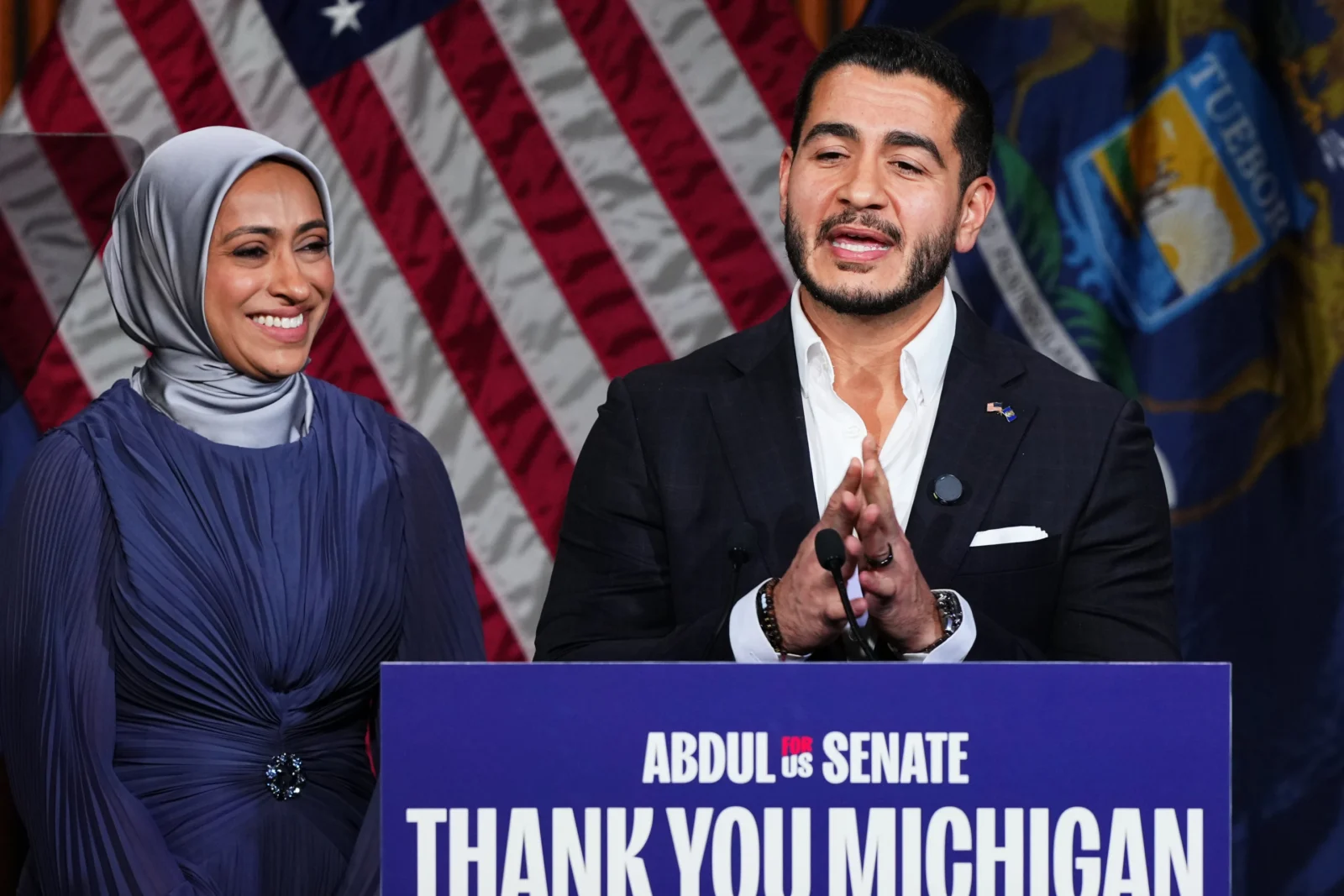

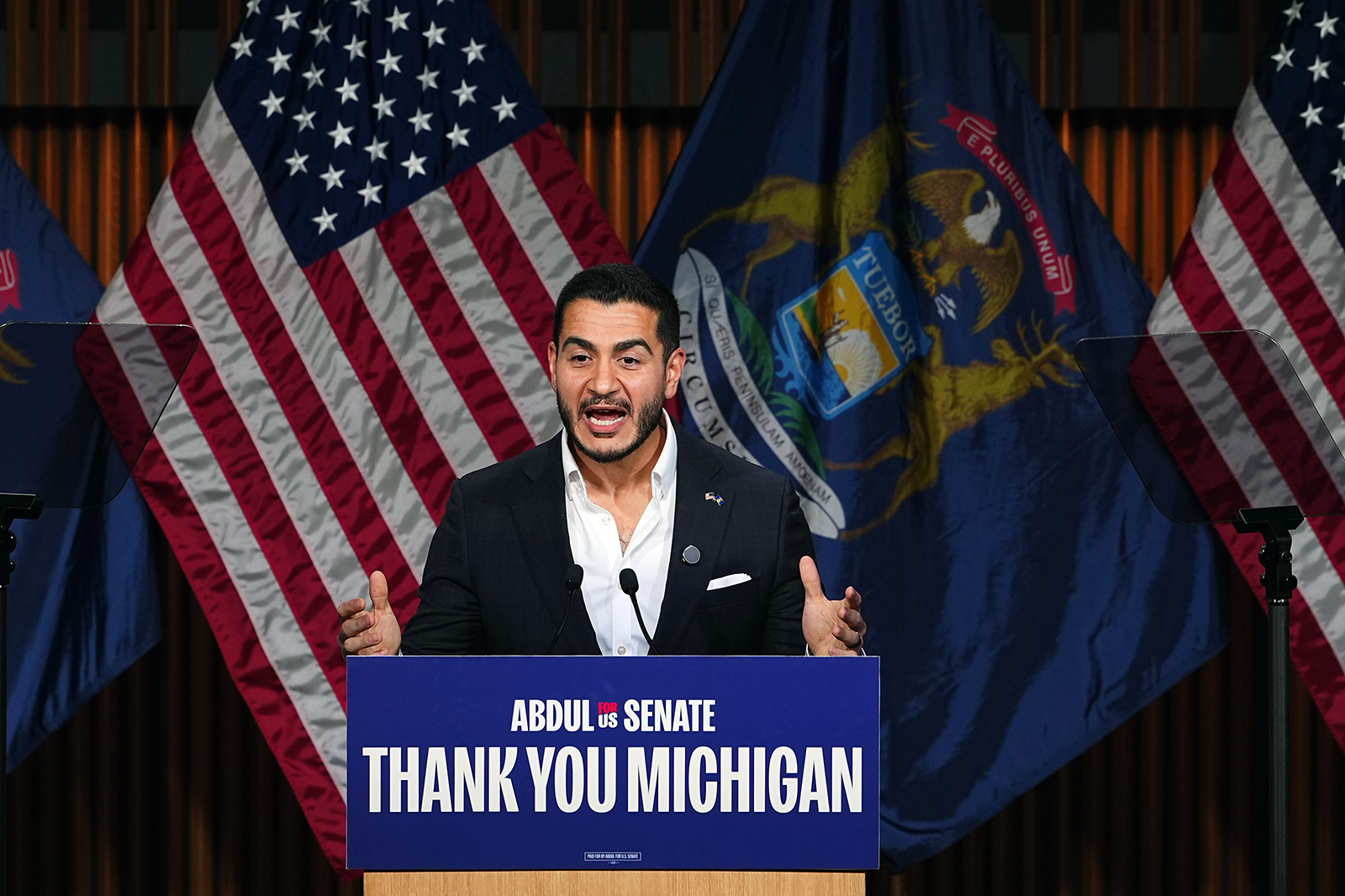
Michigan Democratic Senate candidate Abdul El-Sayed speaks at an election night event, early Wednesday, Nov. 4, 2026, in Detroit, as his wife Sarah Jukaku watches. 
(AP Photo/Julia Demaree Nikhinson)

Omar Suleiman
November 5, 2026
RNS

(RNS) — There is a particular exhaustion, election after election, in seeing the Muslim community dunked on for cheap political points. The anti-Sharia ads and billboards have gotten old, and we’re tired of hearing lies regurgitated constantly about our faith and community.

But after this week’s elections, I wonder whether some politicians will finally recognize another kind of exhaustion: Americans are tired of being told whom to fear instead of what a candidate plans to do to improve their lives.

The assumption behind so much anti-Muslim campaigning is that invoking Islam will end the conversation. Make a candidate sound foreign, turn a mosque into a threat and say “Sharia” often enough, and voters will stop asking about their medical bills and gas prices. They’ll also just turn off their moral conscience in the face of the obvious atrocities our country has helped commit with the genocide in Gaza


This election offered a warning to politicians still relying on that formula. The people you are teaching others to fear vote, too. And their neighbors may be considerably less interested in your prejudices than you imagined.

In Michigan, Abdul El-Sayed became the first Muslim elected to the U.S. Senate despite a campaign that repeatedly cast his faith as a national security threat. President Donald Trump straight-up branded him a jihadist and used the name “Muhammad” to mock him at his ever-more-racist rallies. Mike Rogers questioned his loyalty to the country, Haley Stevens never stopped undermining him and the “Muslim brotherhood” card was overplayed. Like El-Sayed or not, he campaigned on health care and the cost of living and won. He actually seemed to not want to talk about foreign policy much at all, except as it related to how it influences our crumbling domestic affairs. Clearly, the voters didn’t fall for the nonsense.

The warning was already there a year earlier. Zohran Mamdani faced a wave of anti-Muslim attacks during his campaign before becoming New York City’s first Muslim mayor. The city so closely associated with the trauma of Sept. 11 elected a Muslim to lead it. So what?

And by the way, Gaza has been on the ballot ever since the genocide began, and Democrats would be wise to heed that lesson, as I wrote here.

These victories don’t prove that prejudice never wins or that every voter rejected it. Elections turn on many issues. But they should challenge the lazy assumption that Islamophobia is an electoral asset with no downside.

Sometimes the people you intend to intimidate become more determined to participate. Sometimes the people you intend to frighten recognize that you are insulting their intelligence.


And this year, a great deal of money was invested in trying.

By mid-March, Republicans had already spent more than $10 million on television advertisements mentioning Islam or Sharia negatively, according to AdImpact data reported by NPR. Most of that spending was in Texas ahead of its primaries. It was roughly 10 times the spending in each of the previous four election cycles. That was just a March snapshot, not a final accounting of the election season.

Consider what that money was purchasing: not a plan to lower housing costs or improve schools, but an invitation to regard millions of fellow Americans as a threat.

In my home state, Gov. Greg Abbott and Attorney General Ken Paxton helped turn that invitation into government action. They pursued multiple investigations into a Muslim-led housing development, while Abbott threatened airport funding over wudu washing stations used by Muslims before prayer. Paxton’s Senate campaign even attacked his Republican primary opponent for supporting “Muslim mass immigration,” distorting comments about obligations to Afghans who had helped American forces.
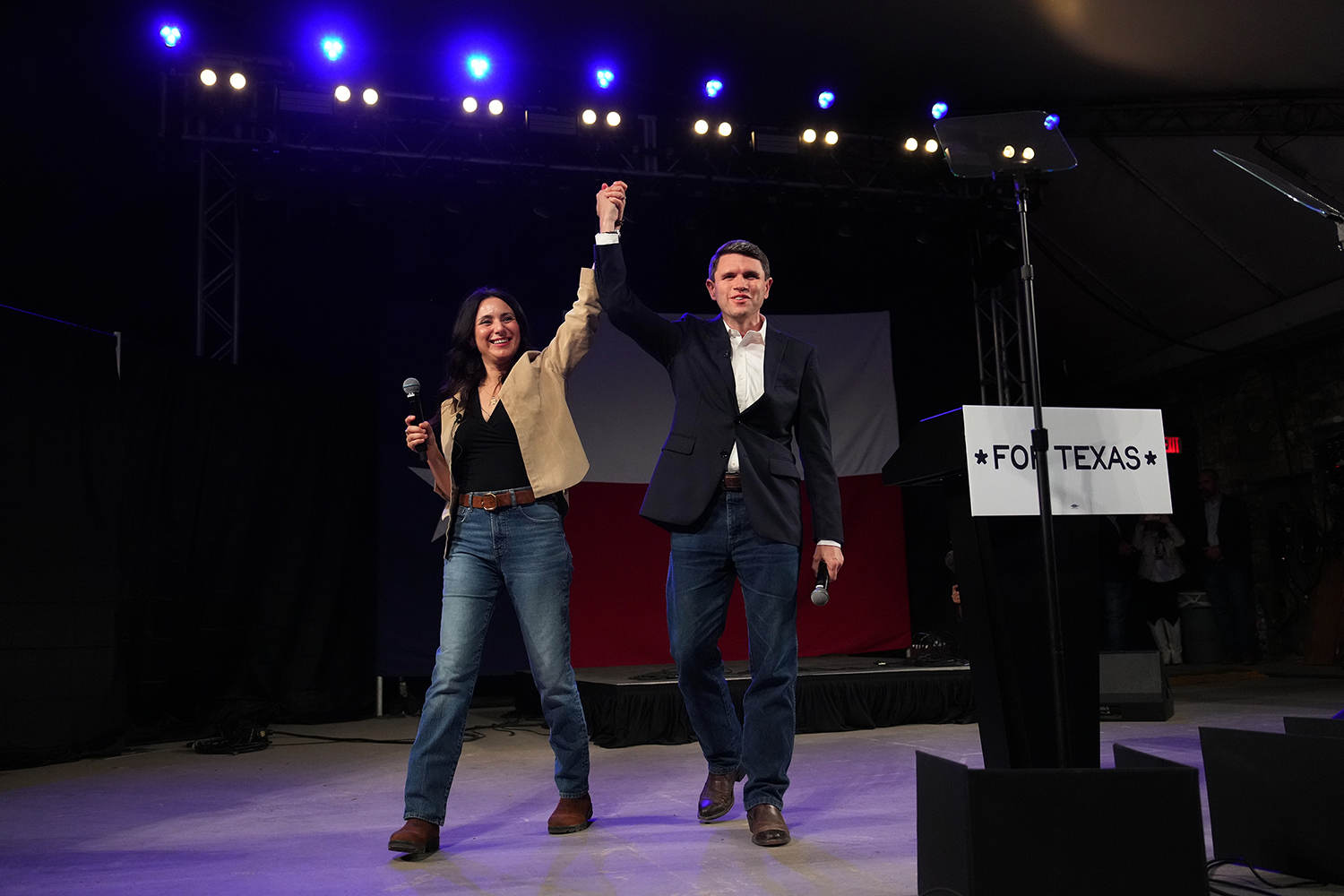


Democratic gubernatorial candidate Texas state Rep. Gina Hinojosa, left, and Democratic Senate candidate Texas state Rep. James Talarico, right, hold a campaign rally in Austin, Texas, Monday, Nov. 2, 2026. (AP Photo/Eric Gay)

Neither man was rescued by that tired form of politics. Abbott lost to Gina Hinojosa, and Paxton lost to James Talarico. Their lopsided defeats cannot be attributed to one issue, but they demonstrate that making Muslims a target was no substitute for earning voters’ confidence.

The consequences extended beyond those races. Texas’ Republican-dominated State Board of Education approved a curriculum presenting early Islam through the Prophet Muhammad’s supposed “brutal military campaigns” and “slavery,” despite objections from Muslims and concerns raised by its own appointed experts. As of this writing, Democrats had secured at least seven seats on the 15-member board, sharply reducing what had been an 11-4 Republican majority.


There is a lesson there for anyone who imagines that turning a child’s religion into a classroom indictment is a way to earn his or her parents’ trust.

But the national significance goes beyond Texas, and beyond any single candidate.

For those of us who came of age after Sept. 11, this moment challenges a familiar demand: that we spend our lives proving we belong before we are permitted to discuss anything else.

I am tired of that bargain. I do not want another generation of Muslim children to inherit it.

And be careful, bigots: You may just be organizing the very people you hoped to silence.

The most hopeful part of this moment is not simply that Muslims are exercising political power. It is the possibility of a broader rejection of the idea that our belonging is something politicians get to revoke.

The lesson of this election is not that America has overcome Islamophobia. It is that politicians should no longer assume Americans will reward them for it.


Hating your Muslim neighbor will not lower your rent, improve your child’s school or make your health care affordable. It will, however, give a politician something to talk about instead of explaining why those problems remain.

Muslims belong in this country whether we win elections or lose them.

Politicians who campaign as though we do not are discovering that their own place in office is far less secure.
Religion Hub

‘A beautifully American story’: El-Sayed’s historic Senate victory resonates with Muslim Americans

DEARBORN, Mich. (AP) — “They tried to demonize people because of how they pray,” El-Sayed told The Associated Press on Wednesday. “And Michigan — the whole Michigan — clapped back. People don’t want that. They’re sick of it.”


Michigan Democratic Senate candidate Abdul El-Sayed speaks at an election night event, early Wednesday, Nov. 4, 2026, in Detroit, as his wife Sarah Jukaku watches. (AP Photo/Julia Demaree Nikhinson)

Susanna Granieri
November 5, 2026
RNS

DEARBORN, Mich. (AP) — Campaigning relentlessly across Michigan, Abdul El-Sayed didn’t highlight the possibility that he could become the first Muslim elected to the U.S. Senate. But with victory in hand, he savored his triumph over the vitriol aimed at him and his fellow Muslim Americans.

“They tried to demonize people because of how they pray,” he told The Associated Press on Wednesday. “And Michigan — the whole Michigan — clapped back. People don’t want that. They’re sick of it.”

He showed his pride in his victory speech, declaring: “My name is Abdulrahman Mohamed El-Sayed.


Twenty-five years after the Sept. 11 attacks and their aftermath yanked anti-Muslim sentiment into the forefront of American life, those emotions are shared by many Muslim Americans in Michigan and across the country.

They saw a surge of anti-Muslim rhetoric after Zohran Mamdani’s election as New York City mayor a year ago, and they saw the attacks intensify as El-Sayed became the new prime target. President Donald Trump called him a “jihadist” who was “on the side of the terrorists.” Dozens of Trump’s fellow Republicans in Congress formed a Sharia-Free America Caucus, depicting Islam’s religious code as a threat to the U.S. Constitution.

But now, after El-Sayed’s defeat of GOP rival Mike Rogers was confirmed early Wednesday, there is a pervasive sense that a broader victory is at hand.

The outcome “represents a historic turning point for American Muslim political engagement and a historic defeat for the politics of hate,” said Nihad Awad, national executive director of the Council on American-Islamic Relations.

“Anti-Muslim extremists, Israel lobby groups and even the president of the United States used every smear in the book to paint Dr. El-Sayed as a Muslim boogeyman,” he said. “None of it was true, and none of it worked. Anti-Muslim hate was on the ballot, and it failed.”
In Dearborn, talk of ‘a beautifully American story’

Excitement over El-Sayed’s victory was palpable in Dearborn, a city near Detroit with a sizable Arab American population. The mayor, Abdullah Hammoud, said residents showed up at the ballot box in huge numbers.


“What a beautifully American story,” Hammoud said. “One of our brightest and best earned the support of the majority of Michiganders who participated in yesterday’s election. And regardless of the direction in which he prays, they’re sending him to the U.S. Senate.”

Hammoud, who has known El-Sayed for more than a decade, said although his win was important for many Arab Americans, people voted for him because of his platform, not his identity. He cited support in Dearborn for independent Vermont Sen. Bernie Sanders’ 2016 presidential campaign. Sanders, who is Jewish and caucuses with Democrats, ran on a progressive platform.

In El-Sayed, residents of Dearborn “finally saw themselves and a candidate who appealed to them, but it had to do with far more than just his ethnicity or his religion,” Hammoud said. “It was honestly because of the policies and building a coalition with this community in an honest way.”

When Zaynah Jadallah, 26, canvassed for El-Sayed in Dearborn, she said most people told her they already planned on voting for him before inviting her in for water or food. She credited the name recognition to El-Sayed’s grassroots campaigning and his pride in his Egyptian heritage.

“He’s always been proud of his identity. He never shied away from it or from saying his name,” Jadallah said.

Yasmin El-Sayed, no relation to the senator-elect, took her two daughters to the Detroit watch party from New York. She teared up after the victory speech.


“Having grown up in a post-9/11 world, being Muslim, being Arab myself, never in a million years did I think we would see what we saw today,” she said.
In a time of suspicion of government, a message of representation

El-Sayed depicted his election as a victory for all those “who don’t see themselves reflected in our government or who’ve been told that they don’t belong for some reason or another — not just how they pray but who they love, how they identify, the color of their skin, where they grew up.″

“I didn’t run to be the first Muslim senator. I ran to be the next senator of the state of Michigan who happens to be Muslim,” he said. ″But I also know that democracy is constantly about the conversation about who we are, who we want to be.”

“Michigan proved just how big we are. Rejected a hateful, spiteful campaign that had nothing to say about the issues and only wanted to point to my name and my face,” he added. ″I want all of those folks out there who have been told that America’s not big enough for them to reflect on that. America really is big enough for all of us.”

Mohamed Gula, CEO of the Muslim American advocacy group Emgage Action, said he was elated by El-Sayed’s triumph after a year of “extremely Islamophobic and disgusting rhetoric being used as a campaign strategy.”

“For Abdul to come out last night and use his full name meant the world to someone who grew up in post-9/11 America, where the Muslim American community was seen through a national security lens,” Gula said.


“Our children, years from now, will be able to run for office,” he said, “to be seen as who they are.”
A debate over the place of Sharia law — and its very definition

Among the most frequent targets of anti-Muslim rhetoric was Sharia, the religious code that provides Muslims with guidance on how to lead righteous lives. At the Republicans’ midterm convention in Dallas, some of the loudest cheers came after GOP Sen. Ted Cruz of Texas declared: “Sharia law has no place in America.”

Muslim American civic leaders and scholars — in Texas and other states — responded forcefully to the anti-Sharia rhetoric that dates back more than 15 years.

They passionately defended Sharia — the way it’s practiced in the United States — as positive guidance that shares elements with the codes of other faiths, such as the Ten Commandments and the collective body of Jewish law derived from the Torah. They rebutted the claims of GOP critics that Sharia is a coercive code that threatens the Constitution and the judicial system.

Gula noted that Republican Texas Gov. Greg Abbott and Attorney General Ken Paxton were among the leaders of the anti-Sharia campaign. Abbott lost his bid for reelection in Tuesday’s voting, and Paxton was trounced by Democrat James Talarico in the race for a U.S. Senate seat.

“I saw this as not just Muslims standing against Islamophobia as never before,” Gula said. “I saw Americans saying hate will not be used as a campaign issue … we are not going to accept hate.”


Asma Uddin, a professor at Michigan State University’s College of Law, has argued that many American politicians are depicting ordinary Muslim religious practices — such as prayer, choice of apparel, family counseling and mosque attendance — as evidence of political danger.

“What I find especially exciting is that El-Sayed won in a political climate where being visibly Muslim can still be a liability,” she said. His victory “gives us real reason for optimism. It suggests that anti-Muslim attacks don’t necessarily carry the political weight that those deploying them assume they do.”
At least 7 Muslims win election to Congress, a record

(RNS) — Their election wins come amid an increasingly hostile political environment for Muslim American candidates.


Michigan Democratic Senate candidate Abdul El-Sayed speaks at an election night event, early Wednesday, Nov. 4, 2026, in Detroit. (AP Photo/Julia Demaree Nikhinson)

Ulaa Kuziez
November 4, 2026 
RNS

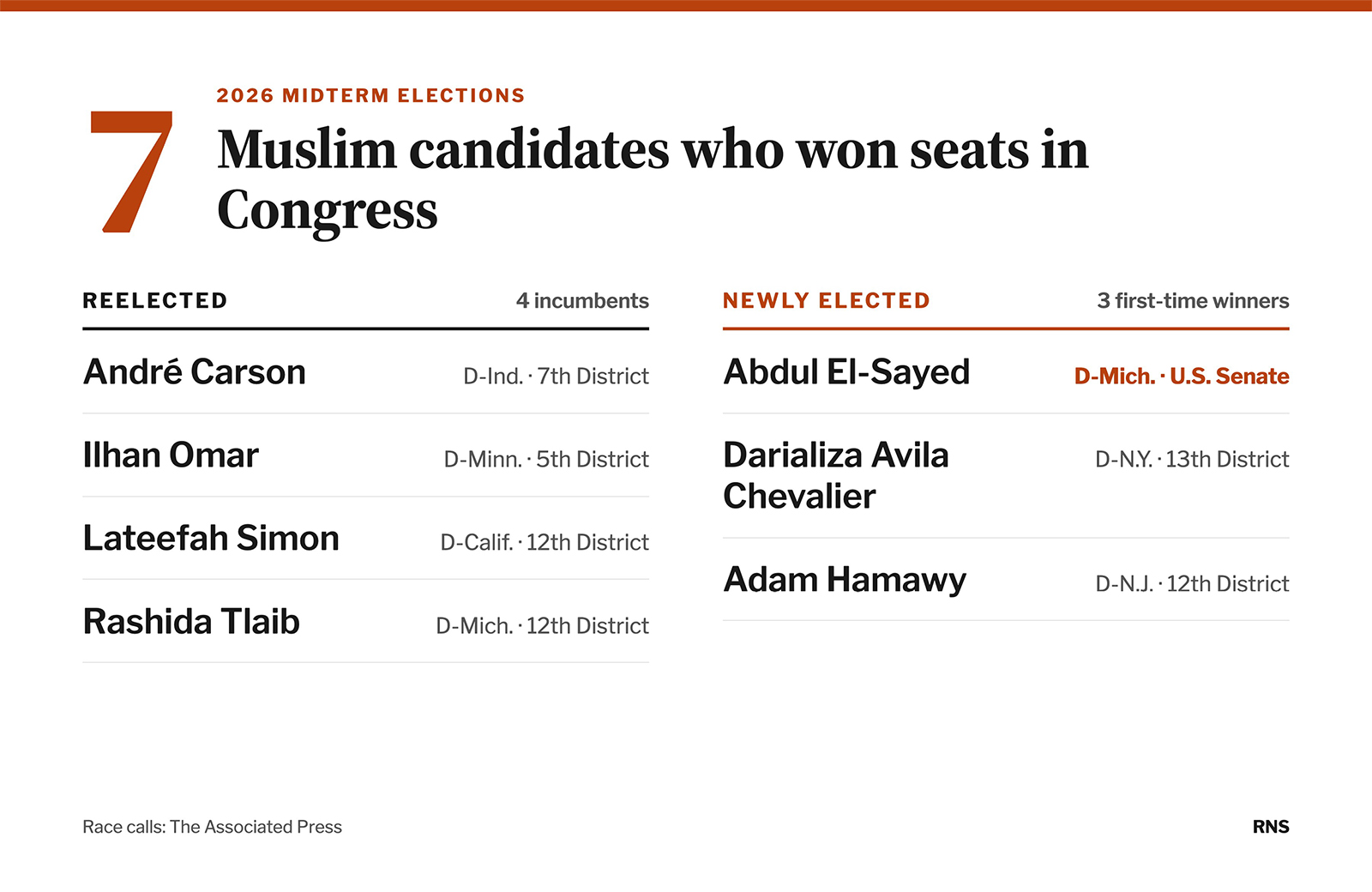
(RNS) — A record seven Muslims were elected to Congress, six to the House of Representatives and one to the Senate.

Early Wednesday (Nov. 4), Abdul El-Sayed, a progressive Michigan Democrat, made history as the first Muslim elected to the U.S. Senate. The son of Egyptian immigrants and a former public health official, the 42-year-old was repeatedly scrutinized and attacked for his faith. President Donald Trump labeled him a “jihadist” and claimed, without evidence, that El-Sayed was on the side of Muslim terrorist groups.

“Islamophobia backfired,” said Fatima Salman, a close childhood friend of El-Sayed who fundraised and campaigned for him. “Today is a day of joy, of celebration, and we need that moment because we have been under so much pressure for so long.”

Incumbent Democrats André Carson of Indiana’s 7th district, Ilhan Omar of Minnesota’s 5th district, Rashida Tlaib of Michigan’s 12th district and Lateefah Simon of California’s 12th district all secured reelection to the House. Two Democrats, Dr. Adam Hamawy in New Jersey’s 12th district and Darializa Avila Chevalier of New York’s 13th district won election for the first time. Aisha Wahab, a Democrat elected to Congress in an August special election, is leading in the race to secure a full term in California’s 14th district. As of 3:42 PM, AP has not called the race. If she wins, the final tally of Muslims in Congress would rise to eight.

Keith Ellison, Minnesota’s Democratic attorney general, in 2006 was the first Muslim elected to Congress. He left Congress after being elected Minnesota’s attorney general in 2018. The previous high for Muslims serving in Congress at once was five.


(RNS graphic; AI-assisted)

While Democrats swept races across the country, the election of these Muslim candidates came despite escalating anti-Muslim rhetoric and campaigns that targeted their faith.

“At the beginning of the year, we were like, ‘How do we fight against the institutionalization of Islamophobia?’ And we knew that we could at the ballot box,” said Mohamed Gula, CEO of Emgage, a Muslim civic engagement group. “We didn’t know that we would have the allies that we have. We didn’t know that we would have this sense of belonging.”

In a victory speech, Dr. Hamawy of New Jersey condemned rising anti-Muslim rhetoric and closed with “Allahu Akbar,” Arabic for “God is greatest.” “Some have tried to turn these words into a symbol of fear, but they have always been words of humility,” he said, adding, “in this moment of victory, I will do what my faith teaches me to do, and to give praise and glory to God, and to ask Him to keep me humble.”

Avila Chevalier, the 33-year-old New York Democrat, is the first Latina Muslim elected to Congress. The daughter of Dominican immigrants and a vocal pro-Palestinian activist, she converted to Islam four years ago.


In state and local races, American Muslim candidates also won historic firsts. Dr. Letitia Plummer is now the highest-ranking elected Muslim woman in Texas. The Democrat was elected county judge (also known as county executive) of Harris County, the third-largest county in the U.S.


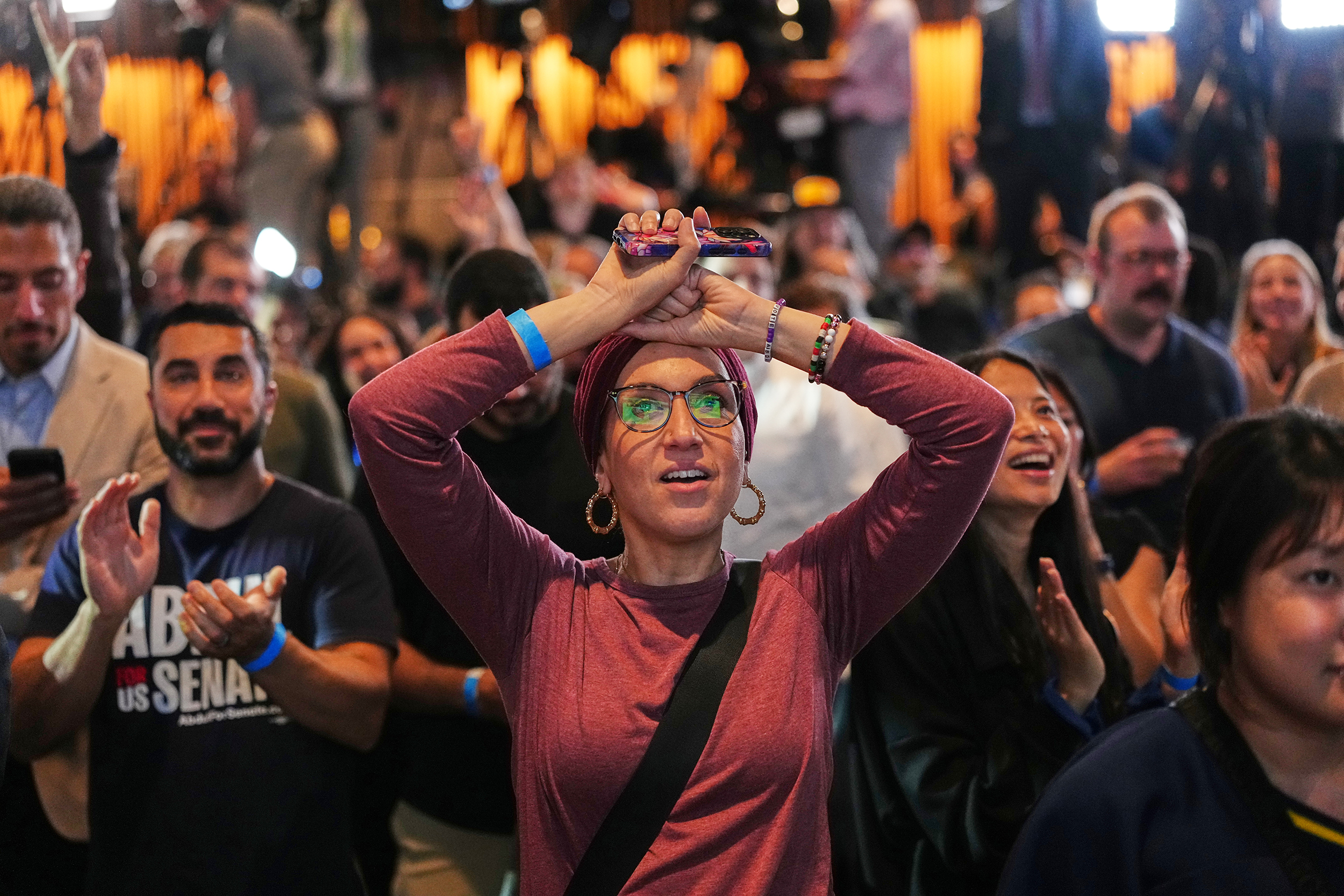
People watch election returns before Michigan Democratic Senate candidate Abdul El-Sayed arrives at a Michigan Democratic Party election night event, Tuesday, Nov. 3, 2026, in Detroit. (AP Photo/Julia Demaree Nikhinson)

In Michigan, three Muslim Democrats won state elections. Abbas Alawieh won a Senate seat, Jalal Abdallah won a House race and Alabas Farhat was reelected to the House. State Rep. Nabeela Syed flipped a Republican-held Illinois Senate seat. In Ohio, Democrats Munira Abdullahi and Ismail Mohamed won their House seats. Muslims running on the Democratic ticket also won or retained seats in Oregon, Texas, Delaware, Pennsylvania, Colorado and Georgia.

Overall, a record number of more than 160 Muslims were running for local, state and federal offices, up from 145 in 2022, according to the Council on American Islamic Relations, a Muslim civil rights group.
France

A government on the ropes

Saturday 7 November 2026, by Léon Crémieux

In the midst of a period of popular mobilization in France, on the eve of the 24 October demonstrations, a racist criminal, animated by the Islamophobic slogans of the Rassemblement national (RN) and the rest of the right and far right, wanted to commit a mass crime in Trappes, a working-class town in Yvelines, in the Paris suburbs. This murderer carried out several shootings with a submachine gun and managed to kill one man, Pengo Bossio Wangi, a 26-year-old black Frenchman, and to wound seven others, several of them seriously, in particular a 12-year-old girl, wearing a scarf on her head. [1]

The murderer said he had deliberately targeted people who seemed to him to be “North Africans or black Africans”. Living in another commune in Yvelines, Plaisir, he deliberately chose the city of Trappes. According to an investigation conducted among his entourage, fed on social networks and racist videos, leaning first towards hatred of Jews, with videos of Soral and Dieudonné, dreaming of assassinations like those committed in 2015 against Jewish customers of the Hyper Cacher, a store on the outskirts of Paris. He then turned to a hatred of Arabs, proclaiming his sympathy for the RN. He had printed militant material himself with posters bearing the RN logo.

For more than 30 years, the Front national (FN) and then the RN have systematically targeted working-class municipalities, where families from the Maghreb or sub-Saharan Africa live: Roubaix, Saint-Denis, Trappes, Vénissieux, Vaulx en Velin, the northern districts of Marseille and so on. So many “lawless zones” for many media and politicians. In 1996 Jean-Marie Le Pen proclaimed: “We have given you back Algeria, give us back Roubaix!” 26 years later, Marine Le Pen said: “If we let this happen, tomorrow, there will be a hundred cities like Roubaix, then 10,000 cities. So there is, objectively, an emergency.” Trappes has become, in the Paris region, the main target of this nauseating racist campaign. In 2021, Marine Le Pen wrote on Twitter: “In 30 years, Trappes has become a lost territory of the Republic, under the weight of massive immigration. Mass immigration has been the driving force behind the rise of Islamism in our country”. RN president Jordan Bardella outbid her on several occasions, notably in 2022, after the election of Ali Rabeh, candidate of Génération-s, as mayor: “Trappes is a small Islamic Republic in miniature”.

This tragedy has therefore occurred in a context where these speeches of the current leaders of the RN can spread in the media, without provoking the reactions that the declarations of Jean Marie Le Pen still provoked in the 1990s. The reason for this is simple. The political class, in its vast majority, now wishes to integrate the far right, the RN, as a respectable political force with which government agreements can be built and which can even, as in Italy, assume the leadership of a government.

This obviously implies a definitive break with what remains of the practices, put in place for decades and more or less assumed on the right, of isolating the RN, of refusing any alliance with it. This dam against the RN (which Macron had twice benefited from to be elected in the presidential elections of 2017 and 2022) had worked again for the legislative elections of 2024, allowing, thanks to numerous withdrawals, the avoidance of a majority of RN deputies in the National Assembly. But the New Popular Front and la France Insoumise (LFI) emerged victorious from this phase, and the right as well as the Macronists found themselves destabilized, with the presence of a relative anti-austerity majority in the National Assembly. Since then, the last two years have seen, along with the legitimization of the RN, a haunting mantra displayed in the media and in Macron’s camp, associating LFI and Mélenchon with anti-Semites, violent and enemies of democracy. France Insoumise has been ostracize, insulted and demonized to spread this mantra and create among the maximum number of people a Pavlovian reflex creating, from the very mention of LFI or Mélenchon, a feeling of disgust and rejection.

This has had its small effect in the Socialist Party, since, barely two years after the victorious alliance of the NFP in 2024 (and while no important political event has happened since then) a large number of officials have come to say that it would be out of the question to withdraw for Mélenchon or an LFI candidate against the RN in the next elections. This obsession, this anti-LFI logorrhea, once essentially the work of CNews - the propaganda channel of the billionaire Bolloré - has spread widely to the rest of the media. Thus, a symmetry has been established between certificates of respectability constantly attributed to the RN, the party of order, (carefully erasing all racist insults and provocations, the roots still very much in the ground linking this party to fascism and its criminal obsessions) and anathemas of a curse cutting LFI off from the democratic community.

The tragedy of Trappes has strongly shaken this nauseating system through which a cowardly complacency has been spread while racist words and slogans have just killed and almost provoked a mass murder, since the killer used 128 rounds of ammunition in his shooting. This created a large mobilization in the population, through outpourings of solidarity in Trappes itself, the day after the attack, while in Orléans a demonstration of 26,000 people against the congress of the RN strengthened the desire to create an anti-RN front and a real unity of social and political forces on the left. This was followed by a rally of 12,000 people in Trappes on 30 October.

Despite this, with boundless cynicism, Macron and Lecornu certainly condemned the attack in Trappes, but Lecornu dared to compare the death of Pengo Bossio Wangi to that of the neo-fascist activist Quentin Deranque, who succumbed to his head wounds, received during the confrontation between his group and left-wing activists. As for Macron, he persisted in symmetry, comparing the criminal racism of the far right to the supposed anti-Semitism of the left. To do so is to deliberately erase the mortal danger that the far right represents.

Since then, of course, the media and the government have been trying to put the lid on this tragedy, which should nevertheless require the silencing of Islamophobic words and insults. As Ali Rabeh, the mayor of Trappes, says, racism, Islamophobia, the theory of the great replacement, are not ideas, opinions, they are crimes that should be treated as such in order to put an end to the trivialization of these ideas that lead to discrimination, daily racism, insults and murders. To say that Jews rule the world is, rightly, condemned by the law against anti-Semitism. Is the assertion that Arabs and blacks will replace whites in France less of a crime?

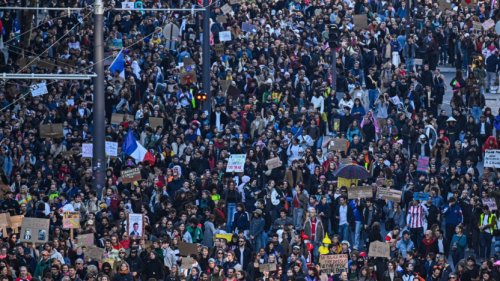
It is in this context that, since 17 October, Macron and his government have been facing a showdown in the streets, with two new major days of demonstrations on 24 and 31 October – which, despite the bans and the anxiety-provoking bludgeon, brought together 800,000 and then 500,000 people – and the approach of 5 November, a major day of mobilization called by the unions for a month and called for by the Gilets jaunes and youth organizations.
In practice, the government creates a climate of violence and repression, describing the country as on the verge of chaos, prey to hordes of ultra-leftists. To do this, in a loop for the past two weeks, the only thing that has been happening in the media are scenes of “urban violence”, testimonies of police officers describing their preparations for order to reign, shopkeepers exposing the looting of their shops... and the need for order to reign.

It was in the name of the freedom of trade and the protection of traders that many demonstrations were banned on 24 and 31 October, that routes away from city centres were imposed, that local curfews were introduced, it was in the name of the risk of riots that the Minister of the Interior issued orders placing people under house arrest and prohibiting the demonstration of environmental or trade union activists by applying measures relating to the law on the fight against terrorism. Similarly, the justice minister, Gérald Darmanin, had pushed for the extension to 72 hours of police custody for young people arrested, including minors, extensions provided for by law only in the context of the fight against organized crime.

Four UN rapporteurs published observations and recommendations on 28 October, saying they were dismayed by the repression of student demonstrations. “The use of force, violence and mass arrests are not appropriate responses to a social protest movement...” [2] All these legal shifts, these exceptional decisions reflect the political impasse of a government with its back to the wall, seeking to stifle the movement, to discredit it, and above all to frighten by increasing repression tenfold. This repression, this anxiety-provoking climate, these numerous mutilations of the eyes or arms, or jaws, suffered by many young people, contrast with the joyful, humorous character of the slogans of the placards and the songs that dot the processions of the youth, despite the tear gas and truncheons. This joyful serenity, but serious in its demands, is the antithesis of a government in desperation that is looking for all the means to get out of the trap which the movement is now setting for it.

He is providing a security and repressive response all the more because his back is against the wall, not wanting to call into question an economic policy totally devoted to the interests of large groups and a social policy aimed at dismantling public services and social systems. In his draft budget, Lecornu also proposes to reduce APLs (personalised housing aid), family allowances, pensions, basically benefits that employees normally receive from the social part of their salary but which, since 1995, have been captured by the state budget. In return, he receives violence in the streets that is a reflection of that exercised by his police and the daily social violence that his policies inflict on millions of men and women of the popular classes.

Macron and Lecornu are using the police (and soon the army perhaps) to protect class politics and “small shopkeepers”, whose protection has been taken as a virtuous pretext, cynically using a social category which, as far as real artisan shops and independent shops are concerned, is just as despised by the Macron government. Far from being treated in the same way as the large capitalist groups with which they sometimes feel solidarity, small craft businesses and retail and local shops (less than 3 employees) see their situation deteriorate year after year, 14162 insolvencies in 2025, +5% compared to 2024. These shops are often hit hard by the decline in purchasing power, online commerce and the development of shopping centres around large distributors and outside city centres. These consequences of ultra-neoliberal policies are much more destructive than the 1160 shops in the city centres of Paris (many of which are large group brands), Marseille and Bordeaux strongly affected by damage and looting.

Nevertheless, after having treated the high school movement from popular neighbourhoods with contempt and violence, the generalization of the movement to all young people attending school in October, the power of 17 October forced the government to open the door to some concessions. These were announced on 26 October. And at the same time, this also leads to schizophrenic behaviour, for example in the attitude towards social networks. On 17 October, the online media Blast revealed a letter from Lecornu sent to the leaders of the four Internet Service Providers (ISPs), Orange, Bouygues, Free and SFR, asking them to be ready to cut off access to TikTok, Snapchat and Instagram, on the day of the 24 October demonstration: “I ask, if I give the instruction, to proceed without delay with the temporary suspension of the services concerned.” Lecornu also asked them to “keep the confidentiality necessary for the preparation of this measure.” [3] In a scathing attitude, a few hours before receiving the youth organizations, Lecornu, the education and higher education ministers received eight influencers so that they could echo the measures announced for the youth, even before receiving the youth organizations, hoping to bypass them. The day before, on a trip to Marseille, Macron did not hesitate to say: "Social networks are damaging our society.”

Lecornu’s announcements obviously testify first of all to the balance of power created by the movement and its legitimacy among the entire population, a balance of power imposing after 7 weeks a “move”, to advance answers to the demands put forward. But, compared to the situation in schools, the consequences for hundreds of thousands of young people, before and after the baccalaureate, these announcements are a smokescreen showing again the extent to which this government takes young people for fools or gullible trade unionists, because as several politicians said, “promises are only binding on those who believe in them”.

The truth is that the high school and student movement demanded an immediate budget extension of 10 billion in 2027 for high schools and the faculty, (the AES- Plus jamais ça, moreover, estimates at 50 billion the budget needed to renovate and adapt the buildings). But in total, behind the loud announcements of 26 October (“the government is committing 5 to 6 billion to the budget” declared Lecornu), the real figure represents, according to the calculations of the main economic daily, Les Echos, a budget line of... 500 million for the 2027 budget, more than 10 times less! [[Les Echos Stéphane Loignon, Budget 2027: ce que vont vraiment coûter les mesures pour les lycéens et les étudiants, 27 October 2027.]]

The government has announced:

 Four billion in the form of loans at reduced rates granted to the regions by the Banque des Territoires. These would therefore be loans committed by the regions, without any additional budget from the state.
 One billion to finance university renovations... by 2029, i.e. 200 million by 2027.
 15,000 additional places in higher education (in the 2027 budget, 190 million), while youth organizations are calling for 150,000 places, i.e. 10 times more so that every young person who has passed their baccalaureate can have a place in higher education.

Moreover, on Parcoursup, far from abolishing the university selection platform, as requested by the youth organizations, the FSU and Sud Education, the government postpones “changes” to 2028 that does not commit it to anything, and does what it knows how to do best, “working groups”. Otherwise, selection would be maintained as it is with only a written explanation of the cause of the refusals!

The only more concrete gain, 1,200 teaching positions in the BTS (Higher Technician Certificate, two years of study after the baccalaureate), 500 positions in secondary school to reach 28 students per class in 50% of the most disadvantaged high schools. The movement would therefore make it possible to slow down the job cuts but, with one additional teacher for seven high schools, we are far from the need to reach 25 students per class in general and technological secondary education, 20 in high schools in priority and vocational education, as requested by the teachers’ unions.

In total, unsurprisingly, the government is not moving. To a request of 10 billion, it responds with 500 million euros! It is out of the question for it to question the 270 billion euros offered to capitalists, mainly large groups. It is out of the question to subject to income tax the 13,000 tax households of millionaires who are exempt, out of the question to tax the 500 largest fortunes in this country who have multiplied their wealth by 14 times over the last 30 years, now amounting to 1,128 billion euros . [4] But tomorrow, it is not 10 billion that the employees, the categories on strike on 5 November, will demand. It will be the upgrading of salaries with the delay since Covid and high inflation, with food and fuel prices, miserable budgets, not only for national education, but also for hospitals and public services. It is this balance of power to impose these demands that is being built for 5 November.

To arrive at a generalized confrontation, a real general strike in the coming days is obviously necessary to settle accounts with Macron’s policies. This is all the more difficult because this government is at the end of its rope, taking refuge behind the shields of the CRS. Nuñez and others like Manuel Valls, like to say that only “the state holds the monopoly of legitimate violence”, partially quoting the seventeenth century English philosopher Thomas Hobbes and the nineteenth century German sociologist Max Weber. For Weber this “legitimacy” came from the fact that the population accepted state authority, or as Hobbes expressed it, this legitimacy came from a social contract with the population that accepted the validity of authority within the framework of this contract. So for them it was not so much violence that was legitimate as the state itself, whose legitimacy was recognized within the framework of the social contract... The problem is that Macron is in no way legitimate, imposing a deeply unpopular government and policies in this country.

31 October 2026

Translated by International Viewpoint.

P.S.

If you like this article or have found it useful, please consider donating towards the work of International Viewpoint. Simply follow this link: Donate then enter an amount of your choice. One-off donations are very welcome. But regular donations by standing order are also vital to our continuing functioning. See the last paragraph of this article for our bank account details and take out a standing order. Thanks.

Saturday, November 07, 2026

Young Arab Americans Describe How Islamophobia Throughout Election Has Made Them Feel Unsafe

“I’m more in danger of going through a racist event, a dangerous event, than I was like five years back, especially in school and public places,” said one young Michigander.


Residents vote in the Michigan US Senate primary at a polling place on August 4, 2026 in Dearborn, Michigan.
(Photo by Scott Olson/Getty Images)

Julia Conley
Nov 03, 2026
COMMON DREAMS

Lawmakers and political operatives from both sides of the aisle, with varying degrees of subtlety, have spent the 2026 midterms campaign insisting that Michigan US Senate candidate Abdul El-Sayed, a progressive Democrat, has endangered or threatened Jewish Americans with his campaign.

But young Arab Americans in Michigan this week said the pervasive anti-Arab and anti-Muslim comments of President Donald Trump along with innuendo by some Democrats have made them feel unsafe in their own communities.

“Seeing us so misunderstood, it’s really disheartening,” a student named Mina Abdel-Khalek told Sam Robinson of The Michigan Chronicle on Monday. “Because I honestly don’t know anyone who’s as evil as we’re painted out to be.”

Aasiya Yaasiin added that “it’s like going back in time.”

“I’m more in danger of going through a racist event, a dangerous event, than I was like five years back, especially in school and public places,” said Yaasiin.


The corporate Democrat-aligned think tank Third Way kicked off months of attacks on El-Sayed long before the August primary that focused on his decision to campaign with streamer Hasan Piker, who has said the October 2023 Hamas-led attack on Israel was a “direct consequence” of US and Israeli actions. His association with Piker, the group suggested, was an act of antisemitism. Rep. Haley Stevens (D-Mich.) and a number of Democratic operatives have amplified the claim.

Sen. Ted Cruz (R-Texas) said point-blank recently that El-Sayed would put Americans’ lives at risk should be win the Senate seat and serve on the Senate Intelligence Committee, while the candidate has been asked repeatedly about his views on Israel’s “right to exist” by journalists who have said nothing about his comments on fighting antisemitism.

Meanwhile, a number of political observers have noticed that the corporate media has said far less about rampant Islamophobia and how the safety of Arab Americans and Muslims in the US has been impacted by the persistent attacks on El-Sayed.

Stevens has accused El-Sayed of being “disrespectful to women,” and focused intently this week, as she struggled to explain why she had decided to endorse Republican former Rep. Mike Rogers in the race, on El-Sayed allegedly becoming “angrier and angrier”—suggesting the Muslim former public health official is an “angry antisemite,” as Matt Sledge wrote at The Intercept.

The former chair of the Michigan Democratic Party also asserted that El-Sayed, an outspoken critic of US funding for the Israeli military, is an “extremist” and urged Democrats to vote for neither the Democrat nor the Republican.

Meanwhile, President Donald Trump and Cruz have openly called El-Sayed a “jihadist,” the president has mocked his Arabic name, and Rogers has claimed he has ties to the Muslim Brotherhood—a movement based in Egypt which Rogers himself has previously said he would be open to working with—and Health and Human Services Secretary Robert F. Kennedy baselessly mused at an event for the Republican candidate that hundreds of millions of Arabs across the world had contributed nothing to science and literature.

A speaker at a Rogers rally also claimed that the Michigan-born candidate, whose family immigrated from Egypt, is “not an American.”

While interview questions, rally speeches, and articles have fixated on whether El-Sayed has endangered or could endanger Jewish communities, whom he has engaged with through a “deep canvassing” campaign in the final weeks of the race, observers have noted that Rogers and Trump have not been asked whether their comments on the candidate may endanger Arab Americans and Muslims.


“Mike Rogers has run a bigoted, openly Islamophobic campaign that endangers millions of our fellow Americans,” said Dylan Williams of the Center for International Policy. “That some pro-Israel groups have assisted him by spreading lies about Abdul El-Saued should be a source of shame and cause for reflection among many who should know better.”
Trump's ex-FBI deputy melts down after 'national security threat' wins Senate seat

By:Matthew Chapman
Nov 05, 2026
RAW ST0RY


President Donald Trump's former FBI Deputy Director Dan Bongino appeared on Laura Ingraham's Fox News program on Thursday to rage against the election of Abdul El-Sayed to the U.S. Senate in Michigan.

"You know, I get and understand — I don't believe in it obviously, but why people would fall for the socialism hoax," said Bongino. "You know, great, free stuff! I mean, you hear free stuff and it just, it sounds good, right? Free healthcare, the government's going to run it, you don't have to do anything, wow, this is all good, we're going to tax the rich, we don't have to pay for anything. I get why people get suckered by that over and over again, and then, like, the Gulags happen later."

"What I don't get is a national security threat, like I believe this guy to be, given his prior associations and his family associations and the people he pals around with," Bongino continued. "I don't get why they don't understand that. Did we not properly explain, like, who the Muslim Brotherhood is?"

The Muslim Brotherhood is an Islamist organization originating in Egypt, where El-Sayed's family comes from. El-Sayed, a former Detroit public health official set to be the first Muslim to represent Michigan in the Senate, has no affiliations with the group and has condemned their ideology.

El-Sayed's campaign pitted him against Republican Mike Rogers, a former congressman making his second bid for the Senate. Pro-Israel groups, including AIPAC, spent heavily in Michigan during the primary and general election, and Elon Musk’s America PAC was among Rogers’ largest backers.

Critics accused Rogers and President Donald Trump of injecting Islamophobia into the race in the closing weeks. A group called “Democrats for Mike Rogers,” later renamed “Together for Michigan,” spent nearly $5 million on his behalf, according to The Bulwark, which reported its funding was predominantly Republican-aligned.