Showing posts sorted by date for query PEASANT REVOLTS. Sort by relevance Show all posts

Saturday, October 24, 2026

Paris march ends in clashes after largely peaceful protests across France

Clashes broke out at the end of a Paris protest on Saturday after a largely peaceful march that drew 110,000 people, according to police, as fresh demonstrations took place across France.

Issued on: 24/10/2026 - RFI

Protesters march during a demonstration against rising living costs in Paris, 
Saturday, 24 October 2026. AP Photo/Thibault Camus - Thibault Camus

Paris police said “more than 500 rioters” were attacking officers on the Cours de Vincennes, in the south-east of the capital. The confrontations began at around 5:30pm, shortly after the procession reached Porte de Vincennes.

Protesters threw projectiles at officers, who responded with water cannon and tear gas. Police said they were manoeuvring to arrest those responsible and help disperse the crowd.

The violence followed a calm and festive start to the Paris march, where demonstrators called for better pay and a better future while criticising government restrictions on protests.

Around 70,000 police and other security personnel were deployed nationwide, backed by armoured vehicles, helicopters and water cannon, to prevent a repeat of last weekend’s widespread unrest.

By midday, Interior Minister Laurent Nunez had reported 135 arrests across France but said there had been “no major incident” at that stage.

“We will not tolerate any violence or any disturbance of public order,” he said.

The demonstrations come amid growing pressure on household budgets, with inflation – particularly fuel prices – rising sharply since the start of the Middle East war in February.

But government restrictions on demonstrations have become a further source of anger, with unions and other groups accusing the authorities of undermining the right to protest.

Peaceful start gives way to clashes

Earlier in the day, many participants in the Paris march had been keen to put their demands at the centre of attention.

Claire, a 26-year-old nurse who declined to give her surname, said she had come to express her hopes for change.

“Not everyone is out to smash things up. Some of us are simply here to say we disagree and that we just want a better future.”

After being caught off guard by last weekend’s unrest, police adopted a more mobile approach on Saturday, intervening quickly to disperse some gatherings.

“The police are really mobile... They come and disperse marches before they even form,” a 21-year-old student in Lyon told AFP, speaking on condition of anonymity.

An AFP journalist saw officers fire tear gas at around 150 protesters who had tried to block a road near the city centre.

Nunez said police had confiscated items including metal balls, lead pellets, fireworks, slingshots, improvised weapons, a katana sword and airsoft weapons.

“These seizures clearly demonstrate the determination of certain far-left and radical left-wing groups to turn a number of demonstrations violent,” he said.

President Emmanuel Macron has blamed “ultra-left” groups seeking to “bring down the republic” for the worst of the previous weekend’s violence, when public buildings were vandalised and hundreds of shops looted.

The government’s decision to ban demonstrations not led by unions has drawn strong criticism. Unions reluctantly accepted restrictions keeping marches away from central Paris, Marseille and other cities, while joining other groups in warning of an “authoritarian drift”.

In Paris, police changed the main march’s route at the last minute, moving it from the city centre to the the south-east of the capital.

Murielle Guilbert of the Solidaires trade union said the ban on non-union protests was “outrageous”.

“We’re here because there is obvious public anger” over low salaries, she said.

For many taking part, the march was an opportunity to voice frustrations that have built up over years.

Aurore, 35, said that “people need to understand that the anger is real. We’ve been walked all over for 10 years.”

Ynyane, a 19-year-old wearing a Dragonball Z costume, said: “Taxes are a bit too high, and I have to support people who are struggling.”

A protester holds up a placard reading ‘Make human rights great again’ at the Paris demonstration on 24 October 2026. AFP - NICOLAS TUCAT

Shops shut as political tensions build

Across Paris, many retailers boarded up their windows or closed their doors, fearing further looting on the margins of the demonstrations.

The Louvre and Musée d’Orsay also closed for the day.

Around 2,700 people were arrested following last weekend’s violence. Retail industry representatives said damage and losses suffered by shopkeepers ran into hundreds of millions of dollars.

The protests are unfolding six months before a presidential election, sharpening the political stakes for Macron’s government. The president cannot stand for another term, while far-right leader Marine Le Pen leads in opinion polls.

Le Pen’s National Rally held a congress in Orléans on Saturday to launch her presidential campaign, drawing a large counter-demonstration.

Thousands marched through the city chanting anti-fascist slogans and directing their anger at both Le Pen and Macron.

“Macron resign. Le Pen in prison,” protesters shouted.

Police put attendance at 11,000, while organisers said 26,000 people took part.

In Paris, far-left presidential candidate Jean-Luc Mélenchon joined the march and predicted that the mobilisation would continue.

Macron “is going to understand that this is going to repeat itself every week”, he said.

The Yellow Vests movement, which organised disruptive protests against Macron eight years ago, has called for further demonstrations on 31 October in defence of “the freedom to protest”.

France is also part of a wider wave of demonstrations across Europe. Protests in Italy, Belgium, Spain and Portugal have focused on different demands, with some shared concerns over inflation and education. Italy has mobilised 500 troops to Milan following street violence there.

(with newswires)


France, October 2026: reasons to believe

Interview with Olivier Besancenot

Saturday 24 October 2026, by Olivier Besancenot, Stéfanie Prezioso
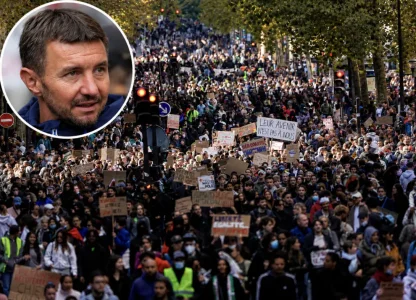


On 17 October 2026, hundreds of thousands of people took to the streets across France. Starting with young people and secondary school pupils, the mobilisation brought together other sections of society around the issue of the cost of living, outside the traditional trade union and political structures.

The Macronist government responded with repression on an unprecedented scale: a number of people taken into police custody not seen since the start of the secondary school pupils’ movement, a partial curfew, the dissolution of organisations now being discussed, and deaths whose circumstances remain to be clarified.

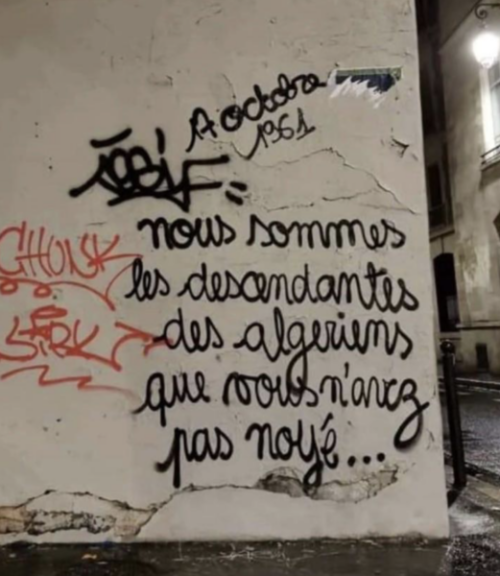
France is not an isolated case. In Belgium; in Italy, where Giorgia Meloni’s government has decided to send the army to Milan to suppress the protests; in Albania; in Spain; and in Portugal, where the call for a general strike is on everyone’s lips, young people are rising up against governments that serve the wealthiest and are becoming increasingly authoritarian. On the streets of Paris, in particular, impromptu bands struck up La Marseillaise, as well as El pueblo unido jamás será vencido, The Internationale and Va, pensiero, the chorus of the Hebrew slaves from Verdi’s Nabucco, amidst the tear gas. These were all songs of emancipation, steeped in the promises of past struggles, much like the slogan that resonated particularly strongly on 17 October, 65 years after the massacre of Algerians carried out in Paris by the police under Prefect Maurice Papon, who was convicted in 1998 of complicity in crimes against humanity for his role in the deportation of Jews from the Gironde region during the Occupation: ‘We are the children of those you did not drown’. [1]

With a cross-sector day of action called for 5 November, Olivier Besancenot looks back with Marx21.ch on this period, its historical roots – from the French Revolution to the Paris Commune – and the reasons to believe in it.
Stéfanie Prezioso: What is new and surprising about the social mobilisation of young people in France and the alliance forged with other sectors of society around the issue of cost of living on 17 October, which points to the crisis of social reproduction?

Olivier Besancenot: What is new and surprising about the mobilisation on 17 October and the alliance that has formed is that it is taking place outside traditional structures. We had already seen social outbursts – whether sector-specific or thematic – that clearly eluded the organisations of the labour movement, be they trade unions, social organisations or political parties – the Yellow Vests, for example. But for a convergence to begin taking place, outside these organisations, between completely different sectors of society, with the support and participation – whether implicit or explicit – of certain structures: as far as I can recall, this is unprecedented.

This explains both the surprise that has caught the political establishment off guard, whilst also highlighting the movement’s limitations in terms of democratic organisation. I think this really points to the global crisis we are living through, which is also a crisis of labour movement organisations, to a transformation of society, and to a new type of proletariat which, in fact, is emerging through this sort of experience.

SP: You often refer to the French Revolution and the Paris Commune – and the social and democratic aspirations driven by the working classes – when reflecting on the events we are witnessing today. Why are these historical references so pertinent?

OB: It is true that my primary point of reference has always been the Paris Commune of 1871, far more so than the French Revolution, which I am learning to discover – or rediscover – through the struggles, particularly that of the Yellow Vests. That movement was a turning point: this history has re-emerged in the mobilisation in a subliminal way – or perhaps not so subliminal after all. The large demonstrations in December, which marched up the Rue de Rivoli to the Place de la Concorde in order to reach the Élysée Palace at any cost and confront Macron there, naturally evoked the great peasant revolts – led in particular by women – who would go and fetch the king from his castle to bring him back, for example, to Paris. Not to mention the French flag, which was not merely an expression of the far-right currents present at the start of the movement, or La Marseillaise, sung at the top of people’s voices, which I have learnt to listen to in a different light.

This Marseillaise can be heard, for example, in schools and in the secondary schools taking part in the protests, particularly in working-class neighbourhoods and the suburbs. So there is an underground history. And when one learns to rediscover it — as I am doing at the moment, notably by reading Jules Michelet’s History of the French Revolution — one realises that something truly extraordinary did indeed happen: the people, from the grassroots up, put an end to centuries of domination, organisation and the monarchical mode of production, and decided to do away with it all—on several occasions between the storming of the Bastille; the act of going to fetch the king in October 1789 to bring him back to Paris—a mass abduction the likes of which we no longer see; later, by beheading him; and later still, by organising days of insurrection and communalist action.

This inevitably leaves its mark, which, for my part, I had underestimated. We belong to a very distinct current, deeply shaped by the political era that began with the October Revolution of 1917 and ended in 1989, and one realises that there is something profound there after all.

SP: What does the scale of repression in France today – carried out by a supposedly centrist government, which is in no way inferior to that of Giorgia Meloni’s far-right administration – tell us about the convergence of the more or less extreme right-wing movements in Europe and around the world?

OB: The scale of the repression is, in fact, absolutely unprecedented. In terms of the number of people taken into police custody since the start of the secondary school pupils’ movement, it far exceeds even that experienced by the Yellow Vests movement, which itself had far surpassed the protests against the First Employment Contract (CPE) or those of the 1990s. In fact, working-class neighbourhoods have served as a testing ground for the systematisation of a repressive apparatus that is now being rolled out to every type of social upheaval. This tells us, first and foremost, something about liberalism and its policies, which require an authoritarian turn.

Secondly, it tells us something about the ongoing ‘fascisation’ – that is what I call it, despite everything, even if the term is open to debate, for it at least has the merit of highlighting what is actually happening: a whole series of measures have already been put in place by the Macronist government, even before the far right has come to power. In July, for example, the presumption of self-defence was granted by law to the police, which is a long-standing demand of the far right.

And there are many more examples like this. In this process, we can also see the extent to which the Macron administration is losing control of its own repressive apparatus. There is therefore a loss of control over the situation and, in this race against time, there is what Daniel Bensaïd called the ‘discordance of times’: between social time, which is becoming more radicalised, and political time, which is nowhere near that stage.

SP: The media have placed great emphasis on the unprecedented violence of 17 October, which undoubtedly reflects heightened anger. But what surprised us most was seeing hundreds of thousands of demonstrators converging across France, united in their shared rejection of social injustice and the denial of democracy. What conclusions do you draw from that day?

OB: To assess the 17th, it is extremely important to understand the scale of what is happening. I took part in this demonstration, and I have never experienced anything like it in my life, in terms of its sheer size, determination and the mix of people. It was a tidal wave, a human tide. Of course, when you get home in the evening and see the mainstream media and political coverage of these events – which, incidentally, did indeed take place – you get the impression that you weren’t part of the same thing. And this, for the time being, is being overlooked in the French political debate, as it is a sense of bewilderment that prevails, alongside the political exploitation of what happened: shops vandalised, and in some cases looted.

But all this cannot simply vanish overnight, for there is something too powerful, too profound in what has just been expressed, and which we have yet to understand: a movement that was organised solely through social media and subsequently supported by a number of organisations.

This points to a new phase, one that throws everything back into question, full of new possibilities, and which – despite the ongoing political unease of the moment, which persists and is catching up with this phase – must give us cause for hope.

SP: The hundreds of thousands of people who have mobilised no doubt feel today that the demonstrations are insufficient to bring a hardline government to its knees, a government that has no qualms about imposing a partial curfew. The call for a general strike is on everyone’s lips, just as it is in Spain. What do you think?

OB: The mobilisation will, indeed, lead to an outcome that, by its very nature, we cannot predict.

Nothing is over, because this movement isn’t going to stop: it’s too deep-rooted, too entrenched. It also has an international dimension. When you look beyond our borders, you can see that, amongst young people, similar events – or events we’re tempted to compare – are taking place in Belgium, Italy and Albania. There’s also the movement unfolding in Spain. There is also something happening from a generational perspective, which means that this movement will not be halted by the imposition of a curfew or by other authoritarian measures which, I am sure, will not be long in coming – perhaps even the dissolution of a number of organisations; we do not yet know.

The challenge now, in fact, is for the labour movement to take up the baton – that is to say, for the working class to take up the baton. If there is no strength in numbers – in terms of reminding society of the place occupied by workers – then, unfortunately, it will not be enough, and we will not succeed in ensuring that this legitimate revolt leads to a fully-fledged class consciousness, based on partial victories, or at least on a visibility that gives us reason to believe in it. This is what is at stake behind the call for a general strike. A day of cross-sectoral action has been called for 5 November: the challenge now is to ensure that the workers of this country do not remain mere spectators of what is happening, that they are not paralysed by the situation, especially as there are still grey areas.

There is talk of deaths in connection with the demonstrations, without a full explanation; accounts, theories and hypotheses are being put forward, but we have reached this level of gravity. We are therefore only at the beginning, and we are of course eager to see what the future may hold, even though we are, on the other hand, extremely — how shall I put it? — weighed down by the political anxiety of the moment, because we can see that all the ingredients of this period, this grim period in which we are living, are re-emerging.

20 October 2026

Translated by International Viewpoint from marx21.ch.

Footnotes

[1] Hundreds of Algerians were thrown into the Seine by police on 17 October 1961.


Monday, September 21, 2026

On Russia’s New Economic Policy in the early 1920s and the crisis facing Cuba today

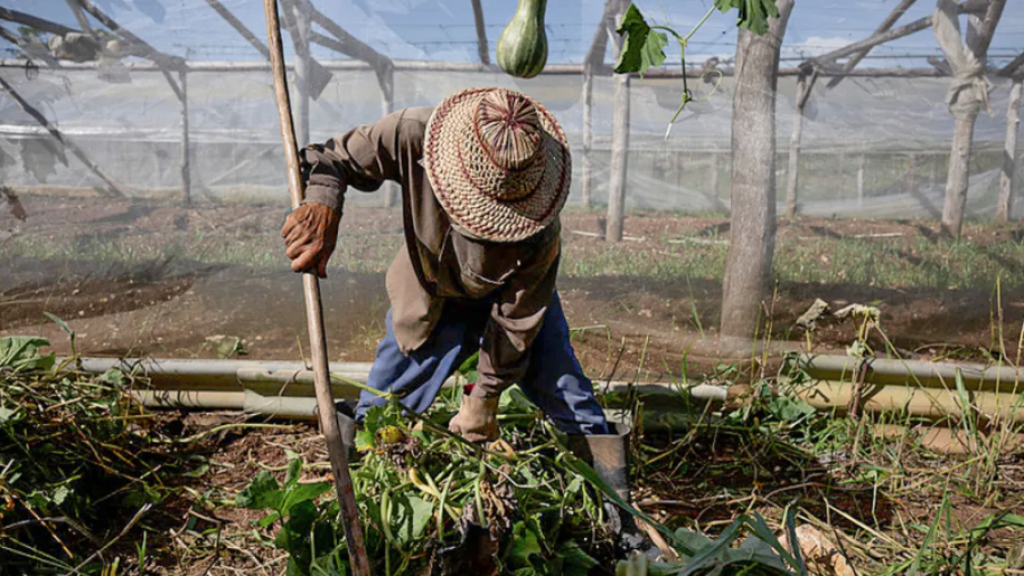
Cuban farmer, 2026. Cuba’s agricultural production has been declining for nearly 30 years.

First published at World-Outlook, with the following introduction and postscript by its editor.

On June 18, 2026, Cuba’s National Assembly — the country’s highest legislative body — adopted an extensive series of new economic measures. The Central Committee of Cuba’s Communist Party had approved the same package a day earlier.

These decisions were made as Cuba confronts its deepest economic and social crisis since the 1959 revolution. This dire situation is largely caused by Washington’s relentless economic war for nearly seven decades. The U.S. economic blockade of Cuba has been in place since 1960. Washington has escalated it repeatedly. Trump tightened it further during his first term as U.S. president and Biden left most of those new restrictions in place during his presidency.

Trump took a qualitatively new and more belligerent step when he imposed a US naval blockade on all oil imports to Cuba last January. Even in the days of the October 1962 “missile crisis,”1 the U.S. naval blockade was limited to what Washington considered “offensive weapons.” This complete blockade of oil imports has resulted in an unprecedented energy crisis resulting in blackouts that last most of every day and affect all aspects of life in Cuba. A new wave of sanctions is now threatening Cuba’s food supply.

The economic measures recently adopted in Cuba include virtual abolition of the state monopoly of foreign trade, enabling establishment of private banks, allowing private companies to hire an unlimited number of employees, easing regulations for direct foreign investment, and creating a partial dollarization of the economy. They are a retreat from many of the policies of the Cuban Revolution, signifying explicit openings to the capitalist market.

In discussions and debates on social media and elsewhere in Cuba, a number of supporters of the Cuban Revolution have referred to similar measures adopted in the early years of the Russian Revolution, known as the “New Economic Policy” (NEP).

In the early 1920s, the introduction of the NEP represented a retreat by the Bolsheviks from earlier policies of the 1917 Russian Revolution. The NEP was a response to the devastation of the young Soviet republic after three years of civil war, foreign imperialist intervention, and setbacks of revolutionary struggles in Europe.

While some of the measures being taken in Cuba resemble the NEP, the situation facing Cuba today is very different.

As a contribution to this discussion, we are publishing below major excerpts of an article on the NEP — written by Argiris Malapanis, who is today an editor of World-Outlook — that first appeared in the April 1994 issue of the International Socialist Review (ISR).2 It was published as Cuba adopted economic changes in the 1990s to revive declining agricultural and industrial production during the Special Period.3

The ISR article that follows introduced speeches and articles on the NEP by Russian revolutionary leader V. I. Lenin, major excerpts of which appeared in the same ISR issue. 

In addition, in a postscript to the article that follows, we sketch the main differences in the political situation faced by the Bolsheviks in the 1920s to the situation Cuba confronts today.

We publish the article below for the information of our readers. The headline, subhead, and text that follow are from the original. 


How the Bolsheviks charted course to sustain the worker-peasant alliance: From War Communism to the New Economic Policy

Argiris Malapanis

The Bolshevik Party was a working-class party both in composition and in program. Bolshevik workers helped lead the insurrection that overthrew the tsar in February 1917 and brought to power a government led by the bourgeois Cadet Party (Constitutional Democrats). That regime represented the interests of the capitalists, landowners, and foreign imperialists. It was overthrown by an armed insurrection of workers and soldiers organized in soviets (workers and peasants councils) in October 1917, which brought the Bolsheviks to power.

The workers and peasants’ government that came to power ended Russia’s participation in World War I.

It declared on the first day of the revolution that the holdings of the big landowners would be distributed to the peasants. Around 80 percent of the country’s population was engaged in agriculture at the time. The industrial working class numbered only 4 million.

Under the monarchy, 100 million peasants had been scraping out a meager living on about 380 million acres of land with average allotments of 19 acres per family. But rich landowners, numbering 30,000 with average allotments of 5,400 acres each, owned as much land as 50 million poor peasants. So, land distribution was immensely popular among the peasants.

To encourage increased agricultural production, the Soviet government provided aid in the form of implements, fertilizer, and other necessities.

This stance cemented an alliance between working people in the cities and countryside without which the revolution could not survive.

The Bolshevik-led government extended freedom of choice to all nationalities. They could either remain in the Soviet Union or peacefully secede if they so desired. In most cases they joined the Soviet federation.

The revolutionary regime took actions to radically advance the status of women.

In the first days of the revolution, the government also issued decrees defending workers’ rights. These included abolishing child labor, guaranteeing the eight-hour day and health and unemployment insurance, forbidding lockouts by employers, and granting elected workers councils increased control over industry.

The communists sought to aid workers’ struggles in other countries and extend the revolution. This was seen as a precondition to defending and advancing the Russian revolution.

Civil war and ‘war communism’

In response to these and other Soviet government policies, a civil war erupted, pitting capitalists and former tsarist forces against workers and peasants. Invading armies from more than a dozen imperialist countries backed the capitalist counterrevolution.

ln response, the workers and peasants’ government utilized its power to deepen the revolutionary struggle, resulting in the expropriation of the capitalist class and nationalization of industry and wholesale trade by the end of 1918. This laid the basis for the establishment of a planned economy and state monopoly of foreign trade.

Although the peasants during the civil war joined with the Bolsheviks and the revolutionary workers against the landlords and the tsar, they were not, in their majority, won to the socialist perspective of the Bolsheviks. Thus, the military alliance had to be accompanied by an economic alliance. Under civil-war conditions, this took the form of compulsory requisitions of the peasants’ grain surpluses to feed the urban working class. In addition, the revolutionary government relied on growing militarization of labor in the factories and in transportation.

By the end of 1920, the foreign invaders and counterrevolutionary armies had been defeated. Under the new post-civil war conditions, the alliance of workers and peasants could not be maintained by the same methods. The policies of “war communism,” followed by the Soviet government from mid-1918 through early 1921 as necessary measures of defense and survival, were no longer sustainable.

Sporadic resistance to these policies turned to open revolt. In late 1920 and early 1921 there were strikes in some factories, peasant revolts in parts of the countryside, and — in March 1921 — a mutiny by troops, largely peasant and petty bourgeois in composition, at the Kronstadt garrison near Petrograd (St. Petersburg).

Tax in kind

The conditions of the peasantry had become too miserable, and the common military cause was no longer there to buffer growing resentment against the requisitioning of food. So, in early 1921, the Bolsheviks replaced their previous policy with a tax in kind on the peasants’ grain surplus — that is, only a certain portion of the surplus, established by law, was taken by the state for distribution in the cities. The peasants could keep the rest for the use of their family or to sell on the market.

Along with this policy toward the peasantry, Lenin and the Bolsheviks also proposed measures to help revive industrial production. This included leasing nationalized factories, mines, forests, and oil fields to foreign capitalists and to some remaining entrepreneurs in Russia itself. This was combined with an ambitious proposal to bring electrification to the entire country — urban and rural areas alike. These measures marked the beginning in Russia of the NEP. The Bolsheviks placed this important shift in their tactics before delegates at the Third Congress of the Communist International in 1921 for a discussion and vote.

Lenin, Leon Trotsky, and other Bolshevik leaders explained that this policy was a necessary but temporary retreat. Above all, the NEP assumed the existence in the Soviet Union of a communist leadership of the working class that worked to strengthen the worker-peasant alliance, increase the production and circulation of food and other agricultural goods, and revive industrial production as rapidly as possible, in order to lay a more solid foundation on which to organize the next steps in advancing toward socialist relations of production and interchange.

A major factor that led the Bolsheviks to adopt the NEP was the conjuncture in world politics that existed in the opening of the 1920s. On an international level, Lenin and the Bolsheviks acknowledged and analyzed the fact that the prewar revolutionary upsurge had peaked. They came to grips with the political consequences of the defeats of working-class uprisings in Germany, Hungary, Italy, and elsewhere in Europe.

The failure to extend the example set by the Bolsheviks and the recoil from revolutionary struggle in those countries, reinforced by bloody repression, meant that the possibility for an extension of the world revolution had been pushed back temporarily. However, solidarity with the Soviet republic and opposition to war against it remained high among workers in Europe and other parts of the world.

Combating negative consequences of NEP

The Bolsheviks were very much aware of the dangers of increased class differentiation and polarization inevitably bred by the NEP. These policies widened social inequalities and helped generate new exploiting layers, especially rich peasants and price-gouging traders and middlemen, whom the workers and poor peasants came to call “Nepmen,” with contempt.

State industrial enterprises, pressed to cut costs, laid off workers and pushed up jobless levels in the cities. Making the profit column of the ledger book look good became the overriding consideration for many factory managers — whether or not these figures reflected less wasteful organization of labor and utilization of resources, and regardless of broader social needs and priorities. Efforts to advance workers control and management in the factories faced greater obstacles.

To combat such consequences of the NEP, the Bolsheviks worked to rebuild the strength of the Communist Party among the reviving industrial working class and to fight for political leadership of the peasantry.

Once the economic recovery was under way and the worker-peasant alliance placed on firmer ground, new tasks were posed. Once again, Lenin led the political battle. During the last year of his active political life, Lenin launched a fight aimed among other things at combating the initial consequences of the NEP and reversing the Soviet republic’s unavoidable temporary retreat. This was one of Lenin’s final contributions to Marxism and working-class politics.

The degeneration of the workers state after Lenin’s death in 1924 was the result of a bloody political counterrevolution carried out against the working class, its vanguard, and its allies, in the interests of a materially privileged social layer numbering in the millions.

By the beginning of the 1930s, Joseph Stalin emerged as the leading representative of that social caste. Under the banner of “socialism in one country,” the new regime beat a headlong retreat from the internationalist course carried out during Lenin’s time of subordinating the national interests of the Soviet state to the advance of the world struggle for national liberation and socialism.

The battle following Lenin’s death over the social consequences of the policies collectively called the NEP were fought out in this political context. It was a struggle over conflicting class interests and orientations.

The representatives of the bureaucratic caste triumphed and reversed the communist course initiated by Lenin in the Soviet government, Communist Party, and Communist International. Contrary to the decades-long distortions by bourgeois, social-democratic, anarcho-syndicalist, ultraleft, and Stalinist opponents of communism, the policies of Stalin and his heirs were not the outcome of the continuity of Lenin’s political course but the bloody defeat of that course….

[A]s Lenin pointed out at the time, as long as the Soviet republic was surrounded by the capitalist world and the revolution in Germany and other advanced capitalist countries had not come to its aid, the Bolsheviks had to pay a tribute to the imperialist bourgeoisie. They had to do it in order to survive and gain time until the extension of the world revolution could shift the balance of class forces once again in favor of the working class…


Postscript 

World-Outlook editors

There are similarities between the circumstances that led the Bolsheviks to adopt the NEP in the early 1920s and what Cuban revolutionaries confront today. But the differences are striking.

1. An unstable equilibrium

The new Soviet republic had won a breathing period as a result of its victory in the civil war and the defeat of imperialist intervention in the early 1920s. Lenin described this in numerous reports, speeches, and articles. A brief excerpt from a speech he gave on July 5, 1921, at the Third Congress of the Communist International (Comintern), Report on the Tactics of the R.C.P. (item 4 in this link), makes this clear:

“During the past few years, we have witnessed the direct struggle waged by the international bourgeoisie against the first proletarian republic. This struggle has been at the centre of the world political situation, and it is there that a change has taken place. Inasmuch as the attempt of the international bourgeoisie to strangle our Republic has failed, an equilibrium has set in, and a very unstable one it is, of course.” [Emphasis added.]

There is no equivalent “equilibrium” facing Cuba today. The opposite seems to be true.

It is virtually certain that Trump has instructed the Pentagon to draw up plans for a U.S. military invasion of Cuba. It is even more certain that such an invasion would meet the most determined resistance by the Cuban people, a certainty that likely gives the U.S. ruling class pause on whether it is prepared to risk suffering large numbers of casualties. But there are other military options, short of the use of U.S. ground troops, that could devastate Cuba. They include air assaults like those Washington has mounted against Iran.

Meanwhile, short of such dangerous additional military moves, the U.S. naval blockade pulls the noose around the Cuban people a little tighter every day. The damage — due to the oil blockade — to the Cuban health care system has already led to the loss of lives.

2. International situation

There’s also an important difference between the international situation then and now.

While acknowledging the setbacks of revolutionary struggles in Europe in the early 1920s that were a major factor in launching the NEP, Lenin expressed the Bolsheviks’ optimism about prospects for coming revolutionary struggles, especially in the East. In the same report to the Comintern’s third congress cited above, Lenin said:

“We can say with satisfaction that the revolution is developing all over the world, and it is only thanks to this that the international bourgeoisie is unable to strangle us, in spite of the fact that, militarily and economically, it is a hundred times stronger than we are.…

“The movement in the colonial countries … has undergone great change since the beginning of the twentieth century: millions and hundreds of millions, in fact the overwhelming majority of the population of the globe, are now coming forward as independent, active and revolutionary factors. It is perfectly clear that in the impending decisive battles in the world revolution, the movement of the majority of the population of the globe, initially directed towards national liberation, will turn against capitalism and imperialism and will, perhaps, play a much more revolutionary part than we expect. It is important to emphasize the fact that, for the first time in our International, we have taken up the question of preparing for this struggle.”

There are no similar prospects on the horizon today for Cuban revolutionaries and the working class and its allies worldwide.

The labor movement has been in decline for decades around the globe.

There has been no successful socialist revolution anywhere in the world since the victory of the Cuban Revolution in 1959. Popular revolutions in Iran, Grenada, and Nicaragua in 1979, and Burkina Faso in 1983, scored initial successes but were ultimately defeated. In countries where capitalist rule had once been overthrown — from the Soviet Union to Eastern Europe, China, and Vietnam — it has been reestablished.

In the 21st century, “the left then began to defend the functioning of bourgeois democracy (without mentioning the adjective, as if it were the only form of democracy possible) and did not go beyond this narrow framework during those years,” wrote Enrique Ubieta Gómez, editor of Cuba Socialista, the theoretical journal of Cuba’s Communist Party, in a July 28 article. Left-wing parties “immersed in the electoral arena, stopped searching for another type of truly popular democracy and rejected, at least in practice, the possibility of defeating and overcoming the capitalist system,” Ubieta Gómez accurately stated.

In addition, no government of any country — without exception — has meaningfully challenged the latest U.S. measures aimed at strangling and starving Cuba and its people. Not Brazil. Not Mexico. Not Spain.

Even though Cuba has received some aid from China, Russia, and Vietnam, Ubieta Gómez wrote, “it will have to fend for itself.”

In an April 30, 2026, interview in Havana with World-Outlook, Cuban historian Ernesto Limia Díaz explained that “China also does not give Cuba anything for free…. China does make small donations, but they are symbolic donations.”

3. Foreign capitalist investment to revive industry

In the early 1920s, the new Soviet republic welcomed foreign capitalist investment through a concession system to revive Russia’s industrial production that had collapsed during the civil war. Foreign firms operated nationalized mines, oil fields, and factories under state supervision, investing capital and sharing profits while the Bolsheviks retained overall control of the economy and its planning.

“Without the slightest denationalization, we shall lease mines, forests and oilfields to foreign capitalists, and receive in exchange manufactured goods, machinery, etc., and thus restore our own industry,” Lenin explained in the same speech cited above.

One of the stated goals of the recent measures adopted in Cuba is precisely to attract capital investments from abroad in order to revive declining industrial production. But there are no signs this is feasible, at least in the short term.

In fact, the opposite seems to be true. Washington keeps tightening sanctions, forcing even capitalists based in countries with friendly relations with Cuba, like Spain, to abandon operations on the island. A case in point is the Spanish-owned Melia Hotels, which shut down its 34 hotels in Cuba on July 24. Mastercard and Visa transactions were also suspended in Cuba on June 6. The country is now largely isolated from the global financial system.

4. Agricultural production

Almost 80 percent of the Cuban population lives in the cities now, a demographic fact that is the reverse of the Soviet Union of the 1920s. The cultural level of the Cuban population today is also much more elevated than that of the young Soviet republic, which was characterized by rampant illiteracy, especially in the countryside.

There is another, overriding contradiction, however, between then and now, regarding agricultural production.

The Bolsheviks took steps through the NEP to cement the worker-peasant alliance and ensure that grain and other foodstuffs produced by the peasantry could flow into the urban areas.

However, Cuba today is hard pressed to quickly shore up agricultural production that has been declining for nearly three decades, as outlined in the recent article published by Jacobin, “After Blocking Fuel, the US Turns to Cuba’s Food Supply”. The World Food Program estimates that Cuba today relies on agricultural imports to meet 70-80% of its needs, making it more vulnerable to Washington’s bellicose sanctions.

During a July 26, 2009, rally in Holguín, Cuba, celebrating the anniversary of the attack on Moncada, the opening act of the Cuban Revolution, Raúl Castro, the country’s president at the time, stressed in his speech that increasing domestic food production was an urgent economic priority to reduce Cuba’s heavy reliance on costly food imports. He said rebuilding the country’s agricultural system was a matter of national security.

“The land is there! The Cubans are here!” Castro said pointedly, pounding the podium. “Let’s see if we can work better or not, if we can produce or not, if we keep our word or not! It’s not a question of crying, ‘Motherland or death! Down with imperialism!’ The U.S. blockade pummels us and yet the land is there waiting for our efforts.”

He told the tens of thousands at the rally in Holguín that half of Cuba’s arable farmland was either fallow or underutilized.

It seems that Cuba was not able to make much progress to address this vulnerability in the decade since then.

5. Food aid

Between 1921 and 1923, for its own reasons, Washington provided significant food aid to the Soviet Union through the American Relief Administration. This was done in response to the Soviet government’s international appeal for such help to alleviate a famine that plagued the country as a result of the civil war and foreign intervention.

However, Washington is now doing the opposite. As the Jacobin article cited above shows, U.S. sanctions are targeting Cuba’s capacity to grow, process, and import food.

While the U.S. government is not directly barring humanitarian shipments, its draconian sanctions and fuel blockade have created a “chilling effect.” United Nations officials report that shipping companies, banks, and insurers refuse to handle cargo for Cuba out of fear of U.S. penalties, leaving thousands of aid containers stranded.

Taken altogether, these differences signify that Cuban revolutionaries today face challenges much more daunting than what the Bolsheviks had to confront a little over a century ago.

  • 1

    In October 1962, in what is widely known as the Cuban Missile Crisis, the U.S. government — under President John F. Kennedy — pushed the world to the edge of nuclear war by enacting a naval blockade of Cuba and threatening war unless the Soviet Union withdrew nuclear missiles it had installed in Cuba against the wishes of the Cuban government. The Cuban people and their revolutionary government, with unparalleled determination to defend their sovereignty and their socialist revolution, blocked U.S. plans for a military assault and saved humanity from the consequences of a nuclear holocaust.

  • 2

    This issue of the International Socialist Review was published as a supplement to the April 4, 1994, Militant newsweekly.

  • 3

    During the 1990s, following the fall of the Berlin Wall and the dissolution of the Union of Soviet Socialist Republics (USSR), Cuba faced its first severe economic crisis since the victory of the revolution in 1959. Confronted with the cutoff of trade at preferential prices with the former Soviet Union, Cuba suddenly faced a 35% plunge in economic production (equal or greater than the decline of the Great Depression in the United States in the 1930s). Those years are often referred to as the “Special Period in Time of Peace.”

    At the same time, Washington intensified its economic warfare against Cuba as the Revolution tried to get new trading partners and sources of capital. Enemies of the Revolution everywhere predicted the “impending” collapse of the workers and farmers republic. Revolutionary minded working people in Cuba, however, defended their socialist revolution in face of these difficulties, showing that the Cuban government remained their government. And they continued to reach out to the oppressed and exploited around the world, aiding anti-imperialist and national liberation struggles.

    A series of eyewitness reports first published in the mid-1990s in the Militant newspaper describe how Cuba’s revolutionary leadership and the country’s working people confronted the challenges of the Special Period. These articles were later published as a pamphlet. They can be found in the following links:

    Cuban Nat’l Assembly debates measures to deal with formidable economic crisis (pp. 5-6, April 4, 1994, issue.)

    Workers debate way forward for Cuban revolution (pp. 8-9, April 11, 1994, issue.)

    Cuban gov’t reorganizes state farms into cooperatives in effort to boost production (pp. 6-7, April 18, 1994, issue.)

    Agricultural markets raise expectations that food scarcities may ease in Cuba (pp. 8-9, January 30, 1995, issue.)

    Workers in Cuba increase their management role through factory assemblies (pp. 8-9, February 6, 1995, issue.)

    Cuba: signs of economic stabilization put workers on footing to meet new challenges (pp. 8-9, April 10, 1995, issue.)