Thursday, March 12, 2020

Health official: Gov't has 'failed' to give easy coronavirus testing in U.S.Fauci said, "The idea of anybody getting [the test] easily the way people in other countries are doing it, we're not set up for that. Do I think we should be? Yes, but we're not."
"The system is not really geared to what we need right now -- what you are asking for. That is a failing. ... Let's admit it," he added.

National Institute of Allergy and Infectious Diseases Director Anthony Fauci arrives Thursday at the U.S. Capitol in Washington, D.C., to brief lawmakers on the federal coronavirus response, Photo by Mike Theiler/UPI | License Photo

March 12 (UPI) -- A top Trump administration official told lawmakers at a congressional hearing Thursday that government efforts are failing so far to provide Americans easy and accessible testing for the coronavirus disease.

Dr. Anthony Fauci, director of the National Institute of Allergy and Infectious Disease, made the remarks at a hearing of the House oversight committee to detail the federal response to the COVID-19 pandemic.


Questioned by Rep. Debbie Wasserman Schultz , D-Fla., about reports of nurses not having access to tests, Fauci said, "The idea of anybody getting [the test] easily the way people in other countries are doing it, we're not set up for that. Do I think we should be? Yes, but we're not."

"The system is not really geared to what we need right now -- what you are asking for. That is a failing. ... Let's admit it," he added.

RELATED Report: U.S. offered COVID-19 help to North Korea

The Centers for Disease Control and Prevention has reported 1,215 U.S. cases of the coronavirus and 36 deaths, as of Wednesday afternoon. Johns Hopkins University, which is keeping a more current tally, listed U.S. cases at more than 1,300 and deaths at 38 by mid-Thursday. It also says eight patients have recovered in California, Illinois, Arizona, Massachusetts, Washington state and Wisconsin.

CDC Director Dr. Robert Redfield also testified Thursday, and said 44 states now have confirmed cases.

U.S. testing for the coronavirus has so far lagged behind other nations, according to data compiled by Oxford University. The total number of tests in South Korea are at a rate nearly 25 times higher than they are being given in the United States. Britain has conducted three times as many tests with fewer overall cases, the data said.


RELATED Princess, Viking cruises halt operations due to coronavirus

Redfield said the CDC is capable of processing as many as 350 tests per day -- far fewer than some privately-owned labs, which can process thousands daily.

The CDC director testified earlier at a House budget hearing that insufficient funding levels are responsible for the government's response to the pandemic. Initial testing efforts suffered a setback due to quality control issues with the first tests the CDC sent out.

Hours before Thursday's hearing, the House and Senate sergeants-at-arms announced the U.S. Capitol would close to the public for the rest of March in an effort to mitigate the spread of the virus. The closure was set to take effect at 5 p.m. EDT Thursday.

Senate Republican leader Mitch McConnell said he "fully supported" the decision, which will also close the House and Senate office buildings to the public. Only those conducting official business and media members were being allowed to enter. Later Thursday, McConnell announced Congress will delay its forthcoming recess, which had been scheduled for next week, to work on legislation to provide additional coronavirus relief.


---30---

WON'T BE DOING THIS ANYMORE

Former Vice President Joe Biden shakes hands with Vermont Sen. Bernie Sanders on stage at the primary debate in Des Moines, Iowa, on January 14. File Photo by CNN/UPI
Bernie Sanders Coronavirus Speech Transcript: March 12, 2020

RevBlogTranscriptsSpeech Transcripts › Bernie Sanders Coronavirus Speech Transcript: March 12, 2020

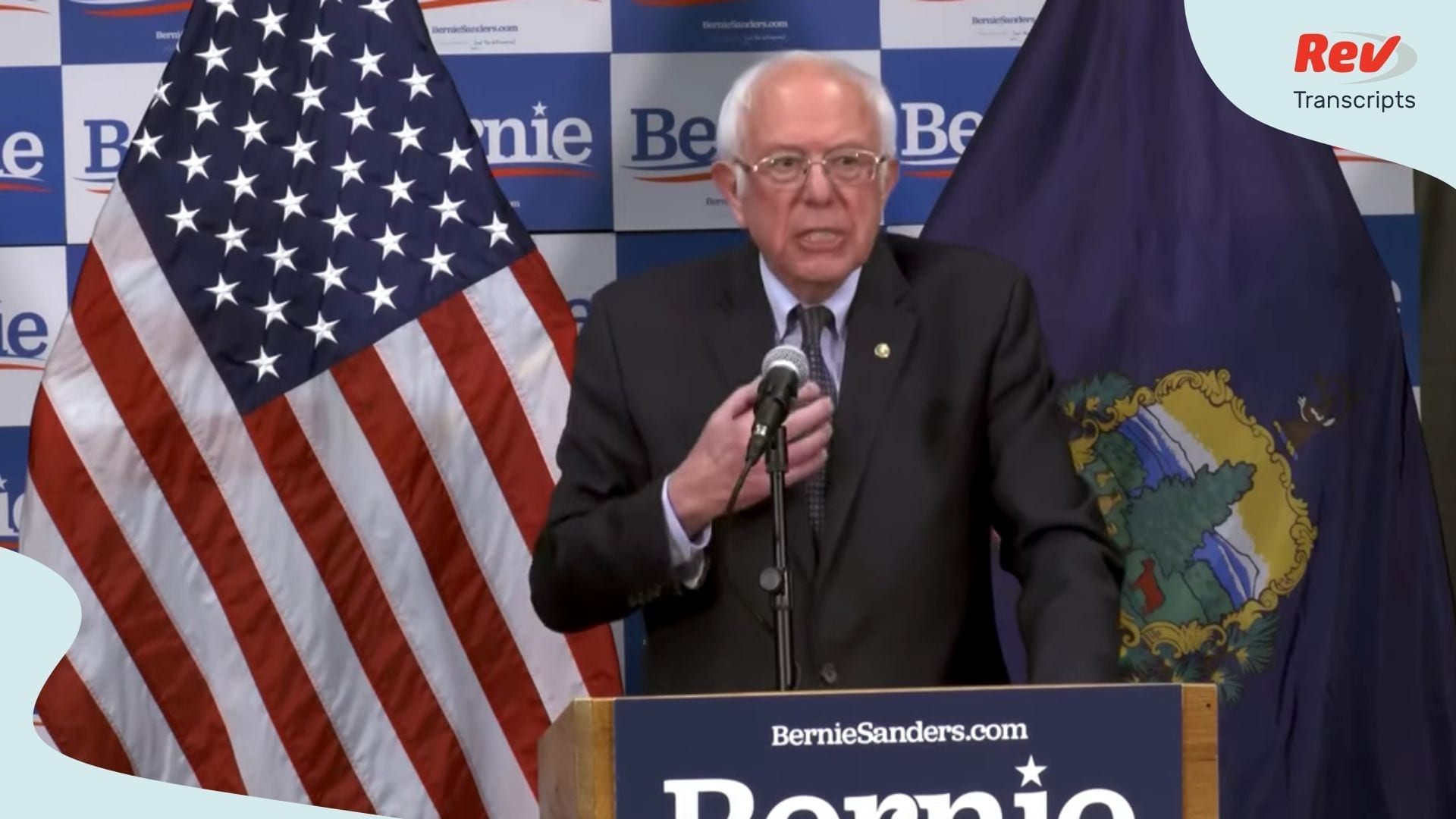
Democratic presidential candidate Bernie Sanders delivered a speech today on the coronavirus, or COVID-19. Read the full transcript of his remarks right here.

Bernie Sanders: (00:00)
The crisis we face from the coronavirus is on a scale of a major war and we must act accordingly. Nobody knows what the number of fatalities may end up being or the number of people who may get ill, and we all hope that that number will be as low as possible. But we also have to face the truth and that is that the number of casualties may actually be even higher than what the Armed Forces experienced in World War II. In other words, we have a major, major crisis and we must act accordingly.

Bernie Sanders: (00:44)
Therefore, it is an absolute moral imperative that our response as a government, as a society, as a business community, and as individual citizens meet the enormity of this crisis. As people stay or work from home and are directed to quarantine, it will be easy for us to feel like we are all alone. “I’m working at home. I’m not at my office.” Or that we must only worry about ourselves and think that everybody else should fend for themselves. But in my view, that would be a tragic and dangerous mistake.

Bernie Sanders: (01:38)
If that ever was a time in the modern history of our country when we are all in this together, this is that moment. Now is the time for solidarity. Now is the time to come together with love and compassion for all, including the most vulnerable people in our society who will face this pandemic from a health perspective or face it from an economic perspective. If our neighbor or coworker get sick, we have the potential to become sick. If our neighbor loses his or her job, then our local community suffers and we may lose our jobs. We are in this together. If doctors and nurses and medical personnel do not have the equipment and the training and the capacity they need right now, people we know may unnecessarily face additional illness and even death. We are all in this together.

Bernie Sanders: (03:05)
Unfortunately, in this time of international crisis, it is clear to me, at least, that we have an administration that is largely incompetent, and whose incompetence and recklessness have threatened the lives of many, many people in our country. So today, I would like to give a brief overview of what, in my view, we must do to respond to this crisis.

Bernie Sanders: (03:37)
First and foremost, we are dealing with a national emergency and the President of the United States must understand that and declare that emergency. Next, because President Trump is unwilling and unable to lead selflessly, we must immediately convene an emergency bipartisan authority of experts to support and direct a response that is comprehensive, compassionate, and based first and foremost, on science and facts. In other words, Congress in a bipartisan manner must take responsibility for addressing this unparalleled crisis.

Bernie Sanders: (04:27)
Further, we must aggressively make certain that the public sector and the private sector are strongly cooperating with each other, and we need national and state hotlines staffed with well-trained people who have the best information available. One of the aspects of the current crisis is there are people who are asking themselves, “What all the symptoms of coronavirus? Well, I have a cold. Do I have the flu? Do I have the coronavirus? Who’s going to help me? Where do I go to seek medical treatment? How do I get a test? When is that test going to be processed?” People have a lot of questions, and at the statewide and federal level, we need experts to provide the necessary information to our people.

Bernie Sanders: (05:17)
The American people deserve transparency. Something that the current administration has fought day after day to stifle. In other words, we need to know what is happening right now in our country, in our states, and in fact, all over the world. If there was ever a time for transparency and honesty and being straightforward, this is that moment. And we need that information coming from credible, respected scientific voices of which we have many in our own country and all over this world, not from politicians.

Bernie Sanders: (05:57)
And during a crisis, we must make sure that we care for the communities most vulnerable to the health and economic pain that is coming, those in nursing homes and rehabilitation facilities. Those confined immigration detention centers, those who are currently incarcerated and in jails, and all people regardless of their immigration status.

Bernie Sanders: (06:29)
Unfortunately, as I think the American people increasingly understand, our country is at a severe disadvantage compared to every other major country on earth because we do not guarantee healthcare to all people as a right. And as we speak, some 87 million Americans are either uninsured or underinsured. And when you are uninsured or underinsured, you hesitate about getting the medical care you need because you cannot afford to get that medical care. The result is that millions of our people cannot afford to go to a doctor, let alone pay for coronavirus tests.

Bernie Sanders: (07:20)
So while we work to pass a Medicare for all single-payer system, the United States government today must make it clear that in the midst of this emergency, every one in our country, regardless of income or where they live, must be able to get all of the healthcare they need without cost. Obviously, when a vaccine or other effective treatment is developed, it must be free of charge. We cannot live in a nation where if you have the money, you get the treatment you need to survive. But if you’re working class or poor, you get to the end of the line. That would be morally unacceptable.

Bernie Sanders: (08:15)
Further, we need emergency funding right now for paid family and medical leave. Anyone who is sick should be able to stay home during this emergency and receive their paycheck. What we do not want to see is at a time when half of our people are living paycheck to paycheck, when they need to go to work in order to take care of their family, we do not want to see people going to work who are sick and who can spread the coronavirus.

Bernie Sanders: (08:53)
We also need an immediate expansion of community health centers in this country so that every American will have access to a nearby healthcare facility. Where do I go? How do I get a test? How do I get the results of that test? We need greatly to expand our primary healthcare capabilities in this country and that includes expanding community health centers.

Bernie Sanders: (09:17)
We need to determine the status of our testing and processing for the coronavirus. The government must respond aggressively to make certain that we in fact have the latest and most effective tests available and the quickest means of processing those tests. There are other countries around the world who are doing better than we are in that regard. We should be learning from them.

Bernie Sanders: (09:47)
No one, none of the medical experts that I have talked to dispute that there is a major shortage of ICU units and ventilators that are needed to respond to this crisis. The federal government must work aggressively with the private sector to make sure that this equipment is available to hospitals and the rest of the medical community.

Bernie Sanders: (10:15)
Our current healthcare system does not have the doctors and nurses we currently need. We are understaffed. During this crisis, we need to mobilize medical residents, retired medical professionals and other medical personnel to help us deal with this crisis. We need to make sure that doctors, nurses, and medical professionals have the instructions and personal protective equipment that they need. This is not only because we care about the well-being of medical professionals, but if they go down, then our capability to respond to this crisis is significantly diminished.

Bernie Sanders: (10:59)
The pharmaceutical industry must be told in no uncertain terms that the medicines that they manufacturer for this crisis will be sold at cost. This is not the time for price gouging or profiteering.

Bernie Sanders: (11:19)
The coronavirus is already causing a global economic meltdown, which is impacting people throughout the world and in our own country, and it is especially dangerous for low income and working class families. People who today, before the crisis, are struggling economically. Instead of providing more tax breaks to the top 1% in large corporations, we need to provide economic assistance to the elderly. And I worry very much about elderly people in this country today, many of whom are isolated, many of whom do not have a lot of money. We need to worry about those who are already sick. We need to worry about working families with children, people with disabilities, the homeless, and all those who are vulnerable.

Bernie Sanders: (12:19)
We need to provide in that context, emergency unemployment assistance to anyone in this country who loses their job through no fault of their own. Right now, 23% of those who are eligible to receive unemployment compensation do not receive it. Under our proposal, everyone who loses a job must qualify for unemployment compensation at least 100% of their prior salary with a cap of $1,150 a week or $60,000 a year. In addition, those who depend on tips in the restaurant industry is suffering very much from the meltdown. Those who depend on tips, gig workers, domestic workers, and independent contractors must also qualify for unemployment insurance to make up for the income that they lose during this crisis.

Bernie Sanders: (13:19)
We need to make sure that the elderly, people with disabilities and families with children have access to nutritious food. That means expanding the Meals on Wheels Program. It means expanding the school lunch program and SNAP so that no one goes hungry during this crisis, and everyone who cannot leave their home can receive nutritious meals delivered directly to where they live.

Bernie Sanders: (13:52)
We need also in this economic crisis to place an immediate moratorium on evictions, on foreclosures, and on utility shutoffs so that no one loses their home during this crisis; and that everyone has access to clean water, electricity, heat and air conditioning.

Bernie Sanders: (14:17)
We need to construct emergency homeless shelters to make sure that the homeless, survivors of domestic violence and college students quarantined off campus are able to receive the shelter, the healthcare and the nutrition they need.

Bernie Sanders: (14:35)
We need to provide emergency lending to small and medium size businesses to cover payroll, new construction of manufacturing facilities and production of emergency supplies such as masks and ventilators, a very serious problem right now in the midst of this crisis.

Bernie Sanders: (14:57)
Here is the bottom line, and that bottom line is that in the midst of this unprecedented moment, we need to listen to the scientists, to the researchers, to the medical folks, not to politicians. We need an emergency response to the current emergency and we needed it immediately. We need more doctors and nurses in underserved areas. We need to make sure that workers who lose their jobs in this crisis receive the unemployment assistance they need. And in this moment, in this moment, we need to make sure that in the future, after this crisis is behind us, we build a healthcare system that makes sure that every person in this country is guaranteed the healthcare that they need. Thank you all very much.

Reporters: (15:56)
Senator? Senator? Senator? Senator?

Speaker 3: (15:58)
Senator, do you consider going back to Washington and the Senate?
COVID-19 IN THE USA IS THE PERFECT TIME TO CALL FOR ;

DEMOCRATIC SOCIALISM TO BAIL OUT CAPITALISM IN CRISIS

UNIVERSAL HEALTHCARE - MEDICARE FOR ALL

EXPANDED EMPLOYMENT INSURANCE FOR ALL
IMPACTED BY VIRUS

UBI UNIVERSAL BASIC INCOME FOR ALL

THAT'S BERNIE NOT BIDEN


BIDEN ADDRESSES CORONAVIRUS CRISIS


Democratic presidential candidate former Vice President Joe Biden delivers remarks on the coronavirus outbreak in Wilmington, Delaware.


Biden unveils coronavirus plan, criticizes Trump's 'shortcomings


Democratic presidential candidate former Vice President Joe Biden delivers remakes on the coronavirus in Wilmington, Del., on Thursday. Biden established an advisory panel to assist his campaign in dealing with the coronavirus. Photo by Kevin Dietsch/UPI | License Photo


March 12 (UPI) -- Former Vice President Joe Biden called for no-cost testing and economic measures to help those already living paycheck-to-paycheck as part of a plan to battle coronavirus he released Thursday.

He announced details from the roadmap to battle COVID-19 in Wilmington, Del.

"Whether or not you're affected or know someone who is affected or have been in contact with an infected person, this is going to require a national response," Biden said.

He called for "radical changes in our personal behaviors," including more frequent and thorough hand washing, staying home when ill, avoiding handshakes and the cancelation of large gatherings across the nation. He said his presidential campaign established a public health advisory group to help him determine how to handle future campaign events.


RELATED Health official: Gov't has 'failed' to give easy coronavirus testing in U.S.


Biden canceled rallies and fundraising events in Cleveland and Chicago this week due to the virus.

Among the recommendations he made for battling coronavirus were:

-- No-cost testing for all Americans, including mobile and drive-up testing to minimize exposure to others.
RELATED DoD restricts travel for military personnel, families over COVID-19


-- Emergency paid leave for those affected by the outbreak.

-- A daily public White House accounting of how many tests have been done and how many people have tested positive.

-- Establishing multi-hundred-bed temporary hospitals in certain locations.

RELATED Report: U.S. offered COVID-19 help to North Korea

-- Prepare for potential military deployment to assist in providing medical capacity and logistical support.

-- Increase telemedicine efforts to free up hospital beds and resources for the very sick.

-- Protect first responders, medical employees and other frontline workers at risk.

RELATED Brazilian leader's aide tests positive for coronavirus days after Trump visit

-- Accelerate the development of treatment and vaccines.

-- Increase the United States' role in a global response to the pandemic.

Biden condemned President Donald Trump's reaction to the virus, specifically pointing to his temporary ban on all travel from Europe announced Wednesday night.

"Banning travel from Europe or any other part of the world will maybe slow it, but as we've seen, it will not stop it," Biden said, adding that the pandemic has "laid bare the shortcomings of this administration."

He said the plan he released Thursday is available for the Trump administration to implement today.

Biden said the United States shouldn't wait for the coronavirus outbreak to get worse before reacting.

"The human and economic toll will grow faster, larger and more dangerous," he said. "We must do whatever it takes, spend whatever it takes.

"This crisis will hit everyone, but it will hit folks who live paycheck-to-paycheck the hardest."

Earlier Thursday, Biden hired former Rep. Beto O'Rourke aide Jen O'Malley Dillon as his new campaign manager.

Biden is the front-runner in the 2020 Democratic primary race, with 864 delegates to Sen. Bernie Sanders' 710.


Joe Biden Speech Transcript on Coronavirus: March 12, 2020

RevBlogTranscripts2020 Election Transcripts

 Joe Biden Speech Transcript on Coronavirus: March 12, 2020


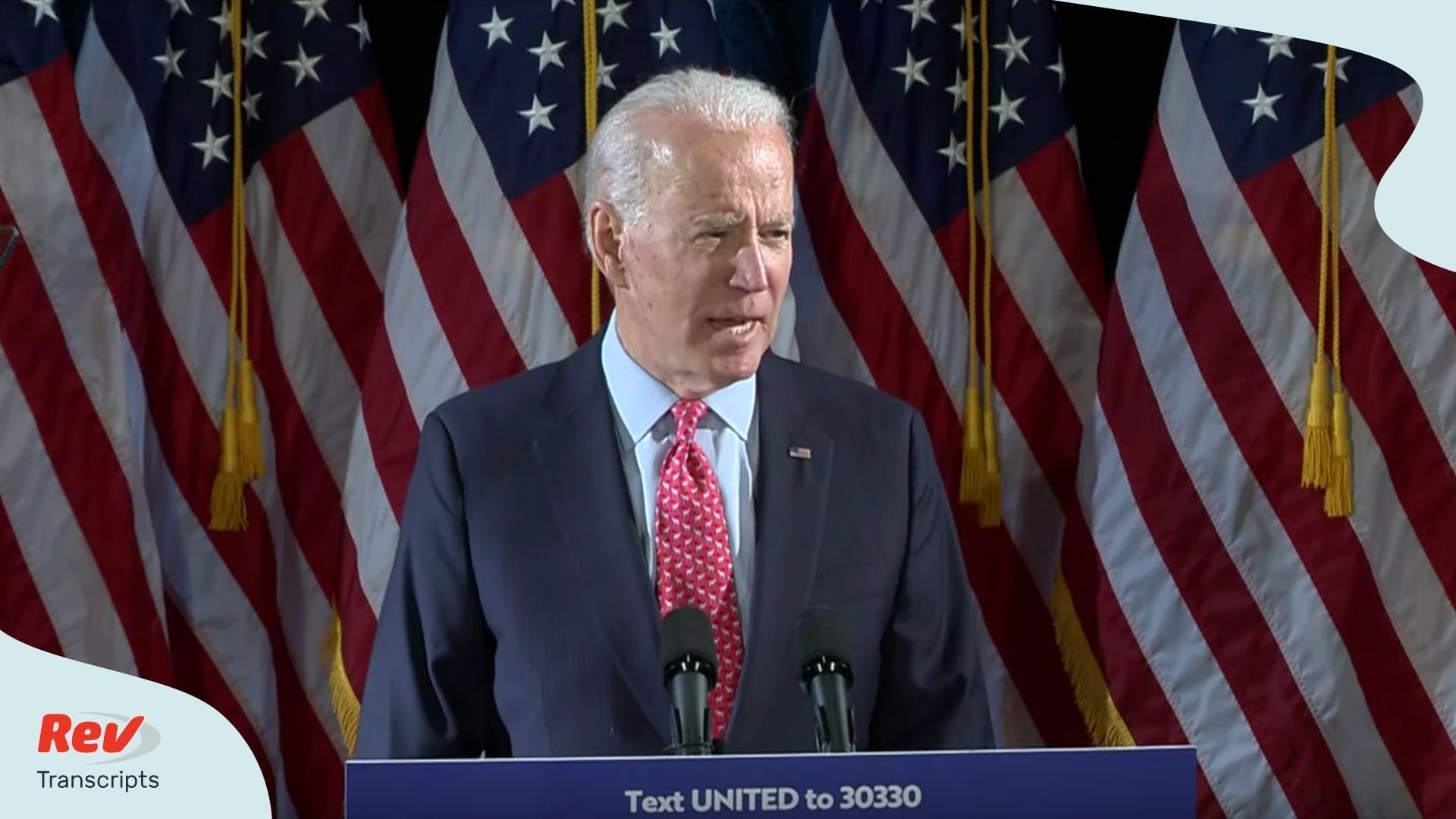
Democratic presidential candidate Joe Biden gave a speech today on the coronavirus pandemic, or COVID-19. Read the full transcript of his March 12, 2020 speech.
FOLLOW OUR NEW REV TRANSCRIPTS TWITTER ACCOUNT HERE


Joe Biden: (00:00)
This virus, those infected families that have suffered a loss, first responders and healthcare providers are putting themselves on the line as I speak for others. I’d like to thank those who are already making sacrifices to protect us, whether that’s self quarantine, self quarantining themselves or canceling events and closing campuses. Because whether or not you’re infected or know someone who is infected or have been in contact with an infected person, this is going to require a national response. Not just from our elected leaders or our public health officials, but from all of us. We must, all of us follow the guidelines of health officials and take appropriate protections to protect ourselves and critically to protect others, especially those who are most at risk for this disease.

Joe Biden: (00:55)
It’s going to be making some radical changes in our personal behaviors. More frequent and more thorough hand washing, staying home from work if you’re ill, but also altering the deeply ingrained habits in our country like handshakes and hugs, avoiding any large public gatherings. That’s where earlier this week on the recommendation of officials, my campaign canceled election night rallies that we had planned to hold in Cleveland, Ohio. We’re also re-imagining the format for large crowd events we had planned in Chicago and Miami in the coming days. And we’ll continue to assess and adjust how we conduct our campaign as we move forward and find new ways to share our message with the public [inaudible 00:01:42]

Joe Biden: (01:43)
People, first above everything else. Yesterday, we announced the public health advisory committee of experts who will continue to counsel my campaign and me. Help guide our decisions on the steps to minimize further risks and we also, we will lead by science. The world [inaudible 00:02:06], officially declared COVID-19 a pandemic.[inaudible 00:02:12] Being overly dismissive or [inaudible 00:02:16] is only going to hurt us and further advance the spread of the disease, but neither should we panic or fall back on xenophobia labeling COVID-19 a foreign virus does not displace accountability for the misjudgments that have taken thus far by the Trump administration.

Joe Biden: (02:37)
Let me be crystal clear. The coronavirus does not have a political affiliation. It will infect Republicans, independents and Democrats alike and will not discriminate based on national origin, race, gender or zip code. It well touch people in positions of power as well as the most vulnerable in our society. And it will not stop, banning all travel from Europe or any other part of the world may slow it, but as we’ve seen it will not stop it. And travel restrictions based on favoritism and politics rather than a risk will be counterproductive.

Joe Biden: (03:17)
This disease could impact every nation and any person on the planet. We need a plan about how we’re going to aggressively manage here at home. You all do know, the American people have the capacity to meet this moment. We’re going to face this with the same spirit that has guided us in through previous crises and we’ll come together as a nation. We’ll look out for one another and do our part as citizens. We have to harness the ingenuity of our scientists and the resourcefulness of our people and we have to help the world, help the world to drive coordinated global strategy, not shut ourselves off from the world. Protecting the health and safety of the American people is the most important job of any president. And unfortunately this virus laid bear the severe shortcomings of the current administration.

Joe Biden: (04:14)
Public fears are being compounded by pervasive lack of trust in this president, fueled by adversarial relationships with the truth that he continues to have. Our government’s ability to respond effectively has been undermined by hollowing out our agencies and disparagement of science and our ability to drive a global response is dramatically, dramatically undercut by the damage Trump has done to our credibility and our relationships around the world. We have to get to work immediately to dig ourselves out of this hole. And that’s why today we will combat and overcome the coronavirus.

Joe Biden: (04:56)
The full details of the plan, if you want to see them go to Joe biden.com where I lay out the immediate steps we have to take to deliver one decisive public health response to curb the spread of the disease and to provide treatment to those who need it, and a decisive economic response that delivers real relief to American workers, families, and small businesses. And protects the economy as a whole are offered as a roadmap, not for what I will do as president 10 months from now, but for the leadership that I believe is needed and required at this very moment.

Joe Biden: (05:33)
President Trump has welcomed to adopt all of it today. The core principle is simple. Public health professionals must be the ones making our public health decisions and communicating with the American people. Public health professional. It would be a step toward reclaiming public trust and confidence in the United States government as well. Towards stopping the fear and chaos that can overtake communities faster than this pandemic can overtake them. And it’s critical to mount an effective national response that will save lives, protect our frontline health workers, slow the spread of the virus.

Joe Biden: (06:14)
First. Anyone, anyone who needs to be tested based on medical guidance should be tested at no charge, at no charge. The administration’s failure on testing is colossal and it’s a failure of planning, leadership, and execution. The White House should measure and report each day, each and every day, how many tests have been ordered, how many tests have been completed, and how many have tested positive. By next week, the number of tests should be in the millions, not the thousands. We should make every person in a nursing home available for testing. Every senior center or vulnerable population has to have easy access to the test and we should establish hundreds of mobile testing sites, at least 25 per state and drive through testing centers to speed testing and protect the health of our workers.

Joe Biden: (07:12)
The CDC, private labs, universities, and manufacturers should be working lock step to get this done and get it done correctly. No effort should be spared. None. No excuses should be made. Tests should be available to all who need them and the government, the government should stop at nothing to make that happen. We must know the true extent of this outbreak so we can map it, trace it and contain it. Nor should we hide, the true number of infections in hope of protecting political interest or the stock market. The markets will respond strong, to strong, steady and capable leadership that addresses the root of the problem, not efforts to cover it up.

Joe Biden: (07:58)
Secondly, we need to surge our capacity to both prevent and treat the coronavirus and prepare our hospitals to deal with this influx of those needing care as I’ve been saying for weeks. This means not just getting out testing kits and processing them quickly, but making sure communities have the hospital beds available. The staff, the medical supplies, the personal protective equipment necessary to treat the patients. The president should order FEMA to prepare of the capacity with local authorities to establish temporary hospitals with hundreds of beds in short notice. The Department of Defense should be planning now should have been planning to prepare for the potential deployment of the resources provided. Medical facility capacity on logistics support that only they can do.

Joe Biden: (08:53)
And a week from now, a month from now, we can need an instant 500 bed hospital to isolate and treat patients in any city in this country. We can do that, but we are not ready yet and the clock is ticking. As you take these steps, state, federal and local authorities need to ensure that there’s accurate up to date information available to every American citizen. To everyone so everyone can make an informed decision about when to get tested, when to self quarantine, when to seek medical treatment and the federal government should provide states and municipalities with clear guidance about when to trigger more aggressive mitigation policies such as closing schools.

Joe Biden: (09:39)
Thirdly, we need to accelerate the development and treatment of a vaccine. Science takes time and it will still be many months before we have a vaccine that can be proven safe for public use and producing sufficient quantities to make a difference. But therapeutics can and should come sooner. This will save lives. When I put together and we passed the Cures Act of 2016 to accelerate work at the National Institute of Health, but now it has to be made available, make available resources to speed up, speed that process along. We have to fast track clinical trials within NIH while closely coordinated with the FDA, the Food and Drug Administration on trial approvals. So the science is not hindered by the bureaucracy and when a vaccine is ready to go. It should also be made widely available and again, free of charge.

Joe Biden: (10:41)
We should also immediately restore the White House security council directorate for global health security and biodefense with a full time dedicated, coordinated to over see that response. Our administration, our last administration, we created that office to better respond to future global threats after the Ebola crisis of 2014. It was designed for exactly this scenario, but for some reason I still don’t understand President Trump eliminated that office two years ago. Look, here’s the bottom line. We have to do what’s necessary to beat the challenge, beat this challenge sooner rather than later. We will beat it. I assure you, if we wait for it to worsen, then scramble to catch up. The human and economic toll will grow faster, larger and more dangerous.

Joe Biden: (11:36)
Congress gave this administration $8 billion last week to fight the virus. We need to know exactly what that money is going to be used for. How quickly it’s going out the door, and exactly how it’s being spent. This brings me to the second half of the challenge in terms of economic dislocation that coronavirus is going to cause in our country. We must do whatever it takes, spend whatever it takes to deliver for our families and ensure the stability of our economy. Taking immediate bold measures to help Americans who are hurting economically right this minute.

Joe Biden: (12:18)
It means we’ll need bigger and broader measures to shore up the economic demand, protect jobs, keep credit flowing to our job creators and make sure we have economic firepower we need to weather the storm and get the people and this economy back to full strength as soon as possible. This crisis will hit everyone, but it’ll hit folks who live paycheck to paycheck the hardest, including working people and seniors. Another tax cut to Google or Goldman or millionaires won’t get the job done. Another tax cut to these folks will not get the job done. Indiscriminate corporate tax subsidies won’t effectively target those who really need the help, now. We need to place our focus on those who are struggling just to get by. People are already losing jobs. We need to replace their wages. That includes workers in the gig economy who lack unemployment insurance.

Joe Biden: (13:19)
Parents already struggling with childcare costs. We need to give them relief. Children who rely on school lunches, we need to provide food for them. Schools will need to help in ensuring children who don’t have easy access to computers can still learn if their schools shut down. People who have difficulty paying their rent or mortgage because they’ve been laid off or had their hours cut back. We need to help them to stay in their apartments, and their homes. Small businesses will be devastated as customers stay home and adventure canceled. And we need to make sure they have access to interest free loans, not loans with interest, interest free loans. It’s a national disgrace that millions of our fellow citizens don’t have a single day of paid sick leave available to them. You need both a permanent plan for paid sick leave and an emergency plan for everyone who needs it due to the outbreak, now.

Joe Biden: (14:24)
Beyond these national measures, my plan also calls for the creation of a state local emergency fund to make sure governors, mayors, and local leaders who are battling the coronavirus on the ground as I speak, have the resources necessary to meet this crisis head on, now. These funds can be used at the discretion of local leaders for whatever they need most. From expanding critical health infrastructure, hiring additional healthcare and emergency service personnel or cushioning the wider economic blows this virus is going to create in their communities. We need smart, bold, compassionate leadership that’s going to help contain the crisis, reduce the hardship to our people and help our economy rebound.

Joe Biden: (15:13)
Let me be very clear. Unfortunately, this will just be a start. We must prepare now to take further decisive action, including relief that will be large in scale focused on broader health and stability of our economy. Look, you can only protect the health or our economy if we do everything in our power to protect the health of our people. The last point I want to make is this, will never fully solve this problem if we’re unwilling to look beyond our own borders and engage fully with the rest of the world. A disease that starts any place in the planet can get on a plane to any city on earth within a few hours.

Joe Biden: (16:00)
We have to confront a coronavirus everywhere. We should be leading a coordinated global response just as we did to the Ebola crisis. That draws on the incredible capability of the U.S. Agency for International Development and our State Department to assist vulnerable nations in detecting and treating the coronavirus wherever it’s spreading. We should be investing in rebuilding and strengthening the global health security agenda, which we launched during our administration specifically to mobilize the world against the threats of new infectious diseases.

Joe Biden: (16:42)
Look, it can be hard to see the concrete value of this work when everything seems to be going well in the world. But by cutting our investment in global health, this administration has left us woefully unprepared for the exact crisis we now face. No president can promise to prevent future outbreaks, but I can promise you this. When I’m president, we will be better prepared, respond better and recover better. We’ll lead with science. We’ll listen to the experts. We’ll heed their advice and we’ll build American leadership and rebuild it to rally the world to meet global threats that we are likely to face again.

Joe Biden: (17:29)
And I’ll always tell you the truth, this is the responsibility of a president. That’s what is owed the American people, now and in difficult days ahead. I know that this country will some of the spirit, the empathy, the decency, and the unity needed. Because in times of crisis, the American people, always, always stand as one if told the truth. Volunteers raise their hands to help, neighbors look out for neighbors. Businesses take care of their workers. So we’ll meet this challenge together. I’m confident of it. We have to move and move now. Thank you all for taking the time to be here and God bless our troops. Thank you. [crosstalk 00:18:13]


WaPo's Harry Litman: Best speech of Biden's career. 

Pitch-perfect tone + persuasive substance.

Two tweets:


Arguably the best speech of Biden's career. Pitch-perfect tone. Not the slightest hesitation or gaffe. Completely persuasive substance, with perfect occasional insertion of higher purpose and American might and values and compassion. Dead-on criticism of Trump with zero snark.


and of course, viewed in contrast and back-to-back with Trump's nervous, wrong-headed, and simple-minded address -- and it's a shame that millions of Americans won't do just that -- it's a rout. have to imagine that it would be enough to shake the confidence of many Trump voters.

Occidental Petroleum fined $18.25 million for fatal 2017 natural gas explosion


Colorado regulators fined Kerr McGee $18.25 million for a 2017 gas explosion that blew up a house and killed two people. File photo by Gary C. Caskey/UPI

DENVER, March 12 (UPI) -- Colorado state oil and gas regulators assessed a record $18.25 million fine Thursday to an oil and gas company found to be at fault in a deadly 2017 house explosion that killed two people.

Jeff Robbins, director of the Colorado Oil and Gas Conservation Commission, the state's regulatory agency, said an "aggravating factor" of loss of life boosted the penalty against Kerr McGee, a subsidiary of Occidental Petroleum Corp.

Mark Martinez and Joey Irwin were killed in Firestone, Colo., and Erin Martinez was badly burned April 17, 2017, when leaking odorless natural gas ignited as the two men were replacing a basement hot water heater. Flames shot hundreds of feet into the air and the house was destroyed.

Kerr McGee failed to protect the health and safety of people and environment by neglecting its properties, the Colorado notice of violation said.

"Our lives are forever changed," Firestone widow Erin Martinez said in a statement Thursday. "It is hard to comprehend that the only recourse is a penalty or a fine, how do you put a price on human life?"

Martinez family members received an undisclosed settlement in 2018 in a civil suit against Anadarko Petroleum Corp., parent company of Kerr McGee at the time of the explosion.

Agency chief Robbins said fine revenue will go toward special projects for mapping buried flowlines and increasing air monitoring equipment for methane leaks.

Occidental spokesperson Jennifer Brice said in a statement the company would not contest the penalties.

"We are mindful of the events of April 17, 2017, every day, and our thoughts continue to be with the families, friends and communities affected by the Firestone tragedy," Brice said.

The multimillion-dollar penalty is the second this year by state agencies for oil and gas explosions.

Pennsylvania's Department of Environmental Protection fined pipeline company Energy Transfer $30 million for a 2018 pipeline explosion.

"This is a high fine for the state of Colorado," said Jeremy Nichols, climate and energy program director for WildEarth Guardians. "A multimillion-dollar fine sends a message to the industry. It is about trying to deter future incidents," Nichols said.

"But no state has really been able to hold this industry accountable. The industry is trying to pay its way out of killing people," he said.

"Safety has been, and will remain, our industry's top priority," Dan Haley, president and chief executive officer, of the Colorado Oil & Gas Association, wrote in an email. "Our members are always working hard to improve our safety practices, to share those best practices and to commit to getting better, cleaner and safer each day."

An October, 2019, investigation of the Firestone explosion by the National Transportation Safety Board showed that a severed plastic pipeline from a dormant, but unplugged, well was the source of the gas that blew up the house.

Anadarko Petroleum had acquired a license to the well, which was left open with a low gas flow. Anadarko was acquired by Occidental last year.

New Colorado laws require mapping of all underground gas lines starting this year.
Sen. Bernie Sanders wins California primary


Sen. Bernie Sanders has 711 delegates compared to former Vice President Joe Biden's 864. Photo by Bill Greenblatt/UPI | License Photo

March 12 (UPI) -- Sen. Bernie Sanders won the biggest Super Tuesday prize -- California -- news outlets projected Thursday.

More than a week after Californians participated in the state's Democratic primary, a final count of mail-in votes and provisional ballots gave Sanders, I-Vt., the win. Both CNN and NBC News called the race in his favor, with 34.3 percent of the vote, or about 184 delegates.

Former Vice President Joe Biden won 27.6 percent -- good for an estimated 144 delegates. The remaining 81 delegates are unallocated, some going toward candidates who've since dropped out of the race, including Sen. Elizabeth Warren, D-Mass., who got 13.2 percent of the vote and former New York City Mayor Mike Bloomberg who got 12.9 percent.

California is one of four states Sanders won on March 10, compared to Biden's nine. This primary season, Biden has 864 pledged delegates and Sanders has 711.

The two candidates will next face each other Sunday during a debate at CNN's Washington, D.C. The Democratic National Committee announced Thursday it won't have a live audience for the event as a precautionary measure due to the coronavirus outbreak.

The next primaries are scheduled for Tuesday in Arizona, Florida, Illinois and Ohio.
Guatemalan woman, unborn child die after fall from border barrier

AMERIKA IS A CRIME AGAINST HUMANITY


A 19-year-old Guatemalan woman and her unborn child died after falling 20 feet while attempting to scale a border barrier in El Paso. File Photo by Natalie Krebs/UPI | License Photo

March 12 (UPI) -- A pregnant Guatemalan woman and her unborn child died after falling while attempting to scale a border barrier near El Paso, Texas, the Guatemalan consulate said Thursday.

The consulate said the woman, Miriam Estefany Giron Luna, 19, fell nearly 20 feet from the steel mesh border wall in Clint, Texas, on Saturday and landed on her back.


Giron Luna was about seven months pregnant and sustained a brain hemorrhage, damage to her liver and kidneys, a fractured pelvis, and other injuries.

She died on Tuesday after multiple surgeries, including an emergency C-section that was unable to save the life of the child.

"Despite the best efforts of medical personnel, her unborn child did not survive," U.S. Customs and Border Protection said.

Dilver Israel Diaz Garcia, 26, accompanied Giron Luna at the time of the incident and went searching for help after the fall. He was in Border Patrol custody.

CBP's Office of Professional Accountability said it is reviewing the incident and the Department of Homeland's Security's Office of the Inspector General and the Guatemalan government have been notified.

Watch as the Rich Take a Larger Share of Income While the Rest Shrink

Visualizing 35 Years of Income Distribution in USA from Howmuch.net on Vimeo.

Watch as the Rich Take a Larger Share of Income While the Rest Shrink

Income inequality is a growing concern across the world. In the United States, the distribution of income controlled by the wealthiest Americans has been growing for some time now. View our Voronoi diagram below to see a time-lapse of the distribution of income in the U.S.
The diagram is split into six different income groups: the top 90 percent, the top 10 percent, the top 5 percent, the 1 percent, the top 0.1 percent and the top 0.01 percent. Each group is represented by a different color. After pressing play, the chart will begin changing shape as the share of income each group controls changes over time. The data were collected from the World and Wealth Income Database for the years 1979 to 2014 (Please note that the data collected does not include capital gains as income, nor is the data a measure of wealth).
Percentage Change of Each Group between 1979 and 2014:
  • Bottom 90 percent
    • 67.65% to 52.66%
    • Total Share Change: -14.99%
    • Growth of Income Group Share: -22.16%
  • Top 10 percent
    • 11.52% to 12.57%
    • Total Share Change: 1.05%
    • Growth of Income Group Share: 9.11%
  • Top 5 percent
    • 12.8% to 16.79%
    • Total Share Change: 3.99%
    • Growth of Income Group Share: 31.17%
  • Top 1 percent
    • 5.87% to 10.36%
    • Total Share Change: 4.49%
    • Growth of Income Group Share: 76.49%
  • Top 0.1 percent
    • 1.54% to 4.43%
    • Total Share Change: 2.89%
    • Growth of Income Group Share: 187.66%
  • Top 0.01 percent
    • 0.62% to 3.19%
    • Total Share Change: 2.57%
    • Growth of Income Group Share: 414.52%
Both the data and the chart show the large growth of total income held by the richest Americans. As the diagram goes through each year, the share of income held by the bottom 90 percent continually shrinks, with the exception of 1981, 1989, 1991, 1993, 2001, 2009 and 2013. However, the overall trend is steeply downward for the bottom 90%. In some years, the share of income held by the bottom 90 percent goes up, but only by a very small amount. In the other years, the share of income held by the bottom 90 percent goes down, but by much larger amount. Between 1979 and 2014, this income group went from controlling 67.65 percent of all income to 52.66 percent. The slice representing the bottom 90 percent shrinks by 22.16% over the course of the time-lapse.
Looking at the Percentage Change of Each Group chart, one can see an obvious trend. The richer the income group, the faster the income share growth. This trend follows exactly through every income group going upward. The top 0.01 percent, the richest group measured, saw its income share grow more than four times its original size. The top 1 percent saw its percentage share of income almost double, from 5.87% in 1979 to 10.36% in 2014. The top 10 percent’s overall share of income did not increase by that much. While it did grow by some, the richer income groups grew at a much faster rate. This is represented by the rapidly growing slices in the time-lapse. Although the top 0.01 percent slice starts small, it grows incredibly quickly, while the bottom 90 percent group shrinks. The trend here is obvious: incomes in the United States are leaving the bottom 90 percent and moving towards the richest Americans.
The time-lapse shows an interesting change over the period 1979 to 2014. The bottom 90 percent of income earners, representing the vast majority of the US population, see their share of total income fall quickly over the period. At the same time, the wealthiest gain more and more control as time passes. The wealthier the income group, the faster the share of total income grows.


Visualizing Countries with the Highest Household Wealth  

We all know it costs money to make money, but is there a direct correlation between income and overall personal wealth? If there is, we would expect to see the relationship in our new visualization comparing accumulated wealth and disposable income at the household level across the OECD.
We got our numbers directly from the OECD. Our visualization roughly corresponds to the geographic location of each country on the map—the U.S. is furthest “west” and Japan is further “east.” The size of each bubble represents average household wealth for each country, or assets minus liabilities. This takes into account things like savings, securities, stocks and loans (but not real estate). We then color-coded each bubble based on the average disposable income for each household, which equates to the amount of income left over after taxes and transfers have been taken out. Basically, it’s how much you can spend on living expenses and other discretionary purchases.

These are the top ten countries among the OECD with the highest household wealth, together with the average disposable income.

1. United States: $176,076 with $44,049 in disposable income
2. Switzerland: $128,415 with $36,378 in disposable income
3. Belgium: $104,084 with $29,968 in disposable income
4. Japan: $97,595 with $28,641 in disposable income
5. Sweden: $90,708 with $30,553 in disposable income
6. Netherlands: $90,002 with $28,783 in disposable income
7. Canada: $85,758 with $29,850 in disposable income
8. United Kingdom: $83,405 with $28,408 in disposable income
9. Luxembourg: $74,141 with $41,317 in disposable income
10. Denmark: $73,543 with $28,950 in disposable income
Our visualization reveals several key insights about personal wealth accumulation across the OECD. First off, the U.S. clearly dominates the rankings with over $170k on average per household. The other standout on our list, Switzerland, is far behind the U.S. with $128k of accumulated household wealth on average. The rankings then become much tighter further down the list with countries grouped together in the $70-90k range. There are also a few countries in the OECD for obvious political reasons. It is hard to see why Russia should be counted with only $16,657 in disposable income and $2,260 in net financial wealth.
Now take a look at the color of each bubble, which corresponds to the average disposable income for each country. You might think that having a higher disposable income is directly associated with building household wealth, but clearly there are other factors involved. Granted, Americans enjoy both the most disposable income on average ($44,049), but this only partly explains their lead in household wealth. For example, Luxembourgers have only $3,000 less in disposable income ($41,317), but over a $100,000 less in average household wealth. And take a look at the Norwegians who have $35,739 in disposable income but only $20,347 in household wealth. Clearly all that extra money is going somewhere, and it’s not to a savings account.
One obvious assumption behind our numbers is the longstanding decline of defined benefit pension systems in the U.S. Whereas European countries maintain social programs that provide for a secure retirement, many workers are largely left alone in the U.S. to save for their golden years. Another factor is wealth inequality. Since we are only looking at average figures, a small number of millionaires and billionaires in the U.S. inflate average wealth figures, when in reality most people are barely getting by.
All these caveats aside, clearly the U.S. enjoys a leg up in wealth accumulation within the OECD. Also keep in mind that owning your own home is closely associated with building personal wealth, but the OECD excluded the value of land and dwellings from its analysis. This means that in all likelihood, our visualization actually understates the real value of American accumulated wealth.

About the article