Monday, July 27, 2026

Silence before the storm in northeast India

upper assam

There is a particular quality to silence in Upper Assam. It is not the absence of sound: the tea gardens still hum with sickle and static radio, the Brahmaputra still drags its brown weight past Sadiya and Dibrugarh, the Bihu drums have not stopped. It is the absence of incident. For a decade now, the districts that once bled under the shadow of the 28th Battalion (Tinsukia, Sivasagar, Golaghat) have known something close to peace. Militancy, we are told, is a memory. United Liberation Front of Asom — Independent (ULFA-I) is a rump. Its commander has not set foot in his own camps for ten years. The story Assam tells itself is one of insurgency exhausted into irrelevance.

But look east, past the tea estates and the last Assam Rifles checkpoint, into the hills where the state’s writ has never fully reached, and the picture complicates. Myanmar is disintegrating in slow motion. Opium is being cultivated at a scale unseen in a decade. Drones sourced in Kyiv and Warsaw are surfacing in the hands of ethnic armies fighting a junta that no longer controls a fifth of its own country. Foreign nationals with opaque biographies are being intercepted along footpaths on India’s borders with unsettling regularity. And a wartime supply road, closed for eighty years, is suddenly being discussed in Delhi’s strategic circles again, not out of nostalgia but because of what lies buried in the hills it crosses.

None of these threads, on its own, proves very much. Together, they describe a region rearming itself in the dark. This is an attempt to lay them side by side.

The vacuum that made ULFA

To understand why the current moment matters, it helps to remember what happened the last time Myanmar’s north came apart.

The ULFA was born in 1979 out of a genuine and still-unresolved grievance: the sense among Assamese youth that the state’s oil, tea and land wealth flowed outward while unemployment and unchecked migration hollowed out the province from within. But grievance alone does not build a guerrilla army. What transformed ULFA from a students’ union offshoot into one of South Asia’s most capable insurgencies was geography, specifically the porosity of the hills separating Assam from a Myanmar that, through the 1980s, was itself fracturing into ethnic fiefdoms beyond Rangoon's control.

Suppressing insurgency in Assam became an essential element of India’s later “Look East” policy precisely because that insurgency had, from its infancy, been sustained by cross-border sanctuary. ULFA cadres trained with the Kachin Independence Army (KIA) and the Naga underground; camps proliferated across the Indo-Myanmar-Bangladesh-Bhutan quadrilateral faster than any single government could dismantle them. The 28th Battalion, the “Kashmir Camp,” was the most lethal expression of that sanctuary system: a force of more than 500 cadres headquartered not in Assam but deep inside eastern Myanmar, funded by extortion, armed with AK-56s and RPGs, and answerable to a leadership that could retreat across a border the Indian state could not follow.

That entire architecture depended on one condition: that the borderlands of northern Myanmar remain lawless enough to host it, and porous enough to supply it. For 20 years, counter-insurgency operations (Bhutan’s 2003 Operation All Clear, sustained Indian Army pressure, Bangladesh’s post-2009 crackdown under the Awami League) steadily closed those sanctuaries, one by one. By the 2020s, ULFA-I had been reduced to a shadow of the 28th Battalion’s era: a few hundred cadres, an ageing and largely absentee commander-in-chief, and a recruitment base that, by the account of a 2025 defector, no longer even receives ideological instruction.

Which is precisely why what is happening in Myanmar right now should concern anyone who has read this history before.

Myanmar’s second collapse

Five years after the 2021 coup, the Myanmar junta controls barely a fifth of the country’s territory, with more than 5 million people displaced and more than fifteen thousand killed in 2025 alone. The prospect of a unified resistance briefly flickered when the Three Brotherhood Alliance’s Operation 1027 tore through northern Shan State in 2023. But by 2025, Chinese pressure had forced the return of captured territory, and in March 2026 the alliance effectively fractured when the Myanmar National Democratic Alliance Army (MNDAA) turned its guns on its former ally the Ta’ang National Liberation Army (TNLA), seizing the border town of Kutkai in a move analysts read as a realignment toward Beijing.

What has emerged from that fracture is not junta victory but a checkerboard of competing sovereignties. A new coalition, the Steering Council for the Emergence of a Federal Democratic Union — bringing together the Chin National Front, the KIA, the Karen National Union and the Karenni National Progressive Party with the exiled National Unity Government — was announced in March 2026 as an attempt to unify a resistance that had spent years speaking in “two or three voices.” Meanwhile the junta, unable to win outright, has turned to intensified aerial bombing of civilian infrastructure, including hospitals and schools, in a strategy of attrition against the population it cannot govern.

This is, in almost every structural sense, a repeat of the conditions that birthed the 28th Battalion: a weak or absent central authority, ethnic militaries controlling long stretches of the India-facing border, and a war economy that rewards anyone who can move men, money, or matériel through the hills. The difference is scale, and the difference is drones.

The road of ghosts, a haunting trail from World War II

There is a single stretch of asphalt, half-swallowed by jungle for eighty years, that captures this shift better than any troop map — the Stilwell Road. It was built by dying men: US engineers and conscripted labourers hacking through malarial hill country at a rate the US Army itself called the toughest assignment it ever handed its engineers. It has spent most of the decades since as a ghost road, remembered mostly through crashed wartime aircraft still occasionally surfacing from the undergrowth of Assam, Arunachal Pradesh, and northern Myanmar. That a corridor built to move armies against Japan should now be stirring back to life as a route for rare earths, insurgents and unmarked convoys is the kind of historical irony this region seems condemned to repeat.

Built between 1942–45 under General Joseph Stilwell to resupply Chiang Kai-shek’s forces against Japan, the 1736-kilometre road ran from Ledo in Assam, through Myanmar’s Kachin and Sagaing regions, into China’s Yunnan province. The Indo-Myanmar stretch has been disused since the war ended, and for decades New Delhi kept it that way deliberately: the presence of ethnic insurgents along the route, and the fear that reopening it would simply widen the pipeline for drugs and small arms into the northeast, made the road a strategic liability rather than an asset. As recently as the 2010s, Indian military planners explicitly warned that opening the road “can be adversely used against us during any war with China.”

That calculus is now being revisited, not for trade in the abstract but for what northern Myanmar is sitting on. India has begun holding talks with the KIA, which controls the terrain, over access to rare-earth deposits, including dysprosium and terbium, minerals essential to EV motors, precision munitions, and satellite systems, a trade currently dominated by China. In other words: the same collapse of central authority that makes the road dangerous is what makes it, for the first time in eighty years, accessible: accessible to Indian officials courting the KIA, accessible to Chinese trade networks realigning with the MNDAA, and, by the same physics of an unpatrolled border, accessible to whoever else wants to move through it unseen.

A road that reopens because a state has collapsed is not a peace dividend. It is a symptom.

Golden Triangle and the Manipur conflict

The clearest evidence of what an ungoverned Myanmar produces is agricultural. The United Nation’s 2025 opium survey found that poppy cultivation in Myanmar expanded 17% from the previous year to 53,100 hectares, the largest area under cultivation since 2015, cementing the country’s position, in the wake of the Taliban’s opium ban in Afghanistan, as the world’s leading illicit opium source. The price of a kilogram of raw opium has more than doubled since 2019, rising from $145 to $329, a market signal that draws exactly the kind of capital that fuelled ULFA’s own extortion-and-arms economy a generation ago.

The correlation between conflict and cultivation is not coincidental. The United Nations Office on Drugs and Crime’s regional representative has directly linked the intensification of fighting in Shan and other border states to farmers’ return to poppy as one of the few reliable livelihoods left to them. A 2023 UNODC assessment also found indications of substantial opium cultivation in Sagaing, directly along Myanmar’s frontier with India. Shan State’s opiate economy has historically bled sideways into northeast India’s own insurgent financing networks; there is no structural reason to assume that a larger opium economy next door produces a smaller one here.

That money finds a ready market in a region already the most heavily armed in India. Assam and its neighbouring states have always sat at an anomaly in India’s gun-control landscape: even under India’s generally restrictive licensing regime, the northeastern states show markedly higher rates of licensed firearm ownership than most of the country, a pattern rooted in border security concerns, rural land-protection traditions and decades of insurgency. Licensed guns are only the visible fraction of the region’s actual arsenal.

Manipur has spent the past three years demonstrating what the invisible fraction looks like once civil order breaks down entirely. Since ethnic violence erupted in May 2023, roughly 6000 weapons have been looted from police armouries and gun shops by militants on both sides of the conflict, of which only a fraction have been recovered. Nearly a third of the weapons in militant hands were found to be more sophisticated than anything in the state’s own armoury, including assault rifles such as M16s and M4A1 carbines sourced from outside official channels entirely. Manipur is not an isolated ethnic crisis sealed off from the wider northeast; it is a live demonstration of how quickly a state’s monopoly on force can collapse once it slips, and of how readily an under-policed, opium-adjacent frontier supplies the weapons to fill the gap. Layer a resurgent Golden Triangle arms-and-drugs corridor onto a region already holding this concentration of both licensed and looted weapons, and the phrase “civilian rearmament” stops being metaphorical.

Mysterious foreigners

Everything laid out above — the collapsing junta, the record poppy harvest, the reopening ghost road, the looted armouries of Manipur — is scaffolding. It exists to answer one question: why should a handful of border arrests matter at all? The answer lies in timing and geography, and in both, this moment rhymes uncomfortably with the one that produced ULFA in the first place.

Recall the sequence from the 1980s: Myanmar’s north slipping out of Rangoon’s control, ethnic armies consolidating territory along the frontier and, arriving into that vacuum almost precisely as it opened, foreign trainers, arms brokers and sympathetic intermediaries who furnished a fledgling insurgency with tradecraft it did not yet possess. ULFA did not invent guerrilla warfare on its own; it was taught, in camps across a border nobody was watching closely enough. The insurgency that became the 28th Battalion was, in its infancy, a beneficiary of exactly the kind of externally supplied expertise that a lawless borderland makes possible.

Set that history beside what has surfaced in the past four months.

The drone network: On March 13, India’s National Investigation Agency (NIA) arrested US citizen Matthew Aaron VanDyke (founder of a Washington-based security consultancy that has provided training to non-state fighters in Libya and Ukraine), alongside six Ukrainian nationals at airports in Kolkata, Delhi and Lucknow. The NIA alleges the group entered India on tourist visas, travelled into Mizoram, a Protected Area Permit zone barred to foreign travellers, then crossed into Myanmar without authorisation, where they trained ethnic armed groups and smuggled a large consignment of drones sourced from Europe. This is not an allegation of tourism gone wrong. It is a documented, charge-sheeted case of foreign nationals entering India’s most restricted frontier specifically to deliver modern combat capability to armed groups on the other side.

Investigative reporting has traced the consequences: sources allege one shipment of drones brought down a Myanmar military aircraft, while Kachin rebels separately used drones to damage an ATR-72 at Myitkyina airport in February. In a detail that underlines how contested this borderland has become for outside powers and not just insurgents, Indian authorities were reportedly tipped off to the group’s movements by Russian intelligence, itself monitoring the network amid the wider geopolitical fallout of the Ukraine war. Whatever the full truth of the network’s backers, the operational fact is undisputed: foreign nationals with combat-training expertise used India’s northeast as a transit corridor into a conflict zone, and the ethnic armies they trained are described by the NIA’s own filing as having links to insurgent organisations inside India.

The Nepal border incidents: In July 2026, two more unexplained figures surfaced along a different but equally porous frontier, and, in the retelling, briefly merged into one story they were not. Jordan Brown, a 36-year-old Californian claiming six years’ service in the US Navy and Special Forces, was intercepted by the Sashastra Seema Bal roughly 35 metres inside Indian territory attempting to cross into Nepal near Sonauli. He was carrying no passport, visa or identification, with two mobile phones he had reportedly damaged himself, and whose account of how he entered India has shifted with each retelling, with his claimed military background still unverified by Indian agencies.

Days earlier and roughly 350 kilometres away in Bihar’s East Champaran district, Sashastra Seema Bal (SSB) personnel separately arrested Ukrainian national Oksana Shevtsova attempting an identical crossing, after discovering her visa had expired in 2022. On the available facts, an unrelated overstay case, folded into the same “foreign agents” narrative online only because the nationality and the border happened to match. It is worth being precise about that distinction rather than letting the two blur, as they did on social media within hours of the arrests.

Here, then, is the pattern worth sitting with, not a proven conspiracy, which the public record does not support, but a recurrence of conditions. A remote frontier, at the periphery of Indian authority and in the underbelly of Chinese influence, is once again drawing men who move without passports, without a consistent story, and without any plausible tourist’s reason to be near a border crossing. One such case has already been proven, under oath, to involve foreign combat trainers arming ethnic militias with links into India’s own insurgent networks. The others remain unresolved. But the 1980s taught this region what happens when unexplained foreigners start arriving in its remotest hills at the exact moment those hills stop being governed by anyone. It is seldom nothing.

Why ‘silence before the storm’

Here is the genuinely uncomfortable part: ULFA-I itself is not what it was. Its commander-in-chief has not visited his own Myanmar camps in over a decade and is reportedly based in China; ideological training of new recruits has largely ceased; and morale within its remaining bases has collapsed following a series of drone strikes on its Sagaing headquarters. By every conventional metric, the organisation that ran the 28th Battalion is dying.

But an insurgency dying of organisational rot is not the same as a region returning to peace: it is a vacancy. The 1980s taught Assam that vacancies of exactly this kind get filled, and filled quickly, by whoever can supply arms, sanctuary and cash fastest across an unwatched border. What has changed since the 1980s is the sophistication of what is on offer: not just AK-56s smuggled from Kachin armouries, but European-made attack drones capable of downing aircraft; not a slow trickle of opium revenue, but a decade-high poppy economy worth up to two billion dollars; not a handful of foreign trainers slipping in on forged papers, but documented mercenary networks with the operational reach to train ethnic militaries in modern warfare.

Assam is not currently at war. That is the honest, unglamorous truth beneath the alarm. But the ingredients that produced its last war — a collapsing neighbour, an unregulated arms and opium economy, and foreign actors moving unsupervised through its border hills — are all present, in a more advanced form. Whether that adds up to storm or false alarm is not yet knowable. It is, at minimum, no longer a silence worth mistaking for peace.

Maharnav Bhuyan is currently reading for an Executive MA in Strategic Communication Management at Monash University, Australia. He is the principal author of Midnight's Oeuvre and Fabricated Communicative Immortality and is a former journalist and columnist from Assam. 

This piece draws on open-source reporting current as of July 2026. Several elements, particularly the VanDyke network investigation and the status of ULFA-I's remaining Myanmar camps, remain active, contested and subject to revision as agencies release further findings.

‘Cockroaches Won!’: Youth-Led Protests Called Off After India’s Education Minister Quits

“Don’t mistake the beginning for the end,” said the Cockroach Janta Party, which vowed to press for further reforms and government accountability.


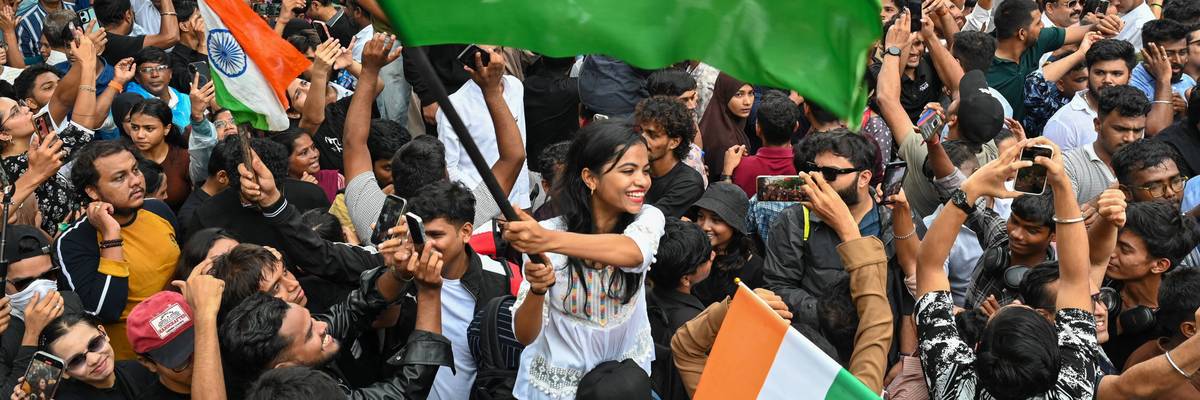
Cockroach Janta Party supporters wave Indian flags a day after the resignation of Education Minister Dharmendra Pradhan, in Mumbai, on July 26, 2026.
(Photo by Punit Paranjpe/AFP via Getty Images)


Brett Wilkins
Jul 26, 2026
COMMON DREAMS

India’s Cockroach Janta Party ended its five-week multi-city protest on Saturday after the youth-led movement’s key demand—the resignation of Education Minister Dharmendra Pradhan—was met.

“We have done it,” CJP spokesperson Saurav Das told a jubilant crowd at New Delhi’s Jantar Mantar. “Pradhan has sent in his resignation, which means that our first demand has been met.”


‘Black Day for Democracy’: Indian Police Bash and Gas Youth-Led ‘Cockroach’ Protesters

Das said that the protesters’ second main demand, the withdrawal of criminal investigations targeting CJP members, was also met. However, members and supporters of the movement noted that some cockroach protesters remain in detention and vowed to continue pressing for their release.

Pradhan’s resignation is the first such surrender to public pressure during the 12-year tenure of Hindu nationalist Indian Prime Minister Narendra Modi.


“Considering the situation at Jantar Mantar and elsewhere in the country, and so that anti-national forces do not take advantage of the circumstances, national unity is maintained, no student’s future gets entangled in legal complications, and our children can focus on their studies and building their careers, I have submitted my resignation,” Pradhan said in a statement.

Pradhan’s tenure was marred by repeated leaks of National Eligibility Entrance Test (NEET) papers in a scandal that has upended the lives of millions of students by forcing them to retake the grueling exams and delaying their university admissions. CJP organizers said more than 20 students have killed themselves over the matter.

The now-ex education minister had dismissed the protesters as “the B-team of terrorists.”

On Sunday, Modi said he would authorize the creation of an examination reform task force headed by Nandan Nilekani, co-founder of Indian tech giant Infosys.

“The government of India is continuously taking various measures for the future of students,” the Bharatiya Janata Party prime minister said in a video posted on social media. “However, we must look to the future. Our examination system needs to be reliable and transparent, and it must make maximum use of technology.”


The protest movement began in May after Chief Justice of India Surya Kant reportedly compared unemployed young people to “cockroaches.” The protesters, led by political strategist Abhijeet Dipke, satirically reclaimed the slur as the symbol of a movement that has grown into a broader challenge to Modi’s increasingly authoritarian rule, which has seen mounting repression of protest and dissent, including restrictions on journalists and activists, and the use of “lawfare” to target critics.

Last week, tens of thousands of youth-led protesters marched in New Delhi, where they were met and attacked by police batons and tear gas. Indian media reported thousands of injuries.

The mood was markedly different following Pradhan’s resignation.


“Cockroaches won!” many CJP members and supporters said.

Others added, “Democracy Won!”

“This is democracy,” said the CJP.

“Now that the cockroaches have won their first battle, may they win many more,” Tavleen Singh, a columnist for The Indian Express, wrote on X. “May they become a real political party in the near future.”

Sonam Wangchuk, an environmentalist whose hunger strike was a focal point of the cockroach protests, was released Sunday from a Gurugram hospital, where he had been recovering from his 26-day fast since Thursday.

Emboldened by the CJP victory, members of the Communist Party of India (CPI)-affiliated All-India Youth Federation and All-India Students’ Federation marched on the Chennai residence of Tamil Nadu Gov. Rajendra Vishwanath Arlekar demanding the abolition of the NEET. According to Indian media reports, police detained more than 200 of the demonstrators.


“The struggle will intensify,” said CPI.

“Don’t mistake the beginning for the end,” echoed CJP.

Asked Sunday what’s next for the cockroach movement, Dipke told an ANI reporter that “we will soon share the next strategy.”

“This has just ended yesterday,” he added, “please give us a little time.”

India: When the streets came alive with new hope and people’s people


Delhi, July 20: When the Streets Came Alive with New Hope and Power of the People

First published at MLUpdate.

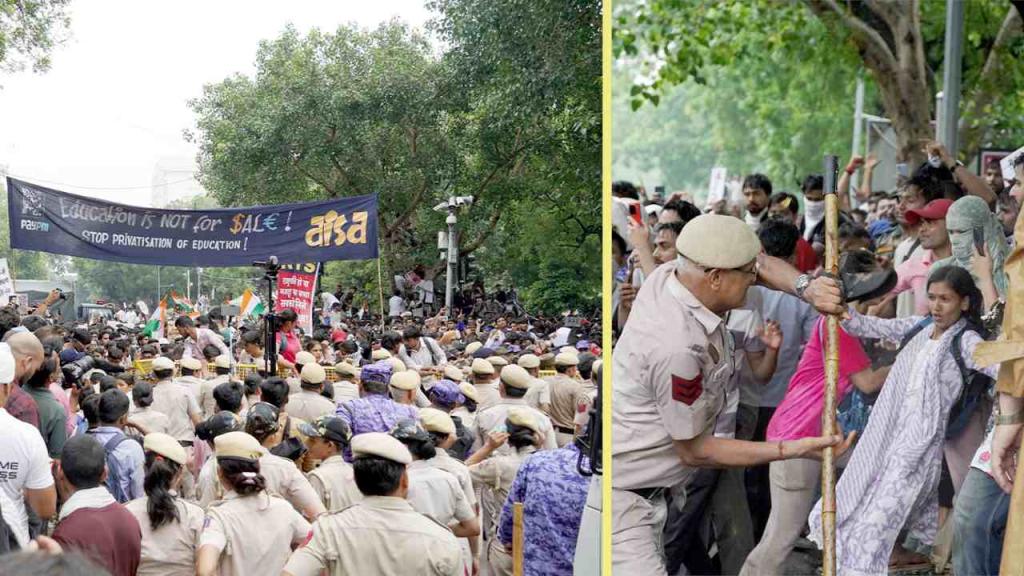
Delhi will remember July 20, 2026 for years and years to come. The fledgling digital outfit Cockroach Janata Party and progressive student organisations, notably All India Students' Association (AISA), had given a call for a march to Parliament on the inaugural day of the monsoon session to press for the resignation of Union Education Minister Dharmendra Pradhan. The government responded by issuing a police advisory which said that there was no permission for such a march and participants would be liable to be punished for participating in any unauthorised event. Just three days ago Amit Shah had changed the Police Commissioner of Delhi. Two days ahead of the march, climate activist Sonam Wangchuk who was on an indefinite fast at Jantar Mantar for the same demand had been bundled away wrapped in a white sheet by plain clothes police personnel. The 'new normal' common sense of Modi's India suggested that no parliament march worth its name was possible in these circumstances.

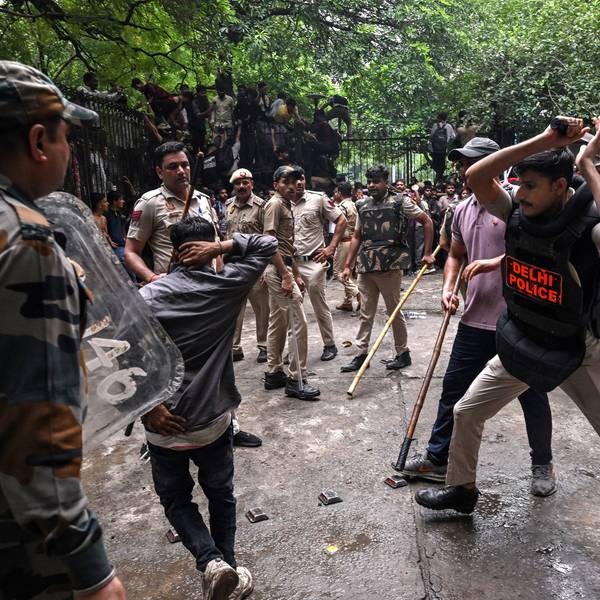
As the day began amidst heavy showers on July 20, Delhi realised that it had never seen a march like this. Waves of young people were surging through every road in the heart of Delhi. Barricades erected by the Delhi Police were overcome as easily as seasoned athletes cross hurdle races in track and field events. The whole of Delhi had become Jantar Mantar, every road was leading to the Parliament building. The monsoon session began, only to be adjourned amidst loud protests by the opposition. As the day progressed reports of severe baton charges, tear gas shelling and even stone pelting by the police started pouring in from all over Delhi. Many areas looked like battlefields covered in thick smoke and several protesters suffered critical injuries. Yet videos of young people facing baton charges with the tricolour or the Constitution in their hands signalled the courage and determination of India's new generation. And as the evening drew in, protesters could be seen reclaiming the Jantar Mantar protest site that had earlier been 'cleared up' by heavy police violence.

The sit-in protests at Jantar Mantar had begun exactly a month ago on 20 June. A week later, on 28 June started the indefinite fast by Sonam Wangchuk and six leaders of AISA. As days passed and the condition of the hunger strikers began to deteriorate in the heat and sweat of a taxing Delhi summer, three of the six fasting student activists had to be hospitalized, while the other three continued to refuse food. Yet the government did not care to respond. Nor did the Godi media care to report. They must have thought that this conspiracy of silence would tire the protesters out. But at the end of the day the power of word of mouth and the extensive coverage on social media proved more than equal to this devious Modi-Godi strategy. The turnout of July 20 took both the government and the media by utter surprise.

Indeed, the scale of spontaneous response to this new combination of digital satire and real world protest also exceeded the expectations of organisations involved in the campaign as well as opposition parties watching it from a distance. Given the disappointing experience of the 2012 anti-corruption movement under the leadership of Anna Hazare, there was understandably considerable scepticism around the CJP phenomenon and the role of Sonam Wangchuk in the ongoing struggle. The positions adopted by Sonam Wangchuk till recently in support of abrogation of Article 370 and many other policies of the Modi government did not inspire much confidence in his new found role as an opponent of the education-examination system in spite of his widely recognised record as an educator, innovator and climate activist. Yet the mass response to the July 20 call clearly showed that the protests had struck a deep chord with India's youth, not only on the agenda of education, examination and employment but also on the question of holding the government accountable.

The unprecedented scale and spirited nature of participation of the people, especially of the Gen Z contingent of youth below the age of thirty, made July 20 stand out as the unmistakable indication of the assertion of Gen Z as a force for social and political change. It had shades of the July 2024 uprising in neighbouring Bangladesh or the September 2025 uprising of Nepal, both of which led to a change of government in their respective countries. Here the demand was only for resignation of the Union Education Minister to make him accountable for the serial paper leaks under his watch. In his notes sent from the hospital, Sonam Wangchuk had even appeared to omit that central demand, expressing his readiness to end his fast if the opposition could assure him of a serious parliamentary discussion on the agenda of education. The reduction of the demand for fixation of accountability with the government to the opposition raising the education agenda in Parliament, something which the opposition had repeatedly been doing in recent sessions, had confused and disappointed his supporters.

To the credit of the participants of the July 20 March to Parliament, it must be said that despite obvious lack of clarity and coordination, the marchers remained peaceful and determined, withstanding the brutality of the police and provocation of the agents of the Sangh brigade who joined the police to malign and attack the march in many parts of Delhi. It reminded us of the Modi government’s conspiracy to discredit and derail the historic farmers' movement after the 26 January 2021 tractor march. But just as the farmers regrouped and bounced back and the movement continued till the repeal of the three anti-farmer farm laws, India wishes the same strength and resilience to its youth to march forward till its core demands are met.

Ten years ago, students had risen in protest in India's universities following the shocking institutional murder of Rohith Vemula. The government had responded by jailing student leaders and maligning the student movement as an anti-national conspiracy. Then in January-February 2020, students and citizens, especially Muslim women, had launched an inspiring protest movement against divisive and discriminatory amendments to the Citizenship Act. The government suppressed that historic Shaheen Bagh protest movement by unleashing communal violence in Delhi and jailing activists under UAPA. Even after six years young scholars like Umar Khalid and Sharjeel Imam continue to languish in jail without any trial.

Unlike university-based student movements of the past, the Shaheen Bagh protests or the Delhi border farmers’ movement, this time the youth movement made its presence felt right in the heart of Delhi. It created a platform of unity where students from universities merged with the local youth from Delhi's neighbourhoods, parents mingled with their children, young women marched shoulder to shoulder with young men cutting across communities and cultures. Activists of AISA and other Left student organisations devoted their fullest energy and efforts to sustain and strengthen the movement against all odds, and demonstrated how student leaders like the hunger strikers Neha and Danish, Manish and Aameen, Hrishikesh and Deepak could also work alongside Sonam Wangchuk and CJP leaders like Abhijeet Dipke and Sourav Das.

Defying massive disenfranchisement and systematic denial of fundamental rights, serial electoral frauds and the relentless blitzkrieg of hate, lies and the all-pervasive fear and despair that seeks to reduce empowered vocal citizens to fearful loyal subjects, Jantar Mantar of July 2026, and the Parliament March of July 20 symbolise a decisive break with the fear and apathy that had gripped large sections of society. If protesters have to risk their lives to demand justice for the victims of paper leak and accountability of the education minister, then does Prime Minister Modi have any right to continue in office? The people of India have suffered enough, they now demand answers and accountability.


Condemn the massive crackdown unleashed by Bihar BJP regime on the student-youth movement

CPI(ML) Liberation, July 24, 2026

CPI(ML) Liberation strongly condemns the large-scale arrests of CPI(ML) leaders, AISA activists, democratic voices, and students across Bihar ahead of the 25 July Bihar Bandh called by the student-youth movement, which is demanding the resignation of Union Education Minister Dharmendra Pradhan and accountability for the rampant examination paper leaks.

As of now, CPI(ML) MLA Sandeep Saurav, CPI(ML) Central Committee member Kumar Parvez, Dhananjay, CPI(ML) leader and former JNUSU President, and AISA leaders Dipankar Mishra, Saba Afreen, Naushad, and Divyam have been arrested in a massive crackdown. Several other AISA activists and students have also been arrested, including many who have remained incarcerated since the 23 July Patna rally. Fabricated cases have been foisted on leaders and students in an attempt to silence the growing voices of the youth demanding accountability, justice, and quality education.

After unleashing brutal police violence against students and youth in Delhi on 20 July, and in Patna on 23 July, the Modi-Shah regime and its BJP government in Bihar have now intensified their campaign of repression in the state.

The BJP must read the writing on the wall. Arrests, fabricated cases, and intimidation will not silence the voices of students and youth demanding justice and accountability. CPI(ML) Liberation demands the immediate release of all arrested leaders, students, and youth, and the withdrawal of all cases against them which are fabricated.

The people of Bihar will give a resounding reply to the BJP government's repression by making the 25 July Bihar Bandh a complete success.


Condemn police crackdown on the student-youth movement at Jantar Mantar

CPI(ML) Liberation, July 18, 2026

CPI(ML) Liberation strongly condemns the early morning police crackdown on the student-youth movement for justice and accountability at Jantar Mantar, Delhi. The hijacking of climate activist Sonam Wangchuk, who had been on a hunger strike for 21 days, and the attempted kidnapping of AISA hunger strikers once again expose the Modi-BJP government's deep hostility towards students and youth.

The Modi government has resorted to repression because it has no answers to the growing anger against corruption, paper leaks and the systematic destruction of the public education system. Instead of addressing the legitimate demands of the protesters, it has chosen intimidation, force and the suppression of democratic dissent.

Despite the forceful removal of Sonam Wangchuk, the students foiled the police's attempt to disrupt the movement. AISA comrades Neha, Manish and Aameen, along with other hunger strikers, are continuing the indefinite hunger strike carrying the struggle forward.

We stand with Sonam Wangchuk and salute his courage and determination. We also salute the exemplary strength, resilience and resolve of the student protesters, who have refused to bow before state repression.

We call upon all sections of society to unite against this tyranny and join the July 20 Parliament March call given by the student-youth movement, demanding the resignation of Education Minister Dharmendra Pradhan, the disbanding of the NTA, the scrapping of NEP 2020, an end to corruption and paper leaks in the examination system, and the guarantee of affordable, inclusive and quality education for all.

The Empire’s Mirror – How Western Imperialism has Alienated the Planet

A pro-Western think tank’s own data shows how Washington’s wars, its support for Israel, and its rejection of a rules-based order have turned global public opinion against the West

by | Jul 27, 2026 


The Democracy Perception Index 2026 is a global survey covering over ninety percent of the world’s population. It has produced results that confound nearly every assumption underlying the Western foreign-policy consensus. The United States, self-declared champion of the rules-based international order, now ranks among the most negatively perceived countries on earth. When the world is asked to choose sides in active geopolitical conflicts, it sides against Washington again and again – overwhelmingly with Palestine over Israel, and almost unanimously against American military bases on foreign soil. China is seen more favorably than the United States across most of the planet. And none of this, the study finds, reflects a turn against democracy itself – support for democratic governance remains strong globally. What the world is turning against is the behavior of the states that claim to lead it.

There is a moment in the history of empires when the internal logic of power becomes visible to everyone except those exercising it. That moment, documented with clinical precision in the ninth edition of the Democracy Perception Index (DPI), published in the spring of 2026 by Nira Data in collaboration with the Alliance of Democracies Foundation, has now arrived for the United States and its closest allies. The study – the largest annual survey of its kind, drawing on nationally representative interviews with more than 94,000 respondents across 98 countries representing over ninety percent of the global population – was designed, one suspects, to demonstrate the enduring appeal of the democratic model promoted from Washington and Brussels. What it demonstrates instead is a historic collapse of American prestige, a profound disenchantment with Western-led institutions, and a global public opinion that has quietly but unmistakably reordered its moral loyalties. The United States now ranks among the five most negatively perceived countries on earth, alongside North Korea, Afghanistan, Iran – and Israel, its closest military client. It loses three of the five geopolitical conflicts the survey puts to the world’s citizens. In 86 of 97 countries, majorities oppose hosting American military bases. For the first time in the survey’s history, the United States is seen slightly more negatively than Russia. China, meanwhile, is viewed more favorably than the United States in 63 of 83 surveyed countries, including across most of Europe.

The Alliance of Democracies Foundation, which co-publishes this index, was founded by Anders Fogh Rasmussen, the former NATO Secretary General and Danish Prime Minister, and exists explicitly to advance Western-style liberal democracy. Nira Data, the Danish firm that conducts the research, describes its mission as giving voice to the global public in service of democratic values. This is not a study produced by critics of the West. It is a study produced by its institutional advocates, and that fact lends the findings a peculiar authority: they arrive not as a verdict from outside but as an involuntary confession from within. Rasmussen’s own foreword acknowledges the data while reaching, almost desperately, for an explanation that absolves Western policy – blaming “threats” that Europeans are not perceiving clearly enough, urging democratic leaders to offer “a vision of optimism and hope.” What the study’s authors cannot bring themselves to say plainly, the numbers say for them: the world does not trust the West, and the reasons are not a mystery.

Unlike conventional democracy indices that rely on expert assessments of laws and institutions, the DPI asks citizens directly how they experience political life. It surveys eight dimensions – the impact of elections, freedom of speech, political pluralism, civic education, separation of powers, rule of law, government transparency, and peaceful transitions of power – then tracks how populations across the globe perceive the United States, China, Russia, and one another, and asks which side respondents support in five live or latent geopolitical conflicts. The result is a portrait of the world as billions of people actually see it, not as Western governments and their affiliated think tanks wish it to be seen.

What that portrait reveals, at its most fundamental level, is a global public that believes in democracy – across virtually every region and culture – but defines it in terms that diverge sharply from the definition promoted by Washington and its allies. More than two-thirds of people worldwide say it is extremely or very important for their country to be a democracy. The demand for self-governance, for fair institutions, for the peaceful transfer of power, is not in retreat. But when the survey asks what people consider democracy’s most important purpose, the answers reorder the priorities that Western leaders typically invoke. In 62 percent of countries surveyed, the top answer is improving living standards and well-being for everyone. Only 18 percent of countries prioritize promoting a fair and peaceful society, and a mere 9 percent – a figure that should give pause to every speechwriter who invokes “protecting individual rights and freedoms” as democracy’s defining purpose – place that goal first. Only in the United States itself, along with Germany, Italy, and Canada, does the protection of individual freedoms rise to the top.

This is not, as Western commentators tend to assume, evidence of authoritarian conditioning or political naivety among the global poor. It is evidence of rational prioritization. For billions of people across the Global South, in South Asia, in sub-Saharan Africa, in the Middle East and Latin America, the question of whether one can freely criticize the government on social media is less pressing than whether one’s children will have food, healthcare, and security from violence – including the violence that frequently arrives with Western “assistance.” The DPI data make this legible in a single, devastating comparison. The most positively perceived countries in the world are not the largest democracies or the most militarily powerful: they are Switzerland, Canada, Japan, Sweden, Italy, and Norway – countries associated, in the global imagination, with neutrality and the absence of aggression, social provision, good education, health care and security. The least positively perceived, in descending order of loathing, are Israel, North Korea, Afghanistan, Iran, and the United States. What distinguishes the top from the bottom is not the presence or absence of elections. It is the presence or absence of violence.

The collapse of American standing is the study’s most dramatic finding, and its scale demands careful attention. Between 2024 and 2026, global net perception of the United States fell by nearly 40 points. In 2022 and 2023, the United States still registered a net positive global image. By 2026 that has inverted completely, to a net negative of minus sixteen globally – minus twenty-five across the Middle East and North Africa, minus thirty-five across Europe, and minus sixteen in Asia-Pacific. It remains marginally positive only in sub-Saharan Africa, and roughly neutral in the Americas, the region it has dominated politically and economically for two centuries. In Europe the pattern is particularly striking: the United States registers minus thirty-five, while China – despite Europe’s official posture of strategic competition with Beijing – registers only minus fourteen. Russia stands at minus forty-seven in Europe, the most negative of the three major powers. But the fact that the United States has now overtaken China as an object of European suspicion and displeasure is a seismic shift that Western policy establishments appear reluctant to absorb. The largest single-year declines in American perception between 2025 and 2026 occurred not in countries already hostile but in broadly neutral ones: Ivory Coast, Senegal, Serbia, Vietnam, Ghana, Cameroon, and Algeria all registered sharp drops. These are not countries animated by ideological opposition to American values. They are countries whose populations have watched American behavior and drawn their own conclusions.

The geopolitical conflict questions constitute an informal global referendum on the legitimacy of American power, and the results deserve to be read slowly. In the conflict between Russia and Ukraine, fifty-five countries side with Ukraine and thirty with Russia – a genuine majority for the Western-backed position, though considerably narrower than Western governments typically suppose, with MENA leaning toward Russia and Asia-Pacific evenly split. In the conflict between Israel and Palestine, fifty-one countries side with Palestine and only seventeen with Israel; the Americas are the only region that leans, mildly, toward Israel, while Europe, Asia-Pacific, MENA, and sub-Saharan Africa either lean toward Palestine or are evenly divided. In the conflict between the United States and Iran, forty-one countries side with Iran and only twenty-eight with the United States. In the dispute over Greenland and Denmark, eighty-five countries side with Greenland and Denmark and only two – the Dominican Republic and Israel – with the United States. Even the American public itself, when asked, leans twelve points toward Greenland and Denmark over its own government’s position, a finding that speaks to something deeper than foreign skepticism: the erosion of American self-confidence in the project of American power.

The pattern that emerges is not a simple division of the world into pro-Western and anti-Western camps. It is something more granular and more damning: the world evaluates each conflict on what it perceives as its particular merits, and in conflict after conflict where the United States is a direct party or the primary backer of one side, the world sides against it. This is not reflexive anti-Americanism. The same global publics that support Ukraine over Russia show no general sympathy for authoritarianism. What they appear to reject is a specific and recurring pattern of American conduct: the willingness to apply international rules selectively, to arm and shield states that violate those rules, and to claim exemption from legal constraint while insisting that others must submit to it.

That reading is powerfully reinforced by one of the study’s most important findings. Global support for a rules-based international order is not weakening – it is growing. Fifty percent of people across all 98 countries agree that nations should follow international laws and agreements even when doing so limits their freedom of action, against only 31 percent who disagree, for a net agreement of plus nineteen points, up from plus seventeen the previous year. The world does not want a lawless multipolar free-for-all. It wants rules applied consistently to everyone. What it increasingly rejects is a world in which one country reserves the right to stand above them.

This is the light in which the data on military bases must be read. In 86 of 97 countries, majorities oppose hosting American military bases on their soil – a posture sustained not by popular consent but by governmental arrangements that routinely override public preferences. The willingness of allied governments to maintain these arrangements against their own citizens’ wishes is itself a measure of how deeply American power distorts democratic accountability even within formally democratic states. On defense priorities, the picture is consistent: in 80 of 98 countries, the top choice for national protection is strengthening alliances and international partnerships, not military buildup, not nuclear deterrents, not mandatory military service. Globally, willingness to fight for one’s country has fallen sharply from 53 percent to 45 percent in a single year – suggesting not cowardice but a generalized exhaustion with the logic of militarization that has governed the post-2001 era.

The contrast with China’s standing requires careful analysis, because it reveals something more complex than a simple transfer of global affection from one great power to another. China is now viewed more favorably than the United States in 63 of 83 surveyed countries. In Europe, where official policy treats China as a systemic rival, China is nevertheless seen more positively than the United States in 20 of 23 surveying countries. In the Middle East and North Africa, the differential is especially vast: Algeria, Tunisia, Libya, and Egypt view China far more positively than the United States, reflecting not only China’s restraint from military intervention in the region but the accumulated memory of what American intervention has actually produced there. Even Russia now registers a slightly more favorable global average than the United States – an outcome the study’s authors flag as unprecedented, and which they clearly find troubling. Yet the DPI’s own data resist the conclusion that this represents a global embrace of authoritarianism. What the authors call “global dealignment, not global realignment” is the more honest description: the world is not choosing China because it has fallen in love with Beijing’s governance model. It is not-choosing the United States because of what the United States has done. That distinction matters enormously, because it means the damage is self-inflicted – and therefore, in principle, reversible.

The domestic dimension of this crisis is also present in the data, though the study does not dwell on it. Citizens in established Western democracies are among the most pessimistic in the world about the direction of their own countries. Europe is the most pessimistic region by a wide margin, with France and Germany among the least optimistic countries surveyed anywhere on earth. Government transparency is the single most negatively rated dimension of democratic life across every region: citizens overwhelmingly believe their governments withhold important information from the public. Paradoxically, the most positive ratings on transparency come from Oman, Ethiopia, Vietnam, and China – reflecting partly the constraining effects of state media environments, but also capturing the experience of populations that feel, rightly or wrongly, that their governments speak to them rather than conceal from them. Among the countries that score highest on the DPI’s citizen-perception index, China ranks near the top of Asia-Pacific alongside India and Sri Lanka. The study notes carefully that this reflects restricted information environments rather than genuine democratic health. But it does not dissolve a more fundamental problem: in many countries where the West has promoted or imposed its democratic model, the material results have been poor enough that populations rate their own systems worse than Chinese citizens rate theirs. When the DPI finds that most of the world defines democracy’s primary purpose as improving living standards, and then finds that many formal democracies deliver neither decent living standards nor effective governance, the gap between democratic promise and democratic reality becomes impossible to paper over.

The Israel-Palestine data deserve particular attention because they reveal, perhaps more starkly than any other finding in the study, the precise mechanism by which American standing has collapsed. The survey was conducted between March and April of 2026, during an ongoing genocide in Gaza that had by that point killed tens of thousands of Palestinian civilians and displaced the majority of the territory’s population. The United States has been not merely a bystander to this campaign but its principal enabler: supplying weapons, providing diplomatic cover in the United Nations Security Council, and maintaining public support for Israeli operations even as international courts have raised formal questions of genocide. Fifty-one countries side with Palestine; only seventeen with Israel. Every region of the world except the Americas leans toward Palestine. This is not, as some American commentators allege, a product of anti-Semitism or manipulation. It is a product of visibility. The genocidal campaign has been documented in real time on platforms accessible to billions of people who are measuring what they see against the standards of the international law the United States nominally champions – the destruction of hospitals, the blocking of humanitarian aid, the displacement of entire civilian populations, torture and rape, the targeting of children and women, doctors and journalists. The United States versus Iran result follows the same logic: forty-one countries side with Iran and only twenty-eight with the United States, a reflection of the accumulated memory of wars, occupations and sanctions that has made the United States, for much of the world’s population, a more plausible source of danger than the state it designates as a major threat.

The DPI does not frame its findings this way. Its foreword nudges readers toward the conclusion that perceptions are being distorted by adversarial information campaigns, that the world is being misled rather than drawing its own conclusions. The data support a different and simpler explanation. The countries where American perception has fallen most steeply are not subject to intensive Chinese or Russian propaganda – they are Senegal, Ghana, Ivory Coast, and Vietnam, societies with their own media ecosystems, their own colonial and post-colonial memories, and their own capacity to evaluate what they observe. The claim that global opinion is being moved primarily by foreign disinformation rather than by the content of Western policy is itself a form of condescension – a refusal to take seriously the rational judgments of billions of people who have decided that the evidence before them warrants the conclusions they are drawing.

The DPI 2026 is, in the end, an extraordinary document – not because it says anything that careful observers of global politics did not already suspect, but because of who produced it and in whose institutional interest it was designed. The Alliance of Democracies Foundation exists to make the case for the Western democratic order. The study it has co-produced makes, instead, the case against the behavior of the states that claim to lead that order. Rasmussen writes in his foreword that the decline in American perception is “saddening but not shocking.” He is right that it is not shocking. The shock lies elsewhere – in the distance between what Western governments say and what they do, and in the growing recognition, now measurable across ninety-eight countries and ninety percent of the human race, that this distance has become impossible to bridge with rhetoric alone.

The crisis of Western credibility is not a communications problem. It is not a failure of messaging, a consequence of foreign disinformation, or a misunderstanding that better public diplomacy could correct. It is a crisis of conduct – of what the United States and its closest allies have chosen to do with their power – at home and abroad. The world has been watching. The world has been counting the dead, mapping the displaced, tracing the flows of weapons, observing who vetoes accountability at the Security Council and who demands it. The DPI gives us, with rigorous methodology and global scale, the world’s answer – and that answer, in its breadth, its consistency, and its moral clarity, represents something that no democracy summit or think-tank report produced by the beneficiaries of the current order can wish away: the moment when the gap between a civilization’s proclaimed values and its practiced conduct becomes obvious not only to its victims, but to the entire watching world.

The Democracy Perception Index 2026 was produced by Nira Data in collaboration with the Alliance of Democracies Foundation, published in conjunction with the 2026 Copenhagen Democracy Summit, and is based on 94,146 nationally representative interviews across 98 countries conducted between March 19 and April 21, 2026.

Michael Holmes is a German-American freelance journalist specializing in global conflicts and modern history. His work has appeared in Neue Zürcher Zeitung – the Swiss newspaper of record – Responsible Statecraft, Psychologie Heute, taz, Welt, and other outlets. He regularly conducts interviews for NachDenkSeiten.  He has reported on and traveled to over 70 countries, including Iraq, Iran, Palestine, Lebanon, Ukraine, Kashmir, Hong Kong, Mexico, and Uganda.  He is based in Potsdam, Germany.

The Spark in Tell: How a Village Resistance Disrupted Israel’s West Bank Strategy

by | Jul 27, 2026

During a military raid on the small town of Tell, southwest of Nablus, a moment of direct defiance shattered the illusion of total Palestinian submission.

Faced with relentless military incursions, land confiscation, and settler harassment and violence, local villagers and farmers refused to retreat.

In the confrontation that followed, a single Palestinian disarmed an Israeli soldier and opened fire on the invading forces near the illegal Havat Gilad settlement outpost, killing two soldiers and wounding three others.

What followed was the predictable, unyielding fury of the occupation: Israeli forces and state-backed armed settlers immediately launched a series of raids across Tell and neighboring communities, killing four Palestinians, setting fire to homes, and converting residential buildings into field interrogation centers.

In a swift collective punishment campaign, Israeli occupation troops detained over 70 Palestinians – including more than 40 in Tell alone – while expanding military incursions into Jenin, Tubas, Tulkarm, Ramallah, Hebron (Al-Khalil), Bethlehem, and Jericho.

Prime Minister Benjamin Netanyahu and Defense Minister Israel Katz promptly ordered a “wide-scale military operation,” while UN Special Rapporteur Francesca Albanese unequivocally condemned the combined army-settler assaults as “pogroms against defenseless civilians,” reiterating calls for an immediate arms embargo and trade sanctions against Israel.

Yet to understand the spark in Tell, one must understand the explosive pressure cooker that the occupied West Bank has become.

Netanyahu’s Primitive Calculus

Netanyahu’s immediate response to the incident in Tell was not a departure from policy, but the activation of an old, entrenched doctrine: every act of Palestinian resistance – no matter how localized – must be weaponized to accelerate the state-sponsored theft of Palestinian land.

For decades, Israel’s security apparatus has used local resistance as cover to achieve long-standing demographic and territorial ambitions. Under the current far-right coalition, this strategy has reached unprecedented levels of speed and brutality.

The Scale of Destruction

Since October 2023, while global media attention focused primarily on the horrors in Gaza, Israel systematically expanded its offensive across the occupied West Bank:

  • Over 1,090 Palestinians – including at least 239 children – have been killed by Israeli forces and state-backed armed settlers.
  • Over 6,800 Palestinians have been injured by live ammunition, shrapnel, and physical assaults, with settler attacks alone accounting for a surging majority of recent civilian injuries.
  • More than 10,000 Palestinians have been forcibly displaced due to home demolitions, violent settler rampages, and severe access restrictions. Entire Bedouin and rural communities across the South Hebron Hills and the Jordan Valley have been systematically depopulated and cleansed.
  • Over 11,000 Palestinians have been swept into detention through military night raids, held under arbitrary administrative detention without charge or trial.
  • Under Finance Minister Bezalel Smotrich – who was granted official authority over civilian affairs in the West Bank – the Israeli government declared tens of thousands of dunams of Palestinian territory as “state land,” marking the largest continuous land grabs since the Oslo Accords. Concurrently, dozens of illegal settler outposts were retroactively legalized, and thousands of new settlement housing units were advanced.

Strategic Purpose Behind the Escalation

Israel’s systematic campaign in the West Bank serves three distinct political and military objectives for Netanyahu and his cabinet:

One, Preempting a Second Front

Israel recognized that if the West Bank rose up in full-scale, organized rebellion while its military was locked in a grueling, unending genocidal campaign in Gaza, containing both entities would prove virtually impossible. Having failed to crush the Palestinian resistance in Gaza despite its overwhelming military force, Israel applied heavy-handed, preemptive violence in the West Bank to terrorize the population into total submission.

Two, Shielding Netanyahu Through Far-Right Leverage

To survive the internal political fallout of October 7 and his military’s failure to achieve its stated war aims, Netanyahu needed to keep his coalition intact. He granted far-right ministers Bezalel Smotrich and Itamar Ben-Gvir absolute freedom to execute their ideological agenda: expanding illegal settlements, annexing Area C, arming settler militias, and repeatedly invading and altering the status quo at the Al-Aqsa Mosque compound in occupied East Jerusalem.

Three, Masking Failure with Offensive Posturing

Desperate to avoid appearing as a helpless leader trapped in a multi-front war of attrition, Netanyahu used military raids, aerial drone strikes, and armored incursions into West Bank refugee camps (from Jenin and Tulkarm to Nablus) to project an image of strength and control to his right-wing domestic constituency.

Settler Terror and the Bankruptcy of the PA

This campaign of state-sponsored expansion was smoothed by two major factors on the ground:

Unchecked Settler Paramilitarism

Armed by Itamar Ben-Gvir’s National Security Ministry, violent settler gangs have been fully integrated into state-sanctioned paramilitaries. Settlers launch routine, organized pogroms against Palestinian villages – burning homes, destroying olive groves, stealing livestock, and firing live ammunition at civilians – with the direct protection and active participation of the Israeli military.

The Subjugation and Inaction of the PA

The Palestinian Authority (PA) has completely abandoned its fundamental duty to protect its people. Rather than formulating a national defense strategy or providing at least symbolic leadership to resist land theft, the PA security forces continued security coordination with the occupation.

The PA actively cracked down on local resistance fighters, confiscated weapons, and suppressed public demonstrations, acting as a sub-contracted administrative force managing Palestinian subjugation on Israel’s behalf.

Why Mainstream Analysis Fails

Most media and political analysts will inevitably frame the current escalation around narrow parliamentary metrics. They will point to upcoming Israeli elections, arguing that Netanyahu is provoking violence purely to consolidate the far-right vote, satisfy Ben-Gvir and Smotrich, and outflank his political rivals.

International human rights bodies will issue familiar warnings, humanitarian organizations like MSF will voice alarm over raids on medical facilities like Nablus Specialized Hospital, and political blocs like the European Union will issue toothless calls for “all parties to de-escalate.”

Meanwhile, the United States government continues to funnel billions of dollars in heavy weaponry to Israel, reinforcing an episode of historical complicity.

What these analyses consistently fail to grasp is the reality of Palestinian agency.

They treat Palestinians as passive victims waiting for international intervention or political shifts in Tel Aviv and Washington. But the explosion in Tell proved that the status quo of total encirclement, daily humiliation, and existential dispossession is inherently unsustainable.

The rebellion did not start where standard military analysts expected it to – it ignited in a small farming town among people who decided that fighting back was the only response left to quiet, gradual annihilation.

The West Bank will not remain silent forever; it will rise at the time and place of its people’s choosing, rendering conventional political forecasts useless.

Dr. Ramzy Baroud is a journalist, author and the Editor of The Palestine Chronicle. He is the author of six books. His forthcoming book,Before the Flood,’ will be published by Seven Stories Press. His other books include ‘Our Vision for Liberation’, ‘My Father was a Freedom Fighter’ and ‘The Last Earth’. Baroud is a Non-resident Senior Research Fellow at the Center for Islam and Global Affairs (CIGA). His website is www.ramzybaroud.net